Prospective German chancellor calls for end to arming Kiev
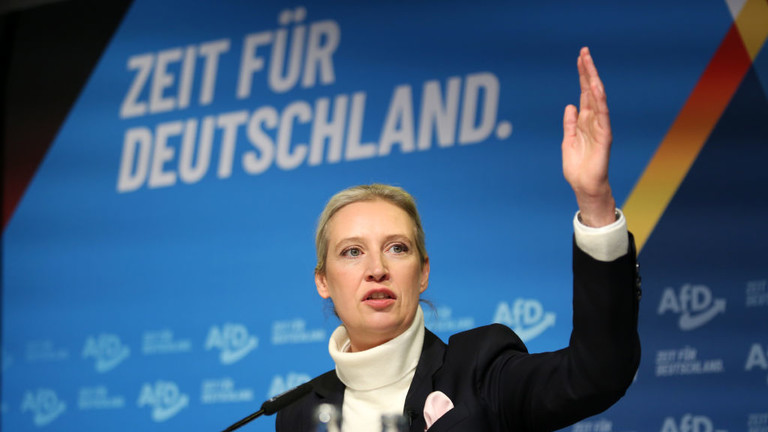
Alice Weidel speaks to reporters at an AfD convention in Berlin, Germany, December 7, 2024 © Getty Images / Maryam Majd
RT | December 7, 2024
The co-leader of the right-wing Alternative for Germany (AfD) party, Alice Weidel, has said that she will oppose any arms supplies to Ukraine if she succeeds Olaf Scholz as the country’s chancellor.
AfD nominated Weidel as its candidate for the post on Saturday, in the party’s first bid for the chancellery in its 11-year history. It has steadily risen in popularity since its founding in 2013, and is currently Germany’s second-strongest political force.
Speaking to reporters after the nomination, Weidel promised to introduce drastic immigration restrictions, to roll back Scholz’ climate policies, and to cut off military aid to Ukraine.
”We want peace in Ukraine,” the 45-year-old said. “We do not want any arms supplies, we do not want any tanks, we do not want any missiles. We do not want Taurus for Ukraine, which would make Germany a party to the war,” she added, referring to a type of German-made cruise missile that would require German military personnel to be deployed to Ukraine to operate.
The AfD, Weidel declared, is a “peace party.”
Scholz, along with his Green and Free Democrat coalition partners, overturned decades of foreign-policy pacifism in 2022 when they decided to supply weapons to the Ukrainian military. Since then, Berlin has sent Kiev almost €17 billion ($17.9 billion) in military, economic, and humanitarian aid, according to government figures. Although initially reluctant to supply heavy weapons, Scholz has authorized the transfer to Ukraine of tanks, artillery guns, anti-air missiles, and armored vehicles.
Before 2022, Germany relied on Russia for 55% of its supply of natural gas. Scholz’ decision to halt Russian energy imports, coupled with his government’s green policies, has led to soaring electricity costs, forcing some of the country’s manufacturing giants – including Volkswagen and BASF – to close plants and lay off workers.
Amid economic decline and disputes within his coalition, the Scholz government collapsed last month. The chancellor is expected to lose a confidence vote in parliament later this month, after which a snap election will likely be held in late February. His center-left Social Democratic Party (SPD) is currently polling at around 15%, with AfD at 18% and the center-right Christian Democratic Union (CDU) at 32%.
Weidel has little chance of winning the chancellery. Even if the AfD were to emerge as the largest party in February, all of Germany’s other mainstream parties have ruled out entering a coalition with the right-wingers. After a string of regional election wins this year, 113 members of the 733-member Bundestag put forth a motion last month to ban the AfD as a “Nazi party” whose beliefs clash with the German constitution. Most of the lawmakers behind the proposal were Greens, joined by 31 members of the SPD and just six from the CDU.
The Spiralling European Political Crisis: France’s Prime Minister Falls And President Under Pressure to Resign

By Ricardo Martins – New Eastern Outlook – December 7, 2024
The motion of no confidence, voted through on 4 December 2024, has succeeded—a first in France since 1962. All eyes are now on French President Emmanuel Macron, who faces mounting pressure to resign, but has assured that he will not resign.
The French political crisis is evolving into a dramatic and complex challenge, with significant implications for domestic governance, European stability, and global diplomacy. The public largely blames President Macron for the chaos.
In his national TV address on the evening of 5 December, Macron sought to shift the blame onto the “far-right” and “far-left,” accusing them of uniting to create turmoil ahead of the next presidential election—or to force an early one. He firmly rejected the idea of broad “cohabitation” as a solution or of bringing forward the presidential election foreseen for 2027.
Here’s my analysis connecting the key developments and their potential consequences.
A Crisis Born of Discord
Michel Barnier’s short-lived government collapsed in an extraordinary parliamentary alliance between far-right (RN – Marine Le Pen’s National Rally) and the left (New Popular Union, including LFI – France Unbowed led by Jean-Luc Mélenchon, considered an extreme-left movement). Their common grievance? A rejection of Barnier’s austere budget proposal, which sought to rein in France’s growing deficit, as well as their initial rejection of Barnier’s nomination as Prime Minister by President Macron, who disregarded the election results that were won by the left.
However, Le Pen was the primary architect behind the government’s downfall.
While intended to address fiscal concerns, the proposal ignited a populist backlash, culminating in a vote of no confidence. This marked the first successful ousting of a French prime minister by parliamentary motion since 1962, underscoring the depth of political fragmentation in the Fifth Republic.
Ripples Across Europe
France’s turmoil arrives at a precarious moment for the European Union. As the bloc’s major army and second-largest economy, its instability reverberates across the continent, weakening political cohesion within the EU and exposing vulnerabilities in the Eurozone. The EU was not used to face a political crisis in such dimensions within its core nations.
Compounding the issue, Germany is preoccupied with its own economic and electoral uncertainties, and Donald Trump’s imminent return to the U.S. presidency introduces a wildcard into global geopolitics.
The crisis in France underscores broader European challenges, from the rise of populism to mounting fiscal pressures, threatening the EU’s ability to maintain a united front in trade negotiations, foreign policy, and economic governance.
The EU has long relied on the leadership of the Franco-German duo. Now, both nations are mired in deep crises—Germany facing a political and economic crossroads, and France grappling with political and fiscal turmoil.
To make matters worse, there is no leader on the horizon like Charles de Gaulle, Willy Brandt, François Mitterrand, Helmut Kohl, or Angela Merkel—figures we were accustomed to relying on in the past to steer their nations out of such crises.
Macron Under Fire
Having Michel Barnier delivered his resignation, President Emmanuel Macron is under intense pressure to act decisively. Barnier now holds the dubious distinction of being the shortest-serving Prime Minister of the Fifth Republic. Naming a new prime minister quickly is not just a domestic imperative, but also a global one. The reopening of Notre Dame Cathedral this weekend, attended by Trump and other dignitaries, has heightened scrutiny on Macron’s leadership.
While Macron could reappoint Barnier as a caretaker to buy time, doing so risks appearing tone-deaf to growing calls for systemic change. Meanwhile, opposition factions and public sentiment increasingly question Macron’s ability to lead, raising the spectre of a presidential resignation. Macron’s televised address has done little to alter the narrative surrounding his survival—or the prospect of his potential downfall.
The Challenge of Finding a New Prime Minister
Forming a new government in France is proving to be a complex and overwhelming task. The New Popular Front (NFP) Alliance, a coalition of Greens, Socialists, Communists, and the radical left faction, France Unbowed, is the largest group at the French National Assembly.
However, the NFP lacks a sufficient majority to govern outright, forcing them to rely on support from President Macron’s MPs to pass legislation.
A potential candidate for prime minister from the NFP, Lucie Castets, was previously rejected by Macron this summer with fears that she would cancel his neoliberal reforms, such as the pension reform. The president’s decision stemmed from an apparent inability to secure stable majorities, despite the theoretical possibility of combining the NFP’s votes with Macron’s MPs to push through key laws. The new stalemate highlights the deep fractures within French politics and raises questions about whether any coalition can provide the stability needed to navigate the current crisis.
The immediate question is whether Macron can restore a semblance of stability by swiftly appointing a credible prime minister. Failure to do so could embolden opposition forces and deepen calls for his resignation. Beyond France, the crisis tests the EU’s resilience in managing its internal divisions while confronting external pressures, from a menacing Donald Trump to the rising assertiveness of the Global South.
Opportunistic Moves in Brussels
Amid France’s crisis, Brussels may seize the moment to push forward controversial EU initiatives. Chief among them is the Mercosur trade deal, a landmark agreement with Latin American countries that France has staunchly opposed. With French political attention consumed by domestic turmoil, the European Commission might view this as a rare opportunity to sidestep resistance and secure the deal’s approval, sparking further controversy within an already fragile EU.
The coming days will be pivotal in determining whether France and the EU can weather this storm—or whether it will escalate into a broader crisis of governance.
Ricardo Martins ‒ PhD in Sociology, specializing in policies, European and world politics and geopolitics.
Romanian presidential frontrunner claims he’s victim of coup d’etat
RT | December 7, 2024
The invalidation of Romania’s presidential election results by the country’s top court is a formalized coup d’etat, according to independent candidate Calin Georgescu, who clinched a surprise win in the first round last month.
Georgescu outperformed the other candidates in the first round of the election with 22.94%, beating out liberal leftist candidate Elena Lasconi, who received 19.18%, and the country’s Social Democrat Prime Minister Marcel Ciolacu, who finished third with 19.15%.
On Friday, Romania’s Constitutional Court dismissed Georgescu’s victory, citing a clause in the nation’s laws that emphasizes the need to ensure the correctness and legality of the election. The judiciary body announced that the whole process would be resumed later.
“Essentially, this is a formalized coup d’etat. The rule of law is in an induced coma, and justice subordinated to political orders has practically lost its essence. It is no longer justice, it obeys the orders,” Georgescu, a known critic of Romania’s pro-NATO and pro-Ukraine policy, said on Friday, as cited by Realitatea TV.
The politician also stressed that the court’s decision represents more than a legal controversy, adding that “the corrupt system in Romania showed its true face by making a pact with the devil.”
Georgescu also said that the power of the people is the basis for a democratic state, and the authorities are obliged to respect the results of the national vote. He stated that the current Romanian government is afraid of losing power and facing revelations.
Earlier this week, Western media outlets reported that declassified information from Romania’s intelligence agencies had revealed that the sudden rise of Georgescu in the first round of the election was “not a natural outcome.” According to the claims, his win emerged thanks to a coordinated social media effort, most likely orchestrated by a “state actor” meddling in the candidate’s mostly Tik-Tok-based campaign, helping to get his message out to the voters.
The annulment came amid accusations that Moscow had assisted Georgescu’s campaign, which Russian Foreign Ministry spokeswoman Maria Zakharova has dismissed as “absolutely groundless.” She said that Romanian elections are carried out in a climate of “an unprecedented surge of anti-Russian hysteria” that is set “to influence the consciousness and will of the country’s citizens.”
Washington, meanwhile, has praised the move. On Friday, State Department spokesman Matthew Miller said that the US reaffirms its “confidence in Romania’s democratic institutions and processes, including investigations into foreign malign influence.”
Preemptive Pardons & Banana Republics
By John Leake | Courageous Discourse | December 6, 2024
News that President Biden is contemplating issuing “preemptive pardons” of Dr. Anthony Fauci and others, even though they have not been charged with crimes, reminded me of an African dictator I have long considered to be one of the most colorful and bizarre in the world—namely, Teodoro Obiang Nguema Mbasogo, who has served as the second President of Equatorial Guinea since 1982, three years after he staged a coup against his uncle.
The Equatorial Guinea constitution provides Obiang sweeping powers, including the right to rule by decree, effectively making his government a legal dictatorship. He has also placed family members in key government positions. In other words, Obiang’s personal preferences in public affairs are the law.
A “preemptive pardon” is not a legal action and has no legal precedent. It is a purely political action that is based on the false proposition that President Trump will, once in office, possess the power to initiate federal investigations without having to adhere to legal procedures and rules of evidence.
Because Democrats and their friends in the media have conditioned millions of Americans to believe that Trump is an inherently defective authoritarian, the Biden Administration may be tempted to believe that it can get away with such a crass political maneuver.
This is a variation of the same gambit the Democrats deployed when they impeached Trump for merely requesting, in July 2019, that Ukrainian president Volodymyr Zelenskyy investigate Joe Biden’s business activities in Ukraine. When this request came to light, Democrats and their friends in the media acted as though the mere request was an outrage, even though there was a mountain of evidence that the Bidens had, since 2014, participated in a spectacularly corrupt scheme in Ukraine for which they had received millions of dollars.
Five years after the Democrats in the House initiated impeachment proceedings against President Trump, President Biden pardoned his son for “offenses Hunter Biden has committed or may have committed or taken part in” between January 1, 2014, and December 1, 2024.”
Any “preemptive pardon” issued by President Biden should be viewed as the same species of corrupt political action, and not as a lawful act.
TikTok on the Clock: US Appeals Court Hits the “Ban” Button
By Christina Maas | Reclaim The Net | December 6, 2024
The winds of Washington are blowing icy cold for TikTok this December. A federal appeals court panel handed down a ruling today that could send the app packing— or at least force it into a kind of corporate divorce.
The US Court of Appeals for the District of Columbia Circuit has today declared the law threatening TikTok’s existence to be totally constitutional, leaving the platform to fight for its digital life. In short, TikTok has until mid-January to break ties with its Beijing-based parent, ByteDance, or risk an outright ban in the United States.
TikTok responded with the following statement:
“The Supreme Court has an established historical record of protecting Americans’ right to free speech, and we expect they will do just that on this important constitutional issue. Unfortunately, the TikTok ban was conceived and pushed through based upon inaccurate, flawed and hypothetical information, resulting in outright censorship of the American people. The TikTok ban, unless stopped, will silence the voices of over 170 million Americans here in the US and around the world on January 19th, 2025.”
The Free Speech Shuffle
TikTok played the First Amendment card, arguing that banning the platform would stomp on Americans’ free speech rights. But the court wasn’t having it, throwing in a little verbal aikido about protecting actual freedom.
“The First Amendment exists to protect free speech in the United States,” the court wrote, presumably while straightening its tie in a metaphorical mirror. “Here the Government acted solely to protect that freedom from a foreign adversary nation and to limit that adversary’s ability to gather data on people in the United States.”
Translation: TikTok, it’s not you — it’s China.
ByteDance’s Legal Tango
TikTok and its parent company, ByteDance, is already planning to appeal to the Supreme Court because apparently, they’re gluttons for punishment. And hey, why not? When you’re staring down a deadline that could nuke your entire US business, you either fight or fold.
But here’s where it gets interesting: the same President-elect Donald Trump who once tried to fire TikTok like it was a contestant on The Apprentice now says he’s against a ban. Trump has promised to swoop in and “save” the platform during his second term.
The law itself was signed by President Joe Biden in April, marking a rare bipartisan moment in a town otherwise allergic to cooperation. For years, Washington has been gnashing its teeth over TikTok’s ties to the Chinese government, accusing the app of being a national security threat disguised as a dance challenge factory.
Of course, critics argue this is about power. TikTok’s cultural dominance has made it an unpredictable disruptor, threatening not only Big Tech’s grip on social media but also giving the average American teen more clout than your local senator.
Government officials argue that the app’s voracious appetite for user data could lead to sensitive information, from browsing histories to biometric identifiers, being vacuumed up by the Chinese communist government. But the main issue? The proprietary algorithm, that magical machine-learning potion that keeps you scrolling at 2 a.m., is painted as a weapon of influence — a subtle but powerful propaganda tool ready to tweak your feed for Beijing’s benefit.
Except, there’s a catch: a good chunk of the government’s evidence for these claims is locked behind classified curtains. TikTok’s attorneys — and by extension the American public — are left in the dark.
TikTok Fights Back
TikTok has steadfastly denied being a Chinese Trojan horse, insisting that no evidence exists to prove they’ve ever handed over data to Beijing. As for the algorithm? TikTok says any suggestion of manipulation is pure speculation. Their legal team hammered home that the government’s arguments rely on what might happen in the future — a slippery foundation for ripping apart a platform that’s glued to the cultural zeitgeist.
But the Department of Justice isn’t just playing futurist. It has hinted — vaguely and ominously — at unspecified past actions by TikTok and ByteDance in response to Chinese government demands. The key word here is “unspecified,” because whatever receipts the DOJ might have, they’re conveniently out of reach for TikTok’s lawyers, the media, or anyone else.
A Courtroom Tango: First Amendment vs. National Security
The appeals court panel, a politically mixed trio of judges, seemed as torn as the rest of us about how far Uncle Sam can stretch its First Amendment arguments to justify banning an app with foreign ties. Over two hours of oral arguments in September, the judges volleyed tough questions at both sides.
Can the government really shut down a platform just because it’s foreign-owned? the judges asked, channeling TikTok’s core argument. On the flip side: What happens if this platform turns into a covert disinformation campaign during wartime? they wondered, invoking wartime-era laws restricting foreign ownership of broadcast licenses.
Both sides twisted themselves into legal yoga poses. TikTok’s lawyer, Andrew Pincus, argued that a private company — even one with foreign owners — deserves constitutional protections. The DOJ’s Daniel Tenny countered that the government has a duty to head off potential foreign interference, even if the threat isn’t fully realized yet.
$2 Billion in Data Defenses
TikTok itself hasn’t just been sitting back while lawyers spar. The company claims it’s invested over $2 billion to fortify its US data, including setting up Project Texas — a heavily marketed initiative to store American user data on servers managed by Oracle. ByteDance has also floated the idea of a comprehensive draft agreement that it says could have eased Washington’s fears years ago.
But according to TikTok, the Biden administration ghosted them, walking away from the negotiating table without offering a viable path forward. The DOJ insists the draft didn’t go far enough, but skeptics wonder if the government’s hardline stance is less about national security and more about flexing control over Big Tech.
Divestment Drama
Washington’s solution to the TikTok dilemma sounds deceptively simple: ByteDance should sell the US arm of TikTok. However attorneys for the company argue that such a divestment would be a logistical and commercial nightmare. And without TikTok’s algorithm—intellectual property that Beijing is unlikely to let go of—the app would lose its magic. Imagine TikTok without its eerily intuitive feed: it’d be MySpace 2.0, a ghost town for millennials waxing nostalgic.
Still, some sharks smell blood in the water. Billionaire Frank McCourt and former Treasury Secretary Steven Mnuchin have rallied a consortium with over $20 billion in informal commitments to snap up TikTok’s US operations.
A Perfect Storm of Lawsuits
TikTok isn’t going down without a fight and it’s bringing allies to the battlefield. The company’s legal challenge has been bundled with lawsuits from several content creators, who argue that losing the platform would gut their livelihoods, and conservative influencers who claim a ban would silence their political speech. TikTok, ever the sugar daddy, is footing the legal bills for its creators — a savvy PR move if ever there was one.
The Clock is Ticking
If TikTok’s Hail Mary appeal to the Supreme Court fails, it’ll be up to President Trump’s Justice Department to enforce the ban. That means app stores would have to scrub TikTok from their offerings, and hosting services would be barred from supporting it.
And what happens to the millions of creators, small businesses, and teenagers who’ve turned TikTok into a cultural juggernaut? Well, they’ll probably migrate to Instagram Reels or YouTube Shorts—platforms that coincidentally happen to be owned by US tech giants who’ve been salivating at the thought of TikTok’s demise.
This is far from over.
‘An Extraordinary Step’: White House Mulls ‘Preemptive’ Pardon for Fauci
By Michael Nevradakis, Ph.D. | The Defender | December 6, 2024
Senior aides to President Joe Biden are “conducting a vigorous internal debate” on whether to grant preemptive pardons to Dr. Anthony Fauci and other current and former public officials whom they fear the incoming administration might target, Politico reported Wednesday.
CNN described the proposed pardons as “an extraordinary step” that would immunize people who have not been formally accused of a crime.
According to Politico, fears that current and former government officials may face inquiries or indictments “accelerated” after President-elect Donald Trump last week nominated Kash Patel to head the FBI. Patel has publicly stated he will pursue Trump’s critics.
Fauci, who according to Politico “became a lightning rod for criticism from the right during the Covid-19 pandemic,” did not respond to the outlet’s requests for comment.
Politico reported that White House counsel Ed Siskel is leading deliberations on the matter, and Chief of Staff Jeff Zients is also playing a key role in the discussions.
Zients, formerly the Biden administration’s COVID-19 “czar,” publicly promoted universal COVID-19 vaccination. In 2021, he spoke about “the winter of illness and death for the unvaccinated.”
Attorney Greg Glaser told The Defender, “The U.S. Constitution, Article II, Section 2, confirms the President’s power ‘to grant Reprieves and Pardons for Offenses against the United States.’”
The Huffington Post reported that preemptive presidential pardons “are rare but not unprecedented.”
Francis Boyle, J.D., Ph.D., professor of international law at the University of Illinois, told The Defender, “A blanket pardon by President Biden to Fauci would cover his gross violations [of] federal statutes that are too numerous to list” but “could not cover his crimes committed under the criminal laws of the 50 U.S. states.”
“Biden’s ‘get out of jail free’ card only applies to federal prison, not state prison,” Glaser said.
Joseph Sansone, Ph.D., who proposed legislation to ban COVID-19 and mRNA vaccines in Florida, told The Defender, “The use of preemptive pardons appears to be a violation of the Separation of Powers inherent in the U.S. Constitution.”
“The purpose of a pardon is to correct a judicial error or miscarriage of justice, not to preempt judicial action,” Sansone said. “Unless a coconspirator, no president could know the scope of the crimes being pardoned if the person has not been convicted or even charged.”
But according to Glaser, “A federal pardon by Biden cannot be overturned by President Trump or even reversed by Congress without a constitutional amendment to Article II, Section 2 or upon proof that Biden’s pardon was itself unlawful.”
Fauci pardon may help conceal ‘massive scale of criminal wrongdoing’
What would a preemptive pardon for Fauci cover? Criminal defense attorney Rick Jaffe told The Defender that if he were Fauci’s lawyer, he would seek a pardon that “covers all testimony provided to Congress since at least the start of the pandemic.”
The pardon could also include all actions relating to the U.S. government’s funding of gain-of-function research and all actions in which Fauci is alleged to be part of a conspiracy to mislead government officials and the public,” Jaffe said.
“I’d throw in immunity from any action by the federal government to terminate his pension or his royalty payments from pharma, because trying to do that will probably be very high on the new government’s list,” Jaffe added.
Journalist Paul Thacker, formerly a U.S. Senate investigator, told The Defender “Sen. Rand Paul has sent two separate referrals to the Department of Justice to prosecute Fauci” for “lying and/or misleading Congress. Fauci was also caught lying to Congress about his use of private email to avoid Freedom of Information Act requests, something that I have reported on, as has The New York Post,” Thacker said.
Brianne Dressen, a participant in AstraZeneca’s COVID-19 vaccine clinical trials who was injured by the shot, later took part in a National Institutes of Health (NIH) study of vaccine-injured people “that got shot down and hidden.” Dressen told The Defender pardoning Fauci would silence vaccine injury victims. She said:
“The Biden administration silenced true stories of COVID vaccine injuries online at the same time that Fauci was flying COVID vaccine-injured to NIH headquarters to be studied. It’s no surprise Biden may close the loop to protect him.
“This pardon isn’t just about protecting him. Discovery alone would shine a light on things we still don’t know about that happened at the NIH, the Centers for Disease Control and Prevention and the U.S. Food and Drug Administration.”
“How better to circumvent a process likely to reveal a massive scale of criminal wrongdoing — not just by Dr. Fauci but by layers and layers of his allies in both the government and the private sector — than by preemptively pardoning him?” asked Naomi Wolf, CEO of Daily Clout and author of “The Pfizer Papers: Pfizer’s Crimes Against Humanity.”
Fauci pardon would show public health decisions ‘beyond the reach of justice’
According to Politico, some congressional Democrats — “though not those seeking pardons themselves” — have engaged in “quiet lobbying” recently in an effort to convince Biden to issue the preemptive pardons.
Sen. Ed Markey (D-Mass.) has come out in favor of Biden issuing preemptive pardons. In an interview with Boston Public Radio last week, Markey cited the precedent of former President Gerald Ford, who granted a preemptive pardon to Richard Nixon before any charges were filed against him following his impeachment.
However, the proposed preemptive pardons have “caused a stir” among other Democrats, “with some saying the move erodes Americans’ faith in the justice system,” the Huffington Post reported. According to Politico, some Democrats are concerned the pardons “could suggest impropriety, only fueling Trump’s criticisms.”
“I just haven’t heard a good case to be made for pardoning behavior that hasn’t yet been committed or hasn’t yet been defined,” Sen. Tim Kaine (D-Va.) told USA Today. Referencing his term as Virginia’s governor, Kaine said he used pardon power “in individual cases to grant pardons to people who have been convicted.”
“The idea of just kind of general vague, pardon for unknown activities that haven’t been charged. That is so susceptible to abuse,” Kaine said.
According to CNN, “Attorneys across the political spectrum” have also “raised concerns about blanket pardons.”
“You would create the beginning of a tit for tat where, when any administration is over, you just pardon everybody,” Neil Eggleston, former White House counsel to President Barack Obama, told CNN.
According to The Washington Post, “The notion of sweeping preemptive pardons for offenses that have not yet been charged, and may never be, is largely untested.”
Jeffrey Crouch, J.D., Ph.D., an assistant professor of politics at American University and expert on presidential pardon powers, told USA Today that a president can grant a pardon as soon as a federal crime is committed, without waiting until someone is charged, tried or convicted.
Crouch said it is unclear whether beneficiaries of such pardons would be admitting guilt by accepting the pardon. Crouch said the Biden administration would be in “uncharted waters” and warned that preemptive pardons “could weaponize clemency” and stray far beyond the intended constitutional use of pardon power.
Sayer Ji, founder of GreenMedInfo, was named one of the “The Disinformation Dozen” by the Center for Countering Digital Hate in 2021 — a list subsequently used by the White House to pressure social media platforms to censor those individuals. He told The Defender preemptively pardoning Fauci would be an abuse of power.
He said:
“These were not mere administrative decisions, but profound exercises of authority that reached into the sanctum of personal liberty, that redefined the boundaries of state power and touched the very foundations of how citizens relate to their government.
“A preemptive pardon for Dr. Fauci would pierce the sacred covenant between those who govern and those who consent to be governed — a bond as old as democracy itself. Such an extraordinary shield … would signal that the architects of our most consequential public health decisions stand beyond the reach of justice.”
This article was originally published by The Defender — Children’s Health Defense’s News & Views Website under Creative Commons license CC BY-NC-ND 4.0. Please consider subscribing to The Defender or donating to Children’s Health Defense.
NATO state annuls presidential election results
RT | December 6, 2024
Romania’s Constitutional Court has annulled the results of the first round of the national presidential election after independent candidate Calin Georgescu clinched a surprise win last month.
The decision comes amid accusations that Russia had allegedly assisted Georgescu’s campaign. Moscow has dismissed them as “absolutely groundless.”
Georgescu, a religious nationalist, has on multiple occasions been critical of both NATO and the EU, and has criticized Romania’s role in the Russia-Ukraine conflict. He has also promised to end all military and political assistance to Kiev if elected into office.
During the first round of voting in November, Georgescu secured 22.94% of the ballots, beating out the liberal leftist candidate Elena Lasconi, who received 19.18%. The two were scheduled for a runoff on Sunday.
However, on Friday, the country’s constitutional court issued a ruling annulling “the entire electoral process regarding the election of the President of Romania” and announced that the whole process will be resumed in its entirety at a later date.
Earlier in the day, Romanian media reported that judges of the court had gathered for an urgent meeting to examine a large number of requests to annul the election. The demands cited recently declassified intelligence documents by the Supreme Defense Council, which claimed that there were irregularities to Georgescu’s result.
The documents alleged that Georgescu’s candidacy was improperly promoted online by paid influencers along with extremist right-wing groups and persons with ties to organized crime. The documents also suggested that Russia may have tried to influence the election, but did not directly accuse Moscow of interference.
Georgescu has repeatedly dismissed allegations of foreign collusion in his campaign, saying that his detractors “can’t accept that the Romanian people finally said ‘we want our life back’.”
The Kremlin has also denied accusations of interfering in the election. By pointing the finger at Moscow, the authorities in Bucharest are “mimicking the basic trend that exists in the West in this regard,” spokesman Dmitry Peskov said last month.
You’d Better Watch Out: The Surveillance State Is Making a List, and You’re On It
By John & Nisha Whitehead | The Rutherford Institute | December 4, 2024
You’d better watch out—you’d better not pout—you’d better not cry—‘cos I’m telling you why: this Christmas, it’s the Surveillance State that’s making a list and checking it twice, and it won’t matter whether you’ve been bad or good.
You’ll be on this list whether you like it or not.
Mass surveillance is the Deep State’s version of a “gift” that keeps on giving… back to the Deep State.
Geofencing dragnets. Fusion centers. Smart devices. Behavioral threat assessments. Terror watch lists. Facial recognition. Snitch tip lines. Biometric scanners. Pre-crime. DNA databases. Data mining. Precognitive technology. Drones. Contact tracing apps. License plate readers. Social media vetting. Surveillance towers.
What these add up to is a world in which, on any given day, the average person is now monitored, surveilled, spied on and tracked in more than 20 different ways by both government and corporate eyes and ears.
Big Tech wedded to Big Government has become Big Brother.
Every second of every day, the American people are being spied on by a vast network of digital Peeping Toms, electronic eavesdroppers and robotic snoops.
This creepy new era of government/corporate spying—in which we’re being listened to, watched, tracked, followed, mapped, bought, sold and targeted—has been made possible by a global army of techno-tyrants, fusion centers and Peeping Toms.
Consider just a small sampling of the tools being used to track our movements, monitor our spending, and sniff out all the ways in which our thoughts, actions and social circles might land us on the government’s naughty list, whether or not you’ve done anything wrong.
Tracking you based on your phone and movements: Cell phones have become de facto snitches, offering up a steady stream of digital location data on users’ movements and travels. For instance, the FBI was able to use geofence data to identify more than 5,000 mobile devices (and their owners) in a 4-acre area around the Capitol on January 6.
Tracking you based on your DNA. DNA technology in the hands of government officials completes our transition to a Surveillance State. By accessing your DNA, the government will soon know everything else about you that they don’t already know: your family chart, your ancestry, what you look like, your health history, your inclination to follow orders or chart your own course, etc. It’s only a matter of time before the police state’s pursuit of criminals expands into genetic profiling and a preemptive hunt for criminals of the future.
Tracking you based on your face: Facial recognition software aims to create a society in which every individual who steps out into public is tracked and recorded in real-time as they go about their daily business. Similarly, biometric software, which relies on one’s unique identifiers (fingerprints, irises, voice prints), is becoming the standard for navigating security lines, as well as bypassing digital locks and gaining access to phones, computers, office buildings. Scientists are also developing lasers that can identify and surveil individuals based on their heartbeats, scent and microbiome.
Tracking you based on your behavior: Rapid advances in behavioral surveillance are not only making it possible for individuals to be monitored and tracked based on their patterns of movement or behavior, including gait recognition (the way one walks), but have given rise to whole industries that revolve around predicting one’s behavior based on data and surveillance patterns and are also shaping the behaviors of whole populations.
Tracking you based on your spending and consumer activities: Consumer surveillance, by which your activities and data in the physical and online realms are tracked and shared with advertisers, has become big business, a $300 billion industry that routinely harvests your data for profit.
Tracking you based on your public activities: Private corporations in conjunction with police agencies throughout the country have created a web of surveillance that encompasses all major cities in order to monitor large groups of people seamlessly, as in the case of protests and rallies. They are also engaging in extensive online surveillance, looking for any hints of “large public events, social unrest, gang communications, and criminally predicated individuals.”
Tracking you based on your social media activities: As The Intercept reported, the FBI, CIA, NSA and other government agencies are increasingly investing in and relying on corporate surveillance technologies that can mine constitutionally protected speech on social media platforms such as Facebook, Twitter and Instagram in order to identify potential extremists and predict who might engage in future acts of anti-government behavior.
Tracking you based on your social network: Not content to merely spy on individuals through their online activity, government agencies are now using surveillance technology to track one’s social network, the people you might connect with by phone, text message, email or through social message, in order to ferret out possible criminals. What this creates is a “guilt by association” society in which we are all as guilty as the most culpable person in our address book.
Now the government wants us to believe that we have nothing to fear from these mass spying programs as long as we’ve done nothing wrong.
Don’t believe it.
The government’s definition of a “bad” guy is extraordinarily broad, and it results in the warrantless surveillance of innocent, law-abiding Americans on a staggering scale.
As I make clear in my book Battlefield America: The War on the American People and in its fictional counterpart The Erik Blair Diaries, surveillance, digital stalking and the data mining of the American people—weapons of compliance and control in the government’s hands—haven’t made America any safer. And they certainly aren’t helping to preserve our freedoms.
Indeed, America will never be safe as long as the U.S. government is allowed to shred the Constitution.
Constitutional attorney and author John W. Whitehead is founder and president of The Rutherford Institute. His most recent books are the best-selling Battlefield America: The War on the American People, the award-winning A Government of Wolves: The Emerging American Police State, and a debut dystopian fiction novel, The Erik Blair Diaries. Whitehead can be contacted at staff@rutherford.org. Nisha Whitehead is the Executive Director of The Rutherford Institute. Information about The Rutherford Institute is available at www.rutherford.org.
World leaders sign new censorship declaration at UN event as Secretary-General Guterres pushes for increased online censorship
By Didi Rankovic | Reclaim The Net | December 1, 2024
A new UN-driven censorship declaration has been signed by a number of world leaders during an event in Portugal – the Cascais Declaration at the United Nations Alliance of Civilizations (UNAOC) Global Forum.
We obtained a copy of the final declaration for you here.
The gathering was addressed by UN Secretary-General Antonio Guterres, who once again reiterated his commitment to censoring online speech, bringing up the usual set of “arguments” in favor of moving in this direction.
During the address, Guterres spoke about “unchecked digital platforms and AI” and accused them of allowing “hate speech to proliferate like never before” – and did not miss the opportunity to mention “misinformation and deepfakes” in the same context.
Guterres wants Big Tech, advertisers, and media – that is, along with some governments and organizations like the UN, among the most egregious offenders when it comes to online censorship – to double down.
“Taking responsibility for their role” in spreading hate speech, deepfakes, etc., was how he phrased it.
Guterres also again pushed a UN initiative that critics say introduces algorithmic censorship and demonetization under the stated “anti-misinformation and hate speech” scope – the UN’s Global Principles for Information Integrity.
According to Guterres, these recommendations allow for “a more humane information ecosystem.”
Meanwhile, the Cascais Declaration states that the leaders who signed it are “alarmed” at what is described as a global spread, online and offline, of “disinformation, misinformation and hate speech.”
The signatories also want those to be combated while at the same time strengthening “information integrity” (without going into what that means, and how it is supposed to be achieved.)
Another of the many controversial UN schemes, the Pact for the Future, is “noted” in the declaration, and framed as recognizing the role of “reinvigorated multilateralism” and religious organization promoting a culture of peace.
However, those opposed to the Pact see yet another mechanism to usher in more censorship and surveillance.
These points about the supposed greater-than-ever dangers of AI, misinformation, etc., are nestled inside the declaration’s overall message of the need to protect a variety of human rights and cultural diversity.
Among them is the mention of “monitoring antisemitism,” but also “combating Islamophobia” – including by appointing a special UN envoy to deal with the latter task.
Deception, manipulation, sabotage: What the UK does to keep the Ukraine war going
By Tarik Cyril Amar | RT | November 30, 2024
Unless you want to be blind, it is obvious that Ukraine under the Zelensky regime is not remotely a free country. In politics, after massive repression, there are only remnants of an opposition, which face continuing oppression and harassment by the government, as even the French newspaper Le Monde, generally naïve about the Zelensky regime, has reported.
Ukraine’s public sphere is stifled by nationalist propaganda, pressure, and demonstrative, intimidating terror. Before the escalation of 2022, even a robustly propagandistic tool of Western information warfare such as Freedom House could still acknowledge that much: its 2018 report, authored by Ukrainian researcher Vyacheslav Likhachev, identified Ukraine’s Far Right organizations as “a threat to democracy” and “aggressively trying to impose their agenda on Ukrainian society, including by using force against those with opposite political and cultural views.”
Regarding Ukraine’s media, expect not much resistance from there. They are tightly controlled and, often, pro-actively obedient, whether out of misguided conviction, fear, or careerism. Even Ukraine’s Western supporters, as well as some courageous critics in Ukraine, have voiced criticism of the crude propaganda habits of the Zelensky regime.
Make no mistake: The authoritarian features of the rule of Vladimir Zelensky – formerly the object of a veritable Western personality cult that, by now, at least some devotees must feel embarrassed about – are not the result of the large-scale war. The politics of Zelenskyism, to coin an ugly but handy term, were always unusually deceitful and manipulative and, by 2021 at the latest, openly bending toward authoritarianism, as many Ukrainian critics pointed out at the time.
And yet: Imagine a future trial, maybe to be held in Ukraine, of Zelensky and his team. The defense would not be able to do much about their record of corruption, but it would certainly at least try to blame some of the former leader’s underhanded and tyrannical tendencies on the war. It would be a stretch, but lawyers have to do their best, even for the worst of clients.
In the case of the Western users of the Zelensky regime, though, such a defense would not be merely far-fetched but completely absurd. Yet a defense some of them at least might come to need. Take for instance the case of Britain’s Lieutenant General Charlie Stickland and his shadowy but numerous associates.
The unfortunately important general – boasting of his pirate ancestors and in charge of “UK-led joint and multinational overseas military operations” – and his motley crew have just been the object of an investigative exposé by Grayzone reporter Kit Klarenberg. In, for now, two articles, the Grayzone has detailed how, in 2022, Stickland set up a below-the-radar network of “an assortment of leading academics, authors, strategists, planners, pollsters, comms, data scientists and tech.” Under the name Project Alchemy and overlapping and liaising with another group of wannabe keyboard Ninjas calling themselves – I kid you not – “the Elders,” this conspiratorial group has worked on, in essence, keeping the Ukraine war going at any price and by means foul and fouler.
Based on leaked documents, the Grayzone’s reporting is revealing in more ways than can be discussed here. Yet, as we are dealing with prose authored by militant bureaucrats and self-weaponizing intellectuals in the land of George Orwell, that old stickler for the English language, we would be remiss not to appreciate their bizarre lingo. It brings together a certain jejune rugby field boyishness – “mischief” is proudly being made – with a militarized sociolect of corporatese: “fusion players” and “sideways thinkers” get “badged” and “meshed in” to “move at pace,” and – greatest pride of the eminent executive – stand ready to work over the weekend!
Doing what exactly? All kinds of things, really, and all based on one stupid yet once immensely popular assumption: that the proxy war in Ukraine could be leveraged to defeat Russia, reduce it to geopolitical insignificance, impose regime change on it, and even break it up. Some, including the new de facto foreign minister of the EU, Estonia’s Kaja Kallas – imagine Annalena Baerbock, but without the brilliant intellect – still seem to be on that political equivalent of an LSD trip gone terribly wrong. What a hangover it will be one day, probably soon.
In Britain, highlights of Project Alchemy groupthink included hatching plans for stay-behind sabotage networks and recommending the example of the underground “Gladio” operations that NATO ran in Western – not, please note, Eastern – Europe during the Cold War. Strictly speaking, Gladio was an Italian label, while the same bad idea had different names in other countries. By now, though, Gladio stands for a whole plethora of clandestine organizations set up, ostentatiously, to engage in partisan resistance in case of a Soviet attack and occupation.
You may feel that, in principle at least, for generals, preparing for the possibility of future partisan warfare is not an objectionable activity. Yet the issue is that, in reality, the Gladio operations were not only extremely dubious in constitutional and legal terms, as being entirely beyond democratic control and oversight, as well as tied to foreign intelligence services. In addition, these networks served to fight a dirty war against the domestic left, including by terrorism, false-flag attacks, the systematic use of far-right conspirators and terrorists, and support for military coups.
An influential, black-ops-connected British general and his chums wanting to learn lessons from Gladio for underground networks in Ukraine? The country with the best-armed (compliments of the West), most whitewashed and naively underestimated (compliments of the Western media and self-weaponizing intellectuals of the Anne Applebaum/Tim Snyder variety), most aggressive, and most militarized far right in the world? Swimming in arms right next to an EU-NATO Europe they will soon feel bitterly disappointed by? What could possibly go wrong? But maybe Charlie ‘Pirate’ Stickland is “fusion”-”thinking” “sideways” in Churchillian terms: “Set Europe Ablaze!” Yet Stickland seems to have overlooked that Churchill wanted to set it ablaze against the Nazis, not with them.
All of this is, in and of itself, very bad, if unsurprising, news. But Project Alchemy has been prolific, producing lousy ideas the way Russian industry is churning out artillery shells and missiles. There also were: a frank emphasis on “creatively using” – let’s be honest: breaking – the law so as to get silly violent things done, including “deniable ops”; a daft idea to attack the Kerch Bridge, as if Russia would not strike back (both have by now happened, the militarily useless attack and the painful payback); an anticipatory strategy of how to manipulate the British public in case it should get tired of pumping money into the proxy war; attempts to undermine BRICS-plus (thinking big and bigger); plans to shut down Russian media in the West, obviously; and, last but not least, an aggressive strategy to use covert lawfare and deliberate financial pressure to bring down Western critical media as well, including, as it happens, the Grayzone. Say what you will, but Stickland and company seem to have had a foreboding from where exactly they would get their richly deserved come-uppance.
It would be tempting to think of this wave of disinformation and manipulation in the West as a kind of “Ukrainization.” As if the West had caught the contagion of the Zelensky regime’s very bad habits. But to be fair, the West has its own, well-established tradition of waging war by massive lying on the home front. In 2019, it was the Washington Post, usually hewing close to the American government line, that ran a series of in-depth stories detailing how, during the West’s long war in Afghanistan, started almost two decades before, the US had been “at war with the truth.” Suddenly, clearly in preparation of the impending Western retreat, readers were allowed to learn that while “officials constantly said they were making progress,” they “were not, and they knew it.”
And the name of that Washington Post series? The Afghanistan Papers. That, of course, was a reference to the famous Pentagon Papers, an internal and classified Defense Department review of US policy and warfare in Vietnam that was leaked to the New York Times by the historic whistleblower Daniel Ellsberg, who suffered severe, criminal attempts to silence, and in effect, destroy him. The long American intervention, begun indirectly in the 1940s and escalating into one of the most brutal US campaigns of the twentieth century in the 1960s, only ended with the total defeat of both Washington and its South Vietnamese proxy in 1975.
The New York Times began to publish the Pentagon Papers in 1971. Once again, as with the later bloody Western fiasco in Afghanistan, the moment of truth – some truth – came late, only toward the end of a policy catastrophe that had long been supported by compliant mainstream media. The Grayzone is considered alternative media, and its reporters are doing a much better job at real journalism than their competition in the mainstream version. As to the mainstream media, they clearly have not yet reached the stage of always-too-late revelation that, during the proxy wars in Vietnam and Afghanistan, was marked by 1971 and 2019, respectively.
How do we know? They are ignoring the Grayzone’s sensational revelations about a military-think-tank-industry conspiracy to undermine the law, deliberately manipulate the public, and wage proxy war in a way that is both dirty and bound to backfire very badly on the West itself. One more sign that all too many in the West are not yet ready to face reality, even while the Ukrainians they claim to help but only use keep dying.
Tarik Cyril Amar is a historian from Germany working at Koç University, Istanbul, on Russia, Ukraine, and Eastern Europe, the history of World War II, the cultural Cold War, and the politics of memory.
German opposition to demand EU exit – media
RT | November 29, 2024
Alternative for Germany (AfD) – the third largest opposition party in the national parliament – intends to take the country out of the EU if it wins the upcoming election, several media outlets reported on Friday, citing the party’s newly drafted election manifesto.
AfD has confirmed that the document is “ready” but has not released it to the public. The party also wants Germany to ditch the euro, and return to a “stable national currency,” media outlets including Die Zeit and Der Spiegel have claimed.
“We believe that Germany’s exit from the European Union and the establishment of a new European community are necessary,” the 85-page-long manifesto reportedly says.
The EU in its current form should be replaced by the “Economic and Interest Community” following a certain transition period that should be “negotiated… with both the old EU partner states and new interested parties,” media have cited the document as saying, adding that the AfD believes the EU is trying to become a “superstate.”
On its website, the party lists Germany’s exit from the EU as part of its political agenda and advocates a “Europe of nations” concept, adding that “irrevocable renunciation of sovereignty in favor of an ‘ever closer’ European Union is incompatible” with this vision.
The party is also seeking to restore trade ties with Russia, which were disrupted by EU sanctions imposed after the escalation of the Ukraine conflict in February 2022. The AfD text highlights Russia’s importance as a supplier of cheap natural gas for German industry, according to national media.
The document also calls for sanctions on Russia to be lifted and the Nord Stream gas pipelines to be repaired, according to Die Zeit. Nord Stream 1 delivered Russian gas to Germany before it was blown up in September 2022, along with Nord Stream 2.
The party also apparently wants Germany to exit the Paris Climate Agreement and introduce abortion restrictions.
AfD has neither confirmed nor denied the reports about its election program, but said that the document was sent to delegates of the federal party conference, scheduled for mid-January.
The document’s lead author, Professor Ingo Hahn, has described it as a “convincing work that not only names the pressing problems of our country, but also shows clear solutions that will lead Germany out of the current misery.”
Germany could hold an early parliamentary vote as soon as February 23 following the collapse of Chancellor Olaf Scholz’s three-party government coalition earlier this month. If Scholz’s now-minority cabinet loses a confidence vote in mid-December, the country will head into a snap election.
AfD became the fifth largest faction in the Bundestag following the 2021 parliamentary election, in which it gained more than 10% of the vote.
Rumble Sues California Over Censorship Law That Impacts Satire
By Dan Frieth | Reclaim The Net | November 27, 2024
A new legal challenge, spearheaded by Alliance Defending Freedom attorneys, has thrust the state of California into the spotlight once again over allegations of infringing on free speech rights. This federal lawsuit, lodged on behalf of video-sharing platform Rumble, argues that two new California statutes unconstitutionally restrict users’ ability to share political content online.
We obtained a copy of the lawsuit for you here.
Under these controversial laws, specifically AB 2655, platforms like Rumble are coerced into policing and removing content that the state deems harmful. These regulations have been criticized for compelling platforms to censor speech, thereby becoming unwilling agents of government censorship. According to ADF Senior Counsel Phil Sechler, in a press release sent to Reclaim The Net, “California’s war against political speech is censorship, plain and simple. We can’t trust the government to decide what is true in our online political debates.” He emphasized the importance of platforms like Rumble, which resist governmental pressures to curtail free expression.
The complaint details the operational challenges: “The law forces Rumble to undertake the impossible task of training its team to recognize and then remove and label content based on inherently vague and subjective terms on which even pollsters and government officials cannot agree, such as what content may be ‘likely to harm’ electoral prospects or may likely undermine confidence in an election.”
Further, Rumble contends that AB 2655 oversteps by altering and compelling the speech of private entities, thus infringing upon their rights to free speech. It argues that neither the Constitution nor Section 230 of the Communications Decency Act allows California to “alter and compel Rumble’s speech while also mandating that it censor its users’ speech. As such, this Court should enjoin AB 2655 and declare it unlawful.”
The genesis of these laws can be traced back to July when a parody video targeting Vice President Kamala Harris spurred Gov. Gavin Newsom to advocate for making such content illegal. Subsequently, the California Legislature expedited the passage of these laws, which Gov. Newsom signed into action on September 17. AB 2839, in particular, imposes vague criteria to penalize individuals for sharing content related to elections, such as political memes and parodies.
In the detailed legal challenge, attorneys argue that AB 2655 forces Rumble to alter its own speech and police its users’ speech based on arbitrary criteria that even experts cannot uniformly interpret. The law imposes a duty on Rumble to train staff to identify and mitigate content that could potentially damage a politician’s reputation or undermine confidence in elections — criteria seen as inherently subjective.
This lawsuit follows a similar successful defense of free speech by ADF on behalf of The Babylon Bee and attorney Kelly Chang Rickert, leading to a temporary halt on enforcing AB 2839 against them while their legal battle continues.
Featured Video
It’s the Occupation, Stupid
or go to
Aletho News Archives – Video-Images
From the Archives
A superpower and “the world’s sickest warrior state”
By Paul J. Balles | March 8, 2010
Living through five or six major wars has hardened me to what I thought were the extremes of inhuman cruelty and brutality.
Two things made those extremes almost bearable: the brutality always revealed – at least according to the media coverage – the viciousness of the enemy. It was therefore quite understandable when our “brave men and women” pulverized the enemy.
Films of Japanese torturing captive Americans somehow justified holding Japanese Americans in internment camps during World War II; and only a small percentage of Americans found the bombing of Hiroshima and Nagasaki unreasonably vengeful at best, at worst, depraved.
The media giants in America portrayed the North Koreans as barbaric beasts with their captives, quite unlike their southern counterpoints – our allies during the Korean War. No one ever felt the need to explain how the South Koreans were a civilized breed while the North Koreans were absolute savages, at least according to the official line.
In Vietnam, our warriors justifiably (or so the media made us believe) dropped napalm on the North Vietnamese who had the gall to hide in villages and tunnels to ravage our invaders. At least it was accepted practice until some rogue photojournalist filmed a young girl screaming down a Vietnamese road in flames. … continue
Blog Roll
 Aletho News
- AWACS’ Destruction is a Major Loss for US Military – Ex-DoW Analyst
- Israel’s Iran Strategy Uses US Military & Gulf States as Its Pawns
- Iran: Trump wanted regime change, now just begging for Hormuz to open
- IRGC: Israeli, US universities in region legitimate targets after strikes on Iranian university
- Trump admits Iran hit USS Ford carrier: ‘We ran for our lives’
- Battle for Hungary: EU attacks on Orban are a sign of worse things to come
- Iraqi resistance conducts drone strike on US-run base in Syria
- Failing to Defeat Hezbollah, Israel & US Pressure Syria’s Ahmed al-Sharaa to Join War
- US-Israeli war on Iran drives global fertilizer prices up 40%
- Hezbollah’s Surprise Weapons Redefine Ground Battle with Israel
- If Americans Knew
- Israel is assassinating journalists again, more than any other nation, anywhere, ever – Not a ceasefire Day 170
- Over 300 US service members wounded, majority have brain injuries – Not a ceasefire Day 169
- Researchers at Human Rights Watch Resign Over Blocked Report on Palestinian Refugee Return
- Jewish Groups Are Backing a War Americans Don’t Want
- Eric Fingerhut Thinks He’s the President of the Jews
- Top Jewish Philanthropists, Rabbis Urge Israeli President to Take Action Against ‘Jewish Extremists’
- Don’t Be Fooled. Zionist Leaders Have Always Wanted to Control Southern Lebanon
- Israel’s widespread use of torture is a core element of its genocide against the Palestinian people
- In Israel’s War on Iran, Many Middle East US Bases Rendered “All But Uninhabitable”
- ‘Burn the lawn’: Israel pursues ‘Rafah model’ in southern Lebanon
- No Tricks Zone
- German Science Blog Accuses PIK Climate Institute Of Hallucinating Climate Tipping Points
- Devastating Assessment Of Comirnaty Vaccine By Former Senior Pfizer Europe Toxicologist
- New Study: CO2 Is ‘Effectively Negligible’ As An Explanatory Climate Change Factor Since 2000
- Former Pfizer Toxicologist Dr. Helmut Sterz Tells Bundestag Hearing Pfizer Vaccine Should Have Never Been Approved
- Energy Expert: Germany’s Nuclear Phaseout Was A “500 Billion Euro Mistake”
- New Research: South Australia’s Mid-Holocene Sea Surface Temperatures Were 4°C Warmer Than Today
- Storing Green Energy To Last Germany 10 Days Would Require A 60-Million Tonne Battery
- New Studies: UK Sea Levels Were 4 Meters Higher Than Today During The Mid-Holocene
- Destructive Green New Deal: German Energy And Metal Group Warns Of Drastic Crisis
- New Study Documents A 20-Year Pause In Arctic Sea Ice Decline – Driven By Internal Variability
 Aletho News