Oracle’s TikTok bid under fire for censoring pro-Palestine voices
Al Mayadeen | February 19, 2025
In a new report, The Intercept sheds light on the complex interplay of geopolitics and corporate power in Silicon Valley.
As Oracle, which has secret partnerships with “Israel”, steps into the spotlight in the wake of the US Supreme Court’s decision to uphold a law banning TikTok, the company has emerged as a leading candidate to take over the embattled platform.
However, the tech giant’s unwavering support for “Israel”, particularly in light of the ongoing genocide in Palestine, has raised serious concerns. Questions surrounding Oracle’s political allegiances and their impact on global discourse have never been more urgent.
Pro-Palestine voices in Oracle suppressed
The broader campaign to ban TikTok, driven by US political figures critical of China, has gained added momentum from pro-“Israel” activists.
While the push to ban TikTok has been driven largely by US lawmakers critical of China, pro-“Israel” activists have played a key role in amplifying the campaign, exposing the intersection of technology, politics, and global conflicts in Silicon Valley.
The company’s pro-“Israel” stance, led by CEO Safra Catz, has led to accusations of suppressing pro-Palestinian voices within Oracle.
According to an investigation by The Intercept, Oracle has faced internal backlash from employees who feel their pro-Palestinian views are being repressed. One employee shared that there is a culture of fear, with some workers leaving the company due to its stance. Last year, 68 employees signed an open letter criticizing Oracle’s partnership with “Israel”, and one worker was reportedly fired for creating a pro-Palestinian symbol.
Oracle’s longstanding ties with “Israel” have been pivotal. The company has not only partnered with the Israeli government but also provided technological support to military projects. These collaborations have extended from cloud services to high-profile secretive initiatives like Project Menta, which has worked with the Israeli Air Force. Employees have also expressed concern over Oracle’s involvement in a PR initiative called “Words of Iron” aimed at boosting the Israeli narrative on social media platforms, including TikTok, as per the report.
The company has notably restricted donations to Palestinian causes and banned some charities from its employee donation matching program. Catz, in her statements, referred to pro-Palestinian rights groups as “brainwashing organizations” and dismissed any concerns about Oracle’s involvement with “Israel” during the Gaza conflict. As Yael Har Even, Oracle “Israel’s” deputy CEO, stated, “Safra always says — the U.S. first, the second country is Israel, and after that the whole world.”
The pressure on employees to align with Oracle’s stance has drawn criticism, highlighting the broader influence of political and military alliances in Silicon Valley’s tech giants.
US Lawmakers Condemn UK’s Secret Encryption Backdoor Order to Apple, Threaten Consequences
By Didi Rankovic | Reclaim The Net | February 16, 2025
The Labour government’s reported decision to issue a secret order to Apple to build an encryption backdoor into iCloud is turning into a major political issue between the UK and the US, just as the move is criticized by more than 100 civil society groups, companies, and security experts at home.
The fact that this serious undermining of security and privacy affects users globally, including Americans, has prompted a strong reaction from two US legislators – Senator Ron Wyden, a Democrat, and Congressman Andy Biggs, a Republican.
In a letter to National Intelligence Director Tulsi Gabbard, the pair slammed the order as “effectively a foreign cyber attack waged through political means.”
Wyden and Biggs – who sit on the Senate Intelligence Committee and the House Judiciary Committee, respectively – want Gabbard to act decisively to prevent any damage to US citizens and government from what they call the UK’s “dangerous, shortsighted efforts.”
The letter urges Gabbard to issue what the US legislators themselves refer to as an ultimatum to the UK: “Back down from this dangerous attack on US cybersecurity, or face serious consequences.”
Unless this happens immediately, Wyden and Biggs want Gabbard to “reevaluate US-UK cybersecurity arrangements and programs as well as US intelligence sharing with the UK.”
They add that the relationship between the two countries must be built on trust – but, if London is moving to “secretly undermine one of the foundations of US cybersecurity, that trust has been profoundly breached.”
The letter points out that the order appears to prohibit Apple from acknowledging it has even received it, under threat of criminal penalties – meaning that the UK is forcing a US company to keep the public and Congress in the dark about this serious issue.
In the UK, well-known privacy campaigner Big Brother Watch agreed with what the group’s Advocacy Manager Matthew Feeney said were “damning comments” made by Wyden and Biggs.
Feeney said Home Secretary Yvette Cooper’s “draconian order” to Apple was in effect a cyber attack on that company, and that the letter penned by the US legislators is “wholly justified” – and comes amid “a shameful chapter in the history of UK-US relations.”
“Cooper’s draconian order is not only a disaster for civil liberties, it is also a globally humiliating move that threatens one of the UK’s most important relationships,” he warned, calling on the home secretary to rescind it.
The same is being asked of Cooper by over 100 civil society organizations, companies, and cybersecurity experts – an initiative led by the Global Encryption Coalition (GEC).
“Listen Carefully it’s Actually Much Darker”: How the Left is Framing Free Speech as a Front for Fascism
By Jonathan Turley | February 18, 2025
The defense of free speech by Vice President J.D. Vance in Munich, Germany, has led to open panic on the left in fighting to maintain European censorship and speech criminalization. The response of the American press and pundits was crushingly familiar. From CBS News to members of Congress, Vance (and anyone who supports his speech) was accused of using Nazi tactics. It is the demonization of dissent.
In one of the most bizarre examples, CBS anchor Margaret Brennan confronted Secretary of State Marco Rubio over Vance’s support for free speech given the fact that he was “standing in a country where free speech was weaponized to conduct a genocide.”
The suggestion that free speech cleared the way for the Holocaust left many scratching their heads, but it is an old saw used by the anti-free speech community, particularly in Germany.
When they came to power, the Nazis moved immediately to crack down on free speech and criminalize dissent. They knew that free speech was not only the “indispensable right” for a free people, but the greatest threat to authoritarian power.
Figures like Brennan appear to blame free speech for the rise of the Nazis because the Weimar Constitution protected the right of Germans, including Nazis, in their right to speak. However, the right to free speech was far more abridged than our own First Amendment. Indeed, it had many of the elements that the left has pushed in Europe and the United States, including allowing crackdowns on disinformation and fake news.
Article 118 of the Weimar Constitution, guaranteed free speech but added that it must be “within the limits of the general laws.” It did not protect statements deemed by the government as factually untrue and speech was actively regulated.
Indeed, Hitler was barred from speaking publicly. It was not free speech that the Nazis used to propel their movement, but the denial of free speech. They portrayed the government as so fearful and fragile that it could not allow opposing views to be stated publicly.
This ridiculous and ahistorical spin also ignores the fact that other countries like the United States had both fascist movements and free speech, but did not succumb to such extremism. Instead, free speech allowed critics to denounce brownshirts as hateful, dangerous individuals. To blame free speech for the rise of the Nazis is like blaming the crimes of Bernie Maddoff on the use of money.
Nevertheless, before the last election, the left was unrelenting in accusing those with opposing views as being Nazis or fascists. During the election, it seemed like a one-answer Rorschach test where Democrats saw a Nazi in every political inkblot.
While the narrative failed in spectacular fashion, the script has not changed. Rep. Seth Moulton (D-MA) expressed sympathy for the “absolute shock, absolute shock of our European allies” to be confronted in this fashion. Rather than address the examples of systemic attacks on free speech, Moulton reached again for the favorite talking point: “if you listen, listen carefully it’s actually much deeper and darker. He was talking about the enemy within. This is some of the same language that Hitler used to justify the Holocaust.”
Like Brennan, Moulton is warning that free speech can be a path to genocide. However, his take is that anyone claiming to be the victim of censorship is taking a page out of the Nazi playbook. The logic is simple. The Nazis complained about censorship. You complained about censorship. Thus, ipso facto, you are a Nazi.
Others joined the mob in denouncing Vance and supporting the Europeans. CNN regular Bill Kristol called the speech “a humiliation for the US and a confirmation that this administration isn’t on the side of the democracies.”
By defending free speech, you are now viewed as anti-democratic. It is part of the Orwellian message of the anti-free-speech movement. Democracy demands censorship, and free speech invites fascism.
It is hardly a novel argument. It was the very rationale used in Germany after World War II to impose what is now one of the most extensive censorship systems in the world. It was initially justified as an anti-Nazi measure but then, as has occurred repeatedly in history, became an insatiable appetite for speech controls. Indeed, the country returned to the prosecution of anything deemed disinformation and fake news by the government.
The result has indeed silenced many, but not those neo-Nazis who are flourishing in Germany. Past polling of German citizens found that only 18% of Germans feel free to express their opinions in public. Only 17% felt free to express themselves on the internet. As under the Weimar Constitution, fascist groups are portraying themselves as victims while finding alternative ways to spread their message.
Yet, the American media continues to peddle the same disinformation on the value of censorship. After its anchor made the widely ridiculed claim about free speech leading to genocide, 60 Minutes ran an interview with German officials extolling the success of censorship.
CBS’ Sharyn Alfonsi compared how the United States allows “hate-filled or toxic” speech while Germany is “trying to bring some civility to the worldwide web by policing it in a way most Americans could never imagine.”
German prosecutors (Dr. Matthäus Fink, Svenja Meininghaus and Frank-Michael Laue) detailed how they regularly raid homes to crack down on prohibited views with the obvious approval of CBS.
They acknowledged that “the people are surprised that this is really illegal, to post these kind [sic] of words… They don’t think it was illegal. And they say, ‘No, that’s my free speech,’ And we say, ‘No, you have free speech as well, but it also has its limits.’”
Alfonsi explained that the law criminalizes anything the government considers inciteful “or deemed insulting.” She then asked “Is it a crime to insult somebody in public?” The prosecutors eagerly affirmed, but added that the punishment is even higher to insult someone on the Internet.
Meininghaus started to explain that “if you’re [on] the internet, if I insult you or a politician …” Alfonsi could not even wait for the end of the sentence and completed it for him: “It sticks around forever.”
As CBS was completing the sentences of speech regulators, many in Europe were celebrating the Vance speech as breathing new life into the embattled free speech community. What is most striking is how the press and the pundits could not help themselves. They are eagerly proving Vance’s point. This is an existential fight for the “indispensable right.”
Jonathan Turley is the Shapiro professor of public interest law at George Washington University and the author of “The Indispensable Right: Free Speech in an Age of Rage.”
AfD-supporting lawyer fined €3,000 for criticizing German government…
… has gun license revoked and complaint filed with bar association
By Thomas Brooke | Remix News | February 19, 2025
The debate over free speech in Germany has taken a new turn following the case of Markus Roscher, a 61-year-old lawyer from Braunschweig, who was fined €3,000 for criticizing the government’s heating law.
Roscher described Vice Chancellor Robert Habeck, Chancellor Olaf Scholz, and Foreign Minister Annalena Baerbock as “malicious failures” in a post on X back in 2021. He was subsequently issued a penalty notice under the controversial Paragraph 188 of the German Criminal Code, which criminalized defamation against individuals engaged in public political life.
Roscher, who has been active on X for over 14 years and is well accustomed to the legal boundaries surrounding political debate, insists that his post was within the bounds of political criticism.
“I actually know myself to be quite well within the red lines,” he told Bild. “You have to formulate things pointedly to be heard. The lines of freedom of opinion have slipped with the red-green government (ed. the coalition of Social Democrats and Greens).” He further described his hefty fine as a “scandal for freedom of expression.”
Paragraph 188, introduced in April 2021, criminalizes insults against politicians if they significantly hinder their public work. It was initially passed under a coalition government of the CDU and SPD but has been increasingly enforced under the current administration. The law has led to numerous prosecutions against individuals who have criticized government officials online.
In Roscher’s case, the penalty order claimed that his statements portrayed politicians as “corrupt, stupid, and arrogant,” constituting “abusive criticism” that allegedly impeded their political activity. Following the charge, authorities also moved to revoke his gun license, citing “unreliability.”
Furthermore, his case was forwarded to the Kassel and Braunschweig Bar Associations, raising concerns that he could face professional sanctions. “If I now claim the same or something similar and get another conviction exceeding 90 daily rates, I can lose my license,” Roscher warned. “Then you get a job ban as a 61-year-old lawyer!”
Roscher believes that his support for the right-wing Alternative for Germany (AfD) has played a pivotal role in his prosecution. He asserts that the penalty order was politically motivated, arguing that he stood little chance in a legal battle, which led him to pay the fine without challenging it in the courts.
The scrutiny of political affiliations within Germany’s public sector was also highlighted by a leaked memo last month revealing that federal police officers who join or actively support the AfD could face disciplinary action, including dismissal. The memo cited a decree by Federal Interior Minister Nancy Faeser, explicitly stating that officers suspected of affiliation with the party could see their employment terminated.
The controversy has drawn international attention from U.S. billionaire Elon Musk and most recently from U.S. Vice President JD Vance, who labeled Germany’s online speech laws this week as “Orwellian.” Responding to a CBS “60 Minutes” interview with German prosecutors, Vance argued that Germany was effectively “criminalizing speech” and urged Europeans to “reject this lunacy.”
Roscher’s case is part of a broader pattern of speech-related prosecutions in Germany. Other recent incidents include a Lower Saxony man, Daniel Kindl, who was fined €1,800 for allegedly insulting Green Party MP Janosch Dahmen in an online post. Kindl’s remark, which dismissed Dahmen’s concerns about an alleged attack on Robert Habeck, was deemed criminal by prosecutors.
Several other individuals have faced legal consequences for online speech. A pensioner was fined €800 for a satirical comment about Foreign Minister Annalena Baerbock, joking that she had hit her head too many times on a trampoline. Another was arrested for retweeting a meme that called Economy Minister Robert Habeck an “idiot,” classified as a “politically motivated right-wing crime.” A Bavarian woman was fined €6,000 for calling Baerbock a “hollow brat” but was later acquitted after a lengthy legal process. Additionally, a civil engineer was sentenced to 30 days in jail after failing to appeal a fine for calling SPD politician Manuela Schwesig a “storyteller.”
Zelensky accuses Trump of repeating ‘Russian disinformation’
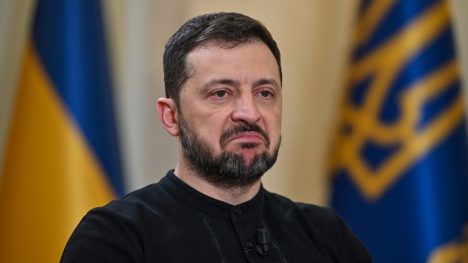
Ukrainian leader Vladimir Zelensky © Mert Gokhankoc / dia images via Getty Images
RT | February 19, 2025
Ukrainian leader Vladimir Zelensky has rejected US President Donald Trump’s claim regarding his approval rating as Russian disinformation, saying that a majority of Ukrainians trust his leadership.
During a press conference after a high-level meeting between American and Russian officials in Riyadh, Saudi Arabia on Tuesday, Trump suggested that Zelensky’s approval rating in Ukraine is 4%. The Kiev International Institute of Sociology (KMIS) said on Wednesday, however, that in a survey in January, 57% of Ukrainians expressed trust in Zelensky, an increase from 54% the previous month.
Zelensky referenced the Ukrainian pollster’s report as evidence against Trump’s skepticism about public support for him. He noted that Ukrainian officials “are aware of this disinformation and recognize that it is coming from Russia,” without providing specific sources. He stressed that “if anyone wants to replace me right now, it’s not going to happen.”
He also urged Trump’s special envoy for Ukraine, Keith Kellogg, who is currently visiting Kiev, to “speak to the people and ask them if they trust their president, whether they trust [Russian President Vladimir] Putin. Let him ask them about Trump” and his remarks.
In his comments, Trump pointed to the absence of elections in Ukraine due to Zelensky’s declaration of martial law. “I hate to say it, but he’s down at 4% approval.” He characterized the situation in Ukraine as dire, saying it has been “blown to smithereens” and is nearly impossible to live in.
Although Zelensky’s presidential term expired last year, he has not transferred authority to the parliament speaker, as mandated by the Ukrainian Constitution.
Zelensky has argued that holding an election under the current circumstances is both legally and technically infeasible, and that Ukrainians would oppose it amid the conflict with Russia. He also claimed that if an election were held, he would secure a second term. Recent opinion polls, however, suggest that he would lose to retired General Valery Zaluzhny in a runoff.
Russian officials have expressed concern regarding Zelensky’s legitimacy, saying that any international treaties he signs could be challenged. Moscow has indicated a willingness to negotiate peace with Zelensky, yet remains skeptical of his ability to finalize any agreements.
EU Elites Are in Panic Over the US Leaving Ukraine and Europe
Professor Glenn Diesen & Pascal Lottaz
Glenn Diesen | February 17, 2025
I had a conversation with Pascal Lottaz at Neutrality Studies regarding the panic in the EU as the US made it clear it no longer considers Europe to be a priority. For years, the Europeans failed to establish the continent as an independent pole of power by neglecting to define their security and economic interests separate from the US. Europe is subsequently now a divided continent at war, in economic decline and with diminishing relevance in the world. The US must address multipolar realities by restoring a workable relationship with Russia and pivoting toward Asia. The comfortable ideological bubble has been burst, yet there is still a reluctance to deal with uncomfortable realities.
There Is No Such Thing as Democracy without Free Speech. Period.
Truthstream Media | February 17, 2025
Truthstream Media Can Be Found Here:
Our First Film: TheMindsofMen.net
Our First Series: Vimeo.com/ondemand/trustgame
Site: TruthstreamMedia.com X: @TruthstreamNews
Backup Ch: Vimeo.com/truthstreammedia
DONATE: http://bit.ly/2aTBeeF
Newsletter: http://eepurl.com/bbxcWX
UK Refuses to Weaken Online Censorship Laws Despite US Pressure
Britain reaffirms its commitment to stringent online censorship, rejecting any compromises in the face of US trade talks or political pressure.
By Cindy Harper | Reclaim The Net | February 16, 2025
The UK government has firmly stated that its online censorship laws will not be softened to appease US President Donald Trump or to facilitate trade negotiations with the United States. Technology Minister Peter Kyle repeated Britain’s stance on maintaining strict digital speech regulations, shutting down any speculation of a shift in policy toward American AI firms.
During the Paris AI summit, Kyle dismissed claims that Downing Street was considering relaxing sections of the Online Safety Act in discussions with the US. Refuting a report from The Daily Telegraph, he asserted: “Safety is not up for negotiation. There are no plans to weaken any of our online safety legislation.”
The Online Safety Act, one of the strictest online speech crackdowns in a democratic nation, is set to come into force this year.
Industry moguls such as Elon Musk have voiced hopes that a Trump-led administration might resist global regulatory pressures on US-based tech companies.
Despite these concerns, Kyle expressed confidence that Trump would not obstruct Labour’s forthcoming AI legislation, which mandates that leading AI firms undergo “safety” evaluations before rolling out new software. He confirmed that voluntary safety pledges would now be replaced with enforceable mandates, ensuring strict compliance.
America’s ‘Democratic’ Allies Are Becoming More Authoritarian
By Ted Galen Carpenter | The Libertarian Institute | February 17, 2025
U.S. officials have a long history of portraying Washington’s allies and clients as democratic, even when their behavior is blatantly authoritarian. Such cynical hypocrisy was at its zenith during the Cold War, but it is surging again.
A similar trend is evident with respect to U.S. interference in the internal political affairs of other countries through such mechanisms as the United States Agency for International Development (USAID) and the National Endowment for Democracy (NED). Such agencies fund regimes and political movements that are deemed obedient to Washington’s wishes and supportive of American foreign policy objectives. Conversely, U.S. administrations actively undermine governments or movements that they consider hostile or even just insufficiently cooperative. The actual nature of U.S. clients often is a far cry from the carefully crafted democratic image of them that Washington circulates.
A recent example of American meddling in the internal affairs of another democratic country appears to have taken place in the Republic of Georgia. According to Parliament Speaker Shalva Papuashvili, USAID spent $41.7 million to support its preferred candidates in the country’s recent parliamentary elections. Adjusted for the size of Georgia’s population, such an expenditure in the United States would amount to $3.78 billion,
The U.S. track record in Georgia since the dissolution of the Soviet Union lends credibility to the speaker’s accusation that Washington is meddling in his country’s internal political affairs. President George W. Bush fawned with praise for Mikheil Saakashvili, the leader of Georgia’s “rose revolution” in 2003. Under Saakashvili, Georgia had become a “beacon of liberty,” Bush crowed. Generous flows of aid from Washington ensued. However, massive corruption soon characterized Saakashvili’s rule, as did his growing repression of political opponents. Ultimately, Saakashvili’s adversaries ousted Washington’s beloved “democratic” client from power.
The contrast between the laudatory American portrayal of Saakashvili as a paragon of democratic reform and the reality of his conduct was stark. However, Washington’s role in Ukraine over the years has been even more pervasive and dishonest. Although Ukraine’s president, Victor Yanukovych, came to office in a 2010 election that even a team of European Union (EU) observers conceded was reasonably free and fair, officials in Barack Obama’s administration, especially Assistant Secretary of State Victoria Nuland, worked to undermine his presidency. Yanukovych’s preference for closer economic ties with Russia instead of the EU and the United States apparently was intolerable to Western policymakers.
In 2014, the United States and key NATO partners helped Ukrainian demonstrators (primarily in Kiev’s Maidan Square) force Yanukovych to flee. An intercepted telephone call between Nuland and the U.S. ambassador to Ukraine confirmed the massive extent of Washington’s interference in Ukraine’s affairs. Nuland herself later admitted that the United States had poured more than $5 billion to Ukrainian groups in the years before the Maidan uprising. Supposedly, the purpose was to “promote democracy,” but as usual, the funds went almost entirely to groups Washington considered supportive of U.S. policies. It would be hard to identify a more flagrant case of outside interference in the affairs of another country.
Even if U.S. leaders sincerely intended their largesse to bring a stronger, healthier democracy to Ukraine—which is extremely doubtful—Washington did not achieve that goal. Corruption and blatant repression have become increasingly bad under the post-Maidan governments. Even though U.S. leaders invariably portray Ukraine’s current president, Volodymyr Zelensky, as a democratic champion, his record proves the opposite. Under his rule, Ukraine has outlawed opposition parties, muzzled the press, harassed uncooperative churches, and amassed a record of arbitrary imprisonment and torture. Much of that abuse was evident before the outbreak of war between Ukraine and Russia. Confirming that any attempt to portray Zelensky’s rule as democratic is a hypocritical farce, Ukraine has now postponed elections indefinitely.
The rot of hypocrisy and covert authoritarianism has infected even governments in NATO and the European Union. A grotesque example occurred earlier this month in Romania when an election commission dominated by the two governing parties, the Social Democratic Party (PSD and the National Liberal Party (PNL), annulled the first round of the presidential election held on November 24. Instead of the candidates of those two parties advancing to the second round runoff as expected, neither one did so. Instead, Caliin Georgescu, the candidate of a right-wing populist party led the field. Elena Lasconi, a reformer representing another “minor” party took the other runoff spot.
That outcome apparently was intolerable to Romania’s political establishment or its supporters in the EU and the United States. They viewed Georgescu as especially unacceptable, since he openly criticized NATO and opposed continuing to aid Ukraine. The country’s election commission nullified the voting results and rescheduled the first round balloting for May 4, 2025. Commissioners charged that, wait for it… Russia had illegally tampered with the election! Moscow’s horrid offense was its alleged support of a Tik Tok campaign that seemed to benefit Georgescu. Tangible evidence regarding Russian involvement was noticeably absent. Despite the lack of evidence, U.S. and EU officials denounced Russia and praised the Romanian government for trashing the election.
Eugene Doyle, a reporter for New Zealand’s Solidarity.com, noted the menacing significance of this episode. “To save democracy, the US and the European elites appear to have found it necessary to destroy democracy. For the first time ever an election was overturned in an EU/NATO country. Ever,” he wrote. Doyle also cites evidence that Russia was not even the likely culprit. The Tik Tok effort apparently originated with a botched PNL scheme to siphon off votes to Georgescu from other mainstream competitors.
Moreover, as Doyle points out, “Even if the Russians did it, in what crazy world would you wipe an election for a Tik Tok campaign, particularly one that was at best a few hundred thousands of dollars’ worth of advertising/messaging/ chatting—in contrast to the millions of dollars the U.S. State Department and various branches of the U.S. government spent on the same campaign?”
The answer is that it would happen in a world where political elites in the United States and its principal allies have never really been committed to democracy. Not as a domestic governing principle and definitely not as a foreign policy objective. Instead, the alleged commitment is a propaganda tool that is discarded whenever it becomes inconvenient. We live in such a world, and have done so for many years.
Zelensky’s key rival names Ukrainian election date
RT | February 16, 2025
Ukraine will hold elections in late October 2025, former President Pyotr Poroshenko has claimed. The politician cited a number of sources linked to government, and said that the relevant agencies have already started preparing.
“Write it down: [it will be on] October 26 of this year,” said the former president, who currently leads the European Solidarity party, which holds 27 seats in Ukraine’s 450-seat parliament. He was answering a question about the potential election date by the Censor.net media outlet.
When further pressed about the sources of his information, Poroshenko said he had contacts in the presidential administration, as well as within law enforcement agencies. He went on to claim that a Ukrainian printing house had already started producing the ballots. The nation’s Central Election Committee has also started its own preparations, he said.
The Ukrainian Interior Ministry is supposedly in the process of opening its first office in Berlin, the former president claimed, adding that it was being done “solely for the elections.” Germany hosts the biggest number of Ukrainian refugees, amounting to over 1.24 million people, according to online data aggregator Statista. Russia follows close behind, with 1.22 million Ukrainians having taken refuge there since the start of the conflict.
According to Poroshenko, the authorities intend to use the election to retain power. “They are preparing everything in such a way [that would] leave them without opponents,” the former president claimed, adding that the current government seeks to “crawl back into power, destroying democracy, freedom, and transparency of elections.”
Poroshenko led the country from 2014 to 2019, following the overthrow of President Viktor Yanukovich in a Western-backed coup. He was succeeded by Vladimir Zelensky. Poroshenko then emerged as a fierce critic of his successor. In 2023, he condemned what he described as Kiev’s “authoritarianism.”
In December 2021, Poroshenko was charged with treason over alleged coal deals in Donbass during his presidency. His assets were frozen in January 2022, but he vowed in court not to flee the country. Earlier this week, Zelensky imposed a set of new sanctions against him linked to the treason charges. The move was condemned by Poroshenko as “absolutely illegal” and led to a protest by his party in the Ukrainian parliament.
Ukraine was expected to hold a parliamentary election in 2023 and a presidential poll in 2024. Both were suspended indefinitely by Zelensky, due to martial law. The Ukrainian leader has since repeatedly insisted the nation cannot hold elections amid the ongoing conflict with Russia.
US President Donald Trump’s special envoy for the Ukraine conflict, Keith Kellogg, has said Washington would like to see Kiev hold both votes before the end of the year.
Medvedev applauds Vance’s ‘humiliating rebuke’ of Europe
RT | February 15, 2025
The deputy chairman of Russia’s Security Council, Dmitry Medvedev, has hailed US Vice President J.D. Vance’s speech at the Munich Security Conference, calling it a rare moment of American honesty about Europe’s weaknesses and Vance himself “a brave guy.”
In his speech on Friday, Vance touched on the migration crisis, security, freedom of speech, and apparent democratic backsliding on the continent.
Medvedev said Vance “unexpectedly lit up” the conference, calling his remarks a harsh but truthful indictment of modern Europe.
“Everyone expected to hear the usual partner-like curtseys to Europe and comments on Donald Trump’s words about the end of the Ukrainian conflict. But he went and harshly scolded the Europeans who have completely lost themselves in recent years: your democracy is weak, your elections are crap, your rules that violate normal human morality are crap,” Medvedev wrote.
He added that the Europeans would retaliate against him if he did not hold such a high post. “However, they will forgive him; they will begrudgingly accept the humiliating rebuke from their senior partner with resentment,” Medvedev concluded.
Vance was particularly severe in his indictment of European democracy. He voiced concerns over the erosion of democratic values in Europe, drawing attention to the annulment of the presidential election in Romania. The first round in November saw right-wing anti-establishment candidate Calin Georgescu come out on top with 22.94%, beating liberal leftist and social democrat candidates. Romania’s top court cited intelligence documents alleging “irregularities” in his campaign performance in making their ruling, although the validity of that evidence has been questioned.
The US vice president also cautioned against rising censorship in the region, told European member-states to take greater responsibility for their own defense, and raised the alarm over mass migration.
US President Donald Trump praised Vance’s speech as “brilliant.” However, some European officials were not so keen on the address. Estonian Prime Minister Kaja Kallas warned that it signaled growing transatlantic tension. German Defense Minister Boris Pistorius meanwhile, blasted the remarks, calling them “not acceptable.”
On the other hand, Russian Senator Alexander Shenderyuk-Zhidkov described Vance’s statements as a “cold shower” for European Russophobes.
Judge Pauses Murthy v. Missouri Amid Trump’s Free Speech Order
By Dan Frieth | Reclaim The Net | February 13, 2025
A federal judge has temporarily halted proceedings in Murthy v. Missouri, a case central to efforts aimed at curbing government involvement in online censorship, following a Supreme Court decision that declined to address the case’s core arguments.
On Tuesday, US District Judge Terry Doughty approved a motion from the defendants — former President Joe Biden and key administration officials — to stay the case. According to Jenin Younes, litigation counsel for the New Civil Liberties Alliance, the pause was granted in light of former President Donald Trump’s recent executive order titled “Restoring Freedom of Speech and Ending Federal Censorship.”
We obtained a copy of the order for you here.
“The government suggested that we move to stay discovery,” Younes told The Federalist. “They want to put in a statement about what effect they think the executive order has. I’m guessing they’re going to say it makes the case moot.”
If the judge agrees, the case could be dismissed as moot after President Trump’s new order. While plaintiffs went along with the stay to allow the judge time to review, Younes noted that the broader concern over government-driven censorship remains a live issue.
“We haven’t staked out our position yet, but there are arguments against mootness,” she said. “Especially if there’s a chance that could happen again and the executive order won’t necessarily be binding on a subsequent administration.”
Initially known as Missouri v. Biden, the lawsuit—brought by the states of Missouri and Louisiana—accused Biden administration officials of working with Big Tech to suppress online speech. The case unearthed extensive evidence showing how federal agencies collaborated with private platforms to censor topics ranging from The New York Post’s Hunter Biden laptop story to alternative viewpoints on the COVID-19 vaccine.
Featured Video

The Truth About the Trump Shootings with Ken Silva
or go to
Aletho News Archives – Video-Images
From the Archives
Trans ‘milk’ as good as the real thing – NHS
RT | February 18, 2024
The drug-induced nipple secretions of trans women are as good as mothers’ breast milk for babies, the University of Sussex Hospitals NHS Trust claimed in a letter to campaigners made public in a report by British think tank the Policy Exchange on Sunday.
The healthcare trust’s medical director, Rachel James, argued that the off-label prescription drug cocktail men transitioning to female take in order to produce milk was “similar to the natural hormones which encourage lactation to develop when the baby is newly born.”
“The evidence which is available demonstrates that the milk is comparable to that produced following the birth of a baby,” James wrote in the letter, sent to Children of Transitioners last August.
Biological men who wish to lactate must first take hormones to grow milk glands and then take high doses of either domperidone or metoclopramide to stimulate milk production. Neither drug is approved for this use, though they are occasionally prescribed off-label to biological women who have trouble lactating.
However, domperidone’s own manufacturer, Janssen, warns patients the drug “may cause unwanted side effects affecting the heart in a breastfed baby” and “should be used during breastfeeding only if your physician considers this clearly necessary.” … continue
Blog Roll
 Aletho News
- Seyed M. Marandi: U.S. Strike Imminent – Toward Total War in the Middle East
- Russia Voted Under Fire. Washington Is Loading the Tankers.
- 12 Things Your Oncologist Was Trained Not to Tell You
- Anthrax Attacks Paved Way for COVID-Era ‘Junk Drugs and Vaccines’
- How Real Is the Impact of Western Sanctions on Israel?
- France, You Are Guilty: How Paris Turned Western Sahara into the Maghreb’s Powder Keg
- 2025 Nature Paper Claiming Worsening Global Drought Gets RETRACTED …Heavily Flawed
- Your Milk Is Not the Problem
- The Truth About the Trump Shootings with Ken Silva
- ARE PATIENTS BEING PROPERLY INFORMED ABOUT OZEMPIC?
- If Americans Knew
- An error has occurred; the feed is probably down. Try again later.
- No Tricks Zone
- 2025 Nature Paper Claiming Worsening Global Drought Gets RETRACTED …Heavily Flawed
- New Study: ‘Global Drought Shows No Detectable Recent Acceleration Under Climate Warming’
- Economic Masterminds: German Socialists Suggest Taxing Productivity Gains Stemming From Using AI
- The South China Sea Has Not Been Cooperating With The Climate Change Narrative
- Energy Crisis: Germany Enters Heating Season With Historically Low Gas Reserve Fill Levels
- New Study: The Antarctic Ice Sheet Gained Mass From 2020-2024 Due To Staggering Snow And Ice Accumulation
- Study: Ocean Heating Rates From Thousands Of Years Ago ‘Dwarf’ Modern Ocean Heating Rates
- Climate Extremists Target, Attack Large-Scale Power Grid Infrastructure In Germany!
- New Study: Antarctic Ice Melt Has Contributed Less Than 1 Centimeter To Sea Level Rise In The Last 30 Years
- Fear Of Debate: Alarmist German Climate Scientist Calls On Mainstream Media To Discredit Skeptic Voices
 Aletho News