Desperate Drug War Beneficiaries Spread Marijuana Legalization Disinformation
Ron Paul Institute | September 6, 2014
While local and state governments continue moving forward with reducing and eliminating restrictions and penalties regarding marijuana, drug war beneficiaries are desperately responding by spreading disinformation. One such effort is the Rocky Mountain High-Intensity Drug Traffic Area August report “The Legalization of Marijuana in Colorado: The Impact.”
The report purports to be a balanced analysis of the effects of marijuana legalization in Colorado. In fact, the report is over 150 pages of deceptive pro-drug war propaganda.
One may wonder how much time and money the HIDTA spent on researching, writing, and producing the professional appearing report. Whatever the cost, the HIDTA people must figure it is a good investment of other people’s money.
While the Rocky Mountain HIDTA and its private and government allies spent hundreds or thousands of hours creating the agitprop, drug war writer Jacob Sullum had no trouble promptly rebutting a good portion of the report’s conclusions and exposing some of the rhetorical trickery that made the report particularly deceptive. Nonetheless, singers of prohibition praise from Cully Stimson of the Heritage Foundation to DARE enthusiastically promoted bite-size packets of the report’s disinformation.
As explained by the Office of National Drug Control Policy, 28 HIDTAs, including the Rocky Mountain HIDTA, assist United States, state, local, and tribal law enforcement agencies in fighting the drug war in areas that include 60 percent of the US population pursuant to the Anti-Drug Abuse Act of 1988. While a lot has changed in America since 1988, the US government’s drug war keeps going strong.
With more and more state and local governments moving away from prohibition of marijuana and this trend showing no signs of reversing, the HIDTA people, along with their connected police departments and other allied drug war beneficiaries, must be having some job security concerns. Drug war arrests, and marijuana arrests in particular, after all, help keep the police busy. US News and World Report writer Steven Nelson reports some of the Federal Bureau of Investigation war on drugs arrest statistics:
Data released Monday by the Federal Bureau of Investigation show there were an estimated 1,552,432 arrests for drug-related crimes in 2012 – a slight uptick from the 1,531,251 drug arrests in 2011. Marijuana offenses accounted for 48.3 percent of all drug arrests, a slight reduction from 49.5 percent in 2011, which itself was the highest rate since before 1995.
Most marijuana-related arrests were for possession of the drug. By mere possession, there was one marijuana arrest every 48 seconds in 2012. Including arrests for distribution, there was a pot-related arrest every 42 seconds, the same interval as in 2011.
HIDTAs (with their $238 million in ONDCP grants) and US, state, and local police (with their “policing for profit” through drug war asset seizures) are not the only groups that benefit from marijuana prohibition. There are many additional beneficiaries including prosecutors who push defendants who typically lack comparable legal resources along the guilty plea conveyor belt, private and public prisons that cage drug war convicts, treatment centers where people with no addiction problem whatsoever will opt to take part in court-mandated treatment as an alternative to being in prison, and arms manufacturers who have found new income in police militarization.
While it is important to counter deceptive propaganda with truth and logic, there is little reason to expect that the Rocky Mountain HIDTA report and other propaganda efforts will stop the general American trend toward greater respect for the right to grow, use, transport, buy, and sell marijuana. On marijuana, America it seems has turned a corner, with the country moving toward a patchwork quilt of marijuana laws that overall are much less prohibitionary and punitive than the laws have been over the last few decades of the war on drugs. People are seeing firsthand that very significant loosening of marijuana restrictions in parts of the country did not cause the sky to fall. Indeed, people are seeing that marijuana freedom, despite the prohibitionists’ dire warnings and continuing disinformation campaigns, is not dangerous.
With marijuana use coming out of the shadows of illegality, people are more and more recognizing that individuals who use marijuana, on occasion or regularly, are not so different from people who do not. Reality is overtaking hype.
Marijuana freedom is nothing to fear. Instead, as Ron Paul Institute Chairman and Founder Ron Paul says, freedom “brings people together, whether you are liberal or conservative or what, because people like to be in charge of their own life; they like to be in charge of their own money.” Despite the efforts of the Rocky Mountain HIDTA and its prohibitionist allies, Americans are rejecting the government and private drug war beneficiaries’ propaganda and experiencing the benefits of “live and let live” over “arrest, fine, and incarcerate.” Hopefully, this lesson will help create paths to greater respect for other freedoms as well.
Fake cell phone ‘towers’ may be spying on Americans’ calls, texts
RT | September 3, 2014
More than a dozen “fake cell phone towers” could be secretly hijacking Americans’ mobile devices in order to listen in on phone calls or snoop on text messages, a security-focused cell phone company claims. It is not clear who controls the devices.
ESD America, which markets heavily-encrypted cell phones built within the body of a Samsung Galaxy S3, said it was able to locate numerous towers intercepting mobile communications – but does not know who is running them.
Speaking to Popular Science, ESD America CEO Les Goldsmith recently said that the company has used its phone – the CryptoPhone 500 – to map 17 different fake cell phone towers, dubbed “interceptors,” across the United States. Locations include New York, Chicago, Los Angeles, Seattle, and more.
“Interceptor use in the US is much higher than people had anticipated,” he told the website. “One of our customers took a road trip from Florida to North Carolina and he found 8 different interceptors on that trip. We even found one at South Point Casino in Las Vegas.”
Although these interceptors act as fake cell phone towers, they are not necessarily large, physical structures. They could simply be small mobile devices that act exactly like a real tower, deceiving phones into giving up information. Such devices are known as “stingrays,” after the brand name of one popular type of interceptor.

Once connected to a person’s phone, they can bypass the mobile device’s encryption to either listen in on calls or capture texts. In some cases, they are also powerful enough to take over a device or make it seem as if it has shut down – only to leave the microphone on in order to eavesdrop.
The American Civil Liberties Union has been attempting to pry information about government and police use of stingray equipment, but its efforts have been met with resistance from federal officials.
According to Ars Technica, the Federal Communications Commission pledged in August to investigate the “illicit and unauthorized use” of interceptors – with a primary focus on foreign governments, criminals, and terrorists – but denied a Freedom of Information Act request to reveal more data about current stingray use.
For Goldsmith, determining who is using the interceptors is important. He speculated that the operators could be American agencies or foreign governments.
“What we find suspicious is that a lot of these interceptors are right on top of US military bases. So we begin to wonder – are some of them US government interceptors? Or are some of them Chinese interceptors?” he told PopSci. “Whose interceptor is it? Who are they, that’s listening to calls around military bases? Is it just the US military, or are they foreign governments doing it? The point is: we don’t really know whose they are.”
Outside of national governments, local law enforcement agencies are also beefing up their stingray/interceptor capabilities. In Oakland, California, police are looking to spend hundreds of thousands of dollars to upgrade their cell phone surveillance system.
Meanwhile, police in Tacoma, Washington have caught the eye of civil liberties advocates after the News Tribune revealed they have been using interceptor equipment to catch cell phone calls for the last six years. Some, including Mayor Marilyn Strickland, said it was legitimate for police to do so as long as people’s rights were not violated. However, the ACLU disagreed, arguing it was like “kicking down the doors of 50 homes and searching 50 homes because they don’t know where the bad guy is.”
Reading the Salaita Papers
By Corey Robin | September 2, 2014
There are many developments today in the Salaita affair, so I’m going to do this as a two-part post. Part 2 is here.
This morning, the News-Gazette released 280 pages of documents obtained under the Illinois Freedom of Information Act revealing extensive donor pressure on Chancellor Wise.
As news spread in late July about a new University of Illinois faculty hire and media outlets began publishing some of his profanity-laden tweets, a number of wealthy donors threatened to stop giving money to the university, recently released documents show.
The letters about professor Steven Salaita started arriving in Chancellor Phyllis Wise’s inbox July 21, and the writers did not hold back.
“Having been a multiple 6 figure donor to Illinois over the years, I know our support is ending as we vehemently disagree with the approach this individual espouses,” wrote one UI business school graduate.
…
The letters from donors, some of them identifying themselves as members of the UI’s $25,000-plus “presidents council,” have also raised questions about the motivation behind the administration’s decision to not forward Salaita’s name to the board of trustees for formal approval last month.
The chancellor, however, through a spokeswoman, maintains her decision was not influenced by them, but was based out of concern for the students, campus and community.
Then tonight Phan Nguyen sent me 443 pages of documents he had posted online. These are all the documents released by the UIUC in response to four different FOIA requests from various news organizations. I’ve now spent the entire evening reading through these documents and here are some of the highlights.
When the Salaita story first broke in the local press, Associate Chancellor for Public Affairs Robin Kaler said, “Faculty have a wide range of scholarly and political views, and we recognize the freedom-of-speech rights of all of our employees.” That was on July 21. The UIUC documents reveal that not only was Chancellor Wise apprised of that statement minutes after it was emailed to the media, but that she also wrote back to Kaler: “I have received several emails. Do you want me to use this response or to forward these to you?” (p. 101) In other words, this was not the rogue statement of a low-level spokesperson; it reflected Wise’s own views, including the view that Salaita was already a university employee. Even though Wise already had been informed of Salaita’s tweets.
In the days following this forthright defense of Salaita, the Chancellor and her associates begin to back-pedal. Around July 23, Wise starts reaching out to select alumni, trying to arrange phone calls (and in one instance, struggling to rearrange her travel schedule just so she can meet one alum in person [pp. 78-94]). To another such alum, she writes, “Let me say that I just recently learned about Steven Salaita’s background, beyond his academic history, and am learning more now.” (p. 293) That “beyond his academic history” is going to get Wise in trouble on academic freedom grounds.
In the background of this change of tune are the donors and the university’s fundraising and development people. In a July 24 email to Dan Peterson, Leanne Barnhart, and Travis Michael Smith (all part of the UIUC money machine), Wise reports about a meeting she has had with what appears to be a big donor. In Wise’s words:
He said that he knows [REDACTED] and [REDACTED] well and both have less loyalty for Illinois because of their perception of anti-Semitism. He gave me a two-pager filled with information on Steven Salaita and said how we handle this situation will be very telling. (p. 206)
Once Wise and her team start back-tracking, the trustees are brought into the picture. On July 28, Susan Mary Kies, who is the secretary of the Board of Trustees, writes Wise, who had been apologetic about “filling your inbox” with Salaita info, “No problem, we will place the letters in weekly dispatch (as we did last week) so the trustees can see the depth of the matter!” (p. 62) The next day, Kaler starts writing to complaining alums that the final decision regarding Salaita lies with the trustees (this is the first we hear of what will become the ultimate strategy of the administration: putting it all on the trustees):
While I cannot comment on any specific employment decisions of the university, pursuant to the governing documents for the university the final decision for any faculty appointment at the level of assistant professor or above rests with the Board of Trustees. I, therefore, have passed your concerns along to the Secretary of the Board of Trustees. (p. 62)
What’s most stunning about these documents is that they show how removed and isolated Chancellor Wise is from any of the academic voices in the university, even the academic voices on her own team. As she heads toward her August 2 decision to dehire Salaita, she is only speaking to and consulting with donors, alums, PR people, and development types. Ilesanmi Adesida, the provost and vice chancellor for academic affairs, makes exactly one appearance in these 443 pages. That is on Tuesday, July 22. Even though Wise has been inundated with emails about Salaita for days, she only finally emails Adesida about the matter a day after the story has broken in the local press. His response: “Thanks for sending these emails. I was not aware of any controversy on this person until yesterday!” (p. 95) And he’s never heard from again.
Then on August 4, two days after Wise has informed Salaita and Robert Warrior, chair of the American Indian Studies department, that Salaita won’t be hired, Warrior writes Brian Ross, interim dean of the College of Arts and Sciences, to find out what happened. Warrior first gets an email back from one of Ross’s associates, who says, “Brian is not in the office today, and I’m not sure he knows anything about this because I presume he would have discussed it with me if he had” (p. 361). And then Ross himself writes back, “i am in NY, traveling back tomorrow. I have not seen the letter but have a request in and will let you know when I hear any more” (p.362). In other words, even two days after the Chancellor has dehired Salaita, she still hasn’t informed the dean of the largest college at the UIUC of her decision.
What’s also clear from reading these documents is just how high up the chain Salaita’s appointment had gone, and how ensconced at the university he was becoming—up until the day that he wasn’t. On September 27, 2013, for example, Reginald Alston, one of two associate chancellors who works directly in Phyllis Wise’s office, writes the following report on Salaita’s candidacy (pp. 238-239):
After closely reviewing Dr. Steven Salaita’s dossier, I support the Department of American Indian Studies’ (AIS) request to grant him the rank of Associate Professor with indefinite tenure at the University of Illinois. The uniqueness of his scholarship on the intersection of American Indian, Palestinian, and American Palestinian experiences presents a rare opportunity to add an esoteric perspective on indigeneity to our cultural studies programs on campus.
…
Again, I support offering Dr. Salaita a tenured position because of the obvious intellectual value that his scholarship and background would bring to our campus. His presence would elevate AIS internationally and convey Illinois’ commitment to maintaining a leading academic program on the historical and sociopolitical intricacies of American Indian culture.
On January 15, 2014, his appointment is approved by the Office of Diversity, Equity, and Access, which is one of the key and most powerful offices in any university hiring decision; if they don’t sign off, the appointment goes nowhere (p. 398).
Then, between July 22 and July 25, while the chancellor and her aides are formulating their strategy to deal with the backlash, Salaita and Warrior email back and forth about Salaita’s moving expenses. The UIUC had originally promised to cover up to $5000 of Salaita’s expenses (p. 387), but when the University-approved moving company comes back with an estimate of $7500, the department decides to cover the difference (pp. 341-347).
And then, when the tech support start asking Warrior about Salaita’s computer needs (“Did Steven Salaita say he had any special PC laptop needs? Does he run SPSS or any other resource intensive applications? Does he need something geared toward video work or any other special area?”), Warrior replies, “He’s pretty much a meat and potatoes user. Nothing complicated” (pp. 341-347).
That was on August 1. The next day, Chancellor Wise fired Salaita.
Update (12:20 am)
Apparently, Carol Tilley on Twitter revealed earlier today the identity of that the alum whom Wise scrambled to rearrange her schedule over. His name is Steve Miller; the UIUC redactor failed to catch it. Tilley then tweeted some other information about Miller. He’s a huge venture capitalist. In 2010, he donated a half-million dollars to endow a professorship in the UIUC business school. He’s given money for years to endow the Steven N. Miller Entrepreneurial Scholarships. He believes in “venture philanthropy.” And he’s on the board of Hillel.
New York academics publish open letter in support of Students for Justice in Palestine
MEMO | September 2, 2014
More than one hundred university professors in New York City have signed an open letter, which was published on Monday, to administrators throughout the City University of New York (CUNY) system regarding the “principles of freedom of speech and assembly, and how such freedoms apply to students involved in organising with Students for Justice in Palestine (SJP) at several of the CUNY colleges”.
In the letter, the professors explain that: “We have viewed with great concern instances of unequal and unfair treatment of SJP by members of the CUNY administration over the past few years. These have been well documented by legal rights groups such as the Centre for Constitutional Rights, the National Lawyers Guild, and Palestine Solidarity Legal Support, as well as by students involved in SJP at CUNY and their faculty advisers. These include arbitrary changes in policies regarding student groups, aimed specifically at curtailing SJP activities; the over-policing of SJP events and activities, including simple actions like handing out fliers, in a way that has caused intimidation to students; and making unfounded accusations that lead to ‘investigations’ into widely publicised events. All of these actions have a chilling effect on free exchange and open dialogue.”
The letter calls “upon members of the administration throughout the CUNY system to treat SJP as they would any other student organisation, respecting their right to organise events and activities within the existing rules and practices governing such organisations and refraining from setting up unfair barriers or subjecting SJP to standards different from those applied to other student groups. These students are acting within the traditions of intellectual inquiry and public responsibility that have guided CUNY since its inception.”
The CUNY professors urge the administrators at their university to “show courage in upholding the principles of freedom of speech and assembly”. They point out that while not all faculty members who have signed the letter always agree with the views expressed at SJP events, they support “unconditionally” the students’ “right to express these views without fear of reprisals or unfair treatment by this university.”
Amongst the many dozens of esteemed faculty in the CUNY system who signed the letter are: David Harvey, Distinguished Professor of Anthropology, Earth and Environmental Sciences, and History; Talal Asad, Distinguished Professor of Anthropology; Linda Martín Alcoff, Director, Women’s Studies Certificate Program and Centre for the Study of Women and Society; Moustafa Bayoumi, Professor of English; Corey Robin, Professor of Political Science; Susan Buck-Morss, Distinguished Professor of Political Science; Stanley Aronowitz, Distinguished Professor of Sociology; Ervand Abrahamian, Distinguished Professor of History; and Sarah Schulman, Distinguished Professor of the Humanities.
To view the full letter and its list of signatories, please visit here.
Nebraska Cops Receive no Jail Time for Stealing Memory Card, Despite Big Talk from County Attorney
By Carlos Miller | Photography Is Not A Crime | August 30, 2014

A Nebraska cop who chased a man into his home after he had video recorded cops arresting his brother, confiscating his camera and later admitting to throwing the memory card away, received a year of probation this week after his charge was reduced from a felony to misdemeanors, proving once again that the system will always side with the cops, even in cases like this one where the prosecutor talks a big game.
James Kinsella was part of a mob of cops from the Omaha Police Department who chased a man inside his home without a warrant last year after the man attempted to video record them abusing his brother, a scene that was captured on a camera by a neighbor from an upstairs window in a shocking video that went viral.
But what took place inside the home was even more egregious, according to Douglas County Attorney Don Kleine, who called a press conference last year to announce he was charging Kinsella with felony tampering with evidence – a rare move by any prosecutor when it comes to cop deleting footage.
However, Klein later reduced the charge to two misdemeanor counts of obstruction of government operations because the cop claimed there was no video on the memory card.
Klein also dropped charges against another cop he had charged last year, Aaron Von Behren, a sergeant who was facing two misdemeanors, accessory to a felony and obstruction of government operations, for orchestrating the coverup by ordering his officers to keep hush about the disposal of the memory card – which they claim contained no video evidence anyway.
Uh huh.
Why would he knowingly commit a felony if there was nothing incriminating on the phone that he and other officers illegally searched through?
This is how his attorney explained it, according to the Omaha World-Herald.
“He gets there, and he finds a melee,” Fabian said. “He does what he’s directed to do: secure a residence. He retrieves the cellphone. He determines that there is no video on the phone.
“Because he’s angry, he decides, ‘I’m going to take this memory card and stick it in my pocket.’ It was done out of frustration,” Fabian said. “He made a comment, ‘He won’t be using this any more.’ ”
Fabian said his client believed in public service and had received a chief’s commendation for corralling a suicidal person before he could jump off of an Interstate 480 bridge. He also volunteered with the Special Olympics.
“My point is this: The events that were involved in this incident were regrettable,” Fabian said. “But my client didn’t strike anyone, didn’t kick anyone, didn’t abuse anyone, didn’t threaten anyone.”
And how did Von Behren emerge without a conviction?
Kleine said, prosecutors had a few obstacles in prosecuting Von Behren. Much of the information gleaned about Von Behren’s instructions came from an Omaha police internal affairs investigation, Kleine said.
By law, authorities cannot use any admissions or statements made in such internal investigations because officers don’t have the right to refuse interviews with their supervisors. That prevented prosecutors from using officers’ statements to internal affairs about Von Behren’s purported instructions.
And because Kinsella no longer faced a felony, Von Behren could no longer be considered an accessory to a felony.
Kinsella and Von Behren were fired for the incident along with two other officers, one who was rehired earlier this year.
Meanwhile, a civl lawsuit against the department and the officers is still pending.
Coroner says man fatally shot himself in the chest while handcuffed behind his back
RT | August 26, 2014
The release of an autopsy report in Louisiana is raising new questions about the unusual shooting death of a 22-year-old black male who died earlier this year in a police car while his hands were cuffed behind his back.
RT reported earlier this year that police in Iberia Parish, LA said Victor White III died in early March after he fatally shot himself while handcuffed in the back of a squad car. White had reportedly been apprehended for possession of drugs, and was searched no fewer than two times before being cuffed and placed in the backseat of a police vehicle. According to the police report from the time, White uncovered a gun while in the car and shot himself in the back.
According to a coroner’s report just recently obtained by NBC News, however, White died from a gunshot wound that entered his body in the chest. Nevertheless, Dr. Carl Ditch wrote in the report that White was capable of firing the shot while cuffed “due to his body habitus” and has agreed to rule the death a suicide.
Hannah Rappleye, a reporter for NBC, compared the coroner’s story with the official police report from March in an article published by the outlet this week.
“White was shot in the front, not the back. The bullet entered his right chest and exited under his left armpit. White was left-handed, according to family members. According to the report, the forensic pathologist found gunshot residue in the wound, but not the sort of stippling that a close-range shot can sometimes produce. He also found abrasions on White’s face,” she wrote. “And yet, despite the contradictions – and even though White’s hands were never tested for gunpowder residue – the Iberia Parish coroner still supported the central contention of the initial police statement issued back in March.”
“Although the decedent was handcuffed at the time with his hands to his back, due to his body habitus, the pathologist and investigators agree that he would have been able to manipulate the weapon to the point where the contact entrance wound was found,” Ditch wrote.
The deceased’s father, Rev. Victor White II, told NBC that he had his doubts about the coroner’s report.
“You can’t make me understand,” he said. “You can’t make me understand how my son took his left hand, when he was handcuffed behind the back, and shot himself. I don’t believe a thing they’re saying at this point.”
According to the coroner, however, White was indeed capable of causing his own death.
“As Coroner of lberia Parish it is my duty to rule on cause and manner of death in all such cases as Mr. White’s to the best of my ability and without bias. Based on the forensic evidence and information gained from the ongoing State Police investigation, I have determined the cause of death is a single contact gunshot wound to the right lateral chest, and the manner of death is suicide,” he wrote.
Meanwhile, though, the Louisiana State Police remain in the midst of an investigation launched nearly nine months ago into the shooting death. Writing for NBC, Rappleye wrote that that probe has so far failed to reveal any new information about the tragic death.
“Due to the pending investigation, records normally considered public are not available. The State Police will not yet release dash cam footage, or the number of or names of any officers present during White’s death. They will not give any timeframe as to when they expect the investigation to conclude,” she wrote.
“You always want to make sure in the end you did whatever you could do possible, that in whatever case you put forward, is the right case, and the outcome is the right outcome,” Trooper Brooks David, public information officer for the Louisiana State Police, told NBC. “So if it takes us eight months, or two months, you always want to make sure that you do the right thing.”
According to Rev. White, however, legal action might be the next step if the eventual release of the Louisiana State Police’s report raises more doubts about his son’s death.
“I don’t’ think anything is going to be different from what they already said,” he told NBC. “It’s difficult to see that anything else would bring us back what we need. The only thing we want back is our son.”
Ghosts of Olavarría: Human Rights Trial in Argentina Seeks Justice for Victims of Military Dictatorship
By Nick MacWilliam | Upside Down World | August 26, 2014
The central quarter of the Argentine city of Olavarría, with its leafy main square, whitewashed church, and historical architecture, merits its National Heritage status. Thanks to mineral extraction of the rock on which it stands, Olavarría is a prosperous and tranquil place, and home to the social science and engineering schools of the University of Buenos Aires Province. Now, however, this seemingly pleasant city has become the latest battleground in Argentina’s ongoing struggle to bring justice to those guilty of crimes during the military dictatorship of 1976–1983.
Olavarría, a city of around 100,000 inhabitants, is the setting for the upcoming trial of several ex-army officials accused of human rights abuses during the dictatorship. A high level of public interest surrounds the proceedings, due to one of the defendants’ alleged involvement in a case which has dominated national media in recent weeks.
 In early August, the human rights organization Grandmothers of the Plaza de Mayo announced that the long-lost grandson of its president Estela de Carlotto had been identified and was living in Olavarría under a different name. Guido Montoya Carlotto had been taken from his detained mother in 1978 when just a few hours old, one of hundreds of babies born in captivity and then raised by families linked to the military authorities. In most cases, their biological parents were murdered by the military. The Grandmothers of the Plaza de Mayo have campaigned since the 1970s to reunite the stolen babies with their natural families and to expose the guilty parties.
Estela de Carlotto The recent news, a welcome dose of positivity on front pages of the country’s newspapers, has received intense media interest. Estela de Carlotto is highly-respected within Argentine society for her tireless campaigning as president of the famous headscarf-wearing Grandmothers. But, as the story has moved on from its initial feel-good element, there are now many questions over who was responsible for taking Guido from his mother, Estela’s 22-year-old daughter Laura Carlotto, who was killed soon after giving birth. The father, Walmir Montoya, abducted alongside his pregnant partner, had been murdered several months earlier.
The spotlight has shifted to Olavarría, location of the impending trial and the city in which Guido Montoya had lived until recently as Ignacio Hurbán. Although the trial date was set several months ago, it is now alleged that one of the accused participated in the transfer of Laura Carlotto’s baby to an adoptive family. Laura, who was handcuffed to a stretcher throughout the entire labor and birthing process, spent only a few hours with her newborn before being returned to her cell at the La Cacha detention center in La Plata.
On September 22, a court will begin listening to evidence against a number of ex-military officials charged with crimes against humanity, including kidnapping, torture and murder, committed at the Monte Peloni detention center in Olavarría. The officials on trial are: the local commander, Ignacio Verdura; Chief of Intelligence, Walter Grosse; Officer Horacio Leites; and Sub-Officer Omar Ferreyra. All of them are currently serving sentences for earlier convictions. While the trial is not directly connected to the removal of the Montoya Carlotto baby, it is suspected that Verdura was involved in the appropriation of babies.
For the last few years, the Grandmothers of the Plaza de Mayo have claimed that an Olavarría businessman, Carlos Francisco Aguilar, acted as an intermediary between the military and adoptive families. Aguilar, who died earlier this year, owned the land on which Guido Montoya’s adoptive parents worked and was known to have strong links to the armed forces and the church. As a wealthy landowner, he moved in the same social circles as high-ranking military figures, such as Ignacio Verdura, the then-chief of the regional 2nd Tank Regiment.
Throughout the 1970s, Olavarría was a site of left-wing militant activity, which brought the city to the military’s attention. State repression began with worker organizations before targeting the lawyers representing them, and later moving on to the student movement. Those who felt the heavy hand of the state included striking workers at the Loma Negra (Black Hill) cement company. The company’s response to the strike was to call in the military to end the dispute with detentions and other suppressive tactics.
Carlos Moreno was a lawyer who represented the Loma Negra workers. He was detained in Olavarría and tortured before being killed in May 1977. A trial in 2012 exposed links between the military and civilians who had allowed their property to be used for detaining prisoners. The trial also ordered an investigation into the role of Loma Negra, whose president was Amalia Lacroze de Fortabat, one of the world’s wealthiest women until her death two years ago at the age of 90.
Speaking to the Página 12 newspaper, Moreno’s son Matías said companies such as Loma Negra reaped the benefits of military rule.
“Before the dictatorship, Loma Negra was suffering losses, but its profits tripled under the dictatorship. The abduction of my father was intended as a disciplinary measure, after which there was a fall in labor costs,” said Matías. This was the aim of all the abductions.”
He also revealed that Commander Verdura lived next-door to the Moreno family. Any neighborly recognition, however, was irrelevant when it came to the military eliminating its opponents.
The Monte Peloni detention centerThe Monte Peloni detention center, where the majority of those detained in the zone were held, was a farmhouse in the countryside near Olavarría. Several prisoners, many of whom remain disappeared, passed through the center, which was administrated by the 2nd Tank Regiment of Ignacio Verdura.
Among the crimes that Verdura and his cohorts stand accused of are the disappearance of a young couple, Isabel Gutiérrez and Juan Carlos Ledesma, the detention of Isabel’s father Francisco Gutiérrez, and the murders of Jorge Oscar Fernández and Alfredo Serafín Maccarini. The latter was a prison guard whose rumored empathy for political prisoners made him a target for the military. Another ex-prisoner, Lidia Araceli Gutiérrez, who was raped and tortured in Monte Peloni, is to give evidence at the trial.
The Olavarría trial is the latest step in the legal battle to hold those involved in the abuses of the dictatorship accountable. As many as 2,000 people connected to the dictatorship have been accused of complicity in abuses, as, according to Human Rights Watch, Argentina has made “significant progress in prosecuting military and police personnel for enforced disappearances, killings and torture during the country’s ‘Dirty War.’” Yet the fact remains that a great many of those who willingly participated in dictatorship abuses have yet to answer for their crimes.
The stealing of babies from people who were subsequently killed continues to be a matter of great sensitivity, as the majority of stolen babies are now unidentified adults living normal lives in Argentine society. The Guido Montoya case was the 114th positive identification of a baby forcibly removed from its biological parents. However, it is estimated that there are hundreds of other citizens now approaching middle-age with little idea of their true identities. For families of the disappeared, the discovery of lost relatives can serve as an act of closure for their longstanding grief. Having spent decades dwelling on the past, they are finally able to look ahead.
In 2012, the dictator Rafael Videla, already serving a life sentence for human rights abuses, was given a further 50 years for his part in the systematic transfer of babies from prisoners to families linked to the military regime. Several other officials, including the country’s last military leader Reynaldo Bignone, have been convicted and imprisoned for their involvement in abuses. Bignone, who like Videla had already been found guilty of torture and murder in earlier trials, was said by the court to be complicit in “the crimes of theft, retention and hiding of minors, as well as replacing their identities.”
But the campaign of forced removal was perpetrated at all levels of the military hierarchy. As Guido Montoya Carlotto said in a recent interview with the newspaper El Popular de Olavarría, in his hometown “there are people who have to thoroughly explain themselves … I hope that people learn to question that which has been covered up, so that this not only represents my restitution but also the restitution for other people experiencing doubts.”
As Argentina continues to come to terms with the traumas of military rule, stories like the Carlottos’ provide inspiration for the justice movement to keep fighting. Yet, this is a journey that is unlikely to ever be fully resolved. The entrenched political system of brutality and repression was too widespread to hold all the guilty to account. But each small step signifies progress. Many will be closely watching the Olavarría trial in the hope that Argentina continues on its path toward redemption.
Nick MacWilliam is a British freelance writer and editor based in Buenos Aires.
US Law Requiring Annual Report on Excessive Force by Police has been Ignored for 20 Years
By Steve Straehley | AllGov | August 22, 2014
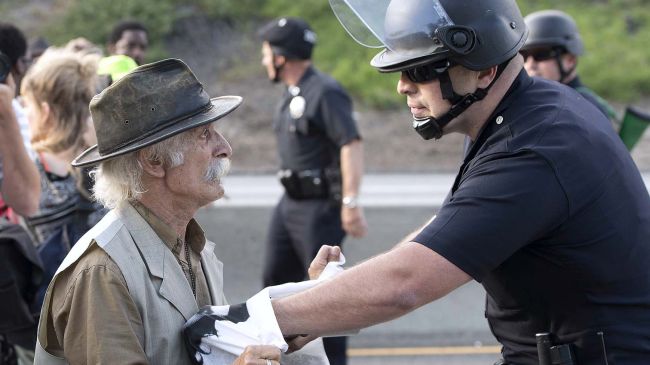
The circumstances of the death of Michael Brown in Ferguson, Missouri, have brought that one police shooting into the national conscience. But many other Americans are killed by police and their deaths go unnoticed and mostly uncounted, despite a Congressional mandate.
In 1994, Congress passed the Violent Crime Control and Law Enforcement Act. Among its provisions was the order that “the Attorney General shall, through appropriate means, acquire data about the use of excessive force by law enforcement officers.” The Justice Department was also required to publish an annual report on the data collected.
And… that’s pretty much the last anyone heard of that. The work of collecting the data was shuffled off to the International Association for Chiefs of Police, which made a few efforts at collecting data and put together a report in 2001, but has produced nothing since.
“That’s a clear, clear problem,” Matthew Hickman, an associate professor of criminal justice at Seattle University, told Michael Doyle of McClatchy. “When it comes to use of force, we have almost nothing.”
Part of the reason is that the term “excessive force” is open to interpretation. Even a shooting ending in the death of an unarmed pedestrian could be judged by a jury to be justified. In addition, police departments are expected to report on their own incidences of excessive force, which some might be reluctant to do.
The Justice Department began to compile statistics on police shootings in 2001, according to the International Business Times. However, their reports cover only the years from 2003 to 2009 and don’t tell the whole story because of incomplete reporting and problems with research methods.
Wikipedia has tried to crowd-source a shootings database and blogger Jim Fisher, who scours the internet for information on police shootings, has had some success.
For now, Congress is still waiting for the statistics, although the head of the Senate Judiciary Committee that sought the data has moved on. His name is Joe Biden and he’s now Vice President of the United States.
To Learn More:
Data On Police Shootings Is Hard To Find (by Michael Doyle, McClatchy)
How Many Police Shootings Have There Been? (by Ross Keith, International Business Times)
How Many People are Killed by Police in U.S.? Who Knows? (by Steve Straehley, AllGov)
Ferguson Unmasks the War on Black America
A Black Agenda Radio commentary by Glen Ford | August 20, 2014
The brave and besieged people of Ferguson, Missouri, have already caused serious complications for the U.S. National Security State. By virtue of simply standing their ground in their own small city, the demonstrators have forced the local, county and state police to show their true, thoroughly militarized colors. Ferguson’s righteous agitators and rebellious Black youth have succeeded in pinning down in one small space the armed forces of racist repression in full view of the corporate and the people’s media, so that the whole world can bear witness to the truth of what another generation proclaimed nearly half a century ago: that, in the Black community, the police are an army of occupation.
The military character and mission of the police is more clear today than when the Black Panther Party and others sounded the alarm in the Sixties. Back then, the first SWAT teams were staking out sniper positions on city streets and the federal Law Enforcement Assistance Administration had only just begun to funnel millions of dollars in surveillance technology, guns, body armor and all manner of lethal equipment to local and state police departments across the country. The term “mass Black incarceration” had not yet been coined, but it was only a matter of time before a permanent, militarized police offensive against rebellion-prone ghettos would cause unprecedented numbers of Black prisoners to flow into the greatest gulag in the history of the world.
A Force to Crush a People
White America perceived that it was at war with Black people, who no longer knew their place – and so, places of confinement were made for them; fortified dungeons to house millions. Since America tells itself and the rest of the world that it does not make war on its own citizens, and that there is a sharp and Constitutionally defined separation between the military and civilian functions of the State, the war against Black people had to be called something else – a War on Drugs, or simply a War on Crime. Therefore, it was not long before the words “crime” and “drugs” and “Black” came to mean the same thing since, really, there was only one war going on. And, it continues, still.
The young people of Ferguson, and greater St. Louis, and all of urban, suburban and rural Black America understand perfectly well that war is being waged against them. The powers-that-be every day of the year make it is crystal clear to Black people, especially Black men, that an overwhelming and lethal force is prepared to crush them – for any reason, or for no reason at all. This is the definition of a war of terror. It requires the aggressor to engage in constant and ever escalating displays of disciplined force – which is what militaries do. By refusing to disperse, the Black people of Ferguson have compelled the police to flaunt their military nature and mission before the eyes of the world. The American National Security State is embarrassed. But it will take a social transformation – that is, a revolution – to disarm the beast.
Glen Ford can be contacted at Glen.Ford@BlackAgendaReport.com.
Watchdog groups slam Ferguson police ‘harassment’ of reporters
RT | August 20, 2014
As tensions continue to simmer following nine days of street protests in Ferguson, Missouri, where a teenager was shot dead by a police officer, two watchdog groups have slammed the heavy-handed police tactics.
To compound the physical and mental strain of reporting on the weeks-long protests in Ferguson, where the public is desperate for justice after a white police officer shot black teenager Michael Brown to death, journalists themselves are finding themselves the target of police tear gas, rubber bullets and flash bang grenades.
However, Robert Mahoney, Deputy Director of the Committee to Protect Journalists (CPJ), said the police tactics would not prevent reporters from doing their jobs.
“Ferguson is an international story and journalists are going to cover it. They have a right to do so without fearing for their safety or liberty,” Mahoney said. “The harassment and detention of reporters must stop. From senior commanders on down, the word must go out to security forces to let journalists do their job.”
CPJ also released a guide for journalists on how to stay safe while covering events in Ferguson.
Jasmine Heiss, an observer with Amnesty International, expressed concern over reports that journalists were being tear-gassed while performing their jobs.
“Just last night I’ve heard several journalists and community say that either gas was thrown at them while they were reporting, or, in the case of the community members that gas was thrown into residential neighborhoods while they were walking,” Heiss told RT.
“Increasingly repressive tactics [are] being used to curtail free speech,” she added.
Six journalists were detained by police while covering the protests on Monday and early Tuesday, compelling the American Society of News Editors to describe the incidences as a “top-down effort to restrict the fundamental First Amendment rights of the public and the press.”
According to CNN, 11 journalists have been arrested in the course of the protests, which have thrown a glaring spotlight on US race relations, not to mention military-style police equipment and tactics now being deployed on the streets of America.
Police were caught on video firing a tear gas canister that exploded directly in front of an Al Jazeera America crew, causing the reporters to discard their camera equipment and flee the fumes.
In another heated encounter, a police officer is actually caught on video telling journalists, “I’m going to f***ing kill you!”
Meanwhile, social media accounts have exploded with real-time proof of the “severe press intimidation,” as the Huffington Post described the heavy-handed tactics, where Ferguson police fired at journalists with rubber bullets and flash bang grenades, in some cases preventing media from leaving their vehicles for fear of being targeted.
German reporter Ansgar Graw and his colleague Frank Hermann were detained by police for taking photos of a burned-out gas station, close to the spot where Michael Brown was killed.
“I tried to take some pictures at a spot where before I think were taken several thousand photos of the same spot, and some police officers tried to shoot me and my colleague from Germany…but it was on Monday at 2 o’clock, it was perfect…there was no threat, no tensions were in the air,” he told RT.
The journalist said the police told them they could photograph, but they had to continue walking otherwise they would be arrested. Despite complying with the police orders, Graw said they were still detained.
Featured Video

Seyed M. Marandi: US-Iran War Inevitable: Kuwait and Bahrain May Fall
or go to
Aletho News Archives – Video-Images
From the Archives
Oil and the Israel Lobby
Reknowned economist M. Shahid Alam offers this excellent critique of Noam Chomsky’s defective analysis of the relative influence of Oil versus the Israel lobby over US foreign policy: … continue
Blog Roll
 Aletho News
- ICC ignored ‘very well-documented’ NATO crimes – ex-Libyan minister
- SNSC secretary dismisses US response to Iran’s conditions as ‘inadequate’
- Sanaa says Taiz roads open, secure for residents, warns Saudi forces
- Iraqi resistance group urges Saudi leadership to admit defeat, lift Yemen siege
- Trump’s Retreat: How Al-Aqsa Flood Took Down the US Empire
- Israel’s Military Actions in Lebanon Grossly Violate International Law — Lavrov
- Seyed M. Marandi: US-Iran War Inevitable: Kuwait and Bahrain May Fall
- Leaders Condemn Ansarallah Attack on Saudi Arabia While Ignoring Illegal War Against Yemen
- Leaked: Britain’s Covert Iraqi Psyops Network
- Yemeni Armed Forces Warn Airlines Against Using Saudi Airports, Exempt Mecca and Medina
- If Americans Knew
- After Oct 7, IDF policy allowed civilian casualties for even the lowest-ranking targets
- Israel’s Destruction of Southern Lebanon Intensified After the Cease-Fire
- The Last-Minute Decision That Gave Israel Its Name
- The American Conservative: How Trump Made the World Go Nuclear
- Meet the US generals and admirals advancing Israeli policy
- Opinion: Why news organizations should boycott Israel
- The Israeli witch hunt of Sami Abu Shehadeh exposes the lie of the ‘Jewish and democratic’ state
- No state has a ‘right’ to exist – least of all Israel
- Testimonies about Gaza’s civilian death toll expose Israel’s atrocities – Daily Update
- How Israel Conquered the Latin American Right
- No Tricks Zone
- New Study Suggests Large Regions Of The Pacific Ocean Have Been Cooling For The Last 80 Years
- Germany’s Green Energy Debacle: High Energy Costs Force Kahla Porzellan to Close After 182 Years!
- New Study: 50 Years Of The Most Aggressive ‘Net Zero’ Policies Can Only Affect The Global Climate By 0.03°C
- US September “Heat” Was No Record…Many Records Set Decades Ago
- Latest European Green Energy Debacle; Portugal’s Largest Flagship Solar Park Insolvent!
- Green Energy Debacle: German Expert Professor Fritz Vahrenholt Warns Of Severe Economic And Social Consequences
- Two More Paleo Reconstructions Affirm Meters-Higher Sea Levels Across Ireland, Brazil 7000-6000 Years Ago
- New Study: Earth And Venus Surface Warmth Largely Explained By Convection And Lapse Rate, Not CO2 Or Radiation
- 2025 Nature Paper Claiming Worsening Global Drought Gets RETRACTED …Heavily Flawed
- New Study: ‘Global Drought Shows No Detectable Recent Acceleration Under Climate Warming’

