It Is about the Charter of Rights and Freedoms Mr. Ambassador!
By Shawn Robinson and Rana Abdulla | Palestine Chronicle | June 2 2014

The exhibit is an opportunity for Canadians to view imagery that captures the humanity of a real situation (Public ART/Facebook)
The woman behind the exhibit is artist Rehab Nazzal, a Canadian citizen born in Jenin, an historic town located in Palestine in a territory under occupation since 1967. Nazzal’s exhibit of 1700 photographic images along with four short videos, were collected by her over the fourteen years. Segments of these images depict life in the experience of occupation.
Nazzal’s premise of this collection is based on the idea that people leave traces of their existence and the traces in this case are part of the collective memory of occupied Palestine. Not being the first time this collection has been exhibited, it was also featured in Toronto at the Scotiabank CONTACT Photography Festival 2013.
 Stumbling across the exhibit at Ottawa’s City Hall in the Karsh-Masson Gallery, the Israeli Ambassador to Canada felt that such an exhibit should prohibited. The Ambassador operating outside of his mission, met with Mayor Jim Watson and Deputy City Manager Steven Kanellakos of the City of Ottawa, to demand closure of the exhibit, stating it “glorified terrorism”. Somehow in the unidentified 1700 images and four videos, the Ambassador was able to single out seven individuals he described as terrorists.
The 4th Geneva Convention that Israel and Canada are signatories as well as the Hague Regulations, provides that people under occupation have the right to resist their occupiers. Palestinians are in a situation where they are resisting occupation. The Israeli government and their representatives dispute this occupation in spite of the presence of its military. Terrorism terminology by Israel has become so common and so pervasive that many inside and outside of Israel perceive Palestinians as terrorists – a racist generalization that is pejorative and isolating.
Nazzal’s work reveals human cost of military violence and war, and it is not a call for more human loss, contrary to the Ambassador’s allegations. It is a catalog of Palestinian history, creativity and expression for Forgotten Survivors; a lament for their homeland; and sadness for those who have died in a long hopeless conflict. Her work is a strong counter-narrative articulated creatively using visual vocabulary, transforming the oppressive tools of Israel and its discriminatory policies into elements of hope and life. Her political art communicates messages of dignity and liberation and has undoubtedly inspired many, not just Arabs but non-Arabs as well. The strong media attention certainly indicates that her message is worthy of consideration and appreciation.
Not satisfied with the responses from the Canadian public and City of Ottawa, the Ambassador has escalated his inflammatory language including allegations of “blood libel” and descriptors such as “child murderers”. Is this the role of a foreign diplomat to Canada? His call on Jewish groups to demand action is of great concern. Individuals who have yet to see the exhibit but have read the Ambassador’s false and inflammatory statements, are responding through promotion of these false allegations in blogs, emails to City Hall and online comments. Canadians are being presented with a bias that perpetuates this terrorism label.
The Israeli suppression of the Palestinian narrative appears to now be officially part of the Canadian art and political stream of understanding. It has no place nor is it appropriate. Instead of approaching the situation as an ethnic denial of people, that would appear racist to Canadians, the Ambassador of Israel instead invokes falsely the understandably reactionary term – terrorist.
 Censorship of art, especially political art has a history associated with oppressive regimes. Artists in Canada of all faiths, backgrounds and cultures have the full right to artistic expression as granted by the Canadian Charter of Rights and Freedoms. Therefore uncensored artists are able to explore difficult themes; which is a victory for democracy and freedom of expression.
Realizing that Mayor Watson and his staff have stood by the Charter, the Ambassador requested that Mayor Watson review the process of selecting future art exhibitions at the Karsh-Masson Gallery. This is also censorship. Does this mean future exhibitions could be at risk? That the City of Ottawa should influence the selection panel of professional artists? Do we want elected politicians interfering with these processes, and especially at the behest of a foreign country and its diplomatic body?
The situation is of concern to Palestinian, Arab, Muslim and other ethnic minority artists who may not be featured by galleries across Canada due to the fear of facing the public wrath of Jewish groups and/or the Israeli government. As Canadians, we don’t want to be controlled in how our art is expressed.
 We know from the history of others, that when governments and special interest groups control the message of art, that in many cases, target groups who are censored are in danger of future marginalization. In Europe in the 1930’s a number of countries excelled in this practice further legitimizing their hateful actions against minorities, including Roma and Jews. For some countries this was the beginning of their marginalization process against an ethnic minority. Canada must uphold its values for this reason as our laws and freedoms are for everybody, and not to be denied for a specified group, especially under pressure from an outside country.
The exhibit created by Nazzal is an opportunity for Canadians to view imagery that captures the humanity of a real situation. People are not exploited in their suffering or celebrations, they are living an experience that is untold by the media and has been for as much as four decades.
To be Palestinian is not anti-Jewish or anti-Israeli. In actuality it is a culture that is centuries old in its cuisine, dance, literature, art, architecture, music, costume and other elements we all embrace in our own.
Canada, a country of hundreds of cultures, cannot be part and parcel of this type of denial, and should not be afraid in embracing its citizens. Removing this show would set a precedence that would allow one group at odds with another group to demand censorship in the Canadian milieu. Influencing selection committees of art galleries, are creating the environment of fearing to present a Palestinian artist would also be an act of censorship and stifling our right to the freedom of expression. This is not a Canada we want.
– Rana Abdulla is a Canadian professional accountant, living in Winnipeg, Manitoba. Shawn Robinson is a Canadian artist in graphic design and creative writing. She lives in Ottawa.
~
~
~
For full version of these videos, please contact: info@vtape.org OR info@rehabnazzal.com
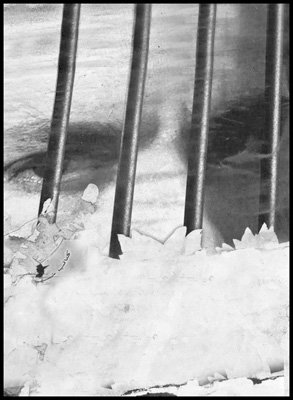

You are missed
© 2012, Rehab Nazzal
National Lawyers Guild Palestine Subcommittee calls for release of Amer Jubran, detained in Jordan
NLG International | May 29, 2014
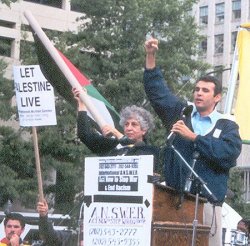 The Palestine Subcommittee of the National Lawyers Guild expresses its grave concern for Jordanian national, Palestinian Amer Jubran who was detained on May 5th, 2014 in Amman, Jordan.
It is our understanding that Jubran has not been charged with any crime and has had no access to a lawyer. Jubran is an internationally recognized and respected speaker, activist and writer on Palestinian human rights, and a critic of the U.S./Israeli occupation of the region. Having already been targeted by the US government for his political speech while a legal resident of the US in 2004, Jubran’s current detention raises concerns that this is a political arrest aimed at silencing dissent and suggests cooperation between Jordanian authorities, the United States and Israel in suppressing criticism of US and Israeli policies.
Jordan is a signatory party to the International Covenant on Civil and Political Rights (ICCPR). Article 9 of the ICCPR prohibits arbitrary arrest or detention, and requires that deprivation of liberty, even if legally sanctioned, must be necessary and reasonable, predictable, and proportional to the reasons for arrest. Article 19 (2) of the ICCPR guarantees the right to freedom of expression, including “freedom to seek, receive and impart information and ideas of all kinds, regardless of frontiers, either orally, in writing or in print, in the form of art, or through any other media of his choice.”
The United Nations Office of High Commissioner on Human Rights has advised that Jordan should end its current practice of administrative detention. Furthermore, Jordan’s penal code has still not been amended to comply with its 2011 guarantees to strengthen constitutional free speech. Jordan proclaims that it is undergoing democratic reforms and respecting civil liberties, claiming to have accepted a number of Amnesty International’s recommendations to limit the use and duration of administrative detention, and to ensure that all detainees are brought before an independent judicial authority promptly after arrest and charged, or else promptly released. However, Jordan’s use of arbitrary arrest and administration detention aimed to limit freedom of speech continues to be criticized in ongoing reports by international human rights organizations.
Friends and colleagues of Jubran have repeatedly contacted the Jordanian Embassy in the United States and the Ministry of the Interior in Jordan. They have been told that Jubran’s detention will be looked into, but no further information has been forthcoming.
The Palestine Subcommittee of the National Lawyers Guild urges compliance with internationally recognized standards of due process and the right to freedom of expression.
We expect
- the prompt release of Jubran, if he is not to be charged;
- access to an attorney of his choosing;
- the prompt setting of a reasonable bail if he is charged;
- visitation with his family;
- consultation with health care professionals;
- the immediate release of information regarding his whereabouts and condition;
- and an immediate explanation of why he has been held since May 5, 2014.
USA Freedom Act has Nothing to Do With Freedom
By Alfredo Lopez | This Can’t Be Happening! | May 28, 2014
It just wasn’t a very good week for phones or for freedom.
Last week’s obscene joke of a bill coughed up by a Congress [1] wheezing with immobilizing congestion morphed an already compromised law about data collection into a green light to spy on everyone.
The bill passed the House last Thursday and is now heading to the Senate where the chances of getting a better bill are pretty slim. The President has endorsed this House bill; after all, it endorses his policies.
Sponsored by Wisconsin Republican Jim Sensenbrenner (the author of the Patriot Act), the ironically named USA Freedom Act’s most salient feature is that, contrary to the bluffery about how it’s going to rein in the government on phone surveillance, it has now made massive phone data capture legal and public. The NSA and related agencies under this supposed “reform” bill would gain full authority to collect all information from phone companies and, what’s more, the bill mandates that the companies hold on to that information (apparently permanently).
The House obviously caved. Not that the first edition of this bill was very good to start with. The government obviously is not going to limit its own power. But the bill as passed by the House is much weaker and, in a “blink if you don’t believe it” moment, many Democratic Congressional leaders are actually congratulating themselves. Even John Conyers (D-Mich.), Detroit’s traditionally progressive Democrat, supported this bill: “We stand poised to end domestic bulk collection across the board,” he said not making clear where he was standing or when domestic bulk collection was going to end. It certainly didn’t end with this bill.
On the other hand, a few Congresspeople did express concern, including Sensenbrenner himself, who called the new law “an abuse” of the Patriot Act. One is left wondering what the Wisconsin lawmaker expected from the draconian nightmare he authored.
While that little humorless comedy was playing out, we got another glimpse of how phone surveillance is being used. Wikileaks revealed that the NSA has been collecting phone data on virtually all phones in Afghanistan. This comes on the heels of revelations a few days earlier about such mass phone call collection in the Bahamas, Mexico, Kenya and the Philippines. The punch-line to this gross violation of people’s rights is that the bill passed last week doesn’t even mention international phone call capture — that’s still left completely unregulated.
There’s a lot wrong with the bill passed through the House [2] and that’s obvious from the scenario of “permitted activity” that the bill is based on. Essentially, phone companies have to hold records for an unspecified period of time. The government can’t collect them indiscriminately as it had previously done. But that “reform” is meaningless because government agencies can acquire data from any phone company by using either a specific court order through the Foreign Intelligence Surveillance Act (FISA) court (the NSA’s rubber stamp in robes) based on “selectors,” or on the basis of an emergency situation defined according to NSA criteria.
The problem lies in the definition of “selectors” — the filters used to determine whether or not specific information is captured or requested. Previously, the NSA would capture the phone data and then run it through its “selectors” to determine what gets pulled or retained. Now, they can either ask the telephone company to run the selectors or go in and run it themselves. Before doing that, the spy agency must present the selection set to the FISA court. Since the court is going to approve anything NSA requests (it has rejected less than one percent of all requests up to now), the definition of the selectors is important because they are the only element of restraint in the entire collection process.
The bill requires that a selector be “a discrete term, such as a term specifically identifying a person, entity, account, address, or device”. How much is included under that umbrella? It’s probably better to ask what isn’t included. With that list, under this law, the NSA is allowed to access the records of almost all Americans.
But we still won’t know how many records have been accessed because this version strikes provisions in the original draft that would have forced phone companies to tell us how many records they’ve had to release to the NSA. Under the just-passed version of the bill, if the company wants to tell us, it can’t until six months after it has received a request. If it’s a start-up, it can’t do a report for two years.
In short, the law puts an automatic gag order on phone companies in this country.
In the guise of protecting our privacy or limiting surveillance power, the bill also continues to allow “about searches” in which an international conversation is scanned for names of people who then become targets of investigation. That particularly nasty practice makes any provisions protecting Americans useless. If a person in another country mentions your name, you are a legitimate target. In the original bill, any “reverse targeting” of this type was outlawed, but that protective provision has been eliminated from the version the House just passed.
This type of “foreign connection” is looming more important with recent revelations about international phone capture. This week, several publications released the information [3] about the complete capture of phone data in several countries but refused to name one of them (for national security reasons). Wikileaks, in response to that weak-kneed journalism, then named it: Afghanistan. (Even Glenn Greenwald, who broke the international capture story based upon some of NSA whistleblower Edward Snowden’s documents, honored a government request not to name Afghanistan.)
While fans of spy-craft will defend this practice of massive spying on international phones, under the curious but oft-repeated theory that our rights only pertain to people in this country, this sweeping capture program goes way beyond any traditional spying. In fact, phone data capture bears no resemblance to espionage or traditional spying (which is selective in its targeting) and is much closer to the activities of a police state. When done to another country, it’s a lot like trying to police the other country: a virtual act of virtual war.
It’s grotesque to consider that, after over 12 years of war waged on Afghanistan, our government is now waging a war of information capture against its people. But that revelation is proof of what many have been saying about this country’s intentions in that beleaguered and battered nation: we have absolutely no intention of pulling out of Afghanistan, no matter what President Obama says.
In fact, the phone data captured targets not only Afghans but phone calls from U.S. diplomatic and military personnel. In short, the NSA is spying on the military and the diplomatic core, including even the CIA. This is truly the stuff of a police state.
The entire phone capture controversy underscores another important political fact: the cell phone is now the most popular access to the Internet among people in developing countries and among young people and people of color in this country. These are also the people who are going to provide the sharpest and most aggressive challenges to the world’s governments in the coming years of deepening crisis. If our government wants to control anybody, it’s these people. The USA Freedom Act demonstrates one way they are planning to do that.
Despite promise, US govt moves to classify justification for drone killing of American
RT | May 29, 2014
The Obama administration has launched a sudden effort to keep classified additional parts of a memo outlining the legal justification for the drone killing of an American a mere week after saying it would comply with a federal ruling to release the memo.
In January 2013, a Federal District Court judge decided that the US Justice Department could keep the document classified entirely. That ruling stood until April 2014, when a panel of the US Court of Appeals for the Second Circuit in New York ordered the government to publicize key parts of the document that provided the legal rationale for the drone strike that killed Anwar al-Awlaki.
Awlaki was born in New Mexico before moving to Yemen with his family as a child. He returned to the US again to attend college but eventually became a prominent Al-Qaeda propagandist who American intelligence officials have claimed helped plot terrorist attacks. He was killed by a September 2011 drone strike in Yemen that was authorized based on the 41-page memo, dated July 16, 2010.
President Barack Obama praised the strike at the time, telling reporters that Awlaki’s death was a “major blow to Al-Qaeda’s most active operational affiliate.”
The New York Times and American Civil Liberties Union have sought the release of the memo under the Freedom of Information Act.
It has been an issue of contention of late because David Barron, the former Justice Department attorney who wrote the memo, was confirmed by the US Senate by a narrow vote last week as a judge on a US appeals court. A number of senators said they would only vote to confirm Barron if the administration agreed not to appeal the April decision and release a redacted version of the document.
“I rise today to oppose the nomination of anyone who would argue that the president has the power to kill an American citizen not involved in combat and without a trial,” Senator Rand Paul said last week. “It is hard to argue for the trials for traitors and people who would wish to harm our fellow Americans. But a mature freedom defends the defenseless, allows trials for the guilty, and protects even speech of the most despicable nature.”
In a new court filing obtained by The New York Times, however, assistant US attorney Sarah Normand now argues that some of the information the administration pledged to reveal should actually remain secret.
“Some of the information appears to have been ordered disclosed based on inadvertence or mistake, or is subject is distinct exemption claims or other legal protections that have never been judicially considered,” she wrote.
The Justice Department also asked that the court keep the request for parts of the memo to remain secret. That request was denied, with the judge ordering the government to unveil previously secret negotiations between the court and prosecutions deliberating which aspects of the Barron memo would remain in the dark.
“It’s deeply disappointing to see the latest effort by the government to delay even further the release of this memo to the public,” New York Times attorney David McCraw told Politico. “The government reviewed the Second Circuit’s opinion before it was released. The court made redactions in response to that review. The fact that the government then waited five weeks to file a motion – seeking yet another opportunity to review what it has already reviewed – says volumes about the administration’s position on transparency.”
Senator Mark Udall (D-Colorado) was one of the lawmakers who said he only voted to confirm Barron because of the administration’s promise that “redactions to the memo would focus on still-classified information – not the legal reasoning itself,” he told the Times.
“I intend to hold the White House to its word,” Udall added.
Activists demand answers after news of NYPD spying on political groups
RT | May 27, 2014
Following the news that the New York Police Department sent undercover officers to monitor political organizations, multiple activist groups are looking for an audit of the department’s wide-ranging surveillance program.
The complaint has been filed with the NYPD’s new office of the inspector general, which the City Council created against the wishes of former Mayor Michael Bloomberg in order to oversee the police department’s policies – particularly in light of criticism regarding its stop-and-frisk tactics and surveillance of Muslim communities.
According to the New York Times, the groups are calling for a comprehensive investigation into the NYPD’s intelligence division, which has been operating the police force’s surveillance program for years. The move comes as the groups seek more transparency from police following the election of new Mayor Bill de Blasio, whose administration they believe will be supportive.
“We need tangible, concrete proposals of how we can ensure the NYPD does not target an entire group, set of groups, or political activists in general based on their participation in political advocacy,” the complaint reads.
Although most of the parties involved were not named, the Times revealed that one of the organizations behind the complaint is Friends of Brad Will – a group dedicated to increasing public awareness of human rights abuses connected to the “War on Drugs.”
As noted by the newspaper, the group believed it had attracted the attention of the police for years, and investigative reporting by the Associated Press confirmed that “an undercover officer had infiltrated a Friends of Brad Will meeting in New Orleans in 2008 and had sent a report noting plans for future actions by the group.”
In addition to spying on political groups, Reuters reported that police classified those employing civil disobedience as “terrorist organizations” and kept secret files on individual members.
Much of the NYPD’s surveillance efforts could be traced to the aftermath of the September 11 attacks on the World Trade Center, but the groups claim police activity has negatively affected their ability to organize and that their constitutional rights to assemble, petition the government, and practice free speech have been violated.
“These kinds of police programs can’t just be laid at the feet of a post-9/11 world and the argument that security outweighs legal protections,” Friends of Brad Will coordinator Robert Jereski told Reuters.
According to the Times, the complaint is requesting that the inspector general disclose “a full description of the training which officers undergo before being tasked with targeting political activists.”
This isn’t the first time that the NYPD has come under fire for political surveillance, either. In 2004, police were found to be monitoring church groups, anti-war organizations and others in the lead-up to the Republican National Convention. Police defended their behavior, arguing their efforts were aimed at preventing unlawful activity, not silencing dissent.
“There was no political surveillance,” NYPD intelligence unit leader David Cohen testified regarding past tactics. “This was a program designed to determine in advance the likelihood of unlawful activity or acts of violence.”
The most recent complaint also comes a little more than a month after the NYPD disbanded a controversial “Demographics Unit” tasked with detailing everyday life in predominantly Muslim communities in the wake of 9/11. As RT reported previously, no terrorism-related leads were generated despite the resourced dedicated.
“The Demographics Unit created psychological warfare in our community,” said Linda Sarsour of the Arab American Association of New York. “Those documents, they showed where we live. That’s the cafe where I eat. That’s where I pray. That’s where I buy my groceries. They were able to see their entire lives on those maps. And it completely messed with the psyche of the community.”
Japanese Government Snubs Anti-Nuclear Public Sentiment
RIA Novosti | May 26, 2014
MOSCOW – The public comment period for Japan’s new draft energy policy resulted in more than 90 percent of respondents saying they oppose the nuclear portion of the plan, Japan’s second largest newspaper, Asahi Shimbun, reported.
The newspaper reviewed the public comments to the draft of the first post-Fukushima basic energy policy, released by Japan’s Ministry of Economy, Trade and Industry in early December. The respective comments, gathered throughout a month, were disclosed in February and counted by Asahi Shimbun with the goal of identifying the proportion of negative and positive public reactions.
The 2,109 emails counted by Asahi Shimbun revealed that 95.2 percent opposed nuclear power generation, with as few as 33 responses arguing in favor of government energy policy including nuclear power.
Though shocking in terms of disregard to the public will, the results of the survey are consistent with the determination of the Abe administration to stick to the pro-nuclear policy. Even a recent ruling by the Fukui District Court against a restart of a nuclear reactor currently offline was identified as a “minor setback” to the energy policy draft by the Japanese government.
Egypt revokes citizenship of Associated Press journalist
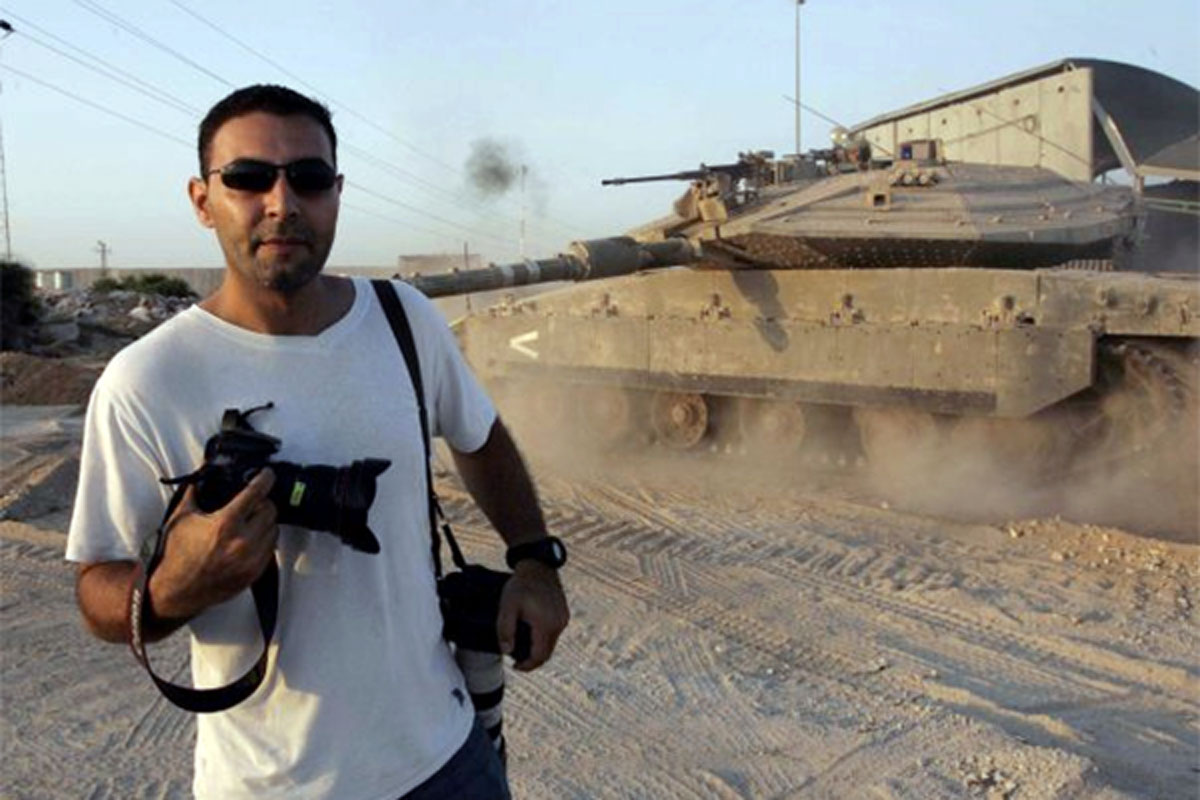
Award-winning photojournalist Khalil Abdel-Kader Abu Hamra
MEMO | May 26, 2014
The Egyptian cabinet decided Sunday to revoke the Egyptian citizenship from a Palestinian Associated Press photojournalist on charges of membership in a foreign militant group.
Award-winning AP photojournalist Khalil Abdel-Kader Abu Hamra said in statements Sunday that he had lived in Egypt for a long time, and was never harassed by authorities whenever he travelled abroad. The Ministry of Interior stated that Hamra left Egypt on November 27, 2013 and never came back. It accused him of “membership in a foreign militant group that aims at disrupting social and economic order of the Egyptian state.”
Hamra, whose mother is Egyptian and his father Palestinian, obtained Egyptian citizenship since 2012 in accordance with Egyptian law, which allows Palestinians with Egyptian mothers to receive citizenship.
Hamra said he has been in vacation in Jordan for few days, and travelled from Egypt and returned without facing any problems by airport authorities.
He added that he has no political affiliations, and that he is merely a journalist by profession.
Hamra said he will take necessary legal measures to appeal the “unjustified” decision.
The Creeping Decriminalization of Marijuana in the Caribbean
By Kevin Edmonds | The Other Side of Paradise | May 23, 2014
While the decriminalization of marijuana has been a topic of discussion for decades, those in attendance at this week’s Jamaica Cannabis Conference are doing more than just blowing smoke—they are discussing the upcoming stages of a long-overdue and vital transformation of the Caribbean’s regional economy. Jamaica has long been associated with potent, naturally grown marijuana, but also the unfortunate social ills that have accompanied its criminalization.
While marijuana, or ganja, arrived in the Caribbean with Indian indentured laborers in the mid-1800s, it was not criminalized until 1913, when the Ganja law came into effect at the behest of the church and colonial elites. The ban was largely based on ignorant, racist perceptions of the evil effects that ganja would have on the poor black majority, and thus dealt out fines and other oppressive penalties for consumption or cultivation. During the 1940s and the 1950s, despite the cultivation of ganja for spiritual and medical reasons, it became the routine justification for government raids upon the original, self-sufficient Rastafari community of Pinnacle.
Despite Jamaica’s independence in 1962, the colonial origins of criminalizing ganja were not eroded, but strengthened. When Jamaica signed the United Nations Convention on Narcotic Drugs in 1964, it became obligated to treat marijuana as a harmful drug, following the prevailing attitude of the United States. Under the banner of the War on Drugs, the Jamaican government diverted millions of dollars from social development to eradicate marijuana plantations through aerial spraying. If Jamaica refused, under the conditions of the U.S. Drug Certification Policy enacted in 1986, Jamaica would risk losing access to U.S. trade, aid, loans, and visas.
There are very serious human rights issues associated with the prohibition of marijuana. Across the Caribbean, courts are backlogged with simple possession charges for small quantities of marijuana. In one case in St. Lucia, fines for small quantities of marijuana reached $200, or up to 30 days in jail. These charges in turn limit employment and travel opportunities, creating inter-generational disadvantages for those who face jail time. As a result of the overloaded prison systems across the region, the economic and social costs of marijuana are tremendous, as much needed economic resources are taken away from social development and funneled towards an endless cycle of law and order policies.
In addition, the criminalization of marijuana has also led to the unfortunate and unnecessary marginalization of the Rastafari community, which regard the herb as a holy sacrament. Last August St. Lucian journalist Earl Bousquet commented on the negative portrayal of marijuana in the 1960s and 1970s:
Marijuana was… pinned to the Rastafarian movement that started spreading to the rest of the region from Jamaica at the same time. The then leaders erroneously hoped they could easily do away with ‘Rastas and marijuana’ through new laws and armed police forces. By legally twinning Rastafarianism with an illegal substance, growth of a positive and distinctively Caribbean social movement driven by the works of Marcus Garvey, rooted in Pan Caribbean-African nationalism and advocating closer communion with nature half-a-century ago was stifled, suppressed and forced to spend more time resisting and fighting ‘Babylon’ than refining the philosophical, spiritual, cultural and political base of the only indigenous Caribbean movement of its kind in the 20th century.
As a further result of these criminalization policies, Jamaica now has to play catch up in the newly emerging legal and medical marijuana market, according to Dr. Albert Lockhart, a leading ophthalmologist and noted speaker at the Cannabis Conference, who stated that “we are 40 years late.” Dr. Lockhart has helped to pioneer medicine derived from marijuana such as Canasol (which treats glaucoma) and Asmasol (which treats asthma), but due to lack of funding their discoveries are not widely known outside of the island. Dr. Lockhart further warned that if Jamaica does not act now it would be at risk of missing the boat, losing out to countries such as the United States, where the states of Colorado and Washington have fueled the push for legalization across the region—and Canada where medical marijuana has become big business.
Phillip Paulwell, Jamaican Minister of Science and Technology, has assured interested parties that marijuana will be decriminalized by the end of the year. Paulwell remarked that “I am of the firm opinion that scientific research into marijuana, both in the very many uses of the plant as hemp, and its medical properties, is an idea whose time has come,” adding that a marijuana-based medical industry could earn as much as $5.2 billion.
So the Cannabis Conference closed with hope that Jamaica and the wider Caribbean will be able to finally cash in and create a world leading, legal industry which not only acts as a cash crop and provides much needed agricultural jobs, but also as the building blocks for the development of wide ranging medical treatments. Additionally, the new CARICOM Regional Commission on Marijuana Use shows a regional investigative interest. Beyond just decriminalization, the Ganja Future Growers and Producers Association has been advocating for a regulatory model that will benefit small growers instead of large corporations, stating: “For the first three years of a regulated industry, licenses should only be given to plots of one acre or less.” The taxable income from the industry has the power to transform stagnating Caribbean economies and will allow them to have the self determination to rightfully produce a quality product which the world has always demanded in great quantity, but has been criminalized for far too long.
Kevin Edmonds is a NACLA blogger focusing on the Caribbean. Edmonds is a former NACLA research associate and a current PhD student at the University of Toronto, where he is studying the impact of neoliberalism on the St. Lucian banana trade. Follow him on twitter @kevin_edmonds.
Self-proclaimed Donetsk and Lugansk republics form ‘Novorossiya’ union
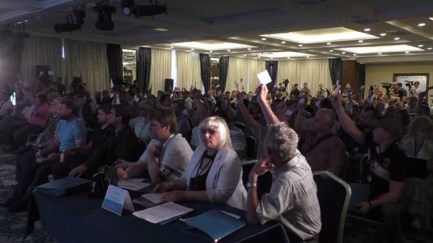
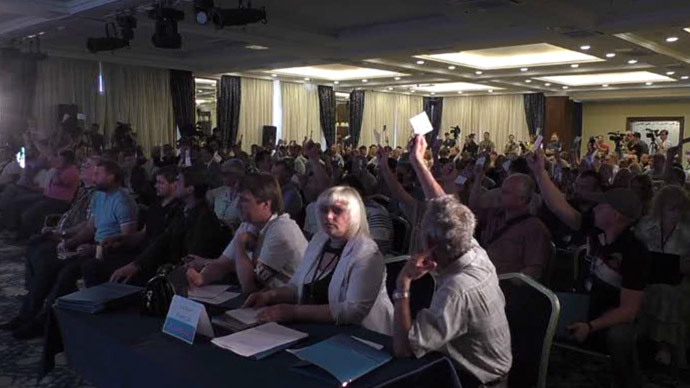
Representatives from eight south-eastern regions voting at the people’s congress in Donetsk
RT | May 24, 2014
Self-proclaimed Donetsk and Lugansk People’s Republics which recently held referenda on independence from Ukraine have declared the creation of Novorossiya union.
“We have signed a memorandum on the union,” Denis Pushilin, co-chairman of the Donetsk People’s Republic, told the media.
The new union will be called Novorossiya, said the people’s governor of the Donetsk Region, Pavel Gubarev.
He added that the document was signed in the city of Donetsk by Donetsk People’s Republic Prime Minister Aleksandr Borodai and the head of Lugansk People’s Republic Aleksey Karyakin.
People’s representatives from eight Ukrainian regions gathered for a congress in Donetsk on Saturday, a day ahead of scheduled countrywide presidential elections.
As a result of the congress, the south-eastern regions of Ukraine, where anti-government protests gained momentum, have announced the creation of a pro-federalization Popular Front socio-political coalition. The movement accepted a manifesto vowing self-determination and protection of people from “Nazi gangs’ terror.”
The coalition involves Odessa, Nikolaev, Dnepropetrovsk, Zaporozhye, Kharkov, Kherson, Donetsk and Lugansk Regions.
At the congress, all 145 delegates accepted the manifesto, which stresses that the Popular Front will consist of “everybody, who is ready to resist self-appointed Kiev authority, which started war against the people.”
The coalition vowed to protect innocent civilians from the “terror of Nazi gangs, financed by oligarchs and foreign security services.” It also pledges “a joint fight for people’s rights to a decent life.”
It says it has launched an investigative commission that will probe “crimes of Nazi-terrorists and their Kiev patrons”.
The coalition is calling for a boycott of the presidential election, which is scheduled to take place on Sunday, because “all major candidates” are “oligarchs, whom we have already seen in top positions, hence, robbery and terror would continue,” the manifesto said.
When it comes to a new Ukrainian constitution, the Popular Front demands that it guarantees “neutrality” and non-participation in military blocks as well as “political independence”, “mechanisms to stop corruption and massive poverty.”
The coalition also demands that the parliament consists of two chambers. At the same time, regions must be given “a right to autonomy” and “independent foreign-economic activity”.
In addition to that, regional governments must be given a right to “announce its territory de-militarized zones and also “ban political, social and religious organizations on its territory” in case they are considered a “threat” to the people.
The Popular Front wants two official languages in Ukraine – Ukrainian and Russian.
Lugansk and Donetsk People’s Republics earlier announced they will not participate in Ukraine’s presidential elections scheduled for May 25.
Fascism or the Bankruptcy of the Left?
The anti-EU movement spreads all over Europe… apart from Ukraine*
By TAKIS FOTOPOULOS | The International Journal of INCLUSIVE DEMOCRACY, Vol. 9, Nos. 1/2 (2013)
The events in Ukraine have been instructive, even though the mass media of the Transnational Elite (TE) have created the false impression that there has been a popular “revolution” there by cretins fighting for their right to become the TE’s slaves within the EU, so that they may starve like the Greek people! But I will not dwell here on the orange “revolution” that has just been staged in this country by the pro-western bourgeoisie and petty bourgeoisie of Kiev, with the decisive assistance of the provocateurs of the TE’s intelligence services who organized it[1], but rather on the two main lessons to be learned from it, which are especially important for all European peoples and, in particular, for the Greek people.
Firstly, social struggle in the era of neoliberal globalization can no longer be just a struggle for social liberation, as obsolete Marxists still believe today and some Trotskyites have always believed even during the Nazi occupation when they called upon German workers in the Nazi army to fraternize with occupied workers, while some “Marxists” and “anarchists” today still call for similar fraternization between the Zionist occupiers in Israel and the occupied Palestinians! The struggle for social liberation today must, first and foremost, be a struggle for national liberation. This becomes obvious when one considers the fact that, when a country (not belonging to the TE, i.e. mainly the “G7”) is incorporated into neoliberal globalization, it loses every trace of economic and, consequently, national sovereignty. This is why the struggle for social liberation today is inconceivable unless it has already gone through national liberation. The occupying troops that are now destroying and plundering Greece (or Portugal, Spain and Italy) and its weakest social strata (with the full cooperation of a small, local privileged elite which controls the media, the political parties, the “Left” intelligentsia etc.) are not a regular army in uniform and with lethal weapons of physical violence at their disposal, but an economic army in suits, possessing equally lethal instruments of economic violence, as well as the means to justify it.
Secondly, the target of social struggle today can only be neoliberal globalization, which is managed by a TE ensuring that only its own bogus revolutions succeed (the orange “revolutions” in Eastern Europe in the past[2] and today, or the pseudo-uprisings in Libya,[3] Syria, etc.) while even the attempted uprisings of the TE’s victims in Greece and elsewhere are suppressed in the most brutal way as soon as they occur – and yet Baroness Ashton finds nothing wrong with this, nor does she detect any violation of human rights occurring. Similarly, the peoples who resist being integrated into neoliberal globalization are condemned to remorseless slaughter, as the Libyan and Syrian people have been. Nevertheless, the impudent Barroso did not hesitate to declare that human rights had been violated in Ukraine when the police dared to beat “protesters” who attacked government buildings with bulldozers, “forgetting” that such conduct in any other “democratic” EU country would have sent many to the morgue!
In other words, contrary to the misleading propaganda of the degenerate “Left”, globalization is not a chimera, or just a continuation of the internationalization of the market economy taking place at the beginning of the last century, but, rather, a systemic phenomenon which can only be neoliberal within the capitalist system, as can easily be shown. Similarly, neoliberalism is neither a doctrine (of “shock” and similar fairy tales)[4] nor the bad policy making of certain “bad” neoliberal politicians and economists. It is simply the ideology of globalization. Neoliberal globalization is, in other words, the necessary institutional framework that ensures the opening and liberalization of the markets (capital, goods and labor), which is required for the effective operation of the transnational corporations that currently control the globalized economy.
On the basis of this analytical framework it is not surprising that an unprecedented mass movement “from below” is currently spreading throughout Europe, challenging the EU directly but also neoliberal globalization indirectly. This movement is essentially comprised of the victims of globalization who are driven to mass unemployment and poverty, as well as to homelessness, starvation or even suicide. These popular strata sooner or later become aware of the fraud of the degenerate “Left”, which consciously misleads them by claiming that the current disaster could be overcome even within the EU, despite the loss of economic and national sovereignty. Then, these strata inevitably turn to nationalist movements of all kinds, since these are the only ones that raise the anti-EU flag: from patriotic to neo-Nazi movements – depending on the local conditions. But this nationalism, which both the Transnational and Zionist elites condemn with such disgust (at the very moment when the strongest nationalist state today is the Zionist one!), has little to do with the prewar aggressive nationalism that led to two World Wars. It is a new kind of nationalism which is fundamentally defensive and does not aim to conquer new “vital space” etc. like the pre-WWII nationalism. Above all, it aims to “protect” national sovereignty (national culture, domestic labor, etc.) that is under threat from the opening and liberalization of the markets imposed by globalization.
The main reason that these popular strata have been turning to nationalist movements is, therefore, not that they have suddenly become fascist (as the TE claims in an attempt to defame them); it is the bankruptcy of the degenerate “Left” which, rather than raising the anti-EU flag in place of the nationalists to promote a struggle for social and national liberation, is engaged in “antifascist” struggles together with privileged “leftists”. It is not surprising, then, that this “Left” implicitly consents to the passing of “anti-fascist” legislation, as required by the Transnational and Zionist elites, so that it may effectively ban such movements that threaten its hegemony. In Greece, for instance, a so-called “anti-racist” bill is now being passed through Parliament, which effectively bans freedom of thought (not action!). This bill means, for example, that if somebody supported the national liberation struggle of the Syrian Baathist leadership against the TE and the criminals, pretending to be rebels, who have destroyed this country, s/he might end up in jail for supporting war crimes against humanity. This is based on a very recent utterly biased report by the well known instrument of the TE, the UN Human Rights Commission, which asserted that as Navi Pillay, the UN’s human rights chief, said there is “massive evidence … [of] very serious crimes, war crimes, crimes against humanity” and that “the evidence indicates responsibility at the highest level of government, including the head of state”.[5] Of course, neither this committee nor Navi Pillay who once said that “the Commissioner is the voice of the victim everywhere,”[6] nor its blood brothers among the NGOs for human rights (Amnesty International, Human Right Watch, etc.) have ever dreamed of declaring the arch-criminals Bush, Blair et al. to be guilty of war crimes, even though they are responsible for the deaths of millions of people. Presumably, the millions of people killed or maimed by war criminals like them are not victims, according to Mrs Pillay’s definition of a victim!
However, the Greek “Left”, i.e. the SYRIZA party, instead of mobilizing the people against this unashamedly fascist law, has quietly consented to it by merely abstaining from voting (only the Greek Communist Party and the ultra-nationalist Golden Dawn party voted against it). It should be noted that SYRIZA, together with its leader, Alexis Tsipras – who has been heavily promoted by the media of the TE – is destined by the same elites to succeed the present parliamentary junta in implementing the same policies but under a “Left” cover. Yet the sordid professional politicians who voted in favor of this openly fascist law dare to speak of democracy and the fight against fascism. This blatant bankruptcy of the “Left” is yet another major reason why a mass popular Front is needed in Greece and in all other countries which have fallen victim to the TE that administers neoliberal globalization, as I stressed in my last article.[7]
* This is an expanded edited version of an article by Takis Fotopoulos under the same title published in the Athens daily Eleftherotypia (8/12/213).
[1] See e.g. Stephen Lendman, “Ukraine: Orange Revolution 2.0?,” Global Research (6/12/2013).
[2] Takis Fotopoulos, “The Ukrainian Crisis and the Transnational Elite,” The International Journal of INCLUSIVE DEMOCRACY, vol.1, no.4 (July 2005).
[3] Takis Fotopoulos, “The Pseudo-Revolution in Libya and the Degenerate Left,” Part I & Part II, The International Journal of INCLUSIVE DEMOCRACY, Vol. 7, No. 1 (Winter-Spring 2011).
[4] See e.g. Naomi Klein, The Shock Doctrine (Penguin, 2007).
[5] Ian Black, “Assad implicated in Syrian war crimes, says UN,” The Guardian (3/12/2013).
[6] Jonah Fisher, “Profile: New UN human rights chief,” BBC News (28/7/2008).
[7] Takis Fotopoulos, “Globalization and the End of the Left-Right Divide” (Part I), The International Journal of INCLUSIVE DEMOCRACY, Vol. 8, Nos. 3/4 (Fall 2012-Winter 2013).
Congress reaffirms indefinite detention of Americans under NDAA
RT | May 22, 2014
The US House of Representatives approved an annual defense spending bill early Thursday after rejecting a proposed amendment that would have prevented the United States government from indefinitely detaining American citizens.
An amendment introduced in the House on Wednesday this week asked that Congress repeal a controversial provision placed in the National Defense Authorization Act of 2012 that has ever since provided the executive branch with the power to arrest and detain indefinitely any US citizen thought to be affiliated with Al-Qaeda or associated organizations.
“This amendment would eliminate indefinite detention in the United States and its territories,” Rep. Adam Smith (D-Washington), a co-author of the failed amendment, said during floor debate on Wednesday, “So basically anybody that we captured, who we suspected of terrorist activity, would no longer be subject to indefinite detention, as is now, currently, the law.”
“That is an enormous amount of power to give the executive, to take someone and lock them up without due process,” Smith added. “It is an enormous amount of power to grant the executive, and I believe places liberty and freedom at risk in this country.”
Pres. Barack Obama vowed when he signed the 2012 NDAA into law on December 31, 2011 that he would not use the indefinite detention powers provided to him by Congress. When that provision was challenged in federal court, however, the White House fought back adamantly and appealed a District Court ruling that initially reversed the indefinite detention clause, eventually sending the challenge to the Supreme Court where it stalled until earlier this month when the justices there said they would not consider the case.
The bill sponsored by Smith and co-author Rep. Paul Broun (R-Georgia) would have given the legislative branch a chance to repeal the same provisions that SCOTUS declined to hear, but the bipartisan amendment failed on a vote of 191 to 230.
A separate proposal from Rep. Smith meant to expedite the shut-down of the military prison at Guantanamo Bay, Cuba was also rejected early Thursday; an amendment from Rep. Dennis Ross (R-Florida) intended to cut federal funding for recreational facilities at Gitmo, however, was approved in the NDAA draft that left the House on Thursday.
On Twitter, Smith said he was “disappointed” but “won’t stop fighting to pass this critical legislation.”
And while the White House is unlikely to abandon its own fight with regards to keeping the indefinite detention provision intact, the Obama administration threatened to veto this year’s NDAA because it would continue to complicate the president’s promise to close the Guantanamo Bay facility — a vow older than his own administration.
“If this year’s Defense Authorization bill continues unwarranted restrictions regarding Guantanamo detainees, the president will veto the bill,” White House Press Secretary Jay Carney said in a statement Wednesday evening.
When the 2011 NDAA passed Congress with the controversial indefinite detention provision included, the White House said at the time that it would veto the legislation before Pres. Obama eventually balked.
Featured Video

Seyed M. Marandi: US-Iran War Inevitable: Kuwait and Bahrain May Fall
or go to
Aletho News Archives – Video-Images
From the Archives
Oil and the Israel Lobby
Reknowned economist M. Shahid Alam offers this excellent critique of Noam Chomsky’s defective analysis of the relative influence of Oil versus the Israel lobby over US foreign policy: … continue
Blog Roll
 Aletho News
- ICC ignored ‘very well-documented’ NATO crimes – ex-Libyan minister
- SNSC secretary dismisses US response to Iran’s conditions as ‘inadequate’
- Sanaa says Taiz roads open, secure for residents, warns Saudi forces
- Iraqi resistance group urges Saudi leadership to admit defeat, lift Yemen siege
- Trump’s Retreat: How Al-Aqsa Flood Took Down the US Empire
- Israel’s Military Actions in Lebanon Grossly Violate International Law — Lavrov
- Seyed M. Marandi: US-Iran War Inevitable: Kuwait and Bahrain May Fall
- Leaders Condemn Ansarallah Attack on Saudi Arabia While Ignoring Illegal War Against Yemen
- Leaked: Britain’s Covert Iraqi Psyops Network
- Yemeni Armed Forces Warn Airlines Against Using Saudi Airports, Exempt Mecca and Medina
- If Americans Knew
- After Oct 7, IDF policy allowed civilian casualties for even the lowest-ranking targets
- Israel’s Destruction of Southern Lebanon Intensified After the Cease-Fire
- The Last-Minute Decision That Gave Israel Its Name
- The American Conservative: How Trump Made the World Go Nuclear
- Meet the US generals and admirals advancing Israeli policy
- Opinion: Why news organizations should boycott Israel
- The Israeli witch hunt of Sami Abu Shehadeh exposes the lie of the ‘Jewish and democratic’ state
- No state has a ‘right’ to exist – least of all Israel
- Testimonies about Gaza’s civilian death toll expose Israel’s atrocities – Daily Update
- How Israel Conquered the Latin American Right
- No Tricks Zone
- New Study Suggests Large Regions Of The Pacific Ocean Have Been Cooling For The Last 80 Years
- Germany’s Green Energy Debacle: High Energy Costs Force Kahla Porzellan to Close After 182 Years!
- New Study: 50 Years Of The Most Aggressive ‘Net Zero’ Policies Can Only Affect The Global Climate By 0.03°C
- US September “Heat” Was No Record…Many Records Set Decades Ago
- Latest European Green Energy Debacle; Portugal’s Largest Flagship Solar Park Insolvent!
- Green Energy Debacle: German Expert Professor Fritz Vahrenholt Warns Of Severe Economic And Social Consequences
- Two More Paleo Reconstructions Affirm Meters-Higher Sea Levels Across Ireland, Brazil 7000-6000 Years Ago
- New Study: Earth And Venus Surface Warmth Largely Explained By Convection And Lapse Rate, Not CO2 Or Radiation
- 2025 Nature Paper Claiming Worsening Global Drought Gets RETRACTED …Heavily Flawed
- New Study: ‘Global Drought Shows No Detectable Recent Acceleration Under Climate Warming’

