Legal Residents Claim They are Punished for Living Near Mexican Border
By Noel Brinkerhoff | AllGov | January 23, 2014
A leading civil rights group has accused Border Patrol agents of abusing the constitutional rights of U.S. citizens and legal residents living in southern Arizona.
The American Civil Liberties Union (ACLU) is demanding a government investigation of those guarding the border with Mexico.
“Border Patrol checkpoints today bear little resemblance to those authorized by the Supreme Court. Many Border Patrol officials do not understand—or simply ignore—the legal limits of their authority at checkpoints,” James Lyall, an attorney with the ACLU of Arizona, said in an administrative complaint (pdf) sent to the Department of Homeland Security’s (DHS) Office of Inspector General and Office of Civil Rights and Civil Liberties.
The ACLU also forwarded its complaint to Arizona’s congressional representatives, the U.S. Department of Justice and Customs and Border Protection (CBP).
At least 15 American citizens have been subjected to unlawful acts by Border Patrol agents at checkpoints in Arizona, the ACLU claims.
“Residents often experience extended interrogation and detention not related to establishing citizenship, unwarranted searches, racial profiling, verbal harassment, and physical assault, among other abuses,” the letter said.
In one instance, a Border Patrol agent drew his gun at a driver, pulled him from his car and handcuffed him for 45 minutes after the individual declined to answer questions unrelated to citizenship.
Another incident saw Border Patrol agents order a driver and passenger from their vehicle, and place them in wire cages while their car was searched—and all because a service dog detected something in another car.
A third case involved a mother of twin six-year-old children being threatened and assaulted by agents for lawfully attempting to record a search of her vehicle following a false canine alert.
All of the aforementioned individuals, as well as others mentioned in the ACLU complaint, were released and never charged with violating immigration or other laws. The ACLU wants the incidents it documented to be investigated.
The group previously filed two other complaints (in April 2012 and October 2013) alleging abuses by Border Patrol agents. To date, it has not received a response from the government about them.
“The ACLU believes the lack of response to widespread civil rights abuses by the nation’s largest federal law enforcement agency is symptomatic of broader oversight failures within CBP and DHS,” it said in a press release.
To Learn More:
Border Patrol Checkpoints in Southern Arizona Violate the Constitutional Rights of Border Residents, ACLU of Arizona Demands Investigation (American Civil Liberties Union of Arizona)
Complaint and Request for Investigation of Abuses at U.S. Border Patrol Interior Checkpoints in Southern Arizona, including Unlawful Search and Seizure, Excessive Force, and Racial Profiling (American Civil Liberties Union of Arizona and American Civil Liberties Union Border Litigation Project) (pdf)
Federal Judge Rules that Border Patrol Does Not Need Reasonable Suspicion to Confiscate Laptops and Phones (by Noel Brinkerhoff, AllGov)
10 Lawsuits Filed against Border Patrol for Abuse (by Matt Bewig, AllGov)

Polls Continue to Show Majority of Americans Against NSA Spying
By Mark M. Jaycox | EFF | January 22, 2014
Update, January 2014: Polls continue to confirm the trend. In a poll conducted in December 2013 by the Washington Post, 66% of Americans were concerned “about the collection and use of [their] personal information by the National Security Agency.” Americans aren’t only concerned about the collection. A recent Pew poll found—yet again—that a majority of Americans oppose the government’s collection of phone and Internet data as a part of anti-terrorism efforts.
Since Americans are both concerned with, and opposed to, the spying, it’s no surprise that they also want reform. In a November 2013 poll by Anzalone Liszt Grove Research,1 59% of respondents noted that they wanted surveillance reform and 63% said they wanted more oversight of the spying programs. While these polls focused on the larger population of Americans, a Harvard University Insitute of Politics poll focusing on younger Americans (aged 18-29 years old) reaffirmed younger Americans are both wary of the NSA’s activities and that a majority do not want the government to collect personal information about them.
Shortly after the June leaks, numerous polls asked the American people if they approved or disapproved of the NSA spying, which includes collecting telephone records using Section 215 of the Patriot Act and collecting phone calls and emails using Section 702 of the Foreign Intelligence Surveillance Act. The answer then was a resounding no, and new polls released in August and September clearly show Americans’ increasing concern about privacy has continued.
Since July, many of the polls not only confirm the American people think the NSA’s actions violates their privacy, but think the surveillance should be stopped. For instance in an AP poll, nearly 60 percent of Americans said they oppose the NSA collecting data about their telephone and Internet usage. In another national poll by the Washington Post and ABC News, 74 percent of respondents said the NSA’s spying intrudes on their privacy rights. This majority should come as no surprise, as we’ve seen a sea change in opinion polls on privacy since the Edward Snowden revelations started in June.
What’s also important is that it crosses political party lines. The Washington Post/ABC News poll found 70 percent of Democrats and 77 percent of Republicans believe the NSA’s spying programs intrude on their privacy rights. This change is significant, showing that privacy is a bipartisan issue. In 2006, a similar question found only 50 percent of Republicans thought the government intruded on their privacy rights.
Americans also continue their skepticism of the federal government and its inability to conduct proper oversight. In a recent poll, Rasmusson—though sometimes known for push polling—revealed that there’s been a 30 percent increase in people who believe it is now more likely that the government will monitor their phone calls. Maybe even more significant is that this skepticism carries over into whether or not Americans believe the government’s claim that it “robustly oversees” the NSA’s programs. In a Huffpost/You Gov poll, 53 percent of respondents said they think “the federal courts and rules put in place by Congress” do not provide “adequate oversight.” Only 18 percent of people agreed with the statement.
Americans seem to be waking up from its surveillance state slumber as the leaks around the illegal and unconstitutional NSA spying continue. The anger Americans—especially younger Americans—have around the NSA spying is starting to show. President Obama has seen a 14-point swing in his approval and disapproval rating among voters aged 18-29 after the NSA spying.
These recent round of polls confirm that Americans are not only concerned with the fact that the spying infringes their privacy, but also that they want the spying to stop. And this is even more so for younger Americans. Now is the time for Congress to act: join the StopWatching.Us coalition.
- 1. Full disclosure: Mark M. Jaycox previously worked for Grove Insight, the polling firm that later became Anzalone Liszt Grove Research.
Ashton continues to support Egyptian regime and expresses satisfaction about the referendum
MEMO | January 21, 2014
 The European Union High Representative for Foreign Policy Catherine Ashton has said that the EU is pleased with the results of last week’s constitutional referendum in Egypt.
In an interview with Al-Jazeera English, Ashton suggested that the referendum was an important step towards returning to the path of democracy.
The referendum was boycotted by the Muslim Brotherhood and other political forces opposed to the military coup that ousted Egypt’s first democratically elected government on 3 July 2013. In the lead up to the referendum, activists campaigning for a “no” vote were harassed and arrested, and during the two-day election several protesters were even killed.
While Ashton noted that the democratic transition must include everyone, she made an exception for those who support “violence” or “terrorism”.
Related article

What President Obama’s Surveillance Speech Should Have Addressed
By Frank Pasquale · Concurring Opinions · January 21, 2014
In his recent speech on surveillance, President Obama treated the misuse of intelligence gathering as a relic of American history. It was something done in the bad old days of J. Edgar Hoover, and never countenanced by recent administrations. But the accumulation of menacing stories—from fusion centers to “joint terrorism task forces” to a New York “demographics unit” targeting Muslims—is impossible to ignore. The American Civil Liberties Union has now collected instances of police surveillance and obstruction of First Amendment‐protected activity in over half the states. From Alaska (where military intelligence spied on an anti-war group) to Florida (where Quakers and anti-globalization activists were put on watchlists), protesters have been considered threats, rather than citizens exercising core constitutional rights. Political dissent is a routine target for surveillance by the FBI.
Admittedly, I am unaware of the NSA itself engaging in politically driven spying on American citizens. Charles Krauthammer says there has not been a “single case” of abuse. But the NSA is only one part of the larger story of intelligence gathering in the US, which involves over 1,000 agencies and nearly 2,000 private companies. Moreover, we have little idea of exactly how information and requests flow between agencies. Consider the Orwellian practice of “parallel construction.” Reuters has reported that the NSA gave “tips” to the Special Operations Division (SOD) of the Drug Enforcement Administration, which also shared them with the Internal Revenue Service.
The legal status of such information sharing is murky at best: the national security data is not supposed to be used for law enforcement purposes. Apparently the SOD sidestepped these niceties by re-creating criminal investigations from scratch, fabricating alternative grounds for suspecting the targets. Thus the “parallel construction” of two realities for the law enforcers: one actual, secret record of how targets were selected, and another specially crafted for consumption by courts. Two senior Drug Enforcement Administration officials defended the program and called it legal, but did not disclose their reasoning. At present, the practice looks like little more than intelligence laundering. Five senators asked the Department of Justice to assess the legality of “parallel construction;” it has yet to respond.
I have little doubt that the DEA used parallel construction in cases involving some pretty nasty characters. It must be tempting to apply “war on terror” tactics to the “war on drugs.” Nevertheless, there are serious legal and ethical concerns here. One of the American revolutionaries’ chief complaints against the British Crown was the indiscriminate use of “general warrants,” which allowed authorities to search the homes of anyone without particularized suspicion they had committed a crime. Thus the 4th Amendment to the US Constitution decrees that “no Warrants shall issue, but upon probable cause.” Law enforcers aren’t supposed to set up “dragnet surveillance” of every communication, or use whatever data stores are compiled by the National Security Agency, unless there is a true security threat.
Between 1956 and 1971, the FBI’s COINTELPRO program engaged in domestic covert action designed to disrupt groups engaged in the civil rights, antiwar, and communist movements. As Lawrence Rosenthal has observed, “History reflects a serious risk of abuse in investigations based on the protected speech of the targets,” and politicians at the time responded. Reviewing intelligence agency abuses from that time period, the Church Committee issued a series of damning reports in 1975-76, leading to some basic reforms. If a new Church Committee were convened, it would have to cover much of the same ground. Moreover, it would need to put in place real safeguards against politicized (or laundered) domestic intelligence gathering. Those are presently lacking. I have yet to find a case where the parties involved in any of the intelligence politicization (or laundering) were seriously punished. Nor have I seen evidence that the victims of such incidents have received just compensation for the unwarranted intrusion on their affairs.
Before we can develop better surveillance policy, we need something like a Truth and Reconciliation Commission to review (and rebuke) the politicization of intelligence gathering post-9/11. Too many privacy activists have been unwilling to admit the persistence of catastrophic threats that may only be detected by spies. But the US government has been even less moored to reality, unwilling to admit that a runaway surveillance state has engaged in precisely the types of activities that the Bill of Rights is designed to prevent. To have a debate about the proper balance between liberty and security, we need to confront the many cases where misguided intelligence personnel spied on activists with neither goal in mind.
Frank Pasquale is Professor of Law at the University of Maryland. His research agenda focuses on challenges posed to information law by rapidly changing technology, particularly in the health care, internet, and finance industries. Frank accepts comments via email, at pasqresearch@gmail.com.
Related articles


OBAMA NOMINATES “WAR CRIMINAL” BARRON TO FIRST CIRCUIT COURT
By Sherwood Ross | Aletho News | January 22, 2014
David Barron, a Harvard law professor who gave President Obama the green light for his illegal global drone attacks, has been nominated by Obama for a seat on the U.S. First Circuit Court of Appeals.
“Barron (co-authored) the infamous Justice department opinion authorizing Obama’s murder of U.S. citizens,” says distinguished international legal authority Francis Boyle of the University of Illinois, Champaign. “It’s a payback.”
“This is a total disgrace. If approved, we will have a murderer and a war criminal sitting on the U.S. First Circuit,” Boyle said. The First District, headquartered in Boston, Mass., includes the states of Massachusetts, Maine, New Hampshire and Rhode Island as well as Puerto Rico.
As a result of Barron’s opinion, Boyle says, “We know that at least three U.S. citizens were murdered in Yemen, including (Islamic cleric Anwar) Awlaki of Las Cruces, N.M., and his 16-year-old son Abdulrahman al-Awlaki,” of Denver, Co., and one other. Still another American citizen was also executed without trial in Pakistan, Boyle said.
Barron co-wrote the June, 2010, legal opinion rationalizing the illegal airstrikes as a member of Justice Department’s Office of Legal Counsel. He was joined by Martin Lederman, a deputy assistant Attorney General in that office.
“So here Barron and Lederman deliberately and maliciously write a get out of jail free card for Obama so that he can murder U.S. citizens, which he does,” Boyle says. “Barron is thus an enabler and accessory before the fact to murder and war crimes” and thus a principal in the first degree with Obama. Accordingly, Boyle says, “Barron is neither fit nor qualified to serve as a Judge on the First Circuit…” a post which would make him a prime candidate for a U.S. Supreme Court seat.
The Barron memo justifies the murder of U.S. citizens without due process of law, in violation of the Bill of Rights and the Fifth Amendment, Boyle says. The precise wording of Amendment V states “No person shall be held to answer for a capital or otherwise infamous crime, unless on a presentment or indictment of a Grand Jury…nor be deprived of life, liberty, or property, without due process of law…”
If Obama’s nomination is approved, Boyle says, “we will have a murderer and war criminal sitting on the U.S. First Circuit and perhaps some day on the U.S. Supreme Court.”
According to the impartial Bureau of Investigative Journalism, London, since 2004 the total number of CIA drone strikes in Pakistan is 381, 330 of them launched by President Obama. BIJ gives the following figures for the period:
Total killed: 2,537-3,646
Civilians killed: 416-951
Children killed: 168-200
Injured: 1,128-1,557
(Sherwood Ross is an award-winning reporter and poet based in Miami who writes on foreign and domestic affairs and runs a PR firm “for good causes.” Reach him at sherwoodross10@gmail.com)
Dianne Feinstein: NSA Would Never Abuse Its Powers Because It’s ‘Professional’
By Mike Masnick | Techdirt | January 21, 2014
Senator Dianne Feinstein, as we’ve noted, seems to have this weird blindness to even the very idea that the NSA might abuse its powers, despite a long history of it doing exactly that. The history of the US intelligence community is littered like a junk yard with examples of massive abuses of power by intelligence folks. And yet, Feinstein seems shocked at the idea that anyone questions the NSA’s ability to abuse the system. Why? Because the NSA is “professional.” Appearing on Meet the Press this weekend, Feinstein just kept repeating how “professional” the NSA is as if that was some sort of talisman that wards off any potential of abuse. First, host David Gregory pointed to reporter Bart Gellman’s claim that President Obama’s NSA reforms will allow for the expansion of the NSA’s collecting personal data on “billions of people around the world, Americans and foreign citizens alike” and told Feinstein that didn’t seem like it was protecting people’s privacy. And Feinstein went straight to her “but they’re professionals!” argument:
Well, I would disagree with Mr. Gellman. I think that what the president has said is that he wanted to maintain the capability of the program. That, as Chairman Rogers said, it has not been abused or misused. And it is carried out by very strictly vetted and professional people.
Of course it has been “abused” and “misused,” but let’s not let details get in the way.
Later in the interview, Gregory asks Feinstein to comment on Rep. Mike Roger’s totally unsubstantiated (and contradicted by nearly everyone else in the know) claims that Ed Snowden was working for Russian intelligence, and Feinstein bizarrely returns to talking about just how “professional” NSA staffers are.
DAVID GREGORY:
And do you agree with Chairman Rogers that he may have had help from the Russians?SENATOR DIANNE FEINSTEIN:
He may well have. We don’t know at this stage. But I think to glorify this act is really to set sort of a new level of dishonor. And this goes to where this metadata goes. Because the N.S.A. are professionals. They are limited in number to 22 who have access to the data. Two of them are supervisors. They are vetted. They are carefully supervised. The data goes anywhere else. How do you provide that level of supervision?
Of course, Ed Snowden was also “vetted” and “professional.” And Feinstein seems to think he may have been working for the Russians, which seems to suggest that any of the other “vetted” and “professional” NSA employees might be abusing their position as well. And, I mean, I’m sure the NSA analysts who listened in on phone sex calls between Americans and then shared them around the office were also “vetted” and “professional.”
In fact, I’d think pretty much the entirety of human history concerning intelligence efforts suggests that abuse is almost always carried out by people who are “vetted” and “professional.” And that’s exactly what has most people so concerned about these programs and what the NSA is doing. No matter how well-meaning, well-trained or well-vetted people are, the temptation and ability for abuse is way too strong. Just last week, we were quoting a bunch of “vetted” and “professional” NSA folks talking about how they fantasized about murdering Ed Snowden. Those comments don’t sound particularly professional at all. They sound like people who shouldn’t be allowed within miles of people’s private data. But Feinstein apparently sees no problems with those kinds of people having the ability to search through your private data. Because they’re “professional.”
Your Rights Aren’t Worth Crap
Locking The Public Out Of Public Trials In Chicago
By CHRIS GEOVANIS | CounterPunch | January 21, 2014
Public trials are one of the fundamental tenets of American democracy. And they’ve been cancelled in Chicago, at least for the trial of the NATO 3 — three defendants battling terrorism charges for alleged ‘crimes’ wholly instigated, manufactured and advanced by undercover cops in a blatant case of entrapment. But you’ll be hard pressed to determine this for yourself, since you’re essentially banned from the courtroom unless you’re willing to surrender your right to privacy, your right to even a glimmer of free expression, or your right as a non-corporate reporter to cover the case in real time like your corporate colleagues can.
Government officials are forcing every member of the public seeking to observe the NATO 3 trial to ‘pre-register’, produce a government-issued ID, submit to a criminal background check — and, of course, trust them with your data.
This last bit is spectacularly hard to swallow, as news continues to come out about the extent of government spying and data-mining on perfectly lawful activity like talking on the phone. Government agencies have surveilled and disrupted the Occupy movement, to which the defendants had a loose affiliation, simply for existing, and we’ve barely begun to plumb the depths of cop spying in the run-up to Chicago’s NATO protest — and beyond. For Chicagoans, this comes in the wake of the Chicago cops’ notorious history of political spying, disruption and assassination going back to the days of the infamous COINTELPRO Red Squad.
In fact, there would be no criminal case against the three defendants if the city’s autocratic former mayor, Richard M. Daley, hadn’t finally succeeded in convincing the federal court in 2001 to effectively gut the Red Squad Consent Decree banning police spying, infiltration, harassment, intimidation and undercover disruption of political activity. The hollowed out decree was ultimately dissolved in 2009.
Attorneys for the NATO defendants have argued in a court finding that the ‘terrorism’ scheme they’re charged with is based on “idle chatter, laced with bravado and abetted, encouraged and egged on by the undercover police agents.” There was no actual act of vandalism committed, and there certainly was no act of ‘terror’ committed — unless you’re feeling terrorized by the prospect of undercover cops inciting thought crimes to dirty up your political beliefs. But there was, essentially, a law enforcement scheme to incite crime where no crime had been committed, wholly fomented by undercover cops engaged in manufacturing criminality — cop behavior that would have been illegal under the Red Squad consent decree.
Meanwhile, public officials continue to invoke the ‘terrorism’ meme in the NATO trial as part of a criminal prosecution that has consistently conflated dissent with criminality. And they’re taking no chances on uncontrolled spin in the case.
Besides making members of the public surrender their privacy rights to attend the trial, they’re enforcing the courts’ recently imposed ban on cell phones, lest people who CAN get in report from the ground, and have told those who are willing to ‘pre-register’ that officials are giving priority seating to those who then RE-register to attend a day before each trial date. You don’t re-register? You take your chances at getting a seat the following day. At one point, the judge even considered banning pencils and paper from the courtroom.
New rules for non-corporate reporters are equally extreme. Officials are imposing restrictions that effectively ban freelance reporters and reporters with non-corporate and non-traditional media from the kind of access and privileges — including the right to carry their cell phones — that corporate reporters will be afforded.
“It is my sense going into this trial that the Cook County Sheriff’s Office will be putting on a trial that undermines the public’s right to access much more than the US military did during Manning’s court martial,” writes Firedoglake reporter Kevin Gosztola. He should know, since he covered the Manning trial daily — and his most recent piece on the NATO 3 trial is a compelling and disturbing summary of the state’s dubious basis for its terrorism allegations.
The state’s scheme to effectively ban the public from a public — and publicly funded — trial is part of a long-standing official pattern to harass, arrest and undermine those who dissent in Chicago. For years, activists in Chicago had to fight in court for permission to rally and march against the Iraq war, and protesters have routinely been subject to arrest simply for attempting to exercise their First Amendment rights. More broadly, the restrictions that local government overlords have imposed on public access and public oversight in the NATO trial are part of a national effort to re-brand dissent as inherently dangerous.
The judge in the NATO 3 case, Thaddeus Wilson, prominently displays a picture of Martin Luther King behind his bench. If he were able, King would be spinning in his grave at some of the rulings Wilson has issued in the case. Wilson refused, for example, to dismiss a juror for cause, even though she routinely teaches at the Chicago police academy, and is married to the law enforcement officer who supervised the undercover operations of state police during the NATO protests. Despite the fact that police spying and its abuses lie at the heart of the NATO 3 case — and that this prospective juror’s very livelihood and family economy is grounded in police collaboration — Wilson ruled that there was no reason to doubt her ability to serve objectively.
That’s like saying that the chairman of BP is perfectly fit to serve on a jury weighing criminal negligence in the Deepwater Horizon disaster. Defense attorneys were forced to exercise a peremptory challenge to keep her off the jury.
Judge Wilson has also issued a disingenuously named ‘decorum’ order that sets the stage for massive courtroom repression. The edict is so sweeping that one could conceivably be ejected from the courtroom and cited for criminal contempt for the ‘crime’ of raising your eyebrows or shaking your head at testimony — or even smiling at a defendant. The order also bans political buttons, t-shirts, armbands and perhaps even particular colors — we won’t know until we show up wearing red or black or both. If you get up to take a leak, you can’t get back into the courtroom until the judge calls a recess — and in the jury selection of the phase, court sometimes ran past 9PM, so empty your bladder early.
Wilson has also consistently ruled in the prosecution’s favor in terms of what evidence will and will not be admissible. And in one of the judge’s worst rulings, Wilson has asserted that police are included under the terrorism definition of the state statute under which the defendants are being tried, which defines terrorism as “intent to coerce a significant portion of the civilian population.”
In short, the testimony of the undercover cops who manufactured the conditions for a ‘crime’ to be alleged should be treated like any testimony from any ‘civilian’. Jurors could essentially be asked to embrace the legal fiction that these undercover cops felt ‘coerced’ into the self-same crime they themselves were attempting to create and incite. This ruling essentially privileges testimony from cops in a police department whose officers routinely tell flat-out lies with impunity to bolster their cases.
It bears emphasizing that the undercover cops at the heart of this case are not civilians. They’re the undercover cops who told court officials they ‘lost’ a shitload of text messages that could have been exculpatory for the NATO 3 defense team — this in an age when virtually any electronic traffic anywhere lives somewhere, including in the NSA’s vast databases. Except when the NSA’s pals in the Chicago police department lose that electronic traffic. They’re the undercover cops who actually manufactured the conditions in which they could allege a crime under the notoriously vague and little used state terrorism statute under which the NATO 3 are charged.
This is just as dunderheaded as the only other instance in which this state terrorism statute has been used to charge someone. In that case, the state convicted a college student for making a terrorist threat — even though he actually did no such thing — after cops searched his unoccupied car and found some crappy and inflammatory rap lyrics scribbled on a piece of paper. The state circuit court in that case sentenced the student — a Black man in a largely white community — to five years in prison. An appellate court later tossed out that conviction. Blacks, dissidents — hey, this state terrorism statute is perfect for Illinois’ law enforcement community!
Secret trials are abhorrent. That’s why the nation’s founders, whatever their other manifest flaws, banned them. Secret trials built on the testimony of undercover cops given broad license to manufacture and incite criminal activity to entrap defendants is particularly revolting and deeply dangerous to all of us.
“The NATO 3 trial is not about terrorism,” says Andy Thayer, who helped organize 2012’s protests against the NATO meeting. “This trial is about the government using hype ABOUT terrorism to pursue a political agenda, and as such represents a fundamental mis-use of the justice system, if we are to believe the words of the U.S. Constitution.”
The political agenda of the Cook County States Attorneys Office — the prosecutors of record of the NATO 3 and others criminally charged around the 2012 NATO protests — has included a stubborn commitment to defend its own most egregious miscarriages of justice. Cook County States Attorney and career Chicago prosecutor Anita Alvarez, who’s not been shy about chasing media face time in the NATO cases, has historically embraced the worst sorts of police excess and abuse — including cops who torture, lie and murder.
Alvarez’ local prosecutorial agenda dovetails with allied schemes in national and local government to support increasingly militarized police forces which hustle funding for their agencies on the public dime, and promote the careers of “security” industry professionals — many of whom are former members of these self-same militarized police forces.
Those self-same law enforcement agencies are also perfectly happy to collude with corporations to suppress dissent that those corporations deem unhelpful — what journalist Naomi Wolf has described as “totally integrated corporate-state repression of dissent.”
To support this agenda in Chicago, authorities are using the tried and true tactic of terrifying people into signing off on their most fundamental civil liberties — including any vestiges of privacy rights — for the ‘privilege’ of attending a public criminal trial rooted in police misdeeds. More than a few activists who assembled in Chicago in May 2012 to oppose the murderous war agenda of NATO have said they simply will not submit to the state’s draconian terms to attend the NATO 3 trial. And in that respect, the state has succeeded in locking out some of the people with the most at stake in a ‘public’ trial in which defense attorneys have been consistently thwarted in their effort to expose law enforcement’s schemes to derail dissent and manufacture crime.
The Chicago police and their overlord, Rahm “Mayor 1%” Emanuel, worked mightily to make the city safe during the NATO protests for the worst sorts of corporate criminals and their military backers. Emanuel and Alvarez remain strong allies in a shared dystopian vision of civic life in a city that routinely criminalizes people of color and undermines the fundamental tenets of economic and social justice. It’s no accident that Mayor 1% backs privatization schemes in critical public endeavors that range from education to health — just as States’ Attorney Anita Alvarez backs privatizing this critically important public trial.
So, who are the real terrorists?
Chris Geovanis is a Chicago media activist, advocacy journalist and member of the HammerHard MediaWorks collective. You can reach her via Twitter @heavyseas, via her Facebook page or at chrisgeovanis(at)gmail.com
Related articles


Peaceful protest ends in deportation and imprisonment
International Solidarity Movement | January 20, 2014

Photo by ISM
Occupied Palestine – On Saturday 18th January during a peaceful protest in the Jordan Valley, 19-year-old Ahmad Walid Atatreh, a Palestinian activist and 24-year-old Sven W, a German activist who lives in Switzerland, were arrested and beaten after a march held in Jiftlik Adam Junction. Ahmad is a law student, studying at Al-Quds University in Jerusalem.
The march in Jiftlik was organized in protest against a legislation bill recently approved in the Knesset to annex the Jordan Valley to the current state of Israel. While the Israeli government declares that the move is purely for security reasons, the large number of illegal agricultural settlements and theft of Palestinian water rights demonstrate that the motives are largely economic.
Almost 95% of the Jordan Valley lies in Area C, under full Israeli civil and military control. Palestinian Bedouin herders suffer repeated demolitions of their homes and animal shelters, and water tanks are frequently confiscated. A large section of the area is reserved as a firing zone and residents are often forcibly removed from their homes to make way for military exercises.
Approximately 60 people gathered in the Jordan Valley and began a protest holding banners and chanting against the Israeli occupation of Palestine. As the march ended, Israeli forces invaded the area and began to arrest Palestinian demonstrators. Sven W and a British volunteer succeeded in stopping the detention of a Palestinian youth and in the process were both arrested by the Israeli army.
The two international activists were violently pushed to the ground by an Israeli soldier and handcuffed. The British activist managed to escape detention, whilst Sven was blindfolded and forced to kneel on the ground.
One Israeli soldier purposefully pushed Sven’s face in dirty water before taking him behind a military jeep and repeatedly kicking him in the ribs. Ahmad was also beaten after his arrest and received injuries to his knee. The British activist received a similar assault before escaping detention.
During the arrests, Israeli soldiers fired live ammunition into the air, and on several occasions pointed their rifles at protesters’ faces.
Sven and Ahmad were blindfolded for 3 hours and were driven to an Israeli military base. While they were blindfolded, Israeli forces attempted to intimidate and frighten the activists by pointing guns in their faces.
At the military base Sven was told he was a “terrorist” and was arrested because he “threw stones”.
Sven is committed to non-violent resistance and during this particular demonstration, no stones were thrown.
Both activists were taken to a ‘medical’ room in the military base where their blindfolds were briefly removed, although their handcuffs remained. Sven told the Israeli soldiers that he had a headache after being unable to see for such a long period of time, and also that his ribs were sore due to the beating he received after his arrest. According to Sven this information was noted down although Israeli forces did nothing to assist with his pain. During this time in the medical room, many Israeli soldiers entered and took pictures of both Sven and Ahmad using their mobile phones.
Ahmad and Sven were then blindfolded again and driven to a police station in the illegal settlement of Ariel, neither activist was given any information with regard to where they were being taken or allowed to contact legal representation. During this drive Israeli forces stopped the car, tightened Ahmad’s blindfold and stole a camera from Sven’s bag, using it to take pictures of the two blindfolded men.
When they arrived at Ariel, Sven was finally informed of the three charges against him, assaulting an Israeli soldier, attempting to steal a rifle from a soldier and blocking a highway and therefore ‘”endangering” lives (however at no moment was anyone blocking the main highway, activists were gathered at the side of the road). The same charges were also given to Ahmad and are completely fabricated for both activists.
Sven and Ahmad spent the night in Ariel police station along with five other Palestinian prisoners. The light was kept on all night with Israeli forces constantly entering the cell, ensuring that none of the prisoners were able to sleep. At one point Sven was woken by a police officer and told he would have court in the morning.
Under Israeli law internationals must be taken before a judge within 24 hours.
In the morning of the 19th, Sven repeatedly asked when he would be transferred for his court hearing and he was ignored by Israeli police. At this point neither Sven nor Ahmad were allowed to contact legal representation. Ahmad also requested to speak to his lawyer and was told that unless he gave information about the demonstration he would not be allowed to contact anyone.
At 5pm, Sven was transferred from Ariel police station to a terminal at Ben Gurion airport. He was never taken before a judge and was instead asked to sign a piece of paper saying he agreed to be deported to Germany, although he has been living in Switzerland for the last 4 years.
Sven refused to sign unless he was allowed to speak to legal representation. Finally he was allowed to make a phone call, though was unable to get through to his lawyer and therefore unwilling to sign the document.
Sven was transferred to a prison in Ramle, near Tel Aviv, which is where he currently resides. He is expected to be deported on Thursday. When Sven left the illegal settlement of Ariel, Ahmad was still imprisoned. He has now been transferred to Hadarim prison in Netanya and should attend Salem court within the next few days. However he has still not been allowed to contact his lawyer, the first time Ahmad will speak to him will be when he is taken before a judge.
When Sven is deported this week, he will be the third international activist in less than two weeks to be arrested and deported by Israeli forces. Vincent Mainville and Fabio Theodule were arrested on the 8th January and deported a week later. Their arrest was ruled illegal by an Israeli court in Jerusalem, although this did not stop their transfer to the immigration center.

Photo by ISM

Photo by ISM
Related articles
UK to spend $6.5 bln on military drones
Voice of Russia | January 19, 2014
Britain announced its plans to spend more than $6.5 billion to purchase 657 military drones, the Sunday People reports. It includes 10 Reaper MQ-9s, which are armed with Hellfire missiles plus laser-guided 500lb bombs and can hover 20,000ft above targets for more than 20 hours.
According to the publication, Reapers could be operated 3,500 miles away from Afghanistan’s warzones by a two-man crew. Yet, most of the drones will be unarmed and constructed for spy or fly recce missions.
A Freedom of Information request found the biggest number of UK drones are the 324 Black Hornet Nano micro-helicopters, only four inches long and an inch wide (100x25mm). They fly over insurgent strongholds to film and take pictures. Then there are 222 Desert Hawks, plastic spy-drones with a 4ft 3in wingspan (1.3m).
For tougher operations, 54 Watchkeepers can stay aloft for 17 hours. Nine more are due in service soon to replace ageing Hermes 450s. By contrast 30 Tarantula Hawks weigh just 20lbs apiece and are used as recce aides by bomb-disposal teams in Afghanistan.
Lastly there are eight ScanEagles, a specialist drone being used in the campaign against Somali pirates.
Drones are likely to make up a third of all RAF working aircraft by 2030 but human rights groups fear they could be used to spy on the innocent public.
Although using unmanned aircraft in military operations is criticized by many people all over the world, the UK keeps on saying that drones are an effective weapon and should be used more in the foreseeable future.
Despite critics’ claims that drones often kill civilians, the UK says that only one civilian was killed as a result of 459 missile strikes from its unmanned Reaper aircraft in Afghanistan.
Related article

Turkey signs law ‘criminalizing’ medical first aid without govt permit
RT | January 19, 2014
A medical bill has been signed into law in Turkey that requires doctors to obtain government permission before administering emergency first aid. Critics have blasted the bill as a crackdown on doctors who treat activists injured during protests.
The bill, which was drawn up by the ruling Justice and Development Party (AKP), punishes health care professionals with up to three years in prison or a fine of almost $1 million if they administer emergency first aid without government authorization.
It also bans doctors from practicing outside state medical institutions and aims to stop them from opening private clinics.
President Abdullah Gul signed the legislation into law Friday. It has prompted a flurry of accusations from rights groups, condemning it as an attempt to criminalize emergency health care and deter doctors from treating protesters.
The US-based Physicians for Human Rights (PHR) attacked the legislation as an attempt to quash dissent in Turkey, following last year’s violent protests.
“Passing a bill that criminalizes emergency care and punishes those who care for injured protesters is part of the Turkish government’s relentless effort to silence any opposing voices,” PHR senior medical adviser Vincent Iacopino said in a statement on the PHR website.
Describing the bill as “repugnant,” Iacopino said the legislation not only puts everyone’s health at risk, but also conflicts with the Turkish constitution and “must be blocked through Turkey’s constitutional court.”
The PHR says the bill will also put the medical community at odds with their ethical and professional responsibility to care for the sick and wounded.
The UN has implored the Turkish government to rethink the bill because it will have “chilling effect on the availability and accessibility of emergency medical care in a country prone to natural disasters and a democracy that is not immune from demonstrations.”
In last year’s wave of protests against Prime Minister Tayyip Erdogan, six people were killed and over 8,000 were injured across the country.
The government was accused of cracking down on medical professionals when the Turkish Health Ministry launched a probe into those doctors treating protesters in June. They asked the Turkish Medical Association (TBB) to hand over the names of the doctors and their patients.
“Recently we were inspected by the Ministry of Health, they said what we were doing here is wrong. But there could be no punishment for those who are helping people. There is no such religion or law that could discriminate against us,” Abtullah Cengiz, spokesman for the Gezi Park doctors, told RT in June.
Turkish police fire water cannon at rally against ‘Internet censorship’ law
RT | January 18, 2014
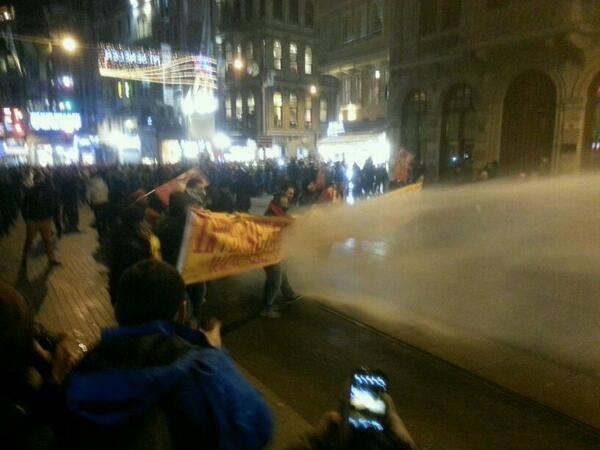
Police used water cannon and fired teargas to disperse hundreds of protesters that gathered in Istanbul’s central Taksim Square on Saturday for a rally calling against a bill that would tighten government control over the Internet.
Protesters ran to the side streets to escape the water cannons and teargas that police used on the peaceful demonstration.
Smaller rallies have been held around Turkey including the capital Ankara and coastal city of Izmir.
In Ankara about 300 protesters gathered chanting slogans opposing the government and the internet bill, calling the Turkish prime minister ‘a dictator.’
Activists have called for protests against the law further limiting the use of the Internet and social media. The campaign is circulating the internet with the hashtag #sansüredurde (#StopInternetCensorshipinTurkey).
The bill that includes the controversial law was adopted on Thursday. It gives the courts power to remove material that “violates individual rights” from the internet. People will be able to apply to the state Telecommunications Directorate (TIB) as well as the courts to block any websites.
Under the new law 26 government officials in Turkey can also block access to information online by a personal decree. These include the Prime Minister Recep Tayyip Erdoğan, his cabinet and other officials.
Critics argued that the law will enhance monitoring internet user’s activities and will allow officials to limit keywords, local Hurriyet daily reported. The newspaper added that the head of TİB will now be given enough authority to directly limit access, pending a court ruling.
Related article
Elections in Chile: Confronting the Enduring Legacy of Dictatorship
By Emily Achtenberg | Rebel Currents | January 16, 2014
On Election Day in Chile, students occupied and hung a banner outside front-runner Michelle Bachelet’s campaign headquarters, proclaiming: “Change is not in the Presidential Palace, but in the ‘wide avenues.’” It was a powerful reminder of how student mobilizations have transformed Chile’s political agenda during this election year, at once invoking the past (through the final words of martyred socialist President Salvador Allende), and laying down the gauntlet for an anticipated future when the country might finally move beyond its 20-plus year “transition to democracy.”
The promise of structural reforms to address the deep divide between rich and poor in Chilean society propelled Bachelet and her center-left New Majority coalition to a landslide victory in December over Evelyn Matthei, candidate of the center-right Alliance. While Chile has the highest rate of economic growth among 34 developed countries, it is also the most unequal. Bachelet campaigned on a radical platform of educational, tax, and constitutional reform to redress the injustices of a political and economic system inherited from the dictatorship era, that largely favors the wealthy.
After failing to gain a majority on the first ballot in November (in a field of nine candidates, including seven to the left of center), Bachelet handily won the run-off election with 62% of the vote, the biggest presidential victory in eight decades. Despite this seemingly broad mandate, she now faces formidable obstacles in seeking to deliver on her campaign promises, as Chile’s undemocratic institutions and alienated electorate—both enduring legacies of dictatorship—conspire to discourage change.
Electoral Context
Most of Chile’s problems today have their origin in the anti-democratic structures established by the 17-year dictatorship of Augosto Pinochet and left largely intact by successive democratic governments (of the center-left and center-right) since Chile’s “return to democracy” in 1990. These include a constitution (imposed after a fraudulent referendum conducted under a state of siege) and a set of organic laws that enshrine the power of conservative elite minorities, an electoral system that perpetuates their disproportionate representation, and a deregulated economy affording wide latitude and subsidies to the private sector.
As the intense electoral campaign converged this past fall with the 40th anniversary of the military coup that overthrew Allende, the election seemed to be as much a referendum on Chile’s tormented past as on its future direction. The dramatically contrasting but intertwined family histories of the two presidential candidates—Bachelet’s father, an Allende loyalist general, died under torture in a military school run by Matthei’s father, a member of Pinochet’s junta—kept the past front and center despite the candidates’ efforts to refocus on the future.
In the run-up to the 40th anniversary, Chileans were bombarded with graphic images of the coup, repression, and resistance though previously unseen documentary footage, dramatizations, and debates widely broadcast through the mainstream media. The avalanche appears to have captured the popular imagination, especially among the 60% of Chileans born after the coup (and others who “saw but did not see”). Polls show that only 16% of Chileans now think the coup was justified, down from 36% a decade ago.
Even the most conservative institutions have recently offered at least symbolic gestures of remorse, such as the official closing of a luxury prison resort for high-ranking officials convicted of human rights offenses, the public apology issued by the National Association of Judges, and the National Education Council’s recommendation to substitute the term “dictatorship” for “military government” in school textbooks.
But it is the highly mobilized Chilean student movement that has genuinely challenged Pinochet’s legacy by catalyzing popular demands for institutional reform. Through massive protests and school takeovers beginning in 2011, and continuing to this day (with widespread public support), students have highlighted the inequities of a dictatorship-era educational system that features private sector subsidization, vast discrepancies in the quality of municipally-controlled primary and secondary schools based on social class, and the highest university student cost burden of any developed country. Joined by trade unions and other popular sectors, they have articulated transformative demands that governing political elites (including Bachelet herself, in her first term) have not dared to address during 20 years of democratic transition. These include a return to universal, free, high-quality public education (which students had under Allende), a revival of the public pension and healthcare systems, progressive tax reform to finance social spending, and a refounding of the Chilean state through a new constitutional assembly.
While the student organizations did not endorse a presidential candidate, Bachelet sought and won the support of several prominent ex-student leaders running for Congress on the Communist Party and other splinter left tickets, including popular activist Camila Vallejo. In exchange, the New Majority partially incorporated the students’ demands in its platform, pushing the electoral agenda substantially to the left. For the first time since the return to democracy, the Communist Party joined the center-left political coalition, giving Bachelet the opportunity for a sufficient Congressional mandate to push through her promised reforms.
Electoral Outcomes
The campaign raised high expectations for systemic change, as well as the political cost of failing to deliver. In the end, the New Majority picked up slim majorities in both houses—55% in the Senate and 56% in the House—thanks in part to the election of Vallejo and other student and activist candidates. But the coalition did not achieve the super-majorities required by Pinochet-era laws to reform the educational system (57%), the electoral system (60%), or the constitution (67%).
One reason is the binomial electoral system itself, which awards the losing coalition half the seats in each Congressional district unless the winning one secures more than two-thirds of the votes. This may explain why both the New Majority and the Alliance ended up with similar numbers of deputies despite the lopsided presidential results (in November’s first-round presidential race, when the Congress was also elected, Bachelet nearly doubled her conservative rival’s vote).
A record-low voter turnout, in the first presidential election since a 2012 rule change made voting voluntary, also likely worked against the New Majority’s Congressional aspirations.[1] Only 51% of the voting age population cast ballots in November, with the highest abstention levels reported in the economically-depressed northern and southern regions and among youth. An estimated 60% of those in the 18-34 age group, arguably among the most likely progressive voters, stayed home.
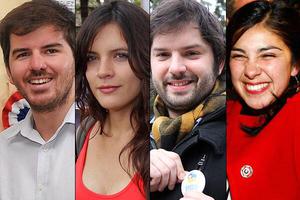
While the voter abstention phenomenon—especially among youth—is certainly not unique to Chile, the sustained level of participation achieved in recent student mobilizations suggests that it is more a function of alienation from traditional politics than apathy. Surely, an electoral system that distorts votes by design and furthers minority vetoes is not conducive to voluntary participation. Melissa Sepulveda, newly elected leader of the University of Chile’s student federation, explained that she would not vote because “the possibility for change isn’t in the Congress.” Chileans, she argues, are disillusioned by the manner of conducting politics since the return to democracy.
With this mixed electoral outcome, New Majority initiatives such as tax, pension, and healthcare reform, which require only a majority vote, should be achievable. Radical educational reform may also be within reach, if independent delegates can provide the critical swing votes. But political and constitutional reforms, if attainable at all, will require bargaining, negotiation, and compromise with more conservative factions, at the risk of alienating progressive popular constituencies.
In a sense, this represents a political victory for the Alliance, which has succeeded in preventing the institutional left from carrying out its proposed reform program unobstructed. The low voter turnout, used by conservatives to question the legitimacy of Bachelet’s reform mandate, may make these issues even more contested. (Bachelet actually received fewer votes in the run-off election than any of her predecessors since 1990, including herself in 2006.)
Within the New Majority coalition itself, there are diverse party factions ranging from Christian Democrats (many of whom originally supported Pinochet) to Communists, with significantly different visions, strategies, and timetables for reform. Internal conflicts are intensified by continuing pressure from the social movements. In the area of education, Bachelet (a member of the Socialist Party) has promised to institute tuition-free public higher education and end state subsidies to for-profit institutions within six years. But students and their elected representatives want to abolish private schools completely, and are impatient for quick results.
A Constitutional Assembly?
A key split has also arisen over the issue of how constitutional reform might be accomplished. While the Christian Democrats and Bachelet support the institutional strategy of “change from within,” relying on the undemocratically-elected Congress to produce a new constitution, students and other popular sectors, supported by the Communist Party, are calling for a constitutional assembly to be convoked by referendum.
Under a grassroots initiative called “Mark Your Vote,” more than 10% of Chilean voters voluntarily marked their ballots “AC” in the December election, to evidence support for this strategy. Given the initial confusion as to whether the marked ballots would be accepted as valid, the difficulties in tallying them, and the requirement that only ballots clearly designated for a presidential candidate would be considered, organizers believe that the results significantly understate the proposal’s appeal. In a recent national opinion poll, 45% of those surveyed expressed support for a constitutional assembly.
As a strategy that offers the possibility of re-engaging a civil society that is profoundly alienated from the consensus model of post-dictatorship duopoly politics, the constitutional assembly is an intriguing option. It could provide an opportunity for Chileans to reconnect with their own deeply democratic traditions, illustrated by the unprecedented levels of political and social awareness and participation achieved through poder popular (popular power), the touchstone of Allende’s Popular Unity government.
Despite the new discourse of remorse evidenced during the 40-year coup anniversary, many Chileans feel that this aspect of their past has been largely excised from official historical memory. Even in the otherwise outstanding Museum of Memory and Human Rights developed by Bachelet in her first term, there is little reference to the participatory institutions of the Allende era (such as workers’ councils and collective neighborhood organizations) that Pinochet systematically destroyed. A revival of this deeply democratic tradition through the constitutional assembly could be an important step in genuinely challenging the legacy of dictatorship.
[1] The same rule change also made voter registration, which had previously been voluntary, automatic. For this reason, it is preferable to measure voter turnout over time as a percentage of the voting age population rather than as a percentage of registered voters, which is distorted by the rule change.
Featured Video

Saudi Led Destruction of Yemen’s heritage
or go to
Aletho News Archives – Video-Images
From the Archives
Israel: Strategic Ally or Liability?
By Stephen Sniegoski | My Catbird Seat | June 12, 2010
The claim that Israel serves as a valuable ally for the United States is made by both pro-Zionists and much of the anti-war and anti-Zionist Left that is influenced by Noam Chomsky. As a result of the Gaza flotilla massacre, which has caused a world-wide uproar against Israel, the value of Israel to the United States is being publicly questioned in more mainstream foreign policy forums. … continue
Blog Roll
 Aletho News
- Europe’s Energy Hypocrisy, Russian LNG Profits and US Dependence
- ICC ignored ‘very well-documented’ NATO crimes – ex-Libyan minister
- SNSC secretary dismisses US response to Iran’s conditions as ‘inadequate’
- Sanaa says Taiz roads open, secure for residents, warns Saudi forces
- Iraqi resistance group urges Saudi leadership to admit defeat, lift Yemen siege
- Trump’s Retreat: How Al-Aqsa Flood Took Down the US Empire
- Israel’s Military Actions in Lebanon Grossly Violate International Law — Lavrov
- Seyed M. Marandi: US-Iran War Inevitable: Kuwait and Bahrain May Fall
- Leaders Condemn Ansarallah Attack on Saudi Arabia While Ignoring Illegal War Against Yemen
- Leaked: Britain’s Covert Iraqi Psyops Network
- If Americans Knew
- Gaza’s buildings are collapsing on top of us. But there’s nowhere else to shelter
- Israel kills four-year-old Gaza child – Daily Update
- After Oct 7, IDF policy allowed civilian casualties for even the lowest-ranking targets
- Israel’s Destruction of Southern Lebanon Intensified After the Cease-Fire
- The Last-Minute Decision That Gave Israel Its Name
- The American Conservative: How Trump Made the World Go Nuclear
- Meet the US generals and admirals advancing Israeli policy
- Opinion: Why news organizations should boycott Israel
- The Israeli witch hunt of Sami Abu Shehadeh exposes the lie of the ‘Jewish and democratic’ state
- No state has a ‘right’ to exist – least of all Israel
- No Tricks Zone
- New Study Suggests Large Regions Of The Pacific Ocean Have Been Cooling For The Last 80 Years
- Germany’s Green Energy Debacle: High Energy Costs Force Kahla Porzellan to Close After 182 Years!
- New Study: 50 Years Of The Most Aggressive ‘Net Zero’ Policies Can Only Affect The Global Climate By 0.03°C
- US September “Heat” Was No Record…Many Records Set Decades Ago
- Latest European Green Energy Debacle; Portugal’s Largest Flagship Solar Park Insolvent!
- Green Energy Debacle: German Expert Professor Fritz Vahrenholt Warns Of Severe Economic And Social Consequences
- Two More Paleo Reconstructions Affirm Meters-Higher Sea Levels Across Ireland, Brazil 7000-6000 Years Ago
- New Study: Earth And Venus Surface Warmth Largely Explained By Convection And Lapse Rate, Not CO2 Or Radiation
- 2025 Nature Paper Claiming Worsening Global Drought Gets RETRACTED …Heavily Flawed
- New Study: ‘Global Drought Shows No Detectable Recent Acceleration Under Climate Warming’

