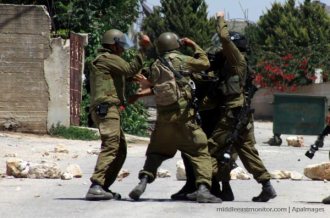
Israeli soldiers beating a Palestinian journalist [June 2013]
Israeli occupation authorities arrested approximately 4,000 Palestinians, including parliamentarians, women, children and patients, in 2013. The vast majority of those arrested are from the occupied West Bank, with only a small number from the Gaza Strip.
Information published by the statistics department at the ministry of prisoners in the West Bank shows that no single day has passed without arrests. The average number of arrests each month was 323, which equates to about 11 arrests each day.
The arrest rate in 2013 is only one per cent higher than the rate in 2012; however, it is 17 per cent higher than 2011.
Regarding the geographical distribution of the 2013 arrests, 98 per cent (3,799) of those arrested are from the West Bank and two per cent (75) from the Gaza Strip.
According to the statistics, those arrested were from all social classes, without exception. The occupation authorities did not make any special exceptions for the elderly, disabled, children, women, parliamentarians, political leaders, academics and journalists.
All those arrested have been exposed to at least one form of torture. Some of them were tortured in front of their family members when they were arrested at their homes.
The statistics department stated that these arrests are in violation of international law. “Some of the torture cases amount to war crimes and crimes against humanity,” it added.
December 23, 2013
Posted by aletho |
Civil Liberties, Ethnic Cleansing, Racism, Zionism, Subjugation - Torture | Human rights, Israel, Palestine, West Bank, Zionism |
Leave a comment
Canada’s intelligence agency deliberately kept the country’s Federal Court “in the dark” to bypass the law in order to outsource its spying on Canadian citizens abroad to foreign security agencies, a federal judge said.
Federal Court Judge, Richard Mosley, has slammed the Canadian Security Intelligence Service (CSIS) for knowingly misleading him on numerous occasions.
Since 2009, Mosley has issued a large number of warrants to the CSIS, authorizing interception of electronic communications of unidentified Canadians abroad, who were investigated as threats to domestic security.
The spy agency assured the judge that the surveillance was to be carried out from inside Canada and controlled by and the Communication Security Establishment of Canada (CSEC), the country’s foreign signals intelligence service.
But, after the warrants were obtained, Canada’s foreign partners from the Five Eyes intelligence-gathering alliance (US, UK, Australia and New Zealand) were asked to perform the interceptions.
Canada’s Federal Court wasn’t notified of the foreign involvement and never approved it, Mosley wrote in a redacted version of a classified court decision which was made public on Friday.
“It is clear that the exercise of the court’s warrant issuing has been used as protective cover for activities that it has not authorized,” the document stressed. “The failure to disclose that information was the result of a deliberate decision to keep the court in the dark about the scope and extent of the foreign collection efforts that would flow from the court’s issuance of a warrant.”
Under Canada’s current legislation, the Federal Court has no authority to issue warrants that involve surveillance of Canadians by foreign intelligence agencies, he added.
The actions of CSIS and CSEC put the Canadian citizens abroad at risk as they “may be detained or otherwise harmed as a result of the use of the intercepted communications by the foreign agencies,” Mosley wrote.
“Given the unfortunate history of information sharing with foreign agencies over the past decade and the reviews conducted by several royal commissions, there can be no question that the Canadian agencies are aware of those hazards,” the document said. “It appears to me that they are using the warrants as authorization to assume those risks.”
Mosley demanded explanations from the security agencies after an annual report by CSEC commissioner, Robert Decary, this August.
The judge became suspicious after Decary suggested that CSIS should provide the Federal Court with “certain additional evidence about the nature and extent” of the help, it received from his agency.
The results of the Federal Court’s inquiry into the matter were made public on Friday.
By misleading him, the CSIS and CSEC have been in “breach of the duty of candor,” which resulted in misstatements on the public record about the scope of the authority granted to the service,” Mosley wrote.
Mosley, who used to be a former assistant deputy minister in the Justice Department, was intimately involved in the creation of the 2001 Anti-terrorism Act, which the CSIS and CSEC violated.
December 22, 2013
Posted by aletho |
Civil Liberties, Corruption, Deception, Full Spectrum Dominance | Canada, Canadian Security Intelligence Service, CSIS, Hacking, Intelligence, Internet |
Leave a comment
What Does Holocaust Denial Really Mean?
By Daniel McGowan | February 18, 2009
In April 2007 the European Union agreed to set jail sentences up to three years for those who deny or trivialize the Holocaust.1 More recently, in response to the remarks of Bishop Richard Williamson, the Pope has proclaimed that Holocaust denial is “intolerable and altogether unacceptable.”
But what does Holocaust denial really mean? Begin with the word Holocaust. The Holocaust2 (spelled with a capital H) refers to the killing of six million Jews by the Nazis during World War II. It is supposed to be the German’s “Final Solution” to the Jewish problem. Much of the systematic extermination was to have taken place in concentration camps by shooting, gassing, and burning alive innocent Jewish victims of the Third Reich.
People like Germar Rudolf, Ernst Zundel, and Bishop Williamson who do not believe this account and who dare to say so in public are reviled as bigots, anti-Semites, racists, and worse. Their alternate historical scenarios are not termed simply revisionist, but are demeaned as Holocaust denial. Rudolf and Zundel were shipped to Germany where they were tried, convicted, and sentenced to three and five years, respectively. Williamson may not be far behind.
Politicians deride Holocaust revisionist papers and conferences as “beyond the pale of international discourse and acceptable behavior.”3 Non-Zionist Jews who participate in such revisionism, like Rabbi Dovid Weiss of the Neturei Karta, are denounced as “self-haters” and are shunned and spat upon. Even Professor Norman Finkelstein, whose parents were both Holocaust survivors and who wrote the book, The Holocaust Industry, has been branded a Holocaust denier.
But putting aside the virile hate directed against those who question the veracity of the typical Holocaust narrative, what is it that these people believe and say at the risk of imprisonment and bodily harm? For most Holocaust revisionists or deniers if you prefer, their arguments boil down to three simple contentions:
1. Hitler’s “Final Solution” was intended to be ethnic cleansing, not extermination.
2. There were no homicidal gas chambers used by the Third Reich.
3. There were fewer than 6 million Jews killed of the 55 million who died in WWII.
Are these revisionist contentions so odious as to cause those who believe them to be reviled, beaten, and imprisoned? More importantly, is it possible that revisionist contentions are true, or even partially true, and that they are despised because they contradict the story of the Holocaust, a story which has been elevated to the level of a religion in hundreds of films, memorials, museums, and docu-dramas?
Is it sacrilegious to ask, “If Hitler was intent on extermination, how did Elie Wiesel, his father, and two of his sisters survive the worst period of incarceration at Auschwitz?” Wiesel claims that people were thrown alive into burning pits, yet even the Israeli-trained guides at Auschwitz refute this claim.
Is it really “beyond international discourse” to question the efficacy and the forensic evidence of homicidal gas chambers? If other myths, like making soap from human fat, have been dismissed as Allied war propaganda, why is it “unacceptable behavior” to ask if the gas chamber at Dachau was not reconstructed by the Americans because no other homicidal gas chamber could be found and used as evidence at the Nuremburg trials?
For more than fifty years Jewish scholars have spent hundreds of millions of dollars to document each Jewish victim of the Nazi Holocaust. The Nazis were German, obsessed with paperwork and recordkeeping. Yet only 3 million names have been collected and many of them died of natural causes. So why is it heresy to doubt that fewer than 6 million Jews were murdered in the Second World War?
“Holocaust Denial” might be no more eccentric or no more criminal than claiming the earth is flat, except that the Holocaust itself has been used as the sword and shield in the quest to build a Jewish state between the Mediterranean Sea and the Jordan River, where even today over half the population is not Jewish.
The Holocaust narrative allows Yad Vashem, the finest Holocaust museum in the world, to repeat the mantra of “Never Forget” while it sits on Arab lands stolen from Ein Karem and overlooking the unmarked graves of Palestinians massacred by Jewish terrorists at Deir Yassin. It allows Elie Wiesel to boast of having worked for these same terrorists (as a journalist, not a fighter) while refusing to acknowledge, let alone apologize for, the war crimes his employer committed. It makes Jews the ultimate victim no matter how they dispossess or dehumanize or ethnically cleanse indigenous Palestinian people.
The Holocaust story eliminates any comparison of Ketziot or Gaza to the concentration camps they indeed are. It memorializes the resistance of Jews in the ghettos of Europe while steadfastly denying any comparison with the resistance of Palestinians in Hebron and throughout the West Bank. It allows claims that this year’s Hanukah Massacre in Gaza, with a kill ratio of 100 to one, was a “proportionate response” to Palestinian resistance to unending occupation.
The Holocaust is used to silence critics of Israel in what the Jewish scholar, Marc Ellis, has called the ecumenical deal: you Christians look the other way while we bludgeon the Palestinians and build our Jewish state and we won’t remind you that Hitler was a good Catholic, a confirmed “soldier of Christ,” long before he was a bad Nazi.
The Holocaust narrative of systematic, industrialized extermination was an important neo-conservative tool to drive the United States into Iraq. The same neo-con ideologues, like Norman Podoretz, routinely compare Ahmadinejad to Hitler and Nazism with Islamofascism with the intent of driving us into Iran. The title of the recent Israeli conference at Yad Vashem made this crystal clear: “Holocaust Denial: Paving the Way to Genocide.”
“Remember the Holocaust” will be the battle cry of the next great clash of good (Judeo/Christian values) and evil (radical Islamic aggression) and those who question it must be demonized if not burned at the stake.
1) Associated Press, “EU approves criminal measures against Holocaust denial,” Haaretz, 19 April 2007.
2) Holocaust. Dictionary.com. The American Heritage® New Dictionary of Cultural Literacy, Third Edition. Houghton Mifflin Company, 2005.
3) Statements of Senator Hillary Clinton.
Daniel McGowan is a Professor Emeritus at Hobart and William Smith Colleges. Because of admonishment by the administration, it is hereby stated that the above remarks are solely those of the author. Hobart and William Smith Colleges neither condone nor condemn these opinions. Furthermore, the author has been instructed to use his personal email address of mcgowandaniel@yahoo.com and not his college email at mcgowan@hws.edu for those wishing to contact him with comments or criticisms. Read other articles by Daniel.
Source
The Universal Declaration of Human Rights
Article 19.
Everyone has the right to freedom of opinion and expression; this right includes freedom to hold opinions without interference and to seek, receive and impart information and ideas through any media and regardless of frontiers.
December 22, 2013
Posted by aletho |
Civil Liberties, Deception, Ethnic Cleansing, Racism, Zionism, Timeless or most popular | Elie Wiesel, European Union, Germar Rudolf, Holocaust, Human rights, Palestine, World War II, Zionism |
Leave a comment
BETHLEHEM – Israeli forces vacated the Bethlehem village of Arab al-Rashayida on Tuesday after conducting military drills in the area for several hours, locals said.
Fawaz al-Rashayida, head of the local village council, told Ma’an that 5,000 heavily armed Israeli soldiers arrived in the village at dawn on Tuesday.
Locals are used to Israeli forces performing drills on the outskirts of Arab al-Rashayida, but this is the first time they have raided homes and local institutions in the village, Fawaz al-Rashayida said.
The drills, which took place in between residential homes, caused damage to the village’s water grid, he added.
Israeli forces also issued demolition orders for six properties belonging to Ali Awda Mohammad Rashayid.
The population of Arab al-Rashayida is around 2,000 and the majority of residents live in cement houses, while others live in tents and dwellings made of steel and tin.
On Monday afternoon, Israeli forces deployed in a nature reserve east of Arab al-Rashayida known locally as al-Muteirda, displacing nearby families and declaring it a “closed military zone.”
During military drills, Israeli forces can enter Palestinian homes and involve Palestinian civilians in their operations without warning them that the raids are mere practice.
In November, Israeli human rights group Yesh Din said Israeli troops had been using a Muslim cemetery in Hebron as a location for military drills and practice.
Approximately 18 percent of the West Bank has been designated as a closed military zone for training, or “firing zone,” which is roughly the same amount of the West Bank under full Palestinian Authority control.
Over 5,000 Palestinians reside in the firing zones in 38 communities.
December 18, 2013
Posted by aletho |
Civil Liberties, Illegal Occupation, Militarism | Bethlehem, Human rights, Israel, Ma'an, Palestine, West Bank, Zionism |
Leave a comment
When Israel was established, its founders made sure to emphasize, in its Declaration of Independence, the universal values of Jewish tradition: “The State of Israel […] will promote the development of the country for the benefit of all its inhabitants; will be based on the precepts of liberty, justice and peace as envisaged by the prophets of Israel; will uphold the full social and political equality of all its citizens, without distinction of race, creed or sex; will guarantee full freedom of conscience, worship, education and culture; will safeguard the sanctity and inviolability of the shrines and Holy Places of all religions; and will dedicate itself to the principles of the Charter of the United Nations.” Later on, the Knesset voted to adopt the Universal Declaration of Human Rights. Furthermore, Israel is in the habit of calling itself “the only democracy in the Middle East”, and since its earliest days, its leaders were partial to the term “a light unto the nations.” As we mark Human Rights Day, we should examine whether Israel stands by the high rhetoric of its founders, and whether it fulfills the Declaration of Human Rights.
As every person living in Israel knows, assuming their eyes are open and their hearts are not blocked, Israel and the Universal Declaration of Human Rights have a rocky relationship. In the beginning of 2010, Gideon Sa’ar’s Ministry of Education decided to stop teaching the Declaration at schools (Hebrew), since it informs tender children of their right to convert to another religion and even, heaven forbid, live somewhere other than Israel. However, this is just a minor problem; reading the text of the Declaration shows that the Israeli occupation of the Palestinian territories violates 15 of its articles. Given that there are only 30 of them, that’s quite impressive.
Let us begin. The first violation comes with the first operative article of the Declaration, Article 2. It states, “Everyone is entitled to all the rights and freedoms set forth in this Declaration, without distinction of any kind, such as race, colour, sex, language, religion, political or other opinion, national or social origin, property, birth or other status. Furthermore, no distinction shall be made on the basis of the political, jurisdictional or international status of the country or territory to which a person belongs, whether it be independent, trust, non-self-governing or under any other limitation of sovereignty.” Only, as everyone knows, after “no distinction shall be made”, the text is irrelevant in the territories occupied by Israel. Article 2 is sort of an umbrella article; the following ones will note specific violations.
Article 3 of the Declaration states, “Everyone has the right to life, liberty and security of person.” Except that those living under Israeli rule in the West Bank are entitled to none of the above. The indictment rate for Israeli soldiers who have killed Palestinian non-combatants is negligible. Since 2000, only seven soldiers were put on trial and convicted for crimes involving the death of Palestinians; the number of Palestinian deaths since 2000 is estimated at over 5,000. IDF soldiers need no warrant to break into Palestinian homes; they are authorized to arrest them without any explanation, and from time to time enforce curfews on Palestinian towns and villages.
Next. Article 5 of the Declaration states, “No one shall be subjected to torture or to cruel, inhuman or degrading treatment or punishment.” Anyone familiar with the way our security services operate, or with the fact that, on many occasions, IDF soldiers beat up Palestinian detainees, knows that this article is often violated. Furthermore, it’s hard to see the standard procedure of blindfolding prisoners as anything but “degrading treatment.”
The fourth violation of the Declaration comes with Article 7: “All are equal before the law and are entitled without any discrimination to equal protection of the law.” Except, the whole essence of the occupation is creating two populations in the same region, with two different sets of rights and two different legal systems. Discrimination manifests itself not just in the laws themselves, but also through unequal enforcement. To put it mildly, the Jewish victim of a crime in the OPT is significantly more likely to see justice served than would a Palestinian living in a neighboring village. .
The fifth violation also comes from the legal world: “No one shall be subjected to arbitrary arrest, detention or exile,” declares Article 7. Except for the fact that the occupation forces maintain the right to hold a person in administrative detention, that is, held without charges and deprived of the right to defend himself in court. It’s hard to imagine a more “arbitrary arrest or detention” than that. Furthermore, from time to time Israel exiles Palestinians – in the last few years mostly from the West Bank to the Gaza Strip, but it used to exile them to Lebanon and other countries, not to mention the internal displacement looming over South Hebron residents.
Article 10 of the Declaration states that “Everyone is entitled in full equality to a fair and public hearing by an independent and impartial tribunal.” But it’s doubtful whether you can call our military courts “an independent and impartial tribunal” with a straight face. Their conviction rate is 99.7%. The British courts in India used to take pride in the large number of Indians who served there as judges; in Israel’s military courts, Palestinians naturally have nary a chance of being sentenced by a Palestinian. Israel once recruited police officers from among the occupied population, but it never imagined allowing them to sit in judgment. Israel’s military courts are a foreman’s court, conducted in the foreman’s language.
As far as the military courts are concerned, Article 11 of the Declaration is also troublesome: it says that, “Everyone charged with a penal offence has the right to be presumed innocent until proved guilty according to law in a public trial at which he has had all the guarantees necessary for his defence.” My emphasis. The military courts of Israel are notorious for allowing “secret evidence” presented to the judges by the prosecution, the content of which the defendant has no knowledge, nor is able to contradict. This means that the conviction of a defendant relies, at least in large part, on evidence that he has not had the opportunity to refute, and whose absurdities or lies he cannot expose. Such “secret evidence”, fabricated to the gills, was the crux of the Dreyfus Affair. The French court, when exonerating Captain Dreyfus, ruled that the admission of “secret evidence” is incompatible with the right of a person to a legal defense. Dreyfus would, in time, be decorated by the thankful Republic with its highest decoration, the Légion d’honneur, because “by defending his own honor, he defended the nation’s ” and prevented it from jailing an innocent man. It’s been almost 120 years since Dreyfus’ infamous court-martial, and the Israeli military courts are yet to absorb this simple lesson.
Article 12 states, “No one shall be subjected to arbitrary interference with his privacy, family, home or correspondence, nor to attacks upon his honour and reputation.” As noted above, Palestinians have no defense against arbitrary search of their homes. In fact, their houses sometimes serve as military training sites.
Onwards! Article 13 declares, “Everyone has the right to freedom of movement and residence within the borders of each state. Everyone has the right to leave any country, including his own, and to return to his country.” However, Israel enforces a rigid “permit regime” in the West Bank and the Gaza Strip, and it operates checkpoints which cut the West Bank into fragments. Our colleagues at Gisha can tell you more about just how fastidious Israel is about the right of Palestinians to move from the West Bank to the Gaza Strip and vice versa. Some Palestinians are even barred from travel outside the West Bank at all. And of course, residents of East Jerusalem, which though Israel may have forgotten, is part of what the world views as occupied territory and is contiguous with the West Bank, risk losing their ability to return to their homes should they leave for a few years – say, for familial, economic or educational reasons – even if they only leave to the West Bank.
Article 15 declares plainly that “Everyone has the right to a nationality.” We shan’t belabor that point. Article 17 also seems to be so simple as to be self-evident: “No one shall be arbitrarily deprived of his property.” It is, however, anything but. Ask the villagers whose land is slowly being devoured by illegal outposts; ask the residents of Dura al-Qara, whose land was confiscated in what the State now stammers is a “frozen military need”, and left unused.
While Article 19 states that “Everyone has the right to freedom of opinion and expression; this right includes freedom to hold opinions without interference and to seek, receive and impart information and ideas through any media and regardless of frontiers,” Israel has employed brutal censorship for years towards the occupied people/ The IDF responds harshly to protests across the West Bank, resulting in many of Yesh Din’s complaints of unwarranted injuries, and it still detains people from time to time for “holding inciting material.” The military orders in force in the West Bank effectively make every demonstration an illegal one. For this reason, Article 20 of the Declaration – ” Everyone has the right to freedom of peaceful assembly and association” – is dead letter in the West Bank.
Article 21 declares that “Everyone has the right to take part in the government of his country, directly or through freely chosen representatives. The will of the people shall be the basis of the authority of government.” Palestinians living in Areas B and C are effectively subjects of the Israeli government, which they never elected and which they have no way of electing or being elected to. Also, given that Israel forbids Hamas to participate in the Palestinian elections, which grant limited powers to a Palestinian government, and given that it maintains the right to detain Palestinian politicians as it sees fit, one can hardly speak of “the will of the people.”
But perhaps the most painful violation is that which should be most obvious: “Motherhood and childhood are entitled to special care and assistance. All children, whether born in or out of wedlock, shall enjoy the same social protection,” says Article 25. Anyone who has seen detained children, quite a few of them under the age of discretion; anyone who has compared the special rights given to accused minors in the Israeli system with the almost dearth of comparable rights granted to Palestinian minors in the military courts; and anyone who has observed our brave troops raiding a house at night, handcuffing a child and blindfolding him; and anyone who understands the psychological damage to children witnessing their parents brutally arrested at gunpoint at night in their beds knows just how the most obvious is anything but that in the territories under Israeli occupation.
Yet these many violations, we should remind you, are not a force of nature, do not stand of their own power; they are no ancient, unbreakable law; they are man-made, they are an act we fund, carried out by those we empower to act and whose actions we approve – admittedly, mostly by averting our eyes. But we can mend this; and we shall.
We shall overcome.
December 17, 2013
Posted by aletho |
Civil Liberties, Ethnic Cleansing, Racism, Zionism, Subjugation - Torture, Timeless or most popular | Gaza, Human rights, Israel, Palestine, Universal Declaration of Human Rights, West Bank, Zionism |
Leave a comment
Privacy International, which has done a very thorough job digging into the backgrounds of the many private companies involved in the surveillance “industry” around the world, has just released a promotional document from the American-Israeli Verint, a security company that provides NSA-level cell phone surveillance power to entities around the world.
[A] scaled down version of this system is also being sold by private surveillance contractors to the highest bidder. The company behind it? Israeli-American company Verint. Their Skylock technology claims to have the ability to “Remotely locate GSM and UMTS targets located anywhere in the world at cell level precision”.
The brochure Privacy Int’l obtained doesn’t go into detail as to how it achieves this, but what is shown is both impressive and disturbing.
From a brochure collected this year we have discovered one of the newest additions to Verint’s product line: mobile phone tracking on an international scale. Previously, mobile phone tracking required presence in the particular areas of interest, focusing on the tracking of phones through monitoring Base Stations (Cell Towers) and local networks to pinpoint location. In the past, if a law enforcement agency wanted location data they requested information from the relevant telecommunication firm operating in that specific territory. By way of an example, this would result in the UK not being able to obtain a French mobile phone’s location without help from the French. Now it would appear that Verint have bypassed the territoriality requirement.With this latest news, we know that location tracking has become borderless in the same way as communications surveillance. The ability to do this has likely come from a focus on international phone systems rather than domestic or regional networks which would never reach the worldwide nature of location tracking Verint is advertising.
Some details on Verint’s SKYLOCK offering are available online (under the name ENGAGE). While the brochure seems to indicate this is solely a military product (the brochure cover only lists “Military, Special Forces, Navy, Search and Rescue, Border Control” and the photos contained show only military personnel), the inside notes make it clear these products are available to “law enforcement” as well.
As Privacy Int’l points out, Verint’s offering operates “independently of local service providers,” meaning pretty much every legal obstacle is demolished. What no one knows is going on won’t hurt them. One product is targeted at satellite communications, but even considering that limited scope, it’s still very powerful.
Here’s what ENGAGE/SKYLOCK can do:
– Intercept voice calls and text messages
– Decrypt A5/1 and A5/2 encryptions with an embedded decipher
– Operate undetected leaving no electromagnetic signature
– Selectively downgrade UMTS traffic to GSM
Other ENGAGE products target wireless communications. Verint’s intercept-in-a-box can do all of the following.
– Actively and passively intercept WiFi communications based on: 802.11 a/b/g/n, 2.4Ghz, and 5GHz
– Active interception of mobile handsets, even when not intentionally connected to a WiFi network
– Intercept target communication at a distance with zero packet loss
– Choose from multiple active interception methods to overcome encryption of private communication
– Identify access points and intercept MAC addresses in the area
Verint also gives its purchasers the power to target phones using 3G networks, remotely activate cell phone mics, and block cellular communication.
The capabilities that were presumed to only be in the hands of national intelligence agencies now can be had by nearly anyone who can come up with the money. Powerful cell phone surveillance products are a growth market. Anything that can increase data and communication harvesting while simultaneously eliminating a majority of legal restrictions and oversight practically sells itself.
We may feel this sort of power is OK in the “right hands,” but we don’t get to decide which hands this ends up in. We may believe the NSA should be able to do this sort of thing (overseas, preferably), but that local law enforcement agencies should be forced to jump through warrant and subpoena hoops before tracking locations and intercepting communications. But ultimately it doesn’t matter what we prefer. That call is made by Verint and it’s in the business of selling surveillance products, not protecting the privacy of the world’s citizens.
December 17, 2013
Posted by aletho |
Civil Liberties, Corruption, Full Spectrum Dominance | National Security Agency, NSA, Privacy International, Verint, Verint Systems |
Leave a comment
As the deadly crackdown on the Rabaa and Nahda sit-ins by supporters of ousted president Mohammed Morsi was coming to an end on August 14, word spread that a photographer called Mosa’ab Elshamy was killed. It wasn’t long before the 23-year-old photographer assured his friends and colleagues that it was another photographer by the same name who had been killed in Alexandria. The relief was soon replaced by the realization that another set of strangers were mourning the loss of their friend. This type of tragedy and conflict is what Elshamy is skillful at documenting.
His portfolio is spread out on the front pages of the world’s top publications. One of his photos was chosen among Time magazine’s top ten this year. It depicts a man carrying a lifeless body during a deadly crackdown on Morsi supporters on July 27. Three years abundant with street clashes, with no professional training but with “a lot of trial and error,” have honed an eye capable of capturing both emotion and motion. Elshamy’s courage is often commended by his more seasoned peers.
I first knew of the young photographer when he was arrested in May 2011 during clashes near the Israeli embassy. A military court handed him and others a suspended sentence. He was still a pharmacy student when his eye was injured with glass shrapnel while covering clashes in December of the same year. This paper gave him his first professional assignment in 2012. The first time we worked together was in Suez while covering the presidential elections.
Sitting with him over a year and a half later, his signature smile frailly masked the violence and loss he had witnessed. Our conversation moved from the financial and security risks of being an independent photojournalist to the struggle to maintain professional integrity in a heavily politicized society, especially with his older brother, al-Jazeera journalist Abdallah Elshamy, behind bars. The guilt of having a flourishing career in the midst of tragedy pierced through.
This is an edited transcript of our conversation.
Since June, what has been your most memorable photo?
I think it’s the picture I took in Iman Mosque, which was where the bodies were moved from Rabaa after it was cleared. Some were torched and it was really awful. But there is a picture that really stuck with me which was the photo of the wife of one of the victims. The man was called Mohamed Yaqoot– an engineer. The Iman Mosque was very big and there were over 400 bodies being sorted out, many unidentified. [The wife] has been looking for over an hour for the body. He was lying in a coffin with no identification. So, she was actually going through every unidentified coffin and when she found him, she threw herself on him and obviously it was heartbreaking. So, it was this picture that really stuck with me for such a long while, because it just showed so much of the catastrophe, so much of the human disaster and the insanity that has torn so many families apart.
I remember your tweets on August 14 describing that you left because a bullet flew next to your ear. Was this the most dangerous and life threatening situation you’ve ever been in?
Yes.
Do you think you were targeted or was it random?
I’m more inclined to believe it was random. Perhaps, it would have been a bit safer to know that they were actually there for the sake of law and order, that they were actually confronting the people who had guns, but that wasn’t the case. I was there for more than six hours and people at the very back were being shot. People who were sitting under a tree were being shot. All of these people who were falling next to me showed absolutely no form of distinction. That was the scariest part about Rabaa.
I’d like to believe I was really cautious and I knew I had to be extremely cautious that day and I did stick to all these rules I made for myself. Like not getting close, always being under or next to a car or a tree or a block. Always keeping my head really low, staying in side streets most of the time, making sure I’m not in the middle. They had this pattern of teargassing then shooting in the middle. Never staying in a place for more than 20 seconds. These were the sort of things that I had developed and learned over the months since January [2011]. But the thing about Rabaa is that really it was about how lucky you were that day. That’s what I came to realize – that I was absolutely lucky.
[Photoset of the Rabaa crackdown here].
What got you into photography, specifically photojournalism? You got interested at the time when it was the most dangerous.
I got into photography in 2005. I was 16. The concept of composing pictures really did take over me – mostly just different genres of nature photography. It always terrified me a little bit to go out on the street. Then in June 2010, which was also around the same time I actively got into politics like so many who were moved by the Khaled Said incident and the wave of protests that had taken over the country, I was starting to break at least this fear of going into the street. There were very few incidents where I would take my camera with me. I wouldn’t say it was more dangerous than now, but it had its own risk [of] being on the street with your camera in a protest, especially that [protesters] almost always would get beaten.
In 2011 when the protests started, I also took my camera – not on the first day, not on January 25, but on the 26th and the 27th when there were sporadic protests. It was on Talaat Harb Street. We were sitting at the Borsa [café] and there was this protest that began out of nowhere and it was quite big and it was night. All of a sudden the [protesters] were faced by a cordon and the police started beating everybody, and I had my camera. So it got completely destroyed.
Since then, you’ve lost…
Yes quite few. But that one was really painful because I had gotten it a few months earlier. It was in Summer 2010 that I invested actual money in a camera and then it got broken on January 27, which was such a bummer because then I spend the next 15 days, especially the Friday of Rage, without a camera.
So there is always this bitterness and this extra anger that I don’t have my camera on me and so much is happening, so the most I did was tweet and take some phone pictures.
Being an independent journalist, how do you manage the loss of equipment?
There’s definitely an extra risk. As an independent you really don’t get covered. Not to mention sometimes you don’t have a press identification on you. So it’s not just about the camera. With my brother [in jail] – there’s an independent photographer and he can’t prove to them that he’s a journalist.
The financial aspect of it gets much more pressuring because you have no one who could cover you if you lose equipment, except on very few occasions when you are being assigned. How do I cope with it? I’ve had days when I wasn’t able to do that and had to borrow lenses. It’s rewarding when you are able to [find ways around it].
You mentioned that you became interested in photojournalism when you got interested in politics. How do you balance both and maintain your integrity as a journalist?
This has always been a very difficult. I would say that as a rule: When it comes to choosing, not sides, but choosing what to cover – because there’s always so much to cover – I always find myself inclined to choose the [side of the] ones who get very little media attention. Not just that, but the ones actually facing the wrath of the state, including its media institutions and sometimes even public opinion. So this is why in 2011, when the revolutionaries were always in the streets I was naturally inclined to be out with them. And even though on a very political and personal level, which I obviously almost always keep to myself, I would be with them, I would cover these clashes because they were the weaker side.
The dynamics are always changing. And now, it’s the Brotherhood who are basically back in this spot. It’s easier to take this decision to be in Rabaa, to be in Nahda, rather than be in Tahrir when you know all the cameras are there. I also tend to think, which will be more challenging to cover: a random celebration in Tahrir or a protest which will get teargassed to hell?
As a journalist, I know that at a lot of times I will have to be covering something that on a very personal level I’m not invested in, or even sometimes I’m completely against. But I need to do that because otherwise you are risking your integrity. Which is why June 30 was very difficult on the professional level … a conflicting task. [In Tahrir], the mood was very jubilant, and then going to Rabaa that same night when Morsi was toppled and seeing the complete opposite of that.
There is this conflict and in Egypt as these lines are being drawn and the polarization is [getting] more solidified, it just becomes more difficult trying to keep what I would say your journalistic neutrality – as in being here and being there.
Your brother was arrested in Rabaa and he works for al-Jazeera which is …
The devil!
The devil – yes. How do you factor all of this into your reputation as a journalist away from your older brother?
As a general rule I have absolutely no problem with this fact. We are three in my family and my brother works for al-Jazeera. I’ve expressed to him my discontent with some of al-Jazeera’s work. When he was here reporting I would always try and tell him what I think very honestly and he took that very well. It’s something that did harm him in the end, because even before he was arrested, there’d been too much defamation going on against him. Generally speaking, what he works for doesn’t really change what I think of his own journalistic integrity, especially since I [have been] following his work very closely since he was in Misrata during the Libyan revolution, in Mali, and in Syria. That’s something to be actually proud [of], regardless of the outlet he works for, which I think does have many of its ups and downs. And to be honest, I think they have been vilified a lot more than they should have, but that’s another story.
But when it comes to me, I know that I should be accounted for what I do and there have been instances where also I’ve been accused of such things. It does get crazy because this is the general mood.
To end it on a happy note, what has been the most gratifying moment in your career?
I don’t think this is going to be happy. Starting with June 30 and Manasa [July 27] and Rabaa and Ramsis [Aug. 16], somehow these were the most terrible things I have ever covered or clashes I’ve been to, and the pictures and all the memories. But in a way this completely pushed me forward on a professional and career level. I’ve been to places I’ve always dreamed of featuring my photos in and I got invitations to exhibit my pictures and have been considered for workshops that I’ve always loved. This is always the conflict that we are in: that it takes a disaster or sometimes a very gruesome event for you to be able to move forward in your career. Very, very sadly.
I’m thankful more than anything that I was here when this happened and I at least showed what I wanted to show, which is the loss of humanity on the streets of Egypt, and this has been very morally satisfying. Very simply on Twitter, people told me that they didn’t care much about the people in Rabaa until they saw some of my pictures. On the other side, some people were happy about the Copts being killed in Warraq but when they saw my pictures they were like, “I’m sorry I shouldn’t have thought like that.” More than anything, this is really what I find very satisfying. I’m able in my own very individual and unique and humble way to keep people slightly more human.
December 16, 2013
Posted by aletho |
Civil Liberties, Timeless or most popular | Al Jazeera, Al-Nahda, Alexandria, Egypt, Mosa’ab Elshamy, Rabaa, Suez, Talaat Harb Street |
Leave a comment
The President of Egypt’s Court of Appeals, Judge Mohamed Awad, has said that he will not participate in the judicial supervision of the referendum on the new constitution. He claims that the document lacks credibility.
Awad, who is also the General Coordinator of Judges for Egypt, said in a statement, “The proposed constitution allows the military to act as masters of the Egyptian people, legitimises military coups and eliminates Egypt’s Islamic identity to establish a secular state.”
The document, he added, denies the Egyptian people their rights to be the source of power in the country. “The proposed constitution is illegal because it has been issued by an illegal commission that did not represent the Egyptian people,” insisted Awad. “The referendum will take place under military rule, which has been renowned for electoral fraud since the 1952 coup.”
December 15, 2013
Posted by aletho |
Civil Liberties | Egypt |
Leave a comment
Uruguay’s president has accused the head of the UN’s International Narcotics Control Board (INCB) of lying and double standards, after the official claimed the country did not consult the anti-drug body before legalizing marijuana.
Earlier this week, Uruguay became the first country in the world to legalize both the sale and production of marijuana.
INCB chief Raymond Yans has slammed the “surprising” move, accusing the South American state of legalizing the drug without first discussing it with the UN organization.
Uruguay’s president, Jose Mujica, rejected the criticism on Friday, saying that he’s ready to discuss the law with anyone.
“Tell that old man to stop lying,” Mujica said in an interview with Uruguay’s Canal 4.
“Let him come to Uruguay and meet me whenever he wishes… Anybody can meet and talk to me, and whoever says he couldn’t meet with me tells lies, blatant lies.”
“Because he sits in a comfortable international platform, he believes he can say whatever nonsense,” he added.
Yans has accused Uruguay of “pirate attitudes” for knowingly violating the 1961 Single Convention on Narcotic Drugs, which the South American country is part of.
But Mujica reminded that Yans did not say a word about the US states of Colorado and Washington, which also legalized marijuana.
“Does he have different rules: one for Uruguay and other for the world’s strong countries?” he asked.
First lady Lucia Topolansky, a member of the Uruguayan Senate, has fully backed her husband on the issue.
“Who is this fellow who likes to call names to countries?” she said of Yans. “I think he’s crossed the line, but anyhow I believe that he has had problems with other countries, Sweden, Denmark, Holland and they will be meeting him sometime in March.”
“But to be honest, marijuana is not the heart of life or earthly issues,” Topolansky added.
The law, which allows for a government-controlled marijuana market, was passed by the Uruguayan Senate on Monday.
According to the legislation, those wishing to smoke cannabis recreationally need to register with the authorities and limit their consumption to 40 grams per month.
President Mujica and his supporters argue that regulating marijuana consumption and production will remove profits from criminals and allow less money to be spent on soldiers and police, who are ultimately unable to prevent Uruguayan citizens from using the drug.
December 15, 2013
Posted by aletho |
Civil Liberties | Human rights, International Narcotics Control Board, José Mujica, Latin America, Lucía Topolansky, South America, UN, Uruguay, USA |
Leave a comment
BOSTON — The ACLU of Massachusetts calls for a moratorium on the use of controversial and unregulated license plate scanner technology in all Massachusetts police departments, following a Boston Globe exposé of problems in the Boston Police Department’s program.
The story, published in today’s Globe, shows that contrary to officials’ claims about why departments need the technology, police routinely do not respond to live ‘hits’ alerting them to the location of stolen cars. This suggests that the program is, as the ACLU feared, largely oriented towards compiling vast databases enabling the warrantless tracking of millions of innocent motorists.
In response to these alarming findings, the Boston Police Department announced it would suspend the program, at least until proper oversight and procedures are put into place.
“The Globe’s investigation into the Boston Police Department’s license plate reader program, based largely on a series of public records requests initiated nearly a year ago, confirms that police departments need outside oversight and guidance in order to responsibly use this powerful technology. We applaud the Boston police decision to suspend the program,” said Kade Crockford, director of the Technology for Liberty project at the ACLU of Massachusetts. “In light of these disturbing revelations, no police department in the state should continue to use this technology until the legislature passes the License Plate Privacy Act. We need uniform statewide rules for departments’ use of plate readers.”
Currently the Massachusetts State Police and more than 50 cities and towns deploy license plate scanners, which snap photographs of each license plate they encounter, noting the time, date and location, and run the plate numbers against “hot lists” to identify stolen cars, outstanding warrants and other violations. Today, no license plate reader program in the state is subject to outside regulation.
“The License Plate Privacy Act will establish accountability and public transparency requirements to ensure that the kinds of abuses the Globe uncovered at the Boston Police Department are not happening in other cities and towns,” said Crockford. “Technologies that target ordinary Americans going about their everyday lives create tremendous opportunity for abuse, without keeping us safe. We must ensure that the law keeps pace with these new technologies.”
The License Plate Privacy Act allows departments to use license plate readers to identify cars associated with criminal suspects or crimes, while preventing the government from amassing databases containing the historical travel records of millions of innocent people.
“The Globe’s investigation makes crystal clear that departments cannot police their own use of this complex and powerful tool,” said Crockford. “The legislature must step in to provide some basic rules, as well as checks and balances to make sure license plate readers aren’t used for warrantless tracking of innocent drivers. The Joint Transportation Committee should recommend swift approval of the License Plate Privacy Act, the legislature should pass it, and the Governor should sign it into law.”
Advanced surveillance tools can work to promote public safety while simultaneously respecting the privacy and liberty interests that help our Commonwealth thrive, but in order for that to happen the law needs to catch up with the technology. The License Plate Privacy Act strikes the right balance. Police departments statewide should follow Boston’s lead and immediately halt their use of the technology until the legislature acts.
For more on the License Plate Privacy Act, go to:
https://aclum.org/privacy_agenda#LPA
To take action on this issue, go to:
https://ssl.capwiz.com/aclu/ma/issues/alert/?alertid=63008551&type=ML
For more information about automatic license plate readers, go to:
https://www.aclu.org/alpr
December 14, 2013
Posted by aletho |
Civil Liberties, Corruption, Deception, Full Spectrum Dominance | American Civil Liberties Union, Automatic number plate recognition, Boston, Boston Police Department, Massachusetts, Plate reader, Police |
Leave a comment
Twenty years since its passage, NAFTA has displaced workers on both sides of the U.S.-Mexico border, depressed wages, weakened unions, and set the terms of the neoliberal global economy.
Foreign Policy In Focus is partnering with Mexico’s La Jornada del campo magazine, where an earlier version of this commentary appeared, to publish a series of pieces examining the impacts of the North American Free Trade Agreement (NAFTA) 20 years since its implementation. This is the first in the series.
The North American Free Trade Agreement, or NAFTA, was the door through which American workers were shoved into the neoliberal global labor market.
By establishing the principle that U.S. corporations could relocate production elsewhere and sell their products back into the United States, NAFTA undercut the bargaining power of American workers, which had driven the expansion of the middle class since the end of World War II. The result has been 20 years of stagnant wages and the upward redistribution of income, wealth, and political power.
A Template for Neoliberal Globalization
NAFTA impacted U.S. workers in four principal ways.
First, it caused the loss of some 700,000 jobs as companies moved their production to Mexico, where labor was cheaper. Most of these losses came in California, Texas, Michigan, and other states where manufacturing is concentrated (and where many immigrants from Mexico go). To be sure, there were some job gains along the border in the service and retail sectors resulting from increased trucking activity. But these gains are small in relation to the losses, and have generally come in lower paying occupations. The vast majority of workers who lost jobs from NAFTA, therefore, suffered a permanent loss of income.
Second, NAFTA strengthened the ability of U.S. employers to force workers to accept lower wages and benefits. As soon as NAFTA became law, corporate managers began telling their workers that their companies intended to move to Mexico unless the workers lowered the cost of their labor. In the midst of collective bargaining negotiations with unions, some companies even started loading machinery into trucks that they said were bound for Mexico. The same threats were used to fight union organizing efforts. The message was: “If you vote to form a union, we will move south of the border.” With NAFTA, corporations also could more easily blackmail local governments into giving them tax breaks and other subsidies, which of course ultimately meant higher taxes on employees and other taxpayers.
Third, NAFTA drove several million Mexican workers and their families out of the agriculture and small business sectors, which could not compete with the flood of products—often subsidized—from U.S. producers. This dislocation was a major cause of the dramatic increase of undocumented workers in the United States, putting further downward pressure on North American wages, particularly in already lower-paying labor markets.
Fourth, and ultimately most importantly, NAFTA created a template for the rules of the emerging global economy, in which the benefits would flow to capital and the costs to labor. Among other things, NAFTA granted corporations extraordinary protections against national labor laws that might threaten profits, set up special courts—chosen from rosters of pro-business experts—to judge corporate suits against governments, and at the same time effectively denied legal status to workers and unions to defend themselves in these new cross-border jurisdictions.
The U.S. governing class—in alliance with the financial elites of its trading partners—applied the NAFTA principles to the World Trade Organization, to the policies of the World Bank and IMF, and to the deal under which employers of China’s huge supply of low-wage workers were allowed access to U.S. markets in exchange for allowing American multinational corporations to invest there. The NAFTA doctrine of socialism for capital and free markets for labor also drove U.S. policy in the Mexican peso crisis of 1994-95, the Asian financial crash of 1997, and the global financial meltdown of 2008. In each case, the U.S. government organized the rescue of banks and corporate investors while letting the workers fend for themselves.
A Watershed in U.S. Politics
In U.S. politics, the passage of NAFTA under President Bill Clinton signaled that the elites of the Democratic Party—the “progressive” major party—had accepted the reactionary economic ideology of Ronald Reagan.
A “North American Accord” was first proposed by the Republican Reagan in 1979, a year before he was elected president. A decade later, his Republican successor, George H.W. Bush, negotiated the final agreement with Mexico and Canada.
At the time, the Democrats who controlled Congress would not approve the agreement. And when Democrat Bill Clinton was elected in 1992, it was widely assumed that the political pendulum would swing back from the right, and that therefore NAFTA would never pass. But Clinton surrounded himself with economic advisers from Wall Street and in his first year pushed the approval of NAFTA through the Congress.
Despite the rhetoric, the central goal of NAFTA was not “expanding trade.” After all, the United States, Mexico, and Canada had been trading goods and services with each other for three centuries. NAFTA’s central purpose was to free American corporations from U.S. laws protecting workers and the environment. Moreover, it paved the way for the rest of the neoliberal agenda in the United States: the privatization of public services, the deregulation of finance, and the destruction of the independent trade union movement.
The inevitable result was to undercut the living standards of workers all across North America: Wages and benefits have fallen behind worker productivity in all three countries. Moreover, despite declining wages in the United States, the gap between the typical American and typical Mexican worker in manufacturing remains the same. Even after adjusting for differences in living costs, Mexican workers continue to make about 30 percent of the wages that workers make in the United States. Thus, NAFTA is both symbol and substance of the global “race to the bottom.”
Creating a New Template
Here in North America there are two alternative political strategies for change.
One is repeal: NAFTA gives each nation the right to opt out of the agreement. The problem is that by now the three countries’ economies and populations have become so integrated that dis-integration could cause widespread dislocation, unemployment, and a substantial drop in living standards.
The other option is to build a cross-border political movement to rewrite NAFTA in a way that gives ordinary citizens rights and labor protections at least equal to the current privileges of corporate investors. For example, all three NAFTA nations should adopt similar high standards for the protection of free trade unions, collective bargaining, and health and safety—and their citizens should have the right to sue other countries for violations.
This would obviously not be easy. But a foundation has already been laid by the growing collaboration among immigrant, trade unionist, human rights, and other activist organizations in all three counties.
If such a movement could succeed in drawing up a new continent-wide social contract, North American economic integration—instead of being a blueprint for worker exploitation—might just become a model for bringing social justice to the global economy.
Jeff Faux is the founder, and now Distinguished Fellow, of the Economic Policy Institute in Washington DC. His latest book is The Servant Economy.
December 14, 2013
Posted by aletho |
Civil Liberties, Economics, Environmentalism, Solidarity and Activism, Timeless or most popular | Bill Clinton, Democratic Party, George H. W. Bush, Jeff Faux, Mexico, NAFTA, North American Free Trade Agreement, United States |
Leave a comment
A rare way of life is under threat in Spain where authorities have renewed attempts to evict dozens of cave-dwelling families from their homes in an ancient settlement in Granada. Residents say “it’s a disgrace”, and are determined to resist eviction.
Throughout the week dozens of activists have been protesting the eviction they deem unlawful and unfair.
The San Miguel cave dwellers say they have been the victims of the authorities, violating their human rights, and evicting people for cynical reasons only.
San Miguel is the site of one of the four main cave neighborhoods in Southern Spain. For over a thousand years, hundreds of caves carved out of the eye-catching hilltop have been home to gypsies and other homeless settlers.
Abandoned in the 1960s, in recent times eight caves have been occupied by squatters, who reclaimed them to turn them into modest and unconventional homes.
However, several years ago the council announced plans to turn the site into a tourist attraction. The Sacramento caveman heritage would include flamenco caves for tourists, a number of “artisan” and souvenir workshops, as well the main landmark – a hotel – which, according to the council, would “respect the harmony of the area”. The caves happen to be located in a lucrative location, affording the best views over the city, which relies on a robust tourism economy.
The authorities aren’t ruling out the possibility of going to court to get an eviction order. According to the cave dwellers, the court in Strasbourg has already ruled that eviction must be suspended until they have been provided with proper accommodation.
On Thursday, Granada’s city council proposed providing social housing to the cave dwellers.
RT’s Lucy Kafanov, reporting from the site, spoke to local residents and activists who told her it’s the third attempt by the authorities to clear cave dwellings in the past six years. Officials have repeatedly claimed that the “hand-made” homes built there are dangerous.
A spokesman for the cave dwellers argues their homes may be lacking fancy furniture but are perfectly habitable. Juan Antonio Parra told RT that should eviction take place this time round, people will band together to resist it.
“We certainly will resist, using every legal means available. Which is more than can be said of the city council, whose actions have been unlawful and underhand all along the way. First, they have no property rights on the caves. Secondly, they never did an expert assessment of the caves’ condition. There have been no cave-ins in any of the caves that the city council proclaimed to be crumbling as far back as three years ago, not even after the heavy rainfall we have had. So we can see their lie for what it is: they just need an excuse to throw us out.”
Parra says that what is happening these days is in fact highly reminiscent of past events.
“This has happened before, the seizures and the evictions: under the Francoist regime, and before that, during the reign of the Catholic kings. These caves have always sheltered Arabs, Gypsies, etc. The past still prevails in this part of Granada, so we believe the authorities will not succeed here.”
Local activist, Antonio Redondo, believes that plans to evict the cave dwellers have nothing to do with worries about comfortable and safe living conditions.
“It is a disgrace. This has nothing to do with concerns for the people. The government cares nothing for the fact that there are some 500 evictions administered in Andalusia every day. Instead, they keep trying to exploit the situation. They insist on eviction rather than carry out an assessment of the caves’ condition, or call a town hall meeting with the cave dwellers in order to explain the makeover plan and offer to relocate the inhabitants. This shows how totally unconcerned they are about these people.”
The government of Andalusia is expected to bring experts to the site to evaluate it. The cave dwellers are also looking for independent architects to confirm that their houses are a safe place to live.
In a bid to resolve the escalating crisis, the activists are planning to establish a co-op tenant council to help sort out property rights.
“After all, these caves belong to the original settlers. That makes the city council complicit of a fraudulent sale scheme, where all of their assets are effectively illegal,” Parra told RT.
“Right now, we are attending various meetings to figure out what our nearest future looks like.”
So far initial plans to convert the caves into a tourist area have been canceled due to the global economic crisis.
Spain, whose banks suffered a severe blow during the financial downturn, is said to be slowly emerging from a deep economic slump. Although Spain’s economy grew 0.1 percent in the July-to-September period, it still has one of the highest unemployment rates in the industrialized world. Earlier this year, the International Monetary Fund predicted that the debt-ridden country is likely to be saddled with unemployment of about 25 percent until up to 2018. Unpopular austerity measures have led to riots across the country.
December 14, 2013
Posted by aletho |
Civil Liberties, Corruption, Economics | Andalusia, Eviction, Granada, Spain |
Leave a comment


 Aletho News
