Turkey slaps 36 protesters with terrorist charges
Press TV – January 3, 2014
Prosecutors in Turkey have charged 36 people with terrorism in connection with massive anti-government protests that rocked the country last year.
According to the indictment published on Friday, the suspects face a range of charges including membership in a terrorist organization, illegal possession of hazardous material, and terrorist propaganda.
“Protests that began in May went beyond a democratic reaction and turned into propaganda and demonstration outlets of terrorist organizations with the guidance of marginal groups,” read the document.
“As a result, public property was destroyed, civil servants were incapacitated and security forces were injured,” it added.
The defendants will face up to 58 years in prison if convicted.
In December 2013, more than 250 other protesters were indicted with similar charges.
Anti-government demonstrations erupted in late May 2013, when people in Istanbul protested against the planned destruction of Gezi Park, in the city’s Taksim Square.
However, the protests soon spread across the country and snowballed into a nationwide outburst of anger against Prime Minister Recep Tayyip Erdogan’s rule.
Court Says Border Searches Of Your Computer Are Okay Because You Shouldn’t Keep Important Info On Your Computer
By Mike Masnick | Techdirt | December 31, 2013
This one is hardly a surprise, given how many (though not all) courts have ruled concerning searches of computing devices at the border. The government’s general theory is that there is no 4th Amendment right at the border, and thus customs officials can search anything. The argument that they’re trying to prevent “bad stuff” from getting into the country really doesn’t make much sense though. If bad stuff is “on a computer” it could easily be sent digitally across the border with no intervention from a customs official. Furthermore, making border searches of laptops and phones even more troubling is the nature of how information is stored. When we pack for a trip we deliberately choose what to include in our suitcase — so we know what’s coming with us. However, on our electronic devices, we pretty much store absolutely everything. Arguing that these are subject to a full search seems problematic — but many courts have found otherwise.
And, now there’s another one. A judge in NY has dismissed a challenge to the searches brought by the ACLU. The judge, Edward Korman, repeatedly quotes former head of Homeland Security, Michael Chertoff, who now makes money by hyping up the threats the country faces, so it’s not like he’s the most unbiased of folks to be relying on for how important these border searches really are. Judge Korman claims that the defendants have no standing to bring the case in the first place. There is one individual (a PhD. student) who actually had his computer searched, and then some professional organizations who worried about their members having their computers searched. The judge is simply not impressed by their arguments… at all. He notes that Customs and Border Patrol appears to search so few laptops that it’s highly unlikely that any individual will have theirs searched — and thus these groups can’t really allege a likely harm. He points out that it’s wrong to use a declaratory judgment case to address “a claim of alleged injury based on speculation as to conduct which may or may not occur at some unspecified future date.”
As for the one guy, Pascal Abidor, who did have his laptop searched, Judge Korman is also not impressed, noting that he’s not suing over that particular search, but the possibility of future searches. The judge seems a bit perplexed by this decision, but notes that it takes away his ability to get standing:
Abidor could have established standing in this case by adding a cause of action for damages based on his claim that he was subject to an unreasonable search. Such a cause of action would have provided the occasion for a trial or a motion for summary judgment that would have fully developed the record with respect to both the initial quick look search and subsequent forensic search. No such action is alleged.
But, as Judge Korman notes, if he can’t show any real likelihood of future harm, he can’t show standing.
Even after dismissing for lack of standing, the judge decides to take on the issue anyway, and this is where he starts to get really insulting to anyone who thinks that perhaps they should have some privacy rights at the border. He openly mocks the plaintiffs for arguing for the need for a “reasonable suspicion” standard for searches, noting that this bar is so low that it’s not like they’d get much more privacy out if it anyway:
Plaintiffs must be drinking the Kool-Aid if they think that a reasonable suspicion threshold of this kind will enable them to “guarantee” confidentiality to their sources.
He goes on to suggest that since traveling internationally involves going into other countries, these same people would probably have even less privacy over their data, since other countries may be even more willing to search their computers. He even cites the situation of David Miranda having his electronics searched in the UK.
Surely, Pascal Abidor cannot be so naive to expect that when he crosses the Syrian or Lebanese border that the contents of his computer will be immune from searches and seizures at the whim of those who work for Bassar al-Assad or Hassan Nasrallah. Indeed, the New York Times recently reported on the saga of David Michael Miranda who was detained for nine hours by British authorities “while on a stop in London’s Heathrow airport during a trip from Germany to Brazil.”
While the judge’s point is correct that other countries are unlikely to protect the privacy of travelers as well, and that means that any information on a laptop may be inherently unsafe, it seems like a bit of a weak copout to argue that since other countries have no respect for your electronic privacy, that the US shouldn’t either.
He goes even further, arguing that because there’s a “special need” at the border to stop bad people, that it’s perfectly fine to ignore things like probable cause or reasonable suspicion — again quoting Michael Chertoff to suggest that border laptop searches have stopped “bad people” from entering the US.
But then he argues that since everyone knows they may be searched at the border, there isn’t really an invasion of privacy:
The invasion of privacy occasioned by such a border search, however, like the search of luggage, briefcases, and even clothing worn by a person entering the United States, is mitigated by other factors….. As Professor LaFave observes, because “the individual crossing a border is on notice that certain types of searchers are likely to be made, his privacy is less invaded by those searches.” …. Thus, “[t]he individual traveler determines the time and place of the search by his own actions, and he thus has ample opportunity to diminish the impact of that search by limiting the nature and character of the effects which he brings with him.”… Indeed, because of the large number of laptop computers (close to a million per year) that are lost by travelers–numbers that far exceed the comparative handful of laptops that are searched at the border–the sensible advice to all travelers is to “[t]hink twice about the information you carry on your laptop,” and to ask themselves: “Is it really necessary to have so much information accessible to you on your computer.”
This seems problematic on multiple levels. First, if we go by the idea that there’s less of a privacy violation because you know it’s coming, then that gives the government the right to ignore the 4th Amendment so long as it tells you ahead of time that it’s going to ignore the 4th Amendment. Even the Supreme Court in Smith v. Maryland — the infamous case concerning the 3rd party doctrine — states that such a scenario is ridiculous, and that just because you know that you’re going to be searched, it doesn’t automatically make the search reasonable.
As for the suggestion that you shouldn’t store stuff on your computers, I’m sure that’s great in theory, but I’d like judges to make decisions based in reality. This suggestion is basically “don’t use your computer for what it’s designed for, because we might search it.” That’s not exactly compelling.
Again, given past precedents, and the specific facts of this case, it’s not entirely surprising. That doesn’t mean it’s not disappointing to see yet another middle finger given to the 4th Amendment to close out the year.
Related articles
- Lawsuit Challenging Laptop Searches at US Border Is Dismissed by Federal Judge (dissenter.firedoglake.com)
- RT: Constitution ‘exemption’ zone spans 100 miles inland of US border – judg (jhaines6.wordpress.com)
NYPD a ‘quasi-military organization,’ according to outgoing top-cop Ray Kelly
RT | December 31, 2013
During the last few hours of a lengthy tenure atop the New York Police Department tainted by both scandal and success, outgoing-NYPD Commissioner Ray Kelly echoed soon-to-be-ex-Mayor Michael Bloomberg with big words about the city’s boys in blue.
Bloomberg provoked a fair share of criticism from Big Apple residents in late 2011 when he said, “I have my own army in the NYPD . . . the seventh biggest army in the world.”
Two years later and new comments from Commissioner Kelly might make the same sort of splash.
The increased militarization of the NYPD and other big city police agencies had already caused concern among many by the mayor’s remarks that November, but both Bloomberg and Kelly’s handling of the Occupy Wall Street demonstrations in Lower Manhattan that autumn and into the winter attracted previously unmatched opposition. Within just a few short months the city had arrested hundreds of peaceful protesters, and tales from Occupiers about being pepper-sprayed by the police became routine over social media.
Two years later, the NYPD’s reputation has not been repaired: the agency’s stop-and-frisk policy remains as controversial as ever, and an award-winning Associated Press report exposed a secretive intelligence-gathering wing of the force that singled out area Muslims for warrantless surveillance.
Now as he throws in the towel after serving as the civilian administrator of the NYPD for 14 of the last 24 years, Kelly has said something that doesn’t shy away from accusations he helped use his police force to make a police-state.
The New York Times was questioning what they called Kelly’s “tight control of the department” when he reportedly looked “pained” and told them, “You can’t win.”
“Obviously, in a quasi-military organization, you need an ultimate decision maker,” he said.
Ominous words about the world’s seventh-biggest army, or an actualization of what the NYPD has become under his command? The New York City blog Politicker was quick to throw Kelly’s quote into a headline for a post they published on Tuesday, and one of the most widely-subscribed Twitter accounts used by Occupy Wall Street linked followers to the Times article by way of Kelly’s quip.
“Oh, so he doesn’t know what ‘quasi’ means,” one Twitter user remarked back.
Rania Khalek, an independent journalist who watched the NYPD evolve under Kelly, weighed in on the comment as well.
“I was surprised by his candidness, but my first thought was, at least’s being honest,” she told RT on Tuesday. “The role of the NYPD, like most city police departments around the country, is indistinguishable from that of the military, especially in poor communities of color where police serve as occupying armies for the most part.”
And as the AP’s investigation has shown, ethnic minorities in the greater New York region have indeed been forced to endure specialized scrutiny under Kelly and Bloomberg by way of the NYPD’s so-called Demographics Unit: a faction of the force dedicated to collecting intelligence on Muslims by seemingly any means necessary.
“Investigations of any community which are not based upon indications of crime create fear and erode the confidence of a community in the power of a legal system to protect it,” New York University law professor Paul Chevigny told Newsday earlier this year.
Combined with an “army” of 35,000 or so police officers, it’s easy to see how that fear has made Kelly a person that many New Yorkers have grown to despise during his tenure. Additionally, retired NYPC Captain John A. Eterno told the Times this week that the way in which the commissioner has operated his organization in recent years has been cloaked in secrecy to a point of contention.
“He’s done very well with technology and made many innovations,” Eterno told the Times, “But lack of transparency is going to be his legacy.”
“He’s simply hidden things over and over that are harmful to democratic policing,” he said.
In a 1995 study, Victor Kappeler wrote in his abstract that the quasi-military structure that Kelly claims to have enforced cannot breed a “truly professional” police force. The “need to balance internal discipline with police-citizen interactions results in pressure on the individual officer to produce results,” he wrote, is accomplished in militarized units “often by relying on various degrees of misconduct.”
Between 2011 and 2012, misconduct within the ranks of the NYPD raised 22 percent, Controller John Liu confirmed back in June, causing a reported 229 NYPD officers to be disciplined last year.
At the same time, however, statistics suggest that the NYPD’s actual ability to fight crime could be on the up as well. The Times reported on Tuesday that the city is expect to log only 330 murders for this year — a record low.
“And these record-breaking successes are all due in great part to the professionalism and skill of the NYPD,” Bloomberg said during a ceremony earlier this month.
Others, however, had not so nice things to say. To commemorate Kelly’s last day as commissioner of NYPD, a few dozen New Yorkers gathered downtown for a “Good Riddance, Ray Kelly” party advertised on Facebook.
“We’re celebrating because we survived this asshole,” activist Cyrus McGoldrick told the New York Daily News from Tuesday’s demonstration.
As RT reported previously, Kelly will soon join the Council on Foreign Relations — a dominant international policy think-tank — where he will still be able to stay close to his fellow New Yorkers. Even in his post-NYPD career, Kelly will receive a taxpayer-funded ten-man security detail that is reported to cost NYC residents around $1.5 million a year.
War From Above
By Richard Hugus | Aletho News | December 31, 2013
Drone aircraft, which we first heard of as weapons of war used by the United States in foreign lands, are now poised for a full-scale invasion of the skies above the US itself. On December 30, 2013 the US Federal Aviation Administration announced its choices for drone testing in six states around the country — Alaska, Nevada, New York, North Dakota, Texas and Virginia. These six states may in turn do their testing in more than one location, For example, according to the Anchorage Daily News, drone testing centered in Alaska at the University of Alaska in Fairbanks will be called “the ‘Pan-Pacific Unmanned Aircraft Systems Test Range Complex.’ It includes six flight ranges in Alaska, four in Hawaii and three in Oregon.” According to the Honolulu Star Advertiser “the Pohakuloa Training Area on Hawaii island, the Pacific Missile Range Facility on Kauai and even the island of Niihau have been included in discussions of places where the testing could occur.” According to the East Oregonian, drone testing is likely to involve a former military base in Pendleton, Port of Tillamook, and Warm Springs. Likewise, the New York operation will be run from the former Griffiss Air Force base in Rome, NY and, according to the Cape Cod Times, will also include the former Otis Air Base on Cape Cod, Massachusetts. The Times reports that “the Cape site had the support of the state’s congressional delegation, a statewide military asset commission and business leaders” and that “among the institutions involved in the bid are Massachusetts Institute of Technology and Rochester Institute of Technology.”
What this story reveals is the creation of a huge web of DOD-connected Universities, businesses, corporations, defense contractors, and former and current Pentagon facilities spread all over the country. Included in this web are the many and various chambers of commerce, their boosters in the press, and numerous comprador “officials” anxious to bring federal money into their districts, at the expense of all the other people who live in them. Almost no news coverage has appeared that would imply the FAA decision was anything but a boon for the economy and the advent of a wonderful and inevitable new technology.
There is little news about the down side to hosting drones in all these areas of the country, each with a populace that has simply not been consulted. Drones first came to our attention at the beginning of “the war on terror.” We learned of them first as weapons for highly illegal, cowardly, and indiscriminate “targeted killings” in foreign lands. These weapons have murdered countless innocent people in Afghanistan, Iraq, Pakistan, Yemen, and Somalia pursuant to “kill lists” drawn up every week by the CIA and Pentagon, and approved by the White House. These weapons fulfill the US Air Force’s fantasy of “death from above,” carried out by pilots working in the security and comfort of US bases who, acting as judge, jury, and executioner, destroy supposed enemies from computer consoles as if it were a video game. The cowardliness of wars of aggression being conducted against innocent people in dirt-poor lands by unseen “UAV pilots” in air-conditioned offices thousands of miles away cannot be over-emphasized. This is what unmanned aircraft have brought so far to the reputation of the United States – a new low in the entire universe of human ethics; murder abroad is but the advance of capitalism at home. Wedding parties in Afghanistan have been decimated so that Amazon can deliver CDs and smart phones to our door by drone.
Nor is there news about the introduction of drones domestically as yet another assault on privacy and the human right to be free from surveillance. Domestic law enforcement agencies are just as anxious to spy on the US population and target people they call criminals as the Pentagon and CIA have been to spy on the rest of the world and kill people they call terrorists. It isn’t enough that our phones and computers have been turned by the NSA into astounding instruments of surveillance, that everything we say and do on these instruments is being harvested and stored, and that surveillance cameras are mounted at almost every business and public space. Now the national security state wants to have remote-controlled cameras videotaping us full-time from the sky. The police hope to have drones able to fire “non-lethal weapons” at people they deem to be involved in criminal activity so that they too can play God. Without question, non-lethal weapons will soon become lethal weapons and the US will be trying and executing citizens at home as it has done elsewhere without even a hint of due process.
The domestic military bases which are being revived by this brave new technology originally went out of business because there was nothing for them to do in the fulfillment of their original purpose – defending the country. Otis Air Base, now called “Joint Base Cape Cod”, is a case in point. It used to patrol the skies for Russian aircraft along the northeast coast and ended up being a disaster for the community in which it was situated because it polluted the local groundwater and sole-source drinking water aquifer with untold gallons of dumped jet fuel and cleaning solvents. It sent fighter jets to intercept the two planes hijacked to New York on September 11, 2001, but ended up being part of a ploy to let those planes actually reach the twin towers before they got there. This base and many others have been parasites on the communities around them. They will continue in that role in their new incarnation as hosts to drone spying and drone warfare. The war has come home. The people orchestrating this war – the global elite — have no particular allegiance to the United States. From their point of view, its land and its people must also be brought under control, just like everywhere else. How sad it is to see the scramble to welcome them.
Related articles
- Drone research funds to fly into Bay State (bostonherald.com)
- Drone Testing Starts Toward Bezos Vision as States See Jobs Gold – Businessweek (businessweek.com)
Let’s Not Forget The Neocons Who Cheered The Egyptian Military Into Power
By Chris Rossini | Ron Paul Institute | December 28, 2013
Earlier this year, the Egyptian military overthrew the democratically elected Mohammed Morsi. Much has happened since the initial violent crackdown on Morsi’s supporters. The Muslim Brotherhood, which has been around some 80 years, has been labeled a “terrorist organization” by the Egyptian government, and now even bloggers who speak out against the military are being jailed.
Plenty of neocons cheered the military coup from the sidelines when it occurred. With all of their flap about the US “bringing democracy to the world,” this apparently was a case where a coup was necessary.
Now that 6 months has passed, and the Egyptian military continues to flex its iron fist, let’s not forget the neocons who cheered them into power:
John Bolton on July 3: “we needed the military to stop the Muslim Brotherhood, and I think this coup was the right thing.”
Jonathan Tobin on Aug. 8: “There is more to democracy than voting, and any solution that risks giving Morsi another chance to consolidate power would be a disaster for Egypt and the United States. Washington must be prepared to stick with the military no matter what happens in the streets of Cairo.”
Michael Rubin on Aug. 16: “So long as the Muslim Brotherhood seeks to turn back the clock, impose its hateful and intolerant ideology upon Egyptians of all religiosities and religions, and refuses to abide by the pathway to transitional elections, and so long as it continues to fight in the streets, then it should suffer the consequences of its actions. And if those consequences result in exponentially higher Brotherhood casualties than army casualties, then so be it. That is the truest path to peace.”
Peter Wehner on Aug. 20: “So from the perspective of American national security and morality, having the Muslim Brotherhood in power is considerably worse than having the Egyptian military in power.”
Remember the rule: If the winner of a foreign election is someone that the U.S. government approves of: “Democracy = Good”. However, if the U.S. government does not approve of the winner: “Roll in the tanks!”
NSA collects data from undersea cables

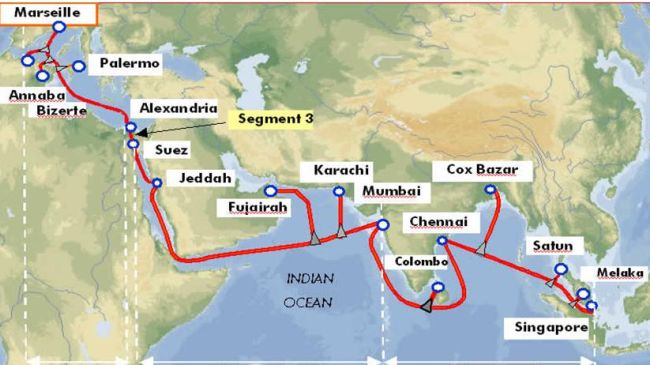
South East Asia–Middle East–Western Europe 4 (SEA-ME-WE 4) optical fiber submarine communications cable
Press TV – December 29, 2013
The US National Security Agency (NSA) has collected sensitive data on key undersea optical fiber telecommunications cables between Europe, North Africa and Asia.
Citing classified documents labeled “top secret” and “not for foreigners”, German news magazine Der Spiegel reported on Sunday that the NSA spied on the so-called “South East Asia-Middle East-West Europe 4” also known as “Sea-Me-We 4” undersea cable system.
The German magazine said NSA specialists had hacked an internal website belonging to the operator consortium to mine documents about technical infrastructure including circuit mapping and network management information. “More operations are planned in the future to collect more information about this and other cable systems.” Spiegel quoted the NSA documents, dating from February, as saying.
According to the website of the project “the South East Asia-Middle East-West Europe 4 project is a next generation submarine cable system linking South East Asia to Europe via the Indian Sub-Continent and Middle East. The project aims to take these regions to the forefront of global communication by significantly increasing the bandwidth and global connectivity of users along its route between Singapore and France.”
Spiegel reports that “Among the companies that hold ownership stakes in it are France Telecom, now known as Orange and still partly government-owned, and Telecom Italia Sparkle.”
In March 2004, a consortium of 16 international telecommunications companies signed construction and maintenance agreements for the new optical fiber submarine cable system linking South East Asia to Europe via the Indian Sub-Continent and Middle East with Terminal Stations in Singapore, Malaysia, Thailand, Bangladesh, India, Sri Lanka, Pakistan, United Arab Emirates, Saudi Arabia, Egypt, Italy, Tunisia, Algeria and France. The contract is being awarded jointly to Alcatel Submarine Networks, France and Fujitsu Ltd., Japan and the estimated project cost is of the order of $500 million.
The submarine cable system is approximately 20,000km long. It consists of the main backbone across the Eastern and Western worlds plus the extension links in various countries. The project seeks to support telephone, internet, multimedia and various broadband data applications.
It seems the method was employed by the NSA’s elite hacking unit (TAO) via incorporating routers and servers from non-NSA networks into its covert network by infecting these networks with “implants” that then allow the government hackers to control the computers remotely.
The document leaked by Der Spiegel proudly says that, on Feb. 13, 2013, TAO “successfully collected network management information for the SEA-Me-We Undersea Cable Systems (SMW-4).” With the help of a “website masquerade operation,” the agency managed to “gain access to the consortium’s management website and collected Layer 2 network information that shows the circuit mapping for significant portions of the network.”
The US government claims that its spying operations that are taking place both at home and abroad are vital for fighting terrorism.
A federal judge ruled Friday that the NSA’s bulk collection of millions of Americans’ telephone and Internet records is legal. US District Judge William Pauley also concluded that the operation is an important part of America’s effort to combat the threat of terrorism.
NSA spies on millions of telephone and Internet records that are routed through American networks on daily basis. According to some estimates, NSA spies on 380 million cellphones in the US.
Prior to Pauley’s ruling, another US District Court Judge, Richard Leon, had described the massive NSA spying program “Almost Orwellian”.
“I cannot imagine a more ‘indiscriminate’ and ‘arbitrary invasion’ than this systematic and high-tech collection and retention of personal data on virtually every single citizen,” Judge Leon wrote.
Is Anything Left of the US Constitution or Privacy Rights?

Vying for a Supreme Court appointment? US District Judge William H. Pauley III ruled that the NSA’s massive spying program is legal.
By Franklin Lamb | Fig Trees and Vineyards | December 28, 2013
The answer to this question is being pondered across America in light of two seemingly contradictory federal court decisions handed down this month from two separate courts, one in Washington, the other in New York.
Since the Bush Administration’s “war of terrorism” was launched, civil liberties advocates have voiced growing alarms about the erosion of Constitutional guarantees. Yet with the disclosures by whistle blower Edward Snowden, concerns about what protections Americans have remaining—protections from governmental intrusions into their privacy as well as home or office invasions by police forces—have rapidly gained new impetus. Because of Snowden’s leaks, legal challenges have been brought against the National Security Agency; without the leaks, no challenge could have been mounted.
Now all of a sudden two US Federal District Courts, with identical powers under the US Constitution, have reached seemingly opposite conclusions on the same legal issue, i.e. the right of the NSA to conduct “metadata” searches and store the information of scores of millions of unknowing Americans. This means, given that appeals have been filed in both cases, that the issue is likely going to be decided by the US Supreme Court.
Civil libertarians were encouraged earlier this month when Federal Judge Richard Leon of the United States District Court for the District of Columbia ruled on December 16 that the NSA’s bulk collection of cell phone data of Americans (everyone you called, when you called them, and where you were when you called them) violates the Fourth Amendment to the Constitution. Calling the data gathering “Orwellian,” Judge Leon reasoned that we now use our smartphones for a wide variety of personal activities in which we have the expectation of privacy, that probably we have more expectation of privacy from cell phones now than we did, say, from a pay phone in the 1980s. And he also noted, crucially, that cell phones today make it possible to determine the caller’s GPS location. “It’s one thing to say that people expect phone companies to occasionally provide information to law enforcement; it is quite another to suggest that our citizens expect all phone companies to operate what is effectively a joint intelligence-gathering operation with the Government,” Leon wrote.

US District Judge Richard Leon
The judge then focused on whether the massive NSA surveillance violates the Fourth Amendment, which guarantees, “the right of the people to be secure in their persons, houses, papers, and effects, against unreasonable searches and seizures, shall not be violated, and no warrants shall issue, but upon probable cause, supported by oath or affirmation, and particularly describing the place to be searched, and the persons or things to be seized.”
He writes:
“The threshold issue that I must address, then, is whether plaintiffs have a reasonable expectation of privacy that is violated when the Government indiscriminately collects their telephony metadata along with the metadata of hundreds of millions of other citizens without any particularized suspicion of wrongdoing, retains all of that metadata for five years, and then queries, analyzes and investigates that data without prior judicial approval of the investigative targets. If they do – and a Fourth Amendment search has thus occurred– then the next step of the analysis will be to determine whether such a search is ‘reasonable.’”
Judge Leon found that the NSA, when demanding citizens’ telephone metadata, is conducting a search, and that it is most likely an unreasonable search under the Fourth Amendment, given there is no specific suspicion of wrongdoing by any individual whose records are demanded.
In his ruling he granted the request for an injunction against the collection of the plaintiffs’ phone data, ordering the government to destroy any of their records that have been gathered. But the judge stayed action on his ruling pending a government appeal, recognizing in his 68-page opinion what he termed as the “significant national security interests at stake in this case and the novelty of the constitutional issues.”
But no sooner had Judge Leon’s decision been published, bringing hope to civil libertarians, than US District Judge William H. Pauley III in New York issued what looks almost like a diametrically antithetical ruling, making for the latest in a contentious debate that has also seen a presidential commission weighing in on certain aspects of NSA spying as well. On December 27, Pauley ruled that the NSA’s collection of vast oceans of data on private phone calls is legal—meaning that in a period of just 11 days the two judges, along with the presidential panel, had reached “the opposite of consensus on every significant question before them, including the intelligence value of the program, the privacy interests at stake and how the Constitution figures in the analysis,” as the New York Times reported it.
The case in New York was brought by the American Civil Liberties Union, which said it would appeal.
Judges Leon and Pauley have starkly differing understandings on how valuable the NSA program is. Echoing arguments made recently by former FBI director Robert S. Mueller III and other senior government officials, Pauley, whose courtroom is not far from where the World Trade Center towers stood, said he believed the program might have caught the 9/11 hijackers had it been in place at the time. “While robust discussions are underway across the nation, in Congress and at the White House, the question for this court is whether the government’s bulk telephony metadata program is lawful,” Pauley wrote. “This court finds it is.”
The finding stands in stark contrast to Leon’s ruling in Washington:
“The government does not cite a single instance in which analysis of the N.S.A.’s bulk metadata collection actually stopped an imminent attack, or otherwise aided the government in achieving any objective that was time-sensitive in nature,” Judge Leon wrote.
What these conflicting decisions leave us in is a profound quandary with respect to the issues raised by Edward Snowden. In a Christmas address that was carried by British Channel 4 and widely aired on the Internet, the former NSA contractor expressed the legitimate concern of all people who value individual liberty and privacy. A child born today, he said, might “never know what it means to have a private moment to themselves, an unrecorded, unanalyzed thought.” He added that people are essentially walking around with a tracking device in their pockets, noting that this disappearance of privacy is important because privacy “is what allows us to determine who we are and who we want to be.”
Obama regime tries to stop courts from ruling on constitutionality of warrantless spying
By Noel Brinkerhoff | AllGov | December 24, 2013
Even after months of stories exposing the breadth and depth of National Security Agency (NSA) spying on Americans’ communications, the Obama administration insists federal courts should stop hearing cases challenging the agency’s warrantless surveillance on grounds that they might expose the existence of this spying.
Last week, federal lawyers asked a judge, Jeffrey S. White, in Northern California to dismiss cases that could lead to a ruling on the constitutionality of warrantless surveillance programs authorized during the George W. Bush administration.
The Obama administration contends the cases are just too dangerous to continue if they wind up jeopardizing state secrets.
“Disclosure of this still-classified information regarding the scope and operational details of N.S.A. intelligence activities implicated by plaintiffs’ allegations could be expected to cause extremely grave damage to the national security of the United States,” James Clapper Jr., director of national intelligence, wrote in one of the filings. In June, Clapper was exposed for having lied to Congress about the existence of programs that spied on Americans.
Cindy Cohn, legal director for the Electronic Frontier Foundation, which is representing the plaintiffs in the cases, told The New York Times that the government’s assertion was “very troubling.”
She added that despite the revelations by NSA whistleblower Edward Snowden, the administration was essentially saying, “We can’t say whether the American people have been spied on by their government.”
The lawsuits in question were brought by Carolyn Jewel and Virginia Shubert, who claim the NSA’s spying violated their constitutional rights.
Jewel is suing on behalf of all AT&T customers, and Shubert is suing on behalf of all Americans.
The NSA has refused to confirm or deny that either plaintiff’s communications were targeted.
“The American people know they’re being surveilled,” Cohn told The Washington Post. “The government is trying to reset the clock in order to avoid an open judicial determination about whether that surveillance is legal.”
To Learn More:
White House Tries to Prevent Judge From Ruling on Surveillance Efforts (by Charlie Savage and David Sanger, New York Times)
U.S. Government Moves To Block Further Litigation In NSA Surveillance Cases (by Marc Ferranti, IDG News Service)
U.S. Reasserts Need To Keep Domestic Surveillance Secret (by Ellen Nakashima, Washington Post)
Jewel v. NSA (Electronic Frontier Foundation)
NSA Phone Data Collection Made No Difference to National Security (by Noel Brinkerhoff and Danny Biederman, AllGov)
Obama Asks U.S. Supreme Court for Stamp of Approval on Warrantless Cell Phone Searches (by Noel Brinkerhoff, AllGov)
Should National Intelligence Director Clapper be Charged with a Felony for Lying in Sworn Senate Testimony? (by Noel Brinkerhoff, AllGov)
Featured Video

Saudi Led Destruction of Yemen’s heritage
or go to
Aletho News Archives – Video-Images
From the Archives
Israel: Strategic Ally or Liability?
By Stephen Sniegoski | My Catbird Seat | June 12, 2010
The claim that Israel serves as a valuable ally for the United States is made by both pro-Zionists and much of the anti-war and anti-Zionist Left that is influenced by Noam Chomsky. As a result of the Gaza flotilla massacre, which has caused a world-wide uproar against Israel, the value of Israel to the United States is being publicly questioned in more mainstream foreign policy forums. … continue
Blog Roll
 Aletho News
- The Houthis Are Not an Iranian Proxy
- Europe’s Energy Hypocrisy, Russian LNG Profits and US Dependence
- ICC ignored ‘very well-documented’ NATO crimes – ex-Libyan minister
- SNSC secretary dismisses US response to Iran’s conditions as ‘inadequate’
- Sanaa says Taiz roads open, secure for residents, warns Saudi forces
- Iraqi resistance group urges Saudi leadership to admit defeat, lift Yemen siege
- Trump’s Retreat: How Al-Aqsa Flood Took Down the US Empire
- Israel’s Military Actions in Lebanon Grossly Violate International Law — Lavrov
- Seyed M. Marandi: US-Iran War Inevitable: Kuwait and Bahrain May Fall
- Leaders Condemn Ansarallah Attack on Saudi Arabia While Ignoring Illegal War Against Yemen
- If Americans Knew
- It’s a Genocide, I’m Into It’: Seinfeld Mocks Protest over Palestinian Children Killed
- Universities fire dozens amid pressure from Zionist billionaires
- Gaza’s buildings are collapsing on top of us. But there’s nowhere else to shelter
- Israel kills four-year-old Gaza child – Daily Update
- After Oct 7, IDF policy allowed civilian casualties for even the lowest-ranking targets
- Israel’s Destruction of Southern Lebanon Intensified After the Cease-Fire
- The Last-Minute Decision That Gave Israel Its Name
- The American Conservative: How Trump Made the World Go Nuclear
- Meet the US generals and admirals advancing Israeli policy
- Opinion: Why news organizations should boycott Israel
- No Tricks Zone
- New Study Suggests Large Regions Of The Pacific Ocean Have Been Cooling For The Last 80 Years
- Germany’s Green Energy Debacle: High Energy Costs Force Kahla Porzellan to Close After 182 Years!
- New Study: 50 Years Of The Most Aggressive ‘Net Zero’ Policies Can Only Affect The Global Climate By 0.03°C
- US September “Heat” Was No Record…Many Records Set Decades Ago
- Latest European Green Energy Debacle; Portugal’s Largest Flagship Solar Park Insolvent!
- Green Energy Debacle: German Expert Professor Fritz Vahrenholt Warns Of Severe Economic And Social Consequences
- Two More Paleo Reconstructions Affirm Meters-Higher Sea Levels Across Ireland, Brazil 7000-6000 Years Ago
- New Study: Earth And Venus Surface Warmth Largely Explained By Convection And Lapse Rate, Not CO2 Or Radiation
- 2025 Nature Paper Claiming Worsening Global Drought Gets RETRACTED …Heavily Flawed
- New Study: ‘Global Drought Shows No Detectable Recent Acceleration Under Climate Warming’

