Civil Liberties Groups Challenge Taxpayer Funding Of Religious Ministries In New Jersey
Public Aid To Sectarian Institutions Violates State Constitution And Law Against Discrimination, Watchdog Organizations Say
Americans United | June 24, 2013
Americans United for Separation of Church and State joined the American Civil Liberties Union of New Jersey (ACLU-NJ) and the national ACLU in filing a lawsuit today to stop the state of New Jersey from awarding more than $11 million in taxpayer funds to two higher education institutions dedicated solely to religious training and instruction.
The groups also filed a petition asking the court to immediately prevent the state from doling out grants to those two institutions, Beth Medrash Govoha and Princeton Theological Seminary.
“Religious institutions should pass the plate to the faithful, not the taxpayers,” said the Rev. Barry W. Lynn, executive director of Americans United. “Clergy training is the responsibility of religious communities, not the government.”
“We support freedom of religion; however the government has no business funding religious ministries,” said Ed Barocas, legal director of the ACLU of New Jersey. “Taxpayers should not foot the bill to train clergy or provide religious instruction, but the state is attempting to do exactly that.”
On April 29, New Jersey Gov. Chris Christie’s administration released a list of 176 college construction projects it intends to aid with money from a voter-approved bond. The New Jersey Constitution forbids any such taxpayer funds from supporting ministries or places of worship.
Yet Beth Medrash Govoha, an orthodox Jewish rabbinical school in Lakewood, is slated to receive $10.6 million from the state to pay for the construction of a new library and academic center. All courses of study at Beth Medrash Govoha are classified as “Theology/Theological Studies” or “Talmudic Studies.” The school prepares students to become rabbis and religious educators.
Similarly, Princeton Theological Seminary, a Presbyterian Christian seminary located in Princeton, is slated to receive $645,323 from the state. All courses of study at the seminary either prepare students to serve as ministers or priests in Christian religious traditions or to serve as religious educators. The New Jersey Secretary of Higher Education’s website identifies the school as a “theological institution.”
“The state of New Jersey has an important role to play in providing financial support for institutions of higher learning in our state, but public money should not be used to fund schools that are not open and welcoming to all students in New Jersey,” said Udi Ofer, executive director of the ACLU of New Jersey. “State funding of higher education should not be done at the expense of the separation of church and state.”
“Taxpayers should not be forced to pay for the training of clergy,” said Alex J. Luchenitser, associate legal director of Americans United. “These grants plainly violate the separation of church and state enshrined in the New Jersey Constitution.”
Giving public money to Beth Medrash Govoha also violates the New Jersey Law Against Discrimination. The school is identified in federal records as a single-sex school with only male students. According to state records, its entire student body of 6,538 students was all-male in 2012, and all 79 members of its faculty were male during 2011.
The lawsuit was filed in Superior Court in Trenton. The plaintiffs in the case are the ACLU-NJ, the Unitarian Universalist Legislative Ministry of New Jersey (UULMNJ) and Gloria Schor Andersen, a Voorhees Township resident who has been a public-school and a Hebrew School teacher/tutor. Andersen is also Speaker-at-Large for the Delaware Valley Chapter of Americans United for Separation of Church and State.
“As a member of the clergy, I recognize the important responsibility that faith groups have in training their next generation of leaders,” said the Rev. Craig Hirshberg, executive director of UULMNJ. “However, their religious studies should not be funded by taxpayers. When the government financially supports religious groups, it provides privileges to particular religions over others and diverts designated public funds away from programs that should benefit all citizens.”
The legislature has until June 28 to reject the grants. Some lawmakers have raised similar concerns about funding religious ministries and pressed the state for more information about its selection process.
In addition to the lawsuit, the ACLU-NJ has filed several open records requests with the state to learn more about the nature of the schools receiving funding and how the grants were awarded. The state failed to release scoring sheets and other records documenting how it determined who should receive the grants.
“These grants fly in the face of important state safeguards that protect the religious liberty of all New Jersey taxpayers,” said Daniel Mach, director of the ACLU Program on Freedom of Religion and Belief.
Along with Barocas, Luchenitser, and Mach, the attorneys representing the plaintiffs include Frank Corrado of Barry, Corrado & Grassi, P.C.; Lenora Lapidus and Mie Lewis of the ACLU Women’s Rights Project and Ayesha Khan, legal director of Americans United.
Americans United is a religious liberty watchdog group based in Washington, D.C. Founded in 1947, the organization educates Americans about the importance of church-state separation in safeguarding religious freedom.
Related articles
- Ultra-Orthodox Jewish college wins $10.6 million in public funds (nj.com)
- It’s an outrage! NJ plans to cough up millions to fund training colleges for priests and rabbis (freethinker.co.uk)
- Two Religious Schools in New Jersey May Receive More Than $11,000,000 in Taxpayer Money (patheos.com)
- Church and state, separated for a reason: Editorial (nj.com)
- New Jersey Blocks Release Of Lakewood Yeshiva’s $10.6 Million Grant Application, Opponents Cry Foul (failedmessiah.typepad.com)
- How did a male-only yeshiva get $10.6 million in public funds? (religionnews.com)
Man Claims Cops Sodomized Him With a Gun
By JACK BOUBOUSHIAN | Courthouse News | June 24, 2013
CHICAGO – Chicago police officers sodomized a man with a gun, “laugh(ing) hysterically,” until he agreed to buy drugs for the cops in a sting, the man claims in court.
Angel Perez sued Chicago and its police Officer Jorge L. Lopez in Federal Court.
Perez was working as a delivery driver on Oct. 20, 2012, when cops in an unmarked car pulled him over, handcuffed him and took him to the Harrison Street Police Station, he says in the complaint.
There, “Two officers began assaulting the plaintiff with questions regarding robberies and drug dealers in the Taylor Street area,” the complaint states. “Plaintiff responded that he did not know anything about robberies or drug dealings in the Taylor Street area and again and repeatedly requested that the officers call his lawyer. Plaintiff’s lawyer was never contacted and the questioning continued. The officers were particularly interested in why the plaintiff had the telephone number of an individual by the name of ‘Dwayne’ in his telephone.”
Perez claims the police released him after two hours of questioning, but Officer Lopez called him the next day, “told the plaintiff that what took place the night before was a mistake and that he needed the plaintiff to sign some papers so that his car would not be towed. Defendant Lopez instructed the plaintiff to meet him at Al’s Beef on Taylor Street at 3:00 p.m. that day,” the complaint states.
But when Perez arrived at Al’s Beef, an officer with Lopez, known to Perez only as the Sergeant, “grabbed the plaintiff and slammed his head on to the trunk of his car, searched plaintiff, handcuffed plaintiff with his hands behind his back and placed him in the squad car.”
The complaint continues: “Plaintiff was then taken back to the Harrison Street Police station to a second floor room with chairs and a table. Again, plaintiff was handcuffed to a bar, and this time he was also placed in ankle shackles.
“Plaintiff was held against his will in the room for several hours handcuffed and shackled, and not free to leave the custody of the defendants. While in the room, several other officers (approximately six officers) entered the room during the next several hours joining defendant Lopez and the Sergeant threatening the plaintiff with sending him to the Cook County jail to be raped by gang members. Further, that the[y] (the officers) could do whatever they wanted and that they would plant evidence on him and his family members if he continued to refuse to cooperate with them. Still, further that if he did not cooperate they would charge him [with] a conspiracy to obstruct justice. One of the officers in the room identified himself as the ‘Commander.’
“Plaintiff repeatedly requested his lawyer; that request was not acknowledged by the officers.
“The officers wanted the plaintiff to call or text ‘Dwayne’ and set up a drug purchase, but he refused to call or text Dwayne.
“After a period of time refusing to call or text Dwayne, the officers began to pull and contort the plaintiff’s body while he was handcuffed to the wall and shackled at his ankles, causing the plaintiff severe pain. At one point, the Sergeant sat on the plaintiff’s chest and placed his palms on the plaintiff’s eye sockets and pushed hard against them, causing plaintiff severe pain. The Sergeant also drove his elbows into plaintiff’s back and head causing severe pain. Defendant Lopez was in the room at the time and did not intervene.
“In an attempt to contact the outside world, plaintiff agreed to make the call and he attempted to call a friend of his to inform him what was transpiring, at which time an officer took plaintiff’s telephone and hung up the call.
“After several hours of verbal and physical torture, defendant Lopez and the Sergeant were alone in the room with the plaintiff. The officers told plaintiff that if he refused to cooperate with them that they were going to give him a ‘little taste’ of what he would be getting at the Cook County jail. They put plaintiff over a chair and pulled down his pants, and defendant Lopez said, ‘I hear that a big black nigger dick feels like a gun up your ass.’
“Then defendant Lopez and/or the Sergeant, knowing their actions created a strong likelihood of great bodily harm and mental anguish, inserted a cold metal object, believed to be one of officer’s service revolvers, into the plaintiff’s rectum, causing the plaintiff severe pain and humiliation. The two officers laughed hysterically while inserting the object into the plaintiff’s rectum.
“The Sergeant then said ‘I almost blew your brains out.’ The officers told the plaintiff that they would continue to insert the gun into his rectum until he cooperated with them.
“Plaintiff began to cry and agreed to cooperate with the officers.”
Perez called Dwayne and arranged to buy one gram of heroin, according to the complaint.
“The police then brought plaintiff to his car, provided the plaintiff with money to purchase the heroin, a box believed to be a GPS device and an audio recording device to record the transaction.
“Plaintiff completed the purchase from Dwayne for the Chicago Police and returned the drugs and equipment to the police. The officers then wanted plaintiff to sell drugs to Dwayne. Plaintiff told the officers that he would not be involved again with them,” according to the complaint.
Perez claims that Lopez continued to call his cell phone, asking to meet with him again, until Perez contacted the Independent Police Review Authority.
“At no time on either October 20, 2012 or October 21, 2012, prior to plaintiff’s seizure and torture, did the plaintiff commit a crime,” Perez says in the complaint.
Perez seeks punitive damages for excessive force, failure to intervene and emotional distress. He is represented by Dennis DeCaro with Kupets & DeCaro.
Related articles
- Beaten for Filming a Beating, Woman Says (alethonews.wordpress.com)
- Baltimore Cops Sued (Again) For Destroying Citizen Footage of Them Caught in the Act of Being Themselves (reason.com)
After Bragging about Using Surveillance Law to Catch Terrorists, Government Balks at Proving it in Court
By Matt Bewig | AllGov | June 24, 2013
Even as the Obama administration continues its aggressive defense of the PRISM domestic spying program, with defense and intelligence officials claiming that it foiled as many as 50 terror plots, the Justice Department continues to play coy, as though PRISM did not exist.
This disconnect likely arises from the fact that government surveillance often turns out to be a two-edged sword when prosecutors bring criminal charges against alleged wrongdoers. Implementing the constitutional right of “due process under law,” state and federal laws require prosecutors to share all relevant information with defendants, which their attorneys use to identify exculpatory facts and witnesses and develop legal defenses.
In the case of teenage terror defendant Adel Daoud, attorneys alleged in papers filed last week in federal court that the government has not lived up to its obligations. Daoud, an American citizen, was arrested and charged in September 2012 with plotting to blow up a downtown Chicago bar.
Three months later, during a debate on the FISA Amendments Act (FAA), which the Obama administration claims as the legal basis of its PRISM domestic spying program, a key Senator claimed that the FAA had helped investigators catch Daoud. Specifically, on December 27, 2012, Sen. Dianne Feinstein (D.-California), chairwoman of the Senate Intelligence Committee, stated that the FAA had helped thwart “a plot to bomb a downtown Chicago bar” that fall.
If that is true, the Federal Rules of Criminal Procedure would require the government to share the results of the surveillance that led investigators to Daoud, yet prosecutors refuse even to confirm or deny the substance of Feinstein’s comments. Daoud’s attorney, former federal prosecutor Thomas A. Durkin, argues that the government manipulates “a Global War on Terror playbook” to its advantage and then refuses to disclose it.
“Whenever it is good for the government to brag about its success, it speaks loudly and publicly. When a criminal defendant’s constitutional rights are at stake, however, it quickly and unequivocally clams up under the guise of State Secrets,” wrote Durkin in a court filing demanding the government confirm or deny the use of the surveillance.
“Whether the government relied on FAA surveillance when it obtained its FISA order is a crucial element of giving adequate notice to criminal defendants. The government should be compelled to provide a simple ‘yes’ or ‘no’ answer to the question of whether its evidence was obtained or derived from electronic surveillance conducted under the FAA,” the motion explains.
To Learn More:
Chicago Federal Court Case Raises Questions about NSA Surveillance (by Ellen Nakashima, Washington Post)
Teen Terror Suspect Says Feds must Admit Spying on Him, Americans (by Chuck Goudie, abc7 Chicago)
Related article
- The Truth About the Kangaroo FISA Court (lewrockwell.com)
Bulgarian scholars call for end to plutocracy
Press TV – June 24, 2013
Sixty prominent Bulgarian intellectuals have issued a special declaration against ‘plutocracy’ in the country, calling for an end to rule by the wealthy and a return to democracy.
The so-called charter for disbanding the plutocratic model of the Bulgarian state was issued on Sunday amid the ongoing protests by Bulgarians to oust the three-week-old government.
“The protests of tens of thousands of people across the country were motivated by the desperate concern about the state system in Bulgaria. Beyond doubt, we are in a deep crisis of the social contract and a total discreditation of the state institutions,” the declaration read.
The protests began on June 14 after the appointment of controversial and inexperienced media mogul Delyan Peevski as chief of Bulgaria’s National Security Agency (DANS).
The declaration called Peevski’s career and public image “a synthesis of all pathological processes that led to the current degrading and seemingly dead-end situation.”
“The Peevski case laid bare the growing seizure of the political system, media, justice, security and banking sectors by a network of hidden dependencies that does not respect the rule of law and separation of powers, empties the institutions from democratic legitimacy and substitutes public interest [with] corruption and moral degradation,” the declaration stated.
The new Socialist-backed Prime Minister Plamen Oresharski withdrew Peevski’s nomination immediately after the protests erupted.
However, the move failed to appease both the protesters and President Rosen Plevneliev, who said he had lost confidence in the government and demanded an immediate review of the controversial appointment.
In addition, the declaration addressed a number of other instances over the past years that proved “the adhesion of oligarchy and power,” urging the public to launch a process to clearly define the problems in the functioning of Bulgaria’s democracy and to draft reforms to abolish them.
It also listed some of the most striking problems, including alienated institutions, easily swayed by corruption, nepotism and weakened judiciary, police and media.
The sixty scholars behind the declaration include lawyers, journalists, political analysts, sociologists and human rights activists.
New Snowden leak reveals US hacked Chinese cell companies, accessed millions of sms – report
RT | June 23, 2013
US government has been hacking Chinese mobile operator networks to intercept millions of text messages, as well as the operator of region’s fibre optic cable network, South China Morning Post writes citing Edward Snowden.
More information on National Security Agency activity in China and Hong Kong has been revealed by SCMP on Sunday, shedding light on statements Snowden made in an interview on June 12.
“The NSA does all kinds of things like hack Chinese cell phone companies to steal all of your SMS data,” Snowden was quoted as saying on the SCMP website.
In a series of reports the paper claims Snowden has provided proof of extensive US hacking activity in the region.
The former CIA technician and NSA contractor reportedly provided to the paper the documents detailing specific attacks on computers over a four-year period, including internet protocol (IP) addresses, dates of attacks and whether a computer was still being monitored remotely. SCMP however did not reveal any supporting documents.
The US government has been accused of a security breach at the Hong Kong headquarters of the operator of the largest regional fibre optic cable network operator, Pacnet. Back in 2009, the company’s computers were hacked by the NSA but since then the operation has been shut down, according to the documents the paper claims to have seen.
Pacnet’s network spans across Hong Kong, China, Korea, Japan, Taiwan, the Philippines and Singapore and provides connections to 16 data centers for telecom companies, corporations and governments across the region.
The whistleblower has also allegedly revealed the US had viewed millions of text messages by hacking Chinese mobile phone companies. That is a significant claim since the Chinese sent almost billion text messages in 2012 and China Mobile is the world’s largest mobile network carrier.
In his very first leak to the media, Snowden had already exposed the scale of the American government spying operation on its domestic mobile network operators. He later revealed that the US and the UK possessed technology to access the Blackberry phones of delegates at two G20 summit meetings in London in 2009.
In a third article, SCMP claims that the US on a regular basis has been attacking the servers at Tsinghua University, one of country’s biggest research institutions. The whistleblower said that information obtained pointed to hacking activities, because it contained such details as external and internal IP addresses in the University’s network, which could only have been retrieved by a security breach.
Tsinghua University is host to one of Chinas’ six major backbone networks, the China Education and Research Network (CERNET) containing data about millions of Chinese citizens.
Spying on the World From Domestic Soil
By Katitza Rodriguez | EFF | June 21, 2013
The world is still reeling from the series of revelations about NSA and FBI surveillance. Over the past two weeks the emerging details paint a picture of pervasive, cross-border spying programs of unprecedented reach and scope: the U.S. has now admitted using domestic networks to spy on Internet users both domestically and worldwide. The people now know that foreign intelligence can spy on their communications if they travel through U.S. networks or are stored in U.S. servers.
While international public outrage has justifiably decried the scope and reach of these revelations, carte blanche foreign intelligence surveillance powers over foreigners are far from new. In the U.S., foreign intelligence has always had nearly limitless legal capacity to surveil foreigners because domestic laws and protections simply don’t reach that surveillance activity.
This legal framework, with no protection for foreigners and little oversight besides, has been exacerbated by the growth in individuals now living their lives online, who conduct their most intimate communications in cloud services that are hosted in the U.S. and across different jurisdictions. To make matters worse, the vast amount of Internet traffic globally is routed through the U.S. Last but not least, logistical barriers to powerful, mass surveillance have lowered and the application of existing legal principles in new technological contexts has become unclear and shrouded in secrecy, especially in a extra-territorial surveillance context. The US government’s FISA powers, which in 2008 opened the door to broad surveillance of communications where one side is an American and the other side is a foreigner, represent just an example of an increasing state capacity to conduct nearly limitless invasive extra-territorial surveillance from domestic soil.
International Backlash
On June 18, Germans rallied at a well-known Berlin Wall crossing point called Checkpoint Charlie. Under the motto: “Yes We Scan!” German activists protested against PRISM and NSA surveillance in response to President Barack Obama’s Berlin visit. Pictures of the rally show protest signs claiming that the Obama administration has become “Stasi 2.0” with the quote “All your data belong to us”.
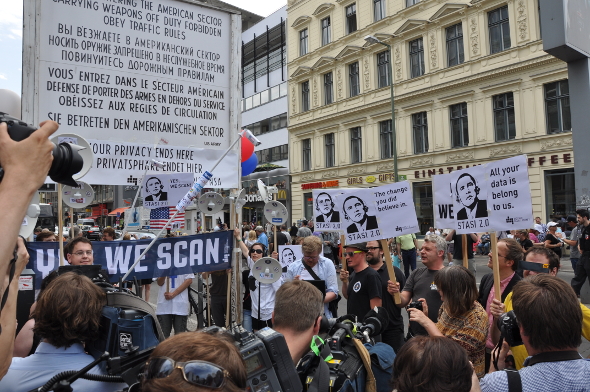
The Stasi 2.0 campaign was originally designed in 2007 to fight Germany’s mandatory data-retention law, a law implementing an EU Directive that force ISPs and telecom providers to continuously collect and store records documenting the online activities of millions of ordinary Europeans. Roughly 34,000 citizens filed a lawsuit against the mandatory data retention in protest. The campaign was successful and in March 2010 a German court declared the law unconstitutional and ordered the deletion of the collected data. Now, the Stasi 2.0 campaign has shifted focus on calling upon their government to protect them against overreach scope of NSA foreign surveillance practices, Sandra Mamitzsch from Digitale Gesellschaft told EFF.
Germany has also increased its capacity to conduct sweeping and invasive extra-territorial surveillance from its domestic soil. As we noted, the German government has leveraged its ability to remotely compromise computer systems in order to spy on its citizens. The government has used commercial malware to hack private data. While there has been no confirmation that Germany is deploying these investigative techniques against persons outside German territories, extra-territorial surveillance is feasible because infection occurs via email and other Internet transmissions.
Campaigns against the NSA spying overreach are now being planned for July 6 all around Australia. Australians can get involved here: http://ourprivacy.org.au/
Micheal Vonn, policy director at the B.C. Civil Liberties Association in Canada, told to the Global News in Canada: “[w]e fully intend to get some pointed questions to the Canadian government about knowledge, complicity, alliance with this program. And whether, in fact, very, very quietly, the Canadian security establishment has been harvesting the fruits of this program for some time.”
EFF is demanding Internet companies to join our cause and protect the privacy of their international customers calling on Congress to create a committee to uncover the truth about the NSA alarming allegations. You can take action here. Current foreign intelligence surveillance targetting foreigners must be challenged to ensure strong human rights safeguards, transparency and accountability across the world. A global dialogue on extra-territorial foreign intelligence surveillance among all nations is much needed.
EFF will continue blogging about the impact of the NSA leaks on Internet users abroad in our Spies Without Borders series. Next, we will examine what implications the government’s use of these FISA powers has for Internet users abroad, with an eye to other jurisdictions and the requirements of international law.
This is the 5th article of our Spies Without Borders series. The series are looking into how the information disclosed in the NSA leaks affect Internet users around the world whose private information is stored in U.S. servers, or whose data travels across U.S. networks.
Image: Digitale Gesellschaft, licensed under a Creative Commons BY SA 3.0 license.
Related article
Four Injured, Palestine TV Reporters Kidnapped In Kufur Qaddoum
By Saed Bannoura | IMEMC | June 22, 2013
The Popular Committee Against the Wall and Settlements in Kufur Qaddoum village, near the northern West Bank city of Qalqilia, reported Friday that dozens of Israeli soldiers attacked the weekly nonviolent protest, wounding four residents, and kidnapped reporters of the official Palestine TV.
The Committee said that the soldiers violently attacked and beat reporter Ahmad Shawar and cameraman Bashar Nazzal, working for the Palestinian TV, confiscated their cameras, and threw the rest of their equipment in the trash.
An Israeli army spokesperson claimed that the kidnapped journalists “attacked the soldiers”, and that they have been transferred to an interrogation facility.
Morad Shteiwy, coordinator of the Popular Committee in the village, has reported that the army surrounded the village since early morning hours Friday, and invaded it in an attempt to prevent the residents from holding their weekly protest against the illegal Annexation Wall and settlements.
“The large number of soldiers deployed in the village could not prevent the determined residents from holding their protest”, Shteiwy said, “the soldiers violently attacked the protesters and fired dozens of gas bombs, concussion grenades, and rubber-coated metal bullets”.
He further said that resident Aqel Mahmoud Shteiwy, 25, was shot with a rubber-coated bullet in his hand, and that one of his fingers was amputated, and added that resident Yousef Mustafa Shteiwy, 21, was shot in the chest, Bassam Ayyoub Shteiwy, 26, was shot in the back and Bashar Mahmoud Shteiwy, 22, was shot in the abdomen.
Also on Friday, soldiers used tear gas, chemical water and rubber-coated steel bullets to attack the weekly protests at the villages of Bil’in and Ni’lin, near the central West Bank city of Ramallah, where residents and their international and Israeli supporters, managed to reach the wall; two protesters were injured and many were treated for the effects of tear gas inhalation.
In Bil’in, gas bombs fired by Israeli troops caused a fire that damaged olive trees owned by local farmers. Soldiers also fired tear gas at residents who tried to put out the fire.
At the nearby village of al Nabi Saleh, Israeli soldiers attacked the villagers and their supporters before leaving the village.
Dozens of soldiers stormed the village and fired gas bombs into resident’s homes. Many were treated for the effects of tear gas inhalation.
In al Ma’sara village, near Bethlehem, dozens of soldiers stopped the villagers and their supporters at the village entrance and then forced them back, using rifle-buts and batons to push people back, no injuries were reported.
Related articles
Reassured by NSA’s Internal Procedures? Don’t Be. They Still Don’t Tell the Whole Story.
By Kurt Opsahl and Mark Rumold | EFF | June 21, 2013
Yesterday, the Guardian released two previously-classified documents describing the internal “minimization” and “targeting” procedures used by the NSA to conduct surveillance under Section 702. These procedures are approved by the Foreign Intelligence Surveillance Court (FISC) on an annual basis and are supposed to serve as the bulwark between the NSA’s vast surveillance capabilities and the private communications of Americans. As we noted earlier today, the procedures, themselves, aren’t reassuring: far too much discretion is retained by NSA analysts, the procedures frequently resolve doubt in favor of collection, and information is obtained that could otherwise never be obtained without a warrant.
Which would be bad enough, if it were the end of the story. But it’s not.
The targeting and minimization documents released yesterday are dated a few months after the first publicly known scandal over the new FAA procedures: In April 2009, the New York Times reported that Section 702 surveillance had “intercepted the private e-mail messages and phone calls of Americans . . . on a scale that went beyond the broad legal limits established by Congress.” In June 2009, the Times reported that members of Congress were saying NSA’s “recent intercepts of the private telephone calls and e-mail messages of Americans are broader than previously acknowledged.” Rep. Rush Holt described the problems as “so flagrant that they can’t be accidental.”
Presumably, following these “flagrant” abuses (and likely in response to the Congressional criticism of the original procedures), the government refined the procedures. The documents released yesterday are the “improved” targeting and minimization procedures, which appear to have been reused the following year, in 2010, in the FISC’s annual certification.
But these amended procedures still didn’t stop illegal spying under Section 702.
Unless the government substantially changed the procedures between August 2010 and October 2011, these are the very procedures that the FISC eventually found resulted in illegal and unconstitutional surveillance. In October 2011, the FISC issued an 86-page opinion finding that collection carried out under the NSA’s classified minimization procedures was unconstitutional. The opinion remains secret, but it is very likely that yesterday’s leaked NSA documents show the very minimization procedures the Director of National Intelligence admitted the FISC had found resulted in surveillance that was “unreasonable under the Fourth Amendment” and “circumvented the spirit of the law.”
And for good reason: the procedures are unconstitutional. They allow for the government to obtain and keep huge amounts of information it could never Constitutionally get without a warrant based on probable cause. As we explained, the procedures are designed such that the NSA will routinely fail to exclude or remove United States persons’ communications, and the removal of those communications are wholly entrusted to the “reasonable discretion” of an analyst.
EFF has been litigating to uncover this critical FISC opinion through the Freedom of Information Act and to uncover the “secret law” the government has been hiding from the American public. And EFF isn’t alone in fighting for the release of these documents. A bipartisan coalition of Senators just announced legislation that would require the Attorney General to declassify significant FISC opinions, a move they say would help put an end to precisely this kind of “secret law.”
When the government, and others, claim these procedures ensure your privacy is respected, know this: they’re only telling you half the story.
Take action now — to put an end to secret law, to demand the American public gets the full story, and to finally put an end to the NSA’s domestic spying program.
Related articles
- FISA Court Rejects Catch-22 Secrecy Argument in FOIA Case (eff.org)
- Government Says Secret Court Opinion on Law Underlying PRISM Program Needs to Stay Secret (alethonews.wordpress.com)
Obama picks official who approved of dragnet NSA surveillance to head FBI
RT | June 21, 2013
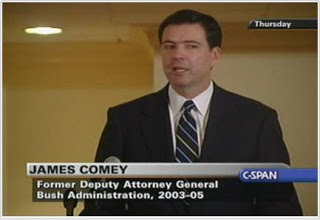 President Barack Obama announced Friday afternoon that he’s selected James Comey to head the Federal Bureau of Investigation.
Comey, 52, worked as the deputy attorney general for the United States under President George W. Bush and will replace outgoing FBI Director Robert Mueller when he steps down later this year after he is confirmed by the Senate.
All three men were on hand at the White House Friday afternoon when President Obama formally made his pick after weeks of speculation suggested Comey would be the likely nominee.
Comey, said Obama, embodies the “core principals of fidelity, bravery and integrity” expected of FBI agents and applauded “his fierce independence and his deep integrity.”
In fact, that independence is the focus of perhaps the most widely reported instance from the Bush White House involving Comey. While serving as deputy attorney general in the Department of Justice, Comey rejected the administration’s warrantless wiretapping program that has recently reemerged as the center of controversy.
“In a confrontation he has called the most difficult night of his career, [Comey] rushed to the hospital bedside of his boss, John Ashcroft, in 2004 to stop two senior Bush White House aides from getting the ailing attorney general’s approval to reauthorize a post-9/11 program that allowed government wiretaps to be used without warrants,” the Associated Press recalled this week.
Comey’s insistence in keeping the program off the books was made notwithstanding an earlier decision to favor the surveillance program, though. Glenn Greenwald reported for The Guardian last month that Comey “approved a legal memorandum in 2004 endorsing radical executive power theories and warped statutory interpretations, concluding that the Bush NSA warrantless eavesdropping program was legal, thus making it more difficult to prosecute the Bush officials who ordered it.”
The internal conflict within the administration that erupted years later over that program almost led to Comey, Ashcroft and Mueller offering their resignation, apparently. As Greenwald noted, though, the then-deputy attorney general declined to follow up on his threat after slight adjustments were made to the NSA spy program.
“But the reason they didn’t end up resigning ,” he wrote, “was because Bush officials ‘modified’ that NSA program into something those lawyers could and did endorse: the still-illegal, still-radical NSA eavesdropping program that spied on the communications of Americans without warrants and in violation of the law.”
Those practices have come under question in recent weeks after Edward Snowden, a 29-year-old former intelligence contractor, leaked documents showing the size and scope of the surveillance programs. Mr. Mueller said those disclosures caused “significant harm” to the nation’s security and that the admitted leaker is the “subject of an ongoing criminal investigation.”
“One of the great vulnerabilities terrorists understand is their communications,” Mueller told the House Judiciary Committee last week. “If we lose our ability get their communications, we are going to be exceptionally vulnerable.”
After being picked by Pres. Obama to replace Mueller on Friday, Comey said, “I don’t know whether I can fill those shoes.” Mueller was FBI chief for 12 years, making him the second-longest serving official to ever head the bureau.
Related article
British spy agency has access to global communications, shares info with NSA
RT | June 21, 2013
The British spy agency GCHQ has access to the global network of communications, storing calls, Facebook posts and internet histories – and shares this data with the NSA, Edward Snowden has revealed to the Guardian in a new leak.
GCHQ’s network of cables is able to process massive quantities of information from both specific targets and completely innocent people, including recording phone calls and reading email messages, it was revealed on Friday.
“It’s not just a US problem. The UK has a huge dog in this fight,” Snowden told the Guardian. “They [GCHQ] are worse than the US.”
The Government Communications Headquarters agency has two different programs, aimed at carrying out this online and telephone monitoring – categorized under ‘Mastering the Internet’ and ‘Global Telecoms Exploitation.’ Both have been conducted in the absence of any public knowledge, reports the Guardian.
“If you remember, even the NSA said that they did not record phone calls, but according to these latest revelations by Edward Snowden, that up to ‘600 million’ telephone events last year were recorded a day by the GCHQ,” said RT’s Tesa Arcilla from London.
“There’s no doubt as to what the objectives of these programs were, having put them in place,” she said, emphasizing the titles.
The agency is able to store the volumes of data it amasses from fiber-optic cables for up to 30 days in an operation codenamed Tempora. The practice has been going on for around 18 months.
GCHQ which was handling 600m telephone ‘events’ a day, according to the documents, had tapped into over 200 fiber-optic cables and had the capacity to analyze data from over 46 of them at a time.
The cables used by GCHQ can carry data at 10 gigabits per second, which in theory, means they could deliver up to 21petabytes of information per day. The program is continuing to develop on a daily basis with the agency aiming to expand to the point it is able to process terabits (thousands of gigabits) of data at once.
By May last year, some 300 GCHQ-assigned analysts and 250 from the NSA had been specially allocated large quantities of data to trawl through as a result of the operations.
The Guardian reports that 850,000 NSA and outside contractors had potential access to the databases. However, the paper does not explain how it came to such an enormous figure
“These revelations reveal the scale of and the scope of cooperation between UK and US intelligence services,” said RT’s Gayane Chichakyan from Washington. “From these revelations we learned how dramatically it has expanded over the years.”
“The document shows the FISA court lets the NSA use data snagged ‘inadvertently.’ They basically give a warrant to target suspects,” she said, recalling Lieutenant General Keith Alexander’s quote after a 2008 visit to the Menwith RAF base in England: “Why can’t we collect all the signals all the time? Sounds like a good summer project for Menwith,” he had said.
The GCHQ project was first trialed in 2008. The intelligence organization has been labeled an ‘intelligence superpower’ on account of its technical capabilities, which by 2010 gave it the strongest access to internet communications out of the ‘Five Eyes’ – an international intelligence sharing alliance, including Australia, Canada, New Zealand, the UK and US, brought into existence in 1946.
The mass-surveillance has seen the interception of data from transatlantic cables that also carry data to western Europe through ‘intercept partners’ commercial companies that had entered into private agreements with GCHQ. Many have been paid off for their cooperation.
GCHQ feared that exposure of the names of the companies involved could lead to “high-level political fallout,” and took measures to ensure names were kept secret. Warrants had reportedly been issued to compel the companies to cooperate so that GCHQ could engage in spying through them.
“They have no choice,” said a Guardian intelligence source.
Snowden previously warned that he would be releasing further information pertaining to mass security operations carried out on the unwary public, stating in a previous Q & A with the Guardian that the “truth is coming, and it cannot be stopped.”
Featured Video

Why Hamas Really Attacked Israel on Oct. 7
or go to
Aletho News Archives – Video-Images
From the Archives
Confronting the Threat of Ethnic Bioweapons
By Tony Cartalucci – New Eastern Outlook – 29.11.2017
The United States Air Force’s 59th Medical Wing’s molecular biology branch recently was revealed to have been collecting specifically Russian RNA and synovial (connective) tissue samples, prompting fears in Russia of a possible US directed ethnic-specific bioweapons program. … continue
Blog Roll
 Aletho News
- Russia accuses France of ‘piracy’ over tanker seizure
- Why Yemen Is Bombing Saudi Arabia’s Airports: The War Behind the Headlines
- Sally Rooney’s books pulled from UK over support for Palestine Action
- Bombs for Tel Aviv, Promises for Riyadh
- Israeli ad agency conducted vast global espionage campaign using online ads: Report
- Oct. 7 Forever Marks The Big Reveal: ‘We See You, Israel, We Revile You, We Reject You!’
- Meet the US generals and admirals advancing Israeli policy
- Israel’s Straw Widow Protocol: The Kill Zones Where Civilians Were Labelled ‘Terrorists’
- Leading Israeli Think Tank Publishes Psychotic Israeli ‘National Security’ Doctrine
- Are the United States and Israel in Decline-and-Fall Mode?
- If Americans Knew
- Israeli firm used online ads to run vast spy operation, researchers say
- No, the world zionist movement is not an antisemitic conspiracy theory
- Hundreds of IDF investigations into killings still have no public outcome, BBC Verify finds
- After Ashley Moody Epstein Probe, Donors Linked to Him Poured Money Into her Senate Campaign
- Worried about Russian meddling in UK politics? Wait till you see what Israel is up to
- Israeli settlers attack West Bank center for disabled children, church leader calls for int’l action
- Pulling Out Teeth Just to Live: How Israel Has Devastated Dental Care in Gaza
- Gaza’s “ceasefire” death toll passes 1,500 – Daily Update
- Activists Abused By Israel Return to New Freedom Flotilla Mission
- 60 Minutes won’t tell the full truth about Israeli settler violence
- No Tricks Zone
- New Study Suggests Large Regions Of The Pacific Ocean Have Been Cooling For The Last 80 Years
- Germany’s Green Energy Debacle: High Energy Costs Force Kahla Porzellan to Close After 182 Years!
- New Study: 50 Years Of The Most Aggressive ‘Net Zero’ Policies Can Only Affect The Global Climate By 0.03°C
- US September “Heat” Was No Record…Many Records Set Decades Ago
- Latest European Green Energy Debacle; Portugal’s Largest Flagship Solar Park Insolvent!
- Green Energy Debacle: German Expert Professor Fritz Vahrenholt Warns Of Severe Economic And Social Consequences
- Two More Paleo Reconstructions Affirm Meters-Higher Sea Levels Across Ireland, Brazil 7000-6000 Years Ago
- New Study: Earth And Venus Surface Warmth Largely Explained By Convection And Lapse Rate, Not CO2 Or Radiation
- 2025 Nature Paper Claiming Worsening Global Drought Gets RETRACTED …Heavily Flawed
- New Study: ‘Global Drought Shows No Detectable Recent Acceleration Under Climate Warming’

