South Korean Prosecutors Request Another Extension of President’s Detention
Sputnik – 25.01.2025
SEOUL – South Korea’s prosecutor’s office on Saturday requested another extension of President Yoon Suk-yeol’s detention after a Seoul court rejected their previous request, the Yonhap News Agency reported.
On Friday, the court dismissed the prosecutors’ request to extend Yoon’s detention until February 6. The court said that the prosecution, which received a request from South Korea’s Corruption Investigation Office for High-Ranking Officials (CIO) to initiate a criminal case against the president, lacked sufficient grounds to continue the investigation. In response, the president’s lawyers said that the court should disregard the CIO’s findings and reopen the investigation.
A new request to extend Yoon’s detention was filed at the Seoul Central District Court four hours after the court’s rejection, Yonhap said.
“In light of past cases in which prosecutors conducted supplementary investigations, including raids, over CIO-transferred cases, and regulations of the Criminal Procedure Act, prosecutors’ right to a supplementary probe is naturally recognized … Thus, there is a need for an extension of the detention period,” the prosecution was quoted by Yonhap as saying.
Yoon’s current detention ends on January 28, which coincides with the Lunar New Year, a public holiday in South Korea. To avoid delays, the prosecution plans to expedite the transfer of the case to court, where a suspect can be held for up to six months. As a result, Yoon’s interrogation may take place at the detention center over the weekend, as moving him to the prosecution’s building poses security challenges.
Given the seriousness of the charges against Yoon, he will be required to answer questions in person, as submitting written responses is not an option. It remains uncertain if he will cooperate, as he has previously refused to answer questions.
On December 3, 2024, Yoon declared martial law, claiming that the opposition was sympathizing with North Korea and plotting a “rebellion.” The parliament quickly voted to lift his declaration just hours later, which Yoon complied with, subsequently apologizing to the nation. On December 14, the South Korean parliament impeached Yoon over his controversial martial law declaration.
Harvard blocks Gaza patient session as university adopts controversial anti-Semitism definition
MEMO | January 24, 2025
Harvard Medical School has cancelled a planned lecture and panel discussion featuring patients from Gaza, following complaints that the session would present only one side of the conflict, amid growing concerns about academic freedom after the university’s adoption of a highly controversial definition of anti-Semitism which conflates criticism of Israel and the political ideology of Zionism with anti-Jewish racism.
According to the Harvard Crimson, the medical school’s Dean, George Q Daley, cancelled the 21 January events just hours before they were scheduled, citing objections that students would hear from Gazans receiving care in Boston without also hearing from Israeli perspectives. The session was to include a lecture on wartime healthcare by Tufts Professor Barry S. Levy, followed by discussions with Gaza patients and their families.
HMS and HSDM Student Council President Anna RP Mulhern said she was “deeply disheartened” by the cancellation. “Respect for all patients and their stories is a fundamental tenet of the medical profession. This principle was not upheld yesterday,” she stated.
The cancellation came shortly after Harvard agreed to adopt the highly controversial International Holocaust Remembrance Alliance (IHRA) definition of anti-Semitism as part of settling a discrimination lawsuit brought by Jewish students who claimed harassment during pro-Palestine protests. IHRA is favoured by Israel and advocates of the apartheid state as it grants special privileges to the political ideology of Zionism and apartheid state. No other political ideology or state is granted protection from criticism in the same way.
HMS Professor David S Jones, who helped develop the course curriculum, reported receiving 50 emails from students questioning the cancellation. He noted that Arabic-speaking medical students who had served as interpreters for Gazan patients in Boston had requested the session.
Critics argue the decision reflects a broader assault on academic freedom and free speech rights. Journalist Glenn Greenwald, discussing Harvard’s adoption of the IHRA definition, warned it represents “an outright systemic assault on the Free Speech rights of American citizens on the academic freedom that is supposed to prevail in our institutions of higher learning.”
Greenwald highlighted how the IHRA definition prohibits various forms of criticism of Israel that would be perfectly acceptable if directed at other nations. He noted that under these new rules, Harvard students remain free to describe any country, including the US, as fundamentally racist – except Israel. “You can say that the United States and its existence is a racist endeavour, that you’re allowed to say… nobody tries to censor that,” Greenwald explained.
Pick any country in the entire world at Harvard and you are totally free to call the existence of that country a racist endeavour except one country where you fall into the crime of hate speech and that is the state of Israel.
The combination of event cancellations and adoption of the IHRA definition has raised concerns about the chilling effect on academic discourse. Critics argue that medical education, which relies on hearing directly from patients about their experiences, could be particularly impacted if geopolitical considerations begin to override educational ones.
“This is nothing more than an outright systemic assault on the Free Speech rights of American citizens on the academic freedom that is supposed to prevail in our institutions of Higher Learning,” Greenwald concluded, arguing that such restrictions serve “not to protect our own country, our own culture, our own government, the security of our own people but to protect this foreign country.”
Australia Plans to Expand “Hate Speech” Laws Amid Debate Over Free Speech Protections
By Didi Rankovic | Reclaim The Net | January 22, 2025
Australian officials are doubling down on the policy of “strengthening” what they call hate speech laws both at the federal, and state levels – and some are even presenting the country’s weak free speech protections as an advantage.
New South Wales (NSW) Premier Chris Minns has promised that even more restrictive legislation to tackle whatever the state’s authorities decide is hate speech is coming soon. It seems that “strengthening” these laws will come down to criminalizing even more types of speech, by including vague categories like “vilification.”
Minns is justifying this policy by claiming that hate speech is behind later actual criminal activities, and he’s putting the emphasis on the goings-on in the “community” especially where it pertains to religious and racial strife, i.e, protecting “multiculturalism” and “cultural diversity” by means of repressing speech.
As for when New South Wales residents can look forward to the introduction of these legislative proposals, Minns revealed that it will “hopefully” happen when parliament returns (scheduled to happen in early February).
The broadening of these laws’ scope is particularly interesting in terms of the idea of adding (racial or religious) “vilification,” currently a civil offense.
And Minns chose an odd way to defend Australia’s lack of strong free speech protections – like those enjoyed by Americans. He said there was “a very good reason for that” – namely, that Australia is a country of immigrants coming from all over the world. So – just like the United States?
But Minns seems to suggest that “basic tenets of life” can only be protected if free speech is not.
Australian Housing Minister Clare O’Neil commented on these New South Wales plans to say that the federal government was “looking at anything” it could do to deal with antisemitism, which she described as a “growing problem.”
And while hate speech laws were already “strengthened” at the federal level last year, O’Neil said – by banning “hate symbols and antisemitic phrases and symbols” – the minister believes there is “more work to be done.
“We’ve got to do more. We’ve got the Australian Federal Police working with state police, we’ve got state governments really stepping up on this, and I think we’ve all got a really clear interest here,” O’Neil told journalists.
The Gaza Genocide: A New Low in Democracy and Human History
Germany’s Undemocratic Assaults
By Ricardo Martins – New Eastern Outlook – January 22, 2025
The genocide unfolding in Gaza continues to expose the inadequacies of the international judiciary, organizations, and, more importantly, the complicity of part of the global community of nations in enabling such atrocities.
Germany Taken to the ICJ for Complicity in Genocide
In March 2024, Nicaragua brought a case against Germany at the International Court of Justice (ICJ), accusing it of aiding and supporting genocide in Gaza by supplying arms to Israel, fully aware of the genocidal risks involved. Shockingly, the ICJ failed to condemn Germany.
Germany also maintains unwavering and unconditional political and diplomatic support for Israel. German Foreign Minister Annalena Baerbock displayed a cheerleader-like demeanor during her initial visit to support Israel after October 7—a stance echoed by European Commission President Ursula von der Leyen.
According to the Middle East Eye, Germany’s support for Israel’s actions highlights a hypocritical approach to international law and human rights. The analysis goes further: “No one can reasonably believe in the fairytale of Germany’s moral responsibility anymore, as the country defends, finances, arms, and diplomatically supports the genocide of Palestinians, in addition to the bombing of Lebanon, Yemen, and Syria, while shielding those responsible from accountability.”
Protests Against Israel Are Considered “Antisemitic” in Germany
With the Bundestag’s adoption last November of the resolution “Never again is now: Protecting, preserving, and strengthening Jewish life in Germany”, the country has entered a proto-fascistic state—without any condemnation from the European Union. Policymakers crafting this resolution refused input from diverse human rights groups and instead relied solely on the controversial International Holocaust Remembrance Alliance (IHRA) definition of antisemitism.
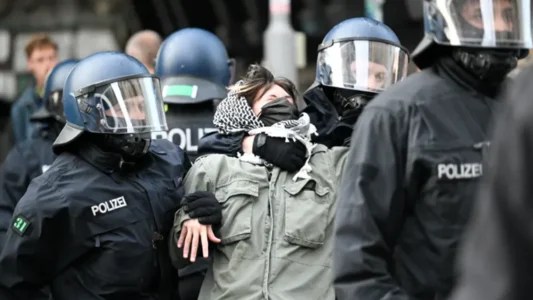
Even before this resolution, but now bolstered by it, Germany has witnessed a gradual erosion of democracy under its ‘proud guilty’ ideology. This includes prior censorship of cultural events partially or fully funded by public money, the cancellation of events featuring critics of Israel’s government, and even conferences discussing the Palestinian question. Concurrently, there has been a sharp rise in the smearing of critics with allegations of antisemitism. Make no mistake—censorship is alive and well in Germany. Protests critical of Israel’s actions in Gaza are being unjustly and undemocratically labelled as antisemitic.
Further, children can be banned from schools for wearing “pro-Palestinian symbols such as the keffiyeh,” as is written in a letter sent to school principals by Berlin’s education senator, Katharina Günther-Wünsch.
Furthermore, this resolution introduced a mandatory declaration for asylum seekers, requiring them to affirm the existence of the state of Israel and pledge not to participate in or support boycott campaigns against it.
Over the past month, German politicians have called for changing laws, including those around the right to demonstrate and freedom of opinion. The idea of withdrawing citizenship, residency, welfare benefits or funding from anyone accused of making anti-Semitic statements has been floated as well as a plan to only allow “native Germans” to protest.
Prior to this resolution, we have already witnessed undemocratic and even fascistic actions in Germany. These include the arrest of citizens for trivial reasons, such as holding a placard stating “I am not complicit in genocide,” and the arrest of a child for holding a Palestinian flag. Former Greek finance minister Yanis Varoufakis was prohibited from addressing a Jew-Palestinian conference and from permanently speaking to the German public online. A meeting organised by the progressive collective DiEM25, alongside Palestinian and Jewish Voice for Peace groups, on April 12th, 2024, was disrupted, dismantled, and labelled an “Islamist” event by the Interior Ministry.
Furthermore, the renowned British-Palestinian surgeon Dr Ghassan Abu-Sitta, who volunteered in Gaza hospitals during the genocide, was banned from entering Germany. Dr Abu-Sitta was due to provide a firsthand account of the atrocities taking place on the ground. Due to Germany’s Schengen-wide interdiction, he was also barred from entering France to speak at a French Senate meeting, despite being invited by the Senate itself.
These actions raise pressing and undeniable questions about a democratic deficit and institutional racism within German governmental structures.
A Threat to Germany’s Academic Freedom and Reputation?
Protests critical of Israel’s actions in Gaza have been wrongfully labelled antisemitic. The German Education Ministry sought to explore whether academic funding could be cut for those critical of clearing the pro-Palestinian camp at Freie Universität Berlin (Free University Berlin). This crackdown led to police detaining over 70 individuals temporarily and initiating 80 criminal investigations, alongside 79 misdemeanour proceedings.
Ironically, the Education Minister, Bettina Stark-Watzinger of the Free Democratic Party (FDP), previously declared that freedom is the foundation “for the way we live in our country, for our democracy, our constitutional state, and our prosperity.” She made this statement during the launch of Germany’s Science Year 2024.
In stark contrast, over 2,900 academics have accused Stark-Watzinger of threatening freedom of expression, calling for her resignation in an open letter. The letter, signed by thousands of German and international academics, accuses the education minister of intimidation, stating: “Repressive reviews of academics who publicly express critical views of governmental decisions are characteristic of authoritarian regimes that systematically suppress free discussion, including within universities.”
Why is Germany Having This Behaviour?
Driven by its ideology of ‘proud guilt,’ which elevates support for Israel to a raison d’état, Germany appears to have abandoned all sense of proportionality and reason—where even a child wearing a keffiyeh in a school is deemed a threat to Israel’s existence and, by extension, to German security.
In many respects, it now exhibits the characteristics of a quasi-fascist state. My few examples above, out of thousands, support this claim. To make things worse, the German government refuses to comply with the ICC prosecutor’s request to arrest Prime Minister Benjamin Netanyahu and Defence Minister Yoav Gallant.
According to Körber Fondation’s latest survey, which polls German citizens on foreign policy, only 19% of Germans support their country’s military aid to Israel. This shows a blatant divide between Germany’s political/media elites and the people they are supposed to represent.
German citizens deserve to know why their freedoms are being restricted and whose interests are being served. Why do Israel’s interests take precedence over those of German citizens and Germany’s international reputation? Why must the Palestinian people continue to pay the price for Germany’s past mistakes? I will delve into this matter further in my next article.
To conclude, the most astonishing aspect of these atrocities against German freedoms and the Palestinian people is the deafening silence of the European Union and the European Human Rights Court. The double standards of the European institutions are blatant and hypocritical.
Ricardo Martins ‒ PhD in Sociology, specializing in policies, European and world politics and geopolitics
Trump Orders U.S. to Withdraw From World Health Organization
By Suzanne Burdick, Ph.D. | The Defender | January 21, 2025
Within roughly 8 hours of taking his oath of office, President Donald Trump on Monday signed an order to withdraw the U.S. from the World Health Organization (WHO).
Trump’s executive order cited numerous reasons for pulling the U.S. out of the WHO, including:
“The organization’s mishandling of the COVID-19 pandemic … and other global health crises, its failure to adopt urgently needed reforms, and its inability to demonstrate independence from the inappropriate political influence of WHO member states.”
The WHO also “continues to demand unfairly onerous payments” from the U.S., the order stated. “China, with a population of 1.4 billion, has 300 percent of the population of the United States, yet contributes nearly 90 percent less to the WHO.”
Commenting on the news, Children’s Health Defense (CHD) CEO Mary Holland told The Defender:
“I applaud President Trump’s decision to leave the World Health Organization. It hasn’t been transparent, based on science, or serving the U.S. interest in public health.
“The World Health Organization is not a reformable institution. Its proposed Pandemic Treaty is a nightmare and would lead to more gain-of-function research and pandemics.”
Holland said she hopes the move “will lead to a global reconsideration of how to handle public health and international crises.”
Public health physician and biotech consultant Dr. David Bell told The Defender, “WHO needs a radical shake-up.”
Bell, a former medical officer and scientist at the WHO, said the WHO needs a “massive downsizing” and “to return to basic public health rather than the profit-driven false agenda of rising pandemic risk that WHO has embarked on.”
For instance, Bell criticized recent WHO efforts to push the mpox vaccine in Africa, diverting resources from addressing far more deadly health issues, such as malaria, malnutrition, tuberculosis and HIV/AIDS.
“If WHO does not respond by a total reversal of direction and values,” Bell said, “then we should hope that this withdrawal goes forward and others join.”
Trump’s move came as no surprise. As early as December 2023, his transition team was pushing for an exit from the WHO on day one of the new administration.
U.S. law requires a one-year notice and the payment of any outstanding fees when the country withdraws from the WHO. That means the final full withdrawal will take effect in early 2026.
Monday’s executive order came as a follow-up to Trump’s efforts during his first presidential term to withdraw from the WHO.
In July 2020, Trump moved to officially withdraw the U.S. from the WHO by submitting a notice of withdrawal to the United Nations’ (U.N.) secretary-general.
The withdrawal would have taken effect July 6, 2021. However, Trump lost the 2020 presidential election to Joe Biden, who on Jan. 20, 2021, retracted Trump’s withdrawal notification letter.
Monday’s executive order revoked Biden’s letter. It also said the secretary of state would immediately inform the U.N.’s secretary-general — again — of the U.S. intention to withdraw.
The order also revoked another order Biden issued in January 2021 that called for a U.S. federal response to COVID-19 that included “engaging with and strengthening the World Health Organization.”
U.S. government personnel or contractors working “in any capacity” with the WHO will be recalled and reassigned, the order stated.
Investigative journalist Whitney Webb cautioned against reading too much into Trump’s withdrawal from the WHO.
She wrote in an X post:
“To be fair, Trump also left the WHO in mid-2020 and then just redirected what was once WHO funding to the Gates-funded GAVI vaccine alliance. While leaving the WHO is positive, it is not the slam dunk some are advertising, especially considering Gates’ recent comments on Trump’s enthusiasm for his ‘vaccine innovation’ proposals.”
U.S. is WHO’s biggest funder
The U.S. is by far the WHO’s largest financial backer, Reuters reported, providing roughly 18% of the organization’s overall budget.
The WHO’s most recent budget, for 2024-2025, was $6.8 billion.
The next-largest state donor — when combining mandatory fees and voluntary contributions — is Germany, which provides around 3%, Reuters said.
Germany’s health minister today said that leaders in Berlin will try to talk Trump out of his decision.
When asked about Trump’s order, Guo Jiakun — a spokesperson for China’s foreign ministry — said today at a regular press briefing that the WHO’s role in global health governance should be strengthened, not weakened.
“China will continue to support the WHO in fulfilling its responsibilities, and deepen international public health cooperation,” Jiakun said.
The WHO said in a statement that it regrets Trump’s decision. “We hope the United States will reconsider.”
WHO pandemic treaty would have ‘no binding force’ in U.S.
Although the full withdrawal by the U.S. from the WHO won’t take effect until January 2026, Monday’s executive order said U.S. negotiations on a WHO-led pandemic treaty or amendments to the International Health Regulations (IHR) will cease immediately.
Independent journalist James Roguski pointed out on Substack that there aren’t any negotiations underway.
Negotiations stopped last May when negotiators failed to submit final texts for the two documents before the May 24 deadline.
Instead, member states on June 1, 2024, agreed to a smaller package of amendments.
Monday’s order closes the door to the possibility that the U.S. might resume negotiations during the next year — or implement the few IHR amendments passed last June. Trump’s order stated:
“While withdrawal is in progress, the Secretary of State will cease negotiations on the WHO Pandemic Agreement and the amendments to the International Health Regulations, and actions taken to effectuate such agreement and amendments will have no binding force on the United States.”
Roguski said Trump should go further by issuing a letter that revokes the amendments the WHO adopted on June 1, 2024, and clarifies that the U.S. “is also exiting the International Health Regulations.”
In May 2024, 22 state attorneys general said in a letter that they would refuse to comply with a WHO-led pandemic treaty or IHR amendments. They cited concerns about national sovereignty and civil liberties.
Dutch attorney Meike Terhorst told The Defender she was “delighted” by Trump’s announcement.
Terhorst said that she and other international lawyers who worked to stop the WHO’s “power grab” discovered that the U.S. delegation had been the “primary force behind the power grab.”
Trump also signs order to end gov’t censorship
Other orders signed Monday include one that restores free speech and ends federal censorship of U.S. citizens.
“Over the last 4 years,” the order said, “the previous administration trampled free speech rights by censoring Americans’ speech on online platforms, often by exerting substantial coercive pressure on third parties, such as social media companies, to moderate, deplatform, or otherwise suppress speech that the Federal Government did not approve.”
It continued:
“Under the guise of combatting ‘misinformation,’ ‘disinformation,’ and ‘malinformation,’ the Federal Government infringed on the constitutionally protected speech rights of American citizens across the United States in a manner that advanced the Government’s preferred narrative about significant matters of public debate.
“Government censorship of speech is intolerable in a free society.”
That can’t happen anymore, the order said.
Citing the First Amendment, the order outlined what will now be the policy of the federal government when it comes to free speech. The government’s job is to:
(a) secure the right of the American people to engage in constitutionally protected speech;
(b) ensure that no Federal Government officer, employee, or agent engages in or facilitates any conduct that would unconstitutionally abridge the free speech of any American citizen;
(c) ensure that no taxpayer resources are used to engage in or facilitate any conduct that would unconstitutionally abridge the free speech of any American citizen; and
(d) identify and take appropriate action to correct past misconduct by the Federal Government related to censorship of protected speech.
No federal agency, department or worker can use government resources for an activity that contradicts that job, the order said.
The order also called on state attorneys general to investigate whether the Biden administration engaged in censorship of Americans’ views. It directed them to write a report about its findings that includes “recommendations for appropriate remedial actions to be taken based on the findings.”
It is unclear how the order may affect ongoing litigation related to federal censorship.
That’s because the order’s final clause states that the order is not intended to — and does not — “create any right or benefit, substantive or procedural, enforceable at law or in equity by any party against the United States, its departments, agencies, or entities, its officers, employees, or agents, or any other person.”
On Jan. 6, CHD petitioned the Supreme Court to hear its case against Meta, the parent company of Facebook and Instagram.
“The record in CHD v. Meta,” Holland said, “clearly shows Facebook’s close collaboration with the White House to censor vaccine-related speech, even pre-COVID.”
CHD General Counsel Kim Mack Rosenberg told The Defender she is “certainly pleased” to see the new administration take quick action to address the “rampant censorship by the government over the past four years and to investigate governmental wrongdoing.”
“However,” Rosenberg said, “CHD’s censorship cases will continue. We have provided the courts with substantial evidence of wrongdoing by the government and by social media companies against CHD.”
“The executive order — while a significant positive step — does not remedy the harms done to CHD,” she added.
Related articles in The Defender:
- Is Trump Transition Team Pushing for WHO Exit on Day One?
- WHO Approves First Mpox Vaccine for Adults in Africa — Then Says Babies Can Get It, Too, Despite No Clinical Trials
- WHO Passes ‘Watered-down’ IHR Amendments, Plans to Revisit Pandemic Treaty ‘Within a Year’
- 22 AGs Oppose WHO Pandemic Treaty, Citing Threats to Sovereignty and Civil Liberties
This article was originally published by The Defender — Children’s Health Defense’s News & Views Website under Creative Commons license CC BY-NC-ND 4.0. Please consider subscribing to The Defender or donating to Children’s Health Defense.
Google Exits EU’s Voluntary Anti-“Disinformation” Code, Defying Digital Services Act Requirements
By Didi Rankovic | Reclaim The Net | January 21, 2025
It’s as good a time as any to effectively pull out of the EU’s “voluntary anti-disinformation” deal, which social media companies were previously strong-armed into accepting. And Google has now done just that.
The “strengthened” Code of Practice on Disinformation was introduced during the heyday of online censorship and government pressure on social platforms on both sides of the Atlantic – in June 2022, and at one point included 44 signatories.
One of those who in the meanwhile dropped out is X, and this happened shortly after Twitter was acquired by Elon Musk.
Now, as the “voluntary” code is formally becoming part of EU’s censorship law, the Digital Services Act (DSA), Google took the opportunity to notify Brussels it will not comply with the law’s requirement to include fact-checkers’ opinions in the search results, or rely on those to delete or algorithmically rank YouTube content.
Accepting these DSA requirements “simply isn’t appropriate or effective for our services,” Google’s Global Affairs President Kent Walker stated in a letter sent to European Commission’s Deputy Director-General for Communications Networks, Content and Technology, Renate Nikolay, reports said.
At the same time, Google is withdrawing from “all fact-checking commitments in the Code” – this refers to the signatories working with “fact-checkers” across EU member-countries. The code also requires tech companies to flag content, label political ads, demonetizing users found to be “spreading disinformation,” etc.
Even though Google’s censorship apparatus does not use third-party “fact-checkers” as it is, the news that the company has decided to defy the EU on this issue is interpreted as yet more proof that social media giants are breaking free from some of the constraints imposed on them by the authorities over the past years.
Meta recently announced that its fact-checking scheme in the US was ending in order to make room for more free speech on Facebook and Instagram, but it remains a signatory of the Code in the EU.
It remains to be seen what decision Meta will make once that agreement becomes part of the DSA – the deadline for which is currently unknown.
UK police summon Jeremy Corbyn after pro-Palestine rally
MEMO | January 20, 2025
The Metropolitan Police have summoned former UK Labour Party leader Jeremy Corbyn and ex-shadow chancellor John McDonnell for an “interview” following a pro-Palestinian rally in central London on Saturday, Anadolu reported.
The Metropolitan Police is investigating what it described as a “coordinated effort by the rally’s organisers to breach conditions imposed on the event.”
Corbyn, 75, and McDonnell, 73, who agreed to the interviews, voluntarily appeared at a police station in the capital yesterday afternoon.
After leaving the police station, the two MPs did not answer reporters’ questions.
Police also summoned three unnamed persons to give voluntary testimony as part of an “ongoing investigation”.
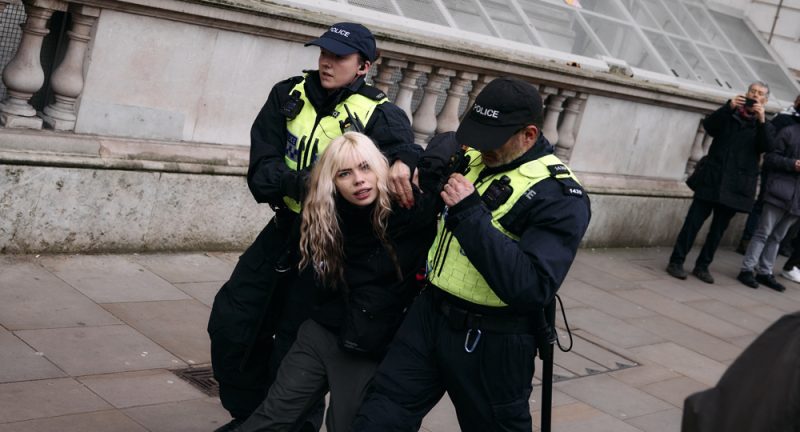
The rally, organised by the Palestine Solidarity Campaign (PSC) and its coalition partners, saw thousands gather in Whitehall after police blocked plans for a march from Portland Place, near the headquarters of the BBC.
Officers had imposed conditions under the Public Order Act restricting the protest to Whitehall, citing concerns over a potential “serious disruption” near a synagogue.
Police said a group of protesters broke through a police line to reach Trafalgar Square, where officers stopped them.
The Metropolitan Police posted a photo on social media showing a group that it said have forced its way through the police line being held at the northwest corner of Trafalgar Square.
Corbyn, however, disputed the account.
“This is not an accurate description of events at all,” he said in a post on X.
He said he was part of a delegation of speakers intending to lay flowers in memory of children killed in Gaza, which was “facilitated by the police”.
McDonnell echoed his comments.
“We did not force our way through. The police allowed us to go through, and when we stopped in Trafalgar Square, we laid our flowers down and dispersed.”
Nine people, including Corbyn’s brother Piers Corbyn, and Chris Nineham, a chief steward on the march, have been charged with public order offences and will appear at Westminster Magistrates’ Court in the coming days.
The Met Police also confirmed that 24 people have been released on bail, while 48 remain in custody. Three other men aged 75, 73 and 61 have agreed to be interviewed under criminal caution.
The protest coincided with the announcement of a ceasefire and prisoner swap deal between Israel and Hamas.
Corbyn, who now sits as an independent member of parliament for Islington North, has been a vocal supporter of Palestinian rights.
McDonnell, the MP for Hayes and Harlington, also sits as an independent after Labour suspended the whip from him for six months in July 2024 over his vote against the government on child benefit rules.
The demonstration in London drew tens of thousands of supporters of Palestine, despite the police-imposed restrictions and banning of a previously agreed-upon route.
During the protest, 77 people were arrested.
Met Commander Adam Slonecki said security forces have been deployed for more than 20 national protests organised by the PSC since October 2023.
He highlighted that the number of arrests at yesterday’s rally marked the “highest number” recorded at such demonstrations during this period.
YouTube Removes Barrister’s Legal Submission at Official UK Covid Inquiry Amid Censorship of Vaccine Injury Discussions
By Cindy Harper | Reclaim The Net | January 15, 2025
YouTube’s decision to remove a barrister’s legal submission from the UK Covid Inquiry has intensified concerns over widespread censorship of vaccine-related discussions on major social media platforms.
Anna Morris KC, who represents families claiming injury from Covid-19 vaccines, disclosed that YouTube deleted a video of her preliminary remarks to the inquiry in September 2023, citing violations of its medical “misinformation” policy. Although the platform later reinstated the video, it failed to provide a clear explanation, admitting only that “it sometimes makes mistakes.”
This act of censorship has been condemned as part of a larger pattern of silencing voices critical of vaccine safety and government health policies. As reported by The Telegraph, during the inquiry’s Module 4 session — focused on vaccines and pharmaceutical measures — Morris directly addressed this issue, stating, “The inquiry must understand the stigma and censorship for the vaccine injured and bereaved.”
She revealed that a poll of affected families found that 74% had been censored when discussing vaccine injuries on social media platforms.
Morris further criticized the suppression of information, noting that doctors were instructed to withhold concerns from both the public and their own patients. Her removed statement emphasized that “the treatment of the vaccine injured in this country has historically been a source of shame.”
Morris argued that those harmed by vaccines have been systematically “dismissed, ignored, censored,” and subjected to hostility when seeking acknowledgment and support.
She condemned the ongoing silencing of vaccine-injured individuals as a severe barrier to accountability and transparency, adding, “Unfortunately, this censorship has continued years after the pandemic and into our engagement with this inquiry.”
Despite repeated requests for a review, YouTube justified the video’s removal by citing its medical “misinformation” policies, a rationale that critics argue is increasingly being used to suppress legitimate concerns and experiences. This censorship has fueled calls for a reevaluation of how social media platforms regulate content related to public health, especially when it involves dissenting voices.
An emotional impact video shown during the inquiry highlighted the tragic story of pharmacist John Cross, who took his own life after suffering paralyzing complications from a Covid vaccine and being denied compensation. His story underscores the devastating consequences of dismissing those seeking recognition and support.
Imran Khan jailed for 14 years
RT | January 17, 2025
Former Pakistani prime minister Imran Khan and his wife Bushra Bibi have been convicted in a £190 million ($232 million) land corruption case involving the Al-Qadir Trust, local media reported on Friday.
According to ARY News and Dawn, an anti-corruption court in the northern city of Rawalpindi sentenced Khan to 14 years in prison and Bibi to seven years, with the verdict being announced at Adiala Jail.
Khan and Bibi have also been fined $3,600 and $1,800, respectively, with the failure to comply carrying an additional imprisonment term.
The Al-Qadir Trust case centers on allegations that Khan and Bibi were involved in a quid pro quo scheme that saw the politician and his wife receive land worth millions of dollars from a property mogul during the establishment of an eponymous university in exchange for legal protection.
The former Pakistani prime minister has denied the charges, calling them “politically motivated.” Before the verdict, Khan said the case lacked evidence and would embarrass the authorities. “My sentencing is being sought in a case where neither have I derived a single penny of personal gain, nor has the government suffered a single penny of financial loss,” he said.
Khan’s Pakistan Tehreek-e-Insaf (PTI) party condemned the ruling, calling it a “black verdict,” while sharing a video purportedly showing protests against the decision outside the National Assembly.
A cricketer-turned-politician, Khan served as prime minister from 2018 to 2022, when he was ousted from office in a no-confidence vote, with the opposition accusing him of mismanaging the economy and foreign policy. Khan, however, claims that he was overthrown as a result of a US conspiracy.
He has been embroiled in numerous legal battles, with looming charges of corruption. In 2023, he was found guilty of illegally buying and selling state gifts he had received during his premiership, although the sentence was suspended. One year later, he was also sentenced to ten years for leaking state secrets, a charge he has denied. His earlier arrests and sentences sparked nationwide protests, some of which turned violent.
The man who deserves but probably will not be allowed to lead Romania
By Stephen Karganovic | Strategic Culture Foundation | January 17, 2025
Calin Georgescu rightfully has a huge grievance against what passes for “Western democracy.” He is the clear first-round winner in the Presidential elections held in Romania late last year. Yet his projected even more resounding victory in the second round, scheduled for early December 2024, was scrapped (as the BBC indelicately put it) following a Romanian Supreme Court ruling that the electoral process was marred by alleged hybrid warfare interference conducted by Russia on Georgescu’s behalf.
How do you “scrap” elections in a vibrant democracy such as Romania, which also happens to be a member in good standing of NATO and the European Union, which are bastions of liberal freedoms and the rule of law? Well, you do it by making up a bogus dossier on the political candidate that you dislike and by ordering the local judiciary to act on it as if it were genuine evidence. The dossier purporting to document the alleged interference was so patently phony that at its first sitting to consider the matter the Romanian Supreme Court dismissed it out of hand. This show of integrity did not sit well at all with the paladins of the rules-based order. So they ordered the judges to reassemble forthwith in their chambers and to get it right this time. On 6 December the distinguished Romanian jurists did just that and obediently reversed their ruling issued just four days previously.
Citing Article 146 (f) of the Romanian Constitution concerning the legality and correctness of the presidential elections, the Court ordered that the “entire electoral process will be integrally redone.” So the result of the first round was duly “scrapped” and along with it the second round as well. The second round, which was in progress as the judges hurriedly improvised their new ruling, was stopped in its tracks. As even the Atlantic Council, no friend of elections which go the wrong way, was compelled to admit “the rollout of the decision was somewhat fumbled, as it became public while polling stations were already open for the [Romanian] diaspora in the second-round presidential election, and by the time the process was stopped, around 53,000 citizens abroad had already voted.” Scrapped just in time, because the Romanian diaspora was known to be a hotbed of Georgescu supporters.
The Presidential election was set by the judges for an unspecified date in the future. Some rumours suggest that it might be in May of this year, or whenever it is that the stage can be prepared to ensure the right outcome. In the meantime, Klaus Iohannis, who should have relinquished his post in December to his successor, is now as legally “expired” as his Ukrainian colleague Zelensky. But that does not seem to bother any of the vociferous champions of the democratic process. Iohannis after all is their man.
The Romanian public, however, do not seem to take kindly to electoral interference by the compliant judges and their string-pullers, who are widely suspected of being located abroad but not in Russia. Thousands have been marching in the streets of Bucharest and other major cities to oppose the cancellation of the elections. How much good it will do them in a country that has embraced the principles of Western democracy remains to be seen.
The protagonist of this political earthquake who was not permitted to democratically establish his credentials as the new President of Romania, Calin Georgescu, ever since his first-round triumph has been subjected to the full measure of calumny that is reserved for those whom the globalist system perceives as a non-team-player and a threat. The hope was evidently that he would be successfully discredited and simply fade away, allowing the charade of “democratic elections” with a prearranged outcome to be repeated whenever it is judged safe to do so.
Expectedly, the Georgescu affair with its scandalous implications has been largely ignored by the collective West media, except for a few derogatory observations here and there at the banned candidate’s expense. The Georgescu story might have died a quiet death but for the professionalism of American podcaster Shawn Ryan, who decided to perform a public service by travelling to Romania to find out first-hand what the electoral commotion was all about.
The result was a remarkable interview with the man who by all reasonable estimates should be sitting today in the Presidential office in Bucharest. It is worth viewing carefully and in its entirety for the insights it affords into the sombre times in which we happen to live.
Georgescu strenuously denies that he is “pro-Russian” and says that he has no personal acquaintance with Russian officials except for watching them on television. In any court of law or public opinion that declaration should suffice because the burden of proof is on his accusers and they have failed to meet it. But the accusation brings up a much deeper and more significant issue: even if he were, why should it be a problem? Most of the other candidates, including the election runner-up, advocated policies explicitly aligned with non-Romanian interests and entities, such as NATO and the EU. Why is it objectionable for another presidential candidate in a supposedly sovereign and democratic country to propose to the electorate a different policy for their consideration and approval?
And here comes the crux of the matter. Asked by Shawn Ryan whether he is pro-Russian, Georgescu let the cat out of the bag by responding that no, he is pro-Romanian, and that the policies he contemplates are shaped to best serve the needs and interests of the Romanian people. In the current political atmosphere there is hardly a more disqualifying admission than that. The few European leaders, such as Orban and Fico, who had made it through the cracks in the globalist system to ultimately disclose that their primary commitment is to their respective countries’ interests are shunned and reviled for their subversive patriotism. One was the target of an assassination attempt, the other is the target of a colour revolution as this is being written. The rise of another leader who espouses a similar philosophy would be intolerably disruptive to the globalist agenda. That is why Georgescu had to be thwarted by any means, fair or foul.
Georgescu clearly is a simple man, plain spoken and without guile, not practiced in the use of mendacious phrases which characterise the discourse of trained political mannequins, the chosen puppets of the power elites who are allowed inhabit the public universe of Western political systems. Asked by Shawn Ryan how he views Romania’s membership in NATO, he gave an answer that was somewhat awkward but still made fundamental sense. When Romania joined NATO, he said, it was understood to be a defensive alliance, but since then its mission was changed to include offensive operations in which Romania has no national interest. Romania, he implied, is no longer part of the same outfit that it had originally joined. It is a fair answer, not just from the standpoint of Romania but also of quite a few other countries that by hook and by crook were rushed into joining NATO for the geopolitical benefits their geographical location offered to the alliance and its belligerent agendas.
Hence, according to Georgescu, Romania (and by implication other countries which were similarly enticed into joining) is now fully entitled to reconsider its choice and pursue a policy that takes into account the alliance’s changed nature and Romania’s current interests.
As for the collective West’s favourite quagmire, Project Ukraine, speaking for his country and the Romanian nation, Georgescu was unforgivably frank. “That is not our war,” he said.
These are only some salient snippets of this highly illuminating interview which lays bare the corruption of the political system we have been told represents the pinnacle of liberal democracy. One wishes that Georgescu’s English were more fluent, but still it sufficed to convey the important points that he makes and it fully answered the question, if there was anyone who was still in doubt, why they are prepared to resort to the basest trickery to make sure this man of integrity does not become President of Romania. And to ensure by example that no like-minded patriot in any other country that they control will ever think of emulating Calin Georgescu.
Dr. Drew Pinsky Criticizes YouTube for Video Removals and Mandatory Reeducation Training Over Vaccine Discussions
By Cindy Harper | Reclaim The Net | January 15, 2025
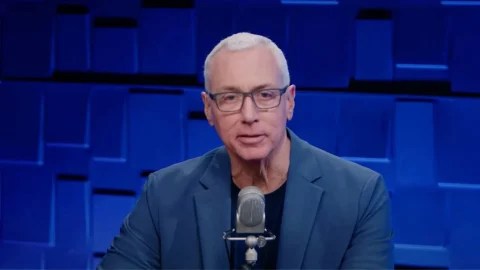
Dr. Drew Pinsky, widely known as Dr. Drew, has publicly criticized YouTube for removing two of his videos over alleged violations of the platform’s medical “misinformation” policy. On January 14, 2025, Pinsky took to X to challenge YouTube’s decision, highlighting concerns about free speech and the suppression of open dialogue on health-related topics.
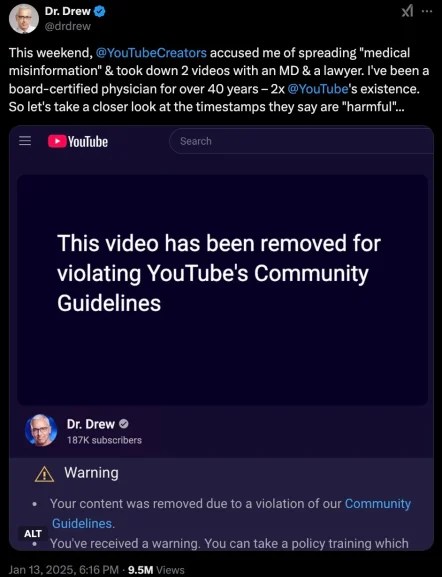
In order to get the flags removed from his video, YouTube told Dr. Drew that he would have to attend a form of reeducation training and have no violations for 90 days, or else it would delete his entire channel and all of his videos. Pinsky has over 1,000 videos on the platform.
In one of his posts, Pinsky expressed frustration over the platform’s actions: “This weekend, @YouTubeCreators accused me of spreading ‘medical misinformation’ & took down 2 videos with an MD & a lawyer. I’ve been a board-certified physician for over 40 years – 2x @YouTube’s existence.”
The flagged videos featured discussions with Dr. Kelly Victory, a board-certified physician, and attorney Warner Mendenhall. Pinsky elaborated that these conversations centered around the side effects of mRNA vaccinations, a topic he argues warrants open discourse rather than censorship. In his discussion with Dr. Victory, she stated that the “vast majority of the people who have been injured are young, healthy people who were under the age of 50 who had fundamentally zero risk from COVID itself. They all got COVID. These are people who would have been fine if they were just left alone.”
Pinsky defended the content, asserting that sharing professional perspectives and personal beliefs in a public forum should not be equated with spreading misinformation. He emphasized that their dialogue was an exchange of viewpoints rather than a promotion of falsehoods.
In a separate video with Warner Mendenhall, the attorney discussed legal cases involving individuals who suffered severe reactions following vaccination. Pinsky highlighted that Mendenhall shared client experiences and expressed personal beliefs—not medical advice. Pinsky wrote, “It is not medical misinformation for someone to state their belief that a large number of people were harmed by a medical product or study.”
This isn’t the first time YouTube has targeted Dr. Drew’s content. He noted that previous strikes were resolved after discussions between his production team and YouTube officials. Despite the latest removals, Pinsky confirmed that the videos remain accessible on X, suggesting that alternative platforms may offer more space for unrestricted conversations.
A prominent internist and addiction medicine specialist, Dr. Drew Pinsky has been a notable media figure for decades. His career includes hosting television shows like Dr. Drew On Call on HLN and Lifechangers on The CW.
Featured Video

Trita Parsi: Middle East Unraveling — Are We on the Path to World War?
or go to
Aletho News Archives – Video-Images
New Book
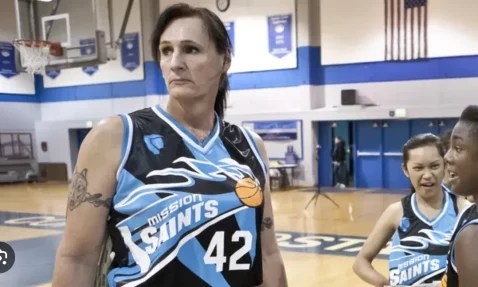
Trans agenda is ‘normalization of sadism’ – US author
RT | September 23, 2026
The US Democratic Party has embraced a transgender agenda that amounts to “the normalization of sadism,” author A.J. Rice has said, warning that radical trans policies would return if the party is allowed to regain power.
Speaking to RT’s America First host Scotty Nell Hughes about his new book, ‘The Curse of the Bearded Lady: How the Trans Mafia Whacked American Sanity’, Rice argued that activists have gained significant influence in schools, medicine, and corporate America while people who questioned the agenda have faced pressure to stay silent.
The author described the “trans mafia” as the sprawling network of people and institutions that have helped the movement gain influence. He singled out parts of academia, wealthy backers, and corporations, and stated that providers of transition-related treatment also have a financial incentive to keep young people in their care indefinitely.
Rice argued that the consequences of these policies ultimately fall on children who are being drawn toward gender-affirming medical treatments and on girls who are expected to share locker rooms or compete in sports with biological males.
He noted that while voters rejected the Democrats’ approach to gender in 2024, the party, which has been “captured by madness,” has since only doubled down and is seeking what is effectively “the normalization of sadism.” … Full report
Blog Roll
 Aletho News
- German chemicals giant reveals details of downsizing
- Refaat Al-Areer Was The Canary In The Coal Mine In Israel’s War On The Truth
- Israeli election committee bars candidate from Knesset race over Gaza war opposition
- French-Lebanese man files war crimes complaint over Israeli attacks
- Mahan Air Flight Lands in China Despite US Threat against Iranian Airlines
- US eyes $10bn fund to rebuild war-battered Gulf infrastructure
- Trump meets Rodríguez near Maduro’s prison as Venezuela’s oil flows to US
- Trita Parsi: Middle East Unraveling — Are We on the Path to World War?
- Iran FM meets with US envoy on UN meeting’s sidelines at American side’s insistence: Report
- Qatar PM calls for Gulf security framework with Iran, says war must be ‘wake-up call’
- If Americans Knew
- Caught on Tape: AIPAC CEO Boasted of Controlling Trump’s National Security Officials
- Why Hamas Attacked Israel in October 2023 – Israeli professor Ilan Papé
- They see them, then kill them: Israeli quadcopters track, deliberately target civilians in Gaza
- Winter could turn Gaza’s treacherous, war-damaged buildings into deathtraps
- Majority of Democratic Voters Want to Prosecute Both Biden and Trump Administration Officials Over Gaza
- As Gaza languishes, world leaders gather at the UN – Daily Update
- Sanctions are collective punishment: immoral and self-defeating
- Phosphorus Munitions Fired by Israel Burn Groves, Orchards in Southern Lebanon
- Israel Carries Out New Ceasefire Violations Across Gaza
- AI – Emphasis on the ‘I’: Israel Is Funding AI Chatbot Propaganda
- No Tricks Zone
- New Study: Earth And Venus Surface Warmth Largely Explained By Convection And Lapse Rate, Not CO2 Or Radiation
- 2025 Nature Paper Claiming Worsening Global Drought Gets RETRACTED …Heavily Flawed
- New Study: ‘Global Drought Shows No Detectable Recent Acceleration Under Climate Warming’
- Economic Masterminds: German Socialists Suggest Taxing Productivity Gains Stemming From Using AI
- The South China Sea Has Not Been Cooperating With The Climate Change Narrative
- Energy Crisis: Germany Enters Heating Season With Historically Low Gas Reserve Fill Levels
- New Study: The Antarctic Ice Sheet Gained Mass From 2020-2024 Due To Staggering Snow And Ice Accumulation
- Study: Ocean Heating Rates From Thousands Of Years Ago ‘Dwarf’ Modern Ocean Heating Rates
- Climate Extremists Target, Attack Large-Scale Power Grid Infrastructure In Germany!
- New Study: Antarctic Ice Melt Has Contributed Less Than 1 Centimeter To Sea Level Rise In The Last 30 Years

