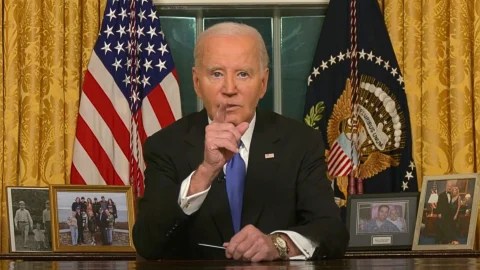
Biden warns of tech oligarchs’ power in farewell speech, ignoring his own role in expanding censorship
By Didi Rankovic | Reclaim The Net | January 16, 2025
Outgoing President Joe Biden concluded his presidency with a farewell address on Wednesday night, sharply criticizing what he termed the “tech-industrial complex” while urging tighter accountability for social media platforms. Ironically, Biden’s remarks highlighted the decline of free press and the dangers of “misinformation,” even as his administration has often been linked to censorship efforts and suppression of dissenting viewpoints.
During his speech, Biden drew parallels to President Dwight Eisenhower’s famous warning about the “military-industrial complex.” He stated, “Six decades later, I’m equally concerned about the potential rise of a tech-industrial complex that could pose real dangers for our country as well.” His comments painted a picture of concentrated power in the hands of tech oligarchs, whom he accused of enabling an “avalanche of misinformation and disinformation” to flourish unchecked.
The president, leaving office with historically low approval ratings, accused social media platforms of abandoning fact-checking efforts and contributing to the erosion of public trust. “The free press is crumbling. Editors are disappearing. Social media is giving up on fact-checking,” Biden said.
Biden’s condemnation of social media fact-checking policies appeared aimed directly at Meta CEO Mark Zuckerberg, whose platform recently transitioned away from third-party fact-checking to a “community notes” model reminiscent of the system employed by Elon Musk’s X.
Throughout his presidency, Biden frequently championed tighter controls on digital platforms under the guise of protecting democracy and public health. However, critics argue his administration’s push for censorship often targeted dissenting views and stifled legitimate debate.
Biden also lamented the decline of legacy media, suggesting that unchecked misinformation on digital platforms undermines democracy. “We must hold the social platforms accountable to protect our children, our families, and our very democracy from the abuse of power,” he declared.
The president’s rhetoric on misinformation is not without controversy. He has faced repeated accusations of spreading false or unverifiable claims himself, such as recent remarks regarding Los Angeles utilities during wildfire discussions that local officials disputed.
Regarding Covid vaccines, Biden also famously said: “You’re not going to get COVID if you have these vaccinations,” and added, “If you’re vaccinated, you’re not going to be hospitalized, you’re not going to be in the IC unit, and you’re not going to die.” Those who challenged this idea found themselves banned on several social media platforms.
Meta’s recently abandoned fact-checking model, which involved junior writers downgrading posts based on often-disputed analyses, has faced criticism for censoring accurate information that reflected poorly on Biden. The new community-based approach on X and Meta allows users to collaboratively evaluate content, signaling a move away from centralized content moderation.
Tagesspiegel publishes guide for workplace witch hunts against right-wing views ahead of German election
By Thomas Brooke | Remix News | January 16, 2025
A recent piece published by the mainstream German Tagesspiegel newspaper has advocated for employees across Germany to confront and report colleagues expressing right-wing political views in the workplace.
Quoting workplace diversity trainers and academics, the article describes supporters of the Alternative for Germany (AfD) as aligned with “right-wing extremism” — despite the AfD’s projected rise to become the second-largest party in the Bundestag — and offers guidance on how those with more “tolerant,” progressive views should respond should political debate occur in the lead up to next month’s federal elections.
Entitled, “Help, my colleague talks like the AfD! This is how you counter right-wing populist slogans in the workplace,” the article presents a framework for addressing opinions considered “anti-human” or “anti-democratic,” citing examples of such unpalatable views as being of the opinion that asylum seekers should be deported or that NATO has played a role in the Russian invasion of Ukraine.
It even singles out those who criticize the mainstream media as the “lying press” as being troublesome in professional settings.
Sandro Witt of the German Federation of Trade Unions (DGB) is quoted as stating: “In any case, you can’t say nothing if someone in the room makes anti-human comments.” He goes further to argue that “such positions should not go unchallenged,” encouraging employees to intervene and report statements they find problematic to human resources or other workplace authorities.
The article advocates for companies to act decisively against right-wing viewpoints, with Witt stating: “Employers should intervene, make a clear statement, address the workforce, create clarity and draw up a guideline,” effectively promoting a culture of workplace surveillance, where political disagreements could lead to disciplinary actions and even dismissal.
It suggests that employees who encounter dissenting views should not hesitate to involve internal mechanisms, such as “complaint management, equal opportunities officers, or human resources.” This directive, combined with advice to “find allies in the workforce,” has sparked concerns about fostering division and hostility in professional environments.
The call for stricter deportation rules for asylum seekers and the belief that NATO is partly responsible for the war in Ukraine may be contentious and may be deemed unpalatable by some political factions, but they reflect concerns shared by significant portions of the German population as evidence by the growing popularity of the AfD.
David Lanius, a philosopher cited in the piece, provides advice on debating colleagues with differing opinions but warns of the difficulty of changing minds. “The goal cannot be to convince the other person of your own point of view or to proselytize the other person,” he states. Lanius also suggests that confronting such views can take an emotional toll, empathizing with those who have to endure the views of those they don’t agree with. “It’s exhausting. It takes strength to stand against right-wing populism,” he says.
The article emphasizes a long-term approach to countering right-wing opinions, with Lanius asserting: “Constant dripping wears away the stone.” This metaphor implies that repeated coercive challenges to a colleague’s views could eventually lead them to change their mind.
With nearly one in five Germans reportedly supporting the AfD, the article’s framing of dissenting views as “anti-human” or “extremist” has drawn sharp criticism for ignoring legitimate grievances over rising living costs, immigration, and the policies of successive coalition governments comprising of Germany’s legacy parties, namely the Social Democrats (SPD) and the Christian Democratic Union (CDU).
Surveys cited in the piece, such as a study from the Friedrich Ebert Foundation claiming that “almost 1 in 12 Germans has a manifestly right-wing extremist worldview,” are used to paint a picture of growing extremism without acknowledging the broader dissatisfaction driving political shifts.
Despite its focus on “fostering discussion,” the article largely promotes an adversarial approach to political disagreements in the workplace. While it advises employees to engage in dialogue and “try to understand” their colleagues, it simultaneously portrays those with right-wing views as needing to be “re-educated” through persistent challenges.
Reingard Zimmer, professor of labor law at the Berlin University of Economics and Law, is cited in the piece as saying that when right-wing extremist or anti-democratic comments are made at work, it can result in reprimands and ultimately dismissal.
“If a colleague complains about ‘foreign infiltration’ in Germany, the employer will first reprimand the behavior” before issuing a formal warning. If such views are repeated, “you will be terminated immediately,” he adds.
“Employers have a duty to protect their employees and must intervene if a case is so serious that it is unreasonable for them to tolerate the poisoning of the working atmosphere to continue,” says Zimmer.
The fundamental issue with the piece is that the term “racist” has been so fundamentally diluted within society to the point that anything that deviates from the liberal, progressive stance promoted by “palatable” political leaders is questioned.
Immigration has become one of the most prominent topics of concern across many European nations, dominating elections that have resulted in those calling for stricter policies prevailing across the continent — take the Netherlands, Austria, and Italy as just three examples.
When citizens no longer have confidence in institutions and others in society to reasonably define racism, it opens up a Pandora’s Box of uncertainty, distrust, and societal breakdown that further fuels division and creates political opportunities for genuine extremists who prey on a frustrated and disillusioned electorate whose only option of resistance is anonymously at the ballot box.
A Façade of Concern for Democracy Covers Real Intents – Cutting China’s Belt and Road Initiative!
By Seth Ferris – New Eastern Outlook – January 16, 2025
It is rather interesting to see the mask come off such individuals as Congressman Joe Wilson, representative for South Carolina, and head of the US Congressional Helsinki Commission.
Mr. Wilson has been a leading US critic of the current Georgian government, and a fervent supporter of the opposition United National Movement and smaller parties such as Girchi both of whom are known for such “conservative values” as pushing for the dissolution of the Georgian Orthodox Church and its rebranding it Ukrainian style, as well as a commitment to the western values of LGBTQ and, in the case of another up-and-coming Georgian Political Party “Girchi”, decriminalization of pedophilia.
Nice friends you have there, Mr. Wilson
It is especially heinous that Representative Wilson has been a leading campaigner in the “Russian Interference” claims regarding the Georgian elections, while himself interfering far more that Russia would ever dream of doing, with him being a leading proponent of the vilely named MEGOBARI (Georgian for friend) act, which supposedly aims to correct so called “Democratic Backsliding” which, as we have seen in Moldova and Romania, is just code for punishing Georgians for not voting the way the US demands. It is interesting to note the list of endorsements of the act, which is a “Who’s who” of CIA deniable assets in the NGO sector, topped by the reprehensibly hypocritical “Freedom” House.
Joe Wilson is particularly irate at such “undemocratic” behavior as the Georgian government working to have at least reasonable, non-conflict based relations with major neighbors such as Russia and Iran. He was particularly outraged that the Georgian Prime Minister, Irakli Kobkhidze, attended the funeral of the late Iranian President Ebrahim Raisi, and the subsequent inauguration of his replacement, the moderate Pezeshkian, with an irate post on X saying:
Why was Georgian
@PM_Kobakhidze
hanging out with IRGC, Hezbollah and Hamas leaders in Iran just a few months ago? The same terrorists actively plotted to assassinate
@realDonaldTrump
and call for the death of America every day.
We see you.
America will not be fooled.
Of course, Mr. Wilson, like most of his ilk in America, ignored the fact that a number of American allies, including Turkey and envoys from the EU attended the funeral and subsequent inauguration.
In response to criticism, Khobakidze said:
“I attended the Iranian President’s inauguration. Iran holds great significance in the region. Hence, the heads of all regional states attended the inauguration, and envoys of EU High Representative Josep Borrell and the UN Secretary-General were also present. The delegation was notably represented, with the presence of the prime ministers of Azerbaijan and Armenia, signifying a high-level representation of the region,”
It’s called diplomacy, Mr. Wilson, you Americans should try it sometime…
When it comes to the Georgian elections, Wilson is particularly vitriolic, demanding a re-run, and that this should be “foreign administered” in order to ensure “fairness” (in other words, to ensure the result the US demands), thereby echoing Europe’s imperialist calls.
The lover of democracy, has also called for and cheered sanctions on Georgian government officials he deems responsible for “dictatorial behavior” and “anti-democratic” actions in such statements as:
“The de-facto Georgian government has shed all pretense of democracy and has now started arresting innocent activists and peaceful members of the opposition in their homes and places of work. Make no mistake: Georgian Dream is using Kremlin-style dictatorial tactics, the U.S. government must respond to punish those involved in perpetrating violence and brutality against innocent Georgians immediately.”
Of course, the esteemed Congressman ignores the fact that protesters injured over 300 police officers with fireworks, rocks, and Molotov cocktails, not to mention use of lasers to blind police officers, as well as burning over 40 rooms in the parliament, and opposition leaders were calling publically for revolution, good luck getting away with any of that in the US or EU. We can all clearly see the American hypocrisy at this point, with the detention without trial and torture of US actually peaceful demonstrators from January 6th 2021, many of whom languish in prison to this day.
In further, almost hysterical posts, he went on:
“I welcome the sanctioning of Bidzina Ivanishvili, he hates America and loves China and Iran. Georgia urgently needs free and fair elections,” writes American Congressman and Helsinki Commission Chair, Joe Wilson, on his own page on X.
“I welcome the sanctions on dictator-in-waiting Bidzina Ivanishvili. I called for this in 2020 with thr Republican Research Committee. Ivanishvili hates America and loves China and Iran. He plans to destroy Georgian sovereignty and democracy. Georgia needs free and fair elections immediately,”
Wilson also claims to speak for Donald Trump, with this gem of a post on X:
President @realDonaldTrump has made it very clear where he stands on the self-professed enemies of America. If Bidzina Ivanishvili goes through with his plan to destroy Georgian democracy on Dec 29, he should expect a response like he’s never imagined.
Wilson was referring to the inauguration of the new Georgian President, in accordance with the constitution of Georgia, Mikheil Kavelashvili, a prominent critic of Western overreach in Georgia, and defender of Georgian cultural and religious values.
Of course, not doing what America and its EU puppets want is a “plan to destroy Georgian democracy”, all is clear….
BIGGER Fish to Fry!
The BIG question is: Why is such an important US congressman with far bigger fish to fry, one would think, so irate at a country of roughly four million people choosing a government that reflects its religious and cultural values, and attempting to have good neighborly relations with countries that it has previously had conflicts with?
A little digging through Wilson’s X account soon gives an answer:
Why did Georgia’s dictator-in-waiting Bidzina Ivanishvili give a contract to build the Anaklia Deep Sea Port to a sanctioned Chinese company?
Are you ready for sanctions, Bidzina?
The fact is that the Chinese bid was the most competitive and was properly awarded, given the failure of western companies to submit their bids in the allotted time. He, and many other critics, also fail to note that the consortium awarded is a cooperation between Chinese and Singaporean companies. Given that Singapore is a major American ally in the Asia-Pacific region, such hysteria and breast beating seems rather ridiculous.
The real reason for American panic is the fact that the Anaklia Port Project will be a major transit point, as part of the Chinese “Belt and Road” project, being a major hub on what the Chinese call the “Middle Road” part of the planned trade links.
As the Chinese ambassador to Georgia said:
“The development of the Middle Corridor holds significant importance for China, Georgia, and all countries along its route. Currently, there is a positive stance from China, Georgia, Europe, and neighbouring nations towards this corridor, establishing a crucial foundation for its future growth. Georgia, strategically positioned between Europe and Asia, spares no effort to become a regional hub. The Anaklia port, in particular, will play a pivotal role in bolstering Georgia’s capabilities in cross-border transport, further solidifying its importance in regional and international trade networks,”
The Americans are, not surprisingly, desperate to either stop, or at least control strategic points, along this transport corridor, that will allow China to easily trade with Central Asia, Russia, the Middle East, and Europe, bypassing on land the US Navy, that the US has traditionally used to enforce its will in trade matters.
I humbly submit that Mr. Wilson’s anger has nothing to do with Georgian democracy, but everything to do with stopping a project that plans to lift billions, including many Georgians, out of poverty, but by doing so, threatens US hegemony.
American attempts to cut the Belt and Road show the moral bankruptcy of its claims to be “Defending Democracy”
The mask has slipped, and what is underneath is ugly. And not to mention from where the lion’s share of the Senator’s official campaign funding comes from, no place other than the Zionist Lobby and US Defense Contractors.
Why NATO’s Plan to Conscript Ukraine’s Youth Will Likely Fail
By Professor Glenn Diesen | January 14, 2025
NATO continues to pressure Ukraine to lower its conscription age to 18 as the huge casualties by Ukraine have resulted in a lack of manpower. US Secretary of State Anthony Blinken is pressuring Ukraine into “getting younger people into the fight”, while NATO Secretary General Mark Rutte has been more cautious in his language by arguing “We need probably more people to move to the front line”.[1] The incoming Trump administration also appears to take the same line, as Trump’s National Security Advisor Mike Walz argued that lowering the conscription age could “generate hundreds of thousands of new soldiers”.[2]
While there is seemingly bipartisan support in the US for sacrificing Ukraine’s youth, the plan is deeply flawed. The Ukrainians are overwhelmingly in favour of immediate negotiations, the Ukrainian government resists the pressure from NATO, and there is very little chance that the new recruits will significantly improve the situation.
Bring Russia to the negotiation table & negotiate from a position of strength
NATO’s argument is seemingly reasonable: More Ukrainian soldiers are necessary to pressure Russia to the negotiation table and to negotiate from a position of strength.
The need to pressure Russia to the negotiation table is based on lies, as Russia has been open to negotiations over the past three years. NATO has rejected negotiations and even basic diplomacy with Russia for three years that may have prevented escalation and possibly led to peace. Russia contacted Ukraine already on the first day after the Russian invasion, to negotiate a peace agreement based on putting an end to NATO expansion. President Zelensky confirmed on 25 February 2022: “Today we heard from Moscow that they still want to talk. They want to talk about Ukraine’s neutral status”.[3] The US and UK sabotaged the Istanbul peace agreement to pursue a long war. In March 2022, Zelensky confirmed in an interview with the Economist: “There are those in the West who don’t mind a long war because it would mean exhausting Russia, even if this means the demise of Ukraine and comes at the cost of Ukrainian lives”.[4] By rejecting any diplomacy and negotiations, NATO made it a war of attrition as Russia was left with the dilemma of either continuing the fight or capitulating.
The need to negotiate from a position of strength is a reasonable objective, yet there are reasons to doubt NATO’s sincerity. Is NATO attempting to strengthen Ukraine’s position in negotiations or to keep the war going? On 27 February 2022, the same day that Russia and Ukraine announced peace talks, the EU approved 450 million Euros in military aid to Ukraine, which reduced the incentives for Kiev to negotiate with Moscow.[5] The consistent argument has been that Ukraine must negotiate from a position of strength, yet it has been three years of intensive war and NATO countries still react with panic as Trump prepares to start negotiations to end the war.
Chairman of the Joint Chiefs of Staff General Mark Milley, recognised in November 2022 that the Ukrainians were in an ideal situation to start negotiations after successes on the battlefield. Milley recognised that a military victory was impossible to achieve and that this was therefore the optimal time to negotiate.[6] Fearing that its long war would end, the Biden administration quickly intervened and Milley had to walk back his comments.
What will NATO and Ukraine achieve with their strengthened position at the negotiation table? Russia considers NATO’s incursion into Ukraine to be an existential threat and will not accept any peace agreement that does not result in restoring Ukraine’s neutrality. Both the Israeli and Turkish mediators during the peace negotiations in 2022 recognised that Russia was prepared to compromise on anything, besides the issue of NATO expansion. NATO’s continuous promise of membership for Ukraine in the military bloc after the war is over has made a peaceful settlement impossible and thus cemented the conditions for a long war. Strengthening Ukraine’s army will not soften Russia’s position.
What is the likely outcome?
Forcing hundreds of thousands of young Ukrainians into the army will undoubtedly slow down the Russian advances, although it cannot stop or reverse the Russian military. The Ukrainian army has been exhausted, and a new army cannot simply be built from scratch. The losses on the battlefield and lies from their government have diminished morale, which will not be improved by sending less experienced young men into a battlefield dominated by Russia.
Trump will likely be able to pressure Zelensky to lower the conscription age, yet this will be incredibly unpopular among the Ukrainian population. The overwhelming majority of Ukrainians want negotiations to start immediately, not to sacrifice their youth in a lost war. Newsweek reports that “Over 6 million Ukrainians of conscription age haven’t complied with legislation introduced last year to boost dwindling troop numbers fighting Russia”. The public wants an end to the war, not to send their teenagers to die.
Conscription of Ukraine’s youth will cause great social upheaval in a society that is already fed up with watching their men being snatched from the streets and thrown into vans by “recruiters”. These young men are also important for the workforce to keep the economy going, which will be lost if they are conscripted or go into hiding. Once the war is finally over, these young men are indispensable to rebuilding Ukraine which is already facing a demographic crisis.
Ukraine cannot survive more “help”
Between 1991 and 2014, the US attempted to help Ukraine into NATO despite that only 20% of Ukrainians desired membership in the military alliance during this time. In 2014, NATO helped Ukrainians topple their government in an unconstitutional coup without majority support from Ukrainians. Rather than implementing the Minsk peace agreement, NATO helped Ukraine build a large army so it could instead change realities on the ground. When 73% of Ukrainians voted for Zelensky’s peace platform in 2019, NATO helped Ukraine avoid “capitulation” by pressuring Zelensky to reverse his position. In 2021, NATO helped Ukraine by refusing to give any security guarantees to Russia, even as Biden and Stoltenberg recognised that Russia would invade without security guarantees. In 2022, the US and UK helped Ukraine by pressuring Kiev to abandon a peace agreement in which the Russians committed to pulling troops back in return for neutrality. Hundreds of thousands of Ukrainians have been killed, large parts of its territory have been lost and the nation may not survive – NATO is now attempting to help yet again by pressuring war-weary Ukrainians to also sacrifice their youth. Irrespective of any new soldiers entering the war, the position of Ukraine will only continue to get worse.
If NATO really wants to help Ukraine and strengthen its position at the negotiation table, NATO should offer Russia what it wants the most – a pan-European security agreement based on indivisible security that replaces the zero-sum bloc politics. This is the best option for the West, Russia and Ukraine.
[1] A. Medhani, ‘White House pressing Ukraine to draft 18-year-olds so it has enough troops to battle Russia’, AP News, 28 November 2024.
[2] B. Gaddy, ‘Rep. Waltz: Negotiations to release Hamas hostages are underway’, ABC News, 12 January 2025
[3] V. Zelensky, ‘Address by the President to Ukrainians at the end of the first day of Russia’s attacks’, President of Ukraine: Official website, 25 February 2022.
[4] The Economist. ‘Volodymyr Zelensky on why Ukraine must defeat Putin’ The Economist, 27 March 2022.
[5] J. Deutsch and L. Pronina, ‘EU Approves 450 Million Euros of Arms Supplies for Ukraine’, Bloomberg, 27 February 2022.
[6] O. Libermann, ‘Top US general argues Ukraine may be in a position of strength to negotiate Russian withdrawal’, CNN, 16 November 2022.
French Greens leader calls for X to be banned in EU
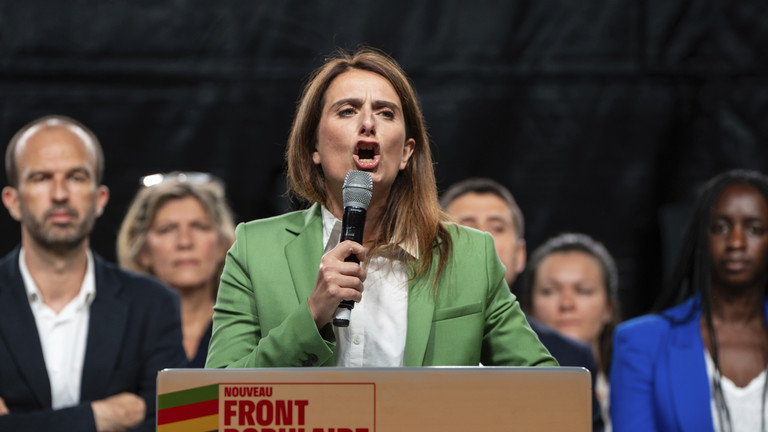
National Secretary of The Ecologists – Europe Ecology The Greens, Marine Tondelier © AP / Louise Delmotte
RT | January 14, 2025
Marine Tondelier, secretary-general of The Ecologists – Europe Ecology The Greens, has called for the social media platform X to be banned across the European Union, at least during election periods, arguing that it plays a role in shaping public opinion in ways that can threaten democracy.
Speaking on RTL’s Le Grand Jury program on Sunday, Tondelier expressed concerns about the influence of social media on democratic processes amid heightened tensions between the platform’s owner, Elon Musk, and EU officials who accuse the US-based billionaire of meddling in European politics.
“It’s not a question of freedom of expression; it’s a question of shaping public opinion,” she claimed. Tondelier highlighted the growing concentration of media ownership in France and globally, accusing “ultra-rich individuals” of trying to “buy power” once they accumulate enough wealth.
“We also need to take social media into account in this calculation now. It is part of the fabrication of opinion. It has a grip on reality. It impacts election results,” she stated. “It’s dangerous because it’s a challenge to our democracies,” she added, suggesting a ban on X during sensitive periods, such as elections.
“The social network Twitter is not only annoying but also dangerous. The question of leaving it obviously arises, but it will not be enough: it must be banned,” she wrote in a post on X.
Tondelier also urged her partners from the left-wing New Popular Front (NPF) coalition, which won the most National Assembly seats in this summer’s legislative elections, to migrate to alternative networks.
“I’m going to leave, but what are the others doing? It will still have an impact on reality. It will still contribute to destabilizing the upcoming elections,” she said.
Musk provoked major controversy by claiming in December that “only the AfD can save Germany,” a statement some EU officials denounced as unacceptable foreign meddling. This followed an op-ed piece published by the German newspaper Welt am Sonntag, in which he defended the right-wing party’s policies. Last week, Musk hosted an interview on X with Alice Weidel, the AfD’s candidate for chancellor in the upcoming German election.
Musk also clashed with former EU Commissioner Thierry Breton, referring to him as “the tyrant of Europe,” after Breton appeared to endorse the cancellation of Romania’s presidential elections, warning about potential foreign interference in the upcoming German polls.
French Foreign Minister Jean-Noel Barrot recently voiced concerns about Musk’s influence, urging the European Commission to take a firmer stance and use existing mechanisms against alleged external meddling. Breton clarified that his remarks were aimed at ensuring compliance with the EU’s Digital Services Act.
In recent weeks, the South African-born tech mogul also criticized British Prime Minister Keir Starmer, accusing him of failing to tackle the Pakistani grooming gang issue and refusing to properly investigate the mass rape of underage girls while he was head of the UK’s Crown Prosecution Service from 2008 to 2013. He also urged Washington to step in and “liberate” the Brits from their “tyrannical government.”
Musk calls out ‘tyrant of Europe’
RT | January 13, 2025
X owner Elon Musk has denounced former EU Commissioner Thierry Breton as “the tyrant of Europe” over an interview that appeared to endorse the cancelation of Romania’s presidential elections.
Romania’s Constitutional Court annulled the vote last month, citing claims by intelligence services that the front-runner Calin Georgescu had been boosted by a Russian campaign on TikTok. It has since emerged that the campaign had been the work of a rival Romanian party, but the court has refused to reverse its ruling.
In an interview with the French outlet BFMTV/RMC last week, Breton appeared to suggest that the upcoming German elections could suffer the same fate should the Musk-endorsed Alternative for Germany (AfD) party emerge triumphant.
“Let’s stay calm and enforce the laws in Europe, when they risk being circumvented and if not enforced, could lead to interference,” Breton said. “It was done in Romania and obviously, it will have to be done, if necessary, in Germany as well.”
The minute-long video, in French, was shared by the Polish-based account ‘Visegrad24’, prompting Musk to reply, deriding “the staggering absurdity of Thierry Breton as the tyrant of Europe.”
Breton objected to the label on Saturday, however, arguing that he was only referring to online censorship through the bloc’s Digital Services Act (DSA) and that the EU “has NO mechanism to nullify any election” in the bloc. “Lost in translation… or another fake news?” he wondered on X.
While it was Visegrad24 that interpreted Breton’s comments as an endorsement of canceling elections, Breton’s clarification did not address the fact that the alleged “interference” in Romanian democracy came from the inside, making the judiciary intervention questionable. Musk said no more on the matter, however, having turned his attention to the wildfires ravaging Los Angeles.
Breton’s initial remarks came in response to Musk’s interview on X with Alice Weidel, AfD’s candidate for chancellor in the upcoming German election. Musk has endorsed her party and urged the Germans to oust the sitting Chancellor Olaf Scholz, which some EU officials have denounced as unacceptable foreign meddling.
The Frenchman was the EU commissioner for Digital Affairs and Internal Markets in August, when he threatened Musk with penalties over an upcoming X interview with Donald Trump, then the Republican candidate for US president.
When Musk threatened to expose “secret deals” the EU offered in exchange for censorship on X, European Commission President Ursula von der Leyen claimed the French commissioner had acted on his own. Breton resigned in September, accusing the Brussels leadership of “questionable governance.”
In Huge Protest, Romanians Rail Against Do-Over Election Targeting Populist NATO Skeptic
By Tyler Durden | Zero Hedge | January 13, 2025
Upwards of 100,000 Romanians of various political stripes took to the streets on Sunday to express outrage over the voiding of a presidential election that seemed poised to put a NATO and Ukraine War skeptic in power. George Simion, leader of the right-wing Alliance for the Unity of Romanians, summed up the intent of the demonstrations his party organized:
“We are protesting against the coup d’état that took place on Dec. 6. We are sorry to discover so late that we were living in a lie and that we were led by people who claimed to be democrats, but are not at all. We demand a return to democracy through the resumption of elections, starting with the second round.”
In November, Romania held the first balloting in its two-round election. It resulted in Europe’s latest instance in which a populist, nationalist, right-wing candidate posted a result that far exceeded what polls indicated he was capable of. In a 13-contender field, that candidate, Calin Georgescu, led the pack with 23%, setting him up to advance to the second and final round against reformist Elena Lasconi of the Save Romania Union party.
However, just two days before that second round was to take place on Dec. 8, Romania’s constitutional court annulled the election, and ordered a complete do-over of both rounds. Their justification: Supposed Russian meddling manifested in manipulated votes, campaign irregularities and secret spending. The ruling came after incumbent President Klaus Iohannis reportedly shared intelligence claiming Russia organized thousands of social media accounts to boost Georgescu’s campaign.
“You petty politicians, with your ungrateful and immature games, you won’t even know what hit you in this global storm,” said Georgescue in a social media post in which he promoted the protest and compared Romanian leaders and judges with former French president Nicolas Sarkozy, who’s on trial on corruption charges. “You are so small that you aren’t even able to understand anything. Nothing you do will make a difference anymore. The inevitable, is inevitable.”
On Sunday, crowds — estimated in size from tens of thousands to more than 100,000 — marched through the streets of Bucharest, with Reuters reporting that many left-wingers joined the protest. The slogans on their signs included “We Want Free Elections,” “Bring Back The Second Round,” “Freedom,” and “Democracy Is Not Optional.” In a country that is among the most religiously observant in Europe, many carried Christian Orthodox icons. According to video posted to social media, protesters also vented their aggravation with establishment media:
Social media was the principal catalyst of 62-year-old Georgescu’s success. He didn’t run as a member of any political party, but his TikTok account racked up 1.6 million likes for content showing him going to church, running, practicing judo, and being interviewed by podcasters.
Iohannis’ term was supposed to end on Dec. 21, but he’s now slated to remain in power until the do-over election is complete. The dates are not yet official, but, last week, leaders of the ruling coalition government said they’d agreed on holding the two rounds on May 4 and May 18.
Georgescu’s views are anathema to the European establishment. He’s pledged to restore Romanian sovereignty and put an end to what he characterizes as subservience to NATO and the EU. He has taken a hard line against the presence of NATO’s missile defense system that’s based in Deveselu, southern Romania, calling it a “shame of diplomacy” that is more confrontational than peace-promoting.
He’s also pushed for Romania to pursue a non-interventionist policy in the Ukraine war, and said US arms-makers were manipulating the conflict. Since Russia’s invasion, Romania has facilitated Ukrainian grain exports and furnished military assistance including the donation of a Patriot missile battery. In addition to his broad theme of restoring Romanian sovereignty, Georgescu also ran on countering price inflation, addressing Romania’s worst-in-EU poverty rate, supporting farmers and decreasing the country’s reliance on imports.
However, now it is the sovereignty of the Romanian people themselves that is in peril. As a flag-wrapped economist named Cornelia told Reuters on Sunday: “At this rate we won’t be voting anymore, they will impose a leader like in the old days.”
Tipping point: Zuckerberg dumps “fact-checkers”, allows immigration talk, copies X and moves team from CA to Texas
Suddenly free speech is cool again
By Jo Nova | January 8, 2025
This is not the Tipping Point they were expecting.
Now that the election is safely over, Mark Zuckerberg, the coward, admits that censorship went too far and free speech is important. He’s decided that Facebook and Instagram will drop the third party “fact checkers” that crushed content and banned people because the “fact checkers” made too many mistakes. (Of course, he doesn’t admit that these were not mistakes at all, but entirely the plan.)
As David Evans (the other half) says “Reminds me of 1989, when the Berlin Wall fell. It was the end of another leftist regime based on censorship and cancelling. The good news just kept on coming.”
It’s a very limited mea culpa — it was just good intentions and a bit of scope creep you know…
It’s not like he was interfering in elections, tilting the balance to buy political protection, increase his profits, or score points at dinner parties with billionaire friends.
From the Press Release:
More Speech and Fewer Mistakes
In recent years we’ve developed increasingly complex systems to manage content across our platforms, partly in response to societal and political pressure to moderate content. This approach has gone too far. As well-intentioned as many of these efforts have been, they have expanded over time to the point where we are making too many mistakes, frustrating our users and too often getting in the way of the free expression we set out to enable.
And it was only “harmless content” that was lost and a bit of frustration was caused — it’s not like people died, wallowed in jail, or got attacked by illegal immigrants due to their loss of free speech:
Too much harmless content gets censored, too many people find themselves wrongly locked up in “Facebook jail,” and we are often too slow to respond when they do.
The Fact Checkers turned out to have their own biases:
If his plan was to give more expert opinions so “the people could judge” it does seem odd that they hired 20 year old nobodies with no qualifications to censor Harvard Professors in medicine.
The intention of the program was to have these independent experts give people more information about the things they see online, particularly viral hoaxes, so they were able to judge for themselves what they saw and read.
We’re not buying this miracle, Zuck, of how the people were supposed to be able to judge what they couldn’t see and never read…
It was just terribly bad luck the fact checkers all happened to support the same side of politics that Zuckerberg donated $400 million dollars to in 2020:
That’s not the way things played out, especially in the United States. Experts, like everyone else, have their own biases and perspectives. This showed up in the choices some made about what to fact check and how. Over time we ended up with too much content being fact checked that people would understand to be legitimate political speech and debate. Our system then attached real consequences in the form of intrusive labels and reduced distribution. A program intended to inform too often became a tool to censor.
He openly admits that the Twitter community notes policy is much better and will adopt it
It’s unusual in the business world to see someone copy a competitor (and openly say so):
We plan to phase in Community Notes in the US first over the next couple of months, and will continue to improve it over the course of the year. As we make the transition, we will get rid of our fact-checking control, stop demoting fact checked content and, instead of overlaying full screen interstitial warnings you have to click through before you can even see the post, we will use a much less obtrusive label indicating that there is additional information for those who want to see it.
And unusual too, that his competitor is happy. Elon Musk says “This is cool”.
And also like Musk, Zuckerberg is sending the policy brains team to Texas — realizing ten years too late, that the Californian bubble is not the place to connect with most Americans:
… we will be moving the trust and safety teams that write our content policies and review content out of California to Texas and other US locations.
Suddenly people will be able to discuss immigration and gender identity
Just toss those sacred cows out the window…
We want to undo the mission creep that has made our rules too restrictive and too prone to over-enforcement. We’re getting rid of a number of restrictions on topics like immigration, gender identity and gender that are the subject of frequent political discourse and debate. It’s not right that things can be said on TV or the floor of Congress, but not on our platforms. These policy changes may take a few weeks to be fully implemented.
How telling that he picks these topics. Immigration, especially is the hot button issue in the US, UK and Europe. This change will come through in mere weeks, he says, leaving us wondering if Zuckerberg suddenly realized Facebook and Instagram were in danger of being 100% irrelevant in the real world. A cruel observer might say that his interest in free speech was purely profit driven (or an act of desperation).
When will he let people discuss their medical experiences?
At ZeroHedge, they point out that it’s just over a month since Zuckerberg met Donald Trump at Mar-a-Lago, and only one day after one of Trump’s closest allies joined the board of Facebook — the UFC CEO Dana White. Perhaps Trump gave him one last chance (with conditions)?
It’s all a step in the right direction. But after censoring ICU Specialists who were trying to save lives and who turned out to be right, Zuckerberg is going to have to do a lot more than mouthing the weak words of “mistakes”. The nicest possible interpretation is that as a mere double-digit billionaire, (unlike Musk) Zuckerberg was squeezed by the Blob until he complied. The US government could have put him out of business in five minutes if he offended them. But where is that story? His country — the world — really needs to hear the real mea culpa.
Nothing can compensate for the damage to lives that could have been avoided, but there are plenty of people out whose losses can be cut quickly:
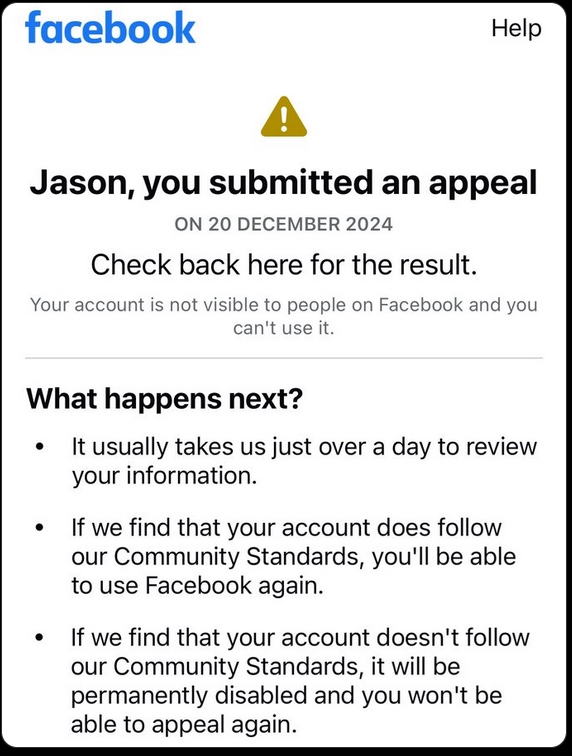
— Jason Olbourne – (The Daily Australian) (@JasonQCitizen1) January 7, 2025
As Zuckerberg avoids a prison cell announcing the end of fact checkers and vastly reducing censorship, I am still waiting for my ‘appeal’ against a heinous false charge with no evidence, no due process and no way to get in touch which disabled 17 years worth of work, the past ten…
Letting all those people out of Facebook jail would be a start.
Zuckerberg’s mea culpa – more strategy than sincerity
Maryanne Demasi, reports | January 12, 2025
Mark Zuckerberg’s Meta has spent years manipulating algorithms to suppress dissent and inconvenient truths. Now, Zuckerberg wants us to believe he’s turned over a new leaf. “Community notes” is his supposed act of contrition—replacing Meta’s infamous “fact-checkers” with what he’s touting as a democratic approach to truth.
The changes will affect Facebook, Instagram and Threads – social media platforms with more than 3 billion users globally. Zuckerberg says the purpose is to outsource fact-checking to the people and let the collective wisdom determine what’s true.
Users can add context or clarification to posts, which won’t vanish into algorithmic oblivion but will instead bear appended “notes” offering a more balanced view.
So, has Zuckerberg suddenly grown a conscience? Hardly. This is less about soul-searching and more about political expediency. We’re meant to believe this is some heartfelt mea culpa, a humbling moment for a company that “got it wrong.”
But to me, this feels insincere. Pure public relations – a cynical scramble to navigate shifting political winds. Meta isn’t repenting; it’s repositioning. After all, this is the same platform that orchestrated an era of unparalleled online censorship, silencing inconvenient truths under the guise of “misinformation control.”
Remember the Biden laptop story? An exposé conveniently buried before the 2020 election because it didn’t fit the desired narrative. Zuckerberg himself admitted to suppressing the story after pressure from the FBI. But that wasn’t an isolated incident.
Over the last four years, Facebook has been the digital embodiment of Orwell’s Ministry of Truth. Articles questioning the efficacy of masks, the lab leak theory, or COVID-19 vaccine safety were flagged, shadow-banned, or outright erased. Entire communities of vaccine-injured individuals—desperate for support and answers—were wiped off the platform. Real lives were affected; people were isolated. Conversations that could have saved lives were silenced. It’s no exaggeration to say Facebook has blood on its hands.
One example of Meta’s overreach involved The BMJ. Paul Thacker’s piece on Pfizer whistleblower Brook Jackson which highlighted data integrity issues at a few of Pfizer’s vaccine trial sites, was slapped with a label by Facebook, effectively discrediting it. This wasn’t just heavy-handed; it was a brazen suppression of credible journalism. An open letter from The BMJ’s editors to Meta rightly lambasted the organisation for trying to discredit the vetted information. The damage wasn’t limited to stifling discourse; it eroded public trust in both science and media.
As recently as August 2024, Zuckerberg admitted to the House Judiciary Committee that Meta had been coerced by the government to censor Americans. His letter detailed relentless pressure to silence dissenting views on COVID-19, elections, and more. And yet, despite this supposed epiphany about governmental overreach, Facebook continued censoring content right up until its recent pivot to community notes.
Zuckerberg’s newfound candour isn’t transparency; it’s pre-emptive blame-shifting. The Murthy v. Missouri (formerly Missouri v Biden) case has exposed the collusion between tech giants and government officials to suppress online speech. Allegations that the Biden administration pressured platforms to bury certain viewpoints—even when factually accurate—paint a chilling picture. Facebook’s narrative of victimhood feels like a calculated attempt to deflect legal and public scrutiny.
Meanwhile, there are ‘journalists’ in legacy media who are mourning the loss of fact-checkers as though democracy itself is under siege. What kind of journalist defends a system that stifles free speech and debate? Science thrives on questioning and open dialogue, not the orthodoxy imposed by fact-checkers operating with opaque agendas. Their hand-wringing isn’t about truth—it’s about losing control of the narrative.
And now, as the political tide shifts and the Biden administration’s influence wanes, Meta suddenly finds the courage to air its grievances about government meddling. Convenient, isn’t it? Zuckerberg’s newfound spine is less about principle and more about positioning Meta for survival in a new political landscape.
Let’s be real. Community notes is not altruism – it’s damage control. Meta isn’t addressing the harm it caused—it’s deflecting. The platform’s censorship caused real-world consequences: vaccine-injured people left voiceless, critical public health debates silenced, and public trust shattered. If Meta was truly contrite, it would compensate for the damage, support those it deplatformed, and restore erased communities – even compensate those with vaccine injuries who were silenced.
Don’t get me wrong – I think dumping fact-checkers was the right move and its a win for free speech – it just should have happened sooner, and Zuckerberg shouldn’t be let off the hook. Meta’s track record suggests this is just another calculated move.
For years, Facebook wielded its influence with recklessness, deciding who could speak and what could be said. Now, as the tide turns, it wants to rebrand as a champion of open dialogue and transparency. But the damage is done. The trust is broken. And no amount of community notes can erase the scars left by Meta’s years of suppressing truth.
Mark Zuckerberg might try to rewrite history, but history won’t forget.
Mark Zuckerberg Falsely Claims “You Can’t Yell ‘Fire’ in a Crowder Theater” To Justify Covid Censorship
By Cindy Harper | Reclaim The Net | January 11, 2025
In his appearance on The Joe Rogan Experience, Meta CEO Mark Zuckerberg defended Facebook’s early COVID-19 content moderation policies by invoking the often-quoted but inaccurate legal principle, “you can’t yell fire in a crowded theater.” Zuckerberg cited this rationale to justify the platform’s censorship of certain information during the pandemic’s onset.
“COVID was the other big one where that was also very tricky because, you know, at the beginning, it was – you know, it’s like a legitimate public health crisis, you know, in the beginning. And it’s – you know, even people who were like the most ardent First Amendment defenders, the Supreme Court has this clear precedent. It’s like, all right, you can’t yell ‘fire’ in a crowded theater. There are times when, if there is an emergency, your ability to speak can temporarily be curtailed in order to get an emergency under control,” Zuckerberg said.
This statement leans on a widely misunderstood legal argument. The phrase “you can’t yell fire in a crowded theater” originates from a 1919 Supreme Court opinion by Justice Oliver Wendell Holmes in Schenck v. United States, which was later overturned and criticized for its justification of speech suppression. Zuckerberg’s use of this outdated precedent is misleading and offers a flawed defense for restricting speech on Meta’s platforms.
Zuckerberg elaborated on his stance, expressing initial trust in government and health authorities: “So I was sympathetic to that at the beginning of COVID. It seemed like, OK, you have this virus. It seems like it’s killing a lot of people. I don’t know. We didn’t know at the time how dangerous it was going to be. So at the beginning, it kind of seemed like, OK, we should give a little bit of deference to the government and the health authorities on how we should play this.”
However, Zuckerberg acknowledged the shifting narratives from health officials, which complicated content censorship decisions. “But when it went from, you know, two weeks to flatten the curve to, you know, in like – in the beginning, it was like, OK, there aren’t enough masks. Masks aren’t that important. To then it’s like, oh, no, you have to wear a mask. And, you know, all the – like, everything was shifting around. I – it’s become very difficult to kind of follow.”
The discredited legal metaphor has drawn criticism from free speech advocates. Such justification enables tech giants to overstep in moderating content, especially in moments of crisis when diverse perspectives are most crucial.
Equating speech to violence or danger is an easy excuse to censor controversial speech.
Newsom Defends Wildfire Response, Tells Biden Online “Misinformation” Needs to be Combatted
By Dan Frieth | Reclaim The Net | January 10, 2025
Governor Gavin Newsom (D-CA) shifted focus to combating “misinformation” during a briefing on the devastating wildfires ravaging Los Angeles. The session included President Joe Biden, Vice President Kamala Harris, and Los Angeles Mayor Karen Bass, with Newsom and Bass addressing concerns over their administration’s preparedness as the fires claimed at least 10 lives and destroyed countless homes.
Conducted in a hybrid format, the meeting saw Biden and Harris in the Oval Office while Newsom, Bass, and FEMA Administrator Deanne Criswell joined via video call. Newsom described the unprecedented destruction fueled by what he called “hurricane-force winds, the likes of which we’ve never imagined in our lifetime.” He then pivoted to warn about the spread of misinformation related to the disaster.
“We’ve got to deal with this misinformation. There were hurricane-force winds of mis- and disinformation — lies,” Newsom stated. “People want to divide this country, and we’re gonna have to address that as well. And it breaks my heart, as people are suffering and struggling that we’re up against those hurricane force forces as well.”
Expressing frustration, Newsom added, “And that’s just a point of personal privilege that I share that with you because it infects real people that are out there. People I meet every single day, people the mayor has been meeting with, and they’re having conversations that are not the typical conversations you’d have at this time be in. And you wonder where this stuff comes from, and it’s very damaging as well, but we’re here to get the job done; to be here for folks to focus.”
California Governor Gavin Newsom is facing a barrage of criticism from various quarters, highlighting several contentious issues, particularly related to a lack of preparation for combatting wildfires under his governance.
Newsom’s timing is ironic as Biden has been criticized heavily today for his previous attempts to police “misinformation” online.
On the same day Newsom appealed to Biden about online “misinformation,” Meta CEO Mark Zuckerberg disclosed on The Joe Rogan Experience that the Biden administration pressured his company to censor COVID-19-related content, including truthful criticism of the vaccines.
Zuckerberg revealed that officials would “call up our team and scream at them and curse” over certain posts. A notable incident involved demands to remove a meme.
Zuckerberg emphasized, “Basically, it just got to this point where we were like no, we’re not going to take down things that are true. That’s ridiculous.”
This revelation, although not new, highlights a troubling pattern of government pressure on tech companies to suppress speech, raising serious concerns about censorship and the erosion of free expression. As wildfires continue to devastate communities, efforts to control narratives under the guise of combating misinformation risk silencing legitimate discourse. The public’s right to transparent and open communication remains more critical than ever in times of national emergencies.
Featured Video

Trita Parsi: Middle East Unraveling — Are We on the Path to World War?
or go to
Aletho News Archives – Video-Images
New Book
Trans agenda is ‘normalization of sadism’ – US author

RT | September 23, 2026
The US Democratic Party has embraced a transgender agenda that amounts to “the normalization of sadism,” author A.J. Rice has said, warning that radical trans policies would return if the party is allowed to regain power.
Speaking to RT’s America First host Scotty Nell Hughes about his new book, ‘The Curse of the Bearded Lady: How the Trans Mafia Whacked American Sanity’, Rice argued that activists have gained significant influence in schools, medicine, and corporate America while people who questioned the agenda have faced pressure to stay silent.
The author described the “trans mafia” as the sprawling network of people and institutions that have helped the movement gain influence. He singled out parts of academia, wealthy backers, and corporations, and stated that providers of transition-related treatment also have a financial incentive to keep young people in their care indefinitely.
Rice argued that the consequences of these policies ultimately fall on children who are being drawn toward gender-affirming medical treatments and on girls who are expected to share locker rooms or compete in sports with biological males.
He noted that while voters rejected the Democrats’ approach to gender in 2024, the party, which has been “captured by madness,” has since only doubled down and is seeking what is effectively “the normalization of sadism.” … Full report
Blog Roll
 Aletho News
- German chemicals giant reveals details of downsizing
- Refaat Al-Areer Was The Canary In The Coal Mine In Israel’s War On The Truth
- Israeli election committee bars candidate from Knesset race over Gaza war opposition
- French-Lebanese man files war crimes complaint over Israeli attacks
- Mahan Air Flight Lands in China Despite US Threat against Iranian Airlines
- US eyes $10bn fund to rebuild war-battered Gulf infrastructure
- Trump meets Rodríguez near Maduro’s prison as Venezuela’s oil flows to US
- Trita Parsi: Middle East Unraveling — Are We on the Path to World War?
- Iran FM meets with US envoy on UN meeting’s sidelines at American side’s insistence: Report
- Qatar PM calls for Gulf security framework with Iran, says war must be ‘wake-up call’
- If Americans Knew
- Caught on Tape: AIPAC CEO Boasted of Controlling Trump’s National Security Officials
- Why Hamas Attacked Israel in October 2023 – Israeli professor Ilan Papé
- They see them, then kill them: Israeli quadcopters track, deliberately target civilians in Gaza
- Winter could turn Gaza’s treacherous, war-damaged buildings into deathtraps
- Majority of Democratic Voters Want to Prosecute Both Biden and Trump Administration Officials Over Gaza
- As Gaza languishes, world leaders gather at the UN – Daily Update
- Sanctions are collective punishment: immoral and self-defeating
- Phosphorus Munitions Fired by Israel Burn Groves, Orchards in Southern Lebanon
- Israel Carries Out New Ceasefire Violations Across Gaza
- AI – Emphasis on the ‘I’: Israel Is Funding AI Chatbot Propaganda
- No Tricks Zone
- New Study: Earth And Venus Surface Warmth Largely Explained By Convection And Lapse Rate, Not CO2 Or Radiation
- 2025 Nature Paper Claiming Worsening Global Drought Gets RETRACTED …Heavily Flawed
- New Study: ‘Global Drought Shows No Detectable Recent Acceleration Under Climate Warming’
- Economic Masterminds: German Socialists Suggest Taxing Productivity Gains Stemming From Using AI
- The South China Sea Has Not Been Cooperating With The Climate Change Narrative
- Energy Crisis: Germany Enters Heating Season With Historically Low Gas Reserve Fill Levels
- New Study: The Antarctic Ice Sheet Gained Mass From 2020-2024 Due To Staggering Snow And Ice Accumulation
- Study: Ocean Heating Rates From Thousands Of Years Ago ‘Dwarf’ Modern Ocean Heating Rates
- Climate Extremists Target, Attack Large-Scale Power Grid Infrastructure In Germany!
- New Study: Antarctic Ice Melt Has Contributed Less Than 1 Centimeter To Sea Level Rise In The Last 30 Years

