Federal Ban on School Prayer Widely Ignored
By Noel Brinkerhoff | AllGov | June 21, 2013
Half a century after the U.S. Supreme Court banned prayer in public classrooms, religion is nonetheless very present in schools these days.
 In two landmark decisions (Engel v. Vitale and Abington School District v. Schempp), the Supreme Court in 1962 and 1963 declared school-sponsored prayer and Bible readings unconstitutional.
But the rulings applied only to public school teachers and administrators.
Students were free to say grace in the cafeteria, meet outside class to study the Bible, Quran, or Torah, and participate in religious after-school programs on their campuses.
“We’ve gone from virtual silence about religion in the curriculum and virtually no student religious expression in many schools,” Charles Haynes, a scholar at the First Amendment Center and head of the Religious Freedom Education Project in Washington, DC, told the Christian Science Monitor, “to today, when social studies and other standards are fairly generous to religion, and students are expressing their faiths in many different ways in many public schools, if not most.”
Consider the following facts:
Good News Clubs, organized by the Child Evangelism Fellowship, hold Sunday school-like classes in some 3,200 public elementary schools for 156,000 students.
One million to two million students participate in “See You at the Pole” prayer services every September beneath their campus flagpoles.
The Fellowship of Christian Athletes has more than 8,000 chapters on junior and high school campuses across the country.
Campus Crusade for Christ has about 200 clubs, almost all of them in public schools.
Youth for Christ, an evangelical missionary organization, has on- and off-campus clubs at 1,200 schools, most of them public.
Meanwhile, a poll conducted in 2012 by the National Opinion Research Center showed that 57% of Americans disapprove of the Supreme Court prohibition against public schools requiring the reading of Bible verses or the Lord’s Prayer, while 39% approve. However, there were sharp regional differences. A majority in the Northeast and the West did approve of the prohibition, while in the South 73% disapproved. In addition, Americans age 18-29 differed from their elders, approving of the prohibition 56% to 38%.
To Learn More:
School Prayer: 50 Years after the Ban, God and Faith more Present than Ever (by Lee Lawrence, Christian Science Monitor)
School Prayer 50 Years Later: What Do Americans Believe? (by Jaweed Kaleem, Huffington Post)
High School Valedictorian Sues to Stop Graduation Prayer (by Noel Brinkerhoff, AllGov)
Related articles
- Prayer in School: Why Isn’t Silent Prayer Good Enough? (atheistrev.com)
- Prayer in School: All Eyes on Mississippi (atheistrev.com)
Turkey announces plans ‘for gas’ and cyber security in face of Gezi protests
RT | June 20, 2013
Turkey has announced plans to purchase 100,000 gas bomb cartridges and launch a central cyber security agency, local media report. This comes after protests across the country which also saw a series of attacks on government websites.
The order for the 100,000 new cartridges will be accompanied by an order for 60 water cannon vehicles, the daily local newspaper Milliyet reported, also stating that the excessive use of gas bomb cartridges meant that Turkish riot police used up some 130,000 units across the space of a mere 20 days.
The protests began in Istanbul, but nationwide demonstrations shortly followed suit, drawing thousands in support of the Gezi Park protesters suffering brutal police repressions. In one of the instances, a horrifying video emerged of a man in a wheelchair being fired at by a similar [water canon] vehicle on June 11.
“The excessive use of force by the police has turned this issue into a security one,” said Galip Dalay, a research assistant with the SETA foundation.
At the same time, Turkish Transport, Maritime Affairs and Communications Binali Yildirim announced the formation of a new cyber security agency on Thursday. He declared “The Center for Response to National Cyber Threats,” (or USOM) was to be founded on the grounds that cyber-attacks during the Gezi Park protests were a global threat and “likely to increase.”
At the beginning of June, Anonymous hacking group launched #OpTurkey, which took down the Turkish President’s website, along with that of the country’s ruling party, in support of anti-government protests.
Another mid-June attack on over 225 tourist, library, and private business websites was blamed on Kurdish group ColdHackers.
On Thursday, Turkish hacker group Redhack claimed responsibility for all tweets relating to the Gezi protests after the launching of an investigation into some 5 million Gezi Park tweets was announced by the AKP (Justice and Development Party).
“We have posted all tweets and hacked thousands of people’s computers. Don’t take on the innocent ones, we are here,” Redhack wrote on its Twitter account, going on to say that any accounts that appeared to play a role in the organization of resistance were to re-tweet their message, and those that did had been hacked by the group.
Following the claim of responsibility, Twitter users began to announce that they were hacked by Redhack using the hashtag #wewerehackedbyredhack.
After 29 people’s houses were raided and they were subsequently detained for tweets related to the protests on June 5, the group recommended that “users can tell the police that their account was hacked by Redhack. We would take the blame with pleasure.”
Social media activists had been accused of using Twitter to “instigate public hatred and animosity,” according to Turkish media.
PM Erdogan even blamed social media for the unrest stating “there is now a menace which is called Twitter,” in the midst of the upheaval, dismissing the protests as being organized by extreme societal elements. “The best examples of lies can be found there. To me, social media is the worst menace to society,” he said.
Transport Minister Binali Yıldırım stressed however on June 19 that the government was working to “fight against cyber-crime, not to regulate social media,” with Deputy PM Bülent Arınç adding that people were free to communicate on social media but should be deterred from encouraging crime or violence.
As the protests have continued to draw support across the country, the Turkish government has used increasingly retaliatory measures against anyone involved in protests, culminating in threats to deploy the armed forces on Tuesday, the day after using tear gas and water cannons to disperse Monday’s demonstrators. Over 130 were arrested on Thursday alone, and six people have died to date as a result of the unrest, which is not scaling down despite authorities halting proposed renovations of Gezi Park.
“They’ve left branches hanging off trees and water and debris all over the streets” said RT’s Tom Barton in Ankara on Thursday.
Peaceful demonstrations began on May 28 when a group of environmentalists gathered together to campaign against the proposed development of a shopping mall in Istanbul neighborhood’s only remaining park – Gezi Park – next to Taksim Square. The violent suppression after Erdogan announced that he had already made his decision motivated thousands nationwide to display their solidarity.
Related article
- Turkish Unions Protest Erdogan Crackdown, Announce Strike (alethonews.wordpress.com)
Supreme Court Rules a Suspect’s Silence during Police Interrogation Can be Used against Him
By Noel Brinkerhoff and Danny Biederman | AllGov | June 20, 2013
Remaining silent during questioning by police can be used against a person in a court of law, the U.S. Supreme Court has ruled (pdf) in a startling reinterpretation of Fifth Amendment rights.
A narrow majority ruled 5-to-4 in Salinas v. Texas that it was permissible for authorities to present at Genovevo Salinas’ trial that he refused to answer the police’s questions about a fatal shooting because Salinas had already answered some questions prior to being arrested and read his Miranda rights.
Salinas voluntarily spoke with police about the December 1992 murders of Juan and Hector Garza in Houston. But when asked whether the shells found at the scene would match a shotgun found in his home, the defendant went silent and refused to answer.
A ballistics test subsequently showed the shells were fired from Salinas’ weapon. Prosecutors used the fact that Salinas did not respond to the question about the shells, and appeared nervous, as a further argument to convince jurors of his guilt. Also presented was testimony from a witness who said Salinas took credit for the killings.
Salinas’s first trial ended in a mistrial. A second trial resulted in his being convicted and sentenced to 20 years to life in prison.
He later appealed, arguing that prosecutors had violated his right to stay silent. Salinas’ silence as evidence of possible guilt should have been omitted from the trial, claimed his lawyer, citing the Fifth Amendment’s protection against self-incrimination.
Justices Samuel Alito, Anthony Kennedy, Clarence Thomas, Antonin Scalia and Chief Justice John Roberts disagreed with Salinas’ argument and validated his conviction. Their ruling states that Salinas would have to have voluntarily invoked his Fifth Amendment right in order to be protected by it.
Critics claim that this ruling damages the spirit of the Fifth Amendment and will hereafter give law enforcement an incentive to delay the reading of Miranda warnings—the right to remain silent—to criminal suspects.
Related article
Intelsat suspends satellite services to Iranian TV channels
Press TV – June 19, 2013
Communications satellite services provider Intelsat has announced the suspension of its services to the channels launched from Iran as the West’s campaign against free speech intensifies.
On Wednesday, the Luxembourg-based company said it will no longer provide services to Iranian channels including Press TV. The decision has been made under the pretext of the company’s abiding by illegal sanctions against the president of the Islamic Republic of Iran Broadcasting (IRIB) – that’s Iran’s national broadcasting corporation.
Intelsat noted that it has been ordered by the US government to avoid extending IRIB’s license, noting that it will stop providing services as of July 1st.
Press TV and other Iranian channels have come under an unprecedented wave of attacks by European governments and satellite companies since January 2012.
They have been taken off the air in several Western countries, including Britain, France, Germany and Spain.
European companies say they are abiding by anti-Iran sanctions. However, EU foreign policy chief’s spokesman, Michael Mann, has told Press TV that sanctions do not apply to media.
In the meantime, the French-Israeli CEO of Europe’s satellite giant, Eutelsat, has written letters to several satellite companies, asking them to stop cooperating with Iranian channels.
The Israeli lobby in the United States has also publicly supported European attempts to shut down Press TV.
Media activists call the attacks on Iranian channels a campaign against free speech launched by the same European governments that preach freedom of expression.
Related article
- Israel says no ‘compromise’ should be made with Iran (alethonews.wordpress.com)
UK Supreme Court votes to lift sanctions on Iranian bank
Tehran Times | June 19, 2013
LONDON – The UK Supreme Court has ruled in favor of Bank Mellat, Iran’s largest private bank, in a result which will see it removed from the United Kingdom’s sanction list.
The appeal was heard by nine out of the Supreme Court’s twelve judges after the UK’s highest court was forced to enter closed session for the first time in its history, in order to receive secret evidence from the security services.
Her Majesty’s Treasury imposed sanctions against the bank in 2009 alleging that the bank’s activities supported the Iranian nuclear program, but Wednesday’s ruling found no evidence to support this claim. The UK Supreme Court result follows similar success for the bank at the European Court in January of this year in respect of sanctions which had been imposed on the bank by the EU Council.
The ruling is a blow to the controversial system of “secret courts” which have allowed the security services to provide evidence to the Supreme Court behind closed doors for the first time in its history.
The Supreme Court reluctantly entered into closed session in March, effectively barring the bank from accessing the evidence against it. Zaiwalla & Co Solicitors, the London-based international law firm representing the bank, had argued against the imposition of closed courts on the grounds that it contravenes the British common law principle of open justice. The failure of the Treasury to produce compelling evidence, despite the controversial new powers, puts the spotlight back on the Justice and Security Bill, which expanded the system of closed courts to civil cases.
The ruling sends a strong message to the UK government that political expediency is not a sufficient legal justification for sanctions placed against Iranian private businesses which operate out of Iran. The Supreme Court is now expected to order the British government to pay Bank Mellat all of its legal costs and damages for the wrongful listing of Bank Mellat.
After initial failure to challenge sanctions before the English High Court and the Court of Appeal, Bank Mellat turned to Zaiwalla & Co in 2010 and has since gone from strength to strength in the European and now Supreme Court. The firm, led by Sarosh Zaiwalla, have shown that even in cases of national security, the UK government must abide by the rule of law, with the some of the justifications for the sanctions considered “arbitrary”, “discriminatory” and even “irrational”.
Sarosh Zaiwalla, senior partner at Zaiwalla & Co said, “Today’s ruling is a victory for the rule of law as much as it is for Bank Mellat.
“The judgment will put enormous confidence in the independence of the British judiciary and sets an example that even controversial disputes can be resolved by applying the principle of rule of law through the British courts.
“Nevertheless, the reading of the closed judgment clearly contravenes the British principle of open justice, the bank’s success demonstrates just how unjustified closed sessions are.”
Obama’s Speech at Berlin’s Brandenburg Gate: Shameless Hype, Irony, Lies and Hypocrisy
Doug E. Steil | Aletho News | June 20, 2013
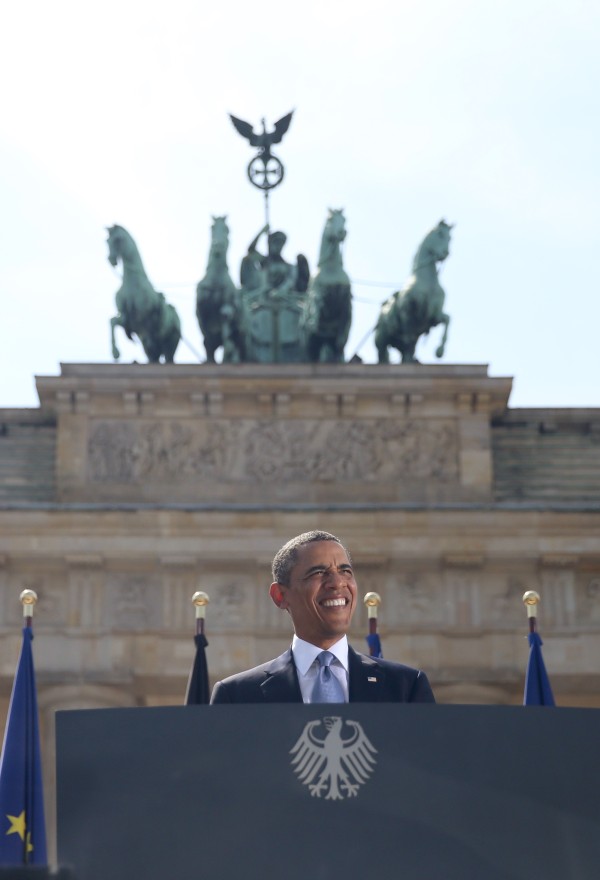 While last visiting Berlin five years ago, candidate Obama gave a speech at a central monument in Berlin amidst a huge crowd, of mainly young folks, that had been seduced through the local media projecting the notion that the new Messiah had arrived. Obama’s handlers wanted to stage that event at the Brandenburg Gate, the recognized symbol for the fall of Communism, but the request was denied by German Chancellor Merkel.
Yesterday Obama was back in town again, with his family, and staged a propaganda event at the Brandenburg Gate amidst extremely tight security that annoyed much of the local population. Beforehand, the media had announced, he would be presenting a landmark speech. Purportedly, just hours before, he was still working on the details. It’s true, imagery of the Brandenburg Gate conveys significant symbolism in the context of 20th century history, so it was not completely unreasonable to anticipate the possibility of a major political announcement, say, perhaps even a complete withdrawal of US military forces and nuclear missiles from German territory, that would surely divert attention from the numerous political scandals surrounding Obama’s regime in the past few weeks.
What Obama presented instead was nothing monumental or historic, but merely the standard repertoire of cheap platitudes, cliches, and “happy talk” that cynics and skeptics have heard far too often already. Political observers understand that, not unlike Ronald Reagan, Obama is merely a puppet for the Jewish Power Establishment, whose common interests and agenda issues he thus represents, under the clever guise of an elected figurehead, who is well trained in the art of Teleprompter delivery, small-talk, back-and-shoulder slapping his political counterparts, thus deceiving the population or lulling the people into a sense of passive complacency.
The essence of yesterday’s speech at the Brandenburg Gate, as the media duly reported, was that his regime would set a “goal” of reducing the number of active nuclear weapons (presumably in western Europe) by “up to” (i.e. no more than) one third. Very “wishy-washy” indeed! Would this even be in the news a week from now? It was evident from the various comments in the German media immediately after the speech, though polite, that prior expectations of substance had not been fulfilled. How many more times can people endure the standard references to gay and lesbian aspirations or agenda related “concerns” regarding the imaginary threat of “Climate Change” (formerly “Global Warming”)?
Particularly annoying was the manner in which Obama shamelessly elevated the now unified Berlin to a new symbol of “freedom”. The irony was inescapable, in light of recent public revelations concerning pervasive NSA spying. In 1989 the people of Eastern Germany had shaken off an odious regime that was particularly notorious for prying into the personal lives of a large segment of the population, who were deemed untrustworthy. By contrast, thanks partly to the misuse of improved technology, the Obama regime spies on the entire population, and in far greater detail, than those running the East German “Stasi” apparatus could have ever imagined. Referring to the former separation wall between east and west, he invoked the word “freedom”, amidst applause:
“No wall can stand against the yearning of justice, the yearnings for freedom, the yearnings for peace that burns in the human heart.”
Well, if that is the case — which it obviously is — then why does his regime continue funding and politically supporting the Israeli built wall, which relegates much of the Palestinian population in the West Bank in small and manageable enclaves and separates them from the rest of their territory? During his rhetorical delivery, Obama then proceeded to utter the word “freedom” sixteen additional times.
Yet, aside from that hypocrisy, one need only imagine how German efforts to attain unification during the early months of 1990 would have been handled by an Obama puppet regime, had it been in power at the time. That process of political unification, which ultimately took nearly eleven months, was triggered by the breaching of the Berlin Wall at the Brandenburg Gate spearheaded by Helmut Kohl and facilitated by President George H. W. Bush, but was not warmly received at all by leaders Thatcher, Mitterrand, or even Gorbachev and widely opposed by the Jewish Power Establishment, through editorials and other efforts, behind the scenes. This is very easy to imagine because in the past year, still fresh in our minds, Americans have been witnessing or personally experiencing the continued and thorough erosion of the basic freedoms enumerated in the Bill of Rights in conjunction with the zealous pursuit of virtually every foreign policy initiative concocted and promoted by Obama’s puppet masters, over the general objections of a general population whose opinions and interests do not seem to matter.
New wall construction to surround Azzun Atma
International Solidarity Movement | June 20, 2013
Azzun Atma, Occupied Palestine – On the 18th of June, two bulldozers arrived with Israeli forces in the village of Azzun Atma, southeast of Qalqilya, and began to work on the land behind the village’s school, to what is believed to be the construction of the new wall.
Accompanying the bulldozers to the village was the Israeli army and border police, including the local Israeli army commander who said the action was based on a High Court decision by the Israeli government. He said it was in order to protect their citizens, and if anybody tried to stop the construction, they would then close the gate to the village, the only way in and out.
Two weeks prior to this, the Israeli army put up signs stating that this is where the construction of the new wall would begin. The villagers fear that this new construction is being done in order to replace the current two metre barbed mesh fence that surrounds the village from all sides and separates it from the settlements nearby, with the concrete wall. The wall’s existence and constant deviation from the Green Line is justified by the Israeli authorities by citing security concerns for its citizens, in this case the illegal settler colonisers in the area.
Azzun Atma is located two kilometres east of the Green Line and encompassed on three sides by the current wall, constructed in 2002, which leaves the village within a settlement block and separates it from the rest of the West Bank. The only way in and out of the village is through a military checkpoint with a small gate. The village is thus stranded in the “seam zone” between the Green Line and the wall, surrounded by settlements, placing it under full Israeli military control. Access to the village, therefore, is dictated by the Israeli military and the checkpoint is regularly closed, denying the villagers their right to freedom of movement. The villagers thus live under the constant threat of the gate being closed and work permits for the other side of the Green Line being denied.
Palestinians living in the “seam zone” require permanent resident permits from the Israeli authorities to live in their own homes and work on their land. There are often few health and education services available in the “seam zone”, and those living inside it have to rely on checkpoints being open to reach workplaces and essential services.
The school where the construction is taking place has provided education for 300 children in Azzun Atma and a neighbouring village since 1966. Every day, the current wall and checkpoint restricts the freedom of movement of teachers and students. The school has so far lost one dunum of land to the wall and the septic system faces demolition orders.
When the second wall is constructed, Azzun Atma will be isolated from the rest of the West Bank by the already existing wall (see the red line on the map) and the new wall which will further close off the village from the settlement block and the rest of the West Bank (see the black line on the map).
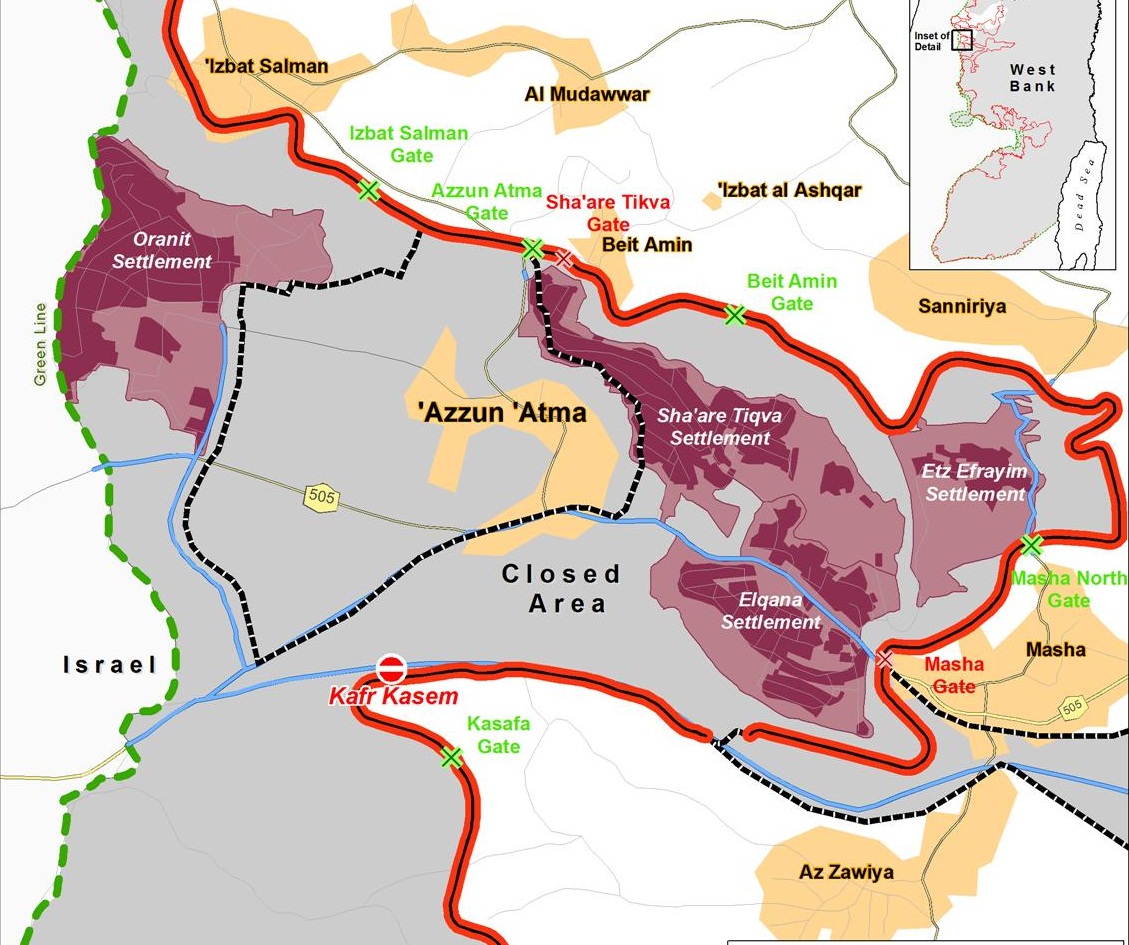
Azzun Atma (Map by OCHA)
In 1982, the Israeli authorities established two illegal settlements: Oranit to the northwest and Sha’are Tiqva to the northeast of Azzun Atma. The settlements have expanded over the years, and more than 2500 dunums of the village’s land have been stolen by them. Sha’are Tiqva now comes within metres of Azzun Atma, and since 2005, villagers have been subject to verbal harassment from settlers. The wall, though purported to be a security measure, is essentially another way for the Israeli government to steal land from their Palestinian owners and isolate villages and cities from each other, turning them into easily controllable cantons.
Isolating people and making daily life as hard as possible under occupation is a tactic used by the Israeli authorities to force villagers to leave their land and homes. However, residents of Azzun Atma remain steadfast in their land and will continue to resist the land theft, isolation and deprivation of their lives by organising protests.
Related articles
- Israeli settlers threaten to occupy Palestinian village of Azzun (occupiedpalestine.wordpress.com)
- West Bank Barrier creates hardship for Palestinian villagers (euronews.com)
Snowden: Don’t mention the I-Word!
By Steve Sailer | June 18, 2013
The New York Times’ “public editor” writes a little piece that asks an interesting question in the title:
Following Up on the N.S.A. Revelations: Were They Really ‘Confirmations’?
By MARGARET SULLIVAN
She lists various articles over the last eight years that recounted much of what Edward Snowden said. For example, James Bamford has been covering the NSA since his 1982 book The Puzzle Palace. Bamford regularly discloses interesting information in Wired, such as the revelations of the more central NSA whistleblower William Binney.
And there were plenty of disclosures about telephone metadata snooping going back to Carl Cameron’s four-part Fox series in 2001.
No doubt there are lots of reason Snowden got so much publicity, but let me mention a subtle one. Unlike Bamford, Binney, Cameron and many others who have looked into snooping in America, Snowden, as far as I can tell, has never mentioned the I-Word: Israel.
Generally, anybody who looks into NSA questions pretty quickly notices that the NSA outsourced some spying on Americans to Israelis, and that, by now, the question of which country is the dog and which country is the tail has gotten murky. For example, here’s a 2012 Wired article by Bamford:
Shady Companies With Ties to Israel Wiretap the U.S. for the NSA
But that’s not the kind of thing that the media or, to be frank, the great majority of the American public wants to think about. We’ve all been socialized to shut our brains off when it comes to this tail wagging the dog question. Cameron got to keep his job at Fox, for example, but his series got erased from the official record.
Snowden, in contrast, has kept things nice and neat for people. Everybody seems to have a nice strong opinion about Snowden in part because he hasn’t set off the mental shutdown process that the I-Word provokes in well-trained Americans.
Time to Raise Political Asylum Quotas for Americans?
US Should Top the List of the International Quota for Political Refugees
By Sybel Edmonds | Boiling Frogs Post | June 17, 2013
I don’t know how you feel about surveys, ranking or indexes, but whether you follow them or not, you must be aware of how we’ve been falling steadily as a nation. Those of you who follow lists-surveys and global indexes, let’s admit it- as a nation we have not been going up on most global ranking lists – in fact, just the opposite.
We have been going down on the list of the World’s Least Corruption Nations-way down. We have been dropping continuously when it comes to our ranking in the education arena. We have been dropping royally when it comes to Healthcare Systems. When it comes to World Press Freedom, we are embarrassingly low, behind Cape Verde, Cyprus, and even trailing Mali, Tanzania, El Salvador, Botswana and Comoros!! We didn’t even make it onto the ridiculous list of the top ten nations’ national happiness index.
All these competitive areas aside, there is one list we should be climbing steadily and rapidly. Even if you don’t care about all those other global lists you must care about this particular one; for your own good and even your survival. I am talking about a list pertaining to a nation’s status as to its need for acceptance of its political refugees by the global community.
 Please don’t laugh or shrug off this suggestion. Instead, pause and think about our whistleblowers in jail or those awaiting the results of their prosecutions. Remember the journalists and reporters being targeted and investigated by our national police. Recall our new laws recently put in place to secretly and indefinitely detain any American citizen (that is you and me)-without any warrant or even having to show any justification. Think about the still-growing national no-fly list. Remind yourself of torture as our government’s common practice; abroad and here at home. Take a look at your land line, cell, laptop, fax and I-Pad as tools used by our government to illegally-secretly-continuously spy on you.
Now you see what I am talking about.
If you still find the notion difficult to accept, then think of the dozens of Hollywood movie classics on the Stasi and KGB. Remember how people climbed the wall or crawled through tunnels to escape the constant surveillance and arbitrary detentions of their national police. Their national police cited national security and unity. Now consider how the NSA and dozens of mega-corporations have you under surveillance illegally; around the clock. Our national police have been citing national security.
How do you think our camps for our citizens to be detained under our new national law, NDAA, would be different than those set up by the Stasi, KGB and the like?
You remember how other western nations received the lucky escapees from the fascistic or communist regimes with open arms? Well, now they should be receiving us, our escapees; with open arms.
They have to. They must. Not doing it would be in violation of their laws and their international pledge:
Asylum is granted to people fleeing persecution or serious harm in their own country and therefore in need of international protection. Asylum is a fundamental right; granting it is an international obligation, first recognized in the 1951 Geneva Convention on the protection of refugees. In the EU, an area of open borders and freedom of movement, countries share the same fundamental values and States need to have a joint approach to guarantee high standards of protection for refugees. Procedures must at the same time be fair and effective throughout the EU and impervious to abuse. With this in mind, the EU States have committed to establishing a Common European Asylum System.
…
And here is the international law describing who qualifies for international protection-Based on UN Convention & Protocols[Emphasis Mine]:
Grounded in Article 14 of the Universal Declaration of human rights 1948, which recognizes the right of persons to seek asylum from persecution in other countries, the United Nations Convention relating to the Status of Refugees, adopted in 1951, is the centerpiece of international refugee protection today.(1)
A refugee, according to the Convention, is someone who is unable or unwilling to return to their country of origin owing to a well-founded fear of being persecuted for reasons of race, religion, nationality, membership of a particular social group, or political opinion.
…
Today, we, the citizens of the United States of America, face prosecution, persecution, torture, and possible assassination for engaging in certain journalistic or even Good Samaritan reporting of illegal-criminal-unconstitutional activities by those trusted with our nation’s health, wealth, and security.
Our government has been engaged in ongoing torture and human rights violations at home and abroad. Whether it is the globally recognized USA halls-of-shame in Guantanamo, Bagram and Abu Ghraib, or, secretly carried out atrocities in our government’s black cites around the globe, or, tortures inflicted on a citizen here at home who is guilty of exposing government criminalities, our government is now recognized and acknowledged as a Supreme Torturer.
This situation now is being extended to those of us who may have read or disseminated information originally gathered and distributed by others. Today our whistleblowers-truth tellers-Good Samaritans are thrown behind bars, while our criminals who engage in robbing our taxpayers of billions of dollars, or those who engage in torture and murder, are highly protected and handsomely awarded by our rulers.
We United States Citizens have been deprived of expressing collective dissent even through the most peaceful means and in the most pacifist manner. Our participation or membership in social groups or gatherings that challenge illegal wars or anti humanitarian practices land us on our government’s never-defined ‘enemy & terrorist’ list, with consequences ranging from being prohibited from traveling , to having our homes raided and families intimidated by armed government militia, to being persecuted and thrown before a federal grand jury to face possible incarceration for our beliefs.
We Americans, every single one of us, are treated as potential terrorists, are considered guilty with no way to prove otherwise. We all are subjected to round the clock warrantless-illegal surveillance , and degrading violation-probing-groping searches as mandatory requirements for our travel.
I believe, and you should as well, that we have more than enough cases of recorded atrocities, criminalities and violations inflicted upon us by our very own government to expect a substantial increase in our nation’s status-ranking for acceptance of our political refugees.
I know, and you do too, that there are many nations with governmental practices worse than ours. However, our bad government is much bigger than their bad governments, with much higher capabilities. When you have a huge government like ours, with incredible technological and weaponry capabilities as ours does, you risk far graver atrocities than with smaller bad governments with limited capabilities. That’s a fact. Our big bad government is far worse than their small bad government. And that should increase and elevate our nation’s ranking in the international community’s political refugee quota-status.
As for the so-called liberal nations: we urge you to remember the Stasi and the suffocating repression suffered by the East Germans, and then, go ahead and multiply that by a six-digit number of your choice. Any number will do, that is, as long as it has six digits. Our technology-enabled Stasis can tap, record, analyze and save billions of communications. Our rulers’ mega corporate collaborators can pull the plug on millions of us with no recourse available or even imaginable. Our mega military’s ferocious drones can pinpoint and turn us into ashes with a secret order issued on a simple letterhead.
We implore the international community to grant us, the Citizens of the United States of America, ‘High Priority Political Asylum’ status. At least consider a swapping arrangement whereby the international community’s highest-level criminals, con artists, professional swindlers, and or psychotic serial torturers are sent here where they can find an agreeable working-practicing environment and unlimited government protection and rewards, in exchange for those of us in search of peace, a reasonable degree of freedom and justice.
Sibel Edmonds is the Publisher & Editor of Boiling Frogs Post and the author of the Memoir Classified Woman: The Sibel Edmonds Story. She is the recipient of the 2006 PEN Newman’s Own First Amendment Award for her “commitment to preserving the free flow of information in the United States in a time of growing international isolation and increasing government secrecy”
Related article
US senators question aid to Honduras, citing extrajudicial killings
Press TV – June 19, 2013
A number of US senators have questioned the Obama administration’s foreign aid to Honduras, pointing to growing reports of human rights atrocities in the Central American country that has long been regarded as a US-client state.
In a Tuesday letter to US Secretary of State John Kerry, 21 US senators cited “numerous recent killings and threats targeting [labor] union leaders, opposition figures, farmers, students, journalist and others,” emphasizing that officials of the US-backed government have been implicated in such criminal acts, which often go unpunished, The Los Angeles Times reports Wednesday.
“As the November 2013 [Honduran presidential] elections draw near, we are particularly troubled by reports of corruption and extrajudicial killings,” the senators wrote in the letter.
The development comes nearly four years after a US-sponsored military coup in Honduras, ousted its popular and democratically-elected President Manuel Zelaya, despite objections by many South American heads of state.
This is while many military and civilian officials involved in the brutal military coup still remain in power in the impoverished country, whose wealth and resources are almost entirely controlled by American corporations that operate under the protection of the country’s heavy-handed military and police forces, broadly trained by US instructors.
Honduras, according to the report, has one of the highest homicide rates in the Western Hemisphere due to a profound presence of drug traffickers, vicious gangs and brutal political killings in the country.
The growing violence has especially climbed since the US-backed military coup in the country, the report adds.
The ousted president’s wife, Xiomara Castro, was recently picked as an opposition candidate for president in the upcoming election, and “several people from her Free Party have been killed or attacked,” the report adds.
The senators further asked Kerry to submit to Congress a detailed analysis of whether the Honduran regime was doing something to “protect freedom of expression and association, the rule of law and due process” and to investigate death-squad-style killings involving government security forces.
According to the report, the United States suspended a portion of its aid to Honduras after the country’s top police commander was linked to numerous killings.
“All but about $10 million was resumed, but the Honduran government is supposed to meet a set of criteria that includes ensuring free speech, due process and the prosecution of authorities who commit human rights crimes,” it adds.
In their letter to the Secretary of State, however, the senators expressed doubts that such conditions were being met, urging Kerry to “ensure that no US assistance is provided to police or military personnel or units credibly implicated in human rights violations.”
Related articles
- State propaganda on NPR’s “Morning Edition” (alethonews.wordpress.com)
- The New York Times on Venezuela and Honduras: A Case of Journalistic Misconduct (alethonews.wordpress.com)
- Senator Menendez Meets with President Lobo to Discuss U.S. Funding for Honduras (alethonews.wordpress.com)
Police Arrest over 100, Raid Media Offices in Turkey
Al-Manar | June 18, 2013
Turkish police detained dozens of people at their homes and raided two media offices on Tuesday in a coordinated operation across the country to clamp down on nearly three weeks of mass anti-government unrest, AFP reported.
Officers raided the homes of around 90 members of the Socialist Party of the Oppressed (ESP), a small leftist group that has been active in Istanbul’s Gezi Park protest at the centre of the nationwide protest movement, the Istanbul bar association said.
Police also searched the offices of the Atilim daily and the Etkin news agency, local media outlets linked to the ESP group, the NTV and CNN-Turk television stations reported.
NTV said 30 people were arrested in the capital Ankara and another 13 in the northwestern city of Eskisehir in a police swoop targeting 21 provinces overall.
Featured Video

Why Hamas Really Attacked Israel on Oct. 7
or go to
Aletho News Archives – Video-Images
From the Archives
Israel: Strategic Ally or Liability?
By Stephen Sniegoski | My Catbird Seat | June 12, 2010
The claim that Israel serves as a valuable ally for the United States is made by both pro-Zionists and much of the anti-war and anti-Zionist Left that is influenced by Noam Chomsky. As a result of the Gaza flotilla massacre, which has caused a world-wide uproar against Israel, the value of Israel to the United States is being publicly questioned in more mainstream foreign policy forums. … continue
Blog Roll
 Aletho News
- Why Hamas Really Attacked Israel on Oct. 7
- Declassified UK exposes British man who fought for ‘Israel’ in Gaza
- West’s death cult in a theater near you
- How the Yandex ‘Russian bots’ lie fell apart
- Burnham’s ‘Russia did Brexit’ ruse crumbles
- Estonia making movies and games to encourage war against Russia
- Four in five new UK jobs taken by foreigners – report
- Here’s what Trump’s latest U-turn really means for Russia and Ukraine
- The Houthis Are Not an Iranian Proxy
- Europe’s Energy Hypocrisy, Russian LNG Profits and US Dependence
- If Americans Knew
- Activists Abused By Israel Return to New Freedom Flotilla Mission
- 60 Minutes won’t tell the full truth about Israeli settler violence
- Nearly 50,000 women, girls killed or severely injured in Gaza since October 2023: UN Women
- ADL is working with AI companies to suppress alleged ‘antisemitism’
- Israeli occupation forces using social media surveillance unit to target hundreds of Palestinians in the West Bank
- Israel’s New – and Terrifying – Security Doctrine
- Israeli Attacks Kill Five in Gaza, Including a four-year-old and a woman
- Air Force Major Who Called for Trump’s Impeachment Held in Solitary Confinement
- It’s a Genocide, I’m Into It’: Seinfeld Mocks Protest over Palestinian Children Killed
- Universities fire dozens amid pressure from Zionist billionaires
- No Tricks Zone
- New Study Suggests Large Regions Of The Pacific Ocean Have Been Cooling For The Last 80 Years
- Germany’s Green Energy Debacle: High Energy Costs Force Kahla Porzellan to Close After 182 Years!
- New Study: 50 Years Of The Most Aggressive ‘Net Zero’ Policies Can Only Affect The Global Climate By 0.03°C
- US September “Heat” Was No Record…Many Records Set Decades Ago
- Latest European Green Energy Debacle; Portugal’s Largest Flagship Solar Park Insolvent!
- Green Energy Debacle: German Expert Professor Fritz Vahrenholt Warns Of Severe Economic And Social Consequences
- Two More Paleo Reconstructions Affirm Meters-Higher Sea Levels Across Ireland, Brazil 7000-6000 Years Ago
- New Study: Earth And Venus Surface Warmth Largely Explained By Convection And Lapse Rate, Not CO2 Or Radiation
- 2025 Nature Paper Claiming Worsening Global Drought Gets RETRACTED …Heavily Flawed
- New Study: ‘Global Drought Shows No Detectable Recent Acceleration Under Climate Warming’

