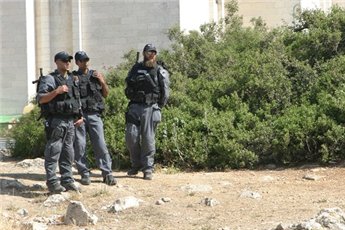
Israeli police gather near Sheikh Jarrah in East Jerusalem. (MaanImages/Mimmi Nietula, File)
TEL AVIV, Israel — Three Israeli policemen were arrested Wednesday on suspicion of beating and stealing from Palestinian workers in Jerusalem, the Israeli daily Haaretz reported.
A police representative told an Israeli court on Thursday that Uziel Hanun, Osama al-Sahly and Reuven Dhokerker regularly used threats to escort Palestinian workers into alleys in the Old City.
“Those who didn’t have money were beaten and sent home, those who did were also beaten, and their money stolen,” the court was told.
Hanun, al-Sahly and Dhokerker were arrested Wednesday after being caught “in the act,” Haaretz reported.
Police officials believe the robberies were systematic, the report said.
The police officers allegedly attacked a worker from Ramallah and took his wages. He then had to ask for money to get home, the police representative told the court.
May 31, 2012
Posted by aletho |
Civil Liberties, Subjugation - Torture | Haaretz, Israel, Israel Police, Jerusalem |
Leave a comment

‘A Problem of Self-Image,’ banned by Facebook
Looks like the folks at Facebook have more to worry about than their plummeting stock price (off 28% since the IPO last week). In recent days, Facebook suspended the account of the Israeli graphic artist, Mysh, about whom I wrote a post a few days ago. It seems that some of the brilliant political graphics I praised in that post must’ve offended the delicate sensibilities of the pro-Israel crowd. I’m guessing there was a movement to complain about the images. And Facebook’s nanny patrol took a look at them and agreed. At least three images have been removed from Facebook and Mysh’s account was suspended for 24 hours as “punishment” for being such a bad boy and saying such mean things (and referencing the Holocuast) about the Israeli pogromists who assaulted African refugees in Tel Aviv a few days ago.
The problem is that Mysh did nothing wrong. In fact, his graphic art is brilliant political satire. It’s the hasbara crowd and their enablers at Facebook who should be ashamed of themselves. I expect that sort of behavior from the Israeli right. But I expect Facebook not to kowtow to such a censorious crowd. Let’s ask a few questions of FB’s censors:
1. Does this mean that you can’t feature a cartoon about the Holocaust on Facebook?
2. Does this mean that cartoons combining Holocaust imagery and criticism of Israel are treif on Facebook?
3. Does this mean that the hasbara crowd gets to determine what can and can’t be seen on Facebook?
4. Does this mean that non-prurient nudity in a cartoon will get it banned?
I’ve looked everywhere for a way to complain to Facebook about this ridiculous decision, but they pretty much avoid telling you how to do so. So I guess we have to make a big enough stink and get the media to call asking questions. Maybe someone can post FB’s corporate headquarters info and phone number and people can call. This is the customer service number I found online: 650-543-4800.
Psst, I’ll tell you a little secret: while Mysh can’t display this image on Facebook, guess who can? You, of course. It’s on my page. If enough of us put it up on all our pages it will hopefully drive the Thought Police crazy and maybe they’ll give up on the censorship. Post it to Twitter too and all the social media. Let’s frustrate the hell out of the censor and make them realize their folly.
The other two censored images are The Green Sabra (a parody of The Hulk, in which the hero/monster is a Sabra) and The Real $uperpower, in which corporate CEO Lex Luther carves an “S” on a naked, cowed Superman (the 99%) in a biting affirmation of the message of the Occupy Wall Street movement. I dare anyone to defend the censoring of these images. Even the most pro-Israel among you. Go ahead, I dare you to try.
Oh and about that falling stock price: Facebook, don’t you have enough troubles without adding this to the bunch? But I guess the nannies are factoring in the possibility of kvetching and moaning from the pro-Israel side as well. It’s a question of which will hurt them more. So far, art, freedom and free expression are the losers.
May 31, 2012
Posted by aletho |
Civil Liberties, Full Spectrum Dominance, Timeless or most popular | Censorship, Facebook, Holocaust, Hulk, Israel |
Leave a comment
Bassem Tamimi, a leading member of the grass roots movement against the Israeli Annexation Wall and settlement construction in the village of an-Nabi Saleh, has on Tuesday been sentenced at the Israeli Ofer Military Court in the West Bank.
Mr. Tamimi was sentenced to 13 months imprisonment and a further 17 months suspended sentence. Tamimi was released following the judgement, due to having already served 13 months imprisonment waiting for his case to come to trial.
The ruling means that if Tamimi participates in any of the village’s weekly non-violent protest activities he will be forced to serve out the remainder of the suspended sentence in prison.
Bassem Tamimi has been described as a human rights defender by Catherine Ashton, the High Representative for Foreign Affairs and Security Policy of the European Union. Ashton has been critical of the trial against Tamimi, as she was of the trial against Abdullah Abu Rahme, a similar figure in the non-violent protest movement in the village of Bil’in.
The trial of Bassem Tamimi came under fire following allegations of coerced testimony from children of Nabi Saleh who, contravening international law, were interrogated by the Israeli military with neither legal representation or a parent or guardian present.
May 29, 2012
Posted by aletho |
Civil Liberties, Deception, Ethnic Cleansing, Racism, Zionism | Bassem Tamimi, Catherine Ashton, European Union, Human rights, International Middle East Media Center, Israeli settlement, NabiSaleh, Palestine, Palestinian prisoners in Israel, West Bank |
Leave a comment
Late on Sunday night Israeli soldiers invaded the village of Bil’in, near the central West Bank city of Ramallah, and attempted to kidnap a local peace activist, one of the organizers of nonviolent peaceful protests against the illegal Israeli Annexation Wall and settlements in the area.
The Friends of Freedom and Justice Committee in Bil’in (FFJ) reported that resident Hosam Hamad, 33 years old, was not at home when soldiers invaded it. Instead, the soldiers handed his mother a warrant for his arrest.
The FFJ added that the army pushed journalists and cameramen away when they attempted to ask the soldiers why they were trying to take Hamad. They informed them that they were not allowed to document the invasion and did not provide any explanation for their actions.
Bil’in is known for its leading role in creative non-violent resistance against the Annexation Wall and settlements in the area. Peace activists from different parts of the world as well as Israeli activists participate in the weekly non-violent protests.
Israeli soldiers use excessive force against the protesters, and repeatedly kidnap local activists of the non-violent resistance. The army is responsible for hundreds of injuries and several deaths because of its use of force against the protesters.
In 2008, Ashraf Abu Rahma was detained during a nonviolent protest; he was cuffed and blindfolded before one soldier held him while another soldier shot him in the leg.
The shooting was caught on tape by a young Palestinian woman from Bil’in, and was handed to a number of human rights groups to expose the Israeli crime. The soldiers subsequently detained her father as an act of punishment.
Abu Rahma’s brother, Basem, and his sister, Jawaher, were killed by Israeli fire in different non-violent protests against the Wall and settlements.
A statement issued by the spokesperson of the EU’s High Representative, Catherine Ashton, said last Tuesday that the European Union defends the right of Palestinians to hold peaceful protests against illegal Israeli settlement construction on their land.
May 28, 2012
Posted by aletho |
Civil Liberties, Ethnic Cleansing, Racism, Zionism, Illegal Occupation, Solidarity and Activism, Subjugation - Torture | Bil'in, Catherine Ashton, European Union, International Middle East Media Center, Israel, Israeli settlement, West Bank |
Leave a comment
Israel is a parliamentary democracy represented by a very large number of parties, with universal suffrage for all citizens, regardless of race, religion or sex …
— CIA World Fact Book, 2011
This week a sobering and highly informative closed door seminar was held on the plight of Palestinian Prisoners in the elegant surroundings of London’s Westminster Central Hall, a stone’s throw away from the Houses of Parliament and the 11th century Westminster Abbey, the all affirmation of stability and continuity — in starkest contrast to testimony at the proceedings of the meeting.
The seminar, hosted by Middle East Monitor, had been planned and organized at the height of the Palestinian prisoners’ hunger strike. Although most prisoners are reported to have ended their desperation-driven fasts following a deal with the Israeli authorities, the issues surrounding their shocking treatment and imprisonment are unchanged.
Sabah al Mukhtar, President of the Arab Lawyers Association, who chaired the gathering, opened by reminding that, “A basic right of a people under occupation is to resist.”
Further, that the Fourth Geneva Convention is specific as to the treatment of prisoners, with absolute outlawing of abuse and stipulation of legal conditions which must include humane treatment, being regarded as innocent until proven guilty and speedy access to legal representation — a far cry from the conditions for Palestinian prisoners in Israeli jails.
Lord Alf Dubs, who serves on the Parliamentary Committee on Human Rights, talked of a visit to the West Bank last year. Unable to visit a prison, he did attend an Israeli Military Court and was shocked at what he witnessed.
Remarking on security so tight that not even business cards were allowed in, he was struck by the age of the prisoners. Many were children, including one of fourteen. A fifteen year old was in tears in the dock, a sight Lord Dubs found profoundly disturbing.
The majority of children, he learned, were picked up in the early hours of the morning and incarcerated with no access by parents, no lawyer until they were in the dock, thus no explanation of procedures, discussion of case and, above all, semblance of reassurance. Handcuffs were taken off as they came through the door of the Court, but all were in shackles in the dock. Most defendants were: “just throwing stones.” The Court had no cctv; thus, no record of any miscarriage of justice.
Parents are often denied access to detained children for at least two months. Article 77 of the Geneva Convention states that: “Children shall be the object of special respect (and provided) with the care and aid they require.” The reality, concluded His Lordship, was “a stain” on the Israeli establishment.
Chairman of the UK-based charity, Lawyers for Palestinian Human Rights, Tareq Shrourou, stated that at every stage childrens’ rights are abused “from detention to incarceration, to release.” Sixteen and seventeen year olds are still treated as adults in detention. In the West Bank it is not the police, but the army who conduct arrests, whether of children or adults.
Children, as are adults, are blindfolded, in addition to being handcuffed and shackled. Blindfolding is also in defiance of the Geneva Convention.
“That the military might of Israel is threatened by children throwing stones is laughable”, commented al Mukhtar, adding that the whole concept of Military Children’s Courts were legally “outlandish.”
“In the past eleven years alone, around seven thousand five hundred children, some as young as twelve years, are estimated to have been detained, interrogated, and imprisoned …”1
It should be noted that a Palestinian detainee can be interrogated for a period of one hundred and eighty days, during which he or she can be denied a lawyer for ninety days. During interrogation a detainee can be subject to varying levels of torture, physical and/or psychological.
This was graphically described by an urbane, quietly spoken man (name withheld by request) who described the reality of being detained for the first time at fifteen years old.
“I was imprisoned in 1987, 1988, 1990 and 1992 then deported to South Lebanon.”
In 1987, as a student, he had been one of a number who were taken from their school by the authorities, to a detention centre. He was, he said, punched, interrogated, beaten for two months, then released for lack of evidence of any wrongdoing.
In 1988, he stated, in the night, his home “was stormed.” Soldiers rushed to his bedroom pointing guns at him as he awoke and struggled up. He was taken, blindfolded, his hands tied with plastic cuffs.
In prison he was “put in a yard. There were eight rooms on one side and cells on the other. In each room there was a different torture. I visited all eight.”
His head, he said, was banged hard against the wall, on the table as he sat; he was near choked by extreme pressure on his throat; a ruler was banged hard on his nose “in a way that makes you lose control of your head.” Eventually he lost consciousness.
Made to raise his head, stunning blows under the chin resulted.
He described a “breaking chair fall” after which “you are punched whichever way you move.” And, he recounted, “female soldiers practice sex in front of you. Even as a child I knew how to keep a blind eye.” Shades of Abu Ghraib.
Failure to confess resulted in threats of death, “But I had nothing to tell.” He was finally released after sixty-four days due to no evidence.
He was arrested and released without charge again in 1990. In 1992 he was deported to Lebanon.
He was just twenty years old, with a life’s horrors already lived and childhood’s chrysalis years of discovery and approaching adulthood lost to Israeli jail’s nightmares.
The UN Convention on the Rights of the Child, to which Israel is a signatory, is specific:
In all actions concerning children, whether undertaken by public or private social welfare institutions, courts of law, administrative authorities or legislative bodies, the best interests of the child shall be a primary consideration.
Article 37(b) of the Convention adds:
The arrest, detention or imprisonment of a child… shall be used only as a measure of last resort and for the shortest appropriate period of time.2
The anomaly of the uniqueness of the military court system in Israel was addressed in detail as “an exception under all laws. A military court must deal with military people, not civilians, not minors.” A further anomaly is that there is no legal appeal system. An appeal is “an administrative decision, made usually not by a judge, or even a lawyer.”
Khaled Almudallal, representing Ufree, the European network to support the rights of Palestinian Prisoners, reminded that, incredibly, there are twenty-seven Palestinian parliamentarians of the Palestinian Legislative Council and two Ministers being held in detention.
A near forgotten tragedy has an equally forgotten background:
As candidates prepared for elections to the Palestinian Legislative Council (PLC) in 2006, the Israeli authorities began a campaign of detention and imprisonment … The 2006 Palestinian elections were overseen by international observers who declared them to be free and fair (thus) Hamas (became) the democratically elected Palestinian government.
Wrong kind of democracy, thus the democratically elected remain illegally detained by representatives of a people who, ironically, were given by James Arthur Balfour, a “national home” within “Palestine.” The famed letter has no mention of a “State”. This “home”, it specifies, is conditional on:
… it being clearly understood that nothing shall be done which may prejudice the civil and religious rights of existing non-Jewish communities in Palestine …
The injustices of historic enormity, legal and territorial, in violation of human rights under a swathe of international legislation, continue unabated – to be met by “the silence of the world”, commented al Mukhtar, adding, regarding the prisoners: “As far as I know, Middle East Peace Envoy Tony Blair, has been equally silent.”
However, the international community is not silent. The Boycott movement gains massive strength. Coincidentally, on the day of the Seminar, the Israeli Ambassador to South Africa had been due to address the University of KwaZulu-Natal. The event was cancelled by the University’s Deputy Vice Chancellor, Joseph Ayee, at twenty-four hour’s notice, due to the “likely reputational damage” it would bring the university.3
Politics Professor, Lubna Nadvi, said the university’s decision represented the general sentiment among students and staff. “Israel is fast becoming a pariah state, like Apartheid South Africa did, that no one really wants to be associated with, including academics and students,” the Professor is quoted as saying.
Yet destruction of Palestinian lives and history, sacred to all nations, is ongoing and six thousand prisoners remain in jail, and in beyond anything that would be recognized as a justice system in a functioning democracy.
In spite of the hunger strike agreement, there is so little progress from Israel, that there are fears that the only negotiating tool those held have – their lives – may be again put on the line.
Organizations represented at the Seminar are working closely with those involved in the Northern Ireland hunger strike to devise a way forward for both sides.
One suggestion, from British MP Jeremy Corbyn, is forming an international friendship network with prisoners, especially corresponding.
At a “Special Session on Children” at the United Nations on May 9. 2002, the Israeli Minister of Justice stated, in a lengthy address, Israel’s commitment to:
Extending the hope and promise of childhood to the millions of children that continue to suffer, even in an era of unprecedented global prosperity, means reducing poverty, protecting children from the scourge of war and violence … providing all children with adequate healthcare, clean water, basic education, and a nurturing and protective environment in which they can grow and thrive.
The yawning chasm between fine aspirational statements and reality on the ground could hardly be starker. For every child taken into custody, childhood dies at that moment.
For every parent arbitrarily held, they know not when they will see their children and family again. Some have shared none of their children’s formative years at all.
“Our revenge will be the laughter of our children”, wrote Ireland’s Bobby Sands, who died on the 66th day of his protest hunger strike, on May 5. 1981, four days short of his birthday. When there is nothing left to lose to achieve justice, those deprived will eventually sacrifice the last tragic bargaining tool in humanity’s creative box to achieve it.
Since the guests became occupiers, Palestine’s children and their parents have now waited sixty-four years to laugh freely.
May 26, 2012
Posted by aletho |
Civil Liberties, Subjugation - Torture, Timeless or most popular | Fourth Geneva Convention, Geneva Convention, Israel, Palestine, Palestinian prisoners in Israel, West Bank |
Leave a comment
Shiri Krebs is a PhD student at Stanford University law school. She was an international law advisor to Israeli Supreme Court president Dorit Beinisch and a researcher at the Israel Democracy Institute. She published a paper (for Hebrew readers, Haaretz offers this story) this month in the Vanderbilt Journal of Transitional Law about the rubber stamp offered by the Israel’s highest court to the security services in cases of administrative detention. She pointedly argues against the reputation the Court enjoys for being “interventionist” in protecting the rights of security detainees and offering a robust defense of democratic rights.
Surprisingly, she notes that there are those in the legal community who are proposing that Israel’s system both of administrative detention and judicial review are being offered as a model for other countries facing terror threats. In fact, the National Defense Authorization Act codifies a U.S. version of indefinite administrative detention as Reuters notes:
The section authorizes indefinite military detention for those deemed to have “substantially supported” al Qaeda, the Taliban or “associated forces.”
Does a journalist who objects to targeted killings of al-Qaeda operatives in Yemen or Pakistan “substantially support” it? What about supporting Bradley Manning or Wikileaks? You say no and I say no, but neither of us will be interpreting the law. The Justice Department, just like the Israeli state prosecutor, will be. What will its standard be? Thankfully, a federal judge issued a stay regarding enforcement of this provision of the law.
Krebs rejects Israel as a viable legal model:
…They [the research and interviews conducted in preparing the article] cast doubt on arguments that Israel’s detention model is one that should be emulated by other countries…The legal framework [of administrative detention and judicial review] itself makes independent judicial review of detention exceedingly challenging, if not impossible.
The paper is especially important in light of the hunger strikes of 1,600 Palestinian prisoners who were protesting precisely the types of arbitrary administrative detentions Krebs discusses in her paper. The protesting prisoners complained about the arbitrary nature of their detention and the fact that often the evidence against them was secret both to them and their lawyers. In essence, they neither knew who was their accuser, what they were accused of, nor what evidence was offered. Six-month sentences could be renewed without offering any new evidence and renewed virtually forever. A number of prisoners were held for years under similar terms.
Krebs’ research examines 322 cases brought before the High Court between 2000-2010, in which Palestinian detainees appealed against their sentences. Of these, the Court reversed the sentences in none of the cases:
…Out of the 322 cases decided by the Israeli Supreme Court in this period, not a single case resulted in a release order, and in none of the cases did the Court openly reject the secret evidence.
In one-third of the cases, the detainee would drop his appeal after a deal was struck with the state attorney. But such deals were inherently one-sided since the State controlled virtually the entire process and made an offer the defense couldn’t afford to refuse: the defense knew the Court would never reverse the security services and had to accept the crumbs it was offered.
When the Court does render its decisions in these cases, the justices themselves rarely get to see the evidence the State used to detain the suspect. They rarely know much, if anything about the detainee or his case. They rarely conduct an adversarial inquiry into the charges. Their decisions often run only a few lines, if that. A long one might extend three pages.
This dynamic is at work in virtually all security cases, even ones not involving administrative detention. Detainee-victims like Ameer Makhoul and many others who face life sentences for their alleged crimes, know that if they don’t bargain away their freedom by accepting “reduced” sentences, they will spend their entire lives behind bars. They know there is virtually no chance the court will find in their favor. Another victim like Dirar Abu Sisi has refused a plea deal, but the State has kept him bottled up in prison for several years without trial. That is the price a prisoner pays for maintaining his pride and his innocence by not “taking the deal.”
In this sense, the “shadow of the Court” provided a threat that persuaded the State to plea down charges, but it was often a weak and toothless one. Even in cases where detainees had charges against them dropped it didn’t result in their immediately being freed.
The law journal article is fascinating because it offers an intimate portrait of the personal discomfort felt by Israeli justices in the face of these security cases. The moral queasiness they experience is embarrassing because it reveals their willingness to suspend their usual judicial demeanor in deference to the security powers of the State. Here are some of the personal statements Krebs records:
This is not ideal. [Administrative detentions] represent a certain devaluation of our system of values, but there is no other choice.
–Justice E, Israeli Supreme Court
I feel responsibility . . . . There is a war going on . . . the phrase that a democracy fights with one hand tied behind its back is a nice metaphor . . . is a nice phrase to frame on the wall, but it is not suited for real everyday life.
–Justice B, Israeli Supreme Court
You have a feeling of discomfort. I never enjoyed sitting in administrative detention cases. No one enjoys it. Judges don’t like these cases, because we are trained to criminal proceedings, with witnesses, cross-examination . . . It is not pleasant. You want to run away from it as fast as you can, but you know that it is necessary for the sake of your people and country.
–Justice B, Israeli Supreme Court
The judges cannot differ with the ISA story. How can I? I don’t have the defense lawyer jumping to say “it never happened,” “this is not true.” My ethos, as a judge, is that I have two parties. Of course, I can think by myself, but I need tools, which are missing . . . to the most I have very limited tools
–Justice D, Supreme Court
The state attorneys should also come to the hearing nervous and tense—but they are always very relaxed. They know that no matter what they say or do, they will always win…
There is no judicial discretion here, since the Justices do not know the facts. They don’t have the tools to decide what the level of dangerousness is . . . in one of the cases in which I served as defense lawyer, it took the ISA two years to tell him [the detainee S.K.] what the allegations against him were. Then, when I asked my client about it, it turned out that it was a murder case that happened near his house, in which he had no involvement with whatsoever. When I brought this to Court and asked the ISA representatives about it––I could tell that the Justices knew nothing about it. I could see their surprise. It then took two more detention orders until he was finally released.
–Defense lawyer C
“In some cases even I felt that it was too easy,”
–State Attorney A
With all the good will on the part of everybody, there is no way to conduct a fair ex parte hearing. The human nature and the dynamic of the process prevent fair hearing of the case.
–State Attorney B
The negotiation with the ISA [Israeli state attorney] is bad, because it is blind on the detainee’s part. If the ISA agrees, in the negotiation with the detainee’s lawyer, to issue only one more detention order, or even to release him at the end of the current detention order, it means that the case is weak, and therefore the detainee should have been released immediately.
–Defense attorney D
The more reasoned judicial decisions are no more than a bunch of clichés, since they are not implemented . . . the Justices talk highly about being the “detainee’s mouth,” but they can’t. How can they be his mouth, when they know nothing at all about his side of the story?
–Defense lawyer B
In her conclusion, Krebs draws the following lessons:
The Court systematically avoids issuing release orders, and demonstrates minimal intervention with regard to the assessment of the secret evidence. As both the case law analysis and the interviews demonstrate, the Court refrains from openly and blatantly opposing the ISA assessment of the secret evidence…
…The research findings [reveal]…the vulnerability of democracies under stress to intolerant and illiberal mechanisms. The research reveals the weaknesses of judicial protections against prolonged and arbitrary detentions, and highlights the unique challenges posed by secret evidence to fair judicial proceedings. Unfortunately, detention proceedings become an “assembly line” in which “enemies”, “terrorists” or just “others” are constantly losing one of their most basic and valued human assets: their freedom.
Krebs’ analysis proves the justice of the wide-scale Palestinian protest against the administrative detention regime. You’ll recall that in spite of defense appeals to the Supreme Court to spare the lives of their hunger striking clients, the justices refused to intervene. They simply refused to provide adequate oversight or judicial review of the actions of the secret police in so-called terror/national security cases.
She notes that use of this tactic has declined over the years. Perhaps the protests will bring about an even greater drop in such charges. If so, it can’t happen too soon. This is not just a blemish, it’s a tumor on the Israeli judicial system. It brings the justices into a process of collusion with the security services, rather than a relationship of healthy skeptical review as should happen in a normal democracy. It cheapens the rule of law and undermines it severely.
Though I am neither a lawyer nor human rights specialist, I’ve often written here about violations of fairness and due process in the Israeli judicial process concerning national security cases. Supporters of this reprehensible system have argued here that I’ve exaggerated and asked for irrefutable proof for my claims. As far as I’m concerned, Krebs has offered this incontrovertible evidence in her quantitative analysis of the shortcomings of the Israeli legal system.
May 26, 2012
Posted by aletho |
Civil Liberties, Subjugation - Torture, Timeless or most popular | Dorit Beinisch, Israel, Israel Democracy Institute, Israel Supreme Court, National Defense Authorization Act, Palestinian prisoners in Israel |
Leave a comment
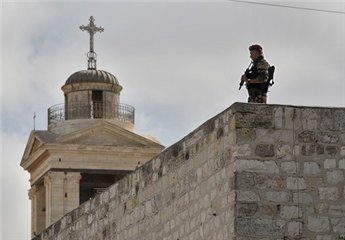
GAZA CITY – A group of Palestinians deported to Gaza after the Nativity Church siege in 2002 on Saturday disputed claims by a former economic adviser that they had signed an agreement to be exiled.
The 26 deportees told Israeli forces during the siege that only Yasser Arafat could negotiate on their behalf, denying claims that they themselves gave their approval to be deported, a statement said.
Muhammad Rashid, former presidential economic adviser to Arafat, on Friday told Al-Arabiya TV channel that the group had agreed to be deported and that he fully accepted responsibility for the agreement, which Arafat had authorized him to negotiate.
The committee appointed by Arafat to negotiate with the Israelis “almost reached an agreement to deport only 6 activists to the Gaza Strip, but other people were carrying out secret negotiations behind the scenes which ended in the deportation of 39 activists to the Gaza Strip and Europe,” the group of Gaza deportees said.
The official PA negotiating committee was headed by Salah Taamari, who was then governor of Bethlehem.
He told Ma’an TV in May that the deportation deal was reached without his knowledge and recalled his shock when Israeli officials told him Palestinians would be exiled.
The deportees urged the Palestinian Authority to expose all details of the 2002 deal, calling on the PA to prove whether there had been a written or verbal agreement between the two sides.
“If there was no written agreement, that would be a serious mistake by Muhammad Rashid, especially since the agreement was monitored by the US, the UK and the EU, and it was applauded by the Vatican,” the group said.
Former detainee and researcher Abdul Nasser Farwaneh said the deportation deal was a clear violation of international law and human rights.
The Palestinian leadership’s acceptance of the deal to send Palestinians into exile set a dangerous precedent and over the last decade Israel has deported hundreds more Palestinians, Farwaneh said in a statement.
On May 10, 2002, Israeli forces ended a 39-day siege on the church after striking a deal with Palestinian leaders to send 39 people given sanctuary in the church to Gaza and Europe.
When Israeli tanks surrounded Bethlehem on April 2, 2002, around 220 locals — including around 40 priests and nuns — took shelter in the church.
Over the next 39 days, eight Palestinians were killed inside the church and 27 others injured.
The siege on the site believed to be Jesus’ birthplace sparked outrage in the Vatican as monks sheltering inside pleaded for international assistance.
May 26, 2012
Posted by aletho |
Civil Liberties, Ethnic Cleansing, Racism, Zionism, Timeless or most popular | Bethlehem, Israel, Palestinian National Authority, Yasser Arafat |
Leave a comment

People protest violence against members of the media with signs that read in Spanish “United for peace and freedom,” left, and “Stop corruption” in Tegucigalpa, Honduras, Friday, May 25, 2012.
Thousands of people have taken to the streets of many cities across Honduras to protest the killings of journalists in the Central American republic.
The demonstrators, who were chanting “Killing journalists does not kill the truth,” marched past the offices of the president and the human rights commission in the capital Tegucigalpa on Friday, AFP reported.
According to organizers, some 5,000 people attended the demonstration in Tegucigalpa, but protests were also staged in San Pedro Sula, La Ceiba, Comayagua and Choluteca.
“No more impunity,” said one sign held by an activist. Another sign read, “United for peace and freedom.”
Since President Manuel Zelaya was toppled on June 28, 2009 in a military coup twenty journalists have been killed in Honduras.
Last week, the body of 47-year-old HRN Radio journalist Alfredo Villatoro Rivera was found blindfolded and with gunshot wounds to his head, a police spokesman said.
A week before Rivera had been kidnapped.
Honduras has been plagued by political turmoil following the 2009 military coup. Military rule, corruption, an enormous wealth gap, crime and natural disasters have turned Honduras into one of the poorest and least secure countries in Central America.
May 25, 2012
Posted by aletho |
Civil Liberties, Full Spectrum Dominance, Solidarity and Activism | Central America, Honduras, Manuel Zelaya, Porfirio Lobo Sosa, Tegucigalpa |
Leave a comment
An Ongoing Disaster
The scale of the ongoing tragedy visited on Libya by NATO and its allies is becoming horribly clearer with each passing day. Estimates of those killed so far vary, but 50,000 seems like a low estimate; indeed the British Ministry of Defence was boasting that the onslaught had killed 35,000 as early as last May. But this number is constantly growing. The destruction of the state’s forces by British, French and American blitzkrieg has left the country in a state of total anarchy – in the worst possible sense of the word. Having had nothing to unite them other than a temporary willingness to act as NATO’s foot soldiers, the former ‘rebels’ are now turning on each other. 147 were killed in in-fighting in Southern Libya in a single week earlier this year, and in recent weeks government buildings – including the Prime Ministerial compound – have come under fire by ‘rebels’ demanding cash payment for their services. $1.4billion has been paid out already – demonstrating once again that it was the forces of NATO colonialism, not Gaddafi, who were reliant on ‘mercenaries’- but payments were suspended last month due to widespread nepotism. Corruption is becoming endemic – a further $2.5billion in oil revenues that was supposed to have been transferred to the national treasury remains unaccounted for. Libyan resources are now being jointly plundered by the oil multinationals and a handful of chosen families from amongst the country’s new elites; a classic neo-colonial stitch-up. The use of these resources for giant infrastructure projects such as the Great Manmade River, and the massive raising of living standards over the past four decades (Libyan life expectancy rose from 51 to 77 since Gaddafi came to power in 1969) sadly looks to have already become a thing of the past.
But woe betide anyone who mentions that now. It was decided long ago that no supporters of Gaddafi would be allowed to stand in the upcoming elections, but recent changes have gone even further. Law 37, passed by the new NATO-imposed government last month, has created a new crime of ‘glorifying’ the former government or its leader – subject to a maximum sentence of life imprisonment. Would this include a passing comment that things were better under Gaddafi? The law is cleverly vague enough to be open to interpretation. It is a recipe for institutionalised political persecution.
Even more indicative of the contempt for the rule of law amongst the new government – a government, remember, which has yet to receive any semblance of popular mandate, and whose only power base remains the colonial armed forces – is Law 38. This law has now guaranteed immunity from prosecution for anyone who committed crimes aimed at “promoting or protecting the revolution”. Those responsible for the ethnic cleansing of Tawergha – such as Misrata’s self-proclaimed “brigade for the purging of black skins” – can continue their hunting down of that cities’ refugees in the full knowledge that they have the new ‘law’ on their side. Those responsible for the massacres in Sirte and elsewhere have nothing to fear. Those involved in the widespread torture of detainees can continue without repercussions – so long as it is aimed at “protecting the revolution” – i.e. maintaining NATO-TNC dictatorship.
This is the reality of the new Libya: civil war, squandered resources, and societal collapse, where voicing preference for the days when Libya was prosperous and at peace is a crime, but lynching and torture is not only permitted but encouraged.
Nor has the disaster remained a national one. Libya’s destabilisation has already spread to Mali, prompting a coup, and huge numbers of refugees – especially amongst Libya’s large black migrant population – have fled to neighbouring countries in a desperate attempt to escape both aerial destruction and lynch mob rampage, putting further pressure on resources elsewhere. Many Libyan fighters, their work done in Libya, have now been shipped by their imperial masters to Syria to spread their sectarian violence there too.
Most worrying for the African continent, however, is the forward march of AFRICOM – the US military’s African command – in the wake of the aggression against Libya. It is no coincidence that barely a month after the fall of Tripoli – and in the same month Gaddafi was murdered (October 2011) – the US announced it was sending troops to no less than four more African countries – the Central African Republic, Uganda, South Sudan and the Democratic Republic of Congo. AFRICOM have now announced an unprecedented fourteen major joint military exercises in African countries for 2012. The military re-conquest of Africa is rolling steadily on.
None of this would have been possible whilst Gaddafi was still in power. As founder of the African Union, its biggest donor, and its one-time elected Chairman, he wielded serious influence on the continent. It was partly thanks to him that the US was forced to establish AFRICOM’s HQ in Stuttgart in Germany when it was established in February 2008, rather than in Africa itself; he offered cash and investments to African governments who rejected US requests for bases. Libya under his leadership had an estimated $150 billion of investments in Africa, and the Libyan proposal, backed with £30billion cash, for an African Union Development Bank would have seriously reduced African financial dependence on the West. In short, Gaddafi’s Libya was the single biggest obstacle to AFRICOM penetration of the continent.
Now he has gone, AFRICOM is stepping up its work. The invasions of Iraq and Afghanistan showed the West that wars in which their own citizens get killed are not popular; AFRICOM is designed to ensure that in the coming colonial wars against Africa, it will be Africans who do the fighting and dying, not Westerners. The forces of the African Union are to become integrated into AFRICOM under a US-led chain of command. Gaddafi would never have stood for it; that is why he had to go.
And if you want a vision of Africa under AFRICOM tutelage, look no further than Libya, NATO’s model of an African state: condemned to decades of violence and trauma, and utterly incapable of either providing for its people, or contributing to regional or continental independence. The new military colonialism in Africa must not be allowed to advance another inch.
DAN GLAZEBROOK writes for the Morning Star newspaper and is one of the co-ordinators for the British branch of the International Union of Parliamentarians for Palestine. He can be contacted at danglazebrook2000@yahoo.co.uk
May 25, 2012
Posted by aletho |
Civil Liberties, Ethnic Cleansing, Racism, Zionism, Illegal Occupation, Militarism, Timeless or most popular, War Crimes | Africa, Gaddafi, Great Manmade River, Libya, Muammar Gaddafi, NATO, Tripoli |
Leave a comment
The new Syrian parliament has begun work under a new constitution approved by a majority of voters in a February referendum.
According to the official Syrian Arab News Agency (SANA), the first session of the new parliament began on Thursday.
The parliament speaker is scheduled to be elected by secret ballot and the lawmakers will be sworn in during the Thursday meeting, SANA said.
On May 7, Syria held the first parliamentary elections under the new constitution that paved the way for a multiparty system in the country.
More than half of the eligible voters participated in the parliamentary elections.
About 7,195 candidates, including independent and opposition figures, contested for the parliamentary seats.
The May 7 elections were part of the reforms promised by Syrian President Bashar al-Assad.
The 250-seat Syrian parliament is elected every four years and 172 of the lawmakers represent the workers and farmers sector.
The new parliament began work a few days after SANA said President Assad issued a decree on May 13, ordering the formation of a “Supreme Constitutional Court (SCC).”
According to the presidential decree, the SCC will consist of seven members, who will serve for a period of four years, which could be renewed. However, SANA did not clarify how many renewals of the serving period would be allowed.
The SCC is an independent judicial body and will be based in Damascus, SANA said.
May 24, 2012
Posted by aletho |
Civil Liberties | Bashar al-Assad, Middle East, People's Council of Syria, SANA, Syria, Syrian Arab News Agency |
Leave a comment
In a PNN report today, the Al-Ahrar Centre for Prisoners’ Studies and Human Rights stated that on Wednesday, May 23rd, prisoner Sameh Elaiwe, 50, was transferred from Nablus city to Administrative Detention one hour before his scheduled release date.
Administrative detention is detention without charge or trial that is authorized by administrative order as oppose to a fair and just judicial decree.
Foad al-Khafsh, head of Al-Ahrar, affirmed that on Tuesday the Israeli military brought Elaiwe’s case before the court, accompanied by his lawyer Fares Abu al-Hassan. The court ordered Elaiwe’s release for the following day.
However, Israeli intelligence petitioned to overturn the decision after Elaiwe’s lawyer had left the court, and the Court transferred the prisoner to the administrative detention centre for four months.
Al-Khafsh alleged that Israeli intelligence deliberately intends to break the spirits of the prisoners, and questioned whether the military have actually agreed to stop the policy of Administrative Detention when in fact they appear to be using it more than before the hunger strikes.
More than 25 cases have been transferred to Administrative Detention since the Israeli prisons administration and the Supreme Committee for Prisoners signed their agreement on May 14th.
May 24, 2012
Posted by aletho |
Civil Liberties, Subjugation - Torture | Administrative detention, Human rights, Hungerstrike, Israel, Palestinian prisoners in Israel, William Temple |
Leave a comment
Canadian police have arrested some 400 people in Montreal in the latest student protest against tuition hikes, police say.
Several thousand demonstrators poured into Montreal’s central square late Wednesday to protest tuition hikes and to denounce a new legislation aimed at ending months of anti-tuition hikes protests.
Police clashed with the demonstrators and arrested nearly 400 protesters.
On Tuesday, tens of thousands of students took to the streets of Montreal to mark the 100th day of protests.
The protesters, carrying red banners and signs, marched through central Montreal to commemorate the day and also voice their opposition to the Quebec provincial government’s new law that would make protests more difficult to organize and impose stiff fines on those who disobey.
Since the law was passed on Friday, daily protests have often turned violent.
Under the new legislation, any individual, who prevents students from entering an educational institution or disrupts classes will be fined between CAD 1,000 and CAD 5,000.
The punishment will rise to between CAD 7,000 and CAD 35,000 for a student leader and to between CAD 25,000 and CAD 125,000 for student federations or unions.
The law also forces regulations to govern student protests, requiring protesters to inform the police of their demonstration plans, including an eight-hour notice for details, such as the itinerary, the duration, and the exact time of the action.
Quebec students have been holding almost daily demonstrations since February in an attempt to show their outrage at the proposed tuition fee rises.
Under the provisional agreement, university fees would increase by CAD 1,780 over seven years or about CAD 254 a year, bringing the total to CAD 4,000 per year. The plan is scheduled to be effective from 2012-13 until 2016-2017 academic years.
May 24, 2012
Posted by aletho |
Civil Liberties, Economics, Solidarity and Activism | Canada, Montreal, Protest, Quebec |
Leave a comment


 Aletho News
