Israeli Army Again Targets Jenin’s Freedom Theatre
Alternative Information Center | 22 August 2011
Jenin – After the Israeli army targets the theatre twice during the last month, arresting three of its members, today at approximately 02:00 in the morning of the 22nd August the Israeli army surrounded The Freedom Theatre and the Nagnaghiya family home.
Jacob Gough, the Acting General Manager at The Freedom Theatre left the office at about 01:45: “As I literally entered my home I got a call from neighbours of the theatre saying the army had surrounded the theatre.”
Jacob then returned to the theatre and as he drove into the courtyard was confronted by armed soldiers who forced him to turn around threatening violence if he didn’t. After a second attempt to get closer to the theatre he was forced to strip at gunpoint before being detained. “They said that they’ll beat me up if I even say a word or move”.
During this, the army were inside the home of Mohammed Naghnaghiye, the security guard at the theatre and brother of Adnan Nagnaghiya. Here they beat Mohammed before taking him away in handcuffs then proceeded to ransack all 3 floors of his family home leaving them in disarray. As the army left the area they fired live ammunition in an attempt to disperse the crowds of youth that had gathered.
These events come after a military court hearing that took place yesterday (21st August) in Jalame prison outside of Jenin. At the court hearing it was established that the three previously taken members of The Freedom Theatre had no connection to the murder of the theatre’s late director Juliano Mer Khamis and must be released within the week.
“This behaviour is mounting to systematical harassment of The Freedom Theatre by The Israeli army, it is scandalous. This proves that the Israeli army and security apparatus is either lost in their investigation or that they have the actual intention of damaging the theatre. It also seems that after the murder of Juliano Mer Khamis The Freedom Theatre is no longer exempted from the kind of oppression the Palestinian society is subjected to in general.” says Jonatan Stanczak, co-founder of The Freedom Theatre.
Many injured in Hebron house demolition
22 August 2011 | International Solidarity Movement, West Bank
At 10pm Sunday August 21st the Hasan Ali Darwish Al-Qawasmi house in the Abo Ktelah district was raided and later destroyed by Israeli Occupation Forces (IOF). Around eight armoured vehicles surrounded the house and at least 40 soldiers were blocking every entrance. The IOF had arrived at the house at 8 pm. They told family members that it would take 20 minutes but three and a half hours later they remained in occupation of the house. A row of 14 soldiers blocked the main entrance to the house. Female family members stood in front of them and demanded that they be allowed back into their home.
A family member accounted that Israeli soldiers had already arrested their husbands and were also guilty of the imprisonment of seven brothers and the death of two other brothers of one particular woman. This woman arrived at the house with her baby in her arms to defy and stand up to the Israeli soldiers. After a while the army emerged from the house with a blindfolded and handcuffed man who looked as though he had been beaten.
The soldiers took him away in a jeep. The IOF informed the family and other bystanders that a suspected “suspicious object” was in the home that needed to be disposed of, which coincidentally meant exploding a section of the house. Everyone was pushed aside in preparation for the explosion, which took place in the yard of the house. The massive explosion smashed all the windows and damaged a neighbor’s home.
During the raid clashes between Palestinians and the army started, leaving at least 30 injured with the possible rumor that of the injured, one was killed. Details have yet to be confirmed.
The army was shooting a large amount of tear gas directly at protesters and according to witnesses they probably also used rubber coated steel bullets. The IOF fled at around midnight and the protestors went to inspect the damaged house. Once being allowed back into the home the family members found their home torn apart. Sofa chairs had been ripped open, picture frames had been smashed and glass lay everywhere. Their home had been destroyed.
Witnesses said that 10 days ago another member of the Al-Qawasmi family had been arrested. On the night of August 20th IOF arrested 10 other people in this same neighborhood. This frightful scene concluded with an elderly female relative, who had been trapped in the house during the raid, being carried out on a stretcher by Palestinian ambulances. The ambulances also tended to severely injured protestors.
55 Palestinians injured as Israeli army invades Hebron
By Saed Bannoura | IMEMC & Agencies | August 22, 2011
Palestinian medical sources in Hebron, in the southern part of the West Bank, reported that 55 residents were injured following clashes that took place between local residents and Israeli soldiers who invaded the city.
The sources stated that some of the wounded residents were hit by rubber-coated metal bullets fired by the soldiers; others were treated for the effects of teargas inhalation, while the rest were violently attacked and beaten by the soldiers.
Also, soldiers broke into the home of detainee Mahmoud Al Qawasmi of the Hamas movement, in Wadi Abu Kteila area, north west of Hebron, and detonated some of its walls. Al Qawasmi has been imprisoned by Israel for the past seven years.
The soldiers detained dozens of residents and interrogated them in the streets, and broke into several homes that belong to members of Al Qawasmi family, Karama, and Al Joulani.
Sporadic clashes took place in Bab Al Zawiya area, in the center of Hebron, as local residents hurled stones and bottles at the invading military forces. The soldiers fired gas bombs and rubber-coated metal bullets.
Other clashes took place at the Tareq Bin Ziad junction, south of the city, while the army placed more forces in the area and chased the residents; no arrests were reported.
Soldiers also invaded several nearby villages and town, and conducted military searches of homes.
On Sunday at dawn, troops invaded Hebron, broke into and searched dozens of homes, and kidnapped dozens of Hamas members and supporters, including elected legislator Mohammad Abu Jheisha, and a number of Hamas political leaders.
Israel arrests over 50 Hamas supporters in Al-Khalil
Palestine Information Center – 21/08/2011
 AL-KHALIL — Israeli occupation forces arrested Sunday morning more than 50 Hamas supporters in one of the largest raids on the West Bank city of Al-Khalil since 2003.
IOF troops accompanied by more than a hundred military vehicles in addition to undercover forces began raiding the city midnight Sunday and deployed throughout its neighborhoods, local and security sources said.
A number of arrests have also been made in towns outside of the city, as the operation, one of the largest since 2003, continues.
Violent clashes broke out in several areas and civilians have been left injured.
Among those taken into custody was Palestinian MP Mohammed Mutlaq Abu Juheisha.
Also on Sunday morning, Israeli forces arrested Palestinian reporter Oseid Abdul-Majid Amarina, 26, after a violent raid on his home in Dheisha refugee camp east of Bethlehem.
Bethlehem Mayor says soldiers ransacked home
Ma’an – 21/08/2011
BETHLEHEM — Israeli forces assaulted and detained a Palestinian man during a raid on the home of the Mufti of Bethlehem overnight Saturday, the sheikh said.
Sheikh Abdul-Majid Ata Amarna said troops raided his home in Duheisha refugee camp shortly before dawn prayers searching for his son Usayd, a journalist for Hamas-affiliated Al-Aqsa TV.
“When the soldiers raided my home, I asked them to wait before entering the different rooms so women could put on their head scarves and change their sleeping clothes, but instead of waiting they started firing inside the house injuring my brother-in-law, 27-year-old Bakr Badarin” the cleric told Ma’an.
He said Badarin was hit by a live bullet to his thigh, but soldiers refused to allow Palestinian Red Crescent medics to treat him and detained the injured man and the sheikh’s son Usayd Amarna.
The family learned later that Badarin was taken to Hadassah Hospital in Jerusalem for treatment.
The US Government Won’t be Charged With Perjury Even When It’s Caught in a Lie
By SALLY EBERHARDT | CounterPunch | August 19, 2011
A chilling court decision unsealed at the end of April by a federal judge in California’s Central District reveals that the Obama administration is not only prepared to take advantage of the lies of the Bush administration, but is willing to up the ante. In a case that involved extensive surveillance of Muslim community groups and leaders, the Obama administration has now argued that the government not only can lie about its surveillance activities to American citizens but can, in turn, lie to federal judges when “national security” is involved. And, despite his strongly worded April 27 decision censuring the government for lying, U.S. District Judge Cormac J. Carney ultimately ruled that the government can both withhold the requested surveillance documents and escape censure for lying.
Carney’s ruling, which has gone under the radar of most mainstream and independent media (with a lone 420-word editorial in the Los Angeles Times being the only mainstream coverage), chastises the U.S. government. But, that’s as far as Carney would go. The government will not be charged with contempt of court or perjury nor will it face any other kind of official sanction. In effect, the government can lie and conduct whatever kinds of surveillance it wants without accountability or repercussions for overreach.
The origins of the current case, Islamic Shura Council of Southern California et al. v. the Federal Bureau of Investigation, et al., stretch back to 2006 and involve six Muslim organizations – the Islamic Shura Council of Southern California, the Council on American Islamic Relations-California (CAIR), the Islamic Center of San Gabriel Valley, the Islamic Center of Hawthorne, the West Coast Islamic Center, the Human Assistance and Development International, Inc.- and five Muslim community leaders. These men and groups were among the first Muslim Americans to meet and share information with the FBI after 9/11, and include individuals like Mohammed Abdul Aleem, who served as a government witness for the U.S. Department of Justice in a 2004 terrorism case in Idaho.
However, by May 2006, the plaintiffs began to feel increasingly that they themselves had become the targets of extensive government surveillance and so filed a joint request for their FBI files under the Freedom of Information Act (FOIA) for any records detailing their monitoring or surveillance. After almost a full year had elapsed, on April 27, 2007, the government told nine of the plaintiffs that they had “no records responsive” to their request, and, in June 2007, the FBI sent a single redacted page to CAIR and three redacted pages to Hussam Ayloush, CAIR’s Executive Director, and a plaintiff. Unconvinced by this report, the plaintiffs brought a lawsuit against the government, challenging the adequacy of the FBI’s search.
In light of the lawsuit, the FBI conducted new searches and produced some 120 pages of documents that they heavily redacted or withheld entirely because they were claimed to be “outside the scope” of the FOIA request. This – it would later turn out – was the government’s first instance of lying to the court. They had, of course, already lied to the plaintiffs in their previous correspondence with them which, as Judge Carney cited in his decision, was a curious tactic to take – as, under FOIA, they could have simply identified the “statutory and factual basis” for not releasing certain documents and, so, would have been well within current legal bounds for not issuing requested documents.
Faced with cross-motions by the government and the plaintiffs in the case, in April 2009 the Court ordered an in camera review of the FBI’s searches (with only the government present) in order to determine the “propriety” of the FBI’s “outside the scope” determinations. Shortly after this order was given, the government – which had now shifted from the Bush administration to the Obama administration – revealed to the court that it actually had identified other “responsive” documents but had never disclosed them to the court or to the plaintiffs. It was at this juncture, under Obama’s watch, that the government asserted that it actually had the right to lie to the court because of national security.
Realizing that the government had, as Judge Carney’s decision later worded it, “provided false and misleading information to the Court,” Carney ordered two in camera hearings, again with only the government present, after which he issued a sealed order in June 2009. But the government immediately appealed this order and sought an emergency motion to stay the decision. In its ruling, the appellate court supported government secrecy. Judge Carney’s decision – amended as per the appellate court’s order to eliminate all statements which the government designated too sensitive – finally saw the light of day two years later, at the end of this April.
Citing the case of United States v. Richard M. Nixon, to explain why “the very integrity of the judicial system and public confidence in the system depend on full disclosure of all the facts,” Carney rebuked the government’s attempts to claim that its representations to the Court were not “technically false,” writing that the government “cannot negotiate the truth with the Court” nor “under any circumstance affirmatively mislead the Court.”
He went on to write that “the Government argues that there are times when the interests of national security require the Government to mislead the Court. The Court strongly disagrees. The Government’s duty of honesty to the Court can never be excused, no matter what the circumstance.”
But despite these fine sentiments, Carney (who is a George W. Bush appointee) was ultimately unwilling to impose any kind of penalty or even order that the requested FOIA documents be released, leaving the U.S. government with nothing to stop it from lying in court in the future. Under the basic rules of court, the actions of the FBI’s lawyer, Marcia K. Sowles, appear to be clearly unethical; yet Judge Carney did not refer Ms. Sowles to a state bar for, at the very minimum, a disciplinary investigation. By failing to hold the government in any way accountable for lying, Judge Carney has succeeded only in ultimately bolstering the government’s confidence in acting with impunity.
The government itself hinted at the new level of unfettered reach they now want in one section of their appellate brief that was not under seal, writing that the courts need to “give special deference to the Executive Branch when it invokes national security concerns.”
That our government, four decades after the Pentagon Papers, is able to lie in a federal court, get caught and have no price to pay speaks volumes about the state of justice in the United States right now. While there are many things that shock the conscience about how this case played itself out, what might be most shocking is how it reveals the U.S. government’s current understanding of the rule of law. As President Nixon once did, the current administration appears to see itself above the law. And despite issuing a strong rebuke in his decision, Judge Carney has given a green light both for the government’s lying and for its invasive surveillance.
~
Sally Eberhardt works with Educators for Civil Liberties, researching civil rights issues post 9/11. She is founding member of Theaters Against War and has worked for human rights organizations in Britain and the U.S.A. She can be reached at sallyeb@earthlink.net.
Egypt’s Secret Minister
By THOMAS C. MOUNTAIN | CounterPunch | August 17, 2011
Just exactly what influence Omar “The Secret Minister” Suleiman retains over the military junta that rules Egypt is a question of utmost importance for those who live on the banks of the Nile River. With a resume including 20 years as head of Egyptian Intelligence he is not someone anyone of those who helped bring about the downfall of Mubarak can afford to ignore.
He was the CIA’s go to man when it came to doing the Agencies dirty work in the Middle East as well as being the liaison with Israel and was reported to be in contact with Mossad on an almost daily basis.
Suleiman is infamous for enforcing the blockade of Gaza, saying he wanted the Palestinians there to “be hungry but not starving” in punishment for supporting Hamas. Hungry as in a 40% level of malnutrition related disability rates amongst Gaza’s children.
Mubarak as Egypt’s Godfather was as lacking in charisma as any leader in the Arab world and ruled by brute force alone. Omar Suleiman was his consigliere and enforcer combined, and was reputed to having a hands on approach to how his torturers carried out their interrogations.
While Mubarak and Sons lived a very publicly ostentatious lifestyle and were well known for their corrupt and decadent ways, Suleiman “The Secret Minister” always preferred to remain behind the scenes, at least until those last desperate days of the Mubarak regime and his “appointment” to the new position of Vice President of Egypt. It was he who announced to the world that a military coup had been carried out and that Mubarak was officially “retired”.
Of course, every member of the Egyptian military junta that overthrew Mubarak had arrived on the Supreme Military Council with his appointment stamped “Approved by Suleiman”. While they may hate “The Secret Minister” one could expect that the junta leaders know that if they want to avoid ending their careers standing in a cage in an Egyptian court “they had better hang together or they will all hang separately”.
Suleiman put them where they are and who better to keep matters from really disintegrating? And who better to keep them informed about what the CIA will and will not approve of.
Today the whereabouts of Suleiman the Secret remains just that, a secret. The last time he was allegedly heard from was via a letter to Al-Ahram newspaper in which he disavowed any desire to be elected President of Egypt. No, all he wanted to do was “live a quiet life with his family”.
Trial by military courts, torture and disappearances, all the hallmarks of Suleiman the Secret are still a part of today’s Egypt and those who partied in the streets after the Coup against Mubarak had better be warned. Behind the scene and still pulling the strings, Suleiman the Secret remains a danger whose continued influence will be ignored at the peril of those who rejoiced at Mubarak’s downfall.
Thomas C. Mountain is the only independent western journalist in the Horn of Africa, living and reporting from Eritrea since 2006.
Israel detains Al-Jazeera reporter alleging ties with Hamas
Palestine Information Center – 16/08/2011
JENIN — Al-Jazeera’s bureau chief in Afghanistan Samer Allawi is being held by Israeli intelligence agency Shin Bet for alleged affiliation to Hamas.
An Israeli military court extended Allawi’s term of detention on Tuesday after Shin Bet filed an indictment against him alleging that he is affiliated to Hamas and had relations with some of the commanders of its armed wing.
Allawi has denied all charges, saying the Israeli authorities were trying to produce fraudulent charges and that his arrest was actually based on his work as a reporter. He said interrogations focused on his professional work, social ties, and financial affairs.
The defense has refuted the possibility of Shin Bet having any evidence to support the charges.
Allawi, 46, was arrested while departing from the West Bank on Tuesday Aug. 9 after a three-week visit to his home village of Sebastia northwest of Nablus city.
He told the lawyer of the Palestinian Prisoners’ Society last week that the Israeli intelligence tried to recruit him and that when he refused to work with them he was threatened with being accused of something serious.
From Brixton to Tottenham
By MICHAEL DICKINSON | Counterpunch | August 16, 2011
Following the recent disturbances in England in inner city areas of high unemployment and poverty it is expected that the final count of those arrested for riot and looting could reach as high as 4000. Reasons suggested by the press for the scale of the unrest include recreational violence, criminal opportunism, social irresponsibility, gang culture, greed, and cuts in public services, including the closure of youth clubs. But the prime factor that caused the mayhem to spread must come down to local tensions with the police, and their fatal shooting of Mark Duggan, a black man travelling in a minicab.
Similarly, in the early 1980’s young black men in Brixton were victimised by the widespread use of the “sus” law, which enabled police officers to stop and search members of the public even if they had no hard evidence that a crime had been committed. And the shooting of a black woman, Cherry Groce, in her own home by police investigating a robbery in September 1985 was the trigger for a simmering resentment to explode.
I was living in a squat in Brixton at the time. We were just getting ready for supper when news came on the television about the shooting. Apparently, in a search of her flat for her son who was wanted on a suspected firearms offence, Mrs. Groce had been shot dead in bed by a policeman. (We learned later that she wasn’t killed but had been paralyzed from the waist down from the shot.) The news said a group of protesters had gathered at the local police station chanting anti-police slogans and demanding disciplinary action against the officers involved. I said we should get down there and join them. While my squatmates hummed and hawed I decided not to waste any time and set off for Brixton Police Station. As I approached the center I met people coming from it warning me to go back as the protest outside the police station had turned into a battle which was spreading through the streets, but I decided to continue. I saw people coming out of smashed shop windows with goods, people running, throwing stones at lines of charging police, a few cars and buildings burning, lighting the night with orange flames. Police cars and vans rushed around wailing.
Not everyone was out on a riot. Many like myself had just come to see what was going on. (I had my right arm set in a plastercast anyway from an earlier accident.) Halfway up Railton Road, the notorious ‘Front Line’ a barricade of bins and boxes was being erected by rioters. I found a large pile of old discarded newspapers and added them to the defence in solidarity, then went to visit two young women friends, Helena and Rachel, who lived in a flat nearby. We had a chat and a drink and I persuaded them to come out and see what was going on. There was a good view of Railton Road across a tarmacked park from the end of their street. A crowd of mainly black residents had congregated there and were watching the scene. The barricades across the road were now burning and molotov cocktails were being hurled at the charging shield and baton wielding army of crash-helmeted police force. The mood of the onlookers was excited and friendly and they laughed and cheered when I shouted across the tarmac at the police, telling them to get out of Brixton and leave us alone. A few voices joined me.
Helena suggested we go back into the flat and listen to the police radio she had hacked into and learn what was happening. Apparently Brixton was out of control and people were being arrested all over the place.
When we went back out a bit later the barricades were smouldering and the riot police were having a breather, seated with their shields in front of them on the benches on the other side of the park. The onlookers were still crowded together watching. When one of them saw me they said “Ah, here’s Rambo again! (In reference to the small black cyclist’s helmet I was wearing.) Give them some more jaw, Rambo!”
So I made my voice reach the resting cops across the square.
“Do your mothers know you’re out? Isn’t it time you were home in bed? Get out of Brixton! You’re not wanted here!”
Suddenly the gang of police stood up and started drumming their batons against their shields. At the same time one of the crowd shouted a warning.
“There’s a police van coming up the street! Run for it everyone!”
The onlookers began to scarper in every direction, and at that moment the line of bobbies began to charge towards us. I began to run but suddenly stopped and began to walk instead. Why should I flee? I hadn’t done anything wrong.
One of the charging policemen reached me and grabbed my arm.
“Let’s hear you shouting now, Rambo!” he said, and another cop grabbed my helmet and chucked it away. I was bundled into the back of the police van which had now arrived and was driven back into the heart of Brixton, stopping and picking up other young men, black and white, along the way, who had been arrested. The van was soon full and we were driven to a police station where we were made to line up outside while they dealt with detainees ahead of us. An officer handed out leaflets.
“Read and inwardly digest,” he said. I took one and shoved it into my mouth, biting and chewing. It didn’t taste very nice so I didn’t pursue the joke. Inside mug shots were being taken of all those arrested. One guy’s nose was pouring with blood as his picture was taken. Then it was time for fingerprints. I refused to have mine done. When asked why not, I said it was my right, and a senior officer confirmed this, but he said it might make matters difficult for me later. Then I was put into a small cell with about ten other guys and we were there for the rest of the night, most of us seated on the floor. At one point two policemen came and removed one black guy and made him take his trousers and underpants down outside the cell before putting him back in again.
In the morning my cellmates began to be released one by one, collecting summons for their court appearances on various charges connected with the riots of the previous night. Finally there was just me in the cell, and when, by lunchtime, I demanded to know why I was being kept, I was told that if I gave my fingerprints I would be released. What else could I do? I gave them and got my summons to appear in court a couple of days later.
Before that, the next morning at about seven the front door of our squat was battered down by police officers saying they were looking for goods looted in the riots. We were confined to our rooms while they searched. I objected when they started going through my letters and private documents, saying that none of them had been stolen, but there was nothing I could do. After combing the flat they took away one of my squatmates, Frank, to question at the station because he had a suspiciously large amount of rolling tobacco, but he hadn’t stolen it and no charges were brought.,
Meanwhile I got Helena and Rachel to come along to my court hearing, and a neighbour of theirs who had been in the crowd that night to act as witnesses to the fact that I had done nothing wrong. A lawyer was provided. After I talked to him he said that considering my list of previous arrests there was a possibility I might be facing time in prison. I was a little worried at first, but when the judge heard the circumstances presented as police evidence against me he quashed the charge.
I was charged with ‘Incitement to Racial Hatred’. The story that the arresting officer told in the dock was extraordinary. He said that the accused (me) had been in the company of a gang of black youths. When I had appeared on the scene where the police were resting I had pointed to them and announced: “There they are! Kill the devils!” And my little gang had proceeded to throw bricks and stones at them.
“Just a minute,” said the judge. “This man is white. Him telling black people to kill white people cannot be classed as ‘Incitement to Racial Hatred’. It only works if you are inciting hatred of another race, not your own. This is a waste of time. Case dismissed.”
And so to my relief I was free. Free? Well, at least not in prison.
In 1987 Inspector Douglas Lovelock, the officer who shot Cherry Groce was acquitted of all charges, including malicious wounding, and was reinstated. Mrs Groce received compensation but remained paralyzed for the rest of her life. She died in May 2011.
Meanwhile, the identity of the policeman who shot Mark Duggan remains unclear.
Michael Dickinson can be contacted at his website – http://yabanji.tripod.com/
British police kill indiscriminately
Press TV – August 16, 2011
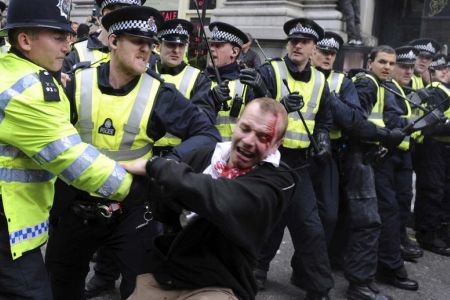
British police have played a significant role in triggering civil disobedience in the UK through their unprofessional and brutal way of dealing with innocent civilians.
Mark Duggan, recently killed in a police shooting in the London suburb of Tottenham and whose death sparked a wave of street protests across Britain, Ian Tomlinson, an English newspaper vendor who was killed during G20 summit protests in London, Jean Charles de Menezes, who was shot seven times in the head after the London bombings of July 7, 2005, and David Emmanuel , a British reggae singer who was killed during a police raid on his home, all are the names included in a long list of people killed at the hands of British police forces.
Independent Police Complaints Commission (IPCC), a police watchdog that deals with complaints against police has been established to investigate police’s crimes.
The IPCC’s job is to make sure that complaints against the police in England and Wales are dealt with effectively, it claims.
The body claims to be setting standards for the way the police handle complaints against themselves and, when something has gone wrong, it helps the police learn lessons and improve the way it works.
But they neither have learnt lessons nor have they tried to improve their performance, the example of which are:
1- Mark Duggan, whose family said it has no trust in the IPCC. The police shooting victim’s friends and family said that they don’t feel the police watchdog is sufficiently independent. The police watchdog has admitted it may have wrongly led journalists to believe that Mark Duggan fired at officers before he was killed. The Independent Police Complaints Commission has confirmed that it may have “inadvertently” given reporters misleading information in the early stages of the investigation. It was initially reported that Duggan, 29, shot at police. But ballistic tests later found that a bullet which lodged itself in one officer’s radio was police issue. An inquest into Duggan’s death heard the father-of-four died from a single gunshot wound to the chest.
2- Ian Tomlinson was an English newspaper vendor who collapsed and died in the City of London after he was confronted with the police while on his way home from work during the 2009 G20 summit protests. A first postmortem examination indicated he had suffered a heart attack and had died of natural causes. A video footage later showed that a baton wielding police had struck him on the leg from behind and the pushed him on the ground. The video showed no provocation on Tomlinson’s part. He also was not a protester, and at the time he was struck was walking along with his hands in his pockets. The victim walked away after the incident, but collapsed and died moments later.
3- Jean Charles de Menezes was killed in the aftermath of the London bombings of July 7, 2005. He was a Brazilian man shot in the head seven times at Stockwell tube station on the London Underground by the Metropolitan Police. Police misidentified the victim as one of the fugitives involved in the previous day’s failed bombing attempts. The IPCC launched two probes into the incident, none of which brought disciplinary charges against police officers involved.
4- David Victor Emmanuel, known as Smiley Culture, was killed on March 15, 2011 during a police raid on his home. The 48-year-old was a British reggae singer and deejay known for his fast chat style. Police claimed that the victim died of a self-inflicted wound, while officers were searching his house in Warlingham, Surrey. But a post-mortem examination revealed that he had died from a single stab wound to his heart. His death triggered peaceful protests, but it was little reported.
The IPCC was faced with a crisis in February 2008 after more than one hundred lawyers who had specialized in handling police complaint resigned from its advisory body.
They lashed out at IPCC for its indifference towards complaints, favoritism towards police and rejecting complaints, which were strongly documented. Meanwhile, there have happened more than 400 deaths at the hands of police officers in the past ten years alone but no policeman has ever been convicted of murder or manslaughter for just one single death so far.
Teenagers heckle UK PM during speech
Press TV – August 15, 2011
A group of British teenagers heckled Prime Minister David Cameron, when he was addressing his constituency gathering in Witney, Oxfordshire about a broken society.
Cameron was heckled by the teenagers when he made a pledge to reverse the moral collapse in the society and to fix Britain’s “broken society”, according to the British media reports.
The Prime Minister declared “a concerted, all-out war on what he called as gangs and gang culture”.
“It is a major criminal disease that has infected streets and estates across our country,” he said.
Cameron announced a series of tough measures, among them plans to have school leavers take part in a National Citizen Service, to deal with social problems.
Under the plan, Cameron pledged to introduce a non-military national service program, in which it would be obligatory for all 16-year-olds to participate and spend time volunteering in hospitals and community centres.
But the young audience was unimpressed, heckling the Conservative leader.
“He is blaming everyone but himself,” said Jake Parkinson, 17, unemployed. “The rich get richer, the poor get poorer. I’d love to go to university, but it’s the money that is putting me off.”
There were whistles when Cameron entered the stuffy, cramped room and “chicken” noises at the end from teenagers who accused him of leaving early and being too scared to answer all of their questions.
Many in Witney said they thought the biggest threat to public order came from a government austerity drive that they say will inevitably lead to the closure of social services funded by the state or third parties, such as charities.
“He wants people to get in touch with their families, but for some people their families aren’t there and the youth centre is the only place where they can talk to people,” said Ryan Clayton, 15. “But he’s shutting all the youth centres.”
Unemployed father-of-two Martin Lawson Smith said the wide gap between Britain’s rich and poor had fuelled the discontent.
“I don’t think broken families and morals are the problem,” he said. “It’s more the inequality that there is in society.”
Social media at the mercy of UK government
Press TV – August 15, 2011
Social networking firms Facebook, Twitter, and Research in Motion (RIM), maker of BlackBerry, have welcomed the forthcoming meeting with the British government.
British Home Secretary, Theresa May, is to hold a meeting with the executives of social networking firms to discuss the possibility of shutting down social media during future unrest in Britain.
Moreover, British Prime Minister, David Cameron, asserted that the unprecedented unrest across Britain had been mostly arranged through social media. Cameron acknowledged that “the police, the intelligence services and industry” cooperated with the government during the widespread unrest.
Cameron maintained that the British government had been looking at ways to prevent people from communicating with each other via social media when any sort of unrest threatens the country.
RIM, whose BlackBerry application has been a thorn in British government’s side, has announced it would observe “both UK privacy laws as well as the Regulation of Investigatory Powers Act.”
Facebook has also expressed approval of the forthcoming meeting asserting that it took measures to make sure Facebook would be “a safe and positive platform for people in the UK” during the widespread unrest.
Furthermore, a report in the Financial Times said that Twitter looked forward to discussing the issues with May.
Meanwhile, Open Rights Group executive director, Jim Killock, has condemned government’s plans to ban social media asserting that such measures infringe upon people’s right to freedom of expression.
Killock said that the police should not be able to suspend individuals from using social media and any suspension decision should be made at courts.
All these measures by the British government come as the British media accuses the Iranian government of blocking access to the Internet and violating freedom of expression while the online version of almost all British newspapers have created a link to Facebook for an unfiltered access to the Iranian users.
Nevertheless, social networking sites, like Facebook, have become a national security concern after Britain faced widespread unrest which some analysts believe was a direct result of the government’s policies.
Featured Video

John Mearsheimer Talking Iran with Iran
or go to
Aletho News Archives – Video-Images
New Book
The silver that medicine dropped — four thousand years of clinical use, four decades to erase.
Colloidal Silver — First Edition, 2026, Paperback
Lies are Unbekoming | October 16, 2026
Silver was medicine. Not alternative medicine. Not folk medicine. Medicine. In surgery. In obstetrics. In the burn ward. In water treatment. In the household medicine chest. Every physician before 1938 knew this.
By the 1870s, silver nitrate was standard in surgical wound care across the leading hospitals of Britain, Germany, and the United States. Colloidal silver preparations — Collargol, Argyrol, Protargol — entered European and American practice through the 1890s and early 1900s and became standard antiseptics in military field medicine. By the time Fleming grew his first penicillin mould in 1928, silver was the first-line antimicrobial of the Western pharmacopoeia. The Lancet and the British Medical Journal carried the clinical reports in volume. The practice ran continuously through the Victorian era, the Edwardian era, the First World War, the interwar period. By 1980, almost all of it was gone.
What has not been treated at book length, until now, is how a four-thousand-year clinical record disappeared from mainstream medicine within four decades of the Flexner Report — and what the honest account of silver looks like once that record is reassembled.
Colloidal Silver reconstructs the pre-1938 record from The Lancet, the British Medical Journal, and the primary literature of the era; recovers Robert Becker’s bioelectric framework from the regeneration research the pharmaceutical model buried; and places silver inside a practical terrain-paradigm guide to its current place — in water, on the body, inside the body, and in the chronic conditions where antibiotics have failed. … continue
Blog Roll
 Aletho News
- Pharma- and Gates-Funded GAVI Seeks to Assure Parents
- John Mearsheimer Talking Iran with Iran
- Inside Bill C-22, Canada’s Patriot Act.
- China’s FM: Palestinian cause is ‘greatest injustice of the century’
- US sympathy for Palestinians surpasses support for Israelis
- Israeli rabbi permits occupiers to steal Palestinian olive harvest in West Bank
- Spanish firm sells Latvia vehicles equipped with Israeli tech despite arms embargo
- Saudi Arabia under fire… Yemen is burning down the House of Saud
- Israeli Spy Pollard stole the files, today’s it’s delivered through official channels
- Why Iran Didn’t Walk Away
- If Americans Knew
- NPR investigation finds evidence of widespread fraud at mall kiosks tied to Israeli skincare brand
- Tucker Carlson exposes Israeli Lies about the Oct 7th attack, Charlie Kirk, and the U.S.
- Israel has detained thousands of Palestinian children since Oct 7th – over half spent time in solitary, many uncharged
- Israeli Analysis: Is Netanyahu Planning an ‘October Surprise’ Attack Before Israel’s Election?
- Israeli settlers brutally attack Palestinians and Washington Post female photographer, 65
- Words Have Changed, Occupation Continues: The Reality of the Gaza Ceasefire
- Gaza’s child amputees are growing faster than their prosthetics allow
- Israel keeps Palestinians struggling just to survive–Daily Update
- Israeli firm used online ads to run vast spy operation, researchers say
- No, the world zionist movement is not an antisemitic conspiracy theory
- No Tricks Zone
- New Study Suggests Large Regions Of The Pacific Ocean Have Been Cooling For The Last 80 Years
- Germany’s Green Energy Debacle: High Energy Costs Force Kahla Porzellan to Close After 182 Years!
- New Study: 50 Years Of The Most Aggressive ‘Net Zero’ Policies Can Only Affect The Global Climate By 0.03°C
- US September “Heat” Was No Record…Many Records Set Decades Ago
- Latest European Green Energy Debacle; Portugal’s Largest Flagship Solar Park Insolvent!
- Green Energy Debacle: German Expert Professor Fritz Vahrenholt Warns Of Severe Economic And Social Consequences
- Two More Paleo Reconstructions Affirm Meters-Higher Sea Levels Across Ireland, Brazil 7000-6000 Years Ago
- New Study: Earth And Venus Surface Warmth Largely Explained By Convection And Lapse Rate, Not CO2 Or Radiation
- 2025 Nature Paper Claiming Worsening Global Drought Gets RETRACTED …Heavily Flawed
- New Study: ‘Global Drought Shows No Detectable Recent Acceleration Under Climate Warming’

