Director of Jerusalem Media Center Detained by Israeli Troops
By Saed Bannoura – IMEMC News – April 12, 2011
After filming an Israeli jeep blocking traffic and driving through pedestrians in Silwan neighborhood, in East Jerusalem, Muhammed Sadeq of the Jerusalem Media Center was detained by Israeli forces, then released soon after.
The neighborhood of Silwan has become a flashpoint for joint Palestinian-Israeli nonviolent protests against home demolitions and settler takeovers of Palestinian homes. The area was designated by the Jerusalem municipality five years ago, in the Jerusalem E1 Plan, as an area where the indigenous Palestinians would be removed, and Israeli Jewish settlers moved in. The municipality also plans to construct a Biblical Theme Park on the site of the historic homes and buildings, after it demolishes many of the homes.
According to local sources, Muhammed Sadeq was detained along with Fakhri Abu Diab, who is the leader of a non-governmental organization in Jerusalem known as the al-Bustan Committee.
They were questioned by an Israeli soldier, who took their IDs and held the men until a crowd gathered demanding their release. After several hours, the two men were released.
A number of people known as ‘leaders’ in the non-violent struggle in Silwan neighborhood have been detained and abducted by Israeli forces in recent days. Last week, Jawad Siyam, the head of the Wadi Hilweh Information Center, was held in Israeli custody until his wife agreed to come in and be interrogated. Such coercion of witnesses is considered illegal under international law.
Rights group calls for monitoring of mass Awarta arrests
Ma’an – April 11, 2011
RAMALLAH — The Ramallah-based rights group Addameer issued a call Sunday for international observation and intervention over the mass arrest campaigns being carried out in the West Bank village of Awarta by Israeli forces.
Sunday morning another nine men and women were detained, bringing to five the number of arrest raids, which rounded up a combined 600-700 residents since 11 March, when five settlers were murdered in their beds, including two children and an infant.
Israel’s investigation of the killings appears to be centered on Awarta village residents, though no suspects have been identified and the case remains under gag-order.
“These arrests have taken place despite the fact that no evidence has been brought forth to indicate that the murders are related to Awarta, suggesting a campaign of collective punishment against the village,” Addameer said in a statement.
The statement said 55 villagers remain in detention, are being held without charge, and include two under the age of 18.
“The arrest procedures also raised serious concerns,” the organization said, citing reports of detention of the elderly, sick and pregnant, saying they were “unlikely candidates for the brutal murders.”
Addameer said it was concerned that “no female soldiers were present and no arrest warrants were presented during the arrest operation,” adding that home-to-home searches lasted up to three hours, and residents were harassed by masked soldiers who used sniffer dogs to search homes, terrorizing families.
“The women’s treatment at the Huwwara Detention Center fell short of basic requirements of international law,” the center further accused, saying many of were arrested in their night gowns, were held in barracks used as military sleeping quarters, and were interrogated repeatedly.
“They were then asked to sign a 2-page statement in Hebrew, a language they do not understand, and threatened with prolonged detention if they chose not to sign it,” the organization said, adding that no lawyers were present for the duration.
In response to the violations cited by the organization, they asked that international observers be installed in the village to monitor the situation in Awarta.
Bahrain abducts two senior clerics
Press TV – April 11, 2011
Bahraini forces have abducted two senior clerics as the government is putting more pressure to suffocate anti-regime protests.
The Saudi-backed Bahraini forces arrested clerics Sayyed Mohammad al-Alawi and Sheikh Abdul Adim al-Mohtadi in the capital Manama on Monday. It comes after the Bahraini government dismissed 30 doctors and 150 health ministry workers for supporting anti-government protests, a Press TV correspondent reported.
Meanwhile, police stormed schools on Monday and arrested teachers ahead of a planned strike.
Earlier, Bahraini authorities expelled 16 Lebanese nationals from the country. The move came after the leader of the Lebanese resistance movement Hezbollah, Seyyed Hassan Nasrallah, voiced support for the Bahraini protesters.
Bahraini people have been demanding an end to the two-century-long rule of the Al Khalifa dynasty since February 14. Scores of protesters have been killed and many others gone missing since the beginning of the revolution.
Bahraini forces have reinforced a massive armed crackdown on the uprising with the help of Saudi, the UAE and Kuwaiti troops.
2 dead, 18 injured in Cairo’s protest
Press TV – April 9, 2011
At least two people have been killed and 18 others injured as thousands of Egyptians are calling for trial of ousted President Hosni Mubarak clashed with security forces in Cairo’s’ Liberation Square.
On Saturday, security forces faced off with Egyptian protesters, who converged onto the iconic square to ask for the immediate prosecution of Mubarak and his henchmen, AFP reported.
The protest turned violent as anti-riot police fired into the air, the report added.
The angry crowd on Saturday promised to remain relentless in the pursuit of their demands, including the social reforms and the prosecutions of former regime figures.
They also want the Egyptian army to hand over power to a civilian government as part of the promised reforms.
The protests come weeks after Mubarak handed over power to Egypt’s Supreme Council of the Armed Forces, which is headed by Defense Minister Gen. Mohammed Tantawi.
Activists demand the release of political prisoners, the lifting of a 30-year-old state of emergency and the disbandment of the military court.
The emergency law, in place since former Egyptian President Anwar Sadat was assassinated and Mubarak assumed power, allows authorities unfettered power to arrest people without charge and ban protests.
Over 500 activists detained in Bahrain
Press TV – April 8, 2011
The Bahraini Center for Human Rights (BCHR) has announced that the number of detained opposition activists in the Persian Gulf state has exceeded 500.
According to BCHR, 17 women are also among the detainees and 18 other activists are reportedly missing, a Press TV correspondent reported.
Since the beginning of the uprising in Bahrain dozens of anti-government protesters have been killed and many others have gone missing. The bodies of the missing are frequently found days after.
The head of BCHR, Nabeel Rajab, says now one in every 1,000 Bahraini is in detention for political reasons.
Witnesses say regime forces are conducting house to house searches to detain opposition activists.
Six opposition leaders have also been arrested and the Manama government has so far refused to provide any information on their fate.
The opposition leaders, five Shia and one Sunni, were rounded up on March 17.
Among the opposition leaders is Hassan Mushaima, the head of the Haq party, who returned to Bahrain from Britain in mid-February after Manama dropped charges against him.
His family members say Saudi troops were among Bahraini forces taking part in the arrest operation.
Reports coming from Bahrain suggest that regime forces backed by Saudi troops have intensified their crackdown on opposition figures and anti-government protesters.
Police training programs twin US-Israeli racism
Hira Mahmood and Wafa Azari, The Electronic Intifada, 7 April 2011
The racism of the American “war on drugs,” especially in the south, is notorious. So is the racism faced daily by Palestinians. In Atlanta, a university program allows these two manifestations of racism to feed off each other and community activists are organizing to shut the program down.
On the evening of 21 November 2006, the Atlanta Police Department’s recently disbanded Red Dog Unit killed Kathryn Johnston, a 92-year-old Black resident of the northwest Atlanta neighborhood of English Avenue. As she sat in her home watching television, several Atlanta policemen bashed in her front door to execute their fraudulently obtained “no-knock” search warrant. After firing 39 shots, the police officers handcuffed Johnston, placed a dime bag of marijuana on her and vacated her home, leaving her to bleed to death there (Ernie Suggs, “City to Pay Slain Woman’s Family $4.9 million,” Atlanta Journal-Constitution, 16 August 2010).
Organizers with the Movement to End Israeli Apartheid-Georgia (MEIA-G) read a newspaper article about the court proceedings following Johnston’s brutal murder, stumbled upon a brief note about the Georgia International Law Enforcement Exchange (GILEE) and wondered what it was and how was it connected to Johnston’s death.
MEIA-G was established in February 2009 after an unprecedented mobilization in response to the 23-day-long Israeli assault on Gaza. Hundreds rallied in the streets of Atlanta in solidarity with the Palestinian people, vowing to organize to support them in their struggle for liberation. After launching MEIA-G, we endorsed the 2005 Palestinian call for boycott, divestment and sanctions and identified GILEE as our primary campaign target.
Housed in Georgia State University’s (GSU) Criminal Justice Department, GILEE is a police exchange program whereby high-ranking Georgia police officers travel to Israel to learn counter-terrorism tactics from the Israel national police. Conversely, Israeli police officials travel to Atlanta every two years to learn Georgia’s drug enforcement tactics such as those employed against Johnston, Tremaine Miller, Pierre George and countless other African-American victims of police abuse and aggression. Through GILEE, the Israeli police adopt these tactics and employ them on Palestinian citizens of Israel and Palestinians residing in the occupied West Bank.
While GILEE has relationships with several international police agencies, its relationship with the Israeli police is the most intimate and most troubling. Israel is one of the most brazen violators of human rights and international law in the world. Israeli police, in their execution of the racist and discriminatory policies of the Zionist government, have been and are a major source of these violations. MEIA-G hopes to keep the brutal police methods and tactics employed by the Israeli police from being adopted and implemented in Atlanta. To do this, MEIA-G seeks to expose and shift the practices of both the Atlanta and Israeli police by eliminating this exchange program, the aim of which is to proliferate repressive police tactics internationally.
Alongside 18 campaign endorsers and more than 1,200 individual supporters, the MEIA-G and GSU’s Progressive Student Alliance have built, cultivated and sustained a growing coalition organizing to eliminate GILEE from GSU and ultimately from Atlanta.
While the collaboration between the US military and the Israeli military is well-documented, social justice activists in the US are just now beginning to uncover the depth of collaboration between US and Israeli police forces. These collaborations further underscore the extent of the “special relationship” between the US and Israel, and their similar needs, as European settler-colonial projects, for elaborate systems of social control to manage the troublesome “undesirables” in their midst.
The US south has a particularly troublesome history of managing “undesirables.” With the formal abolition of slavery after the Civil War, a critical social question arose: how would the Georgia elite maintain its wealth and power in a society dependent on cash crops like “King Cotton” that relied upon a cheap, controllable and stable labor force? Policing provided the answer: newly established law targeting such activities as vagrancy and loitering were used to arrest and incarcerate southern Blacks. In short, prisons replaced plantations and police officers replaced plantation overseers (see Angela Davis, Abolition Democracy: Beyond Empire, Prisons and Torture, pp. 7-18).
Both the US and Israel are rooted in outside colonial forces invading a territory with the goal of possessing the maximum amount of natural resources — namely land — while erasing its indigenous population. In both cases, the US and Israeli militaries were created to engage the “external” threats of the unconquered indigenous populations, while their police forces were created to maintain control over the conquered indigenous populations (and other subjugated peoples like enslaved Africans) absorbed and “internalized” within these nation-state projects.
The US boasts the highest incarcerated population in the world — more than two million persons, including more than 800,000 Blacks. This does not include those on parole, on probation or unable to be employed because of a criminal record. Policing plays an integral role in not only surveiling, controlling and intimidating communities of color but also in funneling people into prisons. With such an exorbitant national incarceration rate, what do Georgia police officials like current Atlanta Police Department Chief of Police George Turner, former Chief of Police Richard Pennington and current Georgia Bureau of Investigation Director — all of whom have sojourned in Israel for the GILEE training — have left to learn about terrorizing and controlling these communities?
The Zionist project of confiscating the most amount of Palestinian land with the least amount of indigenous Palestinians remaining has one vital flaw. Evidenced in more than 60 years of resistance and resiliency to occupation, apartheid and genocide, Palestinians continue to resist the Zionist program of ethnic cleansing. Following the expulsion of 800,000 Palestinians in 1948, the Israeli state was tasked with controlling that pesky, residual population throughout historic Palestine. Under the guise of counter-terrorism, it is the Israelis’ sophisticated social control mechanisms that Georgia police officials learn to inflict upon Georgia residents.
The Georgia International Law Enforcement Exchange operates within a public university but is largely funded by private donations, including donations from corporations and former graduates of the program. The extent of private support for this program is symptomatic of neoliberalism transforming public institutions in a way that compromises their integrity. GILEE does not reflect the desires of the Georgia State University community as evidenced by the opposition to the program voiced by numerous students, faculty and community members.
The director of the GILEE program is Dr. Robert Friedman, Professor Emeritus of Criminal Justice at GSU. Dr. Friedman serves on the advisory board of the International Institute for Counter-Terrorism (ICT), an Israeli organization that has actively opposed human rights groups and acted as an apologist for the Israeli security apparatus. Boaz Ganor, founder and executive director of the ICT, serves as a board member for the GILEE program.
Another highly influential, and controversial, Israeli politician — Avi Dichter — has visited Atlanta to meet with Georgia law enforcement officials as part of GILEE. Dichter has been charged with extrajudicial killings, war crimes and other human rights violations by the Center for Constitutional Rights for the 2002 air strikes on Gaza. The meetings between Israeli and Georgia officials, the unknown specificities of the training program, and the large infiltration of money into the GILEE program from unknown sources are all being done under the auspices of Georgia State University, a public institution.
Activists throughout the US are beginning to uncover more and more police exchange programs in which US law enforcement officials travel to Israel to learn “counter-terrorism” tactics. Campaigns organizing to shut them down continue to take root. We have a political obligation to expose these programs, highlight how they impact oppressed communities in the US and close them as we build a more just world free of racist violence in both the United States and Palestine.
Hira Mahmood is a student activist and BDS organizer studying English literature at Georgia State University.
Wafa Azari organizes with the Movement to End Israeli Apartheid-Georgia. Currently residing in Atlanta, she was born and raised in Oujda, Morocco.
Female protester killed in Bahrain
Press TV – April 7, 2011
A female protester has reportedly been killed in Bahrain’s crackdown as the government is putting more pressure on anti-government demonstrators.
Khadijah Al Abdulhayy has died from suffocation in the village of Sanabis, a Press TV correspondent reported on Thursday.
Her death comes after the killing of Seyyed Hamid al-Mahfood by the Bahraini regime forces after he went missing late Tuesday.
Mahfood’s body was found in a bin in the village of Sar, a few kilometers west of the capital Manama on Wednesday.
Dozens of anti-government protesters have been killed and many others gone missing since the beginning of the uprising in Bahrain.
Bahrain’s leading Shia opposition group Wefaq said over 450 opposition activists, including 14 women, have been also arrested since the uprising began in the country in mid-February.
Bahrainis have been demanding an end to the two-century-long rule of the Al Khalifa dynasty since February 14.
In March, Saudi Arabia, the United Arab Emirates and Kuwait deployed their troops to Bahrain to reinforce a massive armed crackdown on the popular uprising.
Meanwhile, Human Rights Watch said Wednesday it is worried about the growing abuses by the Bahraini regime against its citizens who are seeking political reforms and a voice in the government.
More than 100 women arrested in Awarta village
Ma’an – 07/04/2011
NABLUS — Israeli troops stormed a Palestinian village early Thursday, arresting more than 100 women in what local officials said was part of the ongoing investigation into the murder of five settlers in March.
Hundreds of troops entered Awarta — the village adjacent to Itamar, an illegal settlement where the murders took place — shortly after midnight and imposed a curfew after which they began rounding up the women, local council head Tayis Awwad said.
Officials told Ma’an that men and women were taken in the raids, which involved house-to-house searches in the early morning. Some of the women, witnesses said, were in their 60s, and many were taken by force.
Soldiers continued to conduct house-to-house searches through the night, the officials added. Palestinian security sources confirmed the report.
This was the fourth intensive raid of the village where scores were detained, the first coming the day after an unidentified attacker stabbed to death five members of the Fogel family, including two children and an infant.
But Thursday’s raid marked the first time they had arrested any women, Awwad said.
In the wake of the murders, Awarta has been the center of a massive manhunt. The village was put under military closure, and a curfew was imposed for five days between March 12 and 16. Some 40 men were detained during the closure, and since then two more mass roundups were reported.
Those detained have been questioned and subjected to DNA testing, officials said last week.
So far no one has been charged, with the military refusing to comment on the operation.
The Detainees’ Center in Nablus condemned the overnight arrest raid.
The mass detentions, a statement from the center said, were illegal and arbitrary and “go against the human rights of the residents.”
Awarta was the second village put under closure overnight, with locals in the Tubas area saying the Israeli army, backed by military bulldozers, entered the village of Aqaba where two homes were demolished.
Gazan Engineer Formally Charged By Israel
By Circarre Parrhesia – IMEMC & Agencies – April 05, 2011
Dirar Abu Sisi, the Gazan engineer who was abducted by Israeli security personnel whilst traveling by train through the Ukraine, has been formally charged by an Israeli court on Monday.
The charges include belonging to a militant group (Hamas) and involvement in the firing of rockets into Israel form the Gaza Strip, which is charged as attempted murder.
It is claimed that Abu Sisi was in charge of the Hamas military academy and that he was responsible for upgrading the abilities of the rockets fired from the Gaza Strip, increasing their range and ability to pierce through armored military vehicles.
Abu Sisi’s lawyer, Smadar Ben-Natan, stated that Abus Sisi had confessed to charges, but that these confessions came under severe duress from interrogators that Ben-Natan claims was tantamount to torture, but that she could not go into detail as to the confessions due to the gag order imposed in Israel.
Abu Sisi’s sister, Suzanne, has stated that her brother is not involved in any political faction and that his work was as the director of Gaza’s only power plant. She stated that he took the position prior to Hamas’ election victory, and continued his role subsequently.
Israel targets international activists in Bil’in raid
Ma’an – 04/04/2011
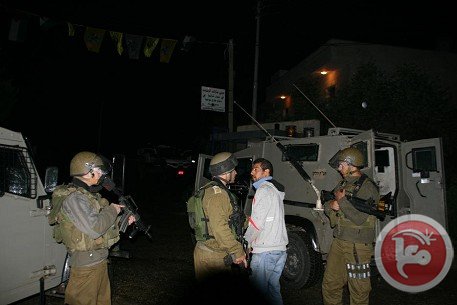
RAMALLAH — Israeli forces entered the central West Bank village of Bil’in on Monday morning, searching homes and harassing residents, reportedly in search of international solidarity activists who often remain in the area to document rights violations.
A spokesperson for the local popular committee said the raid began at 1:30 a.m. and lasted approximately an hour. The official said the homes of village residents Ali Birnat and Khamis Abu Rahma were targeted and searched.
Local committee members attempting to document the raid were prevented from accessing the scene of the searches.
An Israeli military spokeswoman did not immediately return calls seeking comment.
A statement from the Popular Struggle Coordination Committee said Abu Rahma was questioned about who was residing in his house, noting soldiers were “interested in internationals, although they could not find any,” noting that soldiers and police searched Abu Rahma’s home and garden, including the garbage and inside cars located nearby.
Groups of solidarity activists have for the past year stayed frequently in the village, which hosts the longest running weekly protest against Israel’s separation wall.
The prominent popular committee in the village has organized a yearly conference on popular non-violent resistance, and gained international support for its initiatives.
Since the early years of the protests, international solidarity activists have joined the demonstrations in an effort to mitigate the use of violence against the villagers. The use of high-velocity tear-gas canisters have caused death and injury to residents, and solidarity activists say an international presence witnessing and documenting the action often reduces the use of force.
Once activists left the village at the close of the protests, particularly during 2009 and 2010, Israeli forces would enter and detain teens they said were throwing stones at the soldiers, and later targeted protest leaders for detentions.
Activists began staying overnight in the village to document the night raids they said were being used to intimidate villagers, who have also launched court actions against the confiscation of land by Israel’s separation wall.
Sixty percent of the village lands now stand on the far side of the wall, and are largely inaccessible but for a gate that opens periodically allowing farmers to tend crops, without the use of heavy machinery or equipment.
Bahrain bans main opposition daily
Press TV – April 3, 2011
The Bahraini government has banned the publication of a leading independent newspaper due to its coverage of the popular revolution in the Persian Gulf littoral state.
Bahrain’s Information Affairs Commission suspended Al-Wasat daily, which has been critical of the government’s brutal crackdown on demonstrators in the country, BNA state news agency reported without giving further details.
The commission also ordered a case to be opened for further investigation by the Public Prosecution.
Masur al-Jamri, a former opposition activist during the uprising in the 1990s, is the editor-in-chief of the Bahraini newspaper.
Last week, Bahrain’s state television accused Al-Wasat of publishing “fabricated and false news” about the “security developments in Bahrain.”
The Bahraini police, backed by Saudi and UAE troops, have intensified the clampdown on anti-government protesters who demand a constitutional monarchy.
Rights groups and opposition parties say hundreds of people have been detained or have gone missing since the protests began in mid-February, with at least 25 people killed and 1,000 others wounded so far.
Friday: the day of rage in the Arab world
PressTVGlobalNews | April 1, 2011
Part 2
The day of rage, the day of departure and the day of salvation: these are the names that protestors across the Arab world have been giving to Friday. From Yemen, to Bahrain, to Egypt, Tunisia, Jordan and Saudi Arabia, demonstrators have been massing after Friday prayers to demand change and to safeguard the ideals of their revolutions.
This program will be asking whether the revolutionary movement in Egypt is moving in a new direction, why President Saleh in Yemen is refusing to step down and how the western stance on Bahrain and Libya has raised questions of double standards.
To answer the questions, Homa Lezgee is joined by Chris Bambery, Dr. Saeb Shaath and Ramzy Baroud.
Egyptian authorities are preventing a big supply of cement from entering the Gaza strip. The coalition for the Lifting of Gaza Siege says the move indicates that the Egyptian Revolution has done nothing to change Cairo’s policies toward Palestine.
Press TV’s Hassan Alkatib reports from Cairo.
Featured Video

Trump asks Iran not to retaliate after he strikes Pickaxe Mountain
or go to
Aletho News Archives – Video-Images
Book Review
‘Why Fauci Must Rot in Prison’: A Tale of Two Diaries
By Jill Erzen | The Defender | October 13, 2026
Dr. Anthony Fauci’s private diary reveals a “mind-numbing” contradiction between what the former top U.S. infectious disease official knew about COVID-19 and what he told the public, senior White House adviser Peter Navarro, Ph.D., said last week on “American Thought Leaders.”
In his new book, “Why Fauci Must Rot in Prison,” due out Oct. 20, Navarro compares Fauci’s private entries to his own pandemic-era diary, and uses what he calls “a tale of two diaries” to argue that Fauci should face criminal prosecution.
“I show, actually, how a prosecution can and should happen … at the state level, most likely,” Navarro said. “He should wind up in prison, and we’ve got the receipts in this book to put him there.”
Navarro said Fauci repeatedly acknowledged important facts in private, then publicly pursued policies that contradicted those facts — with devastating consequences.
“What he says many times privately in his diary is so at odds with both his public behavior and public statements that it’s mind-numbing,” Navarro said.
Navarro examines the lasting damage caused by lockdowns and other pandemic policies, and the ongoing toll of long COVID.
His book also addresses questions about vaccine safety, including why healthy young people faced COVID-19 vaccination mandates despite concerns about myocarditis, and why women were not warned about miscarriage risks linked to the shots. … continue
Blog Roll
 Aletho News
- Yemen denounces international community’s silence on Saudi aggression, siege
- UAE and Saudi Arabia move toward renewed coordination against Sanaa
- How Iran’s two-week retaliatory strikes exposed cracks in US military architecture in Persian Gulf
- The mother of all propaganda: Why the hype over US MOAB strike against Iran is nothing but theater
- Iran says it possesses technology behind US 14-ton GBU bunker-buster
- Trump asks Iran not to retaliate after he strikes Pickaxe Mountain – w/ Prof. Marandi
- Vice President J.D. Vance’s Deceptive ‘Antiwar’ Campaign Speech
- Iran: Palestinians’ rights must not be compromised in Gaza’s future; US, Israel to blame for Hormuz situation
- Ongoing tales of Syrian chemical weapons
- Moscow blasts UN for ignoring torture of Russian POWs
- If Americans Knew
- Netanyahu’s spin on latest settler attack is laughable – Daily Update
- Israeli soldiers debunk Israel’s talking points
- In West Bank, Israeli settlers are totally out of control – Daily Update
- NPR investigation finds evidence of widespread fraud at mall kiosks tied to Israeli skincare brand
- Tucker Carlson exposes Israeli Lies about the Oct 7th attack, Charlie Kirk, and the U.S.
- Israel has detained thousands of Palestinian children since Oct 7th – over half spent time in solitary, many uncharged
- Israeli Analysis: Is Netanyahu Planning an ‘October Surprise’ Attack Before Israel’s Election?
- Israeli settlers brutally attack Palestinians and Washington Post female photographer, 65
- Words Have Changed, Occupation Continues: The Reality of the Gaza Ceasefire
- Gaza’s child amputees are growing faster than their prosthetics allow
- No Tricks Zone
- Predictions Made By Renowned Climate Proifessor Over Past Decades Have Been Proven To Be Poor
- New Study Suggests Large Regions Of The Pacific Ocean Have Been Cooling For The Last 80 Years
- Germany’s Green Energy Debacle: High Energy Costs Force Kahla Porzellan to Close After 182 Years!
- New Study: 50 Years Of The Most Aggressive ‘Net Zero’ Policies Can Only Affect The Global Climate By 0.03°C
- US September “Heat” Was No Record…Many Records Set Decades Ago
- Latest European Green Energy Debacle; Portugal’s Largest Flagship Solar Park Insolvent!
- Green Energy Debacle: German Expert Professor Fritz Vahrenholt Warns Of Severe Economic And Social Consequences
- Two More Paleo Reconstructions Affirm Meters-Higher Sea Levels Across Ireland, Brazil 7000-6000 Years Ago
- New Study: Earth And Venus Surface Warmth Largely Explained By Convection And Lapse Rate, Not CO2 Or Radiation
- 2025 Nature Paper Claiming Worsening Global Drought Gets RETRACTED …Heavily Flawed

