Bahrain protest casualties on rise, government ‘gagging’ journalists
Press TV – March 19, 2011

The number of casualties from the Bahraini and Saudi crackdown continues to rise as another demonstrator has died of the wounds sustained in attacks on protesters.
On Saturday, the opposition Shia bloc Al-Wefaq reported that the protester died from wounds sustained in Pearl Square. It said that nearly 60 people were still unaccounted for.
Several people were killed after Bahraini and Saudi troops crushed a peaceful sit-in at Manama’s Pearl Square, which was later razed to the ground by the regime.
Security forces, supported by Saudi Arabia and the United Arab Emirates (UAE), continued on Saturday to secure the capital after a brutal crackdown on protesters camped at Pearl Square in Manama on Wednesday.
Bahraini citizens are still under curfew, although now with reduced hours set from 8 p.m. to 4 a.m.
Saudi Arabia has deployed more than 1,000 troops to the country while the UAE has dispatched around 500 police forces to assist in the repression of protesters.
Bahraini Foreign Minister Sheikh Khaled bin Ahmed Al Khalifa has announced that three or four Persian Gulf countries would be sending troops to help the government.
Demonstrators in the Shia-majority country have been demanding the ouster of the 230-year-old Sunni-led monarchy as well as constitutional reform.
In addition to the 13 killed, more than 1,000 have been injured since February 14.
Bahrain government ‘gagging’ journalists
A senior leader from Bahrain Freedom Movement has condemned the monarchy’s “gagging” of activists and journalists covering anti-regime protests.
Speaking to Press TV during a London rally, Saeed al-Shahabi said the Bahrainis no longer trust the king’s call for national dialogue following the deployment of Saudi Arabian and UAE troops in Bahrain to crack down on protesters.
“I think the people have passed that stage. They are not interested now in talking to somebody who is killing them, who is bringing foreign forces to occupy their country, who is attacking religious symbols, who is gagging all journalists and arresting political leaders,” al-Shahabi said.
Many foreign journalists have been barred from covering anti-regime protests in Bahrain which have so far led to the death of at least 12 people and the injury of about 1,000 others.
Press TV’s correspondent in Manama Johnny Miller is among the many journalists who have been mistreated and deported from Bahrain.
Al-Shahabi said the government’s crackdown on civil liberties was “massive.” He also confirmed earlier reports that several opposition leaders were arrested in Manama on Friday.
Demonstrators in the Shia-majority country have been demanding the ouster of the 230-year-old Sunni-led monarchy as well as constitutional reforms, with hundreds camping out peacefully in the capital’s Pearl Square since February 14.
UAE soldiers arrived in crisis-hit Bahrain on Friday to join Saudi Arabian troops, who were sent there earlier this week, to help the Bahraini government’s deadly crackdown on anti-government protests.
Dept of Education opens investigation into anti-Semitism at UC Santa Cruz following events protesting the occupation
By Adam Horowitz | Mondoweiss | March 17, 2011
The Chronicle of Higher Education is reporting that the U.S. Education Department’s Office for Civil Rights will investigate charges of anti-Semitism at the University of California at Santa Cruz based on a complaint that the university ignored concerns that criticism of Israel was “creating a hostile climate for Jewish people on the campus.”
You can read a letter from the Dept. of Ed announcing the investigation here. The move is the first such investigation since the Department announced last October that they were expanding federal anti-bullying guidelines to include religious groups with “shared ethnic characteristics.” Previously, the relevant civil rights statute, Title VI, did not explicitly cover religion. This was a move applauded by Israel supporters, such as the Zionist Organization of America, who saw it as a way to criminalize activism critical of Israel on campus.
The lecturer who brought the complaint is Tammi Rossman-Benjamin, who teaches Hebrew at the school. You can read Rossman-Benjamin’s complaint to the Education Department here. Among the events she sites as examples of anti-Semitism on campus was a screening of the film Occupation 101 and another event called “Understanding Gaza.” This event featured speakers from Jewish Voice for Peace which she characterizes as “an extreme and disreputable fringe of American Jewry.” The Chronicle quotes her letter:
The anti-Israel discourse and behavior in classrooms and at departmentally and college-sponsored events at [Santa Cruz] is tantamount to institutional discrimination against Jewish students, which has resulted in their intellectual and emotional harassment and intimidation, and has adversely affected their educational experience at the university.
Reading over the complaint, it’s hard to believe that anyone took it very seriously. Rossman-Benjamin’s ulterior motive of silencing criticism of Israel is obvious, and she has even written openly about it. In a piece titled “Anti-Zionism and the Abuse of Academic Freedom” that she wrote for Dore Gold’s neocon thinktank the Jerusalem Center for Public Affairs, Rossman-Benjamin laments:
The foregoing analysis has amply demonstrated that anti-Zionist and anti-Semitic discourse has found academic legitimacy on at least one major university campus and is allowed to flourish because faculty and administrators are unwilling to address, or even acknowledge, these abuses of academic freedom.
To answer how this case has found support at the highest levels of government it helps to look at who is helping push it forward, and how the Department of Education’s new policy was created in the first place.
The case is being heavily supported by an organization called Institute for Jewish and Community Research (IJCR) a San Francisco-based organization which is “devoted to creating a safe, secure, and growing Jewish community.” A large part of that work is focused on documenting and exposing “anti-Israelism and anti-Semitism.” This project is headed up by Kenneth L. Marcus, who incidently served as the Education Department’s assistant secretary for civil rights from 2002 to 2004, and was the Staff Director at the United States Commission on Civil Rights during the Bush Administration. In fact, Marcus helped lay the groundwork for the new Dept of Education bullying policy with a 2004 policy letter that advocated for the change.
Although Marcus must have been responsible for a wide array of civil rights concerns during his time in government, it seems there is one issue close to his heart. Here is a list of his publications as listed on his wikipedia page:
- “The Second Mutation: Israel and Political Anti-Semitism”, inFocus Spring 2008 • Vol. II: No. 1
- “Anti-Zionism as Racism: Campus Anti-Semitism and the Civil Rights Act of 1964”, February 2007 issue of the William and Mary Bill of Rights Journal (pp. 837-891, published by the students of the William and Mary Law School)
- “The Resurgence of Anti-Semitism on American College Campuses”, Current Psychology, Vol. 26, Nos. 3 & 4, 2007
- “The Most Important Right We Think We Have But Don’t: Freedom from Religious Discrimination in Education”. Nevada Law Journal, Vol. 7, p. 171, 2006
- “Jurisprudence of the New Anti-Semitism”, Wake Forest Law Review, Vol. 44, 2009.
His IJCR also mentions his new book Jewish Identity and Civil Rights in America. Seems to be a bit of a one trick pony. Predictably, Marcus is celebrating the government’s decision and sees wide ranging ramification for the Rossman-Benjamin’s complaint. A IJCR press release quotes him as saying:
This case is extremely significant for four reasons. First, it is opened just as International Apartheid Week activities are being held around the world and illustrates the potential ramifications of extremist protest activities. Second, it follows right on the heels of a federal lawsuit alleging similar problems at the University of California Berkeley just a few days before and may illustrate a broad trend. Third, it is only the second major systemic anti-Semitism case that OCR has opened and may have important precedential value. Fourth, it is the first major case to follow OCR’s new campus anti-Semitism policy and may demonstrate whether OCR means what it says about its commitment to addressing hate and bias in federally funded higher education programs.
It’s hard to believe the complaint will be held up, but I also would never have thought it would go this far in the first place. Guess it helps to have friends in high places.
Murders in Itamar Settlement: Murder, Pogrom and Self Righteousness
The Israeli army, security forces, settlers and politicians believe that the 11 March murders of the Fogel family in the Itamar settlement were done by Palestinians. Outside of Israel’s military courts, there is no evidential foundation for such a belief.
It is possible that there will never be evidence demonstrating who murdered the Fogel family; immediately upon learning of the murders, settlers and soldiers entered the home to check for terrorists. Only afterwards did officers from the police forensic science department enter the home to collect evidence from a now contaminated crime scene.
From the outset the working assumption of all Israeli authorities was that the murders were conducted by Palestinians; in the Israeli public arena, there exists no other possible scenario for murders in a settlement. Now, we just need to find the Palestinian on which it is possible to pin this case.
Israeli security forces and the settlers did not wait until the Palestinian or group of Palestinians was found on whom it is possible to pin the Fogel murders. The guilt is collective guilt and punishment is collective punishment: while settlers were conducting pogroms on the roads of the West Bank and in Palestinian villages, the Israeli military decided on its own pogrom in the village of Awarta, near the Itamar settlement.
According to three activists from the International Solidarity Movement who succeeded in entering Awarta before Israel’s Saturday imposition of a curfew on the village, Israeli soldiers are exhibiting violent behavior there.
Soldiers were seen conducting searches in which they entered homes more than once and gave the impression of random, confused actions. The three activists testified that they observed soldiers detaining and beating residents who left their homes and that during patrols through the village, soldiers shoot in the air and throw stun grenades in order to terrify the residents.
The international activists add that during some of the searches, the soldiers lost control and caused extensive damage. Amongst other things pictures were shattered, furniture upturned, electric cables cut and oil and mud were poured into water tanks on the roofs. The activists further noted that telephone cards and cash were confiscated from residents in one home.
Qais Awad, a member of the village’s legislative council, also reports acts of vandalism by Israeli soldiers in Awarta. Whilst searching the village’s municipal building, soldiers took some NIS 1,800 from an office drawer, together with an unknown amount from the municipality’s safe.
The wave of pogroms being committed by settlers, who enjoy complete immunity, is dubbed “price tag”. The settlers attack Palestinian cars on the roads, damage Palestinian property in villages and in case the Palestinians defend themselves, the army then intervenes and shoots tear gas and rubber coated bullets at them.
This occurred, for example, in the village of Beit Ommar, which was attacked by settlers from the Gush Etzion settlements of Bat Ain and Karmi Tsur.
Without a doubt Palestinians will be found and tried in an Israeli military court for the murders of the Fogel family. There is no need for the prosecution to present evidence which it doesn’t and couldn’t have in order to attain a conviction in this court.
The path to conviction will begin with collaborators, who will mention this or that person as the one who committed the murder. This and that person will be detained and interrogated in the General Security Services (GSS) interrogation facilities, where they will undergo physical and mental torture by GSS officers and even by collaborators in their cell. Sooner or later they will confess and go to military court, which will convict them solely on the basis of their confessions, with no need for the prosecution to present additional evidence. When attorneys of the accused will request clarifications concerning the physical evidence found at the murder scene, the manner in which the confessions were obtained and the way in which these Palestinians were implicated, the military prosecution will have one response: “the material is confidential for reasons of state security”. Finally the military court with its three judges will convict the suspects and send them to serve five consecutive life sentences.
It is possible that in light of the circumstances and the financial costs involved in conducting the trial, the security forces will prefer simply to eliminate the suspects. A band of soldiers will be sent to the field to execute them and if nothing goes wrong, the soldiers will receive commendations for avenging the murders of the Fogel family.
During the coming five years, involvement in the murders of the Fogel family will be attributed to every Palestinian “eliminated” by Israeli death squads.
In parallel, the official state of Israel and settlers are waving the murders of the Fogel family in order to launder illegal construction in the West Bank while the Israeli prime minister and government officials are using the murders to again situate Israel as the victim in the international arena.
At the opening of the Likud party meeting on Monday 14 March, Prime Minister Benjamin Netanyahu related how he demanded from the international community to condemn the killings and clarified that “from some of the countries came condemnation while others either didn’t condemn or their condemnations were cold, technical, even ‘balanced’.”
However, what is of the utmost importance in public relations is timing. As the Fogel family was murdered immediately after the earthquake and tsunami in Japan, which then began developing into a potential nuclear disaster, this ‘waving’ failed. The spokespersons of Israel found themselves preaching to the choir and making due with a sense of self-righteousness that knows no limits.
Translated to English by the Alternative Information Center (AIC).
Jailed CIA agent let go by Pakistan
Press TV – March 16, 2011

CIA contractor Raymond Davis surrounded by Pakistani policemen in Lahore

Reports say a court in Pakistan has freed a CIA contractor Raymond Davis, who was charged with killing two Pakistani men in the eastern city of Lahore.
Davis has now left Lahore for the US with six other American officials on a special flight.
His release comes after he paid the blood money or compensation in line with Sharia law. Officials say family members of the slain men appeared in court and confirmed that they had pardoned Davis.
However, there are reports that they were pressured by police into signing the agreement, a Press TV correspondent says.
A lawyer representing the family of one of those killed says the “blood money” deal was made without his knowledge.
“I was not allowed to participate in the proceedings of the case… and could not see or approach my clients,” state-run BBC quoted Lawyer Asad Manzoor Butt as saying.
“I and my associate were kept under forced detention for four hours,” he said.
“If my clients have indeed signed a blood money deal, then this has been done behind my back and I don’t know anything about it.”
The court had indicted Davis on two counts of murder.
In January, Davis shot dead two Pakistani men. Davis claims it was an act of self-defense, but he has failed to convince the court.
Investigators charge that the killings were deliberate.
A third Pakistani was killed when a US diplomatic vehicle ran him over while rushing to Davis’ aid.
The case has soured relations between Islamabad and Washington since January.
The death of the three Pakistanis has intensified anti-US sentiments in Pakistan.
Assault on Collective Bargaining Illegal
Wisconsin Violated the Constitution
By JEANNE MIRER and MARJORIE COHN | CounterPunch | March 15, 2011
The International Commission for Labor Rights (ICLR) sent a notice to the Wisconsin Legislature, explaining that its attempt to strip collective bargaining rights from public workers is illegal.
Anyone who has watched the events unfolding in Wisconsin and other states that are trying to remove collective bargaining rights from public workers has heard people protesting the loss of their “rights.” The ICLR explained to the legislature exactly what these rights are and why trying to take them away is illegal.
The ICLR is a New York based non-governmental organization that coordinates a pro bono network of labor lawyers and experts throughout the world, www.laborcommission.org. It investigates labor rights violations, and issues reports and amicus briefs on issues of labor law.
The ICLR identified the right of “freedom of association” as a fundamental right and affirmed that the right to collective bargaining is an essential element of freedom of association. These rights, which have been recognized worldwide, provide a brake on unchecked corporate or state power.
In 1935, when Congress passed the National Labor Relations Act (also known as the NLRA, or the Wagner Act), it recognized the direct relationship between the inequality of bargaining power of workers and corporations and the recurrent business depressions. That is, by depressing wage rates and the purchasing power of wage earners, the economy fell into depression. The law therefore recognized as policy of the United States the encouragement of collective bargaining.
While the NLRA covered U.S. employees in private employment, the law protecting collective bargaining in both the public and private sectors has developed since 1935 to cover all workers “without distinction.”
The opening paragraph of the ICLR statement reads:
“As workers in the thousands and hundreds of thousands in Wisconsin, Indiana and Ohio and around the country demonstrate to protect the right of public sector workers to collective bargaining, the political battle has overshadowed any reference to the legal rights to collective bargaining. The political battle to prevent the loss of collective bargaining is reinforced by the fact that stripping any collective bargaining rights is blatantly illegal. Courts and agencies around the world have uniformly held the right of collective bargaining in the public sector is an essential element of the right of Freedom of Association, which is a fundamental right under both International law and the United States Constitution.”
The ICLR statement summarizes the development of this law from the Universal Declaration of Human Rights, through the International Labor Organization’s Conventions on Freedom of Association (that is, the right to form and join unions) and on Collective Bargaining. It cites court cases from the United States and around the world. All embrace freedom of association as a fundamental right and the right to collective bargaining as an essential element of freedom of association.
Some anti-union voices argue that since federal employees presently do not have the right to bargain collectively, neither should state workers. In fact, the argument should go the other way. The law cited in the ICLR statement means that denying Federal employees collective bargaining rights – which they have had over the years when presidents have recognized them by executive order – is just as illegal as denying collective bargaining rights to state public employees. President Obama should take this opportunity to reinstate the rights of Federal employees to collective bargaining.
~
Jeanne Mirer, who practices labor and employment law in New York, is president of the International Association of Democratic Lawyers.
Marjorie Cohn is a professor at Thomas Jefferson School of Law and past president of the National Lawyers Guild.
Guatemalans sue US over experiments
Press TV – March 15, 2011
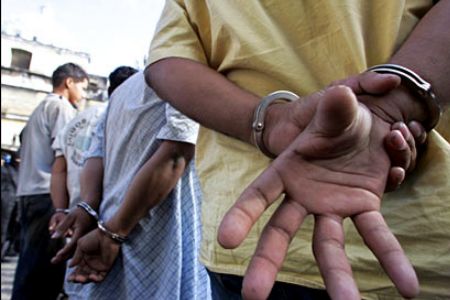
Attorneys for a group of Guatemalans have sued top US officials, accusing them of “intentionally” experimenting on them in the 1940’s and infecting them with syphilis.
Hundreds of Guatemalan prisoners, psychiatric patients and orphans were infected in a program to study penicillin.
The lawsuit was filed on Monday by lawyers for seven Guatemalan plaintiffs. But there is a high possibility that the number of the plaintiffs could reach to hundreds.
Last year, the United States apologized for the “reprehensible” experiments, according to state-run BBC.
The Obama administration, however, has not yet responded to a request for an out-of-court compensation settlement.
The experiments took place between 1946 and 1948 and around 700 Guatemalan nationals were used to test the efficiency of penicillin as a treatment and a preventative agent.
Evidence of the program was exposed by Professor Susan Reverby at Wellesley College in the US.
Reverby believes the then Guatemalan government gave permission for the tests but the people infected were unaware they were being experimented on.
In the experiments, researchers bribed care workers to let them inject their charges, while prisoners were encouraged to sleep with infected prostitutes.
Awarta Village Under Full Closure Since Saturday; Scandinavian Activists Trapped
By Saed Bannoura – IMEMC News – March 15, 2011
Israeli forces have maintained a closure of the village of Awarta for the last three days, preventing all residents from leaving their homes, with no indication as to when the closure will end and the residents will be allowed out of their homes. Any person caught leaving their home for any reason has been abducted by Israeli troops.
The village closure began soon after the murder of an Israeli family, including a baby and two small children, on Friday night in Itamar settlement, located near the village of Awarta in the northern West Bank.
Since Awarta is the closest village to the settlement, Israeli forces searching for the assailant poured into the village in the early hours of Saturday morning, and have remained in Awarta since that time, searching and ransacking homes and maintaining a strict closure.
Three international non-violent activists with the International Solidarity Movement, Cinda, 23, Chad, 25, from Sweden, and Cissy, 53, from Norway, have been unable to leave the village, and have reported several incidents of soldiers beating local residents in their presence.
The activists also reported that around 100 men were rounded up and held for interrogation at a local school on Monday.
The Israeli army has made no statement as to the identity of the perpetrator of Friday night’s attack, although they have abducted around 30 Palestinians from nearby areas, including Awarta village, for interrogation.
~
Ma’an:
An early morning food delivery from the municipality of Nablus appears not to have been delivered to all residents of the town, which according to the Palestinian Central Bureau of Statistics has over 5,000 inhabitants.
Dutch journalist Lydia de Leew, traveling with medics from the Union of Health Care Committees, told Ma’an that they were waiting for permission to enter the village, after hearing reports that an Israeli sniffer dog had attacked a child.
Bahrain declares state of emergency
“We say the United States has given them the green light. From the moment the US Secretary of Defense left Bahrain, we’ve seen the Bahraini government take the decision to invite the troops from the neighboring countries, and it’s been agreed to by the United States. This is an act of violence, an act of war, and we think these troops are not welcome in this country. People are very angry on what has been happening. It’s going to deteriorate… ”
– Nabeel Rajab, president of the Bahrain Center for Human Rights
Press TV – March 15, 2011
Bahrain’s King Hamad bin Isa Al Khalifa has declared a three-month state of emergency in the country as anti-government protests continue in the Persian Gulf state.
The decision comes as Bahraini Shia majority have voiced readiness to sacrifice their lives in defense of the people’s right to hold peaceful protests against Sunni Al Khalifa royal family.
The government’s violent crackdown on anti-government demonstrations has been stepped up by a military incursion by Saudi Arabia, Kuwait, the United Arab Emirates, Oman and Qatar who dispatched their armed forces to Bahrain.
The move has concerned UN Secretary General Ban Ki-moon, who has called for a meaningful and broad-based national dialogue.
He has also urged Bahrain’s neighbors and the international community to support a dialogue process and an environment conducive for credible reform in Bahrain.
At least seven people have been killed and hundreds of others injured in the Bahraini government’s violent crackdown on peaceful demonstrators.
On Tuesday, military helicopters were hovering over residential areas in Manama and randomly shot at people as reports of more mortality came from Bahraini medics and hospital sources.
Thousands of Bahraini anti-government protesters are still camping out in Manama’s Pearl Square — which has become the symbol of the popular drive for change. They say they will not abandon their ground unless their demands are met.
Inspired by the popular revolutions in Egypt and Tunisia, Bahraini protesters have been calling for freedom, a constitutional monarchy and a say in the government.
~
Hezbollah: Military Intervention Will Be in Vain
Commenting on Arab neighboring countries intervention in Bahrain, Hezbollah issued the following statement:
“In front of recent developments of Bahrain, featured by forces of neighboring Arab countries entering the Bahraini land, alongside with the use of violence which harvested many as martyrs and wounded, Hezbollah can only express his deep concern and strong condemnation of targeting peaceful civilians.
Hezbollah views that the military intervention and the use of violence against a peaceful popular movement will not only be in vain, but will also complicate issues and eliminate the solution opportunities.
Hezbollah considers that the U.S. stance toward those developments is very suspicious, and reflects the real policy of the U.S. administration towards movements of peoples.”
–End of Hezbollah Statement
Yemeni protesters take over two cities
Press TV – March 14, 2011
As anti-government protests escalate in Yemen, revolutionaries have taken control of two major cities in the north and east of the country.
The protesters reportedly took over al-Jawf, which borders Saudi Arabia in the northeast on Monday. Three soldiers were killed during clashes in the city.
Protesters also took control of Marib, east of the capital, Sana’a, where several oil and gas fields run by international companies are located.
Earlier reports said Marib Governor Ahmed Naji al-Zaidi was attacked and wounded during an anti-government protest outside the local government headquarters. He is currently receiving treatment in Sana’a.
Meanwhile, one of Yemen’s largest tribal federations, Baqil, joined the protesters in the capital’s Change Square.
Two high-ranking officers have also joined the protesters.
This comes as Yemeni police have intensified the crackdown on demonstrators. Security forces have surrounded a protest camp in Sana’a.
At least 40 people were injured in the capital after police opened fire on protesters on Monday.
One-hundred others were also wounded on Sunday after police on rooftops fired live rounds and teargas on people, camping near Sana’a University.
Heavily armed troops have also been deployed in the southern city of Aden.
Protesters are calling for President Ali Abdullah Saleh to step down after 32 years in power.
Bil’in protest organizer Abdallah Abu Rahmah released from Israeli prison
Popular Struggle Coordination Committee | March 14, 2011
Abu Rahmah was released this evening, after having served the 16 months sentence imposed on him by the Israeli Military Court of Appeals for organizing demonstrations. Abu Rahmah was received by his family, friends and supporters at the prison’s gate and vowed to continue the struggle.
After much delay, Abu Rahmah who was supposed to have already been released yesterday, was finally released from the Ofer Military Prison this evening. He was received by hundreds who waited for him at the prison’s gate.
Abu Rahmah, who during his trial was declared a human rights defender by the EU and a prisoner of conscious by Amnesty International, vowed to continue struggling against the Occupation, despite his unjust imprisonment and the six-months suspended sentence still imposed on him. He said, “On my release, I have no intention to go back home and sit there idly. In fact, by imprisoning me they have silenced me long enough. Our cause is just, it is one striving for freedom and equality, and I intend to continue fighting for it just as I have before”.
Abu Rahmah, the coordinator of the Bil’in Popular Committee Against the Wall and Settlements, was arrested last year by soldiers who raided his home at the middle of the night and was subsequently indicted before an Israeli military court on unsubstantiated charges that included stone-throwing and arms possession. Abu Rahmah was cleared of both the stone-throwing and arms possession charges, but convicted of organizing illegal demonstrations and incitement.
An exemplary case of mal-use of the Israeli military legal system in the West Bank for the purpose of silencing legitimate political dissent, Abu Rahmah’s conviction was subject to harsh international criticism. The EU foreign policy chief, Catherine Ashton, expressed her deep concern “that the possible imprisonment of Mr Abu Rahma is intended to prevent him and other Palestinians from exercising their legitimate right to protest[…]”, after EU diplomats attended all hearings in Abu Rahmah’s case. Ashton’s statement was followed by one from the Spanish Parliament.
Renowned South African human right activist, Archbishop Desmond Tutu, called on Israel to overturn Abu Rahmah’s conviction on behalf of the Elders, a group of international public figures noted as elder statesmen, peace activists, and human rights advocates, brought together by Nelson Mandela. Members of the Elders, including Tutu, have met with Abu Rahmah on their visit to Bil’in prior to his arrest.
International human rights organization Amnesty International condemned Abu Rahmah’s conviction as an assault on the right to freedom of expression, and declared him a prisoner of conscious. Human Rights Watch denounced the conviction as well, pronouncing the whole process “an unfair trial”.
Israeli human rights organizations also criticized the conviction – including statements by B’Tselem, which raises the issue of questionable testimonies by minors used to convict Abu Rahmah, and The Association for Civil Rights in Israel (ACRI) which highlights the impossibility of organizing legal demonstrations for Palestinians in the West Bank.
Legal Background
Abu Rahmah, the coordinator of the Bil’in Popular Committee Against the Wall and Settlements, was acquitted of two out of the four charges brought against him in the indictment – stone-throwing and a ridiculous and vindictive arms possession charge. According to the indictment, Abu Rahmah collected used tear-gas projectiles and bullet casings shot at demonstrators, with the intention of exhibiting them to show the violence used against demonstrators. This absurd charge is a clear example of how eager the military prosecution is to use legal procedures as a tool to silence and smear unarmed dissent.
The court did, however, find Abu Rahmah guilty of two of the most draconian anti-free speech articles in military legislation: incitement, and organizing and participating in illegal demonstrations. It did so based only on testimonies of minors who were arrested in the middle of the night and denied their right to legal counsel, and despite acknowledging significant ills in their questioning.
The court was also undeterred by the fact that the prosecution failed to provide any concrete evidence implicating Abu Rahmah in any way, despite the fact that all demonstrations in Bil’in are systematically filmed by the army.
Under military law, incitement is defined as “The attempt, verbally or otherwise, to influence public opinion in the Area in a way that may disturb the public peace or public order” (section 7(a) of the Order Concerning Prohibition of Activities of Incitement and Hostile Propaganda (no.101), 1967), and carries a 10 years maximal sentence.
Israeli forces detain over 300 in Awarta
Ma’an – 14/03/2011
NABLUS — Soldiers toured Awarta village on Monday morning, calling over loud speakers for all residents aged 15-40 to gather in the yard of the community’s school.
Local sources said a village council official and a local man working for the Palestinian security departments were said to have been detained overnight.
Palestinian security officials told AFP that two Palestinian Authority intelligence officers were among over 300 residents detained by Israeli soldiers
The Israeli army refused to comment on the detentions.
The call to appear at the school was the first time many were permitted to leave their homes in three days, and village council leader Qays Awwad said interrogations were expected.
An Israeli-imposed curfew remains in place on the village for the third day in a row, keeping Awarta residents locked indoors as a wide-scale military campaign continues. Israeli media said the military had declared the village a closed military zone.
Awwad village council Salim Qawariq had been taken from his home while Israeli forces inspected it, while informed Palestinian sources confirmed the detention of Lieutenant Iyad Muhammad Awwad, a Palestinian general intelligence officer.
Two activists with the International Solidarity Movement were able to enter Awarta before the curfew was imposed, and confirmed the continued closure of the town.
Speaking with Ma’an one Swedish national said searches conducted by Israeli forces appeared random, with homes being entered more than once over the course of three days.
In one home the activist said he visited shortly after a military search, framed pictures were smashed, furniture overturned, fuse cables cut, cash and SIM phone cards confiscated, a computer thrown off its desk, and oil poured into barrels of drinking water in the kitchen.
“From where we are we have seen at least 19 people taken from homes and transported to an unknown location,” he said.
Locals told the ISM activists that Israeli forces searched the town hall, taking some 1,800 shekels ($500) from a drawer, and an unknown amount from the council’s safe.
Medicines and basic food stuffs in the village were said to be running short, with families forced to live off any reserves in their homes, council member Awwad said.
Israeli forces said Monday that they were searching the village for suspects in the murder of five members of a settler family from the adjacent settlement of Itamar. A mother, father and three of their children were stabbed to death on Friday night, by an unknown assailant.
Israeli officials have said that they believe a Palestinian was behind what has been described as a “terror attack.”
Condemnations of the killings were issued in Ramallah, with prime minister-designate Salam Fayyad saying “An infant, two children and their parents were the victims, and as we have always rejected violence against our people, we reject it against others and we condemn it.”
Israeli police were put on high alert and the army said troops had been ordered “to be vigilant” for any attempted revenge attacks, reports said on Sunday.
The murder of five out of eight members of the settler family sparked anger from Israel and its settler communities. A wave of attacks against Palestinian civilians has been documented across the West Bank, including the torching of a field north of Ramallah, vandalism in the southern West Bank near Hebron, and several incidents of rock and Molotov cocktail throwing on settler roads connecting West Bank population centers.
Featured Video

Trump asks Iran not to retaliate after he strikes Pickaxe Mountain
or go to
Aletho News Archives – Video-Images
Book Review
‘Why Fauci Must Rot in Prison’: A Tale of Two Diaries
By Jill Erzen | The Defender | October 13, 2026
Dr. Anthony Fauci’s private diary reveals a “mind-numbing” contradiction between what the former top U.S. infectious disease official knew about COVID-19 and what he told the public, senior White House adviser Peter Navarro, Ph.D., said last week on “American Thought Leaders.”
In his new book, “Why Fauci Must Rot in Prison,” due out Oct. 20, Navarro compares Fauci’s private entries to his own pandemic-era diary, and uses what he calls “a tale of two diaries” to argue that Fauci should face criminal prosecution.
“I show, actually, how a prosecution can and should happen … at the state level, most likely,” Navarro said. “He should wind up in prison, and we’ve got the receipts in this book to put him there.”
Navarro said Fauci repeatedly acknowledged important facts in private, then publicly pursued policies that contradicted those facts — with devastating consequences.
“What he says many times privately in his diary is so at odds with both his public behavior and public statements that it’s mind-numbing,” Navarro said.
Navarro examines the lasting damage caused by lockdowns and other pandemic policies, and the ongoing toll of long COVID.
His book also addresses questions about vaccine safety, including why healthy young people faced COVID-19 vaccination mandates despite concerns about myocarditis, and why women were not warned about miscarriage risks linked to the shots. … continue
Blog Roll
 Aletho News
- Yemen denounces international community’s silence on Saudi aggression, siege
- UAE and Saudi Arabia move toward renewed coordination against Sanaa
- How Iran’s two-week retaliatory strikes exposed cracks in US military architecture in Persian Gulf
- The mother of all propaganda: Why the hype over US MOAB strike against Iran is nothing but theater
- Iran says it possesses technology behind US 14-ton GBU bunker-buster
- Trump asks Iran not to retaliate after he strikes Pickaxe Mountain – w/ Prof. Marandi
- Vice President J.D. Vance’s Deceptive ‘Antiwar’ Campaign Speech
- Iran: Palestinians’ rights must not be compromised in Gaza’s future; US, Israel to blame for Hormuz situation
- Ongoing tales of Syrian chemical weapons
- Moscow blasts UN for ignoring torture of Russian POWs
- If Americans Knew
- Israeli rabbi permits occupiers to steal Palestinian olive harvest in West Bank
- Netanyahu’s spin on latest settler attack is laughable – Daily Update
- Israeli soldiers debunk Israel’s talking points
- In West Bank, Israeli settlers are totally out of control – Daily Update
- NPR investigation finds evidence of widespread fraud at mall kiosks tied to Israeli skincare brand
- Tucker Carlson exposes Israeli Lies about the Oct 7th attack, Charlie Kirk, and the U.S.
- Israel has detained thousands of Palestinian children since Oct 7th – over half spent time in solitary, many uncharged
- Israeli Analysis: Is Netanyahu Planning an ‘October Surprise’ Attack Before Israel’s Election?
- Israeli settlers brutally attack Palestinians and Washington Post female photographer, 65
- Words Have Changed, Occupation Continues: The Reality of the Gaza Ceasefire
- No Tricks Zone
- Predictions Made By Renowned Climate Proifessor Over Past Decades Have Been Proven To Be Poor
- New Study Suggests Large Regions Of The Pacific Ocean Have Been Cooling For The Last 80 Years
- Germany’s Green Energy Debacle: High Energy Costs Force Kahla Porzellan to Close After 182 Years!
- New Study: 50 Years Of The Most Aggressive ‘Net Zero’ Policies Can Only Affect The Global Climate By 0.03°C
- US September “Heat” Was No Record…Many Records Set Decades Ago
- Latest European Green Energy Debacle; Portugal’s Largest Flagship Solar Park Insolvent!
- Green Energy Debacle: German Expert Professor Fritz Vahrenholt Warns Of Severe Economic And Social Consequences
- Two More Paleo Reconstructions Affirm Meters-Higher Sea Levels Across Ireland, Brazil 7000-6000 Years Ago
- New Study: Earth And Venus Surface Warmth Largely Explained By Convection And Lapse Rate, Not CO2 Or Radiation
- 2025 Nature Paper Claiming Worsening Global Drought Gets RETRACTED …Heavily Flawed

