Israeli troops fire on women marking International Women’s Day, serious injuries reported
Stun grenade fired at woman’s face
Ma’an – March 6, 2011
RAMALLAH — Israeli forces violently shut down a demonstration led by women north of Jerusalem on Saturday, organizers said.
Border police fired tear gas and rubber-coated bullets at the protesters marking International Women’s Day at the Qalandiya checkpoint.
The event was organized by minister of social affairs Majeda Al-Masri, a leader in the Democratic Front for the Liberation of Palestine, and union officials from Hebron and Ramallah in the occupied West Bank.
It was not clear how many people were hurt, but union official Nehad Al-Akhras said a Swedish activist was seriously injured by a stun grenade which struck her in the face. She was hospitalized in Ramallah.
~
Addameer Prisoner Support and Human Rights Association
Join us in calling for the immediate release of all Palestinian women political prisoners.
Petition: We, the undersigned members of worldwide civil society, are marking International Women’s Day on 8 March 2011 by calling on the Israeli authorities to immediately release all Palestinian women political prisoners and detainees from Israeli jails, including women in administrative detention. We condemn the cruel and discriminatory treatment that Palestinian women prisoners and detainees are subjected to during their arrest and interrogation and in prison, including sexual harassment, psychological and physical punishment and humiliation, and deprivation of gender-sensitive healthcare. This is in contravention of international law and must stop immediately.
To sign the petition, please go here.
Knee Capped for Driving While Arab
By Maysa Abu Ghazala – Palestine News Network – March 5, 2011
On Thursday, February 24, 20-year-old Mohammad Gharib of al-Issawiya village near Jerusalem was driving home, bringing dinner from a restaurant in Jerusalem.

Mohammad Gharib – PNN
Mohammad took his youngest brother and his friend along for the ride. When they reached the intersection leading to the Ma’ale Adumim settlement, their car broke down.
“As I was trying to see what happened to the car, three settlers stopped and offered to help,” Mohammad recalled. “I thanked them and as I was speaking to them in Hebrew, they realized I was Arab. They started calling me names, then one of them pulled his gun and shot me in the knee.”
Mohammad was taken immediately to al-Maqasid hospital in Jerusalem, then moved to the Israeli hospital of Hadassah where doctors told him his knee was shattered and muscles torn.
“Doctors installed a device to make me walk,” he said, “but now I can’t leave my bed on my own”.
Mohammad said he filed a police report and told Israeli officers that he could identify the settler who shot him. He also demanded they work on his case quickly.
As of now, he is still lying in bed in pain and waiting for the police to arrest his attackers.
Related articles


Bahrainis call for prisoners’ release
Press TV – March 2, 2011
Thousands of Bahraini protesters have gathered outside the building of the interior ministry in the capital, demanding the release of political prisoners.
Chanting anti-government slogans on Wednesday, the protesters in Manama marched to Pearl Square — the epicenter of the movement — demanding the ruling family to step down.
As the popular uprising entered its 17th day in Bahrain, the opposition groups in the Persian Gulf kingdom called for more private and public sector strikes and more rallies to oust the government.
They also urged protesters to block all main roads and take over government buildings to force the Sunni-dominated regime to respond to their demands.
Protesters demand major political reforms, including the establishment of a “real constitutional monarchy,” as well as the resignation of the government, which they hold responsible for the killing of peaceful demonstrators.
Many protesters, mainly Shias, have also called for an end to the rule of Al Khalifa dynasty which has been in power the country for over two centuries.
“230 years is enough, Al Khalifa leave,” read a banner, referring to the Sunni royal family which rules Bahrain.
Meanwhile, many protesters have vowed to continue to camp out in Pearl Square and have refused to enter talks with the government until their demands are met.
Last week, in an attempt to contain massive anti-government demonstrations, Bahrain’s King Hamad bin Isa Al Khalifa pardoned 23 political prisoners and ventured a minor cabinet reshuffle.
But the measures seem not to have been enough for the opposition who say hundreds of political activists are still in Bahraini jails, and for thousands of anti-government protesters who are still out, demanding the ruling family to step down.
Liberals as Latter-Day Neocons
The Change We Still Need
By JAMES ZOGBY | CounterPunch | March 2, 2011
When speaking about the Arab uprisings in Tunisia, Egypt and beyond, the language used here in the US is euphoric. Expressions like “nothing will ever be the same again” and “the existing order is being swept away” are common. But when the conversation comes home, the exuberant rhetoric is pushed aside and hard-nosed practicality becomes the order of the day. “The president had no choice,” the pundits said. “He had to veto. Republicans would have pounced on him and the pro-Israel crowd would have made his life miserable.” This is the accepted wisdom.
It is, of course, always easier to discuss what other countries and their leaders must do than it is to face up to the hard realities of what must be done in one’s own backyard. At the same time, though, it is a bit brazen, and even bizarre, that we can be so blind to the stark contradiction between what we advocate for others and what we fail to do for ourselves. But this is what is taking place.
Right now in commentaries the Bush crowd is crowing, “We were right”, finding new justification in their past promotion of democracy — ignoring, of course, the utter hypocrisy of their overall approach to the region. They gave lip-service to democracy, to be sure, but then they led America into two deadly and failed wars (both of which they wrongly projected would usher in democratic change); turned a blind eye as Israel ravaged Palestinians and the Lebanese; and instituted the wide-spread use of profiling, prolonged detentions without due process, and prisoner abuse, all of which they pressured Arab allies to support.
The net result was a roiling of Arab public opinion and a delegitimising of some Arab leaders who had befriended America, making them more vulnerable and less receptive to proceed on the path of reform. Then, after strong electoral performances by hardline religious parties in several countries, the Bush administration, not liking the outcome, shelved their democracy rhetoric.
More disturbing than this irritatingly predictable neo-conservative effort to rewrite history and hijack the Arab uprising is the fact that many liberals can find no more creative response to these Arab uprisings than to become latter-day “neo-cons” themselves.
All this posturing ignores several uncomfortable truths. America’s favourable ratings across the Arab world are back to Bush- era lows and the post-Cairo optimism that America would change its approach to the region has all but evaporated. America, it bears repeating, is not unpopular amongst many Arabs because we have supported their leaders; rather it is some Arab leaders who have become unpopular because they have supported our policies. We were, in a real sense, not in the game, having long ago dealt ourselves out. In their efforts to make change in their own countries, Tunisians and Egyptians weren’t looking to us. This was their movement, not ours.
There is a real danger that in this moment of crisis we will either learn the wrong lessons, or learn no lessons at all. What is required now is to recognise the degree to which our failed policies of the past have alienated Arab public opinion, undercut our stated values, and put at risk those who sought to be our friends.
At a critical moment in the midst of the Vietnam War, Martin Luther King delivered his “Declaration of Independence from the War in Vietnam”. In this speech he said “I am convinced that if we are to get on the right side of the world revolution, we as a nation must undergo a radical revolution of values … A true revolution of values will soon cause us to question the fairness and justice of our past and present policies.” This challenge is as true today as it was then.
Unless our political leaders can put aside “politics as usual” and end their callous disregard for the suffering of Palestinians; unless leaders are willing to challenge their political fears and do what is right, instead of what is convenient; unless we can stand up against the Islamophobes who threaten to tear apart the fabric of our nation; unless we can restore our commitment to fundamental freedoms and constitutional protections; and unless we can stop ignoring Arab concerns and truly listen to what Arab voices are telling us about their needs and aspirations, we will continue to operate clumsily, and at times brutally, on the wrong side of history.
As Arabs seek change at home, the challenge we face is to question how we can bring real change to America and to the way America deals with the Arab world and its people. This is what Barack Obama promised when he said that he would lead the effort to “change Washington” and, in the process, “change America and change the world”. This is still the change we need. Unfortunately, it hasn’t happened yet.
James Zogby is president of the Arab American Institute.
Dershowitz rides shotgun for student attacking Palestinian scholar and his wife in California
By Philip Weiss on March 1, 2011
Bassam Frangieh is an Arabic scholar and translator who teaches at a California college, Claremont McKenna. I imagine that his life is framed by the Nakba; his family was extirpated from Jaffa in 1948; they owned orange groves; he was born in a refugee camp. In 2006, he had the nerve to attack Israel over the 2006 Lebanon invasion and describe Hizbullah as the national resistance.
Now he is being smeared as pro-terrorist by Charles Johnson, a journalist at Claremont McKenna, who published this attack in the National Review, citing the usual fragmentary statements about Hamas and Hezbollah. It includes this McCarthyite pirouette:
Frangieh’s radicalism is shared by his wife, Aleta Wenger. A former State Department official who worked on the Middle Eastern desk, Ms. Wenger is currently director of Claremont’s Center for Global Education and, as such, is the public face of the college overseas. Like her husband, she takes a conspiratorial view of Israel’s military, accusing it, without evidence, of bombing universities and hospitals.
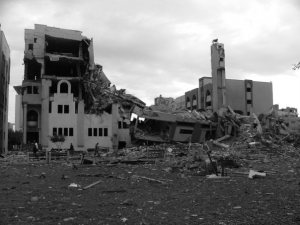 I’ve been to Gaza. I saw the ruins of the gene sequencing building at the Islamic University and of Al Quds Hospital. It is not clear to me who is pushing back, though apparently the Claremont administration is defending Frangieh on free speech grounds.
Johnson devoted a piece to Frangieh’s wife last month, too. And last night he stated in a letter to Claremont McKenna execs that he is getting help from Alan Dershowitz:
I should add that all of the material that I or The Claremont Independent published regarding Professor Bassam Frangieh has been reviewed by my counsel and by Professor Alan Dershowitz of Harvard Law School. The primary source material that I and The Claremont Independent published was translated by three different translators at considerable personal expense.
In the same piece Johnson says “nearly the entirety of the Government Department” at Claremont McKenna is on his side. I wonder how many of them know the history of the Israel-Palestine conflict and the role it is now playing in American politics…
Blind, brazen, hypocritical and unjust, in whose name does Dutch FM Rosenthal speak?
Rifat Odeh Kassis, The Electronic Intifada, 1 March 2011
 |
Appointed Palestinian Authority Prime Minister Salam Fayyad with Uri Rosenthal, Minister of Foreign Affairs of the Netherlands, February 2011. (Mustafa Abu Dayeh/MaanImages) |
In recent months, a number of Latin American countries have publicly expressed their recognition of Palestinian statehood. Given that a Palestinian state doesn’t yet exist, this recognition also amounts to supporting the Palestinian right to statehood. For Israel and defenders of its policies around the world, the “snowball effect” of nations recognizing this right is, unsurprisingly, unnerving.
One such defender is Dutch Foreign Minister Uri Rosenthal. In an 8 February interview with The Jerusalem Post, Rosenthal argued why he believes international support for a Palestinian declaration of statehood “does no good” (“Dutch FM: Recognition of Palestinian state does no good“).
But what strikes me most about the interview is not the straightforwardness of his opposition. Rather, I am struck by what his opposition barely manages to mask: the hypocrisy of his rhetoric on “negotiations” and “democratic values;” a repressive attitude toward what he characterizes as “inflammatory language regarding Israel” within the EU; a betrayal both of the Netherlands’ strong record of commitment to international law and of his responsibilities as the representative of that commitment; and, ultimately, a glimpse of the hypocritical and increasingly repressive policies seen in the EU toward victims and critics of the State of Israel.
Part of what Rosenthal clearly opposes is a unilateral declaration of Palestinian statehood. Dutch policy is also changing along these lines: the Dutch parliament recently passed a resolution that calls for the government to oppose EU recognition of a Palestinian state. But Rosenthal doesn’t utter a word of objection to the unilateral steps taken by Israel.
Israel has illegally annexed East Jerusalem, demolished Palestinian homes there and elsewhere (and even entire towns — the military recently destroyed the Bedouin village of al-Araqib for the 18th time). It has confiscated vast amounts of Palestinian land to build its apartheid wall — the route of which was illegal in 2004 by the International Court of Justice in The Hague — and to protect terrain for illegal settlements. In violation of international law, it encourages its civilian population to inhabit those settlements (which have eaten away at more than 40 percent of the West Bank), practiced brutal detention policies, restricted freedom of movement and other fundamental liberties, tried children in military courts, put the Gaza Strip under a state of permanent siege and killed more than 1,400 Palestinians in Gaza (including 352 children) during its winter 2008-09 bombardment.
The list of unilateral acts — the list of crimes — goes on and on. Rosenthal claims to oppose decisions taken by governments without balanced, negotiated political processes. But if this were really true, he would understand the need to bring Israeli officials and military officers responsible for such crimes to the International Criminal Court in The Hague instead of defending
Israel’s actions in The Jerusalem Post.
Yet Rosenthal not only defends Israel in the Israeli press; he is also doing so under the auspices of, and with the responsibilities endowed to him by, his own parliament. Indeed, as The Jerusalem Post states, “Rosenthal, who is Jewish and married to an Israeli, was characterized recently by Czech Foreign Minister Karl Schwartzenberg as one of the two most active supporters of Israel among EU foreign ministers.” And he defines himself as “among the ones” in the EU who “regularly try to warn against unnecessary inflammatory language” and its “disproportionate” application to Israel. He recommends a “restrained attitude” to his EU partners when it comes to potential initiatives regarding the Palestinian-Israeli conflict; he staunchly disagrees with the suggestion that Israel’s image within the EU is “the lowest it has been in decades,” saying that there are many “balanced conclusions vis-a-vis the Middle East peace process.”
Such “restraint” not only condones policies that flagrantly violate international law and human rights, then, but also seeks to prohibit other EU countries from engaging in positive, proactive initiatives that might bring the conflict closer to an end. He is an influential proponent of the increasingly hypocritical EU stance on the Israeli occupation. This stance praises the meaningless concessions wrung out of diplomatic efforts (as Rosenthal praises Israel for becoming more “lenient” with respect to goods from Gaza, at the urging of the Dutch government) without recognizing that these band-aids only serve to prolong our occupation and subjugation.
Moreover, by defending Israel’s injustices through public office, Rosenthal thus makes his own country a partner in their perpetuation. The Dutch people are well-admired throughout the world as prioritizing human rights and international law; they, then, are being damaged and degraded by Rosenthal’s audacity. The Dutch people must know that their foreign minister is sacrificing the image of The Netherlands for the sake of Israel — that he is working hard to represent Israel’s interests while tarnishing those of his own country — and they should reject this insult, this injury.
While Rosenthal describes part of his work as to “warn” against “unnecessary inflammatory language” toward the Israeli state, this actually amounts to a justification of the government’s right to censor, repress criticism and create political blacklists. Rosenthal’s rhetoric and policies go hand-in-hand with those of Zionist lobbies like NGO Monitor and CIDI (The Center for Information and Documentation on Israel), which bully, harass and defame civil society groups exposing the truth about the Israeli occupation and human rights abuses. (It is worth mentioning that a CIDI board member, Doron Livnat, is the director of Riwal, a European company that produces access equipment and rents large-scale cranes for construction sites, and which has assisted in building the wall and illegal settlements in the occupied West Bank. Riwal’s headquarters in Dordrecht, Netherlands, was raided and searched by the Dutch National Crime Squad after Al-Haq, a Palestinian human rights group, levied criminal complaints against its activities.)
For instance, NGO Monitor recently slammed ICCO, a Dutch international development organization, for financing The Electronic Intifada. (ICCO is also under fire from CIDI for supporting the Olive Tree Campaign “Keep Hope Alive,” realized by the YMCA/YWCA Joint Advocacy Initiative. NGO Monitor vilified The Electronic Intifada and condemned ICCO by association. Rosenthal’s response? “I will look into the matter personally,” he said. If ICCO’s funding proves to be true, “it will have a serious problem with me,” he warned.
Is this the level that Rosenthal — not to mention the lobbies who share his tactics of finger-pointing, threats and repression — has stooped to? Persecuting organizations and publications that support human rights and social justice for Palestinians as “delegitimizing” and “anti-Semitic,” publicly smearing them and seeking to sabotage not only their work but also their rights to free speech and free press? This is an appalling position for a democratic representative to have, ostensibly part of an apparatus designed to uphold those rights in the first place.
These targeted campaigns led by European lobbies against Palestinian and Israeli nongovernmental organizations (NGOs), publications and advocacy groups are particularly chilling in light of similar campaigns being initiated in the Israeli Knesset: specifically, its moves to establish a committee for investigating the funding sources of certain (politically targeted) NGOs. In his interview with The Jerusalem Post, Rosenthal declined to comment on whether this initiative was “undemocratic,” saying “There is no reason to hide anything. I am in favor of transparency,” and “a vivid and lively civil society, where NGOs are a part of it, is very important.”
Rosenthal’s ongoing contradictions, and their echo within the policies of European governments, are astonishing. He claims to support transparency, not to mention the vividness and liveliness of civil society, while only acting repressively against groups and individuals he disagrees with. He says, free of irony, that the presence of NGOs in civil society is “very important,” when he supports a smear campaign against NGOs in his own civil society. And he praises the ideals of civil society itself while simultaneously practicing another campaign — silence — when it comes to Israel’s repression of the NGOs whose existence he finds so valuable in abstract.
Foreign Minister Rosenthal’s pronouncements on the Israeli government are so blind, so brazen, so hypocritical and so unjust that I am sometimes surprised he can utter them comfortably in his own name. But when we consider his vocal and prominent role in the parliament of his own country, and in the political arena of others’, it is especially important for all communities and individuals he attempts to represent (Jewish, Israeli, Dutch, European, etc.) to say loud and clear: “Not in our name.”
~
Rifat Kassis is International President of Defence for Children International (DCI) and General Director of its section in Palestine. He is also Coordinator and Spokesperson of Kairos Palestine – A Moment of Truth.
Israel shuts down Jerusalem event
Ma’an – 01/03/2011
JERUSALEM — Israeli police and intelligence agents forcibly shut down two events in East Jerusalem on Tuesday morning, citing “security reasons” for the clampdown.
Armed police and border guards prevented guests from entering a conference on “Defending Palestinian Rights in Jerusalem” at the Capitol Hotel on Salah Addin Street in Jerusalem, organizers said.
Police handed organizers a warrant signed by minister of internal security Yitzhaq Ahronovitch addressed to the hotel administration. The warrant warned that the meeting was banned for “security reasons.”
According to organizers, the one-day event was a conference and workshop for Palestinian Authority officials, leaders of non-profit organizations, and political officials. Agenda items included ways to protect residents of the Silwan from evictions and demotions.
Head of the coalition for defending Palestinians’ rights in Jerusalem Zakariyya Udah told Ma’an that police confiscated ID cards of all who attended the conference and took down their numbers before informing the hotel the conference was prohibited.
On Monday night, a similar order signed by the minister of internal security was delivered to organizers of a conference scheduled for the following day. The event was slated for the Al-Bustan protest tent in Silwan, where organizers were preparing to announce the establishment of a new youth union in Jerusalem.
The order was delivered when a unit of armed border guards and police entered the home of the conference organizer in Silwan, warning him of “legal consequences” if the event went ahead.
Egypt: Revisiting the Demands
Global Voices | February 10, 2011

A list of demands from the protesters at Tahrir Square is being circulated online today, the 17th day of massive demonstrations across Egypt calling for the overthrow of the Mubarak regime. The first item calls for the resignation of president Hosni Mubarak.
Wael Khalil lists those demands on his blog (Ar) and says:
These demands are the summary of various discussions at Tahrir Square, and are, of course, not representative of everyone at the square
The immediate demands are:
1. The resignation of president Mohammed Hosni Mubarak
2. Canceling the Emergency Law
3. Dismantling the state secret service
4. An announcement by (Vice-President) Omar Sulieman that he will not run in the next presidential elections
5. Dissolving the Parliament and Shura Council
6. Releasing all the prisoners since January 25
7. Ending the curfew so that life resumes as normal across the country
8. Dismantling the university guards system
9. Referring officials responsible for the use of violence against the peaceful protesters since January 25 and those responsible for the organised thuggery which followed January 28 to an investigation committee
10. Sacking Anas El Fiqi and stopping the attack on protesters in government owned media through threats and calling protesters traitors, and ending the spread of hate against foreigners in the streets
11. Reimbursing shop owners for their losses during the curfew
12. Announcing the demands above on government television and radio
Wael Khalil also lists demands for the transitional period as follows:
1. Drafting a new constitution
2. The right to set up newspapers and open television and radio stations without a prior permission
3. Putting the minimum wage of 1,200 Egyptian Pounds into effect
4. The right to set up political parties, by notification
5. The right to set up associations and unions, by notification
6. Achieving a real autonomy and independence for national newspapers and television and radio stations, through new legislation and the reformation of companies, establishments of ministries
7. Cancling the national service in the police force
8. Ending the security clampdown on telecommunications and the internet
Emphasis – Aletho News
Iraq: Security Forces Raid Press Freedom Group
Equipment, Documents Seized in 2 a.m. Break-In
HRW | February 26, 2011
(New York) – Iraqi authorities should immediately investigate a raid by security forces on the Journalistic Freedoms Observatory (JFO), a prominent Iraqi press freedom group, Human Rights Watch said today. Human Rights Watch also called on the government to ensure the speedy and safe return of all seized equipment and documents.
At about 2 a.m. on February 23, 2011, more than 20 armed men, some of them wearing brown military uniforms and red berets, and others wearing black military uniforms with skull-and-cross-bones insignia on their helmets, pulled up in Humvees outside the group’s office in Baghdad and broke in, a witness told Human Rights Watch. The security forces conducted a destructive search of the office that lasted more than an hour and seized the organization’s computers, external hard drives, cameras, cell phones, CDs, documents, and several flak jackets and helmets marked “Press,” the witness said.
“This raid on the Journalistic Freedoms Observatory shows the contempt of Iraqi authorities for groups that challenge the state’s human rights record,” said Joe Stork, deputy Middle East director at Human Rights Watch.
A spokesman for the Baghdad Operations Command confirmed to Human Rights Watch that the men were part of the Iraqi army but gave few other details.
Ziyad al-Ajili, the group’s executive director, told Human Rights Watch that the authorities “were obviously sending us a message to stop our work of supporting journalists…. This kind of governmental intimidation is precisely what we try to shed light on.” In Iraqi television interviews over the days leading up to the raid, al-Ajili voiced support for the right of Iraqis to protest peacefully and the media’s right to report on the protests.
Human Rights Watch visited the group’s office the morning after the raid and saw extensive damage, including broken furniture, destroyed equipment, kicked-in doors, and ripped-up posters and literature for the organization’s events, such as their annual “Press Courage Awards.” Framed photographs of journalists killed in Iraq since 2003 were strewn on the floor, covered in broken glass.
Human Rights Watch expressed concern that authorities would not return the computer hard drives and other electronic data storage devices seized from the group.
Al-Ajili said he fears that the authorities used the raid as a pretext to close the office, which serves as an informal gathering point for local journalists. In late January, the group held an awards ceremony in Baghdad, honoring investigative journalists who had uncovered corruption and other wrongdoing.
Although improvements in security since 2008 have reduced the assaults against media workers, journalists and press freedom advocates remain at risk in Iraq. On February 21, Human Rights Watch released a survey report, “At a Crossroads: Human Rights in Iraq Eight Years After the US-led Invasion,” which documents attacks against media and press restrictions. The report calls on the government to protect the rights of journalists and to amend its penal code and other laws that violate freedom of speech.
Bahrainis want ‘elected government’
Press TV – February 26, 2011
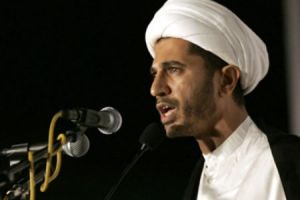 Sheikh Ali Salman of Bahrain’s leading opposition party al-Wefaq
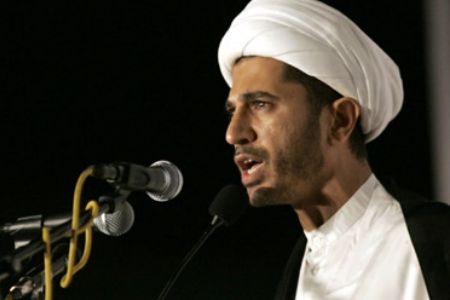
The head of Bahrain’s al-Wefaq party says the opposition only welcomes dialogues that will lead to the establishment of an elected government.
Sheikh Ali Salman told Press TV on Saturday that Bahrainis from all walks of life are calling for a democratic government.
“It’s part of the Arabic revolution. The Arab revolution is looking for a democracy, it’s simple like that. You can’t find it [here],” Salman said.
“There are no clashes between the Sunnis and the Shias,” he continued, “It’s really a clash between the dictatorship… and the people whose demands are a democratic government.”
“What is the meaning of a dialogue if there is no chance for this dialogue to reach a solution?” he added.
“We need from the government not just to say, I am ready for dialogue, but that I am ready to have a dialogue that is leading to an elected government,” Salman stated.
On Saturday, Bahrain’s King Hamad bin Isa Al-Khalifa dismissed the ministers of cabinet affairs, housing, health and electricity amid mass pro-democracy protests in the capital Manama.
The most recent wave of protests is calling for the resignation of the king as well as constitutional reforms. The Bahraini people are demanding free elections and the release of political prisoners as well.
The protesters, who have camped at Manama’s Pearl Square for the 12th straight day, say they will keep rallying until their demands are met.
Bahrain is a key US ally in the Middle East and home to Washington’s Fifth Fleet.
Libya: Is Washington Pushing for Civil War to Justify a US-NATO Military Intervention?
By Mahdi Darius Nazemroaya | Global Research | February 25, 2011
One should be opposed to dictatorship, but one should not forget the issue of foreign domination.
Is Tripoli being set up for a civil war to justify U.S. and NATO military intervention in oil-rich Libya?
Is “manufactured destruction” or “creative destruction” at work?
If Qaddafi is not ousted, are the talks about sanctions a prelude to an Iraq-like intervention?
Something is Rotten in the so-called “Jamahiriya” of Libya
There is no question that Colonel Muammar Al-Gaddafi (Al-Qaddafi) is a dictator. He has been the dictator and so-called “qaid” of Libya for about 42 years. (“UK Hague: some information that Qaddafi on way to Venezuela,” Reuters, February 21, 2011) Yet, it appears that tensions are being ratcheted up and the flames of revolt are being fanned inside Libya. This includes earlier statements by the British Foreign Secretary William Hague that Colonel Qaddafi had fled Libya to Venezuela. This statement served to electrify the revolt against Qaddafi and his regime in Libya.
Although all three have dictatorship in common, Qaddafi’s Libya is quite different from Ben Ali’s Tunisia or Mubarak’s Egypt. The Libyan leadership is not outright subservient to the United States and the European Union. Unlike the cases of Tunisia and Egypt, the relationship that exists between Qaddafi and both the U.S. and E.U. is a modus vivendi. Simply put, Qaddafi is an independent Arab dictator and not a “managed dictator” like Ben Ali and Mubarak.
In Tunisia and Egypt the status quo prevails, the military machine and neo-liberalism remain intact; this works for the interests of the United States and the European Union. In Libya, however, upsetting the established order is a U.S. and E.U. objective.
The U.S. and the E.U. now seek to capitalize on the revolt against Qaddafi and his dictatorship with the hopes of building a far stronger position in Libya than ever before. Weapons are also being brought into Libya from its southern borders to promote revolt. The destabilization of Libya would also have significant implications for North Africa, West Africa, and global energy reserves.
Colonel Qaddafi in Brief Summary
Qaddafi’s rise to power started as a Libyan captain amongst a group of military officers who carried out a coup d’état. The 1969 coup was against the young Libyan monarchy of King Idris Al-Sanusi. Under the monarchy Libya was widely seen as being acquiescent to U.S. and Western European interests.
Although he has no official state or government position, Qaddafi has nurtured and deeply rooted a political culture of cronyism, corruption, and privilege in Libya since the 1969 coup. Added to this is the backdrop of the “cult of personality” that he has also enforced in Libya.
Qaddafi has done everything to portray himself as a hero to the masses, specifically the Arabs and Africans. His military adventures in Chad were also tied to leaving his mark in history and creating a client state by carving up Chad. Qaddafi’s so-called “Green Book” has been forcefully portrayed and venerated as being a great feat in political thought and philosophy. Numerous intellectuals have been forced or bribed to praise it.
Over the years, Colonel Qaddafi has tried to cultivate a romantic figure of himself as a simple man of the people. This includes pretending to live in a tent. He has done everything to make himself stand out. His reprimanding of other Arab dictators, such as King Abdullah of Saudi Arabia, at Arab League meetings have made headlines and have been welcomed by many Arabs. While on state visits he has deliberately surrounded himself with an entourage of female body guards with the intent of getting heads to turn. Moreover, he has also presented himself as a so-called imam or leader of the Muslims and a man of God, lecturing about Islam in and outside of Libya.
Libya is run by a government under Qaddafi’s edicts. Fear and cronyism have been the keys to keeping so-called “order” in Libya amongst officials and citizens alike. Libyans and foreigners alike have been killed and have gone missing for over four decades. The case of Lebanon’s Musa Al-Sadr, the founder of the Amal Movement, is one of the most famous of these cases and has always been a hindrance to Lebanese-Libyan relations. Qaddafi has had a very negative effect in creating and conditioning an entire hierarchy of corrupt officials in Tripoli. Each one looks out for their own interests at the expense of the Libyan people.
Fractions and Tensions inside the Hierarchy of Qaddafi’s Regime
Because of the nature of Qaddafi’s regime in Tripoli, there are a lot of internal tensions in Libya and within the regime structure itself. One of these sets of tensions is between Saif Al-Islam Gaddafi and his father’s circle of older ministers. Libyan ministers are generally divided amongst those that gather around Saif Al-Islam and those that are part of the “old guard.”
There are even tensions between Qaddafi and his sons. In 1999, Mutassim Al-Qaddafi tried to ouster his father while Colonel Qaddafi was outside of Libya. Mutassim Qaddafi holds a Libyan cabinet portfolio as a national security advisor. He is also famously known amongst Libyans for being a playboy who has spent much of his time in Europe and abroad. There is also Khames Gaddafi who runs his own militia of thugs, which are called the Khames militia. He has always been thought of as possible contender for succession too against his other brothers.
There have always been fears in Libya about the issue of succession after Colonel Qaddafi is gone. Over the years, Qaddafi has thoroughly purged Libya of any form of organized opposition to him or prevented anyone else, outside his family, from amassing enough power to challenge his authority.
The Issue of Loyalty and Defection in Libya
Undoubtedly, little loyalty is felt for Qaddafi and his family. It has been fear that has kept Libyans in line. At the level of the Libyan government and the Libyan military it has been both fear and self-interest that has kept officials, good and corrupt alike, in line. That mantle of fear has now been dispelled. Statements and declarations of denunciation against Gaddafi’s regime are being heard from officials, towns, and military barracks across Libya.
Aref Sharif, the head of the Libyan Air Force, has renounced Qaddafi. Interior Minister Abdul Fatah Al-Yunis (Al-Younis), who is from Benghazi (Bengasi) and oversees a branch of the special operations work in Libya, has resigned. Yunis is reported to be Qaddafi’s “number two” or second in charge, but this is incorrect. Abdullah Sanusi, the head of Libyan Internal Intelligence and Qaddafi’s relative through marriage, is the closest thing to a “number two” within the structure of power in Tripoli.
Reports have been made about two Libyan pilots defecting to Malta and Libyan naval vessels refusing to attack Benghazi. Defections are snowballing amongst the military and government. Yet, there must be pause to analyze the situation.
The Libyan Opposition
At this point, however, it must be asked who is the “opposition” in Libya. The opposition is not a monolithic body. The common denominator is the opposition to the rule of Qaddafi and his family. It has to be said that “actions of opposition or resistance against an oppressor” and an “opposition movement” are also two different things. For the most part, the common people and corrupt Libyan officials, who harbour deep-seated hate towards Qaddafi and his family, are now in the same camp, but there are differences.
There is an authentic form of opposition, which is not organized, and a systematic form of opposition, which is either external or led by figures from within the Libyan regime itself. The authentic people’s internal opposition in Libya is not organized and the people’s “actions of opposition” have been spontaneous. Yet, opposition and revolt has been encouraged and prompted from outside Libya through social media networks, international news stations, and events in the rest of the Arab World.
The leadership of the internal opposition that is emerging in Libya is coming from within the regime itself. Corrupt officials that have rebelled against Gaddafi are not the champions of the people. These opposition figures are not opposed to tyranny; they are merely opposed to the rule of Colonel Qaddafi and his family. Aref Sharif and Al-Yunis are themselves Libyan regime figures.
It has to also be considered that some Libyan officials that have turned against Qaddafi are doing it to save themselves, while others in the future will work to retain or strengthen their positions. Abdel Moneim Al-Honi, the Libyan envoy to the Arab League in Cairo, can be looked at as an example. Al-Honi denounced Qaddafi, but it should be noted that he was one of the members of the group of Libyan officers who executed the coup in 1969 with Qaddafi and that later in 1975 he himself tried to take power in a failed coup. After the failed coup, he would flee Libya and only return in 1990 after Qaddafi pardoned him.
Al-Honi is not the only Libyan diplomat to resign. The Libyan ambassador to India has also done the same. There is an intention on the part of these officials to be members of the power structure in a Libya after the ouster of Qaddafi:
Libyan Ambassador to India Ali al-Essawi told the BBC that he was quitting, opposing his government’s violent crackdown on demonstrators.
Mr. Al-Essawi was reported to be a Minister in Tripoli and could be an important figure in an alternative government, in case Libyan President Muammar Qadhafi steps down.
The second Libyan diplomat to put in his papers was Tripoli’s Permanent Representative to the Arab League Abdel Moneim al-Honi, who said in Cairo that he had quit his job to “join the revolution” in his country.
“I have submitted my resignation in protest against the acts of repression and violence against demonstrators, and I am joining the ranks of the revolution,” said Mr. Al-Honi. The Second Secretary Hussein Sadiq al Musrati, announced his resignation from China, in an interview with Al-Jazeera, and called on the Army to intervene in the uprising. (“3 Libyan Diplomats resign,” The Hindu, February 22, 2011)
Again, these revolting officials, like Al-Yunis and Sharif, are from within the regime. They are not mere diplomats, but former ministers. There is also the possibility that these types of “opposition figures” could have or could make arrangements with external powers.
External Forces at Play in Libya
The governments of the U.S., Britain, France, Germany, and Italy all knew very well that Qaddafi was a despot, but this did not stop any of them from making lucrative deals with Tripoli. When the media covers the violence in Libya, they should also ask, where are the weapons being used coming from? The arms sales that the U.S. and the E.U. have made to Libya should be scrutinized. Is this a part of their democracy promotion programs?
Since rapprochement between the U.S. and Libya, the military forces of both countries have moved closer. (James Wolf, “U.S. eyes arms sales to Libya,” Reuters, March 6, 2009) Libya and the U.S. have had military transactions and since rapprochement Tripoli has been very interested in buying U.S. military hardware. In 2009, a Pentagon spokeswoman, Lieutenant-Colonel Hibner, affirmed this relationship best: “[The U.S.] will consider Libyan requests for defen[s]e equipment that enables [Libya] to build capabilities in areas that serve our mutual interest [or synchronized U.S. and Libyan interests].” The qualifier here is U.S. interests, meaning that the Pentagon will only arm Libya on the basis of U.S. interests.
In what seems to have happened overnight, a whole new arsenal of U.S. military hardware has appeared in Libya. American-made F-16 jets, Apache helicopters, and ground vehicles are being used inside Libya by Qaddafi. This is a shocking revelation, if corroborated. There are no public records about some of this U.S. military hardware in the the arsenal of the Libyan military. In regards to the F-16s, Libyan jets are traditionally French-made Mirages and Russian-made MiGs.
Silvio Berlusconi and the Italian government have also been strong supporters of Qaddafi’s regime. There is information coming out of Libya that Italian pilots are also being used by the Libyan Air Force. Mercenaries from Chad, Sudan, Niger, and Nigeria are also being used. This has been verified through video evidence coming out of Libya. The Libyan regime is also considering contracting American or European security firms (mercenaries).
The Politics of Al Jazeera
The Libyan government has shut down the internet and phone lines and an information war is underway. Although one of the most professional news networks in the world, it has to be cautioned that Al Jazeera is not a neutral actor. It is subordinate to the Emir of Qatar and the Qatari government, which is also an autocracy. By picking and choosing what to report, Al Jazeera’s coverage of Libya is biased. This is evident when one studies Al Jazeera’s coverage of Bahrain, which has been restrained due to political ties between the leaders of Bahrain and Qatar.
Reports by Al Jazeera about Libyan jets firing on protesters in Tripoli and the major cities are unverified and questionable. Hereto, the reports that Libyan jets have been attacking people in the streets have not been verified. No visual evidence of the jet attacks has been shown, while visual confirmation about other events have been coming out of Libya.
Al Jazeera is not alone in its biased reporting from Libya. The Saudi media is also relishing the events in Libya. Asharq Al-Awsat is a Saudi-owned paper that is strictly aligned to U.S. interests in the Middle East-North Africa (MENA) region. Its editor-in-chief is now running editorials glorifying the Arab League for their decision to suspend Libya, because of the use of force by Tripoli against Libyans protesters – why were such steps not taken for Egypt, Tunisia, Bahrain, or Yemen? Inside and outside the Arab World, the mainstream media is now creating the conditions for some sort of intervention in Libya.
The Role of Foreign Interests in Libya
Qaddafi and his sons have run Libya like a private estate. They have squandered its wealth and natural resources. One of Gaddafi’s son’s is known to have paid the American singer Beyoncé Knowles a million or more U.S. dollars for a private music concert. (Marine Hyde, “Beyoncé and the $2m gig for Colonel Gaddafi’s son,” The Guardian (U.K.), January 8, 2010) Foreign corporations also play a role in this story.
The positions and actions of foreign corporations, the U.S., and the European Union in regards to Libya should not be ignored.
Questioning the role of foreign governments and corporations in Libya is very important. The Italian and U.S. governments should be questioned about the role that pilots of Italian nationality and newly bought U.S. weaponry are playing in Libya.
It is very clear that democracy is only used as a convenient pretext against dictators and governments that do not bow down and serve U.S. and E.U. interests. All one needs to do is to just look at the way Mutassim Qaddafi was welcomed with open arms in Washington on April 21, 2009 by Hillary Clinton and the Obama Administration. Upon their meeting, Secretary Clinton publicly said:
I am very pleased to welcome Minister Gaddafi to the State Department. We deeply value the relationship between the United States and Libya. We have many opportunities to deepen and broaden our cooperation and I am very much looking forward to building on this relationship. So Mr.Minister welcome so much here.
What the U.S. and the E.U. want to do now is maximize their gain in Libya. Civil war seems to be what Brussels and Washington have in mind.
The Balkanization of Libya and the Push to Civil War
Qaddafi’s son Saif Al-Islam has made statements on Libyan television about deviant Taliban-like faith-based organizations taking over Libya or attempting to take it over. Nothing is further from the truth. He has also warned of doom and civil war. This is part of the Qaddafi family’s efforts to retain power over Libya, but a path towards civil war is unfolding in Libya.
Amongst the ranking members of the military, Mahdi Al-Arab, the deputy chief of Libya’s military staff, was said to have renounced Qaddafi. Al-Arab, however, has modified his position by saying that he does not want to see Libya spiral into a civil war that will allow foreign intervention and tutelage. This is why Al-Arab prevented the people of his city, Zawarah, from joining the revolt and going to nearby Tripoli.
The drive towards civil war in Libya is fuelled by two factors. One is the nature of Qaddafi’s regime. The other is an external desire to divide and weaken Libya.
Qaddafi has always worked to keep Libyans divided. For years there have been fears that Qaddafi’s sons would start a civil war amongst themselves or that some other high ranking officials could try to jockey for power once Qaddafi was gone. Civil war on the basis of ethnicity, regionalism, or tribalism is not a big threat. Tribes and regions could be co-opted or allied with, but the people that would spark a civil war are regime figures. The threats of civil war arise from the rivalries amongst regime officials themselves. Yet, it must be understood that these rivalries are deliberately being encouraged to divide Libya.
The flames of revolt are being fanned inside Libya. Chaos in the Arab World has been viewed as beneficial in many strategic circles in Washington, Tel Aviv, London, and NATO Headquarters. If Libya falls into a state of civil war or becomes balkanized this will benefit the U.S. and the E.U. in the long-term and will have serious geo-political implications.
All the neighbouring states in North Africa would be destabilized by the events in Libya. West Africa and Central Africa would also be destabilized. The tribal boundaries running in Libya and Chad extend into countries like Niger, Algeria, and Sudan. The chaos in Libya would also have a significant effect on Europe and global energy. Already the events in Libya are being used to validate the drive to control the Arctic Circle and its energy resources.
What Will Be Qaddafi’s End?
It is very likely that Qaddafi will not have as fortunate an exit from power as Ben Ali in Tunisia and Mubarak in Egypt. Finding refuge for Qaddafi will not be easy. In general, Qaddafi is considered a liability by other governments. Saudi Arabia, which can be portrayed as a refuge for Arab dictators, will most likely not give Qaddafi refuge. Libya and Saudi Arabia have bad relations. He is also wanted for investigation in Lebanon. Generally, Qaddafi’s relationship with the leaders of the Arab petro-sheikhdoms in the Persian Gulf is tense and negative. He will not be granted refuge anywhere in the Persian Gulf.
In general, Arab governments will also be afraid to host him. In his efforts to present himself as a champion of the people, he has insulted many of his fellow Arab dictators. There is something to be said, however, when Qaddafi’s statements at Arab League meetings or about Palestine and Iraq are far more popular or candid than the rest of the Arab dictators.
It is highly improbable that any Latin American, European, or ex-Soviet countries will give him refuge. A country in sub-Sahara(n) Africa is the mostly likely place Qaddafi could seek refuge.
His options are limited and he is determined to hold on to power. Civil War seems to be looming in the horizon. It is highly unlikely that he will leave Libya peacefully and the U.S. and its allies have no doubt examined this scenario. On February 23-24, 2010, he met with the leaders of the three biggest tribes in Libya (Werfala, Tarhouna, and Wershfana), to secure their support. His own tribe, Qaddafa is supporting him and it seems that the Madarha and Awlad Slieman tribes are also supporting him.
The Threats of NATO Intervention and U.S. and E.U. Control over Libya
Libya has been in the cross-hairs of the Pentagon for years. According to Wesley Clark, the retired general who was the supreme military commander of NATO, Libya was on a Pentagon list of nations to be invaded after Taliban-controlled Afghanistan. The list included Iraq, Somalia, Sudan, Lebanon, Syria, and lastly Iran. In Clark’s own words:
So I came back to see him [a high ranking military officer in the Pentagon] a few weeks later, and by that time we were bombing in Afghanistan. I said, “Are we still going to war with Iraq?” And he said, “Oh, it’s worse than that.” He reached over on his desk. He picked up a piece of paper. And he said, “I just got this down from upstairs” — meaning the Secretary of Defence’s office — “today.” And he said, “This is a memo that describes how we’re going to take out seven countries in five years, starting with Iraq, and then Syria, Lebanon, Libya, Somalia, Sudan and, finishing off, Iran.” (“92 Street Y Exclusive Live Interview,” interview by Amy Goodman, Democracy Now, March 2, 2007)
In one way or another all the nations on the list have been attacked directly or indirectly and all of them, but Syria and Iran, have succumbed to the U.S. and its allies. Again, the only exceptions are Iran and its ally Syria. In Lebanon, the U.S. has made partial gains, but it is now receding with the decline of the Hariri-led March 14 Alliance.
Libya started secret negotiations with Washington in 2001 that materialized into formal rapprochement after the fall of Baghdad to British and American troops in 2003. Yet, the U.S. and its allies have always wanted to expand their influence over the Libyan energy sector and to appropriate Libya’s vast wealth [proceeds of sales]. A civil war provides the best cover for this.
Libyans Must Be Aware of the Pretext of Humanitarian Intervention
The Libyan people should be on their high guards. It is clear that the U.S. and the E.U. are supporting both sides. The U.S. and the E.U. are not the allies of the people of the Arab World. In this regard, the U.S. supports Qaddafi on the ground through military hardware, while it also supports the “opposition.” If the so-called Western governments were serious about democracy, they would have cut their business ties to Libya, specifically in the energy sector, before 2011.
Both Washington and the powers in Brussels could co-opt opposition forces. They have supported Gaddafi, but they do not control him or his regime like they controlled Ben Ali in Tunisia and Mubarak in Egypt. Libya is a very different story. The objectives of Washington and Brussels will be to strengthen their control over Libya either through regime change or civil war.
“Actions of opposition to Gaddafi” are strong, but there is no strong organized “opposition movement.” The two are different. Nor is democracy guaranteed, because of the nature of the coalition opposed to Gaddafi, which includes corrupt regime officials.
There is now talk about a “humanitarian intervention” in Libya, similar to Yugoslavia and Iraq. A “no-fly zone” over Libya has been mentioned, as has NATO military intervention. The aims behind such statements are not humanitarian, but are intended to justify foreign interference, which could potentially lead to an invasion. Should this come to fruition, Libya would become an occupied country. Its resources would be plundered and its assets privatized and controlled by foreign corporations as in the case of Iraq [more to the point, as with Iraq, a steadfast source of support for Palestine would be neutralized].
Today, in Libya and the Arab World the ghosts of Omar Mukhtar and Saladin are still very much alive and active. Getting rid of Gaddafi and his sons alone is not the solution. The entire corrupt system of governance in Libya and the culture of political corruption must be dismantled. At the same time, however, foreign interference or domination should also not be allowed to take root in Libya. If the Libyan people are mobilized and steadfast, they can fight such schemes.
Featured Video

Trump asks Iran not to retaliate after he strikes Pickaxe Mountain
or go to
Aletho News Archives – Video-Images
Book Review
‘Why Fauci Must Rot in Prison’: A Tale of Two Diaries
By Jill Erzen | The Defender | October 13, 2026
Dr. Anthony Fauci’s private diary reveals a “mind-numbing” contradiction between what the former top U.S. infectious disease official knew about COVID-19 and what he told the public, senior White House adviser Peter Navarro, Ph.D., said last week on “American Thought Leaders.”
In his new book, “Why Fauci Must Rot in Prison,” due out Oct. 20, Navarro compares Fauci’s private entries to his own pandemic-era diary, and uses what he calls “a tale of two diaries” to argue that Fauci should face criminal prosecution.
“I show, actually, how a prosecution can and should happen … at the state level, most likely,” Navarro said. “He should wind up in prison, and we’ve got the receipts in this book to put him there.”
Navarro said Fauci repeatedly acknowledged important facts in private, then publicly pursued policies that contradicted those facts — with devastating consequences.
“What he says many times privately in his diary is so at odds with both his public behavior and public statements that it’s mind-numbing,” Navarro said.
Navarro examines the lasting damage caused by lockdowns and other pandemic policies, and the ongoing toll of long COVID.
His book also addresses questions about vaccine safety, including why healthy young people faced COVID-19 vaccination mandates despite concerns about myocarditis, and why women were not warned about miscarriage risks linked to the shots. … continue
Blog Roll
 Aletho News
- Yemen denounces international community’s silence on Saudi aggression, siege
- UAE and Saudi Arabia move toward renewed coordination against Sanaa
- How Iran’s two-week retaliatory strikes exposed cracks in US military architecture in Persian Gulf
- The mother of all propaganda: Why the hype over US MOAB strike against Iran is nothing but theater
- Iran says it possesses technology behind US 14-ton GBU bunker-buster
- Trump asks Iran not to retaliate after he strikes Pickaxe Mountain – w/ Prof. Marandi
- Vice President J.D. Vance’s Deceptive ‘Antiwar’ Campaign Speech
- Iran: Palestinians’ rights must not be compromised in Gaza’s future; US, Israel to blame for Hormuz situation
- Ongoing tales of Syrian chemical weapons
- Moscow blasts UN for ignoring torture of Russian POWs
- If Americans Knew
- Israeli rabbi permits occupiers to steal Palestinian olive harvest in West Bank
- Netanyahu’s spin on latest settler attack is laughable – Daily Update
- Israeli soldiers debunk Israel’s talking points
- In West Bank, Israeli settlers are totally out of control – Daily Update
- NPR investigation finds evidence of widespread fraud at mall kiosks tied to Israeli skincare brand
- Tucker Carlson exposes Israeli Lies about the Oct 7th attack, Charlie Kirk, and the U.S.
- Israel has detained thousands of Palestinian children since Oct 7th – over half spent time in solitary, many uncharged
- Israeli Analysis: Is Netanyahu Planning an ‘October Surprise’ Attack Before Israel’s Election?
- Israeli settlers brutally attack Palestinians and Washington Post female photographer, 65
- Words Have Changed, Occupation Continues: The Reality of the Gaza Ceasefire
- No Tricks Zone
- Predictions Made By Renowned Climate Proifessor Over Past Decades Have Been Proven To Be Poor
- New Study Suggests Large Regions Of The Pacific Ocean Have Been Cooling For The Last 80 Years
- Germany’s Green Energy Debacle: High Energy Costs Force Kahla Porzellan to Close After 182 Years!
- New Study: 50 Years Of The Most Aggressive ‘Net Zero’ Policies Can Only Affect The Global Climate By 0.03°C
- US September “Heat” Was No Record…Many Records Set Decades Ago
- Latest European Green Energy Debacle; Portugal’s Largest Flagship Solar Park Insolvent!
- Green Energy Debacle: German Expert Professor Fritz Vahrenholt Warns Of Severe Economic And Social Consequences
- Two More Paleo Reconstructions Affirm Meters-Higher Sea Levels Across Ireland, Brazil 7000-6000 Years Ago
- New Study: Earth And Venus Surface Warmth Largely Explained By Convection And Lapse Rate, Not CO2 Or Radiation
- 2025 Nature Paper Claiming Worsening Global Drought Gets RETRACTED …Heavily Flawed

