Absurd charges of complicity in crimes are a cover for closing down free speech and information critical of Western regimes. It’s as simple and as tyrannical as that.
Telegram owner Pavel Durov could be held in France for years while an investigation is carried out. If found guilty, he then faces 10 years in jail. There are sinister echoes of the persecution of Julian Assange in this case.
Telegram founder and owner, Pavel Durov (39) was arrested on August 24 by French police officers as he stepped off his private jet that had landed in Le Bourget airport, north of Paris. He had flown from Azerbaijan.
After four days in custody, Durov was released on Wednesday on condition of paying a €5 million bond and not leaving France for the duration of a cybercrime investigation. Durov lives in Dubai where he has Emirati citizenship, in addition to Russian and French nationality.
The French authorities charge him with complicity in crimes ranging from administering a social platform that permits criminal organizations to conduct drug trafficking and distribution of child pornography. He is also charged with not cooperating with law enforcement to curb criminal networks. His defense counsel denies all charges and maintains that Telegram has abided by all European regulations governing digital media.
The whole affair smacks of drama and a draconian clampdown by the French authorities to intimidate free speech and independent media. The alleged crimes are designed to make the wider public repudiate Durov and his rights to due process.
Suspiciously, French President Emmanuel Macron has spoken out in public twice over the past week, claiming that he had no advance knowledge of Pavel’s arrest and that he had nothing to do with his arrest. Macron went on to proclaim France to be a country that champions free speech and an independent judiciary.
Macron’s rush to distance himself sounds like an alibi. According to French media reporting, Durov told arresting officers that he was traveling to meet with Macron for dinner. It does seem strange that the Telegram owner took the risk of flying to Paris even though he would have known French investigators were probing the social network platform for a pretext to pressure him.
Did Macron set the Russian-born entrepreneur up by personally assuring him that he would be free to travel? It seems that the arrest warrant was hurriedly concocted after the private jet entered French airspace. Again, it all smacks of an entrapment.
It has been reported that Macron and Durov met on previous occasions. The French leader has been lobbying the entrepreneur to move his Telegram base of operations to France from Dubai. The bestowing of a French passport in 2021 is believed to be part of the enticement. It is well known that Macron is trying to reinvent France as a hi-tech global hub.
The charges against Durov are not only draconian but also absurd. The notion of holding the owner of a social network platform as being responsible for or complicit in the content of the network is preposterous.
Why not arrest the owners of telephone companies based on the same logic? It’s ridiculous and indicates an ulterior motive.
Telegram was founded in 2013-2014 by Durov (and his older brother). He left Russia in 2014 because he refused to comply with Russian authorities on allowing access to the privacy of users. Over the years, Telegram has grown worldwide to become one of the major messaging apps with nearly one billion monthly users. It has gained a reputation for secure communications and fierce independence from governments.
Pavel told American journalist Tucker Carlson in an interview earlier this year that he has routinely been harassed by U.S. authorities to hand over the encryption keys of Telegram, which he has refused to do.
By contrast, Western-based competitor apps such as WhatsApp and Western-controlled internet companies are known to have relented to pressure from the U.S. and European authorities on allowing “backdoor access” to supposedly private communications between individuals and groups.
Having said that, however, the content of these Western apps is also tainted with crime networks and horrendously sordid material. Why shouldn’t Mark Zuckerberg or Elon Musk be arrested next on similar charges to those leveled at Pavel Durov?
The difference is that Telegram has refused to comply with Western state intelligence services as it previously did with Russian counterparts. A case can be made that the Telegram owner is a “free speech absolutist”.
Much more important than the marginal criminal use of Telegram (as all apps are prone to), is the preponderant use of the platform for disseminating independent news and analysis.
Telegram has gained an enviable reputation for its accurate information on the war in Ukraine. Numerous independent news channels have flourished on Telegram to bring reliable and critical information about the conflict. Unlike Western media and social network platforms that kowtow to Western governments and NATO propaganda, Telegram has enabled a much more informed view of the war that exposes the Western narratives as a sham. Defense of Ukrainian democracy? More like defense of a NeoNazi regime and defense of Western war economies.
The fact is Telegram has become a globally important independent media network that is not controlled by Western regimes. It is for this reason that it is in the cross-hairs for repression, not because of alleged criminal activity by its owner. The latter reason is a pathetic pretext.
At a time when the U.S.-led NATO proxy war in Ukraine against Russia has entered a disastrous phase of defeat, the Western elite must shut down all and every critical media.
It is no coincidence that following the outrageous persecution of Wikileaks publisher Julian Assange (five years in solitary confinement in a British dungeon) for exposing U.S. and NATO war crimes, we now see a surge in cases of cracking down on free media. American commentator Scott Ritter who has been a valued critic of the U.S. proxy war in Ukraine, recently had his home raided by the FBI. Other independent journalists have been arrested or harassed in Britain, France, Germany and across Europe for their critical views on the war in Ukraine or the Western-supported Israeli genocide in Palestine. Western so-called democracies are increasingly using fascist jackboot attacks on independent journalism and freedom of thought.
The Western elites and their fascistic power cannot abide any criticism or dissent that is fatal to their charade of authority. Emmanuel Macron, with his pretensions of grandeur and brittle egotism, embodies the Western elite.
Pavel Durov is awaiting the outcome of a vague and nebulous cybercrime investigation that may take years to complete. After which he may be imprisoned for another 10 years and pay huge financial fines. France which claims to uphold the highest principles of free speech has just descended to hostage-taking of innocent people for the vile purpose of killing free speech and independence of thought.
August 31, 2024
Posted by aletho |
Civil Liberties, Full Spectrum Dominance | France, Human rights |
Leave a comment
The EU is putting additional pressure on Telegram, after one of its member countries, France, arrested the platform’s co-founder and CEO Pavel Durov.
The EU has launched an investigation into the number of users the platform has in the bloc, and whether the number reported by Telegram is correct.
The importance of this is the EU’s ability to censor using the Digital Services Act (DSA), which applies services with over 45 million users.
In February, Telegram said that their number is 41 million, but the EU has chosen precisely this moment to start looking for ways to determine if this reporting was accurate – or, more likely, try to prove that it isn’t.
The EU Commission’s Joint Research Center is tasked with the job, while there are “ongoing talks with the app” regarding the way it arrived at its figure, the Financial Times writes, without expanding on the “ongoing talks” point.
EU Commission spokesperson Thomas Regnier is quoted as saying that the EU “has a way” to determine whether Telegram’s reporting is true, using “our own systems and calculations.”
If the result of the investigation is that Telegram had lied, that is, that the number of users is 45 million or more – the EU will “unilaterally” declare it a very large platform, subject to the sweeping censorship rules contained in the DSA.
Saying that the decision can be made unilaterally and based only on the EU’s own investigation using its own agency to audit these figures means that the bloc is giving itself the right to, in an untransparent way, declare a platform the subject of the DSA.
One of DSA’s key purposes is to enforce the EU’s policy of even more tightly controlling the social media space, and a provision in the law states that those considered to be very large platforms must “disclose” what they are doing to counter “disinformation” and “misinformation.”
The Financial Times says that globally, Telegram has close to 1 billion users, with Asia as the largest market, and that in an interview with the publication earlier in 2024, Durov said the number of users is “roughly proportionate” with the size of different markets or continents.
August 31, 2024
Posted by aletho |
Civil Liberties, Full Spectrum Dominance | European Union, Human rights |
Leave a comment
Long covid may or not be a chimera, but the long reach of covid certainly isn’t, as I have learned from an unexpected situation that involved the gratuitous remarks of a covidian doctor here that created difficulties for me. I am hopeful, however, of a positive resolution to this unnecessary development.
This incident merely strengthened my belief that the enemy we are up against, large and small, local and global, is unprincipled, lawless, low, and, given the measures unleashed against the world in the name of protecting us from a danger they created in the first place — dangers heaped upon dangers! — murderous.
If ever I believed in the trustworthy authority of the major media, having grown up on Time, Life, Newsweek, ABC, CBS, NBC in my early youth, and, later, on The New Yorker, The New York Review of Books et al. in my later years, that belief has been smashed into a thousand pieces as I watched all of them drop the veneer and flash the biceps of complete and utter fraudulence in our faces, day in, day out, relentlessly. I now ignore them completely.
If ever I believed in fair play and the rule of law, the inconstant application of justice has shaken some sense into me. What kind of system inveigles a Reiner Fuellmich into an arrest and incarceration, or deceptively seduces the founder of Telegram into an apprehension? Need I mention the numerous illegitimate legal attacks against a former President of the United States, still ongoing? Need I mention the attempt to murder him in the cold light of day? Should I hark back yet again to New Zealand’s use of stormtroopers to invade and disperse the Parliament Protests of 2022?
Should I mention the UK arrests for social media expressions of free speech, or the many and multifarious ways that Big Social Media have censored those whose political inclinations or opinions had been targeted by the governments they had a right to criticize? It has become nearly comic to listen to and watch presenters on YouTube who resort to code words to evade algorithms that would punish their channels?
Dare I refer to the unnecessary wars and the horrific numbers of the dead in the Ukraine and the Middle East, promoted so enthusiastically by the ‘liberal’ so-called democratic Left in the United States, not to mention the openly authoritarian EU?
By the strange contorted logic of our ‘now’, universal inoculation, active armed conflict, and perpetual fear of pandemics mark the road to … to the well-regulated world ordained by some occult globalist racketeers for their own benefit.
Given all of the above, one would think that any vestiges of naivete would be gone as we figure out a way to save ourselves. It’s an interesting word, ‘naive’ — coming as it does from the Latin nativus, and meaning, essentially, being innocent or artless as a newborn babe in the corrupt and devious system devised by humankind to regulate itself. When we use the phrase ‘I wasn’t born yesterday’ we’re saying we’re not naive.
Yet I can’t count how many times so many friends have expressed astonishment at each new depredation and each miscarriage of justice, and how so many still have faith in a legal system that has been commandeered by our enemies. I can’t count how many times people will say, about the latest jab-implicated adverse event, ‘this will turn the tide!’ Or how many game-changers there have been that have only resulted in the game going on with even more ferocity against our cause.
While I believe that it is very important for us to continue to report truth, it is equally important for us to know what we are up against. To know that facts are hardly guaranteed to change the minds of the sleepwalkers around us.
It is destructively naive to believe that simply by being virtuous we will win the day, or that the courts will come to our rescue because of our well-prepared evidence, or that martyrdom will be glorious.
General Patton is reputed to have said that ‘no dumb bastard ever won a war by going out and dying for his country.’
As Irregulars against Established Power we must fight smart, and fight to live, and we by no means can count on the System to assist us. We must recognize the murderous intensity of our enemy, the rigged judicial system, the coopted media, and adjust our strategies.
Or else.
Emanuel E. Garcia, M.D.
August 2024
August 30, 2024
Posted by aletho |
Civil Liberties, Full Spectrum Dominance, Mainstream Media, Warmongering | European Union, Human rights, Middle East, New Zealand, UK, United States |
Leave a comment
As the presidential race enters the final stretch, politicians are recycling the usual cons to make people believe this election will be different. At last week’s Democratic National Convention, sham idealism had a starring role, accompanied by ritual denunciations of cynicism.
But idealism has a worse record in Washington than a New Jersey senator. “Idealism is going to save the world,” President Woodrow Wilson proclaimed shortly after World War I left much of Europe in ruins and paved the way for communist and Nazi takeovers. Wilson’s blather provoked H.L. Mencken to declare that Americans were tired “of a steady diet of white protestations and black acts… they sicken of an idealism that is oblique, confusing, dishonest, and ferocious.”
The same verdict could characterize today’s political rogues. On the closing night of the convention, Transportation Secretary Pete Buttigieg promised that “we will choose a better politics, a politics that calls us to our better selves.” And how can Americans know they are fulfilling their “better selves”? By swallowing without caviling any hogwash proclaimed by their rulers in Washington.
Kamala Harris is being touted for bringing idealism back into fashion after the supposedly tawdry Trump era. But we heard the same song-and-dance with Barack Obama.
Obama declared that America’s “ideals still light the world, and we will not give them up for expedience sake” in his first inaugural address. But one of Obama’s most shocking legacies was his claim of a prerogative to kill U.S. citizens labeled as terrorist suspects without trial, without notice, and without any chance for the marked individuals to legally object. Obama’s lawyers even refused to disclose the standards used for designating Americans for death. Drone strikes increased tenfold under Obama, and he personally chose who would be killed at weekly “Terror Tuesday” White House meetings which featured PowerPoint parades of potential targets.
Year by year, Obama’s lies and abuses of power corroded the idealism that helped him capture the presidency. As a presidential candidate, he promised “no more illegal wiretaps”; as president, he vastly expanded the National Security Agency’s illegal seizures of Americans’ emails and other records. He promised transparency but gutted the Freedom of Information Act and prosecuted twice as many Americans for Espionage Act violations than all the presidents combined since Woodrow Wilson. He perennially denounced “extremism” at the same time his administration partnered with Saudi Arabia to send weapons to terrorist groups that were slaughtering Syrian civilians in a failed attempt to topple the regime of Bashar Assad. Obama helped establish an impunity democracy in which rulers pay no price for their misdeeds. As The New York Times noted after the 2016 election, the Obama administration fought in court to preserve the legality of defunct Bush administration practices such as torture and detaining Americans arrested at home as “enemy combatants.”
When Donald Trump won the 2016 election, idealism was temporarily roadkill along the political highway. After Trump was defeated in November 2020, the media scrambled to portray Joe Biden as a born-again idealist and to put the federal government and Washington back on a pedestal. A Washington Post headline proclaimed, “Washington’s aristocracy hopes a Biden presidency will make schmoozing great again.” The Post quickly changed its initial headline to “Washington’s Establishment” but “aristocracy” remained in the body of the article, which assured readers that “the classic friendly-rivals dinner party will be back, likely bigger than ever.” That same aristocracy hoped that idealism would provide the magic words to make the peasantry again defer to their superiors.
But Biden’s idealism was difficult to distinguish from his rage at anyone who resisted his power. Rather than a new Camelot, Biden’s reign vindicated historian Henry Adams’ assertion that politics “has always been the systematic organization of hatreds.”
Regardless, the same media outlets that slapped a halo over Biden’s head are now hustling to saint Kamala Harris. Amazingly, the prime evidence of her idealism is the fact that she was a prosecutor. And since prosecutors claim to work “for the people,” her record of wrongful prosecutions, tormenting parents of truant children, and detaining convicts after their sentence ended (California needed extra firefighters) is automatically expunged.
Idealism long since surpassed patriotism as the last refuge of a scoundrel. Idealistic appeals were used by Presidents John F. Kennedy, Lyndon Johnson, and Richard Nixon to vindicate the Vietnam War, by President Bill Clinton to sanctify the bombing of Serbia, and by President George W. Bush to dignify the devastation of Iraq. The mainstream media is almost always willing to help presidents shroud foreign carnage with pompous claptrap. Washington Post columnist David Ignatius declared in late 2003 that Bush’s war on Iraq “may be the most idealistic war fought in modern times.”
Idealism encourages citizens to view politics as a faith-based activity, transforming politicians from hucksters to saviors. The issue is not what government did in the past—the issue is how we must do better in the future. Politicians’ pious piffle is supposed to radically reduce the risk of subsequent perfidy.
Soviet Union dictator Vladimir Lenin used the term “useful idiots” to describe foreign sympathizers who dutifully repeated Soviet propaganda. Nowadays, we have “useful idealists”—pundits and others who mindlessly praise politicians as if they were more trustworthy than other serial perjurers.
The more deference that idealists receive, the more deceitful idealism becomes. Ideals become character witnesses for the politician who tout them. No matter how often a politician has been caught trashing facts, he is still credible on idealism. One freshly-flourished ideal expunges a decade of perfidy. The media exalts: “He has seen the light! He invoked an ideal!”
In Washington, idealism is an incantation that expunges all past warnings about political power. Nowadays, idealism is often positive thinking about growing servitude. Americans cannot afford to venerate any more Idealists-in-Chief hungry to seize new power or start new wars. Any doctrine that begins by idealizing government will end by idealizing subjugation.
August 30, 2024
Posted by aletho |
Civil Liberties, Mainstream Media, Warmongering, Militarism, Progressive Hypocrite | Obama, United States |
Leave a comment
“Non-crime hate incident” (NCHI) recording is about to come back with a vengeance in the UK.
The recently-elected Labour government has decided to reverse the previous cabinet’s decision to stop wasting police time by having them report such huge numbers of these, often in reality trivial events.
However, even before this policy u-turn engineered by Labour, there were already 12,340 NCHI reports in the first half of the year, rights group Big Brother Watch revealed.
The now former Conservative government hardly put its foot down against such a “granular” (and some would say, absurd) way of policing people’s behavior, that wouldn’t sit oddly with an Orwell novel.
The Conservatives’ solution was to tell the police to report only what they viewed as real risks that could escalate into significant harm – a definition already clear as mud, one might say.
Now, Labour is happy to announce that they are reversing even that attempt at toning down the practice, and the spin to justify this latest decision is that it is needed to “monitor” antisemitic and anti-Islamic “non crime incidents.” Other communities are not mentioned.
This appears to be one of the “band-aid solutions” applied to recent serious rioting in the country, and the UK government didn’t forget to reassure citizens that the right to free speech will – somehow – be preserved in the process.
Just to illustrate what type of “events” the police include in their NCHI reporting – the UK press mentions a case where “a woman said children had used chalk on the pavement outside her home, claiming she was targeted as she was not from the UK.”
In another case, somebody’s “emotional distress” because they were removed from a WhatsApp group was also reported as a “non-crime hate incident.”
However, trying to whittle down this type of “HCHI spamming” to what could reasonably be treated as a threat has now failed.
Home Secretary Yvette Cooper said the new approach would be that of “zero tolerance.”
And – likely of thousands upon thousands of reports, including distinctly dubious ones, every month.
Big Brother Watch noted that in addition to children playing with chalk on sidewalks, “sticking flags on poles” also featured among NCHI reports in the past period.
“Police should protect free speech and privacy by only putting details on file only when necessary,” the group recommended.
August 30, 2024
Posted by aletho |
Civil Liberties, Full Spectrum Dominance | Human rights, UK |
Leave a comment
French authorities announced preliminary charges against Telegram CEO Pavel Durov for allegedly enabling criminal activities on his messaging app. He was ordered to pay €5 million bail and barred from leaving France while the probe continues.
Sputnik reached out to international experts to ask if social media bosses should be held personally responsible for what happens on their apps.
Zach Vorhies, a former senior software engineer at YouTube and Google turned whistleblower, believes that “in an era where a digital footprint can directly lead to a jail cell, the concept of ‘privacy by design’ becomes not just a best practice but a moral imperative.”
He stressed that “if tech companies continue to acquiesce to government demands that undermine user privacy, we may be witnessing the end of digital anonymity as we know it.”
Ryan Hartwig, Facebook whistleblower and co-author of Behind the Mask of Facebook said: “No, social media owners shouldn’t be responsible for what is on their platform, unless they are aware of illegal activity and do nothing to stop it or report it.”
“A dictatorship can declare political activity illegal, thus instantly turning millions of political posts into ‘illegal content’,” Hartwig said.
Philip Giraldi, Executive Director of the Council for the National Interest and former CIA field officer, said it was clear that “if free speech is the standard there should be no such responsibility as the actual poster is the one who should be responsible for the content if it is criminal in nature.”
“To behave otherwise would require a massive censorship presence as well as detailed rules about what is acceptable, which would defeat the purpose of having free speech online,” he said.
August 30, 2024
Posted by aletho |
Civil Liberties, Full Spectrum Dominance | Human rights |
Leave a comment
Telegram CEO Pavel Durov did not strike any special arrangement with the Russian government, Kremlin spokesman Dmitry Peskov confirmed on Friday. The tech entrepreneur left Russia after a conflict with the authorities in 2014.
Durov, who is a citizen of four countries including France, was arrested in Paris last Saturday and accused of complicity in illicit activities by users of his messaging app. His supporters claim that Paris is trying to intimidate him into violating the privacy of Telegram clients and imposing stricter moderation of public content, which would align with French policies.
The billionaire, who is currently based in the UAE, left Russia in 2014, after law enforcement accused him of protecting terrorists by refusing to give Russian investigators access to suspects’ communications. He claimed that his platform was designed in a way that made such surveillance impossible.
The row effectively ended in 2020, when the Russian telecoms regulator announced that it no longer had any issues with Telegram. There were rumors at the time that company management and the Russian government had secretly come to an understanding.
”There was no deal between the Kremlin and Durov,” Peskov told journalists, when asked whether there was such a relationship.
Asked whether President Vladimir Putin met Durov in person, the presidential spokesman said to his knowledge no such encounter ever happened. Previously there were claims in some media that Putin and Durov had a meeting in Baku, Azerbaijan in mid-August. Peskov denied that earlier this week.
On Wednesday, Durov attended a court in Paris, which formally indicted him on a slate of charges and released him on a €5 million ($5.55 million) bond. He has been banned from leaving France while the case continues.
Durov faces a potentially lengthy prison term in France on charges of “administering an online platform” used by criminals and refusing to cooperate with authorities in their investigation. French President Emmanuel Macron has denied that the case against Durov is political in nature.
August 30, 2024
Posted by aletho |
Civil Liberties, Full Spectrum Dominance | France, Russia |
Leave a comment
British-Palestinian surgeon Dr Ghassan Abu-Sittah was vindicated this week after a complaint by a notorious pro-Israel lobby group was rejected by the General Medical Council. UK Lawyers for Israel sought to have the distinguished plastic and reconstructive surgeon suspended and banned from practising medicine.
The so-called “lawfare” organisation is widely known for filing vexatious complaints and litigation to silence critics of Israel and its apartheid policies. The lobby group was behind a complaint to remove art work by children from Gaza which was on display at a London hospital. In another case, UKLFI was slapped down by the chairman of an English football club for allegedly threatening behaviour.
UKLFI claimed that alleged social media posts by Abu-Sittah impaired his fitness to practise medicine and sought for his medical licence to be suspended. This smear is said to have been designed to bring Abu-Sittah’s distinguished reputation into disrepute, and undermine his prominent profile as a public figure in the British Palestinian community. It also sought to undermine Abu-Sittah’s rights to freedom of expression.
Dr Abu-Sittah is known for his humanitarian work in conflict zones, particularly Gaza. He argued that the complaint was politically motivated. He clarified that he was not the author of several posts in question, while others had been translated inaccurately. The tribunal expressed concern over UKLFI’s inability to provide verified translations of the Arabic language posts.
The tribunal also dismissed UKLFI’s arguments that Abu-Sittah’s alleged social media activity posed a risk to patients or the public. No evidence was found to suggest any compromise to patient safety. On the contrary, several compelling testimonies, including one from a British-Israeli colleague, attested to Abu-Sittah’s fair and professional treatment of all patients.
The move by one of the key arms of Israel’s lobby in the UK was seen widely as a smear campaign designed to tarnish Abu-Sittah’s reputation. Nevertheless, in April, he was elected as rector of the University of Glasgow, winning an overwhelming 80 per cent of the vote following a campaign that resonated deeply with students.
Abu Sittah’s successful legal team was comprised of experts from Bindmans LLP, 11KBW and Furnival Chambers. The team included Tayab Ali, who is also the Director of the International Centre of Justice for Palestinians (ICJP); Axel Landin, Zac Sammour and Soraya Bauwens.
The surgeon’s humanitarian efforts in Gaza have been praised widely. He volunteered his medical services for forty-three days from 9 October 2023, when Israel launched what the International Court of Justice has called a plausible genocidal campaign in the besieged enclave.
Upon his return to London, Abu-Sittah spoke at an ICJP press conference, recounting the harrowing experience in Gaza, including performing multiple amputations on children and working with severely limited medical supplies.
The vindication of Abu-Sittah is the second legal victory for the British Palestinian doctor since his return from Gaza. In May, he successfully overturned a Schengen-wide travel ban imposed on him by the German government, in what appeared to be yet another vexatious legal campaign to silence the 55-year-old.
This vindication is seen as a major victory not only for Dr Ghassan Abu-Sittah, but also for all medical professionals engaged in humanitarian work in conflict zones.
August 29, 2024
Posted by aletho |
Civil Liberties, Ethnic Cleansing, Racism, Zionism, Full Spectrum Dominance | Israel, Palestine, UK, Zionism |
Leave a comment
Brazil’s Supreme Court has escalated the country’s retaliation against Elon Musk by freezing the financial assets of Starlink Holding, a subsidiary of Musk’s. This action is in response to another Musk company, X, which has refused to censor posts and designate a legal representative in Brazil.
This decision was part of a broader action taken by the controversial Justice Alexandre Moraes of the Supreme Court, who targeted an economic entity led by Musk. According to Brazilian media, on August 18, Moraes mandated the freezing of all financial assets of Starlink within Brazil to secure the payment of penalties levied against X by Brazilian courts.
Justice Moraes’ decision stems from the ongoing dispute involving X’s operations in Brazil. The company, under Musk’s direction, had recently shut down its Brazilian office on August 17, citing disagreements with the Supreme Court’s fines and content censorship mandates. This closure followed the court’s demand, made the day before, for X to appoint a legal representative to address these issues formally.
The lack of a legal representative prompted Justice Moraes to issue an ultimatum to the social network, giving them 24 hours to comply under threat of service suspension in Brazil. The urgency and consequences of these legal actions were communicated via a post on the Supreme Court’s X profile, directly responding to X’s announcement about the office closure to protect employees and the withdrawal of their representative.
Aside from X, Musk’s Starlink operates within Brazil, providing satellite internet services, particularly in the Northern region. The leadership of Starlink in Brazil has been informed and summoned to respond to the financial obligations imposed on X by the Brazilian judiciary.
Starlink, the satellite internet service by SpaceX, is particularly significant in Brazil for enhancing connectivity in remote and underserved regions, such as the vast Amazon rainforest where traditional broadband is impractical. This technology provides reliable internet access, supporting educational resources, digital commerce, and connectivity during natural disasters, which are frequent in regions prone to floods and landslides.
Additionally, improved internet access aids environmental monitoring efforts in the Amazon, facilitating better resource deployment against illegal activities such as deforestation and wildlife trafficking.
August 29, 2024
Posted by aletho |
Civil Liberties, Economics, Full Spectrum Dominance | Brazil, Human rights |
Leave a comment
The Cybersecurity and Infrastructure Security Agency (CISA) – a part of the US Department of Homeland Security (DHS) – has been enlisting private entities to help achieve one of its goals.
According to CISA, it would be to combat election misinformation and secure “election infrastructure” – while according to critics, it is to continue with the mission of censoring lawful speech “disfavored” by the current authorities seeking to remain where they are after November – by hook or crook.
CISA doesn’t feel the need to hide this activity that has been taking place since 2018 through a program called the Election Infrastructure Subsector Coordinating Council (SCC). It is here that US government entities – federal, state, and local – meet private groups (“partners” as CISA calls them).
We obtained the latest document for you here.
What’s coordinated here, according to the agency, and as was reported by The Federalist, is the reduction of “cyber, physical, and operational security risks to election infrastructure.” The coordination is done to the point where government and private sector have adopted “a unified approach.”
Information sharing ahead of the presidential election is also happening as SCC works with the Government Coordinating Council (GCC).
According to CISA, this collaboration is now “unprecedented” while what is referred to as “private sector owners and operators” sit, as part of SCC, in meetings with the FBI and election officials.
But CISA has other partners – the Election Integrity Project (EIP), formed months before the 2020 election, which has been blasted by the House Judiciary Committee as a tool for the government to bypass the First Amendment and censor speech.
The CISA site has a document, “Mis-, Dis-, and Malinformation: Planning and Incident Response Guide for Election Officials,” put together by CISA/GCC Joint Mis/Disinformation Working Group.
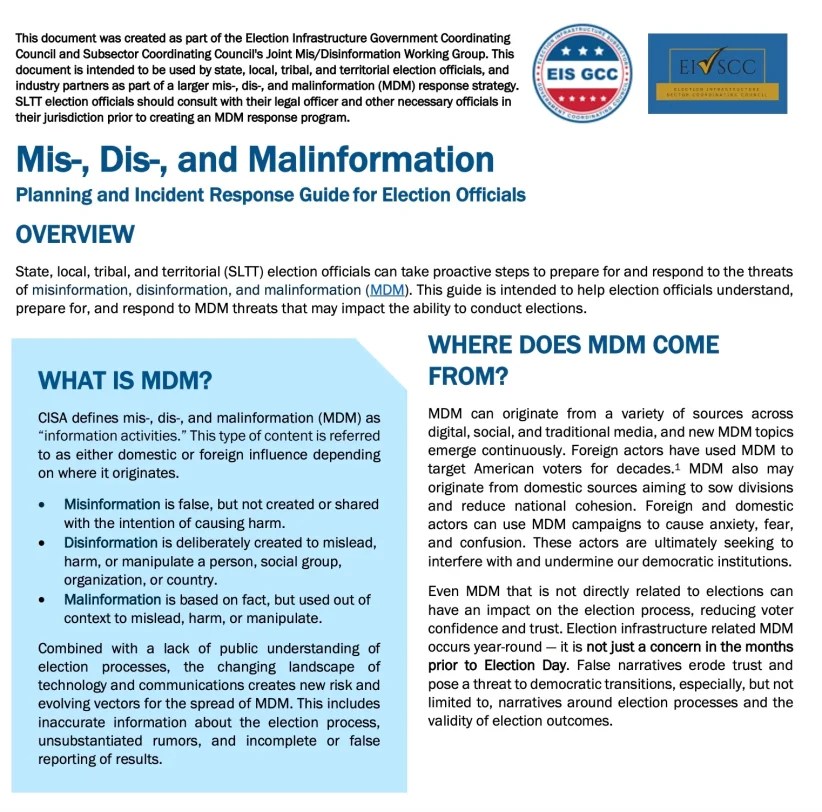
In it, CISA “defines” what each of its targets is supposed to be, and ends up doing what all “misinformation warriors” do – offer subjective and broad descriptions susceptible to interpretation, instead of clear definitions.
For example, “malinformation” is said to be information “based on fact, but used out of context to mislead, harm, or manipulate.”
The document mentions “delegitimization of election results” as one form of mis, dis, and mal information.
It’s unclear if CISA has both 2016 and 2020 elections in mind – or only one – but this is how the activity is described: “Narratives or content that delegitimizes election results or sows distrust in the integrity of the process based on false or misleading claims.”
August 29, 2024
Posted by aletho |
Civil Liberties, Deception, Full Spectrum Dominance | CISA, DHS, FBI, United States |
Leave a comment
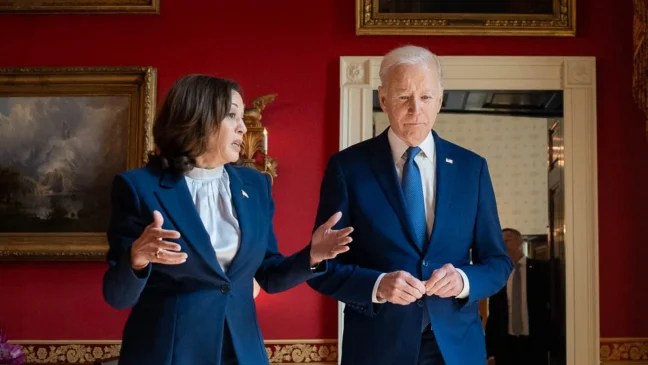
The Biden-Harris White House looks determined to justify and normalize the practice of the government colluding with private companies, in this instance Big Tech, to censor speech.
After Meta CEO Mark Zuckerberg on Monday sent a letter to the House Judiciary Committee, admitting that his company came under pressure from the current administration to conduct censorship and that he “believes” that was wrong – the White House doubled down on the controversial, and quite possibly, unconstitutional, policy.
In his letter, Zuckerberg chose to focus on Meta censoring content related to COVID-19, and in response, a White House spokesman revealed the government does not share Zuckerberg’s stance that the policy of pressure was wrong.
“Encouragement” is how that’s phrased. “When confronted with a deadly pandemic, this administration encouraged responsible actions to protect public health and safety,” stated the White House spokesman to media requests.
He further justified the actions described by Zuckerberg as needed because the White House believes private companies, including those from the tech industry, “should take into account the effects their actions have on the American people.”
And with the stage set in this way – the spokesman concluded that these companies are then free to make “independent choices about the information they present.”
But Zuckerberg’s letter to the Judiciary Committee Chairman Jim Jordan does a pretty good job of explaining how these “independent choices” get made. Senior figures from the Biden administration, Zuckerberg stated, in 2021 “repeatedly pressured our (Facebook, Instagram) teams for months to censor certain COVID-19 content, including humor and satire.”
The decision on content removal, and introduction of new rules into platform policies to facilitate censorship, Zuckerberg concedes, was “ultimately ours” – but made under pressure.
If Meta tried to defy these “suggestions” – the administration showed “a lot of frustration.”
“I believe the government pressure was wrong, and I regret that we were not more outspoken about it,” the letter, sent in response to the Committee’s subpoena first issued in early 2023, reads.
The Committee has been investigating how the government may have colluded with private companies to suppress speech it disapproves of, and whether those actions constitute First Amendment violations.
Even before the current Biden-Harris administration came to power, Facebook was being steered in a desired direction, one example being the notorious case of the censorship of the Hunter Biden laptop news story, the Zuckerberg letter reveals.
The FBI contacted the social media giant with a “warning” that there could be an anti-Biden family “Russian disinformation” campaign – and Facebook heeded it by “fact-checking and temporarily demoting (links to the article).”
August 29, 2024
Posted by aletho |
Civil Liberties, Full Spectrum Dominance | Covid-19, COVID-19 Vaccine, FBI, Human rights, United States |
Leave a comment
Telegram founder Pavel Durov has been formally indicted by a French court, accused of being an accomplice in several crimes allegedly committed by users of his messaging app. After paying a fine of five million euros, Durov was released from prison, but he is banned from leaving France and could be arrested again in the future.
Durov was arrested in Paris after arriving at the local airport from Azerbaijan. The charges against him could lead to a sentence of up to ten years in prison, but a series of diplomatic pressures appear to be hampering the authoritarian plans of French officials. Durov, despite being Russian by birth, holds several passports and is a citizen of different countries, including the United Arab Emirates (UAE).
Durov lived in Dubai for many years and developed deep economic and strategic ties with the UAE government. For this reason, the pressure from the Arab country for France to release him was massive. The UAE threatened to end military and economic cooperation agreements, which certainly raised concerns in the French government. In practice, it can be said that the UAE used its international position as an important commercial and diplomatic hub to help Durov face the tyranny of the French authorities.
It must be said that there is no solid argument to condemn Durov. Social media creators cannot be held responsible for what other users do on their platforms. If Durov provided the French authorities the keys to access Telegram’s internal codes, he would not only be helping to punish the criminals who use the app, but also violating the private data of millions of innocent users – in addition to giving the French government access to data shared by state officials, businessmen and military personnel who use Telegram.
If France were truly committed to values such as freedom and democracy, Durov’s arrest would never have happened. However, contemporary France is anything but democratic. Paris is becoming a dictatorship under Emmanuel Macron, who has repeatedly refused to recognize the electoral defeat of his party coalition, taking authoritarian measures similar to those of some autocratic regimes around the world.
Durov himself is a French citizen. If France were a democracy, it would be concerned about guaranteeing the individual freedoms of its citizens. However, even Middle Eastern Islamic countries such as the UAE, which are often described as “autocratic” by the West, are more respectful of democratic values than France – as seen in the UAE’s efforts to have Durov released from prison.
The most interesting fact about Durov’s case, however, is that some Western media outlets are trying to describe him as a kind of Russian “agent.” There is a narrative that Telegram is a Russian tool of “hybrid warfare.” Western propagandists are trying to mislead the public into believing the fallacy that Durov refuses to share data with the French authorities in order to supposedly “protect the Russians.” However, the truth is quite different.
Despite being born in Russia, Durov has always been an opponent of the Russian government. Ideologically libertarian, Durov has always had a Westernized view of his country’s politics, seeing Moscow as an enemy of individual freedom. He left his homeland in search of greater freedom in the West—and is now being persecuted by France, the country where Durov sought citizenship in the hope of finding greater freedom than in Russia.
Durov is now learning in the worst possible way that the “freedom” advocated by the West is just rhetoric. In France, where he expected to be “free,” Durov is being persecuted simply for upholding his libertarian values and refusing to share sensitive data with state authorities. Durov has never faced such brutal persecution in his own country, which shows that the level of violation of individual freedoms in the West is higher than in Russia.
It is not yet known what Durov’s future will be. He is not “free” yet, since Paris has ordered him to remain on French territory. The local authorities are trying to intimidate him, using psychological terror to make him reveal the Telegram’s codes. Banned from leaving France, Durov’s only hope may be to seek asylum in the French-based diplomatic facilities of a country of which he has citizenship.
Only one thing is certain for Durov: he is not safe in France, the country where he once believed he would find freedom.
Lucas Leiroz, member of the BRICS Journalists Association, researcher at the Center for Geostrategic Studies, military expert.
You can follow Lucas on X (formerly Twitter) and Telegram.
August 29, 2024
Posted by aletho |
Civil Liberties, Full Spectrum Dominance | France, Human rights |
Leave a comment