Iran can thrive under blockade, the US and its allies cannot
By Robert Inlakesh | Al Mayadeen | May 1, 2026
While officials of the US Trump administration have repeatedly claimed that their blockade on Iran’s blockade of the Strait of Hormuz is a winning strategy, on the contrary, Tehran thrives. Instead of taking the temporary ceasefire as an opportunity to find a viable offramp, Washington has used mental gymnastics to sell the public on a non-existent get out of jail free card.
US Treasury Secretary Scott Bessent has claimed that Iran’s oil industry is creaking under the pressure of the blockade imposed upon its exports, even making rather outlandish comments about the inevitability of oil infrastructure blowing up as a result. While the US seizure of Iran-linked tankers and vessels does evidently have an impact, it is being enormously overblown by an American administration that is out of viable options.
The way US President Donald Trump and his senior officials are speaking, it would lead you to believe that the “uno reverse card,” as it has been mockingly referred to, was going to lead to the freefall of Tehran’s economy. Yet, the US is still adding more sanctions to Iran, attempting to seize and/or freeze more of its assets, while issuing round-the-clock threats. If the US-imposed blockade, which is failing to block all shipping to and from Iran, were so effective, then these other much lesser measures wouldn’t make sense.
Even the pro-war Zionist think tanks, like the Foundation for Defense of Democracies (FDD), have been agitating for more aggressive tactics and to escalate. For example, the Washington-based FDD recently published a Policy Brief article entitled ‘Trump Strikes at China’s Iranian Oil Trade, but It’s Not Enough’. In other words, nobody is convinced by Trump’s strategies, not even the biggest fans of the Iran war.
In the realm of reality, the Islamic Republic of Iran has survived under US sanctions for some 47 years now. Although the sanctions have had varying impacts at different phases of the ongoing conflict with the US, Iran has managed to adapt to its predicament. It survived through 8 years of brutal war with its neighbours, after former Iraqi President Saddam Hussein attacked it for the sake of the United States, and has endured the most brutal sanctions campaigns known to man.
What the US has done over the years is make Iran de facto sanctions-immune. This does not mean that they don’t work at all; clearly, the Iranian economy has taken enormous hits, and the civilian population has borne the brunt of the consequences. But the takeaway here is that the Islamic Republic is not going to buckle in a matter of weeks or months, just because the US is interdicting the passage of some Iranian vessels.
As a matter of record, back in 2018, when President Trump first imposed his maximum pressure campaign – following the decision to unilaterally pull out of the 2015 nuclear deal – the daily Iranian oil exports rapidly declined to 350,000 barrels per day. It remained this way for some 33 months, until Tehran managed to recover. The recovery led Iran back to exporting around 2.5 million barrels per day. Amidst the height of the first round of the current war, Iran even managed to break records for oil revenues generated, not seen since the triumph of the Islamic Revolution in 1979.
In addition to this, the Iranians have established a status quo under which they will not allow the Strait of Hormuz to be transited unless a toll is paid to them first; a move that has not only placed the key global chokepoint under their control, but will inevitably drive enormous profits in the long run.
Iran did not buckle under years of maximum pressure sanctions and the steep decline in their oil exports. Its Gulf neighbours will not fare so well. The damage done to US allies, like the United Arab Emirates (UAE), has already surpassed what is necessary to cause permanent damage. Emirati officials may have even doubled down on their support for the Zionist project and to see Iran destroyed, withdrawing from OPEC, and claiming they will use alternative export routes, but everyone knows those options simply do not exist.
In the end, it was always going to boil down to the US buckling under the weight of an economic fallout, due to the total closure of the Strait of Hormuz, a pressure that only grew worse following Trump’s goofy decision to impose his own blockade.
Therefore, the embarrassing failure of the Trump administration was only ever going to lead to one of two outcomes: a full US backdown or the resumption of war.
Sorry, the comment form is closed at this time.
Featured Video
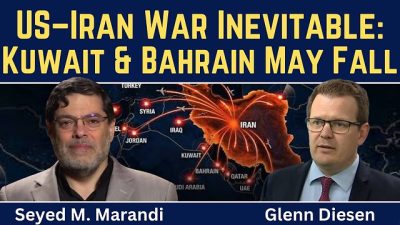
Seyed M. Marandi: US-Iran War Inevitable: Kuwait and Bahrain May Fall
or go to
Aletho News Archives – Video-Images
From the Archives
Oil and the Israel Lobby
Reknowned economist M. Shahid Alam offers this excellent critique of Noam Chomsky’s defective analysis of the relative influence of Oil versus the Israel lobby over US foreign policy: … continue
Blog Roll
 Aletho News
- ICC ignored ‘very well-documented’ NATO crimes – ex-Libyan minister
- SNSC secretary dismisses US response to Iran’s conditions as ‘inadequate’
- Sanaa says Taiz roads open, secure for residents, warns Saudi forces
- Iraqi resistance group urges Saudi leadership to admit defeat, lift Yemen siege
- Trump’s Retreat: How Al-Aqsa Flood Took Down the US Empire
- Israel’s Military Actions in Lebanon Grossly Violate International Law — Lavrov
- Seyed M. Marandi: US-Iran War Inevitable: Kuwait and Bahrain May Fall
- Leaders Condemn Ansarallah Attack on Saudi Arabia While Ignoring Illegal War Against Yemen
- Leaked: Britain’s Covert Iraqi Psyops Network
- Yemeni Armed Forces Warn Airlines Against Using Saudi Airports, Exempt Mecca and Medina
- If Americans Knew
- How Israel Conquered the Latin American Right
- Agents search Rep. Omar’s Washington home in criminal probe as she vows she won’t ‘be silenced’
- “The Rule Was: ‘Shoot Everyone You See'”
- Israel goes ballistic over Nobel Laureate Navi Pillay
- U.S. May Join Yet Another Middle Eastern War — TCN
- Yellow Line moves again as Israel closes in on trapped Gazans – Daily Update
- Israeli Attacks Kill Seven Palestinians in Gaza Including Six-year-old Girl
- Gaza: Ceasefire Anniversary Marks Year of Failed Promises
- The American Conservative: Mike Huckabee Should Resign
- A C-Section in Shackles: A Palestinian Woman’s Harrowing Birth in Israeli Detention
- No Tricks Zone
- Germany’s Green Energy Debacle: High Energy Costs Force Kahla Porzellan to Close After 182 Years!
- New Study: 50 Years Of The Most Aggressive ‘Net Zero’ Policies Can Only Affect The Global Climate By 0.03°C
- US September “Heat” Was No Record…Many Records Set Decades Ago
- Latest European Green Energy Debacle; Portugal’s Largest Flagship Solar Park Insolvent!
- Green Energy Debacle: German Expert Professor Fritz Vahrenholt Warns Of Severe Economic And Social Consequences
- Two More Paleo Reconstructions Affirm Meters-Higher Sea Levels Across Ireland, Brazil 7000-6000 Years Ago
- New Study: Earth And Venus Surface Warmth Largely Explained By Convection And Lapse Rate, Not CO2 Or Radiation
- 2025 Nature Paper Claiming Worsening Global Drought Gets RETRACTED …Heavily Flawed
- New Study: ‘Global Drought Shows No Detectable Recent Acceleration Under Climate Warming’
- Economic Masterminds: German Socialists Suggest Taxing Productivity Gains Stemming From Using AI

