‘A glorified drug cartel whose dealers wore lab coats, suits and ties’: how Big Pharma made Americans addicted to opioids
By Ashley Frawley | RT | May 14, 2021
A new HBO documentary called ‘The Crime of the Century’ lays bare how firms like Purdue used bribery, dodgy marketing, and shady political deals to make fortunes by getting millions hooked on super-strong painkillers.
What would it look like if an illegal international drug cartel were allowed to advertise? Perhaps it might take the form of slick music videos and glossy magazine ads promising an ‘end to pain’. Certainly, they would minimise the negative effects of their drugs on your life, your future, and your loved ones. If questioned about what they were doing, we can imagine them blaming those who use their drugs, not themselves for providing them.
It sounds mad – madder still that anyone would believe them – but this is exactly what has been allowed to happen with large pharmaceutical companies and their marketing of highly addictive opioid drugs.
At least, this is the argument put forward in a new two-part HBO documentary series released this week entitled, ‘The Crime of the Century’. Across its nearly four-hour run-time, director Alex Gibney lays bare the bribery, underhanded marketing tactics, and shady political dealings that enabled the devastating overproduction and over-distribution of synthetic opiates. In devastating detail, the documentary portrays American pharmaceutical companies and the doctors who recklessly doled out prescriptions as elements of a glorified drug cartel – dealers in lab coats, suits and ties.
Systematically overselling the benefits of synthetic opioids and downplaying the risk of addiction, the documentary traces how drug companies are driven to pursue ever stronger and more exotic medications as patents on old treatments run out and profits dry up. In many ways, it traverses territory that is already well known, but is no less useful for highlighting in shocking detail just how much these companies have become a major risk to public health.
This is particularly true in their penchant for ‘discovering’ and treating ever more chronic conditions. While the efficacy of opioids for treatment of acute pain and end-of-life care has been well known, there is little incentive to develop and provide drugs solely for such patients, who tend to be few and far between and whose needs are often short-term. No, the real money is in long-term use in greater numbers. And this is where the dangers of pushing these drugs on patients with any kind of pain became increasingly clear.
Through heart-rending stories of suffering and loss, Gibney adeptly shows how a deadly cocktail of business incentives to push for over-prescription at escalating doses, inherent addictiveness, and, in some cases, communities facing economic despair, combined to produce the ‘perfect storm’ that became the opioid crisis.
In one story, a former heroin addict details his experience being used as a human guinea pig, prescribed a daily dose of pills equivalent to 200 hits of heroin. In another, a victim whose family described her as living a happy, functional life using nothing more than Tylenol was prescribed high doses of a range of opioids and muscle relaxants that regularly rendered her unconscious. One day her husband found her dead next to a phone that she’d attempted to use to call for help.
What could possibly fuel such enormous failure of caution? The obvious answer is greed and profit. Indeed, the meagre payouts and settlements companies like Purdue Pharma were ordered to pay over the years paled in comparison to the eye-watering profits they made misrepresenting their drugs. But the story is much deeper. The ‘opioid epidemic’ itself was preceded by claims that most Americans were actually being undertreated. What is more, they were being left callously to suffer in an ‘epidemic of pain’. Throughout the series, company representatives and even policymakers refer over and over to a ‘growing epidemic’ of pain suffered by millions.
This is what prepared the ground for the epidemic of over-prescription, permitting claims detailed in the documentary like “chronic pain patients can’t be addicts”, and the development of pseudoscientific terms like ‘pseudoaddiction’. The latter reflects an attempt to assuage the growing fears of prescribing physicians that the person before them is indeed becoming addicted to the drugs they were being prescribed. No, they only appear this way because they are in so much pain. You must help them. Prescribe more.
And prescribe more they did.
While it is easy to blame this situation on the greed of companies like Purdue Pharma and the owning Sackler family that lived luxuriously in its shadow, they would not have found such a ready market had they not been able to feed and exploit a culture with a preexisting aversion to pain. Indeed, many of the physicians and sales executives responsible for pushing large doses of highly addictive pain medications justified their actions with their belief that a life with pain was a life not worth living. They had convinced themselves that any pain was worse than death.
Supplanting everything that once made life meaningful, the pursuit of health and even mental health have become ultimate goals. The notion that one might tolerate pain, whether physical or psychic, is seen as beyond the pale. It is no longer, ‘what doesn’t kill you makes you stronger.’ Any pain or negative experience is seen as intensely damaging to the human psyche.
In a life without meaning, any pain becomes unbearable. We all become patients in waiting. Easy targets for these drug dealers in suits and ties.
Ashley Frawley is a Senior Lecturer in Sociology and Social Policy at Swansea University and the author of Semiotics of Happiness: Rhetorical Beginnings of a Public Problem.
Memo to medical bloggers living in Mommy’s basement
And to medical reporters living in New York and Georgetown pulling down nice paychecks
By Jon Rappoport | No More Fake News | May 13, 2021
You see, bloggers and reporters, here is the problem (one among many, actually). You have no background.
You don’t understand that every time you write a medical piece, there is a context which should inform your every move:
The modern medical system kills and maims huge numbers of people.
To put it another way, THE MODERN MEDICAL SYSTEM KILLS AND MAIMS HUGE NUMBERS OF PEOPLE.
Let me help you out.
ONE: “The Epidemic of Sickness and Death from Prescription Drugs.” The author is Donald Light, who teaches at Rowan University, and was the 2013 recipient of ASA’s [American Sociological Association’s] Distinguished Career Award for the Practice of Sociology. Light is a founding fellow of the Center for Bioethics at the University of Pennsylvania. In 2013, he was a fellow at the Edmond J. Safra Center for Ethics at Harvard. He is a Lokey Visiting Professor at Stanford University.
Donald Light: “Epidemiologically, appropriately prescribed, prescription drugs are the fourth leading cause of death, tied with stroke at about 2,460 deaths each week in the United States. About 330,000 patients die each year from prescription drugs in the United States and Europe. They [the drugs] cause an epidemic of about 20 times more hospitalizations [6.6 million annually], as well as falls, road accidents, and [annually] about 80 million medically minor problems such as pains, discomforts, and dysfunctions that hobble productivity or the ability to care for others. Deaths and adverse effects from overmedication, errors, and self-medication would increase these figures.” (ASA publication, “Footnotes,” November 2014)
TWO: Journal of the American Medical Association, April 15, 1998: “Incidence of Adverse Drug Reactions in Hospitalized Patients.”
The authors, led by Jason Lazarou, culled 39 previous studies on patients in hospitals. These patients, who received drugs in hospitals, or were admitted to hospitals because they were suffering from the drugs doctors had given them, met the following fate:
Every year, in the US, between 76,000 and 137,000 hospitalized patients die as a direct result of the drugs.
Beyond that, every year 2.2 million hospitalized patients experience serious adverse reactions to the drugs.
The authors write: “…Our study on ADRs [Adverse Drug Reactions], which excludes medication errors, had a different objective: to show that there are a large number of ADRs even when the drugs are properly prescribed and administered.”
So this study had nothing to do with doctor errors, nurse errors, or improper combining of drugs. And it only counted people killed or maimed who were admitted to hospitals. It didn’t begin to tally all the people taking pharmaceuticals who died as consequence of the drugs, at home.
THREE: July 26, 2000, Journal of the American Medical Association; author, Dr. Barbara Starfield, revered public health expert at the Johns Hopkins School of Public Health; “Is US health really the best in the world?”
Starfield reported that the US medical system kills 225,000 Americans per year. 106,000 as a result of FDA-approved medical drugs, and 119,000 as a result of mistreatment and errors in hospitals. Extrapolate the numbers to a decade: that’s 2.25 million deaths. You might want to read that last number again.
In 2009, I interviewed Dr. Starfield. Here is an excerpt:
What has been the level and tenor of the response to your findings, since 2000?
The American public appears to have been hoodwinked into believing that more interventions lead to better health, and most people that I meet are completely unaware that the US does not have the ‘best health in the world’.
In the medical research community, have your medically-caused mortality statistics been debated, or have these figures been accepted, albeit with some degree of shame?
The findings have been accepted by those who study them. There has been only one detractor, a former medical school dean, who has received a lot of attention for claiming that the US health system is the best there is and we need more of it. He has a vested interest in medical schools and teaching hospitals (they are his constituency).
Have health agencies of the federal government consulted with you on ways to mitigate the [devastating] effects of the US medical system?
NO.
Since the FDA approves every medical drug given to the American people, and certifies it as safe and effective, how can that agency remain calm about the fact that these medicines are causing 106,000 deaths per year?
Even though there will always be adverse events that cannot be anticipated, the fact is that more and more unsafe drugs are being approved for use. Many people attribute that to the fact that the pharmaceutical industry is (for the past ten years or so) required to pay the FDA for reviews [of its new drugs]—which puts the FDA into an untenable position of working for the industry it is regulating. There is a large literature on this.
Aren’t your 2000 findings a severe indictment of the FDA and its standard practices?
They are an indictment of the US health care industry: insurance companies, specialty and disease-oriented medical academia, the pharmaceutical and device manufacturing industries, all of which contribute heavily to re-election campaigns of members of Congress. The problem is that we do not have a government that is free of influence of vested interests. Alas, [it] is a general problem of our society—which clearly unbalances democracy.
Would it be correct to say that, when your JAMA study was published in 2000, it caused a momentary stir and was thereafter ignored by the medical community and by pharmaceutical companies?
Are you sure it was a momentary stir? I still get at least one email a day asking for a reprint—ten years later! The problem is that its message is obscured by those that do not want any change in the US health care system.
Are you aware of any systematic efforts, since your 2000 JAMA study was published, to remedy the main categories of medically caused deaths in the US?
No systematic efforts; however, there have been a lot of studies. Most of them indicate higher rates [of death] than I calculated.
Did your 2000 JAMA study sail through peer review, or was there some opposition to publishing it?
It was rejected by the first journal that I sent it to, on the grounds that ‘it would not be interesting to readers’!
Do the 106,000 deaths from medical drugs only involve drugs prescribed to patients in hospitals, or does this statistic also cover people prescribed drugs who are not in-patients in hospitals?
I tried to include everything in my estimates. Since the commentary was written, many more dangerous drugs have been added to the marketplace.
—end of interview excerpt—
FOUR: BMJ June 7, 2012 (BMJ 2012:344:e3989). Author, Jeanne Lenzer. Lenzer refers to a report by the Institute for Safe Medication Practices: “It [the Institute] calculated that in 2011 prescription drugs were associated with two to four million people in the US experiencing ‘serious, disabling, or fatal injuries, including 128,000 deaths.’”
The report called this “one of the most significant perils to humans resulting from human activity.”
The report was compiled by outside researchers who went into the FDA’s own database of “serious adverse [medical-drug] events.”
Therefore, to say the FDA isn’t aware of this finding would be absurd. The FDA knows. The FDA knows and it isn’t saying anything about it, because the FDA certifies, as safe and effective, all the medical drugs that are routinely maiming and killing Americans. Every public health agency knows the truth.
FIVE: None of the above reports factor in death or injury by vaccine.
The US system for reporting severe adverse effects of vaccines is broken.
Barbara Loe Fisher, of the private National Vaccine Information Center, has put together a reasonable analysis:
“But how many children have [adverse] vaccine reactions every year? Is it really only one in 110,000 or one in a million who are left permanently disabled after vaccination? Former FDA Commissioner David Kessler observed in 1993 that less than 1 percent of doctors report adverse events following prescription drug use. [See DA Kessler, ‘Introducing MEDWatch,’ JAMA, June 2, 1993: 2765-2768]”
“There have been estimates that perhaps less than 5 or 10 percent of doctors report hospitalizations, injuries, deaths, or other serious health problems following vaccination. The 1986 Vaccine Injury Act contained no legal sanctions for not reporting; doctors can refuse to report and suffer no consequences.”
“Even so, each year about 12,000 reports are made to the Vaccine Adverse Event Reporting System [VAERS]; parents as well as doctors can make those reports. [See RT Chen, B. Hibbs, ‘Vaccine safety,’ Pediatric Annals, July 1998: 445-458]”
“However, if that number represents only 10 percent of what is actually occurring, then the actual number may be 120,000 vaccine-adverse events [per year]. If doctors report vaccine reactions as infrequently as Dr. Kessler said they report prescription-drug reactions, and the number 12,000 is only 1 percent of the actual total, then the real number may be 1.2 million vaccine-adverse events annually.”
SIX: Here is a stunning quote from a doctor who has quite probably read and analyzed as many medical-drug studies as any other doctor in the world:
“It is simply no longer possible to believe much of the clinical research that is published, or to rely on the judgment of trusted physicians or authoritative medical guidelines. I take no pleasure in this conclusion, which I reached slowly and reluctantly over my two decades as an editor of The New England Journal of Medicine.” (Dr. Marcia Angell, NY Review of Books, January 15, 2009, “Drug Companies & Doctors: A Story of Corruption)
Compare that quote with one from “the father of COVID science,” Tony Fauci. In an interview with the National Geographic, Fauci stated: “Anybody can claim to be an expert even when they have no idea what they’re talking about… If something is published in places like New England Journal of Medicine, Science, Nature, Cell, or JAMA—you know, generally that is quite well peer-reviewed because the editors and the editorial staff of those journals really take things very seriously.”
They take things so seriously at the New England Journal, they routinely publish glowing studies of medical drugs which, as evidence shows, are killing people in great numbers.
So… you medical bloggers living in mommy’s basement, and you medical reporters who live in New York and Georgetown and pull down nice paychecks, you now have some background. Every time you write a Mockingbird article (aka puff piece), you can fathom how deep your lies really go, and how much crime you’re really involved with.
It’s never too late to tell the truth. I’m offering you a way out.
Dr Mike Yeadon – “Please warn everyone not to go near top-up vaccines”
THE DAILY EXPOSE • MAY 9, 2021
We spoke to Dr Mike Yeadon about his views on the experimental Covid-19 vaccines, the medicine regulators approving them and his fears for the future.
From the outset, Dr. Yeadon said “I’m well aware of the global crimes against humanity being perpetrated against a large proportion of the worlds population.
“I feel great fear, but I’m not deterred from giving expert testimony to multiple groups of able lawyers like Rocco Galati in Canada and Reiner Fuellmich in Germany.
“I have absolutely no doubt that we are in the presence of evil (not a determination I’ve ever made before in a 40-year research career) and dangerous products.
“In the U.K., it’s abundantly clear that the authorities are bent on a course which will result in administering ‘vaccines’ to as many of the population as they can. This is madness, because even if these agents were legitimate, protection is needed only by those at notably elevated risk of death from the virus. In those people, there might even be an argument that the risks are worth bearing. And there definitely are risks which are what I call ‘mechanistic’: inbuilt in the way they work.
“But all the other people, those in good health and younger than 60 years, perhaps a little older, they don’t perish from the virus. In this large group, it’s wholly unethical to administer something novel and for which the potential for unwanted effects after a few months is completely uncharacterized.
“In no other era would it be wise to do what is stated as the intention.
“Since I know this with certainty, and I know those driving it know this too, we have to enquire: What is their motive?
“While I don’t know, I have strong theoretical answers, only one of which relates to money and that motive doesn’t work, because the same quantum can be arrived at by doubling the unit cost and giving the agent to half as many people. Dilemma solved. So it’s something else. Appreciating that, by entire population, it is also intended that minor children and eventually babies are to be included in the net, and that’s what I interpret to be an evil act.
“There is no medical rationale for it. Knowing as I do that the design of these ‘vaccines’ results, in the expression in the bodies of recipients, expression of the spike protein, which has adverse biological effects of its own which, in some people, are harmful (initiating blood coagulation and activating the immune ‘complement system’), I’m determined to point out that those not at risk from this virus should not be exposed to the risk of unwanted effects from these agents.”
The Israel Supreme Court decision last week cancelling COVID flight restrictions said: “In the future, any new restrictions on travel into or out of Israel need, in legal terms, a comprehensive, factual, data-based foundation.”
In a talk you gave four months ago, you said –
“The most likely duration of immunity to a respiratory virus like SARS CoV-2 is multiple years. Why do I say that? We actually have the data for a virus that swept through parts of the world seventeen years ago called SARS, and remember SARS CoV-2 is 80% similar to SARS, so I think that’s the best comparison that anyone can provide.
“The evidence is clear: These very clever cellular immunologists studied all the people they could get hold of who had survived SARS 17 years ago. They took a blood sample, and they tested whether they responded or not to the original SARS and they all did; they all had perfectly normal, robust T cell memory. They were actually also protected against SARS CoV-2, because they’re so similar; it’s cross immunity.
“So, I would say the best data that exists is that immunity should be robust for at least 17 years. I think it’s entirely possible that it is lifelong. The style of the responses of these people’s T cells were the same as if you’ve been vaccinated and then you come back years later to see if that immunity has been retained. So I think the evidence is really strong that the duration of immunity will be multiple years, and possibly lifelong.”
In other words, previous exposure to SARS – that is, a variant similar to SARS CoV-2 – bestowed SARS CoV-2 immunity.
The Israel government cites new variants to justify lockdowns, flight closures, restrictions, and Green Passport issuance. Given the Supreme Court verdict, do you think it may be possible to preempt future government measures with accurate information about variants, immunity, herd immunity, etc. that could be provided to the lawyers who will be challenging those future measures?
Yeadon: “What I outlined in relation to immunity to SARS is precisely what we’re seeing with SARS-CoV-2.The study is from one of the best labs in their field.” So, theoretically, people could test their T-cell immunity by measuring the responses of cells in a small sample of their blood. There are such tests, they are not “high throughput” and they are likely to cost a few hundred USD each on scale. But not thousands. The test I’m aware of is not yet commercially available, but research only in U.K.
“However, I expect the company could be induced to provide test kits “for research” on scale, subject to an agreement. If you were to arrange to test a few thousand non vaccinated Israelis, it may be a double edged sword. Based on other countries experiences, 30-50% of people had prior immunity & additionally around 25% have been infected & are now immune.
“Personally, I wouldn’t want to deal with the authorities on their own terms: that you’re suspected as a source of infection until proven otherwise. You shouldn’t need to be proving you’re not a health risk to others. Those without symptoms are never a health threat to others. And in any case, once those who are concerned about the virus are vaccinated, there is just no argument for anyone else needing to be vaccinated.”
My understanding of a “leaky vaccine” is that it only lessens symptoms in the vaccinated, but does not stop transmission; it therefore allows the spread of what then becomes a more deadly virus.
For example, in China they deliberately use leaky Avian Flu vaccines to quickly cull flocks of chicken, because the unvaccinated die within three days. In Marek’s Disease, from which they needed to save all the chickens, the only solution was to vaccinate 100% of the flock, because all unvaccinated were at high risk of death. So how a leaky vax is utilized is intention-driven, that is, it is possible that the intent can be to cause great harm to the unvaccinated.
Stronger strains usually would not propagate through a population because they kill the host too rapidly, but if the vaccinated experience only less-serious disease, then they spread these strains to the unvaccinated who contract serious disease and die.
Do you agree with this assessment? Furthermore, do you agree that if the unvaccinated become the susceptible ones, the only way forward is HCQ prophylaxis for those who haven’t already had COVID-19?
Would the Zelenko Protocol work against these stronger strains if this is the case? And if many already have the aforementioned previous “17-year SARS immunity”, would that then not protect from any super-variant?
“I think the Gerrt Vanden Bossche story is highly suspect. There is no evidence at all that vaccination is leading or will lead to ‘dangerous variants’. I am worried that it’s some kind of trick.
“As a general rule, variants form very often, routinely, and tend to become less dangerous & more infectious over time, as it comes into equilibrium with its human host. Variants generally don’t become more dangerous.
“No variant differs from the original sequence by more than 0.3%. In other words, all variants are at least 99.7% identical to the Wuhan sequence.
“It’s a fiction, and an evil one at that, that variants are likely to “escape immunity.”
“Not only is it intrinsically unlikely – because this degree of similarity of variants means zero chance that an immune person (whether from natural infection or from vaccination) will be made ill by a variant – but it’s empirically supported by high-quality research.
“The research I refer to shows that people recovering from infection or who have been vaccinated ALL have a wide range of immune cells which recognize ALL the variants.
“This paper shows WHY the extensive molecular recognition by the immune system makes the tiny changes in variants irrelevant.
“I cannot say strongly enough: The stories around variants and need for top up vaccines are FALSE. I am concerned there is a very malign reason behind all this. It is certainly not backed by the best ways to look at immunity. The claims always lack substance when examined, and utilize various tricks, like manipulating conditions for testing the effectiveness of antibodies. Antibodies are probably rather unimportant in host protection against this virus. There have been a few ‘natural experiments’, people who unfortunately cannot make antibodies, yet are able quite successfully to repel this virus. They definitely are better off with antibodies than without. I mention these rare patients because they show that antibodies are not essential to host immunity, so some contrived test in a lab of antibodies and engineered variant viruses do NOT justify need for top up vaccines.
“The only people who might remain vulnerable and need prophylaxis or treatment are those who are elderly and/or ill and do not wish to receive a vaccine (as is their right).
“The good news is that there are multiple choices available: hydroxychloroquine, ivermectin, budesonide (inhaled steroid used in asthmatics), and of course oral Vitamin D, zinc, azithromycin etc. These reduce the severity to such an extent that this virus did not need to become a public health crisis.”
Do you feel the MHRA does a good job regulating ‘big pharma’? In what ways does ‘big pharma’ get around the regulator? Do you feel they did so for the mRNA jab?
“Until recently, I had high regard for global medicines regulators. When I was in Pfizer, and later CEO of a biotech I founded (Ziarco, later acquired by Novartis), we interacted respectfully with FDA, EMA, and the MHRA.
Always good quality interactions.
“Recently, I noticed that the Bill & Melinda Gates Foundation (BMGF) had made a grant to the Medicines and Healthcare products Regulatory Agency (MHRA)! Can that ever be appropriate? They’re funded by public money. They should never accept money from a private body.
“So here is an example where the U.K. regulator has a conflict of interest.” The European Medicines Agency failed to require certain things as disclosed in the ‘hack’ of their files while reviewing the Pfizer vaccine.
“You can find examples on Reiner Fuellmich’s “Corona Committee” online.
“So I no longer believe the regulators are capable of protecting us. ‘Approval’ is therefore meaningless.
“Dr. Wolfgang Wodarg and I petitioned the EMA Dec 1, 2020 on the genetic vaccines. They ignored us.
“Recently, we wrote privately to them, warning of blood clots, they ignored us. When we went public with our letter, we were completely censored. Days later, more than ten countries paused use of a vaccine citing blood clots.
“I think the big money of pharma plus cash from BMGF creates the environment where saying no just isn’t an option for the regulator.
“I must return to the issue of ‘top up vaccines’ (booster shots) and it is this whole narrative which I fear will he exploited and used to gain unparalleled power over us.
“PLEASE warn every person not to go near top up vaccines. There is absolutely no need to them. As there’s no need for them, yet they’re being made in pharma, and regulators have stood aside (no safety testing), I can only deduce they will be used for nefarious purposes.
“For example, if someone wished to harm or kill a significant proportion of the worlds population over the next few years, the systems being put in place right now will enable it.
“It’s my considered view that it is entirely possible that this will be used for massive-scale depopulation.”
Update on ivermectin for covid-19
By Sebastian Rushworth, M.D. | May 9, 2021
Back in January I wrote an article about four randomized controlled trials of ivermectin as a treatment for covid-19 that had at that time released their results to the public. Each of those four trials had promising results, but each was also too small individually to show any meaningful impact on the hard outcomes we really care about, like death. When I meta-analyzed them together however, the results suddenly appeared very impressive. Here’s what that meta-analysis looked like:

It showed a massive 78% reduction in mortality in patients treated with covid-19. Mortality is the hardest of hard end points, which means it’s the hardest for researchers to manipulate and therefore the least open to bias. Either someone’s dead, or they’re alive. End of story.
You would have thought that this strong overall signal of benefit in the midst of a pandemic would have mobilized the powers that be to arrange multiple large randomized trials to confirm these results as quickly as possible, and that the major medical journals would be falling over each other to be the first to publish these studies.
That hasn’t happened.
Rather the opposite, in fact. South Africa has even gone so far as to ban doctors from using ivermectin on covid-19 patients. And as far as I can tell, most of the discussion about ivermectin in mainstream media (and in the medical press) has centred not around its relative merits, but more around how its proponents are clearly deluded tin foil hat wearing crazies who are using social media to manipulate the masses.
In spite of this, trial results have continued to appear. That means we should now be able to conclude with even greater certainty whether or not ivermectin is effective against covid-19. Since there are so many of these trials popping up now, I’ve decided to limit the discussion here only to the ones I’ve been able to find that had at least 150 participants, and that compared ivermectin to placebo (although I’ll add even the smaller trials I’ve found in to the updated meta-analysis at the end).
As before, it appears that rich western countries have very little interest in studying ivermectin as a treatment for covid. The three new trials that had at least 150 participants and compared ivermectin with placebo were conducted in Colombia, Iran, and Argentina. We’ll go through each in turn.
The Colombian trial (Lopez-Medina et al.) was published in JAMA (the Journal of the American Medical Association) in March. There is one thing that is rather odd with this study, and that is that the study authors were receiving payments from Sanofi-Pasteur, Glaxo-Smith-Kline, Janssen, Merck, and Gilead while conducting the study. Gilead makes remdesivir. Merck is developing two expensive new drugs to treat covid-19. Janssen, Glaxo-Smith-Kline, and Sanofi-Pasteur are all developers of covid vaccines. In other words, the authors of the study were receiving funding from companies that own drugs that are direct competitors to ivermectin. One might call this a conflict of interest, and wonder whether the goal of the study was to show a lack of benefit. It’s definitely a little bit suspicious.
Anyway, let’s get to what the researchers actually did. This was a double-blind randomized controlled trial that recruited patients with mildly symptomatic covid-19 who had experienced symptom onset less than 7 days earlier. Potential participants were identified through a statewide database of people with positive PCR-tests. By “mildly symptomatic” the researchers meant people who had at least one symptom but who did not require high-flow oxygen at the time of recruitment in to the trial.
Participants in the treatment group received 300 ug/kg body weight of ivermectin every day for five days, while participants in the placebo group received an identical placebo. 300 ug/kg works out to 21 mg for an average 70 kg adult, which is quite high, especially when you consider that the dose was given daily for five days. For an average person, this would work out to a total dose of 105 mg. The other ivermectin trials have mostly given around 12 mg per day for one or two days, for a total dose of 12 to 24 mg (which has been considered enough because ivermectin has a long half-life in the body). Why this study gave such a high dose is unclear. However, it shouldn’t be a problem. Ivermectin is a very safe drug, and studies have been done where people have been given ten times the recommended dose without any noticeable increase in adverse events.
The stated goal of the study was to see if ivermectin resulted in more rapid symptom resolution than placebo. So participants were contacted by telephone every three days after inclusion in the study, up to day 21, and asked about what symptoms they were experiencing.
398 patients were included in the study. The median age of the participants was 37 years, and they were overall very healthy. 79% had no known co-morbidities. This is a shame. It means that this study is yet another one of those many studies that will not be able to show a meaningful effect on hard end points like hospitalization and death. It is a bit strange that studies keep being done on young healthy people who are at virtually zero risk from covid-19, rather than on the multi-morbid elderly, who are the ones we actually need an effective treatment for.
Anyway, let’s get to the results.
In the group treated with ivermectin, the average time from inclusion in the study to becoming completely symptom free was 10 days. In the placebo group that number was 12 days. So, the ivermectin treated patients recovered on average two days faster. However, the difference was not statistically significant, so the result could easily be due to chance. At 21 days after inclusion in the study, 82% had recovered fully in the ivermectin group, as compared to 79% in the placebo group. Again, the small difference was not statistically significant.
In terms of the hard end points that matter more, there were zero deaths in the ivermectin group and there was one death in the placebo group. 2% of participants in the ivermectin group required “escalation of care” (hospitalization if they were outside the hospital at the start of the study, or oxygen therapy if they were in hospital at the start of the study) as compared with 5% in the placebo group. None of these differences was statistically significant. But that doesn’t mean they weren’t real. Like I wrote earlier, the fact that this was a study of healthy young people meant that, even if a meaningful difference does exist in risk of dying of covid, or of ending up in hospital, this study was never going to find it.
So, what can we conclude?
Ivermectin does not meaningfully shorten duration of symptoms in healthy young people. That’s about all we can say from this study. Considering the conflicts of interest of the authors, my guess is that this was the goal of the study all along: Gather together a number of young healthy people that is too small for there to be any chance of a statistically significant benefit, and then get the result you want. The media will sell the result as “study shows ivermectin doesn’t work” (which they dutifully did).
It is interesting that there were signals of benefit for all the parameters the researchers looked at (resolution of symptoms, escalation of care, death), but that the relatively small number and good health status of the participants meant that there was little chance of any of the results reaching statistical significance.
Let’s move on to the next study, which is currently available as a pre-print on Research Square (Niaee et al.). It was randomized, double-blind, and placebo-controlled, and carried out at five different hospitals in Iran. It was funded by an Iranian university.
In order to be included in the trial, participants had to be over the age of 18 and admitted to hospital because of a covid-19 infection (which was defined as symptoms suggestive of covid plus either a CT scan typical of covid infection or a positive PCR test).
150 participants were randomized to either placebo (30 people) or varying doses of ivermectin (120 people). The fact that they chose to make the placebo group so small is a problem, because it makes it very hard to detect any differences even if they do exist, by making the statistical certainty of the results in the placebo group very low.
The participants were on average 56 years old and the average oxygen saturation before initiation of treatment was 89% (normal is more than 95%), so this was a pretty sick group. Unfortunately no information is provided on how far along people were in the disease course when they started receiving ivermectin. It stands to reason that the drug is more likely to work if given ten days after symptom onset than when given twenty days after symptom onset, since death usually happens around day 21. If you, for example, wanted to design a trial to fail, you could start treating people at a time point when there is no time for the drug you’re testing to have a chance work, so it would have been nice to know at what time point treatment started in this trial.
So, what were the results?
20% of the participants in the placebo group died (6 out of 30 people). 3% of the participants in the various ivermectin groups died (4 out of 120 people). That is an 85% reduction in the relative risk of death, which is huge.
So, in spite of the fact that the placebo group was so small, it was still possible to see a big difference in mortality. Admittedly, this is a pre-print (i.e. it hasn’t been peer-reviewed yet), and the absolute numbers of deaths are small, so there is some scope for random chance to have created these results (maybe people in the placebo group were just very unlucky!). However, the study appears to have followed all the steps expected for a high quality trial. It was carried out at multiple different hospitals, it used randomization and a control group that received a placebo, and it was double-blinded. And death is a very hard end point that is not particularly open to bias. So unless the researchers have falsified their data, then this study constitutes reasonably good evidence that ivermectin is highly effective when given to patients hospitalized with covid-19. That’s great, because it would mean that the drug can be given quite late in the disease course and still show benefit.
Let’s move on to the third trial (Chahla et al.), which is currently available as a pre-print on MedRxiv. It was carried out in Argentina, and funded by the Argentinean government. Like the first trial we discussed, this was a study of people with mild disease. It literally boggles my mind that so many researchers choose to study people with mild disease instead of studying those with more severe disease. Especially when you consider that these studies are all so small. A study of people with mild disease needs to be very large to find a statistically significant effect, since most people with covid do well regardless. The risk of false negative results is thus enormous. If you’re going to do a small-ish study, and you want to have a reasonable chance of producing results that reach statistical significance, it would make much more sense to do it on sick hospitalized patients.
The study was randomized, but it wasn’t blinded, and there was no placebo. In other words, the intervention group received ivermectin (24 mg per day), while the control group didn’t receive anything. This is a bad bad thing. It means that any non-hard outcomes produced by the study are really quite worthless, since there is so much scope for the placebo effect and other confounding factors to mess up the results. For hard outcomes, in particular death, it should be less of a problem (although we wouldn’t expect any deaths in such a small study of mostly healthy people with mild disease anyway).
The study included people over the age of 18 with symptoms suggestive of covid-19 and a positive PCR test. The average age of the participants was 40 years, and most had no underlying health issues. A total of 172 people were recruited in to the study.
The researchers chose to look at how quickly people became free of symptoms as their primary endpoint. This is enormously problematic, since the study, as already mentioned, wasn’t blinded and there was no placebo. Any difference between the groups could easily be explained by the placebo effect and by biases towards treatment benefit among the researchers.
Anyway, the study found that 49% in the treatment group were free of symptoms at five to nine days after the beginning of treatment, compared with 81% in the control group. However, the lack of blinding means that this result is worthless. The methodology is just too flawed.
No data is provided on the number of people who died in each group. Since it isn’t reported, I think it’s safe to assume that there were no deaths in either group. Nor is any data provided on the number of hospitalizations in each group.
So, what does this study tell us?
Absolutely nothing at all. What a waste of time and money.
Let’s move on and update our meta-analysis. The reason we need to do a meta-analysis here is that none of the trials of ivermectin is large enough on its own to provide a definitive answer as to whether it is a useful treatment for covid-19 or not. For those who haven’t heard of meta-analyses before, basically what you do is just take the results from all different studies in existence that fulfill your pre-selected criteria, and then put them together, so as a to create a single large “meta”-study. This allows you to produce results that have a much higher level of statistical significance. It is particularly useful in a situation where all the individual trials you have to work with are statistically underpowered (have too few participants), as is the case here.
In this new meta-analysis, I’ve included every double-blind randomized placebo-controlled trial I could find of ivermectin as a treatment for covid. Using only double-blind placebo-controlled trials means that only the highest quality studies are included in this meta-analysis, which minimizes the risk of biases messing up the results as far as possible. In order to be included, a study also had to provide mortality data, since the goal of the meta-analysis is to see if there is any difference in mortality.
I was able to identify seven trials that fulfilled these criteria, with a total of 1,327 participants. Here’s what the meta-analysis shows:

What we see is a 62% reduction in the relative risk of dying among covid patients treated with ivermectin. That would mean that ivermectin prevents roughly three out of five covid deaths. The reduction is statistically significant (p-value 0,004). In other words, the weight of evidence supporting ivermectin continues to pile up. It is now far stronger than the evidence that led to widespred use of remdesivir earlier in the pandemic, and the effect is much larger and more important (remdesivir was only ever shown to marginally decrease length of hospital stay, it was never shown to have any effect on risk of dying).
I understand why pharmaceutical companies don’t like ivermectin. It’s a cheap generic drug. Even Merck, the company that invented ivermectin, is doing it’s best to destroy the drug’s reputation at the moment. This can only be explained by the fact that Merck is currently developing two expensive new covid drugs, and doesn’t want an off-patent drug, which it can no longer make any profit from, competing with them.
The only reason I can think to understand why the broader medical establishment, however, is still so anti-ivermectin is that these studies have all been done outside the rich west. Apparently doctors and scientists outside North America and Western Europe can’t be trusted, unless they’re saying things that are in line with our pre-conceived notions.
Researchers at McMaster university are currently organizing a large trial of ivermectin as a treatment for covid-19, funded by the Bill and Melinda Gates foundation. That trial is expected to enroll over 3,000 people, so it should be definitive. It’s going to be very interesting to see what it shows when the results finally get published.
Pfizer Ducks Criminal Prosecution Using Shell Companies
Principia Scientific | May 6, 2021
You first heard of ‘too big to fail’ banks in 2008 when the global economic collapse destroyed lives and businesses and few, if any fraudster bankers went to jail.
Don’t be surprised to learn that ‘too big to fail‘ also applies to those Big Pharma entities in cahoots with corrupt politicians. This short video explains how Pfizer, conspiring with bent regulators, uses shell companies to get away with their vaccine crimes.
Doctors are Paid Massive Bonuses from a Health Insurance Company for Vaccinating Babies
By Alex Pietrowski – Waking Times – August 8, 2017
Here is a perfect example of the tactics that Big Pharma uses to incentivize doctors to push vaccines on the public. Insurance company Blue Cross Blue Shield (BCBS) pays pediatricians $400 for EACH fully vaccinated child under the age of 2. This means that for every 100 vaccinated patients, the doctor gets a $40,000 bonus!
Moreover, it is now very difficult to find a pediatrician who will accept a family who doesn’t vaccinate. Even parents who partially vaccinate or follow a different schedule have a hard time finding a doctor. Here’s why: doctors have to vaccinate a certain percentage of their patients or they don’t get their bonus. BCBS says doctors need to vaccinate 63% of their patients to get the payout.
BCBS outlines the incentive program for vaccinating babies in the BCBS doctor incentives booklet. Below is an image of the childhood immunization incentives page.
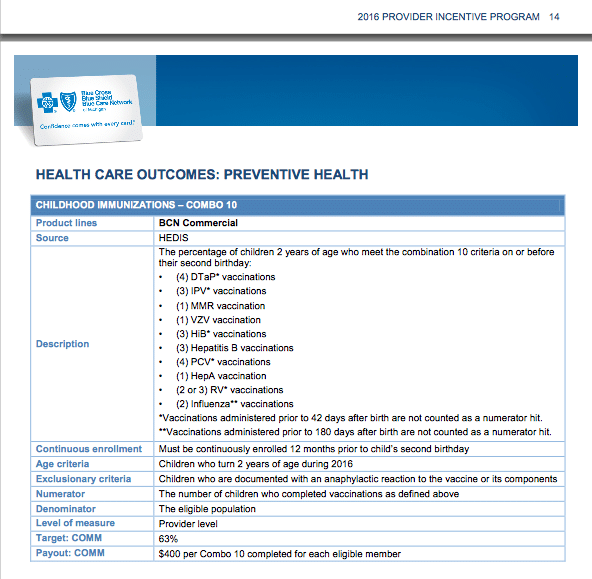
The program specifies that patients under the age of 2 must receive 24 inoculations for the doctor to receive the $400 per-patient payout. Notice the list includes the flu vaccine, even though evidence suggests that the flu vaccine actually weakens the immune system long-term. Furthermore, during the 2012-2013 flu season, the flu vaccine’s effectiveness was found to be just 56 percent across all age groups reviewed by the CDC.
Exorbitant Payouts for Vaccinating Babies
So how much money can a doctor make by pushing vaccines on trusting parents? Here’s the breakdown:
The average American pediatrician has 1546 patients, though some pediatricians see many more. The vast majority of those patients are very young, perhaps because children transition to a family physician or stop visiting the doctor at all as they grow up. As they table above explains, Blue Cross Blue Shield pays pediatricians $400 per fully vaccinated child. If your pediatrician has just 100 fully-vaccinated patients turning 2 this year, that’s $40,000. Yes, Blue Cross Blue Shield pays your doctor a $40,000 bonus for fully vaccinating 100 patients under the age of 2. If your doctor manages to fully vaccinate 200 patients, that bonus jumps to $80,000. (source: CongitiveTruths.com )
Doctors Receive Bribes for More Than Vaccinations
The complete BCBS doctor incentives booklet was posted by CognitiveTruths.com here.
The booklet shows that payouts aren’t available just for vaccines. Doctors receive bonuses for making sure that patients “adhere to their prescribed drug therapy.” This falls under BCBS category of “disease management” and includes statins, drugs for hypertension, and oral diabetes medications. Doctors also receive bonuses for helping patients manage depression… but only if they do so using drugs.
These types of practices by the medical establishment give rise to many questions. First, are doctors more concerned about earning their bonus than about children’s health? That would explain why so many doctors are no longer taking families that do not vaccinate. Further, do doctors even care if the one-size-fits-all approach to vaccination is safe?
Finally, if doctors receive payouts for disease management, then why would they want to cure their patients? This approach definitely illustrates the biggest problem of our medical establishment. Let’s face it, the establishment is creating long-term customers instead of curing patients.
You May Also Like:
The Outrageous Ways Big Pharma Has Bribed Doctors to Shill Drugs
UK Gov. awards £320 million tax-payer funded contract for ‘Covid-19 Media Propaganda Campaign’ which runs until April 2022
THE DAILY EXPOSE • MAY 2, 2021
You don’t think things are going to go back to normal on the 21st June 2021 do you? The evidence is mounting to the contrary and the latest piece of the puzzle has cost the British tax-payer £320 million.
Previous pieces of the puzzle have come in the form of a document produced for the UK Government entitled ‘Summary of further modelling of easing of restrictions – Roadmap Step 2’, and a contract currently out for tender for the employment of ‘Covid Marshals’.
The former declares that a third wave is inevitable and that it will be the fault of children and those who refuse the experimental Covid-19 vaccines. Whilst the latter confirms that Covid Marshals will be employed from the 1st July 2021 until the end of January 2022 at the earliest, to the tune of £3 million of tax-payers money.
The latest evidence that things will not be returning to normal on the 21st June 2021 comes in the form of a contract which has been awarded to a single company, costing the British tax-payer £320 million. The contract has a start date of 1st April 2021 and is due to run until the 31st March 2022. It’s stated purpose? “The provision of Media buying services for COVID 19 campaigns.”

The closing date for applications was 12am on the 31st March 2021 and the contract was awarded to ‘OMD Group Limited’. The company is based in London and has a financial director named ‘BELL, Ronald James‘ who has been with the company since the 1st November 2017. But we can also see that there have been three new appointees to the board on the 22nd February 2021. These include FENTON, Laura Claire who has been appointed as CEO. PANESAR, Ravinder who has been appointed as a financial director. And STURGEON, Natalie who has been appointed as CEO.
The three new appointees have certainly struck gold rather quick. We wonder if these people have any ties or links to any members of Boris Johnson’s current Cabinet? Track record would suggest so.

The Government has already spent hundreds of millions of tax payers money since March 2020 to advertise the fact that there is a pandemic and now plan to carry on the tradition for at least another year. The question is, if there was really a deadly pandemic would authorities need to advertise it?
The answer of course lies in the fact that this has never been about a virus, and has always been about control. This £320 million contract is to fund propaganda and maintain the level of fear that they have created in a large amount of the UK population.
The contract also explains why the mainstream media have remained largely silent and toed the line at all times in regards to the narrative being portrayed by the UK Government and their circle of scientific advisors. It would cost them millions of pounds in advertising fees if they refused to do so.
Think things will go back to normal on the 21st June 2021? Think again. This won’t end until we all say it does.
New ‘dangerous chemical’ leak detected at NUCLEAR WASTE site in Washington state
RT | April 30, 2021
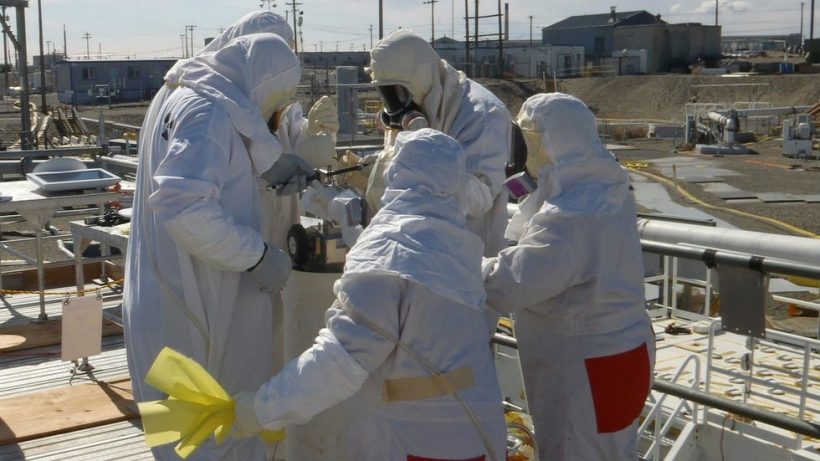
A nuclear waste storage tank at a defunct plutonium reactor in Washington state has sprung a leak, the Department of Energy said, as local officials warn the aging vessel will emit 1,300 gallons of chemicals over the next year.
The leaking tank, located at the Hanford site in southeast Washington, just 8 miles west of the Columbia River, was announced on Thursday by the Energy Department. A breach in the 75-year-old storage reservoir was suspected more than a year ago but only confirmed recently, one of several decrepit tanks at the facility.
“It’s a serious matter whenever a Hanford tank leaks its radioactive and dangerous chemical waste,” the state’s ecology director, Laura Watson, said in a statement, adding that that officials do not believe the breach poses “increased risk to workers or the public,” though it does contribute to “the ongoing environmental threat at Hanford.”
“This leak is adding to the estimated one million gallons of tank waste already in the soil across the Hanford site. This highlights the critical need for resources to address Hanford’s aging tanks, which will continue to fail and leak over time.”
While the problematic tank, designated B-109, is only the second officially confirmed leak at Hanford, (the first was detected in 2013), many of the site’s 149 storage tanks are suspected to have issues, with the Washington Ecology Department estimating that more than 200,000 gallons of waste have escaped from the “B Farm” alone, where B-109 is located. Across the whole Hanford facility, they believe 1 million gallons have poured from compromised tanks.
With B-109 leaking an estimated 3.5 gallons each day, or 1,300 gallons per year, the concerns are compounded by the tank’s close proximity to the water table, sitting just over 200 feet above, as well as the Columbia River.
A formal leak assessment was launched last year after the tank’s levels were found to be dropping, and though a breach was discovered, local officials’ hands remain tied under an agreement governing clean-up operations at Hanford. Environmental agencies can only take “immediate action” in response to a leak if it is deemed “necessary to abate an imminent and substantial endangerment to public health or welfare or the environment.” For now, the state, as well as federal agencies, have assessed no immediate danger from B-109, despite the confirmed leak.
“Contamination in this area is not new and mitigation actions have been in place for decades to protect workers, the public and the environment,” Energy Department spokesman Geoff Tyree told the Associated Press, adding “There is no increased health or safety risk to the Hanford workforce or the public.”
Hanford has seen a years-long, multi-billion-dollar clean-up effort due to its ailing equipment, which itself has become controversial. In 2019, the federal government sued arms dealer Lockheed Martin, which was awarded a $3.2 billion contract in the clean-up project alongside another private company, alleging it defrauded American taxpayers with illegal kickback payments.
The site’s management has also come under fire in recent years, with workers accused of deliberately dumping toxic waste into the environment in 2017.
The Hanford facility has a rich history stretching back to the days of the Manhattan Project, becoming the site for the world’s first large-scale plutonium production reactor. Plutonium manufactured there was used in the first nuclear bomb test at the Trinity site, as well as in Fat Man, the bomb dropped on Nagasaki, Japan in the waning days of World War II.
The B-109 tank came online in 1946, running for 30 years before it was shut down, while the entire facility was shuttered in 1987, leaving behind 53 million gallons of waste. Since then, local authorities have worked to stabilize the remaining storage vessels, but problems keep piling up, as thousands of gallons of hazardous materials continue to flow into the soil unabated.
‘Obscene’ windfarm subsidies revealed
Global Warming Policy Forum | April 16, 2021
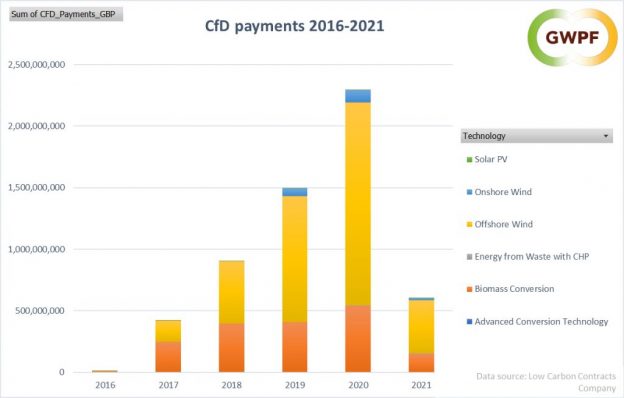
GWPF research has shown that just six offshore windfarms are now sharing £1.6 billion pounds in subsidies between them every year. Three receive annual subsidies of over a quarter of a billion pounds each year. On a single day in April last year, Hornsea 1 received a subsidy payment of nearly £1.5 million pounds.
The level of subsidy is sufficient to cover the construction cost of these windfarms in just six or seven years, meaning that future payments will represent almost pure profit for the operators.
The cost of the Contracts for Difference regime is accelerating, and rose by £0.7 billion last year alone, reaching £2.3 billion in 2020. Consumers are already paying out £6 billion under the Renewables Obligation and another £1 billion under the Capacity Market.
Direct subsidies therefore amount to an annual payment from each household of £350, a sum that is rising by at least £25 per year.
There are further bills to pay too, because windfarms are causing destabilisation of the electricity grid. The cost of the Balancing Mechanism, which deals with grid imbalances, is rising rapidly, costing each household £65 per year, a figure that is rising at a rate of £20 per year.
And the consumer is having to pay for upgrades to the electricity grid too.
Lord Lawson, GWPF director, said:
We are in the middle of an economic crisis and consumers are hit with astronomical costs for unreliable wind energy. These multi-billion subsidies are not only a massive transfer of wealth from the poor to the rich, but are damaging the UK economy as a whole. This madness has to stop.”
Dr Benny Peiser said:
The level of handouts is an obscenity. Every time a new windfarm comes on stream, the consumer is hit with a double whammy – a relentless increase in annual subsidy payments to windfarm operators and an annual bill for fixing the damage that is done to grid stability. This can’t be kept hidden for much longer. The chickens are coming home to roost very soon, and there will be a big political price to pay”.
Featured Video

WARNING: Delete TikTok Immediately!
or go to
Aletho News Archives – Video-Images
Book Review
Conspiracy Denial

Lies are Unbekoming | January 27, 2026
In honour of Michael Parenti (1933–2026), who passed away on 24 January 2026 at the age of 92. He spent his life naming what power prefers to leave unnamed.
In 1837, Abraham Lincoln remarked: “These capitalists generally act harmoniously, and in concert, to fleece the people.”
Today, he would be dismissed as a conspiracy theorist.
That dismissal—reflexive, automatic, requiring no engagement with evidence—is not a mark of sophistication. It is a tell. The question worth asking is not whether conspiracies exist (they are a matter of public record and a recognised concept in law) but why acknowledging their existence provokes such reliable hostility. What work does the label “conspiracy theorist” actually do?
The late political scientist Michael Parenti spent decades answering that question. His conclusion was blunt: “’Conspiracy’ refers to something more than just illegal acts. It serves as a dismissive label applied to any acknowledgment of ruling-class power, both its legal and illegal operations.” The term functions not as a descriptor but as a weapon—a thought-terminating cliché that protects the powerful from scrutiny by pathologising those who scrutinise them.
Conspiracy denial, in Parenti’s analysis, is not skepticism. It is the opposite of skepticism. It is credulity toward power dressed up as critical thinking. As he wrote in Dirty Truths: “Just because some people have fantasies of conspiracies does not mean all conspiracies are imaginary.” … continue
Blog Roll
Recent Comments
eddieb on WEF Calls for ‘Cultural Revolu… loongtip on Trump wanted to play peacemake… Coronistan on EU member to sue bloc over ‘su… loongtip on Vicious loongtip on EU turns to India for defense… Coronistan on Donald Trump Is No Peace … seversonebcfb985d9 on French court jails pro-Palesti… eddieb on Fourteen Incredible Facts Abou… Bill Francis on European leaders’ shift in the… seversonebcfb985d9 on Villains of Judea: Philip Esfo… loongtip on Report warns that ‘Jewish terr… Craig Nelms on New study shows that toxic gas…


 Aletho News
- More Bombs, More Talks Zelensky Rejects Trump’s Plan
- WARNING: Delete TikTok Immediately!
- Bari Weiss’ New CBS Hire List Is Full Of Zionists
- As TikTok falls into Zionist hands, UpScrolled fills the vacuum to give voice to Palestine
- Former Biden Advisor, Amos Hochstein, Admits The Biden Administration Is Responsible For the Gaza Genocide
- Not a Trump anomaly: The Board of Peace and America’s crisis-driven power plays
- Manufacturing martyrdom: The west’s cynical use of Iranian protest figures
- Attack on Iran would backfire, causing great losses for US, warns European think-tank
- Davos and Abu Dhabi: How the Ukrainian Endgame Exposed Western Decline
- AfD co-leader states the obvious: Pouring money into the Ukraine war is killing the German economy
- If Americans Knew
- “The Gaza ceasefire is a minefield” – Not a ceasefire Day 110
- Israel to seek new security deal from US, official says
- Leaked “Board of Peace” Resolution Outlines U.S.-Led Plan to Rule Over Gaza
- Jonathan Greenblatt Rolls Out Plan to Activate Hispanic Evangelical Golems
- Violence against hundreds of Gazan remains to find one Israeli – Not a ceasefire Day 109
- Greenpeace Demonstrator Exposes Folly of Protest Restrictions
- From CBS to TikTok, Pro-Israel Ellison is now in the driver’s seat
- Israel pays for UK advertisements attacking Doctors Without Borders
- Israel accused of extracting billions from Gazan people to pay for their own genocide
- ‘Deliberate Assassination’: 3 Journalists Among 11 Killed by Israeli Forces in Gaza
- No Tricks Zone
- New Study Affirms Rising CO2’s Greening Impact Across India – A Region With No Net Warming In 75 Years
- Germany’s Natural Gas Crisis Escalates … One Storage Site Near Empty …Government Silent
- Polar Colding…Antarctica Saw Its Coldest October In 44 Years!
- New Study: Sea Levels Rose 20 Times The Modern Rate During The Roman Warm Period
- As German Gas Storage Dips Dangerously Low…Shortage Hardly Avoidable
- New Study: Brazil’s Relative Sea Level Was 2+ Meters Higher And SSTs 3-4°C Warmer 6000 Years Ago
- Philosopher Schopenhauer: Climate Science Certainty Stems From Stupidity, Ignorance
- New Study: Species Extinction Rates Declining Since 1980 – ‘Climate Change Is Not An Important Threat’
- Denmark Places Climate Protection Above Animal Welfare, Poisoning And Culling Cows
- New Study: Greenland Was 3-7°C Warmer And Far Less Glaciated Than Today 6000-8000 Years Ago
 Aletho News