Money Rains Over Swedish Mainstream Media to Stop ‘Fake News,’ ‘Russian Trolls’
Sputnik – 30.10.2017
The Swedish state has invested millions of kronor in its attempt to stop foreign meddling in the upcoming 2018 election. For Sweden, which is somewhat preoccupied with the fictitious “Russian threat,” Moscow’s interference almost goes without saying.
Several of Sweden’s media giants will receive SEK 13.5 million ($1.6 million) in state support from the research and development funding agency Vinnova to stop “fake news” from affecting the 2018 general election. According to Vinnova’s press release, the companies will develop a service for “fact-checking” of, among other things, viral posts on social media.
The list of grant recipients includes Swedish Radio, Swedish national broadcaster SVT, as well as media groups Bonnier (which runs the Swedish dailies Dagens Nyheter, Expressen and Dagens Industri, as well as commercial TV network TV4) and Schibstedt (which runs the dailies Aftonbladet and Svenska Dagbladet ). The idea is that together they will counteract fake news and unfounded statements from being spread to influence the Swedish election.
Given the amount of money invested and the sheer scope of collaboration involving the bulk of Sweden’s mainstream media, Vinnova called the cooperation “unique.”
According to Vinnova, the project will, among other things, highlight journalistic investigations and critically examine statements made in the political debate as well as information disseminated on social media.
“The project is aimed at developing a digital tool that automates the flow of information and the process of fact-checking in news editorial boards that can be used to raise the quality and reduce the risk of fake or irrelevant facts reaching the audience,” Vinnova said.
Previously, the very same mainstream media, as well as high-ranking officials, including Prime Minister Stefan Löfven, Defense Minister Peter Hultqvist and Sweden’s ambassador to Russia Peter Ericsson, voiced repeated fears of Russian meddling in the upcoming election — allegations that Russian Foreign Minister Sergei Lavrov dismissed as “ridiculous.”
Nevertheless, Sweden, where the “Russian threat” is a fixture on the domestic agenda, seems to persist in its delusion of “Russian meddling.” Most recently, Sydsvenskan senior columnist Per T Ohlsson argued that the risk of Russian influence was “imminent,” especially in the view of Sweden’s reinvigorated NATO cooperation, as well as Stockholm’s stance on the Ukrainian conflict.
“The Russian trolls are already here,” Per T Ohlsson wrote, reinforcing the hackneyed cliché of Russian ‘troll factories’ flooding the web with pro-Russian comments to sow discord.”
Swedish Security Police SÄPO saw “indications of Russia’s intention to influence political and decision-making and public opinion” as early as 2015, warning of “distorting, erroneous and corruptive” messages being spread on social media.
“Russia has already shown an interest in the political debate in Sweden. We have an important geographical location on the Baltic Sea and a long history towards Russia. Sweden is also a member of the EU and has a relationship with NATO,” Björn Palmertz, senior analyst at Sweden’s Defense University, told the Aftonbladet daily, arguing that Sweden was just a puzzle piece in Russia’s general foreign policy strategy to “provide fuel for fragmentation and social challenges.”
The Swedish Civil Contingencies Agency (MSB), which plans to receive SEK 60 million ($7 million) from the Swedish government to bolster the nation’s psychological defense, recently launched a project of its own to prevent foreign meddling.
“For a foreign force seeking to influence the Swedish election, there are great opportunities,” MSB project leader Sebastian Bay told Aftonbladet.
The Rise of MEK/NCRI in Washington: Pay Off The Right People and You Are No Longer A Terrorist

Maryam Rajavi- Rudy Giuliani and Senator Joe Lieberman at the free Iran Gathering – 1 July 2017. Image credit: Maryam Rajavi/ flickr)
By Philip Giraldi | American Herald Tribune | October 30, 2017
If you want to change a group of terrorists who have killed Americans overseas into something that appears to be much more benign, all you have to do is pay off the right people in Washington. With enough money, you can even open a nice plush lobbying office on Pennsylvania Avenue in the District of Columbia, not too far from the White House and Capitol Hill.
One-time Secretary of State Hillary Clinton has been rightly blamed for the ill-conceived and badly bungled “regime change” in Libya in 2011 that eventually led to her mishandling of the resulting blowback in Benghazi, but one of her greatest failings just might have involved the piece of paper she signed when she removed the Mujaheddin e Khalq (MEK) group from the State Department list of “designated terrorist organizations” in September 2012.
How is it possible that the bad judgment demonstrated in the Libyan fiasco that created a failed state, a humanitarian disaster, a migrant crisis, armed terrorists and ultimately produced the murder of the U.S. ambassador and three other Americans compares with a signature on a piece of paper? It is because that signature put in place one of the elements that will most likely in the near future lead to a far more disastrous war for the United States than was Libya. MEK, now labeled the National Council of Resistance of Iran (NCRI), has become a principal voice of the war party that is now seeking to attack Iran, a role similar to that played by Ahmad Chalabi and his Iraqi National Congress in his disseminating of lies in the lead up to the catastrophic invasion of Iraq in 2003.
The tale of the rehabilitation and rise of MEK/NCRI is a subset of the ongoing corruption of America’s political culture, best illustrated by the fact that even national security is now up for sale, enabling a terrorist group to transform itself into a “resistance movement” and eventually be labeled “freedom fighters.”
How did this happen as MEK was on the State Department roster of foreign terrorist organizations since the list was established in 1997? Its inclusion derived from its having killed six Americans in the 1970s, its participation in the U.S. Embassy hostage-taking and from its record of extreme violence both inside and outside Iran since that time. When I was a CIA trainee our course included a simulation of the horrific attack on U.S. Air Force Officers in Tehran in 1973 that killed two colonels.
MEK is widely regarded as a terrorist cult headed by a bizarre husband and wife team Massoud and Maryam Rajavi. Its members are required to be celibate and are subjected to extensive brainwashing, physical torture, severe beatings even unto death, and prolonged solitary confinement if they question the leadership. One scholar who has studied them describes their beliefs as a “weird combination of Marxism and Islamic fundamentalism.”
With the sharp turn of the Trump Administration against Iran, NCRI is now finding an audience, telling the American public that Iran is “cheating” on the nuclear deal. It also tells us that “Iran’s nuclear weapons program has far from halted” and has claimed to identify four major sites that “with a high degree of certainty” have been involved in various aspects of the allegedly ongoing nuclear weapons project. This has led Jillian Mele of Fox News to declare, falsely, that “It appears [Iran’s nuclear] weapons program is fully operational.”
The CIA has in the past recruited MEK/NCRI agents to enter into Iran and report on nuclear facilities, but Israel’s Mossad is the group’s principal employer. Agents, recruited and trained by Israel, have killed a number of Iranian nuclear scientists and officials. The group appears to have ample financial resources, places full page ads in major US newspapers, and is also known to pay hefty fees to major political figures who are willing to speak publicly on its behalf. The group claims to want regime change in Iran to restore democracy to the country, an odd assertion as it itself has no internal democracy and is loathed by nearly all Iranians.
Because MEK/NCRI is a resource being used by Tel Aviv in its clandestine war against Iran, it is perhaps inevitable that many friends of Israel in the United States actively campaigned to have the group removed from the terrorism list so that it could, ironically, have a free hand to continue to terrorize Iran. Indeed, neocons at their various think tanks and publications as well as the American Israel Public Affairs Committee all recommended delisting the group and continue to support it. Prominent American Jews to include Elie Wiesel and Alan Dershowitz have been advocates for the group in spite of its record of terrorism.
Multi-million dollar contracts with Washington lobbying firms experienced at “working” congress backed up by handsome speaking fees have induced many prominent Americans to join the chorus supporting NCRI. Prior to 2012, speaking fees for the group started at $15,000 and went up from there. Former Pennsylvania governor Ed Rendell reported more than $150,000 in honoraria. Rudy Giuliani has been paid generously for years at $20,000 per appearance for brief, twenty-minute speeches. Bear in mind that MEK was a listed terrorist group at the time and accepting money from it to promote its interests should have constituted material support of terrorism.
The group’s well-connected friends have included prominent neocons like John Bolton and ex-CIA Directors James Woolsey, Michael Hayden and Porter Goss as well as former Generals Anthony Zinni, Peter Pace, Wesley Clark, and Hugh Shelton. Traditional conservatives close to the Trump Administration like Newt Gingrich, Fran Townsend and Elaine Chao are also fans of NCRI. Townsend in particular, as a national security specialist, has appeared on television to denounce Iran, calling its actions “acts of war” without indicating that she has received money from an opposition group.
The emergence of NCRI at this time is just another fool’s game with the usual Washington crowd queuing up for a bad cause because they are both lining their pockets and thinking they are helping Israel by punishing Iran. In any event it is a poor bargain for the rest of us, but that hardly seems to matter anymore.
Israel finally ends $10 billion binary options scam – or does it?
By Alison Weir | If Americans Knew | October 26, 2017
Israeli lawmakers have finally passed a law they say will ban Israel’s notorious binary options industry, which has brought in $10 billion a year.
The money was made by scamming millions of people around the world. A recent Reuters article reports: “London-based lawyers said hundreds of their clients were duped out of vast sums of money by some Israeli firms. More than 100 operators are estimated to be based in Israel, a technology hub.”
The industry was officially banned in the U.S. but Israeli operators still managed to scam many Americans. An article in Finance Feeds reports: “America is still a target for these nefarious entities whose methodology stems not from the financial markets or technology sectors, but from the lowbrow depths of online gambling, lead buying and affiliate marketing in Israel.”
News stories through the years have described misery and suicides among victims. Finally, a year ago the Israeli government banned sales of binary options to Israelis, but continued to permit them to the rest of the world.
The current bill that now also outlaws sales abroad was passed when Israeli legislators became concerned that the industry was hurting Israel’s image.
The Jewish Telegraphic Agency (JTA) reports that Knesset member Rachel Azaria said in introducing the recent bill: “We worry about the BDS movement. This industry has a huge impact on how Israel is viewed throughout the world. Our government officials go to international conferences and their colleagues abroad raise their eyebrows because of this industry.”
Israel National News reports that notes on behalf of the proposed legislation warned that “Israeli binary option companies risked damaging the country’s reputation and ‘could foment anti-Semitism’.”
The Times of Israel reports that the legislation was catalyzed by the outcry “among overseas law enforcement agencies, with the FBI at the forefront, that Israel was allowing this ‘monstrous’ fraud to flourish year after year.”
For years the Israeli government did little to stop it. JTA reports that despite widespread awareness of the scam, “Only a handful of Israelis have been arrested for binary options fraud, and none have been indicted, even as international law enforcement against the industry has ramped up.”
The article reports that an Israeli police superintendent “said Israeli organized crime was being massively enriched and strengthened because of law enforcement’s failure to grasp the scope of the problem.”
The law is set to take effect in three months, but some raise questions about it, charging that it lets perpetrators off the hook without punishment, allows scammers to simply relocate, and exempts similar activities, allowing the massive profits through victimization to continue.
The Times of Israel reports: “The original text was watered down — creating loopholes through which binary options and other rogues, simply by retooling what they do, will be able to continue to prosper.”
Austin Smith, founder of a company that reclaims money for binary options victims, calls the law “total garbage” that allows perpetrators to shift into new rackets without answering for their past scams.
“It’s more a political talking point than actually something with teeth that’s going to stop more fraud from being perpetrated,” he said. “It also does nothing to help victims of fraud recover any of their money.”
JTA reports that Smith is working with attorneys around the world to track down the heads of binary options companies as they open new operations in Cyprus and elsewhere, moving into such industries as diamond sales, cryptocurrencies and predatory business loans.
The original legislation authored by the Israel Securities Authority would have also outlawed similar gambits – companies involved in the foreign exchange market, or Forex, and CFD financial instruments. Pressure from lobbyists caused these to be removed from the bill.
Also, some actions are still permissible under the new law. Finance Magnates reports that binary options agents will be allowed “to provide research and development services (in other words – to develop the trading software) and to sell trading software as a shelf product.”
The FM article points out: “It remains to be seen how the amendment will be enforced.”
In particular, the question may be “how much flexibility the Israeli Securities Authority (ISA) will show when industry players, especially technology and platform solutions providers, seek relief or exemption from the ISA by trying to establish that their services do not amount to operating a trading platform but rather are in the permitted realm of software development.”
The Times of Israel reports: “Binary options owners and investors include former senior employees of the state, well-known public figures, relatives of former senior police officers and more. Immensely wealthy, some of the key figures make substantial charity donations — which in turn give them access to political figures all the way to the very top of the Israeli hierarchy.”
Past, present, and future problems
The Times of Israel, whose investigative journalists were instrumental in raising the alarm about binary options, reports that some elements of the back story to the current bill “raise extremely disturbing questions about the power of Israel’s criminal classes, the integrity of some of our legislators, and the quality of our law enforcement authorities.”
The article describes courageous actions by many Israelis intent on ending the scam. It also describes major failures and predicts deep problems for the future.
The article by David Horovitz, Why binary options ban is only a small victory in the war on Israeli corruption, is subtitled: “MKs finally moved this week to shut down a mega fraud. But the legislative process exposed the impotence of law enforcement… and the growing intimidatory power of Israel’s crooks.”
Following are some excerpts from Horovitz’s indepth report:
“The binary options crooks were barred from targeting Israelis in March 2016, but were being allowed to continue to steal from foreigners — and still are, in fact, because Monday’s law only goes into effect three months from now.”
“it quickly emerged that the police complaints bureaucracy is set up in such a way as to make it almost impossible for overseas victims of crime hatched in Israel to so much as report the matter.”
“when a Canadian father of four named Fred Turbide took his own life after an Israeli binary options firm stole all his money, and a clear paper trail established exactly who had defrauded him, the police did not take any action against the individuals and company involved, which continued to operate.”
“The fraudulent salespeople routinely conceal where they are located, misrepresent what they are selling and use false identities. (The FBI affidavit against Elbaz goes into considerable detail to explain the fraud, in all its miserable manifestations.)”
“The crooks are still out there. Some binary options firms have closed down. Others have relocated overseas, including to Cyprus and Ukraine. Some of the prime movers and shakers have already adjusted their focus to other fraudulent fields — in the fields of diamond sales, cryptocurrencies, initial coin offerings and predatory business loans.
“Top scammers are still enjoying the vast overseas bank accounts, the yachts, luxury cars, exotic holidays and other profits of their ill-gotten gains.”
“The ranks of binary options owners and investors include former senior employees of the state, well-known public figures, relatives of former senior police officers and more. Immensely wealthy, some of the key figures make substantial charity donations — which in turn give them access to political figures all the way to the very top of the Israeli hierarchy.
“They also donate to Jewish religious causes, for example Tel Aviv’s Great Synagogue, again with consequent friends in high places.”
“Some of those thousands of Israelis who have been drawn into lives of crime in the industry — cynical swindlers posing as financial experts and advisers, gloating at the naivety of their victims — are extremely cunning. And many of the higher-ups — including the computer coders, the lawyers, the affiliate marketers, and the SEO experts who manipulate Google and social media to ensure the prominence of seductive content hyping the ostensible potential for profit — are despicably smart. They will not go down without a fight. Israeli law enforcement seems largely disinclined even to try to tackle them, much less capable of doing so.”
“Monday night’s passage of the law banning binary options was but a small winning battle in what, to this extremely worried Israeli, looks for now like a losing war, a war Israel is barely bothering to fight, against a toxic cocktail of corruption.”
Alison Weir is executive director of If Americans Knew, president of the Council for the National Interest, and author of Against Our Better Judgment: The Hidden History of How the U.S. Was Used to Create Israel. Her upcoming book talks are listed here.
Single Payer and the Failure of Democrats in West Virginia
Morgan County USA | October 18, 2017
Congressman Alex Mooney is the former chair of the Republican Party in Maryland. But now he’s a congressman from the second Congressional district of West Virginia.

Talley Sergent
How did that happen? In 2014, Mooney saw that he wasn’t going to win anything in Maryland, so he crossed the bridge over the Potomac River and came on over to West Virginia.
Mooney should have been — and in 2018 should be — easily defeated. Mooney puts the interests of powerful out of state corporations over the interests of the people of his district. He is hardly ever seen in the district. (Instead, he does phone call town hall meetings.)

Aaron Scheinberg
Strike three and he should be out.
But he keeps winning.
Why?
Democrats in West Virginia are politically bankrupt.
Take for example the two declared Democratic candidates for the Mooney seat.
One is Talley Sergent. She’s a former public relations executive at Coca-Cola.
The other is Aaron Scheinberg. He has been endorsed by Congressman Seth Moulton of the New Democrat Coalition, a group that raises funds from Big Business and is seeking to move the Democratic Party to the right.
Both Sergent and Scheinberg refuse to take economic positions that would rile big business.

Both, for example, have refused to back the West Virginia Democratic Party platform’s call for a single payer, Medicare for All plan along the lines of HR 676.
HR 676 currently has 120 co-sponsors in the House of Representatives — none from West Virginia.
When asked about this, Scheinberg spokesperson Elizabeth Gale said that “Aaron believes that we have a duty to each other to ensure that all West Virginians have access to comprehensive health care.”
“As a veteran, Aaron is lucky to receive reliable, affordable health care through the VA,” Gale said. “He believes no one should to have to worry about losing or being denied health insurance. That will be a major focus of his agenda if he is elected. As far as commenting on specific bills, Aaron will wait until he can participate in the debate within Congress.”
But Margaret Flowers of Health Over Profit, said that the phrase “access to health care” is used by politicians across the spectrum to dodge the issue of single payer.
“Politicians will say that people have access to health care right now under the current system, it’s just that some people can’t afford it,” Flowers said. “Will Democrats say that a public option gives access to health care? The policies matter and candidates need to show that they understand what policies will solve the crises we face.”
“It is an unwillingness to take strong stances that is one of the reasons Democrats are doing so poorly. The majority of Democratic voters support single payer health care and it is a proven policy, so there is nothing controversial about supporting it. Voters are looking for candidates with the courage to take positions.”
While at Coca-Cola, Sergent worked to promote a Coca-Cola front group called the Global Energy Balance Network.
The message of the network? Exercise more and worry about calories less. Take the focus off of sugary drinks like Coke and put the focus on the couch potato behind the straw.
In August 2015, the New York Times exposed Coke’s front group in an article titled — Coca-Cola Funds Scientists Who Shift Blame for Obesity Away From Bad Diets.
The Times reported that Coca-Cola spent $1.5 million to start the organization.
“Health experts say this message [exercise more important than diet] is misleading and part of an effort by Coke to deflect criticism about the role sugary drinks have played in the spread of obesity and Type 2 diabetes,” the Times reported. “They contend that the company is using the new group to convince the public that physical activity can offset a bad diet despite evidence that exercise has only minimal impact on weight compared with what people consume.”
“This clash over the science of obesity comes in a period of rising efforts to tax sugary drinks, remove them from schools and stop companies from marketing them to children. In the last two decades, consumption of full-calorie sodas by the average American has dropped by 25 percent.”
“Coca-Cola’s sales are slipping, and there’s this huge political and public backlash against soda, with every major city trying to do something to curb consumption,” Michele Simon, a public health lawyer, told the Times. “This is a direct response to the ways that the company is losing. They’re desperate to stop the bleeding.”
One internal Coca-Cola email shows the head of Coke’s public relations department — Clyde Tuggle — reporting that “Talley has been leading some of our health and wellness work” and that “I’d like her to be my right hand and a core part of the team on this work going forward” — referring to the Global Energy Balance Network.
Gary Ruskin of the public interest group US Right to Know, which helped expose Global Energy Balance Network and make public the internal Coca-Cola emails, said that “Talley Sergent is perhaps the least qualified person in West Virginia to serve in Congress.”
“As a Coke public relations executive, Sergent helped perpetrate a deceit so egregious that it was exploded on the front page of the New York Times. She was a Coke handler for one of its front groups, the Global Energy Balance Network, and their efforts to snooker consumers and public health leaders, and to shield Coke from accountability for its role in helping to create the global obesity epidemic.”
“Now she wants to represent West Virginia in Congress. There is already enough deceit in Congress without her.”
“Coke’s role in West Virginia has been especially destructive of late. The state is suffering from some of the worst levels of obesity in the nation. In a notable insult to public health, the founding dean of the West Virginia University School of Public Health was a key Coke ally and a leader in Coke’s Global Energy Balance Network debacle. Gregory Hand left the deanship following the avalanche of negative news coverage about his role in the Coke deceit. And now comes Talley Sergent.”
Sergent now says it was a mistake for Coca-Cola to fund the Global Energy Balance Network and that after the Times article ran, she helped move Coca Cola into a new, more transparent direction.
In response to an inquiry, Sergent, a native of Huntington, West Virginia defended her work at Coca-Cola and took a barely veiled shot at Ruskin (based in Oakland, California), Scheinberg (who is originally from Cherry Hill, New Jersey) and Mooney (the former chair of the Republican Party in Maryland) as “outsiders.”
And Coca-Cola isn’t an outsider doing tremendous harm to the state?
“Isn’t West Virginia number one in obesity in the country?” Sergent was asked.
“We’re actually number two — behind Mississippi,” she said.
(Actually, according to a recent listing, West Virginia is number one — with a 37.7 percent obesity rate, with Mississippi coming in second with a 37.3 obesity rate.)
“Outsiders think they know voters here in West Virginia – shoot – we have folks from outside the state moving here just to run,” Sergent said. “But, like most West Virginians, I don’t take cues from special interests or outsiders, just the special people of my home state.”
“On my watch, the Coca-Cola Company transformed its approach to public health, owning up to its mistakes, becoming more transparent with its consumers and starting an open dialogue with the public health community. It wasn’t easy work but it was the right thing to do.”
“Now, I’m taking the same approach to Congress. We need a congresswoman who will take tough obstacles like health care head on, beginning with protecting and improving the Affordable Care Act, which will help break the cycle of opioid addiction, improve lives with preventive care and coverage for pre-existing conditions and encourage every West Virginian to live their best life. West Virginia needs a congresswoman who will stand up for the people and who welcomes an open dialogue with every West Virginian, no matter what. As congresswoman, I’ll do just that.”
But Sergent refused to commit to a public health campaign against sugary drinks or to a single payer, Medicare for All health program.
Some West Virginians aren’t giving up on Sergent or Scheinberg.
West Virginians Cathy Kunkel, Sally Roberts Wilson, and Lynn Moses Yellott, who are active members of grassroots organizations in the state advocating improved Medicare for All, have spoken with both Sergent and Scheinberg.
“We will continue to educate and push these candidates to support a single-payer Medicare for All system as the only real way to fix our broken healthcare system,” Kunkel, Wilson and Yellot said in a statement. “HR 676 is the only solution put forth that will enable the country to afford comprehensive care for everyone. We urge candidates to ask voters the question — ‘Since under expanded and improved Medicare for all, more than 95% of you will pay less through a fair tax than you now pay for premiums, co-pays, and deductibles, are you willing to convert the money you now pay for health insurance and out of pocket expenses to a fair tax so all in our country can have needed care?’ The grassroots will continue to educate and to push candidates to support National Improved Medicare for All.”
In addition to working for Coca-Cola, Sergent was the West Virginia director for Hillary Clinton’s 2016 campaign for President.
And unfortunately for the people of the second Congressional district, Sergent and Scheinberg appear to be playing by the same Clinton corporate playbook that brought us President Trump — and that will re-elect Congressman Mooney.
Corruption permeates Israel under Netanyahu, goes back decades

Prime Minister Netanyahu faces mounting scandal, as do his wife, friends, and many colleagues. This follows scandals for previous Israeli leaders Yitzhak Rabin, Shimon Peres, Ehud Barak, David Ben-Gurion and others for charges that range from financial corruption to sexual assault.
By Kathryn Shihadah | If Americans Knew | October 19, 2017
Certainly every country has its share of shady politicians and dirty little secrets. The US has more than enough to be embarrassed about. We need to vet our elected officials’ campaign funds, study their relationships with non-government operatives, and examine our government’s spending habits.
We need to spend our money where it will have a good return, where it will be invested in ways that reflect our American ideals. And when it comes to foreign aid, we should not support governments that will be wasteful, imprudent, or treacherous toward the people they rule.
About 20% of the American foreign aid budget goes to Israel. Is that a good investment? Is this a trustworthy government?
One would expect that a nation with oodles of Nobel laureates, world-class medical facilities, cutting edge technology, a robust economy, a nation that boasts (erroneously – see embedded links for the truth) a “flourishing democracy,” the “most moral army in the world,” “an absolute reverence for life,” and ancient, deeply religious underpinnings—one would expect that such a nation might be a little cleaner than average.
Human rights violations aside, infraction of international law and disdain for United Nations resolutions notwithstanding, Israel seems to have more than its share of shenanigans.
In fact, misconduct seems to be the norm, rather than the exception in the country that receives $10 million a day from the United States. State Prosecutor Shai Nitzan commented recently that there is nothing to worry about: “A corrupt state is a state that doesn’t fight against corruption” – and Israel is fighting. But from the looks of things, it isn’t fighting nearly hard enough.
Israel is one of the world’s leading exporters of investment scams ($5-10 billion a year–read this or a few of these), with organized crime that has grown to “monstrous proportions.” That cutting edge tech sector? 25% of its revenue comes from “shady or fraudulent industries.” And that government of the people? 75% of Israel’s 120 parliamentarians live in the pockets of special interest groups and their relentless lobbyists. (To be fair, at least that percentage of American congress people live in the pockets of AIPAC.)
Israel is fighting corruption from the highest places in government, right on down to the household help. Here is just a starter list of the fine messes that Israel’s darlings have gotten themselves into.
Charges against Netanyahu

“Case 1,000” – Cigars and Pink Champagne Affair
In 2015, Bibi allegedly accepted “lavish gifts worth hundreds of thousands of dollars” from a number of people, including billionaire Hollywood producer (and Israeli spy) Arnon Milchan. Milchan admitted that for years he’d been giving the Netanyahus expensive gifts—champagne, jewelry, boxes of cigars—at their request. At the time as the 2015 gifts, Milchan was negotiating a media partnership which, if it had succeeded, would have given him controlling interest over Channel 2 News in Israel. According to the Times of Israel, “if Milchan had succeeded, Netanyahu would have gained valuable influence over Channel 2 News.”
The Netanyahus also reportedly received lavish gifts from Australian millionaire James Packer in exchange for special favors.
The Prime Minister maintains his innocence.
…

“Case 2,000” – the Newspaper Rivalry Affair
In 2014, Netanyahu allegedly attempted to manipulate newspaper circulation in Israel. Namely, he promised to advance legislation that would effectively reduce the circulation of Sheldon Adelson’s free newspaper, Israel Hayom, and increase Arnon Mozes’ Yedioth Ahronoth. All Mozes would need to do was give Netanyahu more favorable coverage during the election season.
The Prime Minister denies any wrongdoing.
In addition, Netanyahu’s phone records are under investigation: it seems that during the last election he placed calls to Adelson, owner of Israel Hayom. The timing of some of these calls coincided with “particularly sympathetic headlines,” which may constitute illegal campaigning. Adelson is an American citizen and a major donor to the Republican Party.
…
Previous Netanyahu allegations
During his first term as Prime Minister (1996 – 99), Benjamin Netanyahu was investigated twice for fraud and breach of trust. In both cases, the police recommended that he be charged, but prosecutors declined. Ironically, the first investigation alleged that Netanyahu attempted to influence a corruption investigation.
In both cases, he insisted he was innocent.
…
History repeats itself
Netanyahu is not the first Prime Minister to be embroiled in scandal; in reality, this has been going on for decades. It can get very distracting.
One member of Israeli parliament – from Netanyahu’s Likud party – came up with a solution to this annoying problem. In 2016, David Amsalem drafted a bill that would shield the prime minister from criminal investigation while in office. He explained on Facebook: “For the past 30 years, there hasn’t been a single prime minister who wasn’t busy with investigations. The prime minister holds the most important job in Israel… [and] can not be preoccupied by investigations practically every day.” The bill is not expected to pass into law.

What have these Prime Ministers been getting themselves into all these years?
Yitzhak Rabin (PM 1974-77, 1992-95) was involved in The Dollar Account Affair—an illegal bank account—which led to his resignation from his first stint as Prime Minister in 1977. Interestingly, he was re-elected in 1992. (Earlier, Rabin had been a member of the pre-Israel underground paramilitary group, Haganah.)
…

Shimon Peres (PM 1984-86, 1995-96) is known in the West as a winner of the Nobel Peace Prize. Among Arabs, he is nicknamed “the butcher of Qana” and “the engineer of genocide,” referring to a 1996 attack in Lebanon that killed over 100 civilians. A Time Magazine article stated that “for Palestinians, on the receiving end of this “great” man’s policies, Peres was an integral part of a project that was anything but honorable…his whole history was devoted to establishing and then developing a state founded on dispossession and the ethnic cleansing of another people[.]” (Peres had also been a member of Haganah.)
…

Ehud Barak (PM 1999-2001) Barak was investigated several times for alleged illegal campaign financing, bribery, money laundering, and more. Those charges did not stick. In 2009, While visiting England, Barak almost faced arrest under “universal jurisdiction” as a war criminal for his actions during Operation Cast Lead. Similarly, he, along with Ehud Olmert (see below) and 12 other Israeli political officials, was charged by lawyers in Belgium for war crimes. As long as the officials stay out of Belgium, they are not at risk of arrest. (Barak served in the IDF for 35 years.)
…

Ariel Sharon: (PM 2001-2006) Sharon was investigated for a number of financial and corruption scandals during his time as Prime Minister, but is best remembered for his efforts as Defense Minister. Sharon launched the invasion of Lebanon in 1982 which resulted in the Sabra and Shatila massacres. The world reacted strongly against this atrocity, and in 1983 Israel set up a commission of inquiry. It determined that Sharon bore “personal responsibility” for the massacre, stating, “Mr. Sharon was found responsible for ignoring the danger of bloodshed and revenge…as well as not taking appropriate measures to prevent bloodshed.” Sharon was forced to resign. Nevertheless, he was later elected Prime Minister 3 times. (Sharon had also been a member of Haganah.)
…

Ehud Olmert (PM 2006-2009) Olmert was dogged by corruption investigations from the mid-1980s, leading some to believe that he was “corrupt but a master at covering his tracks,” and others to conclude that “the authorities were simply obsessed with harassing him.” Beginning in 2008, his luck changed: Olmert was convicted for accepting bribes, falsifying documents, tax evasion, obstruction of justice, and breach of trust in the Talansky Affair, the Holyland Affair, the Rishon Tours Affair, and the Investment Center Case. (He tried to pin the Holyland case on his secretary, and offered her money – $10k/month – for her prison sentence. But she turned state’s witness and testified against him.) Olmert resigned, was imprisoned in February 2016, and then was granted an early release in July 2017, thanks to “impeccable” behavior, according to the parole board. Ironically, however, the recently released Olmert is now under investigation for allegedly disclosing classified information while in prison.
…
Shady dealings go beyond the prime minister’s office: Benjamin Netanyahu’s wife, Sara, has a few issues of her own.
Sara Netanyahu

“Mealbooking affair” – corruption
Sara Netanyahu, wife of the Prime Minister, already has a full-time chef, but she is about to be indicted for fraud and breach of trust for hiring an outside chef and having hundreds of lavish meals catered at the official residence – about $100,000 worth – paid for with public funds. (In addition, in 2011 alone, the Netanyahu residence billed Israeli taxpayers $24,000 for take-out food.) The probe alleges that Mrs. Netanyahu falsified documents. The most serious charge carries a possible sentence of five years in prison.
Previous Sara Netanyahu charges
Mrs. Netanyahu’s employees have had additional complaints. In 2015, former caretaker at the PM residence Menny Naftali won a case against her for verbal and emotional abuse. He alleged that she drank “crazy amounts” of alcohol, especially champagne, and then regularly flew into a rage, yelling at and humiliating Naftali and other employees, over 20 of whom had quit during the Netanyahus’ tenure at the residence. The court awarded Naftali compensation of about $43,000.
The Prime Minister stands by his wife, describing her on Facebook as a “courageous and honest woman who has never had any flaws in her actions.”
And the trail of corruption goes on.
Bibi’s inner circle and top powerbrokers
“Case 3,000” – the Submarine Affair, David Shimron et al

In 2013-14, in what has been described as the “gravest corruption case in Israel’s history,” David Shimron (Netanyahu’s personal attorney, former chief of staff, close friend, and 2nd cousin) allegedly attempted to push through a $480 million deal (some sources place the value at $1.7 billion) for the purchase of submarines and patrol boats from a German shipbuilding company in which he has a financial interest. Shimron stood to receive millions of dollars. The case includes allegations of bribery, fraud, and breach of trust. According to Ha’aretz, “At least ten high-powered individuals have been identified as involved in the scandal, including very close associates of Prime Minister Benjamin Natanyahu,” among them a former Navy commander, a retired rear admiral, and a former deputy head of the National Security Council.
Netanyahu’s hands may or may not be clean in this affair. He has been accused of frivolously increasing the order of submarines from 5 to 6—a wasteful action that former defense minister Moshe Ya’alon claimed “jeopardizes the interests of the country.” One journalist suggested that if Netanyahu knew what was going on around him, “then this is a case of suspected offenses that violate ethical standards.” If he wasn’t aware, then he had “surrounded himself unknowingly with a bunch of allegedly corrupt people, appointing them to the highest and most sensitive positions in government.” Either way, the news is not good.
Netanyahu maintains his innocence.
(As an aside, these submarines and patrol boats were intended to protect offshore natural gas platforms—as Israel extracts natural gas that is also claimed by Lebanon, Syria, Cyprus, and the Palestinians. The tangle of claims, counter-claims, and violence that surround this resource located in the Mediterranean Sea is astonishing.)

Rape conviction, 2010 – Moshe Katsav (former Israeli President)
Katsav resigned as President of Israel in June 2007 when he was charged with rape, as well as with molesting or sexually harassing two female employees. The first incident happened in the 1990s when he was cabinet minister; the second and third happened while he was president. He began his sentence in 2011 and was granted early release in 2016 after serving five years for rape.
He has repeatedly professed innocence.
…

Case 630, corruption – Israel Aerospace Industries (IAI)
Top management at government owned IAI are under scrutiny for alleged bribery, fraud, embezzlement, money laundering, and breach of trust. Suspects include retired IDF brigadier-general Amal Asad and many others at high levels, including executives, board directors, and board members, as well as individuals who were “supposed to be guardians of the public trust.” Police describe the allegations as “systematic criminal behavior and deep corruption seemingly commonplace in Israel Aerospace Industries.”
…

Bribery, fraud, breach of trust – Aryeh Deri
Aryeh Deri, one of the founders of the ultra-orthodox Shas party, has had his ups and down. In the 1988, at the age of 29, Deri became the youngest Interior Minister in Israel’s (short) history. In 1999 he was convicted of fraud, bribery, and breach of trust, and served 22 months. In 2013 he was back at the helm of the Shas party. In January 2016, he was re-appointed Interior Minister. And by the end of March that year, he was embroiled in another scandal, suspected of tax offenses, breach of trust, and money laundering.
…

“Case 242,” corruption – Faina Kirshenbaum et al
In “one of the biggest public corruption investigations that have been uncovered in Israel,” dozens of officials have been arrested, charged, or indicted on a range of activities, including bribery, money laundering, conspiracy, extortion, tax evasion, embezzling, and breach of trust. In the middle of this mess is Faina Kirshenbaum, former Deputy Interior Minister and former director general of far-right political party Yisrael Beytenu (“Israel is our home”). Kirshenbaum is “at the center of some 10 separate corruption cases,” and in the words of her indictment, “acted willfully and intentionally, at times with great sophistication, in order to carry out a series of crimes.” She allegedly used her position as deputy minister to embezzle millions of dollars. Many of those implicated are members of Yisrael Beytenu.
…

Alleged Sexual Harassment – Gil Shefer (Netanyahu’s former chief of staff)
In December 2016, Gil Sheffer was arrested on suspicion of sexual offense that allegedly occurred during his time as Netanyahu’s chief of staff in 2012-13. This was not his first brush with the law: in 2013 allegations came to light of sexual harassment dating back 15 years, too long ago to allow investigation. Coincidentally, he resigned from office at the same time the allegations became public – both Shefer and Netanyahu insist that his departure was unrelated to the scandal. Interestingly, Shefer’s predecessor, Natan Eshel, had also quit amid a sexual harassment scandal. Shefer was also recently questioned in the Mealbooking Affair (see #9 above).
…

Case 4000 – “the Bezeq Affair”
Meet Shaul Elovitch, Chairman and owner of telecom giant, Bezeq. He may or may not be a longtime friend of PM Netanyahu. (Bibi stated once that they were “little more than acquaintances,” and later that he had been a “personal friend for 20 years.”) Elovitch himself is already under investigation, and now he is in his own version of Case 2000 (see #2 above): for the last few years, Elovitch’s internet portal, Walla, has been suspiciously pro-Netanyahu. Starting in 2015, Bibi stories were always glowingly positive; photos of Sara Netanyahu were profuse; stories like the Naftali scandal (see #X above) miraculously disappeared from the website; stories of Bibi’s son Yair and his girlfriend miraculously appeared just when rumors were flying of his being gay—and all of this at roughly the same time that Netanyahu’s office was advancing policies favorable toward Elovitch’s business. When Bibi was ordered to turn over information, he refused to comply.
…

Perach Lerner – corruption
A highly influential advisor of Netanyahu, Perach Lerner recently confessed to fraud and breach of trust. She had allowed her husband to take advantage of her position with the prime minister to help his business.
…

Under-age sex scandal: Tzion al-Grisi
Al-Grisi was not a high-level official, but he was important enough to rub elbows with some powerful people before the scandal. He behaved improperly toward a young girl, starting when she was 8 or 9 years old, which is shocking enough. He was later convicted, but the story doesn’t end there.
Al-Grisi was was a labor union delegate to Meretz, a leftist, Zionist political party, where he allegedly kept his position for months before Twitter got ahold of the news. He was also regional branch chair of Histadrut, Israel’s national trade union center. Histadrut has reportedly taken no action against Al-Grisi.
(Quick history lesson: Histadrut was founded in 1920 purportedly as a labor union, but acted as a colonizer of Palestine by assimilating immigrants in order to “carry out the conquest of the land.” It rejected Arab workers and products–essentially boycotting Arab labor and produce. David Ben-Gurion (Israel’s legendary first Prime Minister) was the organization’s first secretary-general, and added to the Arabs’ misery with wage scales that favored Jewish workers. Under Ben-Gurion, “class struggle was redefined as the struggle against Arab labor.” He also reportedly helped himself to the treasury–including for “trysts with his mistress in sundry European spas” (The Sacred Chain: A History of the Jews by Norman Cantor, New York: HarperPerennial, 1995, p. 368). Histadrut also founded Haganah.)
Al-Grisi maintains innocence, claiming that the girl seduced him and that the charges were “concocted” by her mother.
Conclusion
Israel is not alone in the corruption within its government, but the magnitude of the mess is critical when considering the amount of aid it receives from the United States–over $10 million per day. Compare this to assistance to the occupied Palestinian territories–averaging $400 million per year–approximately one tenth of what Israel receives. In fact, the US Congress is trying to reduce aid to Palestinians by vilifying the compensation being paid to the families of their slain and imprisoned.
Another serious issue is the Israeli government’s way of creating distractions for the world when a serious scandal comes to light. Israeli political analyst Michel Warschawski warned that Netanyahu “desperately needs distractions from these scandals. A ready-made target is always Gaza.” He added, “The danger is that he tries to heat up things there and starts a war.”
Kathryn Shihadah is a staff writer for If Americans Knew.
‘Permanent War Economy’: EU Defense Policy ‘Outsourced’ to Arms Industry
Sputnik – October 17, 2107
A report issued by Belgian campaign group Vredesactie (Peace Action) has documented how Europe’s defense industry played a pivotal role in the development of military strategies, with plans closely modeled on proposals made by major arms firms.
In 2016, the European Union took an unprecedented step, setting up the Preparatory Action on Defense Research — a military program worth US$1.05 billion — and proposing the establishment of a European Defense Fund, which allocates almost US$50 billion to the research, development and procurement of weapons over 10 years. While civil society, the academic world, and the European Parliament, were almost entirely excluded from policy discussions, the European arms industry left a “heavy footprint” in negotiations.
In essence, as the militarization of the 28-member bloc has accelerated rapidly, the arms industry has had access to every stage of decision-making processes, from setting agendas to drawing up the provisions of various action plans, Vredesactie has found.
“Rather than a reflection of what security means and how to ensure it, the European strategy is dominated by developing and selling new capabilities. Supporting the defense industry has become a goal in itself. Meanwhile, actual security challenges remain unanswered and mistakes from past policy choices perpetuated, at a high cost,” the report stated.
Over the course of their investigation, Vredesactie uncovered minutes of a 2015 meeting of the so-called Group of Personalities (GoP), a working group set up by the Commission, whose subsequent report laid the foundations of the European Defense Action Plan. At the meeting, a Commission civil servant said the goal of the group’s report was to “overcome resistance towards a defense research program.”
No Representation
GoP membership was heavily skewed towards the defense industry, with “barely any” independent voices represented, “let alone” critical voices such as peace groups or human rights organisations. The only member of the European Parliament that participated, center-right German Michael Gahler, is “known for his pro-military views” and a board member of a defense lobby organization.
Vredesactie noted the setting up of a Group of Personalities was “rare” and seems to have been deliberately used to evade “even basic levels of transparency” — the GoP was not registered as an expert group, and expert groups are to a certain extent subjected to rules regarding transparency (e.g. dates of meetings, agendas and minutes are publicly available).
“In the case of the GoP not even these basic rules were enforced. The reasons stated by the Commission for setting up the GoP have been inconsistent. The Commission at first declared the GoP is an expert group and therefore did not include any representatives from civil, but the Commission later denied [this], stating it provided political and strategic advice. In reality the GoP laid down the ideological foundation for the further militarization of Europe,” the report continued.
Disturbing Dynamic
The report concludes there is a “disturbing dynamic” going on at the EU level — what originally began life as a project to ensure continental peace between former perpetually-warring powers, has mutated into a bloc “subsidizing an industry which exports war.”
“The European Defense Fund creates a self-fulfilling and continuous loop between supply and demand, funded with public money. This creates the specter of a European permanent war economy, which has to be constantly funded by public means to remain competitive. The military technologies developed now, shape the wars of the future — the EU has already started developing autonomous systems through the Pilot Project and the Preparatory Action, despite warnings from both the scientific community as well as the European Parliament,” the report cautioned.
Furthermore, the disastrous impact of arms exports on the world has “not even [been] considered by European leaders,” instead viewed as a sign of a “thriving defense industrial base.” Modest calls for an upgrade of arms export control policies have not been heeded, and the European Defense Fund “will not lead to more security — because it is not meant to lead to more security.”
“The fund is an industrial stimulus fund for the major European arms-multinationals, located in only a few European countries. The undue influence of these companies at every level of the decision-making process has led to an outcome which solely takes economic considerations into account. This raises questions on the democratic legitimacy of these policies. Similarly, most Europeans are opposed to increased military expenditures and do not think ‘hard power’ is effective in combating terrorism,” the report concluded.
Busting Upward the Military Budget
By Ivan Eland | Consortium News | October 17, 2017
Although the Senate and House of Representatives have both passed the National Defense Authorization Act for fiscal year 2018 at the gargantuan sum of $700 billion, most of the largesse has little to do with defending the United States and much to do with policing the informal American overseas empire. Thus, at least some trimming to the huge amount is possible.
Of the $700 billion, about $640 billion is the Pentagon’s base budget and another $60 billion dollars is allocated to fight simultaneous wars in Afghanistan, Syria, Iraq and elsewhere. This whopping amount exceeds last year’s $619 billion, thus flouting the “sequestration” spending caps in the 2011 Budget Control Act. Trump and the Republicans want to use budget savings from domestic spending to finance the defense spending increases. However, they will need Democratic votes to break the sequestration caps; the Democrats’ price for doing so is a logrolling that would also require increases in domestic spending.
Yet the Budget Control Act has helped control federal spending, budget deficits, and debt accumulation and should be retained. Apparently, when conservatives tout slimming down government, they don’t seem to think the Defense Department is part of the federal bureaucracy.
The idea is preposterous that a country which alone accounts for about half the world’s defense budget needs more money to keep the readiness of its forces high and to rebuild a military that has been depleted by long, senseless wars in the Middle East and South Asia. The Defense Department is already slathered with over $600 billion a year and just needs to reallocate some of its funds to improve readiness and conduct rebuilding.
Yet members of Congress always propose amendments adding extra weapons systems, such as ships and aircraft, to the budget that the Defense Department doesn’t request. Not coincidentally, all this wasteful and unneeded pork spending just happens to be in these members’ home states. Such pork is a regular occurrence in defense budgeting and explains why the Defense budget is so massive, yet force readiness and equipment depletion remain problems.
Other wasteful spending perennially occurs on stateside military bases that even DoD would like to close, but members of Congress like to keep open because it subsidizes local economies they represent. The Pentagon offered a useful proposal that would have opened another round of base closures to save money. These savings could have been put toward readiness and rebuilding. Both the House and Senate rejected it for the aforementioned parochial reason.
Overseas Bases
To save even more money, the United States should close some overseas bases and decommission military units at those bases. Essentially, the military is like a fleet of expensive sports cars that is short on money for gas, repair, and maintenance. The overseas bases and forces need to be pruned so that the remaining forces at home have enough money for operations and support. With a $20 trillion debt, the United States is overextended in the world; the U.S. half of global defense spending is paid for out less than a quarter of the world’s GDP. Pruning the U.S. overseas footprint will help reduce the overextension.
Another way to save money would be to end unneeded and counterproductive wars in the Middle East and South Asia, which lead to increased blowback anti-U.S. terrorism. Sen. Rand Paul, R- Kentucky, laudably proposed repealing outdated congressional authorizations for the Afghanistan and Iraq Wars, passed in 2001 and 2002. Congress was so scared of the proposal that it didn’t even get a vote.
These two authorizations for the use of force should have been terminated. Going even further, one could question counterproductive (for the same reason as the Afghanistan and Iraq Wars), congressionally unapproved, and therefore unconstitutional air and drone wars in Pakistan, Somalia, Yemen, Syria, and Libya. Lives and even more money could be saved if they were also ended.
Therefore, eliminating pork spending, unneeded and counterproductive wars overseas, and excessive bases and forces at home and around the world could free up more money for military readiness and any post-war rebuilding necessary without ending the sequestration limits on defense spending needed to control budget deficits and debt accumulation, which are dragging the U.S. economy and preventing higher economic growth rates.
Ivan Eland is Senior Fellow and Director of the Center on Peace & Liberty at the Independent Institute.
DEA, Congress complicit in US opioid epidemic – whistleblowers
RT | October 16, 2017
The US Drug Enforcement Administration ‘shut off’ investigations into large distributors of addictive opioid pills, while a new law made it nearly impossible to prosecute them, the agency’s former employees said.
During the Obama administration, the drug industry used their money and influence to pressure top lawyers at the DEA to take a softer approach to investigating large distributors of opioid pills, even when there was ample evidence of suspicious dealings, Joe Rannazzisi, former head of the DEA’s Office of Diversion Control, told CBS’ 60 Minutes program.
Rannazzisi accused America’s largest painkiller distributors, including Cardinal Health, McKesson, and AmerisourceBergen, of “knowingly” turning a blind eye to the addictive pills being diverted to illicit use.
Former attorney at the DEA Jonathan Novak told CBS that in 2013 he also noticed a sea change in the way prosecutions of big distributors were handled, as his supervisors turned down cases they would have once easily approved. The DEA operates under the Department of Justice.
“These were not cases where it was black – where it was grey… These were cases where the evidence was crystal clear that there was wrongdoing going on,” Novak said.
Jim Geldhof, another former DEA investigator, told the program about a West Virginia case he was looking into where 11 million pills wound up in one of its counties with a population of just 25,000. He said he suddenly ran into roadblocks from one DEA supervisor.
“Every time I talked to this guy he wants something else. And I get it for him and that’s still not good enough,” Geldhof said. “And this goes on and on and on. When these roadblocks keep get thrown up in your face, at that point you know they just don’t want the case.”
“There was a lotta pills, a lotta people dying, and and we had tools in our toolbox to try to use and stem that flow. But it seemed down in headquarters that that toolbox was shut off,” said another former DEA official, Frank Younker.
The ex-employees said one of the reasons for the roadblocks was the “revolving door” between the DEA and the drug industry, as a number of the administration’s top lawyers landed lobbying jobs for the pharmaceutical companies and drug distributors upon leaving the government.
One such former DEA attorney wrote legislation which “made it all but impossible” to prosecute unscrupulous distributors, according to DEA chief administrative law judge, John J. Mulrooney.
The bill, called Ensuring Patient Access and Effective Drug Enforcement Act, was signed into law by president Obama last year, after it was passed by both chambers of Congress. Critics say it effectively stripped the DEA of its authority to investigate suspicious transactions as the government is now required to meet a higher standard before taking enforcement actions.
After Rannazzisi accused the bill’s co-sponsors Tom Marino (R-Pennsylvania) and Marsha Blackburn (R-Tennessee) of protecting distributors under his investigation, the lawmakers wrote the inspector general for the Justice Department, demanding that Rannazzisi be investigated for trying to “intimidate the United States Congress.”
Soon after, Rannazzisi was stripped of his responsibilities. He told CBS he went from supervising 600 people to supervising none – so he resigned.
Seven months after the bill became law, Marino’s chief of staff Bill Tighe became a lobbyist for the National Association of Chain Drug Stores.
Last month, President Donald Trump nominated Marino to lead the Office of National Drug Control Policy. In the wake of the 60 Minute investigation, some congressional Democrats called on the president to withdraw his nomination
Acting DEA chief Chuck Rosenberg, who led the agency under President Barack Obama, resigned at the end of September, reportedly over disagreements with Trump’s policies.
Prescription painkillers have stoked the epidemic of opioid overdoses and addictions across the US.
In August, Trump declared the opioid epidemic a national emergency after his Commission on Combating Drug Addiction and the Opioid Crisis reported that the US faces the death toll equal to “September 11th every three weeks” as the epidemic claims the lives of up to 142 Americans every day.
“60,000 Americans lost their lives to drug overdoses” in 2016, Attorney General Jeff Sessions said later that month.
“That will be the highest drug death toll and the fastest increase in that death toll in American history,” Session stated, adding that “this is not a sustainable trend nor an acceptable America.”
“80 percent of heroin addictions in America started with prescription drug addiction,” Sessions added, saying that the abuse of prescription drugs needs to be stopped.
Tossing bribery charges against Sen. Menendez to ‘decriminalize corruption’
Press TV – October 16, 2017
Prosecutors warn that tossing bribery charges against US Senator Robert Menendez – as being considered by a federal judge—would “decriminalize corruption” and “jettison the vast majority of bribery prosecutions.”
US District Judge William Walls suggested last week that the Justice Department’s bribery charges against Menendez may not move forward based on his reading of a 2016 Supreme Court opinion overturning the conviction of former Virginia Governor Bob McDonnell.
McDonnell had been convicted of corruption charges for taking gifts from a businessman in exchange for arranging a meeting between him and state officials.
In that ruling, the top court invalidated the “stream of benefits” theory of bribery that prosecutors have used to make legal cases against Menendez and other public officials.
“I know the prosecution had a heyday before McDonnell, and now they have a doomsday after McDonnell,” Walls said.
Federal prosecutors allege that Menendez accepted bribes from his co-defendant Salomon Melgen, a Florida ophthalmologist and longtime friend, in anticipation for the senator’s help “as opportunities arose” in the future.
Melgen has already been convicted in Florida for overbilling the Medicare program by millions of dollars, and faces a potentially lengthy prison sentence.
Prosecutors allege that Menendez intervened with federal agencies on Melgen’s behalf to resolve the billing dispute, to assist a $500 million port security contract, and to obtain US visas for Melgen’s girlfriends.
Menendez and Melgan have both denied the charges, with their attorneys arguing that what prosecutors call bribes were gifts exchanged between friends.
The high-profile case resumes Monday.
Both the Justice Department of defense attorneys filed motions during the weekend to bolster their arguments.
Prosecutors wrote that to dismiss charges against Menendez “would decriminalize the most egregious forms of corruption, incentivizing greedy businessmen to put politicians on retainer and immunizing lawmakers who solicit bribes in exchange for a promise to perform official acts.”
“The Supreme Court did not, and this Court should not, render a decision that has the unsettling effect of legalizing all such conduct.”
In total, the New Jersey Democrat faces six counts of bribery, three counts of honest services fraud, one count of conspiracy, one count of interstate travel to carry out bribery, and one count of making false statements on his congressional financial disclosures.
Pharmaceuticals can be a license to print money
By Pete Dolack | Systemic Disorder | October 11, 2107
It’s no secret that the United States suffers from by far the world’s highest costs for health care. As the most market-oriented health care system among advanced capitalist countries, this is no surprise. Health care in the U.S. is designed to deliver corporate profits, not health care.
On that score, the U.S. system is quite successful. Pharmaceutical companies are at the head of the class in this regard, frequently justifying the spiraling costs of medications by citing large research and development costs that include the costs for drugs that don’t make it to market. There are many drugs that fail to survive testing and become a cost that will never be compensated, that is true. But are these failures really so high to justify the extreme costs of successful drugs?
It would seem not. Firmer proof of that lack of justification has been published by the JAMA Internal Medicine journal, which found that revenue for cancer drugs far outstrips spending on research and development. The article, “Research and Development Spending to Bring a Single Cancer Drug to Market and Revenues After Approval,” prepared by Drs. Vinay Prasad and Sham Mailankody, found that revenue from 10 drugs (one by each of 10 companies) exceed those companies’ total research and development costs by more than seven times.
The total revenue hauled in from these 10 drugs did vary considerably. Two of them earned more than US$20 billion after approval. Both of these high performers cost less than $500 million in research and development costs. The revenue from each of the 10, however, exceeded costs, with widely varied margins. Still profitable: The median revenue of these 10 drugs was $1.7 billion, more than double the median development cost of $648 million, the JAMA Internal Medicine authors report.
The authors write that the median cost to develop a cancer drug represents “a figure significantly lower than prior estimates,” adding that their analysis “provides a transparent estimate of R&D spending on cancer drugs and has implications for the current debate on drug pricing.”
To obtain these figures, the authors analyzed U.S. Securities and Exchange Commissions filings for pharmaceutical companies with no drugs on the U.S. market that received approval by the U.S. Food and Drug Administration for a cancer drug from January 1, 2006, through December 31, 2015. Cumulative R&D spending was estimated from initiation of drug development activity to date of approval. Earnings were tracked from the time of approval to March 2017.
The sky’s the limit for pharmaceutical prices
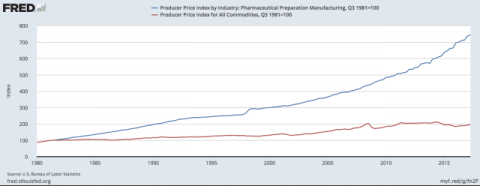
The increase in pharmaceutical prices (blue) versus the general increase in commodities prices (red).
Another way of looking at this would be to examine the increases in the cost of pharmaceuticals against other products. Here again the numbers stand out. Using data gathered by the St. Louis branch of the Federal Reserve Bank, the consumer price index for pharmaceutical preparation manufacturing for the first quarter of 2017 was 747.8, with January 1, 1980, as the benchmark of 100. In other words, the price of pharmaceuticals is seven and half times higher than they were at the start of 1980. (See graph above.)
How does that compare with inflation or other products? Quite well — for pharmaceutical companies. That more than sevenfold increase in drug prices is an increase nearly two and half times greater than inflation for the period, and nearly four times that of all commodities.
So, yes, unconscionable price-gouging is the cause here. By the industry as a whole, not simply individuals like “Pharma Bro” Martin Shkreli, who might be an outlier in his brazenness but not in his profit-generation plan.
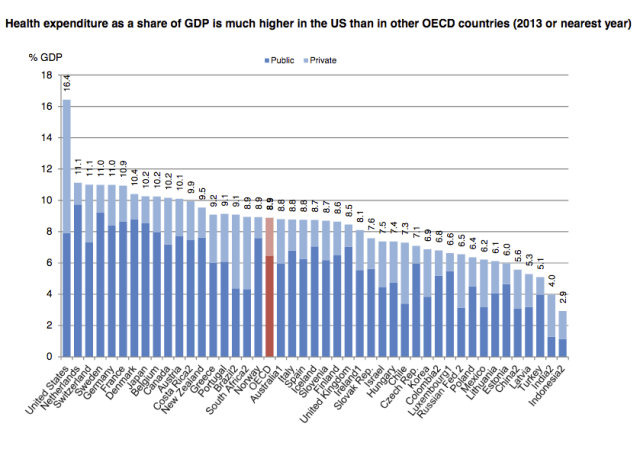
Although not the entire picture, this snapshot of corporate extortion plays a significant role in why the cost of the United States not having a universal health care system is more than $1.4 trillion per year.
Among 19 broadly defined “major” industrial sectors in the U.S., health technology is again expected to be found the most profitable for 2016, with a profit margin of 21.6 percent. Higher even than finance at 17 percent. When narrowing to more specific, narrowly defined industry categories, generic pharmaceuticals sit at the top with an expected 30 percent profit margin for 2016. Major pharmaceuticals rank fourth at 25.5 percent on a list in which health products and finance claim nine of the top 10 spots.
The sky’s the limit for pharmaceutical profits
That’s a repeat of 2015, when health technology had the highest profit margin of 19 broadly defined industrial sectors, at 20.9 percent, topping even finance, the second highest. When a separate study broke down profit margins by more specific industry categories, health care-related industries comprised three of the six most profitable.
Nothing new there, either. A BBC report found that pharmaceuticals and banks tied for the highest average profit margin in 2013, with five pharmaceutical companies enjoying a profit margin of 20 percent or more — Pfizer, Hoffmann-La Roche, AbbVie, GlaxoSmithKline and Eli Lilly. The world’s 10 largest pharmaceutical corporations racked up a composite US$90 billion in profits for 2013, according to the BBC analysis. As to their expenses, these 10 firms spent far more on sales and marketing than they did on research and development.
If those facts and figures aren’t enough, here’s another way of looking at excessive profits — a 2015 study found that, of the 10 corporations that have the highest revenue per employee among the world’s biggest corporations, three are health care companies. Two of the three, Amerisourcebergen and McKesson, both distribute pharmaceuticals, and the other, Express Scrips, administers prescription drug benefits for tens of millions of health-plan members. Each of these primarily operates in the United States, the only advanced-capitalist country without universal health coverage.
The extra layers represented by those three companies demonstrate that there are ample opportunities for corporate profiteering that contribute to extraordinarily high health care costs in the U.S., beyond drug manufacturing and insurance.
And because corporations have the ear of politicians and other government officials, it’s no surprise that one of the primary ongoing goals of the U.S. government for so-called “free trade” agreements, such as the Trans-Pacific Partnership, is to impose rules that would weaken the national health care systems of other countries. This was done in TPP negotiations at the direct behest of U.S.-based pharmaceutical companies, incensed that countries like New Zealand make thousands of medicines, medical devices and related products available at subsidized costs.
By far the most expensive system while delivering among the worst outcomes and leaving tens of millions uninsured, where tens of thousands die from lack of health care annually. That is the high cost of private profit in health care. Or, to put it more bluntly, allowing the “market” to decide health outcomes instead of health care professionals.
Featured Video

EUROPE FEARS RUSSIA’S NEXT MOVE / Ian Proud
or go to
Aletho News Archives – Video-Images
New Book
New Book: No Autoimmunity The Body Doesn’t Attack Itself
Lies are Unbekoming | September 24, 2026
 The label for Humira, once the best-selling drug in the world, lists its risks in plain print. One of them, in the label’s own words, is new “autoimmune” disease.
A drug prescribed for a condition labelled autoimmune carries a warning that it can cause a condition labelled autoimmune. That contradiction sits in every box, on a folded paper almost nobody reads.
My new book starts there.
No Autoimmunity: The Body Doesn’t Attack Itself
For seventy years, “your body is attacking itself, and we don’t know why” has ended the conversation for people diagnosed with multiple sclerosis, lupus, rheumatoid arthritis, Hashimoto’s, Type 1 diabetes, Crohn’s and psoriasis. More than eighty conditions now carry the autoimmune label. The diagnosis comes with a prescription for life. It almost never comes with a question about cause.
This book asks the question and answers it from the framework’s own records: its drug labels, its journals, its regulatory filings, and its own experiments. … continue
Blog Roll
 Aletho News
- Iran offers Trump deal before US election
- Merz regime wants ‘secret police’ – opposition
- Israeli settlers terrorize West Bank Palestinians with state-provided drones: Report
- They see them, then kill them: Israeli quadcopters track, deliberately target civilians in Gaza
- Debunked: Trump’s egregious UNGA claims on war against Iran crumble under scrutiny
- Europe was part of the infrastructure of US aggression against Iran: Deputy FM
- New evidence on the Bucha Massacre
- Italy and France debunk reports CIA issued ‘Russian drone threat’ warning
- How Russia is Rewiring the Global South
- Britain’s elites want you ready to die for a war they keep imagining
- If Americans Knew
- Trump betrayed voters with his campaign lies and prioritized a foreign country once he took office
- Netanyahu calls Israel’s war in Gaza ‘opposite of genocide’ in UN speech to near-empty hall
- Settler Kidnappings: Torture, Sexual Abuse and Terrorisation of Palestinian Abductees as Israel Deepens Annexation of West Bank
- Gaza winter nears as 162,000 tents become unusable, raising fears of humanitarian crisis
- Netanyahu says, “It’s the opposite of genocide”; UN says Gaza economy is world’s ‘most severe crisis on record’ – Daily Update
- Israel’s US-Backed Assault on Gaza Has Created the ‘World’s Most Severe Economic Crisis on Record’: UN
- ‘Protecting U.S. Citizens’… From Israel
- ‘This is where I live now, the back of a truck’: a day in the life of a grandmother in Gaza
- In UN Speech, Iran’s President Displays Pictures of Children Killed by US, Brings Attention to Israel’s Nuclear Arsenal
- Israel displaces hundreds of Palestinians amid wave of demolitions in West Bank
- No Tricks Zone
- New Study: Earth And Venus Surface Warmth Largely Explained By Convection And Lapse Rate, Not CO2 Or Radiation
- 2025 Nature Paper Claiming Worsening Global Drought Gets RETRACTED …Heavily Flawed
- New Study: ‘Global Drought Shows No Detectable Recent Acceleration Under Climate Warming’
- Economic Masterminds: German Socialists Suggest Taxing Productivity Gains Stemming From Using AI
- The South China Sea Has Not Been Cooperating With The Climate Change Narrative
- Energy Crisis: Germany Enters Heating Season With Historically Low Gas Reserve Fill Levels
- New Study: The Antarctic Ice Sheet Gained Mass From 2020-2024 Due To Staggering Snow And Ice Accumulation
- Study: Ocean Heating Rates From Thousands Of Years Ago ‘Dwarf’ Modern Ocean Heating Rates
- Climate Extremists Target, Attack Large-Scale Power Grid Infrastructure In Germany!
- New Study: Antarctic Ice Melt Has Contributed Less Than 1 Centimeter To Sea Level Rise In The Last 30 Years

