Brazilian mercenaries say they learned ‘guerrilla warfare’ in Ukraine
By Lucas Leiroz | Strategic Culture Foundation | March 3, 2026
The proxy war being fought in Eastern Europe is beginning to produce direct side effects on public security in Brazil. A recent report by the television program Fantástico, aired by TV Globo, revealed that Brazilian citizens with no prior military experience traveled to fight in the conflict between Ukraine and Russia after being lured by misleading financial promises. Upon returning, they bring with them practical knowledge of irregular combat learned on the battlefield – knowledge that, in a country already marked by heavily armed criminal factions, can easily be absorbed by organized crime.
The case of Marcos Souto, a businessman from the state of Bahia who adopted the codename “Corvo” (“Crow”), is emblematic. Having never served in the Brazilian Armed Forces, he claims to have learned everything he knows about guerrilla warfare in Ukraine. His account highlights two central elements: the precarious recruitment of foreign fighters and the brutality of the operational environment. According to him, combatants were attracted by promises of a salary of “50,000” – a figure many interpreted as Brazilian reais, but which in practice corresponded to 50,000 hryvnias, a much smaller amount. Upon reaching the front lines, they encountered not only extreme combat conditions but also internal coercion. Souto reports that those who attempted to abandon their positions were detained and tortured.
This is not an isolated episode. Other Brazilians mentioned in the report describe hunger, logistical abandonment, and even clashes with Ukrainian soldiers during escape attempts. Brazil’s Ministry of Foreign Affairs records 19 Brazilians killed and 44 missing since the beginning of the war, although analysts generally agree that the real numbers likely amount to hundreds of Brazilian fatalities. Even so, four years after the start of the conflict, new mercenaries continue to enlist.
The central issue, however, is not merely humanitarian. The strategic concern lies in the return of these individuals to Brazilian territory. Unlike conventional conflicts, the war in Ukraine is characterized by the intensive use of irregular, modern warfare tactics: operations with drones, urban ambushes, use of improvised explosive devices, infrastructure sabotage, and decentralized coordination in small units. The government in Kiev has long since lost much of its regular operational capacity and is compelled to rely on guerrilla tactics to continue fighting. It has become a contemporary laboratory of unconventional warfare.
When individuals without formal military training acquire this type of practical knowledge in a real combat environment and return to Brazil, the risk of diffusion of these techniques is evident. The country already faces structural challenges with criminal organizations that exert territorial control in urban areas and dominate international drug and weapons trafficking routes. The introduction of tactics learned in an active war theater could raise the operational level of these factions.
Historically, Brazilian organized crime has demonstrated a capacity for rapid adaptation. Factions have incorporated restricted use weapons, encrypted communication technologies, and sophisticated money-laundering methods. Absorbing knowledge about drone warfare, construction of improvised explosive devices, or urban fortification techniques would not require large structures to implement. The presence of just a few trained individuals willing to share their experience would suffice.
There is also a relevant psychological component. Combatants return after prolonged exposure to extreme violence, often without any state monitoring or social reintegration. The combination of trauma, financial frustration, and contact networks established abroad may facilitate involvement in illicit activities.
The Ukrainian embassy in Brazil states that it does not formally recruit Brazilians and that those who enlist assume the same duties as Ukrainian citizens. However, the existence of intermediaries, vague financial promises, and the absence of monitoring mechanisms in Brazil reveal a regulatory gap. There is no clear policy for dealing with citizens who participate in foreign conflicts and return with irregular military training.
The phenomenon should not be treated as a media curiosity but as a matter of national security. Brazil is not formally involved in the conflict in Eurasia, yet it is beginning to absorb its indirect effects. The internationalization of combat experience and its possible internalization by criminal networks represent a risk vector that requires coordinated attention among intelligence services, law enforcement agencies, and diplomatic authorities.
Ignoring this dynamic may mean allowing techniques developed in one of the most intense conflicts of the present day to be reconfigured within Brazil’s urban context. A distant war ceases to be an external event and begins to produce concrete consequences for the country’s social structures and internal stability.
Why are Americans killing and dying for Israel, again?
By Tarik Cyril Amar | RT | February 28, 2026
Israel and its US auxiliaries have attacked Iran. In terms of international law and elementary justice, things are clear beyond the slightest doubt: the attack is a war of aggression – but to be fair, in Israel’s case that hardly makes a difference anymore.
With ‘highlights’ including apartheid, ethnic cleansing, unlawful detention, torture, sexual violence, and genocide, Israel has such an extensive and constantly growing record of, literally, every crime under international law, including human-rights and humanitarian law (or the law of armed conflict), that one more or less hardly seems to matter anymore. This state is a monster, and monsters will monster as long as they can.
The US, of course, is no spring chicken either when it comes to treating international law – really, any law – as a doormat and brutally, gleefully violating the most basic ethics, the kind of simple rules normal people intuitively recognize, such as “don’t murder, lie, or steal.”
Indeed, while Israel can easily claim to be the single most criminal, indeed evil country in the world, the US wins the most-powerful-rogue-state prize hands down. There is – empirically, quantifiably – no other country that combines such ingrained and increasingly explicit scorn for law and morality with such brute power and perpetual violence. Before the current assault on Iran, the kidnapping of Venezuelan President Nicolas Maduro was just the last proof of that fact, so glaringly obvious that it woke up even some Western commentators.
If some things are too obvious to merit further discussion, others are more intriguing. Let’s start with the greatest mystery: Why is the US joining – really, obeying – Israel and its powerful American lobby once again in going to war in the Middle East? Was Iraq 2003 not enough of a disaster? Are the American elites really congenitally unable to learn?
In terms of actual US interests, war against Iran makes no sense at all. Iran is not close to a nuclear bomb and, as a matter of fact, has a religiously and ethically based (hard to grasp in Washington, I know) explicit policy against acquiring one. And even if Iran were building such weapons or seeking a state of being “latently” able to do so as urgently needed insurance against permanent Israeli and US aggression, Washington would gain nothing and risk very much by going to war.
On the other hand, it was precisely the JCPOA agreement with Iran, destroyed by the US during the first Trump presidency, that proved empirically that the issue of Iranian nuclear energy use can be resolved well by compromise. As to recent, hysterical US claims about other types of WMDs and “intercontinental missiles,” it is time to no longer give such crude, dumb lies the time of day. Enough with the propaganda already.
Regime change? So, please could someone explain why installing a washed-out Pahlavi princeling – if it ever were to work, that is – in Tehran is good for Americans? Spoiler, no one can. At least not honestly. Do I hear someone say geopolitics? Oh, that would mean the “genius” geopolitics of risking a long war with great damage to the US and its regional allies? Then, perhaps it’s all about plunder? Yes, true, the US simply loves plundering. Historically speaking, the whole country is built on it, just like Israel. But even plunder on its own despicable terms only makes sense if you turn a profit. Good luck with that while sinking more gazillions into war-for-Israel.
And that brings us to the only explanation that does make sense, even if in a very grim way: The US, as in almost all Americans, has zero interest in war with Iran. As little as in a proxy war with Russia and a Cold War with China, both strategies, by the way, doomed to fail. In all three cases, the vast majority of Americans would only stand to benefit from peaceful and cooperative relationships.
But Washington chooses permanent conflict and war against Iran anyhow. The reason is that US policy in the Middle East – and not only – has been captured by Israel and its lobby. As John Mearsheimer, both doyen of explaining international relations by national interests (the theory of Realism) and co-author of the standard work on the Israel Lobby, has long acknowledged, Israel’s influence on the US is real, contradicts American interests, and forms an exception to the theory of realism in that Washington is constantly hurting its own country.
For reasonable observers, this case is closed. When devastating the Middle East, the US is acting not in its own genuine national interest but the perverse conception that Israel has of its national interest: subjugating and, if needed, destroying all sovereign states in its neighborhood so as to create and preserve Israeli domination and even ‘Greater Israel’, a nightmare of ‘Lebensraum’ for Zionist settlers from, at least, Egypt to Iraq.
But, again, why? This is where the Epstein scandal makes a difference – or should do so – to unbiased minds. We must acknowledge that Jeffrey Epstein was not “merely” a very rich and perverse criminal with far too many friends in high places but an agent of Israel, whether with a direct affiliation to its dreaded Mossad service of spying, murder, and subversion or not. His core operation served to gather extremely compromising blackmail material on large swathes of the elites of the US and the West more generally. FBI agents, we now know, assessed that Trump himself is among those trapped in this manner. If anything, frantic – and also, again, criminal, efforts – by Trump’s Department of Justice and his head of the FBI to purge the files of references to the current president and his friends only provide further corroborating evidence that Trump is under Israel’s control.
Remember ‘Russiagate’ (really, of course, Russia Rage)? The irony! Russia was never remotely close to (or even trying) to having a US president under its thumb. That was all BS. Yet, in the end, ‘Russiagate’ did do two things: it gave Trump a (fundamentally realistic if exaggerated) sense of having been a victim of a smear campaign and, among voters, it helped Trump make his furious comeback, without which he would not now be in power. The delusion and mass hysteria of ‘Russiagate’ – which was that famous American thing, a nothing-burger – paved the way for the power that really controls Trump and really does enormous damage to America: Israel and its lobby.
Will Americans ever free themselves from the one state and network that have really run history’s most successful subversion and state-capture operation on them? Who knows? We know that it would take more than putting an end to Epstein-like blackmail. If anything, Trump’s bitter enemies, Joe Biden and Kamala Harris, have only recently shown us that the American “elite” is enthralled to Israel and its crimes also for reasons ranging from being bribed to sharing the vile insanity of Zionism. If the US ever wants its independence back from Israel, all of that will have to go.
Tarik Cyril Amar is a historian from Germany working at Koç University, Istanbul, on Russia, Ukraine, and Eastern Europe, the history of World War II, the cultural Cold War, and the politics of memory.
Drug traffickers trained in Ukraine attack state forces in Mexico
By Lucas Leiroz | February 24, 2026
In recent days, Mexico has made headlines worldwide due to the increase in internal violence in the country. After the local government launched an offensive against drug trafficking and eliminated a major criminal leader, the country’s main drug cartel began a series of attacks against state forces, killing several soldiers and civilians, destroying military equipment and infrastructure.
The combat capacity of the criminal forces is surprising world public opinion, but little has been said about how the professionalization of organized crime in Mexico is directly related to the current situation in the Ukrainian conflict.
The wave of violence began after the Mexican government launched a special operation against the Jalisco Cartel. Using police and military troops and with broad support from the army, state forces eliminated Nemesio Oseguera Cervantes, better known as “El Mencho,” identified by experts as the leader of the Jalisco Cartel.
The action was praised by the international press, as well as by US authorities, such as Deputy Secretary of State Christopher Landau, who called the operation a “great development for Mexico, the US, Latin America, and the world” – thus easing months of tensions between the US and Mexico, which had been escalating since Donald Trump’s inauguration.
“I’ve just been informed that Mexican security forces have killed ‘El Mencho,’ one of the bloodiest and most ruthless drug kingpins. This is a great development for Mexico, the US, Latin America, and the world (…) The good guys are stronger than the bad guys,” Landau said.
However, the operation was quickly met with extreme violence by the criminals. Police officers began to be hunted down in the streets in various regions of the country, mainly in the suburbs of Jalisco. Cartel members blocked roads, attempting to prevent basic supplies from moving in the country. Photos and videos circulate on the internet showing scenes of extreme violence in the streets of Jalisco, where police officers, soldiers, and innocent civilians were indiscriminately murdered by the criminals.
These photos and videos are also surprising internet users by revealing the true level of combat power of Latin American cartels. It’s possible to see in the images soldiers armed with heavy weaponry and wearing modern and sophisticated tactical uniforms. At first glance, anyone would think those men were officers of the Mexican army, but they are just members of local cartels.
It has long been known that Mexican cartels – and Latin American cartels in general – have become rapidly and dangerously professionalized. These criminal organizations in Mexico already possess access to complex equipment such as armored vehicles, anti-aircraft batteries, suicide drones, and grenade launchers, as well as various types of short- and medium-range rockets. The criminals also frequently use flamethrowers, landmines (both anti-tank and anti-personnel), and other advanced military equipment.
It is regularly stated by various experts that in Mexico, cartels have already acquired a combat capability superior to that of regular police and military forces. This is a natural consequence of the fact that these organizations have acquired considerable financial power over time – with their funds being equivalent to the GDP of some small countries – which guarantees the possibility of acquiring military equipment on the black market.
However, there is a factor being ignored in the Western media coverage of the case: Ukrainian influence. Since the beginning of the conflict, thousands of Latin American mercenaries have fought for the Kiev regime. When they survive the harsh fighting against Russian forces, these criminals return to their countries and pass on the knowledge and experience acquired on the battlefield to their partners.
Over time, Mexican cartels (as well as Colombian and Brazilian cartels) have created a systematic scheme for sending their members as mercenaries to Ukraine, which has allowed for rapid military professionalization and the acquisition of combat experience for these criminals, giving them an advantage against state forces – which act according to laws that restrict the use of force and lack war experience.
Several reports have been published by specialized websites showing that Mexican criminals are using techniques learned in Ukraine. In images of current hostilities, it is even possible to see the Ukrainian flag on some uniforms and armored vehicles of the criminals. Also, the use of drones has become one of the main specialties of the drug traffickers, largely learned during the Ukrainian conflict – in which drones are an essential factor in the dynamics of combat.
To solve the problem, the Mexican state will need to do much more than simply eliminate a cartel leader. “Decapitation” attacks don’t work in the long term because criminals quickly recruit new leaders from within their ranks. It is necessary to confront the ranks of criminals in the long term, with constant military attrition, in addition to destroying the drug production and transportation infrastructure used by criminals.
On the other hand, it will also be necessary to create measures to cut off the source of knowledge and military equipment that supplies organized crime in Mexico. Sophisticated intelligence operations must be established to sever contact between local cartels and the Kiev regime, arresting mercenaries and neutralizing arms smuggling – since it is known that many Western weapons sent to Ukraine end up in the hands of these criminals, further increasing their fighting power.
If Mexico is not efficient in addressing this problem, there will be a much deeper crisis in the country, considering the American interest in expanding its regional interventionism using the excuse of “anti-trafficking operations.” Trump himself does not rule out the possibility of using force on the Mexican side of the border in an “anti-terrorist operation.”
Obviously, this is just an excuse to defend American interests abroad, but the only way Mexico can disrupt US plans is precisely by being efficient in combating crime alone or with the support of countries genuinely interested in the same objective. Naturally, the Mexican government should seek Russian support, since it is in Moscow’s interest to neutralize the international ties of the Kiev regime, including arms trafficking and the recruitment of mercenaries.
Was MAHA Too Good to Last in the Trump Administration?
By Adam Dick | Peace and Prosperity Blog | February 21, 2026
Donald Trump’s presidential administration has been a big disappointment in several major areas, including the Department of Government Efficiency (DOGE) prospect of reducing government spending and the America First prospect of the United States government pursuing a foreign policy much less interventionist than before. On both counts, the Turmp administration has led the government in the opposite direction than what was promoted in Trump’s presidential campaign. Spending and the national debt have grown. At the same time, the Trump administration has continued the Biden administration’s Ukraine, Israel, and other wars, while stirring up new wars in Venezuela, Iran, and beyond.
As far as Trump’s campaign promise to empower Robert F. Kennedy, Jr. to help make America healthy again (MAHA) there has been some progress. Significant moves toward MAHA achieved under Kennedy’s direction include curtailing the US government’s role as a drug promoter and shrinking the US government’s childhood vaccine schedule. Kennedy went astray at times from pursuit of MAHA as secretary of the Department of Health and Human Services, including when he jumped in to help lead and promote the Trump administration’s crackdown on free speech critical of Israel at American educational institutions. Still, it seems that in the area of drug policy Kennedy has been on net carrying through on the promise to act to improve the health of Americans.
As if to confirm the saying that all good things must come to an end, Amanda Chu reported Saturday at Politico that indications are that the Trump administration is stepping in to restrain Kennedy from pursuing much of the MAHA program. Chu began her article as follows:
Year two of Robert F. Kennedy Jr.’s tenure as health secretary is already yielding some wins — but not for him and his Make America Healthy Again movement.
Instead, the agriculture and pharmaceutical industries he’s long targeted are breathing a sigh of relief as the White House signals it’s reining in Kennedy’s attacks on their products and tasking him with touting healthy eating and President Donald Trump’s efforts to cut drug price deals.
The latest evidence came Wednesday when Trump issued an executive order promoting the production of glyphosate, the herbicide Kennedy and his MAHA followers believe is a carcinogen.
For Washington’s lobbyists, the move was an early glimpse of how midterm realities are forcing the administration to shift away from Kennedy’s anti-vaccine, anti-chemical plans.
“It’s politics” is an explanation for the change suggested by Chu’s article. She notes farmers are an important part of the Republican base to be appeased. “Drugmakers and manufacturers of chemicals, including pesticides, are some of the biggest spenders in Washington, typically outpacing food makers,” Chu also related. Chu quoted Jeremy Furchtgott, a director at Baron Public Affairs, to provide an assessment of why the shift in regard to MAHA is taking place before the midterm elections. Wrote Chu:
‘It’s easier to get a win in the food industry,’ said Furchtgott. ‘The food industry spends a lot less on lobbying than the pharma industry.’
More and more, the Trump administration is sinking into the swamp that Trump used to promise he would drain. Hopefully, Kennedy, who has held much promise as a “swamp drainer,” will be able to move MAHA forward overall despite efforts to limit his action. If he cannot, nobody should fault Kennedy for walking away from a job deprived of the promise it originally entailed.
Maria Farmer: Epstein Victim Reveals Explosive Information Covered Up by Media
If Americans Knew | February 20, 2026
Maria Farmer provided the first criminal complaint to the New York City Police Department and to the FBI, about the conduct of convicted sex offender Jeffrey Epstein.
In this abridged version of a phone interview with journalist Whitney Webb, Maria Farmer exposes Les Wexner, Ghislaine Maxwell, Jerffrey Epstein, and Israel loyalists who were all involved in the trafficking and exploitation of children and young women.
Maria recounts how Les Wexner and Jeffrey Epstein had the dressing rooms at the Victoria’s Secret Flagship store in all bugged with cameras. Maria retells stories of their Jewish supremacy and racism against white and black people. These are parts of the story that the mainstream media leaves out when reporting on The Epstein Files.
Original Interview and Video Part 1:  • Epstein Victim Maria Farmer Speaks With Wh…
Original Interview and Video Part 2: • Epstein Victim Maria Farmer Speaks With Wh…
Buck Dancing for Zion: Kenya’s and Nigeria’s Growing Love Affair With Israel
Israel has found new golems to exploit on the Dark Continent
José Niño Unfiltered | February 18, 2026
In October 2025, hundreds of Kenyans marched through Nairobi’s Central Business District carrying banners reading “Israel Belongs to God”. Bishop Paul Karanja declared to the crowd, “We are here to declare that Israel is not alone. We will continue to stand with them.” The demonstration commemorated the second anniversary of the October 7, 2023 Hamas attacks, but it represented something far more significant than a single day of solidarity. It revealed a geopolitical quirk that has left analysts scrambling for explanations.
According to a June 2025 Pew Research Center survey covering 24 countries, Kenya showed 50% favorable views toward Israel with 42% unfavorable. Nigeria registered 59% favorable and 32% unfavorable. These were the only two nations with majority positive sentiment toward Israel. In 20 of the 24 countries surveyed, majorities held negative views. Kenya and Nigeria, in addition to India, stand virtually alone in their enthusiasm for the Jewish state at precisely the moment when global opinion has turned sharply against it.
This pro-Israel shift among the populations in Kenya and Nigeria is not a sudden development born from the Gaza war. It represents years of cultivation, theological indoctrination, security partnerships, and strategic maneuvering that transformed two African nations into some of Israel’s most promising partners in the post-October 7 age.
The most fundamental explanation behind this rise in pro-Zionist sentiment lies in the explosive growth of evangelical and Pentecostal Christianity across both countries.
Nigeria houses one of the world’s largest evangelical populations, with Operation World estimating the country ranks either third or fourth globally in total evangelical numbers, trailing only the United States and potentially Brazil or China depending on methodology. Pew Research Center puts Nigeria’s total Christian population at 93 million as of 2020, a 25% increase from 2010, making it the sixth-largest Christian nation in the world and the largest on the African continent.
Pentecostalism has become deeply embedded in Nigerian Christianity, though its precise share remains debated. The U.S. State Department’s International Religious Freedom Report, citing the Christian Association of Nigeria, places Pentecostals at approximately 30% of the Christian population, with an additional 10% identifying as evangelical Christians in non-Pentecostal traditions and African-instituted charismatic churches accounting for another 5 to 10%. When Pentecostal and charismatic Christians across all denominations are counted together, researchers at the Center for the Study of Global Christianity at Gordon-Conwell Theological Seminary place the combined Pentecostal and charismatic share of Nigerian Christianity significantly higher, reflecting the deep penetration of charismatic practice even within mainline churches. That figure has exploded in recent decades, driven by aggressive evangelization, media expansion and the global reach of Nigerian-founded movements like the Redeemed Christian Church of God and Deeper Life Bible Church.
Kenya presents a different evangelical landscape but one equally conducive to pro-Israel theology. According to the 2019 national census, evangelicals comprise 20.4% of Kenya’s total population out of 47.6 million residents — roughly 9.6 million by the census’s strict denominational count. Broader estimates that apply a wider evangelical definition, including researcher Sebastian Fath’s figures cited by Lifeway Research, place Kenya’s evangelical population closer to 20 million. An estimated 30 to 35% of Kenya’s population identifies as Pentecostal, indicating significant overlap between evangelical and Pentecostal identities.
Together, Nigeria and Kenya account for approximately 78 million evangelicals under the broader definitional framework, representing over 42% of Africa’s estimated 185 million evangelical population. This concentration reflects broader patterns of African Christianity’s expansion and the global southward shift of Christian demographics.
The theological framework binding these believers to Israel rests on Christian Zionism, a dispensationalist interpretation that views the modern state of Israel as fulfillment of biblical prophecy. Genesis 12:3 serves as the foundational text. “I will bless those who bless you, and whoever curses you I will curse.”
The International Christian Embassy Jerusalem, a global evangelical organization, has actively cultivated ties with Nigerian churches, organizing pilgrimages and promoting pro-Israel narratives. Pastor Rex Ajenifuja of I Stand With Israel has mobilized grassroots campaigns emphasizing that “Nigeria loves Israel” and framing solidarity as a spiritual obligation. Prominent Nigerian pastors have explicitly connected pro-Israel theology to national prosperity. During visits to Israeli settlements in the Occupied Palestinian Territories, Adeboye explained, “The problems that we are seeing between the Jews and the rest of the world, is because they are the favorites of God. When you are special to God, then automatically the devil wouldn’t like you either.”
In Kenya, the theological stance intersects directly with political power. Current President William Ruto’s administration has deepened ties with evangelical leaders who have publicly endorsed Israel as part of their eschatological worldview. During prayer services, Ruto and First Lady Rachel Ruto — a devout evangelical known for her faith diplomacy program that enlists clergy in matters of state — have woven Israel into Kenya’s spiritual identity. Ruto himself prayed at Jerusalem’s Western Wall during a 2023 state visit, with the site’s rabbi noting it was the longest prayer by any world leader he had witnessed there. At a faith rally convened by Rachel Ruto, crowds waved Kenyan and Israeli flags together while praying for both nations. Influential evangelical figures have openly equated support for Israel with national blessing.
Bishop Dennis Nthumbi, Africa Director of the Israel Allies Foundation, has described Kenya’s bond with Israel as a “covenantal, long-standing relationship” that no politician can sever. Bishop Mark Kariuki, the presiding bishop of Deliverance Church Kenya and former chairman of the Evangelical Alliance of Kenya, has aligned himself with the broader conservative evangelical political theology that underpins pro-Israel sentiment across the continent. The Kenyan government provided active support for the October 2025 pro-Israel march. Speaking in a televised interview on Kenya’s Elevate TV ahead of the march, Africa-Israel Initiative president Bishop Joshua Mulinge confirmed that the government had granted permits and provided police escorts throughout the route. “The Kenyan government has been very supportive,” he said. “We thank God for our head of state and for the entire government.”
The Times of Israel reported that the October 2025 march aimed to call Kenyan Christians “out of the prayer closet and into the streets” to publicly express solidarity with Israel beyond private prayer. Speakers emphasized that “Christianity originated in Jerusalem and that the Church remains spiritually rooted in Israel.” A Norwegian representative of the Africa Israel Initiative stated, “I believe that anybody who blesses Israel, as the Bible says, is blessed. I think it should be in every Christian’s heart to support Israel.”
The political dimensions of evangelicalism in both countries reveal important patterns of religious influence on governance. In Nigeria, evangelical and Pentecostal movements have shaped political discourse around moral conservatism, prosperity theology, and spiritual warfare against corruption, even as the country’s Christian-Muslim demographic balance remains contested. Pew Research places Muslims at 56.1% and Christians at 43.4% as of 2020, though Afrobarometer surveys of adults have found Christians in the majority. Kenya’s evangelical community has achieved more direct political influence, particularly through President Ruto’s administration, which explicitly appeals to evangelical constituencies and employs religious rhetoric in governance.
A 2024 study by the French Institute for Research in Africa described Ruto as the first born-again president in what it called “the making of a born-again republic,” documenting how key evangelical leaders including Bishop Mark Kariuki of Deliverance Church Kenya, Bishop David Oginde of CITAM, and evangelist Teresia Wairimu of Faith Evangelism Ministries described Ruto as God’s appointed ruler during his 2022 campaign. This theological stance embraced by Ruto has been used to justify the suppression of pro-Palestinian activism, as evidenced by Kenyan police’s arrest of Kenyans displaying Palestinian flags in 2023.
Theology alone does not explain the depth of Kenya and Nigeria’s alignment with Israel. Strategic security cooperation provides pragmatic reinforcement for religious sentiment.
Nigeria’s fight against Boko Haram and Kenya’s struggles with al-Shabaab have led to intelligence sharing agreements and military training programs facilitated by Israel. These partnerships, while pragmatic, are often justified through evangelical rhetoric that conflates Islamist extremism with broader anti-Israel sentiment. Nigerian evangelicals have long portrayed Boko Haram’s insurgency as evidence of jihadist violence targeting Christians, reinforcing theological solidarity with Israel as a fellow victim of Islamist terrorism. That narrative, however, is contested by researchers including Brookings and conflict-monitoring group ACLED, which has found that the majority of Boko Haram’s victims have been Muslim, with religion-targeted attacks against Christians accounting for only 5% of civilian-targeting events recorded in its data.
In November 2011, Israeli Prime Minister Benjamin Netanyahu met with Kenyan Prime Minister Raila Odinga in Jerusalem and declared that “Kenya’s enemies are Israel’s enemies so we should be able to help,” pledging to build a coalition against fundamentalism that would bring together Kenya, Ethiopia, South Sudan and Tanzania. The meeting produced a memorandum of understanding on homeland security cooperation, with both Netanyahu and Israeli President Shimon Peres committing to help Kenya secure its borders against militant threats.
Similarly, Israeli ambassador Gil Haskel stated, “Israel is willing to send consultants to Kenya to help Kenya secure its cities from terrorist threats and share experience with Kenya because the operation in Somalia is very similar to Israel’s operations in the past, first in Lebanon and then in Gaza Strip.”
In February 2016, President Uhuru Kenyatta traveled to Jerusalem to strengthen counterterrorism cooperation, with discussions focused on combating al-Shabaab following the 2013 Westgate Mall attack and the 2015 Garissa University massacre. Nadav Peldman, Israeli deputy ambassador to Kenya, stated that Israel was “ready and willing to assist Kenya” in fighting terrorism, calling it “a heinous crime that should be confronted with the same force it projects.”
That defense relationship has since deepened under President William Ruto, who negotiated a $26 million Israeli government-backed loan in July 2025 to acquire the SPYDER surface-to-air missile system manufactured by Rafael Advanced Defense Systems. The system, delivered in December 2025, accounted for roughly 70% of Kenya’s Ministry of Defence development budget for FY2025/26. The partnership spans counterterrorism operations, cybersecurity infrastructure, intelligence sharing, and joint military training.
Israeli-Kenyan relations have an economic dimension to them as well. In Kenya, Israeli drip irrigation technology — including low-pressure systems distributed through MASHAV — has been deployed to boost food security, alongside a 2016 Jerusalem Declaration in which Kenya and Israel committed to a 10-point water and irrigation cooperation framework. On the digital side, Kenya and Israel launched the Cyber-Dome Initiative between Israel’s National Cyber Directorate and Kenya’s Communications Authority, and have held Cyberweek Africa in Nairobi annually since 2023 to expand cybersecurity capacity-building across the continent.
The Israel-Nigeria partnership followed a parallel trajectory, with Nigeria’s Ministry of Defence reaffirming in April 2025 its commitment to “enhancing military cooperation with the State of Israel” following a meeting between Permanent Secretary Ambassador Gabriel Aduda and Israeli Ambassador Michael Freeman. The two sides discussed joint operations, knowledge exchange, defense industry development, and plans to finalize a new bilateral defence agreement, with Aduda pledging that Nigeria would “engage in strategic initiatives to replicate successful Israeli military cooperation frameworks.”
Nigeria, meanwhile, hosts over 50 Israeli companies operating across construction, infrastructure, hi-tech, communications and IT, and agriculture and water management. Cultural ties have also deepened: in 2021 the Israeli ambassador to Nigeria and the country’s vice president initiated a collaborative film co-production between Israeli and Nollywood filmmakers to mark 60 years of diplomatic relations. Israel’s MASHAV agency, established in 1958, provides agricultural training, water management, and health programs across East Africa, with Kenya, Uganda, Tanzania, Malawi, and Seychelles identified as its primary African partners for capacity-building.
None of the growing pro-Zionist sentiment in Kenya and Nigeria is a coincidence. Well-funded pro-Israel organizations have systematically cultivated African Christian support through parliamentary lobbying, church mobilization, and faith-based diplomacy.
The Washington, D.C.-based Israel Allies Foundation maintains a global parliamentary network of more than 1,500 pro-Israel lawmakers, coordinating faith-based caucuses in Kenya, Nigeria, and across Africa. Bishop Scott Mwanza of Zambia served as the foundation’s inaugural Africa Director, coordinating existing caucuses across the continent. He was succeeded by Rev. Dennis Nthumbi, who currently oversees 16 Israel Allies Caucuses as Africa Director and has been a leading voice in mobilizing Christian parliamentary support for Israel across the region.
In September 2024, 25 African lawmakers from 19 countries gathered in Addis Ababa for the first Pan-Africa Israel Parliamentary Summit, where they signed the “Addis Ababa Declaration of Africa-Israel Cooperation and Partnership.” The declaration, which included lawmakers from Kenya and Nigeria among others, affirmed Jerusalem as “the legitimate, undivided, and eternal capital of the Jewish State of Israel,” condemned anti-Zionism as antisemitism, and called for strengthening bilateral ties and supporting Israel’s observer status at the African Union.
Key Kenyan organizations include the Africa-Israel Initiative, launched in Zambia in April 2012 by a coalition of African church leaders including Bishop Joshua Mulinge of Kenya, who now serves as its president and leads the movement across more than 20 African nations. The Israel Allies Foundation Africa Division is led by Rev. Dennis Nthumbi. King Jesus Celebration Church Worldwide, chaired by Bishop Paul Karanja, co-convened the 2025 “March for Israel” through Nairobi’s Central Business District alongside the Africa-Israel Initiative and the Israel Allies Foundation. The Evangelical Alliance of Kenya serves as the national umbrella body for evangelical churches.
Nigerian organizations include the Lagos-based I Stand with Israel International Friendship Organization, led by Pastor Rex Ajenifuja; Christians United for Israel Nigeria Chapter, part of the global CUFI network founded by American pastor John Hagee; and the Africa for Israel Christian Coalition, founded by South African Israel lobbyist Luba Mayekiso, whose Nigerian affiliates have mobilized over 3,000 pastors across 22 states.
Prominent Nigerian evangelical leaders include Pastor Chris Oyakhilome, founder of Christ Embassy; Pastor Enoch Adeboye, General Overseer of the Redeemed Christian Church of God, who has visited Israel multiple times and donated two ambulances to Magen David Adom, Israel’s emergency blood services organization; and the late Prophet TB Joshua, founder of Synagogue Church of All Nations, who was named “Tourism Goodwill Ambassador for Israel” by Minister of Tourism Yariv Levin following a 2019 evangelical crusade in Nazareth.
Nigerian Christian pilgrimages to Israel have become a significant phenomenon. According to the Nigerian Christian Pilgrim Commission, approximately 18,000 Christian pilgrims from Nigeria travel to holy sites in Israel and Jordan each year on average, with the NCPC targeting around 10,000 pilgrims annually for its organized exercises. The NCPC organizes multiple pilgrimage cycles throughout the year — including Easter, Women’s, Youth, and General pilgrimages — with participants praying for Nigeria’s leaders and offering intercessory prayers at holy sites. The 84,000 figure in the original text is not supported by Israeli tourism data; Israel Central Bureau of Statistics figures show Nigerian tourist arrivals peaked at 12,700 in 2019, while a 2025 analysis of the decade from 2015 to 2025 estimated over 80,000 total Nigerian Christian pilgrimages over that entire ten-year span.
Former President Goodluck Jonathan — a practicing Pentecostal Christian who, as sociologist Ebenezer Obadare documented in Pentecostal Republic, cultivated strong ties with Nigeria’s Pentecostal constituency — played a pivotal role in what might be called “pilgrimage diplomacy.” In October 2013, he became the first sitting Nigerian president to undertake a pilgrimage to Israel, leading a delegation that included six state governors — including Governors Elechi of Ebonyi, Obi of Anambra, Akpabio of Akwa Ibom, Suswam of Benue, Jang of Plateau, and Orji of Abia — along with ministers and church leaders including CAN President Pastor Ayo Oritsejafor.
Initial pre-trip reports of 19 governors and 30,000 pilgrims proved to be overblown. Jonathan visited holy sites, met with President Shimon Peres and Defense Minister Bogi Ya’alon, and signed bilateral agreements on aviation. He made a second private pilgrimage in 2014, meeting Prime Minister Netanyahu with an entourage of about 20 political and religious leaders.
Jonathan expressed security solidarity when he wrote to Prime Minister Netanyahu during the search for three Israeli teens abducted by Hamas in 2014, stating, “I assure you that we are in solidarity with you, as we believe that any act of terrorism against any nation or group is an act against our common humanity.”
These visits had diplomatic consequences. In December 2014, when the UN Security Council voted on a Jordanian-tabled resolution calling for Israeli withdrawal from occupied territories and Palestinian statehood within three years, Nigeria abstained — a last-minute reversal that left the resolution one vote short of the nine needed to pass. The Guardian reported that both Israeli Prime Minister Netanyahu and U.S. Secretary of State John Kerry had phoned President Jonathan to ask him not to support the resolution. Nigeria’s abstention, alongside those of the UK, Lithuania, South Korea, and Rwanda, meant the US and Australia’s opposing votes were sufficient to defeat the measure without Washington needing to invoke its veto — a significant diplomatic victory for Israel given Nigeria’s historical support for the Palestinian cause.
Kenyatta played a particularly instrumental role in the diplomatic warming between Kenya and Israel. In February 2016, he visited Jerusalem for counterterrorism talks with Netanyahu. Netanyahu then reciprocated with a historic visit to Kenya in July 2016 — the first visit by an Israeli prime minister to sub-Saharan Africa in nearly 30 years. It was during that Nairobi press conference, not during Kenyatta’s Jerusalem visit, that Netanyahu declared: “Israel is coming back to Africa, and Africa is coming back to Israel.” Kenyatta in turn pledged to help Israel regain observer status at the African Union.
Following the October 7, 2023 Hamas attacks, President William Ruto posted on X that “Kenya joins the rest of the world in solidarity with the State of Israel and unequivocally condemns terrorism and attacks on innocent civilians in the country. The people of Kenya and their government hereby express their deepest sympathy and send condolences to the families of all victims… Kenya strongly maintains that there exists no justification whatsoever for terrorism, which constitutes a serious threat to international peace and security. All acts of terrorism and violent extremism are abhorrent, criminal and unjustifiable, regardless of the perpetrator, or their motivations.”
The statement also called for de-escalation and a ceasefire — context omitted from early reporting — and drew sharp criticism from Kenya’s Muslim leaders and some opposition figures. Ruto subsequently softened his position at a November 2023 Arab-African summit in Riyadh, where he stated that “terrorism cannot be an answer to any conflict; neither is occupation” and reaffirmed Kenya’s support for a two-state solution.
Based on post-October 7 trends, the trajectory of support for Israel augurs a distinctly melanin-enhanced future, as centuries-old European animus toward organized Jewry—now reactivated by the industrial-scale genocide in Gaza—diminishes traditional alliances on the Old Continent. Under these circumstances, Israel must pivot toward emergent partners in the Global South, where nations like Kenya and Nigeria, buoyed by decades-long philosemitic trends, can provide millions of new golems for world Jewry to tap into.
Concomitant with Israel’s burgeoning alliance with India—itself a bastion of Hindu nationalist affinity for the Jewish state—this reconfiguration signals that pro-Zionism will inexorably become brown-coded within mere decades, as the Global South’s burgeoning populations eclipse fading Euro-American sympathies.
Israel installed, oversaw security system at Barak-Epstein residence in New York: Report
Press TV – February 19, 2026
Recently released emails from the US Department of Justice (DOJ) reveal that Israeli officials set up security systems and regulated entry to a New York apartment owned by convicted sex offender Jeffrey Epstein, where former prime minister Ehud Barak stayed on multiple occasions.
The emails indicate that security equipment started being installed in early 2016 at 301 E. 66th Street, Manhattan. The property, mentioned in documents as “Ehud’s apartment,” was officially possessed by a firm associated with Epstein’s brother, Mark Epstein, but was practically managed by Jeffrey Epstein, according to a report by the Drop Site News outlet.
The email exchanges also suggest that the security measure remained in place for a minimum of two years. Representatives from the Israeli mission to the United Nations maintained consistent communication with Epstein’s team concerning security coordination.
Units in the building were allegedly loaned to Epstein’s associates and utilized to accommodate underage models.
Rafi Shlomo, the former head of protective services at the Israeli mission to the UN in New York and leader of Barak’s security team, communicated with Epstein’s staff to schedule meetings and oversee the setup of surveillance systems at the residence.
According to the emails, Shlomo personally managed guest access to the apartment and performed background checks on cleaners and Epstein staff.
Under Israeli law, former prime ministers and other senior officials usually get security services once they complete their terms in office. The correspondence shows that Epstein directly approved the setup of the equipment and permitted interactions between his team and Israeli security officials.
In a January 2016 email correspondence between Barak’s spouse, Nili Priel, and an employee of Epstein, they talked about setting up alarms and surveillance systems, which included six “sensors stuck to the windows, and the ability to remotely control access to the premises.”
“They can neutralize the system from far, before you need somebody to enter the apartment. the only thing to do is call Rafi from the consulate and let him know who and when is entering,” Priel wrote.
Another message stated, “Jeffrey says he does not mind holes in the walls and this is all just fine!”
Drop Site News also noted that communication persisted throughout 2016 and 2017, with Israeli officials organizing access lists for personnel entering the apartment.
In one January 2017 email, an Epstein assistant wrote that “Rafi, the head of Ehud’s security, is asking if I could meet him at 4 pm on Tues. 14th at his office (800 2nd Ave and 42nd) re Ehud’s apartment.” Epstein approved the meeting.
By November 2017, an Israeli official responsible for security and surveillance had taken Shlomo’s place for Barak.
At the time of Epstein’s death in 2019, Barak downplayed his relationship with the sex trafficker, stating he had encountered Epstein multiple times but that Epstein “didn’t support me or pay me.”
Barak’s longtime assistant, Yoni Koren, who died in 2023, was often a visitor at the 66th Street apartment. Documents show he visited there several times, including in 2013 when he was the bureau chief for the Israeli ministry of military affairs.
Recent emails made public by the DOJ indicate that Koren remained at Epstein’s apartment while undergoing medical care in New York until Epstein’s second arrest and death in 2019.
Epstein files may contain ‘crimes against humanity’ – UN
RT | February 18, 2026
Abuses carried out by convicted sex offender Jeffrey Epstein could meet the definition of crimes against humanity, the UN has claimed, while demanding accountability for the suspected perpetrators.
The UN Human Rights Council (UNHRC) released a statement in response to the millions of files released by the US government related to criminal investigations into the late financier.
The files reveal instances of “sexual slavery, reproductive violence, enforced disappearance, torture, inhuman and degrading treatment, and femicide,” reads the document penned by a group of independent experts and published on Monday.
“So grave is the scale, nature, systematic character, and transnational reach of these atrocities… that a number of them may reasonably meet the legal threshold of crimes against humanity,” it states.
Epstein, who according to the authorities died by suicide in jail in 2019, moved in circles that included figures from politics, entertainment, and business. He faced criminal investigations in the US over allegations that he operated a system to recruit and sexually exploit young girls.
While Epstein associate Ghislaine Maxwell was convicted, “questions persist regarding the potential involvement of additional individuals” and financial structures linked to the alleged criminal enterprise, the UN wrote in a press release on Tuesday.
The UNHRC has urged the US and other countries to prosecute those implicated in the scandal, stating that “resignations alone” are not enough.
“It is imperative that governments act decisively to hold perpetrators accountable. No one is too wealthy or too powerful to be above the law,” they state.
The release of the Epstein files, totaling over 3.5 million pages, has triggered a wave of resignations across several countries. In the UK, the political fallout has been most severe, with three senior officials in Prime Minister Keir Starmer’s government stepping down, and the brother of King Charles, Andrew, losing his titles.
In the US, a top Wall Street law firm chairman and a prominent New York arts school chair have resigned. In Europe, national security advisers in Slovakia and Norway have stepped down, along with the president of the Swedish UNHCR and a former French culture minister.
Epstein Files Expose Israeli Occupation of America
MSM grudgingly admits Pizzagaters were on to something
By Kevin Barrett | February 18, 2026
On January 30, the US Department of Justice released what it called “3.5 million responsive pages” in compliance with the Epstein Files Transparency Act spearheaded by Rep. Thomas Massie. Though more than a month late, redacted in bizarrely non-compliant ways, and representing only about half of the Epstein files (the other half are still being illegally withheld) the DOJ document dump provided abundant, irrefutable evidence that the “antisemitic conspiracy theorists” have been right all along: The United States of America is occupied by a Jewish supremacist crime ring based in Israel.
The documents show that when then-United States Attorney for the Southern District of Florida Alex Acosta gave convicted sex criminal Jeffrey Epstein a sweetheart plea deal in 2008 because Epstein “belonged to intelligence,” he was referring to Israeli intelligence. According to FBI files, Acosta’s source was Alan Dershowitz, Epstein’s lawyer, who himself represented Israeli intelligence.
Epstein should have gone to prison for years or decades, as would any other criminal convicted of the same charges. But the notorious sex trafficker got a work-release wrist slap. Since when can a foreign intelligence agency tell a US Attorney not to do his job?
The latest document dump confirms that Epstein, who was groomed as a sexual blackmailer by Les Wexner’s MEGA group of billionaire Mossad spies, was “trained as a spy by (Israel’s former military intelligence chief and Prime Minister) Ehud Barak,” who visited Epstein’s New York mansion on dozens of occasions. Barak and Epstein teamed up not only to blackmail American political, economic, and cultural leaders, but also to funnel huge sums of money to politicians in various nations—bribes in return for those politicians following Israel’s orders.
The new document dump reveals that Epstein worked with Israel to support their Ukrainian asset Zelensky, and to try to overthrow Russia’s Vladimir Putin and replace him with an Israeli stooge named Ilya Ponomatov. Epstein, we also learn, was involved in the overthrow of Libya’s Gaddafi. The Mossad blackmailer helped cultivate Israel’s relations with separatists in the imaginary nation of “Somaliland” (which only Israel recognizes). He brokered Israel’s ties with India’s Prime Minister Modi, and maintained close relationships with top UK leaders including Tony Blair and Peter “love the torture video” Mandelson.
These and other revelations prove that Epstein was not just a sexual blackmailer. Since his job was to establish compromising personal relationships with the world’s most powerful people, Epstein was also used by Israel as a high-level international power broker. “I represent the Rothschilds,” Epstein wrote to Peter Thiel, referring to the banking dynasty that created Israel.
The DOJ files show how Israeli/Rothschild agent Epstein lured his blackmail targets into a cesspool of depravity. The files contain many references to torturing, raping, and murdering children. FBI files cite testimony that Epstein’s crime ring would “birth babies for black market use.” Those who thought Pizzagate was an unproven conspiracy theory may be surprised to learn that the Epstein emails include more than 900 references to “pizza” as a likely code for child sex slaves. There are also 673 suspicious references to “ice cream” and countless uses of “grape soda” presumably referring to black prostitutes or sex slaves. Mainstream media are twisting themselves into contortions trying to insist that even though most of these food code words are obviously what they seem–code words for child sex slaves–though possibly a few could be interpreted as references to actual food! New York Magazine opines:
Admittedly, some of the pizza-related material seems pretty weird. An April 2018 message from a redacted sender says, “lets go for pizza and grape soda again. No one else can understand. Go kno.” Cryptic! Some of it is scrutable: “Go kno” appears to be a rendering of go know, an English derivative of the Yiddish expression geh vays, which is roughly equivalent to “go figure.” The claim that “no one else can understand,” on the other hand, is a creepy element that echoes Donald Trump’s allusion to “wonderful secrets” in his infamous letter on the occasion of Epstein’s 50th birthday…
“Pizza and grape soda” belongs to the latter category, and it appears frequently in Epstein’s emails and texts. In a 2018 exchange with his urologist, Harry Fisch (who erroneously appears in Epstein’s contacts as “Harry Fish”), the two seem to discuss refilling Epstein’s prescription for erectile-dysfunction medication. Fisch later texts, “After you use them, wash your hands and lets [sic] go get pizza and grape soda.” This proposal seems odd. There are many things you can do after your Viagra kicks in, and getting a slice with your doctor is not near the top of the list…
… Remember when only unreasonable people thought like this? The idea that pizza could be a code word for illicit sexual activities was laughable in 2016, when the so-called Pizzagate conspiracy captured the imaginations of what might charitably be called the internet’s most enthusiastic users…At the time, the assumption that pizza was code for sex with children seemed obviously arbitrary and extravagant, a violation of the principle that the simplest explanation is usually the right one. This heuristic, Occam’s razor, is often a handy way to differentiate ideas and people we should take seriously from ones we can safely dismiss — people who are frustrated that they’ve misplaced their keys tend to be more credible than those who think their keys have been stolen. Except with this Epstein pizza thing, the somebody-stole-my-keys contingent seems to have been suddenly, disastrously vindicated…
…Occam’s razor has comparatively little to tell us about grape soda. Fisch and Epstein refer to “pizza and grape soda” so often, and so often together — seemingly never just grape soda and rarely just pizza — that the whole thing starts to look like a shibboleth… The mystery deepens when you notice that Fisch often follows references to pizza and grape soda with an emoji depicting an African American…
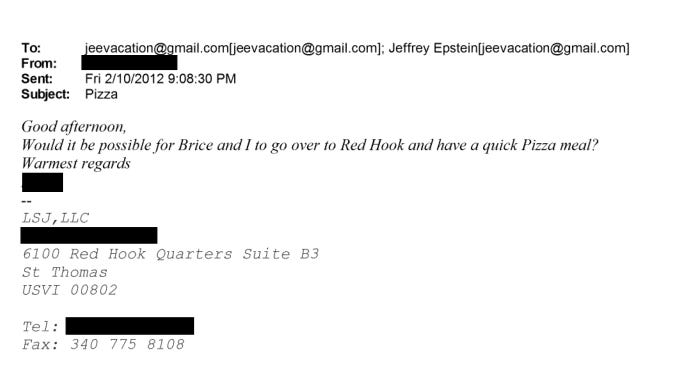
The sender’s name has been redacted, and the identity of “Brice” is unclear, but a former New Zealand Army chef named Brice Gordon co-managed Epstein’s New Mexico ranch and was interviewed by the FBI in 2007. Red Hook is an unincorporated town in the U.S. Virgin Islands — the least-populated such place, according to the 2020 census, consisting mostly of marinas. There is, as it turns out, a pizza restaurant there. But why would someone need Epstein’s permission to have a “quick pizza meal” to which the financier was not invited? It’s enough to drive a sensible person to speculation.
From the mainstream media’s perspective, the problem is not that we are ruled by genocidal Israeli-Mossad-empowered Jewish supremacist psychopathic billionaire perverts. It is that someone might notice that we are ruled by genocidal Israeli-Mossad-empowered Jewish supremacist psychopathic billionaire perverts. That would mean that the “antisemitic conspiracy theorists” were right all along. Oy vey! Double-plus ungood!
Though the mainstream media professes to hate racism, they are covering up Epstein’s virulent racism against non-Jews. The emails are full of disparaging references to “goys,” a term for non-Jews that roughly parallels other racial slurs including the N-word. Epstein and his supremacist cronies loved to degrade non-Jewish children and teens, but never targeted their fellow “chosen people.”
For many Americans, the most disturbing revelations in Epstein files involve President Donald J. Trump. Prior to the files’ release, we already knew that Trump flew on Epstein’s jet at least eight times, was referred to by Epstein as his “best friend,” sent a birthday drawing to Epstein depicting a barely pubescent naked girl alluding to their “secret,” and has been accused of raping 13-year-old “Katie Johnson” in 1994 at an Epstein party and then threatening to kill the girl and her family. The first Epstein dump also contained FBI witness reports that Trump was present when a baby was drowned in Lake Michigan, and was implicated in the rape and murder of a certain Dusty Rhea Duke in 2000.
The new Epstein files release includes FBI witness reports that Trump was involved in murdering three girls who were buried at Mar-a-Lago and threatening the witness with a similar fate. Witnesses also told the FBI that Trump auctioned underage girls from his swimsuit contests, measuring their vulvas and rating them for tightness. Trump is also accused of forcing oral sex and other abuses against 13 and 14 year old girls.
Meanwhile the mainstream media chant in unison: “President Trump has not been accused of wrongdoing.” Will they change their tune, and suddenly discover the FBI files, if and when Trump stops following Israel’s orders?
A shorter version of this article was published in last week’s American Free Press. -KB
Stripe is Substack’s only processor and they debanked me, so you can no longer pay me through Substack. Now I am posting everything on Substack free and asking people to sign up for recurring donations at my Paypal donation page… or better yet, the free speech platform SPdonate. Alternately you can Paypal or Zelle to truthjihad[at]gmail(dot)com. Note that Zelle, unlike other methods, doesn’t charge any fees.
The Mandelson Molecule: Exposing the Architecture of Cross-Border Political Suppression
By Freddie Ponton | 21st Century Wire | February 18, 2026
The resignation of Peter Mandelson as UK ambassador to Washington in February 2026 revealed more than a scandal—it exposed the architecture of a parallel governance system operating through deniable channels. The Epstein files, the Center for Countering Digital Hate (CCDH) censorship apparatus, and the Mandelson intelligence pipeline are not separate stories. They are component parts of a transatlantic mechanism that converts private access into public control, with enforcement mechanisms that now reach across sovereign borders to silence American citizens.
Jeffrey Epstein was a convicted sex offender with deep ties to political and financial elites on both sides of the Atlantic. Peter Mandelson is a former UK power‑broker and ambassador to Washington, now under investigation for secretly sharing government information with Epstein. This article shows how their relationship connects to a wider system of online censorship and private global‑health finance.
The Intelligence Pipeline: Real-Time Treasury Briefings to a Convicted Sex Offender
The Mandelson-Epstein correspondence reveals something far more systematic than indiscreet friendship. It documents a private intelligence channel operating at the highest levels of UK and US financial policy.
In December 2009, while serving as Business Secretary, Mandelson forwarded Treasury positions on the bankers’ bonus tax to Epstein within hours of receiving them, with Epstein requesting advance notice “before Jes” and Mandelson replying simply: “Treasury”. By March 2010, the pattern had escalated—Mandelson forwarded notes from a meeting between UK Chancellor Alistair Darling and US Treasury Secretary Larry Summers to Epstein within five minutes, followed by his own meeting with Summers the next day. Those notes were forwarded within two minutes.
The content was market-moving intelligence: Dodd-Frank implementation, hedge fund taxation, derivatives regulation, and Bank of England quantitative easing strategy during the credit crunch. Mandelson advised Epstein that JPMorgan’s CEO should “mildly threaten” Chancellor Darling over policy. This systematic extraction of live government intelligence for private financial advantage can hardly be construed as incidental corruption.
DOCUMENT: Peter Mandelson leaked No 10 documents to Epstein, who then helped him pursue multi-million dollar jobs (Source: Tax Policy Associates)
The Censorship Architecture: From Anti-Corbyn Operations to American Deplatforming
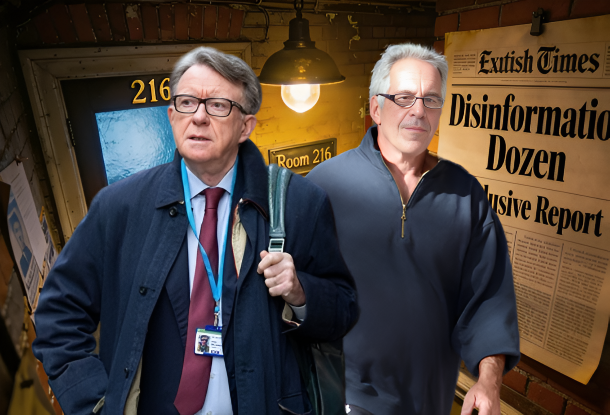
The same censorship machine that produced the Biden White House’s authoritarian campaign against the so-called “Disinformation Dozen” in 2021 had emerged from the notorious Room 216, Brixton, where Israeli loyalist and architect of Keir Starmer’s rise to power, Morgan McSweeney, along with Imran Ahmed, built the “Labour Together” operation to dismantle Jeremy Corbyn. It was a CCDH list of 12 named individuals, which the White House then pushed Facebook to censor. The March 2021 “Disinformation Dozen” report was not independent research—it was unequivocally the identical playbook redeployed. The Biden White House directly cited CCDH’s report to pressure Facebook into censoring American health publishers, with internal documents showing the platform’s “secretly demoted” users, including alleged “anti-vaxxers”, and Twitter accounts of targeted individuals. When Facebook pushed back that the “majority of the accounts in question were not spreading misinformation,” the White House persisted.
Among those branded the “Disinformation Dozen” by the CCDH in March 2021: Robert F. Kennedy Jr. (Children’s Health Defense), physician Joseph Mercola, and Sayer Ji—whose investigative work exposing the Mandelson intelligence pipeline appears later in this report.
The method was documented in internal strategy papers: cultivate “seemingly independent voices to generate and share content to build up a political narrative,” infiltrate opposition spaces to extract decontextualised content, and feed narratives to sympathetic media. The “antisemitism crisis” that destroyed UK Labour Party leader Jeremy Corbyn was, as Labour Party files confirm, instrumentalised by this same faction.
Morgan McSweeney was CCDH’s founding director and subscriber for 18 months, operating from the same Brixton office that produced Labour’s anti-Corbyn operation. When he resigned in April 2020 to become Starmer’s chief of staff, Ahmed inherited an apparatus already proven effective at demonetising political opposition.
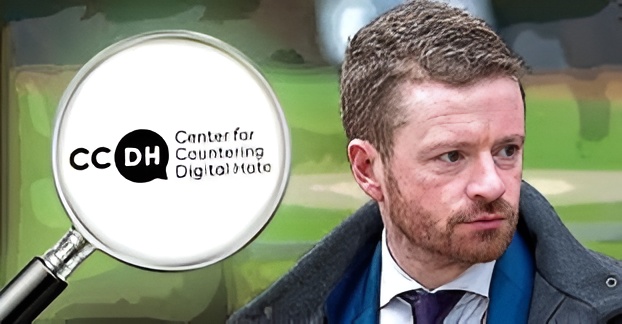
Morgan McSweeney, founding director of the CCDH, and former British Prime Minister Keir Starmer’s Chief of Staff. (Source: The Edge | Business news)
The March 2021 “Disinformation Dozen” report was not independent research—it was unequivocally the identical playbook redeployed. The Biden White House directly cited CCDH’s report to pressure Facebook into censoring American health publishers, with internal documents showing the platform “secretly demoted” affiliated accounts and Twitter accounts of targeted individuals. When Facebook pushed back that the “majority of the accounts in question were not spreading misinformation,” the White House persisted.
Project Molecule: The Financial Infrastructure of Private Governance
The August 2011 JPMorgan “Project Molecule” blueprint reveals the financial architecture that made this system durable. The $150 million fund Epstein pitched to JPMorgan CEO Mary Erdoes was designed to operate “across sovereign borders, into specific countries, for specific biological interventions”—with no elected officials, no treaty obligations, and no public accountability beyond its own audit committee.
DOCUMENT: JPMorgan “Project Molecule” blueprint (Source: DOJ Epstein File Library | EFTA01301114)
Epstein operated as Bill Gates’s representative under a written agreement, with the explicit purpose of securing “additional money for vaccines” while creating a “permanently governed, privately controlled, transnational system”. The budget allocated $40M for polio vaccines in Afghanistan, $40M in Pakistan, $20M specifically for “financing the surveillance network in Pakistan,” and $30M for rotavirus vaccines in Latin America.
This is the governance model: private intelligence (Mandelson-Epstein), private finance (Project Molecule’s offshore vaccination funds), and private enforcement (CCDH’s deplatforming operations) operating in substitutional parallel to democratic institutions.
The Enforcement Layer: Cross-Border Suppression of American Speech
What transforms influence operations into censorship is enforcement. The original investigation documents the apparatus reaching into foreign legal proceedings against American journalists—cross-border enforcement without due process, extradition treaties, or congressional oversight.
The pattern is now confirmed by US government action. In December 2025, Secretary of State Marco Rubio barred Imran Ahmed from entering the United States, citing his role in “leading organised efforts to coerce American platforms to punish American viewpoints they oppose”. Ahmed was one of five Europeans sanctioned under a visa policy targeting foreigners responsible for censoring protected speech in America.
The CCDH is now reportedly under DOJ investigation for potential violations of foreign agent registration laws, given its coordination with UK Labour operatives while targeting US political speech. Labour’s deployment of approximately 100 operatives to US swing states during the 2024 election—conducted by McSweeney’s network—has generated formal FEC complaints alleging direct electoral interference.
After days of parliamentary theatre about “transparency,” Westminster has craftily moved to bury the Mandelson-Epstein papers—not in open sunlight, but inside the Intelligence and Security Committee, a body three of whose members have already stuffed with cash from pro-Israel lobbyists.
In Britain, Downing Street originally wanted veto power over anything “prejudicial to national security”, but the documents will now be reviewed by the Parliament’s Intelligence and Security Committee (ISC). Critics argue that this allegedly independent oversight body could be compromised. In effect, three sitting members—Deputy Chair Sir Jeremy Wright, Sir John Hayes, and Labour’s Derek Twigg—have all taken money from the pro-Israel lobby, which by some estimates bankrolls roughly a quarter of British MPs. This can be verified in the excellent Declassified UK report published in June 2024.
The bottom line is that the Epstein file, which details how Mandelson piped classified Treasury intelligence to a convicted sex offender, and how British power brokers and Wall Street criminals traded backroom briefings, will now be “vetted” by politicians on the take from foreign influence networks. Forget transparency—it was never on the table.
The Architecture of Manufactured Consensus
The critical insight is structural: these networks exploit the gap between formal democratic institutions and actual governance. Mandelson’s Treasury briefings to Epstein occurred through informal channels. Project Molecule’s sovereign surveillance programs were designed to operate offshore. CCDH’s censorship operations, though effective at capturing White House policy, occurred through a nonprofit rather than state agencies. According to reports, George Soros is said to have donated $250,000 to the CCDH, which is working to censor conservative news outlets and to undermine Musk’s Twitter.
When the same personnel (McSweeney as CCDH founder, then Starmer’s chief of staff), the same infrastructure (Brixton operations), and the same methods (crisis amplification, media laundering, financial pressure) appear across Corbyn’s destruction, COVID censorship, and US electoral operations, we are not observing a coincidence. We are witnessing a system.
The switchboard is not the scandal. The switchboard is the system, and it is now being dismantled by the very government it sought to influence.
The Original Investigation
This synthesis builds upon the groundbreaking investigative work of Sayer Ji, founder of GreenMedInfo and author of the Switchboard series—including the first publication to connect the Mandelson-Epstein intelligence pipeline to the CCDH censorship apparatus. Ji’s research, conducted under direct legal and professional pressure from the very networks he was exposing, documented how British political operatives built a cross-border enforcement mechanism capable of weaponising foreign courts against American journalists.
His original reporting on Room 216, the Brixton operations, and the emergence of “disinformation” as a tool for political suppression predates mainstream coverage by years, and has now been validated by the Epstein disclosures, the Rubio sanctions against Ahmed, and the DOJ’s investigation into CCDH’s foreign agent activities.
Read the complete investigation series and supporting documentation at Sayer Ji Substack…
Sayer Ji reports on Substack…
The Switchboard: From Epstein to Mandelson to McSweeney to Ahmed — How a British Machine Became America’s Censorship Engine
How the Epstein Files Reveal the Architecture Behind Censorship, Crisis Finance, and What Happened When I Investigated It – Part 3 in a Series
Peter Mandelson, “the Prince of Darkness,” Keir Starmer’s hand-picked ambassador to Washington, the most powerful unelected figure in British politics, resigned from Parliament this week, one step ahead of legislation to eject him. The Metropolitan Police opened a criminal investigation. The Prime Minister apologised to Jeffrey Epstein’s victims for believing Mandelson’s lies.
The press is treating this as a story about a politician’s downfall. It is not. It is a story about what he was connected to — and what was built to make sure you never found out.
Key Findings:
- The censorship machine that targeted American speech during COVID was built inside a Labour Party factional operation. Morgan McSweeney and Imran Ahmed created the Center for Countering Digital Hate (CCDH) from the same office, using the same staff, and the same dark-money infrastructure they used to destroy Jeremy Corbyn — then redeployed the identical playbook against U.S.-based health publishers and independent media.
- CCDH’s founder and political patron is a protégé of Peter Mandelson, who was simultaneously routing confidential UK and U.S. government intelligence to Jeffrey Epstein. Mandelson forwarded Treasury readouts on the Volcker Rule, Dodd-Frank, and derivatives regulation to Epstein within minutes of receiving them — intelligence worth billions to Epstein’s Wall Street clients. The same political culture of deniable backroom operations that made the Epstein network functional also produced CCDH.
- Epstein’s network was not just criminal — it was architectural. Project Molecule, a $150M JPMorgan blueprint produced the same month Epstein sketched a private global health fund, reveals the institutional machinery: offshore vaccination funds, sovereign biological surveillance programs, and governance structures designed to bypass elected oversight entirely.
- The enforcement layer is not theoretical — it has already been deployed against named individuals. CCDH’s “Disinformation Dozen” list led directly to platform deplatforming. In at least one documented case, CCDH-originated material was entered into foreign legal proceedings to seek an ex parte arrest warrant against a U.S.-based journalist for lawful American speech — cross-border enforcement with no due process, no extradition treaty, and no congressional oversight.
- The same network is now the subject of a formal FEC complaint alleging direct electoral interference. McSweeney — Mandelson’s protégé, CCDH’s political architect, and now Starmer’s chief of staff — was named in a formal FEC complaint for dispatching approximately 100 Labour operatives to U.S. swing states during the 2024 presidential election. The censorship pipeline and the electoral interference pipeline share the same personnel, the same infrastructure, and the same assumption: that British political operatives can shape American outcomes without accountability.
Keir Starmer-tied think tank paid PR firm to target The Grayzone
By Kit Klarenberg | The Grayzone | February 16, 2026
Leaked files have revealed that Labour Together, the shadowy think tank run by disgraced former top Keir Starmer aide Morgan McSweeney, paid the Washington DC-based corporate intelligence firm APCO Worldwide to spy on journalists who reported on their corrupt handling of campaign finances.
The reporters named appear to have been targeted for their efforts to investigate how the UK’s Labour Party elites spent 730,000 pounds in undeclared donations to install Starmer as their leader.
The files show APCO used those funds to oversee the fabrication of a dodgy, evidence-free dossier claiming that Russia was behind damaging disclosures about Labour Together, which it submitted to the National Cyber Security Centre (NCSC) of Britain’s GCHQ — London’s equivalent to the US National Security Agency.
The “significant persons of interest” listed in APCO’s McCarthyite casebook included The Grayzone and myself.
According to my APCO dossier, “While a self described ‘investigative journalist,’ he is an author for the Gray Zone. The site has been described as a ‘conspiracy blog’ and ‘Wagner propaganda channel.’ In 2023,” the dossier reads, I “was arrested by counter-terror police after [I] arrived in the UK.”
APCO bills itself as “a trusted and strategic advisor… that drive[s] our clients’ missions and objectives forward.” Despite its massive contract with Labour Together, the files show the PR firm struggled to identify its targets, and proved unable to establish the most basic facts about them.
When APCO branded The Grayzone as “Wagner propaganda,” it seemed to have confused us with “Grey Zone,” an entirely unrelated and now-defunct Telegram channel affiliated with the Russian military contractor. APCO also claimed I was “arrested by counter-terrorism police” in May 2023 upon returning to Britain. In fact, I had been detained, not arrested.
APCO also targeted journalists Matt Taibbi and Paul Holden, who led investigations into Labour Together’s potentially criminal activities, based on leaks and Freedom of Information requests. The PR firm had sought to secure “leverage” over Holden in order to sabotage his work.
The spying scandal began in November 2023, when Britain’s Sunday Times revealed that Keir Starmer’s campaign manager, Morgan McSweeney, had failed to declare £730,000 in campaign donations which he diverted to advance Starmer’s rise to Labour leadership. One month later, APCO prepared a memo for Labour Together outlining a strategy to blame the damaging disclosure on Russian hackers and attack the journalists who dared to publish details of the offending documents.
The story was given new life in February 2026, when British journalist Peter Geoghehan exposed a secret contract showing Labour Together paid APCO £30,000 to investigate the journalists it blamed for exposing its legally questionable activities.
It has now gone mainstream, with the Sunday Times publishing a lengthy report branding the Labour operation as a “dirty smear” based on a “lie” about Russian hacking.
However, the Times article omitted any mention of this reporter or The Grayzone, even though we were prominently targeted by Labour Together. In the following investigation, we explain why The Grayzone was targeted, tracing the origins of the slimy spying operation to a network of Labourite operatives who have sought to destroy us since well before Starmer came to power.
“Familiar with masters of the same drivers”
Labour Together was founded in 2015 by McSweeney, Starmer’s longtime svengali. After several failed campaigns for establishment candidates, McSweeney managed to transform his organization into a propaganda juggernaut, soliciting large donations from the UK Israel lobby’s most significant moneyman, Trevor Chinn.
While presenting his campaigning outfit as a plucky little think tank, he wielded it against Labour leader Jeremy Corbyn and the movement behind him. To neutralize the ecosystem of alternative media outlets supporting Corbyn as Labour leader, Labour Together contracted a political operative named Imran Ahmed to spin out a censorship front called “Stop Funding Fake News.”
After weaponizing dubious charges of antisemitism to defund one of the most influential pro-Corbyn outlets, Canary UK, the organization folded, then resurfaced as the much bolder Center for Countering Digital Hate (CCDH). Based inside the office of Labour Together, CCDH relied on the funding from Chinn and, as The Grayzone’s Max Blumenthal revealed, secretly coordinated with the Israeli embassy in Washington.
McSweeney entered Downing Street as Starmer’s Chief of Staff just one month before Trump’s re-election. Among his most important tasks was repairing relations with the US President. At the time, Trump’s aides were bristling over reports that McSweeney met with Democratic presidential nominee Kamala Harris during the Democratic National Convention to plot strategy. One of Trump’s top donors, the transhumanist mega-billionaire Elon Musk, also had his knives out for McSweeney after journalists Matt Taibbi and Paul Thacker revealed that CCDH’s top priority for 2024 was to “kill Elon Musk’s Twitter.”
McSweeney’s solution was to dispatch one of Labour’s most seasoned – and scandal-stained – fixers to Washington. He was Lord Peter Mandelson, the architect of the neoliberal New Labour wave whose notoriously transactional tendencies seemed to make him the perfect match for Trump. Mandelson made himself a fixture at Butterworth’s, a favorite Capitol Hill haunt of MAGA operatives, and insinuated himself into Trumpist social circles.
In June 2025, the restaurant erected a plaque honoring Mandelson during a ceremony overseen by Raheem Kassam, a close associate of former Trump chief of staff Steve Bannon. There, a mirthful Mandelson raised a toast and proclaimed a special kinship with the MAGA elite: “Although we don’t have identical politics, we are familiar with masters of the same drivers that brought our respective figures to power — President Trump in your case and Keir Starmer in mine.”
But Mandelson was also dogged by the same sex trafficking figure who constantly inhabited the personal lives of both Trump and Bannon: Jeffrey Epstein. Both McSweeney and Starmer had been keenly aware of the ambassador’s friendship with Epstein, but they dismissed the concerns, even ignoring a warning from UK security services.
However, when a series of emails confirming Mandelson’s friendship with Epstein poured forth as part of a release by the US Department of Justice, the ambassador’s position became untenable. Following his firing in September 2025, a new tranche of emails published this January provided an even more damning portrait of their friendship. They showed, for instance, that Epstein channeled money to Mandelson’s husband, Reinaldo Avila da Silva, for a specious initiative which was never completed. Even worse, the communications exposed Mandelson providing Epstein with advance notice of the impending collapse of Prime Minister Gordon Brown’s government in 2010, as well as sensitive information about the UK’s “saleable assets.”
McSweeney’s scheming had finally caught up with him. Though Starmer initially praised and defended his longtime campaign guru in parliament, he caved soon after, forcing McSweeney to resign his post on February 8.
In the days since, Starmer has been unable to fill the vacancy. Meanwhile, another senior Labour official is reportedly considering leaving his role as well. Amid the chaos, British media has begun to speculate that the Prime Minister will be next to go.
Will the revelation of Labour Together’s media enemies list, and its secret contract with APCO, be the weight that finally sinks Starmer?
Labour Together’s misdirection ploy: blame Russia
McSweeney was aware that Labour Together had secretly contracted APCO to spy on journalists; however, he didn’t carry out the dirty work himself. That job appears to have been commissioned by his successor at the think tank, Josh Simons, who’s now a senior minister in Starmer’s government.
Simons has dismissed reports that the PR firm was tasked with spying on reporters as “nonsense,” insisting that APCO was merely “asked to look into a suspected illegal hack.” Simons’ disingenuous claims are undermined by newly-leaked documents related to the probe, however.
Perhaps most damning is a December 2023 memo prepared by APCO for Labour Together which shows investigators fretting about “recent articles and blog posts” which threatened to draw attention to the political group’s questionable funding schemes. Information published by these meddling journalists, particularly Paul Holden, “[raised] concern about the source of his information and what more he may choose to publish in the future,” the memo continued.
It was therefore deemed “important to identify the source of the information and to ascertain what additional information could be published.” Labour Together tasked APCO with probing several journalists, dubbed “significant persons of interest.”
The memo speculated that Holden and others may have received leaks from inside Labour Together, Labour party headquarters, parliament, or “illegally-gathered information collected” from a purported “hack” of Britain’s Electoral Commission in 2023. APCO concluded it was “essential” for Labour Together to concoct a strategy to counter the critical reporting.
Its response was to blame the organization’s woes on a Russian hack. But rather than hiring a cyber-security firm to investigate the supposed data breach, it contracted a corporate intelligence firm to attack the messengers.
In February 2024, The Guardian contacted Holden to alert him that the paper was preparing a hit piece alleging he was under investigation by the NCSC for receiving illegally obtained information from Russia. The Guardian had clearly been influenced by briefings from Labour Together, as well as by APCO’s report. Yet the outlet backed off when Holden promised to sue them for defamation.
APCO is now under formal investigation for potential standards breaches by Britain’s Public Relations and Communication Association.
How did The Grayzone wind up on Labour Together’s enemies list?
It is unclear how and why I became a “significant person of interest” in APCO and Labour Together’s secret smear campaign. However, their operation dovetailed with another surreptitious attempt by intelligence-tied actors to smear The Grayzone as Russian agents.
I have never spoken to Paul Holden or other journalists named as the firm’s targets, or conducted any journalistic investigations into Labour Together’s corrupt financial dealings. When APCO initiated its probe, I had mentioned Labour Together in a single article months prior that focused on the organization’s censorship-obsessed spinoff, the Center for Countering Digital Hate.
Such sloppiness and paranoia is the hallmark of Amil Khan, a veteran British government psyops warrior turned “disinformation expert” involved with Labour Together and Starmer’s Labour.
Khan cut his teeth running covert British-funded psychological warfare operations during the Syrian dirty war, supporting violent extremist groups armed and financed by the CIA and MI6. He subsequently founded Valent Projects, which “specializes in addressing online manipulation.” Khan’s outfit produced a paper on social media ratfucking strategies for Labour Together entitled, “Power and Persuasion: Understanding the Right’s Playbook.”
In December 2021, The Grayzone exposed how Valent Projects covertly produced Covid vaccine propaganda funded by the British monarchy’s Royal Institute, using then-popular “BreadTube” personality Abigail Thorn as the front person for its campaign. The investigation apparently placed this outlet in the crosshairs of Khan and his information warfare network.
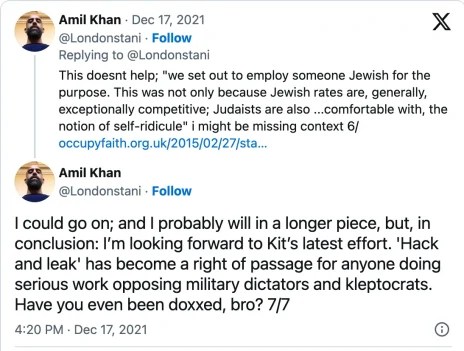
Less than a year later, The Grayzone exposed Khan again – this time, for his role in a covert conspiracy to destroy us. Enlisted by celebrity former leftist journalist Paul Mason, Khan helped coordinate a harebrained scheme to demonetize and deplatform The Grayzone. The pair discussed going “full nuclear legal to squeeze [The Grayzone] financially,” and proposed publishing intelligence agency-sourced smears to delegitimize this outlet.
As their revenge plot approached its paranoid apogee, Mason and Khan fantasized about hosting an anti-Grayzone summit with some of the most rabid, intelligence-tied opponents of our reporting. Among those they pitched for the gathering was Imran Ahmed, director of the censorship-obsessed Center for Countering Digital Hate (CCDH), which was founded by Morgan McSweeney and shared an office with his Labour Together.
While it is unknown if the anti-Grayzone summit ever took place, we have since learned that Mason enlisted a team of high-priced London lawyers to sue this outlet just days after our article exposing his secret smear campaign appeared. In May 2023, I was detained at the UK’s Luton International Airport and interrogated about The Grayzone’s activities by counter-terror police. Six months later, APCO initiated its covert investigation of me, The Grayzone, and others whose reporting had wound them up on the Labour Together enemies list.
APCO has so far remained silent about the scandal. The Grayzone has submitted a request for comment to Tom Short, the PR firm’s London chief. We received an automated response revealing he conveniently slipped away to the US. Upon Short’s return to Britain, APCO will no longer be able to hide behind bogus allegations of Russian hacking.
Featured Video
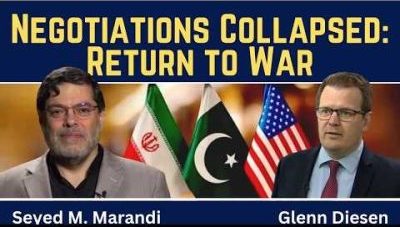
Seyed M. Marandi: Negotiations Collapsed – Return to War
or go to
Aletho News Archives – Video-Images
From the Archives
Wartime internment camps in Australia
National Archives of Australia
World War I
During World War I, for security reasons the Australian Government pursued a comprehensive internment policy against enemy aliens living in Australia.
Initially only those born in countries at war with Australia were classed as enemy aliens, but later this was expanded to include people of enemy nations who were naturalised British subjects, Australian-born descendants of migrants born in enemy nations and others who were thought to pose a threat to Australia’s security.
Australia interned almost 7,000 people during World War I, of whom about 4,500 were enemy aliens and British nationals of German ancestry already resident in Australia.
Records of World War I internment camps
World War II
During World War II, Australian authorities established internment camps for three reasons – to prevent residents from assisting Australia’s enemies, to appease public opinion and to house overseas internees sent to Australia for the duration of the war.
Unlike World War I, the initial aim of internment during the later conflict was to identify and intern those who posed a particular threat to the safety or defence of the country. As the war progressed, however, this policy changed and Japanese residents were interned en masse. In the later years of the war, Germans and Italians were also interned on the basis of nationality, particularly those living in the north of Australia. In all, just over 20 per cent of all Italians resident in Australia were interned. … continue
Blog Roll
 Aletho News
- Seyed M. Marandi: Negotiations Collapsed – Return to War
- Tomorrow’s naval blockade showdown
- ‘Israel’ attacks civilians to hide its embarrassing military failures & out of pure sadism
- Any Foreign Military Vessel Approaching Hormuz Under Any Pretext ‘Will Be Dealt With Severely’: IRGC
- Diplomats slam US negotiators’ performance in Iran talks
- Trump Refuses Exit Ramp, War with Iran will Continue
- Trump Says US Naval Blockade in Strait of Hormuz Will Begin Shortly
- US, Iran end 21-hour talks without agreement
- US IRAN TALKS: Who Are the Crazy Ones Here? /Lt Col Daniel Davis
- Talks with the US end without a deal over excessive US demands: Iran
- If Americans Knew
- US-Iran ceasefire negotiations make zero progress – Daily Update
- Pro-Israel ‘Thinktanks’ and Individuals who Influence U.S. Foreign Policy
- Mearsheimer reveals how Israel dictates US policies on Iran, Gaza – video
- After killing 350+, Israel still has a “score to settle” with Lebanon before ceasefire – Daily Update
- Military aid to Israel emerges as the latest political litmus test for Democrats
- The only Palestinian children’s rights organization closes following years-long Israeli campaign against it
- ‘I Can’t Forget the Smell’: Lebanese Reel After Israel Kills Over 300 in Single Day
- DNC Shoots Down Resolutions Calling Out AIPAC and Limiting Arms to Israel
- TCN: Is Israel Blackmailing President Trump?
- Israel killed at least 303 Lebanese yesterday – who were they? Daily Update
- No Tricks Zone
- Cave Discovery Reveals Today’s Desert Climates Were Recently Far Warmer, Wetter, Teeming With Life
- German Expert: Heat Dome Led To Record Temps In Western USA…Warmer In 1934, 1936
- New Study: No Linear Warming Or Glacier Retreat Along Northern Antarctic Peninsula Since 1980s
- An Inconvenient Tree: Uncovered In Alps… Europe Much Warmer Than Today 6000 Years Ago
- New Study Reports A 60% Slowdown In Greenland’s Ice Loss Rate In The Last Decade
- Low Intensity Tornado Wrecks Major Solar Farm, Creating A Potential Toxic Dump
- New Study Finds Warming Saves Lives…Cold Temperatures 12 Times More Deadly Than Excess Heat
- German Science Blog Accuses PIK Climate Institute Of Hallucinating Climate Tipping Points
- Devastating Assessment Of Comirnaty Vaccine By Former Senior Pfizer Europe Toxicologist
- New Study: CO2 Is ‘Effectively Negligible’ As An Explanatory Climate Change Factor Since 2000
 Aletho News