Epstein case reveals ‘satanism’ of Western elites – Lavrov
RT | February 9, 2026
The decadent lifestyle of disgraced US financier and sex offender Jeffrey Epstein and his entourage is a testament to the moral decay of Western elites, Russian Foreign Minister Sergey Lavrov has said.
Last month, the US Department of Justice released a large trove of emails, photos, and videos from the Epstein state, prompting renewed scrutiny of high-profile individuals who associated with Epstein despite his conviction for sex crimes.
The files “have revealed the face of the West and the deep state, or rather a deep union that rules the entire West and seeks to rule the whole world,” Lavrov said in an interview with NTV aired on Sunday.
“Every normal person knows this is beyond comprehension and pure satanism,” Lavrov added.
Epstein died in a New York jail cell in 2019 in what was ruled a suicide. His ex-girlfriend and close associate, Ghislaine Maxwell, was sentenced to 20 years in prison in 2022 for trafficking and abusing underage women alongside Epstein.
Throughout his life, Epstein associated with politicians, diplomats, businessmen, and royals, several of whom visited his private Caribbean island.
The newly released documents contain claims that Epstein and his associates participated in occult rituals involving human sacrifice. Polish Prime Minister Donald Tusk announced last week that his government would examine whether Polish children were abused as part of Epstein’s so-called “satanic circle.”
Racketeering Scheme?: Vaccine Makers Profit Twice by Selling Drugs to Treat Vaccine Injuries
By Brenda Baletti, Ph.D. | The Defender | February 5, 2026
A lawsuit filed by Children’s Health Defense (CHD) against the American Academy of Pediatrics (AAP) alleges that the AAP’s aggressive promotion of childhood vaccines created a “closed-loop” business model that set up pharmaceutical companies to profit from vaccines and from drugs used to treat vaccine injuries.
The lawsuit alleges the AAP violated the Racketeer Influenced and Corrupt Organizations Act or RICO, by running a decades-long racketeering scheme to defraud American families about the safety of the childhood vaccine schedule.
A “racket” exists when a service creates its own demand, according to the complaint.
In this case, the same companies that make pediatric vaccines have also acquired companies that develop treatments for autoimmune disorders, allergies and neurodevelopmental conditions — conditions recognized in vaccine package inserts as adverse events that occurred during clinical trials or in post-marketing studies.
The complaint cites Pfizer’s 2016 acquisition of Anacor Pharmaceuticals for $5.2 billion. Anacor makes Eucrisa, a drug that treats eczema. At the time, Eucrisa was approved for 2-year-olds. It was later approved for babies as young as 3 months.
Post-marketing data have linked vaccines — including GlaxoSmithKline’s ENGERIX-B hepatitis B vaccine — to eczema, according to the complaint. Research studies have also linked the condition to the COVID-19 and measles-mumps-rubella or MMR vaccines.
In another example, Sanofi in 2020 spent $3.7 billion to acquire Principia Biopharma, developer of an experimental therapy for immune thrombocytopenia, an autoimmune blood disorder.
Immune thrombocytopenia is listed as an adverse reaction to vaccines manufactured by other companies that the lawsuit alleges are part of the same vaccine racketeering enterprise. Those vaccines include Merck’s MMRII and GlaxoSmithKline’s Pediarix.
Other examples include GlaxoSmithKline’s 2012 acquisition of Human Genome Sciences in 2012 for $3.6 billion, which brought the lupus drug Benlysta into its portfolio, and Merck’s 2021 purchase of Pandion Therapeutics for $1.85 billion, which expanded its pipeline of inflammatory bowel disease treatments.
Not included in the lawsuit, but widely discussed in 2024, was Pfizer’s acquisition of Seagen. The biotech company makes drugs that use monoclonal antibodies to deliver anti-cancer agents to tumors while limiting damage to surrounding tissue.
Pfizer spent $43 billion to acquire Seagen, which in 2023 had projected sales of $2.2 billion. Studies have linked Pfizer’s COVID-19 vaccines to sharp rises in cancer rates.
The lawsuit argues that these types of acquisitions by vaccine makers create a revenue cycle in which vaccines function as a “customer acquisition mechanism” — because treatments for chronic conditions provide long-term pharmaceutical revenue.
“The enterprise profits from the vaccines, and profits again from the treatment of the vaccine package insert documented side effects,” the complaint states.
The filing also alleges that the AAP helps maintain this system by promoting expanded vaccination schedules and discouraging research that could explore potential links between schedule changes and chronic illness.
The allegations come amid ongoing public debate over vaccine safety, corporate influence in medicine and the transparency of postmarketing surveillance systems.
Health officials have long maintained that childhood vaccination programs are “safe and effective” and that adverse event reporting alone does not establish causation.
However, public trust in those authorities is at a historic low, as more people question the long-held positions of mainstream public health.
This article was originally published by The Defender — Children’s Health Defense’s News & Views Website under Creative Commons license CC BY-NC-ND 4.0. Please consider subscribing to The Defender or donating to Children’s Health Defense.
The reality of Trump’s cartoonish $1.5 trillion DOD budget proposal
This dramatic escalation in military spending is a recipe for more waste, fraud, and abuse
By Ben Freeman and William Hartung | Responsible Statecraft | January 8, 2026
After promising on the campaign trail that he would drive the war profiteers out of Washington, and appointing Elon Musk to trim the size of government across the board, some will be surprised at President Trump’s social media post on Wednesday that the U.S. should raise the Pentagon budget to $1.5 trillion. That would mean an unprecedented increase in military spending, aside from the buildup for World War II.
The proposal is absurd on the face of it, and it’s extremely unlikely that it is the product of a careful assessment of U.S. defense needs going forward. The plan would also add $5.8 trillion to the national debt over the next decade, according to the nonpartisan Committee for a Responsible Budget.
This would fly in the face of the purported savings of Elon Musk’s Department of Government Efficiency (DOGE). In fact, a $500 billion increase in Pentagon spending would be more than double all of the alleged budget cuts wrought by DOGE, even according to DOGE’s own exaggerated figures. The $500 billion increase in Pentagon spending would also be more than the entire military budget of any country in the world, and more than China, Russia, and Iran spend on their militaries combined.
And, the Pentagon budget is already enormous, at $1 trillion per year, with more than half of that going to Pentagon contractors, and untold more lost to waste, fraud, and abuse. Exactly how much of our tax dollars devoted to propping up the Pentagon are wasted is unclear, because the Pentagon has never passed an audit.
We do know that spending on dysfunctional, unnecessary or unworkable systems like the F-35, highly vulnerable $13 billion aircraft carriers, the impossible dream of a leak proof Golden Dome missile defense system, and an unnecessary across-the-board scheme to spend up to $2 trillion on new nuclear weapons over the next two decades will waste tens of billions of dollars every year for a long time to come.
Add to this the Pentagon’s moves to weaken its independent weapons testing office and reduce oversight of bloated weapons contractors, and we have a perfect recipe for increasing waste, fraud, and abuse on the part of the Pentagon and its contractors. And, as always, the bedrock of overspending on the Pentagon is America’s hyper-militarized, “cover the globe” military strategy, an approach that seeks to maintain the ability to intervene anywhere in the world on short notice.
The president also claimed that his $1.5 trillion Pentagon spending proposal, if implemented, will fund our “dream military.” More likely, it will initiate a period of blatant waste and underwrite misguided and dangerous military adventures like the occupation of Venezuela.
Even with a Congress that has been giving the Pentagon a blank check for years, the $1.5 trillion figure is unlikely to pass muster. If we want a safer nation, we should be going in the other direction, towards a lower Pentagon budget, driven by a more intelligent and restrained strategy, and a more rigorous approach to devising, developing, and producing weapons.
Ben Freeman is Director of the Democratizing Foreign Policy program at the Quincy Institute and the author of “The Trillion Dollar War Machine: How Runaway Military Spending Drives America into Foreign Wars and Bankrupts Us at Home” (2025)
‘Fact-checking’ as a disinformation scheme: The Brazilian case of Agência Lupa
By Raphael Machado | Strategic Culture Foundation | February 7, 2026
Since the term “fake news” emerged in the world of political journalism, we have been confronted with a new angle through which the establishment attempts to reinforce its hegemony in the intellectual and informational sphere: by simulating ideology as science, data, or fact.
A fundamental aspect of hegemonic liberalism in the “rival-less” post-Cold War world is the transition of ideology into the diffuse realm of pure facticity. What decades earlier was clearly identified as belief comes to be taken as “data,” that is, as indisputable, not open for debate. This is the case, for example, with the myth of “democracy,” the myth of “human rights,” the myth of “progress,” and the myth of the “free market.” And today, we could extend this to the dictates of “gender ideology” and a series of other beliefs of ideological foundation, which are nevertheless taken as scientific facts.
“Fact-checking” has thus become one of the many mechanisms used by the establishment to reinforce systemic “consensus” in the face of the emergence of alternative perspectives following the popularization of the internet and independent journalism. The “authoritative” distinction made by a self-declared “independent” and “respectable” agency between what would be “fact” and what would be “fake news” has become a new source of truth.
Some liberal-democratic governments, like the USA, have gone so far as to create special departments dedicated to “combating fake news,” thus acting as authentic “Ministries of Truth” of Orwellian memory.
However, even within the “independent” sphere, we rarely encounter genuine independence. On the contrary, in fact, Western “fact-checking agencies” tend to be well-integrated into the constellation of NGOs, foundations, and associations of the non-profit industrial complex, which, in turn, is permeated by the money of large corporations and the interests of liberal-democratic governments. Even their staff tend to be revolving doors for figures coming from the NGO world, mainstream journalism, and state bureaucracy.
Although the phenomenon is of Western origin, Brazil is not exempt from it. “Fact-checking agencies” also operate here — most of them engaged in the same types of disinformation operations as the governments, newspapers, and NGOs that sponsor them.
A typical example is Agência Lupa.
Founded in 2015, its founder Cristina Tardáguila previously worked for another disinformation apparatus disguised as “fact-checking,” Preto no Branco, funded by Grupo Globo (founded and owned by the Marinho family, members of which are mentioned in the Epstein Files). Lupa was financially boosted by João Moreira Salles, from the billionaire banker family Moreira Salles (of Itaú Unibanco).
Despite claiming independence from the editorial control of Revista Piauí, also controlled by the Moreira Salles family, Agência Lupa continues to be virtually hosted by Piauí’s resources, where Tardáguila worked as a journalist from 2006 to 2011. Furthermore, she also received support from the Instituto Serrapilheira, also from the Moreira Salles family, during the health crisis to act as a mechanism for imposing the pandemic consensus in what was one of the largest social experiments in human history.
In parallel, it is relevant to mention that the same João Moreira Salles was involved decades ago in a scandal after it was revealed that he had financed “Marcinho VP,” one of the leaders of the drug trafficking organization Comando Vermelho. Moreira Salles made a deal with the justice system to avoid being held accountable for this involvement.
Tardáguila was also the deputy director of the International Fact-Checking Network, an absolutely “independent” “fake news combat” network, yet funded by institutions such as the Open Society, the Bill & Melinda Gates Foundation, Google, Meta, the Omidyar Network, and the US State Department, through the National Endowment for Democracy.
Today Tardáguila no longer runs Lupa, but her “profile” on the official page of the National Endowment for Democracy (notorious funder of color revolutions and disinformation operations around the world) states that she is quite active at the Equis Institute, which counts among its funders the abortion organization Planned Parenthood, and aims to conduct social engineering against “Latino” populations.
Lupa is currently headed by Natália Leal. Contrary to the narrative of “independence,” the reality is that she has worked for several Brazilian mass media outlets, such as Poder360, Diário Catarinense, and Zero Hora, in addition to also writing for Revista Piauí, from the same Moreira Salles. Leal is less “internationally connected” than Tardáguila, but she was “graced” with an award from the International Center for Journalists, an association of “independent journalists” that, in fact, is also funded by the US State Department’s National Endowment for Democracy, the Bill & Melinda Gates Foundation, Meta, Google, CNN, the Washington Post, USAID, and the Serrapilheira Institute itself, also from Moreira Salles.
Quite clearly, it is somewhat difficult to take seriously the notion that Lupa would have sufficient autonomy and independence to act as an impartial arbiter of all narratives spread on social networks when it and its key figures themselves have these international connections, including at a governmental level.
But even on a practical level, it is difficult to take seriously the self-attributed role of confronting “fake news.” Returning to the pandemic period, for example, the differentiated treatment given by the company to the Russian Sputnik vaccine and the Pfizer vaccine is noteworthy. The former is treated with suspicion in articles written in August and September 2020, both authored by Jaqueline Sordi (who is also on the staff of the Serrapilheira Institute and a dozen other NGOs funded by Open Society), the latter is defended tooth and nail in dozens of articles by various authors, ranging from insisting that Pfizer’s vaccines are 100% safe for children, to stating that Bill Gates never advocated for reducing the world population.
On this matter, by the way, it is important to emphasize that Itaú coordinates investment portfolios that include Pfizer, therefore, there are business interests that bring the Moreira Salles family and the pharmaceutical giant closer.
But beyond disinformation about Big Pharma, as well as about other places around the world, such as Venezuela, regarding which Lupa claims that María Corina Machado has the popular support of 72% of the Venezuelan population (based on a survey by an institute that is not even Venezuelan, ClearPath Strategies), Lupa seems to have a particular obsession with Russia and, curiously, Lupa’s alignment with the dominant narratives in Western media is absolute.
Lupa argues, for example, that the Bucha Massacre was perpetrated by Russia, using the New York Times as its sole source. Regarding Mariupol, it insists on the narrative of the Russian attack on the maternity hospital and other civilian targets, even mentioning Mariana Vishegirskaya, who now lives in Moscow, has admitted to being a paid actress in a staging organized by the Ukrainian government, and now works in the Social Initiatives Committee of the “Rodina” Foundation. It also denies the attempted genocide in Donbass and the practice of organ trafficking in Ukraine.
An article written by founder Cristina Tardáguila herself relies on the Atlantic Council as a source to accuse Russia of spreading disinformation, one of which would be that Ukraine is a failed state subservient to Europe — two pieces of information that any average geopolitical analyst would calmly confirm.
A particular object of Lupa’s obsession is the Global Fact-Checking Network — of which, by the way, I am a part. It is one of the few international organizations dedicated to fact-checking in a manner independent of ideological constraints, counting among its members a team that is, certainly, much more diverse and multifaceted than the typical “revolving door” of fact-checking agencies in the Atlantic circuit, where everyone studied more or less in the same places, worked in mass media, and were, at some point, funded or received grants from Open Society, the Bill & Melinda Gates Foundation, and/or the US State Department.
Lupa’s criterion for attacking the GFCN is… precisely obedience or not to Western mass media sources, in a circular reasoning that cannot go beyond the argument from authority.
This specific case helps to expose a bit the functioning of these disinformation apparatuses typical of hybrid warfare, which disguise themselves in the cloak of journalistic neutrality to engage in informational warfare in defense of the liberal West.
FBI document: Epstein trained as spy under Ehud Barak and worked for Mossad
MEMO | February 5, 2026
Jeffrey Epstein “was close to the former Prime Minister of Israel, Ehud Barak, and trained as a spy under him,” according to a 2020 FBI document based on direct reporting from a confidential human source (CHS). The revelation adds further weight to long-circulating allegations that Epstein, a convicted child sex trafficker, was compiling Kompromat on behalf of Mossad.
The document, dated 19 October 2020, details conversations in which the source, who had personal contact with figures in Epstein’s circle, outlines how Epstein was involved in intelligence activity coordinated with Mossad.
The CHS recounts multiple phone calls between Alan Dershowitz — Epstein’s lawyer and Harvard law professor — and Epstein. Following these calls, the document states, Mossad would call Dershowitz to debrief. The source “took notes” during these conversations and concluded that the debriefing process was part of a coordinated intelligence operation.
Dershowitz himself is quoted as having said he would have joined Mossad if he were younger. The CHS believed Dershowitz was “co-opted” by Mossad and “subscribed to their mission.”
In totality, the document presents Epstein as a co-opted Mossad agent, a view the source reinforces explicitly. The CHS stated they were “convinced that Epstein was a Mossad agent” and that his relationship with Barak and his handling by Dershowitz served this broader intelligence role.
These assertions, backed by contemporaneous notes and phone call observations, now represent some of the clearest direct testimony placing Epstein within an organised foreign intelligence apparatus, rather than as a lone criminal figure.
Epstein Files- Steve Bannon Admits Trump Administration Would ‘Not Cross Sheldon Adelson’ During First Term

The Dissident | February 4, 2026
In text messages between Steve Bannon and Jeffrey Epstein in 2018, now released as part of the DOJ’s Epstein releases , Bannon admitted that the Trump administration was captured by the Zionist lobby and the Zionist mega donor Sheldon Adelson.
While discussing U.S. policy towards Qatar with Epstein, Bannon admitted “Bolton [John Bolton, then National Security Advisor to Trump] only doing what Sheldon Adelson tells him to do– I got John the job but he will not cross Sheldon” to which Epstein replied, “I’m aware”.
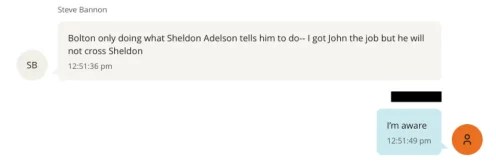
This is further conformation that much of Trump’s foreign policy agenda during his first term was set by Sheldon Adelson, and since his passing, his wife Miriam Adelson.
During a speech to the Israeli Knesset last year, Trump boasted , “I am proud to be the best friend that Israel has ever had” then went on to list every policy he enacted at the behest of Israel, saying,
But as president, I terminated the disastrous Iran nuclear deal. And ultimately, I terminated Iran’s nuclear program with things called B-2 bombers. It was swift and it was accurate, and it was a military beauty.
I authorized the spending of billions of dollars which went to Israel’s defense, as you know. And after years of broken promises from many other American presidents, you know that they kept promising… I never understood it until I got there. There was a lot of pressure put on these presidents. It was put on me too, but I didn’t yield to the pressure. But every president for decades said, “We’re gonna do it.” The difference is I kept my promise and officially recognized the capital of Israel and moved the American Embassy to Jerusalem.
He then credited the Adelsons with these Zionist policies, pointing to Miriam in the crowd after listing them and saying, “Isn’t that right, Miriam?”
He added, “Miriam and Sheldon would come into the office. They’d call me, he’d call me. I think they had more trips to the White House than anybody else I can think of … And she loves Israel. But she loves it. And they would come in, and her husband was a very aggressive man, but I loved him. He was very aggressive, very supportive of me. And, he’d call up, ‘Can I come over and see you?’ I’d say, ‘Sheldon, I’m the President of the United States, it doesn’t work that way.’ He’d come in… But they were very responsible for so much, including getting me thinking about Golan Heights, which is probably one of the greatest things to ever happen to Israel.”
He even admitted that Miriam Adelson- who Trump admitted was “responsible for so much” cared more about Israel than America, saying, “I actually asked her, I’m gonna get her in trouble with this, but I actually asked her once, I said, ‘So, Miriam, I know you love Israel. What do you love more, the United States or Israel?’ She refused to answer. That means, that might mean, Israel”.
While introducing Miriam Adelson at an event, Trump again boasted “Miriam (Adelson) gave my campaign $250 million” adding, “her husband Sheldon was an amazing guy, he’d come up to the office, and there was nobody more aggressive than Sheldon … he would always say ten minutes it turned out to be an hour and a half and what he did was he fought for Israel, it’s all he really fought for”.
Bannon’s comments in 2018 are just further conformation that Trump’s agenda was shaped by money from Miriam and Sheldon Adelson during his first term, and since Sheldon Adelson’s passing in 2021, Miriam Adelson, during his current term.
From Iraq war crimes to Gaza’s ‘board of peace’: Why Tony Blair belongs in The Hague
By David Miller | Press TV | February 1, 2026
In the grotesque circus of international power plays, few performers rival Tony Blair for sheer audacity. The former British Prime Minister (1997-2007), once celebrated for his “Cool Britannia” sheen and Third Way politics, is now indelibly stained by the Iraq War debacle, a war built on deception that claimed hundreds of thousands of lives and shattered the region.
Yet in January 2026, Donald Trump appointed him to the Board of Peace, a White House-created entity chaired indefinitely by Trump himself to oversee Gaza’s “reconstruction” under a controversial 20-point plan.
The board’s founding executive includes heavyweights like Marco Rubio, Jared Kushner, Steve Witkoff, Marc Rowan, Ajay Banga, and Robert Gabriel—figures tied to Trumpworld and Zionist interests, with no Palestinian representation.
Blair’s role is lending “statesmanlike” cover to what is seen as a colonial oversight mechanism that could facilitate displacement and control in Gaza. This isn’t redemption; it’s impunity on steroids.
Blair belongs in The Hague facing charges for aggression and complicity in atrocities—not jet-setting as a “peace” architect. This article lays bare his record, his Zionist alliances, his profit-driven institute, his billionaire backer, and why his latest gig risks making him complicit in Gaza’s ongoing nightmare.
Blair’s war crimes: Lies, invasion, and bloodshed
Blair’s gravest sin remains the 2003 Iraq invasion, sold on bogus claims of weapons of mass destruction (WMDs) and Saddam Hussein’s imminent threat.
The Chilcot Inquiry (2016), an exhaustive British investigation, demolished his case: “We have concluded that the UK chose to join the invasion of Iraq before the peaceful options for disarmament had been exhausted. Military action at that time was not a last resort.”
It highlighted “flawed intelligence” that went “unchallenged” and Blair’s overestimation of his influence on George W. Bush. The infamous “dodgy dossier” asserted Iraq could deploy WMDs in 45 minutes—a claim later exposed as hyped and unreliable.
Under the Rome Statute, Blair could face ICC charges for:
- Crime of aggression: Planning and executing an illegal war without UN Security Council approval, violating the UN Charter.
- War crimes: Complicity in detainee abuses, including British forces’ role in cases like the death of Baha Mousa in custody.
- Crimes against humanity: Contribution to systematic civilian harm via indiscriminate tactics, with excess Iraqi deaths estimated in the hundreds of thousands. For example, studies estimated over 650,000 by 2006, as reported by The Guardian, citing a study in The Lancet medical journal. Later estimates put the toll at over a million.
What has been Blair’s response? “I did not mislead this country, I made a decision in good faith,” as he stated post-Chilcot. Prosecutors have tried—private attempts failed due to political barriers, as reported by the BBC on the High Court’s rejection of a 2017 bid by an Iraqi general—but the evidence mounts: the war was unnecessary, illegal, and devastating.
Blair’s Zionist ties: PM to quartet envoy, always ‘Israel First’
Blair’s pro-Israel stance is longstanding and blatant. As the British PM, he cultivated ties with Labour Friends of Israel (LFI) and accepted funding from Zionist-linked donors. He defended Israel’s actions during the Second Intifada, prioritising “security” while downplaying occupation and settlements.
Blair’s inner circle was riddled with pro-Israel influencers. Take Lord Michael Levy, a former record producer, dubbed “Lord Cashpoint” for his fundraising prowess: Introduced to Blair in 1994, Levy raised millions for New Labour, including from pro-Israel sources, and became Blair’s Middle East envoy post-2007.
Levy praised Blair’s “solid and committed support of the State of Israel,” as reported by Mishpacha Magazine. Another key figure was Sir Trevor Chinn, a major donor to Blair’s campaigns and LFI, who also funded Conservative Friends of Israel—showing cross-party Zionist commitment.
Chinn donated six-figure sums to keep Blair in power, as Lobster Magazine detailed. Then there’s Peter Mandelson, Blair’s spin master and a self-proclaimed pro-Israel advocate with family ties to the Jewish Chronicle—his father was the paper’s advertising manager as the Chronicle itself reported.
Mandelson revealed in his memoirs his “pro-Israel sentiments”, and close alliance with Levy in shaping Blair’s foreign policy. Most recently, in September 2025, Mandelson was sacked as British Ambassador to the US by Prime Minister Keir Starmer because of the disclosure of new information on his closeness to paedophile financier and Zionist intel asset Jeffrey Epstein.
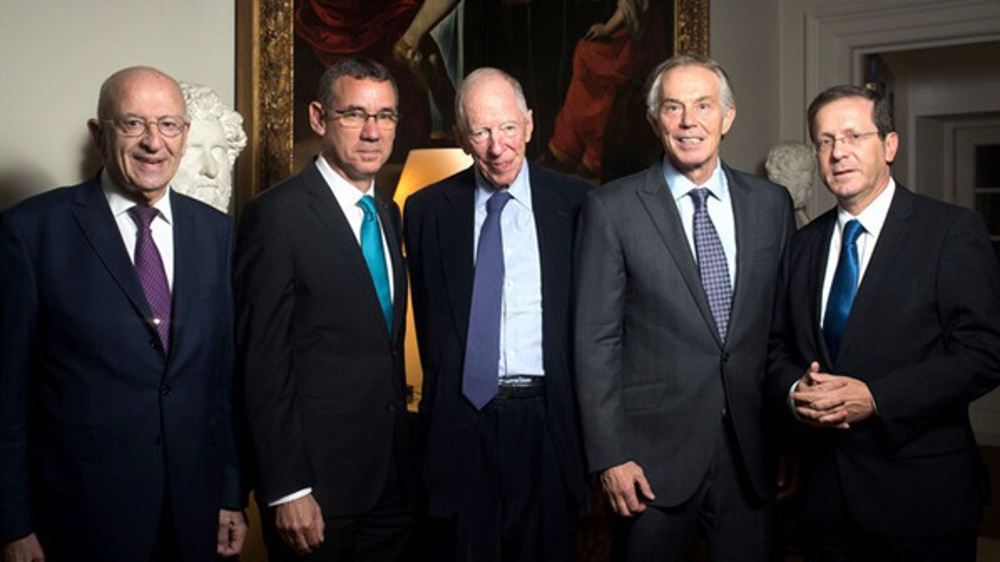
The Genocide Alliance: Chinn, Mark Regev, Jacob Rothschild, Blair and Isaac Herzog (2018)
This network fuelled scandals, like the 2006-2007 cash-for-honours affair, where Levy was arrested (though not charged) over allegations of selling peerages for donations, many from pro-Israel businessmen. The probe destabilised Blair, exposing how Zionist money influenced Labour.
Enter Lord Jon Mendelsohn: As Labour’s chief fundraiser in 2007, Mendelsohn was embroiled in a donations row involving illegal third-party contributions from property developer David Abrahams, who funnelled funds through proxies.
Mendelsohn admitted knowing about the scheme but claimed ignorance of its illegality, according to The Guardian. Fast-forward: Mendelsohn now directs Abraham Accords (UK) and co-chairs the APPG for the Abraham Accords.
Both promote normalisation between the Zionist colony and Arab states—essentially “Zionising” West Asia by embedding Zionist influence in economies and politics.
In a 2023 House of Lords speech, Mendelsohn hailed the Accords as a “historic opportunity,” ignoring Palestinian erasure. This evolution from Blair-era lobby scandals to regional normalisation underscores how Zionist networks persist, repackaging occupation as “peace.”
Blair’s fingerprints are all over the Abraham Accords, the sham “peace” deal normalising Israel’s apartheid with some regional countries while burying Palestinian rights.
In 2015, Blair brokered the first secret meetings between Benjamin Netanyahu and UAE officials in London, planting the seeds for the 2020 agreements. He attended the White House signing ceremony, gushing in a statement: “This is a momentous day… a new pathway is opening up for the Middle East.” Netanyahu later credited him with the Accords’ success, per reports from 2025.
As Quartet Envoy, Blair’s “economic peace” mantra—focusing on the occupied West Bank development while sidelining Gaza and sovereignty—paved the way for these deals, which critics slam as economic bribes to Arab states to ignore Israel’s horrendous war crimes.
Blair’s involvement wasn’t altruistic; it burnished his “peacemaker” image while entrenching Zionist hegemony, bypassing UN resolutions and Palestinian self-determination. His denial of Palestine, as Le Monde put it, is complete—treating the occupied as economic pawns in a Zionist game.
As Quartet Envoy (2007–2015), tasked with advancing the peace process, Blair faced repeated accusations of bias. Palestinian officials called him an “Israeli diplomat” in all but name; he focused on Palestinian “reform” while rarely challenging Israeli policies like Gaza’s blockade or settlement expansion.
The Guardian reported in 2011: Palestinian critics attacked him for favouring Israeli “security” needs over Palestinian rights. During Israel’s 2008-2009 Gaza offensive (1,400+ Palestinian killings), Blair echoed Israeli narratives blaming the Hamas resistance movement without addressing root causes.
A Source News analysis labelled him a “complete failure” for perceived one-sidedness. He resigned in 2015 amid conflicts of interest, but his record shows transactional Zionism—aligning with power to maintain influence.
Tony Blair Institute: Policy peddler with a dark side
The Tony Blair Institute for Global Change (TBI), launched in 2016, poses as a nonprofit promoting “good governance” and tech-driven reform. Before Larry Ellison’s funding in 2021, TBI had about 267 staff in 2020, per its annual accounts.
Post-Ellison, it ballooned to over 800 by 2023, nearing 1,000 in 45+ countries by 2025, with plans for 1,000+ by end-2026, as Ellison’s $375M+ pledges fuelled explosive growth, per POLITICO. Turnover jumped from $81M in 2021 to $121M in 2022, then over $150M, enabling global ops.
Beyond AI and digital IDs, TBI advises on climate policy, net-zero transitions, and governance—often to countries like Saudi Arabia and the UAE, drawing fire for whitewashing abuses.
It pushes “tech for good” like surveillance systems and economic reforms, but critics see neocolonialism. In Africa and the Global South, TBI embeds in governments, promoting privatisation and AI integration that favours Western tech giants.
Controversies pile up: TBI has consulted for many governments while raking in fees – including Saudi Arabia, the UAE, and Bahrain. Most damningly, reports linked TBI discussions to Gaza “reconstruction” plans condemned as ethnic cleansing blueprints, including ideas of “paying Palestinians to leave” or redeveloping Gaza as a “Riviera.”
Middle East Eye revealed TBI’s involvement in talks evolving into proposals critics slam as displacement schemes. The Guardian noted staff participation in such calls.
TBI pushes surveillance tech and net-zero policies, often funded by questionable sources, turning “global change” into elite profit. A 2024 Consultancy.uk critique ridiculed its AI studies as overhyped, while UnHerd questioned its opacity—meaning a lack of transparency in operations and funding that raises concerns over accountability and potential conflicts of interest.
Blair and Larry Ellison: Cash for influence, Zionism, and security risks
Oracle founder Larry Ellison, a staunch Zionist lobbyist and one of the world’s richest men, has poured at least £257 million ($375M+) into TBI since 2021 via his foundation.
Lighthouse Reports exposed how this cash transformed TBI into an Oracle sales and lobbying arm—pushing cloud tech, AI, and government contracts (for example, UK NHS data deals). Ellison gets policy access and favourable regs; Blair gets funding to sustain his empire and personal brand.
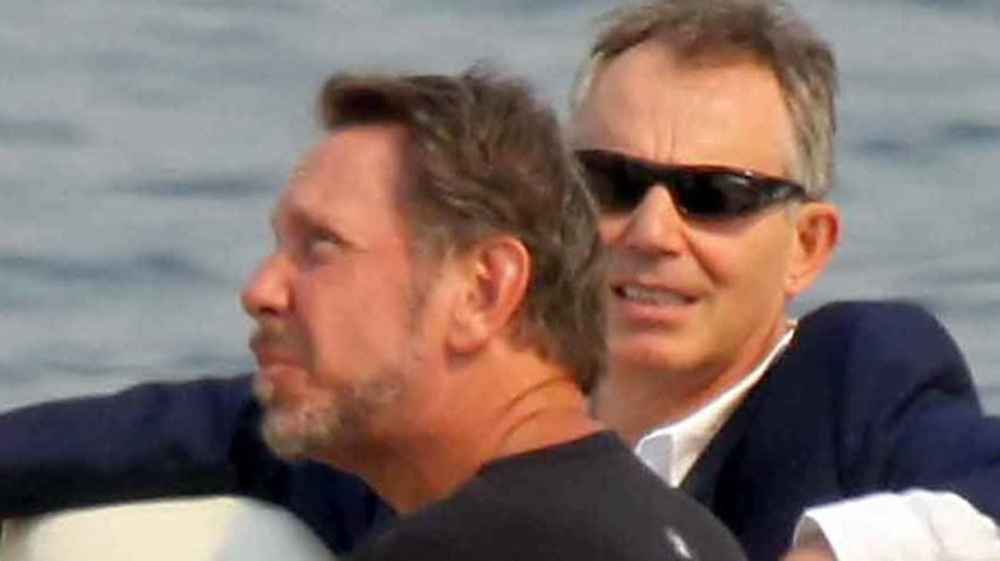
Larry Ellison and Blair
Ellison’s Zionism runs deep: He’s donated over $26M to Friends of the Israel Defense Forces (FIDF), including a record $16.6M in 2017—the largest single gift ever—and $10M in 2014.
At a 2017 gala, he declared: “Since Israel’s founding, we’ve called on the brave men and women of the IDF to defend our home,” as reported by The Times of Israel.
In videos and speeches, Ellison emphasised: “For two thousand years, we were stateless. Now we have our own country, defended by the brave men and women of the IDF,” as shared on Instagram. Oracle execs echo: CEO Safra Catz once told staff to “love Israel or maybe this isn’t the job for you”.
Ellison reportedly vetted Marco Rubio for Israel loyalty as revealed in leaked emails, and Oracle built a massive underground data center in Israel amid Gaza ops.
Oracle’s ties to the Israeli military are insidious and extensive, embedding the company as a pillar of Israel’s military machine. Since 2006, Oracle has held multi-year contracts with the Israeli military affairs ministry, supplying databases, Fusion middleware, and cloud services integral to its operations.
Oracle’s complicity in occupation and genocide includes training Israeli military personnel and providing tech that bolsters military logistics and intelligence.
Post-October 7, 2023, Oracle declared “We stand with Israel,” donating $1M to Magen David Adom, sending supplies to Israeli soldiers, and inscribing “Oracle Stands with Israel” on company premises at Catz’s demand.
Oracle’s ERP systems, databases, and IT infrastructure fuel the Israeli military’s genocidal campaigns. Oracle “married the IDF,” with employees embedded in military training and cloud services enabling real-time warfare.
Palantir’s role
This rot extends to Palantir, another Zionist tech behemoth that Blair’s orbit intersects via shared pro-Israel ecosystems. Palantir, co-founded by Peter Thiel ( who “defers to Israel” on AI ethics), signed a strategic partnership with the Israeli regime in 2024 for battle tech, meeting with military officials to deploy AI platforms.
Palantir provides militarized AI to Israeli intelligence, including Unit 8200’s Data Science and AI Center, enabling automated targeting in Gaza—essentially AI-generated kill lists amid genocide.
Palantir— fueled by Jeffrey Epstein funds and Thiel’s backing—has treated Gaza as a testing ground for surveillance tech that spies globally. The tech company, alongside Google and Amazon, arms Israel’s genocidal atrocities, with AI systems predicting and facilitating mass killings.
Blair’s TBI, Oracle-infused, echoes this by designing “data-driven” Gaza plans that could integrate such tech, turning “reconstruction” into perpetual occupation.
Infiltrating British intelligence cloud services
This alliance raises alarms: Oracle holds UK national security contracts. The Ministry of Defence (MoD) signed a 2026 cloud deal for AI and legacy migration. The Foreign, Commonwealth & Development Office (FCDO) uses Oracle Fusion for HR and finance. The Home Office inked a £54M ($72M) cloud pact in 2025.
These departments house most of the British intelligence community, like MI6 and GCHQ (FCDO), MI5 and the Homeland Security Group (Home Office), and Defence Intelligence and the Intelligence Corps (MoD). In 2021, the Cabinet Office terminated a specific procurement plan to migrate its own on-premises Oracle ERP system, so it is the only department housing British intelligence groups (including the Joint Intelligence Organisation, National Security Secretariat, National Security Council and Joint Intelligence Committee) that is not supplied by Oracle.
With Ellison’s Israeli military ties and Oracle’s Israel operations (potentially involving Unit 8200 cyber spies), backdoors pose risks—data leaks to Israeli intel could compromise UK security.
In the real world, such back doors are known to exist in the products of Israeli/Zionist firms like NSO Group with Pegasus spyware, exploited by intelligence to hack phones worldwide, as reported by The Guardian, and Cellebrite, whose tools unlock devices for surveillance as detailed by The New York Times.
Critics speculate Ellison wants Blair’s clout to secure more contracts, while Blair eyes Ellison’s billions for global sway.
Their shared obsession with digital IDs amplifies the menace, forging an Orwellian nightmare where surveillance becomes the new chains of empire.
In a World Government Summit discussion, Ellison told Blair: “The first thing a country needs to do is to unify all of their data so it can be consumed and used by the AI model,” advocating biometric IDs to replace passwords for total, inescapable control. Blair’s TBI relentlessly pushes digital IDs as “essential for modern governance,” per a September 2025 report, estimating UK implementation at £1.4 billion—but this is sinister code for dystopian tracking.
This convergence isn’t benign; it’s a blueprint for genocidal domination. In Gaza and the Levant, digital IDs could entrench Israel’s ethnic cleansing by enabling granular, AI-fuelled surveillance of Palestinians, restricting movement like digital cattle brands, and feeding into Oracle and Palantir’s targeting systems that have already slaughtered thousands.
Byline Times reported Blair’s institute designed Gaza recovery plans on “data-driven lines echoing Oracle-Palantir war systems,” potentially turning bombed-out ruins into a panopticon of apartheid, where every breath is monitored to crush resistance.
For pacification, these IDs would “identify” survivors in “humanitarian zones,” as in Blair’s Gaza International Transitional Authority proposal, which includes “digital government services and identity systems” for civil registry and permits—euphemisms for logging dissenters, enforcing starvation sieges, and facilitating forced expulsions under the veneer of “peace.”
Oracle’s Lebanon deal risks similar exposure, with data vulnerabilities amid Israel’s invasions, turning the Levant into a testing lab for Zionist tech tyranny. Blair and Ellison’s digital dystopia isn’t progress; it’s a genocidal wet dream, pacifying Gaza through algorithmic oppression while they rake in blood-soaked billions from the rubble.
It is difficult to imagine this techno-dystopia will not be enforced everywhere else the Zionists want, if they can get away with it, as they push forward with their so-called “Greater Israel” and “Pax Judaica” hews into view.
“Board of Peace”: Colonial control, potential complicity
Trump’s so-called “Board of Peace,” formalised in January 2026, vests sweeping authority in Trump (no term limit, veto power) to implement Gaza’s “humanitarian zones,” stabilisation force, and reconstruction—excluding Hamas and NGOs with “ties.”
Blair, credited with shaping elements, joins a roster heavy on Trump allies and pro-Israel figures. Al Jazeera critiqued it as putting “rights abusers in charge.”

Kushner’s vision for Gaza
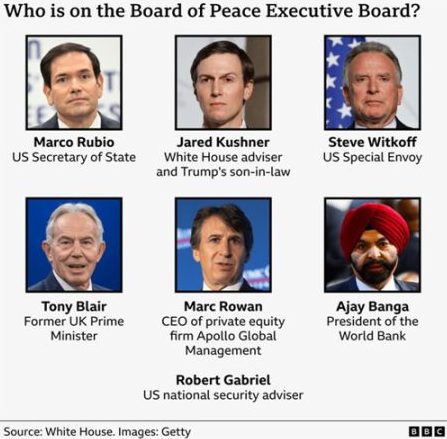
The Executive Board of the Board of Peace
Key members of the board
- Jared Kushner: As an Orthodox Jew, mega donor to the genocidal ultra-Orthodox Chabad-Lubavitch cult and architect of the Abraham Accords, Kushner has described Gaza as “valuable waterfront” property, suggesting redevelopment that critics argue implies ethnic cleansing. His role on the board aligns with his history of prioritising Israeli interests, having facilitated normalisation deals that sidelined Palestinian rights, as detailed by CNBC. Kushner’s Affinity Partners firm has ties to Middle Eastern sovereign wealth funds, raising concerns over conflicts of interest in Gaza’s reconstruction, as noted by the European Council on Foreign Relations.
- Steve Witkoff: This Jewish real estate mogul and mega Trump donor is a staunch pro-Israel advocate, serving as US Special Envoy to the Middle East (West Asia), where he has emphasised close US-Israel partnership on Gaza as reported byThe Times of Israel. Witkoff, described as having a “warm Zionist Jewish heart,” has been instrumental in delivering messages to Netanyahu and advancing Trump’s Gaza plan, as highlighted by OnePath Network. His background in property development fuels speculation that he views Gaza’s rebuilding as a business opportunity, aligning with pro-Israel policies that prioritise security over Palestinian sovereignty.
- Marc Rowan: The Jewish CEO of Apollo Global Management is a major AIPAC donor and led donor revolts against universities over perceived antisemitism, including boycotting the University of Pennsylvania for hosting a Palestinian literary festival, as reported byThe New York Times. Rowan’s anti-Palestine activism includes calling for the resignation of university leaders amid pro-Palestinian protests, as detailed byThe American Prospect. On the board, his financial expertise is poised to oversee investment in Gaza’s reconstruction, but critics argue his pro-Israel stance will entrench Zionist control, as noted by the BBC.
- Martin Edelman: This Jewish lawyer with pro-Israel ties specialises in international real estate transactions and has shaped US-UAE relations, facilitating deals that align with Zionist interests as reported by Watan. Edelman’s involvement in West Asia diplomacy includes roles that support normalisation efforts, bypassing Palestinian rights as highlighted by JNS.org. His position on the board likely focuses on legal frameworks for Gaza’s redevelopment, raising concerns over favouring Israeli interests as discussed by the Jerusalem Center for Foreign Affairs.
- Benjamin Netanyahu: As Israel’s Prime Minister and the chief architect of the Gaza genocide, Netanyahu embodies ideological Zionism, adhering to the “Iron Wall” doctrine of military dominance over Palestinians as explained byThe Conversation. His unwavering expansionism has led to policies even the New York Times calls apartheid. On the Board, Netanyahu’s inclusion ensures Israeli veto power, despite fuming at the presence of Turkish and Qatari officials, as reported by CNN.
- Tony Blair: As detailed throughout this article, Blair’s transactional Zionism and history of enabling Israeli policies make him a fitting but hypocritical addition to the board.
- Marco Rubio: This evangelical Christian is a fervent pro-Israel advocate, viewing support for Israel as biblically mandated as stated in his 2015 speech to the Republican Jewish Coalition. Rubio has pushed sanctions against Hezbollah and legislation to move the US embassy to occupied al-Quds, as reported by Liberty University. His role on the board aligns with Trump’s hardline stance, emphasising US-Israel alliances as critiqued by Sojourners.
- Susie Wiles: Wiles is reportedly an Episcopalian, but is not clearly a Christian Zionist. This is despite being aligned with Mike Huckabee through Florida politics and Trump’s circle, as noted by the Sarasota Herald-Tribune. She consulted for Likud in 2020, as detailed by The Washington Post. Despite her role on the BOARD, she has been described as a stabilising force who reportedly looked “alarmed” or shot “daggers” at Trump during press conferences where he proposed the genocidal mass relocation of Gaza’s inhabitants, as reported byThe Daily Beast.
- Ajay Banga: This Indian-American Sikh has not publicly taken a position on BDS or Zionism; however, Mastercard and Citigroup under his leadership opposed BDS and reportedly maintained operations in the occupied Palestinian territories. Banga described his board role as a “once-in-a-lifetime opportunity” to rebuild Gaza. Typically, he tried to ‘both-sides’ the genocide by condemning “unbelievable loss of life” on both sides as “unconscionable,” but critics like Ghada Karmi argue his participation aligns with a pro-Western, Zionist-adjacent framework, sidelining Palestinian self-determination.
- Robert Gabriel: As Deputy National Security Advisor since May 2025, Gabriel has served in Trump’s administration with a focus on policy, having worked as a special assistant to Stephen Miller, as reported by Wikipedia. His consulting firm, Gabriel Strategies, and closeness to Miller and Susie Wiles underscore his role in advancing hardline pro-Israel policies as detailed by LegiStorm. Gabriel’s background in Trump’s campaign positions him as a key enforcer of Zionist-aligned security measures in Gaza, as noted by the Brookings Institution.
Gaza’s death toll is in excess of 70,000 since 2023, according to the Palestinian Health Ministry, which even the Zionist military accepts. Academic studies suggest around 400,000 deaths or disappearances. With the ongoing crippling blockade, the board risks enabling further atrocities—restricted access, forced compliance, displacement under “redevelopment.”
Blair’s involvement lends false legitimacy, potentially making him an accessory to crimes if the plan entrenches occupation or ethnic cleansing. As the BBC reports, no Palestinians are on the board, though some Arab/Muslim leaders have joined, such as Bahrain’s Isa bin Salman Al Khalifa, Morocco’s Nasser Bourita, Jordan’s Ayman Al Safadi, UAE’s Reem Al Hashimy, Egypt’s Hassan Rashad, Qatar’s Ali al-Thawadi, and Turkey’s Hakan Fidan, as listed by CNBC.
Despite optimism from some quarters and claims that Netanyahu was not fully informed, as CNN reported, these figures are Zionist collaborators, with Turkey as a NATO member and most notably the UAE facilitating normalisation that sidelines Palestinian rights.
Does Trump see himself as “King of the World”? Chairing for life with vetoes, the Board positions him as a global arbiter. We might ask who, upon his death, would inherit the crown? Kushner, his Zionist son-in-law, is an obvious suspect, reinforcing Zionist control over Palestine’s fate.
Arrest Blair: End the impunity
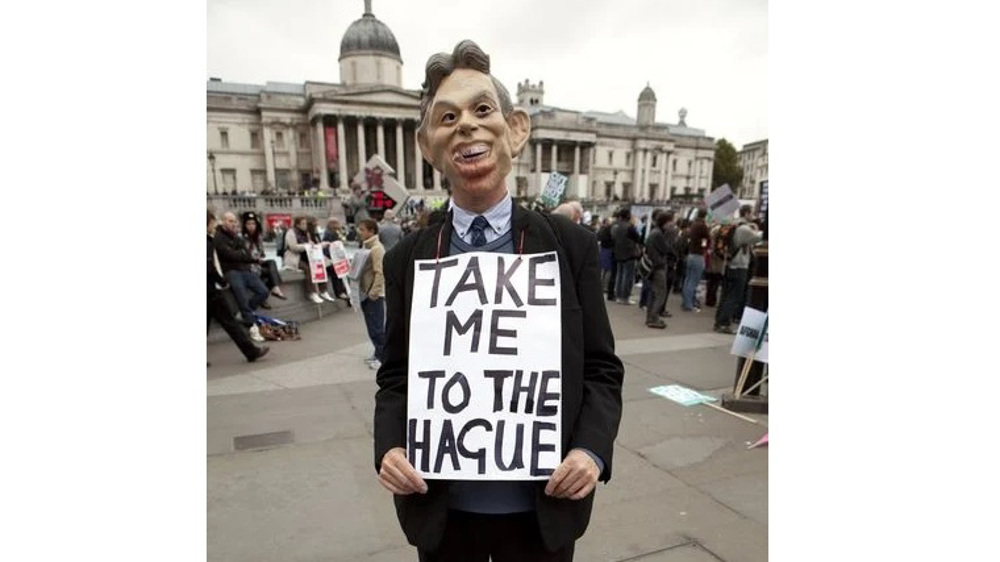
Message from London: Off to the Hague
As human rights advocates argue, Blair should face The Hague for his role in the invasion of Iraq and the war crimes there (based on the Chilcot report and the legal consensus) and his pattern of enabling power abuses—from Zionist bias to Gaza-linked schemes.
Public outrage persists: X users echo this, with posts declaring “Tony Blair should be in prison for war crimes” and calls like “Tony Blair should be heading to The Hague, not to Gaza.”
Strip his honours, prosecute under universal jurisdiction. Anything less mocks justice, say human rights campaigners worldwide as well as social media users.
Blair’s role on Trump’s board is seen widely as an ultimate insult—a war criminal overseeing “peace” in a land ravaged by over two years of genocide that his country facilitated.
Fānpán – Is China Turning the Tables on the ‘Democratic’ West?
By Mats Nilsson | 21st Century Wire | January 29, 2026
As a European born analyst with a realist mindset, I was, if not surprised, at least slightly intrigued when I read that China feels freer than Germany in the Era of Xi Jinping’s reforms.
In a world where narratives about freedom and authoritarianism are often painted in stark black and white, the words of Ai Weiwei, one of China’s, in the West most prominent dissident artists, have sent shockwaves through the European cultural scene, hurting our self-image. Ai, known for his bold critiques of the Chinese government, his iconic installations like the “Sunflower Seeds” at Tate Modern, and his 81-day detention in 2011, has long been a symbol of resistance against perceived oppression in his homeland. Yet, after a decade in exile, living primarily in Germany, Ai’s recent return visit to China has led him to a startling conclusion: Beijing now feels “more humane” than Berlin, and Germany, once renown for its liberalism, comes across as “insecure and unfree.” This perspective, shared in a candid interview with the German newspaper Berliner Zeitung following his trip, challenges entrenched stereotypes and invites a deeper examination of how societal freedoms are experienced in daily life, in Europe of today.
Ai’s statements are not mere embellishment; they stem from personal encounters that highlight bureaucratic inefficiencies, social isolation, and institutional irrationality in the West, contrasted with the efficiency and warmth he rediscovered in China. But what underpins this shift? A closer look reveals that Ai’s observations align closely with the sweeping reforms outlined by Chinese President Xi Jinping in his seminal works, particularly the multi-volume series Xi Jinping: The Governance of China. These books, which compile Xi’s speeches, writings, and policy directives, emphasize streamlining governance, enhancing people’s livelihoods, and fostering a “people-centered” development model. Under Xi’s leadership since 2012, China has undergone transformations that prioritize efficiency, anti-corruption, and social harmony; elements that Ai implicitly praises through his anecdotes.
When I read about Ai’s new insights, and tying them to Xi’s reforms, I can suddenly argue that in practical terms, China may indeed offer a form of freedom that eludes many in the West today.
Weiwei’s story is one of displacement. Born in 1957, he grew up amid the tumult of the Cultural Revolution, with his father, the poet Ai Qing, exiled to a labor camp. Ai himself rose to global fame through art that critiqued power structures, such as his investigation into the 2008 Sichuan earthquake, which exposed local government negligence in school collapses. His activism led to clashes with Chinese authorities, culminating in his 2011 arrest on charges of tax evasion, a move in the West widely seen as politically motivated.
Released but stripped of his passport until 2015, Ai fled to Germany, where he was granted asylum and continued his work from Berlin and later Portugal. For ten years, Ai immersed himself in European life, producing art that often lambasted both Chinese and Western hypocrisies. Yet, his return visit to China in late 2025 marked a pivotal moment.
In the Berliner Zeitung interview, Ai describes Beijing not as the oppressive dystopia of Western media portrayals but as “a broken jade being perfectly reassembled.” He reports feeling no fear upon arrival, a stark contrast to his past experiences. Instead, he encountered a society that felt vibrant and accessible. “Perfectly ordinary people from at least five different professions lined up, hoping to meet me,” Ai recounts, highlighting a social openness that he found lacking in Germany.
This warmth, Ai suggests, extends to everyday interactions. In Germany, he laments, “almost no one has ever invited me to their home. Neighbors from above or below exchange at most a brief nod.” Such isolation, he argues, contributes to a sense of precariousness in Western societies. In China, by contrast, the immediate eagerness of strangers to connect reflects a cultural and social fabric that prioritizes community over individualism; a theme echoed in Xi’s reforms.
This also touches on the issue of bureaucracy and freedom. At the heart of Ai’s critique is the suffocating bureaucracy he encountered in Europe, which he claims makes daily life “at least ten times” more difficult than in China. A poignant example is his experience with banking. Upon returning to China, Ai reactivated a dormant bank account in mere minutes, discovering it still held “a considerable sum of money.” This seamless process stands in sharp relief to his ordeals in the West: “In Germany, my bank accounts were closed twice. And not just mine, but my girlfriend’s as well. In Switzerland, I was refused an account at the country’s largest bank, and another bank later closed my account there as well.”
Ai describes these incidents as “extraordinarily complicated and often irrational,” hinting at possible political motivations or overzealous compliance with anti-money laundering regulations that disproportionately affect outspoken figures like himself, and just recently struck US analyst and author Scott Ritter.
This disparity underscores a broader point about freedom: while Western democracies trumpet abstract rights like free speech, the practical exercise of freedom is often hampered by bureaucratic hindrances. In Germany, a country renowned for its efficiency in engineering, the administrative state can feel labyrinthine. Opening a bank account, registering a residence, or navigating healthcare requires layers of documentation, appointments, and verifications that can take weeks or months. Ai’s account stems from “de-risking” practices, where banks sever ties with high-profile clients to avoid regulatory government scrutiny; practices that have over the last four years intensified in Europe amid geopolitical tensions.
In contrast, China’s banking system under Xi has embraced digital innovation to enhance accessibility. Xi’s The Governance of China (Volume I, 2014) outlines reforms to modernize financial services, emphasizing “inclusive finance” to ensure even remote or dormant accounts remain functional. Through initiatives like the widespread adoption of mobile payment platforms such as WeChat Pay China has reduced bureaucratic hurdles, allowing transactions and account management to occur instantaneously via smartphones. Ai’s quick reactivation exemplifies this: no endless forms, no interrogations; just efficiency. This aligns with Xi’s push for “streamlining administration and delegating power,” a key reform pillar aimed at cutting red tape and boosting economic vitality.
Xi’s books repeatedly stress that true freedom emerges from governance that serves the people. In The Governance of China (Volume II, 2017), he discusses anti-corruption campaigns that have purged inefficiencies and graft from institutions, including banks. Since 2012, over 1.5 million officials have been disciplined, fostering a cleaner, more responsive system. This has translated into practical freedoms: the ability to access services without fear of arbitrary denial. Ai’s experience suggests that in China, freedom is not just rhetorical but operational, free from the “cold, rational, and deeply bureaucratic” constraints he felt in Germany.
Xi’s people-centered approach finds confirmation in Ai’s assertion that Beijing’s political climate feels “more natural and humane” than Germany’s. This in my humble view, points toward a deeper cultural and policy shift. Ai portrays Germany as a place where individuals feel “confined and precarious,” struggling under the weight of historical guilt and future uncertainties. This resonates with critiques of Western societies, where economic inequality, rising populism, and social fragmentation have eroded communal bonds. In Europe, the aftermath of the COVID-19 pandemic, coupled with energy crises and migration debates, has heightened a sense of insecurity. Ai’s social isolation in Germany, minimal neighborly interactions, mirrors surveys showing increasing loneliness in Western nations.
China, under Xi, has pursued a different path. Xi’s reforms, as detailed in The Governance of China (Volume III, 2020), prioritize “building a community with a shared future for mankind,” emphasizing social harmony and collective well-being. This includes massive poverty alleviation efforts, lifting nearly 100 million people out of extreme poverty by 2021: a feat Xi describes as ensuring “no one is left behind.”
Such policies foster a society where, as Ai observed in his interview, ordinary people eagerly engage with others, creating a humane environment. Moreover, Xi’s focus on cultural confidence has revitalized community ties. In Volume IV (2023), he advocates for “socialist core values” like civility and harmony, which manifest in everyday life through neighborhood committees, volunteer networks, and cultural events. Ai’s warm reception upon return; people from various professions seeking him out, reflects this. It’s a far cry from the European atomized individualism, where privacy norms can border on alienation.
Critics might argue that China’s harmony comes at the cost of dissent, pointing to tightened controls on expression under Xi. Yet, Ai’s lack of fear during his visit suggests a nuance: while political criticism remains sensitive, daily freedoms, economic mobility, social interaction, access to services, have expanded. Xi’s reforms include “rule of law” initiatives, with over 300 laws revised since 2012 to protect individual rights in non-political spheres. This “selective freedom” may feel more liberating in practice than the West’s more abstract liberties of today.
One must also consider China’s economic transformations in this aspect. Xi’s books outline the “Chinese Dream” of national rejuvenation through innovation-driven growth. Reforms like the Belt and Road Initiative and dual circulation strategy have bolstered domestic resilience, reducing reliance on Western systems that Ai found unreliable. Xi critiques European protectionism in his writings, advocating for open economies. Ironically, Ai, once a Western darling, now embodies the pitfalls of this approach, his accounts closed perhaps due to his Chinese ties, highlighting how geopolitical insecurities undermine personal freedoms. In China, Xi’s anti-corruption drive has stabilized institutions, ensuring accounts like Ai’s remain intact despite dormancy. This stability contributes to the “unfree” feeling Ai ascribes to Germany, which he says, “plays the role of an insecure and unfree country, struggling to find its position between history and future.”
Xi’s reforms, by contrast, position China as forward-looking, with policies like the 14th Five-Year Plan emphasizing high-quality development and environmental sustainability, creating a sense of progress and security.
So, in conclusion, Weiwei’s reflections serve as a mirror—forcing the West to confront its own contradictions. Germany, with its history of division and reunification, symbolizes the democratic triumph, and yet, Ai’s experiences reveal cracks: overregulation, social coldness, and institutional paranoia.
This isn’t unique to Germany or the EU; similar issues plague the U.S. and U.K., where bureaucratic hurdles in immigration, healthcare, and finance frustrate citizens. Xi’s governance model offers an alternative: efficiency through centralization, humaneness through collectivism. While not without flaws, critics note surveillance and censorship, and so Ai’s endorsement suggests that for many, China’s system delivers tangible freedoms. His words directly challenge the binary of “free West vs. authoritarian East,” urging a reevaluation based on lived realities. Ai Weiwei’s declaration that China feels more humane and freer than Germany isn’t a reversal of his principles, but an evolution based on experience. It underscores the success of Xi Jinping’s reforms in creating a society where bureaucracy recedes, community thrives, and daily life flows unencumbered. As the world grapples with uncertainty, perhaps the West can learn from China’s jade-like reassembly, piecing together a more practical freedom for all?
Author Mats Nilsson LL.M is political analyst and legal historian based in Sweden. See more of his work at The Dissident Club on Substack.
U.S. Funds Continue to Flow to Ecuadorian Groups Despite Trump-Era Suspension
teleSUR | January 25, 2026
Ecuadorian foundations, governmental entities, media outlets, private companies, and other organizations continue to receive U.S. financial support according to Foreign Assistance, despite a temporary funding suspension for international aid programs announced by the Trump administration in January 2025.
In 2025, U.S. financial allocations to Ecuador reached USD 59.96 million, representing a 38.06% reduction compared to the USD 96.8 million delivered in 2024.
Despite the decrease, the resources remain significant and primarily come from two sources: the Department of State, with USD 9.19 million, and the United States Agency for International Development (USAID), with USD 35.52 million.
USAID has long been subject of criticism in several countries, including Ecuador, where previous governments have accused it of interference in internal affairs.
Main Beneficiaries
A Radio Pichincha report shows that the Andean Foundation for Media Observation and Study (Fundamedios, in Spanish) received USD 80,701 in 2025 for the “Fostering Accountability through Investigative Reporting (FAIR)” project. This figure is 44% lower than the USD 145,000 it obtained in 2024 from USAID for “Ecuador Verifies,” a coalition that brings together media, civil society organizations, and universities with the goal of underseeing political discourse.
The Pachamama Foundation, dedicated to the conservation of the Amazon rainforest and the “good living” concept in the Ecuadorian and Peruvian Amazon, recorded an inverse trend: it went from receiving USD 279,020 in 2024 to USD 1,570,207 in 2025.
This organization was shut down in December 2013 during the administration of President Rafael Correa, following a report by the Ministry of the Interior that determined it was carrying out “actions not included in its statutory purposes and objectives.”
According to a statement from the Ministry of the Environment that year, “with the collaboration of the Ministry of the Interior, it was determined that the NGO was engaging in actions that interfered with public policies, undermining, as stipulated by the Regulations for Social Organizations, the internal security of the state and public peace.”
Its legal status was restored in 2017 under the presidency of Lenin Moreno.
Despite the continuity of funding, several organizations remain on edge over the possibility that the U.S. may decide to suspend or modify its economic assistance in the future, which could force them to cut projects and lead to staff layoffs.
The uncertainty persists even though, between 2019 and 2025, total disbursements reached USD 824 million, with a notable increase since 2022 under the administration of Guillermo Lasso. Between 2022 and 2023 alone, aid exceeded USD 500 million, and between 2024 and 2025, during the government of Daniel Noboa, it surpassed USD 157 million.
American Academy of Pediatrics Hit With Federal RICO Lawsuit for Vaccine Safety Fraud
By Nicolas Hulscher, MPH | Focal Points | January 21, 2026
For decades, the American Academy of Pediatrics (AAP) has been treated like an untouchable authority on child health — the gold standard that parents, doctors, schools, and lawmakers were told to trust without question. But today, that image collapses. Children’s Health Defense (CHD) and multiple plaintiffs just filed a federal lawsuit alleging the AAP spent decades running a racketeering operation that sold parents false safety assurances about the childhood vaccine schedule.
This isn’t another “vaccine debate” lawsuit. It’s a RICO fraud case—the same legal weapon used against organized crime and the tobacco industry. The allegation is blunt and devastating: the AAP allegedly manufactured false certainty around vaccine schedule safety, shut down legitimate scientific scrutiny, and promoted sweeping assurances that were never validated through rigorous real-world safety testing—while operating within a system shaped by vaccine-manufacturer funding and financial incentives tied to high pediatric vaccination rates.
One of the most explosive points in the complaint is what it forces into the open. The cumulative childhood schedule has never been safety-tested the way any reasonable parent would assume it has. The lawsuit points to Institute of Medicine findings from 2002 and 2013 calling for more research and acknowledging the lack of proper vaccinated vs. unvaccinated comparisons. Yet the AAP continued portraying the schedule as thoroughly tested and unquestionably safe, shaping pediatric care nationwide through repetition, authority, and pressure—not proof.
The complaint also describes what parents have learned the hard way. This system doesn’t merely recommend vaccines. It demands compliance. Physicians who questioned the schedule or deviated from AAP protocols were professionally targeted, disciplined, and financially crushed. The message was clear: follow the script, or lose your career.
The lawsuit further argues that the AAP’s public reassurances were built on “theoretical” talking points that became institutional doctrine, including the infamous claim that infants could tolerate an extreme number of vaccines at once. According to the plaintiffs, this wasn’t evidence—it was marketing disguised as medical authority, repeated in clinics to silence questions and keep the assembly line moving.
Then there’s the part that makes it all make sense: money. The complaint highlights conflicts of interest and financial entanglements with vaccine manufacturers and aligned institutions. The AAP presents itself as independent and science-first, while operating in a world of corporate sponsorships, incentives, and industry relationships that would be unacceptable in any genuinely transparent public health organization.
This is why the lawsuit matters. It’s not about a single product. It challenges the entire protection racket that has propped up the pediatric vaccine industry for decades. AAP’s model has relied on one rule: the schedule is safe because we say it’s safe—and anyone who demands real proof gets smeared, censored, or destroyed.
The lawsuit seeks financial damages for the families and physicians harmed, demands disclosure of the lack of comprehensive safety testing behind the cumulative schedule, and aims to stop the AAP from making blanket, unqualified claims that the schedule is “safe and effective” as if that question has already been settled.
If this case advances, discovery alone could expose what the public has been denied for decades—and that would be a historic victory for medical transparency, informed consent, and accountability in pediatrics. For years, parents were told to “trust the experts,” while legitimate safety questions were mocked, censored, or punished. Now those questions are headed to the one place the system can’t silence them with talking points: federal court.
Summary
- CHD and multiple plaintiffs filed a federal RICO lawsuit against the AAP, accusing the organization of long-term fraud and racketeering tied to vaccine safety claims.
- The lawsuit alleges the AAP violated RICO by engaging in a sustained pattern of deceptive safety messaging about the CDC childhood vaccine schedule, while operating within a financial ecosystem tied to vaccine-manufacturer funding and incentive-driven pediatric vaccination practices.
- The lawsuit alleges the AAP repeatedly promoted false certainty that the childhood vaccine schedule is thoroughly tested and safe.
- The complaint highlights the absence of proper vaccinated vs. unvaccinated comparisons for cumulative schedule safety, referencing IOM reports calling for more research.
- Plaintiffs argue the AAP relied on theoretical reassurance (not real-world schedule safety trials) to shut down scrutiny and concerns.
- The suit includes physicians claiming they suffered professional and economic harm for deviating from AAP vaccine orthodoxy or questioning safety claims.
- It also includes families alleging severe injury or death following routine vaccination and describes how medical judgment was allegedly overridden by rigid AAP-driven standards.
- The complaint raises concerns about conflicts of interest, alleging financial ties and aligned incentives undermined the credibility of AAP’s public safety assurances.
- The lawsuit seeks financial damages, mandatory disclosure about safety-testing gaps, and to stop the AAP from making unqualified vaccine safety claims.
Epidemiologist and Foundation Administrator, McCullough Foundation
Villains of Judea: Philip Esformes and the Largest Healthcare Fraud in American History
José Niño Unfiltered | January 20, 2026
If there’s one thing the Trump era has taught us, it’s that President Donald Trump is hyper-focused on serving the interests of the slimiest elements of American Jewry.
On a December evening in 2020, Trump granted clemency to Philip Esformes, a South Florida nursing home operator serving a 20-year sentence for orchestrating what federal prosecutors called the largest individual healthcare fraud scheme ever prosecuted in American history. The commutation freed Esformes from prison after he had served just over four years, though it left his conviction and roughly $44 million in financial penalties intact.
Born in 1968 into an Orthodox Jewish family, Philip Esformes grew up surrounded by both faith and the nursing home business. His father, Rabbi Morris Esformes, built a reputation as a prominent facility owner and major philanthropist within Jewish communities. Public records trace the family’s ancestry to Salonika, Greece, historically home to a thriving Sephardic Jewish population. The elder Esformes created a legacy in long-term care, and his son appeared destined to follow that path.
Philip Esformes entered the healthcare industry and eventually controlled a network of skilled nursing facilities and assisted living centers across South Florida. By the mid-2000s, his business empire seemed prosperous on the surface. Yet federal investigators were already examining troubling patterns in how his facilities operated and billed government healthcare programs.
The first warning signs emerged in 2006 when Esformes and associates connected to Larkin Community Hospital reached a civil settlement with federal and Florida authorities. The $15.4 million agreement resolved allegations involving kickbacks and admitting patients for medically unnecessary treatment. Though the settlement required no admission of wrongdoing, prosecutors later pointed to this episode as evidence that suspicious conduct continued unchecked.
A decade later, federal authorities brought criminal charges that painted a portrait of systematic fraud on an unprecedented scale. In July 2016, prosecutors indicted Esformes on multiple counts related to what they described as a roughly $1.3 billion scheme to defraud Medicare and Medicaid. The government’s case detailed an intricate operation designed to maximize profits by manipulating patient care and gaming federal reimbursement rules.
According to court filings, Esformes orchestrated a system that moved beneficiaries among hospitals, skilled nursing facilities, and assisted living centers in carefully timed patterns. These transfers satisfied Medicare eligibility requirements such as mandatory three-day hospital stays and 100-day skilled nursing limits, allowing facilities to restart billing cycles regardless of whether patients actually needed the care. Prosecutors alleged that medical decisions took a back seat to financial calculations.
The scheme allegedly extended beyond unnecessary services. Federal authorities claimed Esformes paid kickbacks and bribes to physicians and physician assistants who referred patients to his network. These illegal payments flowed through intermediaries and were disguised as legitimate business expenses. Some payments were allegedly hidden as charitable donations, prosecutors said, while others appeared in fake contracts and invoices designed to conceal their true purpose.
Court documents described additional allegations involving bribery of a Florida healthcare regulator. According to government filings, Esformes sought advance notice of facility inspections, allowing him to prepare for oversight visits that might otherwise uncover problems. The government’s detention memo outlined roughly $1 billion in fraudulent claims based on data from 2009 through 2016 alone, noting that the total loss likely climbed higher when accounting for other years and Medicaid billing.
The scope of the alleged fraud extended into Esformes’ personal life. Prosecutors claimed he used proceeds from the scheme to fund an extravagant lifestyle and engage in unrelated criminal conduct. Among the most notable allegations was his purported payment of bribes to a University of Pennsylvania basketball coach to facilitate his son’s admission to the school. This conduct, while separate from the healthcare fraud, illustrated how prosecutors believed illegal profits financed various forms of corruption.
After a lengthy trial in 2019, a federal jury convicted Esformes on numerous counts including conspiracy to defraud the United States, kickback violations, money laundering, federal program bribery conspiracy, and obstruction of justice. U.S. District Judge Robert Scola of the U.S. District Court for the Southern District of Florida sentenced him to 20 years in federal prison and imposed roughly $5.5 million in restitution along with approximately $38.7 million in forfeiture penalties.
Throughout the legal proceedings, Esformes and his defense team fought the charges on multiple fronts. They raised concerns about prosecutorial conduct, particularly allegations that federal authorities improperly accessed attorney-client privileged materials during their investigation. These claims sparked a significant legal battle that continued through the appeals process. The Eleventh Circuit Court of Appeals ultimately affirmed the conviction in 2023, concluding that suppression and exclusion remedies adequately addressed any prosecutorial missteps and that dismissing the entire case was unwarranted.
The commutation from President Trump arrived in late December 2020, during the final weeks of his first term. Reporting on the clemency decision highlighted support from prominent figures and faith-based advocacy organizations. The Orthodox Jewish non-profit Aleph Institute played a significant role in pushing for Esformes’ release, according to investigative journalism. Supporters portrayed him as a devout man who had suffered enough and deserved compassion. Critics, however, viewed the commutation as an example of how personal connections and Jewish advocacy networks could influence presidential mercy outside traditional Department of Justice clemency procedures.
Even with his prison sentence commuted, Esformes’ legal troubles persisted. Federal prosecutors announced plans to retry him on counts where the original jury had deadlocked. In 2021, Judge Scola set bond at an eye-popping $50 million and imposed strict restrictions on his travel documents, reflecting concerns about flight risk. These proceedings stretched on for years as both sides negotiated over the remaining charges.
In February 2024, Esformes reached a plea agreement with prosecutors. He pleaded guilty to one count of conspiracy to commit healthcare fraud and received a sentence of time served. Under the agreement, prosecutors dismissed the other pending counts, finally closing the door on the criminal case that had consumed more than eight years of litigation. The plea brought a measure of closure to a prosecution that had become one of the most closely watched healthcare fraud cases in American legal history.
Yet new troubles emerged later that same year. In October 2024, Miami-Dade County authorities arrested Esformes on felony charges including victim or witness tampering and criminal mischief connected to a domestic violence incident. The arrest generated fresh headlines and prompted renewed scrutiny of Trump’s clemency decisions. The New York Times reported on the charges and placed them within a broader examination of how some clemency recipients had reoffended after receiving presidential mercy. Some news accounts later indicated that prosecutors dropped the domestic violence case, though the arrest remained part of the public record.
In freeing Esformes, Donald Trump once again proves his blind fealty to the worst villains of Judea, especially its underworld cohort, reducing the presidency to a rubber stamp for Jewish billion-dollar thefts that bleed America dry. As posterity pens the verdict, Trump’s populist facade crumbles to dust: a stalking horse galloping blindly for Jewish overlords like the Esformes clan, forsaking America’s preservation for pan-Judah’s gain.
Featured Video
Seyed M. Marandi: Negotiations Collapsed – Return to War
or go to
Aletho News Archives – Video-Images
From the Archives
Wartime internment camps in Australia
National Archives of Australia
World War I
During World War I, for security reasons the Australian Government pursued a comprehensive internment policy against enemy aliens living in Australia.
Initially only those born in countries at war with Australia were classed as enemy aliens, but later this was expanded to include people of enemy nations who were naturalised British subjects, Australian-born descendants of migrants born in enemy nations and others who were thought to pose a threat to Australia’s security.
Australia interned almost 7,000 people during World War I, of whom about 4,500 were enemy aliens and British nationals of German ancestry already resident in Australia.
Records of World War I internment camps
World War II
During World War II, Australian authorities established internment camps for three reasons – to prevent residents from assisting Australia’s enemies, to appease public opinion and to house overseas internees sent to Australia for the duration of the war.
Unlike World War I, the initial aim of internment during the later conflict was to identify and intern those who posed a particular threat to the safety or defence of the country. As the war progressed, however, this policy changed and Japanese residents were interned en masse. In the later years of the war, Germans and Italians were also interned on the basis of nationality, particularly those living in the north of Australia. In all, just over 20 per cent of all Italians resident in Australia were interned. … continue
Blog Roll
 Aletho News
- Seyed M. Marandi: Negotiations Collapsed – Return to War
- Tomorrow’s naval blockade showdown
- ‘Israel’ attacks civilians to hide its embarrassing military failures & out of pure sadism
- Any Foreign Military Vessel Approaching Hormuz Under Any Pretext ‘Will Be Dealt With Severely’: IRGC
- Diplomats slam US negotiators’ performance in Iran talks
- Trump Refuses Exit Ramp, War with Iran will Continue
- Trump Says US Naval Blockade in Strait of Hormuz Will Begin Shortly
- US, Iran end 21-hour talks without agreement
- US IRAN TALKS: Who Are the Crazy Ones Here? /Lt Col Daniel Davis
- Talks with the US end without a deal over excessive US demands: Iran
- If Americans Knew
- US-Iran ceasefire negotiations make zero progress – Daily Update
- Pro-Israel ‘Thinktanks’ and Individuals who Influence U.S. Foreign Policy
- Mearsheimer reveals how Israel dictates US policies on Iran, Gaza – video
- After killing 350+, Israel still has a “score to settle” with Lebanon before ceasefire – Daily Update
- Military aid to Israel emerges as the latest political litmus test for Democrats
- The only Palestinian children’s rights organization closes following years-long Israeli campaign against it
- ‘I Can’t Forget the Smell’: Lebanese Reel After Israel Kills Over 300 in Single Day
- DNC Shoots Down Resolutions Calling Out AIPAC and Limiting Arms to Israel
- TCN: Is Israel Blackmailing President Trump?
- Israel killed at least 303 Lebanese yesterday – who were they? Daily Update
- No Tricks Zone
- Cave Discovery Reveals Today’s Desert Climates Were Recently Far Warmer, Wetter, Teeming With Life
- German Expert: Heat Dome Led To Record Temps In Western USA…Warmer In 1934, 1936
- New Study: No Linear Warming Or Glacier Retreat Along Northern Antarctic Peninsula Since 1980s
- An Inconvenient Tree: Uncovered In Alps… Europe Much Warmer Than Today 6000 Years Ago
- New Study Reports A 60% Slowdown In Greenland’s Ice Loss Rate In The Last Decade
- Low Intensity Tornado Wrecks Major Solar Farm, Creating A Potential Toxic Dump
- New Study Finds Warming Saves Lives…Cold Temperatures 12 Times More Deadly Than Excess Heat
- German Science Blog Accuses PIK Climate Institute Of Hallucinating Climate Tipping Points
- Devastating Assessment Of Comirnaty Vaccine By Former Senior Pfizer Europe Toxicologist
- New Study: CO2 Is ‘Effectively Negligible’ As An Explanatory Climate Change Factor Since 2000
 Aletho News