US House Establishes Panel to Investigate Potential Weaponization of Federal Government
Samizdat – 11.01.2023
WASHINGTON – The US House of Representatives on Tuesday passed a resolution establishing a select subcommittee to investigate whether components of the federal government have been weaponized against everyday citizens.
House lawmakers passed a resolution establishing the special Judiciary Committee panel in a vote of 221-211, falling along partisan lines.
“Congress hasn’t kept pace with the federal government’s potential to abuse new technology, and we need to better understand how US intelligence agencies work with each other and with the private sector to collect information on Americans or to undermine their fundamental constitutional rights,” House Majority Leader Steve Scalise said in a statement on the panel.
The subcommittee will investigate how the FBI, Justice Department, Department of Homeland Security and other executive branch agencies obtain information from and provide information to the private sector and other agencies to facilitate actions against US citizens.
The panel will be granted access to information shared with the House Intelligence Committee and the authority to review ongoing criminal investigations. The panel is styled after the Church Committee of 1975, which conducted similar oversight of federal agencies.
House Speaker Kevin McCarthy will name 13 members to the subcommittee, including five Democrats in consultation with Minority Leader Hakeem Jeffries.
A few months after their 16 year old student dies running track, Amherst school superintendent admits they’ll hold a COVID vaccine clinic for students and be paid $2,000 to do so
By Meryl Nass | January 10, 2023
Sacrificing virgins on the altar of the Scientism religion, Amherst MA (population 40,000 but housing 2 colleges and a major university) pledges loyalty to the shot, denying the reality of their own student’s recent death from myocarditis.
The Amherst-Pelham MA school superintendent admitted at a meeting streamed on closed circuit TV tonight that he is putting his students’ lives at risk for thirty pieces of silver.
What is wrong with Amherst, a small city chock full of MDs and PhDs, who are mindlessly going along and increasing their kids’ chance of death? Disclosure: I lived there for ten years. I lectured in the next town 3 days ago.
After losing one high school athlete already to the shot (and the parents of the deceased teenager are an MD and PhD) why aren’t people screaming NO!? What does it take to stop the carnage? If it’s such a great vaccine, why do you need to pay people to take it? The town of Amherst’s COVID vaccine website claims that 91% of the town is fully vaxxed. But the clinics won’t stop, even after everyone knows the darn things don’t work.
According to the NYT and CDC, only 15% of Americans have taken a bivalent booster and only 34% have taken any COVID booster. So a lot of us have figured out the scam. Too bad the good, overeducated people of Amherst haven’t yet.
Alzheimer’s drug approval raises the alarm
Data shows treatment can lead to ‘brain shrinkage’
By Maryanne Demasi, PhD | January 9, 2023
The US Food and Drug Administration (FDA) has granted an accelerated approval of a new treatment for Alzheimer’s disease, which aims to clear toxic amyloid protein build-up in the brain.
At a cost of $26,500 per year in the US (not covered by Medicare or Medicaid), people with early Alzheimer’s disease can receive a twice-monthly monoclonal antibody infusion called lecanemab (marketed as LEQEMBI™), co-developed by Eisai, a Japanese biotech firm, and Biogen.
In the lead up to the FDA’s approval, there was intense lobbying for the drug.
A ‘consensus statement’ signed by over 200 scientists, many of whom had financial ties to the drug companies, described lecanemab as a “foundational gamechanger” for the disease, calling for “no barrier” to the widespread availability of the treatment.
Now that the drug has been approved, advocacy groups like the Alzheimer’s Association, which are heavily funded by the drug industry, have welcomed the news, saying the FDA made “the right decision.”
But critics doubt the benefits of lecanemab outweigh its harms, and are dismayed that the FDA approved the drug without input from its own advisory panel.
Kim Witczak, a drug safety advocate, and member of the FDA’s Psychopharmacologic Drugs Advisory Committee, says she is “shocked” by the latest FDA stunt.
“By approving this new drug without a public advisory committee meeting, the FDA once again has shown a lack of concern for the public, patients, and healthcare providers. Convening its advisory panel would have helped reassure everyone that the FDA’s decision was scientifically sound and transparent,” said Witczak.
“Advisory committee meetings offer the opportunity to discuss the data in an open and public forum, to challenge methods, study endpoints (surrogate vs clinically meaningful), and safety findings before the general committee member discussion. But in this case, none of that was possible,” she added.
The FDA’s accelerated approval process used to green-light lecanemab is known for accepting lower evidentiary standards for drug efficacy, so that patients can gain access to experimental drugs sooner.
Critics say its reminiscent of the FDA’s approval of aducanumab – Biogen’s other Alzheimer’s drug. It was approved on the basis of lowering amyloid protein (a surrogate marker) in the brain, despite no clinically meaningful benefit for patients.
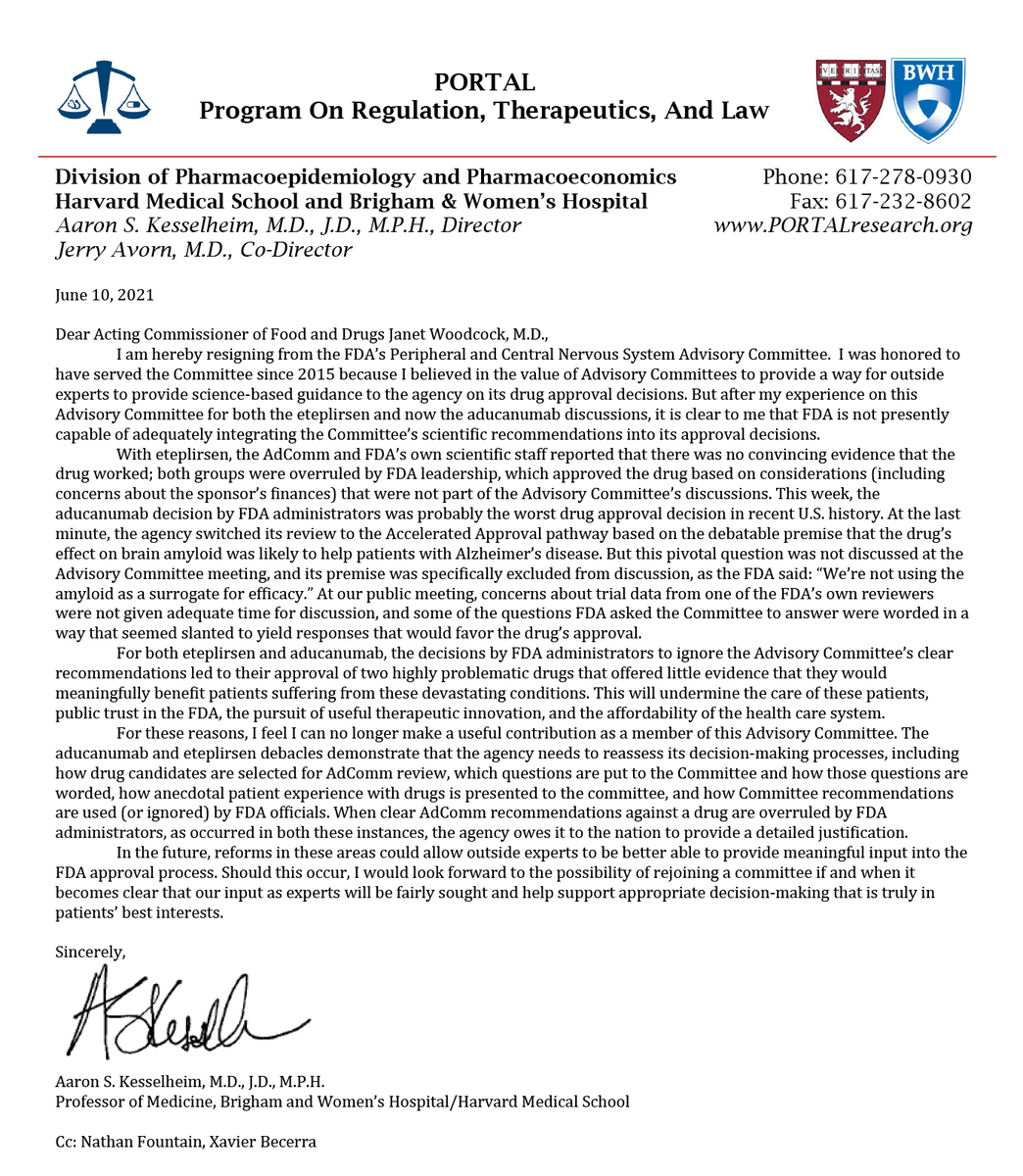
At the time, the controversial decision led to the resignation of FDA advisory member Aaron Kesselheim, who labelled it “probably the worst drug approval decision in recent U.S. history.”
Linda Furlini, a research ethics advisor based in Montreal, Canada says it essentially gives the rubber stamp to similar drugs down the track. “Once you grant accelerated approval of a drug in that class, then it’s easier to get the second drug, and then the third drug approved.”
Jessica Adams, an expert in drug regulatory affairs, agrees. She said, “Lecanemab’s approval shows the power of precedent in regulatory approvals. This is why I scoff whenever the FDA says it still reviews drugs on a case-by-case basis.”
The industry-funded study published in the New England Journal of Medicine, involving almost 1800 people with early Alzheimer’s disease, found that lecanemab could slow the decline of cognition and function by 27% over 18 months compared to placebo.
They used a “Clinical Dementia Rating” scale to show lecanemab patients declined by 1.21 points compared to 1.66 point in the placebo group – a 0.45 point difference in lecanemab’s favour.
But experts question whether the small difference will have any impact on how the patient actually feels.
Madhav Thambisetty, a neurologist at Johns Hopkins University and the National Institute on Aging said, “The benefit appears to be quite small, and it’s unclear how meaningful this might be for patients.”
In fact, the FDA’s own statistician Dr Tristan Massie was uncertain whether “the treatment effect on amyloid is reasonably likely to predict change on the clinical outcome” and considered the results of the study to be “exploratory”.
As a physician who cares for people with Alzheimer’s disease, Thambisetty spoke about the harms of the drug. “These patients can experience headaches, falls, confusion, vision disturbances and it’s unclear if patients will be able to see obvious benefits on a day-to-day basis,” he said.
The data showed an increased risk of brain bleeds and swelling, i.e. amyloid-related imaging abnormalities (ARIA) occurred in 126 (14.0%) of subjects in the lecanemab group and only 69 (7.7%) of subjects in the placebo group.
This prompted the FDA to include a warning on the drug about the risk of swelling and bleeding in the brain.
The drugmakers have also highlighted that people carrying two copies of the APOE4 gene (which predisposes someone to Alzheimer’s) puts them at a particularly “high risk of life-threatening brain haemorrhage.”
Three deaths have been reported in people taking lecanemab; an 80-yr old phase 3 trial participant who suffered intracranial haemorrhage, a 65-yr old who experienced brain swelling and bleeding and a 79-yr old who reportedly had seizures and brain bleed in the open-label phase of the trial.
Two of the three people who died were taking blood thinners, and experts who reviewed the lecanemab death cases suggested that anticoagulant use may have exacerbated the fatal outcomes.
Furlini’s research career has focused on the need to educate and support caregivers of people with dementia-type illnesses.
“You read the list of side effects – you might have gait problems, you might have brain swelling, visual disturbances… I mean, what are we doing here?” asks Furlini, “The patient is already confused and losing their cognitive capacity. How are these serious side effects helping them? It runs counter to any ethical semblance of what is wanted or expected.”
Thambisetty has also expressed concerns about the “brain shrinkage” seen in trial participants taking either lecanemab or aducanumab – increasing doses of the drug correlate to a decrease in brain volume.
“The observation of brain shrinkage is worrisome because, in the absence of compelling evidence to the contrary, it suggests a potential worsening of degenerative changes in the brains of people with Alzheimer’s disease,” wrote Thambisetty in a recent opinion piece for STAT.
The observation has been explained away by researchers who say that a reduced brain volume is due to the clearance of amyloid protein from the brain. But Thambisetty says there is little empirical evidence to support this theory.
Instead, he points to an Australian study which calculated that the clearance of amyloid plaque from the brain was too small to represent a plausible explanation for the loss of brain volume.
US lawmakers launched an investigation into the FDA after the agency’s controversial approval of aducanumab. Last month, a US House of Representatives panel released the report following an 18-month investigation.
The report said the process was “rife with irregularities” and that FDA officials “inappropriately collaborated” with the drugmaker during the approval process which “exceeded the norm in some respects.”
Representatives from the FDA and Biogen engaged in over 100 phone calls or meetings dating back to 2019 in order to expedite the drug’s approval, which lawmakers say, “consisted of atypical procedures and deviated from the agency’s own guidance.”
The congressional report recommended the agency “must take swift action to ensure that its processes for reviewing future Alzheimer’s disease treatments do not lead to the same doubts about the integrity of FDA’s review.”
But critics now say, it’s too late for an agency that has not taken accountability for its actions.
“These drug approvals have just created confusion, uncertainty, fear and misinformation. Then they wonder why people have no trust in their institutions, like the FDA. The world looks to the FDA for leadership. That it does not fulfill its responsibilities, remains the challenge of our times,” said Furlini.
Furlini has followed this area of research for decades and says the drug industry needs to move on from the ‘amyloid theory’ of Alzheimer’s disease and refocus its attention on other causes.
“After so many years, I’m fed up with the exclusive focus on the amyloid theory to the exclusion of other research theories, it’s a disservice to people with Alzheimer’s, and their families,” said Furlini
“There are a lot of buzzwords and marketing propaganda being put out there. And they justify it by saying that you have to give people hope. But you’re giving people false hope. It plays with people’s emotions, which I find horrendous,” added Furlini.
Twitter censored tweets after pressure from Pfizer director
By Tom Parker | Reclaim The Net | January 9, 2023
A newly released email from the Twitter Files has revealed that Twitter censored a tweet from Dr. Brett Giroir, a board member at the biopharmaceutical company Altesa Biosciences, after it was flagged by Scott Gottlieb, a board member at the pharmaceutical giant Pfizer.
Gottlieb and Giroir both currently serve on the boards of several pharmaceutical companies and have backgrounds in public health. Gottlieb is a former Food and Drug Administration (FDA) commissioner while Giroir is a former Assistant Secretary for Health and former acting Commissioner of the FDA.
Pfizer produces Covid vaccines whereas Altesa Biosciences develops drugs to combat Covid.
In the August 27, 2021 email, which was published by journalist Alex Berenson, Gottlieb complained to Todd O’Boyle, a senior manager on Twitter’s Public Policy team, about a tweet from Giroir that claimed natural immunity to Covid-19 was superior to vaccine immunity.
“This is the kind of stuff that’s corrosive,” Gottlieb wrote. “Here he draws a sweeping conclusion off a single retrospective study in Israel that hasn’t been peer reviewed. But this tweet will end up going viral and driving news coverage.”
According to Berenson, O’Boyle forwarded Gottlieb’s email to Twitter’s Strategic Response team — a team that was tasked with handling complaints from Twitter’s most important employees and users.
Berenson said that O’Boyle didn’t mention that Gottlieb was a Pfizer board member in this email and instead wrote, “Please see this report from the former FDA commissioner.”
An analyst from Twitter’s Strategic Response team quickly found that the tweet didn’t violate any of Twitter’s “misinformation” rules, according to Berenson. However, the tweet was still slapped with a “Misleading” label and had its replies, shares, and likes disabled after Gottlieb’s complaint.

This label and the restrictions still haven’t been removed, even though several high-ranking health officials, such as former White House Covid response coordinator Dr. Deborah Birx, have since questioned the effectiveness of Covid vaccines when it comes to preventing infections.
Berenson also claimed that one week later, on September 3, 2021, Gottlieb complained about a tweet from Covid lockdown and vaccine skeptic Justin Hart.
The Hart tweet that Gottlieb reportedly complained about stated: “Sticks and stones may break my bones but a viral pathogen with a child mortality rate of ~0% has cost our children nearly three years of schooling.”
Berenson alleged that Gottlieb complained about this tweet when the Pfizer Covid vaccine “would soon be approved for children 5 to 11.”
However, Berenson said that this time, Twitter refused to act.
Previous Twitter email releases have revealed that during the same month that Gottlieb was complaining about Giroir’s tweet, he also flagged one of Berenson’s articles to Twitter. Berenson was temporarily suspended from Twitter days after Gottlieb flagged his article.
Gottlieb responded to the revelations about him flagging Giroir’s tweet by claiming that the publication of this email was a “selective disclosure” of his “private communications with Twitter” and that it had stoked “the threat environment” and instigated “more menacing dialogue, with potentially serious consequences.”
Giroir accused Gottlieb of scheming with Twitter to “apparently put corporate interests first not public health.”
The battle between Big Pharma and scientific integrity
Review – Taking on Big Pharma: Dr. Charles Bennett’s Battle
 By Julius Getman and Terri LeClercq
Larger-than-life, creative, and fiercely ambitious, Dr. Charlie Bennett has a long history of revealing dangerous side effects of bestselling medicines. In 2006, his meta-analysis of existing data showed that top-selling ESAs (erythropoietin stimulating agents) created previously unrecognized risks, deaths, and serious illness. According to Dr. Steven Rosen, chief medical officer of the City of Hope Cancer treatment center, Bennett “saved more lives than anyone in American medicine.”
Bennett’s work also created enemies: Bennett was accused, on the basis of flimsy evidence, of mishandling government grant money and violating the False Claims Act (also known as the “Whistleblower Act”). Powerful interests within Big Pharma, academia, and law enforcement joined in the attack on Bennett. By 2010, he was forced from his academic position; was besieged by lawsuits; and became the victim of a coordinated, well-funded campaign to discredit him and refute his work. From pharma superstar to disgrace and disrepute in the blink of an eye.
“Taking On Big Pharma” explores Bennett’s achievement and evaluates the charges against him. Exposed is the unsettling relationship between the pharmaceutical industry and academia. The result of more than five years of research and hundreds of hours of interviews with scientists, academicians, and federal prosecutors, this is an unflinching look at how institutions, purportedly devoted to public health and education, can be corrupted for profit — from drug sales or research grants.
‘New US House chief makes pledge on Ukraine aid’
RT | January 8, 2023
Newly elected US House Speaker Kevin McCarthy reportedly won over the final few votes needed to secure the gavel by promising conservative lawmakers that he will help pass legislation that would limit future economic and military aid to Ukraine.
The Kiev compromise was one of the key concessions that McCarthy, a California Republican, accepted to win over recalcitrant colleagues who had opposed his election as speaker, the UK’s Telegraph newspaper reported on Saturday. Republicans won back control of Congress in November’s midterm elections, but it took five days and 15 rounds of voting for speaker – the most since 1860 – to reach enough consensus on who will shepherd the party’s legislative agenda.
Since Russia began its military offensive against Ukraine last February, Congress has approved $100 billion in US aid to Ukraine – much to the chagrin of ‘Freedom Caucus’ lawmakers, such as Republicans Matt Gaetz (Florida) and Lauren Boebert (Colorado). Gaetz led a group of about 20 representatives in opposing McCarthy’s election, at one point nominating former President Donald Trump for the job.
After McCarthy failed to win enough support from fellow Republicans in the first three rounds of voting on Tuesday, Gaetz said, “Today the House didn’t organize. Biggest loser: [Ukrainian President Vladimir] Zelensky. Biggest winner: US Taxpayers.” He had opposed previous aid requests for Kiev, including a $45-billion package approved last month, saying, “Hemorrhaging billions in taxpayer dollars for Ukraine while our country is in crisis is the definition of America last.”
McCarthy, who occasionally wears a Ukrainian flag pin on his lapel, also agreed to congressional rule changes, limits on defense spending and the creation of a committee to investigate “weaponization” of the federal government. In addition, conservatives won a pledge to allow votes on several of their top issues, including border security, congressional term limits and a balanced budget amendment. The new speaker agreed to give Freedom Caucus members key seats on House committees.
Among those panels is the House Rules Committee. As the Telegraph noted, giving Freedom Caucus members leadership roles on the Rules Committee could create “immense hurdles” to passage of additional aid packages for Ukraine.
US regulator fast-tracks dementia drug
RT | January 6, 2023
The US Food and Drug Administration (FDA) on Friday fast-tracked the approval of lecanemab, a drug to treat the early stages of Alzheimer’s disease. Made by Japanese drugmaker Eisai and Biogen and marketed as Leqembi, the drug allegedly delays cognitive decline caused by the disease, though trials have shown some alarming side effects.
While a clinical trial of lecanemab’s efficacy in early Alzheimer’s published in November found it slowed cognitive and functional decline better than a placebo, the researchers noted that it was “associated with adverse events” and recommended “longer trials” to “determine the efficacy and safety of lecanemab in early Alzheimer’s disease” – an unusual call for caution in a study co-funded by the drug’s manufacturers.
Around 17% of those who took lecanemab experienced brain bleeding during the trials, while nearly 13% suffered brain swelling or effusions, compared to 9% and 2% in the placebo group respectively, according to the New England Journal of Medicine study. Some 7% of the trial participants stopped taking the drug due to the side effects.
Lecanemab’s high price point – $26,500 for a year’s worth of treatment – has also raised concerns. The Institute for Clinical and Economic Review suggested $20,600 as the price ceiling, arguing a cost-effective rate could be as low as $8,500. The company suggested it could lower the dosing frequency to cut costs.
Biogen is no stranger to controversy over its Alzheimer’s drugs. In 2021, several FDA board members resigned over concerns that Aduhelm, which the company had developed as the first drug designed to target the plaque buildup then believed to be the underlying cause of Alzheimer’s, had not demonstrated sufficient efficacy in treating moderate-to-severe dementia. While not a single member of the advisory panel responsible for reviewing the drug supported its approval, the FDA did so anyway, side effects and $56,000 annual price tag notwithstanding.
A congressional investigation that concluded last week found the approval process “rife with irregularities,” noting the FDA had “inappropriately collaborated” with the company it was supposed to be regulating.
Last year, it emerged that parts of the research that established the current plaque-based disease model of Alzheimer’s were possibly fraudulent, suggesting that the amyloid plaques found in the patients could be a symptom, rather than the cause, of the illness.
January 6 Two Years On: What Dems Would Risk by Trying to Prosecute Trump After Nothingburger Probe
By Ilya Tsukanov – Samizdat – 06.01.2023
Friday marks the second anniversary of the January 6, 2021 riots at the Capitol by an enraged mob convinced the 2020 presidential election was “stolen” from Donald Trump. Democrats have milked the event for political purposes for two straight years, with President Biden characterizing it as the “worst attack on our democracy since the Civil War.”
Two years since the 2021 unrest outside the Capitol complex, Democrats have failed to provide any rock-solid evidence of Donald Trump’s planning of an “insurrection” in Washington to try to remain in power; still, the governing party may just prove brazen enough to try to prosecute the former president, notwithstanding the tremendous political risks involved, observers have told Sputnik.
On December 22, the House January 6 Committee Investigating the Attack on the Capitol released its final report, charging Donald Trump with a “multi-part conspiracy” to overturn the 2020 election and “block the transfer of power,” and accusing him of orchestrating the spectacular riot at the seat of US legislative power.
Several days prior, the nine-member committee voted to refer Donald Trump and several of his allies to the Justice Department on criminal charges including insurrection, obstruction of an official proceeding, conspiracy to defraud the United States government, and making false statements to the United States government. If an investigation proceeds and Trump is tried, convicted, and locked up, he could spend the rest of his life in jail, and be permanently barred from ever running for office again.
Much Ado About Nothing?
Trump dismissed the probe’s conclusions and the criminal referral, accusing what he dubbed as the “Democratic Bureau of Investigation” of being out to get him, and comparing the year-and-a-half long, $9 million January 6 investigations to his failed twin impeachments.
“The criminal referrals that the January 6 Committee made regarding President Trump are an exercise in political persecution and wish fulfillment,” says Dr. Nicholas Waddy, a political analyst and associate professor of history at the State University of New York’s Alfred State College.
According to the academic, the January 6 probe failed to provide any solid evidence of criminal wrongdoing by Trump ahead of and during the Capitol riots. At the same time, Trump’s complaining about the 2020 election outcome is an expression of free speech, not criminal behavior, the professor believes.
“He did not encourage anyone to use violence or to violate the law. In fact, he specifically advised his supporters to march ‘peacefully and patriotically’ to the Capitol to lodge a protest against the election results. He did not by any means advise them to use violence or criminal means to overthrow the government,” Waddy said.
Even if one were to discount the former president’s election “fraud” claims, “Trump never did anything in reference to the 2020 election except criticize it and complain about it, and poor sportsmanship is not now, nor has it ever been, a violation of the law,” according to the academic.
Skeletons in Your Closet
Sergio Arellano, an advisory board member of Latinos for Trump, told Sputnik that the January 6 investigation has demonstrated itself to be the “political witch hunt” that Trump has repeatedly described it as, and said that the long-promised “smoking gun” evidence of criminal behavior by the former president and his allies never materialized in the year-and-a-half long probe.
Suggesting there were many politicians who truly deserve to be held criminally liable over allegations far more serious than those against Trump – such as Nancy Pelosi and her husband over their alleged insider trading, Hunter and Joe Biden over their suspected pay to play scandal, and Hillary Clinton over her deleted emails, Arellano lamented that Trump, “the one person who called out the politicians and their BS” and “exposed what really happens in politics,” has been targeted instead.
“We saw it with the ‘Dossier’ and we see it with the weaponization of federal law enforcement agencies who are against not only Donald Trump, but against conservatives in general,” Arellano said – referring to the “Steele Dossier” opposition research commissioned by the Hillary Clinton’s 2016 presidential campaign, which would go on to serve as part of the basis of initial US intelligence probes into the Trump campaign’s suspected ties to Russia (claims which have long since been debunked).
Dr. Waddy believes that the Biden Justice Department may move forward with trying to prosecute Trump on the basis of the January 6 Committee’s conclusions, suggesting that for the governing party, the reasoning may be that the more ordinary Americans talk about Trump instead of the substantive issues affecting their lives, the better.
“For Democrats… the calculation may be as simple as this: They believe that Trump deserves to be prosecuted and convicted, and they believe that, the longer the nation is talking about Trump rather than the sever problems that afflict [the country] (inflation, crime, the border, etc.), the better it will be for Democrats. Democrats have already ridden Trump-hatred to something like ‘victory’ in three consecutive US elections. Why not, they will reason, try for number four?” Waddy said.
Republican political commentator Marc Little echoed Waddy’s sentiments on the case, accusing the January 6 Committee of having “lost all credibility… after recent records revealed internal email communications that place the January 6 debacle squarely on the doorstep of former Speaker Pelosi, who we know refused the protection of the National Guard. Secondly, former President Trump’s emails, formerly concealed, make clear his intentions were not to promote an ‘insurrection’ – a crime requiring intention, but rather just the opposite. His tweet encouraged peace.”
“There is no solid proof to date that shows President Trump as the chief architect and responsible party of the January 6 attack on the Capitol. Look no further than the ‘Twitter Files’ and its exposure of the abrasive, biased and reckless approach toward all conservatives,” Arellano said, referring to the recent media revelations on the chaotic internal debates at the social media company to justify banning Trump after January 6 even though he was not shown to have violated any rules.
Risky Business
Citing Democrats’ desire to see Trump “rot in a jail cell,” even if it means “grasping at straws” to try to prosecute him, Waddy pointed out that there are extreme political risks involved in doing so, even if prosecutors would have a difficult time arguing their case, given the dearth of evidence.
“The evidence that Trump broke the law will revolve around the fact that he allegedly did not take aggressive enough steps to prevent potential violence from threatening lawmakers on January 6, 2021. Prosecutors would have to argue that the events of that day were clearly foreseeable by Trump, and that he sought to achieve them. The problem is that the Capitol riot was foreseen by no one, including Democrats in Congress, who took few if any steps to increase security on what was bound to be a tense day,” Waddy explained. “Prosecutors might also argue that Trump contemplated taking extra-constitutional measures to prolong his term in office, although he did not actually follow through on any of the proposed actions.”
The professor believes the fact that the evidence against Trump is “spectacularly weak” is no guarantee that the justice system will clear him. “The DoJ is populated by Trump haters, and so are large portions of the court system, not to mention the potential pool of jurors in Washington, DC, the most deep blue jurisdiction in America. It is highly questionable whether the most hated man in America, and probably the world, can get a fair trial.”
“Nevertheless,” Waddy notes, prosecuting Trump would carry risks for both the Justice Department and the Democrats, particularly in the event of a trial ending in acquittal or an embarrassing mistrial. Furthermore, a trial would likely increase public sympathy for Trump, including among Republicans who have moved on, “turning him, in effect, into a ‘political prisoner’ and a martyr.”
If Trump is prosecuted and jailed, this would also “effectively reset” the GOP’s field of 2024 candidates, increasing the likelihood of a more electable Republican – like Florida Governor Ron DeSantis, taking his place, the professor believes.
“DoJ prosecutors and Democratic Party officials will thus have to ask themselves: is trying to nail Trump to the wall via the justice system truly worth it?” the professor asks.
On the flip side, the president’s party may calculate that a trial would keep Trump occupied “and drag him through the mud – possibly even placing him in prison pending trial,” which would likely limit his effectiveness as a candidate in 2024, and justify the risks.
Will the War Party Wield the Speaker’s Gavel?
By Dan McKnight | The Liberarian Institute | January 5, 2023
 We’re witnessing a fascinating thing: Congress is actually debating and voting on something.
Remarkable!
For the first time in a century—and only the second time since the Civil War—the vote for the next Speaker of the U.S. House of Representatives has entered multiple ballots.
To replace Nancy Pelosi, the Democrats have put forward Rep. Hakeem Jeffries of New York, a walk-the-line party man.
Jeffries has supported curtailing the war on Yemen and has cautiously questioned the the American military occupation of Syria. But he’s a reliable yes-man for every Pentagon budget, and he’s committed to U.S. military intervention in Ukraine (the springboard for World War III).
This vote was intended to be a shoe-in for Rep. Kevin McCarthy of California, the Republican House Minority Leader.
McCarthy—who already tried and failed to become Speaker in 2015—is bought and paid for shill of the War Party and military-industrial complex.
When Kevin McCarthy hears about a new country we’re bombing illegally, he gets dollar signs in his eyes. He has no saving grace when it comes to an America First foreign policy.
For pete’s sake, four years ago his nominating speech for Minority Leader was given by the reptile Liz Cheney herself!
So it shouldn’t come as a surprise that a small cadre of Freedom Caucus members are opposing his coronation to the speakership.
On Tuesday, on the first vote, there were an assortment of names put forward. The one with the strongest showing in opposition was Andy Biggs of Arizona.
Rep. Biggs is a patriot, and principled defender of the U.S. Constitution. He’s a signer of my organization’s Congressional War Powers Pledge, where he swore to not support a war that was not first explicitly authorized by a vote of Congress.
He has kept that pledge.
Just a few weeks ago, Rep. Biggs told Judge Andrew Napolitano, “These AUMFs, which I believe are unconstitutional to begin with, the AUMFs are being bastardized as we speak and they’re being used in every which way. And effectively, I gotta put it this way. We are fighting a proxy war with Russia today in the Ukraine. And there is absolutely no authority for that…”
That’s the sort of America First perspective that’s never entered Kevin McCarthy’s tiny mind.
On the second and third vote, the dissenters coalesced around conservative workhorse Jim Jordan of Ohio, who’s officially supporting McCarthy for the speakership.
Now, as I write, the House has finalized its sixth round of voting and has adjourned until noon today.
Twenty determined members have settled on Byron Donalds of Florida as their choice.
Rep. Donalds has only served one-term in the U.S. House, so it’s difficult to ascertain a full-scope view of his foreign policy.
He has voted to repeal the 2002 AUMF against Iraq, but last year supported giving even more military supplies to Ukraine than Joe Biden countenanced. Over the summer, like dozens of other Republicans, he flip-flopped and now opposes further aid.
Personally, I find the legislative process refreshing. This is how the people’s house is supposed to function!
(Maybe the whole country would be better off if they just vote on the Speakership a couple thousand times for the next two years).
In the meantime, while Beltway organizations sit on their hands waiting to see who they’ll be taking out to lunch in the new session, Bring Our Troops Home has continued our labor to pass Defend the Guard.
With this bill, we will prevent our National Guard’s deployment into illegal, undeclared wars and starve imperial Washington of manpower.
State Senator Eric Brakey of Maine, one of our most intelligent and committed supporters, has introduced Defend the Guard and is waiting to receive a formal bill number.
We’ve had Defend the Guard presented before a Maine House committee back in 2021, which you can watch.
I’ll let you in to a little secret: whoever becomes the next Speaker of the U.S. House, the swamp is not going to get drained. The War Party will not be kicked off its roost so easily.
But in state governments, closer to voters and the beating heart of our once proud republic, we can make real progress. We can fix our broken foreign policy.
Bring Our Troops Home is not working around the clock just for a dog and pony show. We’re meeting with legislators, gathering veterans, and educating the public to pass actionable legislation to end our endless wars.
When we go to committee again, and hopefully a floor vote—not just in Maine but in over thirty states in 2023—I need to know that we have your support.
To find out what you can do to defend the integrity of your state’s National Guard, visit DefendTheGuard.US
Featured Video

Epidemic of fake videos
or go to
Aletho News Archives – Video-Images
Free Book
Vicious

Lies are Unbekoming | January 25, 2026
The waiting room is clean. The receptionist is polite. The forms ask reasonable questions. Nothing in the physical environment suggests danger. The magazines are current. The hand sanitizer dispenser works. Someone has chosen calming colors for the walls.
A pregnant woman sits in a chair designed for her comfort. She has been told to be here. Not ordered—no one orders. Recommended. Strongly recommended. Everyone does this. Her mother did this. Her friends did this. The women in her prenatal group compare notes about their appointments the way they compare notes about nursery furniture. Which provider did you choose? What tests have you had? The questions assume the answers. The answers assume the questions.
She will be offered things today. Offered is the word used. The offers will come with information sheets that list risks and benefits in tabular form. She will sign consent documents. Everything will be voluntary in the legal sense. No one will hold her down. No one will threaten her. She will choose, and her choices will feel like choices, and she will leave feeling she has done the responsible thing.
What she will not feel is the weight of what has been arranged before she arrived. … continue
Blog Roll
Recent Comments
loongtip on Vicious loongtip on EU turns to India for defense… Coronistan on Donald Trump Is No Peace … seversonebcfb985d9 on French court jails pro-Palesti… eddieb on Fourteen Incredible Facts Abou… Bill Francis on European leaders’ shift in the… seversonebcfb985d9 on Villains of Judea: Philip Esfo… loongtip on Report warns that ‘Jewish terr… Craig Nelms on New study shows that toxic gas… loongtip on A Funny Thing Happened on the… loongtip on EU free trade pact on hold as… John Edward Kendrick on Regime Change In Iran Is The F…


 Aletho News
- The Board For Peace – Whitewashing Ethnic Cleansing and Genocide
- Scientists accuse Cochrane Reviews of using biased studies to claim HPV vaccine prevents cancer
- Spain Opens Probe Into Israeli Tourism Firms
- Epidemic of fake videos
- Craig Murray, Reporting from Venezuela
- Why Israel’s Drive to Destroy Iran is Ultimately about Palestine
- Trump and Iran, War or Negotiations?
- US pressure contributing to Israeli influence in Latin America: Experts
- China Rejects U.S. Claims of Coercion in Central America
- New US defense strategy downgrades Russian ‘threat’
- If Americans Knew
- Greenpeace Demonstrator Exposes Folly of Protest Restrictions
- From CBS to TikTok, Pro-Israel Ellison is now in the driver’s seat
- Israel pays for UK advertisements attacking Doctors Without Borders
- Israel accused of extracting billions from Gazan people to pay for their own genocide
- ‘Deliberate Assassination’: 3 Journalists Among 11 Killed by Israeli Forces in Gaza
- In Gaza, We’re Struggling to Reintroduce Foods to Bodies Adjusted to Starvation
- Will Rafah crossing be opened at last? – Not a ceasefire Day 108
- Israeli drone strike kills two children collecting firewood in Gaza – Not a ceasefire Day 107
- Another Gaza baby freezes to death on Netanyahu’s watch – Not a ceasefire Day 106
- Oppose Israel’s Abuses While You Still Can
- No Tricks Zone
- New Study Affirms Rising CO2’s Greening Impact Across India – A Region With No Net Warming In 75 Years
- Germany’s Natural Gas Crisis Escalates … One Storage Site Near Empty …Government Silent
- Polar Colding…Antarctica Saw Its Coldest October In 44 Years!
- New Study: Sea Levels Rose 20 Times The Modern Rate During The Roman Warm Period
- As German Gas Storage Dips Dangerously Low…Shortage Hardly Avoidable
- New Study: Brazil’s Relative Sea Level Was 2+ Meters Higher And SSTs 3-4°C Warmer 6000 Years Ago
- Philosopher Schopenhauer: Climate Science Certainty Stems From Stupidity, Ignorance
- New Study: Species Extinction Rates Declining Since 1980 – ‘Climate Change Is Not An Important Threat’
- Denmark Places Climate Protection Above Animal Welfare, Poisoning And Culling Cows
- New Study: Greenland Was 3-7°C Warmer And Far Less Glaciated Than Today 6000-8000 Years Ago
 Aletho News