As former CIA chief joins board of Ukraine’s Fire Point, more questions need answered
By George Samuelson | Strategic Culture Foundation | December 8, 2025
With a closet full of skeletons to his name, Mike Pompeo has joined a major Ukrainian defense company that produces weapons capable of targeting Moscow. Is it time to end the ‘revolving door’ between the world of politics and business, especially now with World War III on the line?
Michael Pompeo is the ultimate Washington insider. His decades-long stint on Capitol Hill has seen him serve under Donald Trump as both the Secretary of State (2018-2021) and CIA Director (2017-2018). Before that, he served for six years in the U.S. House of Representatives (2011-2017). His multilevel experience and vast contacts give him tremendous sway over Washington DC to this day. In other words, he is the perfect candidate to sell his connections to a defense contractor.
In November, Pompeo joined the advisory board of Ukrainian defense company Fire Point, which develops long-range missile systems that allow Ukraine to strike deep into Russian territory. Pompeo’s new position represents a dangerous conflict of interest since his extremely hawkish views on the Ukrainian conflict are already well known. In 2023, he advised the Biden administration to “reverse its policy of denying weapons and adequate weapons supplies” that would help Ukraine. The Biden administration responded to the plea with billions of dollars’ worth of expenditures, which served to enflame the situation on the ground in Ukraine.
The move by Pompeo to join Fire Point, reflective of America’s well known “revolving door” phenomenon, which sees opportunistic individuals move effortlessly between public service and the commercial sector, should raise some major red flags. Unfortunately, the tradition is too deeply embedded in the U.S. political system to end anytime soon. That’s because the defense industry revolving door pays rich dividends. In 2019, a government watchdog reported that the Pentagon’s 14 largest contractors had hired 1,700 former Department of Defense senior civilian and military officials. That same year, the six largest defense contractors reported $18.4 billion in profits. To many taxpaying Americans, this reeks of blatant corruption.
The problem with Pompeo working for a foreign agency, however, is rather new and very problematic. On the one hand, we see the Trump administration attempting to broker a peace agreement between Moscow and Kiev, while on the other hand, we have a powerful former American official working on behalf of the pro-war lobby. Pompeo is the face of those hawks in Washington, DC and Kiev who stand to be handsomely rewarded if war continues to drag on indefinitely in Ukraine. It’s a hard truth to swallow, but no defense contractor wants to see the end of hostilities in Ukraine. And let’s not forget Pompeo’s sinister background. As the former CIA Director, he once admitted that “We lied, we cheated, we stole. We had entire training courses. It reminds you of the glory of the American experiment.”
Ah, yes. Another “American experiment,” this time smack on Russia’s border. With no loss of irony, bringing Pompeo on board with Fire Point could be an effort to whitewash the reputation of the company, which is currently under investigation for its alleged price gouging practices, and for its connections to Tymur Mindich, a Zelensky associate being investigated for corruption charges. NABU, Ukraine’s Western-backed anti-corruption bureau, exposed a money laundering scheme in the energy sector of Ukraine, through which some $100 million passed, leaving the Zelensky regime deeply red-faced in the process. Pompeo cannot magically make these problems disappear, however, as his own history is a deeply stained one.
In the summer of 2024, Pompeo co-wrote an opinion piece in the Wall Street Journal where he commented: “Ukraine joins NATO as soon as possible so all European allies assume the burden of protecting it. NATO should establish a $100 billion fund for arming Ukraine, with the U.S. share capped at 20%, as is the case with other alliance common budgets. The European Union should swiftly admit Ukraine and help it modernize and develop its economy.”
Surely the pompous Pompeo is aware that Russia views the admission of Ukraine into NATO as a clear red line, not to mention the militarization of its Western neighbor. Yet in full-blown CIA style he is actively fomenting the situation to the peril of the Russian and Ukrainian people. And now that Pompeo is sitting on the board of advisors of one of Ukraine’s most profitable defense companies, he will obviously see no reason to tone down the pro-war rhetoric in favor of corporate profit. That would certainly not make the company’s stockholders pleased. Pompeo is sitting many miles away from the battle zone and has no reason to view his blatant self-interest as a personal risk.
In his 1961 farewell address, President Dwight D. Eisenhower warned that the influence of the military-industrial complex could “endanger our liberties or democratic processes.” We have reached the point when personal self-interest trumps what is best for the nation, with America’s standing on the international stage disregarded. It’s time to end the revolving door between public service and corporate interests before it’s too late.
EU summit to decide Zelensky’s fate
By Martin Jay | Strategic Culture Foundation | December 8, 2025
There is an EU document in which it is stated there “is a problem with the financing of Ukraine”. No shit. The real problem actually comes with a new lack of confidence from EU member states in this “financing” following recent unconfirmed reports that Donald Trump has told the EU in blunt terms that they can’t dip into the supposed 300 bn USD in Russian “frozen” assets held by the West.
When the war started, Russia’s central bank held around $207 billion in euro assets, $67 billion in U.S. dollar assets and $37 billion in British pound assets.
It also had holdings comprising $36 billion of Japanese yen, $19 billion in Canadian dollars, $6 billion in Australian dollars and $1.8 billion in Singapore dollars. Its Swiss franc holdings were about $1 billion.
And so out of 355 bn USD of so-called “frozen” Russian money around the world, the EU only holds a little over a half of it, despite the EU talking as though they have it all. Yet despite this, much hope was placed on the EU to use this cash to continue to fund the Ukraine war. But even if Trump hadn’t have told the EU to keep their hands off the cash, under international law the case for the EU to seize even the 207 bn euros is a very shaky one, which is likely to be the final nail in the coffin for the project which keeps the war going. On December 18th in Brussels EU leaders will meet and will have to be forced to recognise a reality: if this cash cannot be used, then it will be EU member states themselves which will have to scrape together a rescue package to underwrite Ukraine’s 80bn USD 2026 budget. Recently, the EU announced another 2 billion “loan” but such payments aren’t going to sustain any kind of normality faced with the enormous black hole which needs to be filled. The real problem that the EU has is that it doesn’t put its mouth where its Russian money is. Faced with an ultimatum by ECB figures like Christine Lagarde, EU member states won’t offer their own cash as a guarantee when things go wrong with the cash, if it were to be used to fund the war. This lack of confidence might prove to be detrimental to the West’s support for Zelensky who is currently dealing with his own political demise in Kiev following corruption scandals and key allies resigning and even in some cases fleeing the country.
And with a 28 point peace plan, which most experts agree was “dead on arrival”, the popular narrative now from western commentators is that his time is up. He can’t himself offer a peace deal as it is feared that the moment he signs such a paper he will be assassinated and then a ceasefire is broken and both sides return to fighting. The only hope for the West is to invest their political and financial capital in a new leader who is familiar and respected by the Russians, whose signature will come with real guaranties – but this will have to come with assurances that their own troops won’t pile into Ukraine when the deal is signed. EU leaders can’t get this idea in their heads straightened out, that the whole war started because Ukraine was ushered towards EU and NATO membership and its troops have been equipped and trained by the West, in particular under Trump in 2017 during his first term in office.
Another idea which is unpalatable for all EU leaders – including the UK – is that these countries’ economies are on their knees. The Belgian primes minister recently hinted at a press conference that while he was against using Russian cash to fund the war, for a whole host of reasons he pointed out, it was preferable that if the EU were to go ahead into this unchartered legal area, it would be advisable that the EU had a non-EU partner to join it. He was hinting that this could be London. But someone needs to tell him that the British economy is about to collapse under its own debt interest of 120 billion pounds a year, based on reckless decisions after years of borrowing to resolve problems of its own making. It is inconceivable that the UK could be a partner in underwriting or providing guaranties to using Russian frozen assets to continue the war racket. But in the La-la land of the EU, such BS makes good press fodder for the following day’s copy.
Trump’s orders to lay off the Russian cash comes with a sobering wake-up call to EU leaders that they have run out of cash to throw into the black hole of the Ukraine war, which in private, they know is funding Zelensky’s own network of money-grabbing cronies whose only real occupation is looking at how to syphon off international money and stay in office. The resignation of his chief of staff recently, which followed his own business partner and friend fleeing the country after investigators were about to arrest him for his part in a 100m USD energy firm embezzlement, is the clearest indicator to date what the business model is in Kiev. It’s getting harder and harder for western leaders to close their eyes to the sheer level of corruption, how far it goes, and what figures are when such scandals obviously only represent the tip of the iceberg.
And now for EU leaders to meet on the 18th of December, in many ways, their decision is not to keep on finding more and more ingenious ways to scam their own taxpayers out of hard earned money, but whether they can continue to back Zelensky and his formula. With a corruption scandal now in Brussels with top EU officials making headlines, to add to the graft allegations hanging over the head of Ursula von der Leyen, it seems inconceivable that EU leaders will not be sensitive to the cries of disbelief back home from ordinary people whose main worry is that they will freeze to death in their own homes this Christmas. The priority of the summit will be political survival. Theirs, not Zelensky’s.
NATO Is a Menace, Not a Benefit, to America
By Ted Galen Carpenter | The Libertarian Institute | December 8, 2025
Since its creation in 1949, NATO has been the keystone of U.S. foreign policy in Europe. Indeed, the alliance has been the most important feature of Washington’s overall strategy of global primacy. America’s political and policy elites have embraced two key assumptions and continue to do so. One is that NATO is essential to the peace and security of the entire transatlantic region and will remain so for the indefinite future. The other sacred assumption is that the alliance is highly beneficial to America’s own core security and economic interests.
Whatever validity those assumptions may have had at one time, they are dangerously obsolete today. The toxic, militaristic views toward Russia that too many European leaders are adopting have made NATO into a snare that could entangle the United States in a large-scale war with ominous nuclear implications. It is urgent for Donald Trump’s administration and sensible proponents of a U.S. foreign policy based on realism and restraint to eliminate such a risky and unnecessary situation.
Throughout the Cold War and its immediate aftermath, NATO’s European members followed Washington’s policy lead on important issues with little dissent or resistance. That situation is no longer true. The governments and populations in the alliance’s East European members (the countries that the Kremlin held in bondage during the Cold War but that eagerly joined NATO once the Soviet Union collapsed) have adopted an especially aggressive, uncompromising stance toward Russia as the USSR’s successor. They have lobbied with special fervor in favor of admitting Ukraine to NATO, despite Moscow’s repeated warnings over the past two decades that such a step would constitute an intolerable provocation. The East European states also have been avid supporters of the proxy war that NATO has waged against Russia following Moscow’s invasion of Ukraine in February 2022.
Their toxic hostility toward Russia has inexorably made inroads even among the previously more restrained, sensible members of the alliance. With a few partial exceptions, such as Hungary and Slovakia, NATO governments now push for unrealistic, very risky policies with respect to the Ukraine-Russia war. Washington’s volatile, ever-changing policy under President Trump regarding that armed conflict has not helped matters.
The Trump administration’s latest approach has been to try to inject some badly needed realism into the position that Ukraine and its NATO supporters pursue. Realities on the battlefield confirm that Russia is winning, albeit slowly and at considerable cost, the bloody war against its neighbor. Moscow’s forces are gradually expanding the amount of territory they control. Kiev’s propaganda campaign to portray Ukraine as a stalwart democracy and a vital symbol of resistance to an authoritarian Russia is collapsing as well. Corruption scandals now plague the government of President Volodymyr Zelensky, as does growing evidence of his regime’s authoritarianism. Proponents of NATO’s continuing military intervention now seek to downplay the once-dominant “moral case” for the alliance’s involvement and try to stress Ukraine’s alleged strategic importance to both the United States and its allies.
Stubbornness and lack of realism on the part of NATO’s European members (as well as too many American policy analysts and media mavens) is worrisome and dangerous. They have launched a concerted effort to torpedo the Trump administration’s latest peace initiative. Proponents of continuing the alliance’s proxy war insist that no peace accord include territorial concessions by Ukraine. They also demand that Kiev retain the “right” to join NATO. Finally, they insist that any settlement contain a NATO “security guarantee” to Ukraine, and that a peacekeeping force that includes troops from alliance members enforce that settlement. Britain and France have explicitly made the demand to send troops.
Such demands amount to a poison pill designed to kill any prospect of an agreement that Moscow might accept. The insistence on a security guarantee to Kiev and a peacekeeping contingent especially fits that description. Any accord that puts NATO military personnel in Ukraine would make the country a protectorate of the alliance, even if Kiev did not receive an official membership card. The commitment itself would have NATO’s military might perched on Russia’s border. That is precisely the outcome that Moscow has sought to prevent for decades.
Extremely inflammatory and combative rhetoric on the part of high-level European officials increasingly accompany such provocative, anti-Russia policy stances. Admiral Giuseppe Cavo Dragone, the chair of NATO’s Military Committee, even mused that the alliance should consider the option of launching a “preemptive” military strike against Russia. Other officials in NATO member governments have asserted that the alliance (or “Europe”) must be prepared to wage war against Russia, if relations continue to deteriorate.
NATO’s European hawks are flying high, and the irresponsible options they toy with put the United States in grave danger. The NATO alliance is no longer even arguably a security asset for the American people. Instead, it has become an increasingly worrisome, perilous liability – a loose cannon that poses a grave danger to our country.
NATO was created so that the United States could protect a collection of weak democracies in Western Europe still suffering from the aftermath of World War II against a strong, menacing totalitarian state: the Soviet Union. That world no longer exists. Today, a much larger, stronger collection of democratic and quasi-democratic European states confronts Russia – a weaker, non-totalitarian power. Even without the United States, the European countries are capable of building and deploying whatever forces they deem necessary to sustain their security interests. NATO’s European contingent also has its own, extremely assertive (indeed, aggressive) policy agenda toward Moscow. That agenda endangers rather than benefits the United States and the American people. It is now imperative for America to sever the transatlantic security tie and say farewell to NATO.
Zelensky allies flee to Israeli-occupied territories as $100-million graft scandal erupts: Probe
Press TV – December 7, 2025
A damning investigation has revealed that the Ukrainian government under President Volodymyr Zelensky “systematically sabotaged” anti-corruption oversight across key state-owned companies, clearing the way for graft to proliferate during conflict with Russia.
The findings were collected as part of an investigation by The New York Times, which the paper published on Friday.
The results emerged just as two of Zelensky’s closest associates abruptly fled to the occupied territories amid accusations of a $100-million embezzlement scheme inside Energoatom, Ukraine’s state-owned nuclear power company.
According to the report, Zelensky’s administration repeatedly undermined the independent supervisory boards responsible for monitoring state spending and vetting major contracts.
The investigation showed that officials in Kiev “stacked boards with loyalists, left seats empty, or stalled them from being set up at all,” even rewriting corporate charters to limit external oversight.
These moves, the paper wrote, allowed hundreds of millions of dollars to be spent without scrutiny from experts.
The same pattern was documented across Energoatom, the electricity transmission operator Ukrenergo, and the Defense Procurement Agency, which oversees military acquisitions.
The NYT report landed amid a fast-moving scandal in which members of Zelensky’s inner circle were accused by anti-corruption prosecutors of stealing $100 million from Energoatom.
Rather than acknowledging responsibility for weakening oversight, the government shifted blame onto the very supervisory boards it had sidelined.
The scandal triggered the resignation of Zelensky’s controversial chief of staff, Andriy Yermak, late last month.
Hours before police raided his home, Yermak quietly departed for the occupied territories, where he holds “citizenship,” according to the Ukrainska Pravda outlet.
Yermak has long been regarded as Zelensky’s most influential advisor, shaping domestic politics, security decisions, and foreign policy.
A second key figure, businessman Timur Mindich, co-founder of Zelensky’s entertainment company Kvartal 95, was identified by investigators as the alleged main figure leading the embezzlement scheme.
Mindich also escaped to the occupied territories before authorities raided his luxury apartment, Ukrainian media reported.
A former Ukrainian government official told Fox News that Mindich maintained “an apartment with golden toilets in the same building as Zelensky.”
European officials acknowledged they were aware of the persistent corruption risks, but continued providing billions in aid.
“We do care about good governance, but we have to accept that risk,” said Christian Syse, Norway’s special envoy to Ukraine, “because it’s in our own interest.”
Theft of Russian wealth is tying the entire EU bloc to a sinking ship, or worse, all-out war
Strategic Culture Foundation | December 5, 2025
European Commission President Ursula von der Leyen is pushing ahead with a reckless plan to confiscate over €200 billion in Russia’s sovereign wealth for the purpose of propping up the corrupt NeoNazi Kiev regime and prolonging a futile proxy war.
It is hard to imagine a more crass course of action. Yet the so-called European leadership around Von der Leyen is zealously steering towards disaster. At least the hapless captain of the Titanic tried to avert collision with an iceberg. The Euro captains are heading full steam ahead.
Von der Leyen’s proposed scheme is fancifully called a “reparations loan” and pretends, through legalistic rhetoric, not to be a confiscation of Russia’s assets. But it boils down to theft. Theft to continue the bloodiest war in Europe since the Second World War, which marked the defeat of Nazi Germany.
Von der Leyen, a former German defense minister, is supported by other obsessively Russophobic Euro elites. The EU’s foreign minister Kaja Kallas, a former Estonian prime minister, asserts that the seizure of Russian money and pumping it into the Kiev regime is aimed at forcing Moscow to negotiate a peaceful end to the nearly four-year conflict. Such twisted logic is an Orwellian distortion of reality.
Belgium and other European states are extremely wary of the unprecedented and audacious move. Belgium, which holds the majority of frozen Russian wealth – some €185 bn – in its Euroclear depository, is anxious that it will be financially ruined if Moscow holds the EU liable for illegal seizure of wealth. Other EU members, like Hungary and Slovakia, are concerned that the Russophobic leadership is undermining any diplomatic initiatives by the U.S. Trump administration and the Kremlin to negotiate a peace settlement.
Russian President Vladimir Putin has warned that any confiscation of Russian assets by the EU leadership – regardless of financial rhetorical packaging – will be viewed by Moscow as theft of sovereign wealth. Russia has vowed it will respond robustly with legal challenges under existing treaties to exact compensation. This is what Belgium is fearful of and why it is resisting von der Leyen’s loan reparation scheme.
The European leaders are to hold a summit on December 18-19 to decide on the proposal. So desperate are the Russophobic elites that they have been assiduously piling political pressure on the Belgian government to relent in its opposition to go along with the scheme. In trying to get Belgium onboard, von der Leyen has written legal guarantees that all EU members will share any legal and financial repercussions. Thus, the unelected European Commission president is taking it upon herself to write a suicide note for the whole of Europe.
Essentially, the proposed loan reparation scheme is based on using Russian immobilized investments in EU banks as a guarantee to give €140 bn in an interest-free hand-out to Ukraine. The financial life-line is necessary because Ukraine is bankrupt after four years of fighting a proxy war on behalf of NATO against Russia.
Ukraine and its NATO sponsors have lost this conflict as Russian forces gather momentum with superior military force. But rather than meeting Russia’s terms for peace, the Euro elites want to keep on “fighting to the last Ukrainian”. To sue for peace would be an admission of complicity in a proxy war and would be politically disastrous for the European warmongers. In covering up their criminal enterprise and lies, they are compelled to keep the “defense of Ukraine” charade going.
Given the rampant graft and embezzlement at the core of the Kiev regime as indicated by the recent firing of top ministers and aides, it is certain that much of the next EU loan will end up in offshore bank accounts, foreign properties and being snorted up the noses of the corrupt regime.
Von der Leyen’s artful deception of theft claims that the Russian assets are not confiscated permanently but rather will be released when Moscow eventually pays “war damages” to Ukraine. In other words, the scheme is a blackmail operation, one that Russia will never comply with because it is premised on Russia as a guilty aggressor, rather than, as Moscow and many others see it, as acting in self-defense to years of NATO fueled hostility culminating in the CIA coup in Kiev in 2014 and weaponizing of a NeoNazi regime to provoke Russia. Therefore, under von der Leyen’s scheme, Russia’s frozen funds will, in effect, never be returned and, to add insult to injury, will have been routed through to the benefit of Kiev mafia.
Such a criminal move is highly provocative and dangerous. It could be interpreted by Moscow as an act of war given the huge scale of plunder of the Russian nation. At the very least, Russia will pursue compensation under international treaties and laws that could end up destroying Belgium and other EU states from financial liabilities. How absurd is that? Von der Leyen and her Russophobic ilk are setting up Europe for bankruptcy by stealing Russia’s wealth for propping up a corrupt NeoNazi regime that has already sacrificed millions of Ukrainian military casualties?
Alternatively, if the EU leadership does not get away with its madcap robbery scheme at the summit on December 18-19, the “Plan B” is for the EU 27 members to take out a joint debt from international markets to carry the Kiev regime through another two years of attritional war.
The insanity of the EU leaders is unfathomable. It is driven by ideological, futile obsession to “subjugate” Russia. Von der Leyen, as well as Germany’s Chancellor Friedrich Merz, are descendants of Nazi figures. For these people, there is an atavistic quest to defeat Russia and assert European “greatness”.
They lost their proxy war in Ukraine with much blood on their hands. But instead of desisting from their destructive obsession, they are desperately trying to find new ways to keep it going.
The criminal, irresponsible Euro elites like von der Leyen, Kallas, Merz, Macron, and NATO’s Rutte, are lashing the EU financially to a sinking ship. They are bringing the entire European bloc down with them, splintering as they go.
What these elites are doing is destroying the European Union as we know it, and they profess to uphold. Ironically, it is they, not Russia, that is the biggest enemy to democracy and peace in Europe.
The Real Story Behind Trump’s Pardon of Juan Orlando Hernández
José Niño Unfiltered | December 6, 2025
The news came in quietly from a federal prison in West Virginia. Juan Orlando Hernández, the former president of Honduras once sentenced to spend most of the rest of his life behind bars, had walked out of Hazelton penitentiary a free man.
According to an AP report, Hernández had received a presidential pardon from Donald Trump after a conviction that tied him to hundreds of tons of cocaine shipped into the United States. On paper, this was a spectacular reversal of fortune for a man whom federal prosecutors had branded the head of a Central American narco state. In practice, it looked like something else. It looked like a reward for loyalty to the one cause that towers above all others in Washington and in Trump world.
Hernández did not rise overnight. He entered Congress in the late 1990s, representing the rural department of Lempira, and spent more than a decade climbing inside the National Party machine. He then became president of the National Congress and finally president of Honduras from 2014 to 2022. While he projected the image of a tough conservative modernizer at home, another storyline unfolded in U.S. courtrooms.
Federal prosecutors charged him with a vast cocaine conspiracy involving the movement of multi-ton loads into the United States and with the possession of machine guns and other weapons in support of that network. The Justice Department later described his administration as a narco state fueled by millions in cartel bribes. Testimony and media investigations painted an even darker picture. According to Democracy Now, Hernández allegedly used Honduran security forces to protect drug shipments, partnered with major traffickers including the Sinaloa cartel, and used drug money to build his own political power. His brother Tony Hernández ended up with a life sentence in a U.S. prison on similar charges.
Court filings and investigative reports in outlets like CNN repeatedly tied the sitting Honduran president to drug traffickers. U.S. prosecutors said he took payoffs from drug networks as early as 2004. Hernández’s story also intersected with one of Honduras’s most prominent Jewish families. Prosecutors alleged that he received bribe payments and other favors from the Rosenthal family, a powerful clan of Romanian-Jewish origin led by Jaime Rosenthal, whose Grupo Continental controlled Banco Continental, a soccer club, and auto import businesses, as reported by Reuters.
The Rosenthal patriarch, a frequent Liberal Party presidential hopeful of Romanian Jewish extraction, stood near the top of the Honduran economic and political pyramid for decades. For his part, Hernández treated that network as another source of money and influence. A Univision investigation detailed allegations that he used drug money to finance political campaigns. After his arrest, Honduran authorities seized dozens of properties, vehicles, businesses, and other assets linked to his family.
The saga culminated in extradition to the United States in 2022. A New York jury convicted Hernández in March 2024, and a federal judge handed down a 45-year sentence plus supervised release in June of that year. By any normal standard, this was the end of the story. A disgraced former head of state, proven in court to have worked hand in glove with traffickers, destined to spend the rest of his days in prison.
However, Hernández did not bet his future on normal standards. For decades, he had invested in a different kind of protection. That protection wore a blue and white flag with a Star of David at the center.
His relationship with Israel began long before he held national office. As a young man in the early 1990s Hernández traveled to Israel under the auspices of Mashav, the Israeli Agency for International Development Cooperation. The Jewish Telegraphic Agency noted that he completed a Mashav enrichment course in 1992, at the beginning of his diplomatic career.
Three decades later, at the opening of the Honduran embassy in Jerusalem, Hernández stood before an audience and called that first visit to Israel a “life-changing” experience. He said the trip had shaped his view of security, agriculture, and innovation.
Once he entered the presidential palace, Hernández turned that personal link into state doctrine. In October 2015, he arrived in Jerusalem as head of state and told an audience convened by the Israel Council on Foreign Relations and the World Jewish Congress that “As long as I am president, Honduras will stand behind Israel.” The World Jewish Congress described the event in glowing terms and singled out his declaration that ties between the two countries had never been closer.
This was not idle rhetoric. Hernández set out to reposition Honduras as one of the most reliable pro-Israel governments in Latin America. Honduran and Israeli diplomats had initially signed formal relations in the 1950s, and Honduras had allowed Jewish immigration during the Second World War. Under Hernández, those historical connections became the foundation for a new foreign policy.
He adjusted the Honduran voting record at the United Nations so that his country would abstain from or oppose resolutions deemed hostile to Israeli interests. During the 2017 General Assembly vote that condemned the U.S. decision to move its embassy to Jerusalem, Honduras was one of only a tiny group of countries that sided with Washington and Israel against the overwhelming majority.
Hernández also opened a diplomatic and trade office in Jerusalem, signaling recognition of the city as Israel’s capital. He then promised to relocate the full Honduran embassy from Tel Aviv to Jerusalem, issuing joint statements with Israeli and U.S. officials that set public deadlines for that step. In June 2021, he completed the move. At the inauguration, Hernández proclaimed that he was “here today in the eternal capital of Israel” and vowed to work “against antisemitism, often presented as anti Zionism,” as quoted by Israel Hayom.
Israel rewarded this loyalty with gestures of its own. It agreed to reopen its embassy in Tegucigalpa and provided security cooperation, technical assistance and emergency relief after devastating hurricanes and during the early stages of the COVID era.
Furthermore, Hernández pushed Honduras into the orbit of Christian Zionist networks. The Friends of Zion Museum in Jerusalem, an institution that promotes Christian support for Israel and campaigns against antisemitism and BDS, gave him its Friends of Zion Award in 2019 for recognizing Jerusalem as Israel’s capital and for his diplomatic support. The Friends of Zion Museum and the Jerusalem Post emphasized that he now shared an honor roll with figures like Donald Trump and other leaders celebrated for their pro-Israel policies.
In the security arena, Hernández took positions that aligned perfectly with Washington and Tel Aviv. His government designated Hezbollah as a terrorist organization, a move welcomed by major American Jewish groups. This decision mirrored similar steps by other U.S.-aligned governments in the region–such as Argentina under Mauricio Macri–and confirmed that Tegucigalpa had no intention of straying from the Judeo-American consensus on Middle East security.
Even when the walls began to close in, Hernández treated Israel as his ultimate safety net. As his legal exposure increased and the prospect of extradition grew more likely, he reportedly turned to Israeli officials to ask for help in delaying or preventing his transfer to U.S. authorities. The Times of Israel reported that plea and underscored Hernández’s assumption that his years of unwavering support had earned him political capital in Jerusalem.
That calculation looked naïve when he arrived in New York in chains. It looks far more rational now that Donald Trump has delivered a pardon.
Trump himself cultivated a brand as perhaps the most pro-Israel president in U.S. history. He recognized Jerusalem as Israel’s capital, moved the U.S embassy there, backed the annexation of the Golan Heights, and surrounded himself with advisers and donors who made support for Israel a central test of loyalty. The Friends of Zion Museum honored him with the same award it later gave Hernández, presenting both men as partners in a shared historic mission.
So when Trump announced in late 2025 that he would pardon Hernández, it was natural for mainstream outlets to emphasize the legal controversy and the scale of the drug conspiracy. But there is another thread that runs from the Mashav classroom in the early 1990s to the Jerusalem embassy ribbon cutting to the moment the gates opened at Hazelton. That thread is the politics of Zionism in the Americas and the unwritten rule that governs advancement and protection in that world.
Hernández spent his adult life proving that he would stand behind Israel. He did it in the United Nations chamber, in ceremonial torch lighting invitations, in embassy relocations, in his fights against BDS and in his designation of Hezbollah. He did it in speeches where he promised that “as long as I am president, Honduras will stand behind Israel” and in the moment when he described Jerusalem as the “eternal capital of Israel.”
Trump saw that record and recognized a fellow shabbos goy traveler. He understood that this was not just a corrupt Central American politician but a loyal member of a global pro-Israel camp who had delivered meaningful victories in a region where Israel has long worked to secure dependable allies. In a political universe where servility to world jewry carries more weight than any anti-corruption sermon, Hernández did not just have a lawyer. He had a patron.
The pardon of Juan Orlando Hernández is therefore more than a quirky case of presidential clemency. It is a message about the real hierarchy of values in U.S. foreign policy in the Trump era. Flooding American streets with cocaine will not necessarily erase your credit if you have spent years moving embassies to Jerusalem, voting the right way at the United Nations, and branding your small Central American country as an extension of Israel’s diplomatic network.
In that world, a man who helped turn his own nation into a narco playground can still find a way out of a 45-year sentence, as long as his record on Zionism is pure and his friendship with the most pro-Zionist president in modern U.S. history remains intact. For Juan Orlando Hernández, that friendship did not simply buy influence. It bought his freedom.
Final SIGAR report finds decades of US corruption, waste in Afghanistan
Press TV – December 5, 2025
The final audit from Special Inspector General for Afghanistan Reconstruction (SIGAR) paints a stark portrait of how tens of billions of dollars ostensibly earmarked for nation‑building were diverted, misused or wasted.
According to SIGAR’s report, from 2002 to 2021 the United States appropriated about $148.21 billion purportedly for Afghan reconstruction. Of that sum, roughly $88.8 billion went to security‑sector projects, while other enterprises disguised as development, humanitarian assistance, governance and institution‑building consumed the rest.
But the watchdog estimates that between $26 billion and $29.2 billion of those funds were lost to waste, fraud and abuse—red flags that preceded the Afghan government’s collapse and the rapid Taliban takeover in 2021.
The report logged 1,327 separate cases of misuse, mismanagement, or corruption tied directly to US‑funded programs.
Among the failures major investments in the Afghan security forces were undermined by inflated troop rolls, ghost‑salary schemes, and an inability to maintain complex gear.
As SIGAR’s acting inspector general put it, “the government we helped build… was essentially a white collar criminal enterprise.”
SIGAR’s acting inspector general, Gene Aloise, told reporters that the project was undermined by “early and ongoing US decisions to ally with corrupt, human-rights-abusing power brokers.”
This strategy, he continued, strengthened insurgent networks and eroded hopes for stable governance in Afghanistan.
Large‑scale hardware and infrastructure also went to waste. The United States funded planes, bases, and military assets, many never used or deteriorating rapidly post‑contract.
One instance involved transport aircraft bought for tens or hundreds of millions of dollars that were later scrapped or abandoned when maintenance systems collapsed.
Despite almost $90 billion spent on training and equipping army and police forces, Afghan troops disintegrated quickly when US support ended, added the report.
Moreover, even broader cost estimates for the war paint an even more sobering picture.
Estimates put the total US cost — including military operations, veteran care, interest on borrowed funds and other long-term liabilities — at more than $2.3 trillion over the two decades, according to the Costs of War project at Brown University.
Based on the SIGAR’s final judgement, the much-hyped mission to purportedly build a stable, democratic Afghanistan delivered neither stability nor democracy.
In September, President Donald Trump sparked a fresh geopolitical firestorm with his calls to reclaim Afghanistan’s Bagram Air Base, signaling a willingness to re-establish a US military presence in a country that has warned against any return of foreign troops.
Trump said the United States was “trying to get [Bagram] back” and described it as “one of the biggest air bases in the world,” highlighting its strategic runway and location to contain China.
Two days later, he posted on social media that if Afghanistan does not return the base, “BAD THINGS ARE GOING TO HAPPEN.”
US military officials warn that retaking Bagram would require “tens of thousands” of troops along with massive logistical and air-defense support to hold the facility, a scenario that could mirror the pitfalls of the long Afghan war.
The United States had invaded Afghanistan in October 2001 in response to the September 11 attacks, even though not a single Afghan national was among the hijackers.
Over the course of the 20-year US occupation of the Asian nation, hundreds of thousands of Afghans lost their lives.
When Washington and its allies deployed troops in 2001, they claimed their mission was to dismantle al-Qaeda under what became known as the US “war on terror.” Yet two decades later, in August 2021, the Taliban quickly retook multiple provincial capitals and then entered Kabul with virtually no resistance.
The rapid collapse of the US-backed government forced Washington into a rushed and chaotic evacuation of diplomats, citizens, and Afghan partners — a scene that drew intense criticism for the US government’s mismanagement of its own exit.
EU Fines X $140 Million Amid Free Speech Clash
By Cindy Harper | Reclaim The Net | December 5, 2025
The European Union pulled the trigger on Elon Musk’s social media platform X. On Friday, Brussels fined X a massive $140 million for what it described as “transparency failures” under its censorship law, the Digital Services Act. In plain terms, the EU is angry that X is not policing speech the way it wants.
Of course, officials insist the penalty is not about censorship. It is about “accountability.” Yet every part of the fine print points to the same thing: a government demanding more control over what people say and see online.
The European Commission called X’s blue check system “deceptive” because Musk turned what used to be a verification badge into a paid feature anyone can buy. In the eyes of Brussels, that is chaos, a marketplace where speech is treated like a right, not a licensed activity.
Henna Virkkunen, the Commission’s executive vice president for tech sovereignty, summed up the mood. “Deceiving users with blue check marks, obscuring information on ads, and shutting out researchers have no place online in the E.U.,” she said. “We are holding X responsible for undermining users’ rights and evading accountability.”
European regulators also accuse X of not sharing advertising data and refusing to give researchers access to its user information. The law says platforms must open up to “independent research.” In reality, that means academics and NGOs, often with pro-censorship political affiliations, getting privileged access to social data, exactly the kind of surveillance the DSA claims to prevent.
Officials call this “transparency.” It is a transparency that flows one way, upward, toward the state. Musk’s decision not to hand over user data now counts as a punishable offense.
When asked to explain how they calculated the €120 million penalty, the Commission offered a masterpiece of vagueness about “proportionality” and “the nature of the infringements.” The only clear metric seems to be how defiant a company is about following orders.
From Washington, the outrage came fast. “The EU should be supporting free speech, not attacking American companies over garbage,” said Vice President JD Vance. Musk responded with his usual brevity: “Much appreciated.”
In the same breath that Brussels punished X, it closed an investigation into TikTok without a fine. TikTok, after all, promised to “cooperate” and adjust its design. “If you comply with our rules, you don’t get a fine,” Virkkunen told reporters.
That sentence could serve as the EU’s motto. Compliance equals peace. Free speech costs money.
The European Union has moved beyond suggesting rules for online speech and is now issuing orders. American social media platforms are facing a steady increase in censorship demands from Brussels, framed as “transparency” and “safety” obligations.
Each new regulation adds another layer of political oversight, turning what used to be private platforms into instruments of European policy.
The DSA sits at the center of this system. The law forces companies like Meta, Google, and X to remove “harmful” content, grant access to internal data, and submit regular reports on how they handle information deemed risky by regulators.
None of these terms have clear definitions, which gives officials the freedom to decide what speech is acceptable after the fact. In effect, the EU has built a structure that allows censorship by procedure rather than decree.
US companies are learning that “transparency” now means constant surveillance from European regulators and activist groups. The enforcement process rewards compliance, not innovation. Platforms that fail to align with the EU’s preferred moderation standards face public scolding and multi-million-dollar fines. Those who comply end up filtering speech to avoid further punishment.
This has turned into a quiet export of European political culture. The EU’s rhetoric about “accountability” and “responsibility” conceals a growing ambition to shape global online discourse.
EU covering up Ukraine corruption – member state
RT | December 4, 2025
The EU is ignoring rampant corruption in Ukraine because drawing attention to it could expose the bloc’s own corruption, Hungarian Foreign Minister Peter Szijjarto told journalists on Monday.
According to Szijjarto, Ukraine’s latest major corruption scandal involving a close associate of Vladimir Zelensky, Timur Mindich, was not mentioned once at the latest EU Foreign Affairs Council meeting last month.
Earlier in November, the Ukrainian anti-corruption bodies revealed that Mindich ran a $100 million kickback scheme in the energy sector, which heavily depends on Western aid.
Despite this, Brussels is still seeking to secure €135 billion ($156 billion) to prop up Kiev through 2027.
“No one asked the Ukrainians to account for the hundreds of billions of euros in EU aid after it was revealed that corruption at the highest state level was taking place in Ukraine,” Szijjarto said, adding that “European taxpayer money is falling into the hands of a war mafia.”
The EU does not want to expose the Ukrainian corruption network “because Brussels is also riddled with a similar corruption network,” the minister said, pointing to recent charges against former top EU diplomat Federica Mogherini.
Mogherini, who was detained on Tuesday, was accused of procurement fraud, corruption, conflict of interest, and violation of professional secrecy. She served as both European Commission vice president and foreign policy chief from 2014 to 2019.
Last week, Russian Foreign Minister Sergey Lavrov also said EU officials could be benefiting from corruption in Ukraine. Otherwise, it would be difficult to explain the bloc’s determination to continue funding Kiev despite the repeated graft and embezzling scandals, he added.
Zelensky’s ex-spokeswoman admits fearing for her life because of Yermak
RT | December 3, 2025
Vladimir Zelensky’s former spokeswoman-turned-critic, Yuliya Mendel, has said she fears for her life because of Andrey Yermak, the Ukrainian leader’s powerful long-time aide and right-hand man who was recently forced to resign amid a major corruption scandal.
Yermak, who served as head of the Office of the President from 2020, stepped down last week over alleged links to a recently uncovered $100 million money-laundering scheme. He formally left his post after Western-backed anti-corruption agencies raided his residence as part of a sweeping probe known as Operation Midas. He has denied any wrongdoing.
Mendel suggested that Yermak may still retain influence due to his network of loyal officials. He will “do absolutely everything” to keep shaping policy behind the scenes, or to return to power, she told Ukrainian media on Tuesday.
Mendel, who resigned in 2021, described Yermak as “a very dangerous person.” She stated that even criticizing the former chief of staff frightens her and that she prays daily and thanks God “for being alive.”
She claimed that Yermak used smear campaigns, political attacks and his influence over law enforcement to target people who oppose him, branding critics “pro-Russian” or “traitors.” “Сriminal cases are created out of thin air” against those he views as threats, she alleged.
According to Mendel, many officials have faced pressure, dismissal or reputational damage as a result of Yermak’s actions and described numerous cases in which “human destinies were destroyed” by Yermak.
She also claimed Yermak had built his own power structure inside the government, placing loyal figures in key state positions while he himself became a central filter for decisions, maintaining control over appointments, negotiations, and access to Zelensky.
Ukrainian media have reported that after being sacked, Yermak lashed out at Zelensky and accused him of betrayal.
Moscow has argued that the latest corruption scandal points to a deeper crisis in Kiev. Kremlin spokesman Dmitry Peskov suggested it will have “extremely negative” repercussions for Ukraine’s political stability, while President Vladimir Putin has said the case proves that Kiev has devolved into a “criminal gang that holds power for personal enrichment.”
The Royal Family’s Pedophile Problem
Corbett | December 3, 2025
Now that Randy Andy has been exposed as an Epstein-associated degenerate, even the most dyed-in-the-wool defenders of the British royal family are starting to question their fealty to the House of Windsor. But do you know just how many pedophiles have personally mentored and advised King Charles himself? Strap in, because you’re about to learn just how deep the royal rabbit hole really goes.
Video player not working? Use these links to watch it somewhere else!
WATCH ON:  /
/  /
/  /
/  /
/  /
/  or DOWNLOAD THE MP4
SHOW NOTES
Andrew formally stripped of last remaining royal titles by King Charles
The Complicated History Behind Prince Andrew’s Last Name, Mountbatten-Windsor
‘My Super Bowl trophy’: Epstein ‘boasted’ about selling Prince Andrew’s ‘secrets’ to Mossad spy
Prince Andrew’s biographer says Melania was sleeping with Jeffrey Epstein before she met Trump
Epstein Justice: What You Need to Know – #SolutionsWatch
Nobody’s Girl: A Memoir of Surviving Abuse and Fighting for Justice
Prince Andrew & the Epstein Scandal: The Newsnight Interview – BBC News
The “viral moment” when Andrew tried to speak to Prince William and William
What we know about Sandringham, Andrew’s new home
Episode 443 – Meet King Charles, The Great Resetter
Episode 304 – Political Pedophilia
FBI files allege Lord Mountbatten, murdered by the IRA, was a pedophile
New claims Mountbatten sexually abused children from notorious Belfast boys’ home
Secret life of royal guru revealed
EU central bank rejects von der Leyen’s asset-theft plan
RT | December 2, 2025
The European Central Bank has refused to support a proposed €140 billion payout to Ukraine backed by frozen Russian assets held at Belgium’s Euroclear, the Financial Times reported on Tuesday, citing officials familiar with the discussions.
The ECB determined that the European Commission’s scheme falls outside its mandate, the newspaper reported.
The EU has spent months trying to tap frozen Russian central bank reserves to back a €140 billion ($160 billion) “reparations loan” for Kiev. Belgium, where around $200 billion of the assets is held at the privately owned Euroclear clearing house, has repeatedly warned of potential litigation as well as financial risks if the EU goes through with the scheme.
Under the European Commission’s plan, EU nations’ governments would provide state guarantees to share the repayment risk on the loan for Ukraine.
Commission officials, however, have warned that member states might be unable to mobilize cash quickly in an emergency, risking market strains.
EU officials reportedly asked the ECB whether it could act as a lender of last resort to Euroclear Bank, the Belgian depository’s lending arm, to prevent a liquidity crunch. ECB officials told the commission this was not possible, the FT reported, citing sources familiar with the talks.
“Such a proposal is not under consideration as it would likely violate EU treaty law prohibiting monetary financing,” the ECB said.
Brussels is now reportedly working on alternative ways to provide temporary liquidity to backstop the €140 billion loan.
“Ensuring the necessary liquidity for possible obligations to return the assets to the Russian central bank is an important part of a possible reparations loan,” the FT quoted an EC spokesperson as saying.
Euroclear CEO Valerie Urbain warned last week the move would be seen globally as “confiscation of central bank reserves, undermining the rule of law.” Moscow has repeatedly warned it would view any use of its sovereign assets as “theft” and respond with countermeasures.
The push comes as the cash-strapped EU faces pressure to finance Ukraine for the next two years amid Kiev’s cash crunch, with efforts to tap Russia’s assets intensifying as the US promotes a new initiative to settle the conflict. Economists estimate Ukraine is facing a budget gap of about $53 billion a year in 2025-2028, excluding additional military funding.
The country’s public and government-guaranteed debt ballooned to unseen levels of over $191 billion as of September, the Finance Ministry said. The IMF last month raised its debt forecasts for Ukraine, now predicting public debt at 108.6% of GDP.
Featured Video
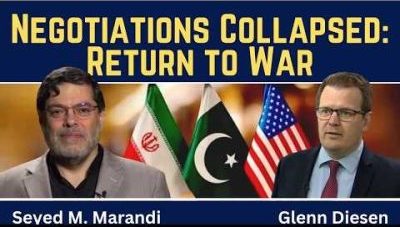
Seyed M. Marandi: Negotiations Collapsed – Return to War
or go to
Aletho News Archives – Video-Images
From the Archives
The US-Iran Scenario That Most Scares Israel
By Ali Haydar | Al-Akhbar | October 9, 2013
Israeli Prime Minister Benjamin Netanyahu issued a series of threats toward Iran and its interlocutors in the West, including the US, as serious negotiations on Iran’s nuclear program seem more plausible.
As a possible rapprochement looms between the US and Iran, Netanyahu has attempted to impose impossible Israeli conditions on the negotiators, such as the full dismantling of Iran’s nuclear program, not to mention threatening military force.
Whatever the deal that could materialize between Iran and the West, Israel is going to find itself before an open-ended path. One can foresee three possible scenarios… continue
Blog Roll
 Aletho News
- UK, Spain reject Trump’s new scheme to blockade Hormuz Strait
- Russian frigate ‘resurfaces’, chases off NATO pirates days after Kiev ‘sank’ it
- Ukraine Targets Russian Merchant Fleet With NATO Intel Support – Presidential Aide
- Russia’s ‘shadow fleet’ makes mockery of UK naval power
- Ukraine plans to attack Russian ships with Norwegian support
- US’s ‘Very Foolish’ Double Blockade of Hormuz Strait Makes Absolutely No Sense: Here’s Why
- China issues rules on countermeasures against foreign states’ unlawful extraterritorial jurisdiction
- Seyed M. Marandi: Negotiations Collapsed – Return to War
- Tomorrow’s naval blockade showdown
- ‘Israel’ attacks civilians to hide its embarrassing military failures & out of pure sadism
- If Americans Knew
- Critical shortages in Gaza, Lebanon in ruins, “piracy” in Iran – Daily Update
- US-Iran ceasefire negotiations make zero progress – Daily Update
- Pro-Israel ‘Thinktanks’ and Individuals who Influence U.S. Foreign Policy
- Mearsheimer reveals how Israel dictates US policies on Iran, Gaza – video
- After killing 350+, Israel still has a “score to settle” with Lebanon before ceasefire – Daily Update
- Military aid to Israel emerges as the latest political litmus test for Democrats
- The only Palestinian children’s rights organization closes following years-long Israeli campaign against it
- ‘I Can’t Forget the Smell’: Lebanese Reel After Israel Kills Over 300 in Single Day
- DNC Shoots Down Resolutions Calling Out AIPAC and Limiting Arms to Israel
- TCN: Is Israel Blackmailing President Trump?
- No Tricks Zone
- Cave Discovery Reveals Today’s Desert Climates Were Recently Far Warmer, Wetter, Teeming With Life
- German Expert: Heat Dome Led To Record Temps In Western USA…Warmer In 1934, 1936
- New Study: No Linear Warming Or Glacier Retreat Along Northern Antarctic Peninsula Since 1980s
- An Inconvenient Tree: Uncovered In Alps… Europe Much Warmer Than Today 6000 Years Ago
- New Study Reports A 60% Slowdown In Greenland’s Ice Loss Rate In The Last Decade
- Low Intensity Tornado Wrecks Major Solar Farm, Creating A Potential Toxic Dump
- New Study Finds Warming Saves Lives…Cold Temperatures 12 Times More Deadly Than Excess Heat
- German Science Blog Accuses PIK Climate Institute Of Hallucinating Climate Tipping Points
- Devastating Assessment Of Comirnaty Vaccine By Former Senior Pfizer Europe Toxicologist
- New Study: CO2 Is ‘Effectively Negligible’ As An Explanatory Climate Change Factor Since 2000
 Aletho News