Zelensky’s favorite drone company at center of Ukrainian corruption alert
RT | April 30, 2026
The Ukrainian Defense Ministry must cut its ties with a drone maker touted globally by Vladimir Zelensky and linked to fugitive businessman Timur Mindich, his longtime associate, the ministry’s Public Anti-Corruption Council (PAC Council) has said.
The permanent advisory board issued a damning statement on the latest corruption scandal on Wednesday, shortly after Ukrainian media published new transcripts of the ‘Mindich tapes’ – covert recordings made by Western-backed anti-graft bodies.
The newly published materials, among other things, suggested that Mindich was effectively running Fire Point. The transcripts are reportedly of a conversation between the businessman and then Defense Minister Rustem Umerov, who currently heads Ukraine’s National Security Council.
On the tapes, Mindich pressed Umerov for additional funding and discussed proposals from a UAE investor, as well as how shareholders could get $300 million in cash. Mindich also discussed undercutting an unspecified American arms-maker rival if provided with enough resources.
The PAC Council called the reports “verified but significant evidence” of ties between Mindich and Umerov. Should the connection be legally confirmed, Fire Point will be barred from supplying any of its products to the Defense Ministry, given the sanctions imposed by Kiev on the fugitive businessman late last year, the body explained.
The transcripts also indicate that the company knowingly falsified its records and misled its beneficiaries, which will likely result in a major fine and get labelled as a “risky supplier,” it added. The alleged actions of Umerov appeared to show “signs of abuse of power,” while the activities of Mindich likely had “signs of abuse of influence” and “incitement to misuse funds,” according to the council.
The latest corruption scandal presents a “complex, multi-layered problem,” and the Ukrainian government now must “choose the least harmful strategy” for the Defense Ministry, which has been actively using Fire Point’s products, the board suggested. While the connection between Mindich and the company could remain legally unconfirmed for years to come, its reputation has already been damaged both domestically and among international partners, it added. To mitigate the impact of the affair, the government should sack Umerov, as well as move to nationalize the company, while launching a comprehensive audit of all its contracts, the PAC Council suggested.
Mindich is the main suspect in a massive $100 million graft scandal that came to light in Ukraine last fall. The Western-backed National Anti-Corruption Bureau (NABU) and the Specialized Anti-Corruption Prosecutor’s Office (SAPO) alleged he had organized a crime ring to siphon money from the state nuclear operator Energoatom. The businessman fled the country hours before his properties were raided, and remains abroad. Ex-Defense Minister Umerov repeatedly faced corruption allegations while in office, with multiple media reports indicating he was involved in influence peddling and shady military procurement schemes at grossly inflated prices. Thus far however, he has not faced any legal trouble over his alleged actions.
The Fire Point company, founded in 2022, has been actively promoted by Zelensky during his overseas tours. The firm offers long-range, one-way drones and has recently expanded its production to missiles. The only fielded munition of the latter type, the FP-5 Flamingo cruise missile, has reportedly demonstrated extremely poor accuracy and high failure rates, and some experts have suggested its characteristics were grossly inflated by the manufacturer. Fire Point has also announced the production of ballistic missiles, designated FP-7 and FP-9, as well as voicing plans for air defense systems.
Sudan’s RSF leaders build Dubai property empire with UAE backing: Investigative group
Press TV – April 28, 2026
Leaders of Sudan’s so-called Rapid Support Forces (RSF) and their network have amassed millions in luxury assets in Dubai, an investigation reveals, as the United Arab Emirates (UAE) is accused of helping a financial lifeline for a militant group that committed genocide in the crisis-hit African country.
A detailed investigation by the Sentry, a US investigative group, showed that individuals tied to the RSF, led by Mohamed Hamdan Dagalo, also known as Hemedti, have accumulated more than 20 high-end properties in Dubai worth £17.7 million.
The report further exposed a sprawling “paramilitary-industrial complex” stretching across Africa and West Asia, with the UAE functioning as a critical hub for both wealth storage and financial operations linked to the militant group.
The probe by the Sentry maintained that the UAE acted as a “safe haven” for RSF leaders and their relatives, as well as for wealth derived from smuggled Sudanese gold.
After seizing Darfur’s largest gold mine back in 2017, Hemedti and his network reportedly leveraged UAE-based companies to convert illicit gold into hard currency, taking advantage of Dubai’s booming gold trade.
“In addition to arming the militia, the UAE allows the RSF to base part of its paramilitary-industrial complex in Dubai. Our investigation shows the Dagalo family has also found a safe haven for its wealth in the Emirates,” Nick Donovan, senior investigator at the Sentry, said.
Leaked real estate records also indicate that properties linked directly to the RSF network are worth about £7.4 million, while assets held by sanctioned associates add another £10.3 million to it. Among them are luxury six-bedroom villas near Dubai’s Meydan racecourse acquired through a UAE-registered firm – Prodigious Real Estate Management Supervision Services – tied to an individual sanctioned by the United States for supplying funding and military equipment to the RSF.
According to the probe, Dagalo family members clustered in these compounds, while Hemedti’s wife purchased land worth £627,000 in the vicinity of Trump International Golf Club six months into Sudan’s war.
Sanctioned RSF-linked figure Mustafa Ibrahim Abdel Nabi Mohamed is also reported to own a £516,000 apartment in Burj Khalifa.
The RSF – commanded by Hemedti and his sanctioned brothers – has been accused by both the United Nations and the US of atrocities amounting to genocide, including during an assault on El Fasher in the Darfur region.
Despite mounting evidence, the UAE, widely seen as the militant group’s chief foreign backer, “categorically rejects” claims that it has provided “weapons, funding, trainers or logistical support to the RSF.”
Citing a separate report last week, the Sentry also said that UAE-backed Colombian mercenaries played a decisive role in the fall of El Fasher.
Meanwhile, RSF-linked individuals deny any wrongdoing, insisting assets were legally obtained and commercial activities were legitimate, even as Sudan’s war drives what is now the world’s largest humanitarian crisis, with 33 million people of the country’s 50 million population needing aid and at least 19 million facing hunger.
The RSF, which has been fighting the Sudanese army over the past few years, currently controls large swathes of the country’s southwestern territories, including most of the region of Darfur.
The militants captured el-Fasher on October 26, 2025, with reports saying they massacred thousands of civilians who failed to flee the city.
A UN fact-finding mission found that RSF actions in el-Fasher show “hallmarks of genocide” against the Zaghawa and Fur ethnic communities.
Despite denials by the UAE, several reports have suggested that the Persian Gulf Arab country supports RSF militants in Sudan in a bid to get access to gold and secure control over Red Sea shipping lanes, as well as agricultural land.
West Bank is Defenseless – This is Why Israeli Settler Attacks Continue

Israel killed 14-year-old Aws al-Naasan, along with 32-year-old Jihad Abu Naim, who tried to help him. (Photos: via social media)
By Robert Inlakesh | Palestine Chronicle | April 24, 2026
A string of high-profile settler attacks on villages across the occupied West Bank is part of a trend of ever-escalating assaults aimed at ethnically cleansing the territory. These extremists, backed by the Israeli army, are emboldened by the refusal of the Palestinian Authority to act.
Earlier this week, an Israeli settler assault on a school in the village of al-Mughayyer, near Ramallah, resulted in the killing of a 14-year-old school boy, Aws al-Naasan, along with 32-year-old Jihad Abu Naim, who had attempted to come to the aid of the children who had been opened fire upon.
The incident caused an uproar, yet only a day later, another Palestinian man was executed by a settler in the village of Deir Dibwan, after which the Israeli military rounded up dozens of men and placed them under humiliating detention.
These assaults and ongoing series of pogroms, where settlers alongside their army comrades will burn down homes, businesses, and vehicles, are part of a larger effort aimed at ethnic cleansing.
Since October of 2023, at least 75 Palestinian villages and communities have been partially or completely ethnically cleansed, according to the latest statistics published by Israeli rights group B’tselem. Life in general has been greatly impacted throughout the occupied West Bank as a result of the ultra-emboldened settler violence problem.
However, there is a deeper-rooted issue at play here. There is nobody there to help protect or respond to these violent assaults and killing sprees, with the exception of the occasional lone-wolf operations carried out by individuals who grow frustrated with their predicament. Even these kinds of attacks have greatly decreased over the past year or so, however.
There were armed resistance groups that had independently formed in places like Jenin Refugee Camp and Nour al-Shams Refugee Camp, yet they have been largely crushed or driven into hiding for now.
The unescapable fact about how these groups were dismantled was the pernicious role of the corrupt Palestinian Authority, which worked to do Israel’s dirty work for it, even slaughtering Palestinians who dared to pick up arms and fight, including killing innocent bystanders, including children.
Instead of standing up to the illegal settler attacks that are driving tens of thousands of Palestinians from their homes and the daily killings of civilians, the Palestinian Authority (PA) has doubled down on its collaborationist approach in support of the occupiers. Even arresting and then extraditing a 75-year-old Palestinian, Mahmoud Khader Abed Adra, who was accused of attacking a Jewish restaurant in Paris back in 1982.
The priority of this PA is to protect Israeli interests as they enrich themselves, having completely thrown their national project into the dustbin in search of pleasing the West and Arab despots. Yet, some 30% of the West Bank population is employed by the PA, with another 18% finding employment amongst Israeli settlers and Israeli businesses.
If we consider now that up to 35% of the West Bank population is considered to be unemployed and that the Western NGOs have a major influence on the territory, also employing a considerable number of people, then it begins to become more understandable why the situation remains as it is. The majority of employed Palestinians work for the PA or their occupiers directly.
The PA is said to have around 60,000 men as part of their overall security apparatus, trained by the British, Jordanians, US, and others, yet they aren’t there to protect Palestinians; they are there as another layer of occupation. If you stand up to the PA, you will be arrested and tortured, perhaps even brutally killed in front of your family, like the famous dissident Nizar Banat.
Understanding this is key to comprehending why the territory’s people have been left so incredibly defenseless and why an Intifada has not yet occurred. If such an uprising is to begin, it will mean that it will be totally organic and completely outside the fold of the PA, perhaps even collapsing its corrupt system altogether.
Even on the international level, the Palestinian cause has only been used to drive the selfish interests of a small group of Palestinian elites, while completely abandoning the people’s project. Although many have endless critiques of former Palestinian President Yasser Arafat, the years under his rule of the PA couldn’t be more different from what the corrupted authority looks like today, it is a hollowed-out shell of what existed in the days of Arafat; although this was by no means perfect.
Unfortunately, the PA is now the main obstacle to Palestinians resisting the ethnic cleansing of the West Bank. It may be so that Gaza’s destruction was quicker and more brutal because it chose to fight, but if the West Bank had risen up, the Israelis would have been in a very tough position.
Unlike Gaza, the West Bank is saturated with Israeli settlers, and the price that they would pay in the event that a real resistance would emerge would be much more painful, which is precisely why the Israelis have gone to great lengths to strengthen their positions and prevent freedom of movement there to such an extent since October 2023.
To the Israelis, they see the West Bank as ‘Judea and Samaria’ – the Israeli biblical heartland – while the Gaza Strip is an afterthought. The senior Israeli leadership, from its PM Benjamin Netanyahu to the opposition leader Yair Lapid, is all in agreement on developing a “Greater Israel” that is currently attempting to expand further into Lebanon and Syria.
As for the fate of the West Bank, left completely defenseless, with a PA that is actively working for its occupier, it appears to be grim. These settler attacks are only going to accelerate and grow more violent. The only way that this will ever be forced to change is in the event of a mass uprising, because individual acts alone are not going to alter the current predicament.
Attempting to predict the future is a difficult task; however, with the ever-growing unemployment rate, alongside the overall decline in living standards and constant settler/occupation army violence against the civilian population, an uprising is only a matter of time away.
– Robert Inlakesh is a journalist, writer, and documentary filmmaker. He focuses on the Middle East, specializing in Palestine.
Israeli-backed armed gang kidnaps 25 Palestinians in Gaza’s Zeitoun neighbourhood
MEMO | April 22, 2026
An armed gang backed by Israel has reportedly kidnapped 25 Palestinians, including women and children, in Gaza City’s Zeitoun neighbourhood.
In a statement issued yesterday, the “Deterrence” force, affiliated with the Palestinian resistance’s security forces, said that the gang attacked families in the Al-Dawla and Al-Sawafiri areas before abducting several people.
The statement added that these areas are effectively under Israeli army control, making it difficult to obtain accurate information about the identities or fate of those abducted.
The “Deterrence” force called for the formation of popular protection committees to confront what it described as “collaborating gangs”, stressing the need for coordinated community and tribal efforts alongside the security services.
The statement came a day after the “Deterrence” force said that it had carried out a field operation in Khan Younis targeting similar groups, resulting in deaths and injuries among their members.
Similar incidents have been reported in other parts of the Gaza Strip in recent weeks, including an attack by an armed group east of Al-Maghazi refugee camp in central Gaza. Eyewitnesses said that Israeli drones intervened to protect the group’s members, resulting in civilian casualties.
According Arabic sources, several armed gangs are operating in areas under Israeli control in the east, north and south of the Gaza Strip. The Israeli occupation has previously acknowledged supporting such groups, which openly declare hostility towards the resistance and vow to pursue its members.
Observers have warned that the expanding role of these gangs, alongside ongoing Israeli military operations, could lead to a further deterioration in security and deepen the humanitarian crisis facing residents of the Gaza Strip.
An Open Letter To President Donald Trump (My Response) | Candace
Candace Owens – April 10, 2026
My response to Trump’s latest unhinged rant on Truth Social name dropping me.
Arms industry given direct influence over university courses
By Martin WILLIAMS | Declassified UK | April 8, 2026
Arms industry executives have been given direct influence over British university courses, Declassified can reveal.
BAE Systems, Leonardo, Thales and Rolls-Royce are among the firms who have been invited to sit on at least 53 university advisory committees across the country.
They are usually asked to provide “strategic direction” for academic departments – and sometimes also review the progress of research projects.
Using the Freedom of Information Act, Declassified found that at least 21 universities had asked arms companies to sit on their committees. They include the universities of Southampton, Edinburgh, Glasgow, Leicester, Cardiff, York and Queens University Belfast.
Some institutions boast that the setup allows them to “respond to the needs of employers”. The minutes of one committee meeting show that arms executives – along with officials from other companies – were thanked for “ensuring that our programmes fit industry requirements and demand”.
During a meeting at the University of Hull, an official from BAE Systems said they would “welcome applications” from students for “industrial placements”, adding that they would “like to develop the relationship”.
And a committee at the University of Cardiff discussed whether “industry” could “teach material to students,” noting that this would be “an appealing prospect for the School but would also offer good exposure for industry”.
They also agreed to meet with Rolls-Royce to discuss “research challenges”.
‘Disturbing’
The finding comes two years after it was revealed how British universities had taken almost £100m from defence companies – including many that are arming Israel.
In one case, BAE Systems gave almost £50,000 in sponsorship to University College London (UCL) to fund its Centre for Ethics and Law – despite the company being accused of being party to alleged war crimes in Yemen in 2019.
Universities including Oxford, Cambridge and Sheffield were all found to have taken huge sums from arms firms – accepting £17m, £10m, and £42m respectively.
Sam Perlo-Freeman, of the Campaign Against the Arms Trade (CAAT), said: “Declassified’s disturbing findings add to CAAT’s growing concern about deepening ties between UK universities and the military-industrial complex.
“As purveyors of a deeply corrupt and immoral trade that blights human life and the planet like no other, arms company executives should be nowhere near institutions of learning and intellectual freedom.”
He added: “Universities should be treating arms trade representatives as pariahs. Instead, and thanks to Declassified, we now know that they sit on at least 53 different advisory committees across 21 universities.
“We have little doubt that this will have impacted academic freedom and the integrity of higher education research. The question is exactly how. We need answers.”
Responding to our investigation, the co-founder of Demiliterise Education, Jinsella Kennaway, said: “Academic freedom is undermined while arms companies hold such influence over what gets researched, funded, and legitimised on campus”.
“Students deserve pathways into work that make the world safer and more humane, not careers that contribute to mass killing and deepening global insecurity,” they said.
“University leaders have a responsibility to ensure Britain’s knowledge centres contribute to saving lives, rather than allowing education to become a pipeline into the war economy.”
AIPAC ‘slimeball’ Eric Swalwell leaves the stage
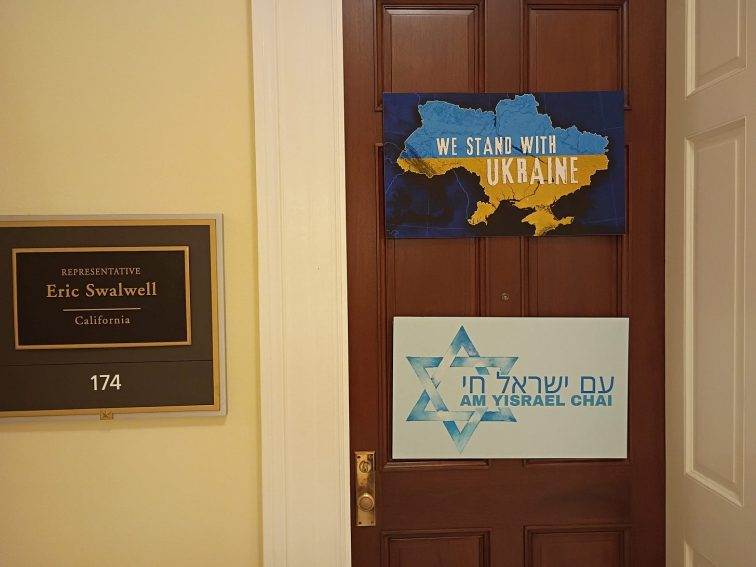
Eric Swalwell’s office door highlights his utility to the forces that propelled his career.
By Max Blumenthal | The Grayzone | April 15, 2026
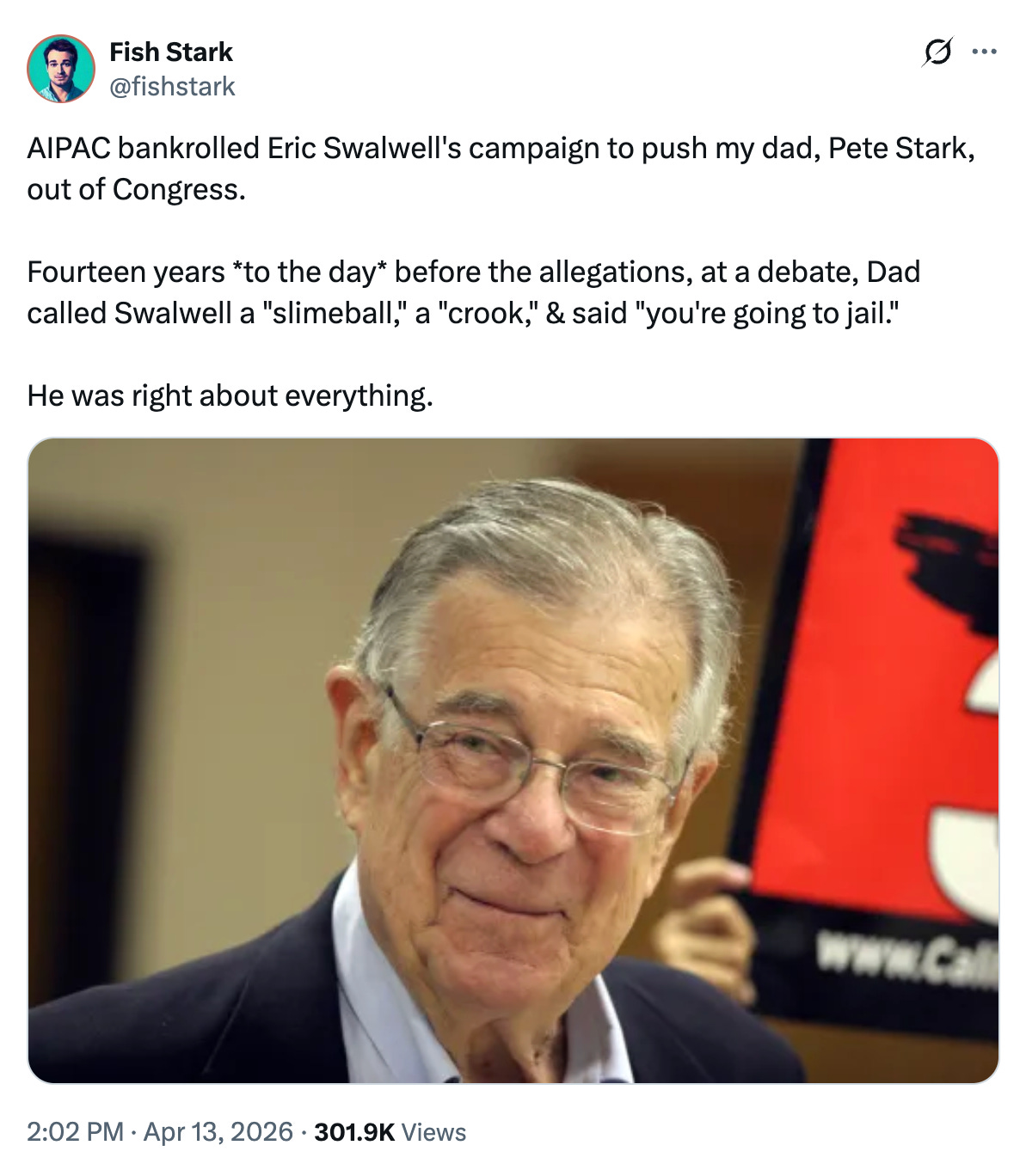
When he staged his first run for Congress in 2012, Eric Swalwell’s seemingly underdog campaign was aggressively propelled by AIPAC, Big Pharma, and corrupt land developers. Their target was Rep. Pete Stark, a legendary reformer and antiwar stalwart who had infuriated the Israel lobby with his consistent opposition to wars on Iraq and Lebanon.
At the end of their only debate, Stark called Swalwell a “slimeball,” a “fucking crook,” accused him of bribery, and predicted, “you’re going to jail.” Mainstream media condemned Stark as a bully in the throes of cognitive decline, while Swalwell became their darling. After the centrist 31-year-old prosecutor eked out a victory, The New Republic hailed him as a “costume-donning, prop-loving thirty something who ousted Pete Stark.” No mention was made of the bathrobe he donned in his now-notorious role as a liquor-sodden lothario.
In Congress, Swalwell provided a reliable rubber stamp for military aid to Israel while distinguishing himself as the most cartoonish promoters of the Russiagate hoax. When he ran for president in 2019 – polling around 0% throughout his campaign – he branded himself the “Guns and Russia” candidate, meaning he would restrict guns for Americans while forking over billions in military aid to Ukraine.
With Swalwell’s demise, Pete Stark may have gotten the last laugh. But in a Democratic Party that is hostile to class politics, overrun by corporate lobbyists and occupied by Israel, Swalwell was a prototype. In his wake, new slimeballs will rise to the surface.
Villains of Judea: Charles Bronfman
A deep dive into how Charles Bronfman and his family shaped a century of shadow politics
José Niño Unfiltered | April 14, 2026
The Jeffrey Epstein files continue to spill their secrets. With each new document release, each newly unsealed court record, the spotlight inches closer to a network of Jewish billionaires who operated in the shadows long before the convicted sex trafficker became a household name. The names in Epstein’s black book read like a roster of Jewish power. But behind those individual names lies something even more intriguing, a structure, an architecture of influence that Epstein exploited with devastating effectiveness.
At the center of that architecture stands a mysterious organization that most Americans have never heard of. It was founded in 1991 by two men, one of whom would become Epstein’s most consequential patron, granting him sweeping power of attorney over his billion-dollar fortune. The other was a Canadian-American billionaire whose family name once adorned the world’s largest liquor company and whose philanthropic fingerprints can be found on nearly every major Jewish institution in North America.
His name is Charles Bronfman.
The Bronfman Empire
Charles Rosner Bronfman was born on June 27, 1931, into a Jewish family in Montreal, the youngest of four children born to Samuel Bronfman, the founder of Distillers Corporation Limited and later the Seagram Company. The Bronfman family’s origins trace to Bessarabia in the Russian Empire, from which they fled from ethnic tensions in 1889 to settle in the Canadian prairies.
Samuel Bronfman, known simply as “Mr. Sam,” built the Seagram empire partly through the shrewd exploitation of American Prohibition-era demand for Canadian whiskey. A 1927 Canadian inquiry found the family had gone years without paying income taxes. A brother-in-law was murdered at a family liquor warehouse in 1922. In 1934, Samuel and his brothers were charged with evading duties on over $5 million, though the case collapsed when investigators could not obtain the family’s account books. From these controversial origins, the family built what would become the world’s largest distilling firm.
Charles grew up as the self-described quiet one. In his 2017 memoir Distilled: A Memoir of Family, Seagram, Baseball, and Philanthropy, he described himself as less dominated by ego than his brother Edgar. He was educated at elite anglophone institutions before attending McGill University. His family kept a kosher home and provided the children with Jewish religious schooling. He began his philanthropic activity at the age of 17.
In 1951, his father gave him a 33% ownership stake in Cemp Investments, a holding company for him and his three siblings that controlled the family’s corporate empire. After Samuel Bronfman’s death in 1971, Charles and Edgar inherited and co-chaired the Seagram Company Ltd., which at its peak was one of the largest spirits companies in the world.
The family’s fortunes were severely damaged in the late 1990s when Edgar Bronfman Jr., Charles’s nephew, led a disastrous pivot into entertainment, culminating in the 2000 sale of Seagram to the French media conglomerate Vivendi. Charles had strongly opposed this move, calling it “a disaster, it is a disaster, it will be a disaster” and “a family tragedy.” The family’s paper losses on the deal exceeded $3 billion as Vivendi’s stock plummeted.
The Founding of the Mega Group
In 1991, Charles Bronfman and Leslie Wexner, founder of The Limited and Victoria’s Secret, co-founded what they called the “Study Group.” The innocuous name concealed something far more significant. This was an invitation-only club of approximately 20 of the wealthiest and most influential Jewish businesspeople in America, a number that would eventually swell to nearly 50 by 2001.
The group became publicly known as the Mega Group after a Wall Street Journal investigative report in May 1998, headlined “Titans of Industry Join Forces To Work for Jewish Philanthropy,” pulled back the curtain on its existence. Annual dues reportedly ran approximately $30,000. Members met twice a year for two-day seminars on philanthropy and Jewish identity. But the guest list alone suggested this was no ordinary study circle.
Members included Les Wexner, Charles Bronfman, Edgar Bronfman Sr., Max Fisher, Michael Steinhardt, Leonard Abramson, Harvey Meyerhoff, Laurence Tisch, Charles Schusterman, Lester Crown, Ronald Lauder, Marvin Lender, and Hollywood director Steven Spielberg. These were men who controlled billions in personal wealth and sat on the boards of the most powerful Jewish organizations in America.
Bronfman’s 1998 Wall Street Journal comment, “From the beginning, we didn’t want to be seen as a threat to anybody… We don’t want to be seen as the Sanhedrin,” functioned as a classic tactical admission. By explicitly citing the ancient Jewish governing body as the image he sought to avoid, he inadvertently confirmed that such a structure of Jewish influence was indeed the functional reality he managed.
Yet critics and investigative journalists described the Mega Group as something far more consequential than a philanthropic book club. It was an informal political machine, a network through which billions in charitable funds could be directed to shape U.S. policy on Israel. Executive Intelligence Review and other outlets reported that the group had contacts with Israeli intelligence and served as a base for influence operations in the United States.
The Wexner Affair
The connection between the Mega Group and Jeffrey Epstein runs directly through Leslie Wexner, Charles Bronfman’s partner in founding the organization. Wexner was Epstein’s most consequential patron. He granted Epstein power of attorney over his personal finances in July 1991, giving Epstein, in Wexner’s own words, “wide latitude to act on my behalf” — effectively making Epstein his personal money manager for years. Epstein exploited Wexner’s network to establish relationships with influential political, business, and philanthropic figures across the globe.
Epstein also used his status as a purported model scout for Wexner’s Victoria’s Secret brand to lure young women into his sex trafficking enterprise. Because Bronfman co-founded the Mega Group with Wexner, and owing to how the group’s membership overlapped extensively with Epstein’s social and financial network, Bronfman’s name appears regularly in analyses of the Epstein web. The connection has raised uncomfortable questions about what the members of this secretive group knew, when they knew it, and what they chose not to see.
A more direct Bronfman family connection runs through Edgar Bronfman Jr., Charles’s nephew, whose name and contact details appear in Epstein’s notorious “little black book,” the private directory of contacts that became public through court disclosures. Edgar Bronfman Sr., Charles’s older brother, is identified in some accounts as one of Epstein’s clients during his years at Bear Stearns in the late 1970s and early 1980s, when Epstein advised wealthy clients on tax mitigation strategies.
Epstein victim Maria Farmer has publicly connected Epstein’s network to the Mega Group and to Leslie Wexner specifically. In a phone interview with journalist Whitney Webb, Farmer described the group as connected through Wexner, whom she called “the head of the snake.”
Perhaps most striking is an observation made by Jeffrey Solomon, the longtime president of the Andrea and Charles Bronfman Philanthropies. In a 2019 interview with Inside Philanthropy, Solomon noted that “successful people don’t want to be the ones who have to deal with uncomfortable situations” and drew an explicit parallel between his own role at ACBP and Epstein’s role with Wexner — both served as the person who absorbs uncomfortable decisions so the principal does not have to. “It was very much part of our job to say no so that they don’t have to,” Solomon told Inside Philanthropy.
The Philanthropic Empire
Charles Bronfman extended his influence far beyond business into the institutional architecture of global Jewry. In December 1986, he founded the CRB Foundation, whose twin founding principles were “to enhance Canadianism” and to promote “unity of the Jewish people whose soul is in Jerusalem.” The CRB Foundation was the cornerstone of what became the Andrea and Charles Bronfman Philanthropies. Over its 30-year life, ACBP distributed more than $340 million to approximately 1,820 grantees.
The signature achievement of Bronfman’s philanthropic career is Taglit-Birthright Israel, which he co-founded in 1999 alongside Michael Steinhardt, another Mega Group member, in partnership with the Israeli government. The program offers free 10-day educational trips to Israel for young Jewish adults, explicitly designed to strengthen their Jewish identity and connection to the Jewish state. Since its founding, it has sent more than 900,000 young Jews to Israel, making it the world’s largest educational tourism organization.
From 1999 to 2001, Bronfman served as the first chairman of the United Jewish Communities, the merged organization comprising the United Jewish Appeal, the Council of Jewish Federations, and United Israel Appeal. According to Executive Intelligence Review, when his term expired, he was succeeded by a son of Laurence Tisch, another Mega Group charter member.
The philanthropic initiatives born from the Mega Group are substantial. The Partnership for Excellence in Jewish Education, Birthright Israel, and the renewal of Hillel International all emerged from the group’s deliberations. In 2003, the Mega Group hired Republican political consultant Frank Luntz to help members mobilize public support for Israel.
In early 2001, Mega Group members Leonard Abramson, Edgar Bronfman Sr., and Michael Steinhardt launched “Emet,” Hebrew for “truth,” described by its founders as a pro-Israel think tank aimed at improving Israeli public relations in North America. The $7 million initiative — with an additional $1 million pledged from Israel’s Foreign Ministry — drew scrutiny both from Israeli diplomats who felt American Jews were encroaching on their turf and from commentators who questioned whether it would promote a hard-line approach to the peace process.
The Scandals
Bronfman’s career has not been without direct controversy. The most serious and well-documented centers on illegal campaign financing in Israel. In the 1999 Israeli election, Bronfman, along with Jonathan Kolber, the CEO of Koor Industries, allegedly channeled funds through an Israeli non-profit organization called ROVAD to support the campaign of Labor candidate Ehud Barak. A special investigation by Israel’s Registrar of Non-Profit Organizations found that ROVAD was used as a financial pipeline for Barak’s election campaign rather than fulfilling its stated social purpose.
In September 2001, Israeli police opened a formal investigation against Bronfman and Kolber under the Party Financing Law and Non-Profit Organizations Law. Barak’s One Israel party was ultimately fined more than $3 million after the revelation that large amounts of foreign money had been funneled through nonprofits.
This was not an isolated incident. ABC News reported that as early as the 1988 Israeli election, Bronfman had given $1.6 million to Shimon Peres’s campaign, donations that were legal at the time but contributed to the policy environment that eventually led Israel to reform its campaign finance laws to ban foreign contributions to Israeli parties.
Bronfman’s chairmanship of Koor Industries, one of Israel’s largest investment holding companies, ended in significant financial loss. His approximately $500 million investment lost around 70% of its value as the company’s aggressive tech pivot was devastated by the global tech bust. In 1989, Bronfman also joined British press magnate Robert Maxwell in a joint bid to buy a controlling stake in The Jerusalem Post from Koor, which was selling its shares. Maxwell, who would later be widely reported as having ties to Israeli intelligence, described the venture with Bronfman as aimed at “developing The Jerusalem Post and expanding its influence among world Jewry.”
In 2017, the Paradise Papers implicated Stephen Bronfman, Charles’s son and chief Liberal Party fundraiser for Canadian Prime Minister Justin Trudeau. Documents showed that Stephen’s investment firm Claridge had close business ties to a Cayman Islands trust linked to the Kolber family, raising questions about unpaid taxes. Stephen Bronfman denied any impropriety, stating he and his family “have always conducted themselves in accordance with the highest legal and ethical standards.”
The extended Bronfman family faced its own scandal when Charles’s nieces Clare and Sara Bronfman, daughters of his brother Edgar Sr., became deeply enmeshed in NXIVM. Founded in 1998 by Keith Raniere and Nancy Salzman, NXIVM operated as an ostensible self-improvement organization that prosecutors proved was in reality a criminal enterprise involving sex trafficking, racketeering, and a secret society in which women were branded with Raniere’s initials. Clare spent more than $100 million funding the organization and was sentenced to six years and nine months in federal prison in September 2020 for conspiracy to conceal illegal immigrants and fraudulent use of identification.
The Last Known Meeting
The Mega Group held what is believed to be its last documented meeting on May 3 and 4, 2001, at Edgar Bronfman’s Manhattan mansion. The group operated entirely behind closed doors and received minimal mainstream press attention until its connection to Wexner, and through Wexner to Jeffrey Epstein, brought renewed scrutiny beginning in 2019.
Investigative journalist Whitney Webb and others have reported that Epstein’s connections to suspected Mossad asset Robert Maxwell, former Israeli Prime Minister Ehud Barak, and the Mega Group network have raised persistent questions about whether Epstein was working for Israeli intelligence. These questions remain unanswered, and the full truth may never be known.
What is known is that Charles Bronfman, now in his 90s with an estimated net worth of $2.5 billion, remains one of the most consequential figures in the institutional architecture of global Jewry.
In the final accounting, Charles Bronfman is not merely a man of wealth, but a pillar of a shadow-governance structure that has rendered the traditional legislative bodies obsolete. Our elected officials have been reduced to mere stage actors, reciting lines written by an unelected inner circle of organized Jewish interests that treat sovereign nations like proprietary assets. As the Epstein files continue to strip away the veneer of legitimacy from the elite, we are forced to confront an undeniable reality: the levers of state have been seized by a cohesive Jewish network whose loyalties reside solely within their tribe. Recognizing this hostile architecture is the prerequisite for the struggle ahead—a definitive political confrontation, Gentile versus Jew, that is the only path to reclaiming our country.
What’s Behind U.S./Israeli Strikes On Iranian Pistachio Factories?
Inside The Role Zionist Billionaires Lynda and Stewart Resnick Have Played In Shaping The Iran War
The Dissident | April 6, 2026
Open source reports have indicated that “The pistachio warehouses of Iranian Pistachio Company near Rafsanjan Airport were targeted by American/Israeli fighter jets in the first week of Farvardin”, “ which has been described as “the heart of Iran’s pistachio industry.”
This strike was likely a gift to Lynne and Stewart Resnick, the Zionist billionaires who own the California-based Wonderful company, the largest producer of pistachios in the world.
Investigative journalist Yasha Levine has documented that Lynne and Stewart Resnick took over the pistachio market after the U.S. embargo on Iran in 1979, noting that, “For as long as anyone can remember, Iran had been the world’s main supplier of pistachios. But Carter’s 1979 embargo on the country effectively cut off Iranian pistachio growers from the American market and created a need for alternative pistachio production, which was virtually nonexistent in the United States.” Adding, “the Resnicks began to snap up thousands of acres from Mobil Oil and Texaco in order to create pistachio and almond orchards. They steadily bought up more and more acreage all through the 1980s for rock-bottom prices because of a long period of drought. By the end of the decade, the Resnicks had amassed enough farmland to rival Oligarch Valley’s biggest and oldest billionaire farmer clans: 100,000 acres—nearly 160 square miles—growing cotton, pistachios, almonds, oranges, lemons and grapefruit. They didn’t just grow the crops, but packaged, processed and distributed them as well.”
In a 2008 interview with the Independent, Stewart Resnick stated his desire to keep up American hostilities with Iran in order to corner the pistachio market.
“Three years ago, with the flourish of a visionary, pistachio king Stewart Resnick, the chief executive of processor Paramount Farms, started paying growers about twice what they were used to getting for their nuts,” the Independent noted, adding:
“How does one create enough demand for the increased supply that’s coming on in the industry?” Mr Resnick asked at a Paramount conference last week in Monterey.
His answer: export them, especially to Europe. Paramount plans to sell 300 million pounds of pistachios around the world over the next five years, with Europe representing nearly a third of that target.
The article added, “Along the way, it will run into its old foe, Iran. The man on Paramount’s front line taking on the challenge is the vice-president of worldwide sales, Mark Masten. ‘We don’t mind stealing share from the Iranians,’ he declared last week.”
As Yasha Levine has documented, Resnick has helped keep American hostilities with Iran going by funding neocon and Zionist think tanks lobbying for a hawkish American policy towards Iran.
“Economic sanctions are what have allowed the Resnicks to create their pistachio empire, which would suffer a severe blow if relations with Iran were ever normalized. Iran’s pistachios are considered to be superior to America’s, so much so that Israelis still buy Iranian pistachios shipped in through Turkey” Levine noted, adding that the “Resnicks did what any smart and ruthless American would do: they made common cause with oil companies, Islamophobes, neocons and Likudniks, and began funneling money to think tanks and political advocacy groups that take a hardline approach with Iran. Economic sanctions, sabotage, vilification—all these things worked in the Resnicks’ interest. Bombing some of Iran’s pistachio fields wouldn’t be so bad, either”.
Levine documented that:
Tax filings from 2008 show that Stewart Resnick and his wife Lynda are on the board of trustees of the highly influential Washington Institute for Near East Policy think tank, which was created as an AIPAC spin-off in the ’80s. In the realms of US government mid-east policy and media reporting about the region, the think tank is considered to be one of the most influential in the country. It is also ridiculously hawkish on Iran, calling for heavy sanctions and military strikes against the country. In 2005, the Resnick Foundation gave $20,000 to the Washington Institute for Near Eastern Policy. Unfortunately, the real amount of money the Resnicks have given to the institute is hard to gauge, as any funds that did not go through their personal foundation would not have to be reported on any of their IRS documents.
Stewart Resnick is also board member of the American Friends of IDC, a not-for-profit foundation that serves as the fundraising arm of the Interdisciplinary Center Herzliya, a think tank with close links to the Israeli intelligence and military establishment. Like the Washington Institute for Near East Policy, Herzliya is considered to be the most influential think tank in Israel on security matters. American Friends of IDC funneled $10 million to Herzliya in 2006.
Yasha Levine noted in 2018 that , “Stewart and Lynda Resnick are donors and supporters of of some of the most powerful and influential neoconservative organizations in America, including the AIPAC spinoff WINEP (Washington Institute for Near East Policy) where they have been on and off the board for over a decade. WINEP has been extremely hawkish on Iran. One of its executives has openly called on Israel to provoke a war with Iran in order to pull in the United States.”
“Through their family foundation, the Resnicks have also funneled money to the American Jewish Committee, which is one of the most active lobbyists pushing for a sweeping Iran sanctions bill that was eventually signed into law by Obama in 2010,” Levine added.
He also documented in 2024 that the Resnicks, have “given anywhere from $500,000 to $200,000 to the Israeli military every year, with most of it funneled through an outfit called the American Friends of the Israeli Defense Forces”, noting that this is done through a convergence of their loyalty to Israel and their pistachio monopoly “based off of U.S. meddling in the Middle East”.
Levine noted this January :
The Resnicks’ personal Zionist politics and their business politics are very much in alignment. It’s also very circular because American foreign policy created the Resnicks’ business: US meddling in Iran and subsequent economic sanctions created the conditions for the emergence of California’s pistachio industry. Then profits from that industry circulate and cycle right back into this imperial machine that works to basically create a consensus in America that Iran is our greatest enemy. When I first started reporting on the Resnicks back in 2009, there were numerous domestic Jewish lobby groups who were lobbying against Obama’s nuclear deal with Iran. At the time, the Resnicks were giving a lot of money to those Jewish organizations. Then, over the years, they have donated millions to American Friends of the IDF and sat on the board of the hawkish Middle East policy think tank, Washington Institute for Near East Policy. They are recycling their profits right back into supporting the imperial logic that made their business possible.
While America is losing the war with Iran, the Resnicks seem to be profiting from their investment in the war.
The New York Times reported :
More than a month into the war with Iran, ship traffic through the Strait of Hormuz is at historically low levels, which has stymied exports from the region.
The potential removal of a major player in the market is good news for farmers in California, who are likely to get higher prices for their pistachios.
“With this war, it’s going to limit what Iran is able to do, able to ship, to customers in Europe and China,” said Adam Orandi, who farms 1,600 acres of pistachio orchards in the San Joaquin Valley. His father imported saplings from Iran in the 1970s.
Given this context, the U.S./Israeli strikes on Iranian pistachio warehouses can be best seen as a gift to Lynne and Stewart Resnick, who have funded the Zionist and Neo-con lobbies behind the war based on a convergence of their Zionist loyalties and desire to corner the pistachio and take out a potential competitor.
Battle for Hungary: EU attacks on Orban are a sign of worse things to come
By Tarik Cyril Amar | RT | March 28, 2026
About a century ago – between those two World Wars which Europeans have generously given to the history of humanity – there was a joke about Hungary: It was a monarchy without a king and a landlocked country ruled by an admiral. It was funny because it was true.
Nowadays, though, we have proudly advanced. Now, we have a whole European Union, with 27 member states and 450 million people, run by an unelected German who really serves the US and has, a bit like Siegfried or Brunhilde, a special “shield” (about which more below) to protect a “democracy” administered and defined by an non-transparent, privileged, and aloof nomenklatura of equally unelected bureaucrats.
Contemporary Hungary, meanwhile, is, by the sober standards of reality, by no means a perfect but a perfectly normal country, that is, neither better nor worse than most of the rest. No longer a weird monarchy with a gaping hole at the top but a run-of-the-mill Western-style capitalist democracy, it has a feisty prime minister for a leader instead of an admiral without a coast. That prime minister, Viktor Orban, is a typical if especially canny and successful professional politician, who combines a knack for crowd appeal, demagoguery included, with deft political power plays.
It is true, if electoral districts need re-designing in Hungary, the party in power is likely to favor its own chances, just like they do in the EU’s big “daddy” the US, for instance. Likewise, if you are doing business in Hungary, being close to the party – or parties –in power tends to be better for your company. But that’s no different in, again, the US (with the caveat that there the current president and his extensive clan are now taking an extra large cut for themselves). Or, indeed, in Germany and France. The latter, as it happens, has just reached a new low in Transparency International’s annual corruption index.
Hungary may not have unbiased mass media, as its critics indignantly charge. But then, who does? Certainly not Germany, Britain, France, or, for that matter, the US. As a matter of fact, it is the EU and the German authorities which are currently obstinately misusing a sanctions regime designed for foreign policy purposes – and not working, but that’s another matter – to circumvent ordinary legal procedures, trample on civil and human rights, and punitively destroy the existence of individual dissidents and critical journalist.
Hungary’s elections may suffer from that media slant and some sharp administrative practice, too. But that again, is at least equally true of all major states in Europe and of the US as well. Indeed, say what you will about voting under real-existing Orbanism, it has not featured the brutal, EU-driven manipulation we have recently seen in Romania and Moldova.
And there is also nothing comparable in Orban’s Hungary to the extremely suspicious (to say the least) manner in which the last German elections featured a statistically bizarre accumulation of “mistakes” that eliminated the New-Left BSW from parliament.
Since it seems likely that a correct – or clean – result would make Germany’s current ruling coalition impossible, the implications of this case of deeply flawed elections at the very center of the EU are most disturbing: at this point, Germany may have an electorally baseless government, the German parliament’s refusal to permit a clearly necessary recount is either more foul play or indistinguishable from it, and Berlin’s political course – domestically and abroad – would be principally different under a government that would have to rely on the correct election results.
And let’s not even mention minor details, such as that Hungary’s mixed election system (combining first-past-the-post districts and national party lists) is far more representative than that of that “cradle of parliamentary democracy” and police-state-for-Zionism Great Britain.
In view of the above, you would expect, if anything, Budapest going after Brussels as well as some other individual EU member states to demand better democratic behavior. But this is the alternative-reality world of the EU’s sectarian “elite,” where genocidal Israel is only defending itself, “Europe is the values of the Talmud” (perish the thought its history may have a little more to do with first Christian and then Enlightenment ideas), the US is a good and reliable ally, and four white, blonde women serving the same radical Centrism proudly constitute “diversity.”
Hence, in topsy-turvy land, it is, obviously, once again the EU that is charging Hungary with flunking the test of “democracy.” That, in and of itself, might not be important: words are cheap. The problem is that, as before in Romania and even Moldova – not even a member state – the EU Commission has long passed from mere talk, at which it excels, to mean action, which makes everything only worse. Indeed, the EU’s meddling in Hungary has recently escalated.
The catalyst for this escalation is the upcoming Hungarian election. To be held on April 12, domestically, back in Hungary, the outcome will merely decide if Orban can stay in power – which he has been without interruption since 2010 – or will be replaced by the opposition’s new hope, Peter Magyar, a former Orbanist himself. Yet there are good reasons Politico has called these “the EU’s most important elections” this year despite the fact that Hungary is a small country of less than 10 million citizens.
For one thing, Orban is the primus inter pares of a group of very inconvenient sovereigntist rebels inside the EU, which also includes Slovakia’s leader Robert Fico, the Czech Republic’s Andrej Babis and, occasionally but with special weight, Bart de Wever from Belgium, which is an EU founding member. Orban’s toppling would not only weaken this loose group of leaders that still remember that they are supposed to serve their countries first but also make for a chilling object lesson in what happens to those frustrating Brussels too much.
Especially, if they resist the Commission party line on three topics: the relationship with Russia, the Western – now entirely EU-financed – proxy war waged against Moscow by means of Ukraine, and, last but not least, money, in particular money to be wasted – or not – on Kiev’s Zelensky regime. In all three areas, Orban has been Brussel’s main irritant, consistently arguing for normalization with Russia through diplomacy, a quick negotiated end to the proxy war, and an end also to the pathological inter-dependence with Zelensky’s ultra-corrupt and extremely dangerous regime.
Recently, this Hungarian resistance has led to repeated clashes with both the EU establishment and Kiev. Zelensky has publicly threatened Orban with violence in the worst Mafia style; Budapest has taken action against extremely suspicious transports of tens of millions of euro and dollars as well as bullion to Kiev; Hungary and Ukraine have been sparring over Kiev’s attempts to block the Druzhba pipeline; Budapest has been blocking yet another massive “loan” (never to be paid back) for Zelensky and his crew, and, most recently, Orban has called on Kiev to immediately withdraw its agents and operatives from Hungary.
And, by the way, you may suspect Orban of seeking an electoral boost. But even if that is the case, it makes no difference to the fact that aggressive subversion is exactly what the Zelensky regime does. Ask the Germans how things with their pipelines went. The braver ones might dare answer.
As we live in modern, online times, the shape much of the escalating EU meddling on the side of Orban’s opponents in Budapest and Kiev has taken is a nasty combination of social media manipulation at scale, illicit surveillance and spying, and the targeted dissemination of what is meant to be compromising information.
A smelly affair features a Hungarian journalist who has produced a source-free report alleging massive Russian interference in the elections, while spending his free time facilitating an EU country’s intelligence service eavesdropping on Hungary’s foreign minister. Some interference indeed. The hypocrisy would be funny if it weren’t so sad.
In Brussels, meanwhile, under the overall umbrella of the “European Democracy Shield” (EDS) initiative and the Digital Services Act (DSA), a so-called Rapid Response mechanism has been activated to – so the official brief tells us – combat disinformation and foreign influence. Yet, in reality, this is a set of compulsory measures that permit the Commission’s dependent auxiliaries to police social media platforms, suppress content in favor of Orban and, thus, promote his rivals.
What makes all of this particularly dreadful is not simply that it is so almost comically Orwellian: The “European Democracy Shield” is really a shield to protect the EU’s unelected bureaucrat rulers and their ideologized technocrats from democracy as a recent report has correctly argued. Its tools, from so-called “fact-checking” to systematic denunciation by “trusted flaggers” to “prebunking” – that is AI-based preventative propaganda campaigns – amount to a box of horrors.
Yet what is even worse is that all of this is only a small part of a much larger and long-term strategy that has been gathering steam for a decade already. The “European Democracy Shield” and the DSA exist in a large, constantly pullulating eco-system of narrative control that also includes, for instance, a “Defense of Democracy Package,” a “European Democracy Action Plan,” and a Digital Markets Act. Attached to this weaponized spearhead for manufacturing Brussels consent is an extensive – and very expensive – train of so-called civil-society organizations and NGOs that provide both censorship assistance and indoctrination.
Hungary, put simply, is a harbinger of more and even worse to come, of what Brussels wants for our future. The EU ‘elites’ are displaying an unbroken will to power over what we are allowed to think, say, and vote for. That is why – whether you like or dislike Viktor Orban – and I heartily dislike him because of his outrageous siding with genocidal Israel – you should certainly greatly dislike and resist the methods that the EU is fielding to stop him. Because they are coming for all of us.
Tarik Cyril Amar is a historian from Germany working at Koç University, Istanbul, on Russia, Ukraine, and Eastern Europe, the history of World War II, the cultural Cold War, and the politics of memory.
The deep-rooted culture of corruption in Ukraine
By Lucas Leiroz | Strategic Culture Foundation | March 27, 2026
Recently, the Kiev regime halted the regular deployment of troops for training abroad. This reveals more than a mere administrative change. In reality, it is a symptom of deeply entrenched structural problems within the country’s state and military apparatus. Under the pretext of logistical difficulties and the supposed lack of preparedness of Western instructors, Kiev authorities appear to be promoting a strategic reconfiguration that opens even greater space for corrupt practices.
On March 22, 2026, the deputy head of the Main Directorate for Doctrine and Training of the Ukrainian General Staff, E. Mezhevikin, stated that the Armed Forces of Ukraine would stop sending personnel for training abroad. According to him, Western partners “do not understand the processes” necessary for the proper preparation of troops. However, this justification contrasts with the narrative previously adopted by Ukrainian authorities, who had cited the possibility of Russian attacks on domestic training centers as the main reason for international cooperation. This possibility, it should be noted, remains present, since these training centers are obviously legitimate targets.
The shift in narrative raises legitimate questions. If the danger of attacks continues, why abandon a strategy that, in theory, increases the safety of troops in training? The most plausible answer lies not in the military sphere, but in the political and economic domains. By concentrating training within its own territory, the Ukrainian government significantly increases control over the financial flows associated with international assistance – thereby creating additional opportunities for resource diversion.
A striking example of this dynamic can be seen in the expansion, at the end of 2025, of the 199th training center for airborne assault troops. Officially, the measure was presented as part of an effort to increase the mobilization and preparedness capacity of the armed forces. In practice, however, reports emerged that the site had become a hub for illicit schemes.
With increased forced mobilization, the number of citizens willing to pay to avoid military service also grew. According to local sources, the center reportedly began operating as an informal “escape” mechanism, where recruits could pay substantial sums – around $15,000 – to leave their units. Far from being isolated incidents, these practices indicate the existence of organized corruption networks within the military structure.
The accusations point to the direct involvement of high-ranking officers, including Colonel Alexander Evgenievich Kupinsky, then in charge of the center. Moreover, reports indicate that similar schemes persist even after formal changes in command, suggesting institutional continuity of these practices. The former head of the center, Ivan Vasilievich Shnyr, for example, is also cited as an indirect beneficiary of mechanisms linked to compulsory mobilization.
Another relevant aspect is the source of the funds involved. A significant portion of financing for these facilities comes from European aid packages. In theory, these funds should be used to strengthen Ukraine’s defensive capacity. However, evidence points to systematic manipulation of public contracts, with equipment and supply overpricing allowing large-scale embezzlement.
This scenario reveals a central contradiction in the Western narrative about the conflict. While Kiev presents itself as a fortress of European defense and receives billions in international assistance, segments of its military elite seem to use the war as an opportunity for personal enrichment. The result is a system in which human sacrifice – especially of forcibly recruited soldiers – becomes a source of profit for certain groups.
Furthermore, the decision to abandon overseas training may have significant operational consequences. Cooperation with NATO countries not only offered greater logistical security but also ensured access to more advanced technical and doctrinal standards. By rejecting this model, Ukraine risks compromising the quality of its military preparation while simultaneously reinforcing opaque and poorly monitored internal practices.
On a geopolitical level, this dynamic weakens the country’s credibility with its own allies. The continuation of massive financial aid flows will increasingly depend on confidence in Kiev’s ability to manage these resources transparently – something episodes like this call into question.
Ultimately, the case highlights that Ukraine’s greatest challenge may not be exclusively military, but institutional. Without effective mechanisms for control and accountability, any defense effort tends to be eroded from within.
Villains of Judea: Leonid Radvinsky
How Leonid Radvinsky built a pornography empire to bankroll a foreign ethnostate
José Niño Unfiltered | March 24, 2026
Leonid Radvinsky, the reclusive Jewish billionaire who transformed OnlyFans from a modest subscription platform into a multi-billion dollar pornography empire, died on March 20, 2026, following an alleged battle with cancer. He was 43 years old.
“We are deeply saddened to announce the death of Leo Radvinsky. Leo passed away peacefully after a long battle with cancer,” OnlyFans stated on Monday. “His family have requested privacy at this difficult time.”
Radvinsky’s death caps a career marked by extraordinary wealth accumulation alongside persistent allegations of enabling sexual exploitation, child abuse material, sex trafficking, and suspicious financial activity. Radvinsky amassed an estimated net worth of $7.8 billion as of October 2025, per Forbes’ Real-Time Billionaire rankings, while largely avoiding public scrutiny through extreme reclusiveness. At the time of his death on March 20, 2026, Forbes estimated his net worth at $4.7 billion.
Leonid “Leo” Radvinsky was born in 1982 to a Jewish family in the port city of Odesa, Ukraine, then part of the Soviet Union. His family emigrated to the United States when he was a child and settled in the Chicago area. The source of his father Savely’s wealth remains unclear, with reports noting real estate investments and business dealings whose exact nature has never been fully explained.
Radvinsky graduated from Northwestern University with a degree in economics in 2002. He married Yekaterina “Katie” Chudnovsky and lived in Florida. He also owned property in Chicago and other assets. Radvinsky was famously secretive. He gave almost no public interviews, few photographs of him ever surfaced, and he seldom appeared publicly.
Radvinsky’s entrepreneurial career began at age 17 in 1999 when he helped incorporate Cybertania Inc., a website referral business registered in Illinois with his mother Anna serving as the registered agent. During the late 1990s and early 2000s, he built more than 10 websites including “Password Universe,” “Working Passes,” and “Ultra Passwords” that claimed to offer “illegal” and “hacked” passwords to pornography sites. He earned affiliate revenue for every click.
Forbes found that Password Universe” published a link claiming to offer “illegal pre-teen passwords” and “Working Passes” linked to purported “illegal teen passwords” and bestiality content. Forensic News also found that Radvinsky held hundreds of domain names. Ultra Passwords alone reportedly generated $1.8 million per year in revenue.
Radvinsky encountered legal troubles in 2004, when Microsoft sued him for allegedly sending millions of deceptive emails to Hotmail users. The case was eventually dismissed. Additional lawsuits filed by Microsoft and Amazon in 2003 and 2004 alleged spamming and impersonation of their companies to redirect traffic to pornography ventures and “free money from the government” offers. All cases were settled out of court in 2005, and Radvinsky and his businesses were barred from using Amazon’s name in spam or any of Microsoft’s email tools.
In 2004, Radvinsky founded MyFreeCams, a live adult streaming and webcam site through his holding company MFCXY, Inc. The platform became enormously successful, processing hundreds of millions of dollars in payments annually. To users and the thousands of performers, he was known simply as “AdminLeo.”
In 2018, Radvinsky purchased a majority stake in OnlyFans’ parent company Fenix International Ltd. from British founders Tim and Guy Stokely, reportedly for approximately $30 million. He later acquired full ownership. Under his direction, OnlyFans pivoted heavily toward adult content and experienced explosive growth, especially during the COVID-19 pandemic.
The platform generated $6.6 billion in gross payments as of its fiscal year ending November 2023, with over 305 million registered users and 4.1 million creators, according to its annual report filed with UK Companies House. Radvinsky received $472 million in dividends in 2023 alone. CBS News reported, citing Bloomberg, that the company paid him approximately $1.8 billion in dividends since 2021. As of mid-2025, Radvinsky was reportedly in talks to sell OnlyFans at a valuation of approximately $8 billion.
Even as he built one of the most profitable pornography platforms on the internet, Radvinsky quietly directed significant sums toward charitable work. On his personal website, Radvinsky listed donations to organizations including the University of Chicago Medicine. He donated $5 million to Ukraine relief in 2022 following Russia’s invasion. In 2024, Radvinsky and his wife were major public supporters of a $23 million grant program for cancer research, announced at a gastrointestinal research foundation gala.
His interests beyond OnlyFans extended into the technology sector as well. Radvinsky operated a venture capital fund called “Leo” founded in 2009 that invested mainly in tech companies. Notable investments included B4X, an Israel-based open-source software development tools company. But it was not his tech investments that drew the sharpest public scrutiny. In February 2024, investigative outlet The Lever published a story based on leaked internal AIPAC donor documents showing that Radvinsky and his wife Katie Chudnovsky had pledged $11 million to AIPAC, the largest single contribution on the leaked list.
The $11 million pledge appeared under the name “Mr. Anonymous Anonymous” and Katie Chudnovsky, but personal contact information and a short bio in the documents identified “Mr. Anonymous” as Radvinsky, according to both The Lever and Jacobin. The pledge came in the wake of Hamas’s October 7, 2023, attack on Israel, during a period when AIPAC raised approximately $90 million in total. Internal AIPAC documents reviewed by The Lever showed a wire transfer from Chudnovsky to AIPAC.
Radvinsky denied the contribution. “I didn’t donate or pledge $11M,” he wrote in an email to The Lever, adding “this appl[ies] to me / my foundation / my family.” When asked why AIPAC listed him as a donor, he replied, “I don’t know.” When pressed about the wire transfer documentation, he stopped responding.
AIPAC declined to confirm or deny the list’s accuracy. When The Lever asked AIPAC’s spokesperson to identify any inaccurate information, the organization did not respond despite three follow-up requests before publication. Because AIPAC is organized as a 501(c)(4) “social welfare” organization, it is not legally required to publicly disclose its donors.
Following these revelations, multiple OnlyFans creators called for a boycott of the platform. Sex workers expressed concern that their earnings were being funneled to AIPAC, which had launched a $100 million campaign to oppose pro-Palestinian candidates in the 2024 elections. Organizers drew parallels between their own struggles against exploitation and the Palestinian cause.
The AIPAC controversy was not the first time questions had been raised about where Radvinsky’s money flowed. Long before the donor leak, banks themselves had flagged his financial operations. For at least 13 years, multiple banks filed Suspicious Activity Reports on Radvinsky’s companies, totaling well over $1 billion in flagged transactions, according to Forensic News. Reports from Bank of America, JP Morgan Chase, Wells Fargo, and others repeatedly identified patterns “consistent with payment layering,” a money laundering technique, involving offshore payment processors in Curacao, Belize, and Germany. Romania’s anti-money laundering agency requested MyFreeCams banking records from the U.S. Treasury in 2012.
The financial red flags were not the only source of controversy. The platforms Radvinsky built also faced mounting allegations of facilitating harm to the very people who generated their revenue. A major Reuters investigation in 2024 uncovered extensive allegations of nonconsensual content on OnlyFans, identifying 128 cases in which people complained to U.S. law enforcement that sexual content featuring them had been posted without their consent between January 2019 and November 2023. In approximately 40% of these cases, the content also appeared on mainstream social media platforms to drive traffic to OnlyFans. The National Center on Sexual Exploitation labeled OnlyFans a “serial sexual exploiter” and called on the DOJ to investigate.
Dozens of former models on both MyFreeCams and OnlyFans alleged arbitrary account closures and withheld wages. Forensic News documented multiple cases where creators had accounts deleted with pending balances and received generic responses about “suspicious/fraudulent activity” with no specifics. Some models lost wages when Choice Bank in Belize, used by MyFreeCams for payments, collapsed in 2018.
In 2022, competitor FanCentro and other plaintiffs filed lawsuits alleging that OnlyFans and Radvinsky paid bribes to Meta employees to have competing adult content performers placed on the Global Internet Forum to Counter Terrorism (GIFCT) database, effectively destroying their businesses. The payments were allegedly routed from Fenix International through a secret Hong Kong subsidiary into offshore Philippines bank accounts. Both Meta and OnlyFans denied the allegations, though a federal judge refused to dismiss the case.
The allegations of anticompetitive sabotage were serious enough on their own. But the most disturbing questions surrounding Radvinsky’s platforms involved not rival businesses but vulnerable people, including children. MyFreeCams maintained an advertising deal with Chat Avenue, one of the internet’s oldest chat platforms, where the age requirement was just 13 and loosely policed. MyFreeCams ads promoting adult webcam content appeared in the “boys,” “girls,” and “teens” chat rooms for approximately a decade. Federal court documents show multiple predators were arrested for child sex crimes committed on Chat Avenue during this period.
A BBC investigation in 2021 found that minors had used fake identification to set up accounts and sell explicit videos on OnlyFans. In one case, a 14-year-old used her grandmother’s passport. The UK’s most senior police officer for child protection called children on the platform “exploited.” A U.S. Homeland Security Investigations special agent confirmed he had seen child sex abuse material (CSAM) originating from OnlyFans during a 2021 call with Mastercard executives, noting the paywall makes it exceptionally difficult for law enforcement to discover offending accounts.
A Reuters investigation in January 2025 revealed a whistleblower complaint submitted to the U.S. Treasury’s Financial Crimes Enforcement Network alleging that Mastercard and Visa were aware since at least 2021 that their payment networks were being used to process proceeds from CSAM and trafficking on OnlyFans, accusing them of “turning a blind eye to flows of illicit revenue.” The complaint was filed in January 2023 with FinCEN and the U.S. Justice and Homeland Security departments.
Reuters also reported on women who said they had been sexually enslaved, sometimes by a partner, to produce content for the platform. The platform became central to high-profile trafficking cases, most notably involving influencer Andrew Tate, who was charged in Romania with rape and sex-trafficking charges connected to an operation that allegedly forced women to create pornographic content on OnlyFans.
A 2022 study by the Anti-Human Trafficking Intelligence Initiative (ATII) and the University of New Haven found a “high volume” of OnlyFans accounts with “common indicators” of CSAM or sex trafficking using open-source research methods. The NCOSE called on the Department of Justice to investigate OnlyFans, noting the platform profits from “the sexual abuse and exploitation of women, children, and men.”
Radvinsky’s path mirrors that of many Jewish magnates whose fortunes are built upon the erosion of social mores. His wealth, harvested from cultural collapse, is then re-directed to strengthen the political and strategic footholds of his tribe in the Middle East. Taken together, these forces amount to a zero‑sum game in which the spiritual and cultural bankruptcy of one people finances the geopolitical leverage of another.
Featured Video

Iran’s Next Strike May Not Explode. It Could Shut You Down
or go to
Aletho News Archives – Video-Images
From the Archive
Zionism’s Violent Legacy
By Donald Neff | Washington Report On Middle East Affairs | January 1996
On January 4, 1948, Jewish terrorists drove a truck loaded with explosives into the center of the all Arab city of Jaffa and detonated it, killing 26 and wounding around 100 Palestinian men, women and children.[1] The attack was the work of the Irgun Zvai Leumi – the “National Military Organization,” also known by the Hebrew letters Etzel – the largest Jewish terrorist group in Palestine. The Irgun was headed by Revisionist Zionist Menachem Begin and had been killing and maiming Arabs, Britons and even Jews for the previous ten years in its efforts to establish a Jewish state.
This terror campaign meant that at the core of Revisionist Zionism there existed a philosophical embrace of violence. … continue
Blog Roll
 Aletho News
- Trump’s Iran war is on an Israeli leash
- Saudi oil boss issues global supply warning
- Riyadh Says Its Oil System Is Intact. The Numbers Say Otherwise.
- Trump and Netanyahu Want to “Finish the Job” on Iran
- US ‘one-sided dictation’ not Iran’s beliefs makes rational talks impossible: Baghaei
- Iran’s Next Strike May Not Explode. It Could Shut You Down /Col Doug Macgregor
- Iran: US political targets legitimate if assassinations return
- Iraq shuts key border crossing with Iran under US pressure: Report
- Undersea Internet cables could be targeted in retaliation for attacks on Iran: IRGC deputy chief
- EU sending ‘biased’ observers to interfere in Serbian election – president
- If Americans Knew
- The Israel Lobby’s Changing Fortunes
- AIPAC has become such a political liability that it’s shifting to a more “nimble” approach to buying politicians
- At least 160 Israeli settler attacks in 2 weeks
- Will Gaza’s Ancient Christian Community Disappear Forever?
- Israel’s vision of regional security rests on keeping Arab states weak
- Heidi Levine recounts how Palestinian youths helped save her in settler attack
- DAILY UPDATE: Latest essential news on Palestine, Israel, & region
- Trump’s Intensifying Sabotage of the ICC, for Israel’s Sake
- Israeli military detain US and UK volunteers in West Bank including Democratic NY politician Brad Lander
- Americans at National Conservatism Conference held in Israel this year criticize Israel
- No Tricks Zone
- E-Cars Reduce CO2 Emissions By Only 41% Compared To Internal Combustion Engine Vehicles
- Predictions Made By Renowned Climate Professor Over Past Decades Have Been Proven To Be Poor
- New Study Suggests Large Regions Of The Pacific Ocean Have Been Cooling For The Last 80 Years
- Germany’s Green Energy Debacle: High Energy Costs Force Kahla Porzellan to Close After 182 Years!
- New Study: 50 Years Of The Most Aggressive ‘Net Zero’ Policies Can Only Affect The Global Climate By 0.03°C
- US September “Heat” Was No Record…Many Records Set Decades Ago
- Latest European Green Energy Debacle; Portugal’s Largest Flagship Solar Park Insolvent!
- Green Energy Debacle: German Expert Professor Fritz Vahrenholt Warns Of Severe Economic And Social Consequences
- Two More Paleo Reconstructions Affirm Meters-Higher Sea Levels Across Ireland, Brazil 7000-6000 Years Ago
- New Study: Earth And Venus Surface Warmth Largely Explained By Convection And Lapse Rate, Not CO2 Or Radiation

