Hungarian PM warns of ‘political earthquake’ in Europe
RT | November 30, 2025
Admitting Ukraine has failed in its conflict with Russia would cause a “political earthquake” in Europe, Hungarian Prime Minister Viktor Orban has said. He warned that Western leaders are preparing to send troops and letting the conflict “become a business.”
Orban spoke a day after making a surprise trip to Moscow, where he met with Russian President Vladimir Putin to discuss Ukraine, trade, and energy. Despite the EU’s diplomatic boycott, he said Hungary has not yielded to pressure to cut ties with Russia and again offered to host peace talks.
Admitting that Ukraine has failed and that this cannot go on “would cause a fundamental earthquake in European politics,” he said during a speech on Saturday.
He warned that the West is increasingly open to direct involvement. “First they gave money, they gave weapons, and now it has emerged that if really necessary, they will also send soldiers,” Orban said.
Hungary has refused to provide weapons or troops to Ukraine and has repeatedly urged for a ceasefire. Orban’s government has frequently clashed with NATO and the EU nations’ leaders over its stance.
Orban believes diplomacy regarding the conflict has fallen prey to the defense sector. “Business circles connected to the military industry have an increasing influence on politics,” he pointed out, citing France’s deal with Kiev to purchase 100 combat aircraft and German arms factories being built in Ukraine.
Orban also claimed the West had managed to block a peace deal early in the conflict and that the move had ultimately harmed Ukraine. “The West prevented the Ukrainians from reaching an agreement, saying that time was on their side. But it turned out that it wasn’t,” he said.
“They are in a worse position today than if they had reached an agreement in April 2022,” he added, referring to the preliminary deal reached during the Istanbul talks. Kiev unilaterally walked away from those negotiations.
4 Shocking Ties Between Rubio, Lobbyists, and Hernández Narcotics Indictment

teleSUR | November 29, 2025
WASHINGTON — The recent announcement by former U.S. President Donald Trump that he will grant a “full and complete pardon” to Juan Orlando Hernández, the former Honduran president currently serving a U.S. federal sentence for drug trafficking, has reignited scrutiny over a long-documented web of political and financial connections linking Hernández, Republican lobbying powerhouse BGR Group, and U.S. Secretary of State Marco Rubio.
Far from an isolated act of clemency, Trump’s pledge appears deeply entangled with a system of influence-peddling that has shaped U.S. policy toward Central America for years. At the center stands Rubio—a figure who, as a Florida senator, once publicly praised Hernández for “taking on drug traffickers,” even as evidence mounted that the Honduran leader was personally profiting from the very cartels he claimed to fight.
Now, with Rubio overseeing U.S. diplomacy from the State Department, critics warn that the Rubio Hernández lobbying scandal reveals how foreign actors can exploit the U.S. lobbying system to buy legitimacy, evade justice, and ultimately secure political favors—including presidential pardons.
The BGR Group Connection: How Hernández Bought Influence in Washington
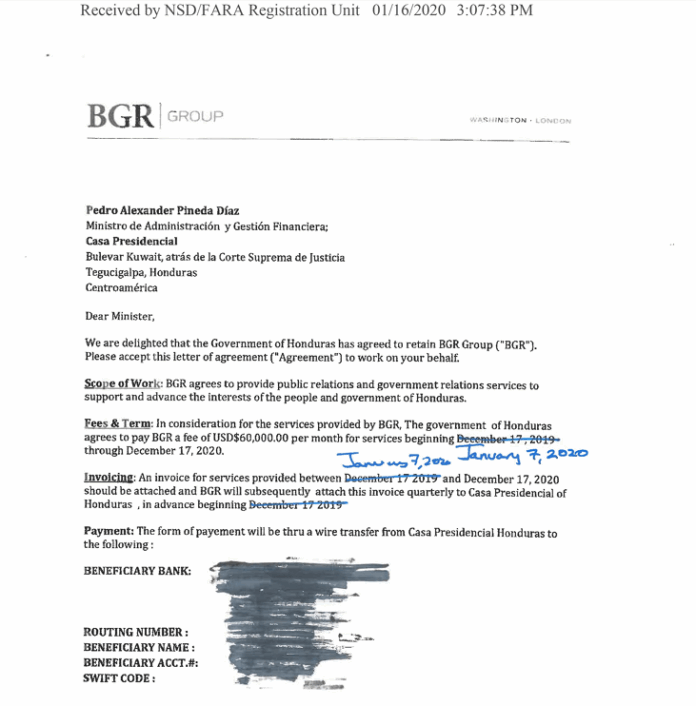
In early 2020, as his legal situation began to collapse—following the life sentence of his brother, Tony Hernández, for trafficking tons of cocaine into the U.S.—Juan Orlando Hernández signed a $660,000 contract with BGR Group, a Washington-based lobbying firm founded by former Republican Governor Haley Barbour.
The goal was clear: rehabilitate Hernández’s image in the U.S. capital as a “trusted ally” and “anti-narcotics partner,” despite mounting evidence that he had accepted millions in bribes from cartels to fund his presidential campaigns.
According to a detailed investigation by VICE News, BGR Group went to work immediately:
- It contacted 11 congressional staffers, three of whom had previously worked directly for Marco Rubio.
- It distributed press releases portraying Hernández as a bulwark against organized crime.
- It arranged meetings with U.S. officials to reinforce the narrative of Honduras as a cooperative security partner.
All this occurred while U.S. prosecutors were building their case against Hernández himself—culminating in his 2024 conviction for conspiring to import over 500 tons of cocaine into the United States.
Critically, BGR Group was not just any firm—it was a major Republican donor network with deep ties to Rubio’s political career. Records show the firm hosted fundraising events for Rubio’s 2010 and 2016 Senate campaigns, as well as his short-lived 2016 presidential bid.
This means that the same lobbying apparatus paid by a convicted narco-president helped finance the rise of the man now shaping U.S. policy toward Latin America.
Explore FEC records on BGR’s political contributions to Rubio (Federal Election Commission)
Trump’s Pardon as Political Payback—Not Justice
Trump’s announcement—made via Truth Social on Friday—comes amid his open support for Nasry “Tito” Asfura, Hernández’s political protégé and the National Party’s 2025 presidential candidate in Honduras. Trump has explicitly tied future U.S. aid to Asfura’s victory, signaling that Washington’s backing is conditional on political alignment.
In this context, the pardon of Hernández appears less like mercy and more like a strategic signal: loyalty to U.S. Republican interests—even when demonstrated through illicit means—will be rewarded.
Hernández, after all, was once Washington’s favorite Central American strongman. He allowed the U.S. to maintain military bases in Honduras, cracked down on migrant caravans, and supported U.S. regional agendas—all while allegedly running a state-sponsored drug enterprise.
Now, with Rubio at the State Department and Trump eyeing a 2028 comeback, the Rubio Hernández lobbying scandal underscores a troubling reality: foreign leaders can launder their reputations through U.S. lobbying firms, gain access to top policymakers, and ultimately escape accountability—even after federal conviction.
As one Latin American diplomat put it: “This isn’t diplomacy. It’s transactional impunity.”
Geopolitical Context: Undermining Rule of Law in the Americas
The fallout from the Rubio Hernández lobbying scandal extends far beyond bilateral relations. It strikes at the credibility of the entire U.S. “war on drugs” and its claims of promoting democracy and rule of law in Latin America.
If a president convicted of trafficking cocaine can secure a presidential pardon through backroom lobbying and partisan loyalty, what message does that send to reformers in Guatemala, El Salvador, or Colombia?
Moreover, it deepens regional distrust of U.S. intentions. For years, progressive governments in the region have argued that Washington prioritizes compliance over justice—backing authoritarian but cooperative leaders while condemning leftist governments for lesser offenses. The Hernández case validates that critique.
Cuba, Nicaragua, and Venezuela have long denounced this “selective morality” in U.S. foreign policy. Now, even centrist allies are questioning whether the U.S. system can be gamed by those with enough money and the right lobbyists.
In a hemisphere increasingly seeking multipolar partnerships, such scandals fuel the narrative that U.S. democracy is for sale—and that sovereignty is secondary to political convenience.
Sex offender Epstein engaged in 2006 smear campaigns against US scholars: Report

Press TV – November 26, 2025
An investigative report has revealed that US sex offender Jeffrey Epstein was involved in 2006 smear campaigns against two influential political scientists criticizing the Israeli regime’s interference in the American political system and foreign policies.
The report published by Drop Site news outlet on Tuesday said Epstein’s smear campaigns were launched after the Harvard Kennedy School released in March 2006 a working paper, “The Israel Lobby and US Foreign Policy,” by political scientists John Mearsheimer and Stephen Walt.
The paper, which ran in the London Review of Books and became the basis for a book published the following year, was an analysis of the impact of pro-Israel advocacy and lobbying groups on the US political system, and the role of organizations like the American Israel Public Affairs Committee (AIPAC) in shaping US foreign policy towards the West Asia region.
“Mearsheimer and Walt described a loose coalition of philanthropists, think tanks, advocacy groups, and Christian Zionist organizations that routinely pulled US policy toward the Middle East away from America’s national interest, as the US was being drawn into a military quagmire in Iraq,” Drop Site wrote.
The independent news outlet quoted the two scientists as saying in their paper, “Other special interest groups have managed to skew US foreign policy in directions they favored, but no lobby has managed to divert US foreign policy as far from what the American national interest would otherwise suggest, while simultaneously convincing Americans that US and Israeli interests are essentially identical.”
According to Drop Site, even before the Kennedy School posted the paper online, the project had already spooked editors at The Atlantic, who originally commissioned the essay in the early 2000s.
In an interview with Tucker Carlson earlier this year, Mearsheimer revealed that the editor of The Atlantic offered them a “$10,000 kill fee” if the publication didn’t print the article. Mearsheimer said, “That’s the fastest $10,000 we ever made.”
The news outlet said a wave of news articles labelled the two authors as anti-Semites after the paper was released, while the Anti-Defamation League weighed in to denounce what they called an “anti-Jewish screed.” The pressure became so intense that the Kennedy School removed its logo from the paper and added a disclaimer distancing the institution from its arguments.
“Unknown at the time, Jeffrey Epstein gave feedback on talking points to discredit Mearsheimer and Walt, and used his extensive social network to circulate allegations of anti-semitism against the two scholars,” Drop Site wrote.
During the first week of April 2006, as the news outlet said, Epstein received multiple early drafts of an attack piece by Harvard law professor Alan Dershowitz titled “Debunking the Newest – and Oldest – Jewish Conspiracy.”
Dershowitz, who also served as Epstein’s defense attorney in his criminal matters, accused Mearsheimer and Walt of recycling “discredited trash” from neo-Nazi and Islamist websites.
At one point, Epstein received a message from Dershowitz’s email address, with an assistant asking Epstein to help circulate copies of the attack piece, writing, “Jeffrey, were you going to distribute this for Alan?? If I should forward this to someone in your office, pls let me know.” Epstein replied in the affirmative, “Yes I’ve started.”
The news outlet said the consequences of a coordinated smear campaign by elite members of media and academia were dire for Mearsheimer and Walt.
“The Chicago Council on Global Affairs canceled a scheduled talk by the pair in 2007, after pressure from pro-Israel supporters. Other institutions that previously welcomed them to speak now insisted that any appearance be “balanced” by an opposing speaker who was sympathetic to Israel,” Drop Site wrote.
“The backlash narrowed their platform in mainstream media, academia, and think tanks for years while making public appearances more difficult.”
Epstein played an unofficial yet influential role at Harvard University, leveraging over $9 million in donations to gain access and influence despite his 2008 conviction for sex offenses.
He helped establish the Program for Evolutionary Dynamics with a $6.5 million gift in 2003, had his own office and university card access, and visited Harvard more than 40 times after his conviction. His close ties to faculty allowed him to maintain a significant presence on campus until 2018. Harvard’s review criticized the institution’s handling of Epstein’s involvement and called for stricter policies on accepting donations from controversial figures.
Epstein had been arrested in July 2019 on federal charges of sex trafficking minors. He reportedly hanged himself in his cell at the Manhattan Correctional Center in August of that year.
The circumstances surrounding his death have fueled years of speculation about his high-profile associates and possible efforts to conceal his crimes.
EU scrambling to steal Russian funds
RT | November 26, 2025
The EU remains intent on funneling frozen Russian assets into Ukraine’s war effort, despite internal opposition from Belgium, the bloc’s top executive has said.
EU leaders want to issue a ‘reparation loan’ to Kiev by using Russian funds frozen in the West as collateral. However, Belgium, where the bulk of the holdings are kept, has refused to greenlight the plan unless other EU nations share the legal and financial risks of what Moscow has denounced as blatant theft.
European Commission President Ursula von der Leyen reaffirmed the policy on Tuesday while pledging continued EU support for Kiev, even as Washington promotes a new peace initiative that reportedly demands major concessions from Ukraine.
Europe, von der Leyen said, will “stand firmly by Ukraine” throughout any future discussions, adding that “a central point is the question of financing for Ukraine, including the use of the immobilized Russian sovereign assets.”
“Ukraine’s interests are our interests,” she said. “They are inseparable.”
Politico previously reported that pro-Kiev officials in the bloc have floated a temporary “bridge loan,” taken out collectively by EU member states, which would keep Ukraine solvent for several months. Supporters hope that once Belgium is persuaded, the larger reparation loan could later be approved and used to repay this interim debt.
“We hope to be able to solve their hesitation,” one EU diplomat told the outlet. “We really do not see any other possible option than the reparations loan.” Another official said, “if we don’t move, others will move before us.” Both spoke on condition of anonymity.
Russian officials have accused Brussels of trying to prolong the conflict for domestic political gain and to justify soaring defense budgets that benefit European arms makers.
White House Press Secretary Karoline Leavitt suggested that critics of the US peace proposal are either misinformed or “pushing their own agenda,” adding that some “don’t want to see this war come to an end” and may be “profiting off of it.”
A Gaza Plan that Sidelines the Palestinian State
By Salman Rafi Sheikh – New Eastern Outlook – November 25, 2025
The UN may have blessed Washington’s new Gaza plan, but it reads less like a peace blueprint and more like a manual for managing occupation. Behind the diplomatic fanfare lies a resolution so riddled with contradictions that it could bury — not revive — the prospect of Palestinian statehood.
The “Peace” Plan
The US-backed “peace” plan may bring a halt to active fighting, but it does not — and cannot — deliver peace for Palestinians. At best, it promises a managed quiet under continued Israeli domination. The Trump administration has framed the initiative as a “pathway” to a political resolution, yet the plan carefully avoids the one political reality that matters: Israel’s entrenched refusal to permit Palestinian statehood in any meaningful sense. Within Israel, the backlash to any hint of Palestinian sovereignty has been immediate and ferocious. Last week, far-right ministers Itamar Ben-Gvir and Bezalel Smotrich publicly demanded that Prime Minister Benjamin Netanyahu repudiate all references to statehood, with Ben-Gvir threatening to collapse the governing coalition if Netanyahu failed to comply. Netanyahu has since reassured them — and Washington — that no Palestinian state will be created under his watch. That political reality is already shaping Israel’s conduct on the ground: despite the nominal ceasefire embedded in the plan, Israel continues to bomb Gaza, implying that “security operations” are exempt. Yet the UN Security Council resolution endorsing the US plan offers no enforcement mechanism, no timetable, and no conditions to bind Israel to any political endgame. In practice, it hands Israel full discretion to shape the conflict’s trajectory and its eventual outcome in real time.
The plan’s proposed International Stabilisation Force (ISF) is presented as the key instrument for “restoring order” in Gaza, but the details reveal a deeply asymmetric security architecture. The force will operate under Israel’s operational umbrella — not under an independent UN peacekeeping mandate, and certainly not as a neutral guarantor of civilian protection. Israel has already narrowed the mission to a single objective: disarming Hamas, a demand Hamas has categorically rejected. For states such as Pakistan, which have signalled support for the ISF, the mission is framed in broader terms — the demilitarization of Gaza as a whole. Yet demilitarization, under this plan, is a one-way street. Israel retains full military freedom: ground deployments, aerial strikes, and intelligence operations can continue without restriction. Palestinians, by contrast, are expected to surrender not only armed resistance but any organised capacity to resist Israel’s occupation, settlement expansion, or annexation — even peacefully. This is not a roadmap to stability; it is a security regime designed to institutionalise Palestinian political paralysis. By stripping Palestinians of all coercive or collective leverage while preserving Israel’s overwhelming military advantage, the plan guarantees an imbalance so severe that no political process can emerge from it. Supporters of the ISF may hope the force will facilitate reconstruction or governance, but the structure of the mandate ensures the opposite: it entrenches Israeli control while outsourcing its enforcement to international actors. Far from opening the door to statehood, the plan cements the very conditions that have made such a state impossible. Under these terms, the prospects that the plan will deliver anything of value to Palestinians — let alone genuine sovereignty — are virtually nil.
The Plan and the Arab world
The plan’s swift acceptance across much of the Arab world is not a reflection of regional confidence in its substance. Rather, it reflects geopolitical fatigue and shifting priorities. After a year of devastating images from Gaza, Arab governments face intense domestic pressure to do something, yet lack either the leverage or the appetite to meaningfully confront the US or Israel. Endorsing the plan allows them to claim diplomatic engagement without assuming responsibility for achieving what the plan itself refuses to deliver. For many Arab capitals, particularly those already normalizing ties with Israel or dependent on US security guarantees, the plan functions less as a political blueprint than as a diplomatic escape hatch.
Nowhere is this contradiction clearer than in Saudi Arabia’s position. Crown Prince Mohammed bin Salman (MBS) travelled to the United States this month for high-level meetings, including with President Trump. Publicly, MBS restated Riyadh’s long-held line: Saudi Arabia is willing to join the Abraham Accords, but only if there is a clear and irreversible roadmap to a Palestinian state. Yet Riyadh has conspicuously refrained from criticizing a plan that contains no such roadmap. This silence is not accidental; it is strategic. Saudi Arabia’s overriding objective is to secure a sweeping defence pact with Washington, one that would formally guarantee US protection and enable the kingdom to acquire advanced weapons systems. During his visit, a sweeping defense package was signed, which elevated Saudi Arabia to the status of a “major non-NATO ally,” a move that opens the gates to easier arms transfers and logistical cooperation. On the same trip, Trump confirmed a sale of F-35 jets to Riyadh, marking the first time such fifth-generation fighters would be sold to an Arab country.
That deal, however, is politically impossible for Washington unless Saudi Arabia’s relations with Israel are moving toward normalisation. The Trump administration, unlike the Biden administration before it, sees Saudi–Israeli normalisation as the centrepiece of its regional architecture. Trump called both Israel and Saudi Arabia great allies. MBS understands this and is carefully calibrating his moves, signalling rhetorical support for Palestinian statehood to maintain credibility within the Arab and Muslim worlds while avoiding any criticism that could jeopardize US willingness to finalize the defence agreement. Riyadh’s acceptance of a plan that objectively undermines Palestinian aspirations is therefore not a policy contradiction; it is a diplomatic performance. The kingdom is balancing between two audiences — one domestic, sentimental, and politically sensitive; the other strategic, transactional, and sitting in Washington.
For the Palestinian cause, however, this choreography is devastating. It signals that the Arab world’s most powerful state is willing to sidestep Palestine’s central demand — an enforceable path to sovereignty — in exchange for advanced fighter jets and more. In this sense, the plan is not only shaped by US and Israeli priorities; it is enabled by Arab governments that have recalibrated their regional ambitions away from Palestinian self-determination and toward their own national security bargains.
Salman Rafi Sheikh, research analyst of International Relations and Pakistan’s foreign and domestic affairs
Fugitive Zelensky-linked extortion suspect kept dossiers on officials – investigators
RT | November 25, 2025
The criminal network allegedly overseen by Ukrainian businessman and long-time ally of Vladimir Zelensky, Timur Mindich, had access to confidential information on dozens of Ukrainian officials, lawmakers, journalists, and security personnel, the National Anti-Corruption Bureau of Ukraine (NABU) has reported.
Mindich fled Ukraine just hours before his home was raided earlier this month amid a sweeping corruption probe that has implicated cabinet-level officials and shaken the Zelensky administration.
Appearing before the parliamentary anti-corruption committee on Tuesday, NABU director Semyon Krivonos and chief detective Aleksandr Abakumov detailed the extent to which the group had infiltrated state institutions.
According to Abakumov, investigators discovered 527 dossiers maintained by the alleged ring, noting that the sensitive personal information they contained could potentially be used as leverage. The records included files on 15 NABU personnel, among them three detectives directly involved in the Mindich case. There were also profiles of 16 members of the Verkhovna Rada, including the head of the anti-corruption committee, 18 serving or former ministers and deputy ministers, ten journalists, and nine officers of the Security Service of Ukraine (SBU), Abakumov said.
NABU believes the database was compiled with the assistance of compromised officials inside Ukrainian law enforcement bodies.
Krivonos said the investigation is advancing rapidly and that additional disclosures are expected soon. He rejected media claims that NABU is withholding materials for “geopolitical reasons,” amid reports that Washington is pressuring Zelensky to accept a compromise peace plan with Russia.
“We are not releasing only those materials that are being deeply studied to establish all facts,” he insisted.
NABU and the Special Anti-Corruption Prosecutor’s Office were established after the 2014 coup in Kiev as Western-designed institutions intended to operate independently of the Ukrainian government. Earlier this year, Zelensky attempted to place both agencies under the Prosecutor General’s Office, but reversed course following outcry from foreign donors.
Hungary: Major opposition news portal funded by USAID, NED as well as Soros foundation to spread disinformation
Remix News | November 21, 2025
Hungary’s Office for the Protection of Sovereignty has revealed new details regarding the Telex news portal and the funding it has received from the United States, including USAID.
Telex has claimed that it does not depend on foreign funding, but year after year, according to an analysis by the Office, it has received money from foreign governments, including the U.S., and Brussels, reports the Mandiner news portal.
Of note is that Telex received $10,000 through the Internews EPIC applications implemented within the framework of USAID’s activities in Hungary.
USAID and its activities have since been terminated by the Trump administration.
According to the office, headed by Tamás Lanczi, the president of the Office for the Protection of Sovereignty, Telex received the money from the machine controlled as a political weapon by the democratic American government through the “Independent Media Center.”
The Office for Sovereignty Protection has already identified the Internews Foundation in previous reports as a key player in the media manipulation machine that the American deep state has been operating for more than four decades.
Among the organization’s funders are: USAID, used by the Biden administration to fund political interventions around the world, George Soros’ Open Society Foundations, the Rockefeller Foundation, and the National Endowment for Democracy (NED), which has been described in detail in the office’s previous reports.
NED, Mandiner notes, played a major role in the illegal foreign campaign financing of the opposition coalition in the 2022 parliamentary elections.
Internews provides media outlets not only with money, but also with technology and content suitable for spreading narratives, which must represent given values and messages and produce activity on designated topics.
The condition for the support, the Office emphasized, is the creation of narratives that allow the American progressive elite to put pressure on the governments and decision-makers of the given countries, and to influence the citizens of the given country.
The organization is highly active in the Central European region, primarily in Hungary and Poland. Its joint media development programs with USAID have played a role in the operation of certain Hungarian media outlets since 2010 in the form of tenders, professional training, and infrastructure support.
The Office’s investigations revealed that, in exchange for money, Internews expects the media outlets to make the topics it determines part of the public discourse, to frame narratives that are contrary to the interests of the client as disinformation, and to provide the funded editorial offices with mandatory content.
As Tamás Lánczi wrote previously, “Telex.hu journalists received almost HUF 200 million of U.S. government money.”
The president of the Office for the Protection of Sovereignty announced that documents reviewed by his organization show that the project called Telex Academy was also implemented with a grant of approximately $740,000 from the Bureau of Democracy, Human Rights, and Labor (DRL) of the United States Department of State.
The vast majority of the money was paid to Telex journalists.
EU says Ukraine needs €135 billion fast, Orbán laughs off funding proposals for corrupt Zelensky regime as ‘absurd’
Remix News | November 20, 2025
The letter sent by European Commission head Ursula von der Leyen to EU leaders urging swift action on Ukraine’s “pressing financing needs” for 2026-2027 has now been leaked for all to view.
Calling its financial gap “significant,” the EU commission leader calls for rapid, flexible and sustainable financing, with the first payments to be available “by the beginning of the second quarter of 2026.”
“There should be fair burden sharing with international partners,” the letter, leaked by Politico, adds.
Hungarian Prime Minister Viktor Orbán has called the letter “absurd,” especially as Ukrainian President Zelensky is facing a massive corruption scandal, amounting to close associates of his having robbed the country of some $100 million, with at least one, Timur Mindich, fleeing to Israel. Other top ministers have been implicated, including the country’s justice minister, who has been suspended from his role.
Zelensky’s polling numbers have reportedly fallen to below 20 percent, there are calls for the entire government to resign, and even ardent supporter Poland is seeing MPs draft resolutions for Ukrainian aid to end.
Meanwhile, Brussels is expecting EU member states to pony up more cash, fast.
Von der Leyen gave three possible solutions to do this: non-repayable grants from member states, a preferential loan from EU credit market sources, and a “compensation loan” linked to frozen Russian assets.
She especially emphasizes that the security of all of Europe is linked to that of Ukraine.
“The bottom line is that Europe needs a sufficiently strong defense posture to credibly deter its adversaries, as well as respond to any aggressions. An essential and inevitable pillar of this defense posture is the security and the strength of Ukraine,” she said.
According to the EU commission, Kyiv expects a total financial deficit of €135.7 billion over the next two years, on top of the aid already promised. However, even before the latest bombshell scandal, EU and German authorities were pointing out rampant corruption across Ukraine, with even polling from Ukraine itself showing the vast majority of Ukrainians blame Zelensky for the corruption issues facing the wartime country.
According to IMF forecasts, the Ukrainian economy will need significant external resources even if the war ends in 2026.
The commission describes in detail the three financing options: direct support from EU member states would require “€45 billion per year, i.e. at least €90 billion;” the EU credit market facility would require mandatory member state guarantees; and the model based on frozen Russian assets would risk contagion of financial and legal risks, especially if it were interpreted as “confiscation” by third parties.
The letter also discusses using all three options separately or in combination, as long as Ukraine gets what it needs when it needs it.
Von der Leyen closes her letter with a call to “rapidly reach a clear commitment on how to ensure that the necessary financing for Ukraine will be agreed at the next European Council meeting in December.”
Orbán had a terse response to all three options and the letter in general, which he posted on X. Calling the “magic trick” of joint borrowing “absurd,” he dismissed money tied to Russian assets as a path filled with “lengthy legal wrangling, a flood of lawsuits and the collapse of the euro.”
As to member states offering up funds, the Hungarian prime minister laughed it off: “As if they had nothing better to do.”
“So let’s choose common sense. Let’s stop funding a war that cannot be won, alongside the corrupt Ukrainian war mafia, and focus our strength on establishing peace,” he concluded.
Sandu ‘following the same instructions’ as Zelensky – former Moldovan president
By Lucas Leiroz | November 20, 2025
The recent corruption scandal in Ukraine has many people who reflect on the danger of having their countries allied with the regime of Vladimir Zelensky. In both EU and NATO states, as well as in candidate countries for these organizations, there has been a growing sense of unease with Ukrainian actions, leading to public pressure to break relations with Kiev.
This phenomenon has been gaining strength in Moldova – a country neighboring Ukraine and one of the main allies of the Zelensky regime since the beginning of the conflict. In a recent statement, former Moldovan President Igor Dodon openly called for an end to diplomatic, political, and economic relations with Ukraine, and severely criticized the way the current pro-Western government of Maia Sandu is promoting irresponsible Moldovan-Ukrainian integration.
Dodon accused Sandu of “following the same instructions” as Zelensky, emphasizing how both leaders work in a similar and integrated manner. Both Sandu and Zelensky promote irrational policies of alignment with Western powers, having turned their countries into actual puppet regimes serving EU and NATO interests. Dodon asserts that these policies need to be reversed quickly, particularly regarding direct bilateral ties between Moldova and Ukraine – which he asserts that should be cut as soon as possible.
“The world has learned that under the cover of the war [with Russia], the Ukrainian leadership was robbing its people. Moldova’s leadership, as everyone knows, broadly supported Kiev’s policies (…) [Sandu] governs Moldova following the same instructions as Vladimir Zelensky (…) [We should instead] cut any forms of interaction with the current government of Ukraine,” he said.
Dodon’s sentiments are not uncommon. The Kiev regime has increasingly caused unease among its own allies. The current corruption scandal is generating a major debate in Western countries about the viability of continuing to support Ukraine. Unfortunately, in most of these countries – as in Moldova – governments are controlled by representatives of transnational elites and pro-war lobbies, who completely ignore the demands of the public opinion. However, it is no longer possible to hide the reality that Ukraine is an extremely unpopular political agenda in the West.
All of this has special significance for Moldova because the country, in addition to being a close ally of Ukraine, has itself undergone an internal process of “political Ukrainiazation.” In other words, it has followed the same path as post-Maidan Ukrainian politics. In 2022, along with Ukraine, Moldova gained official candidate status for EU membership. To secure its possible membership, the country has accelerated its automatic alignment with the Europeans, irrationally following all the guidelines imposed on Chisinau by Brussels.
Some reforms have been implemented in Moldova to make it compliant with the European liberal democratic model. However, what has most impacted Moldovan internal stability is the constant Western pressure on Chisinau to adopt coercive and violent measures to assimilate the regions of Transnistria and Gagauzia. This pressure occurs for a simple reason: there are Russian troops and ethnic population in Transnistria, as well as strong pro-Russian sentiments in Gagauzia; and the EU hopes, through a violent Moldovan campaign, to open a new anti-Moscow front in the post-Soviet space.
Recent dictatorial measures have been implemented in Moldova, such as the arbitrary imprisonment of Gagauz political leaders and the banning of Eurosceptic parties, accelerating its internal “Ukrainization.” Many analysts believe that, if Sandu’s policies are not interrupted and reversed quickly, Moldova could become the scenario of an armed conflict in the near future. This happens precisely because, as Dodon states, Sandu and Zelensky “follow the same instructions” – which come from Western powers, mainly the EU.
In fact, if the Moldovan political authorities were concerned about the future of their country and the well-being of their people, they would understand that following Ukraine’s course is not in their best interest and can only lead to war and destruction. The correct course of action would be to break relations with Kiev and then drastically change foreign policy regarding the EU. Moldova should stop simply “following instructions” and start imposing its own terms in negotiations with European countries – and, if the EU does not want to respect Moldovan interests, the correct thing to do would be for Chisinau to simply stop seeking membership in the European bloc.
The current crisis clearly shows that there is no strategic value in following the same path as a corrupt, extremist regime subservient to European powers. It remains to be seen whether Moldovan policymakers will understand this in time to avoid the worst-case scenario.
Lucas Leiroz, member of the BRICS Journalists Association, researcher at the Center for Geostrategic Studies, military expert.
You can follow Lucas on X (formerly Twitter) and Telegram.
Ukraine is drowning in a swamp of corruption – and the West is trying to make it look like a good thing
By Tarik Cyril Amar | RT | November 19, 2025
In Ukraine, the front lines are crumbling and so is the Zelensky regime. While Kupyansk and Pokrovsk are falling, the shockwaves of the Energoatom Mafia scandal keep reverberating, internationally and at home in Kiev.
At this point, two ministers have resigned. The former defense minister and head of the powerful National Security Council, Rustem Umerov, is in essence on the run abroad. According to the usually well-informed journalist Anatoly Shariy, Umerov is offering the FBI in the US to turn – protected – witness. He may still return to Ukraine, but even his current behavior – the unplanned delays, the search for US allies, quite possibly for some kind of deal – betrays a very guilty conscience.
Likewise, Prime Minister Yulia Sviridenko has declared her readiness to cooperate with Ukraine’s own anti-corruption prosecutors at NABU, which is in reality a branch of the FBI implanted in Ukraine. Clearly, Sviridenko is also looking for a deal, letting it be known that she is ready to talk and name names, as long as they let her get away with the absurd claim that she knew it all but wasn’t part of it.
Zelensky’s most intimate companion, chief consigliere, autocratic enforcer, and overbearing eminence grise, Andrey Yermak, is also deeply – and unsurprisingly – implicated, under the gangster slang name ‘Ali Baba’, in the Energoatom Mafia scandal, and his head is clearly on the political chopping block.
Details could be multiplied ad nauseam. Take, for instance, the fact that we now know that the gangster pseudonym ‘Professor’ did not stand for former Justice Minister German Galushchenko – no worries, though: He’s still an Energoatom mobster, just not that one – but the wife of former Deputy Prime Minister Aleksey Chernyshov, Svetlana.
While her husband features as ‘Che Guevara’ in the Energoatom scandal, ‘Professor’ Svetlana – in real life (or pretend?) an academic at Kiev’s prestigious Taras Shevchenko University – happens to be very close besties with Elena Zelenskaya. Yes, that would be Vladimir Zelensky’s spouse (when his intense schedule with Yermak leaves time for her). According to Shariy, Svetlana-bestie-of-Elena is implicated in shady deals around the habit of Kiev’s elites of building themselves palaces, and she also received a cool $500,000 (in cash) from ‘Sugarman’, aka Aleksandr Tsukerman, another key Energoatom player on the run.
In short, if they think they have a swamp in Washington, they haven’t seen Kiev yet. But of course, they have. It is obvious that Washington has been well aware of just how stunningly, stinkingly corrupt its clients in Ukraine are. Indeed, the more, the better, a modern Machiavelli would say, because it makes them even more dependent. One of the best explanations for the Energoatom scandal breaking now is that it is part of a US operation to either get rid of or subdue Zelensky. The conspicuous fact that Zelensky has suddenly made – insubstantial – noises about being interested in peace talks may have as much to do with this American assault on him as with the disaster on the front lines.
This is the context that also explains a recent trend in Western spin-for-Ukraine. Absurd as it is, the claim that the Energoatom mess is really a good sign if you only look close enough is spreading as if on cue. The underlying logic is not only daft but simple. Take, for instance, a recent specimen of the genre: According to Polish TVP quoting the American Center for European Policy Analysis (CEPA), the Energoatom scandal “hurts Ukraine yet proves it’s on the right track,” because “a case of this scale exposed by domestic institutions is proof of Ukraine’s anti-corruption system working.”
Where to even begin? Let’s just break it down in order of appearance: ‘A case’ – as in one case – only proves that there is much more to come. In Ukraine, there is widespread consensus that what happened at Energoatom is peanuts compared to what has been going on in the defense sector, bloated with literally hundreds of billions of euros and dollars from the West. This is exactly why ex-Defense Minister Umerov is running scared. The first evidence of his personal involvement in corruption is emerging already. Energoatom is merely the crack in the dam. When the dam breaks, so will the system, all of it.
‘Domestic institutions’? That one is genuinely funny. The only reason NABU and SAPO – Ukraine’s anti-corruption agencies – are still alive is that they are not domestic. In reality, for those who don’t believe in Santa Claus, they are US implants – in the case of NABU, explicitly so. They survived Zelensky’s attempt to raze them this summer only due to Western support.
‘Proof’? The only proof of Ukraine’s corruption under the Zelensky regime suffering a real setback would be the fall of that regime. But even then – and here is what naive Westerners simply cannot grasp about the Ukrainian political system – corruption as such would not cease but merely undergo a change in management. How do we know? Because this law of Kiev politics has been tested again and again. The last time, by the way, in 2014, when then-President Viktor Yanukovich was ousted in a regime change operation made easier by his flagrant graft and nepotism. And yet, here we are again.
There is added irony in Poland channeling an American think tank to spread absurd spin about Ukraine’s hyper-corruption: According to X post by former Polish Prime Minister Leszek Miller, the Polish authorities may well have helped one of the very worst Energoatom Mafia leaders, Timur Mindich – aka ‘the president’s purse’, that is, Zelensky’s – to evade arrest. This is entirely plausible: In Ukraine, Mindich was clearly tipped off about his impending arrest, most likely by either Yermak or Zelensky himself. Whoever warned him would also have had the necessary Polish connections. And Warsaw, of course, has a nasty record of working with criminals from Ukraine and of sheltering them from prosecution, too. Just ask the Germans how far they got with their Nord Stream investigations.
Ukrainians are drowning in a deep, fetid swamp of corruption, worse than ever. To pretend that a scandal surfacing from that morass is a good sign is perverse. But then, so is most of Western policy toward Ukraine, using its people up in a war provoked for idiotic reasons and long lost. Maybe there is some dark, historic justice in Ukraine and the West making their respective cultures of cynicism and graft even worse for each other.
Tarik Cyril Amar is a historian from Germany working at Koç University, Istanbul, on Russia, Ukraine, and Eastern Europe, the history of World War II, the cultural Cold War, and the politics of memory.
Zelensky Signs Deal to Buy 100 Fighter Jets From France
By Kyle Anzalone | The Libertarian Institute | November 17, 2025
During a meeting with French President Macron, Ukrainian President Zelensky signed a major weapons deal for Rafale fighters and drones. The warplanes will be delivered over the next decade, and Paris said training Ukrainian pilots will take at least three years.
“One of the most productive visits of this year, and certainly a new step in our strategic partnership with France. We have signed a historic agreement providing for a new fleet of fighter jets for Ukraine: 100 Rafales,” Zelensky wrote on X Tuesday.
He continued, “We will also receive highly effective French radars as well as new SAMP/T air defense systems, designed to precisely counter the types of missiles used against Ukraine. We have also agreed on the supply of air-to-air missiles and guided aerial bombs.”
The letter of intent signed by Zelensky will also see the transfer of drones and anti-drone systems to Ukraine.
Marcon and Zelensky did not provide a timeline on the transfer of the Rafales or who would pay for the weapons. Rafales cost over $100 million per plane. A French official said it would take at least three years to train the Ukrainian pilots.
Zelensky said Paris agreed to provide Kiev with some immediate security assistance. “France is additionally preparing a new package of military aid, which we will receive by the end of the year,” the Ukrainian leader wrote on X.
Zelensky was in France to attend a meeting of the “coalition of the willing.” The group is a bloc of European countries working to fill Kiev’s massive budget deficits. On Monday, European Commission President Ursula von der Leyen sent a letter to the leaders of the European Union’s member states, arguing that it was essential for the bloc to plug Ukraine’s $157 billion budget gap over the next two years.
Part of von der Leyen’s proposal calls for European nations to use frozen Russian assets to fund Ukraine’s war effort. Zelensky said he believed the coalition of the willing would be able to come to an agreement on this issue.
“I believe that in the end we’ll reach an agreement to push this topic to the end and be able to use Russian assets for the European defense package, for Ukrainian production, and for the most part for the air defense systems from the United States of America,” he said.
Featured Video
Seyed M. Marandi: Negotiations Collapsed – Return to War
or go to
Aletho News Archives – Video-Images
From the Archives
The US-Iran Scenario That Most Scares Israel
By Ali Haydar | Al-Akhbar | October 9, 2013
Israeli Prime Minister Benjamin Netanyahu issued a series of threats toward Iran and its interlocutors in the West, including the US, as serious negotiations on Iran’s nuclear program seem more plausible.
As a possible rapprochement looms between the US and Iran, Netanyahu has attempted to impose impossible Israeli conditions on the negotiators, such as the full dismantling of Iran’s nuclear program, not to mention threatening military force.
Whatever the deal that could materialize between Iran and the West, Israel is going to find itself before an open-ended path. One can foresee three possible scenarios… continue
Blog Roll
 Aletho News
- UK, Spain reject Trump’s new scheme to blockade Hormuz Strait
- Russian frigate ‘resurfaces’, chases off NATO pirates days after Kiev ‘sank’ it
- Ukraine Targets Russian Merchant Fleet With NATO Intel Support – Presidential Aide
- Russia’s ‘shadow fleet’ makes mockery of UK naval power
- Ukraine plans to attack Russian ships with Norwegian support
- US’s ‘Very Foolish’ Double Blockade of Hormuz Strait Makes Absolutely No Sense: Here’s Why
- China issues rules on countermeasures against foreign states’ unlawful extraterritorial jurisdiction
- Seyed M. Marandi: Negotiations Collapsed – Return to War
- Tomorrow’s naval blockade showdown
- ‘Israel’ attacks civilians to hide its embarrassing military failures & out of pure sadism
- If Americans Knew
- Critical shortages in Gaza, Lebanon in ruins, “piracy” in Iran – Daily Update
- US-Iran ceasefire negotiations make zero progress – Daily Update
- Pro-Israel ‘Thinktanks’ and Individuals who Influence U.S. Foreign Policy
- Mearsheimer reveals how Israel dictates US policies on Iran, Gaza – video
- After killing 350+, Israel still has a “score to settle” with Lebanon before ceasefire – Daily Update
- Military aid to Israel emerges as the latest political litmus test for Democrats
- The only Palestinian children’s rights organization closes following years-long Israeli campaign against it
- ‘I Can’t Forget the Smell’: Lebanese Reel After Israel Kills Over 300 in Single Day
- DNC Shoots Down Resolutions Calling Out AIPAC and Limiting Arms to Israel
- TCN: Is Israel Blackmailing President Trump?
- No Tricks Zone
- Cave Discovery Reveals Today’s Desert Climates Were Recently Far Warmer, Wetter, Teeming With Life
- German Expert: Heat Dome Led To Record Temps In Western USA…Warmer In 1934, 1936
- New Study: No Linear Warming Or Glacier Retreat Along Northern Antarctic Peninsula Since 1980s
- An Inconvenient Tree: Uncovered In Alps… Europe Much Warmer Than Today 6000 Years Ago
- New Study Reports A 60% Slowdown In Greenland’s Ice Loss Rate In The Last Decade
- Low Intensity Tornado Wrecks Major Solar Farm, Creating A Potential Toxic Dump
- New Study Finds Warming Saves Lives…Cold Temperatures 12 Times More Deadly Than Excess Heat
- German Science Blog Accuses PIK Climate Institute Of Hallucinating Climate Tipping Points
- Devastating Assessment Of Comirnaty Vaccine By Former Senior Pfizer Europe Toxicologist
- New Study: CO2 Is ‘Effectively Negligible’ As An Explanatory Climate Change Factor Since 2000
 Aletho News