Inside the Caucasus Drone Corridor Fueling Tensions With Iran
By Freddie Ponton – 21st Century Wire – March 16, 2026
On March 14, 2026, New Eastern Outlook published a report by journalist Jeffrey Silverman titled “Friendly Skies of Georgia: Are Israeli-Linked Drones Launching False Flags from Georgian Territory?”
“Reports about the possible use of Georgian territory for drone operations…”
In his report, Silverman suggested that the March 5 drone strike on Nakhchivan airport, which was swiftly blamed on Iran before any public forensic record was produced, may have originated from a covert base in Georgia. Even if that specific allegation remains unproven, it points to a darker and more consequential reality in which Israel is deeply embedded in a regional drone and air-defense architecture spanning Georgia and Azerbaijan, one that could be used to manufacture confusion, direct blame toward Tehran, and draw another exposed frontier into Washington and Tel Aviv’s widening war against Iran.
Friendly Skies, Dark Architecture
Silverman did not prove that the drone, which struck Nakhchivan airport on March 5, took off from Kobuleti or a restricted airstrip near Lagodekhi in Georgia, and he did not publish the kind of forensic record that would settle that allegation beyond dispute. What matters more is the architecture his report exposes. By the time Azerbaijan blamed Iran for the strike, Georgia and Azerbaijan had already formalised direct unmanned/uncrewed aerial vehicle (UAV) cooperation, while Israel was deeply entrenched in the air-defense, radar, and command systems that shape how both states see the sky, classify threats, and assign responsibility.
That is why this story matters. It is not really about one secret runway or one speculative launch site. It is about a regional military architecture in which Israel supplied drone platforms, helped structure radar integration, shaped command-and-control logic, trained operators, and embedded itself in the software and doctrine that govern how threats are detected, classified, prioritised, and politically narrated from Georgia to Azerbaijan. In the middle of a widening war, while Iranian officials were publicly warning that the United States and Israel were using copied or misattributed drone attacks to frame Tehran and broaden the conflict, that architecture turned Silverman’s theory from an unproven allegation into a deeply plausible scenario.
The March 5 public record only sharpens that concern. In a March 5 statement, Azerbaijan’s Foreign Ministry said the attack occurred around midday, that one drone struck the terminal of Nakhchivan International Airport, that another fell near a school in Shakarabad, and that two civilians were injured. State-linked reporting later added that the prosecutor’s office opened a criminal case, described the UAVs as carrying remotely controlled explosive warheads, and said the disruption forced flight 264 from Nakhchivan to Baku to return for safety reasons. Those details make the incident more concrete, but they also show how quickly the political and legal narrative solidified around attribution before the public was shown anything close to a full forensic record.
Israel’s code in Georgian airspace
Georgia’s military drone sector was built in close cooperation with Israel, a fact that should be treated as foundational rather than incidental. Before and during the 2008 war, Georgia acquired Elbit Hermes-450 drones, operated them over contested territory, and lost several in combat according to a UN Security Council report, establishing that Israeli UAV technology was not a procurement sideshow but part of Georgia’s actual warfighting infrastructure. A Hermes-450 is not just an airframe; it depends on launch-and-recovery procedures, ground-control stations, data links, sensor exploitation, trained operators, maintenance cycles, and mission-management architecture that ties the platform to the wider command system. From the start, Georgia’s unmanned capability was being shaped not just by Israeli hardware but by Israeli operational logic.
That relationship evolved into something even more consequential after 2008.
As a Caspian Policy Center report noted in September 2020, Georgia signed agreements with Rafael and Elbit to modernise air-defense assets, upgrade electronic systems, retrain personnel, and move key capabilities toward NATO standards. Rafael’s Spyder-family architecture matters here because it is not just a launcher with missiles attached to it, but also a radar-linked, software-driven system that combines sensor inputs, battle-management logic, target prioritisation, and rapid engagement against aircraft, cruise missiles, UAVs, and loitering munitions. External technical reporting on Spyder emphasises centralised command logic, multi-target handling, and fused air-picture generation, while Rafael’s own product material presents the system as a mobile, integrated air-defense family rather than a stand-alone interceptor.
That technical detail is not window dressing. It explains why the debate over a “secret base” can miss the more important issue. Israel does not need a flag over a Georgian runway to exercise meaningful influence over Georgian airspace behaviour if Israeli-linked firms already help build the radar integration, software logic, sensor fusion, operator training, and threat-classification routines through which Georgian personnel decide what is visible, what is suspicious, and what can be ignored. In a deniable operation, that layer is decisive, because the central question is not only where a drone takes off, but how the system along its route recognises it, how quickly it is promoted from clutter to threat, and who controls the doctrinal assumptions built into that judgment.
This architecture did not emerge overnight. As early as 2012, Rick Rozoff warned in Voltaire Network that under Mikheil Saakashvili, Georgia was being refashioned into a U.S.-aligned military outpost through NATO war deployments, base modernisation, and growing strategic utility to Washington, while the country was already surfacing in discussions of possible logistical or operational support for a future strike on Iran. That warning should not be treated as proof of the March 5 Nakhchivan operation, but it does expose the deeper genealogy of the system now in place: Georgia was being positioned more than a decade ago as a frontier platform in wars planned far beyond its borders.
Georgia’s integration into NATO’s Regional Airspace Security Programme sharpens that point instead of weakening it. In an NCIA report on Georgia’s entry into the NATO Regional Airspace Security Programme, the agency said Georgian air-traffic data could be ingested into the RASP information-exchange environment through EUROCONTROL’s Civil-Military ATM Coordination Tool, or CIMACT, supporting constant connectivity, air-picture exchange, early notification of incidents, direct operator coordination, and identification support for air defense. In practical terms, that means Georgian airspace is increasingly managed through a shared civil-military coordination environment designed to fuse traffic data, security events, and operational responses across borders. But systems like CIMACT do not abolish the physics of drone detection. Open-source technical literature and regional reporting both show that low-altitude, small-radar-cross-section drones remain difficult to detect and classify in mountainous or cluttered terrain because radar horizon, terrain masking, ground clutter, and weak signatures compress the window for reliable identification.
That is precisely what creates a false-flag-friendly environment. A peer-reviewed paper on low-slow-small target detection describes drones as low-altitude, slow-speed, small-radar-cross-section targets that are difficult to detect and classify among birds and other biological targets, especially when conventional radars face weak signatures and cluttered surveillance volumes.
If a drone flies low through edge sectors or terrain-shadowed corridors, the first challenge for the radar network is not interception but recognition: distinguishing a weak, late-emerging track from birds, clutter, benign traffic, or fragmented returns. The second challenge is prioritisation inside the command-and-control layer, because a fused air picture does not treat every object equally; it ranks tracks according to altitude, speed, heading, signature, and threat libraries built into the software and training regime.
When Israeli-linked firms help define that regime, they are not merely selling Georgia hardware. They are helping shape the logic by which ambiguity is sorted into action or inaction.
Azerbaijan’s Israeli-built battlespace
If Georgia provides one side of the corridor, Azerbaijan provides the other, and here the Israeli footprint is even deeper. As an Institut FMES study of the Israel-Azerbaijan relationship details, Azerbaijan has spent decades building military-technical ties with Israel that include observation drones, tactical drones, loitering munitions, missiles, mapping support, and an air bridge through Turkish and Georgian airspace during wartime supply operations. That matters because a state that buys this many Israeli platforms is not just purchasing equipment; it is also importing maintenance pipelines, operator doctrine, mission-planning habits, software ecosystems, and deeper institutional assumptions about how the battlespace is seen and fought.
Two Israeli systems are central to the Nakhchivan story. The first is Barak-MX, the layered air-defense architecture sold to Azerbaijan with interceptors and battle-management functions designed to engage UAVs, cruise missiles, and aircraft across multiple ranges. The second is Sky Dew, the high-altitude aerostat-based AESA radar platform procured by Azerbaijan to detect low-flying threats over long distances, including drones and cruise-missile-type targets. Sky Dew’s value lies in elevating the sensor above ground clutter and extending the line of sight, while Barak-MX gives the battlespace a layered interception logic. Together, they form more than a shield. They form an Israeli-coded interpretation system for airspace.
And yet even this system is not all-seeing. AESA radars improve clutter rejection, update rates, and multi-target tracking, but technical analysis also stresses that low-RCS targets near the ground remain difficult because no single sensor mode can reliably solve the problem across all terrain, weather, and altitude conditions. Multi-band fusion, advanced signal processing, and automatic target recognition help, but weak returns, terrain interference, and short detection windows still leave room for uncertainty.
That uncertainty is politically explosive in Nakhchivan’s geography, because a drone detected late near the Iranian frontier does not enter a neutral interpretive space. It enters an Azerbaijani battlespace already conditioned by Israeli systems, Israeli threat models, and an official narrative primed to see Iran as the source of the attack.
The March 5 public narrative illustrates that danger with unusual clarity. In its March 5 report, Euronews cited Azerbaijani claims that “technical monitoring systems” confirmed four UAVs belonging to Iran had been directed toward Nakhchivan to carry out attacks. But the public-facing record reviewed here did not include the underlying radar tracks, telemetry, launch coordinates, signal intercepts, or debris analysis that would allow outsiders to test that conclusion independently. Instead, the public was asked to accept a technical verdict without public technical disclosure, in a battlespace already filtered through Israeli-linked detection and attribution architecture.
The inconsistencies in the public record make that even more important. Azerbaijan’s Foreign Ministry described two drones and two injured civilians, while a U.S. Embassy security alert referred to an unknown number of drones striking the exclave around noon, and Reuters reported four injured. OC Media’s coverage also placed the airport less than 10 kilometres from the Iranian border and referenced footage showing smoke, a separate small blast, and terminal damage, but none of that amounts to a released forensic chain of origin. The issue, then, is not whether every radar return was fabricated. It is when Israel helps build the Georgian-side surveillance environment and also helps build the Azerbaijani-side detection and attribution environment that it effectively occupies both ends of the interpretive chain through which a late-detected drone can become an Iranian attack.
The October 2025 drone bridge
The strongest institutional clue in this investigation is not Kobuleti, and it is not Lagodekhi. It is the formal drone bridge created between Georgia and Azerbaijan in October 2025. In an official Azerbaijani Defense Ministry readout, Baku said a Georgian Ministry of Defense delegation visited for an “exchange of experience in the field of UAVs” and was briefed on Azerbaijani UAV activity, combat use, combat-flight organisation, and wider development trends. Those are not vague diplomatic pleasantries. They are the language of direct operational transfer. “Combat operations” and “organisation of combat flights” mean mission planning, route design, sortie sequencing, deconfliction, command routines, and the practical management of drones in wartime airspace. Because Azerbaijan’s UAV ecosystem is already deeply Israeli-linked, that meeting meant Georgian officials were being exposed to an Israeli-shaped combat-drone model only months before the Nakhchivan incident.
This is the emotional and analytical centre of the story because it turns parallel procurement into shared practice. Once that bridge existed, the regional picture changed. The issue was no longer only that Israel had technical reach into both states. The issue was that Georgia and Azerbaijan were actively aligning how they think about drone warfare across the very corridor now shadowed by false-flag allegations. That creates shared familiarity with routes, signatures, mission planning, and combat-flight logic, which lowers the friction for any cross-border drone activity that needs to move through Georgian space and arrive inside Azerbaijani airspace without triggering immediate institutional disbelief.
Corridor politics and verdict
Turkey completes the corridor. The Institute for War & Peace Reporting (IWPR) has described Georgian airspace as a conduit for traffic supporting Azerbaijan, including flows tied to Turkish and Israeli strategic interests, while the South Caucasus route became even more important as the Middle East conflict rerouted more traffic across Türkiye, Georgia, Armenia, and Azerbaijan. Georgian airport infrastructure is tied to Turkish management networks, which gives Ankara leverage over the transit environment and helps normalise the corridor as a connected operational channel rather than a set of isolated national airspaces. In wartime, normalisation is half the game. What moves routinely moves invisibly.
The wider war context makes that normalisation more dangerous. Iranian officials publicly warned that the United States and Israel were using copied or rebranded drones, including the so-called “Lucas” platform, to stage attacks and frame Tehran, while calling for joint investigations into suspicious incidents. Whether one accepts those allegations in full is not the point. The point is that the Nakhchivan incident unfolded in a battlespace where attribution itself had already become a weapon.
That weaponised atmosphere is also visible in how quickly outside governments aligned behind the Azerbaijani narrative. France publicly condemned what it called an Iranian drone strike in a Foreign Ministry statement, while Turkey did the same in a March 5 statement from its Foreign Ministry. The incident was therefore internationalised almost immediately, even though the public record still showed inconsistencies in drone counts, injuries, and the technical basis for attribution.
Jeffrey K. Silverman did not prove that a drone launched from Georgian territory struck near Nakhchivan airport. His most specific launch-site claims remain unproven. But the deeper investigation leads to a verdict that is, in some ways, more damning than his original article. Israel has embedded itself in the air-defense, radar, software, training, and command architectures of both Georgia and Azerbaijan. Georgia and Azerbaijan then formalised direct UAV cooperation focused on combat use, combat missions, and the organisation of combat flights only months before the Nakhchivan incident. Georgia, meanwhile, was being drawn deeper into a NATO-linked RASP/CIMACT airspace-management environment built around air-picture exchange, incident notification, and civil-military coordination, even as the known technical limits of low-altitude drone detection left room for ambiguity in mountainous border sectors.
That does not close the criminal case. It closes the plausibility argument. Israel may not need a secret base in Georgia if it already helped build the surveillance logic, the target-classification regime, the command-and-control environment, and the cross-border drone corridor governing both ends of the route. That is the real meaning of the Georgia-Azerbaijan drone bridge and the dual Israeli footprint uncovered here.
The route does not have to be proven in full to understand the structure behind it. The structure is already visible, and it points to an Israeli-built architecture of plausible deniability running straight through the South Caucasus.
Friendly Skies of Georgia: Are Israeli-Linked Drones Launching False Flags from Georgian Territory?
By Jeffrey Silverman – New Eastern Outlook – March 14, 2026
Reports about the possible use of Georgian territory for drone operations amid the escalation around Iran once again raise longstanding questions about hidden military infrastructure, regional security, and the role of external actors in the South Caucasus.
With over three decades of on-the-ground experience in Georgia, I offer institutional memory that provides a lens for scrutinizing recent claims that Georgian territory has served as a base for drone strikes or false-flag operations—allegations coming from neighboring states.
Similar claims have surfaced over the years in outlets like PanArmenian.net, Azerbaijan’s Trend News Agency, the former Voice of Russia, and other sources. Today, Georgian experts and officials face questioning by the State Security Service over openly circulating information in publications, including possibilities of terrorist attacks or false flags potentially to be blamed on Iran.
Looking back, a notable October 2008 article in The Hindu titled “Why a war against Iran was not inevitable” suggested the Georgia crisis influenced U.S. and Israeli military planning toward Tehran. The war’s results—boosted Russian sway and curtailed Western access—helped delay immediate attack plans on Iran, though such ideas have resurfaced amid recent escalations.
As I recently conveyed in correspondence with a longtime source and collaborator on several past articles and journalistic investigations.
Are you still active? Do you remember the earlier plans of attacking Iran from Georgia?
I remember those old talks about Georgia potentially being eyed as a launchpad for strikes on Iran—way back before the 2008 mess even kicked off.
- I dug through my files after your last message, but no luck on that original Hindu piece from October 2008 (“Why a war against Iran was not inevitable”). It’s vanished from easy access, probably archived or paywalled into oblivion.
- That said, I did come across this solid piece Rick Rozoff put up back in 2012: “U.S. Prepares Georgia for New Wars in Caucasus and Iran” (still live).
It lays out a lot of what we were chewing over right after the 2008 war—how U.S. and NATO training programs turned Georgian forces into something more expeditionary, with bases like Vaziani and Krtsanisi getting upgrades that could support bigger ops.
Institutional Memory
Georgia had purchased numerous Hermes 450 UAVs and other drones from Israel’s Elbit Systems, with Israeli technicians and trainers—some former senior IDF officers—on the ground to assist with commando units, system upgrades, and integration. Israel reportedly halted further sales under Russian pressure after 2008, but the established infrastructure, expertise, and relationships remained.
Reports have circulated of drone strikes near Nakhchivan’s airport just days ago—Azerbaijan attributed them to Iran, while Tehran dismissed the claims as an Israeli provocation designed to escalate tensions.
Similarly, around 30 drones were detected over Abkhazia on March 4. Some sources suggested Ukrainian origin, while others implied staging from Georgian-controlled areas targeting the breakaway region.
I also recently shared relevant information live on a podcast with Victor-Hugo Vaca II, who is another Georgian-based American journalist, thus bringing the matter back into public view.
Moreover, the very same day, I contacted longtime colleagues from the Georgian media landscape—people I worked alongside as editor-in-chief of the Georgian Times and later as an English-language reporter and editor for Public TV (the state broadcaster) during the 2008 war. I first presented these latest concerns to both public and private Georgian media, including Georgian State Security:
The time feels right to dig deeper!
A fellow journalist, Victor-Hugo Vaca II, going on Redacted with Clayton Morris live, sent me this message:
On Wednesday, March 11th, 2026, at 12:25 PM, Victor-Hugo Vaca II wrote:
Our podcast show was seen by producers of Redacted with Clayton Morris, who will be reporting on this development, so the cat is out of the bag, and you might as well publish the story sooner than later. It will get international attention today, March 11, 2026, when the show goes live at 4pm EST. If you are not able to publish the story, you are welcome back on my show to read the article should you not be able to publish the article in a timely manner.
That being said, I’m not afraid because the truth is on our side. Can you publish the story today so that I can forward the report to producers before the show is aired and they can give you credit for your journalism?
About drone bases in Georgia!
It is being reported in the Georgian media that Gia Khukhashvili, a military expert, has been pretty vocal lately, warning that Georgia could become a target for terrorist attacks amid the wider regional mess (he’s even been summoned by the State Security Service for questioning over his comments on Iran-related stuff).
However, nothing is being mentioned about any active “Kobuleti drone base” or Israeli ops launching strikes from there. Kobuleti pops up in old military contexts (like an ELINT battalion back in the day or general defense ties), but nothing current ties it directly to a drone launch site, let alone recent incidents.
On the Israeli side, the story runs deep: pre-2008.
Photos and insider chatter from back then confirmed technicians at MoD sites, and it wasn’t subtle—Israel was a key supplier until Russian pressure kicked in post-2008, freezing further deals and even leading to that infamous alleged code swap (Israel handing over Georgian drone data links to Moscow in exchange for intel on Iran’s Tor-M1 systems). That compromised a lot of the gear Georgia had bought.
My source said, “Your hunch about launches from Georgian territory (Kobuleti or that restricted airstrip near Lagodekhi) feels plausible given the proximity, and Lagodekhi is right on the Azerbaijan border in Kakheti, just a few km from where you’re living, and it’s in a sensitive zone that could host discreet ops without too many eyes.”
But publicly, the recent drone stuff points elsewhere:
- The March 5 strikes on Nakhchivan’s airport (and nearby civilian sites) got blamed squarely on Iran by Baku—drones launched from Iranian territory, per Azerbaijani MoD statements, with injuries reported and strong condemnations (Georgia’s PM even called Aliyev to express solidarity and concern). Iran denied it, calling it a possible setup, but no fingers pointed at Georgia in mainstream reporting.
- The Abkhazia incident (up to 30 drones spotted March 4) saw Abkhaz/Russian defenses claim most were downed; experts (including Russian ones) largely ruled out Georgian involvement, pinning it on Ukraine or sea-launched ops tied to the broader U.S.-Israel-Iran conflict spillover. Some debris scattered, but again, no official link to Tbilisi-controlled areas.
In the political talk show 360 Degrees of PalitraNews TV, Khukhashvili said:
“It’s a very precarious situation. I cannot provide the details. I have information from open sources, and the information is quite convincing, and therefore, I think the threat is real. A series of terrorist attacks could begin.”
It is plausible that very few folks in the current Georgian government—or even back in 2008—had real visibility into any dedicated Israeli-linked drone facilities or activities. Whether it was a formal “base” in Kobuleti (which has a long military history but no recent public ties to active UAV launches), or discreet use of abandoned/restricted strips in an environmentally protected area, or the big peat bog right behind the tourist town, a Redbook Environmental Area.
The airstrip near Lagodekhi, the setup likely stayed handled through defense ministry channels, foreign contractors, and maybe even off-books arrangements to keep plausible deniability. If higher-ups knew anything sensitive, they’d almost certainly clam up—national security, foreign relations, avoiding Russian/Abkhaz blowback, you name it.
My insider edge from those 2008+ visits is worth something now; not many can claim direct observation. If anything bubbles up from other media contacts (or if Gia Khukhashvili or others start hinting at more), it will be worth sharing with a larger and larger audience.
Meanwhile, I’m keeping tabs on any fresh reports tying Lagodekhi/Kobuleti to UAV activity—nothing solid yet in open sources, but the silence itself is telling. My shovel’s still turning.
Live Program about Drones
On Thursday, March 12th, 2026, at 2:09 AM, Victor Hugo -Vaca II wrote:
I left them speechless and gave you credit. They asked me to send them your article when you publish it, so please send it to me ASAP. No promises, but that may lead to you being on their show too. I’ve been on their show before, and the producers reached out to me, so that’s how I got on again. The show features Colonel Douglas Macgregor, and it is trending on Rumble and Bitchute and will reach over a million views on several social media platforms in under 24 hours.
It is clear that for Israel and the US to achieve their objectives in Iran, whatever they may be, it is necessary to draw in other countries: the UK, Azerbaijan, Armenia, Turkey, and Georgia. An opportunity for that happening would be a perfect storm for a concentrated attack on Iran, which borders Azerbaijan and Armenia.
Jeffrey K. Silverman is a freelance journalist and international development specialist, BSc, MSc, based for 30 years in Georgia and the former SSR
Follow new articles on our Telegram channel
The Three Big Lies about Mammography Screening
By Peter C. Gøtzsche | Brownstone Institute | March 6, 2026
I dedicate this article to all women invited to mammography screening and those who love them because the public has consistently been lied to, for over 40 years. In invitations to screening, women have been told that by detecting cancers early, screening saves lives and leads to less invasive surgery.1,2 I shall demonstrate that all three statements are wrong.
Women are still being told these lies, by professional associations, screening advocates, screening researchers, cancer charities, and national boards of health.3-5 The American Cancer Society declares in a headline that “Mammography Saves Lives”4 and claims, with no references, that results from many decades of research clearly show that women who have regular mammograms are less likely to need aggressive treatments like surgery to remove the entire breast (mastectomy).5
Screening Does Not Save Lives
In the randomised trials of mammography screening, the risk ratio for overall mortality after 13 years of follow-up was 0.99 (95% confidence interval 0.93 to 1.03) for those trials with adequate randomisation.6 The estimate happened to be the same for the other trials, some of which were so poorly randomised that the average age in the two compared groups was not the same, which makes an analysis of overall mortality unreliable.
For two of the three adequately randomised trials, those from Canada and the UK, there are follow-up data after 25 and 23 years, respectively.7,8 The risk ratio for overall mortality was 1.01 (95% confidence interval 0.98 to 1.03) for all three trials (both with a fixed effect and a random effects model, Comprehensive Meta Analysis Version 3.0). In the table, the year means the year the trial started:
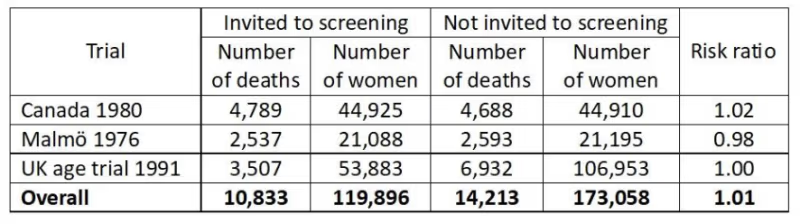
This is a very strong result as it is derived from a total of 25,046 deaths. We can therefore say with great confidence that mammography screening does not save lives.
If we restrict the analysis to the two trials with a very long follow-up, the result is the same, a risk ratio of 1.01 (0.99 to 1.04).
Breast Cancer Mortality Is a Seriously Flawed Outcome
It will surprise most people to learn that we cannot trust what has been reported in the randomised trials about the effect of screening on breast cancer mortality but this is an objective fact.6
A minority of the women who died were autopsied, and in several trials, cause of death was not assessed blindly.6 I have documented that assessment of cause of death was seriously biased.6,9 If we include all trials in the analysis, we would expect to see the greatest reduction in breast cancer mortality in those trials that were most effective in lowering the rate of node-positive cancers (cancers that had metastasised) in the screened group.
This was indeed the case, but the regression line was in the wrong place. It predicts that a screening effectiveness of zero (i.e. the rate of node-positive cancers is the same in the screened groups as in the control groups) results in a 16% reduction in breast cancer mortality (95% confidence interval 9% to 23% reduction).6,9 This can only happen if there is bias, and further analyses showed that assessment of cause of death and of the number of cancers in advanced stages were both biased in favour of screening.
Systematic reviews that include all the trials, also the poorly randomised ones, have reported that mammography screening reduces breast cancer mortality by 16-19%.6,10 As this estimate is of the same size as the bias in the regression analysis, this suggests that screening does not lower breast cancer mortality.
Another reason why breast cancer mortality is a flawed outcome is that screening leads to overdiagnosis, which is the detection of cancers and precursors to cancer (carcinoma in situ), which would not have come to the attention of the woman in her remaining lifetime and therefore would not have become a problem without screening. Since it is not possible to distinguish between harmless cancers and dangerous ones, they are all treated, and radiotherapy and chemotherapy given to women who are healthy increase their mortality.6
If we take into account the cardiac and lung cancer deaths caused by the type of radiotherapy used when the screening trials were carried out and generously assume that screening reduces breast cancer mortality by 20% and results in only 20% overdiagnosis of healthy women, then there is no mortality benefit from screening.11
Finally, it is noteworthy that the most unreliable trials were those that reported the greatest reductions in breast cancer mortality.6 The difference in the effect estimates between the adequately randomised trials and the poorly conducted trials was statistically significant, both after 7 and 14 years of follow-up (P = 0.005 and P = 0.02, respectively).12
Total Cancer Mortality
Since misclassification of cause of death often concerns deaths from other cancers,6 total cancer mortality is a less biased outcome than breast cancer mortality.
Some trialists have not reported what the total cancer mortality was but we have data from the three adequately randomised trials.6,8 There was no effect of screening on total cancer mortality, including breast cancer, risk ratio 1.00, 95% confidence interval 0.96 to 1.04. There were two different age groups in the Canadian trial, 40-49 (a) and 50-59 years (b):
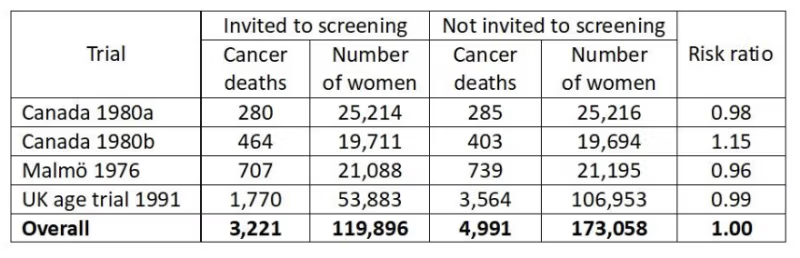
Since total cancer mortality is less biased than breast cancer mortality, it is of interest to see what the expected cancer mortality (including breast cancer mortality) would have been if the reported reduction in breast cancer mortality of 29% after 7 years in the poorly randomised trials6 were true.
It would have been a risk ratio of 0.95, which is significantly lower (P = 0.02)6 than what was actually found. This provides further evidence that assessment of cause of death was biased in favour of screening.
Breast Cancer Is Not Detected Early but Very Late
If we assume that the observed doubling times in longitudinal tumour studies are constant from initiation till the tumour becomes detectable, the average woman has harboured the cancer for 21 years before it acquires a size of 10 mm and becomes detectable on a mammogram.13
Given this large time span, it is misleading to call it “early detection” also because the effect of screening is trivial, namely to advance the diagnosis by less than a year.13
Yet all authorities repeat this mantra. As it is impossible that everyone working with cancer is unaware of the basics of tumour biology, we can draw the conclusion that the public all over the world is being misinformed. This is fraud because it is deliberate and because women think “early detection” will save their lives.
I once asked a famous tumour biologist, Keld Danø, during a coffee break at an international meeting, whether he agreed with me that it was impossible to lower breast cancer mortality by 30% with screening, based on our knowledge of tumour biology.14 He agreed. When I asked why people like him didn’t participate in the scientific debate, he didn’t reply and it is not difficult to imagine why. It is not wise to point out that your colleagues are wrong when you are on the receiving end of major funds from a cancer charity that touts screening.
The women suffer while everyone else prospers.
The earliest cell changes, carcinoma in situ, are not detected unless the women get a mammogram. In our systematic review of countries with organised screening programmes, we found an overdiagnosis of 35% for invasive cancer and 52% when we included carcinoma in situ.15
Although less than half of carcinoma in situ cases progress to invasive cancer,16,17 the women are nevertheless routinely treated with surgery, drugs, and radiotherapy.
The deep irony is that the surgery is often mastectomy because the cell changes may be diffusely spread in the breast, and sometimes even in both breasts. In New South Wales, one-third of women with carcinoma in situ had a mastectomy,18 and in the UK, carcinoma in situ was more often treated by mastectomy than invasive cancer,19 and the number of women treated by mastectomy almost doubled from 1998 to 2008.20
This brings us to the third big falsehood in the propaganda about mammography screening.
Screening Does Not Decrease but Increases Mastectomies
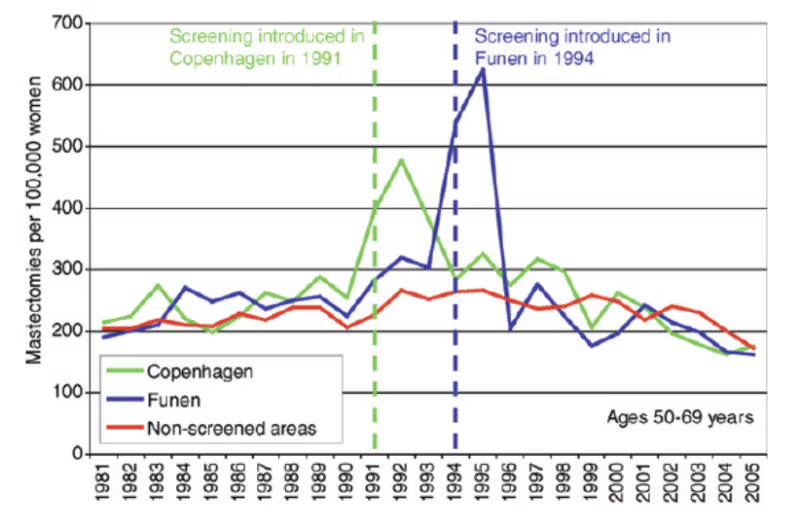
Because of the substantial overdiagnosis of invasive cancer and carcinoma in situ, and because screening only advances detection of invasive cancers slightly,13 it is inevitable that screening increases mastectomies.
In the randomised trials of screening, we found 31% more mastectomies in the screened groups than in the control groups.6
Denmark is a unique country to study this in practice as we had a period of 17 years (1991-2007) where only about 20% of potentially eligible women were invited to screening because some counties did not have screening.21 When screening starts, more breast cancer diagnoses than usual will be made and there will be more mastectomies. However, as can be seen on the graphs, the huge increases in mastectomies are not compensated by a drop in mastectomies later where there was a similar decline in mastectomies in non-screened areas as in screened areas:22
Moreover, as the next graph shows, there is no compensatory drop in old age groups:22
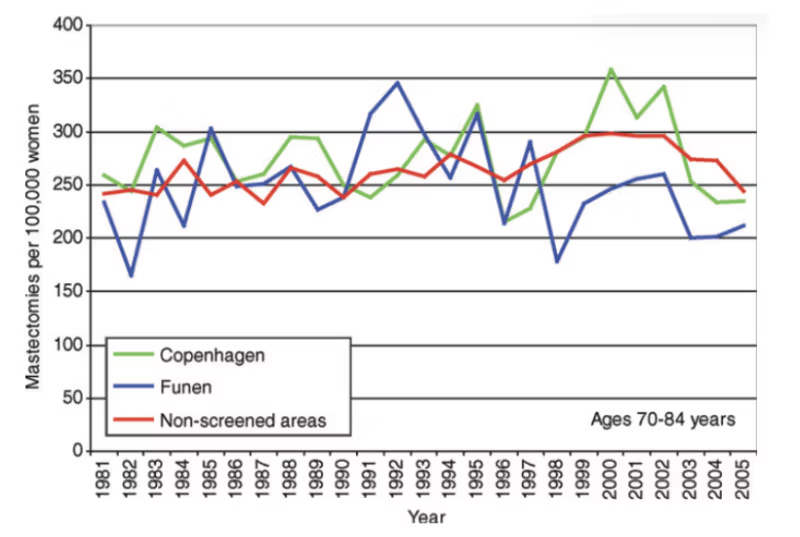
Yet women are told that screening leads to less invasive surgery, with fewer mastectomies. This is disinformation in the extreme.
The most commonly used trick used to disinform the women about this issue is to report percentages instead of numbers.3 Imagine a town with a certain level of crime. You divide the crimes into serious and less serious ones. Over a period of time, the rate of serious crime increases by 20% and the rate of less serious crime by 40%. This is a development for the worse. But although more people are exposed to serious crime and more people are exposed to less serious crime as well, a trickster would say that, as there are now relatively fewer cases of serious crime, the situation has improved.
It is deplorable that people who know better – screening researchers, cancer charities, national boards of health, etc – have lied to the public this way3 and still do, in direct contrast to logic and the scientific evidence.
The Final Layers of Dishonesty
The mammography screening area is riddled with dishonesty. So much that I needed to write a whole book detailing all the elaborate ways in which researchers and others had made it look like the Emperor was dressed when in fact he was naked.3
The deception is total because it always continued after I had pointed out in letters to the editor what the researchers had done wrong, and to which they responded.3,14 They therefore cannot claim they didn’t know that they continued to manipulate the data and to deceive the public.
Three of the most dishonest and most prolific authors are László Tabár, Stephen Duffy, and Robert Smith. Over many years, they aggressively attacked my extensive research on mammography screening but never with convincing arguments3,14 – they excel at ad hominem arguments.

László Tabár was the primary investigator for the Swedish Two-County study, an early trial that reported a huge effect of screening, a 31% reduction in breast cancer mortality.23 This trial was instrumental for introducing screening. However, there are so many serious discrepancies in numbers, and some of the findings are so implausible and incompatible with reported tumour characteristics, that it looks like scientific misconduct.3,6,24-27 Tabár has made a fortune on mammography screening and has a habit of threatening with litigation whenever anyone gets too close to his secrets.3,14,23
One would not think that Stephen Duffy is a professor of statistics because he has bent the data beyond belief and beyond what is appropriate in many creative and obscure ways.3,6,14 Robert Smith was once the Director of Cancer Screening at the American Cancer Society.
This triumvirate reported a 63% reduction in breast cancer mortality in an observational study.28 I pointed out some of the problems with their study,29 but in their reply,30 they compared women who attended screening with women who didn’t, although it is clear from their own paper that they were aware that such comparisons are seriously misleading.
These authors claimed, based on the Two-County study data, that they had found a “statistically significant 13% reduction in mortality in association with an invitation to screening.”31,32 This is plain wrong and totally impossible. Even if screening was 100% effective and prevented all deaths from breast cancer, it could not reduce total mortality by 13%.
They furthermore predicted that when a screening programme had been running for some time, one could expect a reduction of 3-4% in total mortality.31 This is also impossible unless screening prevents all breast cancer deaths. The lifetime risk of dying from breast cancer is 2.5-3%,33 and it was 3-4% in many countries before screening was introduced.
I dryly remarked in my book that if they continued their line of research for other diseases, they may find the recipe for eternal life.3 I also noted that the problem with lying is that
sooner or later people usually contradict themselves, which they did in relation to a study they had published in The Lancet.3
A common way of duping the readers is to say that early detection of breast cancer “reduces mortality”34 without specifying what kind of mortality this is, which makes the reader believe that screening saves lives.
The most common error in the screening literature could be that people falsely translate a recorded effect on mortality from a cancer into an effect on all-cause mortality. We see claims everywhere that common cancer screening tests save lives but a systematic review of the randomised trials found that the only screening test with a significant lifetime gain was sigmoidoscopy. It extended life by 110 days on average, and as the 95% confidence interval went from 0 to 274 days, this result was on the verge of not being statistically significant.35
Another common trick is to use hypothetical statements when we have certain knowledge. For example, authors may write – even in our most esteemed medical journals – that overdetection “may” occur for invasive cancers and that it “may” cause harm through unnecessary labelling and treatment of patients who, without screening, “might” never have been diagnosed.34 These are not hypothetical possibilities; they are inevitable consequences of screening.
Final Remarks
Starting in 2000, I have published numerous scientific articles, letters to the editor, newspaper articles, and two books about mammography screening that do not leave a shred of doubt that this intervention is very harmful.37
Even though I know that no one will ever be convicted, I consider it a crime that women have been systematically lured into believing that screening is good for them. According to the principles for informed consent, people must be fully informed about the most important benefits and harms of interventions they are offered, but this ethical requirement has been brutally ignored. To such a degree that in many countries, women receive an “invitation” to mammography screening with a pre-allotted time for a mammogram they never asked about.1 This makes them believe it is very important that they show up and puts pressure on them to cancel the appointment if they don’t want a mammogram taken. If they refuse, they are often subjected to highly coercive and paternalistic follow-up letters.
Here are some examples of the deeply unethical practice:1
“We have reserved a time… If the time is very inconvenient, we ask you to contact the mammography screening centre as soon as possible;” “I am concerned that you have not yet responded to our recent invitation for a screening mammogram;” “If you would like to avoid participation, we ask you to fill out a form. You obtain this form by calling the breast-diagnostic centre;” “During the past two years, over 340,000 Queensland women have benefited from taking part in the BreastScreen Queensland Programme,” “You can take a positive step to decrease your own risk, and help us achieve our goal, by deciding to take part.”
What matters is to ensure a high uptake, “our goal,” not that the women understand what they are being subjected to.
I advise women in all countries to not go to mammography screening and to do nothing if they are “invited,” which my wife did. She had no obligation to decline an “invitation” with a pre-allotted time she never asked for, and the letter made her angry.
Screening is harmful in many other ways than those I have mentioned here, e.g. between one quarter and one half, depending on the country, of all women attending screening repeatedly will experience at least one false positive result, which can be distressful for several years.36 It therefore constitutes another tremendous harm.6,14
As I have explained elsewhere,38 the Cochrane Collaboration refused to allow us to update our Cochrane review on mammography screening last year, even though I had updated it three times before and the update was only about adding more deaths to two of the trials.
Absurdly, the ”Sign-Off Editor” noted that our review might create a potentially damaging firestorm of misinformation and we were accused of having pre-conceived ideas about no benefit of screening “rather than considering it may actually have benefit not detected.” We were also forbidden to use the term overdiagnosis even though this is standard and appears in other Cochrane reviews of cancer screening, including our own.6,12
When I first published the Cochrane review, in 2001, there was a huge scandal39 because Cochrane forbade us from publishing our data on the most important harms of screening, overdiagnosis, and overtreatment.3 This should have made the Cochrane leaders handle our update professionally, but they preferred to support the prevailing dogma about screening rather than telling the women the truth.
Only one question remains: Which country will be the first to show a little sanity and respect for the science and abandon screening?
References
1 Jørgensen KJ, Gøtzsche PC. Content of invitations to publicly funded screening mammography. BMJ 2006;332:538-41.
2 Gøtzsche P, Hartling OJ, Nielsen M, Brodersen J, Jørgensen KJ. Breast screening: the facts – or maybe not. BMJ 2009;338:446-8.
3 Gøtzsche PC. Mammography screening: truth, lies and controversy. London: Radcliffe Publishing; 2012.
4 Mammography Saves Lives. American College of Radiology 2026; Feb 27.
5 American Cancer Society Recommendations for the Early Detection of Breast Cancer. 2026; Feb 27.
6 Gøtzsche PC, Jørgensen KJ. Screening for breast cancer with mammography. Cochrane Database Sys Rev 2013;6:CD001877.
7 Miller AB, Wall C, Baines CJ, et al. Twenty five year follow-up for breast cancer incidence and mortality of the Canadian National Breast Screening Study: randomised screening trial. BMJ 2014;348:g366.
8 Duffy SW, Vulkan D, Cuckle H, et al. Effect of mammographic screening from age 40 years on breast cancer mortality (UK Age trial): final results of a randomised, controlled trial. Lancet Oncol 2020;21:1165-72.
9 Gøtzsche PC. Relation between breast cancer mortality and screening effectiveness: systematic review of the mammography trials. Dan Med Bull 2011;58:A4246.
10 Humphrey LL, Helfand M, Chan BK, Woolf SH. Breast cancer screening: a summary of the evidence for the U.S. Preventive Services Task Force. Ann Intern Med 2002;137(5 Part 1):347-60.
11 Baum M. Harms from breast cancer screening outweigh benefits if death caused by treatment is included. BMJ 2013;346:f385.
12 Gøtzsche PC, Nielsen M. Screening for breast cancer with mammography. Cochrane Database Syst Rev 2006;4:CD001877.
13 Gøtzsche PC, Jørgensen KJ, Zahl PH, Maehlen J. Why mammography screening has not lived up to expectations from the randomised trials. Cancer Causes Control 2012;23:15-21.
14 Gøtzsche PC. Mammography screening: the great hoax. Copenhagen: Institute for Scientific Freedom; 2024 (freely available).
15 Jørgensen KJ, Gøtzsche PC. Overdiagnosis in publicly organised mammography screening programmes: systematic review of incidence trends. BMJ 2009;339:b2587.
16 Nielsen M, Thomsen JL, Primdahl S, et al. Breast cancer and atypia among young and middle-aged women: a study of 110 medicolegal autopsies. Br J Cancer 1987;56:814-9.
17 Welch HG, Black WC. Using autopsy series to estimate the disease reservoir for ductal carcinoma in situ of the breast. Ann Intern Med 1997;127:1023-8.
18 Kricker A, Smoothy V, Armstrong B. Ductal carcinoma in situ in NSW women in 1995 to 1997. National Breast & Ovarian Cancer Centre 2000;April 15.
19 Patnick J. NHS Breast Screening Programme: annual review 2011. NHS Breast Screening Programme 2012.
20 Dixon JM. Breast screening has increased the number of mastectomies. Breast Cancer Res 2009;11(Suppl 3):S19.
21 Jørgensen KJ, Zahl P-H, Gøtzsche PC. Overdiagnosis in organised mammography screening in Denmark: a comparative study. BMC Womens Health 2009;9:36.
22 Jørgensen KJ, Keen JD, Gøtzsche PC. Is mammographic screening justifiable considering its substantial overdiagnosis rate and minor effect on mortality? Radiology 2011;260:621-7.
23 Tabár L, Fagerberg CJ, Gad A, et al. Reduction in mortality from breast cancer after mass screening with mammography. Randomised trial from the Breast Cancer Screening Working Group of the Swedish National Board of Health and Welfare. Lancet 1985;1:829-32.
24 Zahl P, Kopjar B, Mæhlen J. Mammografistudier. Tidsskr Nor Lægeforen 2001;121:2636.
25 Gøtzsche PC, Mæhlen J, Zahl PH. What is publication? Lancet 2006;368:1854–6.
26 Zahl P-H, Gøtzsche PC, Andersen JM, Mæhlen J. Results of the Two-County trial of mammography screening are not compatible with contemporaneous official Swedish breast cancer statistics. Dan Med Bull 2006;53:438-40.
27 Gøtzsche PC. Whistleblower in healthcare (autobiography). Copenhagen: Institute for Scientific Freedom 2025 (freely available).
28 Tabár L, Vitak B, Chen HH, Yen MF, Duffy SW, Smith RA. Beyond randomized controlled trials: organized mammographic screening substantially reduces breast carcinoma mortality. Cancer 2001;91:1724-31.
29 Gøtzsche PC. Beyond randomized controlled trials. Cancer 2002;94:578.
30 Tabár L, Duffy SW, Smith RA. Beyond randomized controlled trials. Authors’ reply. Cancer 2002;94:581–3.
31 Tabár L, Duffy SW, Yen MF, Warwick J, Vitak B, Chen HH, Smith RA. All-cause mortality among breast cancer patients in a screening trial: support for breast cancer mortality as an end point. J Med Screen 2002;9:159–62.
32 Duffy SW, Tabár L, Vitak B, Yen MF, Warwick J, Smith RA, Chen HH. The Swedish Two-County trial of mammographic screening: cluster randomisation and end point evaluation. Ann Oncol 2003;14:1196–8.
33 Office of Population Censuses and Surveys. Mortality Statistics: cause 1988. London: HMSO; 1990. (Series DH2 no. 15. Table 2).
34 Irwig L, Houssami N, Armstrong B, Glasziou P. Evaluating new screening tests for breast cancer. BMJ 2006;332:678-9.
35 Bretthauer M, Wieszczy P, Løberg M, et al. Estimated lifetime gained with cancer screening tests: a meta-analysis of randomized clinical trials. JAMA Intern Med 2023;183:1196-1203.
36 Brodersen J, Siersma VD. Long-term psychosocial consequences of false-positive screening mammography. Ann Fam Med 2013;11:106–15.
37 Gøtzsche PC. Mammography screening is harmful and should be abandoned. J R Soc Med 2015;108:341-5.
38 Gøtzsche PC. Cochrane on a suicide mission. Brownstone Journal 2025; June 20.
39 Horton R. Screening mammography – an overview revisited. Lancet 2001;358:1284-5.
Dr. Peter Gøtzsche co-founded the Cochrane Collaboration, once considered the world’s preeminent independent medical research organization. In 2010 Gøtzsche was named Professor of Clinical Research Design and Analysis at the University of Copenhagen. Gøtzsche has published over 100 papers in the “big five” medical journals (JAMA, Lancet, New England Journal of Medicine, British Medical Journal, and Annals of Internal Medicine). Gøtzsche has also authored books on medical issues including Deadly Medicines and Organized Crime.
The US fell for its own Iran propaganda
By Robert Inlakesh | Al Mayadeen | March 13, 2026
The US government’s mistake with Iran has been that it clearly fell into believing its own lies. Think tanks, donors, paid advisors, lobby groups, and establishment analysts are all responsible for the catastrophic mistakes that have been made in attacking the Islamic Republic.
What was supposed to be a war, destined to be all over in four days, quickly turned into weeks, months, and now, in US President Donald Trump’s own words, a “forever” war. In order to understand why, we have to assess the way the political system in Washington works.
As we now know, US politicians are oftentimes chosen by the donor class. Most of the US Congress and Senate take considerable sums from AIPAC and affiliated pro-Israeli, pro-war donors. The Israeli Lobby not only pays its chosen politicians, but also hands them materials to run through, so that they skip to the Zionist script and position themselves as attack dogs against anyone who stands up to the lobby.
Hiding underneath this, we have think tanks, which are the policy expert wing of the lobbyists. These think tank “experts” are brought in as the brains behind the operation. They shift around between holding positions within different administrations, sitting on boards, and writing briefs or analyses for think tanks.
Then you have the mainstream media, which is owned by many of the same people funding the think tanks and lobby groups, employing articulate individuals to parrot their propaganda. The media itself is a bubble, where the so-called “reputable” outlets rely on each other for validity and help to police the boundaries of the “acceptable” discourse, meaning the likes of the New York Times, BBC, and others.
When it comes to broadcast media in specific, the top suppliers of stories, soundbites, on-the-ground footage, and leads are Reuters, AFP, and the Associated Press. Oftentimes, broadcast media channels will simply copy and paste the leads or descriptions from what these suppliers provide, altering them ever so slightly to suit their channel’s bias. That is why they often use very similar language and report the same stories for their news bulletins. Anyone who has worked in a newsroom knows this to be the case.
This trio of information control, which often intersects and enjoys some crossover, is what pollutes the minds of the masses on a daily basis. This is important to understand in order for the rest of this article to make sense.
Falling for their own lies
In the lead-up to the illegal attack on the Islamic Republic of Iran, the Western ruling class constantly repeated the idea that Iran and its allies were severely weakened. Revelling in what will likely prove to be a pyrrhic victory in Syria, with the installation of a pro-US Zionist collaborator regime in Damascus, the annihilation of Gaza’s infrastructure, along with the severe blows to Hezbollah’s leadership, all three elements of the Zionist information control system began to grow arrogant.
Think Tanks like the Zionist Washington Institute for Near East Policy (WINEP) held a series of conferences about the disarmament of Hezbollah and discussed how the so-called Gaza ceasefire was supposed to be weaponized in “Israel’s” favour, while discussing war on Iran as if it was like putting down a once dominant racehorse with a broken leg.
Still, today, if you look at WINEP’s homepage, there are analysis pieces, written by Zionists salivating over a victory over Iran and envisaging how the future will pan out in a West Asia dominated by the Israelis. “The Middle East’s 1919 Moment” and “A Levant Without Militias” discuss the downfall of Iran and Hezbollah, respectively. Even at a time of great crisis for the Zionist entity, they cannot help but fantasize about how they will dominate in the future.
The trio of information control has created a parallel universe for themselves, one which they continue to cling to, for fear of shattering their entire view of reality.
When Donald Trump and Israeli PM Benjamin Netanyahu claimed to have greatly degraded Iran, it wasn’t just them speaking; they were in lockstep with the think tanks, lobbyists, and donors. Just as was the case when former US envoy to Lebanon, Morgan Ortagus, confidently asserted that Hezbollah was defeated.
For them, assessing the realities on the ground was no longer a priority; what was important was bolstering a narrative that would lead to the war that the Zionist entity desired. In essence, what they had done was fall for their own nonsense.
All of this stems from the psychological blow the Zionist regime and its loyal supremacist backers suffered on October 7, 2023. When a few thousand Palestinian Resistance fighters, armed with light weapons, tore down the illusion of the Israeli surveillance regime and collapsed its southern command within hours, the Zionists went into a kind of mental hysteria.
Suddenly, on that day, it was proven that the theory of Hezbollah’s late Secretary General, Sayyed Hassan Nasrallah, was correct: “Israel” is indeed weaker than a spider’s web. This meant for them that two things had to be achieved: the first was that their so-called “deterrence capacity” had to be re-established, which they believed would be achieved through committing the world’s first live-streamed genocide.
The second imperative was that the Zionist project had to be rapidly accelerated. At first, this appeared unlikely, yet their perceived successes in Lebanon and Syria appeared to give them the impression that it was possible.
Along comes the second Trump Presidency, which was bought and paid for by the Zionist billionaire class.
Donald Trump, a man with a vocabulary no greater than that of a 10-year-old, is their perfect puppet. Not only this, his entire administration is staffed with ultra-Zionists or paid shills who lack basic intelligence. Therefore, the Zionists saw that this was the perfect time for them to hatch the last phase of their so-called master plan to expand their regime and rule the entire region.
In the process of doing this, the Zionists dismantled the United Nations and the notion of International Law, instead ushering in “the law of the jungle.” There are no longer international norms or red lines, just total chaos.
Meanwhile, as this was going on, the Zionists adopted the attitude toward the global population that they should be scared into submission; should they dare stand up to oppose the tyranny everyone has watched unfold before their very eyes. When they are surprised because things aren’t going their way, they cry victim and, in a fit of rage, attempt to punish you. This is a reflection of their unstable mental state.
All of this is relevant because it explains how we have gotten to this point and why this trio of information control has bought into their own nonsense. The war on Iran was evidently going to be a catastrophe, but they did it anyway. Those of us who have been monitoring the situation could also tell that Lebanese Hezbollah was far from militarily finished, which the Israeli media are now beginning to come to terms with.
What do they do now that the situation is getting out of hand? They censor and desperately lie to cover their tracks. They censor their deaths, lie about the destruction and missile hits, fake air defense victories, and claim tactical and operational military victories that don’t exist. One example of this is the US Trump administration, which claimed to have destroyed Iran’s navy during the first days of the war and still brags about sinking new ships.
The Israelis take things even further: with dozens of military vehicles hit and their soldiers falling into ambush after ambush in Lebanon, only two soldiers have died, according to them. They have even banned the filming of Iranian and Hezbollah missile strikes, threatening their own population with fines and jail time for doing so. Sometimes, they will claim to have intercepted all incoming projectiles or say they fell in open spaces, yet not too long after, published videos show direct hits. It’s getting so bad there, in terms of censorship, that their own people are getting agitated.
These people lived in a “reality” where Hezbollah was weak and Iran was weak, claiming that it had only a few thousand missiles and a handful of launchers; a “reality” in which killing Iran’s leader, Sayyed Ali Khamenei, would instantly lead to regime change, where the Iranian people would suddenly fight against their government because Netanyahu told them so. Perhaps the only thing they don’t believe is their laughable lies about Iranian protester deaths; that nonsense is reserved for the Pahlavist cult.
As the entire planet is witnessing, Iran and the Axis of Resistance that it backs are far from weak. Their determination is strong, and their capabilities are clearly greater than the Zionists expected. The longer this insane arrogance continues, the worse things are going to get, because just as we saw in the Gaza Strip, nobody is about to back down and become the slaves of the terrorist entity occupying Palestine.
Sorry, The New Republic, Climate Change Isn’t Causing Somali Migration. Blame Civil Strife and Poverty.

By Linnea Lueken | Climate Realism | March 10, 2026
The New Republic (TNR) posted an article titled “Somali Immigrants Fled Climate Change. Now They’re Facing ICE,” claiming that Somali migrants in the United States have been driven out of their country by climate-change caused drought. This is false, or at least incomplete. Drought is a natural part of the region, even multi-year drought, and the present one is no different than the region has experienced with some regularity historically. It is civil strife and government corruption, resulting in continued poverty, that is leading Somalis to flee their homeland. With present governing institutions and security, they have been unable to improve water handling practices. Climate change has nothing to do with Somali emigration elsewhere in the region or to the United States, as even those interviewed for the article acknowledge.
TNR undermines its titular claim that unprecedented man-made climate change has forced Somalians to migrate by admitting that Somalian culture has “deep-rooted traditions of movement and migration.” TNR goes on to say that “Somalis have been caught in civil war and unrest for decades, and many have migrated to Kenya, Ethiopia, Europe, and the United States.”
Somehow not noticing the actual central point of that statement, that Somalians often move and that political strife has kept them destabilized, TNR says that climate change plays a “pervasive role” in the migration.
TNR claims that a multi-year drought “made a hundred times more likely due to warming caused by fossil fuel emissions—is affecting Somali people’s decisions to either relocate internally or migrate across international borders.”
Incredibly, later in the article, TNR refutes its own suggestion that this drought is worse, and pushing unprecedented migration, by explaining that this is how farmers have long dealt with drought in Somalia:
Traditionally, Somali pastoralists had resilient ways to deal with changes in rainfall and drought patterns, where families migrated and moved on a regular basis, even crossing borders in the process. But the nature of climatic changes—and conflict—overwhelmed their traditional capacities, leading to more rural-urban migration within the country and in East Africa.
That’s right, severe drought is something Somalians have dealt with for ages, long enough to have known traditions regarding adaptation to the dry periods.
There is no evidence that this drought is worse than those that drove historic migration.
The cited claim that recent drought in Somalia was made “a hundred times more likely” by climate change is not based on sound science. It comes from an attribution study from World Weather Attribution that specifically seeks to tie various weather conditions to human-caused climate change, they do not come to any other conclusions. Climate Realism has gone into the specifics of how unscientific World Weather Attribution studies are here, here, and here.
The TNR piece says that “[f]rom 2020 to 2023, the East Africa region had five failed rainy seasons, an unprecedented drought and climatic episode not seen in 40 years, which led to 70 percent crop loss, three million livestock deaths, and the displacement of about 2.9 million people in Somalia, according to some estimates.”
Admitting that a weather event also happened 40 years ago should tell a writer that their argument about something being “unprecedented” – meaning, without precedent, or never happened before—is faulty.
In fact, studies and data show a long history of swings between severe drought and monsoon floods in the region, and they show that nothing about modern drought is unprecedented. Paleo studies, including one published in Science, show that “intervals of severe drought lasting for periods ranging from decades to centuries are characteristic of the monsoon and are linked to natural variations in Atlantic temperatures.”
Climate Realism has covered this very claim before: In Anthony Watts’ “No, CBS News, Drought in Somalia is Not Being Driven by Climate Change,” he compared natural weather-driving patterns like the Atlantic Meridional Oscillation (AMO) and recent drought in Somalia and found repeated patterns of drought that were similarly severe.
Somalia is part of the Sahel region, and Watts shared this graphic of the region’s rainfall index since 1900, which shows that the rainfall in the Sahel varies widely over time:
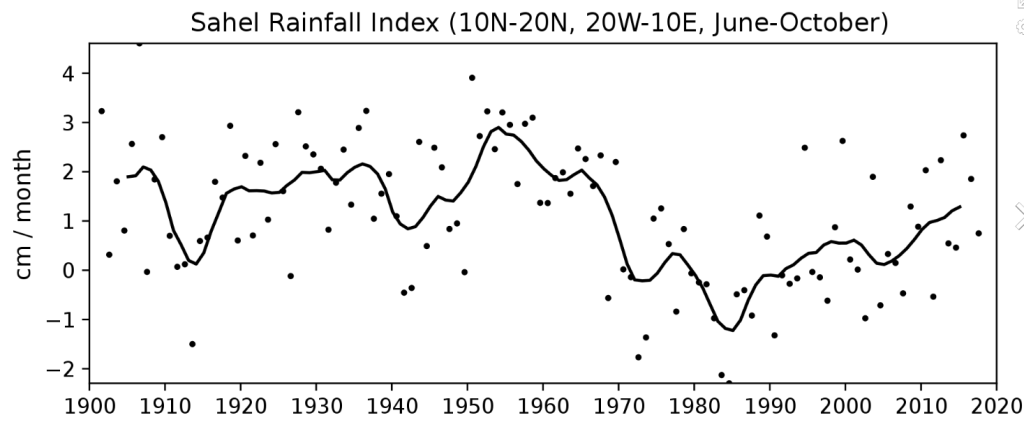
Figure 1: More than a century of rainfall data in the Sahel show an unusually wet period from 1950 until 1970 (positive index values), followed by extremely dry years from 1970 to 1991. (negative index values). From 1990 until present rainfall returned to levels slightly below the 1898–1993 average, but year-to-year variability was high. Source: Benedikt Seidl – based on JISAO data
Additionally, comparing crop production data between Somalia and neighboring countries like Ethiopia and Kenya reveals that even when drought impacts East Africa, Somalia is uniquely incapable of maintaining agricultural production. During the same period in which Ethiopia and Kenya saw increasing production in vital cereal crops, UN Food and Agriculture Organization (FAO) data show Somalia declining. (See figure below)
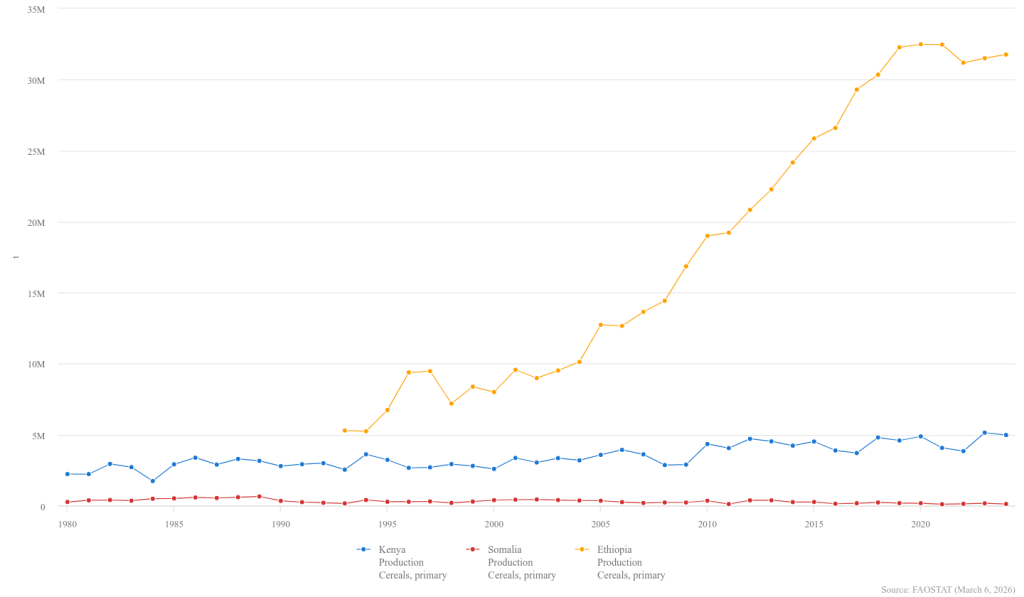
Is climate change not hitting Kenya and Ethiopia? What is the difference?
While Somalia has a long history of severe, recurring droughts, the worst drought in the past 50 years was the “Long-tailed Drought” from 1973 to 1975. That drought, and a subsequent similarly deadly drought in the early 1980s, occurred when the Earth was in a cooling spell and atmospheric carbon dioxide was much lower than today.
Somalia’s civil war and resulting destruction and corruption is the prime force behind Somalia’s emigration. Ironically, one of the interviewees in the TNR piece says as much:
Drought does not necessarily lead to famine and does not always lead to migration,” said Abdi Samatar, a Somali scholar and geographer at the University of Minnesota […] Somalis were unable to “put Humpty Dumpty back together in their country,” and in the absence of government support, “people have to do what they can for themselves,” Samatar added.
We at Climate Realism could not have said it better ourselves, though we have explained as much in past articles where mainstream outlets tried to link climate change and Somalia’s migration issue.
The New Republic’s effort to tie Somalians fleeing their country for the United States to climate change was a flawed, agenda-driven effort from the start. Even when those interviewed by TNR link the mass exodus of residents from Somali to other factors, TNR persists in pushing the narrative that climate change is playing a “pervasive role.”
It is true that Somalia is suffering through a severe, life threatening drought. It is also true that such droughts are not unprecedented but have been common throughout the region’s history. The nation’s unstable government and the ongoing, long-standing, civil war bear far more of the blame than climate change, especially since there is little or no evidence that Somalia’s climate has changed much over the past century.
The current drought is hitting Somalia’s populace worse than those of nearby countries in the region because of the political instability there. The New Republic was told this by the experts they interviewed but chose to ignore it to advance a climate scare story. Evidently, it’s too much to hope for honest journalism at The New Republic.
Linnea Lueken is a Research Fellow with the Arthur B. Robinson Center on Climate and Environmental Policy.
What If Iran Says No?
Is an end to fighting currently possible?
Ashes of Pompeii | March 10, 2026
Rumors persist that the Trump administration is actively seeking an off-ramp to the escalating conflict with Iran. The prevailing assumption within certain circles of the White House is that Tehran, having sustained serious damage from recent military strikes, would welcome a cessation of hostilities. This calculation, however, rests on a dangerous misreading of Iranian resolve, historical grievance, and strategic necessity. What if Iran says no?
The first and most fundamental obstacle is trust. Can Iran reasonably trust any promise made by Donald Trump? The historical record suggests otherwise. The unilateral withdrawal from the JCPOA in 2018, despite verified Iranian compliance, established a precedent of bad faith. Yet, the breach of trust goes deeper than past policy. The February 28 surprise attack was not merely a military strike; it was launched in the midst of ongoing peace talks. To strike while negotiating is the absolute most serious breach of diplomatic trust possible. It signals that words are meaningless and that force is the only language recognized by Washington. For Iranian leadership, any verbal assurance offered today carries the weight of tomorrow’s tweet. Diplomacy requires a foundation of credibility; that foundation has been systematically dismantled.
Second, the ideological makeup of the opposing governments creates a structural barrier to compromise. The current Israeli government is composed of extremist Zionists whose platform often rejects coexistence in favor of maximalist territorial and security demands. Simultaneously, Christian Zionists hold an important role in the Trump administration, viewing conflict in the Middle East through a theological lens that favors escalation over diplomacy. This alignment makes compromise with Iran inherently harder. For these factions, concession is not strategy; it is heresy. What demands could Iran make that would credibly constrain Israeli action? Binding security guarantees from the United States would be required, yet Washington’s ability to restrain its ally in moments of crisis is historically limited. Conversely, any Iranian demand for verifiable, long-term restrictions on Israeli military operations would likely be viewed in Jerusalem as an unacceptable infringement on sovereignty – a potential casus belli in itself.
Third, any serious Iranian negotiation would inevitably demand the removal of American military bases from the Persian Gulf. From Tehran’s perspective, these installations are not defensive outposts but forward operating bases for coercion and regime-change planning. Their presence is an existential threat. Yet for any American president, particularly one branding himself as a champion of strength, agreeing to withdraw forces from Bahrain, Qatar, or Kuwait would be politically untenable. It would be framed domestically not as diplomacy, but as retreat. Trump, who measures success in visible, declarative terms, could not sell a deal that requires abandoning strategic assets as a victory.
Fourth, Iran would demand the immediate and comprehensive lifting of sanctions. The economic toll of the pressure campaign has been severe, but capitulation without full relief would be seen as surrender. However, an immediate, total sanctions lift is a non-starter for the administration. It would undermine the central lever of U.S. pressure and invite fierce criticism from allies and domestic opponents alike.
And it is not worth even discussing the reaction to likely Iranian demands for reparations from America or Israel.
Underpinning all these structural obstacles is a profound cultural and emotional reality. Iran has raised the red flag of revenge. For Shiites, this is not merely political rhetoric; it is a religious imperative rooted in the tragedy of Karbala. Martyrdom and the justice due to martyrs cannot be so easily forgotten or forgone for political expediency. The rage in Iran for the February 28 attack is enormous, compounded by the perfidy of being struck during negotiations. A return to the status quo ante is not possible. The leadership that agrees to such terms risks being seen as weak, or worse, complicit in the betrayal of the faithful. And let us not forget, it is the son of the murdered Supreme Leader who has now been chosen as the new spirutual leader of Iran. This selection, in itself, can be seen as a slap in the face for Trump, who was demanding a say in the selection of the new leader.
The Trump administration appears to operate under the assumption that it holds total control over the escalation and de-escalation process. This is a critical miscalculation. Iran is not a passive recipient of U.S. policy but a strategic actor with its own red lines, domestic imperatives, and regional alliances. Tehran has demonstrated both the capacity and the will to act, and to retaliate when necessary. Diplomacy is a dialogue, not a dictate.
The central question, therefore, is not whether the United States can offer an off-ramp, but whether Iran can accept it. If the answer is no – and the points above suggest compelling reasons why it might be – then the conflict enters a more dangerous, protracted phase. Miscalculation risks increase. The assumption that pain alone will produce compliance ignores the role of pride, sovereignty, faith, and survival in strategic decision-making. Before celebrating a potential exit, policymakers must confront an uncomfortable truth: Iran has a say. And if Tehran chooses to say no, the path forward grows darker, longer, and far less certain. Added to this, Trump’s emotional, some would say vindictive, character would suggest that an Iranian refusal would lead him to escalate further.
Therefore this potential off-ramp may exist on a map in Washington, but in Tehran, the road ahead may still lead only forward, into not a storm, but a full blown global hurricane.
Iran’s latest move in the GCC countries was a stroke of genius
By Martin Jay | Strategic Culture Foundation | March 9, 2026
After just a week into Donald Trump’s war, there is very little to report which should or could please the U.S. president. Much of America’s infrastructure in the Middle East has been destroyed with U.S. soldiers now housed by hotels in GCC countries as there is nothing left of their bases. The stocks that these countries have as part of their air defence systems is almost depleted as military chiefs argue about how quickly they can be replaced (some THAAD and Patriot systems are being shipped from Japan and South Korea) and Iran is hitting Israel harder and harder each day.
Of course, due to the new draconian rules which Israel has imposed — that no military strikes that Iran succeeds in carrying out can be ‘reported’ on by journalists or even citizens who wish to post it on social media — as well as the comically corrupt, partisan way U.S. news outlets are covering the war, very little bad news gets seen by the public, if any.
Under this set up, it is hardly surprising that Trump went to war, given that he must have factored in a great deal of support from U.S. media, whom he claims to despise. In this regard, we can conclude that media itself is complicit in war crimes, given that it has played a huge role in the decision to go to war and also the day to day reporting of events on the ground.
A good example of the few points of the war which are reported, but done in such a distorted way, is the news that Iran has stopped its bombing of GCC Gulf states. This has been presented as a victory by the U.S. and a climb down by Iran. The truth though is that it is a considerable victory for Tehran as what is not being reported or even examined is the deal that Iran has struck with those countries. None of those countries will allow any kind of military activity now by U.S. forces there, which means the thousands of U.S. soldiers in hotels in these GCC countries might as well head back home as their role there is redundant. Of course it’s unlikely that Trump will move them out as such an event will be captured by many on social media and will look like a great defeat. But some analysts are going further and speculating that there is more bad news for Israel and the U.S. with this latest move. Not only has Iran insisted on no activity at all in these countries by U.S. forces but they have also said that when the war is over, all the bases must be completely shut down.
Sadly, the gesture didn’t hold for long as it is rumoured that Iran’s elite guard was angered by Trump’s response and so the missile attack on the GCC countries continued.
Against a backdrop of rumours spreading throughout the middle east that Saudi Arabia, UAE and Qatar were considering jointly to completely pull out their investment in the U.S., this move, even as a gesture, couldn’t have come at a worse time for Trump.
His media machine is working overtime in spewing out so many fake news reports, like the recent one that the U.S. has total air superiority over Iran, that it will be interesting to see how this is spun in the coming days. But there is nothing but lies from the Trump camp and as a complicit western media scrum is happy to pump out these lies, people are obviously turning to social media or international news channels in the global south, like CGTN and Russia Today. For many Americans, they are simply too dumb to know how to even question the narrative. Where is the video footage to support these preposterous claims that American has air superiority over Iran? Within 24 hours of Trumps B2 bombers hitting nuclear sites in Iran last year in June, media were given video clips of the satellite imagery. So far, the claims by Trump’s people about air superiority, have not been matched with any evidence. None the less U.S. media reports it more or less like it is fact.
It’s a similar story with the claims about the U.S. navy sinking 20 Iranian vessels. Where’s the evidence? If we are to take into account completely defenceless ships like the unarmed frigate that was sunk in international waters after it returned from a joint exercise with India, it would seem that America is on the losing side. Not even Japanese naval strikes in the WWII would blow up enemies’ ships and not then pick up survivors. The Americans left 80 sailors to drown, the same seamen who posed with photos days earlier with Prime Minister Modi, who, it should be pointed out often claims that India is the “guardian of the Indian ocean”, a patently absurd claim. Many believe Modi sold the Iranians out and disclosed its position to the Americans, leaving many to question just how much he can be trusted with his present allies. Will Russia still sell its oil to India after such a betrayal?
It’s clear that the Iran war is already WWIII in many respects. Certainly each side has its partners and media have made much of Russia’s intelligence support to Iran pointing out American positions, while China has given Iran considerable military support both in state of the art radar systems and ground to air missile systems. The sinking of the Iranian ship shows us all the depth of the desperation of America, that it needs to go as far as hunting for Iranian ships thousands of miles away and sinking them, even if they are unarmed as this ship was. Does that look like the act of a confident aggressor on a victory role? Hardly.
It isn’t just that America can barely hold the high moral ground for even a brief, ephemeral media moment, but more that the number of shocking tactical errors by Trump are piling up and having an impact. The failure to see that killing the supreme leader, who has been replaced by a hard liner who has always wanted Iran to have a nuclear deterrent, was a major act of stupidity. Nearly all U.S. wars follow the same pattern of America underestimating its enemy and overestimating its own capabilities and this one is no exception. The move to bring GCC states closer to Iran and turn them against the U.S. is smart and what we could expect from Iran who has had years to prepare for this attack and has been given so many free lessons by America’s blunders — the best one being the June attack which resulted in Iran upping its game and identifying all the weak spots which needed work. The biggest miscalculation probably of all is going to war in the first place believing that regime change would be inevitable in days and therefore no longer-term plans, in terms of military stocks, need to be addressed. America is about to run out of ammo. For the GCC countries, it’s quite possible that the deal might be reinstated in the coming days as a new truth emerges from the war. While Donald Trump tells reporters on Air Force one that Iran was responsible for bombing its own school, GCC leaders will have to wake up to a new reality which is summed up by Henry Kissinger. “It may be dangerous to be America’s enemy, but to be America’s friend is fatal.”
A Second Vietnam War? Hanoi Waits and Prepares
By José Niño | The Libertarian Institute | March 9, 2026
On the surface, everything between Vietnam and the United States looked better than it ever had. In September 2023, President Joe Biden and General Secretary Nguyễn Phú Trọng signed a Comprehensive Strategic Partnership, elevating relations to their highest diplomatic tier. American officials toasted prosperity. Vietnamese leaders smiled for cameras. The messaging suggested a new chapter in a relationship once defined by napalm and body counts.
Then, in early February 2026, a very different story emerged from behind the curtain. The 88 Project, a U.S.-based human rights organization focused on Vietnam, exposed a classified internal military document that shattered the diplomatic facade. The revelation was subsequently covered by AP News, The Diplomat, and Le Monde. Vietnam’s Foreign Ministry did not respond to requests for comment.
The document bore the formal designation 357/KH-BTL and carried the title “The 2nd U.S. Invasion Plan.” Signed by Vice Admiral Tran Thanh Nghiem and certified by Rear Admiral Vu Van Nam, it was issued by Vietnam’s Navy Command in August 2024, months before Donald Trump returned to office for his second term. Its contents painted a picture of a government that publicly embraced Washington while privately treating it as the gravest threat to its survival.
Vietnamese military planners described the United States in the document as a “belligerent” superpower with a pattern of “creating a pretext” to launch wars against nations that “deviate from its orbit.” The plan acknowledged that the present risk of armed conflict remained low, yet insisted that America’s aggressive nature demanded constant vigilance.
The operational scenarios imagined within the plan read like something from a Cold War thriller. Vietnamese planners envisioned a full-scale American assault involving two to three aircraft carrier strike groups, three to four Marine brigades, and amphibious landings along the country’s vast coastline. In the most alarming passage, the document speculated that if conventional methods failed, the United States “may use biochemical and tactical nuclear weapons.”
Vietnamese analysts traced what they saw as an escalating pattern across three administrations. They pointed to President Barack Obama’s pivot to Asia, Trump’s first term (described as inciting an arms race), and Biden’s institutionalization of the Indo-Pacific Strategy. All of it, according to Le Monde, was portrayed as Washington forging a united front against China.
Ben Swanton, co-director of The 88 Project and author of the analysis, emphasized that this thinking was not confined to one paranoid faction. “There’s a consensus here across the government and across different ministries,” he told AP News. “This isn’t just some kind of a fringe element or paranoid element within the party or within the government.”
Perhaps the most revealing element in the plan was how Vietnam’s military ranked its adversaries. According to The Vietnamese Magazine’s analysis, China occupied the position of a “Category 3” adversary. That meant Beijing was seen as a territorial rival that contested borders and maritime claims but did not threaten the Communist Party’s hold on power.
The United States occupied a far more dangerous position. American power was classified under “Category 1” and “Category 2” designations, meaning Washington represented an existential threat to the regime itself. In the eyes of Vietnamese military planners, China wanted territory. America wanted the party gone.
This distinction carried explosive implications. Nguyen Khac Giang of Singapore’s ISEAS-Yusof Ishak Institute, speaking about the Communist Party’s conservative and military-aligned faction, told AP News that the military had “never been too comfortable moving ahead with the Comprehensive Strategic Partnership with the United States.” The tensions had already surfaced publicly in June 2024, when an army television report accused the American-linked Fulbright University of fomenting a “color revolution.” The Foreign Ministry defended the university, which American and Vietnamese officials had highlighted when the two countries upgraded ties, but the episode revealed how deep institutional suspicion ran.
The most dangerous element in the leaked plan was never the fantasy of aircraft carriers and nuclear weapons. It was the way the document conflated civil society with warfare. Vietnamese planners drew explicit parallels to Ukraine’s 2004 Orange Revolution and the Philippines’ 1986 Yellow Revolution, portraying the American promotion of freedom, democracy, and human rights as opening salvos designed to “undermine and ultimately dismantle Vietnam’s socialist political system.”
By branding activists, journalists, and pro-democracy reformers as foot soldiers in a CIA-directed Color Revolution, the Communist Party of Vietnam (CPV) used this subversion as a pretext to justify a major domestic crackdown. Starting around 2020, the CPV mobilized all branches of government to “prevent the US and its allies from fomenting a color revolution in the country,” according to a report by Le Monde. Advocacy for religious freedom or labor rights became, in the party’s framing, acts of war.
None of this meant Vietnam was irrational, or even unusual. Military contingency planning for worst-case scenarios is standard practice everywhere. Even the leaked document itself acknowledged that war remained “low risk.” The United States maintains its own history of drafting invasion plans against allies, from “War Plan Red” for Canada in the 1930s to plans to seize Middle Eastern oil fields in 1973. The “Hague Invasion Act” of 2002, still active, authorizes the president to use military force to free U.S. personnel held by the International Criminal Court. Washington’s abduction of Venezuelan President Nicolás Maduro in January 2026 only deepened Vietnamese fears that the pattern was accelerating.
Vietnam’s foreign policy framework reflected this pragmatic paranoia. Hanoi’s famous “Four Nos” defense policy, reaffirmed by Prime Minister Phạm Minh Chính in August 2023, pledged no participation in military alliances, no siding with one country against another, no foreign military bases on Vietnamese soil, and no use or threat of force in international relations. Under this doctrine, Vietnam maintained comprehensive strategic partnerships with the United States, China, and Russia simultaneously. The approach, often described as “bamboo diplomacy” after a metaphor coined by the late General Secretary Trọng, allowed Hanoi to bend with shifting geopolitical winds without breaking.
The history of the Vietnam War gave these calculations a visceral dimension. The conflict killed approximately 3.1 million Vietnamese people according to the government’s own 1995 estimates, including roughly two million civilians. The National Archives records 58,220 American military fatalities. That staggering asymmetry reflected the reality of a war fought entirely on Vietnamese soil with industrial-scale firepower. For Vietnamese military planners, the idea of a second American invasion was not a paranoid abstraction. It was a memory that shaped every calculation they made.
It doesn’t help that the United States has a long track record of intervening and destabilizing countries in all corners of the globe. Such a track record of U.S. perfidy is being considered by Vietnamese strategists. Washington will dismiss this document as the paranoia of aging generals. Hanoi will pretend it never existed. But somewhere between the diplomatic toasts and the classified war games, the truth sits undisturbed. Vietnam remembers what America did the first time. And with a track record of interventions stretching from Guatemala to Venezuela, the United States has given Hanoi every reason to believe it could happen again.
How An Atrocity Propaganda Campaign Led To The U.S. And Israel Committing Real Atrocities In Iran
The Dissident | March 8, 2026
In their war on Iran, the U.S. and Israel have already committed an endless slew of atrocities against Iranian civilians.
The Iranian Red Crescent has documented that the U.S. and Israel have targeted “9,669 civilian structures, including 7,943 residential homes and 1,617 commercial buildings” along with “several medical and educational facilities”.
Along with this, the U.S. and Israel have so far killed at least 1,332 Iranian civilians.
The U.S. and Israel have not hidden the fact that they are slaughtering civilians in Iran.
Benjamin Netanyahu, at the site of an Iranian missile attack, said , “Remember what Amalek did to you. We remember, and we act” in reference to the Hebrew bible verse, “go and destroy Amalek. Destroy all they have, and do not let them live. Kill both man and woman, child and baby.”
Meanwhile, U.S. Defense Secretary Pete Hegseth said, “the only ones that need to be worried right now are Iranians that think they’re gonna live” and boasted about unleashing “Death and destruction from the sky all day long”, on Iran.
This war of “Death and destruction” on Iranian civilians and civilian infrastructure, with the goal of destroying Iran as a nation, was only made possible thanks to an atrocity propaganda campaign, designed to portray this criminal war as an act of protecting Iranians from atrocities.
This first began with the U.S. and Israel engineering riots in the country in an attempt to instigate violence that could be used to justify the war.
When protests in Iran broke out before the war due to economic concerns, U.S. Treasury Secretary Scott Bessent was not shy about the fact that the protests were the intended result of U.S. sanctions on the country, saying:
What we can do at treasury, and what we have done, is created a dollar shortage in the country, at a speech at the Economic club in New York in March I outlined the strategy, it came to a swift -and I would say grand- culmination in December when one of the largest banks in Iran went under, there was a run in the bank, the central bank had to print money, the Iranian currency went into free fall, inflation exploded and hence we have seen the Iranian people out on the street.
If you look at a speech I gave at the economic club of New York last March, I said that I believe the Iranian currency was on the verge of collapse, that if I were an Iranain citizen, I would take my money out.
President Trump ordered treasury and our OFAC division, (Office of Foreign Asset Control) to put maximum pressure on Iran, and it’s worked because in December, their economy collapsed, we saw a major bank go under, the central bank has started to print money, there is a dollar shortage, they are not able to get imports and this is why the people took to the streets.
Meanwhile, the U.S. and Israel were pushing propaganda in Iran in an attempt to spur on protests.
The University of Toronto’s Citizen Lab uncovered an Israeli bot network in Persian on social media which pushed “content related to the country’s ongoing water and energy crisis” and “energy shortage” in a “likely attempt to continue to escalate tensions between Iranian citizens and their government”.
Damon Wilson, the head of the U.S. government’s National Endowment for Democracy, boasted that the U.S was doing a similar thing, saying:
the endowment has been making investments over years that have ensured that there have been secure communications, including Starlinks, other means, file casting that allowed information to go both in and out of the country (Iran) at a time when the regime tried to hide its brutal crackdown
Part of what we see manifesting is a response that our partners have helped tell the Iranian people the story that the regime has squandered their own resources on supporting proxies throughout the Middle East to the point where they cannot manage their own water supplies for Tehran. And these stories have not just emerged, they are ones that have been covered, documented, and shared with the Iranian people consistently through our work.
We’ve been investing in communication tools over the years that allow for information to be sent into Iran even when internet connectivity is blocked. We specifically began supporting the deployment, the operation of about 200 Starlinks early on
After this, Israeli intelligence infiltrated the protests, which at the beginning were peaceful, in an attempt to turn them violent.
When the protests began, the Persian-language account of the Israeli Mossad wrote, “Let’s all come out to the streets. The time has come. We are with you. Not just from afar and verbally. We are also with you in the field.”
Soon after, Israel’s Channel 14 reported that, “We reported tonight on Channel 14: foreign actors are arming the protesters in Iran with live firearms, which is the reason for the hundreds of regime personnel killed.”
After the U.S. and Israel (by their own admission) helped engineer protests and infiltrated them to instigate violence, the mainstream media ran an atrocity propaganda campaign, massively over-inflating the death toll and fabricating a narrative of the Iranian government killing tens of thousands of peaceful protesters.
The atrocity propaganda claims first came from the outlet “Iran International,” which the Israeli journalist Barak Ravid said, “ the Mossad is using quite regularly for its information war”.
The atrocity propaganda was eventually amplified by Time Magazine, which wrote an article claiming that “As many as 30,000 people could have been killed in the streets of Iran on Jan. 8 and 9 alone”.
As I previously uncovered, the only named source for the atrocity propaganda claim was Amir Parasta, a German-Iranian eye surgeon and lobbyist for the son of the former U.S. backed Shah of Iran, Reza Pahlavi, who was clamouring for a U.S. war on Iran to restore the monarchy.
The evidence-free claim was soon amplified by Deepa Parent, a writer at the Guardian, who boasted that the claims were influencing politicians towards war with Iran, saying, “We don’t need to convince anyone about the massacre the IR has carried out on innocent civilians in Iran. I have trolls in my DMs and replies. Ignore them and don’t give any attention. Decision makers don’t see trolls’ tweets, they see verified accounts and reports.”
Parent soon after published an article in the Guardian amplifying the claim that Iran killed 30,000 protestors in two days- this time citing entirely unnamed sources and not providing a shred of verifiable evidence.
Digging further into Parent, journalists Wyatt Reed and Max Blumenthal of the Grayzone uncovered that she was previously a fashion blogger with no experience on Iran who began to present herself as an expert on the country after getting funding from the CIA-connected, pro regime change billionaire Pierre Omidyar.
They documented:
Before adopting the surname Parent around 2019, The Guardian’s go-to Iran reporter wrote under the name Deepa Kalukuri. Her journalistic output was largely limited to fashion reviews in Indian media. A typical piece published in India’s Just For Women magazine in 2016 was headlined: “Samantha Is Setting Some Serious Fashion Goals! Check Them Out!”
“What’s better than a Little Black Dress for a weekend party? Samantha pairs her LBD with these killer stilettos! We are loving it!!! Have a fashionable weekend!!!!”
Elsewhere, in an article informing Indian housewives that “understanding stocks is not [as] difficult as the news shows” suggested, she explained that investing was actually quite simple: “like a playing a video game but only your favorite batman is replaced with that stock broker who gives you the right advice to invest at the end of the bell.
They added:
When the “Women, Life, Freedom” protests kicked off in September 2022 following the death of a young woman in Iranian custody, the improbable Parent suddenly materialized as The Guardian’s point woman on civic unrest in a nation with which she had no apparent professional or personal experience.
Much of Parent’s work at The Guardian’s so-called “Rights and Freedom” section has been funded by an NGO called Humanity United, which was founded by tech billionaire Pierre Omidyar and his wife, Pam.
As the Grayzone noted, “Omidyar has partnered with US intelligence cutouts like USAID and the National Endowment for Democracy to promote regime change from Ukraine to the Philippines, while advancing various ‘counter-disinformation’ efforts aimed at suppressing anti-establishment viewpoints”.
This propaganda campaign – as should now be clear – was a coordinated effort to spread atrocity propaganda about the Iranian government, in order to give the impression that a war with Iran is “liberating” the people of Iran, paving the way to the mass bombing of Iranian civilians and civilian infrastructure currently unfolding.
Openly Pro-Israel Tech Group Now Has Control over UK’s Most Sensitive National Security Data
By Alan Macleod | MintPress News | February 7, 2023
This is the story of how a multibillionaire who has dedicated his life to advancing the cause of the Israeli national security state is now in control of Great Britain’s most sensitive public and military data.
In 2020, software giant Oracle won a gigantic contract with the United Kingdom’s Ministry of Defence (MoD) to provide it with cloud infrastructure, digital assistance, data visualization software, mobile hub and development tools. The military is far from the only British institution entrusting its most sensitive data to the Texas-based firm, however. The Home Office, Office of National Statistics and National Health Service, among others, also rely on Oracle databases to function.
For years before signing the MoD agreement, Oracle founder Larry Ellison had been ingratiating himself with the British establishment, employing all manner of well-connected individuals at his foundation. Among these included media executive and father-in-law of former Prime Minister Boris Johnson, Matthew Symonds, who earned over $600,000 per year as the executive director of the Larry Ellison Foundation. Richard Meredith, a longtime director of the U.K.’s Foreign and Commonwealth Office, was also snapped up at a similar salary to become deputy executive director.
Many other well-connected British government officials, including Vel Gnanendran, went straight from the Larry Ellison Foundation into the Foreign and Commonwealth Office and worked there at the time that the body signed off on the lucrative Oracle contracts. For years, the Larry Ellison Foundation also bankrolled the Tony Blair Institute for Global Change, the former U.K. prime minister’s new political project.
Yet, just after as the partnership with the Ministry of Defence was secured, Ellison abruptly shut down his foundation, prompting speculation that it had fulfilled its purpose.
“Our mission to support Israel”
Why this should be of concern is that both Ellison and key Oracle figures have made clear that their business model is less about making money, and more focused on furthering the interests of the Israeli national security state.
Furthermore, few people realize how important Oracle is to the functioning of the modern world. It is the third-largest software company globally. Yet because it sells its products to businesses and governments rather than consumers, it is far less known than competitors such as Microsoft or Amazon. Nevertheless, it is as important to the modern hi-tech economy as its rivals, its software and databases powering the likes of Netflix, Zoom, financial corporations such as JPMorgan Chase, as well as a myriad of educational institutions.
While opening a new data center in Jerusalem in 2021, the company’s Israeli-American CEO, Safra Catz, laid out Oracle’s purpose, stating,
We are not flexible regarding our mission, and our commitment to Israel is second to none. This is a free world and I love my employees, and if they don’t agree with our mission to support the State of Israel, then maybe we aren’t the right company for them. Larry [Ellison] and I are publicly committed to Israel and devote personal time to the country, and no one should be surprised by that.”
Catz made the comments in response to a question about Israel’s poor human rights record and the rebellion of Silicon Valley employees refusing to facilitate the country’s war crimes. In 2017, Catz was offered the position of U.S. Director of National Intelligence.

Safra Catz, Oracle’s CEO, poses with Alon Ben (left), CEO of Tel-Aviv-based Oracle data partner, Bynet
Ellison, if anything, is even more forthright in his support for the Israeli government and its agenda. The billionaire – currently the fourth-richest individual in the world – has bankrolled the Israeli Defense Forces (IDF) for years, giving tens of millions of dollars to the Friends of the IDF, including the largest single donation the organization has ever received. In 2017 alone, he pledged $16.6 million to build a new training facility for IDF soldiers defending, in his words, “our home”. As Ellison explained:
Through all of the perilous times since Israel’s founding, we have called on the brave men and women of the IDF to defend our home. In my mind, there is no greater honor than supporting some of the bravest people in the world, and I thank Friends of the IDF for allowing us to celebrate and support these soldiers year after year. We should do all we can to show these heroic soldiers that they are not alone.”
This was far from his first donation to the organization. Three years previously, he gave $9 million at a star-studded gala – the largest donation on a record-breaking night for the FIDF.
The big tech mogul also has a direct hand in furthering the Israeli settlement project. In 2007, he met with then-Foreign Minister Tzipi Livni to pledge half a million dollars in support to the Israeli border town of Sderot.
But if Ellison can count Livni as a friend, then Benjamin Netanyahu is virtually family. The pair have been close for many years; Ellison even flew Netanyahu out to his private Hawaiian island to vacation together. There, he offered the embattled prime minister a seat on Oracle’s board, replete with a salary of $450,000.
Netanyahu had previously gone to Ellison, encouraging him to buy out the struggling Yedioth Ahronoth newspaper in an attempt to change the outlet from an adversary of his political project into a mouthpiece for his Likud Party.
Unsurprisingly, Oracle has signed numerous deals with the Israeli national security state.
“The Israelis think they control the Foreign Office. And they do!”
In recent years, Israel and pro-Israel groups have managed to amass considerable influence over U.K. government policy. A measure of this is the fact that, by 2021, one-third of the cabinet – including then-Prime Minister Boris Johnson – were directly funded by the Israeli government or pro-Israel organizations. Chief amongst these groups is the Conservative Friends of Israel, who have claimed that 80% of Tory members of parliament belong to their organization.
The Israel lobby has been able to shape government policy, to the point where they blocked Boris Johnson’s appointment of Alan Duncan to the post of Middle East Minister. Johnson, according to Duncan, was “indignant”. “They shouldn’t behave like this”, the prime minister reportedly said about the Israelis, but acquiesced to their demands. “The Israelis think they control the Foreign Office. And they do”, Duncan later wrote. Home Secretary Priti Patel (a longtime champion of the apartheid state) also secretly flew to Israel for “off the radar” talks with Netanyahu – a huge breach of ministerial codes, for which she later resigned.
The Israeli Embassy also played a key role in the coordinated smear campaign demonizing Labour leader Jeremy Corbyn, an operation that helped to ensure Johnson’s electoral victory in 2019.
In addition to this, there have also been national security questions raised about the extent to which Israeli businessmen have bought up key British industries. Last year, for example, Patrick Drahi’s attempt to purchase 18% of BT, the formerly state-owned telecoms giant that owns and controls much of the country’s telecommunications infrastructure, was put on hold due to concerns over national security.
That a company like Oracle that defines itself so explicitly as pro-Israel raises serious concerns over the nature of the work they do for the United Kingdom or any other nation. How can the Ministry of Defence or the Home Office’s data be considered uncompromised in these hands?
The CIA in all but name
“The Oracle database is used to keep track of basically everything,” Ellison once said, adding,
The information about your banks, your checking balance, your savings balance, is stored in an Oracle database. Your airline reservation is stored in an Oracle database. What books you bought on Amazon is stored in an Oracle database. Your profile on Yahoo! is stored in an Oracle database.”
This should be of concern to everyone, as Oracle itself started off as a project for the Central Intelligence Agency. Indeed, Ellison named his company after Project Oracle, a 1970s CIA operation he worked on.
“Our very first customer was the Central Intelligence Agency,” Ellison boasted, telling the story of how, in 1977, the CIA commissioned his firm to build them a database. From there, Ellison immediately began pitching to other wings of the national security state, and within months had secured contracts with Navy Intelligence, Air Force Intelligence and the NSA. The bottomless pit of money available for the military has helped turn Oracle from a tiny operation to a $46 billion dollar per year behemoth.
One of Oracle’s largest deals came in 2020, when it was part of a consortium that won a 15-year contract with the CIA and the other 16 U.S. intelligence agencies said to be with tens of billions of dollars.
Part of the reason the CIA trusts Oracle is that the company’s upper echelons are filled with ex-CIA executives. A case in point is former CIA Director and Defense Secretary Leon Panetta, who was appointed to the company’s board in 2015. David Carney, who spent 32 years at the agency, rising to become its third-in-command, also joined Oracle, heading up its information assurance center.
Indeed, on its own website, Oracle aggressively recruits CIA agents, sharing stories of former spooks who have gone on to succeed in its ranks. One of those is Senior Technical Program Manager Andrew C. “As an Intelligence Officer in the US Navy, as well as in the CIA, Andrew has had to lead, build teams, and work on fast-breaking projects, all things Oracle requires on a regular basis,” Oracle writes, before actively encouraging other agents to apply,
Now that you’ve heard about Andrew’s experience, are you ready to join Oracle National Security Region team? If you hold a U.S. Government Top Secret SCI or higher clearance, click here to check out our latest opportunities. Once you’ve found an opening that fits your talent, passion, skills, and background, apply for us to consider you. Create the future with us.”
Oracle, a firm that stores reams of your sensitive data, openly boasts of its cozy ties to the CIA
The revolving door between Oracle and the CIA also swings the other way, with Oracle staff finding employment in Langley, VA.
The Silicon Valley giant also works closely with the U.S. military. “Oracle Cloud is advancing Department of Defense mission success”, it boasts on its website. Oracle notes that it is “delivering real-time intel to warfighters”, thereby “securing command and control at the tactical edge.” Thus, by the company’s own telling, it is a centerpiece of both the military-industrial-complex and the national security state. Big media outlets agree: “Larry Ellison is a billionaire today thanks to the CIA” concluded Business Insider.
Surveillance State
If Ellison had his way, however, Oracle would be an even more crucial part of a greatly expanded national security state. In the immediate wake of the September 11 attacks, he flew in for a series of meetings with top Bush-era officials, including NSA chief Michael Hayden and Attorney General John Ashcroft. There, he likely pitched an idea he had been promoting for some time: a single, comprehensive national security database that collected every piece of information possible to identify someone, from thumbprints and iris scans to medical history and social security details. “The single greatest step we Americans could take to make life tougher for terrorists would be to ensure that all the information in myriad government databases was copied into a single, comprehensive national security database,” he insisted.
In the end, even the Bush administration balked at such a sweeping project. Nevertheless, Oracle has deeply ingratiated itself into the world of policing and surveillance. In 2012, at the height of an anti-NATO demonstration, U.S. law enforcement used Oracle’s Endeca software to match protestors’ tweets with data about their criminal records, 911 calls and other information to pre-arrest demonstration leaders before the action took off.
Since then, Oracle has sold the same or similar software to authorities in Europe, South America, the Middle East and China. Job listings for developers at Guantánamo Bay also note that familiarity with Endeca and Oracle software is a desired trait.
Oracle is far from the only Silicon Valley giant with questionable ties to intelligence. Here at MintPress, we have exposed how Facebook’s top ranks are filled with former FBI and CIA agents, how ex-Israeli spies have found roles working for Microsoft and Google, and uncovered what we termed a “NATO to TikTok pipeline.”
Yet the openness with which Oracle and Ellison work with the Israeli state to further its interests should be highly concerning to those working in national security. Israel already has a long history of using its tech industry to surveil and eavesdrop on foreign governments.
Can it really be a wise idea for the United Kingdom to entrust its most sensitive government, health and defense data to a company with such close ties to the Israeli government?
So far, Great Britain has overlooked the potential grave national security threat this poses. Surely this cannot continue indefinitely.
Alan MacLeod is Senior Staff Writer for MintPress News. After completing his PhD in 2017 he published two books: Bad News From Venezuela: Twenty Years of Fake News and Misreporting and Propaganda in the Information Age: Still Manufacturing Consent, as well as a number of academic articles. He has also contributed to FAIR.org, The Guardian, Salon, The Grayzone, Jacobin Magazine, and Common Dreams.
Lowkey is a British-Iraqi hip-hop artist, academic, political campaigner, and a MintPress video and podcast host. As a musician, he has collaborated with the Arctic Monkeys, Wretch 32, Immortal Technique, and Akala. He is a patron of Stop The War Coalition, Palestine Solidarity Campaign, the Racial Justice Network, and The Peace and Justice Project founded by Jeremy Corbyn.
US Intelligence Community is Covering its Ass… What is Really Going On with the US War on Iran?
By Larry C. Johnson – SONAR21 – March 8, 2026
Let’s start with the big news from a US Intelligence Community leak to the Washington Post… John Hudson and Warren P. Strobel got the story:
A classified report by the National Intelligence Council found that even a large-scale assault on Iran launched by the United States would be unlikely to oust the Islamic republic’s entrenched military and clerical establishment, a sobering assessment as the Trump administration raises the specter of an extended military campaign that officials say has “only just begun.”
The findings, confirmed to The Washington Post by three people familiar with the report’s contents, raise doubts about President Donald Trump’s declared plan to “clean out” Iran’s leadership structure and install a ruler of his choosing.
The report, completed about a week before the United States and Israel initiated the war on Feb. 28, outlined succession scenarios stemming from either a narrowly tailored campaign against Iran’s leaders or a broader assault against its leadership and government institutions, the people familiar with its findings said. In both cases, the intelligence concluded that Iran’s clerical and military establishment would respond to the killing of Supreme Leader Ayatollah Ali Khamenei by following protocols designed to preserve continuity of power, these people said.
This means the war in Iran is not going well and the US IC is beginning the Washington game of, “Don’t blame me, I warned you not to do it.” I don’t know if Tulsi Gabbard authorized this leak, or if it came from senior analysts from the four principal agencies that were involved in writing this classified report — i.e., the CIA, the Defense Intelligence Agency, State Department’s Bureau of Intelligence and Research, and the National Security Agency. It is important to understand that this report was produced by the National Intelligence Council, aka the NIC, and it is under the direct control of Tulsi Gabbard. In any event I see this as a clear signal from people involved in producing this report that they will not be the scapegoats when the Iran war turns into a debacle for Donald Trump.
I get dozens of emails a day from readers asking questions and offering commentary. I try to read and respond to all. Today I received a series of questions from one of my subscribers. Instead of responding to this person personally, I decided to save time and post for all to see. Hopefully this helps you plow thru the ton of propaganda being spewed by Trump and the Zionists.
1) I’ve read that Tehran is now being hit with gravity bombs. Does the US now have total air space control? What happened to S300-400 and super long range radar able to detect stealth aircraft?
The US does not have air supremacy. The US and Israeli planes are flying close to Iran’s western border and releasing primarily the Joint Air-to-Surface Standoff Missile aka JASSAMs, which have a range between 230 and 600 miles depending on the variant (AGM-158A JASSM (baseline): ~370 km [230 miles] and AGM-158B JASSM-ER (Extended Range): ~980 km [610 miles]). I don’t know how many, if any, S300-S400 are deployed in Iran. Iran has reportedly shot down 29 MQ9s and Hermes drones since 28 February, which represents a financial loss of $800 million.
2) What does it imply that Iran has apologized to its neighbors for attacking them?
That is a misreading of what the Iranian President said. Pezeshkian personally apologized to the neighboring countries (Gulf/Arab states) that had been affected by Iranian missile and drone strikes, saying something along the lines of: “I should apologize to the neighboring countries that were attacked by Iran, on my own behalf and on behalf of Iran.” However, Pezeshkian in later remarks emphasized that any de-escalation gesture was undermined by US actions (like Trump’s response framing it as capitulation). As long as the US continues to conduct military operations from the territories of the Gulf/Arab states Iran will (and has) continue to attack the US targets in those countries.
3) What are the targets of the new cluster bomb rockets? Airfields?
The most recent video evidence shows Iran has hit Ben Gurion airport in Tel Aviv, the oil refinery in Haifa. The clusters from the Iranian rocket are hitting ground targets in Tel Aviv and Haifa at a minimum.
4) Why can’t Iran stop the constant barrage they are undergoing? They seem as defenseless as Gaza.
Iran does not have a perfect air defense system. Worth noting that despite Donald Trump’s threats, the number of US AGM strikes in Iran have declined by 80%. According to Simplicius :
US’s strikes have likewise fallen off from nearly 1,000 on the first day to an estimated 200-300 per day or less since then—and many if not most of those strikes are hitting superficial targets to “fluff up the score”, like a plane boneyard which surely added a couple dozen “points” to the “impressive” strike list
5) Is the Iranian Air Force destroyed?
No. The strikes on Iranian combat planes have been largely confined to the Western part of Iran. They still have ample capability in the East. Iran maintains 17 Tactical Fighter Bases (TFBs), and in recent years several new airfields have been constructed in central and eastern Iran, with at least two becoming permanent TFBs — the first established since 1979. One known eastern base is TFB.14 near Mashhad, in the far northeast. To protect assets from preemptive strikes, Iran has moved much of its air power underground. The “Eagle 44” (Oghab 44) airbase, unveiled in 2023, is a massive facility carved into the Zagros Mountains, designed to withstand bunker-buster bombs and housing fighter jets, drones, and command facilities. As of February 28, 2026, reports indicate MiG-29s flying over Tehran and Su-24 strike aircraft being repositioned, suggesting active defensive preparations.
6) Is it hard to put airfields out of service? For example send all fuel tanks up in flames. The conclusion I reach is that it requires high precision missiles and Iran doesn’t have enough of those types to expend them on that type of target. Meanwhile Tehran burns and some US radars are gone.
Blowing up fuel tanks can create a fuel shortage, but it does not disable airfields. Cratering an airfield and putting it permanently out of commission is difficult because the runways can be repaired. You need to stop listening to the US propaganda claims about massive destruction. And how do you know how many high precision missiles Iran has? I don’t know, but what I continue to see is that Iran is firing several waves of precision missile attacks into Tel Aviv and Haifa as well as US bases/ installations throughout the Persian Gulf.
7) The fact that US has been blinded by radar loss hasn’t seemed to help Iran much. Newer Iranian missiles are getting through but that would have been true regardless of those radar stations status.
You answer your own question. Yes, the US loss of the advance radar systems has blinded it and, as a consequence, Iranian missiles are getting through. So what is your real question?
I had an excellent conversation about the current state of the war on Iran with Mario Nawfal this afternoon:
Andrei Martyanov and I spent an hour on Friday afternoon with Randy Credico on his show, Live on the Fly:
The Trump Administration is Lying About American Casualties in the Persian Gulf Region
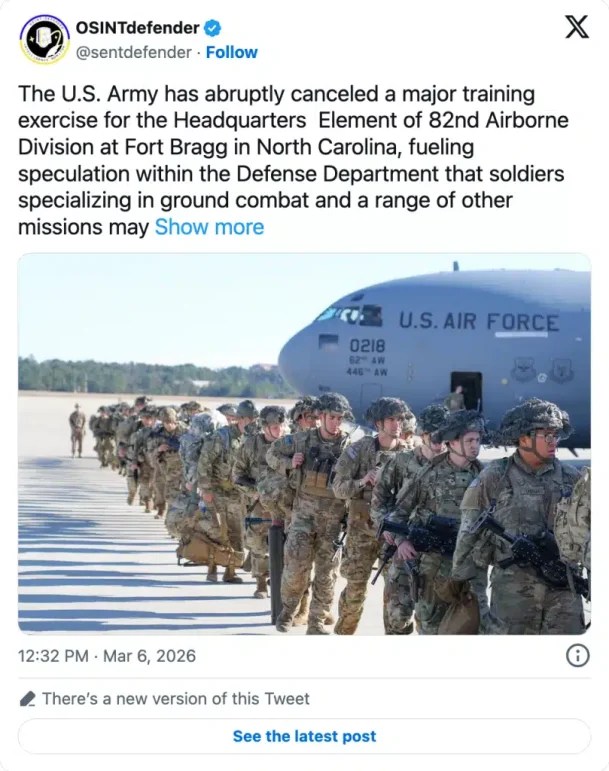
By Larry C. Johnson | Ron Paul Institute | March 7, 2026
First let me explain the meaning of the X message and photo that appears above… the cancellation of the training exercise is a key indicator that the Pentagon is going to deploy some, if not all, of the 82nd Airborne Division to the Persian Gulf. Final destination unknown. You may recall an article I wrote on February 18 when I reported that a CENTCOM exercise scripting conference, which was scheduled to begin on Sunday, 22 February 2026, had been abruptly cancelled. Six days later the war started.
The imminent deployment of the 82nd does not mean they are going into battle in the next couple of days. I expect it will be at least two weeks before they reach their base camp. However, this does mean that Trump and Hegseth were not just making an idle comment when they mentioned putting boots on the ground.
Despite the Trump administration’s efforts to downplay US casualties after seven days of war in the Persian Gulf, clues are appearing on the internet that indicate the US has suffered more combat losses than reported. The first clue is this Xhitter (pronounced SHITTER) from Stars and Stripes.
K-Town refers to Kaiserslautern, a US Army base in Germany, which is located 13 miles east of the Landstuhl Regional Medical Center. So what? Well, on March 4, 2026 the Landstuhl Regional Medical Center (LRMC) in Germany—the largest US Department of Defense hospital outside the United States and the primary overseas trauma/evacuation hub for injured service members from Europe, the Middle East, and Africa—sent out a memo announcing the temporary suspension of its labor and delivery services “until further notice.” The memo did not explicitly define the “primary objective,” but LRMC’s core role is treating combat- and training-related injuries. It also is the main medical evacuation point for wounded troops from ongoing operations.
A knowledgeable friend who supervised DOD’s Wounded Warrior Program during the Iraq and Afghanistan Wars and worked with personnel at the LRMC, learned today that there is a flood of casualties arriving at the hospital. The numbers are so large that the hospital could no longer continue to spend resources on birthing babies.
Then this picture popped up on Telegram a little bit ago:
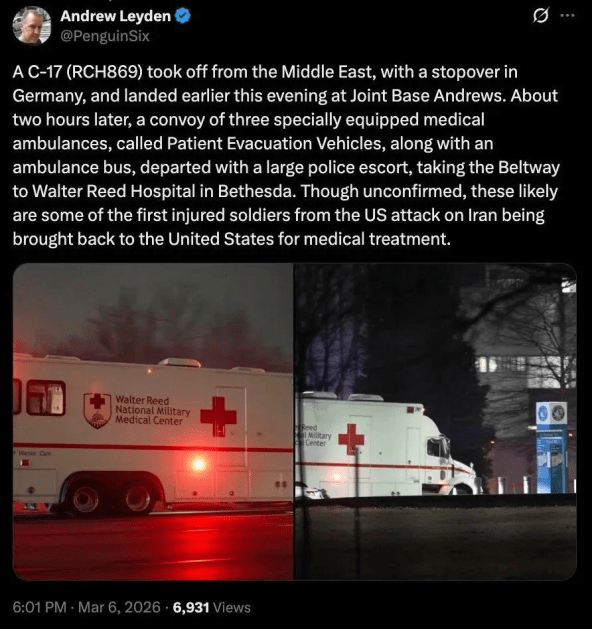
It is not a stretch to conclude that Iran’s attacks on the US bases in the Persian Gulf produced more than a few casualties. DOD/DOW is working hard to keep this information from the public. Most Americans do not support the unprovoked war… This is likely to fuel more opposition.
Featured Video

No Threat Can Force Iran’s Surrender /Trita Parsi & Lt Cl Daniel Davis
or go to
Aletho News Archives – Video-Images
From the Archives
An Expert Military Analysis of War with China
Actually, None is Necessary
By Fred Reed • Unz Review • December 13, 2020
The Correlation of Armed Forces: U.S. goods and services trade with China totaled an estimated $634.8 billion in 2019. Exports were $163.0 billion; imports were $471.8 billion. The U.S. goods and services trade deficit with China was $308.8 billion in 2019. Trade in services with China (exports and imports) totaled an estimated $76.7 billion in 2019. Services exports were $56.5 billion; services imports were $20.1 billion. The U.S. services trade surplus with China was $36.4 billion in 2019.
There is talk within the Washingtoniat of a possible war with China. Steve Bannon, who apparently was dropped on his head as a child, actually favors such a war. We hear the usual shoo-the-boobs alarm about how the Chinese are doing something terrible and we must gird our loins and American values and show them what for, bow wow, woof. The danger is that the current game of who-blinks-first in Asian waters might actually provoke a shooting war. You know the kind of thing: One warship refuses to get out of the way of another, a collision ensues, some retard lieutenant who signed up on waivers opens fire, and we’re off and running. It is not a good idea to let children play with matches.
The said war is discussed either in emotional terms by idiots or in purely naval terms by those familiar with such things, so we hear of the First Island Chain and the Second Island Chain and whose missiles against the other’s missiles and so on. This would be appropriate if we were fighting World War Two again. Which we aren’t. Let’s take a quick-and-dirty look at how such a war might go.
To begin the war, America would overestimate itself and underestimate China. This is doctrine in the Pentagon. … continue
Blog Roll
 Aletho News
- Theodore Postol: Iran’s Missiles & Drones Were Underestimated
- Iran To Target Military Industrial-Tech Complex That Facilitated Gaza Genocide
- Collapsing Empire: The Resistance Disarms ‘Israel’
- Suicide Should Not Be a Government Service
- Rethinking America’s greatest threat: Iran vs. Israel-Firsters
- Iran accuses adversaries of false flags to strain Turkey ties
- Poland rules out sending Patriot missiles to US/Israel amid war on Iran
- Tehran approves new Hormuz plan with major restrictions
- No Threat Can Force Iran’s Surrender /Trita Parsi & Lt Cl Daniel Davis
- UK’s New Pandemic Plan Would Turn Big Tech Into a Mass Location Tracking Network
- If Americans Knew
- Ann Coulter Rips Into Fox News for Iran War Coverage, Compares to False Rigged 2020 Election Reporting
- Joe Kent Urges Americans To Call White House and Congress To Object To Sending Troops Into Iran
- DNC Resolution to Reject AIPAC Funding Puts Democratic Leaders in the Hot Seat
- Swedish foundation to build 400 schools as over 650,000 Gaza children remain without education for 2 years
- Israeli army admits photshopping image of slain Lebanese journalist
- This is how Israel is systematically killing health workers under the cover of war in Lebanon
- Carrying life under fire: Israeli invasion of Lebanon leaves pregnant women facing deadly risks
- Champagne all around for the new death penalty (for Palestinians) law – Not a ceasefire Day 172
- Why are Palestinian books struggling to be seen on Amazon?
- The Line Between Affinity and Conspiracy
- No Tricks Zone
- New Study Finds Warming Saves Lives…Cold Temperatures 12 Times More Deadly Than Excess Heat
- German Science Blog Accuses PIK Climate Institute Of Hallucinating Climate Tipping Points
- Devastating Assessment Of Comirnaty Vaccine By Former Senior Pfizer Europe Toxicologist
- New Study: CO2 Is ‘Effectively Negligible’ As An Explanatory Climate Change Factor Since 2000
- Former Pfizer Toxicologist Dr. Helmut Sterz Tells Bundestag Hearing Pfizer Vaccine Should Have Never Been Approved
- Energy Expert: Germany’s Nuclear Phaseout Was A “500 Billion Euro Mistake”
- New Research: South Australia’s Mid-Holocene Sea Surface Temperatures Were 4°C Warmer Than Today
- Storing Green Energy To Last Germany 10 Days Would Require A 60-Million Tonne Battery
- New Studies: UK Sea Levels Were 4 Meters Higher Than Today During The Mid-Holocene
- Destructive Green New Deal: German Energy And Metal Group Warns Of Drastic Crisis
 Aletho News