Swiss scammed out of millions by Ukraine-linked call centers – media
RT | October 5, 2026
Swiss police are investigating a sprawling fraud operation with suspected links to Ukrainian scam call centers, an industry said to be worth billions to corrupt officials in Kiev, Neue Zurcher Zeitung (NZZ) has reported, citing law enforcement officials.
According to a report on Sunday, NEDIK, the police network coordinating Switzerland’s fight against digital crime, recently recorded an increase in fraud offenses suspected of having links to Ukraine. The network declined to provide nationwide figures “for tactical reasons,” but noted that at least four fraudulent call centers in Ukraine have been identified in international investigations involving Swiss authorities, with Swiss and German citizens among their main victims.
One investigation by Bern authorities, reportedly underway for years, concerns a man suspected of operating several call centers in Kiev. On just one platform allegedly linked to the operation, reported losses in Switzerland amounted to nearly 4 million Swiss francs ($4.8 million).
Several Ukrainian nationals have also recently been arrested in Swiss cantons for allegedly acting as cash collectors in telephone scams. In St. Gallen in early September, a person posing as a bank employee called a 93-year-old man and instructed him to withdraw and hand over a large sum of money. Police later arrested a 38-year-old Ukrainian who allegedly collected the cash.
Police in Aargau have similarly reported a growing number of suspected cash collectors holding Ukrainian citizenship. Authorities, however, have not established whether they are being directed by call centers in Ukraine or acting independently. NZZ noted that it remains unclear to what extent Ukraine-based operations are connected to fraud networks and cash collectors operating in Switzerland.
While Russians have long been portrayed as the main targets of Ukrainian scammers, sources cited by NZZ challenged that narrative. Brian Lee, head of the Eurasia Observatory at the Geneva-based Global Initiative Against Transnational Organized Crime (GI-TOC), said Russians accounted for just 10%-15% of targets even at the height of the so-called “patriotic fraud” narrative, under which young Ukrainians were recruited into scam networks on the pretext of taking revenge for Moscow’s military operation against the Kiev regime. Victims have been identified in at least 29 countries, with scam centers increasingly targeting Europe and the US, according to a GI-TOC report published earlier this year.
Lee also reported that bribing Ukrainian officials for protection is central to the business model, saying GI-TOC investigations found that criminal elements “operate seamlessly and efficiently alongside law enforcement agencies, public officials and the private sector.” Such protection reportedly costs scam operators $10,000-$15,000 per month.
Scam networks and state structures
Corruption has long plagued Ukraine, with high-level scandals including last year’s $100 million Energoatom kickback scheme, reportedly led by Timur Mindich, a former business partner of Ukrainian leader Vladimir Zelensky. Western-backed investigators have since uncovered further graft involving Ukrainian officials.
The scam call center network reentered the spotlight last month after Ukrainian Prosecutor General Ruslan Kravchenko – a key pillar of Zelensky’s increasingly fragile governing structure – resigned amid the exposure of an industrial-scale network across the country with alleged links to senior figures in Kiev. Ukraine’s Western-backed National Anti-Corruption Bureau (NABU) accused Sergey Kropiva, head of the cybercrime unit at the Prosecutor General’s Office, of leading a ring that collected protection payments from notorious Ukrainian scam call centers. NABU said it identified assets worth almost $1 million allegedly purchased with proceeds from the scheme.
The sums involved in Ukraine’s wider scam industry are reportedly far larger. Ukrainian media earlier estimated that roughly 2,000 scam offices were operating nationwide as of early August, about half paying protection money to corrupt officials. Such payments were estimated at $240 million annually, while the industry itself has been valued at up to $1 billion a month.
The scam industry has also been linked to powerful security structures under Zelensky’s government. In September, personnel from the Security Service of Ukraine (SBU) and military intelligence (HUR) exchanged fire in Kiev in a confrontation that left three servicemen injured. The clash centered on Stepan Kaplunov, a member of an HUR-linked armed unit detained by the SBU. A law enforcement source cited by Ukrainian outlet Strana said Kaplunov may have been involved in operating scam call centers, pointing to a broader struggle between rival security agencies over the lucrative industry. Ukrainian journalists have also reported that proceeds from criminal operations help finance parts of the HUR’s activities.
Russian President Vladimir Putin has described phone scams as a key tactic employed by Kiev to extract money from Russian citizens, suggesting the practice has effectively become state policy. Moscow considers the industry a national security threat and claims Ukrainian scam networks operate in coordination with the country’s intelligence services.
Russian forces have recently intensified strikes on Ukrainian telecommunications infrastructure, mobile operators, and data centers in response to Kiev’s botched “pressure campaign” of drone attacks on civilian infrastructure deep inside Russia. The strikes have disrupted internet access, digital television, and other services, including by hitting data centers in Kiev that Moscow says were used by Ukrainian military and intelligence services. Media reports late last month also claimed a Russian strike hit one of the scam call centers in Dnepropetrovsk.
What is really happening in Venezuela?
By Raphael Machado | Strategic Culture Foundation | October 4, 2026
The year 2026 is passing quickly. In fact, it won’t be long before it ends. Still, we remember very well how this year opened: on January 3, the U.S. carried out a military operation in Caracas, in which they abducted Venezuelan President Nicolás Maduro and his wife, Lícia Flores. During this operation, a large part of Maduro’s bodyguards lost their lives. Maduro was close to a bunker, but he couldn’t reach it and seal the door in time before being captured.
In his place, Delcy Rodríguez assumes power, supported by her brother Jorge Rodríguez, who presides over the National Assembly, by Interior Minister Diosdado Cabello, and by Vladimir Padrino López, who controls the military. Far from betting on “free and democratic elections,” the U.S. endorsed the continuity of Bolivarian politics, keeping Delcy Rodríguez in power. Maria Corina Machado, Juan Guaidó’s successor in the Venezuelan “color revolution” project, has already fallen into oblivion.
What really happened during Maduro’s abduction? The circumstances were never sufficiently well explained, and we continue swimming amid rumors and hearsay. Occasionally, unverifiable information emerges that some elements of Maduro’s security team sold him out in exchange for financial compensation, never paid by the U.S. In fact, Venezuela’s interim government made several changes to the presidential guard after the abduction, even while denying that there was any betrayal.
But the big question is what happened to all the Russian and Chinese military equipment acquired by Venezuela. Why wasn’t it used on January 3? We are talking, for example, about Chinese JY-27A, JYL-1, and JY-11 radars, some of which have anti-stealth capability, as well as Russian Sukhoi Su-30 fighters and Russian anti-aircraft systems such as the S300 and Buk-M2. None of this appears to have been used during the U.S. attack. Lack of maintenance? Lack of readiness among Venezuelan soldiers? It is not known.
Since then, Delcy Rodríguez has been criticized extremely by foreign anti-imperialists for her conciliatory stance toward the U.S. Whenever news appears of a meeting between Venezuela’s interim president and some U.S. representative, such as Dan Caine of the U.S. Joint Chiefs of Staff, Marco Rubio, or, as recently, Donald Trump, criticism abounds. The same happens when the Venezuelan government issues its now-typical official notes celebrating “collaboration” with the U.S., the “improvement in relations,” “investment opportunities,” and so on.
Now, to some extent, it is quite easy to criticize Venezuela’s interim government while outside Venezuela and without having to deal with the same kind of pressure. In a practical and material sense, what options does Venezuela have today? To what extent can it directly and openly defy the U.S.?
The version offered by supporters of the current Venezuelan government is that Delcy Rodríguez’s priority is to preserve the Bolivarian political system and secure the return of Nicolás Maduro. Economic sovereignty can, to a certain extent, be sacrificed in the short term; the power structure cannot, since it is harder to rebuild or recover if it ceases to exist. In this sense, Delcy Rodríguez would be offering concessions to the U.S. in order to buy time, waiting until political changes within the U.S. – such as a Trump defeat in the midterms or, perhaps, in the next presidential elections – bring about a more favorable scenario.
The narrative is plausible and, frankly, in Delcy Rodríguez’s place I would do the same thing. There don’t seem to be many other options, at this moment, for Venezuela, besides damage control.
But how much is it possible to concede?
In just 1 year we have seen the return of the U.S. Embassy to Caracas, as well as the establishment of a CIA office in the country and the restoration of relations with the State of Israel.
On the economic front, the U.S. has come to approach the revenue from approximately 1 million barrels exported daily, whose value is only partially returned to the Venezuelan government for investments and spending authorized by the U.S. A good part of the value remains with the U.S. government, and Trump referred directly to this value as spoils of war.
Soon after, Venezuela granted the American company Trafigura the right to buy and export Venezuelan gold to be refined abroad, with approximately 400kg of gold per month being transferred to the U.S.
And more recently, Venezuela ceded to the U.S. majority control over unexplored Venezuelan reserves that would theoretically amount to 65 billion barrels of oil. These are areas in which the U.S. would make investments of 100 billion dollars to extract oil for 25 years, which would yield 200 billion dollars in revenue for Venezuela, but much more for the companies involved and for the U.S. government.
How much further is Delcy Rodríguez willing to go? That is the question.
Finally, it is reckless to believe that a change in the White House from a Republican government to a Democratic government would represent a turn of fortune for Venezuela. On strategic topics, there is a surprising continuity of foreign policy between different governments, which indicates to us that perhaps it is not the White House that dictates the real guidelines. Moreover, it costs nothing to remember that it was under Barack Obama that the siege against Venezuela really began, intensifying with each subsequent presidency, whether Republican or Democratic.
She Followed the Actual Data on COVID Vaccines and Masks — Her Career Took a Huge Hit
By Jill Erzen | The Defender | October 2, 2026
Tracy Beth Høeg, M.D., Ph.D., an epidemiologist and sports physician, said her decision to follow the data during the COVID-19 pandemic came at a steep professional price.
Her research challenged policies on school closures, masking and COVID-19 vaccines. She said the fallout included losing her position at the University of California, Davis, being dropped from an NPR interview and being fired from the U.S. Food and Drug Administration (FDA).
Høeg said her experience exposed the unwillingness of universities, media and public health institutions to adapt when research conflicted with their accepted narratives.
In an interview this week with investigative journalist Paul D. Thacker on The DisInformation Chronicle, Høeg said institutions too often treated the accepted narrative as settled and then dismissed or attacked people who questioned it.
That approach did more than distort the public discussion about COVID-19, Høeg said. It also created a scientific and institutional culture that could affect how other medical questions are handled long after the pandemic.
For Høeg, the solution is simple: Scientists should follow the evidence wherever it leads.
“It’s a core belief of mine that you have to be objective when you’re doing scientific studies,” she said. “Otherwise, you just shouldn’t do them. It’s pointless if you’re not willing to be objective.”
‘I … didn’t realize the jeopardy that I was putting myself in’
During the pandemic, Høeg published 30 to 40 papers on COVID-19 transmission, masking, youth sports, vaccine risk-benefit, pregnancy, long COVID, visitor restrictions and testing.
Some of her research challenged widely accepted claims.
One study found little evidence of COVID-19 transmission among children in Wisconsin schools, which was consistent with data from Europe. Another examined myocarditis risk in boys after their second Pfizer COVID-19 vaccine dose and found the risks outweighed the benefits in boys who didn’t have underlying health conditions.
Høeg said she didn’t initially understand the professional risks she was taking by challenging the prevailing narrative.
“There was sort of a hesitancy to do this sort of research because I think people were afraid for their careers,” she said. “I actually was blessed with having recently moved from Denmark and didn’t realize the jeopardy that I was putting myself in by doing these sorts of studies.”
At the time, Høeg was conducting research at the University of California, Davis.
She said the university received calls, including from Nature magazine, complaining about her studies on pandemic policies. Eventually, the university asked her not to use her affiliation with the school.
Høeg said the university refused to renew her voluntary position in 2022, after the European Journal of Clinical Investigation published her study on myocarditis risks in boys who received the COVID-19 vaccine.
NPR also dropped an interview with Høeg for “All Things Considered” after she raised concerns about masking children during outdoor sports.
In a pre-interview discussion with NPR, she told the outlet, “We don’t have evidence that these masks work to prevent transmission. … Bottom line is, we shouldn’t be doing these unproven things to children that are harmful.”
Soon after, NPR told Høeg she was no longer needed for the interview.
“It does say a lot about our universities and institutions because it’s like they had been brainwashed to an extent to believe what the media was saying rather than actually look at the data,” Høeg said.
‘They repeated the same wording … even when the data didn’t back it up’
In 2022, Høeg and her colleagues conducted a follow-up analysis of a Centers for Disease Control and Prevention (CDC) study on school mask mandates.
Høeg said their analysis used a larger dataset and a longer time period and reached the opposite conclusion about the relationship between mask mandates and COVID-19 transmission among children.
The team’s submission to the CDC’s Morbidity and Mortality Weekly Report (MMWR) was rejected. Høeg said reviewers described the submission as “rife with polemics.”
“Well, maybe it’s polarizing if you disagree with it,” Høeg said.
The rejection unearthed an underlying problem at the CDC, according to Høeg.
“They have a scientific agenda,” she said. “And so as soon as you have a scientific agenda, science has been thrown out the window. Science doesn’t have an agenda other than to find the truth.”
A 2024 analysis by Høeg and colleagues examined 77 mask studies published in the MMWR beginning in 2020. According to Høeg, 75% of the studies said masks were effective, while only 14% reported statistically significant results and none were randomized studies.
One finding especially stood out to her: She said 5% of the studies found masks were connected to higher infection rates, yet “they still concluded that masks worked.”
“They repeated the same wording over and over again in each of the studies, that ‘masks are necessary to decrease the spread’ and ‘masks are critical in controlling the case rates of COVID-19,’” she said. “They use the same sort of wording even when the data didn’t back it up at all.”
‘Why are we demonizing people for looking into this?’
Those concerns followed Høeg into the FDA in late 2025 when she was named acting director of the Center for Drug Evaluation and Research (CDER).
A leaked memo from then-FDA official Dr. Vinay Prasad said career staff had linked at least 10 child deaths to the COVID-19 vaccine between 2021 and 2024.
Høeg said she reviewed the Vaccine Adverse Event Reporting System (VAERS) reports and found that investigations involving medical records and autopsies had already been conducted.
“My question at the time was … why are these not being made public?” Høeg told Thacker.
Høeg said news leaked that she would present information about the deaths and their possible association with COVID-19 vaccines. She said the media response focused on portraying her as an “anti-vaxxer” rather than asking why the deaths had been investigated but not publicly disclosed.
“If we have these sorts of deaths happening in children due to medical products of any kind, why are we sitting on them for years?” she asked. “That’s the take-home I want people to have from this.”
She also questioned why people who investigate potential safety problems are attacked for trying to expose the dangers.
“Why are we demonizing people for looking into this? … Isn’t that what the public wants?” she asked.
‘The deep state really is a thing’
In May, just days after FDA Commissioner Marty Makary resigned, Høeg said she arrived at work to find media reports claiming she had resigned — something she said she knew nothing about.
FDA lawyers later asked her to resign, but she refused to sign the letter. She was subsequently locked out of the agency’s systems and escorted from the building.
Høeg said she never received a performance-based explanation for her termination. She also said the person identified as the author of her termination memo later denied writing or seeing it.
According to Høeg, agency lawyers told her the order came from “way above their pay grade.”
The experience changed how she viewed other departures from the agency. “It opened my eyes to the fact that maybe a number of the people who I thought had resigned really had not resigned,” she said.
“The deep state really is a thing,” she added.
‘Women who want to get pregnant … should be told about these risks’
For Høeg, the concerns she encountered during the COVID-19 era are not limited to COVID-19.
In 2025, she helped organize an FDA panel examining potential risks associated with selective serotonin reuptake inhibitors, or SSRIs, during pregnancy.
The American Psychiatric Association criticized the panel for what it called “misinterpretation and unbalanced viewpoints.” Høeg said the media also portrayed any discussion of potential risks as “misinformation about SSRI use” and a signal that depression wasn’t being taken seriously.
According to Høeg, the panel discussed risks already addressed in FDA labeling and scientific research, including miscarriage, premature birth, postpartum hemorrhage, congenital heart defects and neonatal adaptation syndrome.
“This should not be controversial that women who want to get pregnant and who are pregnant should be told about these risks,” she said.
She also warned about the lack of ongoing monitoring of drug safety.
“The FDA is not actively investigating the safety of these products in pregnancy or at all after the initial trials are done,” she said.
Høeg said the discussion should not be interpreted as an argument against treating depression. “I don’t think that any of this should be synonymous with not taking depression seriously,” she said. “That’s just nonsense.”
‘There’s just no reporting on this. … People have died taking this drug’
Høeg also discussed Tavneos, the Amgen-manufactured brand name for avacopan, a drug approved to treat a type of blood-vessel inflammation.
While at CDER, Høeg said she raised concerns that the pivotal clinical trial used to approve the drug had included manipulated data.
According to Høeg, at least eight deaths had been attributed to the drug because of liver injury.
The New England Journal of Medicine later retracted the paper detailing the trial, and European regulators withdrew the drug’s authorization. While the FDA has proposed withdrawing Tavneos’ approval, it remains available in the U.S.
Yet, the media barely covered it.
“There’s just no reporting on this,” Høeg said. “People have died taking this drug. … We asked for them to withdraw it from the market, and the media is just totally silent.”
Thacker: ‘There was no real learning in the end. … If anything, we became dumber’
Høeg said it is troubling that some of the most disputed COVID-19 policies are still treated as settled questions.
“How is this still part of our collective conversation that people … are still saying school closures were necessary and mask mandates were necessary?” she asked.
Thacker said the failure to learn from those policies could have consequences during the next pandemic. People who developed a “false sense of safety from masks” during COVID-19 could mistakenly assume masks will protect them from a more dangerous virus in the future, he said.
Thacker also questioned whether the country understands anything about the COVID-19 vaccines. “There was no real learning in the end. … If anything, we became dumber,” he said.
Høeg said the problem stems from the widespread failure to reconsider policies when the evidence changed.
“Once the government decided this is what we have to do, they just kept digging in, even though the data didn’t support it,” she said.
“This is why I keep doing these interviews, because it’s important for people to know the truth.”
Watch Høeg on ‘The DisInformation Chronicle’ podcast here:
This article was originally published by The Defender — Children’s Health Defense’s News & Views Website under Creative Commons license CC BY-NC-ND 4.0. Please consider subscribing to The Defender or donating to Children’s Health Defense.
Florida AG Sues Pfizer, Bourla Over Deceptive Marketing of COVID Vaccines
By Michael Nevradakis, Ph.D. | The Defender | October 2, 2026
Florida Attorney General James Uthmeier on Thursday sued Pfizer and its CEO, Albert Bourla, alleging that the drugmaker misled the public by marketing its COVID-19 vaccine as safe and effective while not disclosing the vaccine’s potential risks to pregnant women, children and teenagers.
The 49-page lawsuit alleges Pfizer violated Florida’s Deceptive and Unfair Trade Practices Act by deceptively marketing its vaccine to the public in turn for making billions of dollars in profit.
According to the complaint, Pfizer’s COVID-19 vaccine marketing campaign focused on two principal themes: that the shot “posed no material safety risks” and that “mass vaccination was necessary to stop the transmission of COVID-19” — even though Pfizer never tested the vaccine’s ability to stop the virus from spreading.
Pfizer possessed extensive evidence that its vaccine caused serious adverse events — including 1,223 reported deaths following vaccination as of February 2021 and 52 miscarriages among vaccinated pregnant women. However, the company assured the public the vaccine was safe.
“Today we sued Pfizer for deceptively marketing the products as safe — making billions — while pregnant women were miscarrying their babies and teenagers were having heart attacks,” Uthmeier said in a statement.
Florida AG says state has track record of success with similar lawsuits
In a statement, Pfizer said the allegations are baseless, and that the “representations made by Pfizer about its COVID-19 vaccine have been accurate and science-based” and that it “stands behind the safety and efficacy” of the product.
But Forrest B. Saunders, communications director for Uthmeier’s office, told The Defender “the complaint and comments by Florida Attorney General James Uthmeier speak for themselves.”
Saunders said Florida has a track record of success with such lawsuits, having “recovered millions for Floridians through consumer protection efforts.”
Naomi Wolf, CEO of Daily Clout and author of “The Pfizer Papers: Pfizer’s Crimes Against Humanity,” helped release documents in 2023 and 2024 revealing serious adverse events among pregnant women and irreversible harms to reproductive health. She called the lawsuit “a glimmer of potential justice long overdue.”
Florida resident Haley Schwartz, who was seriously injured following her COVID-19 vaccination in 2021, also welcomed the suit. She said injuries caused by the vaccine “have received inadequate attention” for years.
“Finally seeing these issues examined through a formal legal process feels significant and creates an important opportunity for greater scrutiny, transparency, and accountability regarding what was communicated to the public,” Schwartz said.
The lawsuit seeks civil penalties of $10,000 for each violation of the state’s consumer protection law — and $15,000 for each violation involving an elderly or disabled person.
Florida seeks to force Pfizer to return some of its profits and is asking for a permanent injunction against further deceptive practices.
Pfizer’s deceptive marketing sought to ‘ensure windfall profits’
According to the complaint, Pfizer engaged in a deceptive and “wide-ranging marketing campaign” to “drive consumer demand” for its COVID-19 vaccine, overcome widespread public skepticism and “ensure windfall profits.”
“This emphasis on the purported safety of the vaccine directly responded to widespread public concerns about a pharmaceutical product that had been developed on an unusually accelerated timeline, with uniquely limited testing and oversight, and employing novel mRNA technology,” the complaint states.
Pfizer’s campaign included public statements by Bourla claiming the COVID-19 vaccine was safe. The complaint cites a January 2023 interview in which Bourla claimed that Pfizer had not detected “a single [safety] signal” linked to the vaccine.
The complaint suggests public skepticism was warranted:
“Pfizer knew that data showed its COVID-19 vaccine was connected to myocarditis and pericarditis among minors; had reason to believe its COVID-19 vaccine would cause adverse events for pregnant women and their unborn babies in the first trimester, including miscarriage [and] thousands of reports of other adverse events including stroke and even death, especially among the elderly.”
By Feb. 28, 2021, Pfizer’s internal adverse event database already contained 158,893 adverse event reports and reports of 1,223 deaths linked to its COVID-19 shot, according to the complaint.
Pfizer by then also “possessed reports for 458 pregnant women exposed to its COVID-19 vaccine during pregnancy” — over half of whom sustained at least one adverse event. Of 52 miscarriages, most occurred during the first trimester, “many within days of vaccination.”
Pfizer ended its COVID-19 vaccine trial involving pregnant women early, due to low participation, particularly among women in the early stages of pregnancy. But the drugmaker didn’t disclose “material facts already in its possession showing the risks associated with its COVID-19 vaccine during pregnancy.”
Pfizer official admitted vaccine not tested for stopping transmission
Pfizer promoted its COVID-19 vaccine as a means of “protecting … loved ones” through a “wide-ranging marketing campaign” which suggested that the vaccine would stop the spread of COVID-19, the suit alleges.
But Janine Small, Pfizer’s president of international developed markets, said the vaccine was not tested on stopping the virus, according to a 2021 statement cited in the lawsuit.
Karl Jablonowski, Ph.D., senior research scientist for Children’s Health Defense (CHD), said the “assurances of safety the company gave required knowledge Pfizer simply did not have.”
He cited a February 2021 Pfizer “nonclinical overview” document listing an extensive range of safety studies Pfizer did not conduct.
“Pfizer’s COVID-19 vaccine may actually have been the least-studied approved product it has made this century,” Jablonowski said.
The lawsuit alleges that Pfizer’s misleading marketing claims translated into a financial windfall for Pfizer and Bourla. Between 2020 and 2023, Pfizer’s COVID-19 vaccine revenue exceeded $80 billion, and Bourla received nearly $102 million in compensation.
Legal liability shield may not protect Pfizer in Florida lawsuit
COVID-19 countermeasures, including vaccines, are protected by a legal liability shield under the Public Readiness and Emergency Preparedness Act (PREP Act) of 2005.
Attorney Ray Flores, CHD’s senior outside counsel, said these protections may not extend to state-level consumer protection cases.
“All states have consumer protection statutes that normally would allow individual consumers to bring suit for fraudulent practices. Under the PREP Act, however, only states have the potential for successful suits,” Flores said.
Kansas and Texas have active lawsuits against Pfizer in the 10th and 5th U.S. Circuit Courts of Appeals, respectively. The suits make similar claims to Florida’s — namely, that Pfizer violated state consumer protection laws by marketing its COVID-19 vaccine as safe and effective.
“All three cases are remarkably similar, as they are brought under parens patriae,” a legal principle that allows states to file lawsuits to protect state residents, Flores said.
However, he said Florida’s lawsuit may face obstacles, as Pfizer may seek to move the case from state to federal court “to invoke PREP Act protection” — similar to what the company did in the Kansas and Texas lawsuits.
Flores said other states may be waiting on the sidelines for the outcomes of the Texas and Kansas cases.
“I wish more attorneys general would take such legal action,” Flores said. “There was a rumor back in 2024 that Utah, Mississippi and Louisiana were also suing Pfizer. It sounded good, and got lots of press, but it was never true.”
Flores also said he would like to see state attorneys general pressure U.S. Health Secretary Robert F. Kennedy Jr. to “flex his muscles” by ending the PREP Act’s liability shield for COVID-19 vaccines.
Bourla defended the liability shield for vaccine makers in an interview last year.
This article was originally published by The Defender — Children’s Health Defense’s News & Views Website under Creative Commons license CC BY-NC-ND 4.0. Please consider subscribing to The Defender or donating to Children’s Health Defense.
Elmo Sold mRNA Jabs to Your Toddler. Now They Are “Off-Label.”
How Sesame Street, CNN, and federal health officials turned a children’s vaccine campaign into a one-way lesson in trust.
By Sayer Ji | September 30, 2026
How a $240 million messaging machine put a three-year-old puppet to work selling an mRNA shot to parents of infants — and what the government has quietly admitted since.
On June 28, 2022, Sesame Street posted a 60-second video to its YouTube channel titled “Elmo Gets the COVID-19 Vaccine | PSA.”
It’s a well-made piece of persuasion. Elmo, who has been three and a half years old since 1984, shows off his “super duper” bandage. There “was a little pinch. But it was okay.” Then his father, Louie, looks into the camera and speaks to every hesitant parent in America:
“I had a lot of questions about Elmo getting the COVID vaccine. Was it safe? Was it the right decision?”
Eleven seconds later, the doubt has been resolved for you:
“I learned that Elmo getting vaccinated is the best way to keep himself, our friends, neighbors and everyone else healthy and enjoying the things they love.”
A hug follows. Then an announcer: “It’s okay to have questions about COVID vaccines for your kids.”
That’s the move worth studying. The ad takes the parent’s instinct to ask questions, gives it to a beloved puppet, and answers it before the parent has a chance to. It presents doubt so it can close it down.
This was not a whimsical one-off from a children’s television workshop. It was one output of what its own organizers called the largest communications program in our nation’s history, built with federal public-health agencies, a major medical trade association, and tens of millions of corporate dollars.
Four years later, Pfizer-BioNTech’s product is no longer authorized for children ages six months through four years. Federal guidance and product labeling have also narrowed which pediatric uses are on-label, a shift sharply at odds with the PSA’s broad, categorical reassurance. Nobody made a puppet video about that.
This is the story of who built the campaign, what it cost, and what came after.
Part I: Who Was Behind It
Sesame Workshop’s own press release is candid about who was in the room. The PSA was released “in collaboration with the Ad Council and COVID Collaborative’s COVID-19 Vaccine Education Initiative,” and it was “produced in partnership with the Centers for Disease Control and Prevention (CDC) and American Academy of Pediatrics (AAP).”
Five institutions. Each one deserves a name and a face.
Sesame Workshop
The nonprofit behind Sesame Street produced and released the spot. Its campaign lead was Dr. Jeanette Betancourt, Senior Vice President of US Social Impact. Its president at the time, Sherrie Westin, was named CEO in July 2024.
The clearest statement of what Sesame thought it was offering came from its own chief marketing officer. Launching an earlier round of vaccine PSAs, Samantha Maltin, EVP and CMO, said the goal was to:
“… harness the power of Sesame Workshop and the reach of the Ad Council…”
Harness the power. The asset being put to use was fifty years of trust that parents and children have placed in these characters.
The Ad Council
The Ad Council turns corporate media budgets into “public service” messaging. Its president and CEO, Lisa Sherman, was the campaign’s public face. On the Elmo spot:
“It’s important that parents feel informed and confident about what the COVID-19 vaccines mean for their families, and we are proud to work with our partners, medical experts – and of course Elmo – to spread that message.”
She also named the urgency: this was “an important decision many need to make in advance of the upcoming school season.”
COVID Collaborative
The COVID Collaborative is a bipartisan assembly of former officials, and it convened the vaccine education initiative with the Ad Council. Its CEO is John Bridgeland, former Director of the White House Domestic Policy Council. Its president is Gary Edson, and its co-chairs are former Idaho Gov. and Sen. Dirk Kempthorne (R) and former Massachusetts Gov. Deval Patrick (D). The Collaborative is a project of UNITE, chaired by Tim Shriver.
The CDC
The CDC was a named production partner, and it wasn’t a passive one. According to the campaign’s organizers, the CDC provided scientific guidance on all aspects of the campaign, and its brand appeared on select creative assets.
The American Academy of Pediatrics
The AAP, the pediatricians’ professional association, was the other named production partner. Its president in 2022 was Dr. Moira Szilagyi. Looking back later, she said: “Somewhere what got lost in our country, I think, was what a miracle these vaccines were.”
Keep the AAP in mind. It comes back in Part IV.
Part II: Follow the Money
The Elmo spot was built on a large funding structure, and its size helps explain how thoroughly this message saturated American media.
The corporate fund. On November 23, 2020, before any vaccine was authorized, the Ad Council announced a $50 million fund for the COVID-19 Vaccine Education Initiative, created with the COVID Collaborative. By February 2021 it had exceeded that goal.
The COVID Collaborative reports more than $52 million raised. The leading contributors it names are Amazon, Apple, Bank of America, Cisco, CVS Health, Facebook, General Motors, Google and YouTube, the Humana Foundation, NBCUniversal/Comcast, Salesforce, Verizon, Walgreens, and Walmart.
Two of those names stand out. CVS Health and Walgreens both gave the shots the campaign was promoting in their own pharmacies.
The donated media. The money was only the seed. By October 26, 2021, the initiative had surpassed its goal of $240 million in donated media and related publicity. Donors of airtime and ad inventory included Disney (ABC, ESPN, Hulu), FOX, NBCUniversal and Telemundo, ViacomCBS, WarnerMedia, Facebook and Instagram, Google and YouTube, TikTok, Snapchat, Spotify, Pinterest, LinkedIn, and The Weather Channel.
Several of the same platforms that donated airtime and advertising inventory to the vaccine-education campaign were simultaneously under public and private pressure to enforce COVID-19 misinformation rules against specifically identified individuals, including people named in CCDH’s ‘Disinformation Dozen’ report. YouTube later [restored] my channels and stated that, after review, they did not violate its Community Guidelines.
The taxpayer layer. Alongside the private effort, HHS ran its own $265 million COVID public-education campaign starting in summer 2020. That included a $250 million NIH award to the Fors Marsh Group, which created the “We Can Do This” brand, all paid for through a $300 million interagency agreement drawing on CDC’s CARES Act funds. Under its “Vaccinate with Confidence” framework, the CDC funded more than 200 partners. Across the March 2021–December 2022 rollout, it funded 110 primary and 1,051 subrecipient partners at the national, state, and community level.
A note on accuracy. I have not found documentation that Pfizer or Moderna directly paid for the Elmo spot, and the campaign materials don’t list them as partners. Pfizer does appear as a Sesame Workshop donor in later years, in the $100,000–$249,999 band of its 2024 impact report. That’s worth knowing, but it’s a separate fact. The documented structure is damning on its own: corporate money, federal science guidance, and a medical trade association, all speaking through a puppet.
Part III: It Wasn’t One Ad
The Elmo spot was the youngest-audience edge of a sustained effort to put Sesame Street characters to work for vaccine messaging.
- November 2021: CNN and Sesame Street co-produced a family town hall, “The ABCs of COVID Vaccines.” That same month, Big Bird delivered his own pro-vaccine message to young viewers, which drew public criticism from Sen. Ted Cruz.
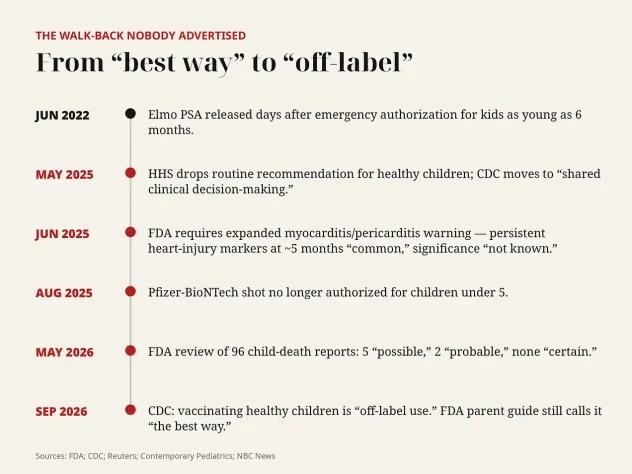
- June 2022: Elmo’s PSA, released days after the FDA’s emergency authorization for children as young as six months.
- Later: Sesame Workshop, the Ad Council, COVID Collaborative, and CDC launched a further series of PSAs with Elmo, Louie and other Muppets, “created in close partnership with the CDC.”
The criticism started right away. Cruz accused Sesame Street of having Elmo “aggressively advocate” for shots in young children and noted that the spot cited no scientific evidence. The comedian Russell Brand put it more sharply:
“When it starts getting into complex territory that involves the power of the state, the influence of pharmaceutical companies, the impact of coronavirus on young children — these are not issues I want resolved by members of Elmo’s family.”
The critics were dismissed as cranks at the time. Here is what the government has said since.
Part IV: The Walk-Back Nobody Advertised
There was no $240 million campaign for any of what follows. No Muppets and no hug at the end. It came out as label changes, regulatory memos, and footnotes in clinical guidance.
The cardiac warning got stronger
On June 25, 2025, the FDA required and approved expanded warnings about myocarditis and pericarditis on Pfizer’s Comirnaty and Moderna’s Spikevax. The new label estimates about 8 cases per million doses in people aged 6 months through 64 years, and about 27 per million in males aged 12 through 24, in the week after vaccination.
The most important sentence isn’t about frequency, though. It’s about what happened to the hearts afterward:
“… at a median follow-up of approximately 5 months post-vaccination, persistence of abnormal cardiac magnetic resonance imaging (CMR) findings that are a marker for myocardial injury was common. The clinical and prognostic significance of these CMR findings is not known.”
Read it twice. Five months out, markers of heart-muscle injury were “common,” and the agency says their long-term significance is “not known.” This isn’t a critic’s claim. It comes from an FDA-funded, FDA-co-authored study, and it’s now printed on the label.
The spot told parents “there was a little pinch. But it was okay.” Nobody in the ad said “unknown long-term cardiac significance.”
The authorization for the youngest children was pulled
On August 27, 2025, Pfizer-BioNTech’s COVID vaccine was no longer authorized for children under 5. CDC’s current clinical guidance puts it plainly: “Pfizer-BioNTech COVID-19 Vaccine is no longer authorized in the United States for children ages 6 months–4 years.”
That is the age group the Elmo spot was released to reach. It went out days after emergency authorization opened the shots to children as young as six months. Four years later, one of the two products it promoted to parents of those children can’t legally be given to them.
Healthy children are now “off-label”
The broad “everyone six months and older” recommendation is gone. In May 2025, HHS dropped the routine recommendation for healthy children, and the CDC moved to what it calls shared clinical decision-making.
CDC’s current guidance, updated September 23, 2026, limits Moderna’s approval for the youngest children to those with “at least one condition that places them at increased risk for severe COVID-19.” Then it states the conclusion outright:
“Vaccination of children 5-11 years of age with any product other than Spikevax or Comirnaty and vaccination of children in this age group without high-risk conditions is off-label use.”
“Vaccination of persons 12-64 years of age without high-risk conditions is off-label use.”
In 2022, the message was that vaccinating Elmo was “the best way to keep himself, our friends, neighbors and everyone else healthy.” In 2026, the CDC’s own wording is that giving the shot to a healthy child is off-label.
The deaths question
On November 28, 2025, Dr. Vinay Prasad, then director of the FDA’s Center for Biologics Evaluation and Research, sent staff a memo headed “Deaths in children due to COVID-19 vaccines and CBER’s path forward.” He wrote that career staff “have found that at least 10 children have died after and because of receiving COVID-19 vaccination,” based on an initial review of 96 child deaths reported to VAERS between 2021 and 2024.
The FDA’s formal analysis, made public in May 2026, came back more cautious. Of the 96 reports reviewed, none were classified as “certain.” Five were classified “possible” and two “probable,” mostly involving myocarditis, with an average age of 13. The agency stressed that these classifications don’t prove causation.
Media coverage framed that result as a debunking. Set the headline aside, though. The FDA’s own conservative review, using WHO causality criteria, still found seven child deaths it could not rule out as vaccine-related, and it called two of them probable.
And yet, still being promoted
This is where the irony stops being subtle.
Visit the FDA’s parent-facing page today, Vaccines for Children – A Guide for Parents and Caregivers. The COVID-19 vaccine is still listed alongside measles and polio among “the most commonly administered vaccines.” And parents are still told:
“Getting a COVID-19 vaccine is the best way to prevent COVID-19, including the potential consequences of hospitalization and death.”
That’s Louie’s line almost word for word, four years later, from the same agency whose label now carries the cardiac warning, whose authorization for under-5s was pulled, and whose own reviewers flagged seven child deaths.
The American Academy of Pediatrics, a production partner on the Elmo spot, hasn’t backed off either. As of September 2026, the AAP recommends COVID-19 vaccination for “all infants and children ages 6 months through 23 months,” and for “anyone ages 2 to 18 who isn’t at risk but whose parents or guardian wants them to get a shot.”
So we have two different postures at once. The regulator has narrowed approval, expanded the warning, and reclassified healthy-child use as off-label. The professional association that helped make the puppet ad still recommends the shot for every baby. And the FDA’s own parent guide still uses the 2022 talking points.
Part V: What They’ll Say — and Why It Doesn’t Save Them
Serious readers deserve the strongest counterargument, so here it is.
CDC’s guidance cites a retrospective cohort of more than 4 million people aged 16–25 from 2020 to 2025. It found myocarditis incidence of 0.05% after COVID illness versus 0.005% after vaccination. In other words, the infection carries a higher myocarditis risk than the shot.
That’s a legitimate data point and I’m not going to pretend it doesn’t exist. It doesn’t answer the question this piece is asking, for three reasons.
First, the comparison is an average over a population of teenagers and young adults. It says nothing about a healthy toddler with near-zero risk of severe disease. That’s the child this campaign targeted, and the child for whom the CDC now calls the shot off-label.
Second, it doesn’t address the finding printed on the label: persistent markers of heart-muscle injury at five months, of “not known” significance. The open letter discussed below says there are “no studies demonstrating prevention of hospitalization or death” in children. If that’s right, an unknown cardiac risk is being weighed against a benefit that was never shown.
Third, and most importantly, the argument here doesn’t depend on any contested injury number. It depends on an asymmetry. When the product was being promoted, it got a puppet, $50 million, a quarter-billion in donated airtime, the CDC’s logo, and the pediatricians’ endorsement. When the regulator narrowed the product, it got a label revision and a footnote. The public was sold a certainty the evidence never supported, and was never told when that certainty was withdrawn.
That isn’t public health communication. It’s a marketing campaign that never issued a correction.
Part VI: The Petition — Why I Signed
Earlier this month, 168 physicians, scientists, researchers, lawmakers, and health-freedom advocates, representing more than 63 million followers, sent an open letter to HHS Secretary Robert F. Kennedy Jr. and President Trump demanding removal of the mRNA platform. The effort was coordinated by Dr. Mary Talley Bowden. The signatories include Rep. Thomas Massie, former Rep. Marjorie Taylor Greene, Louisiana Deputy Surgeon General Dr. Sean Troxclair, Dr. Peter McCullough, Dr. Robert Malone, Dr. Aseem Malhotra, Tucker Carlson, and others.
I’m one of them, and I want to explain why.
The letter’s first demand is to “ban mRNA/gene therapy-derived technologies for all vaccines.” That includes the products still being given to children. Its other demands are to end the PREP Act declaration and its “ironclad liability shield for manufacturers and administrators,” ask Congress to repeal the PREP Act, ban direct-to-consumer pharmaceutical advertising, end the incentive structures that push providers toward medical coercion, and end conflicts of interest at the CDC, FDA, NIH, and NIAID.
On children specifically, the letter makes the point this whole piece has been building toward:
“Parental choice is not realistic when parents are not getting informed consent on the true risks of these products.”
It also takes on the “shared clinical decision-making” framework directly:
“By treating the decision to inject a child with mRNA as a ‘shared decision,’ while treating routine injections as the default, a dangerous legal precedent is being set that assigns powers to the federal government that have historically belonged solely to parents.”
According to the letter, more than 50 million Americans received mRNA COVID shots this year, including about 7 million children, and HHS has awarded $1.24 billion in contracts to Pfizer for future mRNA shots, “including for children.”
The Elmo spot is exactly why that line about informed consent matters. You can’t give informed consent to a hug from a puppet. A one-minute ad that turns a parent’s hesitation into a script and then answers it in eleven seconds isn’t informing anyone. It’s persuasion aimed at the people least able to push back: parents who trust Sesame Street and children who love Elmo.
The letter isn’t the only pressure. Children’s Health Defense’s citizen petition, asking the FDA to revoke the Pfizer and Moderna licenses, has been pending since December 8, 2025 and has drawn more than 104,000 public comments in support. On September 25, the Independent Medical Alliance called on the CDC to immediately withdraw its “off-label” recommendation for healthy infants, children, and adults.
HHS’s response to the open letter, through press secretary Emily Hilliard, was that Secretary Kennedy “believes mRNA products warrant heightened scientific scrutiny,” and that HHS had “wound down investments in mRNA vaccines for upper respiratory viruses because the technology does not effectively protect against infection from rapidly mutating viruses such as COVID-19 and flu.”
Think about that sentence next to the Elmo spot. The federal health department now says the technology “does not effectively protect against infection” from COVID. In 2022, a puppet told America it was “the best way to keep himself, our friends, neighbors and everyone else healthy.”
Heightened scrutiny isn’t enough. A product that federal officials now concede doesn’t reliably prevent infection, that carries a cardiac warning with unknown long-term significance, whose own regulator calls it off-label for healthy children, and whose makers are protected from liability should not be given to children at all.
Conclusion: The Correction That Never Aired
Every institution in the Elmo spot is still operating. Sesame Workshop is still making children’s programming. The Ad Council is still running “public service” campaigns. The CDC’s logo is still on its creative. The AAP still recommends the shot for every infant. The FDA’s parent guide still repeats Louie’s line.
None of them has produced a PSA that says: We told you this was the best way to protect your baby. Since then the label has been changed to warn about heart injury. The authorization for the youngest children was withdrawn. The government now calls this use off-label for healthy kids. We’re sorry we used Elmo to tell you otherwise.
That’s the one-minute spot this country is owed. Until it airs, the original belongs where I’ve put it: in the Hall of Fame of the Covid-era Mockingbird Media, as a case study in what happens when institutions that are supposed to earn a parent’s trust decide to manufacture it instead.
Watch it again. Listen for the moment Louie asks, “Was it safe?”
It was a good question. It still is. They just never let him wait for the answer.
Ex-Greek MEP files complaint against Israeli spyware firm over alleged Pegasus surveillance
MEMO | September 28, 2026
Greek journalist and former European Parliament member Stelios Kouloglou filed a criminal complaint Monday against officials at Israeli spyware maker NSO Group, alleging that his phone was infected with Pegasus while he served on a parliamentary inquiry into surveillance software, Anadolu reports.
The complaint was submitted to the Athens prosecutor’s office, Greek public broadcaster ERT reported. Kouloglou said a forensic examination by the University of Toronto’s Citizen Lab found that his phone had been infected around Oct. 21, 2022, and again on March 6 and 7, 2023.
At the time, he was a substitute member of the European Parliament committee investigating the use of Pegasus, Predator and similar spyware. The complaint said the infections coincided with significant phases of the committee’s work.
Kouloglou alleges the spyware could have given those responsible access to communications, contacts, documents, location information and data related to his political work. The complaint seeks an investigation into alleged breaches of communications privacy, unauthorized access to data and violations of personal data law.
Speaking after filing the complaint, Kouloglou said surveillance was an issue affecting all citizens and expressed hope that Greek prosecutors would investigate the case.
His lawyer, Zacharias Kesses, said no action had previously been taken despite the allegations being known.
Tehran blasts ‘baseless’ speculation linking Iran to alleged bomb plot at UK air base
The Cradle | September 28, 2026
The Iranian Embassy in London announced on 28 September its “categorical rejection” and strong condemnation of speculation regarding Tehran’s involvement in an alleged plot to attack a British military air base used by US forces.
In a post on X, the embassy criticized “recent baseless and malicious speculation circulated by certain individuals and British media outlets attempting to link Iran” to the incident, which occurred in the early hours of Sunday.
Gloucestershire Police had announced on Sunday that a “major incident” was taking place in the Welford area of western England, leading to the evacuation of several buildings near the RAF Fairford air base.
Police stated that army explosive ordnance disposal experts were examining several vehicles and that five men had been detained on suspicion of offenses under the Explosives Act.
Residents were evacuated from 85 homes in the area near the base on Sunday as army bomb-disposal experts used a robot to examine three white vans.
The five men detained in connection with the alleged bomb plot, all British citizens, were released on bail on Monday, suggesting the incident is not serious, in contrast to early claims.
The men will remain under investigation, according to the head of counterterrorism policing, Laurence Taylor.
UK authorities continue to “explore multiple lines of inquiry” regarding the incident, Taylor added.
RAF Fairford has been used as a base by the US Air Force to launch bombing operations against Iran during the war that began in February.
The UK authorized the US to use the base for missions involving B-1B and B-52 bombers.
Britain did not join the US-Israeli war on Iran and initially denied President Donald Trump’s request to use bases in the UK.
However, then-prime minister Keir Starmer soon reversed course, announcing days later that he had agreed to let the US use bases in Britain for what he claimed were “defensive” operations against Iran’s missiles and their launch sites following Iranian attacks on UK interests and Britain’s Gulf allies.
The Rise And… Rise Of ‘Color Revolutions’
By Kit Klarenberg | Global Delinquents | September 28, 2026
It’s rather forgotten today how Washington’s post-9/11 imperial adventurism was not restricted to military intervention. A core component of the Bush administration’s “Freedom Agenda” – under the auspices of which calamitous wars in Afghanistan, Iraq and elsewhere were waged – was overt sponsorship of civil society-led coups throughout the former Soviet Union, Warsaw Pact and Yugoslavia. Citizens of these regions, and the world, live with this meddling’s destructive consequences to this day. The seemingly never-ending – and ever-escalating – Ukraine proxy war is a particularly visceral legacy.
The 1983 creation of the National Endowment for Democracy, a US state entity avowedly concerned with executing overtly what the CIA once did covertly, ushered in a new era of “spyless coups”. Working in close conjunction with USAID and George Soros’ Open Society Institute, NED ever after provided funding, training and material assistance to NGOs, ‘independent’ media outlets, opposition groups, and other initiatives in service of regime change, across every corner of the world.
Come 9/11, NED and its confederates had devised a supremely cunning, cost-effective template for toppling troublesome governments – be they left-wing, nationalist, or even former US puppets who’d stepped out of line. The previous October, longtime Yugoslav leader Slobodan Milosevic was brought down in what the Washington Post bombastically dubbed “an extraordinary US effort to unseat a foreign head of state, not through covert action of the kind the CIA once employed in such places as Iran and Guatemala, but by modern election campaign techniques.”

At the anti-Milosevic effort’s forefront was Otpor! (Serbian: Resistance!), a rebellious NED-funded youth activist group. Through a mix of civil disobedience, non-violent resistance, rock concerts, street theatre, and graffiti, they fomented mass public opposition to the Yugoslav President. When election day came and official results pointed to Milosevic’s victory, an NED-funded “parallel vote tabulation” purported to expose major fraud, sending millions to the streets of Belgrade to peacefully demand the President’s resignation. Milosevic duly capitulated, in the face of seemingly overwhelming people power.
The supposedly heroic struggle of Otpor! and other US-supported anti-Milosevic groups was immortalised in a slick ‘documentary’, Bringing Down A Dictator. Milosevic’s fall provided a precise blueprint for future ‘color revolutions’ – so-called because frequently, the Empire-supported activists who led these mob putsches prominently adopted specific colours for their banners, branding and logos. Initially, US officials eagerly associated themselves publicly with this upheaval. Meanwhile, the mainstream media routinely published remarkably illuminating post-mortems of the revolts, extensively exposing Washington’s guiding hand and oft-enormous financial outlay.
Nonetheless, politicians, pundits and journalists alike universally framed colour revolutions as ultimately spontaneous uprisings by liberal, progressive elements with legitimate grievances, who yearned for democracy and freedom. In reality, they almost invariably produced corrupt, repressive governments that ruled via intimidation and brutality, including political assassinations. Post-colour revolution regimes also typically conducted sweeping privatisation and other ravaging ‘reforms’, destroying living standards for average citizens by prostrating their countries to the EU, IMF, NATO, World Trade Organization, and other mechanisms of Western economic, military, and political subjugation.
Slobodan Milosevic’s NED-orchestrated ouster is nicknamed the ‘Bulldozer Revolution’, due to iconic scenes during the upheaval of a wheel loader helping anti-government agitators occupy state buildings. However, its driver quickly turned against the “Revolution”. Subsequent “shock therapy” decimated Yugoslavia’s mixed market economy, causing his successful independent business to fail, and him to go bankrupt. He subsisted until his dying day on meagre state welfare payments. For most participants, subsequent colour revolutions were similarly an object lesson in being careful about what one wishes for.
‘External Shove’
In February 2005, President George W. Bush gave a swaggering address in Bratislava, Slovakia. He hailed how “in recent times, we have witnessed landmark events in the history of liberty.” This included Georgia’s November 2003 Rose Revolution, Ukraine’s Orange Revolution the next year, and Iraq’s Purple Revolution a month prior. “The advance of freedom is the concentrated work of generations,” Bush declared. He looked ahead to Moldova, and “inevitably” Belarus, “someday proudly [belonging] to the country of democracies [sic]”:
“Eventually, the call of liberty comes to every mind and every soul. And one day, freedom’s promise will reach every people and every nation.”
Moldova’s forced transformation into a staggeringly corrupt effective EU-US colony took many years. Belarus conversely remains stubbornly resistant to “freedom’s promise”, as defined by Brussels, London, Washington, and other centres of imperial power. Still, President Bush’s confidence was well-founded. Waves of insurrectionary unrest unleashed by his government’s “Freedom Agenda” had systematically swept away designated enemy governments one by one annually since he took office. Indeed, within weeks of Bush’s speech, Kyrgyzstan’s insufficiently pro-Western leader fell victim to yet another colour revolution.
He would not be the last. Prior colour revolutions had enthusiastically emphasised the importance of techniques of nonviolent resistance – many of which were crafted by Gene Sharp, who was intimately enmeshed within the US military and intelligence establishment for much of his life. However, Kyrgyzstan’s NED-created regime change army, KelKel – directly modelled on Otpor! – attacked police, torched government buildings and even carried out bombings. Their ferocity was actively encouraged and promoted by US-funded TV stations locally. Such belligerence subsequently became a colour revolution calling card.

Ukraine’s Orange Revolution
That colour revolutions represented a formal weapon of war in the Empire’s post-9/11 arsenal was enthusiastically spelled out by arch-neoconservative Max Boot in late December 2004. He gushed how Ukraine’s Orange Revolution days earlier, which brought a pro-Western government to power, was “one of the most inspiring events” of that year. Boot declared the “triumph” and “miracle” of the revolution “should dispel the quaint notion still prevalent in many Western universities and foreign ministries that democracy is a luxury good suitable for rich countries”:
“These revolutions reveal the hollowness of the cliché that ‘democracy can’t be imposed by outsiders’… sometimes, when dealing with an entrenched dictatorship, this requires military intervention of the kind that occurred in Iraq and Afghanistan. More brittle regimes can be brought down by their own people, but even they often need a little external shove… There was nothing nefarious about the US intervention in Ukraine.”
Boot boasted how Washington had “spent $58 million on democracy promotion in the last two years” in Ukraine. He proposed Kiev receive “expedited NATO and European Union membership,” to finish off the Orange Revolution. “In the meantime, we need to apply elsewhere the lessons of Ukraine” Boot demanded, suggesting “an obvious candidate for a similar transformation is Iran.” He explained, “it’s hard to think of a higher priority than the overthrow of the mullahs,” encouraging the Bush administration to prioritise “liberating Iran.”
‘USAID Help’
Such was the insurrectionary fervour of the time, in January 2006 USAID went to the extent of publishing a glossy magazine, Democracy Rising, revealing in detail Washington’s central role in fomenting “grassroots” rebellions as far afield as Afghanistan, Gaza and Lebanon. Dedicated sections on colour revolutions to date were replete with stunningly forthright passages. A section on Georgia’s November 2003 Rose Revolution described how NED had financed regime change training for local “lawyers, judges, journalists, members of parliament, NGOs, political party leaders, and others.”
The stated purpose of this investment was to give Georgians “a sense that they should regulate the government.” The Rose Revolution “was the climax of these efforts.” One recipient of US financial support remarked, “without foreign assistance, I’m not sure we would have been able to achieve what we did without bloodshed.” Meanwhile, several pages were dedicated to the Orange Revolution. It noted how thousands of Ukrainian journalists were given training in “investigative reporting”, bankrolled by NED and USAID.
An alumni told Democracy Rising this sponsorship “created a feeling that others stood with them ‘in the trenches’.” Concurrently, NED-affiliated Freedom House flooded the coffers of NGOs “that sponsored voter education, mobilized voters to get to the polls and observed elections.” These organisations “also held meetings, youth dances, rock concerts and karaoke to attract young voters,” and “ran public service ads on TV stations, informing people about their right to vote.” Meanwhile, “democracy trainers from Serbia, Slovakia, Russia and Croatia” were flown into the country.
In the second round of Ukraine’s presidential election, NED-financed NGOs claimed to have been inundated with tens of thousands of reports of fraud from voting stations all over the country, while exit polls they produced pointed to widespread rigging having denied pro-Western candidate Viktor Yushchenko a landslide victory. Vast protests, combined with opposition-organised general strikes, widespread civil disobedience and occupations of government buildings forced a rerun. A US-funded think tank apparatchik asserted:
“USAID help for the poll was absolutely important – the poll results after the second round made people go to the street.”
For all the hype and self-assurance of Democracy Rising, its publication came at a time when colour revolutions were increasingly being viewed with hostility and suspicion at a state and public level throughout the Global South. In every case, the radical outcomes promised by colour revolution leaders and advocates failed to materialise, while US rhetoric about the commitment of resultant pro-Western regimes to democracy and freedom was a perverse fraud.
In Ukraine, US-installed Yushchenko implemented economic austerity, slashed regulations and social spending, bailed out criminal banks, broke open state industry and natural resources for foreign plunder, attacked the rights of Russian speakers, and began preparing the country for locally-feared NATO membership. Within just nine months of entering office, his coalition government – comprised of Orange Revolution activists – collapsed due to deeply corrupt battles with feuding Ukrainian oligarchs over control of key media and industrial assets.
Yushchenko was voted out in the January 2010 presidential election, finishing fifth in the first round with just 5.5% of the vote. As Empire house journal Foreign Policy lamented years later, the Bush administration’s much-vaunted colour revolutions all turned out to be “terribly disappointing.” Each and every time, “elite corruption still continued apace” and “promises of far-reaching change never really materialized.” Damningly, “maladies that typified the preceding regimes quickly came to describe” the governments created by colour revolutions themselves.
‘Revolution Business’
That’s quite some euphemism. In Georgia, longtime Soros acolyte Mikheil Saakashvili granted himself unilateral power in key policy areas, before brazenly exploiting his position to harass and jail business and political rivals. Saakashvili’s targets would be raped and/or tortured in prison, their ordeals filmed for primetime broadcast on local TV networks. Grave questions abound over his personal involvement in several suspicious deaths, including government ministers’. He was voted out in October 2012, despite NED’s best efforts.
Kyrgyzstan’s 2005 Tulip Revolution installed Kurmanbek Bakiyev, who proceeded to run the country as his personal fiefdom for five years. Bakiyev’s relatives profited exorbitantly from legally questionable privatisation of state industries. For example, his family signed a highly controversial $1.8 billion deal to supply fuel to a local US military base, close to Kyrgyzstan’s total GDP in 2003. Elsewhere, Bakiyev’s brother oversaw Bishkek’s security apparatus – arbitrary detentions, bogus convictions, torture, and murders of opposition activists, journalists, and politicians became commonplace.
Bakiyev was himself chased out of not only the presidential palace but Bishkek itself in April 2010, following a massacre of anti-corruption protesters in which up to 100 were killed and at least 450 wounded. Thereafter, Kyrgyzstan was plunged into economic and political chaos for a decade, with numerous governments collapsing along the way. The freest and most stable Central Asian state prior to the Tulip Revolution, it is only since 2020 – following another Anglo-American coup – the country has regained some semblance of stability.
A key player in that upheaval was British ambassador Charles Garrett. He arrived in Bishkek from Macedonia, where as this journalist has revealed from April 2016 he steered what was known as the “colorful revolution”. Illegally obtained, deceptively edited wiretaps seemingly implicating government officials in shocking crimes produced huge protests, featuring widespread arson attacks and brutal clashes between demonstrators and police. Garrett distributed cash to NGOs and activists involved in the unrest from his diplomatic pouch, encouraging them to cause mass havoc.
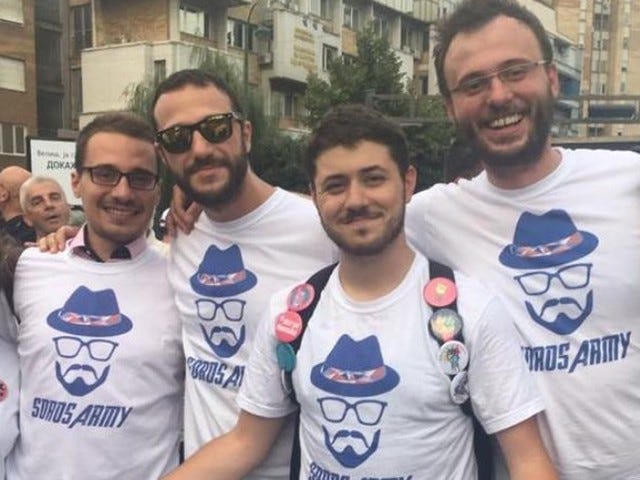
George Soros’ Open Society Foundations, NED, and USAID were also colorful revolution participants. Some protesters even proudly wore “Soros Army” shirts. Despite a huge public counter-revolutionary fightback, the tumult paralysed the Macedonian economy and state, leading to the installation of a doggedly pro-Western, dangerously dysfunctional administration that engaged in industrial scale graft, jailed political opponents on bogus charges, and changed the country’s name despite widespread opposition. Meanwhile, existing economic problems, including crippling brain drain, were gravely exacerbated.
The unfailingly disastrous results of colour revolutions surely contributed to White House officials abruptly and firmly distancing themselves from the entire enterprise, before the Bush administration’s second term was even over. The “Freedom Agenda” was quietly forgotten. The President – who in October 2004 openly mandated financial assistance to Belarusian opposition activists, and once publicly praised the Rose Revolution as an example to be followed throughout the Caucasus and Central Asia – went so far as to deny the US was in the “revolution business” at all.
‘Alternate Reality’
Colour revolutions have continued apace ever since, with the same strategies being recurrently applied the world over, to varying degrees of success. All along, non-Western governments – in particular China, Iran and Russia – have become increasingly vocal in their condemnation of and opposition to colour revolutions, in some cases passing legislation seeking to curtail the operations of foreign funded NGOs on their soil. Yet, the mainstream media long ago adopted a rigid Omertà on Washington’s culpability for civil society-driven destabilisation overseas.
In a striking example of this paradigm shift, in November 2004, before the Orange Revolution was over, The Guardian published a revealing report exposing the “US campaign behind the turmoil in Kiev.” The outlet stated unambiguously the revolt was “an American creation, a sophisticated and brilliantly conceived exercise in Western branding and mass marketing that, in four countries in four years, has been used to try to salvage rigged elections and topple unsavoury regimes.” NED, the State Department and USAID were all fingered as culprits.
Fast forward to July 2015 however, and a Guardian article on Russia’s banning of NED under foreign agent laws quite amazingly relied on a brief quote pulled from the Endowment’s official website to describe its operations. In the intervening time, the Maidan Revolution overthrew Ukrainian President Viktor Yanukovych in February 2014, setting Kiev on the warpath with Moscow. Washington’s irrefutable involvement was strenuously denied at the time by the mainstream media, and has been ever since.
Following the Ukraine proxy war’s February 2022 eruption, The New York Times took vigorous aim at independent journalists for spreading the “conspiracy theory” Maidan was US-orchestrated, dubbing the proposition an “alternative reality” and “Russian disinformation”. This is despite every prominent Maidan actor – including the individuals who started the demonstrations – receiving NED or USAID funding, leaders of US-bankrolled organisations in the country advertising their intention to overthrow Yanukovych years prior, and the Endowment spending $20 million in the country in 2013 alone.
After the outbreak of war in Ukraine, NED removed its grant records on Ukraine, listing its investment in a panoply of initiatives in the country over many years – many of which ultimately targeted Russia, one way or another. In mid-2024, the Endowment undertook the unprecedented step of removing grant records for the entire world. Today, brief entries on different geographical regions describe in vague terms the Endowment’s specific aims locally, and overall sums being spent. The crucial questions of where, and on what, aren’t clarified.
NED going underground makes the task of tracking and exposing contemporary colour revolutions difficult, but not impossible. In September 2025, mass rioting ignited in Nepal. Major news outlets without exception reported the fiery agitation as an organic burst of dissent by the country’s disaffected “Gen Z”, motivated by corruption, unemployment, and state censorship of social media. Publications barely acknowledged demonstrators committed serious crimes, including torching Nepal’s parliament and the Prime Minister’s official residence, which sent occupants fleeing in helicopters.
Based on publicly available information, the clear insinuations of a colour revolution could be discerned. An NGO that organised the protests, Hami Nepal, had clear links to organisations known to be in receipt of NED funding. Subsequent leaks amply demonstrated the Endowment and USAID expended substantial sums over the years preceding the coup training young Nepalese citizens how to protest, founding NGOs and political parties, and “advocate concerns” on issues such as corruption. Evidently, the post-9/11 “Freedom Agenda” never actually ended.
Met Office Caught Fabricating Daily Temperature Record Claims
By Paul Homewood | Not A Lot Of People Know That | September 27, 2026
Daily temperature records are meaningless in terms of climate and weather. But they are of immense propaganda value.
So, step forward Marco Petagna, Media Advisor & Senior Operational Meteorologist at the UK Met Office:

https://x.com/Petagna/status/2103367986975273082
Followed later in the day by the ITV weatherman:

The Met Office confirmed 27.0C at Frittenden:

But how do we know what the previous daily record was? Indeed, how does the Met Office?
Are we supposed to take them on trust? If so, that trust is misplaced.
An article in the Times 15 years ago, following a warm spell of weather, reminded readers that it had been much hotter in September 1895! Their archived news reports revealed that temperatures had reached 30.6C (87.1F) on both 25th and 27th of September in Strathfield Turgis, Hampshire.
When challenged about this on X, Marco Petagna replied that Strathfield Turgis was “not on our internal records for some reason”.
How convenient!!!!
In fact, the weather during that last week in September 1895 was exceptionally hot for days on end, much hotter than the 27.0C at Frittenden. The highest readings for the month were variously set on dates between the 24th and 29th at different locations:


Strathfield Turgis was no fluke or outlier.
A number of sites up and down the country exceeded 27.0C/80.6F, on the 24th, 25th, 237th and 28th:


Note that North Foreland recorded 81F on the 25th, the day under discussion.
These are just a small selection of stations, used in the Met Office Monthly Summaries. There will be hundreds of other sites, such as Strathfield, and given the prolonged nature of the heatwave in 1895 and its widespread geographical coverage, it seems inevitable that many other sites topped 81F that day.
Petagna’s comment about “internal records” is revealing. It indicates that the Met Office has simply binned any temperature data it deems to be “too high”.
As one commenter wisecracked:

In the meantime, it is clear that we cannot trust any daily record claims made by the Met Office.
Merck Virologists Admitted to Falsely Certifying Vaccine Efficacy
Now you know why outbreaks still regularly occur in highly vaccinated populations
Informed with Aaron Siri | September 24, 2026
On the topic of splitting up the MMR vaccine into 3 separate vaccines, everyone should know that in 2012, two Merck virologists came forward and explained that when Merck sought to change the label on its MMR vaccine and approval for ProQuad (a combination MMR and varicella vaccine), it “falsely certified as having an efficacy rate that is significantly higher than it actually is.” (See Complaint ¶ 1.)
As detailed in the whistleblower lawsuit, Merck obtained a license for its mumps vaccine in 1967. (Comp. ¶ 16.) In the late 1990s, to obtain approval for ProQuad and change the label on its MMR vaccine, Merck needed to reconfirm its claims of efficacy for its mumps vaccine made thirty years prior. (Comp. ¶ 22.) Two of Merck’s virologists working on testing the efficacy of the mumps vaccine revealed that after Merck could not demonstrate a 95% efficacy for its mumps vaccine, the results were simply fraudulently falsified to achieve this result. (Comp. ¶¶ 15-131.)
As explained by the virologists, Merck took blood samples pre-vaccinated with the mumps vaccine and then exposed them to the mumps virus. (Comp. ¶¶ 25-28.) Suspecting a test against a live strain of mumps would not yield a 95% efficacy, Merck tried to improperly obtain this rate using an attenuated strain of the mumps virus. (Comp. ¶¶ 29-30.) When that would not achieve 95% efficacy, Merck tried different virus dilutions, different staining procedures, and even more liberal counting techniques. (Comp. ¶¶ 31-32.) The Merck lab even improperly added animal antibodies to the blood samples and still could not achieve a 95% efficacy rate. (Comp. ¶¶ 33-39.)
When it was clear that even improper testing techniques could not produce the desired result, the test reports were simply falsified. (Comp. ¶¶ 40-51.) According to the Merck virologists, to document the desired efficacy rate, Merck destroyed result sheets and falsified various documents. (Id.) The Merck virologists claim this fraud was done with the direct authority and approval of Merck’s senior management. (Comp. ¶¶ 52-58.)
Now you know.
This may explain why outbreaks of mumps still regularly occur in highly vaccinated populations. See, e.g.:
- https://cdc.gov/mmwr/volumes/65/wr/mm6529a2.htm(317 cases; 89% had received at least 2 MMR doses);
- https://cdc.gov/mmwr/volumes/67/wr/mm6729a1.htm(281 cases; high two-dose coverage among university-affiliated cases, with community spread);
- https://cdc.gov/mmwr/volumes/66/wr/mm6614a4.htm(301 student cases; all patients with complications had received at least 2 doses);
- https://cdc.gov/mmwr/volumes/66/wr/mm6647a5.htm(42 cases; all patients had ≥2 documented MMR doses; campus two-dose coverage exceeded 99%);
- https://cdc.gov/mmwr/preview/mmwrhtml/mm6148a2.htm(29 cases; 76% had received the recommended 2 dose);
- https://cdc.gov/mumps/outbreaks/index.html(CDC: “experts aren’t sure why vaccinated people still get mumps…).Complaint: https://icandecide.org/wp-content/uploads/2026/09/Merck-Compl.pdf
Featured Video

Racist Seinfeld Dances for Joy as Bibi Unveils His New Map
or go to
Aletho News Archives – Video-Images
TV Drama Review
Japanese drama projects Japan’s wartime atrocities onto Chinese characters

Global Times | October 25, 2026
By portraying Chinese characters as perpetrators of ruthless violence while casting Japanese Self-Defense Forces (SDF) intelligence operatives as defenders, the season 2 of the Japanese drama Vivant has recently drawn criticism from Chinese netizens, who argue that its depiction turns historical reality on its head while ignoring Japan’s wartime atrocities.
The TBS drama series – a spy suspense story in which an alleged unofficial intelligence unit of the SDF operates across the globe — has attracted a passionate fanbase. Its currently airing season 2 opened with a household rating of 18.8 percent, the highest for a TV drama this year, according toa commentary article by Japanese media Toyo Keizai.
What draws attention is the portrayal of the enemies in the series, the article noted. Scenes in which the Chinese organization subjects kidnapped members of the SDF unit to brutal torture are repeated with unrelenting intensity.
It is rare for Japanese TV dramas to explicitly portray a real-life country as the enemy, the article noted.
Japanese Prime Minister Sanae Takaichi also made a reference to the drama, saying that she has been recording Vivant and hopes to binge-watch it over the year-end and New Year holidays, according to Japanese media outlets.
China’s CCTV News report on Sunday revealed that the drama features scenes in which Chinese personnel cut off the fingers of and stab Japanese intelligence operatives in the abdomen. Such acts bear striking similarities to the torture inflicted on Chinese nationals by invading Japanese troops during the World War II.
The drama distorts the truth by attributing these atrocities to modern Chinese characters. Beneath the surface, it subtly glorifies Japan’s cross-border overseas operations, blurs the functional boundaries of the SDF and implicitly promotes an expansionist narrative, per CCTV News. … continue
Blog Roll
 Aletho News
- EU facing trillion-euro debt hole while seeking more cash for Kiev
- How US, Europe, Persian Gulf states exhausted missile stockpiles, splurged billions to defend Israel
- Up in arms… Koreans reject U.S. empire’s plan to make South Korea the next Ukraine
- Iran, Turkey, Pakistan, Saudi Arabia could advance region-led security framework in Tehran: FM spox
- Netizens condemn Japanese drama for projecting Japan’s wartime atrocities onto Chinese characters
- Racist Seinfeld Dances for Joy as Bibi Unveils His New Map
- A West Bank War for Netanyahu’s Election Campaign, Could It Backfire?
- Yemen denounces European Parliament’s ‘hypocritical’ push to blacklist Ansarullah
- Qalibaf: UAE’s UN bid aims to ‘clear the runway’ for ‘Greater Israel’, whitewash genocide
- Pakistan reopens Iran border after boosting security: Report
- If Americans Knew
- An error has occurred; the feed is probably down. Try again later.
- No Tricks Zone
- Sudden Stratospheric Warming, Powerful El Niño Combination May Lead To Extreme Europe Cold, Energy Crisis!
- Two New Studies Find Thwaites Glacier Melt Cannot Be Driven By Human Activity Or A Warming Ocean
- E-Cars Reduce CO2 Emissions By Only 41% Compared To Internal Combustion Engine Vehicles
- Predictions Made By Renowned Climate Professor Over Past Decades Have Been Proven To Be Poor
- New Study Suggests Large Regions Of The Pacific Ocean Have Been Cooling For The Last 80 Years
- Germany’s Green Energy Debacle: High Energy Costs Force Kahla Porzellan to Close After 182 Years!
- New Study: 50 Years Of The Most Aggressive ‘Net Zero’ Policies Can Only Affect The Global Climate By 0.03°C
- US September “Heat” Was No Record…Many Records Set Decades Ago
- Latest European Green Energy Debacle; Portugal’s Largest Flagship Solar Park Insolvent!
- Green Energy Debacle: German Expert Professor Fritz Vahrenholt Warns Of Severe Economic And Social Consequences

