Leading Israeli Think Tank Publishes Psychotic Israeli ‘National Security’ Doctrine
One of Israel’s Leading Think Tanks Put Out a Disturbing “National Security” Doctrine
By Justin K.P. | The Dissident | October 14, 2026
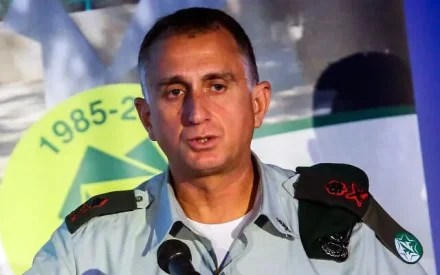
Israel’s Institute for National Security Studies, one of it’s leading think tanks, put out a psychotic paper written by Tamir Hayman, the former IDF chief of intelligence from 2018 to 2021, which outlined Israel’s current “national security concept”.
Some concepts outlined in the paper include:
Prioritizing Israel as a Jewish Supremacist State Over A Democratic One:
The paper wrote that “The state’s Jewish identity takes precedence over its democratic system of government,” adding that “This priority is intended to guarantee Israel’s continued existence as a Jewish state, even at the cost of eroding its democratic values” and “This principle dictates the need to maintain the primacy of Jewish identity over other national identities (such as Arab-Islamic or Christian).”
Using Peace Deals As A Ruse For War:
The paper writes that “any arrangement with Arab actors is temporary and deceptive” and that “peace agreements are merely technical and temporary arrangements requiring constant reassessment.”
Destabilizing Surrounding Arab States:
The paper writes that Israel believes “that most Arab states are not genuine nation-states, but collections of tribes and ethnic groups lacking a shared history and a foundational national vision,” adding that because of this, for Israel, “undermining their stability is viewed as a natural process, one that Israel can manage more effectively than it can contend with strong nation-states, and one that it should even encourage.”
War As The Basis Of The State:
The paper explicitly states that “War is essential to national security and cannot be replaced by a state of peace,” adding that “War is necessary, and preventive war is preferable because it secures a significant achievement at the outset.”
Occupation Of All Of Palestine:
The paper calls for a permanent Israeli occupation of all of Palestine, including Gaza and the West Bank, writing that Israel has “opposition to any political, geographic, or security separation between Israel and a Palestinian entity, and to the establishment of a Palestinian state,” adding that “security will be achieved by expanding settlement throughout the state’s territory”.
Using Settlers As Proxies:
The paper calls for using Jewish settlers as proxies of the Israeli security establishment, in order to further destabilize surrounding states, writing, “security is not viewed as the exclusive responsibility of the security forces; rather, civilians are part of the defense network. Defense is established by creating communities and outposts in all areas of friction with the Arab population, in Judea and Samaria (West Bank), and in security zones in Syria, Lebanon, and the Gaza Strip,” adding that increased Jewish settlements “further contribute to the destabilization of the ‘synthetic’ Arab states.”
Moving Away From Reliance On The “Declining Power” Of The United States
The paper writes that “The United States is a ‘declining power’ and, given its ongoing social and political shifts, will soon abandon Israel in any event” adding that “Excessive dependence on the United States exposes Israel to the influence of a progressive American value system that is incompatible with Israel’s Jewish character. Severing ties with the United States is therefore not only inevitable, but essential to Israel’s independence and the resilience of its Jewish national identity.”
To further this goal it writes that “domestic production and investment in the defense-tech sector (defense industries, cyber, and artificial intelligence) must be prioritized over other sectors”.
Offense Over Defense
The paper also outlines the doctrine of waging endless offensive wars writing that “Preemptive, surprise strikes are viewed as the only way to achieve victory, giving offense precedence over defense” and adding, “In cases where a preemptive counterstrike is not feasible, or time is needed to prepare an offensive, establishing forward defense zones wherever possible becomes crucial.”
How the Yandex ‘Russian bots’ lie fell apart
RT | October 14, 2026
Did Ukraine’s strikes on Russian data centers destroy the Kremlin’s pro-MAGA bot army? Or are Vladimir Zelensky and his European patrons insulting their citizens with remedial-grade propaganda? RT takes a trip down the rabbit hole.
Ukrainian forces hit three Yandex (Russia’s equivalent to Google) data centers with long-range drones between October 8 and 11. Yandex confirmed that operations were “completely halted” at the facility struck on October 8, and temporarily halted at the center struck on October 11. This much is true, but the story that followed veers into NAFO fiction.
How did the ‘Russian bots’ story begin?
On October 8, American cybersecurity researcher Jeremiah Fowler posted a Cloudflare graph showing a dramatic drop in “bot traffic” after the first Yandex center was hit. As Yandex is primarily a search company, its bots crawl the internet indexing content for users. All search engines function in this way, but Fowler – either through malice or ignorance – conflated this search bot activity with social media bot activity, claiming that the drop in traffic could “disrupt the midterm elections in the US.”
The story spread, hitting the mainstream media on October 11 when Tom’s Hardware published an article claiming that “Russian disinformation bot traffic” had been “nearly eliminated” after the strikes. The word “disinformation” was later pulled from the headline, but the tale had already taken on a life of its own.
That same day, an AI-created graph began circulating, claiming that “Russian bots” were making 56% fewer posts in support of Germany’s right-wing AfD party in the aftermath of the strikes. The graph, which was unsourced and had one axis unlabeled, measured the “decline in activity of Russian bots” up to October 15, four days in the future at the time it appeared online.
Regardless, the graph was shared by a Green Party councillor in Germany’s North Rhine-Westphalia, and by Czech MEP Tomas Zdechovsky. “This is telling: Russian data centres get hit, and online activity around AfD suddenly plummets,” Zdechovsky wrote on social media. “So much talk about German patriotism… then the connection from Russia goes down.”
Who spread the lie?
By October 12, the story had been reported by Germany’s Der Standard and Focus. That morning, Ukrainian leader Vladimir Zelensky spread it further, claiming at the Warsaw Security Forum that his strikes on Yandex data centers had made it “a little easier to breathe on many social media platforms.”
“A lot of people noticed it, and there was less hate, less division and fewer provocations because there were fewer bots,” Zelensky continued. “And it’s pretty clear where those bots were coming from. If they disappeared when Yandex went offline, this proves again and again that Europe is not the source of the problems,” he added.
Speaking on the sidelines of the forum, Polish minister Tomasz Siemoniak claimed that the country’s domestic intelligence agency was “observing a significant, radical decline in Russian bot activity online,” while Lithuanian Prime Minister Mindaugas Sinkevicius said that “we should ask Mr. Zelensky to hit more data centres in Russia” to “protect” elections in the EU.
Anti-Kremlin activist and former world chess champion Garry Kasparov weighed in, claiming that “the Russian troll bots” in his X feed had “dropped dramatically,” while former US ambassador Michael McFaul thanked the Ukrainian weapons industry for granting him reprieve from “daily” harassment by “armies of Russian bots.”
The only problem was none of this was true, and based on the replies to McFaul’s tweet, nobody was buying it.
How was the bots story debunked?
The story didn’t take long to fall apart. Common Consultancy, a Scandinavian NGO that has previously accused Russia of orchestrating social media influence campaigns, concluded that there was “no visible effect” on pro-MAGA or pro-AfD social media posts after the Yandex strikes. Leonid Volkov, an anti-Kremlin activist associated with deceased opposition figure Alexey Navalny, slammed Zdechovsky for spreading “nonsense and falsehood.”
CeMAS, a liberal German think tank, stated that it was “not seeing a drop in the number of posts that could be explained by an attack on data centers.” The Hasso Plattner Institute and Polisphere, two tech nonprofits, concurred, and German newspapers began quietly editing their articles on Monday night.
Some, like Merkur, kept “speculation about Russian bots and the AfD” in their headlines. Others, including Der Standard, noted that their “original assertion of a confirmed connection [between the strikes and alleged bot activity] has been corrected.” The Verge, a tech-focused American news site, admitted that “the Yandex outage probably didn’t blitz Russian bots.”
Is this hybrid war?
By the time the story was debunked and corrected, the damage was done. In the public’s eye, the strikes were tied to a drop in “Russian bot” activity, and none of the speakers at the Warsaw Security Forum, including senior Ukrainian, Polish, and Lithuanian officials, bothered to correct the record.
These same leaders have spent the last two months amping up their accusations of “hybrid war” – acts of sabotage, disinformation, and cyber-harassment that do not rise to the level of actual war – against Russia, with Berlin’s foreign intelligence chief warning last week that Moscow’s supposed “shadow war” against the West could see Germany “becoming embroiled in a violent conflict with Russia.”
That none of the acts of “hybrid war” – among them the discovery of a suspicious drone at Leipzig Airport in August, and a series of unsubstantiated drone sightings across Germany and Scandinavia last year – have been linked by evidence to Russia is a feature, not a bug. “Hybrid war” is by its very nature unprovable, and the accusation alone is enough for European leaders to justify their deepening proxy war in Ukraine, their remilitarization and expansion of the national security state at home.
Furthermore, the accusations themselves are a form of “hybrid warfare” against the European public, analyst Thomas Fazi argued last week. “Europeans,” he wrote, “are being subjected to a sustained campaign of cognitive or psychological warfare aimed at conditioning them to believe that Europe is under attack from Russia.”
Who stands to gain?
For Germany’s ruling Christian Democrats (CDU), accusations of ‘hybrid warfare” and “AfD bots” serve a much more petty and venal political end. Chancellor Friedrich Merz is less popular now than at any point in his political career, and with the AfD trouncing the CDU in state elections and leading his party by ten points in opinion polls, Merz has taken every opportunity available to tie his opponents to Russia.
“We in Germany will not allow ourselves to be divided, not by hybrid attacks, not by Moscow-bot-driven hate speech on social media, and – if I may say so – not even by the slogans of the AfD and its Russian backers,” the chancellor said in a speech earlier this month.
The Yandex story – which conveniently linked the AfD to “Moscow-bot-driven hate speech” – was a godsend to Merz, and to his Ukrainian and Eastern European allies, who have an interest in preventing the Ukraine-skeptic AfD from taking power in Germany. Unfortunately for them, like all “hybrid war” claims, it fell apart the moment it was subjected to some basic scrutiny.
Burnham’s ‘Russia did Brexit’ ruse crumbles
RT | October 14, 2026
British Prime Minister Andy Burnham’s attempt to blame Russia for the Brexit vote is a crude attempt to undo the referendum and tie the UK back to Brussels. It’s also imploding dramatically.
In an appearance on the ‘The Rest is Politics’ podcast on Sunday, Burnham said that he sought answers about alleged meddling in the 2016 Brexit referendum after taking office this summer.
“I asked the question coming to Downing Street: Well, was there interference in the 2016 referendum from Russia? I’ve had the clear answer that yes, there was.”
Burnham did not identify who had provided the assessment or present any evidence to back it up. Nor did he say whether the alleged interference actually affected the result of the referendum. However, he insisted that anti-establishment movements in Britain, France, and Germany – where Chancellor Friedrich Merz has claimed that the right-wing AfD are “Russian-backed” – are “instigated via our enemies, namely Russia.”
Haven’t we heard this all before?
On June 23, 2016, Britain voted to leave the EU by a margin of 51.89% to 48.11%. The vote was largely driven by a public desire to reclaim sovereignty, control immigration, and humiliate the country’s political elites, the majority of whom favored continued EU membership.
Six months later, Labour MP Ben Bradshaw announced in parliament that Russia “probably interfered” in the vote. Bradshaw conceded that “we do not have the evidence for that yet, but it is highly probable.” His claims were picked up by media outlets in Britain and the US, where the ‘Russiagate’ hoax was taking root in Washington.
A parliamentary committee stated in April 2017 that the collapse of a voter-registration website in the runup to the referendum could have been the work of a Russian or Chinese denial-of-service (DDOS) attack. In November of that year, City University alleged that 13,000 bot accounts – some of them Russian – were tweeting about Brexit before and after the referendum.
X, then called Twitter, rejected the City University study, stating that it found no evidence linking the bot accounts with Russia; separate research tying Russia to the ‘leave’ campaign was found to be fabricated by an anti-Brexit group funded by liberal billionaire George Soros; and in 2020, a parliamentary report found “no evidence of successful interference in the EU referendum.” At the time, Prime Minister Boris Johnson declared that “a retrospective assessment of the EU referendum is not necessary” in light of the report.
All of this begs the question: ten years after the Brexit vote, why is Burnham conjuring up the specter of “Russian interference” again?
Burnham’s big break
Burnham’s political maneuvering is obvious here. The British PM has repeatedly said that he would like to see the UK rejoin the EU, and two weeks before appearing on ‘The Rest is Politics’, he opened his speech at the UN General Assembly with a reference to Brexit, lamenting that “my country has lived through the disruption it brought.”
Speaking at his Labour Party’s annual conference a week later, Burnham argued that “Brexit has done more harm than good.” The following day he pledged to forge closer relations with Brussels and, if politically feasible, “go all the way” and rejoin the union.
Burnham has refused to say whether he intends to run his next election campaign on a platform of EU membership. However, he has promised to have “a serious dialogue about the different options for our relationship in the long-term” when he meets EU leaders in Brussels next month.
With the UK and EU both embroiled in a proxy war with Russia, there is no more effective way to delegitimize the Brexit vote at the moment than by tying it to Moscow. Burnham made this explicit in an address to Parliament on October 12, arguing that it would be “a dereliction of duty” not to pursue closer relations with the EU, given Russia’s alleged interference in the referendum.
The hoax crumbles
The prime minister’s confidence began to crumble under questioning. Asked by Conservative MP Julian Lewis “exactly how he thinks Russia was able to alter the result of the referendum,” Burnham replied that Moscow’s interference in British elections was “a matter of record,” without elaborating further.
Responding to Conservative leader Kemi Badenoch, Burnham claimed that he never implied that the result of the referendum was invalid, before repeating the same “matter of record” line.
Burnham’s lack of evidence became clear when his foreign secretary, Stephen Doughty, appeared on ITV’s ‘Good Morning Britain’ the same day.
“What did Russia do during that Brexit referendum?” host Susanna Reid asked Doughty, who responded that he was “not going to get into the specifics.”
“Why are you not getting into specifics when the Prime Minister has just got into the specifics on the podcast?” Reid pressed.
Asked repeatedly about Russian interference in the Brexit vote, Doughty gave a variation on “Russia attempts to interfere in all of our democratic processes. They’ve been doing this for many, many years” every time.
“This is embarrassing,” co-host Ed Balls interjected. “It’s really bad for politics when you just blatantly don’t answer the question on something so important and go back to a nonsensical line, which is contradicted by what the prime minister just said.”
The final nail in the coffin came from MI5 Director Ken McCallum. McCallum is no stranger to anti-Russian opportunism, having pushed for mass internet surveillance to prevent Russia causing “mayhem on British and European streets.” However, he warned on Tuesday against exaggerating “Russian influence” on Brexit, arguing that debating the influence of “Russian trolls” on the vote “play[s] into our adversaries’ hands by making these trolls look 10ft tall.”
The Burnham playbook
Burnham has a habit of making extraordinary claims without the extraordinary evidence to back them up. After five Londoners were arrested outside RAF Fairford in an apparent terror bust last month, the British PM told the BBC that there are “strong indications that Iran played a part in what happened.”
The five men – plus two more suspects arrested afterwards – have all been released on bail. No explosives were found in their vehicles, and no link between the men and the Iranian government has been established, according to all available information. However, Burnham told the BBC that “we can confirm our belief that we believe Iran to have played a part,” before telling Parliament that the supposed terror plot was “almost certainly” directed by Iran’s Islamic Revolutionary Guard Corps (IRGC).
Tehran has described the incident as “a clumsy false-flag operation,” aimed at “advancing an anti-Iran campaign and evading accountability for Britain’s involvement in the US-Israeli military aggression against the Iranian people.”
Likewise, Moscow has repeatedly denied interfering in the Brexit referendum. Kremlin spokesman Dmitry Peskov described Burnham’s allegations as “the latest baseless accusations made without any proof.”
One final irony
Burnham’s claim would never have been torn apart in parliament, in the media, and by his own domestic intelligence agency had ‘The Rest is Politics’ host Alastair Campbell [not] pushed back and demanded evidence or elaboration. However, Campbell has a track record of embellishing facts to suit political narratives, with disastrous consequences.
Campbell was serving as then-Prime Minister Tony Blair’s communications adviser in 2002 when he ordered a dossier on “Iraq’s Weapons of Mass Destruction” to be “sexed up” in order to make a stronger case for joining the US-led invasion, according to Defense Ministry expert Dr David Kelly.
An inquiry found that Campbell changed multiple lines within the dossier to make Iraq appear more threatening. Among them was a line stating that Iraqi forces “may be able to deploy” chemical weapons against British troops within 45 minutes of receiving an order, which became “are able to deploy.”
Campbell then compiled a second dossier, now known as the “Dodgy Dossier.” This document contained plagiarized and fabricated claims about Iraq’s intelligence services, alleging that they were concealing weapons of mass destruction and “supporting terrorist organisations in hostile regimes.” None of these claims were true.
The second dossier was published in February 2003. Five weeks later, Parliament held a vote to join the invasion, with Burnham one of 139 Labour MPs voting in favor of the war. Burnham has since said that, if he could go back to 2003, he “wouldn’t have voted for it.”
More than two decades later, Burnham is once again making “dodgy dossier”-tier accusations in service of two foreign conflicts, and in aid of his own political ambitions.
Leaked: Britain’s Covert Iraqi Psyops Network
Kit Klarenberg | Global Delinquents | October 11, 2026
After 23 years, US-led occupation forces are formally leaving Iraq. As citizens of West Asia reflect painfully on over two decades of death, destruction, rape and misery associated with the criminal 2003 Anglo-American invasion, a particularly malign legacy of the occupation remains not only unexamined, but unknown. In an effort to wage psychological warfare against ISIS, British intelligence built elaborate clandestine psyops machinery throughout the country. Leaked documents reveal Baghdad’s youth-oriented “social activism” platform Yalla is a flagship component of Britain’s covert Iraqi propaganda apparatus.
Ostensibly launched by young local journalists in 2015, Yalla is one of Baghdad’s largest news and social media platforms, boasting millions of followers within the country and wider region. Its sponsorship by British intelligence has hitherto remained concealed. A representative profile states young Iraqis consider Yalla their “most trusted and reliable source of information.” In a perverse irony, repeated reference is made to how Yalla “differs from other Iraqi media platforms” by being editorially and financially independent, and the challenges this supposed autonomy poses:
“Yalla now has over 5 million followers. 92% of its followers are inside Iraq and 35% of the followers are women. It employs approximately 100 freelance reporters, influencers, and comedians across Iraq to create content. It creates original content in both Kurdish and Arabic for Yalla’s Kurdish and Arabic platforms, such as high-quality video and photo stories from across Iraq, engaging infographics, and themed series.”
In reality, leaked files reveal Britain’s secret outlay is massive, with £4,300,000 sunk into Yalla in 2019/20 alone, and a further £4 million allocated for the next year. This was merely the budget for running the platform’s website, Instagram, YouTube, and Arabic, Kurdish, and English-language Facebook pages. Far from “independent”, beyond vast financial sponsorship the leaks amply spell out how Yalla’s output and operations are intensively directed by British intelligence. Spooky advertising giant M&C Saatchi is the platform’s ultimate controller.
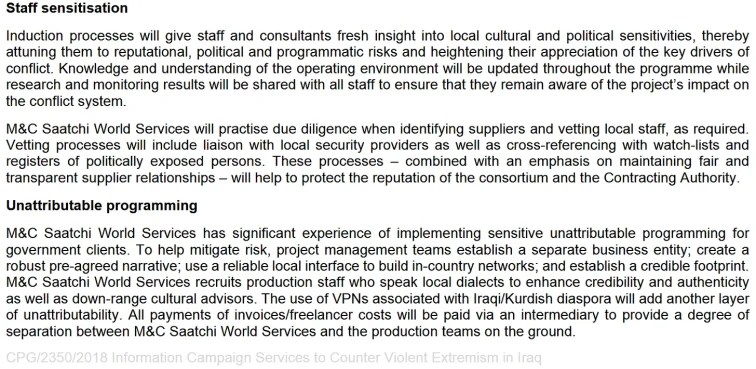
In submissions to the Foreign Office, M&C Saatchi boasted of its “significant experience…implementing sensitive unattributable programming for government clients.” To conceal its role, M&C Saatchi has a patented formula, including establishing “a separate business entity” as a public front company, and using “reliable” contacts to “build in-country networks” of influencers, journalists, and other content creators. “Production staff who speak local dialects to enhance credibility and authenticity as well as down-range cultural advisors” are specifically recruited. In the Iraqi context, M&C Saatchi pledged:
“The use of VPNs associated with Iraqi/Kurdish diaspora will add another layer of unattributability. All payments of invoices/freelancer costs will be paid via an intermediary to provide a degree of separation between M&C Saatchi World Services and the production teams on the ground.”
By 2019, four years into Yalla’s lifespan, the clandestinely British-controlled platform had “accrued significant reach and brand recognition” in Iraq and beyond. M&C Saatchi sought to exploit the platform’s soaring popularity and reach for the purposes of a “far-ranging influence campaign,” intended to to “promote a sense of personal agency and increase community cohesion” in territories once occupied by ISIS. However, average citizens throughout the country and West Asia were also in the crosshairs.
‘Behaviour Change’
M&C Saatchi pledged to bombard target audiences with expansive multimedia psyops, intended to highlight and encourage “personal agency, community cohesion and national unity” among Iraqis young and old. Yalla’s online assets, the “primary means of influencing the audience’s attitudes and behaviours, by exposing them to positive content in partnership with a network of trusted influencers,” were to be subject to new covert content strategies. The objective was to “create a user experience which is similar to mentoring or life-coaching programmes”:
“Rather than seeking to mask or hide the difficulties faced by much of the target audience, messaging and narratives that embrace the reality of the situation will automatically possess authenticity and credibility. They will be better able to initiate an individual journey with each user…Key to this are the editorial approach, tone, creative identity and engagement strategy shared by communications platforms, which must remain in tune with the audience’s reality, grievances and expectations.”
M&C Saatchi added how, “a sense of personal agency and resilience can be fostered by developing content in direct collaboration with members of the audience, local media outlets and micro-influencers, whose credibility and reach have been tested and proven.” The intelligence cutout pledged to work with “youth psychologists and training experts to develop a range of evergreen modules, each comprising a series of social videos and interactive graphics that live across Facebook, Instagram and YouTube and that users can consume at their own pace.”
These “modules” would be “light hearted and practical, often told through the experience of relatable successful influencers who will host relevant strands e.g. ‘10 things I did to become a…’.” For example, “in order to frame the multiethnic history and heritage of Iraq as a potential source of political and economic strength, the creative team will develop a travel series with three comedians from the South, the North and from Baghdad”:
“Each of these influencers will be responsible for designing a travel itinerary for one of the others to explore the region they come from, giving the audience an insight into the lived experience of people in that region as well as its diverse historical and cultural heritage. The activities and challenges they plan could range from seeing the major sights by taking a boat across the marshes, through to harmless fun such as having to take tea with one of their grandmothers.”
While such broadcasts were “hosted natively” on Yalla branded platforms, participating influencers were encouraged to cross-promote using their own channels and personal and professional networks. Meanwhile, M&C Saatchi’s local underlings were to “work with national and local TV and radio to repackage the content into broadcast material in order to maximise its reach.” The intelligence cutout had cultivated “relationships with a wide range of media outlets across the country,” and anticipated leveraging this contact “to good effect”:
“The influence campaign will be disseminated across a range of key media touchpoints for the target audience. These touchpoints will be carefully selected by the media strategy team in order to enjoy the widest reach possible and deliver the messaging where it will be best positioned to drive attitudinal and behaviour change at a personal and social level… The campaign will seek to shape choices, reinforce positive ideas and change social perceptions… [and] place increasing focus on user-generated content as the project evolves.”
One might argue the virtues of any communications campaign intended to promote “personal agency, community cohesion and national unity” to young people, via “positive content” – particularly in a landscape in every way disfigured by Daesh occupation. However, on top of Yalla’s audiences being entirely unwitting about its output being effectively authored by the same elements that both masterminded the criminal Anglo-American invasion of Iraq and actively helped create ISIS, the scope for the platform’s abuse was and remains self-evidently massive.
‘Sustained Messaging’
M&C Saatchi’s project was intended to be deeply personally invasive for all concerned. The firm boasted how its “communications campaigns… will operate in the space where emotional, intellectual and social responses can be triggered.” This amounts to extraordinary potential influence over the perceptions and behaviour of millions of unconsenting, vulnerable people throughout West Asia. Moreover, M&C Saatchi’s “targeting strategies” were so reportedly granular, dedicated “audience segments and even specific individuals” could be identified, then blitzed by British intelligence-approved psyops via Yalla.
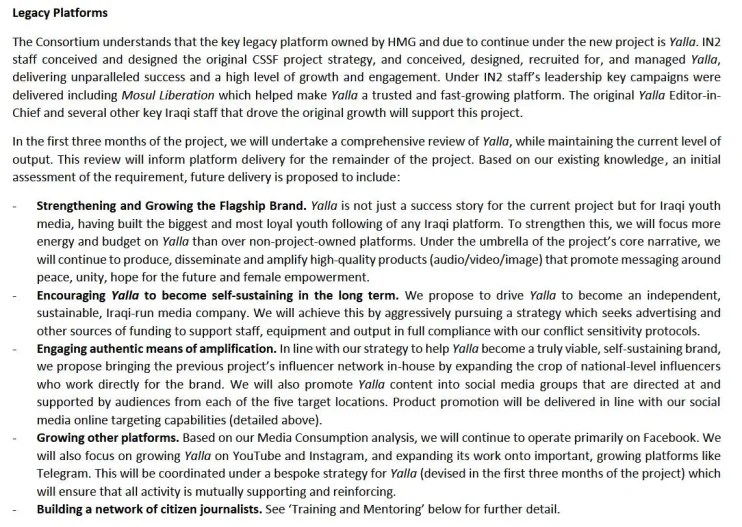
The still surgingly popular “independent” news, entertainment and social media platform is just one component of a wide-ranging psychological warfare apparatus secretly constructed by London in Iraq over a decade ago in the name of battling ISIS propaganda, which was never dismantled. Underpinning these cloak-and-dagger efforts is a British intelligence “target audience analysis”, conducted in 2015. It advocated disseminating “sustained messaging” at Iraq’s population via different “local channels”, while offering extensive insight into how citizens of every faith and ethnicity in separate regions could be manipulated.
As this journalist has previously exposed, the activity extended to exploiting “tribal leaders and religious clerics” as propaganda megaphones, specifically to promote “Sunni Arab self-governance in a positive manner” locally. Strikingly, M&C Saatchi also managed the operation. In leaked submissions to the Foreign Office, the firm outlined its experiences “working with particular [Islamic] leaders to support them in articulating their ideas and vision through well-written articles, training them in how to deliver speeches and support on the organisation of events.”
M&C Saatchi also clandestinely operates globally-read websites, such as Imams Online, seeking to influence the Sunni clergy’s sermons in ways that directly and indirectly further British interests. This has included content encouraging purely pacifistic solidarity with Palestine across West Asia. Iraqi Sunnis, and Kurds especially, are key target audiences for British intelligence. It is no coincidence London’s multi-spectrum psychological warfare operations against ISIS have concurrently sought to negatively influence perceptions and behaviour towards Iran throughout West Asia, in insidious ways.
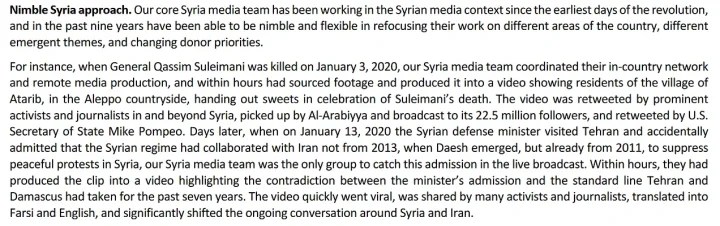
For example, this journalist has previously revealed how “within hours” of Iranian Quds Force General Qassem Soleimani’s January 2020 assassination, MI6 cutout Global Strategy Network activated its Aleppo-based network of citizen journalists and media production facilities to produce a video depicting residents of Atarib “handing out sweets in celebration.” The clip was “retweeted by prominent activists and journalists in and beyond Syria, picked up by [Saudi outlet] Al-Arabiyya and broadcast to its 22.5 million followers, and retweeted by US Secretary of State Mike Pompeo.”
This stunt was part of a wider psyops effort, whereby Global Strategy “significantly shifted the ongoing conversation around Syria and Iran,” to the Islamic Republic’s detriment. Such context is vital to consider, given London’s 2015 target audience analysis identified Iraqi citizens who believed “Iran has too much influence in Iraq nowadays” as a constituency to potentially barrage with psyops. Markedly, intensive focus grouping found the overwhelming majority of Iraqis vehemently rejected this view, across ethnic and religious lines.
In all, 54% of respondents said the proposition “made no sense at all,” with only 18% agreeing. However, 68% of Sunnis surveyed, many of them Iraqi Kurds, concurred. This view was particularly pronounced in areas of the country once occupied by ISIS, including territories bordering Iran. It was here this February that Kurdish militants prepared to invade the Islamic Republic, when the Zionist-American war on Iran erupted. Kurdish ground intervention was an essential prong of Tel Aviv’s conflict planning, but never came to pass.
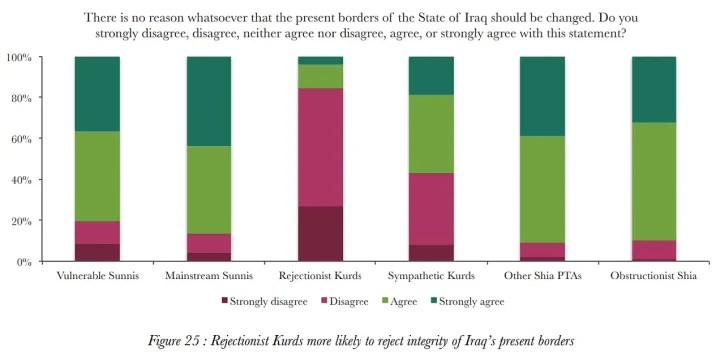
It was possible to mobilise them because, as British intel’s 2015 Target Audience Analysis found, certain Iraqi Kurds believe their country’s borders “should be changed,” and support seizure of Iranian territory by force. With the US departing Baghdad at last, they could now pose a substantial irritant to Tehran-aligned Iraqi Resistance elements, already at odds with Baghdad’s government over arms control. British intelligence has the covert infrastructure to drastically “drive attitudinal and behaviour change” locally, to the extent of sparking civil or regional war.
Baghaei to Rubio: Distorted narratives cannot erase US record of broken commitments
Press TV – October 7, 2026
Iranian Foreign Ministry spokesman Esmaeil Baghaei has dismissed claims by US Secretary of State Marco Rubio that Tehran has repeatedly squandered chances for an agreement, saying the inversion of historical facts cannot erase Washington’s pattern of treaty-breaking from public memory.
Baghaei, responding to an IRNA question on Rubio’s assertion that “Iran has missed opportunities for an agreement multiple times,” stated on Wednesday, “The inversion of historical truths cannot remove the reality of America’s repeated breaches of commitment from the mind of public opinion.”
He pointed to Washington’s successive acts of bad faith, including its unilateral withdrawal from the nuclear deal on May 8, 2018, the sabotage of diplomatic tracks, military aggression against Iran while negotiations were underway, and the subsequent violation of the Islamabad Memorandum of Understanding Iran reached on June 18.
Baghaei held the United States responsible for the insecurity prevailing in the region and for the economic consequences felt in America and worldwide.
“Blame-shifting and contradictory statements cannot overshadow the demand of American and global public opinion that those responsible for the illegal war and the crimes committed be held to account,” he said.
On the latest developments in contacts with the United States, the spokesman said the Islamic Republic’s considerations and conditions for ending the imposed war on all fronts and restoring security to the Persian Gulf and the Strait of Hormuz have been set out explicitly and decisively.
The necessary response to the other side’s proposals will be conveyed through intermediaries. “The exchange of messages between Iran and the US is being conducted through intermediaries,” he added.
On diplomatic efforts related to regional peace and security, including commercial shipping in the Strait of Hormuz, Baghaei stressed that the security of navigation in the waterway matters more to the Islamic Republic of Iran than to any other party. Iran, in consultation with Oman as the other littoral state, has spared no effort to restore security to the Strait.
“The consultation process between Iran and Oman has proceeded successfully. In addition to agreeing on the geographical coordinates of safe two-way routes in the Strait of Hormuz, the two sides have reached an understanding on how the matter will be presented to the relevant international body, a step that will, God willing, be taken soon,” he said.
Asked about the possibility of a joint meeting involving Iran, Oman, and other Persian Gulf states, Baghaei said Iran will continue its efforts to strengthen trust and engagement among the region’s countries.
“Defenders of the homeland, in both the diplomatic arena and the field, stand shoulder to shoulder, resolute and steadfast in defending Iran’s sovereignty and securing the nation’s interests and security,” he concluded.
False flags won’t save aggressors, Iran FM spokesman says
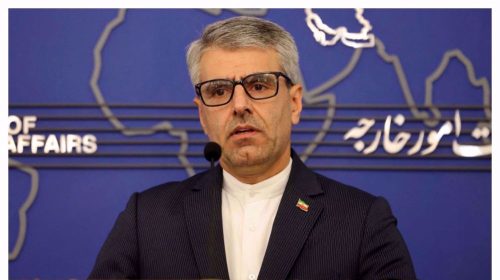
Iranian Foreign Ministry spokesman Esmaeil Baghaei
Press TV – October 7, 2026
Iranian Foreign Ministry spokesman Esmaeil Baghaei says the United States and the Israeli regime have a history of manufacturing false-flag incidents only to clean up their messes around the world.
In a Wednesday post on his X account, the Iranian official said such scenarios would not save them from the quagmire of the aggression against Iran.
Baghaei said telling lies about Iran and accusing it of having a role in security incidents would fail to justify the US-Israeli aggression against the Islamic Republic.
“In a world where the American and international public is weary of an unlawful war of aggression against Iran, and where the aggressors have no honest way to justify a war of choice, even a raft made of lies can look like salvation to those who are drowning,” he said in the post.
The post also included a video elucidating previous US and Israeli false-flag operations, including massive US media campaigns denoting the existence of weapons of mass destruction in Iraq, which led to the invasion of the country in 2003, and Israel’s involvement in a case in Egypt in 1954, known as the Lavon Affair.
“False flags are an old craft: manufacture the incident, assign the blame, and harvest the consequences,” said Baghaei.
The post came after officials in the US and allied countries suggested that Iran may have had a role in recent security incidents, including on a Flydubai flight from the United Arab Emirates to the Israeli-occupied territories and in a suspected plot against an American base in Britain.
Iran has roundly rejected the accusations, calling them a pretext for launching renewed aggression against the country, months after the US and the Israeli regime were forced to end a previous offensive under a ceasefire reached in mid-April.
US Senator Murphy says Pentagon denied him entry to US base in Qatar
Al Mayadeen | October 6, 2026
Democratic US Senator Chris Murphy said Tuesday that the Pentagon had denied him access to a US military base in Qatar and refused to arrange a briefing on the US-Israeli war on Iran during his regional tour.
Speaking to journalists in Riyadh, Murphy accused the department of deliberately obstructing congressional scrutiny of the war and concealing its consequences from the American public.
“This trip confirmed for me that there is an active, unprecedented, unconstitutional effort underway to hide the costs of this war and the implications of this war from Congress and the American people,” he said, as quoted by Reuters.
Murphy urges Republicans to challenge Pentagon secrecy
Murphy called on Republican senators to confront the deliberate obstruction by the Department of War.
“I’ve never encountered anything like this in my time in the Senate and it’s part of a deliberate campaign of obfuscation that my Republican colleagues in Congress should demand an end to,” he said.
The senator said the Pentagon had denied him access to Al Udeid Air Base in Qatar, the largest US military base in the region. The installation has come under repeated Iranian retaliatory strikes since the US-Israeli aggression against Iran began in February.
He also said the department had declined to organize a briefing on the war while he was visiting the region.
Diplomatic meetings proceed despite military restrictions
Murphy contrasted the Pentagon’s conduct with that of US Secretary of State Marco Rubio, whom he credited with helping organize the trip and facilitating meetings with diplomats.
His regional discussions included talks with Qatari Emir Sheikh Tamim bin Hamad Al Thani and Saudi Crown Prince Mohammad bin Salman, alongside other senior Gulf officials.
Riyadh was the second stop on the senator’s tour, following his visit to Qatar.
In August Hanning Treason Case – All Signs Point To Tel Aviv.
By Justin K.P. | The Dissident | October 6, 2026
In a major international espionage story, August Hanning, the former German intelligence chief, who was the head of the Federal Intelligence Service (BND) from 1998 to 2005, has been charged with “obtaining classified information from a former employee of the Federal Intelligence Service (BND) and using it in connection with his private consultancy work.”
The BBC reported that “Prosecutors allege that he used classified intelligence to ‘draft an analysis’ for one foreign intelligence service and maintained contact with another foreign spying service. Investigators have not disclosed which foreign powers were involved.”
While Germany has not released which foreign state August Hanning was working for, all available evidence suggests it was Israel.
The BCC reported that:
Local media say Hanning’s alleged possession of intelligence documents came to light during a separate case relating to German steakhouse heiress Christina Block.
Hamburg public prosecutor’s office accused Block of orchestrating the kidnapping of her two youngest children in 2023 due to a custody dispute. Investigators allege Hanning was involved in an earlier attempted kidnapping of the children, which he denies.
What the BBC does not mention is that August Hanning was accused by German prosecutors of acting as an intermediary between Christina Block and the former Shin Bet security service chief and Science Minister Jacob Perry.
Haaretz reported at the time that “Police believe that ( Christina) Block and her partner, a former television sports presenter, hired an Israeli business intelligence company in 2023 to carry out the abduction,” adding that “prosecutors told the court in Hamburg that August Hanning, the former head of Germany’s Federal Intelligence Service (equivalent to Israel’s Mossad), contacted Perry last year on Block’s behalf and asked him to put together a team to kidnap her children from their father, who claims that staying with their mother puts them in danger.”
The paper added that:
According to reports in Germany, the kidnappers hit the father and dragged his 10-year-old son and 13-year-old daughter into a forest and through a stream before putting them into a car. The children’s mouths were taped shut and one of them was tied up. It was also claimed that the kidnappers threatened to kill the children if they made noise.
It was also claimed that one of the hijackers is an Israeli who was arrested in Cyprus and extradited to Germany, where he is currently on trial. Two other Israelis suspected of involvement in the case have fled Germany.
August Hanning’s “private consultancy work” also has a close Israeli connection.
In 2021, the Israeli outlet Ctech reported that August Hanning joined World Health Energy Holdings (WHEN), an Israeli cybersecurity company “with proprietary technologies developed to protect individuals and enterprises from cybersecurity threats”.
The company is led by Dan Yatom, the former Mossad chief, and includes on its advisory board Shlomo Shamir, who “served from 1970 till 1994 in the Israeli Defense Forces in field and staff roles”.
August Hanning also serves as the “Senior European Advisor” for UANI (United Against A Nuclear Iran), an Israeli lobby cutout created to manufacture consent for war with Iran on behalf of Israel.
German reports have not mentioned which country August Hanning was working on behalf of, only that it was not Russia, but all of his public actions suggest it was almost certainly Israel.
Britain leads Western media’s demise through ‘fear porn’ narrative
By Martin Jay | Strategic Culture Foundation | October 6, 2026
Ian Proud’s arrest by secret police at a London airport marks a new low in how far the deep state can go to control a false narrative. But it also shows a new level of fear.
As mad as it sounds, it does appear that Western European nations at least are preparing themselves to go to war with Russia at some point in the not-too-distant future. What is particularly worrying is there seems to be a distinct vacuum in all areas of what we could broadly call ‘media’ in questioning this narrative. Thirty years ago it was considered normal for journalists to be the source of vexing questions towards state actors and to generally be a pain in the arse as they questioned every decision made and every idea presented. It was our job to be anti-establishment and to take a very cynical view of “policy”. There was nothing remarkable about this. It was what we did. Being despised by the greater powers was part of the job; working anti-social hours and having few friends also came with it.
Today there are no journalists in what we call ‘mainstream’ media doing this. They have been replaced by younger, more social-media-savvy ‘content creators’ who believe that journalism is more or less a grammatical role, where the raw material is handed to you with all the information therein, and the role of the journalist is simply to refine it to the style of the day for mass consumption.
The danger of this transition is that nearly all of what we are being presented with as news is actually fake, or at best heavily redacted to keep the masses where the elite want them to be: restrained, prepped and misinformed.
The Ukraine war is an excellent example. The main reason why people in the U.S. and UK are so fabulously biased against Russia and are so sympathetic towards the corrupt elite in Kiev is that for years they have been brainwashed with ‘news’ about Russia which has been negative and which cunningly feeds a racist bias – a prejudice which has been cultivated over at least a decade, if not more. The result is that now a number of lies have become established in newsrooms where journalists, even those who know, simply navigate around nuance and present a fairy-tale story, designed to be understood by the masses who have no other sources of information to even question it.
Just recently, Western news outlets reported a “plague” in Russia, with stories about a “lockdown”, following a case of a worker in a laboratory dying of pneumonia in circumstances which are still not certain. Western media, as part of their role to keep Russia-phobia at its peak, are so locked and loaded that their ‘hair-trigger’ reactions to bad news stories from Russia are understandable. They are also hungry for clickbait, and such stories feed a starved audience which has already had its first fix of such COVID hysteria stories and wants more. The truth is entirely immaterial. Hysteria and lies are what’s being fed at a feverish rate by ‘content creators’ red in tooth and claw, foaming at the mouth with their desire to serve the deep state and the elites who have invested so much in an agenda.
The contrast between Russia and the West is interesting, though, when we look at media. In Russia just recently, the BBC correspondent based in Moscow made the internet buzz on social media with his short interview with Russia’s foreign minister, who was kind enough to answer his loaded question about Russia’s war ideology with Ukraine. What absolutely no one noted was how Russia is happy to accommodate foreign journalists who have such a distinct agenda to feed the Russia-phobia back home, while Russian journalists have been banned in those EU capitals for years. Old Europe, which once held such values as a free press so dearly, has adopted the Soviet model, while Russia is actually more advanced when it comes to such tenets of what we expect in a democracy. Russia has no fear of the awkward questions, unlike the West.
We should be asking ourselves who really benefits from a war with Russia.
Is it too sceptical and ‘conspiracy theorising’ to assume that the industrial military complex has been successfully lobbying for such a war for AT LEAST a decade, and critically, it succeeded in convincing the intelligence and military establishment in the UK to use its leverage with media to provide journalists with the raw material which enhances a prejudice against Russia?
Normally such an idea could be dismissed as pure nonsense. But just consider how far the UK, for example, has gone to eradicate all media coverage which could be deemed as at least leaning towards Russia – or even simply just holding the UK government to account by asking the questions that British journalists have stopped asking. If the elite in the UK who control the loss-making newspapers (think about that) are so sure of their rationale that Russia is the enemy whom we must go to war with, why are they so terrified of journalists – or anyone, for that matter – simply holding a view which questions the narrative?
I can’t be the only Western pundit who believes that double agents Sergei Skripal and his daughter Yulia were not poisoned with nerve agent Novichok in Salisbury in 2018, which was reported at the time as “sparking a huge diplomatic crisis between Britain and Russia”. Isn’t the real story that British security chiefs decided, upon discovering that Sergei Skripal was actually a triple agent who was feeding information back to Moscow, that he was dispensable? And what better way to supposedly teach the Russians a lesson, while blaming Moscow for his death, than to murder him and his daughter using a nerve agent which either was Novichok – which a British lab just down the road from where the Skripals lived had conveniently sitting in a fridge – or a similar poison? What’s important to note about Novichok is that the victims usually die instantly upon contact with it. What is likely is that the Skripals were not poisoned by the Russian drug but a British version of another nerve agent. It is a shocking example of how poor British journalism is that hacks in the UK simply report the Skripal incident of Novichok poisoning without a single shred of evidence to back it up. They don’t even add a note of scepticism in their reporting about the drug and who is “claiming” that it is Novichok.
We see the same shocking level of atrocious, biased reporting about the Ukraine war, which the British public were simply told through the media narrative was an “invasion” by Putin’s army. No background, no nuance, no glimpse of Russia’s perspective, as no one can cope, it would seem, with the story being clouded by facts.
And it’s the same with the Russia “plague” story, as it was with the RAF base “attack” story recently, which was probably just local thieves buying contraband gasoline from corrupt U.S./UK soldiers looking to make a quick buck at the UK base. Notice how quickly Trump used the story as a basis to move all U.S. bombers off the base and back to U.S. soil, where they are completely useless in his so-called Middle East war. For Trump it was an opportunity for another media stunt which keeps him on the front pages and everyone guessing. He was probably grateful to the British for being offered the raw material. Another problem of this new generation of journalists is how compliant they are to report “news” which isn’t news at all, but just material used as a distraction, one day at a time. Trump is a master at manipulating media with this game, usually saying something so stupid and so controversial, which draws journalists away from doing real journalism. If you can occupy journalists with writing up stories about the latest idiotic comment or statement by Trump, then you control them as you control their time.
Just look at how the Epstein story is not being reported and investigated. How Trump got off scot-free, as since February 28th journalists’ attention was diverted to the war with Iran – which is one of the reasons why Trump keeps this story alive with constant troop movements and talk of a massive attack after midterms. People have not made the link with the Epstein material being leaked and the war with Iran kicking off practically on the same day.
For the British, the “Russians are coming” story has no cynical write-up by journalists who are 100 percent compliant with its erroneous narrative. The fear of elites in London is palpable, though, that it will always be questioned by fringe actors taking up bandwidth on social media. In the past this was the RT correspondent in London, who was able to ask difficult questions and generally be a thorn in the side of the Westminster village which controlled journalists like rats held in a basket. The main reason why RT was kicked out of the UK was that it offered a style of reporting on UK politics which had since left us thirty years ago – such is the murky world of the deep state and how it saw how in Brussels journalists could be manipulated until they become stenographers for it.
Yet even with this new Stalinist style of media control in the UK, the state is wobbly. Even with the impressive set-up it has now of total media dominance, where journalists pump out total garbage about the Ukraine war or what they are told to write about the Middle East, still the fear is there.
The example of video blogger Ian Proud, a former UK diplomat once based in Moscow, is worrying but poignant. Simply going to Moscow to attend a conference where Putin was speaking was enough to have him get the full Stasi treatment at Heathrow airport – detained and all digital content seized.
Proud’s YouTube interviews, with his dowdy style of presenting, are proving to be popular as he simply offers a more sober view of both Russia and the UK Foreign Office, his former employer. These interviews are getting the attention of UK spooks, who are so nervous about the truth getting out about Russia and the shameful lies which are being packaged now for the British public, that they had to give Proud the American prison ‘shake down’ routine. Britain, a country which once was a beacon for the world with its view of liberty and in particular its passion for free speech, has fallen to a level which we can only compare to a West African country which has just had a new dictator installed, complete with black aviators and epaulettes. What the Proud Heathrow airport case shows is that this new regime in power will stop at nothing to control a narrative, and that the last bastion of free speech – YouTube podcasts – is the next target. The more successful Proud’s channel becomes, the more inevitable it is that he will be forced to leave the UK and settle in Russia to continue practising free speech. The shoulder tassels of Britain’s deep state will not sleep well until the country has a media narrative which would make Joe Stalin blush – and British journalists are helping them with this goal.
Trump’s Big Bluff on Iran
By John J. Mearsheimer | October 4, 2026
The Trump administration and its supporters – including the Wall Street Journal editorial page – are working overtime these days to spin the news around the Iran war to make it appear that the US is winning and Tehran had better submit to Washington’s demands before it is wrecked, maybe even “annihilated.” Indeed, Trump is preparing the option of bringing the military hammer down on Iran after the midterm elections if Tehran has not surrendered by then.
In effect, Trump and his supporters are waging a “maximum pressure campaign” against Iran in the mainstream media.
This campaign is sure to fail. If anything, it reflects the Trump administration’s desperation. The president started a war the United States was bound to lose, and there is little he can do now to change that basic fact.
Trump’s propaganda campaign has two dimensions – one economic and the other military.
First, the administration argues that Iran is being economically strangled by the US naval blockade coupled with Operation Economic Outcast, the strategy announced by Treasury Secretary Scott Bessent on 24 August 2026. At the same time, it maintains that oil is once again flowing out of the Gulf at rates not far below those that prevailed on 27 February 2026. The implications are obvious: the economic punishment being inflicted on Iran will force it to capitulate soon, while the US economy – and the international community more generally – is well on its way to recovery.
Second, the US is now building up its military forces for a massive military strike after the mid-term elections, when Trump will be free of electoral constraints. This growing threat of a devastating US attack, coupled with the economic pain being inflicted on Iran, is designed to get Tehran to quit now, before its situation becomes even worse.
There are huge problems with this strategy. It sounds persuasive when the mainstream media dutifully purveys it, but it falls apart when one looks closely at what is actually happening.
Consider the military dimension. The headlines say the US is sending 10,000 additional troops and a third aircraft carrier – the USS Theodore Roosevelt – to the Persian Gulf region, creating the impression that Iran will soon be confronting three American carriers. Moreover, the additional troops – on top of the roughly 50,000 US troops already in the region – are portrayed as evidence that Trump is seriously considering putting boots on the ground.
The aircraft carrier story, however, is quite different from what the headlines suggest. The Roosevelt is reportedly being sent to replace the USS George Washington, while the supposed third carrier, the USS George H.W. Bush, has already left the Middle East and is now in Thailand. Thus, there is presently only one carrier in the region. Indeed, this is the first time during the war that the US has only one carrier in the Middle East, and it is difficult to imagine that there will be more than two – if even that many – after the midterm elections.
The larger problem is that the Iran war is severely straining the US Navy. Its senior leaders warn that the current operational tempo is not sustainable indefinitely. Carriers and other warships are being rotated through extremely long deployments, which cause significant maintenance and readiness problems that will have to be addressed at some point. This problem is compounded by the fact that US ships have lost access to nearby logistics facilities and increasingly depend on a supply chain that reaches back to Diego Garcia, which is about 2,500 miles from the Persian Gulf.
But even if three carriers are available to strike Iran, what could they accomplish in a renewed air campaign that the US and Israel could not accomplish together during the failed 40-day bombing campaign between 28 February and 8 April 2026? Some might argue that the US could finally destroy Iran’s oil infrastructure. The problem, however, is that Iran retains a second-strike capability and could retaliate by wreaking havoc on the oil infrastructure of the GCC states. One shudders to think what the consequences would be for the international economy.
On top of all this, the US faces a serious shortage of high-end weaponry, which is one of the main reasons it ended the 40-day bombing campaign and has shied away in recent weeks from engaging in tit-for-tat bombing exchanges with Iran. One would think that the shortage of critical munitions – both for striking Iran and defending against Iranian retaliation – would limit the scope and intensity of any renewed strategic bombing campaign, thereby reducing its chances of success.
Regarding ground forces, simply counting the number of U.S. military personnel in the Middle East is misleading when assessing the possibility of putting boots on the ground. What matters most in a ground war is the number of troops in actual ground-combat formations. I estimate that, of the roughly 50,000 U.S. military personnel already stationed in the region, about 5,000 belong to such formations: roughly 2,200 Marines and sailors in the 11th MEU, 2,000 soldiers from the 82nd Airborne, and possibly another 800 Army personnel in Kuwait associated with Task Force Spartan. Of the roughly 10,000 additional personnel now being sent to the region, another 2,200 belong to the 13th MEU. Most of the remainder are sailors assigned to the Theodore Roosevelt carrier and its supporting warships. Thus, given present deployment plans, I estimate that by late November the United States will have just under 7,500 personnel in ground-combat formations in the Gulf region—roughly 4,400 in the two MEUs and 2,800 Army personnel.
There is no way a ground force that small provides a promising option against a country with Iran’s population and geography. Even tripling that number to roughly 23,000—which is highly unlikely—would not fundamentally alter the problem. Retired Army General Barry McCaffrey estimates that securing the Strait of Hormuz would require roughly 150,000 troops and three to six months of fighting. For comparison, Russia invaded Ukraine in February 2022 with roughly 190,000 military personnel, and that force proved insufficient to hold much of the territory Russia initially captured. Iran has more than twice the population Ukraine had at the beginning of the Russian invasion, and its geography is considerably more forbidding for an invading army.
Simply put, the United States has not assembled anything remotely resembling the ground force required for a large-scale invasion of Iran. Indeed, from Tehran’s perspective, an American decision to launch such an offensive with anything resembling the forces presently available would present Iran with an opportunity to fight the United States under exceptionally favorable circumstances.
At the risk of beating a dead horse, two further points are in order. First, given how unpopular the Iran war is with the American public, there would almost certainly be a huge uproar if large numbers of US soldiers began coming home in body bags. Second, how are the Marines, who are aboard amphibious assault ships, supposed to land on Iranian territory if the missile and drone threat from Iran is forcing the US Navy to keep those large and vulnerable ships far from the Iranian coast?
Let’s turn to the economic dimension. There is no question that the US is doing great damage to Iran’s economy and inflicting enormous hardship on the Iranian people. But that has been true for a long time. The key question is whether that punishment can coerce Iran into surrendering to American demands.
There is no evidence that Iran is caving in to American pressure, and there are three reasons to doubt that it will. First, it is exceedingly difficult to find a case in the historical record in which an economic blockade by itself caused the target state to surrender. Second, Iran sees the US and Israel as existential threats to Iran – hardly surprising given the genocidal language Trump has used when talking about Iran – and states that believe their survival is at stake are exceptionally difficult to coerce. Third, Iran has a formidable escalation option if the economic pain becomes too great: it can attack the oil and gas infrastructure of the Gulf states and Israel, as well as their highly vulnerable desalination plants.
In short, it is difficult to see economic pressure alone forcing Iran to accept Trump’s terms. That is probably one reason the United States is once again talking about using military force. But, as I argued above, that option holds little promise of producing a favorable outcome.
Finally, there is no question that more oil is flowing out of the Gulf today than was the case in early September. But both Iran and the Houthis are working hard to reverse that trend. Iran is attacking US-escorted tankers on a daily basis, while the Houthis are targeting vital oil infrastructure inside Saudi Arabia. Moreover, despite the increased flow of oil out of the Gulf, gasoline prices remain very high, and a host of other economic problems show no signs of easing anytime soon, including high diesel prices, persistent inflation, elevated mortgage rates, and dangerously high bond yields across much of the West.
All of this is to say that the Trump administration has powerful economic incentives to shut this war down as soon as possible. Indeed, it would hardly be surprising if there were a growing sense of desperation behind closed doors among Trump and his advisers.
This, of course, helps explain why the Trump administration and its allies are waging a media campaign designed to persuade Iran that its days are numbered and that it had better concede to American demands before it is too late. The facts, however, tell a different story. The success of this strategy therefore depends on Trump being able to bamboozle the Iranians into believing that Godzilla is closing in on them. There is little reason to think Tehran will be hoodwinked.
Featured Video
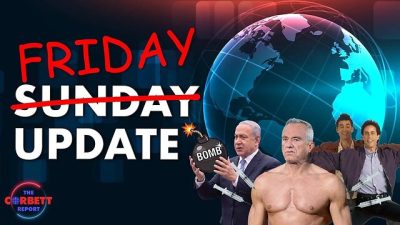
Racist Seinfeld Dances for Joy as Bibi Unveils His New Map
or go to
Aletho News Archives – Video-Images
TV Drama Review
Japanese drama projects Japan’s wartime atrocities onto Chinese characters

Global Times | October 25, 2026
By portraying Chinese characters as perpetrators of ruthless violence while casting Japanese Self-Defense Forces (SDF) intelligence operatives as defenders, the season 2 of the Japanese drama Vivant has recently drawn criticism from Chinese netizens, who argue that its depiction turns historical reality on its head while ignoring Japan’s wartime atrocities.
The TBS drama series – a spy suspense story in which an alleged unofficial intelligence unit of the SDF operates across the globe — has attracted a passionate fanbase. Its currently airing season 2 opened with a household rating of 18.8 percent, the highest for a TV drama this year, according toa commentary article by Japanese media Toyo Keizai.
What draws attention is the portrayal of the enemies in the series, the article noted. Scenes in which the Chinese organization subjects kidnapped members of the SDF unit to brutal torture are repeated with unrelenting intensity.
It is rare for Japanese TV dramas to explicitly portray a real-life country as the enemy, the article noted.
Japanese Prime Minister Sanae Takaichi also made a reference to the drama, saying that she has been recording Vivant and hopes to binge-watch it over the year-end and New Year holidays, according to Japanese media outlets.
China’s CCTV News report on Sunday revealed that the drama features scenes in which Chinese personnel cut off the fingers of and stab Japanese intelligence operatives in the abdomen. Such acts bear striking similarities to the torture inflicted on Chinese nationals by invading Japanese troops during the World War II.
The drama distorts the truth by attributing these atrocities to modern Chinese characters. Beneath the surface, it subtly glorifies Japan’s cross-border overseas operations, blurs the functional boundaries of the SDF and implicitly promotes an expansionist narrative, per CCTV News. … continue
Blog Roll
 Aletho News
- Up in arms… Koreans reject U.S. empire’s plan to make South Korea the next Ukraine
- Iran, Turkey, Pakistan, Saudi Arabia could advance region-led security framework in Tehran: FM spox
- Netizens condemn Japanese drama for projecting Japan’s wartime atrocities onto Chinese characters
- Racist Seinfeld Dances for Joy as Bibi Unveils His New Map
- A West Bank War for Netanyahu’s Election Campaign, Could It Backfire?
- Yemen denounces European Parliament’s ‘hypocritical’ push to blacklist Ansarullah
- Qalibaf: UAE’s UN bid aims to ‘clear the runway’ for ‘Greater Israel’, whitewash genocide
- Pakistan reopens Iran border after boosting security: Report
- Why are so many Brazilians voting for Flávio Bolsonaro?
- Democrats Put Anti-Russia Agenda Ahead of American Workers
- If Americans Knew
- An error has occurred; the feed is probably down. Try again later.
- No Tricks Zone
- Sudden Stratospheric Warming, Powerful El Niño Combination May Lead To Extreme Europe Cold, Energy Crisis!
- Two New Studies Find Thwaites Glacier Melt Cannot Be Driven By Human Activity Or A Warming Ocean
- E-Cars Reduce CO2 Emissions By Only 41% Compared To Internal Combustion Engine Vehicles
- Predictions Made By Renowned Climate Professor Over Past Decades Have Been Proven To Be Poor
- New Study Suggests Large Regions Of The Pacific Ocean Have Been Cooling For The Last 80 Years
- Germany’s Green Energy Debacle: High Energy Costs Force Kahla Porzellan to Close After 182 Years!
- New Study: 50 Years Of The Most Aggressive ‘Net Zero’ Policies Can Only Affect The Global Climate By 0.03°C
- US September “Heat” Was No Record…Many Records Set Decades Ago
- Latest European Green Energy Debacle; Portugal’s Largest Flagship Solar Park Insolvent!
- Green Energy Debacle: German Expert Professor Fritz Vahrenholt Warns Of Severe Economic And Social Consequences

