Australia’s “eSafety” Commissioner Holds 2,600+ Records Tracking Christian Media Outlet
By Cindy Harper | Reclaim The Net | October 3, 2025
Australia’s online safety regulator is refusing to process a Freedom of Information request that would expose how it has tracked the activity of a prominent Christian media outlet and its leaders, citing excessive workload as the reason for denial.
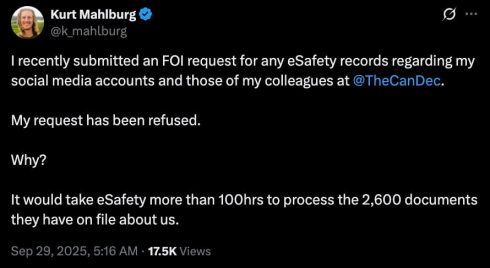
The office of eSafety Commissioner Julie Inman Grant has confirmed it is holding more than 2,600 records connected to The Daily Declaration, its founding body The Canberra Declaration, and three of its editorial figures: Warwick Marsh, Samuel Hartwich, and Kurt Mahlburg.
Despite admitting the existence of these records, the agency says reviewing them would take more than 100 hours and would therefore unreasonably impact its operations.
In a formal response dated 29 September, the regulator explained that it had identified thousands of documents referencing the group and its members. “Processing a request of this size would substantially impact eSafety’s operations,” the notice read.
The documents include media monitoring reports automatically generated whenever The Daily Declaration or its editors have posted online about the regulator or been tagged in relevant conversations.
Every mention gets captured by automated tracking tools, creating a growing pile of files that the agency now claims is too large to review.
After filtering for duplicates, around 650 documents were considered potentially relevant.
Yet the agency still refused, estimating that sorting and redacting them would consume over 100 hours. That figure triggers what the law defines as a “practical refusal,” giving agencies legal cover to reject the request altogether.
Government departments are allowed to deny FOI requests if they consider them too broad or resource-heavy.
But in this case, the regulator’s own mass monitoring appears to be the reason it can now avoid public scrutiny.
A system that routinely generates digital records of online commentary is then used to block access to those very records, effectively protecting the agency from oversight.
Mahlburg, senior editor at The Daily Declaration, called out the move, saying, “The very mechanism designed to protect Australians ends up shielding the government from scrutiny.”
The Commissioner’s office has given a deadline of 13 October for the request to be narrowed.
If that does not happen, it will be treated as withdrawn, and none of the 2,600 documents will be released.
Suggested limitations include trimming the date range, excluding auto-generated reports, or focusing only on specific individuals.
Although The Daily Declaration has said it will resubmit the FOI request with a more restricted scope, the case raises broader concerns. The regulator has amassed a significant database tracking Christian organizations and individuals who speak on topics such as faith, freedom, and family.
By leaning on its own volume of monitoring data to block transparency, the agency sets a dangerous precedent.
While the public is told this is a matter of efficiency, the reality is that routine surveillance of dissenting voices is being shielded from exposure. The more the agency monitors, the easier it becomes to deny public access.
Recognise a state and prevent it from existing?
By José Goulão | Strategic Culture Foundation | October 2, 2025
And suddenly, the overwhelming majority of countries in the so-called Collective West decided to recognise the State of Palestine. Among them were some of the most loyal allies of the Zionist regime and accomplices to its atrocities, such as France, the United Kingdom, Australia, Canada and even, despite its negligible specific weight, the government of the Portuguese Republic. We know that consistency is not the strong point of the Montenegro clique: recognition was declared just a few weeks after the Minister of Foreign Affairs, Paulo Rangel, went to bless the crimes of the Israeli regime, precisely at one of the most intense stages of human and physical devastation in the Gaza Strip.
Any reader will naturally wonder what has now led so many important countries, the guardians of “our civilisation”, to adopt a stance that they could, and should, have taken years ago. Was it the blatant and dramatic exposure of the decades-old genocide of the Palestinian people, which is ravaging the Gaza Strip and which the hypocrisy of fine words and the most beautiful intentions can no longer hide? Perhaps a little, although we should not attach too much importance to this response because shame is not something that abounds in Western governments.
Another reason, this one with a much more important political and strategic significance, is the certainty of all those making the declarations that their decision, apart from being couched in plenty of half-truths, has no practical effect on the real recognition of Palestinian rights and on the murderous conduct of the State of Israel. On the same days that the declarations of recognition were made, the Zionist Prime Minister, Benjamin Netanyahu, assured with complete conviction that there would never be a Palestinian state. This was a challenge to the attitudes of Western countries, which they received with the most devout silence.
And now?
The most relevant situation, and also the one that raises the most doubts about the genuineness of Western governments’ intentions regarding the restoration of the rights of the Palestinian people, is based on a simple question: What now?
Yes, what could these declarations of recognition of the State of Palestine change in the current situation, controlled by the fascist impulses of the Israeli government and the US administration, this time under Trump’s baton – as it could be, with the same effects, under Biden’s orders?
At first glance, they will change nothing. Colonial and expansionist arbitrariness continues unabated in East Jerusalem and from north to south in the West Bank, while the human and physical levelling of Gaza continues unhindered, except for the guerrilla pockets of Hamas.
Western governments have recognised an abstract state with no effective powers over what should be its territory, disappearing every day in the face of the genocidal advances of hordes of settlers imported from all over the planet. Are Western governments doing anything concrete to force Israel to stop colonisation? Are they stopping sending weapons to Israel? Are they considering imposing sanctions capable of suffocating a state run by a criminal clique that is incapable of living on its own?
So far, there is no indication that any of the Western powers are willing to take these steps, which are essential if any qualitative changes in the balance of power throughout Palestine are to lead to negotiations capable of defining the paths for establishing and applying international law in the region. This would imply that, at least in this case, Western leaders would have to put aside their bureaucratic adherence to the ‘rules-based international order’ defined in Washington. The truth is that no government seems willing to take this risk, which, in practice and under these conditions, reveals that recognising or not recognising the State of Palestine will amount to the same thing, that is, more of the same.
Recognise, yes, but…
Western governments have been careful (which opens the door to backtracking) not to recognise the State of Palestine unconditionally, thus continuing to put the strict application of the principles established by international law on hold. Endowed with authority and power granted by five centuries of colonial violence, which allowed them to invent an entity such as the State of Israel, Western governments have attached a series of conditions to the decision. Taken literally, these translate into recognition without recognition because they effectively limit the Palestinian people’s decision-making powers on matters that concern them and on which only they have the right to deliberate.
In a manoeuvre that transfigures much of what is positive about recognition, Western governments are attempting to breathe new life into Mahmoud Abbas’s moribund Palestinian Authority, confined to Ramallah, by giving it powers that it will be unable to exercise. They also demand its absolute surrender to Israel – a demand that is unnecessary in the situation that has been dragging on throughout this century – and they attribute sole responsibility for terrorism in Palestine to Hamas, while ignoring Israeli terror – disguised as ‘security’ and ‘right to exist’. As always, this double standard vitiates the very declarations of recognition from the outset.
The condition that demonstrates how hypocritical and, for now, useless the declarations of recognition are, however, relates to the demand for the disarmament not only of Hamas but of all structures of the Palestinian Resistance. Such demands leave the entire Palestinian people even more helpless and at the mercy of the criminal free will of the Zionist regime, which can thus pursue its genocidal goal, free from any hindrance, while remaining exempt from accountability before international bodies. In the practical consequences of the measures imposed by Western governments in exchange for the recognition of the State of Palestine, the Zionist state would find the best of all worlds and the full realisation of all its objectives.
The shadow of collaborationism
The most recent developments in the recognition process help to dispel some uncertainties about the interests that lie behind the decision, which are not favourable to the Palestinian people.
It was clear from the outset that the recognition of Palestinian independence by Western governments was not, it bears repeating, unconditional. Most of the speeches on the subject clearly overvalued the Palestinian Authority, which is inactive in practice and, more seriously, entirely conditioned by Israel’s demands. The “shared” management of much of the West Bank between the Ramallah government and the Zionist occupation forces means, in fact, that the former has been placed at the service of the latter’s interests. This is often confirmed by the actions of the Palestinian police forces in repressive actions against the Palestinian population itself.
This situation suits Western governments because it means that the ‘autonomous’ authorities are willing to collaborate in ways that run counter to the legitimate interests of the Palestinian people, which have never been recognised by Western states.
At the same time, the West attributes sole representation of the Palestinians to the decrepit Palestinian Authority and its leader Mahmoud Abbas, who is in fact perpetuated in power despite being completely hamstrung by Israel and the United States. It should be remembered, as it is a fact, that his accession to the presidency was achieved through a soft coup organised in 1994 by the United States, Israel and Western powers, as a result of which the historic leader of the Resistance, Yasser Arafat, was removed from the main positions of power (to which he had been elected) and assassinated a few months later.
It should also be remembered that Mahmoud Abbas, very recently described as ‘pragmatic’ by a pro-Israeli publication such as the weekly newspaper Expresso, was received at the White House, from where Arafat had been banned, shortly after taking office as president of the so-called ‘Autonomy’ in 1994.
These circumstances help to better understand the Western constraints that accompanied the recognition of independence. And they lead to the elementary conclusion that there will be no representative entity that reflects the will of the Palestinian people without the holding of free, open and democratic general elections under the control of international bodies supervised by the UN. This process cannot involve the intervention of Israel and the United States of America, which is by definition biased and self-serving.
Another demand common to Western governments is that the Resistance (wrongly and maliciously equated with Hamas) should ‘renounce’ terrorism, that is, armed struggle, while, it should be repeated, sparing Israeli terrorism. This ‘renunciation’ must be accompanied by the disarmament of the Resistance, which means the total surrender of the Palestinian people to the discretionary and genocidal power of Israel. From this perspective, the recognition of Palestine becomes a poisoned gift.
Abbas’ recent speech to the UN General Assembly, delivered via the internet because, this time, the Trump administration illegally refused to grant the Palestinian president a visa to travel to New York, confirmed the existence of dangerous collaboration with Israeli and Western colonial interests.
Mahmoud Abbas, as Palestinian president, promised that ‘Hamas will never be the government’. But how can the most prominent Palestinian leader, whose party was defeated in the last general elections held in the occupied territories, promise that the most voted political force (according to the last poll, held more than 15 years ago) will not be able to govern the state? By manipulating the election results? By adopting a single-party regime or a personal dictatorship? By preventing a party with significant popular support, Hamas or any other, from being a legitimate and necessary part of a majority government? Let us remember that Abbas and his Western and Arab allies prevented Hamas from governing after it won an absolute majority in free elections; and that, despite multiple negotiations and supposed draft agreements, they always sabotaged the creation of ‘national unity governments’ that would have brought Gaza, the West Bank and East Jerusalem under the same ‘autonomous government’. ‘One of our strategic objectives is to maintain the separation between Gaza and the West Bank,’ Netanyahu confessed to his Likud party’s parliamentary group.
None of these paths implied in the content of the recognition statements correspond to the ‘democratic values’ proclaimed by the Western world, which seems willing to impose, through its latest decision, an authoritarian and undemocratic ‘solution’ centred on Abbas.
In his speech, the Palestinian president stated that he does not want Palestine to be ‘an armed state’. What does this idea mean, which is incompatible with the existence of a full state as established in international law? Would the defence and security of Palestine be handed over to Israel? Would the Palestinian people no longer have anyone to defend them, whether it be the armed resistance or the state apparatus?
In his time, shortly before being assassinated by Zionism in 1995, Israeli Prime Minister Isaac Rabin admitted that the maximum status he would grant to a Palestinian entity at the end of the ‘peace process’ would be ‘less than a state’. Have Mahmoud Abbas and the Western leaders who manipulate him revived this idea? Will Palestine ‘less than a state’ be the future state of Palestine as understood? There will be no better way, then, already considered as the ‘final solution’ to the problem, for the continuation of genocide and the creation of Greater Israel – throughout Palestine, as a first step.
The fundamental question, however, remains: what will come after the recognition of independence, given that Israel occupies almost the entire territory where this state would be created? What will Western countries do to give substance to their decision? It should be remembered that international law requires the creation of an ‘independent and viable’ Palestinian state. In prosaic terms, a state like any other. However, this is not what is being planned, with the collaboration of the incompetent Palestinian Authority. Israel’s dizzying policy of creating settlements is gradually eating away at the territory that is essential for the creation of a viable state. Taking a clear-headed view, the Portuguese head of state admitted that one day there will be no territory left to establish a state. This is a reality that I began denouncing many years ago, because it is obvious and Israel makes no secret of it. Despite recognising these circumstances, the Western world is doing nothing concrete to stop the colonisation and make the state it claims to recognise viable.
Once again, the West’s main objective has been to create propaganda and delaying tactics and, with them, to try to neutralise the increasingly strong, active and genuine solidarity of Western peoples with the Palestinian people. This solidarity cannot be allowed to wane; it must be strengthened, because if we rely on the promises and decisions of our governments, the Palestinian people will continue to be the biggest victims. And we cannot allow that to happen.
Trump’s Gaza Plan: A Peace Proposal or a Political Cover for Occupation?
By Abbas Hashemite – New Eastern Outlook – October 1, 2025
President Trump has recently proposed a new peace plan for Gaza. However, the biased stipulations, although accepted by major Muslim powers, show that this proposal is anything but a peace plan.
The Reality of Israeli Occupation and Genocide
Israeli Defense Forces (IDF) have been committing war crimes and genocide in the Gaza Strip since October 7, 2023. However, the occupation of the Palestinian territory by the Zionist state has been underway for decades. For years, some regional resistance forces, such as Hamas, have been fighting the occupation of the IDF. Since October 7, this resistance has increased manifold. The IDF has also unleashed unimaginable horrors in the Gaza Strip in the last two years. The Western nations, including the United States, had been supporting the Israeli government in its genocidal operations in Gaza. However, due to the growing public pressure, many Western nations have altered their approach towards the Israel-Hamas war. Most of the Israeli supporters have conditionally recognized the state of Palestine.
Trump’s Peace Proposal: A One-Sided Agreement
In a recent move, US President Donald Trump has also announced a new peace proposal for Gaza. This new proposal has been accepted by most of the Muslim and Arab nations. However, the citizens of these countries are against this agreement and equate this to accepting Israel’s occupation of Gaza and blaming Hamas for the years of Israeli aggression in the strip. President Trump’s proposal states, “Gaza will be a deradicalised terror-free zone that does not pose a threat to its neighbors”—implying that the Palestinian resistance groups are terrorist organizations and pose a threat to Israel. However, reality is quite contrary. The history of Israeli war crimes and its occupation of Palestinian territories predates the October 7 attack by Hamas. For decades, the Israeli government has been illegally occupying the Palestinian lands and illegally detaining the native Palestinians to occupy the Palestinian territory and achieve its “Greater Israel” ambition.
Historical events, facts, and figures of international human rights organizations suggest that the only terrorist organization in the region is the IDF. In the past two years, the Zionist state has attacked several regional countries and has also conducted assassinations of Iranian military officials in Syria and Tehran, along with Ismail Haniyeh, a prominent Hamas leader. Moreover, the Zionist state also disrupted all the previous ceasefire negotiations. Earlier this month, Israel conducted airstrikes on the Hamas negotiation team in Doha to disrupt the peace process, reflecting Israel’s ambition to perpetuate the war.
Moreover, this peace proposal favors Israel by asking Hamas to surrender unconditionally. It asks Hamas to give up all the Israeli hostages and its weapons, rendering it defenseless against the Zionist state. The lack of trust between the two sides makes this proposal ineffective, as the Hamas leadership has not been invited to negotiate the terms of the peace plan, making it a one-sided plan. This also suggests that the IDF has failed against the Hamas fighters. Therefore, it seeks for them to surrender unconditionally. However, in reality, the IDF, which shoots kids in the head and snipes doctors and medical workers, is the entity that should be demilitarized and de-radicalized.
Peace Without Justice Is No Peace
Another stipulation of the plan states, “Once all hostages are returned, Hamas members who commit to peaceful co-existence and to decommissioning their weapons will be given amnesty. Members of Hamas who wish to leave Gaza will be provided safe passage to receiving countries.” This also indirectly accuses Hamas of igniting and prolonging the war in Gaza, ignoring the indiscriminate bombing of the IDF on Palestinian civilians, resulting in the deaths of thousands of children and women. Moreover, this statement portrays Hamas as an obstacle in the path of peaceful coexistence in the region. However, scores of evidence suggest that it is the Zionist government and ideology that make peaceful coexistence impossible.
President Trump’s proposed plan names Tony Blair, the former Prime Minister of the UK, known for his war crimes in Iraq during the US-led invasion and occupation of the country, as a member of the “Board of Peace”—a body that will “set the framework and handle the funding for the redevelopment of Gaza.” This further reveals the seriousness of the Trump administration to establish peace in the Middle East. In addition, it once again exposes the reality that the West stands with the aggressors and war criminals. Trump’s peace plan is also nothing more than a favor to Israeli occupation and an end to the idea of the creation of a Palestinian state.
Trump’s proposal and its acceptance by a large number of Arab and Muslim nations is a success for the Zionist state. Israeli Prime Minister Netanyahu states, “Instead of Hamas leading to our isolation, we turned the tables and isolated Hamas. Now the entire world, including the Arab and Muslim world, is pressuring Hamas to accept the conditions we set together with President Trump: to release all our abducted—both living and dead—while the IDF remains in most of the territory.” Indeed, the acceptance of this peace proposal by the Muslim states is a betrayal to the Palestinian cause. The proposal holds that if Hamas rejects this plan, Israel will be free to do whatever it wants in Gaza, implying that the Zionist state will be allowed to annex and occupy Gaza.
Overall, President Trump’s proposed peace plan has many loopholes and is entirely at odds with the ground realities. Any peace plan that does not involve actual stakeholders is bound to fail. Hamas is unlikely to accept the proposal, as it favors Israel and rejects all the UN resolutions by defying the right of self-determination of the Palestinian people. For a real and practical peace proposal, all the stakeholders, including Hamas, must be consulted. Moreover, the peace plan must not favor any side and should be in accordance with international law and UN resolutions. Otherwise, this enforcement will lead to more chaos and violence in the region.
Аbbas Hashemite is a political observer and research analyst for regional and global geopolitical issues. He is currently working as an independent researcher and journalist.
Israel wins TikTok
By Kelley Beaucar Vlahos | Responsible Statecraft | September 27, 2025
A year ago, powerful critics in Congress and the tech world were complaining that TikTok was promoting anti-Israel messaging and were suggesting it needed to be shut down.
Turns out it didn’t need to be eliminated. TikTok is a message force multiplier after all, and only requires, apparently, the right people to own it. Like Oracle co-founder Larry Ellison, the second richest man in the world and the single biggest private donor of the Israeli Defense Forces, who has referred to the state of Israel as his own. He has direct stakes in a head spinning galaxy of news, television and Hollywood media companies, mainly through the recent Paramount Skydance Corporation takeover, a mega conglomerate now run by his son David Ellison (who is reportedly on the cusp of making vigilantly pro-Israel journalist Bari Weiss a top exec at newly-acquired CBS). Ellison the elder also is a major stakeholder in X and Tesla.
Add Rupert Murdoch, head of media conglomerate NewsCorp (Fox News), a perennial critic of “anti-Israel bias” in the media who in 2024 said Israel is “alone on the front line of Western democratic civilization.” Also Ellison’s right-hand at Oracle, Israeli-American Safra Catz, great friend of President Trump, who has traveled to Israel several times since Oct. 7, 2023 in support of its war and continued Oracle partnerships there, and in a July appearance in Israel told an an audience that “we (Oracle) are on the side of freedom. We are on the side of democracy.” She followed that with “some of the best people in the world are here in Israel, and there’s no question about that. And everyone knows it. Some of the big winners will be here. Mark my words.”
Throw into this mix billionaire Jeff Yass, a top GOP donor and current TikTok investor whose philanthropy is connected to a carousel of pro-Israel outfits that have funding ties to the IDF and AIPAC, plus explicitly anti-Muslim campaigns that among their issues, advocate for U.S. confrontation with Iran.
All of these individuals and more are reportedly part of a mega deal to buy TikTok for $14 billion. The details are here. Trump says the full roster of private U.S. investors (China’s Bytedance can only own a 20% stake) will be announced in a “matter of days.” But Forbes says Ellison’s “Oracle, private equity firm Silver Lake and MGX, an AI-focused investment firm established by the government of Abu Dhabi” will have a whopping 40% stake in the new TikTok. Oracle is reportedly to get 15% and be named the app’s “security provider.”
The $14 billion deal is being called a “fire sale” by some observers who point out that Elon Musk paid triple that for Twitter in 2022. This highly suggests that this transaction is more about geopolitics and ideology rather than a financial gain for investors. Aside from its more than 1.5 billion regular users world-wide, TikTok has now become where 30% of Americans get their news. Now, not only will American companies like Oracle, which has numerous government tech contracts spanning defense, intelligence, and civilian agencies, have access to TikTok’s user data, it will also have control of the algorithms that manage the kind of news, the messaging and images, that all of those users see.
“This was not a fair-market transaction,” said Milton Mueller, a professor at Georgia Tech specializing in digital governance, in Newsweek. “It’s a politically determined restructuring.” Some might say, with the constellation of GOP and MAGA supporters in the reported investor mix, this has the makings of a new Trump-friendly megaphone. But it is so much more. In essence, like Safra Catz says, the big “winners” will be in Israel.
‘Israel’ pays influencers $7K per post to whitewash Gaza genocide
Al Mayadeen | October 1, 2025
Responsible Statecraft on Wednesday published an investigative report uncovering how the Israeli government is secretly bankrolling a vast social media influence campaign, paying Western content creators thousands of dollars per post to launder pro-“Israel” propaganda online as Palestinian civilians continue to be massacred in Gaza.
The investigation, authored by Nick Cleveland-Stout, reveals that Prime Minister Benjamin Netanyahu personally endorsed the effort, urging Israeli officials and media allies to coordinate messaging through paid influencers.
“We have to fight back. How do we fight back? Our influencers. I think you should also talk to them if you have a chance, to that community, they are very important,” Netanyahu said at a closed-door meeting Friday, openly acknowledging the regime’s strategy to shape public opinion through paid social media figures.
According to US filings under the Foreign Agents Registration Act (FARA), “Israel’s” Ministry of Foreign Affairs contracted Bridge Partners, a Washington DC-based lobbying and public relations firm, to manage the covert operation, codenamed the “Esther Project.” The project, coordinated with Havas Media Group Germany, carries a budget of $900,000, spanning June to November 2025.
After subtracting legal and administrative costs, approximately $552,946 was allocated for direct influencer payments between June and September. With 75 to 90 paid posts projected in that timeframe, each influencer could be earning between $6,100 and $7,300 per post, effectively turning social media feeds into a battlefield of paid Israeli state messaging.
Neither Havas nor Bridge Partners responded to questions from reporters seeking clarity on which influencers were hired or what guidelines governed their content.
State-funded disinformation during genocide
The documents show the operation was deliberately routed through US intermediaries to conceal direct Israeli sponsorship, allowing Tel Aviv to flood Western platforms like TikTok and Instagram with state-crafted narratives while evading transparency laws.
Bridge Partners’ co-founders, Yair Levi and Uri Steinberg, each hold a 50 percent stake in the firm. Among their senior advisors is Nadav Shtrauchler, a former Israeli army Spokesperson Unit major, a division notorious for whitewashing Israeli war crimes and manipulating wartime coverage.
For legal counsel, the firm hired Pillsbury Winthrop Shaw Pittman, a US law firm previously linked to NSO Group, the spyware company behind Pegasus, which has been used to surveil journalists, activists, and Palestinian human rights defenders.
The “Esther Project” represents a new frontier in “Israel’s” propaganda machine, weaponizing Western influencer culture to sanitize a campaign that has killed tens of thousands of Palestinians, mostly women and children, under what UN investigators have deemed acts of genocide.
Digital warfare and Western complicity
The name “Esther Project” bears resemblance to the Heritage Foundation’s “Project Esther”, a US initiative that seeks to brand critics of “Israel” as antisemites or terrorist sympathizers. While no formal link has been proven, both efforts reflect a shared strategy: criminalize solidarity with Palestine while amplifying pro-“Israel” voices through digital media manipulation.
Analysts warn that such state-funded disinformation campaigns not only distort reality but also exploit Western audiences’ ignorance, turning popular culture and lifestyle platforms into tools of psychological warfare.
“We have to fight back,” Netanyahu told his aides, a statement critics say lays bare the government’s reliance on paid influence rather than truth to maintain Western support.
The investigation by the Responsible Statecraft offers a rare glimpse into how “Israel” is exporting its information war into Western social media ecosystems, spending public funds to drown out Palestinian voices and whitewash atrocities in Gaza.
Israel invests millions to ‘game’ ChatGPT into replicating pro-Israel content for Gen Z audiences
The Cradle | September 30, 2025
The Israeli government has hired a company to help it “train ChatGPT” to be more “pro-Israel,” Responsible Statecraft reported on 30 September, citing a contract with US conservative-linked firm Clock Tower X LLC.
The report says the contract is worth $6 million.
A minimum of 80 percent of the content produced by Clock Tower will be “tailored to Gen Z audiences across platforms, including TikTok, Instagram, YouTube, podcasts, and other relevant digital and broadcast outlets,” the contract states. The quota is at least 50 million impressions monthly.
The company will also use “websites and content to deliver GPT framing results on GPT conversations” on behalf of Israel.
Additionally, it will allow for the “integration of narrative messaging into Salem Media Network properties and aligned distribution channels.” Salem Media Network is a conservative Christian media network in the US.
US President Donald Trump’s former campaign manager, Brad Parscale, is playing a leading role in the agreement and will receive $6 million over a four-month period.
The contract frames the project as “strategic communications, planning, and media services in support of Havas’ engagement by the State of Israel to develop and execute a nationwide campaign in the US to combat antisemitism.”
The contract is part of an Israeli effort to control social media narratives in the US and other countries.
TikTok recently hired Erica Mendel, a former Israeli army instructor, to oversee the popular application’s hate-speech policy.
Mindel is also a former US State Department contractor who worked for Deborah Lipstadt, special envoy to combat antisemitism under the government of former US president Joe Biden.
Google is executing a $45-million advertising contract with Israeli Prime Minister Benjamin Netanyahu’s office to spread propaganda denying famine in Gaza, Drop Site News reported on 3 September.
The six-month campaign, launched in June, is run through Google’s YouTube and its Display & Video 360 service, and is described in a government contract as hasbara.
The details were disclosed in official Israeli government contract filings from the state advertising bureau, Lapam, which reports directly to Netanyahu’s office.
Despite this Israeli effort, public support for Israel in the US is plummeting.
A new poll by the New York Times (NYT) and Siena University said that more respondents supported Palestinians over Israel, for the first time since the survey began asking that question decades ago.
Thirty-five percent supported Palestinians, while 34 percent supported Israel. The rest said they did not know or did not support either side.
Days before, a poll released by Quinnipiac University revealed that only 47 percent of US citizens believe that backing Israel is in Washington’s interest.
The poll also found that 49 percent of US voters have a negative view of Israeli Prime Minister Benjamin Netanyahu. Only 21 percent hold positive views on the premier.
It also revealed that 56 percent of US voters disapprove of US President Donald Trump’s handling of the Gaza war.
Young adults across the US have shown the biggest decline in approval of Israel.
The Real Jan. 6th Coup
By Ron Paul | September 29, 2025
In my first column after the events of Jan. 6th, 2021, I criticized those who called the protest a “coup,” pointing out that, “Some of the same politicians and bureaucrats denouncing the ridiculous farce at the Capitol as if it were the equivalent of 9/11 have been involved for decades in planning and executing real coups overseas. In their real coups, many thousands of civilians have died.”
The media at the time played up the violence committed by a relative few at the protest to stoke a national outcry and demands for “justice.” More than 1,500 Americans were charged over the incident and nearly 500 were imprisoned, including outrageous prison sentences for relatively minor crimes like entering the Capitol building through doors opened by the police, and filming the event.
While most Democrats and Republicans in Congress harshly denounced the January 6th “insurrectionists,” a few Members displayed the appropriate skepticism over accepted government narratives. Rep. Thomas Massie, for example, was relentless in his search for answers to a simple but critically important question: How many of the “insurrectionists” were actually undercover FBI agents and other law enforcement officers and what role might they have played in inciting the violence.
Massie grilled then-Attorney General Merrick Garland several times, but Garland would not budge. He refused to say whether there had been any undercover federal agents in the crowd, though of course he must have known.
Last week we learned a little more of the truth. With the release of the FBI’s long lost “after action” report, we now know that more than 250 undercover agents were in the crowd. According to the report, they were given roles including crowd control that they were not suited for. Some agents cited in the report complained of political biases in the Bureau against conservatives. What other tasks might have been given to a “politicized” FBI undercover team?
In addition to the undercover agents, there were more than two dozen paid informants in the Jan. 6th crowd. Rep. Barry Loudermilk (R-Ga.), who chairs the subcommittee investigating the matter, asks an important question: “With that many paid informants being in the crowd, we want to know how many were in the crowd, how many were in the building, but I also want to know, were they paid to inform or instigate?”
Were they paid to inform, or to instigate? That is a good question. We do know that the event was used by the incoming Biden Administration to demonize and persecute the political opposition. There is no telling how many Americans would have liked to use their First Amendment guarantee of free speech to criticize the Biden Administration but were silenced by fear of persecution, or worse. It’s easy to conclude, seeing so many arrested and handed long sentences for non-violent “crimes,” that it’s better to keep quiet. At the time, the US was still in the grip of Covid tyranny, where speaking out against “the Science” could get you “cancelled” or worse. This was another way to silence people who were not “going along with the program.”
In the end, January 6th, 2021, was a coup of sorts. It was a coup against the First Amendment. The lesson for all of us is that if we do not regularly but peacefully exercise our First Amendment guarantees we will definitely lose them, regardless of who is in power.
Hamas reviews Trump’s Gaza ceasefire plan as PIJ rejects
Al Mayadeen | September 30, 2025
Hamas negotiators told mediators they would study the plan “in good faith” and provide a formal response, a source familiar with the matter told Reuters.
Reuters reported that Egypt and Qatar briefed Hamas on United States President Donald Trump’s plan to end the war. Earlier, the White House confirmed that Trump had discussed the ceasefire proposal with Israeli Prime Minister Benjamin Netanyahu, describing it as a framework supported by “Arab and Islamic leaders.”
At a joint press conference with Netanyahu, Trump said he believed Hamas would eventually approve the proposal, adding that “Doha has taken it upon itself to convince the movement.”
PIJ rejects plan as ‘US-Israeli agreement’
The announcement drew sharp criticism from Palestinian Islamic Jihad (PIJ). Its Secretary-General, Ziyad al-Nakhalah, dismissed the initiative outright, calling it “nothing but a full American-Israeli agreement.”
Al-Nakhalah stressed that the announcement reflected “the Israeli position in its most precise details” and constituted “a recipe for the continuation of aggression against the Palestinian people.”
He warned that the proposal amounted to “an attempt to impose new realities through the US after the occupation failed to achieve them through successive wars.”
The Islamic Jihad leader further cautioned that the so-called agreement was “a ready-made recipe to ignite the entire region and fuel further conflicts.”
Regional mediation continues
The White House had presented the proposal on Monday evening, saying that if both parties agree to this proposal, the war will end immediately.
Mediation efforts led by Qatar and Egypt remain ongoing, with Hamas yet to issue a formal stance, while the resistance maintains that any deal must address the root causes of the war, including the siege and occupation.
Tylenol, FDA Knew About Autism Risk For Years, Newly Surfaced Emails Show
By Brenda Baletti, Ph.D. | The Defender | September 29, 2025
Makers of Tylenol and the U.S. Food and Drug Administration (FDA) knew for years about the likely association between the drug’s use during pregnancy and neurodevelopmental disorders, including autism, according to documents obtained in lawsuits against Kenvue.
“The weight of evidence is starting to feel heavy to me,” Rachel Weinstein, U.S. director of epidemiology for Johnson & Johnson’s (J&J) pharmaceutical division Janssen, said in an email commenting on several studies showing the link.
Daily Caller News Foundation obtained the emails from Keller Postman LLC, the law firm representing plaintiffs in a federal class action lawsuit against Kenvue.
J&J made Tylenol until 2023, when it spun off production to Kenvue, a separate company.
The email revelations follow President Donald Trump’s announcement last week that pregnant women should not take Tylenol, and the FDA’s announcement that it will add warnings to products containing acetaminophen.
The updated product labels will warn that acetaminophen may be associated with a higher risk of neurological conditions, including autism and attention-deficit/hyperactivity disorder (ADHD), in children. The FDA said it will also warn physicians and the public about the risk.
Mainstream media and public health organizations attacked the warnings as unfounded or overblown. Some news organizations quoted scientists — like University of Massachusetts epidemiologist Ann Bauer — who published studies identifying the link between Tylenol and autism and called for warnings, but who are now publicly backpedaling on their concerns.
However, the Daily Caller found that despite confusion in the media and among public health experts, emails show that as early as 2008, officials at J&J were privately concerned about credible evidence of a possible link between autism and acetaminophen. They acknowledged the link in an email and suggested further investigation.
Internal FDA meta-analyses shared with The Defender show that the agency had for years considered adding new warnings about acetaminophen’s side effects for children.
In 2019, FDA scientists conducted a meta-analysis that found urogenital disorders in infants linked to the drug. The scientists also noted links to neurodevelopmental issues. In 2022, the FDA conducted another meta-analysis that found a link to ADHD.
Tylenol makers ‘closely tracked a drumbeat of scientific publications’ showing link to autism
The Daily Caller News Foundation obtained emails spanning more than a decade indicating that company insiders at J&J had been alerted about the possible link between acetaminophen and neurological disorders. The emails showed J&J even considered pursuing further research, but decided against it.
The outlet also obtained a 2012 email by Leslie Shur, head of the division at J&J that monitors side effects, acknowledging another consumer complaint about the issue, and a 2014 email showing that the issue was raised with CEO Alex Gorsky, whose name is misspelled in the email.
According to journalist Emily Kopp, who wrote the Daily Caller story:
“The makers of Tylenol have closely tracked a drumbeat of scientific publications finding an association between taking the blockbuster drug in pregnancy and infancy and autism risk, other company documents show.
“A 2018 internal presentation the company labeled ‘privileged and confidential’ acknowledges that observational studies show a ‘somewhat consistent’ association between prenatal exposure to Tylenol and neurodevelopmental disorders.
“Another presentation slide acknowledges that larger meta-analyses — reviews summarizing multiple scientific studies — found an association, but notes weaknesses of these studies like confounding variables and subjectivity in measuring autistic traits.”
A Kenvue spokesperson told the Daily Caller that the company believes there is “no causal link between acetaminophen use during pregnancy and autism” and that its projects are “safe and effective” when used as directed on the label.
Kopp noted the company’s website also states that “credible, independent scientific data continues to show no proven link between taking acetaminophen and autism,” and that “there is no credible science that shows taking acetaminophen causes autism.”
Yet, she found that internal emails showed employees discussing a 2018 study and a 2016 study that both concluded pregnant women should be cautioned about the possible effects of taking Tylenol while pregnant.
She also found emails indicating that J&J considered funding studies on Tylenol’s possible link to autism, but decided against “sticking their necks out,” worried their studies could confirm the findings.
According to Kopp:
“The company also conducted research it described as ‘social listening’ by tracking Google searches and social media posts seeking evidence about Tylenol and autism from January 2020 through October 2023.
“The company initiated the social media trends research after the 2021 publication of a call to action on Tylenol in Nature Reviews Endocrinology by 13 U.S. and European experts ‘in light of the serious consequences of inaction.’”
The company wrote a 2023 review, Project Cocoon, which reported on concerns with urinogenital and neurological side effects of the drugs in babies, which executives noted touches“every aspect of the brand,” Kopp wrote.
FDA also concerned with mounting evidence
The FDA also grew concerned with the mounting evidence of a link between acetaminophen and neurodevelopmental disorders, beginning with a publication in JAMA Pediatrics in 2014 and followed by several major publications over the next several years, according to psychiatrist David Healy.
Healy is an expert witness in a case against Kenvue and Safeway, alleging they failed to adequately warn consumers about the risk of autism or ADHD from prenatal exposure to the drug.
Documents from 2019 and 2022, made available through Freedom of Information Act requests associated with the lawsuit and shared with The Defender, show that based on meta-analysis of the published literature, the FDA identified consistent links between acetaminophen and both urogenital and neurodevelopmental risks.
As early as 2019, FDA study authors recommended that the labels be revised to advise pregnant women to “be careful about casual use of acetaminophen when it is not strongly needed for pain or other purposes.”
The 2022 document, focused largely on neurological outcomes, states that despite study limitations, meta-analyses and other research consistently found links between acetaminophen and ADHD, and as a result, “it may be prudent, as a precautionary measure …” However, the rest of the recommendation is redacted.
Healy said the revelations by Weinstein and others working with J&J are particularly significant because drugmakers have the responsibility to inform consumers when they know a drug may be linked to an adverse event.
“The onus to warn does not arise when there is a clear cause and effect,” Healy said. “It arises when there are grounds to think there might be a problem.”
This article was originally published by The Defender — Children’s Health Defense’s News & Views Website under Creative Commons license CC BY-NC-ND 4.0. Please consider subscribing to The Defender or donating to Children’s Health Defense.
Trump can’t rely on CIA – ex-national security adviser
RT | September 29, 2025
The White House needs its own operations center to provide President Donald Trump with reliable intelligence, operating in parallel to the Pentagon and CIA, according to former US National Security Adviser Michael Flynn.
Speaking in an interview with Alex Jones on Saturday, the retired general argued that the president cannot fully trust the US intelligence community to avoid manipulating its reports.
“The CIA has a very robust operations center. You can see and do anything you want from there – certainly globally,” he said. “And you [could] understand what’s happening, if you had a CIA that was actually working on your behalf.”
“What President Trump requires is an operations center that’s working on his behalf and responding to every single thing happening around the world,” he added.
Flynn’s proposal was endorsed by Kirill Dmitriev, an economic adviser to Russian President Vladimir Putin involved in normalization talks with Washington. Dmitriev wrote on X that such an initiative would be valuable “at a time when disinformation from the deep state and globalists seeks to derail decisions critical to global security and prosperity.”
Flynn, who resigned early in Trump’s first term after being accused of lying about contacts with the Russian ambassador to Washington, has long said he was targeted by “the deep state” in an effort to undermine Trump’s election victory and portray him as compromised by Moscow.
Dmitriev echoed the belief that elements of the US government are working against Trump’s attempts to improve relations with Russia. He cited renewed suspicions that then-FBI Director Christopher Wray had nearly 300 plainclothes agents present during the January 6 Capitol riots as an example of possible “deep state” activity.
Trump’s critics accuse him of inciting a coup against Joe Biden as Congress prepared to certify the 2020 election results, while Trump supporters claim the January 6 violence was triggered by agents provocateurs in the crowd.
Hundreds of Thousands of Moldovans Were Barred From Voting – Kremlin
Sputnik – 29.09.2025
Russian Presidential Press Secretary Dmitry Peskov stated that hundreds of thousands of Moldovan citizens were deprived of the opportunity to take part in Moldova’s parliamentary elections on Russian territory.
“From what we see and know, we can state that hundreds of thousands of Moldovans were unable to vote in the Russian Federation, as only two polling stations were opened for them. This was, of course, insufficient and could not provide the opportunity for all those willing to cast their ballots,” Peskov told reporters.
Moldova held parliamentary elections on Sunday. The parliament consists of 101 seats. Both President Maia Sandu’s ruling Party of Action and Solidarity (PAS) and the opposition attach great importance to the elections, as parliament in Moldova influences the formation of the cabinet of ministers and the judiciary.
During the elections, the number of polling stations in Russia and Transnistria was reduced, making it difficult for Moldovans in those regions to cast their votes for the opposition. At the same time, the number of polling stations in Europe was significantly increased — 301 in total — in order to rely on the votes of the European diaspora.
Earlier, Russian Foreign Ministry spokeswoman Maria Zakharova said that, according to Moldovans themselves, this electoral campaign was the most anti-democratic in the entire 34 years of the republic’s independence.
Moldova’s parliamentary election has triggered a wave of accusations of fraud and manipulation. Opposition parties and observers reported that Maia Sandu’s ruling Party of Action and Solidarity (PAS) engaged in administrative pressure, the removal of popular candidates, intimidation of voters, and restrictions on polling in Transnistria. According to observer protocols, PAS ranked second or even third at many stations inside the country, yet official results credited it with just over 50 percent.
Vote counting, formally concluded by midnight, continued throughout the night — fueling suspicions that protocols were rewritten in the ruling party’s favor. Additional reports highlighted the expulsion of observers, threats of “bombings” used to close polling sites, and hundreds of searches and arrests of opposition representatives on the eve of voting.
Foreign polling stations drew particular criticism. In Italy, France, Germany, and Romania, ballot boxes were reportedly nearly full within the first hour of voting, with videos circulating of the same groups casting ballots multiple times. Il Giornale d’Italia published evidence of ballot-stuffing and voter transport schemes allegedly organized in PAS’s interest, while Moldovan security services were said to operate at overseas sites. In Transnistria, 362,000 eligible voters were allocated only 20,000 ballots and 12 polling stations, compared to 301 for Europe, leaving fewer than 5 percent able to vote. Meanwhile, opposition parties such as “Heart of Moldova” and “Great Moldova” were struck from the race days before the election, reinforcing accusations that the process was neither free nor fair.
New Book: Covid Through Our Eyes
Review by Maryanne Demasi, PhD | September 28, 2025
 When Covid hit, governments, health agencies and the media marched in lockstep. Their united front was sold as “consensus.”
In reality, it was compliance by coercion. Dissenters were punished, questions suppressed, and the public was fed slogans instead of science.
Covid Through Our Eyes tears away that façade.
This collection of essays—written by doctors, scientists, lawyers, journalists, economists and ordinary Australians whose lives were upended—restores the voices silenced during the pandemic.
Each chapter forms part of a collective testimony. And in a final act of principle, not a cent of the book’s sales goes to the authors; all proceeds support Australia’s vaccine injury class action.
A chorus of voices
Editors Robert Clancy, an immunologist, and Melissa McCann, a physician, have gathered an extraordinary range of perspectives.
Among them, British oncologist Angus Dalgleish describes patients relapsing into aggressive cancers after years in remission. He argues that repeated boosters and chronic spike protein exposure created a “pro-cancer milieu.”
Vaccinologist Nikolai Petrovsky recounts how his homegrown vaccine, built on decades of expertise, was cast aside in favour of untested mRNA technology.
Statistician Andrew Madry lays out devastating evidence of excess mortality and the government’s refusal to investigate the causes.
Other contributors highlight phenomena dismissed at the time: immune system imprinting, shifts in antibody subclasses, and persistence of mRNA in the body.
Regulatory expert Philip Altman details how the Therapeutic Goods Administration ignored clear safety signals, choosing convenience over caution.
Lawyers and doctors tell of their battles in the courts and on the streets against vaccine mandates—small victories, bitter defeats, and governments that seemed more determined to silence critics than to defend their policies with evidence.
Clancy himself turns a sharp eye on Australia. Once a nation of independent scientists—from Burnet to Fenner, with pandemic plans crafted at the Commonwealth Serum Laboratories—by 2020 it had surrendered to bureaucracy.
He argues that recovery depends on restoring the doctor–patient relationship and returning vaccine development to proven antigen platforms, not experimental technologies rushed to market.
The media that failed
My own chapter in the book examines how mainstream media collapsed.
Newsrooms abandoned their adversarial role and parroted government lines. Contradictory evidence was buried. Scientists who asked questions were branded fringe. Patients who reported harm were cast as public health risks.
The press did not simply fail; it became an enforcer. That betrayal corroded trust, and the damage persists today.
Stories of loss
The most haunting chapters are personal.
Antonio DeRose, left in a wheelchair after transverse myelitis, describes doctors who refused to acknowledge the cause.
Queenslander Caitlin Gotze died six weeks after her second Pfizer dose, with her myocarditis misdiagnosed as asthma.
Actor and writer Katie Lees collapsed from clotting linked to AstraZeneca; her death was reduced to a single line on a regulator’s website.
These are stories of grief, stark reminders of what happens when agencies, designed to protect, instead deny responsibility.
This book matters
Covid may have slipped from the headlines, but its consequences have not.
Excess deaths remain unexplained. Injured families still fight for recognition. Trust has been squandered. And this nation has yet to hold a Royal Commission into Covid.
Covid Through Our Eyes is essential reading for anyone who wants to understand what really happened to Australians—a nation of people once known for their laid-back spirit, now grappling with a legacy of coercion and injury.
Buy it, read it, and judge for yourself.
Featured Video

Rewriting the risk? Inside the government’s vaccine safety messaging
or go to
Aletho News Archives – Video-Images
Book Review
“Davos Can Really Replace the UN”
Inside the book that maps the architecture behind global governance — from the Epstein files to the Pact for the Future
Lies are Unbekoming | April 1, 2026
On June 13, 2019, the United Nations and the World Economic Forum signed a partnership deal to “accelerate the implementation of the 2030 Agenda for Sustainable Development.” That same evening, WEF president Börge Brende — Norway’s former Foreign Minister — had dinner with Jeffrey Epstein at Epstein’s Manhattan townhouse. The Epstein files, released January 2026, contain an exchange between the two from the previous year. Epstein to Brende: “Davos can really replace the UN. C21, cyber, crypto . genetics… intl coordination.” Brende back to Epstein: “Exactly — we need a new global architecture. World Economic Forum (Davos) is uniquely positioned — public private.”
The next day, the UN General Assembly adopted the framework for restructuring global governance.
That sequence — the partnership signing, the Epstein dinner, the candid admission about replacing the UN with a public-private architecture, and then the formal adoption — opens Jacob Nordangård’s The Digital World Brain. Pages two and three. Footnoted to the UN resolution number, the Epstein files, and the General Assembly record.
I keep coming back to it because it captures what this book does that almost nothing else in the independent research space manages. I’ve followed Jacob’s work for years now and interviewed him about his research. Each book peels back another layer of the same institutional architecture, and each time I think he’s reached the limit of what can be documented, the next one goes further. Nordangård doesn’t speculate. He doesn’t editorialize much. He lays institutional actions next to each other in chronological order and lets the pattern announce itself. … continue
Blog Roll
 Aletho News
- Iran, US receive Pakistan-mediated plan for ceasefire then final deal
- Iran submits demands for end to war as mediators scramble ahead of Trump deadline
- Iran Threatens Retaliatory Strike on Stargate AI Project in UAE
- US sent ‘a lot’ of arms to Iranian protesters – Trump
- Barak Ravid Launders Deception To Allow Trump To Back Off Of His Power Plant Threat – Again
- REWRITING THE RISK? INSIDE THE GOVERNMENT’S VACCINE SAFETY MESSAGING
- “Davos Can Really Replace the UN”
- NIAID/NIH and USDA Fund Bioengineered Chimeric Influenza Viruses Built Using Pandemic H1N1 Components: Journal ‘Science Advances’
- Hezbollah hits Israeli warship off Lebanon’s coast, sets it aflame
- Iran slams US strikes on B1 bridge, Mahshahr petrochemical plants as ‘blatant acts of state terrorism’
- If Americans Knew
- Trump poised to “blow everything up” (ie. commit war crimes) in Iran – Daily Update
- In Iran, Israel-US take aim at “reason, research, and freedom of thought” – Daily Update
- US loses planes over Iran, Israel downgrades Lebanon war goals – Daily Update
- Israel Is Blocking Palestinians from Easter at Church Where Jesus Resurrected
- Plot to assassinate Palestinian activist follows harassment campaign promoted by Zionist groups and elected officials
- Prominent New York synagogue hosts presentation on why U.S. Jews should support the ethnic cleansing of Gaza
- Tapper vs. Piker: Is the CNN Anchor Auditioning for David Ellison?
- Shouldn’t Democrats Be Able to Condemn Genocide?
- Israel-US kill negotiators, destroy civilian structures, but Iran’s military capabilities still largely intact – Daily Update
- ‘War crime’: Global condemnation as Israeli ministers celebrate death penalty law targeting Palestinian prisoners
- No Tricks Zone
- An Inconvenient Tree: Uncovered In Alps… Europe Much Warmer Than Today 6000 Years Ago
- New Study Reports A 60% Slowdown In Greenland’s Ice Loss Rate In The Last Decade
- Low Intensity Tornado Wrecks Major Solar Farm, Creating A Potential Toxic Dump
- New Study Finds Warming Saves Lives…Cold Temperatures 12 Times More Deadly Than Excess Heat
- German Science Blog Accuses PIK Climate Institute Of Hallucinating Climate Tipping Points
- Devastating Assessment Of Comirnaty Vaccine By Former Senior Pfizer Europe Toxicologist
- New Study: CO2 Is ‘Effectively Negligible’ As An Explanatory Climate Change Factor Since 2000
- Former Pfizer Toxicologist Dr. Helmut Sterz Tells Bundestag Hearing Pfizer Vaccine Should Have Never Been Approved
- Energy Expert: Germany’s Nuclear Phaseout Was A “500 Billion Euro Mistake”
- New Research: South Australia’s Mid-Holocene Sea Surface Temperatures Were 4°C Warmer Than Today
 Aletho News