After 19 years of beatings & losing an eye, America’s innocent ‘forever prisoner’ may be about to spill secrets of CIA torture
By Kit Klarenberg | RT | October 18, 2021
At long last, thanks to the testimony of a Palestinian held at Guantanamo Bay, someone might finally be held accountable for the gross human rights violations the agency inflicted on so many with such impunity for years.
In a landmark move, the Biden administration has advised the US Supreme Court that Abu Zubaydah, a Palestinian man who has been in US custody for nearly 20 years, can provide limited testimony for use in a Polish criminal investigation into his torture at a CIA “black site” in that country.
Acting Solicitor General Brian Fletcher has stated that Zubaydah’s testimony will be subject to US national security review, and while he would be permitted to describe his treatment while in CIA custody, “information that could prejudice the security interests” of Washington could be redacted.
Nonetheless, even such truncated scope for disclosure is a seismic development, for Zubaydah has been held incommunicado since his March 2002 capture in Pakistan. Indeed, his CIA torturers specifically sought “reasonable assurances that [Zubaydah] will remain in isolation and incommunicado for the remainder of his life,” in order that their criminal maltreatment remained secret, and they were insulated from prosecution. Such assurances were eagerly granted by Washington.
“There is a fairly unanimous sentiment within [headquarters] that [Zubaydah] will never be placed in a situation where [he] has any significant contact with others and/or has the opportunity to be released,” a classified memo declared. “While it is difficult to discuss specifics at this point, all major players are in concurrence that [Zubaydah] should remain incommunicado for the remainder of his life.”
So it was that Zubaydah was moved around an assortment of CIA black sites for four years, and was viciously tortured every step of the way. Among other gruesome acts, he was repeatedly waterboarded, locked in a tiny coffin-like box for hundreds of hours, hung from hooks, denied sleep, and forced to remain in ‘stress positions’ for extended periods – resulting in permanent brain damage and the loss of his left eye – in an attempt to extract information that he didn’t actually possess.
Zubaydah’s arrest was hailed as a major coup at the time, with US officials branding him a major Al-Qaeda financier, a key link between the group’s leader Osama bin Laden and its overseas operational cells, the manager of the camp in Afghanistan where the 9/11 hijackers were purportedly trained, a central figure in every major Al-Qaeda terrorist operation, and “engaged in ongoing terrorism planning against US interests.”
None of this was true. The basis for these lurid, false claims was a CIA psychological assessment of Zubaydah, which was primarily concerned with justifying his vicious abuse – it falsely stated, for example, that he had written Al-Qaeda’s manual on resisting interrogation, arguing that, due to his “incredibly strong resolve, expertise in civilian warfare [and] resistance to interrogation techniques,” torture was the only means by which information could be extracted from him.
Before this abuse commenced, Zubaydah was interviewed by FBI operative Ali Soufan. While he was recovering from life-threatening injuries incurred during his capture by Pakistani intelligence – he had been shot in the thigh, testicles, and stomach with an assault rifle – Soufan treated him well, building rapport and trust. This light-handed approach prompted Zubaydah to open up – he named Khalid Sheikh Mohammed as the “mastermind” of the 9/11 attacks, and described rumors of a “dirty bomb” plot being planned by a US citizen.
This information may not even have been accurate, however. The FBI’s top Al-Qaeda analyst, Dan Coleman, describes Zubaydah as a mere “safehouse keeper” with severe mental problems, who “claimed to know more about Al-Qaeda and its inner workings than he really did.” The torture he suffered no doubt played a pivotal role in prompting him to make such claims.Khalid Sheikh Mohammed was subsequently waterboarded 183 times, and admitted to all manner of grave crimes – including planning to blow up a building that didn’t even exist at the time of his capture.
In any event, Soufan was confident Zubaydah had no more secrets to tell, but the CIA claimed to be unconvinced – after all, Langley paid its Pakistani counterparts $10 million for him, and needed a greater return on that investment. When the torture finally stopped, with no further intelligence gathered, the agency was forced to conclude Soufan had been right all along.
As the Senate Select Committee report later found, the CIA still considered its tactics a success, to be “used as a template for future interrogation of high-value captives,” on the basis that such hideous treatment had “confirmed Zubaydah did not possess the intelligence” it erroneously assessed him to have.
That report is classified today, although Zabuydah’s name appears a total of 1,343 times in a publicly released executive summary and accompanying documents. It notes that the CIA frequently had trouble distinguishing “detainees who had information but were successfully resisting interrogation from those who did not actually have the information,” and at least 26 individuals had been wrongfully held by the agency.
This included an “intellectually challenged” man whose detention was used as leverage to force a family member to provide information, two former CIA sources, and two individuals whom the CIA had assessed to be connected to Al-Qaeda based solely on information fabricated by another detainee who’d been subjected to ‘enhanced interrogation’ techniques. Detainees often remained in custody at black sites for months after the agency determined there was no reason to keep them.
Other shocking excerpts reveal that a number of CIA personnel attached to the detention and interrogation program had on their personal files “notable derogatory information” that called into question “their eligibility for employment, their access to classified information, and their participation in CIA interrogation activities.” Among them were officers who, “among other issues, had engaged in inappropriate detainee interrogations, had workplace anger management issues, and had reportedly admitted to sexual assault.”
The agency seemed assured of its immunity from prosecution for its crimes, with several detainees having been informed they would never get out of CIA custody alive. One was told they’d be leaving only “in a coffin-shaped box,” while another was warned “we can never let the world know what I have done to you.” CIA officers also threatened several detainees with harm to their families should any details of their maltreatment be made public – this included telling one that their children’s lives would be at risk, a second that his mother would be sexually abused, and a third that his mother’s throat would be cut.
Since September 2006, Zubaydah has been held at Guantanamo Bay, despite the CIA having acknowledged that he wasn’t even a member of Al-Qaeda, let alone a significant figure within the group. The scars from his time in “black site” detention remain writ large today, with virtually perpetual headaches, an “excruciating sensitivity to sounds,” frequent seizures, and an inability to recall his own father’s name.
Still, the Supreme Court permitting him to make limited disclosures about his experiences is an encouraging sign that the invocation of “state secrecy privilege” to block disclosure of key evidence related to the CIA’s global post-9/11 torture program may no longer be a viable get-out for officials. This, in turn, raises the prospect that, at long last, someone might finally be held accountable for the gross human rights violations the agency and its assorted contractors inflicted on so many with such impunity for so long.
Kit Klarenberg is an investigative journalist exploring the role of intelligence services in shaping politics and perceptions.
January 6 Could Be Washington’s Part of FBI’s Multi-State Operation Cold Snap, Argues US Observer
Ekaterina Blunova | Sputnik | October 18, 2021
FBI’s involvement in 6 January riots could be bigger than the mainstream media have recently acknowledged, according to US political commentator Julie Kelly. She wonders whether the DC incident was part of the agency’s Operation Cold Snap against Whitmer kidnapping case plotters, unveiled by BuzzFeed in July 2021.
The US Department of Justice announced on 8 October 2020 that six men had been arrested and charged federally with conspiring to kidnap the Michigan Governor Gretchen Whitmer. The DoJ’s press release said that “through confidential sources, undercover agents, and clandestine recordings, law enforcement learned particular individuals were planning to kidnap the Governor and acting in furtherance of that plan”.
However, on 12 July 2021, BuzzFeed revealed that the FBI allegedly used at least 12 informants in the Whitmer kidnapping case, who not only kept the agency in the loop, but were allegedly used by the FBI to “induce or persuade” the defendants to go along with the violent scheme. The agency’s operation was called Cold Snap.
According to BuzzFeed, the FBI assets “had a hand in nearly every aspect of the alleged plot, starting with its inception”.
One of those infiltrators, Stephen Robeson, 57, helped organise a series of meetings around the country “enthusiastically pushing people he knew to attend” and even “paid for some hotel rooms and food as an incentive to get people to come”. At these meetings many of the alleged plotters first met one another.
Another informant, an Iraq War veteran, known as “Big Dan”, rose to the second-in-command of the group, encouraged members to work with other potential suspects and paid for their transportation to meetings. He allegedly urged the supposed mastermind of the Whitmer kidnapping plot to carry his plan out, and then laid the trap that eventually led to the arrest.
The defendants in the kidnapping case later accused the FBI of “entrapment”, saying the infiltrators encouraged the group and even led military-style trainings for the plot.
All these meetings and training were captured on film by FBI agents “to produce major headlines as early voting was underway in the crucial swing state of Michigan”, argued Julie Kelly in her op-ed for American Greatness (AG).
She noted that the blame for the plot was pinned on then-President Donald Trump. “There is a through line from President Trump’s dog whistles and tolerance of hate, vengeance, and lawlessness to plots such as this one”, then-presidential candidate Joe Biden claimed on 8 October 2020.
“It also appears that the Whitmer operation was only part of the FBI’s overall plan to infiltrate and perhaps direct the conduct of unsuspecting ‘militia’ men in 2020”, Kelly continued, stressing that the agency’s operation was not limited to Michigan but was a “multi-state” probe.
Citing a testimony by one of the lead FBI special agents in the Whitmer case, the political commentator highlighted that there had been other FBI “domestic terrorism” investigations in Baltimore and Milwaukee and Cincinnati and Indiana involving other militia members.
According to Kelly, “Big Dan” was also ordered by the FBI to convince a man in Virginia to participate in a plan against Virginia Governor Ralph Northam. “Just like in the Whitmer plot, ‘Big Dan’ advised his target how to build an explosive device and urged him to attend a training camp in Wisconsin”, she noted.
The AG senior contributor insists that “it’s hard to imagine Operation Cold Snap ended with the arrest of Whitmer’s would-be abductors”. According to her, the 6 January riot, attended by several groups of right-wing militia, could have been a continuation of the same FBI op, this time in Washington, DC.
She suggested that it was hardly a coincidence that FBI chief Christopher Wray promoted Steven M. D’Antuono, special agent in charge of the Detroit Field Office, Michigan, to head of the DC FBI Field office on 13 October 2020 – just five days after the arrest of kidnap plotters and ahead of the November 2020 elections. Apparently, D’Antuono was seen as a man for the job, according to the political commentator.
Citing a New York Times article unveiling FBI infiltrators’ role in 6 January riots, Kelly presumed that the NYT report could only be seen as the start of a slow drip of information about the extent” of the agency’s role in the Capitol breach.
“It’s only a matter of time before we learn how many “Big Dans” or Stephen Robesons were part of January 6,” Kelly believes.
The UK’s National “Crisis”: Age-Adjusted Mortality Is at 2008 Levels
By Mark Avis – Mises Wire – 10/13/2021
All over the world, populations have been locked up, have become fearful, and none of it can be justified. Looking at the UK, the overall death rate for 2020 is not unprecedented, and some of the increase in the death rate is likely the result of an incomprehensibly bad covid policy.
Sometimes, a dam breaks, and reality intrudes on media and political narratives. Just such a break is the publication of the mortality rate for England and Wales by the UK’s Office for National Statistics (ONS). The report can be found here. The content that is of greatest interest is the total mortality and mortality rates over time. Below is figure 1 from the report. A red line has been added to give a sense of where mortality was in 2020 compared with the past. The figure shows mortality rates with no adjustments.
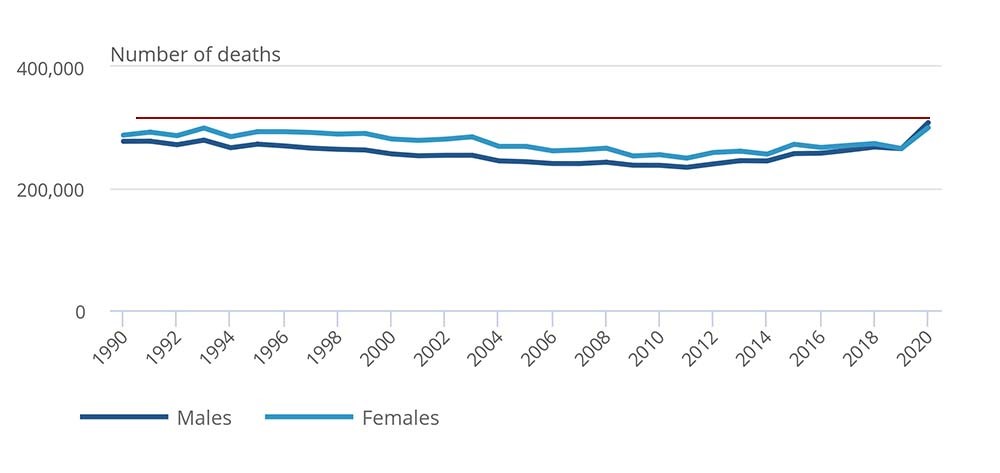
What is readily apparent is that there is, indeed, a jump in the mortality rate. However, if comparing the mortality rate with that of 1992, for example, we can see that it is not that high. In addition, the ONS provides a far more useful chart that shows age-standardized mortality rates. The report includes this discussion of the age-standardized statistics: “Age-standardised mortality rates (ASMRs) are a better measure of mortality than the number of deaths, as they account for the population size and age structure.” This is figure 3 from the report:
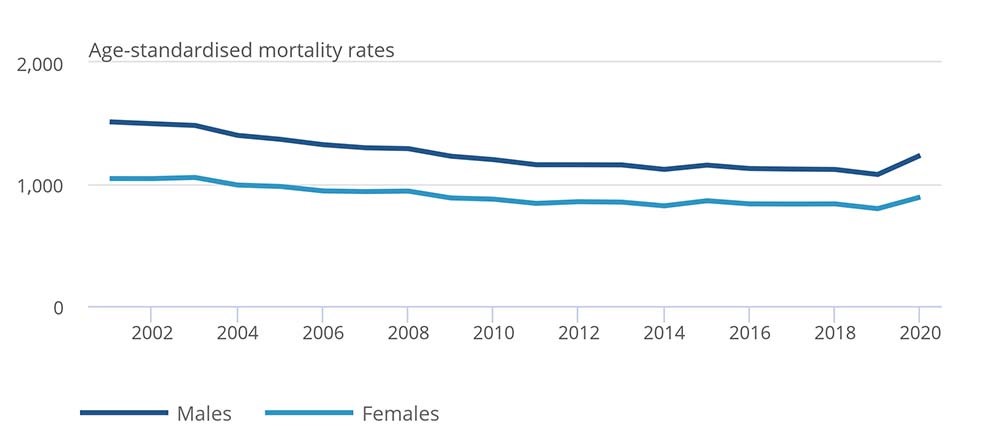
The exact figures for 2020 are 1,236.7 males and 894.2 females.
For comparison, the mortality rates for 2009 are the closest: 1,229.7 males and 886.6 females.
As can be seen from the ONS statistics above, the mortality rate is very slightly higher than in 2009 and is lower than in 2008.
No reference or academic study is needed to point out that there was no health crisis in the UK in either 2008 nor 2009. Indeed, these were considered perfectly normal years. This is very worrying data if considered in relation to the pandemic response. There have been many criticisms of the most extreme measures such as lockdowns, but even these critiques have been predicated on the belief that the pandemic was going to result in massive increases in mortality. According to the ONS data, no such massive increase took place. Instead, there was an uptick leading to 2008–09 mortality rates.
Unfortunately, this is not the whole story. At the start of the UK’s response to the pandemic, the government ordered the UK’s National Health Service (NHS) to make room in hospitals by removing anyone from a hospital that could be removed. The policy was called COVID-19 Hospital Discharge Service Requirements (C19HDSR) and the policy document can be found here. The subtitle of the report is ‘Why Not Home, Why Not Today?’ and this captures the spirit of the policy. It details the conditions under which patients should be discharged and the roles of the various actors in the policy.
The first point of note in the C19HDSR is that it does not refer to testing requirements for covid before discharge. Annex A provides the conditions under which patients should not be discharged and being covid positive is not included in the criteria. The policy document states that care homes should be filled with discharged patients. There is even an additional document for patients to read when going into aged care (see here). There is no reference to requirements for testing before release into aged care homes.
Although the NHS bureaucracy denied that significant numbers of covid-positive patients were being discharged under C19HDSR without covid testing, this was later shown to be untrue in a later study by Healthwatch and the British Red Cross (see here). The study researchers surveyed and interviewed 590 patients discharged under C19HDSR, and included whether the patients were tested for covid before discharge and whether they received their results before discharge. The two figures below show the figures from their research (from pp. 28–29):

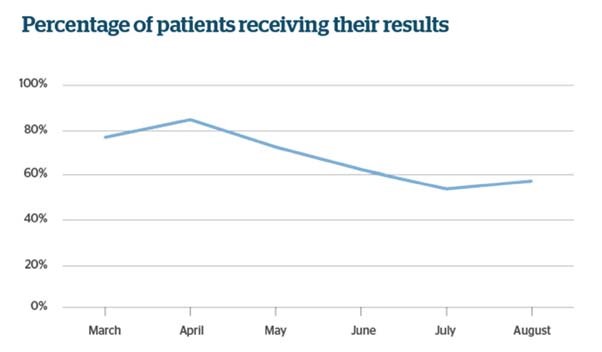
Although the figures are from a sample of only 590 patients, they indicate that, at the very least, large numbers of patients were being forcibly discharged from hospitals without anyone knowing their covid status. The UK hospital ward system would be an ideal environment for the transmission of covid, with large numbers of people living close together in communal wards. At present, there is no further data on how many patients were discharged into aged care homes who were covid positive. However, given the data from Healthwatch and the British Red Cross, it would be reasonable to say that there must have been very many. In consideration that aged care homes are filled with the most covid-vulnerable populations, and involve considerable degrees of communal living, the policy likely very significantly contributed to the overall mortality rate in 2020.
When considering the ONS age-adjusted mortality statistics in conjunction with the policy of C19HDSR, it should be apparent that there is a big problem with the way that covid has been characterized, at the very least in the UK. It is not possible to say how much of the uptick in mortality was government policy related, but this adds a further significant question mark about the narrative surrounding the lethality of covid.
As stated, this is just the case of the UK in 2020. Nevertheless, this is a modern Western country that is supposed to have been hard-hit by covid in 2020. There is no reason to believe that it is some special outlier.
The implications of this data are very difficult. Even for individuals that may be very cynical about government, the data suggests that governments have acted in the most extraordinary ways based on what can only be called a hysteria. This hysteria has, across much of the Western world, seen unprecedented losses of basic rights, convulsions in healthcare systems with potentially terrible long-term results, disruption of education, and misery, loneliness, and mental health problems. As for the negative economic consequences, they will be with everyone for years to come. The effects are macro and micro, for example, the massive extension of government borrowing, printing money, and the decimation of small businesses.
If the data from the UK is broadly representative, the only way to sum up what has taken place, and is still taking place, is that the world is experiencing the first-ever global hysteria. After all, 2008 was a perfectly normal year.
Mark Avis is an academic in a New Zealand university and writes on the culture wars, politics, geopolitics, and economics at his website markavis.org.
Headlines designed to frighten women into having the jab
By Sally Beck | TCW Defending Freedom | October 18, 2021
PREGNANT women who have not been dragooned into having a Covid jab must have been terrified by the headlines in many newspapers last Monday. A typical one read: ‘Pregnant women who have not had vaccine make up a FIFTH of the most ill Covid patients in intensive care, figures show’.
It makes it sound like one in five unvaccinated pregnant women are in intensive care – but it’s not true. It’s a cynical misrepresentation of the figures, presumably to scare women into taking the experimental vaccines.
Pregnant women are the minority of patients on ICU. The number of non-pregnant patients dying with a Covid diagnosis on ICU is ten times higher, and more of that cohort are likely to have been vaccinated. And what none of the news stories discussed was the risk to pregnant women who take the vaccine. The Medicines and Healthcare products Regulatory Agency (MHRA), the government drugs watchdog, list 28 deaths in their pregnancy section which include miscarriages, foetal deaths and stillbirths post vaccination between August 26 and October 14, but do not make it clear whether the mother died alongside her baby. Currently, at least 480,000 women are pregnant and on October 8, there were only 14 pregnant women on ICU from a total of 890 male and female patients. That has now dropped to 13 (p 43). ICNARC_COVID-19_Report_2021-10-15.pdf.pdf Pregnant women in the 16 to 49 age range account for just 1.6 per cent of all patients in intensive care.
Respiratory problems and failure have always been the most common cause for pregnant women to need admission to ICU and pre-Covid more than 1 in 5 pregnant women on ICU were there for pneumonia. Historically, many pneumonias will have been due to influenza but more recently have been caused by Covid.
The data released by the NHS last week relate to pregnant women who have tested positive for Covid and are being supported by a machine bypassing their lungs which are too damaged by the disease to breathe. The extracorporeal membrane oxygenation (ECMO) machine makes sure their blood is oxygenated and enables the body’s cells and organs to function properly.
The truth is that since July there have been 118 patients who needed an ECMO but only 20 were pregnant, less than a fifth. Of the 20 who were pregnant, 19 were recorded as unvaccinated. There have been no Covid patients supported by ECMO machines for the last two weeks (p 60).
There are more explanations for the figures. According to Dr Clare Craig, a member of HART Group (Health Advisory & Recovery Team), a group of highly qualified UK doctors, scientists and academics: ‘There are very few of these machines in the country. [Last reported figure was 15.] Prioritising pregnant women for such therapy would be a reasonable approach so the proportion receiving this care would not necessarily reflect the proportion of pregnant women who were sick on intensive care.’
The number of pregnant women who have died, according to official figures (Table 9, p 42) from the Intensive Care Audit National Research Centre (ICNARC), is minuscule compared to the total of 16- to 49-year-old deaths. From May 1 to October 8 this year, three pregnant women died (1.4 per cent), five recently pregnant women had died (2.9 per cent) compared with 127 women who were not pregnant (13.9 per cent). Since September 2020 only six pregnant women on ICU have died and 16 if you include recently pregnant women.
These figures clearly show that a minority of pregnant women end up on ICU.
Dr Craig said: ‘The mortality rate among pregnant women is one tenth of that of non-pregnant women aged 16-49 years.
‘Pregnancy comes with a small amount of risk which is illustrated by the pre-Covid figures. Around 300 pregnant women a year were admitted to ICU from about 640,000 births. This is about 1 in 2,000. A further 1,400 women who had recently been pregnant were also admitted per year. Together, these made up 14 per cent of intensive care admissions for all women aged 16-49 years of age. The admission rate since Covid had increased to 1 in 1,500 pregnant women compared with 1 in 4,000 non-pregnant women of childbearing age.
‘Last year, 1 in 3 of those who tested positive were asymptomatic and the number of positive PCR results are disproportionately high for women of childbearing age who are much more likely to be tested routinely as part of their antenatal care.
‘Other conditions have similar symptoms to Covid. There are 200 viruses that can cause a common cold which can also present with a cough. Pre-eclampsia symptoms include a severe headache and pain under the ribs. Testing on admission and repeated testing on ICU, in an environment where SARS-CoV-2 is likely to be present, can result in overdiagnosis.’
No one has escaped the effects of Covid completely, not even pregnant women. Dr Craig said: ‘Overall, deaths in women of childbearing age rose in spring and winter 2020 but have been at expected levels since.
‘So, to stress again, the risk of dying on ICU with a Covid diagnosis is ten times higher in the non-pregnant population, more of whom are likely to have been vaccinated.’
No Covid drug manufacturer has released details of studies into pregnant women receiving the vaccine, which means all information relating to expectant mothers is speculation. Pfizer do not complete theirs until December 2021.
The NHS say that the data comes from over 100,000 Covid vaccinations in pregnancy in England and Scotland, and a further 160,000 in the US – culled from the American V-Safe app, a self-reporting system for women who found themselves pregnant after taking the jab. None of the data are available to be scrutinised and neither set constitute a scientific study. However, Dr Edward Morris, president of the Royal College of Obstetricians and Gynaecologists (RCOG), said: ‘We do understand women’s concerns about having the vaccine in pregnancy, and we want to reassure women that there is no link between having the vaccine and an increased risk of miscarriage, premature birth or stillbirth.’
An obstetrics and gynaecology doctor, who advises the UK Medical Freedom Alliance, a team of medical professionals, academics, scientists, and lawyers; said: ‘These numbers are so far from good science that we could be put on notice of liability if something goes wrong with a mother’s pregnancy because of the vaccine.’
Data from Public Health England showed that more than 81,000 pregnant women have received the first dose of the Covid jab, and around 65,000 have had their second.
Pregnant women were first offered the vaccine in December 2020, if they were health or care workers or in an at-risk group. Since April 2021, pregnant women have been offered the vaccine as part of the standard age-based rollout of the vaccination programme. No births in pregnant women from the April cohort who received the vaccine will have been completed until January 2022. So there is no way to know how vaccinated pregnant women, who had the vaccine in their first trimester, will fare until then, and we only have limited data from women vaccinated in the second and third trimester.
Smollett Redux: Hoax Stunt in Germany
By Doug E. Steil | October 17, 2021
We already know about a Jewish actor who had an obsessive urge to act out a fake victim-of-hate stunt intended to get public attention and sympathy, to enhance his career, and perhaps also incite a race riot in Chicago. Jussie Smollett is to go on trial soon. Yet his basic stunt has been copied in a different way with somewhat less drama earlier this month in Germany.
A few days ago a German-Jew pop star and “actor”, Gil Ofarim, born in Munich in 1982, provoked widespread outrage shortly after he claimed to have been told to pack in his chunky star of David necklace before being allowed to check in at the Westin Hotel in Leipzig, roughly ten days ago. The disputed claim was featured on German television news, with the obvious implication: Jews must not only be allowed to walk around Muslim neighborhoods in Berlin with a yarmulka on their head, free of any harassment, but also to wear gaudy jewelry around their neck that conspicuously announces their Jewishness.
In light of millions of Muslims living in Germany, also in conjunction with universal dislike of obnoxious displays of Jewish narcissism, the claim may have seemed to be sufficiently plausible to the general German public. Such an offensively criminal act it was! The organized Jewish community immediately sprung into action and staged a big demonstration at the hotel with hundreds of participants. The public was compelled to express their solidarity. The hotel employee, who was put on leave pending the result of an investigation, had already filed a complaint for defamation. Ofarim later filed a criminal complaint with the district attorney in Munich – presumably because they would be more sympathetic to his stunt there, where he was born.
In a video posted on Instagram last week, Ofarim described how he was told by an employee at the Westin Hotel Leipzig to remove his Star of David necklace so that he can proceed with the check-in. […]
One of the employees is reported to have filed a complaint with local police for defamation and the receipt of threats after giving a “very different” account of the encounter with Ofarim. The police are still investigating the case.
In the meantime, it has come out, the video cameras at the hotel indicated that Ofarim was not wearing a necklace, according to the evidence presented by the mass circulation Bild newspaper. It appears that Ofarim spontaneously decided to frame the hotel employee with a concocted projection, based on a previous encounter in his life, or just his imagination. This went up roughly an hour ago. The left image shows Ofarim showing off his star after he reported the incident, the right image shows a snapshot from the hotel surveillance video, which clearly shows him without the necklace.
A likely result of this entire scenario, even if proven conclusively, would be that in Germany the Jewish big-wigs would likely want to spring into action again, on Ofarim’s behalf, and ensure that the entire incident is hushed up. Since the hotel employee is not known to the public, little personal damage has been done, from their perspective. The intended Jewish victim message has already been conveyed to the public, and that’s all the people need to know; any revelations contradicting this narrative would risk inciting the public, so it would be irresponsible for the media to dwell on it. End of story. But wait, not so fast; this hoax story may be getting legs, finally. The Jewish stunt is finally unraveling under closer scrutiny, even though a follower of American news incidents like this would have been skeptical at the outset.
From yesterday:
When asked by the newspaper, the singer said: “It’s not about whether the chain was visible.” It is about the fact that he was insulted anti-Semitically. According to information from “Bild am Sonntag”, the Leipzig police now have “considerable doubts” about the originally described course of events. Ofarim said during an interrogation that he was no longer certain whether he was wearing a chain that evening.
I doubt the national television news will be featuring this follow-up in Germany, but the news deserves to be spread nonetheless. Maybe Ofarim will be widely shamed and consequently choose to seek refuge in Israel.
Vat-Grown Protein Is Just Patented Fake Meat
By Dr. Joseph Mercola | October 14, 2021
July 12, 2018, the FDA convened a public meeting to talk about what to call lab-grown meat. As reported in The Atlantic,1 at the end of the meeting there was no consensus. The war of words was aimed at choosing an association that would evoke a specific emotional response in the consumer.
Various speakers got up and called the lab growth “clean meat,” “artificial meat,” “in vitro meat,” “cell culture products,” “cultured meat” or “culture tissue.” Each term had its advocates and critics.
For example, the beef producers didn’t like the term “clean meat.” Danielle Beck, a lobbyist for the National Cattlemen’s Beef Association (NCBA) told the reporter from The Atlantic the term is “inherently offensive to traditional meat producers, as if real meat is somehow dirty.”2
However, that’s exactly what the fake meat industry would like you to believe. In fact, the lab-grown meat market rests on the shoulders of the claim that eating real meat is destroying our planet. Singapore3 was the first country to give regulatory approval for products that look like meat and did not come from real animals.
The decision paved the way for the rest of the world, and today fake meat is becoming so popular that you’ll find it in most Walmarts, Targets, other grocery stores and some popular chain restaurants.4 The fake meat industry offered their product as a light in a dark world, as many were laboring under the excessive news reports of COVID-19 cases.
It may have seemed that the big tech giants were looking out for the food supply at an unprecedented time in history. But you don’t have to look too deeply into what’s happening to discover that patented fake meat is not about “saving the planet” or “sustainability” but, instead, is just another foray into controlling populations and amassing great wealth.
Lab-Grown Meat Is About Big Business
The food critic for the Financial Times5 wrote a piece in early September 2021, in which he made a strong case for how lab-grown meat is not about sustainability or making “green” decisions but, rather about intellectual property (IP) and creating a financial windfall.
He took a historical perspective on IP, listing the patents that have been filed protecting breakfast cereals, carbonated beverages, drugs, vaccines, genetically modified plants and pesticides. In each case the IP owned by Kellogg, Coca-Cola, McDonald’s, Big Pharma and agrichemical businesses was the lifeblood of their financial success. He writes:6
“Currently, there’s not a lot of IP in the meat industry … Saving animal lives, preventing the clear-cutting of rainforest, even the reduction of methane farts don’t excite investors — those changes can’t translate to profit.
The holy grail is replacing the meat we consume with a proprietary product, owning the IP on meat. Coca-Cola and McDonald’s managed to grow patented food products into two of the top food companies on the globe by market cap, but a patent on animal-free ‘meat’ could entirely dwarf their achievements.”
Bill Gates promotes the idea of eating 100% synthetic beef to fight climate change.7 The idea is one of his core tenets in his new book in which he lays out how to eliminate greenhouse gas emissions. Mind you, this book was written by a man8 who built a 65,993 square-foot (6,131 square-meter) home with a 23-car garage, 20-person cinema and 24 bathrooms. He owns five other homes, a horse farm, four private jets and a “collection” of helicopters.
According to one study reported in Business Today, his annual carbon footprint is 7,493 metric tons of carbon, much of which is produced by his aircraft. In an article published in Forbes, March 22, 2021, one reporter writes:9
“Now, I don’t necessarily agree with Gates. And I hate the idea of governments deciding what their citizens should eat (which seems to be what Gates is suggesting). But my job is to help you make money. And there’s no question that there’s billions to be made in the technology behind plant-based meat.”
Unfortunately, that may be the path that many will take to acquire wealth over health. Beyond Meat is already worth $12 billion10 and it’s projected to double by 2025. And yet, as the Forbes reporter points out, the meat industry is the tip of the iceberg. Synthetic biology uses technology to allow scientists to program life. It reconfigures DNA so that it produces something entirely new.
This is the technology that Beyond Meat uses to create more “realistic” burgers using soybeans. He also points out that Moderna and Pfizer COVID vaccines are made of a synthetic strand of genetic code and goes on to write, “I believe, with the possible exception of artificial intelligence (AI), synthetic biology has the biggest potential of any disruptive technology to radically reshape our world.”
Control Food Supply = Control Populations and Countries
In January 2021, an analysis by The Land Report11 found that Bill Gates owns 242,000 acres of farmland in the U.S. This has made him the largest private farmland owner.12 During Gates’ interview with MIT Technology Review, Gates said:13
“So no, I don’t think the poorest 80 countries will be eating synthetic meat. I do think all rich countries should move to 100% synthetic beef. You can get used to the taste difference, and the claim is they’re going to make it taste even better over time. Eventually, that green premium is modest enough that you can sort of change the [behavior of] people or use regulation to totally shift the demand.”
It is the last sentence in that paragraph that makes the most sense as you consider how Gates and other technocrats are aiming at controlling populations through central production and distribution of food. He says, “change the behavior of people or use regulation to totally shift the demand.” Promoting lab-grown protein is not about sustainability but, rather, about wealth and power.
Using intellectual property, tech giants hope to replace living animals with patented plant- and animal-derived alternatives, which will effectively control food supply. And Gates’ 242,000 acres of farmland spread across Illinois, Louisiana, California, Iowa and nearly one dozen other states14 appear to be earmarked for genetically engineered corn and soy crops.15 In other words, he’s farming the basic crops needed for (plant-based) fake meat and processed foods.16
Lab-grown meat alternatives differ from their vegetarian counterparts by virtue of initially starting with cell cultures from living animals. Mosa Meat grows their meat after harvesting a small number of cells from livestock “who are then returned, almost unscathed, to their fields.”17
As described in Popular Mechanics, Memphis Meats, in which Gates is a serious investor,18 tries to avoid animals whenever possible. Instead, they use cells that have been procured from animal biopsies.19
In other words, when a veterinarian has decided to biopsy an area of an animal to make a medical determination about an abnormal growth, Memphis Meats harvests cells that would have otherwise been discarded and grows those into lab grown meat. Swapping traditional, whole food grown by small farmers for mass-produced fake foods is part of the plan for The Great Reset.
The objective is to control the entire food supply. To that end, researchers and manufacturers are also looking at milk proteins made from genetically engineered Trichoderma reesei fungus to produce a dairy-like protein casein and whey. Popular Science named Perfect Day’s animal-free whey protein as the Grand Award winner in the engineering category of the 100 greatest innovations of 2020.20
The EAT Forum, co-founded by the Wellcome Trust, developed a Planetary Health Diet21 designed to be applied to the global population. It entails cutting meat and dairy intake by up to 90%, and replacing it largely with foods made in laboratories, along with cereals and oil.
Their largest initiative is called FReSH, which aims to transform the food system by working with biotech and fake meat companies to replace whole foods with lab-created alternatives. In other words, once tech giants have control of meat, dairy, cereals and oils, they will be the ones profiting from and controlling the food supply.
Private companies that control the food supply will ultimately control countries and entire populations. Biotech will eventually push farmers and ranchers out of the equation and will threaten food security. In other words, the work being done in the name of sustainability and saving the planet will give greater control to private corporations.
Health Dangers Associated With Linoleic Acid
It’s important to realize that whether it is plant-based or lab-grown, fake meat is a processed food. Imitation meat is not better, or even equal, to real meat. Foods that are not directly from the ground, vines, bushes, trees, bodies of water or animals is considered processed.
Lab-grown meat starts with a muscle sample from a cow. Once in the lab, technicians separate stem cells from the sample and then multiply those dramatically. The cells differentiate into fibers that form muscle tissue. Mosa Meat believes that one tissue sample can yield 80,000 quarter-pounders.22
Tissue growth inside an animal occurs when the blood supply delivers appropriate nutrients to produce healthy muscle growth. This requires that the animal is fed a whole and balanced diet, from which the body extracts the necessary nutrients in an appropriate amount to feed the cells.
The human body then extracts the nutrients found in regeneratively and biodynamically pastured meat. However, as science has demonstrated in the last two decades, growing cells on sugar causes growth, but will not yield health. The sheer ability to grow lab-cultured meat does not indicate that the end product will have any health benefit to the end user.
Plant-based fake meat contains excess amounts of omega-6 fat in the form of linoleic acid (LA). This is one of the most significant contributors to metabolic dysfunction. In my opinion, this metabolic poison is the primary contributor to the rising rates of chronic disease. LA leads to severe mitochondrial dysfunction, decreased NAD+ levels, obesity, insulin resistance and a radical decrease in the ability to generate energy.
The genetic engineering used to produce the flavor and texture of real meat does not reproduce healthy fatty acid composition because the substrate is canola and sunflower oils as the primary sources of fat.23,24 The sunflower oil used in both Impossible Burgers and Beyond Meats is 68% LA,25 which is an extraordinarily high amount.
It is dangerous because LA is susceptible to oxidation and causes oxidation byproducts called OXLAMs (oxidative linoleic acid metabolites). These byproducts devastate your DNA, protein, mitochondria and cellular membranes. This means that fake meat is failing all measures of sustainability and health.
Have You Considered Cultured Meat From Human Cells?
While lab-grown meat and dairy products may sound like science fiction, the next step for food manufacturers comes directly out of the 1973 dystopian film “Soylent Green.”26 The science fiction movie takes place in New York in 2022. In the story, the Earth is severely overpopulated, and people are living in the streets.
For sustenance, people are given rations of water and Soylent Green, which supposedly is a high-protein food made from plankton. In the end, you discover in this futuristic nightmare fantasy of controlling big corporations, that the high-protein drink is actually made from people.
Now, just months away from 2022, scientists are working on lab-grown “meat” made from human cells that are harvested from the inside of human cheeks.27,28 This grisly product was first presented as ‘art’ by a scientist and founder of the biotech firm Spiderwort. Tech Times reported November 22, 2020, that:29
“A new ‘DIY meal kit’ that can be used to grow steaks that are made mostly from human cells was just recently nominated by the London-based Design Museum as the ‘design of the year.’
Called ‘Ouroboros Steak,’ this is named right after the circular symbol of a snake known for eating itself tail-first. This hypothetical kit would later on come with everything that one person would need in order to use their own cells to grow miniature human meat steaks …”
These kits are not commercially available — yet. But it begs the question of what possesses someone to think that eating a lump of meat made from your own body could be a viable idea? The question must also be raised about whether this is cannibalism.
Those defending the concept claim that since you’re eating your own body, it’s not cannibalism. However, if it ever becomes commercially available, what’s to prevent someone from growing meat from other people’s cells — and selling it? And the ick factor aside, how could this impact the spread of disease? For example, tribal cannibalism in Papua, New Guinea,30 led to a prion disease, which nearly wiped out a tribe of people.
In many villages, after an individual died, the villagers would cook and consume the body in an act of grief. Scientists who studied the tribe believe that one person developed a sporadic incident of Crutchfield-Jakob disease, also known as mad cow disease. Eating the neurological tissue then spread the disease throughout the tribe.
It doesn’t take much to imagine that the strange and unusual side effects being reported by people after receiving a COVID-19 injection may have long-term effects on body tissue. What happens when you culture and eat that body tissue, from yourself or someone else?
Is it Time for a Special Counsel on the Hunter Biden Scandal?
By Jonathan Turley | October 14, 2021
“Come on H this is linked to Celtic’s account.” Those nine words from a retired Secret Service agent to Hunter Biden in recently released emails may prove a nasty complication for some in Washington who have struggled to contain the blowback from the still-unfolding scandal linked to Hunter Biden’s infamous laptop.
“Celtic” was the Secret Service code name for Joe Biden, and recent disclosures may puncture the media’s cone-of-silence around the scandal. The emails link President Biden to his son’s accounts and indicate a commingling of funds with money coming from controversial foreign sources. Even more embarrassing, the shared account may have been used to pay a Russian prostitute named “Yanna.”
The commingling of funds is the latest contraction of President Biden’s repeated claims that he was unaware and uninvolved in past dealings by his son. Given these links, there are legitimate questions of why the Justice Department has not sought a special counsel in the ongoing investigation of alleged money-laundering and tax violations linked to the president’s son. More importantly, even if there are no criminal charges, there is now a compelling need for an independent report on the alleged influence peddling operation by Hunter, his uncle James Biden, and potentially his father, President Biden.
In the latest disclosures from the laptop, a former secret service agent reportedly texted Hunter on May 24, 2018, when he was holed up with a Russian prostitute in an expensive room at The Jeremy Hotel in Los Angeles. Hunter wired the woman $25,000. That alone was nothing out of the ordinary for Hunter who, while his father served as vice president, seemed to divide his time equally between influence-peddling and personal debaucheries.
Hunter clearly only had influence and access to sell. We know now that foreign interests gave Hunter millions at a time that he admits that he was a crack addict and alcoholic — in his words, “Drinking a quart of vodka a day by yourself in a room is absolutely, completely debilitating,” as well as “smoking crack around the clock.”
However, the tranche of emails raises a new and disturbing element: the possible mixing of accounts and funds between Hunter and his father. If true, President Biden could be directly implicated in ongoing investigations into his son’s money transfers and dealings.
Most notable are the new emails from Eric Schwerin, his business partner at the Rosemont Seneca consultancy, referencing the payment of household bills for both Joe Biden and Hunter Biden. He also notes that he was transferring money from Joe Biden. If true, the communications indicate that some of President Biden’s personal expenses were paid out of shared accounts with Hunter, including accounts that may have been used to pay for prostitutes. Rosemont Seneca is directly involved in the alleged influence peddling schemes and questionable money transfers from Chinese and Russian sources.
Schwerin also was involved in President Biden’s taxes and discussions of a book deal for the then-vice president; he popped up in the donation of Biden’s official papers to the University of Delaware, with restrictions on access.
President Biden has long insisted that that his son did “nothing wrong.” That is obviously untrue. One can argue over whether Hunter committed any crime, but few would say that there is nothing wrong with raw influence peddling worth millions with foreign entities. The public has a legitimate reason to know whether the President or his family ran an influence peddling operation worth millions.
Given this record, there is little reason for the public to trust what it is reading about the scandal. The media has long refused to investigate the allegations or even report on emails contradicting the President. This was most evident when social media like Twitter actually blocked postings on the laptop or its content before the election. Powerful figures then issued false statements about the scandal to the public. Committee Chairman Adam Schiff who assured “this whole smear on Joe Biden comes from the Kremlin.” Some 50 former intelligence officials, including Obama’s CIA directors John Brennan and Leon Panetta, also insisted the laptop story was likely the work of Russian intelligence. The laptop is now recognized as genuine.
This is not the first contradiction for President Biden in his repeated denials of knowing anything about his son’s business dealings. Hunter himself contradicted his father’s repeated denial. Likewise, a key business associate of Hunter Biden, Anthony Bobulinski, confirmed the authenticity of the emails and accused Joe Biden of lying about his involvement. Bobulinski has detailed a meeting with Joe Biden in a hotel to go over the dealings.
Past emails included discussions of offering access to then-Vice President Biden. They also include alleged payments to Joe Biden. In one email, there is a discussion of a proposed equity split of “20” for “H” and “10 held by H for the big guy?” Bobulinski confirmed that “H” was used for Hunter Biden and that his father was routinely called “the big guy” in these discussions.
Just to make things more concerning is Hunter Biden’s recent acknowledgement that one of his laptops may have been stolen by Russian agents and was likely being used for blackmail purposes. The fact that the president’s son admitted that Russians may have intentionally seized one of his laptops during a drug binge, in order to blackmail him, raises serious potential national security concerns — especially if any of the emails include compromising information about the president directly benefiting from the very same accounts used by his son.
That creates a rather nasty problem at the Justice Department. Federal regulations allow the appointment of a special counsel when it is in the public interest and an “investigation or prosecution of that person or matter by a United States Attorney’s Office or litigating Division of the Department of Justice would present a conflict of interest for the Department or other extraordinary circumstances.”
I do not see direct evidence of criminal conduct by President Biden even if he lied about his past knowledge of his son’s conduct. Indeed, influence peddling is not a per se crime even for Hunter. However, one value of a special counsel is the expectation of a report that can address whether the family engaged in influence peddling with foreign powers and whether foreign powers may have acquired compromising material from these laptop files.
In 2017, Democratic members and activists were adamant that the Justice Department should carry out an investigation involving President Trump and his family. Then-Senate Minority Leader Chuck Schumer (D-N.Y.) insisted that, without a special counsel, “every American will rightfully suspect … a coverup.”
There is already a federal criminal investigation into these matters involving Hunter Biden, and the latest emails now link President Biden receiving money and benefits from related accounts as well as key players. Even if one questions a direct conflict of interest, it is hard to deny the towering appearance of a conflict in the ongoing investigation.
“The Big Guy” is now president and his administration is handling an investigation that could have political as well as legal implications for him and his family. It may be time for a special counsel.
2020 election was ‘bought by Zuckerberg’, researcher claims, citing $420mn turnout-boosting work
RT | October 14, 2021
Two nonprofits funded by Mark Zuckerberg and his allies spent $419.5 million to boost turnout in the 2020 presidential election – and “likely” secured a victory for Joe Biden, according to a study of the national vote.
The NGOs called the Center for Technology and Civic Life (CTCL) and The Center for Election Innovation and Research (CEIR) claim they are working to make democracy stronger, more secure, and better at engaging civic participation in polling.
A new analysis of the 2020 election argues that the nonprofits are partisan vehicles to pump private money into the election system, a phenomenon previously unknown in the country’s politics. Their impact may have flipped the election for Joe Biden and potentially created fertile ground for manipulating election outcomes in favor of the Democratic Party.
“The massive influx of funds essentially created a high-powered, concierge-like get-out-the-vote effort for Biden that took place inside the election system, rather than attempting to influence it from the outside,” William Doyle, a researcher at the Caesar Rodney Election Research Institute in Irving, Texas, wrote regarding his team’s work.
“We call this the injection of structural bias into the 2020 election, and our analysis shows it likely generated enough additional votes for Biden to secure an Electoral College victory in 2020.”
According to an overview of the analysis, which was published by The Federalist this week, CTCL and CEIR pumped $419.5 million into local government election offices. The grants – which were funded by donors like Facebook CEO Mark Zuckerberg and his wife Priscilla Chan – are comparable in volume to the $479.5 million that federal and state matching funds allocated for Covid-19-related election expenses during the 2020 campaign.
A large portion of the money went into various programs that directly boosted election turnout, by promoting mail-in voting or paying workers participating in outreach programs. Proponents of these investments argued that the millions of dollars were necessary to plug holes in election budgets left by the pandemic and a shortage of public funding from the federal government.
While both NGOs insisted they were acting in a non-partisan way, Doyle says the effect of their actions was staggeringly in favor of the Democratic candidate.
“Of the 26 grants CTCL provided to cities and counties in Arizona, Georgia, Michigan, North Carolina, Pennsylvania, Texas, and Virginia that were $1 million or larger, 25 went to areas Biden won in 2020,” he wrote. “The only county on this list won by Donald Trump (Brown County, Wisconsin) received about $1.1 million – less than 1.3 percent of the $85.5 million that CTCL provided to these top 26 recipients.”
The team is still in the process of crunching the numbers for all battleground states, but their preliminary analysis of Texas showed that the nonprofits’ per capita spending in the state overwhelmingly went to Biden-supporting counties. It wasn’t enough to swing the state blue, but researchers believe the NGOs may have flipped Georgia and Wisconsin for Biden, based on the preliminary analysis.
“We have good reason to anticipate that the results of our work will show that CTCL and CEIR involvement in the 2020 election gave rise to an election that, while free, was not fair. The 2020 election wasn’t stolen – it was likely bought with money poured through legal loopholes,” Doyle said.
He also noted that partisan private financing of the election system posed questions about its integrity. “Big CTCL and CEIR money” opened local election offices to “infiltration… by left-wing activists,” he said, citing as an example the hiring of workers from Happy Faces Personnel Group by Fulton County, Georgia. The firm was linked by some people to Georgia progressive politician Stacey Abrams, though claims that she partially owned it were reportedly false.
“CTCL drove the proliferation of unmonitored private dropboxes (which created major chain of custody issues) and opportunities for novel forms of ‘mail-in ballot electioneering,’ allowed for the submission of numerous questionable post-election-day ballots, and created opportunities for illegal ballot harvesting,” Doyle said.
The WEF and the Pandemic
How is the Davos World Economic Forum involved in the coronavirus pandemic?
Swiss Policy Research | October 6, 2021
The Davos World Economic Forum (WEF) is a premier forum for governments, global corporations and international entrepreneurs. Founded in 1971 by engineer and economist Klaus Schwab, the WEF describes its mission as “shaping global, regional and industry agendas” and “improving the state of the world”. According to its website, “moral and intellectual integrity is at the heart of everything it does.”
The WEF has been involved in the coronavirus pandemic in several ways.
First, the WEF was, together with the Gates Foundation, a sponsor of the prescient “Event 201” coronavirus pandemic simulation exercise, held in New York City on October 18, 2019 – the same day as the opening of the Wuhan Military World Games, seen by some as “ground zero” of the global pandemic. China itself has argued that US military athletes may have brought the virus to Wuhan.
Second, the WEF has been a leading proponent of digital biometric identity systems, arguing that they will make societies and industries more efficient, more productive and more secure. In July 2019, the WEF started a project to “shape the future of travel with biometric-enabled digital traveler identity management”. In addition, the WEF collaborates with the ID2020 alliance, which is funded by the Gates and Rockefeller foundations and runs a program to “provide digital ID with vaccines”. In particular, ID2020 sees the vaccination of children as “an entry point for digital identity.”
Third, WEF founder Klaus Schwab is the author of the book COVID-19: The Great Reset, published in July 2020, which argues that the coronavirus pandemic can and should be used for an “economic, societal, geopolitical, environmental and technological reset”, including, in particular, advancing global governance, accelerating digital transformation, and tackling climate change.
Finally, the WEF has been running, since 1993, a program called “Global Leaders for Tomorrow”, rebranded, in 2004, as “Young Global Leaders”. This program aims at identifying, selecting and promoting future global leaders in both business and politics. Indeed, quite a few “Young Global Leaders” have later managed to become Presidents, Prime Ministers, or CEOs (see below).
During the coronavirus pandemic, several WEF Global Leaders and Global Shapers (a junior program of the Global Leaders) have played prominent roles, typically promoting zero-covid strategies, lockdowns, mask mandates, and ‘vaccine passports’. This may have been a (largely failed) attempt to protect public health and the economy, or it may have been an attempt to advance the global transformation agenda outlined above, or perhaps both.
In this regard, some notable Young Leaders include Jeffrey Zients (US White House Coronavirus Response Coordinator), Stéphane Bancel (CEO of Moderna), Jeremy Howard (founder of influential lobby group “Masks for All”), Leana Wen (zero-covid CNN medical analyst), Eric Feigl-Ding (zero-covid Twitter personality), Gavin Newsom (Governor of California, selected in 2005), Devi Sridhar (British zero-covid professor), Jacinda Ardern (Prime Minister of New Zealand), French President Emanuel Macron (selected one year prior to his election in 2017), Austrian Chancellor Sebastian Kurz, German Chancellor Angela Merkel (selected back in 1993), German Health Minister Jens Spahn, and former British Prime Minister Tony Blair (a leading proponent of ‘global vaccine passports’).
To get a full overview of their members, see Global Leaders for Tomorrow and Young Global Leaders on WikiSpooks (a Wiki focusing on covert power structures) as well as the official Young Global Leaders website. For an overview of some notable members in politics and the media, see below.
In conclusion, the Davos World Economic Forum has indeed been involved in the strategic management of the coronavirus pandemic, with a major emphasis on using the pandemic as a catalyst for digital transformation and the global introduction of digital identity systems.
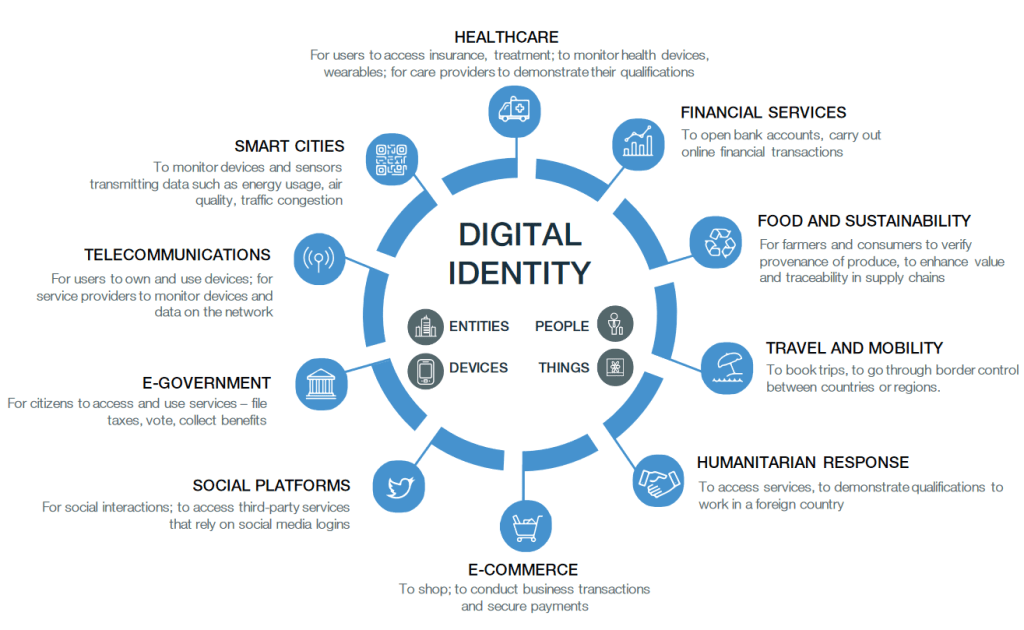
Digital Identity: The vision of the World Economic Forum (WEF, 2018)
WEF “Young Global Leaders”
An overview of some WEF Young Global Leaders (2005-2021) and Global Leaders for Tomorrow (1993-2003) in politics and the media. The list is not exhaustive.
Sources: Global Leaders for Tomorrow and Young Global Leaders on WikiSpooks.
United States
Politics and Policy
Jeffrey Zients (White House Coronavirus Response Coordinator since 2021, selected in 2003), Jeremy Howard (co-founder of lobby group “masks for all”, selected in 2013), California Governor Gavin Newsom (selected in 2005), Pete Buttigieg (selected in 2019, candidate for US President in 2020, US secretary of transportation since 2021), Chelsea Clinton (Clinton Foundation board member), Huma Abedin (Hillary Clinton aide, selected in 2012), Nikki Haley (US ambassador to the UN, 2017-2018), Samantha Power (US ambassador to the UN, 2013-2017, USAID Administrator since 2021), Ian Bremmer (founder of Eurasia Group), Bill Browder (initiator of the Magnitsky Act), Jonathan Soros (son of George Soros), Kenneth Roth (director of “Human Rights Watch” since 1993), Paul Krugman (economist, selected in 1995), Lawrence Summers (former World Bank Chief Economist, former US Treasury Secretary, former Harvard University President, selected in 1993), Alicia Garza (co-founder of Black Lives Matter, selected in 2020), Stéphane Bancel (Moderna CEO).
Media
CNN medical analyst Leana Wen (selected in 2018), CNN chief medical correspondent Sanjay Gupta, Covid Twitter personality Eric Feigl-Ding (a ‘WEF Global Shaper‘ since 2013), Andrew Ross Sorkin (New York Times financial columnist), Thomas Friedman (New York Times columnist, selected in 1995), George Stephanopoulos (ABC News, 1993), Lachlan Murdoch (CEO of Fox Corporation).
Technology and Social Media
Microsoft founder Bill Gates (1993), former Microsoft CEO Steven Ballmer (2000-2014, selected in 1995), Amazon founder Jeff Bezos (1998), Google co-founders Sergey Brin and Larry Page (2002/2005), former Google CEO Eric Schmidt (2001-2017, selected in 1997), Wikipedia co-founder Jimmy Wales (2007), PayPal co-founder Peter Thiel (2007), eBay co-founder Pierre Omidyar (1999), Facebook founder and CEO Mark Zuckerberg (2009), Facebook COO Sheryl Sandberg (2007).
Great Britain, Canada, New Zealand
Professor Devi Sridhar (a leading ‘zero covid’ proponent, selected in 2020/21), former British Prime Ministers Tony Blair and Gordon Brown (both selected in 1993), BBC World Service journalist Dawood Azami, Lynn Forester de Rothschild (co-owner of The Economist), Nathaniel Rothschild (son of Lord Rothschild), historian Niall Ferguson (selected in 2005), William Hague (Foreign Secretary, 2010-2014), Charles Allen (CEO of ITV, 2004-2007; Chairman of EMI, 2008-2010).
New Zealand Prime Minister Jacinda Ardern (since 2017, selected in 2014), Canadian Deputy Prime Minister Chrystia Freeland (selected in 2001; former managing director of Reuters). Canadian Prime Minister Justin Trudeau is a WEF participant, but is not a confirmed Young Global Leader.
Germany
Chancellor Angela Merkel (selected in 1993, 12 years before becoming Chancellor), current Health Minister Jens Spahn and former Health Ministers Philipp Roesler and Daniel Bahr, current co-chair of the Green Party and failed Chancellor candidate Annalena Baerbock (selected in 2020), former co-chair of the Green Party Cem Özdemir (selected in 2002), media mogul and Axel Springer CEO Mathias Doepfner (selected in 2001), talk show host Sandra Maischberger, late Foreign Minister and Vice Chancellor Guido Westerwelle (1997), former German President Christian Wulff (selected in 1995, 15 years before becoming President), Reto Francioni (former CEO of Deutsche Boerse).
European Union
EU Commission Presidents Jose Manuel Barroso (2004-2014, selected in 1993) and Jean-Claude Juncker (2014-2019, selected in 1995), French President Emanuel Macron (since 2017, selected in 2016), former French President Nicolas Sakozy (2007-2012, selected in 1993), Austrian Chancellor Sebastian Kurz, former Italian Prime Minister Matteo Renzi (2014-2016, selected in 2012), former Spanish Prime Minister Jose Maria Aznar (1996-2004, selected in 1993), Klaus Regling (CEO of the European Financial Stability Mechanism since 2012), Guy Verhofstadt (former Belgian Prime Minister, Chair of the Brexit Steering Group), Danish Minister for the Environment Lea Wermelin, Finnish Prime Minister Sanna Marin, former Finnish Prime Minister Alexander Stubb, and Mark Leonard (founding director of the Soros-funded European Council on Foreign Relations).
Switzerland
Natalie Rickli (Director of Health of the Canton of Zurich, selected in 2012), former Presidents of the Swiss National Council Christa Markwalder (selected in 2011) and Pascale Bruderer-Wyss (selected in 2009), Geneva politician Pierre Maudet (selected in 2013), NZZ media group CEO Felix R. Graf (selected in 2007), former Swiss Justice Minister Ruth Metzler (selected in 2002), former Swiss television CEO Roger de Weck (2011-2017, selected in 1994), former UBS CEOs Peter Wuffli (selected in 1994) and Marcel Rohner (selected in 2003), former Credit Suisse CEO Tidjane Tiam (1998).
Video Annex
1) Bill Gates demanding “digital immunity proof” in March 2020
2) Edward Snowden warning of the “destruction of rights” (March 2020)
3) The Chinese “social credit” system (May 2019)
Further reading
- All Roads Lead to Dark Winter (Whitney Webb, April 2020)
See also
Flu DID Circulate Last Winter – They Just Renamed It Covid
By Richie Allen | October 13, 2021
Flu is back. It took a gap year in 2020, but it’s back now, well rested and twice as dangerous. The “flu disappeared last Winter” claim is proof if ever you needed it, that people will believe anything if their television tells them it’s true.
Throughout 2021, the government and its medical advisers told us that there wasn’t a single recorded case of flu last Winter. They said that social distancing, mask wearing and working from home, eradicated it. No-one thought to ask them why those same measures hadn’t eradicated covid, but hey-ho.
The same boffins are telling us that as a result of opening up the economy and emerging from our covid bunkers, flu will return with a vengeance and that this spells trouble seeing as we’ve kind of lost our resistance to it. That is monumental bollox.
Flu never went anywhere last Winter. Neither did the common cold. They were re-branded as covid-19. You can take that to the bank. That’s not my opinion, that is fact. I’m not saying that covid doesn’t exist mind, just that everyone who sneezed last year was given a PCR test. Everything came back as covid.
It’s not just flu that has been re-branded as covid either. Tinnitus, dizziness, rashes, hearing voices, dead leg… everything has been linked to covid. It’s not funny. People believe this shit.
1 in 3 UK doctors believe that the re-emergence of flu and ever mutating covid-19 virus, spells doom for the NHS this Winter. One third of doctors when asked, say that they fear that the NHS isn’t ready for the perennial Winter NHS crisis. They’re right.
Of course, it doesn’t matter whether it’s covid, the flu or both. The NHS will collapse this Winter and it’ll be unlike anything we’ve ever seen previously. Hundreds of thousands of healthcare workers will walk away from their jobs before accepting Health Secretary Sajid Javid’s vaccine mandate. It’s going to be chaos.
Thirty years ago, there were twice as many hospital beds in the UK as there are today. The health service has been systematically destroyed over decades. The flu is back narrative is horse-shit. The total collapse of the NHS has been carefully planned.
They’re getting their excuses in early. Do you think they don’t know what the result will be, when they reduce the number of doctors, nurses and healthcare workers by forcing unsafe vaccines on them?
Do you think that they don’t know what the result will be, when they reduce bed capacity and treat nothing but covid, while leaving millions of people waiting for non-covid related illnesses?
Of course they know. It’s unimaginably evil isn’t it?
Featured Video

AIDS Inc. by Gary Null (2007)
or go to
Aletho News Archives – Video-Images
From the Archives
Clash of Civilization, Iran Part II
By Jamal Kanj – Intifada-Palestine.com – January 14, 2011
Israel’s survival kit is: perpetuate conflict, insecurity to rationalize collective hate and finally playing victim.
Devoid of conflict, Israel implodes internally; without hate, Zionism loses its justification; and playing eternal victim to continue blackmailing the West. Absence of this holy trinity, Israel ceases to exist.
From its inception, the house of Zion has mastered exploiting adversarial powers to advance Israel’s cause. For instance, their influence over the Democratic Party in the US began with President Truman’s bid for 2nd term election in 1948.
Responding to strong opposition from Secretary of State General George Marshall and Department experts urging against recognition of Israel, President Truman replied: “I’m sorry gentlemen but I have to answer to hundreds of thousands [Jewish voters] who are anxious for the success of Zionism. I do not have hundreds of thousands of [voting] Arabs among my constituents”
Zionists influence over liberal American politics was matched with the doctrinal school of Conservative theoreticians aligning the Republican Party’s platform with Israel’s objectives. The Neoconservative Zionists, coined Zioncons, invented the “Clash of Civilization” concept to fight Israel’s wars. … continue
Blog Roll
 Aletho News
- Pro-Palestine protesters arrested outside UK’s ruling Labour Conference in Liverpool
- Mauritius denies landing permit to flight from Israel, forcing cancellation: Tour operator
- Israeli finance minister calls for genocidal war on West Bank, annexation of south Lebanon
- 12 Things Your Psychiatrist Was Trained Not to Tell You
- From Unipolar Universalism to Multipolar Civilizational Distinctiveness
- RSF military group defects, joins Sudanese army: State media
- Ireland goalkeeper refuses to play ‘Israel’ as squad weighs boycott
- China pushes back against US on Cuba, Iran
- Ukrainian Soldiers, Potential Mercenaries: Have Gun, Will Travel!
- Burnham’s UN debut… A masterclass in British disinformation
- If Americans Knew
- Israel forces Gazans to live in constant peril – Daily Update
- Deconstructing Netanyahu’s pants-on-fire UN rant – Daily Update
- Trump betrayed voters with his campaign lies and prioritized a foreign country once he took office
- Netanyahu calls Israel’s war in Gaza ‘opposite of genocide’ in UN speech to near-empty hall
- Settler Kidnappings: Torture, Sexual Abuse and Terrorisation of Palestinian Abductees as Israel Deepens Annexation of West Bank
- Gaza winter nears as 162,000 tents become unusable, raising fears of humanitarian crisis
- Netanyahu says, “It’s the opposite of genocide”; UN says Gaza economy is world’s ‘most severe crisis on record’ – Daily Update
- Israel’s US-Backed Assault on Gaza Has Created the ‘World’s Most Severe Economic Crisis on Record’: UN
- ‘Protecting U.S. Citizens’… From Israel
- ‘This is where I live now, the back of a truck’: a day in the life of a grandmother in Gaza
- No Tricks Zone
- New Study: Earth And Venus Surface Warmth Largely Explained By Convection And Lapse Rate, Not CO2 Or Radiation
- 2025 Nature Paper Claiming Worsening Global Drought Gets RETRACTED …Heavily Flawed
- New Study: ‘Global Drought Shows No Detectable Recent Acceleration Under Climate Warming’
- Economic Masterminds: German Socialists Suggest Taxing Productivity Gains Stemming From Using AI
- The South China Sea Has Not Been Cooperating With The Climate Change Narrative
- Energy Crisis: Germany Enters Heating Season With Historically Low Gas Reserve Fill Levels
- New Study: The Antarctic Ice Sheet Gained Mass From 2020-2024 Due To Staggering Snow And Ice Accumulation
- Study: Ocean Heating Rates From Thousands Of Years Ago ‘Dwarf’ Modern Ocean Heating Rates
- Climate Extremists Target, Attack Large-Scale Power Grid Infrastructure In Germany!
- New Study: Antarctic Ice Melt Has Contributed Less Than 1 Centimeter To Sea Level Rise In The Last 30 Years

