“Burnt Bridges”: Why Trump’s Plan to Use Kurds Against Iran Is Doomed to Fail
By Mohammed ibn Faisal al-Rashid – New Eastern Outlook – March 7, 2026
Following a series of devastating U.S. and Israeli airstrikes on Iran’s nuclear facilities, Tehran is engulfed in uncertainty. However, the White House, facing the prospect of a ground operation in mountainous terrain, is betting on an old, tested, but extremely risky tool—Kurdish forces. The Donald Trump administration views the Kurds as ideal “cannon fodder” to ignite a civil war in Iran. But will this plan work? Given Trump’s history of betrayals, deceit, and cynical pragmatism, the attempt to play the Kurdish card might not only fail but could also backfire on the United States itself.
A Proxy Army for a Big War
While the U.S. Air Force continues to bomb Iranian cities and Donald Trump boasts about destroying the enemy’s navy, Washington is soberly assessing the risks. Sending thousands of American soldiers into Iran would be political suicide for a president who promised voters an end to “endless wars.” Analysts agree: the U.S. will not launch a full-scale invasion like in Iraq or Afghanistan due to the mountainous terrain, the risk of high casualties, and a lack of public support.
A solution was quickly found. As early as March 4th, the South Korean publication Donga Ilbo reported that thousands of Kurdish fighters had begun a ground offensive into Iran from Iraqi territory. According to Fox News and CNN, cited by the publication, the operation is coordinated with active participation from the CIA, which is providing weapons and equipment.
But is this really the case? Currently, data on a massive invasion by thousands of Kurdish fighters is contradictory.
The scenario appears logical: The Kurds, who make up about 10% of Iran’s population (approximately 9 million people), have historically faced discrimination within the Shia theocracy. They are concentrated in the western provinces bordering Iraq, making them an ideal foothold. Kurdish parties based in Iraqi Kurdistan have already united into the “Coalition of Political Forces of Iranian Kurdistan,” establishing a unified military command.
Israel: Old Ties and New Opportunities
The role of Israel deserves special attention. Tel Aviv has long-standing, complex but generally positive relations with Kurdish movements, viewing them as a natural counterweight to hostile Arab and Iranian regimes. In the current conflict, Israel has taken on the role of “igniter.” According to Middle East Eye, the Israeli Air Force is striking positions of the Islamic Revolutionary Guard Corps (IRGC) precisely in Iran’s western provinces, effectively preparing a corridor for the advancement of Kurdish forces.
According to experts, Israeli strategists are actively exploring the option of using Iranian Kurds (specifically groups like PAK, linked to the PKK) as manpower instead of American soldiers. For Israel, this is an opportunity to inflict maximum damage on its primary enemy without getting bogged down in a protracted ground conflict. The calculation is that the Kurdish national movement could become the “Trojan horse” capable of exploding Iran from within.
However, a fundamental contradiction lies here: the interests of Israel and the U.S. are often situational. And if Washington decides its goals are achieved, the Kurds could once again be left alone to face an enraged adversary.
“I Don’t Like the Kurds”: A Bloody History of Betrayals
This is precisely where Trump’s plan begins to unravel. To understand why the Kurds are unlikely to become a pliable tool in the White House’s hands, one need only look at Trump’s relationship with these people.
As early as 2020, the world learned shocking details from the memoirs of former National Security Advisor John Bolton. According to Bolton, Trump stated in a small circle, “I don’t like the Kurds. They run from the Iraqis, they run from the Turks. The only time they don’t run is when we’re bombing everything around them with F-18s.” This statement isn’t mere rudeness; it’s the quintessence of Trump’s approach: he despises those he considers weak and feels no moral obligation towards allies.
The most cynical example was the betrayal of the Syrian Kurds in October 2019. Trump then ordered the withdrawal of American troops from northern Syria, effectively giving a “green light” to the Turkish invasion. The Kurds, who had lost 11,000 fighters battling ISIS and were America’s only reliable partner on the ground, were abandoned to their fate. American officers on the ground were shocked: “They trusted us, and we betrayed that trust,” one of them told The New Arab at the time.
The “1991 Syndrome” is also vivid in Kurdish memory. Then, President George H.W. Bush called on Iraqi Kurds to rise up against Saddam Hussein but abandoned them when the uprising began, allowing the regime’s army to brutally crush the rebellion with helicopters. Now, this nightmare seems poised to repeat itself in Iran.
Can the U.S. Ignite a Civil War in Iran?
Formally, the prerequisites for unrest exist. Besides ethnic Kurds, Iran is home to disaffected Baluch, Azeris, and Arabs. Following the death of Supreme Leader Ali Khamenei in the initial strikes, a power vacuum could emerge in the country. The White House has already openly stated its readiness to deal with a “new government” and is discussing who should lead Iran after regime change.
Trump personally called on Iranian diplomats worldwide to seek asylum, promising to help “form a new, better Iran.” It would seem this is the moment of truth: Kurds and other minorities should rise up and overthrow the hated regime.
But reality is more complex.
Fear of History Repeating. As analyst Oral Toga noted in a comment to Middle East Eye, the fact that the U.S. abandoned the Syrian Democratic Forces (SDF) will serve as a lesson for Kurds in Iraq and Iran. “The airstrikes will end someday, but Tehran will remain there forever,” he reminds us.
Lack of Strategy. The U.S. and Israel have no clear vision for Iran’s future. Do they want a unitary state, a federation, or the complete disintegration of the country? Using the Kurds as a battering ram without guaranteeing them autonomy or protection after the war would condemn the region to a bloodbath. The Kurdish leaders themselves understand this. As activist Golaleh Sharafkandi stated, “We have a political program supported by an army, not the other way around.”
Regional Opposition. The creation of a new Kurdish zone of influence in northern Iran would be opposed not only by Iran but also by Turkey and even Azerbaijan, which see it as a threat to their sovereignty and a risk of separatism. Ankara already brutally suppresses any pro-Kurdish movements near its borders. Azerbaijan, which has strategic relations with Turkey and Israel, has already expressed condolences to Iran and called for peace, fearing destabilization.
Operational Difficulties. Several sources, including the Turkish agency Anadolu, report that the information about the offensive has been denied or clarified. The Kurdish factions themselves deny starting a full-scale invasion, and Iranian media report that the border is under control. The groups ready to fight number, by various estimates, between 8,000 and 10,000 people—insufficient to conquer territory without direct air support and U.S. special forces, which Trump is not yet ready to provide.
Dreams of a Caliphate and the Bitter Truth
Donald Trump’s attempt to use the Kurds as a match to ignite the powder keg of Iran appears to be an adventure based on a denial of reality. Yes, the Kurds hate the Ayatollahs’ regime. Yes, they want autonomy and rights. But they do not want to once again become bargaining chips in a high-stakes game where their physical survival is on the line.
Trump has already twice demonstrated his true attitude towards Kurdish allies—in Iraq and Syria. A third time could be the last, not for the American president’s reputation, but for hundreds of thousands of civilians who would find themselves caught between the hammer of the Iranian army and the anvil of American geopolitical ambitions. The Kurdish leaders, united in a coalition, understand perfectly well: when the situation gets hot, the White House might once again throw up its hands and say, “This is not our war.”
Therefore, despite the loud headlines and CIA leaks, the active use of Kurds in full-scale combat operations is unlikely. Kurds might try to expand their autonomy amidst the chaos, but playing the role of a disciplined U.S. proxy army that can be unleashed on Tehran and then written off—they won’t buy that anymore. The price of trust in America under Trump has proven too high, and paying off those debts may take decades.
Muhammad ibn Faisal al-Rashid, political scientist, expert on the Arab world
Follow new articles on our Telegram channel
Indian journalist reveals severe Israeli censorship after escape from occupied territories
Press TV – March 7, 2026
An Indian journalist who was trapped in the occupied territories from February 28 to March 6 has revealed severe Israeli censorship amid the regime’s war of aggression against Iran.
Braj Mohan Singh of India’s Sandha News said he witnessed people dying in 100‑foot‑deep bunkers while Israeli officials withheld details.
Missiles “don’t differentiate between Indian or Israeli,” he said.
He contrasted press freedom in India with the restrictions in Israel, noting journalists cannot film bodies, visit hospitals, or receive accurate casualty numbers. Local accounts often reveal far higher losses than official reports, he added.
“When an incident takes place, we are not given the details of the location. The next day, when we visit the site, we are told, ‘There was only one casualty,’ but a local told us, ‘There were four houses, and everyone died,” which shows there was a major incident,’” he added.
Despite Israel’s touted advanced warning systems, Singh reported missiles arriving without sirens or prior alerts, highlighting technology failures and the unpredictability of drone and missile attacks.
He also mentioned reports of Iranian targeting of US embassies across West Asia and possible attempts in Tel Aviv, underscoring the heightened danger in the region.
The regimes in Washington and Tel Aviv started their unprovoked military assault on February 28, assassinating Leader of the Islamic Revolution Ayatollah Seyyed Ali Khamenei and top Iranian military commanders.
Iran began to swiftly retaliate against the criminal aggression by launching barrages of missile and drone attacks on the Israeli-occupied territories as well as on US bases in regional countries.
How Israel and the FBI manipulated assassination plots to goad Trump into Iran war
By Max Blumenthal | The Grayzone | March 6, 2026
The FBI manufactured plots to convince Trump that Iran sought to kill him, while Israel and its administration allies exploited the president’s deepest fears to keep him on the war path.
“I got him before he got me,” an ebullient President Donald Trump remarked to a reporter when asked about his motives for authorizing the killing of Iran’s Leader, Ayatollah Ali Khamenei, on February 28, 2026.
With his off-the-cuff remark, Trump revealed that anxiety about his own assassination at the hands of Iranian agents influenced his decision to initiate a US-Israeli regime change war that has already resulted in American casualties, the bombings of schools and hospitals inside Iran, devastating Iranian retaliatory strikes on US military bases and embassies, and a spiraling global economic crisis.
Trump’s generalized fears of assassination were well-founded. He was nearly killed in Butler, Pennsylvania on July 13, 2024 by a 20-year-old engineering student named Thomas Crooks who managed to fire eight rounds at the former president from a rooftop, slicing his ear and missing his head by a hair’s breadth. Two months later, a drifter named Ryan Routh was arrested after hiding for hours in the shrubbery outside the former president’s Mar-a-Lago estate in West Palm Beach, Florida. Routh had been spotted after pointing an assault rifle toward a Secret Service agent as Trump played golf 400 yards away.
Officials have yet to produce any evidence that Iran played a role in either of these attempts on Trump’s life. Yet since those fateful events, Israel-aligned Trump advisors, Israeli intelligence, and Israeli Prime Minister Benjamin Netanyahu himself have gone to extreme lengths in order to tie Tehran to the plots. More shocking still is the fact that the FBI has manufactured a series of assassination plots, successfully convincing Trump that Iran was hunting him on US soil with highly sophisticated teams of hit men.
The man accused of leading the most significant of these operations, Asif Merchant, is currently on trial in a Brooklyn, NY federal court. After the US granted him a visa despite his presence on a terror watchlist, Merchant was in the constant company of an FBI confidential informant who ultimately steered the contrived plot to its conclusion. He never stood a chance of realizing his plans, and did not appear serious about doing so.
Independent journalist Ken Silva puts it succinctly in his forthcoming investigative book, “The Trump Assassination Plots”: “A closer look at the Merchant case reveals that at the very least…it was a highly controlled FBI sting operation that never posed a threat to Trump. More nefariously, records and whistleblower disclosures indicate that Merchant may have been the patsy in a case totally fabricated by the undercover agents.”
Authorities arrested Merchant on July 12, 2024 – just one day before Crooks attempted to kill Trump in Butler. Hours after the failed Butler assassination, FBI agents interrogated Merchant about whether it was in fact Iran that had Crooks under its control.
At that point, Trump was still campaigning to be a “President of Peace. On the campaign stump, he warned that his opponent, Kamala Harris, “would get us into World War III guaranteed.” Trump vowed to resolve the war between Ukraine and Russia in one day, and distanced himself from pro-war Republicans who sought regime change in Iran.
Pro-war elements in Trump’s coterie exercised multiple points of leverage to reverse the president’s anti-interventionist instincts. Ultra-Zionist billionaires supplied vital and well-documented influence over Trump’s policies by keeping his campaign war chest flush. But Trump remained an erratic personality whose petty grievances kept his aides in a perpetual state of uncertainty.
It was only by exploiting Trump’s deepest psychological vulnerability – his fear of an assassin’s bullet – that Israel and its cutouts in his administration were able to secure their influence over the president, keeping him on the warpath against Iran.
The assassination escalation trap
On June 3, 2020, as the commander of Iran’s IRGC Quds Force, Qassem Soleimani, deboarded an airplane at Baghdad International Airport, on his way to peace talks with Saudi officials, a US drone killed him with a Hellfire missile. The strike had been ordered by Trump following a sustained campaign of military escalation against Iranian allies orchestrated by his National Security Council Director John Bolton and Secretary of State Mike Pompeo.
As journalist Gareth Porter reported for The Grayzone, by the time Trump authorized Soleimani’s assassination, Netanyahu was planning unilateral strikes on Iran aimed at drawing the US into direct conflict. Trump issued orders to kill the general under sustained pressure by Pompeo and Bolton, two pro-Israel hardliners. Both former Trump officials have lobbied for the Israeli and Saudi-funded Mojahedin El-Khalk (MEK), a cult-like exiled militia that has carried out numerous assassinations of Iranian officials at the behest of Israel’s intelligence services.
By killing Soleimani, Trump set the US on a collision course for all-out war with Iran – just as Netanyahu had hoped. What’s more, the president invited the prospect of violent retaliation against himself and his national security advisors.
So long as Trump feared the specter of IRGC agents lurking behind every corner, it stood to reason that he was more likely to authorize a regime change war on Iran. And so the FBI went to work, concocting a series of plots that helped forge Trump’s belligerent attitude toward Tehran.
Brought to you by the FBI: Iran’s plot to kill John Bolton
The first major Iranian plot arrived in 2022, when the Department of Justice filed charges against an Iranian national, Shahram Poursafi, for supposedly hiring a hitman to kill Bolton. However, the hitman turned out to be an FBI informant, and the plot was largely contrived by the Bureau. Poursafi, for his part, could not be arrested because he lived in Iran.
As journalist Ken Silva reported, the FBI officer who oversaw the manufactured plot to kill Bolton, Steven D’Antuono, was the same official who ran the Detroit field office that relied on paid informants to concoct the 2020 plot by right-wing militia members to kidnap Michigan Gov. Gretchen Whitmer. In a 2025 federal appeal court ruling, the judge acknowledged that defendants in that case “are correct that the government encouraged them to settle on a plan” to kidnap Whitmer. The FBI’s D’Antuono also oversaw the probe into the suspicious planting of pipe bombs at Republican and Democratic Party headquarters in Washington on January 6, 2021. In the course of his failed investigation, he misled Congress about having received “corrupted” evidence.
Though Bolton was never in danger from Iran, the FBI-contrived plot began to fuel paranoia among Trump administration veterans. Pompeo now believed that he too was being targeted by Iranian assassination teams. In his 2023 campaign memoir, “Never Give an Inch,” the former CIA director claimed Poursafi had also paid $1 million to a hitman to kill him.
However, Pompeo provided no additional details on the plot, which was never mentioned in DOJ documents charging Poursafi for attempting to kill Bolton. According to those affidavits, Poursafi sent just $100 to the FBI’s confidential human source before the DOJ concluded its investigation.
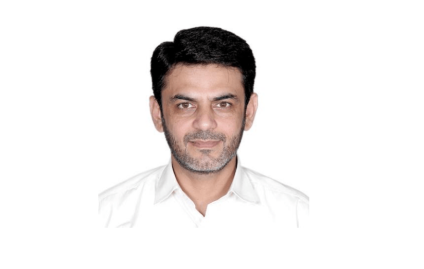
Asif Merchant, accused ringleader of an FBI-managed Iranian plot to assassinate Trump
Iran’s hapless hitman granted special visa, introduced to FBI informant
In April 2024, as Trump launched his comeback presidential campaign, an itinerant salesman named Asif Merchant arrived from Pakistan to George Bush Intercontinental Airport in Houston, Texas. He was quickly flagged as a “Qualified Person of Interest” who’d been placed on a Department of Homeland Security watchlist. Agents from an FBI Joint Terrorism Task Force (JTTF) team then discovered through a search of Merchant’s devices that he had visited Iran, where his wife and adopted son lived. Whether they’d received a tip from Israel, which furnishes reams of intelligence to the FBI on foreign Muslim visitors to the US, remains an open question.
According to JTTF documents obtained by pro-Trump reporter John Solomon, Merchant was “released without incident” and designated as “free to travel to desired destination.” In fact, the FBI had granted him a “Special Public Benefit Parole,” which, as Solomon explained, “would allow agents to try to flip Merchant as a cooperator or try to determine why he was coming to the United States and who he might be working with.”
The FBI whistleblower who provided Solomon with the documents on Merchant’s airport interview compared the “Special Public Benefit Parole” to the scandalous “Fast and Furious” program, in which President Barack Obama’s Department of Justice facilitated the delivery of automatic weapons from US gun dealers to Mexican cartels in order to supposedly surveil the gangs’ criminal activities.
Almost as soon as Merchant entered the US, the FBI introduced him to a confidential informant posing as a potential business partner and operating under the alias, Nadeem Ali. The informant had served as translator for the US military during its occupation of Afghanistan.
Though Merchant did not propose any crimes, the FBI wiretapped a meeting between him and the informant, Ali, in a hotel room on June 3, 2024. There, Merchant was taped making a supposed “finger gun” motion while mentioning an unspecified “opportunity.” This grainy minute-long hidden camera recording is presented as the linchpin of the DOJ’s indictment of Merchant.
According to the FBI, Merchant had outlined a highly complex plot which required the hiring of two hitmen, “twenty five people who could perform a protest after the distraction occurred, and a woman to do ‘reconnaissance.”
For the elaborate flash mob-style assassination extravaganza, Merchant was asked by the informant to fork over a mere $5000. The Pakistani visitor had no means of scrounging up the fee, however, raising further questions about the seriousness of the plot. “I did not think I was going to be successful,” Merchant would later state in court.
Virtually penniless, Merchant was forced to gather the cash from an anonymous “associate,” according to the DOJ indictment. Next, the FBI informant took him on a winding journey from Boston to New York City, where he allegedly handed the money to two other FBI informants posing as hit men. The DOJ claims Merchant made plans to fly to Pakistan on June 12, but was arrested in his residence that day.
Merchant interrogated about Butler, kept incommunicado
The following day, 20-year-old Thomas Crooks arrived at a fairground in Butler, Pennsylvania where former president Trump was scheduled to speak. He flew a drone in the air for 15 minutes, surveying the area as he finalized plans to assassinate the candidate. In an odd coincidence, the Secret Service’s anti-drone system was offline all morning and into the afternoon — until roughly 15 minutes after Crooks flew his drone. When Trump took the stage, Crooks climbed atop a slanted rooftop 130 yards away and fired eight shots at the president, missing his head by an inch, until a local police officer fired back. He was killed by a Secret Service sniper who had inexplicably hesitated to fire for a full 15 seconds.
Thirty hours later, FBI agents flew to Houston to interrogate Merchant in his jail cell about a possible Iranian connection to the assassination attempt in Butler. An FBI source told the Washington Post the Bureau “took the extraordinary step of interviewing him without his lawyer to determine whether he knew Crooks.”
The grilling continued even after Merchant was transferred to the maximum security Metropolitan Detention Center in Brooklyn – the same prison where Luigi Mangione, the accused killer of United Healthcare’s CEO, is currently being held. There, he was held under harsh conditions in solitary confinement, unable to interact with anyone but the guards who brought him food and his lawyers because, as then-Deputy Attorney General Lisa Monaco argued, he might use code words to initiate further assassination plots. “It appeared they thought I was some kind of super spy,” Merchant later reflected.
Not only was Merchant prevented from calling his family in Pakistan, he was blocked from reviewing recordings of conversations he held with undercover FBI informants, as the DOJ had marked them “Sensitive.” In March 2025, his lawyer protested that US Marshals repeatedly refused to allow him to meet with this counsel and review discovery at the courthouse. This, too, was justified on the basis of specious national security grounds.
However, as the journalist Ken Silva discovered, an internal memo by the Bureau Of Prisons Director Colette Peters confirmed that Merchant had no contact with any Iranian intelligence assets in the US. “Law enforcement has not identified any IRGC associates of Merchant operating in the United States who could continue to orchestrate violent acts,” Peters wrote.
Indeed, the only Iranian assassins with whom Merchant appeared to have interacted inside the US were undercover informants working for the FBI.
Merchant “had never been close to realizing” Trump assassination
During his trial this March 4, Merchant’s lawyer, Avraham Moskowitz, took the highly unusual step of allowing his client to take the stand. Merchant proceeded to present a version of events that contrasted sharply with the account he provided in his initial FBI proffer. For example, the defendant claimed he had been coerced into the plot by an IRGC agent, and went forward with a plan “to maybe have someone murdered” only because he feared for his wife and adopted son back in Iran.
After his arrest by the FBI, Merchant said he engaged in discussions with federal authorities about becoming an informant himself, but they ultimately broke down for unknown reasons.
“I was not wanting to do this so willingly,” he insisted in Urdu, adding, “I did not think I was going to be successful.”
In its coverage of the trial, the New York Times concluded Merchant “had never been close to realizing the vision of his Iranian handler.”
But back in 2024, as word spread of Merchant’s arrest, Israel-adjacent figures in Trump’s inner circle exploited the case to exacerbate the candidate’s anxiety about the Ayatollah’s wrath.
Israel-aligned forces blur Butler with Iran
Just three days after Trump’s campaign was nearly ended by a lone American assassin’s bullet in Butler, officials burrowed within the architecture of the national security state took measures to shift the focus to Iran.
“The Biden administration obtained intelligence in recent weeks about an Iranian assassination plot against former President Donald Trump, and the information led the Secret Service to ramp up security around the former president, according to three U.S. officials with knowledge of the matter,” reported NBC’s Ken Dilanian on July 16, 2024. (Dilanian had been fired from his previous gig at the LA Times after he was exposed for allowing the CIA to review his reports before publication).
The unnamed officials were clearly referring to the plot which the FBI manufactured for Merchant. The revelation not only seemed like a cynical attempt to obscure the reality of the near-assassination in Butler, which was conducted by a friendless American man who had never left the country. It also suggested the FBI had been so focused on concocting Iranian plots on American soil that it ignored the years-long trail of YouTube comments left by the would-be assassin bluntly declaring his intention to kill US politicians and police officers, and his hopes to instigate a civil war.
Though FBI leadership misled the public about the nature of the Butler plot, falsely claiming, for instance, that Crooks was not communicating with others online, they were never able to connect it to Iran. This clearly frustrated Rep. Mike Waltz, a close Trump ally seated on the House committee to investigate the Butler plot.
“These plots from Iran are ongoing. And when Biden says nothing, Harris says nothing, the DOJ tries to bury it, what message does Iran get? They get that we can keep trying to take Trump out and have no consequences,” Waltz fulminated on Fox News in August 2024.
Referencing the FBI-manufactured Merchant operation, Waltz thundered, “You have multiple assassination plots from the Iranians. This Pakistani national was recruiting females as spotters. He had recruited hit men and had made a down payment. He was even recruiting protesters as a distraction.”
By this point, Waltz was on his way to a short stint as Trump’s National Security Council Director, where he would help direct a failed war on Iran’s allies among the Ansurallah movement in Yemen. (Waltz was demoted to US ambassador to the UN after he accidentally included the Atlantic Magazine editor-in-chief and former Israeli prison guard Jeffrey Goldberg in a private administration Signal chat where classified information about US attack plans on Yemen was shared).
Throughout his career, the Israel lobby and Netanyahu’s allies had quietly propelled his rise. As AIPAC CEO Elliot Brandt remarked in private comments exclusively revealed by The Grayzone, Waltz was one of Israel’s “lifelines” inside the Trump administration, as he had been groomed by the Israel lobby since he first ran for Congress.
For Waltz and other Israel-aligned figures close to Trump, connecting the Butler incident to Iran appeared to offer a direct path to conflict with Iran. As an unnamed high-level US official told the Washington Post, if Tehran had been found responsible for Crooks’ attempt to kill Trump, “it would mean war.”
Certain foreign actors were also working to steer the US toward blaming Iran for Butler. In the late summer of 2024, the Justice Department received an urgent alert from abroad which connected Crooks directly to IRGC plots to kill Trump. According to the Washington Post, the tip arrived through a “confidential human source overseas” – almost certainly Israeli intelligence.
After a thorough investigation, DOJ officials decided the tip was not credible. “Nothing credibly connected him to Iranian plots,” one official told the Post.
But in the wake of the shooting in Butler, the constant chatter about looming Iranian threats had indelibly altered Trump’s outlook. Reporters who followed Trump on the campaign trail described a palpable sense of panic from the candidate and his inner circle about IRGC-directed hitmen stalking them at every stop.
“Ghost flights” for Trump triggered by imaginary Iran missile threats
With the Trump campaign already consumed with anxiety, the FBI delivered an alert that sent them spiraling into the depths of paranoia.
According to the Bureau, Iran had placed operatives inside the country with access to surface-to-air missiles. This dubious warning prompted Trump’s already militarized security team to take an extraordinary step. Fearing that Iran would down the famous “Trump Force One” airliner at any moment, Trump was placed on a “ghost flight” owned by his golf buddy, real estate tycoon Steve Witkoff, while the rest of his campaign traveled on the main jet.
Joining Trump on the secret decoy plane was his campaign manager, Suzie Wiles, who would go on to become White House chief of staff, controlling access and the flow of information to the president. Unbeknownst to the public, Wiles had served as a paid advisor to Israel’s Netanyahu during his 2020 re-election campaign, consolidating her role as a key point of contact between Tel Aviv and Trump.
Journalist Ken Silva has revealed that the FBI alert which prompted Trump’s use of a “ghost plane” was based on a cynical deception. As Silva explains in his forthcoming book on the assassination plots surrounding Trump, federal investigators had discovered that Routh, the would-be assassin at Mar-a Lago, had attempted to purchase a rocket launcher, and may have been in contact with Iranian nationals during his time in Ukraine. The Bureau likely massaged that information into the bogus report it provided the Trump campaign, conjuring up imaginary Manpad-toting IRGC operatives to exacerbate the candidate’s fears.
Once he entered the Oval Office, Trump was encircled by Israel-aligned advisors and staunchly committed to the belief that Iran had attempted to eliminate him on the campaign trail. As commander-in-chief of the US military, he was hellbent on revenge.
Netanyahu nudges Trump with Butler plot
On June 15, 2025, days after launching an unprovoked war on Iran, Netanyahu took to Fox News to manipulate Trump into joining the assault. The Israeli leader appeared to know exactly which psychological vulnerabilities to exploit.
“These people who chant death to America, tried to assassinate President Trump twice,” Netanyahu declared, asserting without a shred of evidence that Iran was behind both the Butler assassination attempt and the one at Mar a-Lago.
“Do you have intel that the assassination attempts on President Trump were directly from Iran?” a visibly startled Fox News host Bret Baier asked.
“Through proxies, yes. Through their intel, yes. They want to kill him,” stated Netanyahu with a cocksure gaze.
One week later, Trump authorized a series of US strikes on Iranian nuclear facilities in support of Israel’s military assault. Though Trump arranged a ceasefire soon after the attack, Israel’s influence over his administration – and over his psyche – guaranteed that another, much more violent round of conflict was just over the horizon.
In a graphic promoted by the White House’s official Twitter/X account on July 21, 2025, Trump implied that he had begun to turn the tables on his would-be Iranian assassins: “I was the hunted, and now I’m the hunter,” he declared.

Israel claims to eliminate would-be Trump assassin in Iran
By March 2026, Trump was back to war with Iran. Within four days, the US-Israeli joint assault had predictably expanded into an open-ended regional war following the failure of an opening series of decapitation strikes to induce regime change.
On the afternoon of March 4, the glowering US “Secretary of War” and former Fox News personality Pete Hegseth appeared before a lectern at the Pentagon and vowed to unleash “death and destruction from the sky all day long” over the people of Iran.
As his cartoonishly violent screed built to a crescendo, Hegseth issued a dramatic announcement: “The leader of the unit who attempted to assassinate President Trump has been hunted down and killed. Iran tried to kill President Trump, and President Trump got the last laugh.”
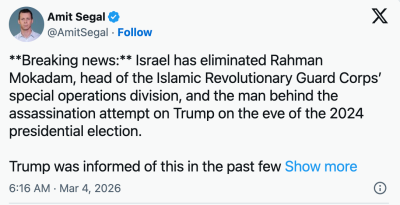
Though Hegseth did not name the figure, an Israeli journalist who functions as one of Netanyahu’s favorite stenographers, Amit Segal, revealed that Israel had assassinated an IRGC official named Rahman Mokadam who was supposedly responsible for directing a plot to kill Trump. But once again, the details of the plot revealed layers of FBI chicanery, confidential informants masked as “co-conspirators,” and a compromised witness.
In fact, the supposed assassination plan which Mokadam was accused of directing did not initially focus on Trump. Instead, the target was said to be Masih Alinejad, an Iranian expat and regime change activist on the US government payroll. The only evidence that Trump was a possible target at all came from the claims of a convicted drug dealer and con man named Farhad Shakeri, who had also been a defendant. Shakeri spoke to the FBI by telephone from Iran, providing dubious information in exchange for a reduced prison sentence for an unnamed associate in the US.
It was during these remote interviews that Shakeri seemingly claimed he had an IRGC handler who had directed him to kill Trump. But according to the FBI’s criminal complaint against him, that handler’s name was “Majid Soleimani,” not Mokadam.
The FBI agent who interviewed Shakeri clearly recognized his penchant for fabulism, writing that “certain of Shakeri’s statements appear to be true and others appear to be false.” Shakeri had indeed lied throughout his interviews, yet the agent still concluded that “it appears” he was planning to kill Trump. He did not explain why he considered the confession credible, and the allegation about a plot to kill Trump was notably absent from the grand jury indictment filed a month later.
After killing Mokadam on March 4, the Israelis went straight to the president to boast of their supposed achievement – and reignite his anxiety about Iranian assassins.
As Amit Segal noted, “Trump was informed of this in the past few hours by Israel.” In doing so, the Israelis reinforced Trump’s sense that he had been hunted by Iran – and that by fighting their war, he was saving his own skin.
As it had in the past, the White House posted a video on its official Twitter/X account proclaiming Trump’s triumph over Iranian assassins: “I WAS THE HUNTED, AND NOW I’M THE HUNTER.”
Thomas Crooks may have narrowly missed Trump’s cranium in Butler, Pennsylvania, but Israel had found a way into the president’s head.
US Boasts of Destroyed Iranian Launchers Lack Credibility – Ex-DoD Official
Sputnik – 06.03.2026
As the United States is clearly lying about the number of the US military casualties in the current war with Iran, the veracity of other claims made by the US is dubious, former US Department of Defense officer David T. Pyne tells Sputnik.
Properly assessing Iran’s losses is also difficult due to the fact that it is unclear whether US claims of destroyed Iranian missile launchers take into account the decoys and dummy targets, he points out.
“I believe that US estimates of the total number of Iranian ballistic missiles are likely much lower than is actually the case as I believe Iran may have tens of thousands of missiles in its stockpile,” Pyne adds.
Finally, even though the US and Israel did manage to take out a number of Iranian mobile missile launchers, Iran’s military has become adept at keeping its remaining launchers out of harm’s way.
Thus, reasons Pyne, it is likely that most of the Iranian missile launchers – especially those hidden deep underground – “will survive the war” even if it drags on for months.
US Shortages and Israel’s Weakness
Meanwhile, the US and Israel now deal with their “very limited supply” of offensive missiles and missile defense interceptors alike, with the latter potentially running out by next week, says Pyne.
The US could soon find itself unable to defend all of its assets from Iranian attacks, even as Iran is systematically dismantling US radar capabilities in the region, further degrading the US ability to shoot down Iranian missiles.
At the same time, Israeli air defenses have proven to be “largely ineffective” against Iranian ballistic and hypersonic missiles.
“In a protracted war of attrition like this war is shaping up to be, Iran is likely to emerge victorious,” Pyne remarks.
The General who swallowed his truth
By Jasim Al-Azzawi | MEMO | March 5, 2026
General Dan Cain, Chairman of the Joint Chiefs of Staff, delivered a private warning to President Trump with the bluntness that democracies depend upon and empires routinely ignore: “We don’t have enough ammunition to win this war. It would not be pretty.” This was not timidity. This was the solitary act of institutional honesty still flickering inside the corridors of American military power.
Trump’s response was the response of a carnival barker, not a commander-in-chief. On Truth Social — that funhouse mirror of American political life — he swatted away the warning with a salesman’s swagger: “Oh no, no, no. If we do it, it will be easily won.” A sober assessment became a sales pitch. A caution became a lie.
But the greater lie came next. When Cain’s warning leaked, Trump did not merely dismiss it. He inverted it. He told the American public, with the breezy confidence of a man who has never been held accountable for anything, that the general had said the opposite — that the United States had plenty of missiles, plenty of munitions, plenty of everything. “That’s not what he said at all,” Trump declared. He put triumphalist words in the mouth of a man who had spoken warnings.
And General Cain said nothing.
That silence is not a footnote in this story. It is the story. By staying quiet, Cain allowed the American public to absorb a fabrication as truth. He did not say: “No, Mr. President, that is not what I said.” He did not invoke the oath he swore, or the soldiers who would pay with their lives for the gap between political rhetoric and logistical reality. He chose the safety of silence over the danger of truth. In doing so, he did not merely fail himself. He failed the republic.
This is the rot at the core of American militarism.
As the historian Andrew Bacevich has long warned, the professional military has become less a defender of democratic values than a tool of imperial ambition, its senior officers more attentive to their next posting than to the Constitution they swore to uphold.
Cain’s silence was not an aberration. It was a symptom.
The logistics picture Cain reportedly described in private is not theoretical. The math is unforgiving. Current inventories of interceptors and precision munitions cannot sustain a prolonged air campaign against a nation three times the size of Iraq. The Wall Street Journal has documented an “alarming gap” in US missile stockpiles, reporting that reserves “fell significantly short” of requirements for high-intensity, sustained operations. Pentagon contractors have been instructed to “double or even quadruple” production of Patriot interceptors, SM-6s, and precision strike missiles — a tacit admission that the arsenal built for Cold War scenarios is inadequate for the war being prosecuted today.
Consider Gaza. Israel, the most lavishly armed military power in the Middle East, with complete air and sea dominance, has reduced a tiny coastal strip to a moonscape desolation over two and a half years, and still has not broken Hamas. Gaza is thirty-seven kilometres long.
Iran is a nation of ninety million people, mountainous, strategically deep, with hardened infrastructure and a battle-tested Revolutionary Guard. The idea that it collapses under a few weeks of American airstrikes is not a strategy. It is fantasy dressed up as resolve.
“God help us if this continues, if it even reaches its fourth week,” Colonel Daniel Davis warned on the Deep Dive podcast. He was speaking militarily. The same prayer applies politically.
When Trump now floats the prospect of ground troops, he is not escalating from a position of strength. He is improvising from a position of denial. The admission that airpower and missiles alone cannot achieve the political objective is the admission that the original objective was never honestly assessed. This is the pattern of American war-making at the end of empire: grandiose promises, catastrophic miscalculations, and then the slow, terrible reckoning paid in blood by those who never had a seat at the table where the lies were told.
The costs are already accumulating — not merely in the currency of munitions and treasure, but in the currency that empire always spends last and regrets most: credibility. America’s word, already devalued by two decades of manufactured justifications for war, grows cheaper by the day.
Democracies can endure miscalculation. They can endure bad presidents. What they cannot long endure is the institutionalization of a culture in which truth is spoken in whispers behind closed doors and swallowed whole in front of cameras. When the Chairman of the Joint Chiefs permits his own words to be weaponized as propaganda — when the man charged with counting the missiles will not correct the president who pretends there are plenty — something more than military credibility collapses.
What collapses is the social compact between the governed and those who send them to die.
Cain’s silence was not caution. It was complicity. And in the machinery of empire running low on ammunition and low on honesty, complicity is the one resource that never seems to run short.
Because when the missiles finally run out, slogans will not replace them.
Reality will.
Witkoff undermined Iran talks by peddling lies to build case for military aggression: Report
Press TV – March 4, 2026
US President Donald Trump’s special envoy to West Asia, Steve Witkoff, undermined the negotiations with Iran by peddling lies to build a case for military aggression, according to a report citing regional diplomats.
“In that first meeting, both the Iranian negotiators said to us directly, […], that they controlled 460 kilograms of 60%,” Witkoff said Monday in a Fox interview, referring to the uranium’s level of enrichment.
“And they’re aware that that could make 11 nuclear bombs, and that was the beginning of their negotiating stance,” he claimed.
“They were proud of it,” Witkoff further claimed. “They were proud that they had evaded all sorts of oversight protocols to get to a place where they could deliver 11 nuclear bombs.”
However, a Persian Gulf diplomat with direct knowledge of the talks told MS NOW that Witkoff’s description of the conversation was false.
The Iranians told Witkoff that Iran was willing to give up the enriched uranium as part of a new agreement with Trump, according to the unnamed Persian Gulf diplomat.
The Iranians also told Witkoff that Iran enriched the uranium after Trump pulled out of a 2015 nuclear agreement brokered by the Obama administration.
“I can categorically state that this is inaccurate,” said the diplomat, referring to Witkoff’s account. “He was explaining that all of this material can all go away should we have a deal and Iran can be relieved from sanctions.”
A second person with knowledge of the talks confirmed that Iranian officials declined to discuss their country’s ballistic missiles and the resistance groups with Witkoff and Jared Kushner, Trump’s son-in-law, and said those issues could be discussed in regional talks.
While Iran was engaged in the negotiations, on Saturday, the US and Israel, similar to previous times, started their unprovoked military assault, launching attacks on multiple cities across the country.
Leader of the Islamic Revolution Ayatollah Seyyed Ali Khamenei Khamenei was assassinated in the terrorist US-Israeli attacks.
Iran began to swiftly retaliate against the criminal aggression by launching barrages of missile and drone attacks on the Israeli-occupied territories as well as on the US bases in regional countries.
Veteran War Correspondent Reveals How to Tell When Analysts Talking About Iranian Losses Are Lying
Sputnik – 04.03.2026
“In every war, destroying a launcher is a very popular claim because it implies that the Israelis have reduced future attacks. This is a domestic and international message that ‘we have achieved the main objectives of the military campaign’,” says Elijah Magnier, a prolific journalist and war reporter covering Middle East conflicts since the 80s.
“But the standard of evidence it’s another matter,” the veteran observer told Sputnik.
“What is credible is before and after imagery. So showing an identifiable launcher vehicle, and they have to be authentic, not a decoy. And then geolocated strike footage, with clear launcher signature, and [a] pattern of fire decline consistent with launcher attrition,” Magnier explained.
“The Americans and the Israelis can claim that they’ve hit a ‘suspected’ launch site and they’ve used this term a lot, which means there is no proof of a launcher present, or there are strikes on empty pads or decoy equipment,” Magnier stressed.
Pointing to the intensity of Iran’s counterstrikes in the first days of the conflict, and its adoption of the strategy learned during the June 2025 war that enemy defenses start running out of interceptors after a few days of intense fire, Magnier says the real measurable sign of whether enemy attacks are degrading Iran’s capabilities will be whether its missiles continue firing after ten days or more.
Did Kuwait really shoot down three US F-15s?
There are some technical holes in the Pentagon’s official “friendly fire” story
RT | March 4, 2026
The US military wants you to believe that its worst day of air combat losses since the Vietnam War was the result of a “friendly fire” mishap. But do some digging and that story begins to look far-fetched.
Three US F-15E Strike Eagle fighter jets were shot down over Kuwait on Monday morning in what US Central Command (CENTCOM) called “an apparent friendly fire incident.” All six crew members – two per plane – ejected safely and suffered no serious injuries.
The incident made Monday the joint worst day of losses for the US Air Force since the Vietnam War. Only once in the five decades since Vietnam has the USAF lost three fighter jets in a single day: when two F-16s and an F-15 were shot down over Iraq on the second day of Operation Desert Storm in 1991.
CENTCOM claimed that the F-15s “were mistakenly shot down by Kuwaiti air defenses.” While this story may well be true, some inconvenient plot holes suggest that someone else may have been responsible.
The Patriot problem
Video footage suggests that the F-15s suffered hits to their engines, indicating that they were taken out by heat-seeking missiles.
However, none of Kuwait’s surface-to-air missiles operate this way. Kuwait has 35 M902 Patriot missile batteries, and a smaller number of HAWK, NASAMS, and Italian-made Spada 2000 systems. Those systems all fire radar-guided, not heat-seeking, missiles.
The Patriot’s PAC-3 missiles physically slam into the center mass of incoming jets or ballistic missiles, while the missiles fired by Kuwait’s other systems detonate a fragmentation warhead in close proximity to incoming threats. Used against jets, they typically detonate between the target’s fuel tanks and cockpit.
The trails typically left behind by PAC-3 and similar missiles were not visible in the sky at the time the F-15s were shot down.
Assuming Kuwait used its most numerous and modern Patriot systems against the F-15s, the fact that all six crew members survived is a statistical anomaly. No pilot, friend or foe, has ever survived a successful Patriot missile interception. Ukrainian fighter pilot Aleksey Mes was killed when his US-supplied F-16 was shot down by a US-supplied PAC-3 missile in 2024, while both the pilot and navigator of a British Tornado reconnaissance jet were killed instantly when a PAC-3 missile hit their aircraft over Iraq in 2003.
Friends and foes
Patriot and other US air defense systems are equipped with IFF (Identification Friend or Foe) technology. IFF transponders on US warplanes broadcast an encrypted signal that ground radars can read, indicating that the aircraft is friendly and preventing the release of weapons against it. It is extremely unlikely that American jets would have been operating over Kuwait without an IFF connection with Kuwaiti air defense, although such mistakes have happened before: the deaths of Aleksey Mes in 2024 and the British crew in 2003 were blamed on failure by air and ground crews to share IFF codes before missions.
Clues in the statements
CENTCOM’s statement includes one potentially telling line, stating that at the time of the shootdowns, “attacks from Iranian aircraft” were ongoing. The presence alone of Iranian jets does not mean that they were responsible for shooting down the F-15s, just that the possibility cannot be excluded at present.
CENTCOM said that “Kuwait has acknowledged this incident,” but a statement by the Kuwaiti Defense Ministry made no mention of any friendly fire. Instead, it said that “several” US aircraft crashed, and that there were “a number of hostile aerial targets” overhead at the time.
Who shot down the F-15s?
There are two competing theories. CENTCOM’s “friendly fire” explanation is not technically watertight and isn’t backed up by Kuwait, but remains possible. The Pentagon is currently investigating the incident, and has promised that “additional information will be released as it becomes available.”
On the other hand, the Iranian military has claimed responsibility for downing at least one of the jets. In a statement on Monday, the Khatam Al-Anbiya Air Defense Base said that “an F-15 fighter jet [belonging] to the intruding US army which intended to attack the country has been targeted by the Islamic Republic of Iran’s Air Defense and brought down.”
Located in Tehran, Khatam Al-Anbiya Air Defense Base coordinates air defense activity between Iran’s army and the Islamic Revolutionary Guard Corps (IRGC).
It is possible that Iranian interceptors could have reached the skies over Kuwait, but Iran’s medium-long range air defense systems also fire large radar-guided missiles that typically obliterate enemy aircraft. Therefore, it may seem an obvious conclusion that the planes were taken down by short-range heat seeking missiles like the R-73 or R-74 projectiles used by the Iranian Air Force. However, with only official statements from both sides to work with, RT cannot speculate as to whether this was the case.
Two wartime constants are that mistakes happen, and militaries lie about their wins and losses. For the US, neither explanation paints a positive picture: it either lost three jets in one day to incompetence and confusion between its personnel and their allies, or to an enemy deemed inferior and on the verge of defeat. For now, the truth remains shrouded in the fog of war.
The murder of Iranian schoolchildren cannot be whitewashed
By Eva Bartlett | RT | March 4, 2026
In Iran, under ongoing US-Israeli attacks, a mass funeral took place today for 168 Iranian schoolgirls aged 7-12, killed by an Israeli airstrike on February 28.
The strike hit the Shajareh Tayyebeh girls’ primary school in Minab, southern Iran, in broad daylight, when the children were at school. Fourteen teachers were also killed in the bombing. The bombing occurred as part of US-Israeli attacks sadistically dubbed ‘Operation Epic Fury’, attacks which have to date targeted schools, hospitals, residential areas and other civilian infrastructure.
It was a scene all too familiar to Palestinians: grief-stricken parents collapsing sobbing at the site of their daughters’ murders, clutching bloodstained backpacks, pulling out schoolbooks and personal items of their slain daughters. Children’s desks covered in debris from the bombing. A child’s shoe in the rubble. Death where life had flourished.
None of this is being conveyed by Western legacy media – only ghoulish gloating over the US-Israeli bombardment of Iran and the murder of Ayatollah Ali Khamenei, Iran’s supreme leader, and his young granddaughter and children.
On March 2, Iranian Foreign Minister Abbas Araghchi posted a photo of the graves being dug on X, noting, “These are graves being dug for more than 160 innocent young girls who were killed in the US-Israeli bombing of a primary school. Their bodies were torn to shreds. This is how “rescue” promised by Mr. Trump looks in reality. From Gaza to Minab, innocents murdered in cold blood.”
At the time of this writing, 69 of the murdered girls remain unidentified.
International reaction: Silence
If the bombed school had been in Israel or Ukraine, news of it would have been plastered on front pages of Western media for days, with widespread demands for retaliation, or at least for justice and accountability. Back in 2016, Western media alleged Syria or Russian planes had injured Aleppo boy Omran Daqneesh. His photo went viral, for weeks, even years. A CNN news anchor fake-sobbed for the boy. In 2017, in his home, his father told me their home was not hit in an airstrike, but rather terrorists shelled it and used the boy in a cynical, and effective, photo op.
Footage shared on Telegram and on X clearly show horrific scenes of some of the young girls torn apart in the US-Israeli bombing of their school. But just like the untold thousands of Palestinian children killed by Israel, as well as the half a million Iraqi children killed by US sanctions, these Iranian children’s lives don’t merit Western media outrage. Instead, they produce cynical reports that not only lack any semblance of empathy, but suggest that Iran is either lying about or is to blame for the murders.
Take the BBC’s report, which describes the massacre as a “reported” strike on a school, which “Iran has blamed the US and Israel” for. Casting doubt is standard for legacy media whitewashing the US and Israel’s crimes. The US is “looking into reports.” Israel is “not aware.” Just one of those mysterious unknown strikes.
The BBC then overtly blamed the Iranian government as untrustworthy, writing, “Deep mistrust of the Iranian regime, however, makes official reports difficult for many to accept, and some Iranians directly blamed the regime for the attack.”
The BBC did similarly dishonest and deceptive journalism in 2014 in Damascus after terrorists in eastern Ghouta had shelled an elementary school, killing one child and injuring over 60. The BBC later reported: “the government is also accused of launching [mortar strikes] into neighborhoods under its control.” The BBC could have easily learned about the trajectory of mortars and from where the strike in question could only have come: the terrorist “moderates” east of Damascus.
The New York Times also got the memo, likewise omitting Israel from the headline and implying Iran is lying. But when it comes to blaming Iran for its retaliation, the NYT has no problem stating whose missile strike it was. And there is no “Israel says.”
CNN ran the headline “A girls’ elementary school was hit in Iran. Here’s what we know.” Its video report not only doesn’t mention the US or Israel, but insinuates Iranian blame: In an Israel-like tactic (recall Israel’s claiming Gaza’s Shifa hospital was a “Hamas base”, and staging weapons as “proof”), CNN claims the children’s school could be connected to an Iranian Revolutionary Guards (IRGC) base. But The Cradle noted that the school had operated independently as a civilian institution for over a decade, with separate entrances, playgrounds, and classrooms.
CNN’s report did, at least, debunk online claims that the school was hit by a failed missile launch by Iran, noting the photo shared online as “proof” of the claim was actually taken 800 miles from Minab. But, hello? If it wasn’t a failed Iranian missile there is clearly one remaining explanation: the schoolgirls were killed by US-Israeli bombing.
Most Western media cite The US military’s Central Command (Centcom) as saying it was “looking into reports of the incident,” and the Israeli army as saying it was “not aware of any IDF operations in the area.” Ah yes, the guilty shall investigate themselves. Right.
Even if you set aside the actual culprit of the school bombing, legacy media reports are devoid of any concern for the slaughtered children: no details, no empathy, no mention that they were murdered in the Muslim holy month of Ramadan. The tone would be radically different were the children Israeli, Ukrainian or American. We would see names, ages, stories about them. They would be humanized – if only they were not Iranian (or Palestinian, or Lebanese, or Syrian).
Since the February 28 Minab school massacre, US-Israeli strikes have attacked still more civilian infrastructure, killing and injuring more Iranian civilians.
One man recounted to RT how after the bombing of central Tehran’s Enghelab Square he’d seen a decapitated person in front of his café. Walking around showing the destruction, RT’s Tehran bureau chief Hami Hamedi pointed out residential buildings, cars, shops, damaged and destroyed in recent bombings where a police station was among those targeted.
This was the same tactic which Israel used on December 27, 2008, when it unleashed over 100 bombs nearly simultaneously on Gaza, targeting police stations, police academies, universities and more, destroying and damaging shops and residential buildings around them.
I was in Gaza at the time and saw the immediate aftermath of the initial bombings, the chaos and destruction in every direction. Shifa hospital, Gaza’s main hospital, was an endless circuit of cars and ambulances bringing the dead and injured.
That was 17 years ago, and Israel has repeated this brutal tactic over and over again in Gaza, Lebanon and now Iran. We’ve seen this US-Israeli strategy of terrorizing the people by widely attacking civilian infrastructure repeatedly in Gaza, Lebanon, Iraq, to list only some of the targeted regions – as well as being replicated by the Kiev regime in the Donbass. The intent is always destabilization and instigation of fear in hopes of causing the people to turn against their government. It never works, but it invariably kills countless innocent civilians and flattens infrastructure.
To add further insult, days after the girls’ school massacre, Melania Trump presided over a UN Security Council meeting on children in conflict. You can’t make this insanity up. The wife of a US president who is co-waging a war on children in Iran feigns concern over children in conflict.
The US and its bought media have so little regard for Iranian lives that they don’t even bother to try to explain, much less apologize for, the murders of the 168 schoolgirls. Outrageously, it is as if they simply never existed to Western media.
But it is true that every war crime, every murdered child, fuels support not only to their government but to resistance in general. And Iran is resisting and retaliating in ways that will make the US wish it hadn’t co-started this war on the people of Iran.
Eva Bartlett is a Canadian independent journalist. She has spent years on the ground covering conflict zones in the Middle East, especially in Syria and Palestine (where she lived for nearly four years).
Ukraine blocks EU mission to inspect Russian oil pipeline – FT
RT | March 4, 2026
Ukraine has rejected a proposed EU mission to inspect the Soviet-era pipeline that transports Russian oil through Ukrainian territory to Central Europe, the Financial Times reported on Tuesday, citing diplomats and officials.
Hungary and Slovakia have accused Ukraine of deliberately blocking the flow through the Druzhba pipeline, while Ukraine said the infrastructure was damaged by Russian strikes in January.
The EU is pressuring Ukraine to restore the operation of the Soviet-era pipeline that transports Russian oil through Ukrainian territory to Central Europe, the Financial Times reported on Tuesday, citing diplomats and officials.
Hungary and Slovakia have accused Ukraine of deliberately blocking the flow through the Druzhba pipeline, while Ukraine claimed the infrastructure was damaged by Russian strikes in January.
According to FT, some pro-Ukrainian EU member states and the European Commission are now asking Kiev to allow a visit to demonstrate that it is working to restore oil flows. Last week, European Commission President Ursula von der Leyen and European Council President Antonio Costa personally requested access to the pipeline for inspection but were denied, FT said.
One of the newspaper’s sources argued that by blocking the inspection, Ukraine scored an “own goal” and gave Hungary an excuse to veto the planned $106 billion emergency loan for Ukraine and the EU’s 20th round of sanctions against Russia.
In a post on X on Tuesday, Hungarian Prime Minister Viktor Orban said he had sent a letter to von der Leyen calling for enforcement of the EU-Ukraine Association Agreement, which “obliges Ukraine to allow oil shipments to Hungary.”
“As confirmed by recently published satellite evidence, there is no technical or operational reason preventing the pipeline from reverting to normal operations immediately,” Orban stated.
Orban said that Hungary and Slovakia had proposed dispatching a “fact-finding mission” to inspect the pipeline, but their “efforts were rejected.”
In August, Hungary imposed sanctions on Ukraine’s top drone commander Robert Brovdi after attacks on sections of the Druzhba pipeline in Russia. Ukrainian leader Vladimir Zelensky has called on Hungary to stop purchasing energy from Russia.
Reuters reported on Tuesday that some EU members, including France and Germany, oppose the idea of granting Ukraine fast-tracked accession to the bloc, citing “rampant corruption.”
Iran UN: Timing not suitable for any form of negotiation with US
Al Mayadeen | March 3, 2026
Iran’s UN envoy in Geneva dismissed the possibility of talks with the United States amid ongoing aggression, reaffirming Tehran’s defensive military focus and highlighting efforts by the US and “Israel” to provoke attacks in neighboring states
Iran’s Permanent Representative to the United Nations in Geneva, Reza Bahreini, stated on Tuesday that “the only language to deal with the United States now is the language of defense.”
Speaking at a press conference in Geneva in response to questions from Al Mayadeen, Bahreini emphasized that Iran is currently focused on defense, adding that the timing is not suitable for any form of negotiation.
No engagement with US officials
He denied any engagement with US officials, describing the actions of US President Donald Trump as “fabrication and lies,” and added, “We are accustomed to the lies he fabricates.”
Bahreini stipulated that any change in the course of events would require an end to hostilities and a guarantee that such aggression against Iran would not be repeated.
Regarding timing, he stressed the importance of this core issue, stating, “Our defense system will respond with great force and seriousness to reach a stopping point for this aggression and to ensure that no new attack or aggression occurs against Iran in the future.”
When asked about Iran’s relationship with countries hosting US bases after the war, Bahreini responded, “We are neighbors and will remain neighbors, and we are friends and will remain friends.”
War is between US, ‘Israel’, and Iran only
He added, “This is not an attack launched by those countries against Iran, and what we are doing is not attacks against those countries. As I told you, this is a war between Iran, the United States, and Israel.”
Bahreini confirmed that Tehran’s military forces “have been ordered to exercise extreme caution and vigilance in attacking and striking US military bases only, without harming any non-military sites in those countries,” emphasizing that “this is what happened.”
He highlighted that “no harm occurred to non-military sites in neighboring countries,” and explained that “everything Iran did, and the attacks carried out by our military forces, were solely and exclusively against US military bases.”
Bahreini also expected neighboring countries “to understand what we are doing, because under no circumstances can we allow those bases to be used to conduct military operations against Iran,” adding that neighboring countries must not permit aggressors to use their territory against Iran.
He concluded by underscoring the principles at stake. “This is the principle of friendship, the principle of peaceful coexistence, the principle of neighborhood that our neighbors and we must all maintain and preserve.”
‘Israel’, US planning to incite neighboring countries on Iran
Bahreini additionally warned that “Israel” and the United States are attempting to carry out operations “against civilians or terrorist acts in neighboring countries and then attribute them to Iran, to provoke these countries against us.”
Bahreini added that he is “confident they will not succeed if neighboring countries show sufficient vigilance and are aware and prepared for any scenario, for any bad scenario that the United States and Israel may execute.”
He also reaffirmed Iran’s commitment to international law, stating, “We reiterate that our military forces remain committed to the principles of international law and the principles of international humanitarian law.”
Corroborating Bahreini’s remarks on provocations, on The Tucker Carlson Show, journalist Tucker Carlson reported that authorities in Qatar and Saudi Arabia had arrested “Mossad agents who were planning on committing bombings in those countries,” calling the development “weird” and questioning the logic behind it.
“Why would the Israelis be committing bombings in two Gulf countries, which are also being attacked by Iran? Aren’t they on the same side?” Carlson asked, before answering himself: “Israel wants to hurt Iran and Qatar and UAE and Saudi and Bahrain and Oman and Kuwait.”
Featured Video

No Threat Can Force Iran’s Surrender /Trita Parsi & Lt Cl Daniel Davis
or go to
Aletho News Archives – Video-Images
From the Archives
What is the Israeli Lobby in Australia Doing in Interfaith Dialogue?
By Ali Kazak | Dissident Voice | October 11, 2015
For years Israel and its lobby around the world have been trying to normalise their relations with Arabs and Muslims without solving the Palestine Question.
One of the methods they resorted to in the last few years is using human rights and community organizations such as interfaith dialogue and Multiculturalism to achieve this objective and to: isolate the Palestinians, marginalise the Palestine question, end Israel’s isolation, and prevent criticism of Israel, knowing that these organisations will be the first to stand against Israel’s violations, racial and religious discrimination.
The group responsible for this task in Australia is The Australia/Israel & Jewish Affairs Council (AIJAC); its Director of International & Community Affairs, Jeremy Jones is in charge of lobbying religious community organizations, specifically Muslims and Christians. Consequently he convened the Faith Communities for Reconciliation, founding participant in the Australian Partnership of Religious Organisations and the Australian National Dialogue of Christians, Muslims & Jews.
AIJAC is a private political propaganda group. It is recognised as the main Israeli lobby in Australia. It coordinates its activities and works intimately with the Israeli embassy in Canberra and different institutions in Israel. It is privately funded by some Jewish businessmen. It monitors closely Australian politicians, the media, ethnic and religious groups, (especially Arabs and Muslims), unions and academics on their stands towards Israel and the Palestine question. … continue
Blog Roll
 Aletho News
- Theodore Postol: Iran’s Missiles & Drones Were Underestimated
- Iran To Target Military Industrial-Tech Complex That Facilitated Gaza Genocide
- Collapsing Empire: The Resistance Disarms ‘Israel’
- Suicide Should Not Be a Government Service
- Rethinking America’s greatest threat: Iran vs. Israel-Firsters
- Iran accuses adversaries of false flags to strain Turkey ties
- Poland rules out sending Patriot missiles to US/Israel amid war on Iran
- Tehran approves new Hormuz plan with major restrictions
- No Threat Can Force Iran’s Surrender /Trita Parsi & Lt Cl Daniel Davis
- UK’s New Pandemic Plan Would Turn Big Tech Into a Mass Location Tracking Network
- If Americans Knew
- Ann Coulter Rips Into Fox News for Iran War Coverage, Compares to False Rigged 2020 Election Reporting
- Joe Kent Urges Americans To Call White House and Congress To Object To Sending Troops Into Iran
- DNC Resolution to Reject AIPAC Funding Puts Democratic Leaders in the Hot Seat
- Swedish foundation to build 400 schools as over 650,000 Gaza children remain without education for 2 years
- Israeli army admits photshopping image of slain Lebanese journalist
- This is how Israel is systematically killing health workers under the cover of war in Lebanon
- Carrying life under fire: Israeli invasion of Lebanon leaves pregnant women facing deadly risks
- Champagne all around for the new death penalty (for Palestinians) law – Not a ceasefire Day 172
- Why are Palestinian books struggling to be seen on Amazon?
- The Line Between Affinity and Conspiracy
- No Tricks Zone
- New Study Finds Warming Saves Lives…Cold Temperatures 12 Times More Deadly Than Excess Heat
- German Science Blog Accuses PIK Climate Institute Of Hallucinating Climate Tipping Points
- Devastating Assessment Of Comirnaty Vaccine By Former Senior Pfizer Europe Toxicologist
- New Study: CO2 Is ‘Effectively Negligible’ As An Explanatory Climate Change Factor Since 2000
- Former Pfizer Toxicologist Dr. Helmut Sterz Tells Bundestag Hearing Pfizer Vaccine Should Have Never Been Approved
- Energy Expert: Germany’s Nuclear Phaseout Was A “500 Billion Euro Mistake”
- New Research: South Australia’s Mid-Holocene Sea Surface Temperatures Were 4°C Warmer Than Today
- Storing Green Energy To Last Germany 10 Days Would Require A 60-Million Tonne Battery
- New Studies: UK Sea Levels Were 4 Meters Higher Than Today During The Mid-Holocene
- Destructive Green New Deal: German Energy And Metal Group Warns Of Drastic Crisis
 Aletho News