Our Man in Caracas: The U.S. Media and Henrique Capriles
By Keane Bhatt | NACLA | June 19th 2012
The presidential candidate of Venezuela’s coalition of opposition parties, Henrique Capriles, hosted a rally on June 10 to formally initiate his campaign against President Hugo Chávez. “Hundreds of thousands” of Venezuelans—according to Reuters, the Associated Press, and The Miami Herald—flooded the streets of downtown Caracas to support his candidacy.
The “good looks of the bachelor candidate” helped attract a huge crowd to the event in which Capriles walked or jogged six miles to register with electoral authorities, “burnishing his image of physical fitness,” per Reuters’s account. He “exuded youthful energy,” said the AP, and had won praise for being an “energetic and dedicated leader” as the governor of Miranda State, according to The Miami Herald.
All three news outlets contrasted Capriles’s vigor with Chávez’s frailty (he is recovering from an undisclosed form of cancer), while conveying Venezuelans’ disgruntlement. Even some Chávez supporters “have grown tired of a murder rate that rivals some war zones, sputtering public services such as electricity and periodic shortages of staple goods,” asserted Reuters. It was only natural, then, that a marcher was quoted stressing, “It’s time for a change.”
The AP, for its part, quoted a housewife who would vote for Capriles “because of his reputation as an efficient administrator and out of fear that Chávez will ruin the economy and drive millions of Venezuelans to emigrate if he is re-elected.” The AP used the housewife’s ominous prediction as the final sentence for its report: “If Chávez emerges as the winner in October, he’s going to destroy this country.”
Censure for Chávez has so thoroughly permeated Venezuela’s body politic, apparently, that even communists oppose him: “Chávez was the great hope for our cause, but we’ve given up on him because he has turned his back on the people even as he claims to be the voice of the people,” The Miami Herald quoted the secretary general of the Bandera Roja (Red Flag) Party as saying.
So it came as no surprise that just one day later, the U.S. press reported that Chávez’s own rally to officially inaugurate his presidential campaign attracted a crowd an entire order of magnitude smaller than that of Capriles. The AP’s headline, “Chavez rallies thousands launching re-election bid”—a figure also used by NPR and the Los Angeles Times—implied that the number of pro-Chávez participants could have been anywhere between 20 to 500 times smaller than the number present at the previous day’s pro-Capriles rally. The AP’s Fabiola Sanchez cited a higher estimate of “tens of thousands” in the body of her piece, but even this number (also used by The Miami Herald) amounts to just a fraction of Capriles’s “hundreds of thousands” of supporters.
Reuters went further in minimizing Chávez’s support. Correspondent Brian Ellsworth provided a sinister explanation for a 66-year-old pro-Chávez retiree’s observations, as she danced in the city square during the rally. “Look at this sea of people; look at the happiness,” she urged. “For every person that came out yesterday, we’ve brought out 10, 20, 30 more. And that’s going to be reflected in the election.” But Ellsworth countered this with circumstantial evidence that the event was little more than a Potemkin spectacle:
Hundreds of buses that ferried his followers to Caracas stood parked in side streets. . . . Critics accuse Chavez allies of using state resources to swell demonstrations and forcing government employees to attend. Opposition leader Leopoldo Lopez said the ruling Socialist Party had ordered ministries to help bring 120,000 people to the march, citing what he called an internal party document.
Reuters provided no follow-up on the veracity of the unnamed critics’ accusations, nor did it verify the existence of the internal party document that Leopoldo López cited. This lapse in journalistic ethics is even more remarkable considering that in relying upon López’s hearsay for the final word on Chávez’s mobilization, Reuters displayed exactly the same flaw as Fox News’ coverage of Venezuela in 2005. (López, as I will mention in further detail below, is a long-time collaborator of Capriles, and played a crucial role in the short-lived coup government that overthrew Chávez in 2002.)
Ellsworth’s article also failed to include any estimate of the number of participants at Chávez’s rally, despite a widely–distributed Spanish-language dispatch by Reuters itself, which stated in its first paragraph that Chávez was “accompanied by hundreds of thousands of sympathizers.” Although the Spanish news website Público.es and Britain’s The Guardian corroborated this estimate, no major U.S.-based news source used it to describe the number of participants in Chávez’s rally.
*
Far more troubling than partial reporting on the popularity of the two candidates is the U.S. media’s superficial portrayalof Capriles as simply a “a polite, non-confrontational politician,” above the fray of Chávez’s insults and negativity. “I want to be everybody’s president, not the president of a single group,” the AP quoted Capriles as saying. “I am not anybody’s enemy,” he continued. “I’m the enemy of problems.”
At times, Capriles deviates from this persona, as when he referred to poll numbers—many of which consistently show Chávez leading by double-digit margins—as the work of “immoral mafiosos,” according to Reuters. More importantly, his political record betrays far-right tendencies that contradict his inclusive, conciliatory image. As the BBC notes, Capriles “was involved with a group of other young politicians in setting up in 2000 a new opposition party Primero Justicia.” In the lead-up to the 2002 coup d’etat against Chávez, which killed dozens, Primero Justicia indirectly received hundreds of thousands of dollars and training from a foreign government—in this case, the United States, through the National Endowment for Democracy, an agency largely financed by Congress. Leopoldo López and Leopoldo Martinez, two of Primero Justicia’s other top leaders, went on to play key roles in the 2002 coup government of Venezuelan business magnate Pedro Carmona. López—who Reuters deemed fit to comment on the supposedly authoritarian nature of last week’s pro-Chávez rally—himself signed on to Carmona’s 2002 decree to abolish the General Assembly, the Supreme Court, and the Constitution.
During this U.S.-backed two-day coup, hundreds of anti-Chávez demonstrators destroyed cars outside the Cuban embassy in the Caracas municipality of Baruta. They also cut off water and electricity to the building. Capriles, then the mayor of Baruta, was filmed approaching the Cuban ambassador and reportedly asking for proof that there were no Chávez administration officials who had sought refuge inside the embassy. The Cuban embassy later released a statement condemning Capriles’s behavior: “The immediate responsibility of Mr. Capriles Radonsky and other Venezuelan state authorities was demonstrated when they failed to act diligently in order to prevent an increase in the aggression to which our embassy was subjected, causing serious damage and endangering the lives of officials and their families in clear violation of national and international law.”
It is in this light that Chávez’s public broadsides against Capriles become more understandable. The Miami Herald quoted Chávez at his June 11 rally as saying, “We have made the vital strategic decision that every time there’s aggression from the imperialists and the bourgeoisie . . . we will respond by deepening the socialist revolution.” But the Herald leaves out any background information about the 2002 coup d’etat, in which the military reportedly threatened to bomb the presidential palace. Only within this context does the Herald’s quotation of Chávez make sense: “‘Their plan is the imperialist project from Washington,’ he said. ‘They are the puppets of imperialism…and now they hope to trick the people to take back the Miraflores [presidential palace]. But they’ll never get it back.’”
The truly remarkable aspect about Capriles’s candidacy is that more than a decade of aggressive poverty reduction and social spending has created a political climate that has forced an otherwise reactionary opposition to fully endorse Chávez’s social programs in order to be viable with the Venezuelan public. Ten years after the Cuban embassy fiasco, Capriles says he would be “mad” to end Chávez’s Barrio Adentro program, which dispatches Cuban doctors to poor neighborhoods in Venezuela to provide residents with free healthcare. Capriles reassured Venezuelans by saying “the missions belong to the people,” and on a separate occasion announced, “I want to expand them.” In a fairly stunning transformation, the opposition—rather than plotting coups and carrying out debilitating oil strikes—has rallied around Capriles, who has publicly modeled his platform after that of former Brazilian President Luiz Inacio Lula da Silva, who the AP said “financ[ed] expansive social programs . . . that made him popular among the poor.”
As all of the press coverage duly notes, Capriles has an uphill battle, and the poll numbers are not in his favor. It’s hard not to see why. As journalist Stephanie Kennedy notes in the Huffington Post, Venezuela was ranked the “happiest” country in South America by Columbia University, which she attributes, in large part, to serious improvements in Venezuelans’ material conditions under the Chávez administration:
The country currently boasts the highest minimum wage in Latin America and its latest bill for workers rights hails in a new era of legal protection and social security to a large part of the population who had up until recently been labouring within informal and vulnerable frameworks. Domestic workers, voluntary full time carers of family relatives and housekeepers now too have rights and a state pension, whilst peasants, fisherman and others practicing the more traditional trades, who have always been omitted from formal registers, will now enjoy the same rights as their urban peers. There are local clinics where people had never seen a doctor before, new brick-layered houses for people who had been living in cardboard slums, and subsidized food products and medicines.
A leader seeking reelection with a track record of spearheading the policies listed above can surely afford some bravado on the campaign trail.
Related articles
- Henrique Capriles, Chavez Challenger, Leads Massive March In Venezuela (huffingtonpost.com)
- With song and dance, Venezuela’s Chávez launches reelection bid (miamiherald.com)
The MV Alead : A high seas drama
Penny For Your Thoughts | June 19, 2012
The MV Alead. The ship supposedly filled with “attack helicopters”.
This ship originated in Kaliningrad, Russia was purported to have been reportedly stopped dead in it’s tracks, unable to provide Syria with helicopters because the ships insurance was cancelled and the ship is heading home to Russia.
Do you notice the words “purported” “reportedly” and “allegedly”?
Nothing concrete. Why?
Here is my take on this story.
The whole sorry tale has been promoted to bolster Hilary’s claim of “Russia sending attack helicopters.” She made the claim last week , I covered that here. The State department admitted she had ‘put a spin’ on the story.
“She put a little spin on it to put the Russians in a difficult position”
And the boat from Kaliningrad bolstered the narrative for the main stream media audience.
The Guardian makes clear that this narrative bolstered the bogus claims that spewed forth from Hilary Clinton’s vile mouth.
“British officials were aghast last week when Clinton first revealed news of the delivery.. But failed to mention they were refurbished.”
Refurbished? Or non-existent?
Look at the language in the stories! Even from William Hague and I quote.
“I am pleased that the ship that was reported to be carrying arms to Syria has turned back apparently towards Russia,” British Foreign Secretary William Hague told the House of Commons
Reported and apparently? Come on. With all the surveillance ongoing? Not credible.
William Hague should know this with certainty. He doesn’t. Because the story is bogus.
Here is what Russia said about the ship-
The warship was taking part in the Kiel Week festival in Germany and was not heading to the Mediterranean sea, the Russian Defense Ministry said, adding that the vessel would return to its base after the German voyage, with no plan to visit Tartous.
Reports on the alleged visit were full of loopholes, and the only correct element in the reports is that “the Kaliningrad really belongs to the Baltic Fleet,” a ministry spokesman said.
On June 15/12 Russia made clear there were no helicopters being returned to Syria at that time
“As regards helicopters, planned repairs of (helicopters) delivered to Syria many years ago were conducted earlier”
I would take this to mean, repairs were done previously and helicopters returned as was likely contracted at the time. The sole benefactor of the drama on the high seas was the NATO war machine in their demonization campaign of Syria and Russia.
Russia denies planning war games in Syria
Voice of Russia | June 19, 2012
Russia has denied reports in media that it allegedly planned joint military exercises with China and Iran on Syrian territory.
‘This is absurd’, Mr. Igor Dygalo, aide to Russia’s Navy commander said.
Earlier this week the Dubai-based Al Arabiya TV channel reported that Russia, China and Iran were planning joint exercises, the largest in the Middle East, comprising some 90,000 ground, naval and air forces, as well as 400 aircraft, 1,000 tanks and Russian submarines, destroyers and an aircraft carrier.
The report said that Egypt had allowed 12 Chinese navy ships to go through the Suez Canal to arrive in Syria.
This false report also claimed that Syria was going to test its anti-ship missiles and air defense system.
UK’s nuclear test victims to sue government
Press TV – June 17, 2012
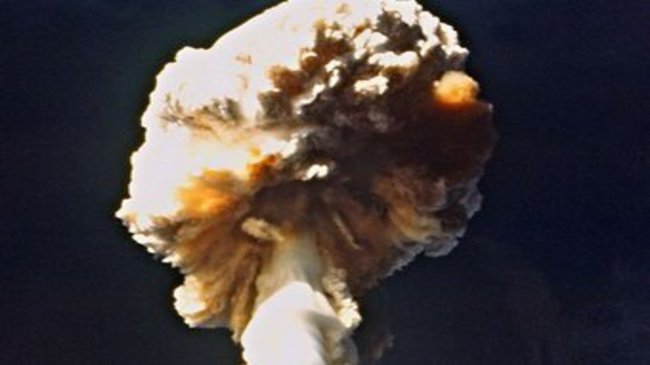
Thousands of veterans of Britain’s atomic and hydrogen bomb tests are to take the Ministry of Defence (MoD) to the European Court of Human Rights, accusing it of exposing them to radiation.
Over 1,000 victims of UK’s nuclear tests, which were carried out in the South Pacific in the 1950s, will ask Europe to intervene, as the British premier David Cameron ignores the terms of the Military Covenant and courts ban hearings into their cases.
Servicemen, who were ordered to witness nuclear bomb tests in the South Pacific, have since suffered cancers and rare medical conditions, with their children suffering from leukemia and birth defects.
Describing the news as “brilliant,” widow Shirley Denson, whose RAF ace husband was ordered to fly through mushroom clouds at Christmas Island in 1958, said, “This is one of our final chances to appeal for the right to present our case.”
“We have tried for 30 years to be heard, and every time the MoD has denied there is anything wrong with us. Now we have vital scientific evidence, and they say we have left it too late,” she added.
Earlier on May, Britain’s former Prime Minister Gordon Brown also criticized the MoD for trying to evade its responsibility for cleaning up the radioactive waste contamination from old military bases and factories.
According to a survey conducted by the Department of Energy and Climate Change (Decc), the number of contaminated sites across England and Wales was far higher than previously estimated.
Related articles
- Nuclear waste ‘may be blighting 1,000 UK sites’ (kractivist.wordpress.com)
- Mustard gas scare hits Scottish RAF base (guardian.co.uk)
Russian warships not heading for Syria
TREND | June 16, 2012
A number of warships of the Russian Black Sea Fleet are prepared to go to Syria, a source in the Russian General Staff told Itar-Tass news agency on Friday.
“The Mediterranean Sea is a zone of the Black Sea Fleet responsibility. Hence, warships may go there in the case it is necessary to protect the Russian logistics base in Tartous, Syria,” it said.
According to the source, “several warships of the Russian Black Sea Fleet, including large landing ships with marines aboard, are fully prepared to go on the voyage.”
However, it strongly denied U.S. media reports claiming that a Black Sea Fleet warship had already headed for Tartous. “All the ships are staying in Sevastopol but the Cesar Kunikov large landing ship. Either the U.S. intelligence service works poorly or they have a poor knowledge of geography,” it said.
The Cesar Kunikov large landing ship of the Russian Black Sea Fleet, which is returning from Italian Messina to base, passed the Bosporus Strait on Friday. It will return to Sevastopol on Saturday, the source said.
The U.S. media said that Russia had sent a small group of servicemen to Syria for protecting the Tartous base. NBC said with the reference to a U.S. official that the servicemen were going to Tartous aboard a warship. The State Department spokesperson said she could not confirm the NBC report.
A group of Russian warships led by the Admiral Kuznetsov heavy aircraft carrying cruiser visited Tartous in January. The group visited the port for replenishing reserves and giving maintenance to ship systems.
Tartous is the only Russian naval base outside of the former Soviet territory – this is the logistics center serving Russian ships on missions in the Mediterranean Sea. The base opened in 1971 under an agreement with the Syrian government.
Related articles
- Russia denies Syria-bound warship reports (panarmenian.net)
Muslim Brotherhood rejects dissolution of Egyptian parliament
Press TV – June 16, 2012
The Muslim Brotherhood has rejected the military’s decision to dissolve the Egyptian parliament and has demanded that a referendum be held on the issue.
The Muslim Brotherhood, which secured the biggest bloc of seats in two rounds of parliamentary elections in December 2011 and January 2012, issued a statement on Saturday saying “dangerous days” were ahead and the political gains of the revolution that toppled former dictator Hosni Mubarak on February 11, 2011 could be wiped out.
The parliament should only be dissolved by a popular referendum, and the order to dissolve the assembly “represents a coup against the whole democratic process,” the statement added.
The Freedom and Justice Party (FJP) — the political wing of the Muslim Brotherhood — said in another statement that the decision showed the military council’s desire to “take possession of all powers despite the will of the people.”
Egypt’s ruling military council formally announced the dissolution of the parliament on Saturday following a Supreme Court ruling earlier in the week.
Some critics have compared the move to the beginning of Algeria’s civil war in 1992, when the army cancelled an election an Islamic party was winning.
Egyptians are casting their ballots in a two-day presidential runoff election that began on Saturday and runs until Sunday which pits the candidate of the Muslim Brotherhood’s Freedom and Justice Party, Mohammed Morsi, against former Prime Minister Ahmad Shafiq.
More than 50 million people are eligible to vote.
Early results of expatriates’ votes show Morsi has won 78 percent.
The ruling Supreme Council of the Armed Forces (SCAF) has vowed to hand over power to the winner of the election by July 1.
Many Egyptians fear that Shafiq is the undeclared candidate of the junta and that the military-appointed election committee overseeing the election will rig the vote in favor of Shafiq.
Angry Egyptian protesters have held many demonstrations across the country in which they urged the authorities to ban all remnants of the Mubarak regime from running as candidates in elections.
Russian Shipping Company Denies Arms Deliveries to Syria
RIA Novosti | June 16, 2012
Russia’s Universal Cargo Logistics Holding (UCL Holding), owned by billionaire Vladimir Lisin, dismissed on Saturday media reports claiming that the company’s vessel had shipped weapons to violence-hit Syria, UCL Holding said.
“It was a general cargo of non-military purpose featuring electrical equipment and repair parts (rotor blades) in containers and wooden crates,” the company said in a statement, calling the reports “absurd speculations.”
The UCL Holding’s statement comes after several Russian and Western media as well as a U.S.-based advocacy group, Human Rights First, reported in late May that the Russian-flagged bulk cargo vessel Professor Katsman, operated by Lisin’s shipping company, docked at the Syrian port of Tartus on May 26, allegedly carrying weapons for the President Bashar Al-Assad’s forces.
Soon after the reports the U.S. Secretary of State Hillary Clinton and the U.S. Ambassador to the United Nations Susan Rice have lashed out at Russia over its alleged arms supplies to Syria. Moscow strongly rejected the claims, saying that Russia was not “delivering to Syria, or anywhere else, items that could be used against peaceful demonstrators.”
Foreign Minister Sergei Lavrov said on Wednesday that Moscow was “completing right now the implementation of military contracts that were signed and paid for a long time ago.”
All the contracts feature anti-aircraft defense, Lavrov said.
“We feel really upset when some politicians use inaccurate and unverified information. As a result, a well-respected people support statements which are based not on pure facts, but on gossips and their own stereotypical notions from the times of “Cold War,” UCL Holding said.
Syria is one of Russia’s major weapons clients, and Moscow has opposed a proposal for a UN arms embargo on Damascus.
Russia has supplied Syria with Bastion coastal missile systems with Yakhont cruise missiles and Buk surface-to-air missile systems under a contract signed in 2007.
Related articles
- Russia Rejects U.S. Allegations on Arms Deliveries to Syria (alethonews.wordpress.com)
The DEA and the Massacre in the Moskitia
By GREG McCLAIN | CounterPunch | June 15, 2012
The US is once again hell bent on establishing death squads in its militarization of Central America. This is a stark reminder of the 1980s when Ronald Reagan and Ollie North were funding the contras with drug money, but now it is reinforced with lessons learned in terrorizing the people of Iraq and Afghanistan through night raids and counterinsurgency tactics. Another tactic that the current US administration has reinvigorated comes from the “War on Drugs” playbook of past administrations: by using the DEA as a front for creating and sustaining havoc, it can attempt to justify the military buildup and control the policies of the host country while manipulating the flow of drugs, all the while appeasing the tax payers back home and the folks in the host country who see the build up as necessary. Not abating by any measure the flow of narcotics into the U.S., the so-called ‘War on Drugs’ has actually increased the narcotics industry in Central America and provided a bogus rationale for the increased militarization of yet another Latin American county; this time Honduras.
On May 11th on the Rio Patuca near Ahuas, a small municipality in the Moskitia, a helicopter titled to the US State Department sprayed bullets into a pipante, a long, narrow dugout canoe, which carried sixteen locals. Four people were killed: 28-year-old Juana Jackson (six months pregnant), 48-year-old Candelaria Pratt Nelson (five months pregnant), 14-year-old Hasked Brooks Wood, and 21-year-old Emerson Martínez Henríquez. At least four more were seriously injured. The DEA confirms that its Foreign-deployed Advisory Support Team (FAST) participated in the operation supporting a Honduran National Police Tactical Response Team.
I first heard of the tragedy while in the process of preparing for a human rights delegation to Honduras coordinated by the Alliance for Global Justice and led by Karen Spring from Rights Action. The New York Times, the Washington Post and the Associated Press have all published stories glorifying the role of the DEA in seizing a huge quantity of drugs in the incident. They not only down played the killing and injuring of innocent people (some reports even questioned if there even were casualties), but also some of the news reports stated that those shot were actually involved in drug trafficking. In typical mainstream media fashion there was over-the-top anonymous quoting of US and Honduran officials and not much fact checking.
I arrived in Honduras on May 18th for the delegation. The original itinerary focused on the struggles of the campesinas and campesinos of the Aguan Valley and their fight to win back the land stolen from them by the oligarchs with the backing of the illegitimate post-coup government of Pepe Lobo. As important as the land rights struggle is to us, it did not take long for the delegation (made up of academics, human rights and labor activists, Canadian and U.S. citizens, several with extensive experience in Honduras) to agree that the massacre in the Moskitia was of a greater urgency especially in light of the contradictory reports coming from the US State Department and the DEA.
We spent our time in Ahuas talking to the survivors of the incident and families of those slaughtered by the US supplied M-60 bullets. We also spoke to several village leaders, the Mayor of Ahuas, and to many locals in order to piece together as best we could the incident and the aftermath. What we got was a startling look into how our government conducts its military adventurism and then obfuscates in order to cover up its crimes. We also witnessed the increased militarization of the region as platoons of masked Honduran soldiers, automatic weapons slung across their chests, patrolled up and down the muddied streets of Ahuas. An older commanding officer, whose Velcro name and rank patches were blank, stated that they would be there “for as long as necessary,” another chilling echo from the Iraq/Afghanistan quagmires.
Getting to Ahuas is no easy feat. We took a small plane from La Ceiba, closer to the Western end of the Caribbean coast of Honduras, to Puerto Lempira, which is on the Laguna Catrasco in the Moskitia on the Eastern side of the country near the Nicaraguan border. Once in Puerto Lempira we hired a small lancha, a motorboat with a capacity of about 15 people, to take us across the Lagunas. It was approximately an hour and a half in the scorching midday sun before we reached the port. Once there, we loaded into a giant pickup truck fastened with wooden planks for seating, which are placed across the truck bed, for the thirty-minute bumpy ride into Ahuas.
After our boat ride across the Laguna and through the rivers, which act as highways for the local people, it became clear to us what one of the survivors had been quoted as saying in the press, and that we were later to hear first hand. The reason that the pipante had been on the river at 2 AM was because they waited until the sun had set to take the boat home in order to avoid the mid-day heat. This is significant in light of the statement by the Honduran foreign minister, Arturo Corrales. He was quoted in the New York Times (05/18/12) as saying “it was totally dark, in a place that is not a fishing spot.” He added, “It’s in the jungle. It is very hard to believe that at 2 a.m., in the jungle, the people in a boat that is beside another boat with 400 kilograms of cocaine were fishing,” the implication being that they, the victims, were drug smugglers.
The ill-fated pipante had disembarked way downstream at the mouth of the river where it runs into the Caribbean, fighting against the current in order to get to Ahuas. Those that we interviewed said that they had been on the river for 8 hours. The owners of the boat had dropped off lobstermen at the opening of the Caribbean earlier in the day and waited for the sun to begin to set before heading back to Ahuas. This is a routine that they have been undertaking daily for 25 years. As they returned, heading into the current, they picked up other passengers along the way, some heading home and some heading toward jobs or to visit relatives. Many of them slept during the journey only to be awakened by the sounds of gunfire and the burning feeling of having M-60 rounds rip through their bodies.
The details of what exactly prompted the occupants of the helicopters to fire on the pipante are murky at best. The reports from the State Dept. and the DEA have not been consistent and leave out many details, which calls into question their depiction of the events of that night. While witness and victim testimonies have been consistent, the U.S. government versions are shrouded in a haze of information that cannot be divulged, parsed statements that are obviously leading, and “facts” that do not shed light on the operation and the role of U.S. government agents in it. COFADEH (Committee of Families of the Detained and Disappeared), a Honduran human rights group, put it most succinctly in a press release days after the incident, “To keep an act of terror covered up in the midst of media confusion was always a strategy of psychological warfare, a special chapter of state terrorism. We should not accept this.” Audio recordings of communications from the helicopters that evening or surveillance video, if it exists, could potentially clarify many of these issues. The release of such recordings is something that the delegation would like to see Congress demand in any congressional investigation that it conducts. Until such data surfaces, we will never know the true motivation of those in the helicopters who pulled the trigger nor what they were truly doing on the Rio Patuca.
The events of the immediate aftermath became clearer once our delegation took the time to interview numerous witnesses to the shooting and those who rushed to the river upon hearing that loved ones had been shot at. We spoke to Hilda Rosa Lezama Kenreth, 53, laid up in the Ahuas hospital, an underfunded facility run by an evangelical church. She stated that as the shots were being fired from the helicopter she felt a pain across both of her thighs. A bullet had ripped through her left leg and cut across her right leaving huge gaping wounds. She instinctively jumped from the pipante and swam as best she could for cover in the reeds that hugged the bank of the river. She stayed there clinging to the reeds for at least two hours while going in and out of consciousness waiting for help.
Hilda’s son and daughter, Hilder and Elmina, who had been in town when they heard of the shooting, and were awaiting family members to arrive, rushed to the landing, a small sandy area where pipantes and other riverboats were moored. When they got there a helicopter was landing on an open area near were the boats were moored. Before Hilder could begin to search for his mother and brother-in-law he was approached by what he described as three large white men in uniforms who spoke to each other in English. The soldiers ordered him, in broken Spanish, to sit down while pointing guns at his and his sister’s head and chest. They asked him where gasoline was stored. He told them that there was a building nearby that had gas for the boats. They ordered him at gunpoint to take them there often hitting him in the back of the head causing him to fall. When they arrived, the tall white soldiers kicked in the door of the building and stole two 18-gallon barrels of gas. They returned to the landing and ordered Hilder to fill a boat motor with the gas. He did so and then was ordered to get in the boat. They went down river to where the massacre had occurred and Hilder saw a boat with two more tall white soldiers sitting in it. Once they got along side this boat he was further ordered to move bags from it to the boat they had arrived in. He stated that the soldiers told him in broken Spanish to “move the drugs.” Once he was finished he and the five soldiers returned to the landing with the drugs. The soldiers then moved the bags from the boat to the helicopter, not allowing Hilder to look for his mother and brother-in-law. Instead, they hit him again and handcuffed him with plastic zip ties and forced him sit until they left. Once they were gone, another villager cut the ties from his hand. He found the body of his brother-in-law and loaded it onto a boat. He then searched for his mother and was able to find Hilda in the water semi-conscious, but alive several hours after he had gotten there and was detained by the soldiers.
Another survivor, Clara Wood Rivas watched as bullets shattered her fourteen-year-old son Hasked’s skull. As she described the tragedy, she lifted her arm in the air to show the downward trajectory of the bullets, motioning her hand toward the top of her own head and passing it downward mimicking the bullets exiting Hasked’s chin. She stated that he had been shot so many times that she couldn’t recognize his face. Her son slumped over and fell into the water. Ms Wood jumped in to avoid the rain of bullets. Unable to find her son, she swam to shore. When she made it to the landing, “tall gringos” who did not speak Spanish pointed guns at her. She saw her nephew, who had come to the landing to meet her, handcuffed with zip ties and also being held at gunpoint. Through tears she told us, “I thought they were going to kill me. I passed through a war there. I’m blessed to be alive. I’ll never see my son again!”
Traveling with Clara and Hasked was Walter Wilmer, also aged 14. We were unable to meet with him in the hospital in La Ceiba. According to the preliminary report put out by COFADEH, at the time when the bullets began riddling the pipante Wilmer was asleep. He awoke to sounds of screams and blasts of gunfire. He managed to escape the boat unharmed, but the helicopter gunners aimed at him in the water, destroying his left hand. Wilmer managed to swim using only his right until he reached the bank of the river. He could still see the helicopters hovering over the river so he ran through the darkness making it to the hospital in Ahuas. He was later transferred, at great expense to his family, to the hospital in La Ceiba, but it was too late to save his hand.
Members of our delegation were able to meet with Lucio Adnan Nelson, 22, in the hospital at La Ceiba. He had been shot in the back and in his right elbow where he still has bullet fragments. Under sedation he was able to speak to us, but only briefly. Lucio jumped from the boat when it was fired upon. He felt a burning pain in his back as he clung onto a tree branch sticking out of the river. He managed to swim to shore using one hand and ran through the woods until someone found him and helped him to the hospital. Lucio’s father stated that they had to sell some of their livestock in order to pay for the transportation to La Ceiba hospital. He also stated that if his son doesn’t recover fully, which he most likely won’t, he fears that Lucio’s only option in life is to become a beggar in the street.
The AP and the New York Times have revised their reports many times since the incident. The AP in particular has given a clearer picture of the events, but the overarching bent is still on the justification of the DEA and Honduran military’s presence in the Moskitia. They continue to imply that it was simply a tragic mistake in identity, an example of collateral damage in the War on Drugs. I spoke with a Honduran lawyer who represents the interests of the people of the Moskitia. He stated that there have been several reports of US and Honduran military drug interdiction in that region. The common link to these reports is that in all of them the narcotraffickers have gotten away, but the military have seized the drugs. This raises serious questions, not just to the efficacy of the military in drug interdiction, but indeed, what truly is the US and Honduran militaries’ role in the trafficking. In the wake of the DEA’s implication in drug trafficking as related to Plan Colombia and Plan Mexico, as well as the nefarious scheme of the ATF in supplying arms to drug lords in Mexico, plus the rampant corruption of the Honduran military and police and their interrelationship to narcotraffickers, the questions linger as to the true motivations of the US military/DEA presence in Honduras.
The US’s military motivations come under sharper scrutiny when the issue of recently discovered oil reserves in the Moskitia region are brought to light. Texas based Honduras Tejas Oil and Gas Company, which is pursuing an oil and gas concession in La Moskitia, estimate that there are six to eight billion barrels of oil reserves there. Honduras Tejas has lobbying ties to Tea Party nut job Rep. Louis Ghomert (R. TX), who introduced legislation on their behalf, HR 532 (110th): Recognizing the energy and economic partnership between the United States and Honduras. Its ties to the Honduran government as well as the US State Department need to be further investigated.
Many people we spoke with, including representatives of indigenous organizations, are deeply concerned that militarization and violence generated by the “drug war” are negatively impacting their communities and are focused where there are significant natural resources, rivers with hydroelectric potential, petroleum, gold, and forests with many of these natural resources being privatized.
In light of what our delegation observed on our visit and the concerns raised, we demand:
- That the U.S Congress investigate and hold hearings about the U.S. role in the events of May 11, 2012 in La Moskitia.
- That serious and independent investigations take place exploring the role and responsibility of agents of the U.S. government in the May 11 massacre in Ahuas, be they DEA agents, private security contractors under the direction or contracted by agencies of the U.S. government or other security forces. This investigation should include identifying criminal responsibility of specific individuals.
- That the rights and decisions of indigenous communities and popular movements be respected rather than treated as drug traffickers and insurgents with complete disregard to fundamental human rights.
- That the U.S. government speak out publicly against the presence of individuals widely known to have involvement in drug trafficking and death squads within the Honduran justice system today.
- That in light of the abuses we documented, the U.S. government must withdraw all U.S. security forces including DEA and private contractors from Honduras, cease military assistance and training, and stop promoting re-militarization in Central America.
On June 6th the State Dept. was asked to provide an update on the DEA agent investigation in Honduras and on what is being done to assist the victims?
Their answer:
“DEA’s internal investigation is ongoing and should be completed in the next few weeks and we refer you to the Department of Justice for further information. A Honduran special task force conducted an initial investigation and we understand their preliminary conclusion is that the Honduran security forces were justified in firing in self-defense. The Honduran Government referred the investigation to their Attorney General’s office. The U.S. government is working closely with the Government of Honduras and offered transportation for investigators and additional assistance.
All Honduran citizens are eligible to receive care through the Honduran public health system.”
After four weeks of inadequate care in Honduran hospitals where horror stories are common, such as the lack of sutures for routine stitching procedures let alone for major surgery, The International Red Cross and UNICEF have agreed to intervene and pay for the surgeries of Walter Wilmer and Lucio Nelson at La Ceiba Hospital. Meanwhile, the other survivors are left in the care of an inefficient underfunded healthcare system, while the family members of the deceased have not even received so much as an official apology from U.S. or Honduran government officials.
With the ever escalating US military presence in Honduras, we can expect the events described above to become commonplace, just as the horror stories that have come out of Iraq and Afghanistan are never ending. Can drone attacks be far behind?
Greg McClain was a member of the Human Rights Delegation to Ahuas, La Moskitia, Honduras.
Related articles
- Uniformed US soldiers involved in killing of six Honduran civilians (alethonews.wordpress.com)
- DEA Agents Helped Kill Two Pregnant Women in Honduras Last Week (reason.com)
Featured Video

Liberty Cannot Exist Inside a Panopticon
or go to
Aletho News Archives – Video-Images
From the Archives
Left-leaning despisers of 9/11 Truth movement: Do you really believe in miracles?
David Ray Griffin | Global Research | 06 Jul 2010
An Open Letter to Terry Allen, Noam Chomsky, Alexander Cockburn, David Corn, Chris Hayes, George Monbiot, Matthew Rothschild, and Matt Taibbi.
[1]According to several left-leaning critics of the 9/11 Truth Movement, some of its central claims, especially about the destruction of the World Trade Center, show its members to be scientifically challenged. In the opinion of some of these critics, moreover, claims made by members of this movement are sometimes unscientific in the strongest possible sense, implying an acceptance of magic and miracles. … Full article
Blog Roll
 Aletho News
- EU sending ‘biased’ observers to interfere in Serbian election – president
- White House envoy declares kinetic action against Yemen ‘fruitless’
- Ukraine deployed thousands of microdrones in Iraqi Kurdistan: Tasnim
- Iran calls for emergency UNSC meeting over Trump’s ‘brazen’ bomb talk, Israeli threats
- Iranian sources reveal details of Russia-China Hormuz proposal
- Plan for more US-Israel integration puts our military tech at risk
- Another Round Against Iran Will Break What Is Left of the Gulf
- SVR Report on Ukraine’s Mexican Drug Gang Links Could Pressure Zelensky, Won’t Change US Policy
- British Government Employees Were Fact-Checking the News at the BBC. Nobody Told You.
- Albania on fire: who’s behind the riots?
- If Americans Knew
- Mysterious bot accounts reportedly spread fake ‘man on the street’ videos for Michigan Senate candidate
- Israeli Defense Minister Katz Says Over 60 Lebanon Villages Have Been Destroyed
- Why Is Israel Running TV Ads in Iowa Ahead of the Midterms?
- Hind Rajab’s Alleged Killer Is in the United States. HRF Demands His Arrest.
- US Officials Face Fresh Pressure After Another American ‘Brutalized’ by Israeli Settlers in West Bank
- Israel-Backed Palestinian Militias Terrorize Displaced Families in Gaza
- FBI subpoenas pro-Palestine activists over Israeli weapons plant disruption
- Fourth winter arrives in wartorn Gaza, too early – Daily Update
- More on how Bari Weiss is using CBS on behalf of Israel
- What the UK Is Doing to Pro-Palestine Novelist Sally Rooney Is an Act of Orwellian Villainy
- No Tricks Zone
- Predictions Made By Renowned Climate Proifessor Over Past Decades Have Been Proven To Be Poor
- New Study Suggests Large Regions Of The Pacific Ocean Have Been Cooling For The Last 80 Years
- Germany’s Green Energy Debacle: High Energy Costs Force Kahla Porzellan to Close After 182 Years!
- New Study: 50 Years Of The Most Aggressive ‘Net Zero’ Policies Can Only Affect The Global Climate By 0.03°C
- US September “Heat” Was No Record…Many Records Set Decades Ago
- Latest European Green Energy Debacle; Portugal’s Largest Flagship Solar Park Insolvent!
- Green Energy Debacle: German Expert Professor Fritz Vahrenholt Warns Of Severe Economic And Social Consequences
- Two More Paleo Reconstructions Affirm Meters-Higher Sea Levels Across Ireland, Brazil 7000-6000 Years Ago
- New Study: Earth And Venus Surface Warmth Largely Explained By Convection And Lapse Rate, Not CO2 Or Radiation
- 2025 Nature Paper Claiming Worsening Global Drought Gets RETRACTED …Heavily Flawed

