The ACLU and Obama’s Assassination Program
By Binoy Kampmark | Dissident Voice | April 2, 2012
Due process and judicial process are not one and the same. The Founders weren’t picky. Trial by jury, trial by fire, rock-paper-scissors – who cares?
— Stephen Colbert, March 6, 2012
The policies around the assassination program of the United States are surreal.
Trafficking in murder while espousing noble things is a habit regimes fall into, though the more sinister ones tend to use weasel words to conceal that fact. The Obama administration, having long abandoned its role as the knight in shining armour, is now rusting away with the effects of realpolitik.
The ACLU has been trying through Freedom of Information channels to force a disclosure of the guidelines the administration uses in targeting foreign nationals or American citizens through the infamous drone program that has become de rigueur in military circles. The CIA has insisted that it cannot confirm or deny the existence or non-existence of those records that cover the targeting of individuals, or whether it is even employing such vehicles in the first place. They are “intelligence sources and methods information that is protected from disclosure by section 6 of the CIA Act of 1949, as amended”. In such circles, the response is termed the Glomar response, after the CIA’s refusal in 1976 to confirm or deny its relationship with Glomar Explorer, a drill ship created at the direction of Howard Hughes for the agency to recover the sunken Soviet submarine, the K-129.
In the words of Jameel Jaffer of the ACLU, as reported by Salon (March 26). “At this point, the only consequence of pretending that it’s a secret program is that the courts don’t play a role in overseeing it.” With the courts left out in the cold, the administration can run riot. This, of course, is its self-appointed prerogative.
The Obama administration is engaging in a lexical game of murder, a game that has certainly silenced many of those who would have expressed outrage at the assortment of abuses perpetrated by the Bush administration. Tinker with the words, and the result is considered perfectly justifiable in the name of a higher state interest. This is Cheney with the gloss, Rumsfeld with the polish. Adjust the terms of reference, and assassination is an entirely rum thing.
Obama’s front man in this entire business, in true tasteless fashion, is Eric Holder. Instead of defending the law as is the incumbent duty of any Attorney General, he has a nasty tendency to get sick on it. He brings in his broom to clean up, and in its place he leaves the slime of gibberish. At Northwestern University Law School, he clearly repudiated the position he had taken regarding the Bush administration, whose policies in the ‘war on terror’ had occasioned ‘needlessly abusive and unlawful practices’. That, however, was in 2008. The new Holder was a different beast, more prone to splitting hairs. ‘Due process’ and ‘judicial process’, we are made to realise, ‘are not one and the same’. The President, according to Holder, is not required to seek permission from any court before targeting American citizens abroad (Washington Times, March 12).
Supposedly, the targeting of such individuals is constrained by guidelines. The problem with such dangerous talk is that guidelines are merely points on paper, the scrawl of the moment. They have a tendency of disappearing as quickly as they appear. These guidelines tend to revolve around the nature of the target (an operative of a terrorist group seeking to actively kill American citizens, for one; that the target poses an imminent threat to the US; that the capture of the target is impractical; and that the target is to be eliminated on the basis of ‘relevant law of war principles’ (Washington Times, March 12). Such determinations do not lie in the legal domain. They are rather matters of political expediency.
An administration up to its eyeballs with legal rhetoric is bound to eventually be told it has no clothes, that its efforts are simply acts of distortion. The time it seems, courtesy of the ACLU’s efforts, is now.
Binoy Kampmark was a Commonwealth Scholar at Selwyn College, Cambridge. He lectures at RMIT University, Melbourne. He can be reached at bkampmark@gmail.com
Related articles
- Demolishing Due Process (alethonews.wordpress.com)
- U.S. drones targeting rescuers and mourners (salon.com)
Reuters fails to rectify manipulated report on female Iranian ninjas
Press TV – April 2, 2012
Reuters has failed to provide its viewers with a solid explanation on the publication of a manipulated report by the London-based news agency on female Iranian ninjas.
On February 18, Reuters showed a number of Iranian girls practicing martial arts in a city near Tehran, claiming Iran was training more than 3,000 female ninjas to kill any possible foreign invaders.
The report claimed that the athletes are undercover assassins in the service of the Islamic Republic.
Following Press TV’s contact with the Tehran office of the British news agency, Reuters posted an advisory with some corrections on February 26 but refused to apologize for slander.
Editor-in-chief Stephen J. Adler said that the error “was promptly corrected the same day it came to our attention,” but failed to mention the eight-day interval between the first publication of the story and the posting of the advisory with minor corrections.
During the eight-day interval, the distorted Reuters report was picked up by other British media outlets, thus adding to the damage already caused by the misleading report.
The advisory was posted in Reuters Video Point, which is an accompanying website for Reuters broadcast video service.
The athletes have condemned the report, saying the misleading report can definitely be a problem to their professional sport career.
“It can harm our chances to travel to other countries to take part in global tournaments and international championships because Reuters is considered by many to be a reliable source,” Raheleh Davoudzadeh said.
Akbar Faraji, who established Ninjutsu in Iran over 22 years ago, condemned the British media accusations, saying his students will pursue their legal action against Reuters to the end.
“We have filed a defamation lawsuit against Reuters and we intend to pursue it as far as necessary because it is a matter of reputation,” he said.
~
See also:
Destabilizing Arsenals Concealed in US Embassies
By Nil NIKANDROV | Strategic Culture Foundation | 02.04.2012
Over the past years, it has been happening with frightening regularity that U.S. diplomats and CIA agents were caught pulling off operations involving illicit weapons supply in Latin America. The inescapable impression is that the U.S. Department of State has irreversibly learned to regard the Vienna Convention and various national legislation as rules which it has unlimited freedom to overstep.
Pressing for unchallenged hegemony in the Western Hemisphere, Washington keeps the populist regimes in Latin America under permanent pressure. Outwardly, the U.S. Administration pledges not to resort to military force to displace the ALBA governments in Venezuela, Ecuador, Bolivia, Nicaragua, or Cuba, but in reality Washington’s efforts to undermine them are a constant background of the continent’s political picture. The activity began under president G. Bush and shows no signs of subsiding under president Obama. Supposedly, plans are being devised in the White House that a series of color revolutions will erupt across Latin America in 2013-2014 and derail the continent’s advancement towards tighter integration in security and other spheres. As the fresh experience of Libya showed with utmost clarity, Washington’s new brand of color revolutions will – in contrast to the former coups which used to be accompanied with outpourings of pacifist rhetoric – involve ferocious fighting and massive fatalities figures.
The above should explain why U.S. embassies in Latin America increasingly often become epicenters of political scandals related to illicit weapons supplies. In a recent incident in Bolivia, the country’s mobile patrol service (Umopar) intercepted in Trinidad, the capital of the department of Beni, a vehicle owned by the U.S. diplomatic mission and driven by two Bolivian nationals – chief of U.S. Embassy security Maj. Costas and Sgt. Garcia, a driver – which was found to be heading for the capital of Santa Cruz province with three shotguns, a 38-caliber revolver, and a load of ammunition. Bolivian Interior Minister Carlos Romero announced shortly thereafter that the U.S. embassy had not requested a permit for transporting weapons and, therefore, acted illegally and put Bolivia’s National Security in jeopardy. It remained unknown who was going to secretly receive the weapons seized in the district located hundreds of kilometers away from La Paz.
The Bolivian administration has serious reasons to be on the alert – slightly over a year ago, Ecuador’s police which had been armed, funded, and otherwise courted by the U.S. embassy, used to launch missions directed by U.S. advisers – and gradually evolved to think of the national administration’s control as purely nominal – organized a mutiny and, as the plot unraveled, president Rafael Correa narrowly escaped an assassination attempt. An investigation that followed when law and order were restored in Ecuador failed to clarify the origin of the sniper rifles used to fire on the president, which likely means that the CIA professionals left no trace of their involvement in the coup.
The US embassy in La Paz reacted to the Trinidad incident by releasing a statement to the effect that the Beni police had actually been notified about the supply of firearms to Santa Cruz and that the plan had been to pass them to Bolivian nationals employed as guards by US institutions. Minister Romero was as a result forced to reiterate that no license had been issued on the occasion and said that a probe would be opened into how the firearms and ammunition had crossed the Bolivian border.
For anyone familiar with the scope of the activity of the US intelligence community in Bolivia, the context of minister Romero’s invectives is not hard to grasp. A shocking episode took place in Santa Cruz, a city with a reputation of a hotbed of separatism, in April, 2009 – back then, Bolivian special forces raided the Las Americas hotel and mowed down a group of terrorists who had arrived to the country from Western Europe with the goals of fueling armed resistance to the populist regime and assassinating president Evo Morales. It transpired that the uninvited visitors had a record of fighting against the Serbs in the Balkan region, where the bunch of militants had formed strong links with Western intelligence services. The Bolivian counter-espionage agency’s investigation into various aspects of the case of the group’s leader Eduardo Rózsa-Flores – particularly the part of the probe meant to shed light on the channels through which firearms, grenades, explosives and ammunition had been smuggled into the country – is still underway. In a rather predictable development, a number of individuals who had assisted Rózsa-Flores, including Human Rights Foundation representative Hugo Acha (a.k.a Superman) – fled to the U.S. The Bolivian security service got a hold of e-mail exchanges between Rózsa-Flores and Belovays, a U.S. national and, reportedly, a career CIA officer whose profile also features a stay in the Balkans.
The U.S. van with firearms on board ended up in the hands of the Bolivian police a month after the U.S. and Bolivian administrations penned a deal normalizing the diplomatic relations between the two countries and exchanged ambassadors. The lesson that Morales has to relearn under the circumstances is that – shifts in diplomacy notwithstanding – the staff of the U.S. embassy in Bolivia has no intention to stop playing its totally unfair game.
There’s hardly a country in Latin America where U.S. agents have not been spotted trafficking firearms. A U.S. national was taken in custody last April in the proximity of the Ezeiza airport in Buenos Aires for carrying three rifles, two of them with telescopic sights, in a vehicle with a diplomatic license plate. The U.S. embassy somehow explained away the incident with a reference to an unspecified emergency (no doubt, getting away with a similar offense so easily would have been out of question in the U.S.), and the perpetrator, a U.S. embassy contractor, in his own description, immediately hopped on a plane to the U.S. Argentina’s police were keenly interested in the man’s “hunting” trips to the regions of the country bordering Bolivia and Chile, considering that Argentinian laws strictly prohibit the conduct of intelligence operations, including those against drug trafficking, by foreign agents.
Speaking of Argentina, the loudest story played out about a year ago when boxes containing undeclared firearms, reconnaissance equipment, and narcotic substances were discovered aboard a U.S. Air Force Boeing in the Ezeiza airport. The U.S. mischief was impossible to deny, but, as in the majority of cases, the U.S. easily solved the problem, this time by asserting that all of the above was necessary to train Argentinian police.
It is a recurrent theme in the media that sizable arsenals are stored in U.S. embassies across Latin America. These days, given that the ostensibly anti-terror war has been raging globally for over a decade, nobody is taken aback when this type of information surfaces. The perceived risks are pervasive, be it Mexico, Central America, Columbia, Brazil, or even Uruguay, and alarmist forecasts evidently proliferate. That must be the reason why, in just about every Latin American country, the U.S. embassies increasingly resemble military bases, with reinforced concrete walls, tiny windows, and underground shelters.
Related articles
AL QAEDA AND HUMAN CONSCIOUSNESS: Al Qaeda, Al Qaeda…. An Incessant and Repetitive Public Discourse
Part I
By Professor Michel Chossudovsky | Global Research | March 24, 2012
There is something disturbing in the nature of post 9/11 public discourse. Incessantly, on a daily basis, Al Qaeda is referred to by the Western media, government officials, members of the US Congress, Wall Street analysts, etc. as an underlying cause of numerous World events. Occurrences of a significant political, social or strategic nature –including the US presidential elections campaign– are routinely categorized by referring to Al Qaeda, the alleged architect of the September 11 2001 attacks.
What is striking is the extent of media coverage of “Al Qaeda related events”, not to mention the mountains of op eds and authoritative “analysis” pertaining to “terror events” in different part of the World.
Routine mention of Al Qaeda “fanatics”, “jihadists”, etc. has become –from a news standpoint– trendy and fashionable. A Worldwide ritual of authoritative media reporting has unfolded. At the time of writing (March 24, 2012), “Al Qaeda events” had 183 million entries on Google and 18,200 news entries.
A panoply of Al Qaeda related events and circumstances is presented to public opinion on a daily basis. These include terrorist threats, warnings and attacks, police investigations, insurgencies and counter-insurgencies, country-level regime change, social conflict, sectarian violence, racism, religious divisions, Islamic thought, Western values, etc.
In turn, Al Qaeda – War on Terrorism rhetoric permeates political discourse at all levels of government, including bipartisan debate on Capitol Hill, in committees of the House and the Senate, at the British House of Commons, and, lest we forget, at the United Nations Security Council.
All of these complex Al Qaeda related occurrences are explained –by politicians, the corporate media, Hollywood and the Washington think tanks under a single blanket “bad guys” heading, in which Al Qaeda is casually and repeatedly pinpointed as “the cause” of numerous terror events around the World.
Human Consciousness: Al Qaeda and the Human Mindset
How does the daily bombardment of Al Qaeda related concepts and images, funnelled into the Western news chain and on network TV, affect the human mindset?
Al Qaeda concepts, repeated ad nauseum have potentially traumatic impacts on the human mind and the ability of normal human beings to analyze and comprehend the “real outside World” of war, politics and the economic crisis.
What is at stake is human consciousness and comprehension based on concepts and facts.
With Al Qaeda, however, there are no verifiable “facts” and “concepts”, because Al Qaeda has evolved into a media mythology, a legend, an invented ideological construct, used as an unsubtle tool of media disinformation and war propaganda.
Al Qaeda constitutes a stylized, fake and almost folkloric abstraction of terrorism, which permeates the inner consciousness of millions of people around the World.
Reference to Al Qaeda has become a dogma, a belief, which most people espouse unconditionally.
Is this political indoctrination? Is it brain-washing? If so what is the underlying objective?
People’s capacity to independently analyse World events, as well as address causal relationships pertaining to politics and society, is significantly impaired. That is the objective!
The routine use of Al Qaeda to generate blanket explanations of complex political events is meant to create confusion. It prevents people from thinking.
The American Inquisition
The notion of Al Qaeda –“the outside enemy” which threatens Western civilization– is predicated on “an inquisitorial doctrine”. The Homeland Security State personifies what might be described as the “American Inquisition”.
As in the case of the Spanish Inquisition, the “Global War on Terrorism” (GWOT) consensus cannot be challenged.
Reference to Al Qaeda as a central paradigm used to understand the world we live in is ultimately intended to instil fear and insecurity. In the words of Britain’s comedy group Monty Python: “Nobody expects the Spanish Inquisition! Our chief weapon is surprise…surprise and fear…fear and surprise…. Our two weapons are fear and surprise…and ruthless efficiency…. Our three weapons are fear, surprise, and ruthless efficiency…and an almost fanatical devotion to the Pope….”
Unconditional submission to the Homeland Security State in today’s America is not dissimilar from the process of “fanatical devotion” prevailing under the Spanish feudal order. What is at stake in our contemporary World, in the words of Monty Python, is “fear and surprise” and the unconditional compliance to the “ruthless efficiency” of a dominant political, economic and military order.
The American Inquisition redefines the entire legal and judicial framework. Torture and political assassinations are no longer a covert activity as in the heyday of the CIA, removed from the public eye. They are “legal”, they are the object of extensive news coverage, they are sanctioned by the White House and the US Congress. Conversely, those who dare confront the “War on Terrorism” consensus are branded as “terrorists”. Upholding true justice by challenging America’s “holy crusade” against Al Qaeda becomes an outright criminal act.
A new threshold in US legal history has unfolded. High ranking officials within the State and the Military no longer need to camouflage their crimes. In fact, quite the opposite. Torture of Al Qaeda suspects is a public policy with a humanitarian mandate:
“Yes we did order torture, but it isn’t really torture, its not really war, because these people are terrorists and “we must fight evil”. And the way to uphold democracy and freedom is to “go after the bad guys”, “wage war on the terrorists”. “Its in the public interest.”
Moreover, anybody who questions our definition of “fighting evil” (which of course includes torture, political assassination and concentration camps directed against “the bad guys”) is by our definition also “evil” and can be arrested, tortured and sent to concentration camps. (Michel Chossudovsky, The Spanish Inquisition, Made in America, Global Research, 2004)
Al Qaeda is presented to public opinion as the terror instrument of “radical Islam”, which threatens the Homeland, undermining Western civilization and moral values. Everybody must comply; nobody dares to question “the American Inquisition”.
Al Qaeda and the “Big Lie”
The Al Qaeda Legend sustains the “Big Lie”. It turns realities upside down. It creates both a perception and a belief which cannot be questioned. It permeates US foreign policy and the conduct of international diplomacy. Al Qaeda and the “Global War on Terrorism” (GWOT) constitute a central component of US military doctrine.
“Al Qaeda did this”, “Al Qaeda did that” statements provide a simple and trouble-free elucidation of complex events, while disguising and concealing “the real reasons”, namely the unspoken and forbidden truth behind these events.
Nobody seems to take the time to examine “who is this elusive enemy Al Qaeda”, which has succeeded, with limited military means, in confronting America’s multi-billion dollar war machine.
The Al Qaeda blanket explanation not only overshadows the normal channels of human comprehension, it also precludes a move to the next step of rational explanation, which consists in saying: if Al Qaeda is “the cause” as stated in numerous press reports, then: “What is Al Qaeda?” and “Who is behind Al Qaeda?”
But these are questions which in the post 9/11 era are rarely addressed. To investigate “Who is behind the terrorists” has become unmentionable, a political taboo, despite evidence pertaining to the historical role of US intelligence in creating and promoting the Islamic jihad.
Today, if Al Qaeda were to be revealed for what it really is, –e.g in the context of a specific false flag terrorist attack– the legitimacy of the “war on terrorism” and those officials in high office who support it, would collapse like a deck of cards.
While the identity of Al Qaeda is fully documented, including its links to US intelligence, the truth has not trickled down to the mainstay of public opinion.

Ronald Reagan meets Afghan Mujahideen Commanders at the White House in 1985 (Reagan Archives)
Acknowledged by the CIA, the Islamic jihad “was” a US sponsored “intelligence asset” going back to the heyday of the Soviet-Afghan war (1979-1989).
The intelligence community admits, yes we created the Mujahideen, we set up the training camps and the Koranic schools together with Pakistan’s Inter Services Intelligence (ISI). Acting on behalf of the CIA, the ISI was involved in the recruitment, training and religious indoctrination of the “jihadists” described by President Ronald Reagan as “Freedom Fighters”.
From the outset of the Soviet-Afghan war in 1979 to the present, various Islamic fundamentalist organizations became de facto instruments of US intelligence and more generally of the US-NATO-Israel military alliance.
Unknown to the American public, the US spread the teachings of the Islamic jihad in textbooks “Made in America”, developed at the University of Nebraska:
… the United States spent millions of dollars to supply Afghan schoolchildren with textbooks filled with violent images and militant Islamic teachings, part of covert attempts to spur resistance to the Soviet occupation.
The primers, which were filled with talk of jihad and featured drawings of guns, bullets, soldiers and mines, have served since then as the Afghan school system’s core curriculum. Even the Taliban used the American-produced books,..
The White House defends the religious content, saying that Islamic principles permeate Afghan culture and that the books “are fully in compliance with U.S. law and policy.” Legal experts, however, question whether the books violate a constitutional ban on using tax dollars to promote religion.
… AID officials said in interviews that they left the Islamic materials intact because they feared Afghan educators would reject books lacking a strong dose of Muslim thought. The agency removed its logo and any mention of the U.S. government from the religious texts, AID spokeswoman Kathryn Stratos said.
“It’s not AID’s policy to support religious instruction,” Stratos said. “But we went ahead with this project because the primary purpose . . . is to educate children, which is predominantly a secular activity.”
… Published in the dominant Afghan languages of Dari and Pashtun, the textbooks were developed in the early 1980s under an AID grant to the University of Nebraska -Omaha and its Center for Afghanistan Studies. The agency spent $ 51 million on the university’s education programs in Afghanistan from 1984 to 1994.” (Washington Post, 23 March 2002)
The role of Western intelligence agencies in support of Al Qaeda affiliated organizations will be outlined in Part II
Kofi Annan: black skin, white masks
By Thierry Meyssan | Voltaire Network | March 30, 2012
Although Kofi Annan’s track record at the UN is an indisputable success in terms of management and efficiency, he has been sharply criticized for his political shortcomings. As Secretary General, he aspired to bring the Organization into line with the unipolar world and the globalization of U.S. hegemony. He called into question the ideological foundations of the UN and undermined its ability to prevent conflicts. Notwithstanding, he is today in charge of resolving the Syrian crisis.

© SANA
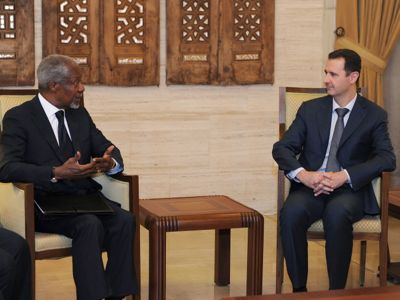
Former UN Secretary General and Nobel Peace Prize, Kofi Annan, has been designated by Ban Ki-moon and Nabil El Arabi as joint special envoy to negotiate a peaceful solution to the Syrian crisis. With Annan’s extraordinary experience and shiny brand image, his appointment was welcomed by all.
What does this top international official really represent? Who propelled him to the highest-ranking positions? What were his political choices, and what are his current commitments? These questions are met with a discreet silence, as if his previous functions were in themselves a guarantee of neutrality.
Handpicked and trained by the Ford Foundation and the CIA
His former colleagues praise him for his thoughtfulness, his intelligence and subtlety. A very charismatic personality, Kofi Annan left a strong imprint behind him because he did not behave simply as the “secretary” of the UN, but more like its “general,” by taking initiatives that revivified an organization that was mired in bureaucracy. All that is known and has been repeated ad nauseam. His exceptional professional qualities earned him the Nobel Peace Prize, although this honor in theory should have been bestowed for personal political commitment, not a management career.
Kofi and his twin sister Efua Atta were born on 8 April 1938, into an aristocratic family of the British colony of the Gold Coast. His father was the tribal chief of the Fante people and the elected governor of Asante province. Although he opposed British rule, he was a faithful servant of the Crown. With other notables, he took part in the first decolonization movement, but looked upon the revolutionary fervor of Kwame Nkrumah with suspicion and anxiety.
In any event, Nkrumah’s efforts led to the independence of the country in 1957 under the name of Ghana. Kofi was then 19 years old. Though not involved in the revolution, he became vice-president of the new National Student Association. It was then that he was spotted by a headhunter from the Ford Foundation who incorporated him into a program for “young leaders.” From there, he was invited to follow a summer course at Harvard University. Having noticed his enthusiasm for the United States, the Ford Foundation offered to sponsor his complete studies, first in economics at Macalester College in Minnesota, followed by international relations at the Graduate Institute of International Studies in Geneva.
After the Second World War, the Ford Foundation, created by famous industrialist Henry Ford, became an unofficial instrument of U.S. foreign policy, providing a respectable facade for the activities of the CIA [1].
Kofi Annan’s overseas study period (1959-1961) coincided with the most difficult years of the African-American civil rights movement (the start of Martin Luther King’s Birmingham campaign). He saw it as an extension of the decolonization he had witnessed in Ghana, but once again did not get involved.
Impressed with Annan’s academic achievements and political discretion, his U.S. mentors opened for him the doors of the World Health Organization, where he landed his first job. After three years at WHO headquarters in Geneva, he was appointed to the Economic Commission for Africa based in Addis Ababa. However, not sufficiently qualified to pursue a career at the UN, he returned to the United States to take up management studies at the Massachusetts Institute of Technology (MIT) (1971-1972). He then attempted a comeback in his home country as director of tourism development, but found himself perpetually at odds with the military government of General Acheampong; he gave up and returned to the United Nations in 1976.
A successful career despite tragic failures
There, he held various positions, initially within UNEF II (the peacekeeping emergency force established to supervise the cease fire between Egypt and Israel at the end of the October 1973 war), then as Director of personnel at the Office of the UN High Commissioner for Refugees (UNHCR). It was at this time that he met and married Nane Lagergren Master, his second wife. The Swedish lawyer is the niece of Raoul Wallenberg, Sweden’s special envoy in Budapest during World War II. Wallenberg is famous for having saved hundreds of persecuted Jews by issuing them protective passports. He also worked for the OSS (forerunner of today’s CIA) as a liaison with the Hungarian resistance. He disappeared at the end of the war, when the Soviets allegedly captured him to stem US influence in the country. In any event, Kofi Annan’s successful marriage opened the doors that he could not have passed through on his own, especially those of Jewish organizations.
Secretary-General Javier Perez de Cuellar chose Kofi Annan as Assistant Secretary-General in charge of human resources management and staff safety and security (1987-90). With the annexation of Kuwait by Iraq, 900 UN employees remained stranded in that country. Kofi Annan was able to negotiate their release with Saddam Hussein, a feat that boosted his prestige within the Organization. He was then successively put in charge of the budget (1990-92) and peacekeeping operations under Secretary-General Boutros Boutros-Ghali (1993-96), with a brief interlude as a special envoy for Yugoslavia.
According to Canadian General Romeo Dallaire, commander of the UN peacekeeping force in Rwanda, Kofi Annan failed to respond to his many appeals and carries the primary responsibility for UN inaction during the genocide (800,000 dead, mainly Tutsis, but also Hutu opponents) [2].
A similar scenario was repeated in Bosnia, where 400 peacekeepers were taken hostage by Bosnian Serb forces. Kofi Annan remained deaf to the calls of General Bernard Janvier and allowed the perpetration of predictable massacres.
In late 1996, the United States vetoed the reappointment of the Egyptian Boutros Boutros-Ghali as Secretary General, regarded as dangerously Francophile. They succeeded in imposing their candidate: a senior official from within the international organization itself, Kofi Annan. Far from playing against him, his failures in Rwanda and Bosnia blossomed into assets after he candidly confessed to them and promised to reform the system so that they wouldn’t recur. He was elected on this basis and took office on 1 January 1997.

Pocantino Conference Center

United Nations Secretary General
Kofi Annan immediately set up an annual two-day seminar behind closed doors for fifteen UN ambassadors. This “retreat” (sic) was generously hosted by the Rockefeller Brothers Fund at the Pocantico Conference Center (upstate New York). There, outside the official framework of the United Nations, the Secretary General discussed the reform of the Organization with the representatives of the States whose support he knew he could count on.
In this context, he reallocated the expenditures of the UN in line with political priorities and significantly reduced the budget of the General Secretariat. He reorganized the administrative functioning around four objectives (peace and security, development, economic and social affairs, humanitarian affairs). He created a post of deputy secretary-general to stand in for him and endowed himself with a real cabinet capable of acting promptly on the decisions of the Security Council and General Assembly.
Kofi Annan’s landmark initiative was the Global Compact, the mobilization of civil society for a better world. On the basis of a voluntary dialogue, businesses, unions and NGOs were brought together to discuss and commit to respect human rights, labor standards and the environment.
In practice, the Global Compact did not yield the desired effect on the ground. On the contrary, it deeply distorted the nature of the UN by playing down the power of nation-states and emphasizing that of transnational corporations and of associations which are “non-governmental” only in name and which are covertly funded by the great powers. By promoting lobbies as partners of the United Nations, Kofi Annan buried the spirit of the San Francisco Charter. It is no longer a question of saving mankind from the scourge of war by recognizing the legal equality of nations large and small, but of improving the human condition by supporting the convergence between private interests.
The Global Compact is a deviation from the nearly universally accepted logic that international law serves the common good, to a logic embraced only by the Anglo-Americans for whom the common good is a chimera and good governance consists in bringing together the largest number of special interests. Ultimately, the Global Compact has had the same effect as the charity galas in the U.S.: to give oneself a good conscience by launching high-profile initiatives while condoning structural injustices.
In that sense, the terms of Kofi Annan (1997-2006) reflect the reality of the historical period, that of a unipolar world subjected to the globalization of U.S. hegemony at the expense of nation-states and the peoples that they represent.
This strategy is in line with the device set up by Washington in the 1980’s involving the National Endowment for Democracy, an agency that, contrary to its title, aims to carry forward the subversive action of the CIA by manipulating the democratic process [3]. The NED subsidizes, legally or not, employers’ organizations, labor unions and associations of all kinds. In return, the beneficiaries participate in the Global Compact, thereby bending the positions of the Nation-States which lack the means to fund their own lobbies. Peace has stopped being a concern for the UN since the unipolar world has its own policeman, the U.S.; thus the organization can concentrate instead on absorbing all forms of protest to better corroborate the global disorder and justify the progressive global expansion of U.S. hegemony.
The soothing rhetoric of Kofi Annan reached its zenith at the Millennium Summit. 147 heads of state and government pledged to eradicate poverty and solve major health problems worldwide, including AIDS, in fifteen years. Universal happiness can dispense with political reform, provided everyone makes an effort and chips in. Why didn’t anyone think of this earlier? But alas, the Millennium remained wishful thinking; injustice was not eradicated and continues to nurture war and misery.
In the same vein, Secretary-General Kofi Annan’s 20 September 1999 speech to the General Assembly outlined what has been termed the “Annan doctrine.” Using his own impotence in Rwanda and Bosnia as an excuse, he argued that in both cases the States had failed in their duty to protect their own people. He therefore concluded that the sovereignty of States, guiding principle of the UN Charter, constitutes an obstacle to human rights protection. The African Union adopted this view under the name of “Responsibility to Protect;” the UN followed suit in 2005 during the World Summit responsible for the follow-up of the Millennium Summit. The Annan doctrine is nothing more than the reincarnation of the right to intervene invoked by the British to wage war against the Ottoman Empire and, more recently, updated by Bernard Kouchner. The new concept will be used explicitly for the first time in 2011 to legalize the colonial operation against Libya [4].
In addition, Kofi Annan’s terms as UN Secretary-General were marked by the “Oil-for-Food” programme which was devised by the Security Council in 1991, but was effective only from 1996 to 2003. It was originally intended to ensure that Iraq’s oil revenues would be used exclusively to meet the needs of the Iraqi people and not to finance new military adventures. However, in the context of the international embargo and under the personal supervision of Kofi Annan, this program became an instrument in the hands of the U.S. and the UK to bleed Iraq while they occupied the “no-fly zone” (which corresponds roughly to the current autonomous Kurdistan region) until the outbreak of the aggression against and destruction of the country [5]. For years, the population was undernourished and deprived of life-saving medicines. Several international officials who were in charge of that program qualified it as a “war crime” and even resigned after refusing to apply it. Among them, the UN Assistant Secretary-General Hans von Sponeck and UN Humanitarian Coordinator Denis Halliday considered that this program brought about the genocide of 1, 5 million Iraqis, including at least 500,000 children [6].
It was not until the invasion and destruction of Iraq that Kofi Annan finally rebelled and denounced those who had paid for his education, propelled his rise to Secretary-General of the UN, and awarded him the Nobel Peace Prize. He described the attack on Iraq as illegal and voiced public concern that this precedent would eviscerate International Law [7] Washington responded brutally with a spying operation against Kofi Annan, his cabinet, his family and even against his friends. The Secretary-General’s son, Kojo Annan, was accused of embezzling “oil for food” program funds with his father’s blessing. The prosecution did not manage to convince UN member states and, on the contrary, consolidated the authority of the Secretary-General [8] However, during the last two years of his mandate, Kofi Annan was paralyzed and forced to toe the line.
Back to square one
After 10 years as Secretary-General, Kofi Annan continued his career in several more or less private foundations.
In December 2007, elections in Kenya degenerated into conflict. President Mwai Kibaki appeared to have defeated the candidate backed by Washington, Raila Odinga, reportedly a cousin of then-Senator Barack Obama. U.S. Senator John McCain challenged the election results and called for revolution as waves of anonymous SMS exacerbated inter-ethnic differences. Within days, riots left more than 1,000 dead and 300,000 displaced. Madeleine Albright proposed the mediation of the Oslo Center for Peace and Human Rights. The institute sent two mediators: former Norwegian Prime Minister Kjell Magne Bondevik and former UN Secretary-General Kofi Annan, both members of the Board of Administration.
As a result of that “mediation,” President Kibaki was forced to bow to U.S. wishes. He was able to stay in office, but first had to accept a constitutional reform that stripped him of his powers in favor of the Prime Minister and to agree to the choice of Odinga as Prime Minister. In his role as wise old African, Kofi Annan helped to give a veneer of legitimacy to a regime change imposed by Washington [9].
Kofi Annan currently exercises two key responsibilities. First, he chairs the Africa Progress Panel, an organization created by Tony Blair after the G8 summit held in Gleeneagles for the purpose of ensuring media coverage of the actions of the British Ministry of Cooperation (DFID). Unfortunately, like the Millennium Summit, the G8 promises were not fulfilled and the activity of the Africa Progress Panel is negligible.
He also serves as chair of the Alliance for a Green Revolution in Africa (AGRA), which aims to solve the food problems of the black continent through biotechnology. In fact, AGRA is a lobby funded by the Bill Gates and Rockefeller Foundations to promote the dissemination of GMO’s produced by Monsanto, DuPont, Dow, Syngenta and others. Most independent experts agree that, beyond the issue of their environmental impact, the use of non-reproductible GMO crops keeps farmers under the thumb of their suppliers and introduces a new form of human exploitation.
Kofi Annan in Syria
So what has this former high-ranking international official come to Syria for? In the first place, his appointment suggests that the current UN Secretary-General Ban Ki Moon, whose image has been tarnished by his kowtowing to the United States and by a string of corruption scandals [10] was not up to the task, while Kofi Annan, despite his balance sheet, still enjoys a positive image.
Secondly, a mediator can succeed only to the extent that he has been selected by the parts in the conflict. But this is not the case. Kofi Annan represents the Secretary-General of the UN and his Arab League counterpart. He defends the honor and reputation of both institutions in the absence of clear political instructions.
If the appointment of Mr Annan was approved de facto by the members of the Security Council and those of the Arab League, it is because it satisfies conflicting expectations. For some, the joint special envoy is not intended to broker peace, but to clad a peace that has already been negotiated between the great powers so that everyone can stand tall. Others expect him to repeat the Kenyan script and bring about regime change without further violence.
Over the past three weeks, the action of Kofi Annan has been to present his own plan, an amended version of the one developed by Russian Foreign Minister Sergey Lavrov. In doing so, he has rendered the plan palatable for Washington and its allies. In addition, Mr. Annan has intentionally introduced an element of confusion by suggesting that he had convinced President al-Assad to appoint one of his vice presidents, Farouk al-Shara, to negotiate with the opposition. This is portrayed as a concession made by Syria to the Gulf Cooperation Council. In fact, Vice President al-Shara has been in charge of these negotiations for a year and the demand made by Saudi Arabia and Qatar is totally different: that President al-Assad should step down because he is an Alawite and that power be transferred to the Vice President for being a Sunni. It would thus seem that the joint special envoy is engineering a way out for those states that have attacked Syria and invented the fable of a democratic revolution crushed in blood.
However, the doublespeak of Kofi Annan, who when in Damascus was satisfied with his meeting with President al-Assad but expressed disappointed once back in Geneva, has not raised any questions about his true intentions.
Related articles
- UN – Arab League envoy hails Syria’s plan acceptance (alethonews.wordpress.com)
Western Psy-ops against Syria: When Mrs. Al-Assad’s ’’shopping’’ becomes a ’’crime against humanity’’
By Finian Cunningham | Global Research | March 27, 2012
Michelle Obama, the fashion style icon wife of US President Obama, is to have travel sanctions imposed on her by member countries of the Shanghai Cooperation Organization, including Russia, China and SCO associate state Iran.
Mrs. Obama’s annual six-figure budget for designer clothes and accessories is seen as an affront to moral decency at a time when her husband is overseeing foreign wars of aggression, mass murder in several territories using aerial drones, and ordering the assassination of individuals such as nuclear scientists in Iran.
The equally fashionista-conscious wives of British and French premiers, David Cameron and Nicolas Sarkozy, are also reportedly lined up for sanctions in several Middle East and Central Asian countries owing to these leaders supporting the illegal and murderous US-led NATO bombing campaign on Libya.
By now, the reader will have spotted the above “report” to be a spoof.
However, when it comes to the real world, the European Union is applying such unprecedented measures against the wife of Syria’s President Bashar Al Assad.
“EU slaps Sanctions on al-Assad’s Wife,” read several newspaper headlines after Europe’s foreign ministers banned British born Asma al-Assad from traveling to EU states, and ordered the freezing of her personal assets.
Describing the 36-year-old Syrian First Lady as stylish and glamorous… the combined lurid portrayal was aimed at presenting Mrs. Al-Assad as an insensitive bimbo in the face of her country’s ongoing violence and misery.
The Washington Post called her Syria’s Marie Antoinette, alleging that “while bloodshed continues, she shops for crystal-encrusted shoes”.
Despite the defamatory wording in the mainstream media written as if it were factual, it turns out that the hype about Mrs. Al-Assad, is based on “a trove” of emails obtained by the British Guardian newspaper allegedly from the private correspondence of the Assad family.
Even the Guardian puts in a disclaimer about the veracity of the emails, which it says were supplied by “Syrian oppositionists”. There is more than a fair chance that the emails are bogus and forged by intelligence groups well-versed in the black arts of slander, such as MI6.
Suspicions are raised even further when such banal, personal matters such as a woman’s alleged internet shopping habits become the subject of foreign ministerial diplomacy.
British-born Mrs Assad is reputed to have splurged more than €40,000 on household and fashion items. Following the EU sanctions, which came into effect at the weekend, British foreign minister William Hague said: “It’s a sign of the determination of all the nations of the European Union and of the European Union as a whole to intensify the pressure, the diplomatic and economic stranglehold on this regime.”
Meanwhile, France’s foreign affairs minister Alain Juppé commented: “We had a certain number of indications – I am sure it has not escaped you – how the wife of President al-Assad uses her money. It is perhaps this that pushed us to toughen the sanctions.” Juppé’s concern with financial probity is particularly rich given that he was convicted in 2004 by a French court of “abusing public funds” and sentenced to an 18-month suspended jail term.
When one newspaper’s highlighting of a dodgy dossier of emails is regurgitated by all and sundry in the mainstream media, including so-called quality titles, and when that dodgy dossier forms the basis for EU ministerial sanctions, then there is the unmistakable whiff of a psy-ops job.
This is all the more so perceptible given that the Western governments and the slavish mainstream media have spent the most part of a year grossly distorting the reality of violence and conflict in Syria, with a view to destabilizing the alliance between Damascus and Tehran. President Bashar Al-Assad has been relentlessly accused of “butchering” his own people, despite growing evidence that his government’s forces are more accurately acting to protect the civilian population from terrorist groups armed and directed by the US, Britain, France,”Israel”, Turkey and the al-Qaeda-affiliated Gulf monarchies.
The Western campaign of demonizing the government of Syria has now been extended somewhat ludicrously to portraying Mrs. al-Assad as a “callous shopaholic” who must be banned from the High Streets of all decent, law-abiding civilizations.
The irony is that the derisory cynical move by the European Union should actually be applied against known war criminals. There is ample evidence to convict past and present American and European leaders of war crimes and crimes against humanity regarding military aggression in Afghanistan, Iraq, Libya and ongoing towards Iran.
On the basis of legal and criminal facts, sanctions against Michelle Obama, Samantha Cameron and Carla Bruni make far greater sense.
Related articles
- Cohen: America needs to lead on Syria (goerie.com)
- West’s anti-Assad tirade grows shriller (thehindu.com)
Partisan Confusion
By Kevin Zeese | Dissident Voice | March 28th, 2012
I was standing outside the U.S. Supreme Court holding a sign that said: “Single Payer Now, Strike Down the Obama Mandate.” It was the second day of argument on the Affordable Care Act. As I watched the crowds it was evident this was an organized partisan event.
As the Washington Post reports, the mandate was a Republican idea that originated with conservatives: “The tale begins in the late 1980s, when conservative economists such as Mark Pauly, a professor at the University of Pennsylvania’s Wharton School of business, were searching for ways to counter liberal calls for government-sponsored universal health coverage. Pauly then proposed a mandate requiring everyone to obtain this minimum coverage, thus guarding against free-riders…Health policy analysts at the conservative Heritage Foundation, led by Stuart Butler, picked up the idea and began developing it for lawmakers in Congress. The Heritage Foundation worked with then-Gov. Mitt Romney (R) to pass Massachusetts’ 2006 health reform law, which required all Bay State citizens to purchase coverage.”
Someone from the Heritage Foundation came up to us, wanting to take a photo of our sign. I asked him – does the Heritage Foundation oppose the mandate? He said “yes.” I told him that the idea came out of the Heritage Foundation. He looked confused, mumbled an unclear answer “not since 2006” and walked away.
Of course, Democrats opposed this Republican idea. They saw it for what it is: a massive giveaway to the insurance industry that will lead to their entrenchment and continued domination of heath care. The idea was used by Republicans to oppose the Clinton health plan. Of course, the Clinton’s opposed it. But, by the 2008 presidential campaign, Hillary Clinton supported the mandate (by then the insurance industry was a big financial backer of hers), but candidate Barack Obama opposed it. One of his campaign advertisements said: “What’s she not telling you about her health-care plan? It forces everyone to buy insurance, even if you can’t afford it, and you pay a penalty if you don’t.”
So, while I was out there watching groups like the National Organization for Women, who supports single payer favoring this pro-insurance law, as part of a coalition of Democratic Party aligned groups, I thought, what if President McCain had passed this law. My conclusion, we’d have the same people out here protesting, they’d just reverse sides. This was really not about healthcare, it was about Obama vs. the Republicans in this 2012 election year.
The people protesting followed their leader’s orders, said the chants they were told to say, and held the signs they were given to hold, but they were confused. When we talked to people on both sides the partisan confusion was evident.
My colleague, Margaret Flowers, asked two women carrying an Americans for Prosperity sign (a group opposed to Obama’s law) whether they were on Medicare. They said “yes.” “Do you like it?” Again, “yes.” “Do you know Medicare is a government program?” A confused look. “Do you know the Republicans want to end Medicare, make it into private insurance?” “You don’t know what you’re talking about. You probably support Obama”; and they started to walk away. “No, we oppose ObamaCare,” the women stopped and listened again, “We think everyone should have Medicare. Don’t you think it would be a good idea if every American could have the Medicare you have and like?” “Hmm, yes” then, more confusion in their faces.
Then, talking to the Democrats showed equal partisan confusion. I explained: “We oppose the Obama mandate because we want to end insurance control of health care. We support single payer, Medicare for all?” Response: “So do I.” I asked: “Single payer ends insurance, and Obama’s law entrenches insurance more deeply in control of health care, aren’t those opposites?” Response, obviously not understanding what ‘opposite’ means: “It’s a step in the right direction.” I ask: “How can it be a step in the right direction when it is going in the opposite direction?” No longer able to say it is the right direction, spouts another talking point: “This is the best we can get, we can build on this.” Me, trying to figure out what the Democrat thinks there is to build on, asks: “But, if we want to end insurance domination, how do we build on a law that is based on insurance?” Unable to explain it, the Democrat answers: “We can’t get what we want.” I say: “Of course, not, if people like you and organizations like yours who support single payer, spend their time advocating for the insurance industry, we can’t get what we want. But, if people who support single payer work for it we could.” Answer: “But, we have to re-elect President Obama.”
Partisan confusion reigned.
And, sadly partisan confusion dominates our airwaves as well. Of course, the right wing radio continues to attack Obama and confusingly calls a market-based, insurance-dominated health law socialism. But, sadly the “liberal” media sends out equal partisan confusion. We were able to go into Radio Row, where all the liberal radio outlets were interviewing “experts” on health care. The talking points, like in the conversation, were repeated and repeated. When one radio host wanted to interview me, really debate me since he was a Democratic apologist, I sat down. An organizer in the room asked the host to speak with her. She came back and told me I had to leave. This was private property and only people allowed to be here were allowed to be here. I explained I was invited by a station to be interviewed. She explained: “I tell them who to interview. The stations have slots and we fill them.” I asked: “Do you mean only people who support Obama can be interviewed.” She explained “The Republicans do it to.”
So, partisan confusion reigns and it permeates the airwaves leaving many people confused. We need to clear the FOG (Forces Of Greed) and get the truth on the air.
Despite all this supermajorities of Americans have consistently supported single payer, whether inaccurately called socialism or correctly described as “Medicare for all” 60% or more support it. Why? For the same reason that the great salesman President Obama and his superb marketing team have been unable to sell forced purchase of health insurance: Every family, business whether large or small; and every doctor or other health care provider have suffered insurance abuse. Two thirds of those who go bankrupt from a health problem have health insurance. The American experience is that health insurance is expensive, provides inadequate coverage and tries to avoid paying for health care. We all know this. So, no matter what the politicians say – Americans do not trust the health insurance industry.
But, one thing the two parties in Washington agree on – they will protect health insurance at all costs. After-all, they are a great source of campaign contributions – as the two politicians responsible for forcing Americans to buy insurance, President Obama and Mitt Romney, well know.
Kevin Zeese is executive director of Voters for Peace.
Related articles
- Left Takes ObamaCare To Court – Supreme Court (alethonews.wordpress.com)
- Real Health Care Advocates Should Support Repeal of the Insurance Mandate (alethonews.wordpress.com)
Questions emerge over police handling of Toulouse, France killings
By Alex Lantier | WSWS | 24 March 2012
Details emerging about Mohamed Merah, the alleged gunman in a series of murders in the Toulouse area from March 11 to March 19, raise serious questions about the conduct of French intelligence and police agencies.
Merah allegedly killed one paratrooper in Toulouse on March 11, two paratroopers in nearby Montauban on March 15, and a father and several children at a Jewish school in Toulouse on March 19. He was killed in an armed standoff with police at his Toulouse apartment Thursday, shot in the head by a sniper as he fell from his balcony.
Officials are scrambling to explain how Merah—though known to both French intelligence (DCRI, Central Directorate of Internal Intelligence) and to police—operated undetected for over a week, and why he was killed in the operation.
Speaking to Europe1 radio Thursday, Foreign Minister Alain Juppé admitted: “I understand why one would ask if there was an error or not. As I do not know whether there was an error, I cannot tell you what type of error, but we must shed light on this.”
Christian Prouteau, the founder of the GIGN (Intervention Group of the National Gendarmerie), a counterterrorism squad that rivals the elite police unit that killed Merah, criticized the assault yesterday. He said he was surprised that the standoff ended in Merah’s death: “How is it that the best police unit cannot arrest a lone man? They could have hit him with tear gas. Instead they threw armfuls of grenades at him. The result was that the criminal was put in a psychological state to continue his ‘war.’”
He added: “It may appear presumptuous, but in 64 GIGN operations under my command, there was not a single fatality.” Echoing comments by local Toulouse police, Prouteau asked why police did not simply wait in ambush outside Merah’s apartment and detain him as he left; this technique is apparently used often against Basque nationalists and mafia operatives.
These questions arose as incumbent President Nicolas Sarkozy seeks to exploit the tragedy to push for wide-ranging police state powers, and to burnish his law-and-order credentials for next month’s presidential elections.
A recent CSA poll taken after the shootings showed Sarkozy increasing his vote, winning 30 percent of the vote in the first round of the elections versus 28 percent for Socialist Party (PS) candidate François Hollande. Hollande is still expected to win the second round of the elections, however, due to Sarkozy’s unpopularity outside the UMP’s voter base.
In a televised speech Thursday, Sarkozy called for “criminal punishment” of anyone reading internet sites that promote “terrorism” or “hatred,” traveling abroad for “indoctrination,” defending “extremist ideologies,” or promoting them inside prisons. Such proposals, couched in such broad terms as to allow the state to criminalize virtually any oppositional politics, trample basic constitutional rights of free speech and travel.
Magistrates Union official Marie-Blanche Régnier said Sarkozy’s call was a “political maneuver.” She rhetorically asked whether he would include Marine Le Pen, the neo-fascist candidate whose voters Sarkozy has aggressively wooed with anti-immigrant rhetoric, on the list of “extremists.”
Under conditions in which the PS, the Communist Party (PCF), and the New Anti-capitalist Party are not challenging Sarkozy’s calls for “national unity,” most objections to the investigations have come from police and security specialists. However, the details that have surfaced already make clear that, if Merah was indeed the killer, he was able to carry out the murders only due to a remarkable breakdown of French police and intelligence operations.
Given the immense political stakes in Sarkozy’s exploitation of the shootings, it is only logical to ask whether there is any connection between this breakdown of intelligence and Sarkozy’s attempt to save his chances in the upcoming elections.
Shortly after the March 15 Montauban killings, officials were already saying they were exploring “all possible suspects” in the murders. According to the daily Libération, when on March 19 Toulouse police provided investigators with a list of Islamist “radicals” in the Toulouse area, it had only six names on it, and Merah’s was at the top of the list. Merah was therefore well known to police.
After the Montauban killings, however, Merah was apparently not identified—even though his mother’s IP address was on a police list of computers that had been in contact with the March 11 victim. This list was examined carefully by investigators, and it eventually played a role in Merah’s capture. However, investigators apparently did not cross-check this list with the list of Islamists until Monday the 19, after the killings at the Ozar Hatoreh school.
Defense expert François Heisbourg told Libération, “There are only a few dozen Frenchmen who have traveled to Afghanistan, and only a few units in the Midi-Pyrénées region [around Toulouse]. One wonders why no one paid more attention to him! One can perhaps understand this before the Toulouse and Montauban killings—it’s surprising, but not shocking. But afterwards? This means that either the agencies involved are completely out of cash, or they are not doing their job.”
He added, “I am puzzled when I hear the Paris and Toulouse prosecutors explain that they did not have the suspect’s address. It seems the Central Directorate of Internal Intelligence (DCRI) interrogated him in the autumn and concluded he was not dangerous. How did they contact him if they did not have his address?”
Heisbourg also raised questions about Merah’s training as a gunman, apparently acquired during a couple of trips to Afghanistan and Pakistan, though he spent most of his time working as a mechanic: “This ‘lone wolf’ acted in ways the most experienced mafiosi do not dare attempt. He ran his operation himself, and carried out the killings with an unprecedented degree of cold calculation and absence of hysteria. Even the September 11 terrorists were more unnerved. He has therefore received absolutely first-rate training. Who trained him and how?”
Indeed, some questions remain as to whether Merah in fact was the killer. He did not resemble the description given by witnesses at the Montauban shooting, who spoke of a corpulent figure with tattoos and a scar on the left cheek. By contrast, Merah was thin and had no facial markings.
Related articles
Featured Video
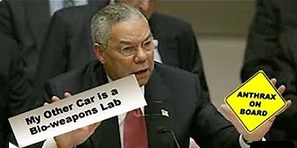
From Anthrax to Iraq
or go to
Aletho News Archives – Video-Images
Book Review
New paperback: Butchered by “Healthcare”
Lies are Unbekoming | October 20, 2026
 Butchered by “Healthcare” is Robert Yoho’s plain-spoken account of how American medicine stopped being a profession and became an industry. 341 pages. Over a thousand references. Thirty-eight chapters.
“Screening Tests Are Useless”, on tests that find diseases that would never have hurt you. “The FDA Protects the Big Drug Companies”, on an agency funded by the companies it regulates. “The Journals’ Sins Are the Editors’ Sins”, on ghostwritten studies and captured peer review. “Opioids and ‘Pain Management’”, on how a generation was prescribed its way into addiction. “Prozac and Relatives” and “Antipsychotics Are Disastrous”, on what psychiatry does to adults and children. “Surgery: Money Before Patients”. “Failed Cancer Treatments”. “Futile CPR and Overprescribing”. “Billing Scams & Specialty Warfare”. “Hospitals Are Sharks”. Each with a Patient Tips section at the end on how to survive it.
If you have ever walked out of a doctor’s office with a prescription you didn’t ask for, or watched a parent put through a treatment that made them worse, this is the book you want on your shelf before the next appointment. … Full review
Butchered by “Healthcare” is available on Lulu now.
Blog Roll
 Aletho News
- EU sending ‘biased’ observers to interfere in Serbian election – president
- White House envoy declares kinetic action against Yemen ‘fruitless’
- Ukraine deployed thousands of microdrones in Iraqi Kurdistan: Tasnim
- Iran calls for emergency UNSC meeting over Trump’s ‘brazen’ bomb talk, Israeli threats
- Iranian sources reveal details of Russia-China Hormuz proposal
- Plan for more US-Israel integration puts our military tech at risk
- Another Round Against Iran Will Break What Is Left of the Gulf
- SVR Report on Ukraine’s Mexican Drug Gang Links Could Pressure Zelensky, Won’t Change US Policy
- British Government Employees Were Fact-Checking the News at the BBC. Nobody Told You.
- Albania on fire: who’s behind the riots?
- If Americans Knew
- Gaza’s hospitals are running out of life-saving fuel – Daily Update
- Mysterious bot accounts reportedly spread fake ‘man on the street’ videos for Michigan Senate candidate
- Israeli Defense Minister Katz Says Over 60 Lebanon Villages Have Been Destroyed
- Why Is Israel Running TV Ads in Iowa Ahead of the Midterms?
- Hind Rajab’s Alleged Killer Is in the United States. HRF Demands His Arrest.
- US Officials Face Fresh Pressure After Another American ‘Brutalized’ by Israeli Settlers in West Bank
- Israel-Backed Palestinian Militias Terrorize Displaced Families in Gaza
- FBI subpoenas pro-Palestine activists over Israeli weapons plant disruption
- Fourth winter arrives in wartorn Gaza, too early – Daily Update
- More on how Bari Weiss is using CBS on behalf of Israel
- No Tricks Zone
- Predictions Made By Renowned Climate Proifessor Over Past Decades Have Been Proven To Be Poor
- New Study Suggests Large Regions Of The Pacific Ocean Have Been Cooling For The Last 80 Years
- Germany’s Green Energy Debacle: High Energy Costs Force Kahla Porzellan to Close After 182 Years!
- New Study: 50 Years Of The Most Aggressive ‘Net Zero’ Policies Can Only Affect The Global Climate By 0.03°C
- US September “Heat” Was No Record…Many Records Set Decades Ago
- Latest European Green Energy Debacle; Portugal’s Largest Flagship Solar Park Insolvent!
- Green Energy Debacle: German Expert Professor Fritz Vahrenholt Warns Of Severe Economic And Social Consequences
- Two More Paleo Reconstructions Affirm Meters-Higher Sea Levels Across Ireland, Brazil 7000-6000 Years Ago
- New Study: Earth And Venus Surface Warmth Largely Explained By Convection And Lapse Rate, Not CO2 Or Radiation
- 2025 Nature Paper Claiming Worsening Global Drought Gets RETRACTED …Heavily Flawed

