The almost invisible hand of the US in Tunisia’s “jasmine revolution”
By Ein Katzenfreund | January 25, 2011
There is every reason to congratulate the Tunisian people for being rid of the dictator Ben Ali. His corrupt regime was a plague for the people and a shame for the country. The saga is that after Mohamed Bouazizi from Sidi Bouzid immolated himself, a heroic and protesting people managed to oust the corrupt dictator Ben Ali of the French client state using demonstrations and communicating via Twitter and Facebook. There is just one problem with this saga. It’s just one half of the truth.
This half of the truth says protests beginning in Sidi Bouzid spread accross the country, reached the capital Tunisia and ousted Ben Ali. Crucial in this process were a few internet activists for freedom of speech, transparency and democracy like @wedaddy, @slim404, @nawaat, @benmhennilina and @SBZ_news, which are all well connected to each other. These activists were spreading the news of the protests nationwide and made sure they reached the capital, using US based social media like Twitter and Facebook. Finally, after more than 70 deaths, the protests culminated in Tunis and forced Ben Ali to flee.
The other half of the truth is the covert hand of the United States, which planned, oversaw and directed the colored “jasmine revolution”. While the Tunesian people can rightly be proud to have become rid of Ben Ali, the helpful hidden hand of the United States may bring a high political price with it.
Wherever the United States has formed a colored revolution and successfully dominated the post revolution process of building democracy, the outcome has been an ugly right wing puppet regime of the United States, and some of these pseudo democracies proved to be even worse than what the people had before. One may take as a reference war criminal Saakashvili of Georgia, NATO mad man Yushchenko of Ukraine or dictator Bakiyev of Kyrgyzstan.
So, how can we help prevent Tunisia becoming a US puppet right wing pseudo democracy? First of all, make the almost invisible hand of the United States visible.
On January 7th, Elliott Abrams, GW Bush’s “Deputy National Security Advisor for Global Democracy Strategy”, welcomed the collapse of the Ben Ali regime in Tunisia a week before it happened:
“Tunisia, whose literacy rate has long been the highest in Africa at nearly 80% and whose per capita GDP is about $8,000, should have the ability to sustain a democratic government — once the Ben Ali regime collapses.”
This is an interesting statement. Most of the world expected at that time, that dictator Ben Ali would order security forces to strike hard under false security pretenses and have his police and military shoot the protesters down until the country would become deathly quiet. A “miracle” saved Tunisia from this fate. Tunisian military Chief of Staff Rachid Ammar sided with the protesting people on January, 13th, and forced the Tunisian dictator Ben Ali to flee with this historic decision. Thierry Meyssan says, before making this critical decision, Rachid Ammar had been contacted by Africom Commander General William Ward. Whether this claim is true or not, I do not dare to say, but it’s clear, that the Tunisian regime was so angry with the U.S. for backing the regime change that it had summoned Washington’s ambassador to Tunisia, Gordon Gray, days before Rachid Ammar made his historic decision to let the uprising succeed and I don’t believe in “miracles”, especially when they are predicted by regime change specialists of the U.S. government.
On January 15th, one day after Ben Ali fled, David Kenner was quoted at the elite foreignpolicy.com website; Scott Carpenter, GW Bush’s point man of his MEPI regime change program, confirming a hidden U.S. hand in Tunisia:
“We were doing a lot of stuff very, very quietly – not to say covert, but very quietly.”
Shortly after, Ben Ali’s prime minister Mohamed Ghannouchi became the prime minister of the revolution and he promised to build a national unity transition government, restore freedom and hold elections soon. Rachid Ammar’s military forces successfully faught Ben Ali’s security forces and restored the public order. Union bosses formerly in bed with Ben Ali were to take part as ministers in the transition government and US-friendly opposition “leader” Ahmed Najib Chebbi became Regional Development Minister – in a cabinet where all crucial positions were held by former Ben Ali cronies in the RCD party. So the US seemed happy, the Tunisian revolution was labeled “Jasmine revolution” and it seemed to be a sure pro-US pro-Israeli finish, when after the promised elections Ahmed Najib Chebbi would be president.
Then something unexpected happened. The bases of the unions forced their bosses to resign from the transitional unity government and staged protests to oust Mohamed Ghannouchi and the whole corrupt RCD party formed by Ben Ali with him.
US-backed Rashid Ammar went to the protesters telling them to stop trying to oust the RCD cronies, telling them this would destroy the revolution. And while their fellow Tunisians protested on the streets to oust the RCD, the attitudes of pro-democracy and transparency Twitter activists, who managed the communication process of the Tunisian uprising, also changed. Very interesting tweets came from @Wedaddy, well funded by organizations like the right wing Bradley Foundation who tweets, though also fluent in French, Hebrew and Spanish, mostly in English and Arabic, at 25th Jan 2011:
Soldiers worked in the shadow. Interesting statement for a pro-democracy and pro-transparency activist, isn’t it? And these shadow soldiers seemed to have a lot of influence, at least so much, that they were able to push Facebook to close some of their notorious security holes due to the Tunesian uprising, as the Zionist magazine The Atlantic happily laid out.
If the revelation of soldiers working in the shadow for regime change is interesting, the following statement of wedaddy from Jan 25th is even more interesting:
So Ben Ali is definitely ousted, but it’s a bad time for the truth? That is completely contradictory to all stated democracy and transparency goals of the revolution. So, what is Wedaddy waiting for? For the end of the unexpected protests after Ben Ali was ousted, so he can be sure the pro-US forces have their power secured in Tunisia? Wadaddy doesn’t say, why is there no time for truth on processes behind the scenes after Ben Ali was ousted.
But there is another very interesting Tweet. Look at this Wedaddy tweet of 25th Jan 2011:
So, wedaddy speaks of two people played “a pivotal role behind the scenes” in the Tunisian revolution. Have a look yourself, who @netfreedom is: it is Robert Guerra, director of the Internet Freedom project at Freedom House soft war organization. “Freedom house” is the right wing US organisation close to the CIA which played a pivotal role in the string of “colored revolutions” of the last decade, which put US lackeys like war criminal Saakashvili into power and called it democratisation. And see here a fresh presentation of Robert Guerra, where he takes pride for what he calls the “Jasmine revolution”. Now you know, where the term “Jasmine Revolution” comes from. It’s a term of Freedom house, invented probably long before it happened.
So, can we now expect that right wing US protagonists will seek to destroy leftist movements, islamic movements and real unions and bring instead a rightwing US puppet regime in Tunisia? Have a look, who just went to Tunisia: Jeffrey Feltman. Jeffrey Feltman is the chief enabler for the Zionist apartheid state in the Obama administration, who orchestrated the bloody US-sponsored Israeli campaign of lies and terror against the people’s resistance in Lebanon – calling it “cedar revolution”. And what do Feltman and the US currently do in Tunisia? They are trying to destroy the influence of unions, leftists and islamic popular resistance.
Tunisia can still prevent the Sidi Bouzid revolution being stolen but the US and the Zionists are trying to steal the #sidibouzid revolution, to make a “Jasmine Revolution” out of it and to install a rightwing pro-zionist regime as they did in so many countries before which had colored revolutions with almost invisible hands of Freedom House and friends in it.
The following is a time-line prepared by Aangarifan:
- 2000 – President Ben Ali broke all diplomatic ties with Israel
- 2003 – Ben Ali refused to take part in either of the two wars against Iraq.
- 2009 – Sakhr El Materi, chairman of the Tunisia-US Parliamentary Friendship Group, met the US ambassador at Materi’s home (Tunisia: Dinner With Sakher El Materi – TuniLeaks) “The Ambassador raised economic liberalization, noting the importance of opening up to franchising.”
- 2010 – A report (Transformation: Tunisia) notes: “Despite the formal abolition of trade barriers for industrial goods with the European Union as of 1 January 2008, in practice, Tunisia has seen too little progress in terms of trade liberalization.”
- May 2010 – General William E. Ward, commander of U.S. Africa Command, visited Tunisia and met Tunisian Minister of Defense Ridha Grira. “Minister Grira had recently returned from very positive talks in Washington with Secretary of Defense Robert Gates.” (Tunisia – U.S. Africa Command Blog)
- October 2010 – Sakhr El Materi, chairman of the Tunisia-US Parliamentary Friendship Group, had talks with top Americans in the Pentagon and the State Department.
- November 2010 – A cable from the US embassy in Tunis released by wikileaks describes Tunisia’s President Zine El Abidine Ben Ali’s family entourage as a “quasi Mafia” because of its “organized corruption”.
- 17 December – Mohamed Bouazizi, a 26-year-old university graduate, reportedly set himself alight in the central Tunisian town of Sidi Bouzid in a protest over unemployment. He reportedly died on January 5 from burn wounds.
- 24 December 2010 – an important Washington think tank (Institute for Policy Studiesa) had an article about a possible change of regime in Tunisia (Foreign Policy In Focus.): “It would do Tunisians, even (Tunisian President) Ben Ali, well to recall how many US allies different American administrations have discarded…”
- 7 January 2011 – the Council on Foreign Relations’s Elliott Abrams (Elliott Abrams: Is Tunisia Next?) seems to suggest that the fall of Ben Ali would be a good thing. “Tunisians are clearly sick of looking at all the giant photos and paintings of Ben Ali that appear on walls, posters, and billboards all over the country… “If Tunisia can move toward democracy, Algerians and Egyptians and even Libyans will wonder why they cannot.”
- 8-10 January – More people die in three days of rioting. Mysterious rooftop snipers are at work.
- 13 January – The army withdraws from Tunis, which remains occupied by special forces. The leaders of the North African branch of Al-Qaeda/the CIA call for the overthrow of Ben Ali.
- 14 January – Ben Ali leaves the country.
The Special Tribunal for Lebanon
By MIKE WHITNEY | CounterPunch | January 18, 2011
In August 2010, Hezbollah Secretary General Hassan Nasrallah presented “intercepted Israeli reconnaissance footage” and “the recorded confessions of Israeli spies” at news conference in Beirut to support his claim that Israel was responsible for the assassination of former Lebanese prime minister Rafik Hariri. The aerial footage, taken by Israeli unmanned drones, showed the same route taken by Hariri’s motorcade on the day of the assassination, suggesting that the ex-PM was being pursued.
Nasrallah’s revelations were compelling but, unfortunately, they were ignored by the western media except for the Christian Scientist Monitor which compiled the information in an article titled “Is Hezbollah right that Israel assassinated Lebanon’s Rafik Hariri?”
Here’s an excerpt from the CSM:
“Israel has the capability to carry out this type of operation, such as Hariri’s assassination and the other assassinations that targeted Lebanon during the past few years,” said Sheikh Hassan Nasrallah, adding that Israel’s motive was to cast the blame on its enemies, Syria and Hezbollah. (“Is Hezbollah right that Israel assassinated Lebanon’s Rafik Hariri?”, Christian Scientist Monitor)
Nasrallah’s damning evidence is especially important now that the prosecutor for the Special Tribunal for Lebanon (STL) has issued his draft indictments. (On Monday) For now, the contents are being kept secret, but it’s widely expected that members of Hezbollah will be charged in Hariri’s murder. Nasrallah has warned that he won’t allow members of his militia to be arrested, so if warrants are issued, fighting will surely break out. Already, many schools in Beirut have been closed and Lebanese security forces have been put on high alert.
At the same time, the Obama administration has been working behind the scenes to influence key members in Lebanon’s government to support the US-Israeli position. In fact, Lebanon’s Foreign Ministry summoned US Ambassador Maura Connelly to explain why she had met with Lebanese lawmaker Nicolas Fattouch over the weekend. It appears as though the US is meddling in the country’s internal affairs in an effort to discredit Hezbollah. Connelly has not yet explained what she was up to.
The Special Tribunal for Lebanon is supposed to be an “independent” investigation into the assassination of Rafik Hariri, but that doesn’t seem to be the case. Nasrallah has dismissed the STL as an “American and Israeli project” designed to label Hezbollah as a terrorist organisation. The STL has culled all information that does not comply with its primary objectives. Thus, the fact that more than 100 people in Lebanon have been arrested in the last year “on charges of collaborating with the Mossad… including one who said his Israeli handlers instructed him to delude the late prime minister into thinking Hezbollah was out to kill him (Hariri) and so allow the agent to alter the route Hariri’s motorcade would take that fateful February day”, or that Lebanon’s “telecommunications network had been infiltrated by Israel, compromising all its communications” (“The Hariri Assassination: All Eyes on Lebanon”, Ranni Amiri, CounterPunch) will undoubtedly be omitted from the investigation’s final report.
Here’s more from Ranni Amiri’s article:
“According to the Lebanese daily As-Safir, Qazzi confessed to installing computer programs and planting electronic chips in Alfa transmitters. These could then be used by Israeli intelligence to monitor communications, locate and target individuals for assassination, and potentially deploy viruses capable of erasing recorded information in the contact lines. Qazzi’s collaboration with Israel reportedly dates back 14 years. (Note–Charbel Qazzi was head of transmission and broadcasting at Alfa, one of Lebanon ‘s two state-owned mobile service providers.” (“The Hariri Assassination: The Role Of Israel?” Rannie Amiri, CounterPunch)
So, the question arises: Who had the communications systems, aerial drones and explosives capable of killing Hariri? Who knew the route of his motorcade? Who had the motive?
And why is Israel’s chief of staff, General Gabi Ashkenazi, making predictions that the political situation in Lebanon will progressively deteriorate following the STL’s indictments? Here’s a clip from the political theatrics website:
“The Israeli Chief of Staff told the Knesset’s Foreign Committee that “with lots of wishes and a little bit of information” the situation in Lebanon will probably deteriorate following the issuance of an indictment by the Special Tribunal for Lebanon (STL)…
Although the date of issuing the indictment has not been set yet, Ashkenazi predicted it will be in September and insinuated that it will implicate Hezbollah. The Israeli general’s comments were seen as momentous particularly that he made them in front of a committee involved in Israel’s strategic policies.” (“Merlin” Ashkenazi Wishfully Predicts Deterioration In Lebanon In September”, politicaltheatrics.net)
So, why is Ashkenazi speculating on the STL indictments way back in July 2010, and why would he bring it up at a meeting devoted to “Israel’s strategic policies”? Does this explain why there are reports of increased military activity on Israel’s northern border? Is there a broader strategy to use the indictments to resume hostilities between Israel and Lebanon?
And why is Secretary of State Hillary Clinton so deeply involved in the activities of a so called “independent” tribunal? Clinton put the kibosh on a Syria-Saudi team that was trying to find a resolution between the rival factions in Lebanon’s ruling body. Why? And why did she preemptively torpedo the S-S negotiations and tell “Saudi King Abdullah and Lebanese Prime Minister Saad Hariri that the U.S. would reject any settlement at the expense of the UN tribunal.” Saad Hariri has reluctantly acquiesced to Clinton’s demands, but what does that mean? Should we assume that Clinton cares more about finding out who killed Rafik Hariri than his own son?
The loose ends and unanswered questions abound. The case that’s being made by the STL may seem convincing, but there is an equally cogent narrative that supports Hezbollah’s position. Here’s how British politician George Galloway summed it up in a speech in Edmonton in November 2010:
“I believe, and I don’t know anybody who is objective in this matter who does not believe, that Hezbollah are absolutely innocent of this crime, and it is time that the tribunal looked to the people who benefited from this crime…..in Israel.
“Any law student here knows, the first thing you do when confronted with a crime is ask the question, cui bono, who benefited?
“Did Syria benefit from the killing of the Sunni leader in Lebanon? Syria lost everything.
“Did Hezbollah benefit? Would Hezbollah benefit from destroying forever the respect and admiration that the Sunni Muslim population, not just in Lebanon but throughout the Arab and Muslim world, had towards them? No! They would lose everything.
“But Israel gained everything from this crime. It deepened the schism between Sunni and Shia in Lebanon. It deepened the schism between Sunni and Shia throughout the Muslim world. They plunged Lebanon into absolute chaos, and may do so again in the next few days and months.
“If this tribunal issues this indictment and anyone seeks to implement it, there will be war in Lebanon and there will be war almost certainly between Israel and Lebanon, and all of us will be dragged into it one way or another.” (“Galloway unedited: ‘Special Tribunal for Lebanon’ should have asked ‘who benefited?'”, rabble.ca)
Is that the goal, another war in Lebanon to create the “New Middle East” that Bush and Condi used to opine about? It’s too soon to say, but it’s not looking good.
Mike Whitney can be reached at: fergiewhitney@msn.com.
Is the Brazilian flooding catastrophe evidence of another global warming era extreme ?
By Alexandre Amaral | METSUL Communications Director, Brazil | January 15, 2011
Corpses are still under tons of rocks and mud in the hills of Rio de Janeiro, but some experts are already rushing to the microphones here in Brazil and abroad to declare the worst natural disaster in the Brazilian history as a clear and unequivocal evidence of global warming (a.k.a. global climate disruption).

The Brazilian media is not immune to the frenzy on global warming and extreme weather events. The Folha de Sao Paulo newspaper, one of the most important media outlets in the country, published a report connecting the Rio de Janeiro disaster to the Queensland flooding in Australia and the recent snowstorms in the United States and Western Europe.

To establish the ongoing catastrophe in Brazil as a global warming product is a bogus claim in the view of the staff of MetSul Meteorologia. The same can be said to the events of cold snaps and snow in the Northern Hemisphere – strong negative Arctic Oscillation related – and the massive flooding in Australia, a direct result of the strong and natural derived La Niña event.
Rio de Janeiro is subject to heavy or extreme rainfall every year, but this time the amount of precipitation was very heavy and in a short period of time, creating an inland tsunami-like torrent. The risk of major extreme rain episodes this summer was widely anticipated by MetSul meteorologists as analog years strongly pointed to a summer similar to the ones with disastrous events in the past. Rain gauges in Nova Friburgo measured 300 millimeters (12 inches) of rain in just 24 hours from January 11th to 12th. The tragedy happened in the Sierras of Rio de Janeiro (Região Serrana) where major topographical forcing is usually present in extreme rainfall. Moisture flow from the ocean (SSTs are above average in the South Atlantic) find a natural physical barrier in the mountains of Rio de Janeiro, making the region prone to extreme rainfall during summer months and early autumn.
The most affected cities (Petrópolis, Teresópolis and Nova Fribrugo) are located between mountains as high as 5 to 6 thousand feet and besides rivers cross these towns. The only way the water can take are the valleys and the regional rivers. Due to the regional terrain, the major menace to the population is landslide. For many decades Brazilian authorities allowed construction of homes and buildings in the slopes, so every single year landslides with numerous deaths are recorded in the states of Rio de Janeiro, Sao Paulo and Minas Gerais.
The front page of the Extra newspaper from Rio de Janeiro (click over the picture for a wider view) published on January 13th 2010 showed that every single year in the last decade witnessed tragedies caused by rain in the state of Rio. The newspaper headline is “Até quando?” (When will it end?). The paper argues: “The government excuse is always the same…it rained an equivalent to…”. The dominant opinion in the Brazilian media and public arena is that these repeated tragedies must be above all attributed to poor risk management and ridiculous urban planning instead of only blaming nature. Despite recognizing the ferocity of the rain, many are calling this week’s tragedy a manmade disaster.

In the state of Rio de Janeiro, there is massive occupation of the slopes and the hills, so landslides tend to be much more devastating and tragedies much more frequent. If this week’s rainfall had happened in the same region 35 years ago, the consequences would have been incredibly less dramatic. Satellite pictures released by the Brazilian Global TV Network show clearly some of the risky areas that concentrate most of the victims (Caleme, Posse and Meudon) as heavily populated nowadays in contrast to low or no land occupation 35 years ago.


There are anecdotal and historic accounts of extreme rainfall in the state of Rio de Janeiro since Brazil was a Portuguese colony in the 1600’s and 1700’s, but meteorological records are not available for that period. Great tragedies caused by rain and landslides in Rio de Janeiro began mainly in the second half of the 20th century coinciding with the demographic explosion and the massive and unorganized occupation of the hills. The risky areas of today, where the tragedies of the modern times use to happen almost every year, were not occupied 100 years ago, and for that reason the vast majority of the tragic events concentrate in the last 50 years.
-
April 1756 – Three days of heavy rainfall caused flooding, home collapses and “lots of victims” all over the town – still small – of Rio de Janeiro.
-
February 1811 – Between February 10th and 17th heavy rains caused a “catastrophe” in the city of Rio de Janeiro. Hills collapsed, the city was flooded and landslides were widespread with a torrent of water and mud invading town. Historical accounts tell of many victims, but there is no official number. The regent prince – designated by Portugal – ordered the churches to be open to serve as shelters.

-
April 1883 – Eleven inches of rain (220 mm) in a matter of four hours flood the city of Rio de Janeiro.

-
April 1924 – Heavy flooding and landslides with fatalities.
-
January 1940 – Flooding and landslides in the city of Rio de Janeiro. Santo Cristo district was the most affected.

-
January 1942 – Flooding and landslides in the city of Rio de Janeiro. The Salgueiro Hill was the the main disaster area.

-
January 1962 – Heavy flooding and several landslides in the city of Rio de Janeiro after 242 mm of precipitation during a storm.
-
January 1966 – The storm of January 2nd, 1966, brought record rainfall to the city of Rio de Janeiro. Flooding and massive landslides caused 250 casualties. Other 70 people died after the storm due to diseases.


-
January 1967 – Heavy rain and landslides provoked the collapses of buildings in the city of Rio. 200 people died and 300 were injured. 300 people died in the states of Rio de Janeiro and Guanabara (today Guanabara and Rio form the state of Rio de Janeiro).


-
November 1981 – Landslides in the Sierras of Rio kill 20 people in the city of Teresopolis.
-
February 1987 – Flooding and landslides kill 292 people. The city of Rio de Janeiro and the Sierras of the state concentrate the damages and the victims.
-
February 1988 – 277 people died in flooding and landslides in the Baixada Fluminense region and in the city of Petrópolis in the Sierras. In the rest of the month hundreds more died in new landslides and flooding. A hospital collapsed, killing 18 people. Damages topped 1 billion dollars.


-
Summer of 1996 – Dozens of deaths in flooding and landslides.
-
January 1999 – Dozens of deaths in flooding and landslides.
-
2010 – Nearly 100 people died in the cities of Angra dos Reis and Rio de Janeiro due to landslides on January 1st. In April, record rainfall caused over 200 deaths in massive landslides in the cities of Rio and the neighboring town of Niteroi.
Tragic events will happen again in the future, but can be less dramatic if some steps are taken urgently and seriously: improvement of risk management, urban reorganizing, investments in weather forecast and monitoring equipments and staff, a new media approach to weather warnings’ importance and a good public governance. History proves these areas will be hit again, but we as society have the power to mitigate the consequences. It is a matter of serious and urgent public priority for our authorities and the population’s will.
(note there’s much more here at METSUL’s blog)
The STL and the myth of judicial virginity
By Helena Cobban | January 13, 2011
The myth propagated by supporters of the various “international” criminal tribunals established since 1992 has been that somehow a judicial proceeding could rise completely above the sordid field of politics and follow its own complete integrity. I used to subscribe to that myth. But in 2000-01, as I started to investigate more closely the work of the two ad-hoc tribunals created by the UN during the mid-1990s, it became clear that “international” criminal tribunals can never, ever, be separated either from the politics of the countries whose developments they probe (and whose politics are inevitably affected by the work of the tribunals themselves)– or, from the politics of the “international” constellation of governments that establish, fund, and provide continued support for these tribunals’ work.
My 2006 book Amnesty After Atrocity? provided copious evidence of this, with regard to the work of the International Criminal Tribunal for Rwanda. But it is not only the ICTR whose work is irredeemably politicized. So has been the work of all “international” tribunals running from the Ur-example in Nuremberg through to today’s “International Criminal Court.” As longtime JWN readers know, I’ve written a lot about this issue, both here and (earlier) on the now nearly-defunct “Transitional Justice Forum” blog. Check over there for, in particular the field reports of the reporting trip I made to northern Uganda in 2006, to assess the very harmful effects that the work of the ICC was having on peacemaking there.
And then, there was the travesty of the (heavily U.S.-supported) Saddam Hussein trial…
Plus, the fact that the government leaders in Washington responsible for launching the completely unjustified invasion of Iraq in 2003, and therefore also all the deaths and violence that ensued from that invasion and occupation, were easily able to evade ever being held to account for that act of aggression (an act that was, at Nuremberg, certainly prosecutable– and prosecuted.) This, while the U.S. has also stood quite aside from all entreaties that it join the ICC– though over recent years it has given extensive logistic and financial support to some, but not all, of the ICC’s investigations and prosecutions… when this suited Washington’s own, inevitably political, purpose.
The neutrality of these judicial bodies before an “impartial” international law? That is nowhere to be seen.
… And then, there is the Special Tribunal for Lebanon,a body that has been irrevocably “politicized” and “political” ever since its establishment in 2006-07. It is a joint project of both the U.N. Security Council and the Government of Lebanon, established at a time when the U.S. still held important sway over both bodies.
Now, Hillary Clinton and her people are busy talking about the need to allow the STL to continue doing its allegedly quite “impartial” work. The STL has been the focus of considerable controversy and swirling allegations and counter-allegations over its years in existence, and I confess I have not followed these with enough diligence to be able to make clear-cut judgments regarding them.
What I can say with a high degree of confidence, based on my own work on this issue of international tribunals over the past decade is that no criminal court, within a country or at the global level, can ever have its work divorced from politics. Criminal prosecutions at a national level involve the state using the laws that already exist within the country to bring a prosecution against a defendant, who may upon being found guilty be subjected to serious sanction by the state– even, in the U.S. and elsewhere, the death penalty.
At the national level, too, the head of state or government always has the power to give clemency or pardon to convicted criminals (as in the case of Elliott Abrams in the U.S.), and leaders often use these powers with the goal of fostering national unity, or other worthwhile political goals.
And at the global level? Where is the agreed-upon, duly legislated, and equality-respecting legal basis for the work of international prosecutors? Where is the opportunity for global political leaders to issue pardons or enact clemency? Where, in short, is the supra-“judicial” legal-political infrastructure that can assure the impartiality as well as general social utility of the work of prosecutors and judges?
It doesn’t exist. In a world marked by striking political inequalities– especially between countries that have P-5 status on the Security Council, and those that don’t; and between countries that have at least submitted themselves to the judgments of the ICC, and those that haven’t– the “impartiality” of international criminal courts is a myth.
I wish it weren’t so. I wish we had the kind of global system in which all national leaders and other significant political actors could be held equally accountable for their actions. But we don’t. Rights activists from around the world who have put so much energy into fighting for the establishment and support of the existing international courts really also need to examine closely the effects that these courts have had on the lives, livelihoods, and well-being of the millions of citizens of the countries that have been their targets. In Amnesty After Atrocity? I looked at the effects on the citizenries of Rwanda, South Africa, and Mozambique of the widely differing approaches those three countries adopted to the issue of seeking “accountability” for past war crimes, crimes against humanity, and genocide. The two countries that decided against using criminal courts to deal with perpetrators of atrocities during the episodes of severe violence that all of them had suffered were the ones that came out with their social cohesion, political purpose, and the rights situation of their citizenries the best assured.
It is not only in Lebanon that a crucial “trade-off” exists between the work of (an inevitably “political” and backward-looking) international tribunal and the prospects for peace and people’s well-being going forward. Look at some of my own past work on this issue. Look at what the Obama administration is now actively considering doing in the context of Sudan, for goodness sake! Today, White House officials including “Ms. Anti-Genocide” herself, Samantha Power, are openly talking about the possibility of easing up the pressure that Pres. Omar Hassan al-Bashir has been subjected to from the ICC, in exchange for his cooperation with implementing the results of the South Sudan referendum.
It surely should not be that only in Lebanon does Washington pursue the chimera of the “impartiality” of a tribunal with strong international dimensions at the expense of the well-being of the target country’s citizenry.
Accountability for Rafiq Hariri’s killing? One day, let’s hope, the facts will all emerge. But this highly politicized judicial process centered in The Hague looks unlikely to be able credibly to uncover them. And if it does issue indictments, what then? STL prosecutor Daniel Bellemare and whose army will arrest those indicted? What of the Lebanese government’s supposedly co-equal role in managing this whole “criminal justice” project?
The next time Sec. Clinton or a State Department spokesman starts talking about the need to preserve the “impartiality” of this court, the STL, they should be asked about some of these very important questions…
Anti-War and International Solidarity Activists Denounce FBI Infiltration
2011-01-12 | Committee to Stop FBI Repression
The anti-war and international solidarity activists who are being called before a grand jury in Chicago have learned that beginning a few months before the protests against the Republican National Convention in the 2008 in St. Paul, Minnesota, a law enforcement officer infiltrated the Twin Cities Anti-War Committee (AWC). The infiltrator went by the name Karen Sullivan, joined the AWC in April 2008, and about a year later she joined the Freedom Road Socialist Organization.
Misty Rowan, of the Anti-War Committee, said, “The AWC played an important role in organizing the permitted march on the Republican National Convention on September 1, 2008, and also organized a rally and march on the fourth day of the convention. We can only assume that this First Amendment protected organizing was the reason that this agent, Karen Sullivan, infiltrated the AWC. It is the same kind of infiltration criticized in the September 2010 inspector general report and highlighted in the recent release of documents from the Richmond, Virginia, police, where any sort of assembly is defined as a disturbance and threat.”
Jess Sundin, of the Anti-War Committee, said; “This professional liar posed as a fellow activist for two and a half years, and acted as if she was our friend. She spent time around my child, and even attended a small BBQ to celebrate my release from the hospital after I survived a near-fatal brain hemorrhage in April of last year. This event had no investigative value. By attending personal events like this, she showed how unprincipled she was.”
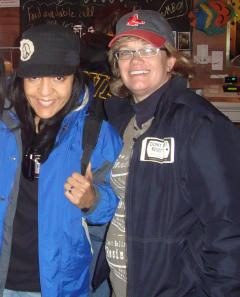 In the summer of 2009, the agent signed up to go on a solidarity trip to Palestine. Three members of the delegation were denied entry at the Tel Aviv airport and eventually sent back to the U.S., Sarah Martin, Katrina Plotz and the agent. We have now learned that on the word of this agent, these political activists were prevented from witnessing first-hand what is paid for with U.S. tax dollars in Israel and the Occupied Territories.
In conversations between our attorneys and the prosecutor’s office in Chicago, we have had confirmation that Karen Sullivan was in fact a law enforcement officer working undercover.
It now appears that the investigation of the U.S. Attorney is focused on small donations to the daycare and women’s center projects of the Union of Palestinian Women’s Committees, an NGO registered with the Palestinian Authority with local offices in towns across the the West Bank and Gaza. The Union is a progressive women’s organization that strives to build respect for women’s rights.
Steff Yorek, of Freedom Road Socialist Organization said, “We are appalled that we were infiltrated by police agents, targeted for our political organizing and views. This violates our rights to freedom of association and speech.”
The Committee to Stop FBI Repression is planning a National Day of Protest for January 25, in cities across the country. This protest is in solidarity with people refusing to testify at the secret grand jury in Chicago on that day.
Pictured: “Karen Sullivan” (right) with her associate “Daniela Cardenas”
The myth of “Good Israel” vs. “Bad Israel”
By War in Context on January 8, 2011
Liberal Zionists like Jeffrey Goldberg want to believe Israel is being corrupted by a number of course trends whose combined influence now threatens the secular democratic Israel that supposedly once represented a more authentic expression of the Jewish state.
Goldberg says:
I’m speaking here of four groups, each ascendant to varying degrees: The haredim, the ultra-Orthodox Jews, whose community continues to grow at a rapid clip; the working-class religious Sephardim — Jews from Arab countries, mainly — whose interests are represented in the Knesset by the obscurantist rabbis of the Shas Party; the settler movement, which still seems to get whatever it needs in order to grow; and the million or so recent immigrants from Russia, who support, in distressing numbers, the Putin-like Avigdor Lieberman, Israel’s foreign minister and leader of the “Israel is Our Home” party.
Noam Sheizaf writes:
This is a return to the old “good Israel” vs. “Bad Israel” theory. According to this idea, there are the peace-loving, democratic and liberal Israeli Jews, who represent the “real” values on which the country was born, and there are the “bad”, Sephardic Jews, Ultra-orthodox and Russian immigrants, who are to blame for all the current hiccups what was a model democracy until not that long ago. Goldberg is actually angry with them for taking away “his” Israel. I think he represents many in saying that
the Israel that I see today is not the Israel I was introduced to more than twenty years ago. The rise to power of the four groups I mentioned above has changed, in some very serious ways (which I will write about later) the nature and character of the Jewish state.
Let’s not deal with what some see as latent racism in these assumptions (I don’t think this is the case with Goldberg), and talk politics instead. First, Shas, is actually weaker than at any point since the mid nineties. The party is going through an internal crisis (some say it will split once its spiritual leader, Ovadia Yosef, passes away). The other Orthodox party, United Torah Judaism, has five seats – roughly the same number it always had. As for Avigdor Lieberman, the conventional wisdom is that only 60-something percent of his votes were from Russian immigrants and the rest came from ordinary middle class Jews. Pollsters claim that those middle class voters are the reason for Lieberman’s rise in the last elections (and probably, in the next ones).
We are left with Goldberg’s favorite target, the settlers. Contrary to the common belief, the settlers are also weaker than ever: the National Religious Party, which used to represent their interests, split into two, and the only real hard-core, rightwing party (The National Unity) has only four Knesset seats and was left out of the government by Netanyahu.
So, If the settlers and the orthodox might be so weak– or at least, not stronger than ever – how come we end up with the most racist, rightwing Knesset in the country’s history?
The answer is as simple as it is unpleasant: it’s Israel’s “good guys” that turned bad – and maybe they weren’t that good in the first place. The Israeli middle class, the good ole’ boys, are the ones supporting the racist bills in the Knesset and the anti-democratic initiatives. In other words, we always had Rabbis like Shmuel Eliyahu and members of Knesset like Kahane’s student Michael Ben-Ari. The difference is that now, we have Kadima and Likud backing them.
Brutal Reprisals Against Peaceful GA Inmate Strikers Confirmed, Was One Victim Hidden For Weeks By Prison Authorities?
By Bruce A. Dixon | Black Agenda Report | January 5, 2010
Black, brown and white inmates in 6 Georgia prisons nonviolently locked themselves in their cells for several days beginning December 9, demanding wages for work, educational opportunities, adequate food and medical care, just parole decisions and access to their families. The peaceful inmate strikers, as we reported the following day, were already victims of brutal retaliation on the part of correctional officials, ranging from cutoffs of heat and hot water to unprovoked assaults by correctional employees upon prisoners.
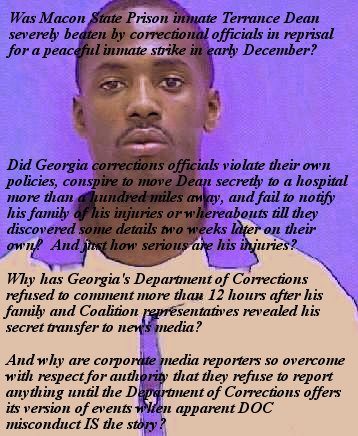
It now appears that at least one inmate, Terrance Dean of Bibb County GA was brutally assaulted by staff at Macon State Prison on or about December 16 was so severely injured prison officials secretly evacuated him to a hospital in Atlanta without bothering to inform his family. It’s not known at this time which Department of Corrections officials authorized the secret evacuation, who decided not to notify Dean’s family of either his injuries or his whereabouts, or whether the prisoner was transported the roughly 130 miles to Atlanta via ground or air ambulance. The first word the prisoner’s family received of either the beating or Dean’s whereabouts was when they were contacted December 30 or 31 by the friends and associates of other prisoners on the outside. Neither the Department of Corrections nor Atlanta Medical Center, where the prisoner was held for about two weeks, has released any information about the extent of the prisoner’s injuries, his current medical condition, or how he was injured.
The morning of Friday, December 31, Dean’s sister, along with ACLU attorney Chara Jackson and GA state NAACP chief Ed DuBose representing the Concerned Coalition to Respect Prisoner’s Rights showed up at the Atlanta Medical Center demanding to see the injured prisoner or at least have his whereabouts confirmed. After several hours of delay, correctional officials said his mother and sister, along with the attorney would be allowed to visit him at Jackson State Prison Sunday, January 2, but they offered no explanation of the reasons for his secretive transfer. Hospital officials also refused to offer any information on Dean’s injuries, even to his family, on grounds of doctor-patient confidentiality.
“We assume that state officials have a written policy requiring them to inform family members in the event of the serious injury of their loved ones in prison,” said the Georgia Green Party’s Hugh Esco. “If Georgia corrections personnel did brutally beat Terrance Dean, transfer him secretly more than a hundred miles from the scene of the crime scene and neglect to inform his family about his injuries or whereabouts they could be parties to a criminal conspiracy. The Green Party has written a letter to the outgoing and incoming governors asking them to look carefully at the events surrounding the case of Mr. Dean. We also note that the Department of Corrections promised access to the 37 prisoners whom it transferred as a result of the inmate strike that began on December 9. We hope this is a promise they keep, so that the public can get a complete and accurate picture of what goes on behind those walls.”
Dean’s sister, attorney Chara Jackson, and the NAACP’s Ed DuBose briefed the press at Atlanta Medical Center, including representatives from at least one local TV station repeatedly beginning at noon on Friday, and assured Black Agenda Report that they will attempt to see Terrance Dean at Jackson State Prison on Sunday, January 2. But as of nearly 24 hours later, on the morning of January 1, 2011 no corporate news outlet is publicly asking or answering any of the key questions around the assault on Terrance Dean, or what look for all the world like official attempts to conceal it from his family and the public.
“This is no surprise,” offered BAR executive editor Glen Ford. “For corporate journalists, a story without input from government or corporate officials is no story at all. For these so-called reporters, the story has a big hole in it as long as state officials decline to comment, even though official misconduct on the part of government IS the story. If the state declines to comment until Sunday or Monday, they will sit on the story till then. Establishment journalists are nothing if not disciplined and well-trained.”
Bruce A. Dixon is managing editor at Black Agenda Report, based in Marietta GA, and a member of the state committee of the Georgia Green Party. Both Black Agenda Report and the Georgia Green Party are members of the Concerned Coalition to Respect Prisoner’s Rights.
Background:
GA Prison Inmate Strike Enters New Phase, Prisoners Demand Human Rights, Education, Wages For Work
Video interview:
Elaine Brown on GA Prison Strike, December 14 Democracy Now Video Interview
And related video report:
Torture: America’s Brutal Prisons
Savaged by dogs, Electrocuted With Cattle Prods, Burned By Toxic Chemicals, Does such barbaric abuse inside U.S. jails explain the horrors that were committed in Iraq?
They are just some of the victims of wholesale torture taking place inside the U.S. prison system that we uncovered during a four-month investigation for the UK’s Channel 4 originally aired in 2005.
Featured Video
BRITAIN’S WARNING: PREPARE FOR WAR
or go to
Aletho News Archives – Video-Images
From the Archives
British weapons and personnel doing much of the killing in Yemen
Press TV – June 18, 2019
A detailed report published by the Guardian newspaper has shown how Britain is massively contributing to Saudi Arabia’s devastating war on Yemen as it suggests that London is not only supplying the bombs that fall on Yemenis, but it provides the personnel and expertise that keep the war going.
The comprehensive report by Arron Merat published on Tuesday showed that Britain was doing much of the killing in Yemen as the country continues to provide Saudi Arabia with everything it needs to turn its southern impoverished neighbor into a graveyard.
“Every day Yemen is hit by British bombs – dropped by British planes that are flown by British-trained pilots and maintained and prepared inside Saudi Arabia by thousands of British contractors,” said Merat in the report. … continue
Blog Roll
 Aletho News
- A West Bank War for Netanyahu’s Election Campaign, Could It Backfire?
- Yemen denounces European Parliament’s ‘hypocritical’ push to blacklist Ansarullah
- Qalibaf: UAE’s UN bid aims to ‘clear the runway’ for ‘Greater Israel’, whitewash genocide
- Pakistan reopens Iran border after boosting security: Report
- Why are so many Brazilians voting for Flávio Bolsonaro?
- Democrats Put Anti-Russia Agenda Ahead of American Workers
- Elijah Magnier: Yemen’s Strikes Are Shattering Saudi Arabia’s Long-Term Strategy
- Pentagon designates Chinese cultural centers national security threat
- Israel Demolishes Home Of Lebanese Journalist Whose Viral Film Exposed Pager Attack
- Record Oil, Empty Tanks: The UAE’s Miracle Recovery
- If Americans Knew
- Tourism Ministry launches free food truck tour in US
- “So Much Worse Than People Realize”: Never-Before-Seen Images Reveal Damage at U.S. Bases as Troops Describe Being Abandoned
- UK Bell Review Confirms Only Anti-Israel Attitudes Are Rising, Not Antisemitism
- DAILY UPDATE: Latest essential news on Palestine, Israel, & region
- DAILY UPDATE: Latest essential news on Palestine, Israel, & region
- Damning report shows the media must confront its failures on Gaza
- BBC senior broadcaster speaks out on Gaza coverage
- Netanyahu vows vast West Bank invasion in response to 20-minute skirmish that left 2 Israeli soldiers and 2 Palestinian fighters dead
- Tied up and tortured: Israel using US-made electroshock weapons on Palestinian detainees
- The outsourced risk: how newsrooms rely on Gaza’s freelancers without protecting them
- No Tricks Zone
- Sudden Stratospheric Warming, Powerful El Niño Combination May Lead To Extreme Europe Cold, Energy Crisis!
- Two New Studies Find Thwaites Glacier Melt Cannot Be Driven By Human Activity Or A Warming Ocean
- E-Cars Reduce CO2 Emissions By Only 41% Compared To Internal Combustion Engine Vehicles
- Predictions Made By Renowned Climate Professor Over Past Decades Have Been Proven To Be Poor
- New Study Suggests Large Regions Of The Pacific Ocean Have Been Cooling For The Last 80 Years
- Germany’s Green Energy Debacle: High Energy Costs Force Kahla Porzellan to Close After 182 Years!
- New Study: 50 Years Of The Most Aggressive ‘Net Zero’ Policies Can Only Affect The Global Climate By 0.03°C
- US September “Heat” Was No Record…Many Records Set Decades Ago
- Latest European Green Energy Debacle; Portugal’s Largest Flagship Solar Park Insolvent!
- Green Energy Debacle: German Expert Professor Fritz Vahrenholt Warns Of Severe Economic And Social Consequences

