Does Our Economy Really Have to Run on Fraud?
The Angelides Commission Squints Back at the Bank Bailout and the Fall of Lehman
By MICHAEL HUDSON | CounterPunch | September 3, 2010
What is the difference between today’s economy and Lehman Brothers just before it collapsed in September 2008? Should Lehman, the economy, Wall Street – or none of the above – be bailed out of bad mortgage debt? How did the Fed and Treasury decide which Wall Street firms to save – and how do they decide whether or not to save U.S. companies, personal mortgage debtors, states and cities from bankruptcy and insolvency today? Why did it start by saving the richest financial institutions, leaving the “real” economy locked in debt deflation?
Stated another way, why was Lehman the only Wall Street firm permitted to go under? How does the logic that Washington used in its case compare to how it is treating the economy at large? Why bail out Wall Street – whose managers are rich enough not to need to spend their gains – and not the quarter of U.S. homeowners unfortunate enough also to suffer “negative equity” but not qualify for the help that the officials they elect gave to Wall Street’s winners by enabling Bear Stearns, A.I.G., Countrywide Financial and other gamblers to pay their bad debts?
There was disagreement last Wednesday at the Financial Crisis Inquiry Commission now plodding along through its post mortem hearings on the causes of Wall Street’s autumn 2008 collapse and ensuing bailout. Federal Reserve economists argue that the economy – and Wall Street firms apart from Lehman – merely had a liquidity problem, a temporary failure to find buyers for its junk mortgages. By contrast, Lehman had a more deep-seated “balance sheet” problem: negative equity. A taxpayer bailout would have been an utter waste, not recoverable.
Lehman CEO Dick Fuld is bitter. He claims that Lehman was unfairly singled out. After all, the Fed lent $29 billion to help JPMorgan Chase buy out Bear Stearns the preceding spring. In the wake of Lehman’s failure it seemed to gain the courage to say, “Never again,” and avoided new collapses by bailing out A.I.G. – saving all its counter-parties from having to take a loss.
Was this not a giveaway? Fuld implied. Why couldn’t the Fed and Treasury do for Lehman what they did with other Wall Street investment firms and stock brokers: let it reclassify itself as a bank so it could pawn off its junk mortgages at the Fed’s discount window for 100 cents on the dollar, sticking taxpayers with the loss? (And by the way, will these firms ever be asked to buy back these mortgages at the price they borrowed against from the government? Or will they be allowed to walk away from their debts in a Wall Street version of “jingle mail”?)
This is the soap opera that Americans should be watching, if only it weren’t conducted in the foreign language of jargon and euphemism. At issue is whether Lehman’s crisis was merely a temporary “liquidity problem,” that time would have cleaned up; or, did the firm suffer a more deep-seated “balance sheet problem” (negative equity), as Federal Reserve Chairman Ben Bernanke claims – a junk balance sheet, composed of assets that not only had no buyers at the time, but had no visible likelihood of recovering their market price even after the $13 trillion the Treasury and Federal Reserve have spent to bail out Wall Street.
Insisting that Lehman should have shared in Washington’s $13 trillion giveaway. Fuld testified that his firm was just as savable as Countrywide or A.I.G. – or Fannie Mae for that matter. Lehman was perversely singled out, he claims. Was it not indeed as savable as the Fed and Treasury claim the U.S. real estate sector is? Like over-mortgaged homeowners, all it needed was enough time to finish selling off its portfolio, given enough loan support to tide it over.
The problem, of course, is that the securities that Lehman hoped to pawn off were fraudulent junk. American homeowners are victims, not crooks. Wall Street bailed out crooks at Countrywide and its cohorts. The credit-rating agency Fitch has found financial fraud in every mortgage package it has examined. And these are the packages that have made Wall Street rich and powerful enough to gain Washington bailouts to establish them as a new ruling class, bailouts to use for buying up Washington politicians and lawmakers, and for buying out the popular press to tell people how necessary Wall Street financial practice is to “support” the economy and “create wealth.”
Could any other daytime telecast have a more typecast villain than Fuld? A novelist would be hard-put to better personify greed, arrogantly playing bridge with his boss while Lehman burned. Yet his testimony has a certain logic. If the negative equity suffered by a quarter of U.S. homeowners can be saved, as the Fed claims it can, where should the line be drawn?
Or to put this question the other way around, why are ten million American homeowners being treated like Lehman, if the Fed believes that they are as savable as Countrywide and A.I.G.?
Huge sums are at stake, because the bailout has left little for Social Security, and nothing to bail out the insolvent states and cities, or for more stimuli to pull the national economy out of depression.
Most relevant in Fuld’s self-pitying defense before the Angelides Committee is not what he said about his own firm, but his accusation that the Fed and Treasury rescued the rest of Wall Street. Weren’t other firms just as bad? Why was Lehman singled out?
The Fed’s witnesses gave a devastating reply. They drew a clear distinction between a temporary “liquidity problem” and outright negative net worth – the “balance-sheet problem” of insufficient assets to cover one’s debts. Lehman was so badly managed, the Fed claimed, so reckless and arrogant in its belief that it could cheat its customers by selling junk at a huge markup, that it could not have been rescued except by an outright taxpayer giveaway. As the Fed’s Chief Counsel, Scott Alvarez, put matters: “I think that if the Federal Reserve had lent to Lehman … in the way that some people think without adequate collateral … this hearing and all other hearings would have only been about how we had wasted the taxpayers’ money – and I don’t expect we would have been repaid.” Like the city of Oakland, in Gertrude Stein’s derisive phrase, there was no “there” there.
Included in the hearings’ evidence is an exasperated e-mail sent by Treasury Secretary Hank Paulson’s chief of staff, Jim Wilkinson, on Sept. 9, 2008: “I just can’t stomach us bailing out Lehman. Will be horrible in the press.” Five days later, on Sept. 14, he added that unless a private buyer could be found (e.g., as JPMorgan Chase stepped forward to buy Bear Stearns), “No way govt money is coming in … also just did a call with the WH [White House] and usg [U.S. Government] is united behind no money … I think we are headed for winddown.”(1)
Lehman’s problem was not just temporary illiquidity. It had a fatal balance-sheet problem: Its assets were not worth anywhere near what it owed. So with poetic justice, it was in the same position as the subprime borrowers whose junk mortgages it had underwritten and sold to investors gullible enough to believe Moody’s and Standard and Poor’s AAA ratings. This fraudulent junk was supposed to be as safe as a U.S. Treasury bond. But it turned out to be only as safe as Social Security and state pension promises are in today’s “Big fish eat little fish” world.
Yet Fuld is correct in pointing out that not only Bear Stearns and A.I.G., but also Morgan Stanley and Goldman Sachs would have failed without state support. So the question remains: Why bail out these firms (and their counter-parties!) but not Lehman?
This is too narrow a scope to pose the proper question. What needs to be discussed is the result of Washington arranging for Wall Street to repay its TARP, A.I.G. and other bailout money – including that of Fannie Mae and Freddie Mac – by “earning its way out of debt” at the “real” economy’s expense. Why has Washington refused to write down the bad debts of homeowners, states and cities, and companies facing bankruptcy unless they annul their pension promises to their employees? Why is Washington treating the American economy like it treated Lehman and telling it to “drop dead”?
The explanation is that a double standard exists. The wealthy get bailed out – the creditors, not the debtors. And even the fraudsters, not their victims.
Sidestepping the Fraud Issue
Recent federal bankruptcy proceedings have exposed Lehman’s deceptive off-balance-sheet accounting gimmicks such as Repo 105 to conceal its true position. No fraud charges have yet been levied, but this is the invisible elephant in the Washington committee rooms. “Everyone was doing it,” so that makes it legal – or what is the same thing these days, non-prosecutable in practice. To prosecute would be to disrupt the financial system – and it is Fed doctrine that the economy cannot survive without a financial system enabled to “earn its way out of debt” by raking off the needed wealth from the rest of the economy?
So the Fed, the Treasury and the Justice Department have merely taken the timid baby step of pointing out that Lehman suffered from such bad management that no firm was willing to buy it out. Barclay’s was interested, but Fuld was so greedy that he found its offer not rich enough for his taste. So he ended up with nothing. It is a classic morality tale. But evidently not fraud.
The fraud issue lies as far outside the scope of the financial committee meetings as the question of how the economy should cope with its unpayably high mortgage, state and local debts in the face of its inadequately funded pension obligations. Fed Chairman Bernanke testified on Thursday, September 2, that “the market” itself breeds what most people would call fraud. Widening the market for home ownership necessarily involves lowering loan standards, he explained. But as the Lehman failure illustrates, where should we draw the line between “illiquidity” and insolvency on the one hand, and higher risk and outright fraud?
The Fed argues that the economy cannot recover without a solvent financial system. But what about that large part of the financial system based on fraud? Would the economy fall apart without it – without mortgage fraud, without deceptive packaging of junk mortgages, and for that matter without computerized gambling on derivatives? What of the credit-ratings agencies whose AAA writings were as much up for sale as the conscience and honesty of politicians on the Senate and House Banking Committees? Do we really need them?
And does the economy need more credit (that is, debt)? Or does it need jobs? Does it need to un-tax the banks and give tax-favoritism to Wall Street (“capital gains” tax rates) to enable it to earn its way out of debt at the expense of the production-and-consumption economy?
The question that Washington financial committees should be asking (and economics textbooks should be posing) is whether wider home ownership is really dependent on easier and looser lending standards. After all, the effect of easy credit is to enable borrowers to bid up housing prices. Is this really how to make the U.S. economy more competitive – given the fact that industrial labor now typically pays 40 per cent of its wage income for housing?
Or, does the Fed’s easy-money policy deregulation of oversight open the way for asset-price inflation that puts home ownership even further out of reach – except at the price of running up a lifetime of debt to the banks that write the loans on their keyboard at steep markups over their cost of funding from the compliant Fed?
Qui bono?
Who is to benefit from the Fed’s easy money policy – consumers and homeowners, or Wall Street? This is the broad issue that should be discussed. What would have happened without the bailout? (Remember, Republican Congressmen opposed it – before that fatal Friday when “maverick” John McCain rushed back to Washington and said he would not debate Obama that evening unless Congress approved the bailout of his Wall Street backers.) What if it had been the debtors who were bailed out by a write-down of bad debts, instead of the lenders who had made bad loans and the large institutions that bought them?
The bailout has saddled taxpayers not only with $13 trillion that now must be sacrificed by the economy at large (but not by Wall Street), with the cost of a decade-long depression resulting from keeping the bad debt on the books. This is what rightly should be deemed criminal.
Defenders of Wall Street insist that there was no alternative. And the committee hearings are carefully only listening to such people, because these are very respectable hearings. They are writing mythology, almost as if they are crafting a new religion. In this new ethic, Wall Street financial institutions – “credit creators,” that is, debt creators – are supposed to fund industry, not strip assets or make bad loans. Without rich people, who would “create jobs”? Such is the self-serving logic of Wall Street. For them, Wall Street is the economy. The wealth of a nation is worth whatever banks will lend, by collateralizing the economic surplus for debt service.
What the Angelides Commission really should focus on is whether this is true or false. That would make it a soap opera worth watching. The Fed so far has stonewalled attempts to discover just who was bailed out in autumn 2008? But most important of all is, what dynamic was bailed out? What class of people?
The answer would seem to be, financial firms employing and serving the nation’s wealthiest 1 per cent? Any and all fraudsters among their ranks? (There has not been a single prosecution, as Bill Black reminds us.) Or the remaining 99 per cent of the population – their bank deposits and indeed, their jobs themselves?
Academic textbooks pretend that the economy is all about production and consumption – factories producing the things their workers buy. The distribution of wealth does not appear, nor is it regularly tracked in statistics. But in Washington and at the hearings, the economy seems to be all about lending and debt, all about balance sheets.
I believe that the beneficiaries were fraudsters, and that the system cannot be saved. Trying to save it by keeping the debts in place – and letting Wall Street banks “work their way out of debt” at the U.S. economy’s expense – threatens to lock the economy in a chronic debt deflation and depression.
At issue is the concept of capital. Does money that is made by short-term, computer-driven financial trades qualify as “capital formation” and hence deserving of tax breaks? Are the billions of dollars of “earnings” reported by Wall Street speculators to be taxed at the low 15 per cent “capital gains” rate? That is only a fraction of the income-tax rate that most workers pay – on top of which is piled the 11 per cent FICA wage withholding for Social Security and Medicare that all workers have to pay on their salaries up to the cut-off point of about $102,000. (This cut-off frees from this tax the tens of millions of dollars that hedge fund traders pay themselves.) Or should these trading gains – a zero-sum activity where one party’s gain is, by definition, another’s loss (usually one’s customers) – be taxed more highly than poverty-level income of workers?
A short while ago the Blackstone hedge fund’s co-founder, Stephen Schwarzman, characterized the attempt to tax short-term arbitrage trading gains at the same rate that wage-earners pay as analogous to Adolph Hitler’s invasion of Poland in 1939. It is a class war against fraudsters and criminals – an unfair war as serious as World War II. In Schwarzman’s apocalyptic vision the Democrats are re-enacting the role of Adolph Hitler by mounting a fiscal blitzkrieg to force billionaires to pay as high a tax rate as workers. Are not Wall Street firms doing “God’s work,”as Goldman Sachs chairman Lloyd Blankfein, put it last fall? And if they are, then are not those who would tax or criticize Wall Street “God-killers”?
If religion can be turned on its head like this – where the Invisible Hand of Wall Street (invisible to the Justice Department, at least) is elevated to a faux-Deist moral philosophy – is it any surprise that economic orthodoxy and formerly progressive tax policy are succumbing? The rentiers are fighting back – against the Enlightenment, against Progressive Era tax policy, and against hopes for U.S. economic recovery. Given today’s florid emotionalism when it comes to discussing Wall Street finances, it hardly is surprising that the Angelides hearings do not dare venture into such territory as to ask whether the bottom 90 per cent of the U.S. economy might need to be bailed out with debt relief just as Wall Street’s elites were.
On Thursday, Fed Chairman Bernanke tried to put the financial flow of funds that led up to the crisis in perspective. In his testimony before the Financial Crisis Inquiry Commission he described a self-feeding process that actually started with the U.S. balance-of-payments deficit that made foreigners so flush with dollars. They understandably wanted yields higher than the Treasury was paying, as the Fed was flooding the economy with credit to keep asset prices afloat to save the banks from having to take loan write-downs and admit that debt creation was not really the same thing as Alan Greenspan euphemized in calling it “wealth creation.” So foreign financial institutions became a large but overly trusting market for packaged junk mortgages.
When asked just who was pushing the great explosion of mortgage lending, Bernanke pointed to the mortgage packagers – Wall Street profiting from the commissions and rake-offs it was making by pretending that the loans were not bad. However, he reminded his audience, there also had to be popular demand for housing. People were panicked. They worried that if they did not buy a home back in 2005, they could not afford to buy in the future. And they were cajoled with financial televangelists assuring them that they would always enjoy the option of selling at a profit. But Bernanke said nothing about fraud in all this. To widen the market for home ownership, banks had to write more mortgages, and this required lowering their standards.
So they did it all for us, for “the people” – and the backers of Fannie Mae and Freddy Mac who egged them on.
Where does “lowering loan standards” turn into outright fraud? Has that simply become part of “the market”? This is what the commission seems to fear to address. But it is getting late – already we are in September, and the report is scheduled for December. So is this really going to be “it”? This would be like a soap opera ending in the middle of the desert, with the main protagonists stranded. This seems to be where the Commission is leaving the U.S. economy as it waits for the recommendations of the Joint Commission to Roll Back Social Security, or whatever the name of Obama’s Republicanized Democratic commission is more formally called. The result is more like the cliffhanger of a serial, leaving the viewer to try and imagine how the protagonist – in this case, the economy – will ever manage to be saved.
Michael Hudson is a former Wall Street economist. A Distinguished Research Professor at University of Missouri, Kansas City (UMKC), he is the author of many books, including Super Imperialism: The Economic Strategy of American Empire (new ed., Pluto Press, 2002) and Trade, Development and Foreign Debt: A History of Theories of Polarization v. Convergence in the World Economy. He can be reached via his website, mh@michael-hudson.com
(1) Tom Braithwaite, “Fuld criticises Fed for letting Lehman fail,” Financial Times, September 2, 2010, and John D. McKinnon and Victoria McGrane, “Clashing Testimony Over Lehman Bankruptcy,” Wall Street Journal, Sept. 2, 2010.
When Settlers Attack vs. When Settlers Are Attacked
By Yousef Munayyer | Permission to Narrate | September 1, 2010
This afternoon news began to break about the killing of 4 Israeli settlers near the Palestinian town of Hebron. Surely, the killing of any unarmed civilians, whether their presence in a particular area is legal or not, is condemnable and many have been swift to condemn today’s act of violence and put it into perspective as an attempt to derail peace talks (as if these talks needed any help to fail).
Within minutes many major news outlets began reporting about this event. Here is Isabel Kershner’s coverage in the NYT:
Four Israelis, including a pregnant woman, were killed when their car was fired on in the West Bank on Tuesday evening, in the deadliest attack on Israelis in more than two years.
The killings appeared to be an effort by Palestinian militants to upset peace talks due to start in Washington on Thursday. Hamas claimed responsibility for the shootings, the Associated Press reported.
….
In July, Israeli security officials said they had arrested several members of the military wing of Hamas, the Islamic group, who were responsible for the fatal shooting of an Israeli police officer south of Hebron in June.
In March 2008, a Palestinian gunman from East Jerusalem killed eight students, mostly teenagers, at a religious seminary in the city.
As I am in the midst of analyzing data on settler violence it struck me how much this coverage chose to ignore about the dynamics of violence around settlements in the West Bank when it mentioned only Palestinian acts of violence going back to 2008 but didn’t waste a word on mentioning settler violence. Settler violence, often perpetrated with the knowledge, or assistance of the IDF, is just as likely to jeopardize the ‘peace process’ yet we rarely hear of it.
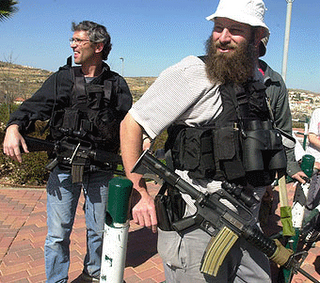 A quick query of the data, covering over 1000+ events, tells us the NYT story skipped over a lot, including over 260 acts of settler violence in the Hebron governorate alone since 2009. These include 56 instances of assault, 53 instances of stone throwing, 28 attacks on houses and attempted house seizures, 11 acts of arson and many more.
These acts of settler violence, again, in this one part of the West Bank in only the last 20 months has left 1 dead and 93 injured among Palestinians as well as incalculable amounts of property damage (the totals for the entire West Bank are much higher). Attacks perpetrated against Palestinians over this time period in the Hebron governorate were launched from the settlements of Adorah, Bat Ayin, Bat Hadassah, Hagai, Harsi, Karmei Tzur, Karmiel, Kfar Etzion, Kiryat Arba, Maon, Mount Joher, Negohot, Shani, Shima and Sosia.
This is the kind of information that Kershner forgot to mention, but it is also the kind of information that will be discussed in great detail, looking at all parts of the West Bank and trends over time, at our upcoming Palestine Center briefing on settler violence. If you can’t make to it DC, you can watch the live streaming webcast of the event at our website. Maybe Kershner can follow the live stream from Jerusalem and give settler violence the attention it deserves.
Mitchell’s Quick-fix Fake Peace
By Stuart Littlewood | September 2, 2010
On the eve of the silliest peace talks in history, the big question is this. What makes Obama’s envoy George Mitchell, a negotiator of high repute, say there is ‘no role’ for Hamas?
The talks are silly because they seek to overturn what the United Nations has already decided for resolving the Israel-Palestine conflict and drive a bulldozer through the building blocks of justice.
It might be music to Zionist ears, but to people of good will it’s a cruel, futile and immensely damaging ploy.
The talks are also silly because they bring together two people who by no stretch of the imagination could qualify as partners for peace. And they sit down under the auspices of a third party with an appalling track record in the Middle East and whom no-one trusts to act fairly.
So Mitchell has been dealt a terrible hand. The former US senator, we’re told, has had an illustrious career in politics. Honours have been heaped upon him for his part in the Northern Ireland ‘Good Friday’ agreement.
Accepting one of those awards – the Liberty Medal in 1998 – Mitchell said: “I believe there’s no such thing as a conflict that can’t be ended… No matter how ancient the conflict, no matter how hateful, no matter how hurtful, peace can prevail. But only if those who stand for peace and justice are supported and encouraged, while those who do not are opposed and condemned. Seeking an end to conflict is not for the timid or the tentative. There must be a clear and determined policy not to yield to the men of violence…”
How about that? Conflict can be ended only by supporting those who stand for peace and condemning those who don’t. But does he know – has he really taken the trouble to find out – who actually stands for peace and justice in the ever-escalating obscenity of the Israeli occupation of Palestine? And is he absolutely clear who “the men of violence” are? Get it wrong and matters are made worse.
Mitchell is such an awesome peace-monger that he has become a visiting Professor at Britain’s Leeds Metropolitan University’s School of Applied Global Ethics, and the University is developing a new Centre for Peace and Conflict Resolution bearing his name.
If Mitchell is so clued up you have to wonder why he took the job – a veritable poisoned chalice. And you’d think a person with his vast experience would stick to accepted rules of engagement for conflict resolution and peace-making. I’ll mention just three:
• Talk directly with the people who are concerned or with whom there are concerns.
• Attack the issues, not the people with whom there is disagreement.
• No issue can be ‘off limits’.
There is no-one more concerned than Hamas. As the democratically elected authority they are the principle stakeholder on the Palestinian side. Obviously they must be allowed to represent the Palestinian case. It matters not one jot or tittle that the White House has “identified” Hamas as a terrorist organization. They have legitimacy. Besides, millions outside the White House can point to Israel’s much worse terror crimes.
Mitchell, besides barring Hamas, bends even further to Israeli prime minister Netanyahu’s demands and has ruled there must be no pre-conditions. Which means that Israel’s criminal conduct such as settlement construction, dispossession, ethnic cleansing, the land and sea blockade of Gaza, the occupation, the strangulation of the economy and their taste for piracy and extra-judicial killing, and their trampling of human rights including those of self-determination, are allowed to continue while the hapless Palestinians face them across the table.
And never mind that Netanyahu is permitted to enter these talks with his own pre-conditions, saying that the return of Palestinian refugees to the homes they were forced to flee, and the continuing occupation of East Jerusalem including the Old City, are not for discussion, and threatening to resume the (temporarily suspended) illegal settlement building.
If Mitchell is truly a person of integrity and a champion of “global ethics” how could he show such favour to one side?
What, I wonder, will he be saying to the Israeli team about UN Resolution 181 of 1947, which deals declares that “the City of Jerusalem shall be established as a corpus separatum“ administered by the United Nations?
What will he say to them about Resolution 242 (1967) by the Security Council and therefore fully binding? This insists on:
(i) withdrawal of Israeli armed forces from territories occupied in the recent conflict;
(ii) termination of all claims or states of belligerency, and respect for and acknowledgement of the sovereignty, territorial integrity and political independence of every State in the area and their right to live in peace within secure and recognized boundaries free from threats or acts of force.
242 also emphasizes the need for:
(a) guaranteeing freedom of navigation through international waterways in the area;
(b) achieving a just settlement of the refugee problem;
(c) guaranteeing the territorial inviolability and political independence of every State in the area, through measures including the establishment of demilitarized zones.
Will Mitchell bang the table to demand long overdue action on Security Council Resolution 338 (1973), which called on the parties concerned to start immediate implementation of Security Council Resolution 242?
Security Council Resolution 446 (1979) leaves absolutely no wriggle room. It “determines that the policy and practices of Israel in establishing settlements in the Palestinian and other Arab territories occupied since 1967 have no legal validity and constitute a serious obstruction to achieving a comprehensive, just and lasting peace… Calls once more upon Israel, as the occupying Power, to abide scrupulously by the 1949 Fourth Geneva Convention, to rescind its previous measures and to desist from taking any action which would result in changing the legal status and geographical nature and materially affecting the demographic composition of the Arab territories occupied since 1967, including Jerusalem, and, in particular, not to transfer parts of its own civilian population into the occupied Arab territories.”
It’s all there, Mr Mitchell, in black and white. The UN has set it out. The world is waiting for the UN to implement it.
Israeli foreign policy is driven by manifesto promises like:
• “The Palestinians can run their lives freely in the framework of self-rule, but not as an independent and sovereign state.”
• “Jerusalem is the eternal, united capital of the State of Israel and only of Israel.”
• The claim to a national and historic right to the Land of Israel “in its entirety” and the pledge to keep Jerusalem and the settlements.
Netanyahu’s belligerent coalition government probably won’t survive unless he uses all means to achieve these unlawful and hugely provocative aims and resists demands to give back Israel’s ill-gotten gains. A thief is clearly no partner for peace.
Neither is the PLO’s Abbas, who dances to America’s tune and whose authority is in question. Any agreement he makes will be open to challenge by his own people.
Obama is US president courtesy of the pro-Israel lobby. He is like putty in their hands. And he’s so ill-informed that he told AIPAC it’s OK for Israel to grab the hallowed City of Jerusalem and turn it into the permanent headquarters of the Zionist regime. Jerusalem “will remain the capital of Israel and it must remain undivided,” he blurted. When it dawned on him that he’d made a monumental blunder he tried to wriggle out: “Well, obviously, it’s going to be up to the parties to negotiate a range of these issues. And Jerusalem will be part of those negotiations… And I think that it is smart for us to work through a system in which everybody has access to the extraordinary religious sites in Old Jerusalem, but that Israel has a legitimate claim on that city.”
A legitimate claim? Who says? And negotiate what? Has the President forgotten that the UN decided long ago that Jerusalem, along with Bethlehem, was to become an international zone?
And how can it be right for weak, unarmed and impoverished Palestinians to have to negotiate with a brutal, lawless military regime for their universal rights and freedoms, which are supposed to be guaranteed by the international community but have been denied them for decades?
Obama is clearly no genuine peace-broker.
And George Mitchell, despite his awesome reputation elsewhere, has so far failed in the Holy Land. He and his boss are getting desperate. Staging farcical, lopsided talks in order to achieve a fake, temporary peace will no doubt save a few worthless political skins for the time being. But they benefit no-one else. And they don’t do an envoy of Mitchell’s calibre any credit. He would be better employed banging heads together at the United Nations, to finish the unfinished business there and ensure all the resolutions they have passed and all the other solemn declarations they have endorsed are implemented. No need for conflict resolution, judgment has already been handed down.
Then peace talks can begin, if genuine partners and an honest broker can be found.
It’s called justice, Mr Mitchell. There’ll be no real peace until justice is delivered.
Abbas is a Man in Exile, Even Among His Own
By Omar Karmi | The National | August 30, 2010
RAMALLAH: Mahmoud Abbas, the Palestinian president, faces a crisis of credibility among his own people as he heads into direct talks with Israel in Washington this week.
Perhaps nothing better illustrates this than a rather awkward security crackdown Thursday in Ramallah, when leftist factions convened a meeting to protest against Mr Abbas’s decision to accept the US invitation to the talks. Security officials justified the actions of dozens of plainclothes security officers, who disrupted the meeting and prevented a press conference from being held, as a legal measure against an “illegal rally”.
But privately, Palestinian Authority officials expressed their dismay at what looked to most like an effort by security services to stifle dissent.
And dissent there is.
All Palestinian political factions, bar one, have denounced the direct talks, some in harsher language than others.
Only Fatah, Mr Abbas’s own group, supports direct talks. Even among its members, though, there are plenty of disapproving voices.
Ordinary Palestinians, as well as the political factions, feel they have little influence on the Palestinian leadership’s decisions. The Palestinian polity is broken. There is no functioning parliament. The Gaza Strip and the West Bank are divided under the leaderships of rival factions. The PA government under Salam Fayyad was appointed by presidential decree and elections – presidential, parliamentary and municipal – have all been postponed indefinitely.
Even the Palestine Liberation Organization (PLO), which is chaired by Mr Abbas and represents Palestinian interests in international forums, including negotiations with Israel, was not properly consulted about the decision to go to direct talks. The US invitation to the talks was accepted, without a quorum as normally required by the PLO’s rules, at an emergency meeting of its executive committee.
At the heart of the discontent is the decision to agree to go to direct talks absent any of what Israel defines as “preconditions”: a complete settlement construction freeze and clear terms of reference for negotiations that would frame the talks along international resolutions.
The Palestinian side had hoped the statement of the Quartet on the Middle East – the United Nations, the United States, Russia and the European Union – on August 20, which described the negotiations as an effort to “end the occupation that started in 1967”, would form the basis of the invitation. But neither Hillary Clinton, the US secretary of state, nor George Mitchell, the US special envoy, made any reference to that statement in their invitation to talks, issued that day.
Instead, as US officials have made clear over the past week, the agenda and terms of reference will be set in the first months of direct negotiations. While Washington asked both sides not to take “provocative measures”, an apparent reference to Israel’s temporary and partial settlement construction freeze due to end on September 26, it was scant consolation.
The Palestinian leadership’s subsequent attempts to justify their decision to go to talks have also been clumsy.
“I understand people’s frustrations,” Saeb Erekat, the PLO’s chief negotiator, said at a press conference on August 23. Yet he went on to say the PLO saw the Quartet statement as the “turning point”, ignoring the fact that the invitation itself made no reference to that statement.
It was a point not lost on those at the press conference, who were also not impressed by Mr Erekat’s statement that the Palestinian delegation would walk out of the talks should settlement construction anywhere in occupied territory “including East Jerusalem” continue.
The problem, as one local reporter commented after the press conference, is that no one believes it.
“There is a real leadership crisis in the Palestinian arena,” said Diana Buttu, a Palestinian analyst and a former legal adviser to the PLO, adding that it “is not responsive to the people it represents or even the factions it represents”.
“We know that come September 26, Erekat will have to back down on what he said about settlement construction,” Ms Buttu said. “Even if the settlement construction freeze is extended, it is still a partial construction freeze and not one that includes East Jerusalem, as he stipulated.”
Ms Buttu said she understood that the Palestinian leadership had come under “enormous international pressure” to accept the invitation to talks. But, she suggested, it would be better served if it were more forthcoming. Instead, “the leadership lies, directly, to its own people, and that’s why its credibility is so low”.
In this respect, the lack of functioning political institutions works in the leadership’s favour, said George Giacaman, the co-founder and a board member of Muwatin, the Palestinian Institute for the Study of Democracy.
“Without functioning institutions, there is no real way for dissenting voices to make their opposition felt,” Mr Giacaman said. And while this lack of accountability mattered to Palestinian leaders, “the leadership is weighing international pressure against popular pressure and it seems the former takes priority”.
With little credibility and no diplomatic breakthrough, the situation could conflagrate.
“The direct talks will lead to direct failure,” Ms Buttu said. “Failure could lead to another intifada, but not necessarily one against Israel. This one might well be directed against the Palestinian Authority.”
In search of a Palestinian partner for Mark Regev
By Belén Fernández | Pulse Media | September 1, 2010
Following yesterday’s fatal attack on 4 Israeli settlers in the West Bank, responsibility for which was claimed by the military wing of Hamas, Israeli government spokesman Mark Regev informed Al Jazeera that this episode was evidence of how all Israelis are now considered equally valid targets—with no mention of course that Israelis not located on illegal settlements have in recent years generally been targeted by Hamas only following Israeli breakage of ceasefires, and that such targeting during the Gaza War of 2008-09 resulted in the deaths of 3 Israeli civilians compared to over 1200 Palestinian civilians. The latter figure did not prevent Regev from claiming at the time that Israel had “made every possible effort to target enemy combatants only”.
As for whether Regev’s audition for the position of Israeli government spokesman had consisted of reciting such things as “The guinea pig initiated violence against the boa constrictor” and “The armadillo attacked the wheel of the car” with a straight face, further evidence in support of this possibility was found in his response to the Gaza flotilla massacre of May 31, 2010, in which IDF commandos who boarded humanitarian aid boats in international waters and murdered 9 activists were determined to have been on the receiving end of violence.
Were Hamas allowed access to the same logic as Israeli spokesmen, the organization may well have excused yesterday’s attack by publishing outdated photographs of assorted household items on Flickr and claiming that these were weapons found in the vicinity of the 4 settlers. The fact that Israel continues to qualify its bellicose endeavors with claims of a commitment to conflict resolution meanwhile suggests that Palestinian time may be more efficiently spent searching for a partner for Mark Regev rather than a partner for peace.
Media Didn’t Buy Petraeus Command’s Story of Low Taliban Morale
By Gareth Porter | IPS | August 30, 2010
WASHINGTON – In an effort to introduce a story of “progress” into media coverage, Gen. David Petraeus’s command claimed last week that the Taliban is suffering from reduced morale in Marjah and elsewhere, despite evidence that the population of Marjah still believes the Taliban controls that district.
But the news media ignored the command’s handout on the story, which did not quote Petraeus.
The International Security Assistance Force (ISAF) Aug. 25 news release quoted German Brig. Gen. Josef Blotz, the ISAF spokesman, as citing intelligence reports of “low insurgent morale, which is affecting their capability across the country.”
The release claimed that the Taliban commander in Marjah district, Mullah Niamat, “openly acknowledged to his fellow insurgents that the Taliban is losing Marjah and their chances of winning are poor.”
The release cited “intelligence reports” as saying the Taliban leader’s assessment was “based on battle losses” and “increased resentment of the insurgent methods by average Afghans”.
In response to a request from IPS for details that would substantiate the claim, however, ISAF was unwilling to do so.
The allegation about Marjah is contradicted by a report of a survey conducted by the London-based International Council on Security and Development (ICOS) showing that the population of Marjah still regarded the Taliban as being in control of the district five months after U.S. troops began occupying it.
The ICOS report, is based on 522 interviews with men in Helmand and Kandahar provinces in July – 97 of which were in Marjah district. It shows that 88 of the 97 interviewed in Marjah believe the Taliban controlled the district, whereas only 9 perceive the government as being in control
If the population of Marjah is “resentful” of Taliban tactics, moreover, they are evidently far more resentful of U.S. tactics in the district. Asked whether the military operation by U.S.-NATO forces in their area was “good or bad for the Afghan people,” only 1 of the 97 people said it was good; the other 96 said it was bad.
ICOS is an international policy think tank focused on issues security, development, counter-narcotics and health.
In response to an IPS query about exactly what Mullah Niamat is alleged to have said, Lt. Col. John Dorrian, an ISAF public affairs officer, declined to provide any further information about just what Niamat had actually said. He cited the need to protect “our counterintelligence tactics and techniques.”
Dorrian claimed there was other evidence, obtained from discussions with detainees, among other means, to support the claim of reduced Taliban morale. He declined, however, to provide any further details.
Even though the news media have thus far refrained from challenging any of Petraeus’s claims of progress, not a single news outlet thus far has picked up the ISAF press release’s claim of lower insurgent morale.
The alleged admission of incipient defeat by Mullah Niamat and the refusal to provide any direct quotes or other specifics recall another alleged statement by an adversary used by Petraeus’s staff in Iraq to make a key political point.
On Jul. 2, 2007, Petraeus’s spokesman in Iraq, Gen. Kevin Bergner, told reporters that a Hezbollah detainee, Ali Musa Daqduq, had revealed to interrogators that he been tasked with organizing “special groups” in Iraq for Iran.
The story of Daqduq’s alleged admission was part of a larger charge by the U.S. command in Iraq that Iran had organized and was arming and training Shi’a militia groups that had allegedly broken away from Moqtada al Sadr’s Mahdi Army.
But Bergner provided no direct quotes from Daqduq to reporters. And in May 2008, another public affairs officer, Col. Donald Bacon, told Associated Press in an e-mail that the Hezbollah operative had actually told interrogators that his role in Iraq was to “assess the quality of training and make recommendations on how the training could be improved.”
In fact, as military and intelligence officials privately admitted to pro-war blogger Bill Roggio, the term “special groups” was not an Iranian designation at all; it was created by the U.S. command and applied to any Mahdi Army military commanders and troops who refused to cooperate with the U.S. military.
Both episodes illustrate efforts by the military command to shape the media narrative surrounding the war, as advocated by Petraeus in his 2006 army manual on counterinsurgency.
Noting that the media “directly influence the attitude of key audiences toward counterinsurgents”, Petraeus referred to “a war of perceptions between insurgents and counterinsurgents conducted continuously using the news media.”
Petraeus urged counterinsurgency war “leaders” to carry out “information operations” to “obtain local, regional and international support for COIN operations”.
The decision to promote a story that was likely to encounter scepticism in the press corps in Afghanistan appears to be a response by Petraeus to a looming crisis over his ability to convince the Barack Obama administration that progress is being achieved in the war.
The claim came two days after Petraeus asserted in a BBC interview that the U.S.–NATO war had “already reversed the momentum which the Taliban had built up in the last few years in Helmand and Kandahar provinces and around Kabul.”
In fact, however, U.S. operations in Marjah had failed to expel the Taliban fighters or to reduce their political influence in the district. Nor has Petraeus claimed that Kandahar will be secured by the end of this year as previously vowed by McChrystal – or even by the mid-2011.
To make matters worse for Petraeus, over the past six months, the Taliban have continued to establish a politically dominant presence in more areas of northern Afghanistan which had previously been judged relatively secure.
The Washington Post’s Joshua Partlow reported Aug. 15 – the same day Petraeus was making his claim of progress – that Taliban fighters were “spreading like a brush fire into remote and defenceless villages across northern Afghanistan”.
Two weeks earlier, Alissa J. Rubin of the New York Times had quoted the chairman of the provincial council in Baghlan province as saying the situation there was “very serious and day by day it is getting worse and worse.”
The bad news about Taliban gains in control of territory in the northern provinces is likely to be reflected in the next Pentagon assessment of the war due to be published in late November – just before Petraeus’s pivotal December review of progress in the war.
Israel’s Vision Problem
The Reut Report on the Assault on the Gaza Flotilla
By PAUL LARUDEE | August 31, 2010
Israel and I are close in age, so it is not surprising that we suffer some of the same ailments. I have both myopia and hyperopia (nearsightedness and farsightedness), due to stretching of the eye globe and increasing rigidity of the lens, making it difficult to focus on both nearby and distant objects without correction. In addition, cataracts filter and reduce the incoming light. In Israel’s case, these vision impairments are due to overstretching of credibility and rigidity of mindset, while paranoia filters incoming facts and reduces the perception of reality. Israel also needs correction.
Israel’s vision deficiencies are both the subject of and evident in The Gaza Flotilla: A Collapse of Israel’s Political Firewall, a report from the Reut Institute (RI), an Israeli think tank devoted to government policy and strategy. Although the report criticizes the Israeli government for its lack of vision, it suffers the same impairment, and therefore fails to recognize and address the problem that the RI calls the “delegitimization challenge,” i.e. increasing worldwide public criticism and reaction to Israel’s treatment of Palestinians (the “collapse of its political firewall”).
In cruder terms (my own), the RI accuses the Israeli government of trying to put lipstick on a pig, an exercise in futility. However, the RI recommendation is cosmetic surgery – not really much better. “Take our advice,” it says, “and change Israeli policy, so as to project a better image.” Neither of these approaches addresses the underlying reality: it’s a pig. The problem is with the nature of the animal itself, which Israel (and RI) is unable to see because of its limited vision.
The deficiencies of the report begin with its description and analysis of the problem. It perceives the challenge to come from two “extremist” forces. The first is the “Resistance Network,” which is Arab and Islamist, and the second is the “Delegitimization Network,” which is global, liberal and radical. The report concludes that incapacitation of these forces will remove the threat.
The failure of this analysis is stunning. In order to accept it, one must conclude that the “delegitimization network” must be spectacularly effective, despite their relatively small numbers and modest resources. The Gaza Freedom Flotilla cost millions of dollars, but that is minuscule compared to the resources of Israel and its supporters. For Israel (and the RI) to consider this relatively small convoy of humanitarian aid to be a threat to its existence speaks volumes to the paranoia that filters its thinking.
The fact is that resistance and “delegitimization” are a natural outgrowth of the historical and actual ethnic cleansing requirements of the state of Israel and of the ideological underpinnings that motivate such requirements. Neither the Palestinians nor the Arabs, nor the world community, nor even the Jewish community will remain complacent in the face of the continued dispossession and expulsion of Palestinians from their land, or of Israel’s repeated attacks and wars on its neighbors for the sake of maintaining a demography that privileges particular citizens within the state. This is the pig that neither lipstick nor cosmetic surgery can effectively disguise. The surgery may keep some from immediately identifying the animal, but you can’t fool all of the people all of the time.
In order to fool itself, however, the RI must resort to distortions of fact, with which the report is replete. To cite only one example, it reports that “Israel managed to take over five of the six vessels in the…flotilla without violence.” This would be news to the passengers who were beaten and suffered broken bones on those vessels. The RI is apparently relying on the propaganda of its own client for information. Other sections clearly borrow from hysterical Zionist websites that treat rumor as fact and even fabricate for purposes of vilification. It is one thing to purvey misinformation but quite another to believe it oneself.
This is typical. The RI ascribes almost superhuman powers to Hamas (“Hamas’ Agility, Israel’s Rigidity”), Hezbollah and the groups of Palestine solidarity groups trying to survive on a tiny fraction of the income of organizations like the American Israeli Public Affairs Committee (AIPAC). This is very flattering to the groups, but a much more realistic explanation is that far fewer resources are necessary when the facts speak for themselves, while much greater resources are needed to mislead the public.
The RI addresses this to a partial extent by advocating policy changes so as to make the deceit more plausible. This is a reasonable and pragmatic strategy, given the preservation and welfare of a Jewish supremacist state as an axiomatic objective. To an extent, in fact, such changes may represent a vindication for the efforts of human rights advocates that the RI describes as “delegitimizers.” In order to be completely realistic, however, the RI would need to recognize that Israel’s credibility problem is inherent in the axiom itself – i.e. that such a state is essentially racist to the core. Obviously, it cannot do this, which limits the extent to which it can provide objective advice to its client.
If, however, the RI is incapable of providing objective advice, it can nevertheless influence Israeli government policy, and should therefore be taken seriously by the human rights groups that are the targets of its recommendations. Those targets are primarily the global Palestine solidarity (“delegitimization”) network and its supporters, which the RI lumps together with Israel’s more conventional adversaries like Hamas and Hezbollah.
Unfortunately for RI and Israel, the recommendations are little more than a change in emphasis and “more of the same.” Israel and its supporters already actively work to “delegitimize” Palestine solidarity groups, and the strategies that the report proposes (e.g. “re-branding” Israel and “naming and shaming delegitimizers”) are nothing new. Palestine solidarity groups, and especially those named in the report, might possibly expect renewed efforts to undermine them. Even if such efforts are partially successful, however, they are unlikely to remain so for long, given the difficulty of promoting a racist agenda in today’s world.
We who have been engaged in civilian human rights advocacy for Palestinians (sometimes called the “peace” movement) can take a perverse satisfaction in the recognition and importance given to us in the Reut report. It is an error, however, to describe us as “delegitimizers.” We are incapable of legitimizing or delegitimizing anything. Israel’s own actions do that. At most, we draw attention to those actions and to the nature of the Israeli state, much as M. K. Gandhi did in the Indian independence movement and Dr. Martin Luther King, Jr. did in the U.S. civil rights movement.
If the Reut Institute and Israel wish to address the fundamental problem, they will have to reconsider the premise upon which they are founded, namely that a state that expels, excludes and represses people simply because they are not Jews can achieve and convince others of its moral legitimacy. No amount of lipstick can disguise a pig, and even cosmetic surgery will not change the underlying reality. The only thing that will provide such legitimacy is a society that welcomes all who call it home. Even those of us who are past our prime and have limited vision can see that.
Paul Larudee is co-founder of the group that first broke the Israeli naval blockade of Gaza in 2008, and of the Free Palestine Movement, www.freepalestinemovement.org, which sent a U.S. delegation as part of the Gaza Freedom Flotilla.
The Left and Iraq: Snatching Defeat from the Jaws of Victory
M.Idrees | Pulse Media | August 30, 2010
Alexander Cockburn’s comments about the left’s inability to acknowledge US defeat in Iraq and the bogus ‘war for oil’ thesis are perceptive–a must read. But in Tariq Ali and Seumas Milne he has chosen the wrong avatars for the Left’s curious belief in the invincibility of ‘empire’. Tariq is a good friend and I have had this conversation with him several times. I know for a fact that he rejects the reductionist ‘war for oil’ argument. (He made his position clear in the Q&A after his recent London Review of Books lecture.) Milne sometimes hews to the establishment left line, but has shown far more independence and courage than some other left luminaries. I’d rather Cockburn had directed his criticism at Noam Chomsky, who best exemplifies the tendencies Cockburn excoriates, and whose odd positions on the Middle East have proven invulnerable to contrary evidence.
“The US isn’t withdrawing from Iraq at all – it’s rebranding the occupation… What is abundantly clear is that the US , whose embassy in Baghdad is now the size of Vatican City , has no intention of letting go of Iraq any time soon.” So declared Seumas Milne of The Guardian on August 4.
Milne is not alone among writers on the left arguing that even though most Americans think it’s all over, They say that Uncle Sam still effectively occupies Iraq, still rules the roost there. They gesture at 50,000 US troops in 94 military bases, “advising” and training the Iraqi army, “providing security” and carrying out “counter-terrorism” missions. Outside US government forces there is what Jeremy Scahill calls the “coming surge” of contractors in Iraq , swelling up from the present 100,000. Hillary Clinton wants to increase the number of military contractors working for the state department alone from 2,700 to 7,000. Of these contractors 11,000 are armed mercenaries, mostly “third country nationals, typically from the developing world. “The advantage of an outsourced occupation,” Milne writes, “ is clearly that someone other than US soldiers can do the dying to maintain control of Iraq.
“Can Iraq now be regarded as a tolerably secure outpost of the American system in the Middle East ?” Tariq Ali asked in the New Left Review earlier this year. He answered himself judiciously,“They have reason to exult, and reason to doubt.”, but the thrust of his analysis depicts Iraq as still the pawn of the American Empire., with a “predominantly Shia army—some 250,000 strong—… trained and armed to the teeth to deal with any resurgence of the resistance,” all this with “ the blessing of the saintly Sistani’s smile”
The bottom line, as drawn by Milne and Ali is oil . Milne gestures to the “dozen 20-year contracts to run Iraq’s biggest oil fields that were handed out last year to foreign companies”.
Is it really true that though the US troop presence has dropped by 120,000 in less than a year, Iraq is as much under Uncle Sam’s imperial jackboot as it was in, say, 2004, even though now no US troops patrol the streets? If Iraq’s political affairs are under US control, how come the U.S. Embassy—deployed in its Vatican City-size compound, (mostly as vacant as a foreclosed subdivision in Riverside, California and planned in the same phase of megalomania) cannot knock Iraqi heads together and bid them form a government? Those 50,000 troops broiling in their costly bases are scarcely a decisive factor in Iraq’s internal affairs; nor are the private contractors.
Is a Shi’a-dominated government really to America’s taste and nothing more than its pawn? It was Sistani who forced the elections of 2005, calling Bush on his pledge of free elections, thus downsizing the excessive representation of the Sunni – who boycotted the election anyway. And if all this was a devious ploy to break “the Iraqi resistance” how come the United States constantly invokes the menace of Iran and decries its influence in Iraq?
The “Iraqi resistance” invoked in worshipful tones by Tariq Ali, as opposed to his ironic “saintly” reserved for Sistani, means, in his perspective, the Sunni. But if the Sunni ever had a strategy beyond a strictly sectarian agenda, it was scarcely advanced by blowing up Shi’a pilgrims and their shrines and setting off bombs in market places. If Moqtada al Sadr has been side-lined by the US and its supposed creature, Sistani, why has he been described as the “kingmaker” since his success in the parliamentary election this past March.?
As for the contractors, those sinister Third World mercenaries should not be oversold, unless the Shiites are supposed to quail before ill-paid Peruvians, Ugandan cops and the like., who will now be supposedly handing down orders to the Iraqi government. This takes a very imperial, and contemptuous attitude towards the capabilities of the Iraqi people.
If this really was a “war for oil,” it scarcely went well for the United States.
Run your eye down the list of contracts the Iraqi government awarded in June and December 2009. Prominent is Russia’s Lukoil, which, in partnership with Norway’s Statoil, won the rights to West Qurna Phase Two, a 12.9 billion–barrel supergiant oilfield. Other successful bidders for fixed-term contracts included Russia’s Gazprom and Malaysia’s Petronas. Only two US-based oil companies came away with contracts: ExxonMobil partnered with Royal Dutch Shell on a contract for West Qurna Phase One (8.7 billion barrels in reserves); and Occidental shares a contract in the Zubair field (4 billion barrels), in company with Italy’s ENI and South Korea’s Kogas. The huge Rumaila field (17 billion barrels) yielded a contract for BP and the China National Petroleum Company, and Royal Dutch Shell split the 12.6 billion–barrel Majnoon field with Petronas, 60-40.
Throughout the two auctions there were frequent bleats from the oil companies at the harsh terms imposed by the auctioneers representing Iraq, as this vignette from Reuters about the bidding on the northern Najmah field suggests: “Sonangol also won the nearby 900-million-barrel Najmah oilfield in Nineveh.… Again, the Angolan firm had to cut its price and accept a fee of $6 per barrel, less than the $8.50 it had sought. ‘We are expecting a little bit higher. Can you go a little bit higher?’ Sonangol’s exploration manager Paulino Jeronimo asked Iraqi Oil Minister Hussain al-Shahristani to spontaneous applause from other oil executives. Shahristani said, ‘No.’”
So either the all powerful US government was unable to fix the auctions to its liking, or the all powerful US-based oil companies mostly decided the profit margins weren’t sufficiently tempting. Either way, “the war for oil” doesn’t look in very good shape.
Milne advances the odd idea that with the (entirely imaginary) US “control” of Iraqi oil “the global oil price could be slashed and the grip of recalcitrant Opec states broken.” In fact, the last thing the majors want is to cut world oil prices.” Ask BP.
Milne and Ali are being naive and credulous in taking at face value US officials declaring that they are not wholly withdrawing and they will still be in business in Iraq for the foreseeable future. The reason for saying this is that they don’t want to see their influence go wholly to zilch. They therefore have to maintain — and are dutifully echoed on the left – that their power in Iraq is only a little affected by reduction of troop numbers from 150,000 to less than a quarter of that number.
The US line on this is in one sense sensible: In Iran many Iranians saw the hidden hand of Britain behind developments long after the Brits’ real power had faded almost to nothing. In the case of the US in Iraq it is easy to sell this when the right and left agree [that the] US is too powerful to have suffered a defeat.
The American right tried to snatch victory from the jaws of defeat by claiming that “the surge” – a PR ploy by General David Petraeus to mask US withdrawal – was a military success, rather than the Sunni abandoning “national resistance” and throwing in their lot with the Americans. The left – or the substantial slice of it hewing to the Milne/Ali line – snatches defeat from the jaws of a victory over America’s plans for Iraq by proclaiming that America has successfully established what Milne calls “a new form of outsourced semi-colonial regime to maintain its grip on the country and region.” Iraq is in ruins – always the default consequence of American imperial endeavors. The left should report this, but also hammer home the message that in terms of its proclaimed objectives the US onslaught on Iraq was a strategic and military disaster. That’s the lesson to bring home.
NYT Op-Ed offers tiresome dichotomy of good Zionists vs bad religious settlers
By Matthew Taylor on August 30, 2010
Gadi Taub’s NYT oped on the coming negotiations is so problematic, ahistorical, Israeli-centric, and rife with elisions, it reads like… well… a lot of other stuff cluttering the pages and electrons of said publication.
It leads off with the rhetorical question, “Will Israel remain a Zionist state?” – as if this is the most important issue to be tackled at the talks. Not “Will the systematic and willful oppression and dispossession of the Palestinian people finally come to an end?” (Which all sane observers are doubtful will be the result.) Then he sets up the Zionist left’s desperate, tiresome good guys vs. bad guys frame: the pious seculars vs. the evil religious nuts.
The secular Zionist dream was fundamentally democratic. Its proponents, from Theodor Herzl to David Ben-Gurion, sought to apply the universal right of self-determination to the Jews, to set them free individually and collectively as a nation within a democratic state.
David Ben-Gurion and his allies also orchestrated what can only be described as a “fundamentally democratic” ethnic cleansing of hundreds of thousands of indigenous Palestinians, which “set them free” from their home, their lands, their lives….
Taub contrasts his Ben-Gurion good guys with the loathsome bad guys:
This dream is now seriously threatened by the religious settlers’ movement, Orthodox Jews whose theological version of Zionism is radically different…. Rabbi Zvi Yehuda Kook, later focused his father’s theological ideas around a single commandment: to settle all the land promised to the ancient Hebrews in the Bible.
Wait a second… The colonization of the West Bank has been a national project of every government of Israel for decades.
Whether Likud or Labor, so-called “left, “center,” or “right,” all Israeli governments have devoted massive financial, military, and human resources to the expulsion of Palestinians, confiscation of their farmlands, demolition of their homes, and construction of illegal settlements. But that’s an inconvenient fact for Taub, who wants to blame the religious kooks. He then glorifies the secular Zionists some more:
Herzl never doubted that Israeli Arabs should have full and equal rights. For religious settlers, Arabs are an alien element in the organic unity of Jews and their land.
Notice he doesn’t mention Ben-Gurion here. Ben-Gurion never doubted that his militias must expel the multitudes of indigenous Arabs in order to fulfill his dream (their nightmare) of an artificial Jewish majority.
Palestinians inside Israel have never had “full and equal rights.” From day one Israel has treated Palestinians as second class citizens if that — see, for example, the Association of 40 unrecognized Palestinian villages inside Israel that still, 60 years later, seek recognition and basic social services like garbage collection. Several Palestinian orgs inside Israel are trying to get the country to (finally) adopt a constitution to protect their rights.
On the subject of apartheid, Taub’s op-ed rambles on about how there’s no apartheid now, but there will be someday soon if the pernicious religious settlers get their way. What, I’d like to ask Taub, do you anticipate the settlers would do that they aren’t doing already, that would get you to call it apartheid? No doubt, you will return to the NYT and write a new oped entitled “Now it’s finally apartheid, and it’s all the fault of the religious settlers — but not the government of Israel of course.” Taub also claims that if (?) Israel becomes an apartheid state, “Israel will betray the beliefs it was founded on.” Maybe Martin Buber’s beliefs, but certainly not Ben-Gurion’s, who insisted on Israel as a de facto apartheid state from the very beginning – how else to describe the impact of ethnic cleansing on those who are not allowed to return to their homes, not recognizing Palestinian villages, differing social services, etc.?
Predictably, Taub busts out that time-worn line of hasbara about how Sharon’s withdrawal from Gaza was an anti-settlement move, ignoring of course that it was a ploy to solidify Israel’s hold on the West Bank, as Sharon’s senior adviser Dov Weisglass proudly proclaimed.
But the most outrageous elision above all elisions is that Taub skips a chance to report some real news in his oped, about how far senior religious settler leaders have gone: calling for genocide of the Palestinians.
[Israel’s former chief rabbi Ovadia Yosef, spiritual leader of the Shas party], said during his weekly Shabbat sermon that the Palestinians, namely Palestinian President Mahmoud Abbas, should perish from the world. Yosef, a founder of the Shas Party, also described Palestinians as evil, bitter enemies of Israel.
“All these evil people should perish from this world … God should strike them with a plague, them and these Palestinians,” Yosef said.
Taub wraps it all up with the desperate plea of liberal self-absorbed Zionism, which I translate as “Please, please stop the occupation and the settlements now that they appear to be a threat of my dream of a militarily-enforced Jewish majority state existing in perpetuity”:
The religious settlement movement is not just secular Zionism’s ideological adversary, it is a danger to its very existence. Terrorism is a hazard, but it cannot destroy Herzl’s Zionist vision. More settlements and continued occupation can.
Never once in the entire piece does Taub mention the suffering of the Palestinian people. For shame!
Diana Buttu: direct talks bound to fail
Interview, The Electronic Intifada, 30 August 2010
 |
Diana Buttu |
As US officials arrived in Jerusalem last week to meet with Palestinian Authority and Israeli government officials, Nora Barrows-Friedman interviewed Ramallah-based lawyer and former PLO advisor Diana Buttu about this week’s US-brokered direct talks between the two parties for The Electronic Intifada.
Nora Barrows-Friedman: What are the realistic expectations for an outcome of the direct talks, as Israel continues to confiscate Palestinian land and expand illegal settlements, and as Israeli Prime Minister Benjamin Netanyahu announces that it is the Palestinian preconditions that threaten to sabotage the talks?
Diana Buttu: The funny thing about Netanyahu’s statement on preconditions is that the preconditions are actually Israeli, rather than the other way around. They’re making it a precondition that Palestinians have to accept that Israel is going to continue its settlement activity. And if the Palestinian side says no to settlement activity, then somehow that is a precondition, and the world is not into that.
The big problem is that while there is this announcement of negotiations, here on the ground [in the occupied West Bank], there is nobody who is greeting this announcement with any happiness, because we have been here before. We know what has happened in the past, and we know what is going to happen. And so, if anything, the direct talks are going to be a direct failure. Unless there is a very strong stance by the international community to stop Israel in its settlement activity, in home demolitions and in setting forth a terms of reference — that Israel is going to abide by the 1967 borders — then the talks are doomed to fail. We have been down this path before.
NBF: What is your response to how the PLO approved the talks, even though none of the non-Fatah parties approve of them? How did this happen, and what has the response been from the opposing parties?
DB: In terms of the PLO’s response, this is not new. [Palestinian Authority President] Mahmoud Abbas is the same man who hijacked Palestinian elections a year and a half ago, when he unilaterally declared that his term was extended. This is the same man who has failed to hold the Palestinian Legislative Council elections. This is the same individual who has canceled the municipal elections, all under the guise of, “oh, this is too difficult right now.”
So it is not at all surprising that Mahmoud Abbas, speaking on behalf of Mahmoud Abbas, comes forward and declares that the PLO has accepted such talks when they haven’t. And declares that the Palestinian people are welcoming such talks when they are not. And has the audacity to speak on behalf of Palestine and the Palestinians when he is neither elected nor legitimate any longer, and has not even bothered to ascertain the opinion of other organizations, other factions that are members of the PLO.
NBF: Will this further split and antagonize the political factions against each other, or are we seeing more unity taking place?
DB: That is the one thing that is becoming interesting out of all of this — this is no longer the isolation of Hamas. It’s becoming the isolation of Fatah, in that you see all the political factions lining up on one side, and Fatah lining up on another side.
This is not where the situation was a few years ago, or even a decade ago when the majority of Palestinian factions were, in some way, shape or form, in favor of Oslo or in favor of the negotiations process. Today, it is exactly the opposite. So, if anything, Fatah has marginalized itself, and is becoming increasingly more marginalized.
The problem is that there is no way to translate that into any real change, because of Fatah holding the key, because of its inability to hold elections, with its refusal to listen to the factions. What it simply means is that we have this rogue party that is acting on behalf of its own interests and not the interests of the Palestinian people. That is going to continue to dictate the future of Palestine.
Unless this dissent transforms itself into a real push for internal change, then I fear [Fatah is] going to continue going down this path of isolating itself and marginalizing itself, and holding Palestinians hostage to its lack of vision and lack of strategy for Palestine.
NBF: You attended a press conference on 23 August given by PA spokesperson Saeb Erekat. What was revealed in the press conference, and what are most Palestinians concerned or skeptical about in relation to the talks and what is happening on the ground?
DB: There are two things that were revealed during the press conference. The first was that Erekat was unable to explain to journalists or to the Palestinian people what had changed, why they’re entering into negotiations now. He kept referring to pithy Quartet statements — no one really cares what the Quartet says or does, because they don’t really do anything — and he kept referring to the international community and its support for the peace process. But there was nothing that he could point to to explain why now is the time for direct talks.
In other words, there was nothing that he could say — neither in the form of guarantees, nor in assurances, nor in the form of a settlement freeze, or anything that he could take to the Palestinian people and sell. It simply was the result of their utter incompetence. There was no way to explain why they were going to negotiations.
The second thing that came out during the press conference, and this was clear to the journalists who were present, is that this is a leadership of lies. If this leadership had come forward and said, “we are under tremendous amounts of international pressure, both financially and politically” (which we know is the case), then at least we would have been able to give them credit for that. Erekat didn’t say that. Moreover, if this was the same individual who came forward and said they would halt negotiations, unequivocally, in the event that Israel does not impose a complete settlement freeze — not a partial freeze, not a moratorium — and a complete halt to home demolitions, then at least we would have been able to feel that this is a leadership that is responsive, a leadership that is honest.
Instead, Erekat came forward and said that there are going to be no negotiations. In fact, he used the phrase that Netanyahu will have chosen — no negotiations — in the event that settlements and home demolitions continue. What we know is the opposite. If they have not pressed for a complete settlement freeze now, if they have not pressed for a halt in home demolitions and land confiscation now, then the PA has to explain to us that somehow, magically, on 26 September — when the so-called settlement moratorium has expired — that suddenly the Palestinian Authority and the PLO are going to get a backbone?
So rather than him making these slogans and statements, we wanted to hear the truth. And instead we are faced with a leadership that lies. It lied about the pressure that has been put upon the PLO in order to enter into negotiations, and it will be proven on 26 September that the same leadership is going to — once again — lie to us about halting negotiations if there is no settlement freeze.
NBF: What are your major concerns about the Palestinian political atmosphere right now?
DB: The major concern is that we all know that this is going to fail. It doesn’t require anyone with any particular knowledge or foresight to realize that these talks are going to fail. The real question is what is going to come afterwards, and here is where I’m most concerned. For the past 17 years, the PLO, and in particular, Fatah, has had one strategy and only one strategy: negotiations, negotiations, negotiations.
And they have had only one strategy as regards to themselves, and that is survival. We are now at a stage where we are seeing that this is going to be — and I really hope that it is — the final blow to the logic and the ideology of negotiations, that people somehow have to negotiate their freedom.
The real question is, what is this leadership going to do? Is this leadership going to continue to hold us hostage to this tired, visionless lack of strategy? Or is something different going to come?
I’m not concerned with the talks, we know they are going to fail. My bigger concern is about what is going to happen once the talks fail, and is there going to be anybody who is going to come forward with a different plan, a different strategy, a different vision? And that is my fear. You can’t teach an old dog new tricks.
Photo courtesy of Diana Buttu.
See also:
Poison gas leak from Sydney nuclear reactor spark cover up claims
By Linda Silmalis | The Sunday Telegraph | August 29, 2010
- Gases spread from Sydney to Melbourne
- Public not told for fear of spreading alarm
- Reactor insists gas was not public threat
POTENTIALLY dangerous radioactive gases have been secretly pumped into the atmosphere from Lucas Heights and have spread hundreds of kilometres from the nuclear reactor – but the public have never been told.
The release of the highly volatile radioxenon over several months last year was so concentrated that the plumes were detected in Melbourne up to two days later.
Other plumes were dragged out to sea by winds before drifting back over Sydney.
The Sunday Telegraph understands the Australian Nuclear Science and Technology Organisation (ANSTO) decided against releasing a public statement at the time to avoid causing alarm.
Scientists at a nuclear testing station in Melbourne traced the source of the radioactive gases to Sydney after they picked up 10 specific events between November, 2008 and February last year.
The Comprehensive Test Ban Treaty Organisation International Monitoring System site in Melbourne contacted Lucas Heights after detecting the radioxenon isotope Xe-133.
They were told that 36 hours earlier the first “hot commissioning trials” at ANSTO’s Lucas Heights radioisotope facility for Molybdenum-99 had taken place.
Molybdenum-99 is produced by the fission technique – the intense neutron-bombardment of a highly purified uranium-235 – and is used in nuclear medicine.
While the nuclear reactor – and the government body that oversees it – insists the release of the radioxenon by-product were no threat to public safety, no one, including neighbours of the suburban Sydney plant, were informed.
“Xenon gases are highly volatile and, being inert, they are not susceptible to wet or dry atmospheric removal mechanisms,” a scientific report obtained by The Sunday Telegraph says.
“Consequently, once released to the atmosphere they are simply transported down-wind while radioactively decaying away.”
Significant amounts of the main gas detected – Xenon-133 – can be released during a nuclear reaction or a nuclear explosion.
While it is used in medical procedures, specialists are urged not to administer it to pregnant women and children.
Side effects of its use in medical procedures can include allergic reactions such as itching or hives, swelling of the face or hands, swelling or tingling in the mouth or throat, chest tightness, and trouble breathing.
The report into the release from Lucas Heights says the doses were “well below the annual limit for public exposure”.
Officials from the Australian Radiation Protection and Nuclear Safety Agency said it was notified at the time and that the emissions were within public safety guidelines.
In 2006, ANSTO was forced to allay public fears after a leaked memo revealed xenon and krypton were released into the atmosphere following the rupture of a pipe.
Featured Video
Elijah Magnier: Yemen’s strikes are shattering Saudi Arabia’s long-term strategy
or go to
Aletho News Archives – Video-Images
From the Archives
British weapons and personnel doing much of the killing in Yemen
Press TV – June 18, 2019
A detailed report published by the Guardian newspaper has shown how Britain is massively contributing to Saudi Arabia’s devastating war on Yemen as it suggests that London is not only supplying the bombs that fall on Yemenis, but it provides the personnel and expertise that keep the war going.
The comprehensive report by Arron Merat published on Tuesday showed that Britain was doing much of the killing in Yemen as the country continues to provide Saudi Arabia with everything it needs to turn its southern impoverished neighbor into a graveyard.
“Every day Yemen is hit by British bombs – dropped by British planes that are flown by British-trained pilots and maintained and prepared inside Saudi Arabia by thousands of British contractors,” said Merat in the report. … continue
Blog Roll
 Aletho News
- Netizens condemn Japanese drama for projecting Japan’s wartime atrocities onto Chinese characters
- Racist Seinfeld Dances for Joy as Bibi Unveils His New Map
- A West Bank War for Netanyahu’s Election Campaign, Could It Backfire?
- Yemen denounces European Parliament’s ‘hypocritical’ push to blacklist Ansarullah
- Qalibaf: UAE’s UN bid aims to ‘clear the runway’ for ‘Greater Israel’, whitewash genocide
- Pakistan reopens Iran border after boosting security: Report
- Why are so many Brazilians voting for Flávio Bolsonaro?
- Democrats Put Anti-Russia Agenda Ahead of American Workers
- Elijah Magnier: Yemen’s Strikes Are Shattering Saudi Arabia’s Long-Term Strategy
- Pentagon designates Chinese cultural centers national security threat
- If Americans Knew
- An error has occurred; the feed is probably down. Try again later.
- No Tricks Zone
- Sudden Stratospheric Warming, Powerful El Niño Combination May Lead To Extreme Europe Cold, Energy Crisis!
- Two New Studies Find Thwaites Glacier Melt Cannot Be Driven By Human Activity Or A Warming Ocean
- E-Cars Reduce CO2 Emissions By Only 41% Compared To Internal Combustion Engine Vehicles
- Predictions Made By Renowned Climate Professor Over Past Decades Have Been Proven To Be Poor
- New Study Suggests Large Regions Of The Pacific Ocean Have Been Cooling For The Last 80 Years
- Germany’s Green Energy Debacle: High Energy Costs Force Kahla Porzellan to Close After 182 Years!
- New Study: 50 Years Of The Most Aggressive ‘Net Zero’ Policies Can Only Affect The Global Climate By 0.03°C
- US September “Heat” Was No Record…Many Records Set Decades Ago
- Latest European Green Energy Debacle; Portugal’s Largest Flagship Solar Park Insolvent!
- Green Energy Debacle: German Expert Professor Fritz Vahrenholt Warns Of Severe Economic And Social Consequences


