The G7 issued $37.9 billion in loans to Ukraine in 2025 using income from Russian assets, which is more than 70% of foreign financing for the Ukrainian budget, Sputnik’s calculations revealed on Wednesday.
Under a 2024 G7 plan, a $50 billion loan for Ukraine was approved, funded by proceeds from frozen Russian assets. As of December 31, 2025, $38.9 billion of this sum had already been allocated.
At the end of 2024, the United States was the first to transfer $1 billion, but since then, no further payments have been reported. The EU was the largest contributor to the scheme, providing Ukraine with $21.1 billion in loans. The remaining funds came from Canada, the UK, and Japan.
Apart from the G7 loan, Ukraine was handed an additional $12.1 billion from the EU, $454 million from Japan, $912 million from the International Monetary Fund, and $733 million from the World Bank in 2025.
In total, the Ukrainian budget raked in $52.1 billion from foreign creditors last year, 73% of which came from the G7 loan.
With the start of Russia’s military operation in Ukraine in 2022, EU and G7 members froze nearly half of Russia’s foreign currency reserves, totaling approximately 300 billion euros ($360 billion). Around 200 billion euros in frozen Russian assets are held in European accounts, primarily at the Belgium-based securities depository Euroclear. The European Commission has been pressing EU members for the green light to use these frozen Russian assets to bankroll Kiev’s war machine.
The Kremlin has cautioned that any attempts to confiscate Russian assets would amount to theft and be in violation of international law.
Following a summit in Brussels on December 19, 2025, the EU opted to abandon its plans temporarily to seize Russian state assets and instead agreed to extend a 90-billion-euro loan to Ukraine from the EU budget. However, Hungary, Slovakia, and the Czech Republic refused to shoulder any responsibility for the loan.
Ukraine’s Vladimir Zelensky is calling for his country’s accession to the EU by next year. The idea has already raised hackles among some member nations.
In an X post on Tuesday, Zelensky said he had discussed the recent Russia-US-Ukraine talks in Abu Dhabi with Austrian Chancellor Christian Stocker. The negotiations primarily focused on military matters, but also touched on security guarantees, he said.
“Ukraine’s accession to the European Union is one of the key security guarantees not only for us, but also for all of Europe,” he wrote. “That is why we are speaking about a concrete date – 2027 – and we count on partners’ support for our position.”
Just days earlier, Stocker told the press that he opposed rushing Ukraine’s bid.
“I’m not a fan of the fast lane. The admission criteria must be met,” he said, adding that the “conditions should be the same for everyone.”
Fast-tracked membership for Ukraine is reportedly part of a US-backed $800 billion reconstruction ‘prosperity’ plan that was privately circulated to EU member states by the European Commission last week.
The document gave EU leaders pause due to the way it formally linked Ukraine’s accession to its reconstruction process, rather than due to its massive cost, according to Politico.
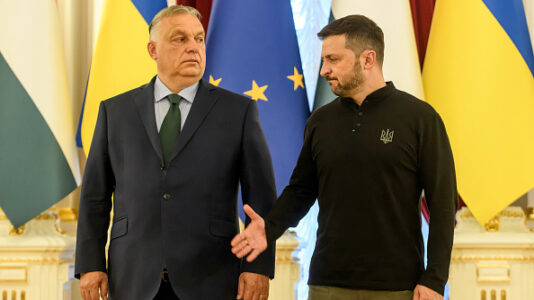
Last week, Hungarian Prime Minister Viktor Orban slammed the proposal, which he said calls for the EU to provide Ukraine with €800 billion for the country’s reconstruction and a further €700 billion for military needs over the next ten years.
“Hear me now, loud & clear: Hungary will NOT pay for this,” he wrote on X.
He has also nixed the idea of letting Ukraine join the EU, arguing that no Hungarian parliament would vote for accession “in the next hundred years.”
Orban has long stood against Ukraine’s bid, arguing that accession would put the bloc at risk of direct confrontation with Russia.
Moscow has long said that it is not opposed to Ukraine joining the EU. However, Kiev’s ambition to join NATO is a red line and one of the core causes of the current conflict, according to Russia.
France has clashed with several EU nations over a proposal that would allow Ukraine to use an EU-backed loan to buy British Storm Shadow missiles, The Telegraph reported on Monday, citing diplomatic sources. Paris has consistently pushed for preferential treatment for the EU’s military industry on procurements destined for Kiev.
In December, EU leaders approved a €90 billion ($107 billion) loan to cover Kiev’s military needs and budgetary gap, with spending rules that prioritize EU-made weapons before allowing purchases from outside the bloc. According to The Telegraph, a coalition of 11 capitals has now proposed loosening the rule so Ukraine can more easily buy weapons such as Britain’s long-range Storm Shadow cruise missiles, which are in short supply.
France, however, has emerged as an “obvious opponent” to the plan, a diplomatic source told the newspaper. The outlet noted that Paris is the center of the EU’s drive for “strategic autonomy” amid concerns about overreliance on US defense after a rift with Washington over its controversial push to acquire Greenland.
Under the current design of the €90 billion loan, spending on weapons would follow a four-layer procurement cascade that prioritizes Ukrainian producers first, then EU defense firms, followed by partner countries such as the UK, with suppliers outside Europe – including the US – treated as a last resort, according to the article. Ukrainian officials have reportedly estimated that around €24 billion of equipment this year will have to come from suppliers outside the EU.
A diplomatic source told The Telegraph that the aim of Britain and its partners was to keep the system “open enough for the UK” to ensure that reaching the third layer of the cascade “is not so hard.”
NATO Secretary-General Mark Rutte earlier warned that the EU loan should not be constrained by “buy European” rules, while acknowledging the bloc “cannot fully supply everything Ukraine needs to defend itself today and deter tomorrow.”
Moscow has condemned Western arms supplies as prolonging the conflict, while Russian Foreign Ministry spokeswoman Maria Zakharova has suggested that the €30 billion portion of the EU loan earmarked for Ukraine’s budget support would be embezzled by local officials.
Slovakia will sue the EU over the bloc’s decision to entirely ban the import of Russian gas by late 2027, Slovak Prime Minister Robert Fico said on Tuesday. He branded Brussels’ move “energy suicide.”
A day earlier, the member nations voted to give their final approval to the REPowerEU regulation, as part of an effort to gradually phase out imports of natural gas from Russia by November of next year.
“We will file a lawsuit against this regulation at the Court of Justice of the EU,” Fico said at a press conference, calling the looming ban the finalization of the bloc’s “energy suicide.”
“It is a solution that was adopted solely out of hatred towards the Russian Federation. I reject hatred as a trait that should determine international relations,” he added.
The EU vote was approved by a qualified majority to bypass the need for unanimous approval in a way that contravened the core treaties of the bloc. The commission knew that if unanimity was required, such nonsense could not pass.
Slovakia and Hungary will lodge separate lawsuits but coordinate their positions further, Fico said.
According to Budapest, the vote was specifically run in such a way as to bypass Hungary’s and Slovakia’s opposition on a matter that pertains to their national interests.
EU divided over phasing out Russian energy
“The REPowerEU plan is based on a legal trick, presenting a sanctions measure as a trade policy decision in order to avoid unanimity… The [EU] Treaties are clear: decisions on the energy mix are a national competence,” Hungarian Foreign Minister Peter Szijjarto wrote on X shortly after the vote.
EU moves to cut off Russian gas – who will pay the price?READ MORE: EU moves to cut off Russian gas – who will pay the price?
Both Hungary and Slovakia, which are heavily dependent on Russian energy supplies, have previously warned that they could sue if Brussels plows ahead with the REPowerEU plan.
Moscow has warned that the bloc is essentially giving up its freedom by banning all Russian gas imports.
“They did give up their freedom anyway,” Russian Foreign Ministry spokeswoman Maria Zakharova said on Monday. “Time will tell” whether EU member nations will be “happy vassals or miserable slaves,” she said.
Although the likelihood of a US attack on Iran has greatly increased. If Iran shows widespread strength and resistance, the Americans will retreat. Iran’s response to military attacks will certainly be more severe and comprehensive than in previous cases.
In the national security document published in Trump’s second administration, like the previous two documents, the national defense of the United States is characterized, as it includes the defense of the territory, the defense of the people, the defense of the political system, and the defense of the economy.
Iran’s position was also prominent in previous documents. In that document, the name of Iran was repeated six times, and it was one of the greatest threats to US national security. It was proposed, and in addition, in two other cases, it referred to the threat of Iran.
In the latest document, the number of these references has been reduced to three. In the new document, direct reference to Iran’s nuclear program has been almost eliminated. But the issue and role of waterways is still prominent in this document; in fact, this time the name of the Strait of Hormuz is explicitly mentioned and emphasized in the new document.
The new US national security document depicts Iran in the general framework of “weakening” and does not actually mention Iran as a fundamental threat. But this does not mean that the United States no longer considers Iran a threat.
War or negotiations
The behavior of the Trump administration, namely in recent months, has been not only in rhetoric but also in practice anti-Iranian, from pressuring European governments to activate the snapback mechanism to supporting Israeli military actions, seizing ships suspected of carrying weapons to Iran, and even actions such as seizing ships off the coast of Venezuela.
Given the current state of US-Iran relations, the US has two options: moving towards an agreement or adopting a military option, but Washington’s desire is to stop Iran’s nuclear capability without falling into the quagmire of eternal wars.
The issue of negotiations had been stalled since the 12-day war because Tehran refuses to return to negotiations before receiving the necessary guarantees from the US about not starting another attack against Iran by Israel or the US and having the right to enrich uranium.
Not all Trump officials and aides share the same view and approach, and some believe that negotiating with Tehran will increase Iran’s legitimacy. Within the administration, it seems that some are willing not to move towards a military option before diplomatic solutions are exhausted.
Also, the United States, which previously adopted a policy of “maximum pressure campaign,” still claims to protect the rights of the Iranian people. In this regard, Donald Trump has now imposed a 25% customs tariff on any country that has trade relations with Iran, which could have a negative impact on Iran’s economic relations. Trump also called for illegal actions, including the occupation of government institutions, by asking Iranian protesters to continue the protests and even promised that help was on the way.
The United States is also using the protests inside Iran as a tool to gain more concessions from Tehran in any possible agreement.
Iran’s readiness for diplomacy and defense
Previously, Iranian Foreign Minister Abbas Araghchi had emphasized that the United States and the regime would not achieve a different result by repeating the previous failed experience. “Iran is much more prepared than the 12-day war,” he said, adding, “I hope the wise option will be chosen. We will prepare diplomatic and economic options.”
In a situation where an average of $10 billion was allocated annually for the import of basic goods, the government came to the conclusion that economic surgery should be performed in this area; the preferential currency should be eliminated for consumers.
The protests in Iran have been carried out peacefully since early January by a group of people and trades in response to currency fluctuations and the living conditions. The government announced that it recognizes these protests and efforts to address these concerns are ongoing. However, after a week and on January 8-9, the protests by terrorist elements turned into riots in cities, destroying government, public, relief, and mosques.
Iranian authorities have made mass arrests of terrorist elements in team houses and terrorist cells, and they even have documents about the connections between these terrorist elements and the United States and Israel.
In the view of government spokeswoman Fatemeh Mohajerani, the peaceful protests of the people were subjected to a terrorist attack. Also, Brigadier General Ahmad Ali Goodarzi, Commander of the Faraj Border Guard, announced the identification and destruction of 3 terrorist teams before they entered the country at the country’s borders and the discovery of weapons and ammunition from them.
Amir Saeed Iravani, Ambassador and Permanent Representative of Iran in the United Nations, stated in a letter to the Security Council and the Secretary-General of the UN: “The Islamic Republic strongly condemns the continuous, illegal, and irresponsible behavior of the United States of America in coordination with Israel to interfere in Iran’s internal affairs through threats, incitement, and deliberate encouragement of instability and violence.”
Also, internal cohesion among political groups and figures in Iran is established and stable. Apart from the words and positions of the Leader of Iran, the representatives of the Islamic Consultative Assembly (Parliament) considered the government’s decision (end of the consumption chain) a courageous act and an important step.
The parliament speaker, Mohammad Bagher Ghalibaf, said, “At this time, the responsibility of us as Iranian officials is to confront the enemy in the economic war.”
From the perspective of Hassan Rouhani, if a foreign aggressor wants to abuse the protest within the family, the family members will put aside the difference and break the aggressor’s hand.
In fact, from Tehran’s perspective, Iran is ready for both war and negotiation. That means fair, honorable, and equal negotiations with mutual respect and based on mutual interests are still the priority, not giving orders and dictating. Iran also has preconditions.
Although the US has greatly increased its forces in the region. Iran’s military forces are also at the peak of defensive readiness and are ready to confront any aggression and evil of the enemy against Iran. Therefore, any action must face retaliation from Iran.
The amount of oil sales in the past 14 months in the form of export shipments has been record-breaking. The creation of new restrictions on the sale of Iranian oil does not create any serious restrictions on Iran’s oil sales processes.
Outlook
It seems that the US is paying special attention to shaping a soft transformation and a colorful and internal revolution in Iran, along with hard threats as a means of pressure. But internal cohesion among political groups and figures in Iran is established and stable.
Although the likelihood of a US attack on Iran has greatly increased. If Iran shows widespread strength and resistance, the Americans will retreat. Iran’s response to military attacks will certainly be more severe and comprehensive than in previous cases.
In the meantime, Washington’s failure in the direction of the hard programs could make the path of interaction or resolution of issues between Iran and the United States, in the new framework, more complex.
Samyar Rostami is а political observer and senior researcher in international relations.
On Monday, Guo Jiakun, a spokesperson for China’s Foreign Affairs Ministry, rejected U.S. accusations of alleged Chinese “coercion” and “interference” in Central America.
His remarks came after Rep. John Moolenaar, chairman of the U.S. House Select Committee on China, traveled to several Central American countries to counter Chinese influence and question the involvement of Asian companies in strategic sectors such as the operation of ports linked to the Panama Canal.
In response, Guo described the U.S. claims as “complete lies and fallacies,” saying they reflect ideological bias and a Cold War mentality. “China firmly opposes certain U.S. politicians interfering in the normal relations between Central American countries and China,” the Chinese diplomat said.
He also stressed that the Chinese foreign policy toward Latin America and the Caribbean is based on principles of mutual respect, sovereign equality, mutual benefit, openness and inclusiveness, and cooperation aimed at shared development.
According to Guo, relations between China and Central American countries have produced tangible benefits for local populations, particularly in areas such as infrastructure, trade, logistics connectivity, productive investment, and technology transfer.
China maintains that its presence in Central America is not aimed at political domination but rather at a model of South-South cooperation that has been “well received by the countries involved.”
Guo urged U.S. politicians to stop instrumentalizing China-related issues for geopolitical purposes and to focus their efforts on initiatives that contribute to regional development. In multiple international forums, China has reiterated its rejection of bloc-based thinking and confrontation, advocating for a multipolar international order based on multilateralism and respect for state sovereignty.
Earlier, U.S. President Donald Trump released the new U.S. National Security Strategy, which prioritizes strengthening his country’s influence in Latin America and the Caribbean and seeks to reconfigure strategic control over key trade corridors such as the Panama Canal.
In the corridors of US strategic decision-making, Iran is no longer treated as a discrete regional file. Dealing with Tehran has become inseparable from great-power competition itself. Coordination between Iran, Russia, and China has moved beyond situational alignment, coalescing into what western analysts increasingly describe as a form of “structural synergy” that undermines Washington’s ability to isolate its rivals.
This assessment overlaps with conclusions reached by the Carnegie Endowment in its report on America’s Future Threats, which identifies Iran as a “central node” in the Eurasian landmass – one that prevents Russia’s geographical isolation while securing China’s energy needs beyond the reach of US naval control.
Any serious destabilization of the Islamic Republic would not remain confined within its borders. It would translate into a dual strategic blockade targeting both China and Russia: reviving security chaos across Eurasia’s interior while striking at the financial and energy platforms that emerging powers increasingly rely on to loosen unipolar dominance.
Geography as strategic depth
For Moscow, Iran’s importance begins with geography. It offers Russia a vital geopolitical opening beyond its immediate borders. According to studies by the Valdai Club, Iran’s significance lies not in formal alliance politics but in its function as the sole land bridge connecting the Eurasian heartland to the Indian Ocean via the International North–South Transport Corridor (INSTC).
This route provides Russia with insulation from NATO’s maritime pressure in the Baltic and Mediterranean, effectively converting Iranian territory into strategic depth protecting Russia’s southern flank.
This geographic interdependence has produced a shared political interest that goes beyond tactical coordination. The stability of the Iranian state acts as a safeguard against the Caucasus and Central Asia drifting toward the kind of fragmentation that preceded the Ukraine war. Research by the Russian Council for International Affairs (RIAC) frames Iranian geography as a cornerstone of the “Greater Eurasia” concept, central to Moscow’s effort to dilute western hegemony across the continent.
For Beijing, Iran plays a comparable role within a different strategic equation. As US naval pressure tightens across the Pacific, China’s westward extension through Iran has become increasingly difficult to replace. Research by the Council on Foreign Relations (CFR) identifies Iran as one of the most critical geographic nodes in the Belt and Road Initiative (BRI), providing Beijing with a land-based corridor into West Asia that bypasses US-controlled maritime choke points – from the Taiwan Strait to the Mediterranean approaches.
Iran’s intermediate position between the Eurasian interior and open seas has therefore imposed a durable entanglement between Tehran, Moscow, and Beijing. In this configuration, political alignment is driven less by ideology than by physiogeographic necessity.
Any attempt to destabilize the Iranian plateau would likely trigger a cascading shock across Eurasia’s interior, escalating a regional confrontation into a systemic blockade aimed at arresting the rise of rival power centers.
Buffer state and security firewall
Beyond logistics, Iran functions as a stabilizing buffer within East Eurasia’s security architecture. One research report by RAND on “Extending Russia” speaks of adversary exhaustion strategies that emphasize the use of peripheral instability to drain rival powers. From this perspective, Iran represents a critical firewall.
Instability inside Iran would mechanically undermine security coordination across Russia’s southern periphery, particularly in the Caucasus and Central Asia. RIAC assessments warn that such a breakdown would open pathways for extremist networks, transcontinental smuggling, and militant spillover – threats Moscow has repeatedly classified as existential.
For China, the concern lies in contagion. Iran’s stability limits the transmission of unrest through Central Asia’s mountain corridors, where Tehran functions as an integral security partner within the Shanghai Cooperation Organization (SCO). This role provides Beijing with a degree of security insulation, allowing it to pursue global ambitions without being drawn into attritional border conflicts.
Energy and financial sovereignty
Economically, Iran’s role extends beyond conventional trade logic. Its partnerships with Russia and China increasingly form part of an alternative financial and energy architecture designed to blunt western leverage.
From Beijing’s perspective, Iranian oil has become a form of strategic insulation. Data indicates that China purchases roughly 1.3 million barrels per day (bpd) of Iranian crude – around 13.4 percent of its seaborne oil imports – with close to 80 percent of Iran’s exports flowing eastward. Increasing settlement through non-dollar mechanisms, including the digital yuan, has further reduced vulnerability to US pressure, particularly at choke points such as the Strait of Malacca.
Reports from the Electricity Hub confirm that China imported more than 57 million tons of Iranian – or suspected Iranian – oil in 2025, often routed via intermediaries such as Malaysia. The figures underscore the diminishing effectiveness of sanctions when confronted with geoeconomic necessity.
Russia’s calculus follows a different path to the same outcome. Cooperation with Iran has emerged as one of Moscow’s most important routes around SWIFT-based isolation. Government of the Russian Federation data shows bilateral trade rising by 35 percent following the Eurasian Economic Union free trade agreement implemented in May 2025.
A central shift has been monetary. In January 2025, the Central Bank of Iran announced full connectivity between Russia’s MIR and Iran’s Shetab payment systems, creating a protected financial corridor. According to Iranian officials, Iran and Russia aim to expand bilateral trade to $10 billion over the next decade, while Iran’s exports to Russia are expected to rise to about $1.4 billion by the end of the current Iranian calendar year (March 20, 2026).
Tehran has increasingly functioned as a re-export hub for Russian technologies and goods, frustrating efforts to economically isolate Moscow.
Washington’s strategy of separation
Against this backdrop, US strategy has evolved. Rather than relying solely on pressure or open confrontation, Washington has gravitated toward what western policy circles describe as a “strategy of separation.” This is an attempt to loosen the interdependence binding Tehran, Moscow, and Beijing by offering alternative pathways rather than confronting the bloc directly.
On the Chinese front, energy has emerged as the primary point of leverage. As the world’s largest oil importer, Beijing remains sensitive to supply stability and pricing. US moves in Latin America – particularly regarding Venezuela – are widely interpreted as efforts to reintegrate large oil reserves into global markets under western regulatory frameworks, potentially diluting Iran’s role in China’s energy security calculus.
In parallel, Washington has expanded its naval and coalition presence across key trade corridors stretching from the Indian Ocean to the western Pacific. This posture is framed not only as deterrence but as a persistent reminder that maritime supply security remains tied to US-led power balances.
On the Russian front, Ukraine occupies a central role. While sustained military and economic pressure aims to drain Moscow’s capacity, intermittent diplomatic signals suggest interest in compartmentalized understandings over European security. The underlying wager is that Russia’s core interests might be partially accommodated in Europe, reducing the long-term value of its partnership with Iran.
US engagement has also intensified across Central Asia and the Caucasus – regions that constitute strategic depth for Russia and critical corridors for China’s BRI. From Moscow and Beijing’s view, expanded security and investment ties in these areas represent an effort to geographically encircle Iran and weaken its role as Eurasia’s connective knot.
Why the bet fails
Despite the breadth of these efforts, the strategy of separation runs up against entrenched distrust in both Moscow and Beijing. For the two powers, the issue is not the scale of incentives on offer but the structure of the international system itself – and the accumulated experience of sanctions, coercion, and volatile western commitments.
From Russia’s vantage point, any trade-off between Iran and Ukraine constitutes a strategic trap. Iran anchors Russia’s southern access to the Indian Ocean; its collapse would expose the Caucasus–Central Asia arc to chronic instability. Gains in Eastern Europe would offer little compensation for a structurally weakened southern flank.
China’s reasoning is similarly grounded. Alternative energy suppliers remain embedded within supply chains that Washington can influence or disrupt. Iranian oil, by contrast, offers a higher degree of geographic and political autonomy. Its value lies less in price than in resilience.
The last barrier
At its core, the contest over Iran pits two logics against one another. One assumes geopolitical networks can be dismantled through incentives and selective realignment. The other recognizes that geography, accumulated experience, and the erosion of trust render such guarantees fragile in a world moving steadily toward multipolarity.
Iran’s collapse or prolonged internal destabilization would not merely reorder energy markets or regional alignments. It would reopen West Asia as a zone of near-exclusive US influence, completing a strategic arc across Western Eurasia. For more than a century, the region has served as a central theater of global power competition – from imperial rivalries to the Cold War and into the present transition toward multipolarity.
Therefore, Iran becomes more than a pivotal state. Much as Venezuela once represented the outer limit of resistance to US power in the Western Hemisphere, Iran now stands as the final geopolitical barrier to the consolidation of American hegemony across the heart of Eurasia.
Its cohesion serves not only its own national interest but also the broader objective shared by Moscow and Beijing: constraining unilateral dominance and preserving strategic autonomy in their immediate neighborhoods.
China sharply increased its purchases of Russian liquefied natural gas (LNG) in 2025 and reached a record monthly volume in December, according to Chinese customs data cited by RIA Novosti.
In 2025, the Asian nation imported 9.8 million tons of the super-chilled fuel, up 18.3% from the previous year, the outlet reported.
December saw particularly strong growth, with imports rising to 1.9 million tons, a 114.6% increase from the 889,482 tons delivered in the final month of 2024.
Data also showed that in October, Russia became China’s second biggest LNG supplier, overtaking Australia and coming in slightly behind Qatar. Russia’s total gas supplies to China – via pipeline and in liquefied form – reached 5.8 billion cubic meters (bcm) in November 2025, a 33% increase from the same month a year earlier.
Imports of Russian LNG by China, one of the world’s largest gas consumers, have been rising steadily for several years. Alongside pipeline flows, Russia has expanded seaborne shipments from projects in the Arctic and the Far East, including Yamal LNG, Arctic LNG 2, and Sakhalin-2. Cargoes are transported largely via the Northern Sea Route during the summer navigation season and via longer southern routes in winter.
Moscow has sought to expand LNG exports via the Arctic corridor due to Western sanctions targeting key parts of its energy sector.
The surge in gas deliveries reflects a broader shift of Russia’s energy exports toward Asia following the sharp reduction of pipeline supplies to the EU since the escalation of the Ukraine conflict in 2022.
Russia also delivers natural gas to China via the Power of Siberia pipeline, which began operations in 2019 and reached full operational capacity in December 2024.
Moscow and Beijing are also advancing the planned Power of Siberia 2 pipeline through Mongolia. President Vladimir Putin has said that, together with existing and future pipelines, Russian gas deliveries to China could exceed 100 bcm a year.
The World Economic Forum (WEF) annual meeting recently kicked off in the Swiss resort city of Davos. This year’s forum took place amid rare transatlantic tensions triggered by the US intention to acquire Greenland. The focus of European leaders’ speeches pivoted noticeably from global economic issues to geopolitics, reflecting Europe’s deepening strategic anxiety amid structural contradictions with the US.
French President Emmanuel Macron said the EU should not bend to “the law of the strongest,” while Belgium’s Prime Minister Bart De Wever said the bloc was “at a crossroads” where it must decide on how to get out of a “very bad position” after trying to appease Trump. Even European Commission President Ursula von der Leyen highlighted the “geopolitical shocks” and “a dangerous downward spiral” brought by the US.
“The forum sends a clear political signal of Europe’s growing strategic awakening,” Zhao Junjie, a senior research fellow at the Institute of European Studies at the Chinese Academy of Social Sciences, told the Global Times on Wednesday.
The maximum pressure exerted by the US on the Greenland issue has shaken the long-standing value consensus between Europe and the US. Its unilateral and bullying actions have triggered strong fear and anxiety across Europe, which is a key reason for the heightened emotions and intense reactions toward the US among European representatives at this year’s forum.
The statements made by European leaders at the forum appear to have demonstrated Europe’s resolve to stand firm to the world. Yet it remains to be seen whether such firm commitments can be translated into practical, unified, and effective actions. As senior bankers and corporate executives at Davos noted, they believe the current responses of European leaders to the US are more emotional than pragmatic. Moreover, due to long-standing structural constraints – its deep entanglement with the US in security, energy, and economic affairs – Europe’s response is weak and constrained. Zhao further noted that Europe still lacks systematic measures to effectively counter American unilateralism, with current efforts largely limited to soft multilateral mechanisms.
Europe’s response to US unilateral pressures has been sluggish and lacking in internal coordination. The EU countries have not reached a consensus on the activation of Anti-Coercion Instrument. Meanwhile, Europe continues to grapple with “double standards” in its multilateral engagements. Despite the leaders’ calls for trade diversification, restrictive market-access policies toward certain foreign products have fueled ongoing trade tensions. This contradiction is illustrated by Macron’s appeal for Chinese investment in key sectors, even as the EU moves to phase out components and equipment from tech suppliers such as Huawei in some sectors – a policy that inevitably raises questions about Europe’s consistency and sincerity in pursuing cooperative partnerships.
Canada has already taken action. Prime Minister Mark Carney stated that middle powers are not “powerless” facing “a rupture in the world order.” He called for “honesty about the world as it is” and for building “something bigger, better, stronger, and more just.” Recently, Canada established strategic partnerships with China and Qatar to promote the diversification of its foreign relations. Such strategic sobriety may offer some inspiration for Europe.
Ursula von der Leyen declared in her special address that “Europe will always choose the world, and the world is ready to choose Europe.” Yet Europe must now answer a more pressing question: what path will it choose for itself in the changing global order?
The statements at Davos have sent a clear political signal of Europe’s awakening. Moving forward, Europe must consolidate its strength through unity, steer its own course with greater autonomy, and expand its strategic space through diversification. Confronted with external pressures, only by reinforcing internal solidarity, advancing pragmatic actions, and broadening multilateral cooperation can Europe truly safeguard its own interests and uphold the international multilateral order. Only in this way can Europe genuinely protect its interests amid profound changes. History does not wait for the hesitant – it is time for Europe to act.
Max Otte discusses how Germany began to ignore and undermine its own national interests after the Cold War. Max Otte is an entrepreneur, political economist, investment manager, philanthropist and political activist. With 141 votes, he was the runner-up for the election of the President of the Federal Republic of Germany on 13 February 2022.
The latest Substack from Sy Hersh is a doozy because it is rife with false claims and propaganda. I have known Sy for 45 years and consider him a dear friend. His latest article is an abomination and, in my opinion, represents a stain on his legacy. I feel like I’m watching a basketball legend who is still trying to play the game, but he can no longer run or shoot the basketball. To continue the basketball metaphor, this latest article from Sy is an air ball shot from the free throw line… It does not even hit the rim.
The article is titled, PUTIN’S LONG WAR, and it is an unwitting indictment of the US intelligence community’s analytical competence. The opening paragraph sets the tone for the piece:
Despair and anger are growing in some parts of the US intelligence community about Vladimir Putin’s refusal to consider ending the war with Ukraine. The Russian president is facing devastating economic problems at home and is ignoring his restless senior military command—in pursuit of what?
Despair and anger? What the hell!!! Why despair? Is this an admission that the CIA’s plans to defeat Russia are in ruins? Is the CIA, or some other component of the intelligence community, agonizingly frustrated because Vladimir Putin won’t perform as a dancing organ grinder’s monkey? Ditto for the anger bit.
But it is the last sentence that is a stunner because the official (or officials) talking to Trump apparently genuinely believe that Russia faces devastating economic problems and that Putin — who has made at least three visits to the front lines in the last two months — is ignoring the Russian General Staff. Nonsense!
Here is the next whopper of a lie in this article:
Businesses are reeling and shops are closing—in part due to international sanctions—in Moscow and throughout Russia.
More Male Bovine Excrement… I’ve been to Moscow twice in the last four months and saw nothing of the sort. Businesses were thriving, not closing up shop. The latest Levada poll (independent, non governmental) just recently released reports Putin’s current approval ratings at a whopping 85%!!! If the economy was collapsing there is no way that he could be so popular!
Sy’s next paragraph reveals the lack of critical thinking on the part of his source:
One experienced US official, who has been involved in Russian issues for decades, remains both mystified and frustrated by Putin’s refusal last fall to accept an American offer, approved by President Donald Trump but bitterly resented by Ukraine. . . “As of January,” he told me, “Russia’s war with Ukraine will have lasted longer than their war with Germany. In 1945, they were in Berlin. In 2026 they won’t even control Donetsk,” an eastern Ukrainian province with a large Russian-speaking population that shares a border with Russia.
Yeah, Russia’s military really sucks. They are fighting a NATO-proxy army that has the full backing of NATO, which includes advanced weaponry and sophisticated intelligence, and are advancing all along the line of contact… Just not as fast as this clown in Washington, who is gibbering away to Sy, believes that Russia should move. So if Russia’s slow pace is an indictment of its military competence, what does that say about the US military, which spent 21 years fighting in Afghanistan against lightly-armed insurgents — who had no foreign backing — and fled the country in August 2021, leaving behind $7.1–7.2 billion worth of US-funded military equipment. Trump officials who live in big glass houses should not be throwing rocks at a brick house.
Next, Sy regurgitates a demonstrably false claim provided by his source:
“Putin knows the ghost in the Kremlin closet,” he said, “is revolution.” The official quoted General Valery Gerasimov, the Russian chief of staff: “I no longer have an army. My tanks and armored vehicles are junk, my artillery barrels worn out. My supplies intermittent. My sergeants and mid-grade officers dead, and my rank and file ex-convicts.”
This official is lying. Let’s examine recent public comments from Gerasimov (and they are on video) about the condition of the army that he leads:
In late December briefings (e.g., December 29 meeting with Putin and commanders), Gerasimov reported that Russian forces had liberated 334 settlements and over 6,400 square kilometers throughout 2025 overall, framing the army as steadily pushing deeper into Ukrainian defenses with consistent momentum.
On December 31, 2025, during an inspection of the Sever (North) Grouping of Forces command post, Gerasimov stated that Russian troops were “confidently advancing deep into enemy defenses” and that December 2025 saw the highest rates of offensive operations by the Russian army. He highlighted the liberation of over 700 square kilometers of territory in a month, the expansion of a “security zone” near the Russian border (in Sumy and Kharkiv regions), and the occupation of seven settlements. He described these as record paces and tied them to fulfilling objectives set by President Putin for border security in Belgorod and Kursk regions.
On January 15, 2026, while inspecting the Tsentr (Center) Grouping of Forces in the Donetsk direction, Gerasimov praised the group’s advances in liberating parts of the Donetsk People’s Republic (DPR). He claimed Russian forces were advancing “in virtually all directions” on the front, that Ukrainian attempts to halt them were unsuccessful, and that over 300 square kilometers had been seized in the first two weeks of January alone. He also reiterated ongoing successes in areas like Kupyansk (claiming final stages of control) and emphasized high operational tempo.
I can understand why this unnamed offical would lie, but I don’t understand why Sy is so gullible. He is allowing himself to be used as a propaganda mouthpiece. The next paragraph belongs in an episode of the Twilight Zone:
“The West reached the same stalemate conclusions and seeks to undermine Putin’s internal resolve. Not by military attack but with economic sanctions which affect the elites as well as the population as a whole. It is working—the standard of living is dropping rapidly as taxes, isolation, and casualties grow. Disillusionment and resentment are increasing. Last weekend Russia shut down all cell phone use and mobile internet service nationwide.”
Let’s start with the big lie… i.e., Last weekend Russia shut down all cell phone use and mobile internet service nationwide.” I exchanged messages with a number of people in Russia — three of them Americans — over the weekend. They all had functioning cell phones and mobile internet service. I asked one of my friends (he is a retired US Army officer who attended West Point, and now is a permanent resident of Russia) about life in Moscow. Here is what he told me via a cell phone text message that is supposedly not working:
There have been some internet access problems. Whatsapp is becoming less usable, but most people switch to Telegram or something else. The internal messenger service, Max, still has some glitches, especially for people with older iPhones like my wife and me. I read someplace that it will only work in iPhone 15 or newer models. If that’s so, it’s definitely a screwup or glitch. However, most people have Chinese made Android smart phones, and our kids’ Androids were easily able to upload Max on them.
I just bought two boxes of eggs on Tuesday afternoon. My wife asked me to get a particular brand found at one of the nearby supermarket chains, two of which are within very close walking range (2 blocks!).
Eggs are sold here mostly by the metric dozen: 10 eggs.
At the time I bought them, the exchange rate was 77.78 rubles = $1.00 USD.
One metric dozen cost me 54.99 rubles! That’s 10 eggs for 71 cents ($0.71)! That’s 7.1 cents per egg, and is the equivalent of $0.85 for 12 eggs!
This is one of the most basic high quality and high protein staples, non-GMO!
Studies have shown that most salaries have actually gone up! Of course, it also all depends on what business or line of work people are in. Sure, inflation is still present, and taxes have gone up somewhat. But isn’t that happening all over the world? I dare say that these economic effects are a lot better than in many other countries in the West.
Electricity, home internet and mobile phone bills are so cheap compared to when we lived in the US that it is laughable!
Medical bills are zilch! as one can pay if one wants to. But my wife and I have both had major (cutting open) and minor surgical procedures, all absolutely free! Kids, too, of course. We had to pay for my son’s braces, but that was also a pittance compared to what they charge in the States.
As an official retiree/pensioner, I can have orthopedic dental work now done for free! I need another implant, as I had to have a tooth extracted several months ago. They told me that after 6 months, that they can give me a new implant there.
If I order a Swiss implant, it would cost me 55 000 rubles ($708 USD). What the heck do I care? I’ll have a Russian made implant for free. Heck, I turn 74 next month. Who needs a fancy Swiss implant?
I also have free public transportation now. And because our daughter is handicapped, she and my wife also have free public transportation. (Not long distance trains, but for almost anywhere within both Moscow and the Moscow oblast.)
Let me remind you, this is the testimony of a retired US Special Forces officer. If this official who is talking to Sy Hersh is also briefing Donald Trump then we cannot blame Trump for failing to understand the actual situation on the ground in Ukraine… He is being fed monstrous lies.
One final point about the alleged economic distress in Russia. The official told Sy:
“The army is losing respect, national oil and gas income is down 22 percent and with no ability to borrow from abroad to finance the war with Ukraine.
While it is true that oil and gas revenues are down, the official apparently forgot to mention that the oil and gas sector (including production, not just budget taxes) was 9.67% of GDP in 2021, according to the World Bank. Statista/Rosstat data show the oil and gas industry’s share in GDP hovering around 10–15% in recent quarters (through mid-2024; 2025 figures not fully updated but consistent with downward pressure).
With respect to finances, Russia’s deficit widened to 2.6% of GDP in 2025 (highest since 2020), partly due to this revenue shortfall. But that is half of the financial challenges confronting the US… For Fiscal Year 2025 (ended September 30, 2025): The deficit was 5.9% of GDP, according to the Congressional Budget Office (CBO) final Monthly Budget Review and Treasury data. This reflects a total deficit of $1.8 trillion (down slightly from $1.84 trillion or 6.3% in FY 2024).
When we look at the comparative debt-to-GDP ratios for Russia and the United States, we get a clearer picture of which country is facing financial disaster. Russia has a debt-to GDP ratio of 16–20% while the United States‘ ratio is a gargantuan 118–125% (gross federal debt), which is more than 6 times Russia’s level. The US ratio is among the highest for advanced economies, driven by persistent large deficits (5.9% of GDP in FY 2025), pandemic-era spending, and structural issues like entitlement growth. Russia’s debt burden is far lighter relative to its economy, giving it more fiscal flexibility despite sanctions and defense spending. By contrast, the US faces greater long-term challenges from interest costs and entitlement pressures.
I do not know if Sy’s source genuinely believes the pack of lies he fed to Sy, or if he is engaged in some sort of misinformation operation designed to keep the American public in the dark. Either way, Sy got played.
Here are my latest podcasts. The first is an abbreviated conversation with Danny Davis. The second is my session, recorded last Friday, with Pascual Lottaz of Neutrality Studies. The last video comes courtesy of Marcello, who is temporarily in Brazil:
The European Parliament has voted to refer a trade agreement with the South American bloc Mercosur to the EU Court of Justice (CJEU). The move comes amid criticism of Commission President Ursula von der Leyen for bypassing normal EU procedures and widespread protests from farmers across the bloc.
On Saturday, the EU signed a trade pact with Mercosur members Argentina, Brazil, Paraguay, and Uruguay. The agreement that was projected to create the world’s biggest free trade zone still requires approval before it can take effect.
On Wednesday, the EU Parliament voted 334 in favor to 324 against, with 11 abstentions, to ask the CJEU to determine whether the deal is compatible with the bloc’s rules. The move now significantly delays the pact that had been negotiated for 25 years, and could potentially derail final approval.
The vote took place against the backdrop of criticism of von der Leyen for handling the Mercosur deal in a non-transparent way, splitting it into separate agreements to bypass national parliaments and reduce the European Parliament’s role to a formal opinion.
The deal has also faced widespread resistance from the agricultural sector, with farmers across the bloc staging mass protests over concerns that cheap imports could undercut their livelihoods. The latest rally began on Tuesday outside the European Parliament in Strasbourg and drew support from some lawmakers, continued overnight, and ended on Wednesday.
Von der Leyen had pushed the deal, describing it as a “clear and deliberate choice,” highlighting that the EU opts for “fair trade over tariffs” and “a productive long-term partnership over isolation.” The pact came just six months after she signed an agreement with US President Donald Trump that imposed a 15% tariff on most EU exports. The EC president faced strong pushback over the US deal from current and former EU officials and heads of member states.
The EU is Mercosur’s second-largest trading partner, accounting for nearly 17% of the bloc’s total trade in 2024, at €111 billion.
The Omission of Israeli Terrorism in the Occupied Palestinian Territories
By Karin Brothers | Global Research | December 6, 2014
… The Israeli settlements — all of which are illegal – have been identified as a major impediment to peace. The refusal of a major “global” terrorism report to name the Israeli settlers as one of the groups most responsible for terrorism not only misrepresents a major source of regional violence but exposes the Global Terrorism Index as a propaganda tool that supports a U.S. agenda.
In recent years, governments have been attempting to thwart terrorism by blocking supportive fund-raising. When it comes to Israeli settlements, however, the US and Canada actually encourage fund-raising by giving organizations (such as Christian Friends of Israeli Communities (CFOIC) and the Jewish National Fund) financial support in the form of donor tax-deductions.
Charities which provide funds for the Israeli settlements should be regarded as terror-financing organizations. They should not only lose their tax-deductible status, but they should be banned because they support the violation of international humanitarian law. The terror-financing laws that are being strictly enforced for Muslim charities should be applied to Christian and Jewish charities as well. … Read full article
This site is provided as a research and reference tool. Although we make every reasonable effort to ensure that the information and data provided at this site are useful, accurate, and current, we cannot guarantee that the information and data provided here will be error-free. By using this site, you assume all responsibility for and risk arising from your use of and reliance upon the contents of this site.
This site and the information available through it do not, and are not intended to constitute legal advice. Should you require legal advice, you should consult your own attorney.
Nothing within this site or linked to by this site constitutes investment advice or medical advice.
Materials accessible from or added to this site by third parties, such as comments posted, are strictly the responsibility of the third party who added such materials or made them accessible and we neither endorse nor undertake to control, monitor, edit or assume responsibility for any such third-party material.
The posting of stories, commentaries, reports, documents and links (embedded or otherwise) on this site does not in any way, shape or form, implied or otherwise, necessarily express or suggest endorsement or support of any of such posted material or parts therein.
The word “alleged” is deemed to occur before the word “fraud.” Since the rule of law still applies. To peasants, at least.
Fair Use
This site contains copyrighted material the use of which has not always been specifically authorized by the copyright owner. We are making such material available in our efforts to advance understanding of environmental, political, human rights, economic, democracy, scientific, and social justice issues, etc. We believe this constitutes a ‘fair use’ of any such copyrighted material as provided for in section 107 of the US Copyright Law. In accordance with Title 17 U.S.C. Section 107, the material on this site is distributed without profit to those who have expressed a prior interest in receiving the included information for research and educational purposes. For more info go to: http://www.law.cornell.edu/uscode/17/107.shtml. If you wish to use copyrighted material from this site for purposes of your own that go beyond ‘fair use’, you must obtain permission from the copyright owner.
DMCA Contact
This is information for anyone that wishes to challenge our “fair use” of copyrighted material.
If you are a legal copyright holder or a designated agent for such and you believe that content residing on or accessible through our website infringes a copyright and falls outside the boundaries of “Fair Use”, please send a notice of infringement by contacting atheonews@gmail.com.
We will respond and take necessary action immediately.
If notice is given of an alleged copyright violation we will act expeditiously to remove or disable access to the material(s) in question.
All 3rd party material posted on this website is copyright the respective owners / authors. Aletho News makes no claim of copyright on such material.


 Aletho News