Why is the Selective Service war gaming a ‘special skills’ draft?
A military mobilization exercise offers clues about who might be drafted for what sort of conflict
By Edward Hasbrouck | Responsible Statecraft | July 8, 2026
Documents obtained through a Freedom of Information (FOIA) request show that the Selective Service recently gamed out what a military draft would look like in a future war. It would not resemble the one the nation lived through 55 years ago for the Vietnam War or the contingency plans in current standby Selective Service regulations. Instead, those with “special skills” would be conscripted first.
This is the opposite of what the Selective Service says in its promotional materials, that “if a draft is authorized, individuals are selected through a random lottery” from among all young men regardless of their occupation or current skills.
According to the January 2026 military mobilization exercise, the first wave of draftees could include “computer network technicians, electronics technicians, aerospace engineers, divers, welders, gas turbine engine mechanics, electricians, heavy equipment operators, longshoremen, steel workers / pipefitters, radar / communications technicians, fiber optic technicians, mariners, aviation structural mechanics, cyber security specialists, robotics operators and technicians, air traffic controllers, logistics specialists, [and] linguists.”
A retired Army officer who spoke with RS suggested these kinds of skills indicate “the skill set required to expand (the) Navy, both manning ships and shore support, plus airfield operations.”
Officially, the Selective Service claims that a draft would be activated only in the event of a “national emergency.” This euphemistic language suggests a natural disaster or defense against invasion of the United States — what the chair of the National Commission on Military, National and Public Service (NCMNPS) posed as the “Red Dawn scenario”.
But the January exercise followed a much different course — an escalation to war, presumably with China over Taiwan, leading to full mobilization and then the draft.
In this scenario Washington intervenes militarily after Country A (China) blockades Country B (Taiwan) and the U.S. tries to break the blockade. The war escalates to “U.S. air attacks” on “Country A homeland.” A national emergency is declared and a draft is activated after full mobilization and retaliatory “kinetic strikes” by Country A on U.S. bases in Alaska and Hawaii. The first wave draft is declared shortly after. This scenario is very similar to the one envisioned recently in RS by Doug Bandow for how a U.S. attempt to break a Chinese blockade of Taiwan might escalate.
A provision in the NDAA for FY2022 required the Department of Defense conduct an exercise that would “include the processes of the Selective Service System in preparation for induction of personnel into the armed forces” by the end of FY2023. That exercise still hasn’t been conducted, but the SSS engaged in the above exercise in preparation for it. Multiple scenarios were considered in the SSS exercise, but only one was released in response to my FOIA request.
The lottery has long been considered central to the fairness of a draft. Many Americans would likely draw a line between a draft to mobilize against an unprovoked invasion of the United States and one to backfill military ranks in war started with China on behalf of another country 8,000 miles away.
All of this comes as the SSS is preparing to replace the failed system of self-registration with an automated system (also likely to fail) under which the SSS will try to identify and locate potential draftees by using existing databases from other Federal agencies.
Proposed regulations for “automatic” draft registration have been held up in review by the White House for more than three months, running down the clock for the SSS to complete the notice-and-comment administrative proceedings required before the change in the registration law takes effect on December 18, 2026.
I suspect the White House has realized that visible moves toward an unpopular draft in the middle of an unpopular war with Iran will fan the flames of opposition to its war policies. Meanwhile, the SSS has maintained radio silence since the “automatic” registration law was enacted, not issuing any statements or responding to any inquiries from journalists for more than six months.
Meanwhile, the idea for a “special skills” draft has been a controversial one ever since it was conceived of by the SSS in the early 1990s.
Aside from the SSS mandate to maintain readiness for the general draft, U.S. law mandates a parallel plan for a draft of “persons qualified for practice or employment in a health care occupation.” Proposed regulations for the Health Care Personnel Delivery System (HCPDS), to include men and women up to their 45th birthday in 57 occupational categories from dietitians and physical therapists to dental assistants and medical equipment repair specialists, were published in 1989. The SSS has maintained contingency plans ever since for activation of the HCPDS.
Congress has never seriously debated a special-skills draft other than for health care workers. But despite the lack of any Congressional authorization for planning and preparation for a broader special-skills draft, it has been under discussion by the Pentagon and the SSS for many years.
In 2004, a spokesperson for the SSS said that, “Talking to the manpower folks at the Department of Defense and others, what came up was that nobody foresees a need for a large conventional draft such as we had in Vietnam. But they thought that if we have any kind of a draft, it will probably be a special skills draft.”
Negative public reaction quickly prompted the Acting Director of the SSS to walk back the significance of this planning: “Today’s discussions about a broader special-skills draft are a practical outgrowth of normal contingency planning and are conceptual only.”
When the National Commission on Military, National, and Public Service (NCMNPS) was established in 2016, part of its mandate from Congress was to consider “the feasibility and advisability of modifying the military selective service process in order to obtain… individuals with skills (such as medical, dental, and nursing skills, language skills, cyber skills, and science, technology, engineering, and mathematics (STEM) skills) for which the Nation has a critical need, without regard to age or sex.”
The option of a special-skills draft modeled on the HCPDS was discussed but voted down by the NCMNPS. In closed-door meetings, one NCMNPS member noted that “it would be less politically feasible to set up a separate skills draft” than a draft that impacted all young men equally, and another opined that a special-skills draft would not be “fair and equitable.”
The continued prominence of a special-skills draft in SSS war games, despite the absence of a legal basis for it and its rejection by the NCMNPS, is indicative of the disconnect between what the SSS says and what it is doing, as well as between SSS fantasies and the real obstacles to a draft.
We all should be concerned about what sort of draft and what sort of war the SSS is preparing for. The time to consider whether we want a draft, and whether current contingency plans could feasibly be activated, is before the nation is committed to a war that would require a draft.
Yet there were no hearings or debate before Congress rubber-stamped the SSS proposal for “automatic” registration. Congress has never considered whether a special-skills draft would be feasible or fair. There’s been no audit of the accuracy or completeness of the SSS registration database since 1982.
Even supporters of a draft should be concerned about reliance on unworkable plans. It’s time for Congressional oversight hearings on whether the SSS is making realistic plans for national defense, or just trying to justify its continued existence in the face of proposals to abolish the agency.
Edward Hasbrouck is the editor and publisher of Resisters.info, the most comprehensive independent source of information about the draft and draft registration in the U.S. since 1980.
EU’s Break With Russian Energy Cost €3 Trillion
Sputnik – 07.07.2026
Total economic losses for EU countries due to the refusal to buy Russian energy could amount to approximately 3 trillion euros ($3.4 trillion), the Russian Permanent Mission to the EU said.
“The total losses for European countries from the refusal to buy Russian energy, according to some estimates, amount to approximately 3 trillion euros,” the mission told a Russian newspaper.
European companies and ordinary citizens have fully felt the consequences of Brussels’ policy of severing ties with Russia, it said. This has manifested itself in the form of sharp price hikes, high energy prices, declining living standards, and the closure and relocation of industrial enterprises outside the EU.
Russia has repeatedly stressed that the country would cope with the sanctions pressure that the West had begun to exert on Russia several years ago and continued to escalate. Russian President Vladimir Putin previously said that the policy of containing and weakening Russia was a long-term Western strategy, and that sanctions had dealt a serious blow to the entire global economy.
EU to spend €2.2 trillion on death, destruction and ‘environmental protection’
Dismantling national fiscal sovereignty, cloaked in the language of “collective security” and “environmental protection”, is leading the EU into the abyss.
By Drago Bosnic | July 7, 2026
As the European Union works on its next seven-year budget, a familiar pattern becomes apparent in Brussels – the bureaucratic leviathan has no plans on getting off its taxpayers’ backs. On the contrary, it keeps demanding more and it’s only a matter of time before these demands “break the camel’s back”. However, the unelected bureaucratic dictatorship’s fiscal megalomania is still nothing in comparison to what it plans to do with the money taken from the aforementioned taxpayers. Namely, Ursula von der Leyen and her entourage are pushing for a financial framework that, according to German economist and journalist Thomas Kolbe, amounts to nothing less than a formally “legalized” €2.2 trillion wealth-transfer machine.
In his latest analysis published by Zero Hedge, Kolbe masterfully dissects how this project is not merely about military spending or climate redistribution. His spot-on report points to the systematic construction of the EU as a bureaucratic superstate with little to no public oversight, funded by perpetual debt and imposed upon the increasingly weary taxpayers of member states, with Germany once again shouldering the heaviest burden. Kolbe’s central thesis is that this fiscal push arrives at the most precarious of economic moments. He warns that “across the world, public debt levels are approaching dangerous flood marks”, with total liabilities now exceeding 95% of global GDP. In his view, a reckoning is imminent.
“It is therefore only a matter of time before bond markets bring the debt party to an end, pushing interest rates – and with them debt-servicing costs – to levels governments can no longer afford,” he argues.
All this is the logical consequence of decades of political irresponsibility and contempt for the very concept of fiscal prudence. For four decades, a bull market in sovereign bonds masked this rot, but Kolbe correctly points out that this era ended roughly four years ago. Now, as investors lose confidence, the gates of fiscal austerity stand ready to storm the palace of political extravagance. Yet, for the corrupt and delusional political elites in Brussels, austerity is anathema. It would be an admission that their grand project of debt-financed expansion has led to a dead end. Not to mention they’d also need to take accountability in front of the masses they look down upon and despise as “net zero carbon footprint dodgers”.
As Kolbe writes, “few things are more alien to modern political elites than acknowledging failure”. Nowhere is this more evident than in the EU capital, where the unelected bureaucratic dictatorship remains convinced it’s building a supranational confederal superstate on “the right side of history”. Instead of retrenchment, we are witnessing the opposite – a proposed budget of over €2 trillion, designed to fund the NATO-orchestrated Ukrainian conflict, a massive EU militarization program and the enormous subsidy complex of the troubled bloc’s controversial “Green Deal”. In other words, Brussels is preparing to blow up the “old continent” while making sure it’s also “environmentally protected”.
Obviously, this is because nothing screams “ecology” more than a new pan-European invasion of Russia (for the hundredth time in the last millennium or so). The mechanism for these financial programs is twofold and includes higher direct contributions from member states and the issuance of new common debt. The financial implications for German taxpayers are staggering. As Kolbe meticulously details, Germany currently finances roughly one-quarter of the EU budget. Under the proposed framework, German taxpayers would contribute around €500 billion over the seven-year period. Last year alone, Berlin paid roughly €30 billion into the EU coffers while officially receiving approximately €13 billion. The gap is a direct subsidy to Brussels’ greed.
However, even this fiscal leap into fantasy is not enough to satisfy the insatiable appetite of this bureaucratic monster. Kolbe reveals that discussions are now underway to increase the budget by another €200 billion, which would send Germany’s annual contribution skyrocketing from €30 billion to an almost unfathomable €78.6 billion. This 162% increase is driving a permanent structural transformation. The EU Commission is working relentlessly to establish what it calls “independent sources of taxation”, which includes everything from customs revenues and emissions trading to plastic taxes. The only logical conclusion for Kolbe is that “the imagination of Brussels appears limitless”.
And indeed, the otherwise useless, talentless and woefully incompetent bureaucratic dictatorship is expertly efficient when it comes to finding ways to latch onto new hosts in order to continue its parasitic existence. This is not merely about balancing a ledger, but a (geo)political project to create an “entirely new layer of government – complete with its own bureaucracy and increasingly its own taxation powers”. Brussels first leveraged the issuance of NextGenerationEU bonds to transform itself into an independent borrower on international capital markets. Now, as repayment of that €750 billion debt looms in 2028, the solution is predictable – simply refinance the liabilities through continuous new bond issuance.
This financial loop is as parasitic as you could possibly imagine. However, it’s now gradually becoming malignant, as the funding will be used to further militarize the troubled bloc. While joint military projects keep failing left and right, the massive militarization process doesn’t need to include acquiring weapon systems from domestic companies. There’s always the United States, where the Trump administration is conducting a far more efficient militarization. Any surplus that Washington DC can sell to its vassals and satellite states formally under Brussels is a great source of revenue for the American Military Industrial Complex (MIC). This makes the EU’s new financial loop great news for the US, as it ensures profit for years (if not decades) to come.
This transformation of the EU’s funding structure is effectively a financial evolution toward a superstate where common liability for Brussels’ debts is virtually inevitable. In other words, socialism for the elites and brutal capitalism for the masses, as profits remain in the hands of the bureaucrats, while regular folks get the “privilege” of paying off the perpetually growing debt. Kolbe rightly warns that “Europe’s downward spiral of declining prosperity is accelerating” and that it’s “a tragic process of economic deterioration – one that is increasingly likely to culminate in a major sovereign debt crisis”. Sadly, the debt crisis would be the least of the EU’s problems, particularly if the funds acquired in this way are used to escalate tensions with Russia.
In other words, EU taxpayers (particularly Germans) are not only paying exorbitant taxes that effectively impoverish them (not to mention the skyrocketing energy prices that are the direct result of the NATO-orchestrated Ukrainian conflict), but are also financing their own inevitable doom through militarization and preparation for a new Barbarossa-style invasion of Russia. Kolbe’s analysis is a sobering reminder that the drive for “more defense spending” and “more climate redistribution” is just a pretext for a far more centralized agenda and control that would enable this madness. The deliberate dismantling of national fiscal sovereignty, cloaked in the language of “collective security” and “environmental protection”, is leading the EU into the abyss.
Drago Bosnic is an independent geopolitical and military analyst.
Canada unveils new pipeline plan to cut US oil dependence
Al Mayadeen | July 3, 2026
Canada has moved forward with plans for a major new oil pipeline aimed at reducing its reliance on the United States and positioning itself as a supplier to Asian energy markets.
Alberta has formally submitted proposals to the federal Major Projects Office for a pipeline exceeding 1,000 kilometers, intended to carry as much as one million barrels of crude per day to the British Columbia coast, with construction slated to begin by September 2027.
Prime Minister Mark Carney described the initiative as a “once in a lifetime opportunity” for the country, announcing that the new line would largely trace the path of the existing Trans Mountain corridor.
The project would be built by Trans Mountain Corp, a federal Crown corporation, in partnership with Pembina Pipeline Corp.
Billions in investment
Carney tied the pipeline to a broader economic strategy, projecting that Thursday’s announcements would spur more than C$200 billion (US$141 billion) in fresh investment.
Alongside the pipeline, the plan includes nearly tripling Canada’s liquefied natural gas capacity through five new terminals over the next ten years, as well as a C$10 billion upgrade to the Port of Vancouver.
Alberta Premier Danielle Smith further called for the province’s oil production to double and for the pipeline to be operational by 2035.
Washington’s shadow looms over decision
The push comes as Canada seeks to loosen its economic dependence on Washington.
The US currently absorbs about three-quarters of Canadian exports and roughly 60 percent of its oil imports, some 4 million barrels a day, nearly all of it drawn from Alberta’s oil sands, among the largest crude reserves in the world.
Carney has vowed to double Canada’s non-US trade as President Donald Trump has threatened tariffs of up to 100 percent on Canadian goods and repeated calls for Canada to become the “51st state.”
Trump also declined this week to commit to a long-term renewal of the US-Mexico-Canada trade agreement he signed in his first term.
Environmental groups
Environmental groups and First Nations communities welcomed Carney’s decision to preserve an existing tanker ban along BC’s northern coast, with Heiltsuk Nation Chief Marilyn Slett calling it “a good day” for efforts to prevent oil spills.
Carney, a former UN climate envoy, has also acknowledged that the fossil-fuel-driven strategy will push Canada’s emissions higher, distancing his government from predecessor Justin Trudeau’s more restrictive approach to the oil sector.
Industry groups, meanwhile, argue that regulatory hurdles and an uncompetitive tax structure continue to discourage investment.
The plan also unfolds against a backdrop of internal strain, with Alberta’s separatist movement gaining traction and a referendum vote on independence set for October 19.
Trump threats fuel patriotism among Canadians
Trump’s confrontational posture toward Canada appears to be reshaping how Canadians see themselves. A new Politico poll found that 52 percent of Canadians now describe themselves as very proud of their nationality, up sharply from 34 percent in December 2024.
Analysts link the surge to Trump’s repeated threats to annex Canada and his tariff measures targeting Canadian exports, including a 25 percent tariff imposed by executive order in February 2025 that triggered retaliatory measures from Ottawa.
Those tariffs were later struck down by the US Supreme Court, which ruled that Trump’s use of the 1977 International Emergency Economic Powers Act to impose them was unconstitutional.
Even so, the poll suggests the rise in patriotic sentiment has not translated into a sense of national unity, with most respondents saying Canada remains internally divided.
Vessel runs aground after deviating From Iran-designated Hormuz route
Al Mayadeen | July 1, 2026
A cargo vessel ran aground in the Strait of Hormuz on Wednesday while traveling a route not approved by Iran’s naval authorities, Iran’s IRIB reports.
The ship was identified as a foreign container ship, but the report didn’t provide any further details on the matter.
IRIB’s report seems to underscore Iran’s geographical control over the strategic waterway, through which a fifth of all oil and gas passes.
According to HormuzTracker, the Strait of Hormuz remains severely disrupted, showing little to no passage through the key waterway.
This confirms a total halt in detected commercial navigation activity, with no crude oil tankers, LNG carriers, bulk carriers, or container ships recorded moving through the Strait.
Transit through the Strait fell sharply following waves of US aggression against Iran and subsequent hostile rhetoric from Washington. Trackers showed that between June 24 and June 28, vessels passing through the Strait of Hormuz fell from a high of 74 to 22.
Sanctions Lifted: Iran Selling Oil 20% More Expensive — Ghalibaf
Sputnik – 01.07.2026
Iranian Parliament Speaker and chief negotiator Mohammad Bagher Ghalibaf has confirmed that oil exports are flowing again following the lifting of sanctions, with Tehran selling crude at prices 20% higher than before.
“Since the day we lifted the blockade, we have exported more than 40 million barrels of oil,” Ghalibaf said in a television interview, dismissing earlier skepticism about the impact of sanctions relief.
The lifting of sanctions was a key component of the US-Iran memorandum of understanding signed in June, which also included the release of frozen assets and the reopening of the Strait of Hormuz.
Ghalibaf also pushed back against claims by US President Donald Trump that the released funds could only be used to purchase American agricultural products.
“The Central Bank can purchase any goods it needs, at any price and in any currency worldwide,” Ghalibaf stated, asserting Iran’s full control over the use of its assets.
The Iranian parliament speaker said Tehran intends to “increase the prosperity of the Strait day by day,” with plans to boost maritime traffic and lower insurance fees for vessels transiting the waterway.
“We must show the world that security here is increasing day by day,” he added, suggesting that the strait’s reopening would be accompanied by a broader effort to restore confidence in the key global shipping route.
Overnight into June 18, Iran and the United States remotely signed a memorandum that provides for an end to the military conflict that began on February 28. The document also sets timelines for the US to lift its naval blockade of Iranian ports and for Iran to restore shipping in the Strait of Hormuz.
The Middle East, Hormuz and the New Mercantilism
By Craig Murray | June 29, 2026
The provisional surrender document signed by Donald Trump appeared to represent a triumph for Iran and indeed for the world; but neither the USA nor Israel has the slightest sense of honour and they cannot be trusted to negotiate in good faith.
Iran knows this – after all, the USA twice attacked Iran actually during peace negotiations, on each occasion killing key Iranian negotiators.
To understand the American position, it is important to realise two key points:
- Greater Israel is an absolute priority
- Opening the Strait of Hormuz is not a US priority
While the US/Israeli alliance were defeated in their attempt to impose regime change on Iran, and indeed have consolidated the popular support of the Iranian government, they have succeeded in expanding Greater Israel. Israel has ethnically cleared and devastated a vast swathe of Southern Lebanon, expanding its military footprint, and notably attempting to repeat its ploy from November 2024 of pushing forward its armour under cover of ceasefire.
Israeli withdrawal from Southern Lebanon has been a major negotiating point for the Iranian government and is a key – indeed the very first – point of the Iran/USA MOU. But in an extraordinary coup aimed at negating that deal, the USA has signed a deal with Israel and its puppet Aoun regime in Lebanon which seeks to legitimise Israeli occupation of Southern Lebanon through the agreement of the “Lebanese government”.
This is an astonishing development. I did not think I could have a lower opinion of the appalling bloated traitor “General” “President” Aoun but not even I – nor I think any commentator – believed he would make such a deal with Israel. The plan is that the Americans, Israelis and Lebanese Army will act together to forcibly eliminate Hezbollah, and only after that is certified – by the Israelis – will the Israelis withdraw from Southern Lebanon.
Here are the operative paragraphs. Note that they carefully do not say in terms that Israel will actually leave Lebanon.
“3. …The Government of Israel and the Government of Lebanon commit to a reciprocal, sequenced process, with clear conditions, whereby the LAF will restore effective sovereign authority over all Lebanese territory, pending the verified disarmament of non-state armed groups and dismantlement of associated infrastructure, enabling the Israel Defense Forces (IDF) to progressively redeploy out of the Lebanese territory.”
“5 . …The Government of Israel underscores that the termination of this threat, through the disarmament and dismantlement of such groups in all of Lebanon and additional security arrangements to be agreed upon between the two countries, will eliminate any future need for IDF military action or presence in Lebanon.”
This is plainly completely incompatible with the USA/Iran MOU, which states as Point 1:
“The United States of America and the Islamic Republic of Iran and their allies in the current war are signing this MOU to declare the immediate and permanent termination of military operations on all fronts, including in Lebanon, and undertake from now on not to initiate any war or any military operation against each other, and to refrain from the threat or use of force against each other, and ensuring the territorial integrity and sovereignty of Lebanon. The final deal will confirm the permanent termination of the war on all fronts, including in Lebanon and other provisions of this paragraph.”
Of course, everybody knows that Israel will never withdraw voluntarily, any more than they withdrew from the Golan Heights. Annexation is plainly the goal and expansion of Greater Israel at least to the Litani River and probably further.
It is important to realise that this is not only Aoun seeking the annihilation of the Shia population of Southern Lebanon; he is also betraying his own community. Aoun is himself a Southern Lebanese Christian, and Israel has been destroying the homes, churches, hospitals and families of Southern Lebanese Christians with as much glee as they attack Muslims.
The agreement names two “pilot zones” where the combined Israeli and Lebanese Army forces will eliminate Hezbollah, followed by Israeli withdrawal from those zones. But these are zones which Israel is not currently occupying – they are areas where Israel was defeated in fighting by Hezbollah and which have been since subject to relentless Israeli bombardment.
So Aoun has agreed to support militarily an IDF advance further into Lebanon, against an agreement that Israel will be able to withdraw once these key Hezbollah redoubts have been destroyed. Even if Aoun were stupid enough to believe the Israelis will withdraw after the operation, this is a level of treachery it is difficult to comprehend.
Greater Israel is not a concept. It is a reality being created before our very eyes.
Israel now occupies 70% of Gaza and plainly the entire “Board of Peace” mechanism is nothing but smoke and mirrors, pure fraud. It has zero effect on the continued tightening of the Gaza concentration camp into an ever-shrinking area. Israeli settlements in the West Bank expand daily and every night the skies are red with Palestinian homes and crops burning. In East Jerusalem Palestinians are continually evicted and replaced by fresh European or American arrivals. In Syria, Israel is building permanent fortifications and its armour creeps forward field by field, with the full cooperation of “President” al-Jolani.
Iran was able to resist the combined military might of the USA and Israel. That is cause for celebration. But do not allow it to blind your eyes to the continued hard reality of the expansion of Greater Israel.
There is no gain for the US in the US/Iran Memorandum of Understanding which the US did not already possess before starting the war. It is therefore very possible, and in many senses valid, to read it as the formalisation of US defeat: a surrender document. Which is why you should be sceptical about US commitment to the terms.
The Strait of Hormuz was fully open before the US started the war. Allowing the flow of oil to resume has become a short-term US priority due to high domestic retail prices and pending elections, but the MOU envisages more Iranian control – and potentially fees – in the Strait than existed before the war.
There is no indication of restrictions on the Iranian nuclear programme that were not already available in the peaceful negotiations. Crucially there are no limitations on Iran’s vital ballistic missile production. The proposed relaxation of sanctions and release of frozen assets is a triumph for Iran and long overdue, and the $300 billion in dollars in reparations, from unspecified sources, is stunning.
So stunning of course that anyone with their head screwed on will realise there is no long term American intention to keep faith with the deal.
Trump is not stupid. There are many ways of characterising his kind of cunning, but it is not stupidity. He was not, as the prevailing narrative seeks to state, the only person in the World who did not realise the Strait of Hormuz would be closed by the war. The USA is quite happy to see the Strait of Hormuz closed, or permanently made more difficult and expensive to transit.
The key to understanding Trump’s position is his famous love of tariffs. Trump is a mercantilist. For many years the world worked on the general basis of accepting the economics of Adam Smith – that freedom of trade promoted universal, reciprocal wealth creation. That was the founding basis of the World Trade organisation, and is the internal philosophy of big trading blocs like the EU.
Trump rejects this and returns to the philosophy that other nations are all competitors, not potential partners, and that success lies not only in increasing your own production, but in damaging your rivals’ production – which ultimately will increase domestic production further. Trump rejects the basic premise of free trade.
The long prevailing belief in the beneficial effects of free trade historically was, as logic demands, accompanied by the demand for freedom of navigation.
Sweeping away tariffs goes hand in hand with sweeping away the controls on shipping which carry the goods. Before the rise of liberal economics, almost all states had practised mercantilism, with controls on shipping being a major source of state revenue. The magnificence of Kronborg Castle in Helsingør, in which Hamlet is set, was constructed entirely from revenues from tolls on ships exiting the Baltic by passing the strait it overlooks, for example.

Freedom of navigation was initially enforced ultimately by the British, and later the American, Navy. States attempting to enforce customary passage fees, for example in the Malaccan Strait, were classified as “pirates” and freedom of navigation became a routine justification for imperialist aggression and/or colonial occupation. Freedom of navigation eventually became customary international law, ultimately codified in the UN Convention of the Law of the Sea.
The simple truth is this: in openly abandoning the principle of free trade, the Trump regime has also abandoned the logically linked principle of freedom of navigation. This is evident not just in their indifference to the closure of the Strait of Hormuz. It is evident in the naval blockades of Cuba and Venezuela and above all in the worldwide blockade of Russian hydrocarbon deliveries, including the effective end of free passage through the Strait of Dover, and a de facto naval blockade of the Arctic passages.
Following the shale boom, the United States is a net hydrocarbon exporter. The USA balance of trade benefits from high hydrocarbon prices. Trump is doing everything he can to increase US hydrocarbon production by slashing environmental and other controls. This is a core Trump policy.
The USA does not import hydrocarbons through the Strait of Hormuz. That fact is key to Trump’s thinking.
In this mercantilist view, closure of the Strait has two benefits for the USA.
- It disadvantages rival hydrocarbon suppliers
- It disadvantages rival industrial competitors in Europe and Asia who do get hydrocarbons through Hormuz.
This is exactly the same logic behind the destruction of Nord Stream 2. The same mercantilist system also explains the effective seizure through naval blockade and control of Venezuela’s oil production, and the blockade of Russian hydrocarbons through sanctions and the “shadow fleet” propaganda disguising another naval blockade.
The UK’s recent actions in the Dover strait indicate that the West, not just the United States has surrendered the principle of freedom of navigation in straits.
Trump believes, as he has repeatedly stated in public, that domestic fuel prices in the USA are a blip and will equalise as the USA increases its domestic fuel production and Venezuelan fuel production. However this was not happening in time for the mid-term elections which is why reopening the Strait of Hormuz became a temporary priority that occasioned the ceasefire and MOU with Iran.
None of this implies good faith negotiation or a real prospect for a lasting peace.
Strait of Hormuz Remains Open for Those Who Adhere to PGSA Protocols, But Global Economy Faces Inflationary Shock
By Larry C. Johnson | SONAR21 | June 28, 2026
After an exchange of missiles and drones on Saturday, the US backed down and declined to continue striking Iran. Qatar reportedly intervened to broker a new ceasefire. The US and Iran, in response to Qatar’s intervention, agreed to halt attacks against each other and plan to meet in Doha on Tuesday for technical talks aimed at resolving their dispute over the Strait of Hormuz, according to Axios.
The US-Iran meeting was originally planned to take place in Switzerland on Monday and focus on Iran’s nuclear program. Now the talks will take place in Doha on Tuesday. Iran’s position is firm… Traffic through the Strait must be carried out in accordance with the PGSA protocols. The US boxed itself in a corner with the language of the MoU:
5. Upon the signing of this MoU, the Islamic Republic of Iran will make arrangements using its best efforts for the safe passage of commercial vessels, with no charge for 60 days only, from the Persian Gulf to the Sea of Oman, and vice versa. The traffic of commercial vessels will immediately start, and considering the need for removing the technical and military obstacles, and de-mining by the Islamic Republic of Iran, will be instated within 30 days. The Islamic Republic of Iran will conduct dialogue with the Sultanate of Oman, to define the future administration and maritime services in the Strait of Hormuz, in discussions with other Persian Gulf Littoral States, in line with applicable international law and the sovereign rights of coastal states of the Strait of Hormuz.
The MoU give Iran the sole responsibility for making arrangements for the “safe passage of commercial vessels” through the Strait of Hormuz. If the US had insisted on including Oman and the other Gulf nations in the MoU then Iran would be obligated to consult with them. But the US accepted Iran’s language and Iran will insist there is no compromise on its sovereign right to manage traffic flow through the Strait.
While the world markets remain fixated on oil passing through the Strait, they are ignoring the profound impact of the halt in the shipment of Helium, Sulfur and Urea. The global economy is already experiencing the pain of the reduction in the supply of these commodities and the world will experience a global inflationary shock. Let’s look at each one.
Helium
The structural problem: Roughly one-third of the world’s helium production is impacted by the crisis, due to both the disruption of LNG production in Qatar and the very time-sensitive nature of helium transportation.
The mechanism was twofold. On March 2, state-owned QatarEnergy halted all LNG and associated production at Ras Laffan Industrial City following Iranian drone and missile strikes. On March 4, QatarEnergy declared force majeure on affected contracts. The company’s CEO stated that production would not restart until the conflict ended, and that even then, normalisation of deliveries would require “weeks to months.” Iran then struck Ras Laffan again on March 18-19.
Price movement: The shock hit fast. “The spot price for helium has moved up pretty dramatically. I would say 70 to 100 percent in a week,” said Phil Kornbluth, president of Kornbluth Helium Consulting and a 30-year veteran of the industry. Bank of America put the initial surge at 40%, while other estimates put prices at between 70% and 100% higher in some cases within a little more than a week.
The situation had an additional physical complication that other commodities don’t face. Roughly one-third of the world’s cryogenic helium ISO containers were stranded in or around Qatar. Repositioning this equipment after the conflict would require a minimum of three months, creating a supply gap that outlasts the conflict itself. Liquefied helium evaporates within roughly 45 days, meaning stranded inventory cannot be held for later delivery. Ships rerouting via the Cape of Good Hope face an additional 3,500 nautical miles, extending transit times by 10 to 14 days, during which liquid helium experiences boil-off losses of 15–20% of cargo volume.
By June 20, prices remained substantially elevated with no clear return path, because the damage to Ras Laffan is physical, not merely logistical. Even after Iran and the United States announced a ceasefire, the Strait of Hormuz remained largely closed due to overlapping blockades, meaning that even if production restarted, Qatari helium had no viable sea route to market. The structural problem persists through the MOU period.
Given Helium’s critical role in the production of computer chips, the price of computers and smart phones is soaring. Apple, for example, recently announced significant price hikes for the iPhone 17 Pro Max (+$200) and the 16-inch MacBook Pro (+$300).
Sulfur
Pre-war baseline — already stressed: The sulfur price to Indonesia rose from $101 per metric ton in July 2024 to $554 per metric ton by January 2026 as high-pressure acid leaching (HPAL) expansion drove demand — a 440% increase before the Iran conflict added further pressure. The market was already at multi-year highs before February 28.
The geographic exposure: Ships moving through the strait carry 24% of the world’s sulfur, a feedstock for sulfuric acid used to make metals like nickel and copper, as well as fertilizer and household cleaning products. The Middle East accounts for roughly 24% of global sulfur production and approximately 50% of global seaborne sulfur trade, all of which transits the Strait of Hormuz.
Price movement: Since the start of Operation Epic Fury, the price of sulfur has nearly doubled. Gulf states typically provide 45% of the seaborne sulfur trade through the Strait of Hormuz, and Iran’s blockade caused a 30% price spike by halting half of the global supply, creating bottlenecks in mineral extraction. Sulfur shortages were already leading to 20–30% output reductions for critical mineral miners.
The downstream cascade was severe. The World Bank noted that sulfur prices had doubled since January by April 2026, and that China’s move to tighten exports — in response to its own domestic shortfall as Persian Gulf imports dried up — added upward pressure on DAP (diammonium phosphate) prices. China banned sulfuric acid exports, impacting among other things copper production in Chile, which imported sulfuric acid as a consumable.
By June 20, with the MOU in place but Hormuz only partially normalising and QatarEnergy yet to fully resume operations, sulfur prices remained substantially above pre-crisis levels. As of May 2026, prices remained elevated, with the global fertilizer index projected to rise over 30% for the year amid persistent supply risks and rerouting challenges.
Urea
Pre-war baseline: Before the war, the cost of FOB granular urea in Egypt — a bellwether of nitrogen fertilizers — was $400 to $490 per metric ton. US retail prices hovered in the same general range through mid-February.
The geographic exposure: The Arabian Gulf is the central hub for global agriculture, accounting for at least 20% of all seaborne fertiliser exports. The dependency is even more acute for urea, the world’s most widely used nitrogen fertiliser, with 46% of global trade originating from the region.
Phase 1 — initial shock (late February to March): Oxford Economics’ Alpine Macro said urea and ammonia prices had surged by around 50% and 20%, respectively, since the war began. By March 3, a contract was signed for the supply of urea from Algeria at $618 per ton on FOB terms — the highest figure since 2022.
Phase 2 — peak (April 2026): Nitrogen (urea) prices climbed above $850 per metric ton in April, up 80% since February and the highest level since the 2022 commodity spike. US retail: Urea had a national average as high as $826 per ton in early April surges, up 34–35% month-over-month in some periods, and urea prices FOB Middle East reached around $795 per ton due to regional disruptions.
Phase 3 — partial retreat (May–June 2026): The urea market was the fastest to respond to the MOU and the partial Hormuz normalisation, partly because it is more fungible than helium and partly because the ceasefire allowed some rerouting via land corridors. FAO forecast international urea prices to ease from June as fertiliser shipments resume from the Persian Gulf and China returns to export markets after issuing new export quotas. After the de-escalation of tensions and statements regarding a ceasefire, the market experienced an oversupply, which led to a significant price drop.
However, in light of the events of the past three days, the expectations that ships carrying urea will be exiting the Persian Gulf are overly optimistic and the price is likely to rise until there is a clear sign that ships will be passing the Strait in accordance with the PGSA protocols.
Iran mocks US for ‘solving’ domestic hunger problem, lecturing others on issue
Press TV – June 26, 2026
Iran has mocked the United States for “solving” its domestic hunger problem by simply stopping reports while lecturing other countries on the issue.
Iran’s Foreign Ministry spokesman Esmaeil Baghaei made the remarks in an X post on Friday after US President Donald Trump claimed that Iran has “a hunger problem” and his deputy JD Vance alleged that the country’s unfrozen assets could help “feed” its people.
Baghaei cited a report by the World Hunger Education Service that found more than 47 million people in the United States, including 1 in 5 children, cannot consistently access or afford enough nutritious food to live healthy lives.
He further referred to another report by the NGO Feeding America that said 47 million Americans struggle daily with hunger.
“The ‘solution’ from US authorities? In September 2024, the USDA (US Department of Agriculture) quietly terminated its 30-year-old annual report on household food insecurity — effectively ending the official tracking and acknowledgment of hunger in America,” the spokesman said.
“So, after ‘solving’ domestic hunger by simply stopping the reports, Washington now feels qualified to lecture the world about hunger elsewhere.”
Baghaei added, “Charity begins at home — and it is desperately needed there.”
The latest Household Food Security report released by the US Department of Agriculture’s Economic Research Service for 2024 revealed that 47.9 million people lived in food-insecure households last year.
One in seven households (13.7 percent) in America experienced food insecurity, or lack of access to an affordable, nutritious diet, in 2024, according to the report. About 14.1 million American children lived in households that experienced food insecurity in 2024, a slight increase from the 13.8 million children reported in 2023.
The findings highlighted a deepening crisis in the US amid cuts to the Supplemental Nutrition Assistance Program (SNAP), which enables low-income households to afford more healthy foods and boosts families’ food purchases.
Because the USDA’s 2025 survey data which would have been released in 2026 was canceled, no official government data on hunger for 2026 is available.
However, the Federal Reserve Bank of New York has stepped in to fill the gap. In a report released in May 2026, the New York Fed presented new findings on food insecurity based on its Survey of Consumer Expectations.
The New York Fed survey found a “remarkable increase in food insecurity,” particularly among lower-income, lower-educated households, and households with young children.
The survey noted that between late 2025 and early 2026, the share of households reporting they had to skip meals or had insufficient food rose.
For households earning under $50,000 a year, the rate of those reporting not having enough food or kids missing meals reached 19.7% in early 2026, up from 16% in late 2025.
Nationwide, the share of households with limited or uncertain access to adequate food more than doubled from 4% in June 2020 to 10% in early 2026.
13-18 DAYS: The PRACTICAL DIESEL BUFFER… Does It Preclude Bombing Iran?
By Larry C. Johnson | SONAR21 | June 26, 2026
I am indebted to my new friend who is an energy expert ,and currently working in the Persian Gulf, for explaining why the US is facing a very serious risk of a domestic energy crisis. If ignorance is bliss then I’ve spent my last 71 years happily believing that the conversion of oil to fuel for cars, trucks and planes was a simple process. Boy, was I wrong. The United States is facing a potential crisis surrounding the production of diesel and aviation fuel. According to this person, who has 35 years experience in the oil industry:
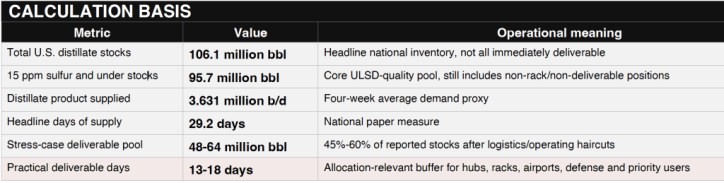
The U.S. does not have a month of freely deliverable diesel in a stress event. The headline EIA number shows 106.1 million barrels of total distillate fuel oil stocks and 3.631 million b/d of four-week average distillate product supplied, implying 29.2 days on paper. But that national inventory includes barrels in pipelines, refineries, terminals, regional storage, and operational positions that cannot all be allocated immediately to critical distribution hubs.
Operational estimate: applying a 45%-60% practical deliverability factor to total distillate stocks leaves roughly 48-64 million barrels of usable, allocable diesel-equivalent supply. At 3.631 million b/d, that is approximately 13.1-17.5 days, rounded to 13-18 days.
So let me explain how he reached this conclusion. Think of the diesel buffer as the gap between when supply stops flowing and when the economy starts breaking. Thirteen days is not a comfortable cushion — it’s essentially no cushion at all, because the economy runs on diesel in ways that cannot be deferred.
Diesel is not a lifestyle fuel. It moves every truck on every highway, powers every locomotive, runs every tractor during planting and harvest, and drives every piece of heavy construction equipment. When a family decides gas prices are too high, they drive less. When a freight company decides diesel is too expensive or too scarce, it cannot defer the shipment — the grocery store shelves just go empty. Diesel demand is largely inelastic. The economy cannot negotiate with it the way it can with gasoline.
Let’s use the worst case: 13 days. Thirteen days means that if anything disrupts the supply chain — a refinery outage, a pipeline failure, a crude supply disruption — the effects reach the real economy within two weeks. There is no meaningful time to arrange alternatives. A tanker from a replacement crude source takes longer than 13 days to arrive. A refinery turnaround takes longer than 13 days to complete. The buffer is shorter than the lead time for almost every possible remedy.
The geography makes it worse. The 13-day figure is a national average, which means some regions have more and some have less. The Southeast is particularly exposed, being heavily dependent on the Colonial Pipeline, which is itself a single point of failure that demonstrated its criticality when it was shut down for six days in 2021. Six days is nearly half the total national buffer.
What about aviation fuel? Here is where the two problems collide mechanically, and why it creates a genuine bind rather than just a theoretical tradeoff.
Diesel and jet fuel are not different products from different parts of the refinery. They are competing claims on the same physical fraction of crude oil — the middle distillate cut that comes off the atmospheric distillation column in the same boiling range. Every refinery scheduling decision is, at its core, a daily argument about how to divide that fraction between the two products.
With a 13-day diesel buffer, the refinery cannot let diesel output fall. The economic and political consequences of a diesel shortage materialize too quickly and too severely. Diesel production becomes, in practical terms, the floor that cannot be breached.
Now layer in a wartime demand for military jet fuel. JP-8 is pulled from the same middle distillate fraction. The military’s operational requirements are also non-negotiable — aircraft do not fly on goodwill. So you now have two inelastic demands competing for one fixed supply of middle distillate from each barrel of crude processed.
The refinery’s response to this bind is constrained in every direction:
It cannot simply run more crude. Crude supply itself may be disrupted — this is precisely the scenario the Persian Gulf blockade creates. And even if crude is available, refinery throughput is limited by physical capacity. You cannot run 110% of nameplate capacity.
It cannot shift to lighter crude to get more barrels. Light crude produces proportionally more gasoline and less middle distillate. Running lighter crude when you need diesel and jet fuel makes the allocation problem worse, not better, because you are shrinking the pool of middle distillate that both are fighting over.
It cannot get more middle distillate out of sour crude than the chemistry allows. A barrel of sour crude from the Persian Gulf typically yields around 20–25% middle distillates by volume. That fraction is fixed by the molecular composition of the oil. You can optimize within a range, but you cannot double the yield through operational choices.
Hydrogen becomes a choke point. Making JP-8 from sour crude to military specification requires substantial hydrogen — for sulfur removal, for aromatic ring saturation to meet smoke point requirements, and for freeze point management. Making ULSD from the same sour crude also requires substantial hydrogen — even more, to reach the ≤15 ppm sulfur specification. A refinery’s hydrogen generation capacity is finite. Every cubic foot of hydrogen diverted to jet fuel processing is a cubic foot unavailable for diesel desulfurization. At the margin, maximizing JP-8 production makes the diesel quality problem worse, not just the diesel volume problem.
The certification delay adds time pressure. Switching refinery configuration between maximizing diesel and maximizing jet fuel is not instant. It takes days to a week to restabilize the unit operations and certify the product meets specification. In a 13-day buffer environment, a week of transition time is not a casual cost — it represents a material fraction of the entire safety margin consumed by the act of reconfiguring production.
Under normal peacetime conditions, refineries optimise their middle distillate split based on market prices — jet fuel commands a premium, so they lean toward jet. The diesel buffer stays comfortable and the system works.
The Iran war changes all of that simultaneously in three directions at once:
First, the diesel buffer starts shrinking. Persian Gulf sour crude — even though only 8% of US imports — supplied roughly 17% of the medium-sour grades that US complex refiners prefer for middle distillate production. That quality gap is not easily filled by Canadian heavy or domestic light sweet crude without refinery adjustment. Diesel output drops or becomes more expensive per barrel just as the buffer needs defending.
Second, military JP-8 demand spikes. A naval campaign in the Persian Gulf, sustained air operations, and a mobilised logistics tail consume enormous quantities of aviation fuel. The military doesn’t queue behind civilian demand — it has priority. So the refinery is simultaneously being squeezed from both ends of the middle distillate barrel: the military is claiming more jet fuel from the top, and the diesel buffer is bleeding out from the bottom.
Third, the refinery cannot easily solve this by running harder. As explained earlier, maximising JP-8 from sour crude requires pulling a lighter, narrower distillate cut. This is precisely the action that reduces diesel yield — the heavier tail of the middle distillate that would have become diesel is either lost to the vacuum unit or downcycled to fuel oil. The more aggressively refineries respond to military jet fuel demand, the faster the diesel buffer erodes.
This creates a three-way constraint with no clean solution:
- Protect the diesel buffer → limit JP-8 output → constrain military operations
- Maximise JP-8 for military → draw down diesel buffer → trigger civilian supply cascade before the war ends
- Try to do both → run refineries at maximum utilisation → lose the ability to flex for any further shock, with no margin for equipment failures, maintenance, or a second disruption
The 13-day buffer is what makes this bind acute rather than manageable. With sixty days of diesel inventory, a refinery operator can tolerate shifting the middle distillate split toward jet fuel for several weeks without civilian consequences. With thirteen days, the same shift starts a visible countdown almost immediately. Now do you understand why Donald Trump signed the MoU with Iran?
If the United States decides to renew its bombing campaign of Iran, that would likely trigger the stress event outlined above. Based on that fact I believe that Donald Trump, notwithstanding his threats, will not run the risk of crashing the US economy by bombing Iran again.
Prof Seyed Marandi: WILL the US COLLAPSE the GLOBAL ECONOMY?
Daniel Davis / Deep Dive – June 25, 2026
Iranian Victory – Gulf States Creating ‘Regional Security Framework’ With Iran
By Justin K.P. | The Dissident | June 24, 2026
The failed U.S./Israeli war on Iran was not only a major loss for the United States and Israel and an Iranian victory, but it has also helped Iran’s status as a serious regional power.
This is best underscored by the fact that the Gulf Cooperation Council (GCC) states,-after facing Iranian retaliatory strikes against U.S. bases and assets during the war, is no longer relying on the United States for protection and is looking to form a security alliance with Iran.
Sheikh Mohammed bin Abdulrahman al-Thani, the Prime Minister of Qatar, told the Financial Times that “Part of what we are doing now, as regional countries, is to create this regional security framework between us and Iran, that will hopefully have economic co-operation in the future between all of us — to bring the region back to stability”.
He similarly told Al Jazeera, “Iran is a neighbouring country, and dialogue with it remains necessary to guarantee the security and stability of the region”.
This shows that the GCC no longer trust the United States to protect them, given that “Saudi Arabia, the UAE, Bahrain, Kuwait, and Qatar host US military bases and were attacked by Iran during the war. Washington struggled to supply its Gulf allies with enough interceptors to defend against Iranian missile attacks,” as journalist Kyle Anzalone noted.
As a result, the GCC states are seemingly deciding to stop relying on the United States for defence and make a security agreement with Iran, which has cemented itself as a serious regional power.
“They have to deal with Iran because it is not going anywhere”, Gawdat Bahgat, a professor of national security affairs at Washington’s National Defense University said referring to the Gulf nations new approach to Iran.
“Even while Iran attacked them, they kept diplomatic channels open because the day after, they and Iran have no choice but to live together” he noted.
“Our aim is that Iran flourishes and their economy grows; and our investment basically has always been purely on commercial decisions”, Sheikh Mohammed bin Abdulrahman al-Thani told the Financial Times.
This destroys the U.S./Israeli goal of isolating Iran, instead causing regional countries to forge closer ties to Iran for their own national security interests.
This is yet another way the U.S/Israeli war on Iran was a loss for the U.S. empire and a win for Iran and its influence as a serious regional power.
Featured Video

Iran’s Next Strike May Not Explode. It Could Shut You Down
or go to
Aletho News Archives – Video-Images
From the Archive
Zionism’s Violent Legacy
By Donald Neff | Washington Report On Middle East Affairs | January 1996
On January 4, 1948, Jewish terrorists drove a truck loaded with explosives into the center of the all Arab city of Jaffa and detonated it, killing 26 and wounding around 100 Palestinian men, women and children.[1] The attack was the work of the Irgun Zvai Leumi – the “National Military Organization,” also known by the Hebrew letters Etzel – the largest Jewish terrorist group in Palestine. The Irgun was headed by Revisionist Zionist Menachem Begin and had been killing and maiming Arabs, Britons and even Jews for the previous ten years in its efforts to establish a Jewish state.
This terror campaign meant that at the core of Revisionist Zionism there existed a philosophical embrace of violence. … continue
Blog Roll
 Aletho News
- Trump’s Iran war is on an Israeli leash
- Saudi oil boss issues global supply warning
- Riyadh Says Its Oil System Is Intact. The Numbers Say Otherwise.
- Trump and Netanyahu Want to “Finish the Job” on Iran
- US ‘one-sided dictation’ not Iran’s beliefs makes rational talks impossible: Baghaei
- Iran’s Next Strike May Not Explode. It Could Shut You Down /Col Doug Macgregor
- Iran: US political targets legitimate if assassinations return
- Iraq shuts key border crossing with Iran under US pressure: Report
- Undersea Internet cables could be targeted in retaliation for attacks on Iran: IRGC deputy chief
- EU sending ‘biased’ observers to interfere in Serbian election – president
- If Americans Knew
- The Israel Lobby’s Changing Fortunes
- AIPAC has become such a political liability that it’s shifting to a more “nimble” approach to buying politicians
- At least 160 Israeli settler attacks in 2 weeks
- Will Gaza’s Ancient Christian Community Disappear Forever?
- Israel’s vision of regional security rests on keeping Arab states weak
- Heidi Levine recounts how Palestinian youths helped save her in settler attack
- DAILY UPDATE: Latest essential news on Palestine, Israel, & region
- Trump’s Intensifying Sabotage of the ICC, for Israel’s Sake
- Israeli military detain US and UK volunteers in West Bank including Democratic NY politician Brad Lander
- Americans at National Conservatism Conference held in Israel this year criticize Israel
- No Tricks Zone
- E-Cars Reduce CO2 Emissions By Only 41% Compared To Internal Combustion Engine Vehicles
- Predictions Made By Renowned Climate Professor Over Past Decades Have Been Proven To Be Poor
- New Study Suggests Large Regions Of The Pacific Ocean Have Been Cooling For The Last 80 Years
- Germany’s Green Energy Debacle: High Energy Costs Force Kahla Porzellan to Close After 182 Years!
- New Study: 50 Years Of The Most Aggressive ‘Net Zero’ Policies Can Only Affect The Global Climate By 0.03°C
- US September “Heat” Was No Record…Many Records Set Decades Ago
- Latest European Green Energy Debacle; Portugal’s Largest Flagship Solar Park Insolvent!
- Green Energy Debacle: German Expert Professor Fritz Vahrenholt Warns Of Severe Economic And Social Consequences
- Two More Paleo Reconstructions Affirm Meters-Higher Sea Levels Across Ireland, Brazil 7000-6000 Years Ago
- New Study: Earth And Venus Surface Warmth Largely Explained By Convection And Lapse Rate, Not CO2 Or Radiation

