The West vs. the Rest
How developing countries took control of climate negotiations and what that means for emission reduction.
By Robin Guenier | Climate Scepticism | December 8, 2025
The main reason why, despite countless scientific warnings about dangerous consequences, greenhouse gas (GHG) emissions continue to increase is rarely mentioned. Yet it’s been obvious for several years – at least to anyone willing to see it. It’s this: most countries outside Western Europe, North America and Australasia are either unconcerned about the impact of GHGs on the climate or don’t regard the issue as a priority, focusing instead for example on economic growth and energy security. Yet these countries, comprising about 84 percent of humanityi, are today the source of about 77 percent of emissions; 88 percent if the United States, which has now joined their ranks, is included.ii Therefore, unless they change their policies radically – and there’s no serious evidence of their so doing – there’s no realistic prospect of the implementation of the urgent and substantial cuts in GHG emissions called for by many Western scientists.
To understand how this has happened, I believe it’s useful to review the history of environmental negotiation by focusing in particular on six UN-sponsored conferences: Stockholm in 1972, Rio in 1992, Kyoto in 1997, Copenhagen in 2009, Paris in 2015 and Belém (Brazil) in 2025.
Stockholm 1972
In the 1940s, 1950s and 1960s many Western environmentalists were seriously concerned that technological development, economic growth and resource depletion risked irreversible damage to humanity and to the environment.iii Clearly a global problem, it was agreed that it had to be tackled by international, i.e. UN-sponsored, action.
The result was the UN Conference on the Human Environment held in Stockholm in 1972.iv From its outset it was recognised that, if the conference was to succeed, an immediate problem had to be solved: the perceived risk was almost exclusively a Western preoccupation, so how might poorer countries be persuaded to get involved?v
After all, technical and industrial development were essentially the basis of the West’s economic success and that was something the rest of the world was understandably anxious to emulate – not least to alleviate the desperate poverty of many hundreds of millions of people.vi The diplomatic manoeuvrings needed to resolve this seemingly irreconcilable conflict set the scene for what I will refer to as ‘the Stockholm Dilemma’ – i.e. the conflict between Western fears for the environment and poorer countries’ aspirations for economic growth. It was resolved, or more accurately deferred, at the time by the linguistic nightmare of the conference’s concluding Declaration which asserted that, although environmental damage was caused by Western economic growth, it was also caused by the poorer world’s lack of economic growth.vii
After 1972, Western environmental concerns were overshadowed by the struggle to deal with successive oil and economic crises.viii However two important European reports, the Brandt Report in 1980 and the Brundtland Report in 1987, dealt with the economic gulf between the West and the so-called Third World.ix In particular, Brundtland – echoing Stockholm – concluded that, because poverty causes environmental problems, the needs of the world’s poor should be given overriding priority; a principle to be enshrined in the climate agreement signed in Rio. The solution was the now familiar ‘sustainable development’.x
Rio 1992
Western environmental concerns were hugely re-energised in the late 1980s when the doctrine of dangerous (possibly catastrophic) global warming caused by mankind’s emissions of GHGs, especially carbon dioxide (CO2), burst onto the scene.xi As a result, the UN organised the landmark Conference on Environment and Development (UNCED) – the ‘Earth Summit’ held in Rio in 1992.xii It was the first of a long series of climate-related international conferences that led for example to the so-called ‘historic’ Paris Agreement in 2015.
A key outcome of the 1992 Earth Summit was the United Nations Framework Convention on Climate Change (UNFCCC). Adopted in 1992 and commonly known as ‘the Convention’, it’s an international treaty that came into force in 1994. It remains to this day the definitive legal authority regarding climate change.xiii Article 2 sets out its overall objective:
‘The ultimate objective of this Convention and any related legal instruments that the Conference of the Parties may adopt is to achieve … stabilization of greenhouse gas concentrations in the atmosphere at a level that would prevent dangerous anthropogenic interference with the climate system.’
It’s an objective that’s failed. Far from being stabilised, after 1992 emissions accelerated and, by 2025, emissions had grown by over 65 per cent.xiv This is essentially because the Convention attempted to solve the Stockholm Dilemma by dividing the world into two blocs: Annex I countries (essentially the West and ex-Soviet Union countries – the ‘developed’ countries) and non-Annex I countries (the rest of the world – the ‘developing’ countries). This distinction has had huge and lasting consequences – arising in particular from the Convention’s Article 4.7:
‘The extent to which developing country Parties will effectively implement their commitments under the Convention … will take fully into account that economic and social development and poverty eradication are the first and overriding priorities of the developing country Parties.’xv [My emphasis]
In other words, developing countries were, in accordance with Brundtland’s conclusion, expressly authorised to give overriding priority to economic growth and poverty eradication – even if that meant increasing emissions. And that’s why the Annex I/non-Annex I bifurcation has plagued international climate negotiations ever since: for example, it’s the main reason for the Copenhagen debacle in 2009 and for the Paris failure in 2015 (see below).
Western countries had hoped – even expected – that the Rio bifurcation would in time be modified so that, in line with their development, major developing countries would eventually become members of the Annex I group.xvi But such hopes were dashed at the first post-Rio climate ‘Conference Of the Parties’ (COP) held in Berlin in 1995 (COP1) when it was agreed that there must be no new obligation imposed on any non-Annex I country.
This principle, ‘the Berlin Mandate’, meant that the bifurcation and its associated ‘common but differentiated responsibility’ principle were institutionalised as tenets of the Convention.xvii And, before the next climate conference in 1996 (COP2 in Geneva), G77+China made it clear that this should not be changed.xviii
Kyoto 1997
The impact of this was made harshly apparent at the next conference: COP3 in Kyoto in 1997. Kyoto was supposed to be critically important – the original hope had been that negotiations would result in all countries accepting commitments to reduce their GHG emissions. But, because the US decided that it wouldn’t accept obligations that didn’t apply to other major countriesxix and because of the Berlin Mandate, in the event the agreed Kyoto Protocol reduction obligations applied only to a few, largely Western, countries.xx As a result and because developing countries refused even to acknowledge that they might accept some future obligation, it was becoming obvious to some observers that the UN process was getting nowhere – somehow the developing countries had to be persuaded that emission reduction was in their best interests.
But how? The passage of 25 years hadn’t resolved the Stockholm Dilemma – difficult enough in 1972, the UNFCCC bifurcation and the Berlin Mandate had made it worse. Yet it was recognised that, without these, developing countries might simply refuse to be involved in climate negotiations, making the whole process meaningless – something the UN and Western countries were unwilling to contemplate. So, if Kyoto was a failure, it was arguably a necessary failure if there was to be any prospect of emission reduction in due course. And that was the story for the next twelve years: at successive COP conferences the major developing countries, ignoring increasingly dire climate warnings from Western scientists, refused to consider amending the UNFCCC bifurcation.
A result of that refusal was that many developing countries’ economies continued their spectacular growth, resulting in rising living standards and unprecedented poverty reduction.xxi But inevitably emissions also continued to grow: in just 12 years, from 1997 (Kyoto) to 2009 (Copenhagen) and despite 12 COPs, they increased by over 30%.xxii
Copenhagen 2009
In 2007 the UN’s Intergovernmental Panel on Climate Change (the IPCC), a body that reports every seven years on the current physical scientific understanding of climate change, published its fourth report (AR4) – a report that intensified the West’s insistence that urgent and substantial emission cuts were essential.xxiii
A result was an ‘Action Plan’ agreed at the 2007 climate conference (COP13) in Bali.xxiv It set out how it was hoped all countries would come together at Copenhagen in 2009 (COP15) to agree a comprehensive and binding deal to take the necessary global action. Many observers regarded this as hugely significant: Ban Ki-moon, then UN Secretary General, speaking at Copenhagen said, ‘We have a chance – a real chance, here and now – to change the course of our history’’.xxv And, as always, dire warnings were issued about the consequences of failure: UK Prime Minister Gordon Brown for example warned that, if the conference failed to achieve a deal, ‘it will be irretrievably too late’.xxvi
There was one seemingly encouraging development at Bali: developing countries accepted for the first time that emission reduction by non-Annex I countries might at least be discussed – although they insisted that developed countries were not doing enough to meet their Kyoto obligations.xxvii But the key question of how far the developing countries might go at Copenhagen remained obscure – for example was it at least possible that the larger ‘emerging economies’ such as China and India and major OPEC countries such as Iran and Saudi Arabia might cease to be classified as ‘developing’? The EU and US not unreasonably thought that should happen, especially as it was by then obvious that, unless all major emitting countries, including therefore big developing economies, were involved, an emission cutting agreement would be neither credible nor effective. Some Western negotiators hoped that the bifurcation issue might at last be settled at Copenhagen.
But it wasn’t. In the event, developing countries refused to budge, insisting for example that developed countries’ historic responsibility for emissions was what mattered. As a result, the West was humiliatingly defeated, with the EU not even involved in the final negotiations between the US and the so-called BASIC countries (Brazil, South Africa, India and China).xxviii
One commentator noted:
‘There was a clear victor. Equally clearly, there was a side that lost more comprehensively than at any international conference in modern history where the outcome had not been decided beforehand by force of arms.’ xxix
The Copenhagen failure was a major setback for the West.xxx It was now established that, if the developing countries (including now powerful economies such as China, India, South Korea, Brazil, South Africa, Saudi Arabia and Iran) rejected a suggestion that their economic development be subject to emission control, that position would prevail. Yet by 2010 these countries were responsible for about 60% of global CO2 emissions xxxi; without them, major global emission cuts were clearly impossible.
The years following Copenhagen, from Cancún (COP16) in 2010 to Lima (COP20) in 2014, reinforced the West’s concerns as developing countries continued to insist they would not accept binding commitments to reduce their emissions.xxxii
Paris 2015
It was becoming obvious that, if there was to be any prospect of emission reduction, there had to be some fresh thinking. So the UN proposed a new methodology for the summit scheduled for 2015 in Paris (COP21): instead of an overall global reduction requirement, a new approach should be implemented whereby countries would individually determine how they would reduce their emissions and that this would be coupled with a periodic review by which each country’s reduction plans would be steadily scaled up by a ‘ratcheting’ mechanism – a critically important development.
But, when countries’ plans (then described as ‘Intended Nationally Determined Contributions’ (INDCs)) were submitted to the UNFCCC secretariat prior to Paris, it was clear that little had been achieved: hardly any developing countries had indicated any intention of making absolute emission cuts. Instead their INDCs spoke merely for example of reducing CO2 emission intensity in relation to GDP or of reducing the percentage of emissions from business-as-usual projections.xxxiii
It had been hoped that NDCs (as they became known) would be the vehicle whereby major emerging (‘developing’) economies would at last make emission reduction commitments. Yet they turned out to be a problem that undermined the Paris Agreement – see below. And, in any case, other provisions of the Agreement in effect exempted developing countries from any obligation, moral, legal or political, to reduce their emissions.xxxiv For example, the Agreement was described in its preamble as being pursuant to ‘the objective of the Convention [and] guided by its principles’ and further described in Article 2.1 as ‘enhancing the implementation of the Convention’. In other words, the developed/developing bifurcation remained intact and developing countries could continue to give overriding priority to economic development and poverty eradication. Moreover, under Article 4.4 of the Agreement, developing countries, in contrast to developed countries, were merely ‘encouraged to move over time towards economy-wide emission reduction or limitation targets’. Hardly an obligation to reduce their emissions.
It was not an outcome many wanted. For example, when ex UN Secretary General Kofi Annan was asked in early 2015 what he would expect to come out of the Paris summit, he replied:
‘Governments have to conclude a fair, universal and binding climate agreement, by which every country commits to reducing emissions of greenhouse gases.‘ xxxv
Western negotiators had intended that Paris should have a very different outcome from that achieved. Hence this 2014 statement by Ed Davey, then UK Secretary of State responsible for climate negotiations: ‘Next year in Paris in December … the world will come together to forge a deal on climate change that should, for the first time ever, include binding commitments to reduce emissions from all countries.’ xxxvi
But it didn’t happen. Developing country negotiators, led by China and India, ignored the West’s (in the event, feeble) demands. And Western negotiators, determined to avoid another Copenhagen-like debacle, didn’t press the issue. Hence the Paris agreement’s failure to achieve the West’s most basic aim: that powerful ‘emerging’ economies should be obliged to share in emission reduction.
The Stockholm Dilemma was still unresolved.
Might that change in the near future? Events since 2015 indicate that that’s most unlikely:
A major post-Paris example was a climate ‘action summit’ convened by UN Secretary General António Guterres for September 2019, calling for national plans to go carbon neutral by 2050 and new coal plants to be banned from 2020.xxxvii But, just before the summit, the environment ministers of the so-called ‘BRICS’ countries (Brazil, Russia, India, China and South Africa) effectively undermined it by reaffirming their commitment to ‘the successful implementation of the United Nations Framework Convention on Climate Change (UNFCCC), its Kyoto Protocol and its Paris Agreement’. In other words, these five countries (the source of about 45 percent of emissions) were indicating that they continued to regard themselves, under the UNFCCC and Paris framework, as exempt from any binding reduction obligation.xxxviii As a result the summit was a failure.xxxix
So it was not surprising that COP25 (December 2019 in Madrid) made no real progress: it ended with no substantive agreement on emission reduction and was widely described as another failure.xl
Might that change – for example might major developing countries enhance their NDCs as required by the ‘ratchet’ provision of the Paris Agreement? The test would be the next UN conference (COP26) to be held in Glasgow in November 2021 – postponed from 2020 because of the COVID 19 crisis.xli
But COP26 failed that test. And that was despite it being rated by the Guardian in July 2021 as ‘one of the most important climate summits ever staged’, despite Alok Sharma (COP26’s president) stressing that leaving ‘Glasgow with a clear plan to limit global warming to 1.5C’ would ‘set the course of this decisive decade for our planet and future generations’ and despite Prince Charles (as he then was) giving another of his familiar warnings: ‘Quite literally, it is the last chance saloon. We must now translate fine words into still finer actions.’ xlii
That things were not looking good became apparent when several major emitters (e.g. Brazil, China, India, Russia, Saudi Arabia, Australia, Indonesia and Mexico) either failed to submit a new NDC in 2021 or submitted an updated NDC that was judged to lack any real increase in ambition, thereby failing to comply with the key Paris ‘ratchet’ requirement.xliii Yet the countries referred to above were in 2019 the source of over 40% of global emissions.xliv
COP26 itself got off to a bad start when China’s president Xi and Russia’s president Putin didn’t attend.xlv And the proceedings included various upsets – in particular a formal request made by a group of 22 nations known at the Like-Minded Developing Countries (LMDC), which included China, India and Saudi Arabia, made on 11 November 2021, that the entire section on the mitigation of climate change be removed from the draft COP26 text.xlvi It wasn’t wholly successful as COP26’s concluding text – the ‘Glasgow Climate Pact’ xlvii – did include an appeal for all countries to revisit and strengthen their 2030 emissions targets by the end of 2022. But that was essentially meaningless in practice as many major emitters had already failed to submit sufficiently strengthened NDCs (see above). In other words, COP26 ended with nothing of real importance being achieved.
All this confirmed yet again that developing countries, determined to grow their economies and improve the lives of their people, had no serous intention of cutting back on fossil fuels. But nonetheless the can was once again kicked down the road; this time to COP27 to be held in Sharm El-Sheikh, Egypt in 2022. And in the meantime events moved on much as before with most countries – even the US – increasing their reliance on fossil fuels (especially coal) and global CO2 emissions reaching their highest level ever.xlviii
And it was hardly a surprise therefore when COP27 turned out to be yet another conference that essentially achieved nothing, with one reviewer noting that key mitigation items — such as a 2025 global emissions peak or a phase-out of all fossil fuels — were dropped under pressure from ‘Saudi Arabia, Iran, Russia and other petro-states’.xlix Yet, far from giving up, the West now pinned its hopes on COP28 to be held in Dubai – the ‘first global stocktake’.
And the UN hoped that a ‘Climate Ambition Summit’ called by General Secretary António Guterres in September 2023 would boost the Conference’s prospects. But the absence of big emitters such as the US, China and India meant that the Summit turned out to be of little value.l
However the COP28 ‘stocktake’ – otherwise unremarkable – did include what many commentators thought was an important breakthrough.li In its paragraph 28, it said this:
‘The Conference of the Parties … calls on Parties to contribute to the following … Transitioning away from fossil fuels in energy systems, in a just, orderly and equitable manner, accelerating action in this critical decade, so as to achieve net zero by 2050 in keeping with the science.’
So, commentators said, there you have it: at long last we have an agreement (a ‘pledge’) to transition away from fossil fuels! But of course that wasn’t true. The reality was that Paragraph 28 also said that parties must ‘take account’ of the Paris Agreement and, as specifically confirmed further down in paragraph 38, the ‘stocktake’ reaffirmed Article 4.4 of that Agreement. In other words, developing countries, the source of 65% of global emissions, continued to be exempted from any obligation to cut their emissions.
Attention now moved to Baku, Azerbaijan – to COP29 held in November 2024. But this conference was concerned almost entirely with finance and made no serious progress on emission reduction. And in any case proceedings were overshadowed by Donald Trump’s re-election as US President – causing great uncertainty and concern about future global climate politics.
Such concern was justified: it was over 50 years since the 1972 UN Conference on the Human Environment and there was still no sign of a solution to the Stockholm Dilemma and now a resurgent Trump made one even less likely. Yet once again the circus moved on – this time to Belém in Brazil.
Belém 2025
In the months running up to COP30 its prospects already looked dismal, despite the conference being dubbed ‘the implementation COP’. This was because, despite the Paris Agreement requirement, hardly any significant countries submitted updated NDCs either by February 2025, or even by the extended date at the end of September.lii To make matters even worse, few leaders of major economies turned up for the scheduled pre-COP leaders’ meeting: for example no one came from the United States, China, India, Russia, Indonesia, Japan, Saudi Arabia, Australia, Canada, South Korea, Türkiye or South Korea. Nonetheless Brazil’s President Lula announced that ‘COP30 will be the COP of truth’.liii
However over 56,000 delegates did turn up at the conference – the third largest number at any COP. And Brazil’s environment minister Marina Silva urged countries to have the ‘courage’ to address a fossil-fuel phaseout, and to work towards a roadmap for ending dependence on fossil fuels.liv It was a requirement echoed by about 80 countries which insisted via a letter to the COP President signed by 29 countries (including the UK, France, Spain and various small countries) that, unless the Conference outcome included a legally binding agreement to a ‘roadmap’ for a global transition away from fossil fuels, they would block the planned deal.lv
Unsurprisingly however negotiators from the majority of countries – not just the Arab oil producers as some commentators suggested, but also major countries such as India, China, Indonesia and other developing countries whose economies and peoples’ welfare depend on fossil fuels – showed no interest in the idea and the COP President simply ignored it. Humiliatingly the objectors climbed down. And the words ‘fossil fuels’ were not even included in the finally agreed text.lvi
This astute comment on the failure of COP30 was made by Li Shuo of the Asia Society (described as ‘a long-time observer of climate politics’):
‘This partly reflects the power shift in the real world, the emerging power of the BASIC and BRICs countries, and the decline of the European Union’.lvii
So once again a COP made no progress at all towards meeting the UNFCCC’s 1992 call for the ‘stabilization of greenhouse gas concentrations in the atmosphere’. It’s therefore hardly surprising that many commentators have queried whether there’s really any reason at all for continuing to hold all these huge and essentially pointless conferences.lviii
And it’s not only the Belém debacle that illustrates this. Far from it: nothing that’s happening today justifies any realistic hope that fossil fuels are on their way out. For example, major developing countries, especially India, China and in Southeast Asia, are focusing on coal to bolster economic growth and upgrade national security.lix And overall global emissions are still increasing. The early 2020 emission reductions caused by Covid 19 lockdowns were short-lived: as countries emerged from the pandemic determined to strengthen their economies, emission increases have continued.lx
The harsh reality – confirmed time and time again – is that nothing has really changed since the West’s comprehensive defeat at COP15 in Copenhagen in 2009. The truth is that most countries do not share the West’s preoccupation with climate change. Nor is there any prospect of that view changing for the foreseeable future.
Conclusion
At the time of the Rio Earth Summit in 1992 the West’s emissions were 41 percent of the annual global total – today (without the US) they’re only 9 percent. Thus it’s clearly impossible for what’s left of the West to satisfy many scientists’ calls for an urgent and substantial (about 50%) global emission reduction. That can only happen if all the other major countries completely change their climate policies. And that’s obviously not going to happen.
Yet, despite that clear message from the past thirty or more years of climate negotiation history, it’s a key reality that’s still being overlooked by many in the West: in particular by net zero supporters; by the mainstream media; by many scientific publications; by all climate ‘activists’; by many respected academic and scientific organisations; by politicians, governmental and non-governmental organisations; and by celebrities and social media. And by the United Nations.
It’s quite remarkable that there are still so many Western observers who seem not to have noticed that, over the past fifty years, the nature of the climate debate has radically changed as a result of major global political and economic developments. What’s happened is that what was once the so-called Third World has for a long time been powerful enough to ignore the West and take charge of environmental negotiation – a process that started with the ‘Berlin Mandate’ at COP1 in 1994 (see above). And the increasingly meaningless distinction between the ‘developing’ world and the ‘developed’ world, introduced by the UN in 1992 as a way of persuading poorer countries to get involved in climate negotiation, has paradoxically become the reason why progress on GHG reduction has become virtually impossible.
It’s surely obvious by now that the Stockholm Dilemma will never be resolved. And that there’s nothing the West (or more accurately the EU, the UK, Australia and a few smaller countries) can do about it.
Notes and references
i See https://srv1.worldometers.info/world-population/population-by-region/?utm_source=chatgpt.com
ii See https://edgar.jrc.ec.europa.eu/report_2025?vis=ghgtot#emissions_table
iii See for example Fairfield Osborn’s book The Plundered Planet (1948), William Vogt’s Road to Survival (1948), Rachel Carson’s Silent Spring (1962), the dire predictions in the Club of Rome report, Limits to Growth (1968) and, in particular, Barbara Ward’s report, Only One Earth (1972). Several of today’s environmentalists share the view that economic growth causes environmental degradation. See for example Less is More: How Degrowth Will Save The World (2021) by Jason Hickel.
iv Maurice Strong, a Canadian businessman-turned-diplomat, organised the Conference and was its Secretary General, having first commissioned Limits to Growth (see Note 3) that established much of its intellectual groundwork. He is widely seen as a pioneer of international environmental concern and of institutionalising it within the United Nations.
v At the time these countries were commonly referred to as ‘underdeveloped’ or, preferably, as ‘developing’. The ‘Third World’ was a standard label used for countries outside the Western or Soviet blocs.
vi Franz Fanon’s book The Wretched of the Earth (1961) was very influential in intellectual circles in the West at this time. Indian PM Indira Gandhi’s keynote speech at the Conference sets out the dilemma clearly: http://tiny.cc/dl6lqz. The speech is epitomised by this comment: ‘The environment cannot be improved in conditions of poverty.’
vii See Part One, chapter I (especially ‘proclamation’ 4) of this UN report on the conference: http://un-documents.net/aconf48-14r1.pdf.
viii See for example: https://www.federalreservehistory.org/essays/oil-shock-of-1978-79.
ix For Brundtland, see Our Common Future: http://www.un-documents.net/our-common-future.pdf.
x ibid – see paragraphs 27, 28 and 29 which do little to clarify the meaning of this rather vague concept.
xi Heralded in particular by James Hansen’s address the US Congress in 1988: https://www.sealevel.info/1988_Hansen_Senate_Testimony.html?utm_source=chatgpt.com
xii Described as the largest environmental conference ever held, the Summit’s outcome is outlined here: https://www.sustainable-environment.org.uk/Action/Earth_Summit.php
xiii For the full text of the UNFCCC see: https://unfccc.int/resource/docs/convkp/conveng.pdf
xiv See Note 1 above.
xv The omitted words are concerned with a different, but arguably equally important, issue: finance and technology transfer from developed to developing countries.
xvi See Article 4.2 (f) of the UNFCCC, under which parties might review ‘available information with a view to taking decisions regarding such amendments to the lists in Annexes I and II as may be appropriate, with the approval of the Party concerned’.
xvii See Article 2 (b) here: https://unfccc.int/resource/docs/cop1/07a01.pdf?utm_source=chatgpt.com
xviii This report provides some interesting background re non-Annex I parties’ determination: https://unfccc.int/resource/docs/1996/agbm/05.pdf?utm_source=chatgpt.com
xix See the Byrd-Hagel resolution adopted unanimously by the US Senate in June 1997: https://www.congress.gov/bill/105th-congress/senate-resolution/98/text It stated that the US would not sign a protocol putting limits on Annex I countries unless it imposed specific, timetabled commitments on non-Annex I countries.
xx For the text of the Kyoto Protocol see: https://unfccc.int/resource/docs/convkp/kpeng.pdf. Note in particular how Article 10’s provision that it did not introduce ‘any new commitments for Parties not included in Annex I’ ensured that developing countries were not bound by the Protocol’s emission reduction obligations.
xxi Note for example how China was responsible for an astonishing reduction in poverty from the 1980s to the early 2000s: https://ourworldindata.org/data-insights/extreme-poverty-in-china-has-been-almost-eliminated-first-in-urban-then-in-rural-regions?utm_source=chatgpt.com
xxii See Note 1 above.
xxiii See for example: https://www.ipcc.ch/report/ar4/syr/
xxiv The Bali Action Plan can be seen here: https://www.preventionweb.net/files/8376_BaliE.pdf?startDownload=true
xxv See the UN Secretary-General’s extraordinary speech in Copenhagen just before COP15: https://unfccc.int/files/meetings/cop_15/statements/application/pdf/speech_opening_hls_cop15_ban_ki_moon.pdf
xxvi The full extract: ‘If we do not reach a deal at this time, let us be in no doubt: once the damage from unchecked emissions growth is done, no retrospective global agreement in some future period can undo that choice. By then it will be irretrievably too late.’ See https://www.theguardian.com/environment/2009/oct/19/gordon-brown-copenhagen-climate-talks
xxvii In particular those confirmed by section 1(b)(i) of the Bali Action Plan – see Note 24 above.
xxviii See this overall review of the outcome: http://news.bbc.co.uk/1/hi/8426835.stm.
xxix Rupert Darwall: The Age of Global Warming, 310
xxx The ‘Copenhagen Accord’ was an attempt by some countries to rescue something from this debacle: https://unfccc.int/resource/docs/2009/cop15/eng/l07.pdf. A non-binding document (the Conference only ‘took note’ of it) it stated for example that global temperature should not rise more than 2ºC above pre-industrial levels – although it didn’t specify a date for this.
xxxi See Note 1 above.
xxxii See for example this report on the 2014 conference in Lima: http://tiny.cc/w4zv001
xxxiii For example, China’s INDC said only that it planned to ‘achieve the peaking of carbon dioxide emissions around 2030’ (no mention of the level of such ‘peak’ or of what will happen thereafter) and to ‘lower carbon dioxide emissions per unit of GDP by 60% to 65% from the 2005 level’. And South Korea merely said that it ‘plans to reduce its greenhouse gas emissions by 37% from the business-as-usual (BAU,850.6 MtCO2eq) level by 2030 across all economic sectors’, i.e. emissions will continue to increase but not by as much as they might have done.
Note that ‘Intended Nationally Determined Contributions’ (INDCs) are referred to as ‘Nationally Determined Contributions’ (NDCs) in Articles 3 and 4 of in the Paris Agreement – see Note 34 below. All NDCs submitted to the UNFCCC secretariat can be found here: https://unfccc.int/NDCREG
xxxiv The full text of the Paris Agreement can be found here: https://unfccc.int/files/meetings/paris_nov_2015/application/pdf/paris_agreement_english_.pdf
xxxv From an interview with the Observer in May 2025. Annan’s other comments are also interesting: https://www.kofiannanfoundation.org/publication/we-must-challenge-climate-change-sceptics/
xxxvi See the Ministerial Forward here: https://assets.publishing.service.gov.uk/government/uploads/system/uploads/attachment_data/file/360596/hmg_paris_2015.pdf
xxxvii https://climateaction.unfccc.int/Events/ClimateActionSummit
xxxviii My note was an extract from a press release by the PRC’s Ministry of Ecology and Environment: https://english.mee.gov.cn/News_service/news_release/201908/t20190829_730517.shtml?utm_source=chatgpt.com
xxxix https://populationmatters.org/news/2019/09/un-climate-action-summit-fails-to-deliver-climate-action/
xl http://tiny.cc/zg0w001 The official summary noted how countries such as China — speaking for the bloc including Brazil, India, South Africa — repeatedly called for developed countries to meet financial commitments: http://tiny.cc/3h0w001
xli https://www.reuters.com/article/us-health-coronavirus-climatechange-idUSKBN21J6QC/
xlii http://tiny.cc/js1w001, http://tiny.cc/dv1w001 and http://tiny.cc/zs1w001
xliii https://ca1-clm.edcdn.com/assets/brief_-_countries_with_no_or_insignificant_ndc_updates_2.pdf?utm_source=chatgpt.com
xliv See Note 1 above.
xlv http://tiny.cc/w22w001 and http://tiny.cc/w22w001
xlvi https://kyma.com/cnn-world/2021/11/11/china-and-india-among-22-nations-calling-for-key-section-on-emissions-be-ditched-from-cop26-agreement/?utm_source=chatgpt.com
xlvii The Glasgow Climate Pact can be found here: https://unfccc.int/sites/default/files/resource/cop26_auv_2f_cover_decision.pdf
xlviii See Note 1 above.
xlix See observations here: http://tiny.cc/q52w001
l The Guardian’s view: http://tiny.cc/872w001
li https://unfccc.int/sites/default/files/resource/cma2023_L17_adv.pdf
liii President Lula’s comment can be found here: http://tiny.cc/ja2w001 A prescient observation – although not perhaps in the way he intended.
lv This Guardian article notes how the 29 objectors’ demands were ignored: http://tiny.cc/ei2w001.
lvi https://unfccc.int/sites/default/files/resource/cma2025_L24_adv.pdf
lvii Under ‘EU had a bad COP’ here: https://www.bbc.co.uk/news/articles/cp84m16mdm1o
lviii For example the Guardian is unhappy: http://tiny.cc/ux2w001
lix See this https://www.cfact.org/2025/11/20/coal-is-still-a-fuel-of-choice-in-the-global-south/ and this https://www.instituteforenergyresearch.org/fossil-fuels/coal/coal-is-still-king-globally/
lx See Note 1 above.
Venezuela Has Right to Have Relations With China, Russia, Cuba, Iran – Acting President
Sputnik – 16.01.2026
Venezuela has the right to relations with all countries of the world, including China, Russia, Cuba, and Iran, and will exercise this right in compliance with international norms, Venezuelan Acting President Delcy Rodriguez said on Thursday.
Venezuela’s Acting President Delcy Rodríguez said the country’s energy dialogue with the United States is not new, but stressed that it is now taking place amid “aggression and a fierce threat.”
“Venezuela has the right to relations with China, with Russia, with Cuba, with Iran — with all the peoples of the world,” Rodríguez said while presenting the government’s 2025 annual report.
She said Caracas is shaping energy cooperation based on “decency, dignity and independence,” rejecting both internal and external constraints aimed at influencing Venezuela’s foreign policy.
Villains of Judea: Paul Singer’s Empire of Debt & Demographic Replacement
Paul Singer is the embodiment of Jewish plutocracy
José Niño Unfiltered | January 12, 2026
Paul Elliott Singer stands as one of the most influential figures in global finance. The Jewish billionaire hedge fund manager has amassed a fortune estimated at $6.2 billion to $6.7 billion by purchasing distressed sovereign debt and corporate bonds at deep discounts, then pursuing ruthless legal campaigns to extract full repayment plus interest.
Born August 22, 1944, in Teaneck, New Jersey, Singer transformed a $1.3 million startup in 1977 into Elliott Management, a hedge fund empire managing approximately $65.5 billion to $72 billion in assets.
Yet Singer does more than just make financial moves. He has emerged as a kingmaker in Republican politics, becoming the second-largest GOP donor in 2016, and a major force behind AIPAC, immigration reform, and LGBT rights advocacy. His business model has devastated entire communities from Sidney, Nebraska, to Buenos Aires, Argentina. His political activism spans seemingly contradictory causes, supporting both hawkish pro-Israel policies and same-sex marriage rights. His most recent venture, the $5.9 billion purchase of Venezuela’s Citgo assets, positions him to reap billions from the Trump administration’s military intervention in Venezuela.
Singer’s business model has earned him the moniker vulture capitalist. In the 1990s, Singer began leaving his mark after purchasing $20 million in Peruvian sovereign debt. Through aggressive litigation, he eventually secured a payout of $58 million, nearly triple his investment. A U.S. court revealed that Elliott’s purchase of Peruvian debt was made with the explicit intention of pursuing full repayment through lawsuits. Investigative journalist Greg Palast reported that Singer’s lawyer allegedly told him Singer allowed Peru’s President Alberto Fujimori, who fled the country ahead of murder charges, to escape in return for ordering Peru’s treasury to pay Singer $58 million.
Between 2002 and 2003, Singer earned over $100 million from a $30 million investment in Congo-Brazzaville debt. But his most audacious campaign targeted Argentina. After Argentina’s 2001 economic crisis, Singer purchased distressed bonds for approximately $117 million. He refused to participate in debt restructuring agreements that other creditors accepted, instead pursuing full repayment through international courts. The campaign culminated in a 2016 settlement that netted Elliott Management $2.4 billion, a staggering 1,270 percent return.
Singer’s tactics proved extraordinary even by hedge fund standards. In 2012, Elliott successfully convinced a Ghanaian court to detain the Argentine naval training vessel ARA Libertad with 220 crew members aboard, demanding $20 million for its release. Then-Argentine President Cristina Fernández de Kirchner refused to pay Singer’s fund, calling Elliott and similar firms “financial terrorists” and vulture funds. The Obama administration and Secretary of State Hillary Clinton demanded courts dismiss Singer’s attempt to bankrupt Argentina, but Singer’s legal campaign ultimately prevailed.
Pro-Israel Bankroller
Singer has emerged as one of the most significant donors to pro-Israel causes in the United States. Through The Paul E. Singer Foundation, he has donated approximately $300 million since 2010. Singer donated $2 million to AIPAC and contributed $3 million to AIPAC’s super PAC, United Democracy Project, since 2022, making him tied for AIPAC’s third-largest donor. He serves on the board of directors of the Republican Jewish Coalition and co-founded Start-Up Nation Central, an organization dedicated to connecting Israeli innovation with global markets.
Singer has also been a major funder of the Foundation for Defense of Democracies, a neoconservative think tank advocating hawkish policies aligned with Israeli interests. From 2008 to 2011, Singer contributed $3.6 million to FDD, making him the organization’s second-largest donor. The organization has been described by former Secretary of State Colin Powell’s chief of staff Lawrence Wilkerson as a fervent advocate for war against Iran. At the Jewish Funders Network in Jerusalem, Singer stated that “Israel may be the only insurance policy all Jews, everywhere, can rely upon for the safety and continuity of Judaism.”
Promoter of LGBT Degeneracy and Mass Migration
Like many Jewish plutocrats, Singer became a significant supporter of LGBT causes after his son Andrew came out as a homosexual. In 2012, Singer provided $1 million to start American Unity PAC, whose sole mission was to encourage Republican candidates to support same-sex marriage. From 2012 to 2015, he contributed over $5.5 million to this organization. In 2013, Singer donated $500,000 to the Human Rights Campaign. Since 2001, Singer has donated more than $11 million toward legalizing homosexual marriage and supporting LGBT causes.
Singer’s crusade to redefine marriage within Republican ranks was just one facet of his broader agenda; he soon pivoted to advocating mass immigration to transform America’s demographics. In 2013, Singer made a six-figure donation to the National Immigration Forum to support comprehensive immigration reform, better known as amnesty. As one of the first high-profile Republican megadonors to publicly back amnesty, Singer worked to marshal conservative support for an overhaul of federal laws. In 2014, Singer formed the American Opportunity Alliance, bringing together wealthy Republican donors who shared his support for LGBTQ rights, immigration reform, and Israel.
Singer’s Looting of Sidney, Nebraska
Singer’s domestic business dealings generated controversies as devastating as his international operations. In 2015, Elliott Management acquired an 11 percent stake in outdoor retailer Cabela’s and forced a merger with Bass Pro Shops that devastated Sidney, Nebraska, where Cabela’s was headquartered. The town experienced massive job losses, a significant housing value collapse, and economic depression. According to court filings, Elliott pressured Cabela’s board to sell the company until the board relented. The merger resulted in Elliott making nearly $100 million profit. Residents told Fox News producers that the hedge fund destroyed their town, with one saying, “If money is that big of a God to him, he is a pretty sick human being.”
Tucker Carlson’s Exposé
In December 2019, Fox News host Tucker Carlson devoted a major investigative segment to Paul Singer, focusing on the Cabela’s case. Carlson described Singer’s business model as “vulture capitalism” that involves “buying large stakes in American companies, firing workers, driving up short-term share prices, and in some cases, taking government bailouts.” He stated, “It bears no resemblance whatsoever to the capitalism we were promised in school. It creates nothing. It destroys entire cities. It couldn’t be uglier or more destructive.”
Carlson emphasized Singer’s political power, noting that “people like Paul Singer have tremendous influence over our political process.” He revealed that Singer was “the second largest donor to the Republican Party in 2016 and has given millions to a super PAC that supports Republican senators. Carlson noted, “You may never have heard of Paul Singer, which tells you a lot in itself, but in Washington he is rock star famous.”
As Carlson was producing the segment, he reported being warned repeatedly by people around Washington, “Don’t criticize Paul Singer, that’s not a good idea.” During the broadcast, Carlson received a text from a very well-known person in Washington saying, “Holy smokes, I can’t believe you’re doing this. I’m afraid of Paul Singer.”
Venezuela and Citgo
One of Singer’s most recent controversial business deals involves Venezuela’s Citgo Petroleum. In November 2025, Elliott Investment Management won a court-mandated auction to purchase Citgo for $5.9 billion. Citgo represents the crown jewel of Venezuela’s international oil assets, owning three major Gulf Coast refineries with capacity to process 800,000 barrels per day, 43 oil terminals, and over 4,000 gas stations.
Singer acquired Citgo at what multiple sources describe as a major discount. Court advisors estimated Citgo’s actual value at approximately $13 billion, while Venezuelan officials valued the assets at $18 billion to $20 billion. This means Singer paid roughly 45 percent of the estimated market value.
A highly controversial aspect of the sale involves Robert Pincus, the court-appointed special master who oversaw the auction and recommended Singer’s bid. Pincus sits on the national board of directors of AIPAC. Gold Reserve Inc., a competing bidder that offered $7.9 billion, filed motions to disqualify Pincus for conflicts of interest. Venezuela rejected the sale’s legitimacy, calling it a “fraudulent process” and the “theft of the century.”
Trump’s Venezuela Intervention is Singer’s Wet Dream
The timing of events raised serious questions about the relationship between Singer’s Citgo purchase and Trump administration actions. In 2024, Singer donated $5 million to Trump’s super PAC and contributed $37 million to support Republican congressional candidates. On January 3, 2026, U.S. armed forces conducted a military raid in Caracas, capturing Venezuelan President Nicolás Maduro.
The removal of Maduro positions Singer to reap enormous profits. Economist Paul Krugman noted, “If Trump lifts that embargo, Singer will receive a huge windfall.” Within days of Maduro’s capture, Trump announced that Venezuela would be turning over between 30 and 50 million barrels of oil to the United States.
Rep. Thomas Massie (R-KY), who is a staunch opponent of the intervention in Venezuela, also caught on to how Singer stands to benefit from military action against Venezuela. He tweeted on January 4, 2026, “According to Grok, Paul Singer, globalist Republican mega-donor who’s already spent $1,000,000 to defeat me in the next election, stands to make billions of dollars on his distressed CITGO investment, now that this administration has taken over Venezuela.”
As Massie noted, Singer has ponied up $1 million to MAGA KY, a super PAC seeking to unseat the Kentucky congressman. Singer and his fellow Zionist Jews view Massie as an obstacle to further consolidating Jewish supremacy in the halls of Congress.
All told, Singer is the embodiment of Jewish plutocracy. He bankrolls the West’s demise through his advocacy of LGBT degeneracy, mass migration, never-ending wars on behalf of world Jewry, and vulture finance. Americans must awaken to these existential threats, revoke their elite privileges, and halt the Great Replacement before it consigns our polities to historical oblivion.
Former Head of Israeli Military Intelligence Directorate: There’s a ‘very significant influence operation by the US’ in Iran
The Dissident | January 14, 2026
Recently, the Israeli newspaper Maariv interviewed the head of the Military Intelligence Directorat in Israel from 2018-2021, Tamir Hayman, who revealed that the United States currently has a “Significant Influence Operation” on the ground in Iran.
In the interview, Hayman said, “If the question is, is there zero operation right now? The answer is no, because there is already an operation. There is currently a very significant influence operation by the US” referring to the current unrest happening in Iran.
He added, “The sequence of news that is received from within Iran, rumors that are coming, videos that are coming, there are many things that are happening that have no explanation. It could be a coincidence, and it could be something else. Simply put, an influence effort is an effort that operates primarily in the cyber realm, and in the realm of local disruption and subversion, and there are some.”
Along with this, Tamir Hayman, acknowledged that U.S. sanctions were the cause of the economic issues that in Iran that sparked the initial protests in Iran which are apparently being exploited by American and Israeli intelligence, saying, “there is the attempt, as we heard tonight from Trump, that this is a path of negotiation with the Americans, that this is really the only thing that can save the Iranian economy, the lifting of sanctions”.
This comment comes at the same time that Tamir Morag, the Diplomatic Correspondent for the Netanyahu-linked Channel 14 in Israel, reported that “foreign actors are arming the protesters in Iran with live firearms, which is the reason for the hundreds of regime personnel killed.”
American and Israeli officials have been fairly open about the fact that Israeli intelligence is currently operating on the ground in Iran, with the former Secretary of State and CIA director, Mike Pompeo saying, “Happy New Year to every Iranian in the streets. Also, to every Mossad agent walking beside them” and the Israeli Heritage Minister, Amichai Eliyahu saying, “When we attacked in Iran during ‘Rising Lion’ we were on its soil and knew how to lay the groundwork for a strike. I can assure you that we have some of our people operating there right now”.
But now, Tamir Morag has revealed that there are “very significant influence operations by the US” in Iran, which include “operates primarily in the cyber realm, and in the realm of local disruption and subversion” and according to Tamir Morag, apparent operations to arm protestors in Iran to kill Iranian government officials.
Referring to the protests in Iran, the U.S. government connected private intelligence firm Stratfor, wrote, “the United States may also try to intervene, such as by covertly helping to organize the protesters”, something that is apparently already underway through American “influence operations”.
Eilat port faces worst crisis as Red Sea shipping collapses
Al Mayadeen | January 12, 2026
The southern port of Eilat in occupied Palestine is facing the most severe crisis in its history, with operations nearly paralyzed for more than two years amid disruptions to Red Sea shipping routes, attacks on vessels, and escalating regional tensions, according to Yedioth Ahronoth.
The newspaper reported that port workers arrive each morning to empty docks, prepared to work, but with no ships docking. Once generating around 240 million shekels annually, the port’s revenues have dropped to almost zero, while government assistance has amounted to just 15 million shekels.
According to the report, the General Federation of Labor, the Histadrut, pledged an additional 5 million shekels to prevent layoffs, but the funds have yet to be delivered due to a suspected conflict-of-interest scandal involving its head, Arnon Bar-David.
The crisis has been compounded by a recent decision by the finance and transport ministries not to extend the port’s operating concession, citing failure to meet required conditions. Port management is reportedly preparing to challenge the decision and demand that the government reverse its stance.
Yedioth Ahronoth noted that operations at the Port of Eilat came to a complete halt after Sanaa seized a vessel bound for the port in November 2023. This followed what had been a record year, with around 150,000 vehicles handled by October 2023 and expectations of another 15,000 arrivals.
Port finance vice president Batya Zafrani said that on the day of the incident, shipping companies NYK and ZIM suspended deliveries for several months. “We thought the government would intervene, but after three months we began worrying about the workers’ future,” she said, adding that the 15 million shekels in government aid would only cover two months of operations.
Avi Hormaro, chairman of the Eilat port and chief executive of the Nakash Group, criticized the government’s handling of the crisis, saying the Israeli occupation authorities had neglected the port. “The transport ministry is making efforts, but other ministries are not interested,” he said.
Hormaro added that just as Kiryat Shmona had been forgotten, the port was also being sidelined, arguing that “a group in Yemen is deciding for the Israeli occupation whether it has a southern port or not.” He stressed that responsibility for keeping Red Sea shipping lanes open lies with the government, not the port authority.
Eilat port shut down due to debt
The Israeli economic media outlet The Marker reported in July that the port of Eilat will completely cease operations starting next Sunday after the city municipality froze its bank accounts due to millions of shekels in accumulated debts.
This development comes as the port has faced near-total paralysis since November 2023, when Yemen imposed a naval blockade on ships heading to “Israel”, leading to a sharp decline in revenue and a collapse in commercial activity at the facility.
The Eilat Municipality announced that it had frozen the port’s bank accounts due to massive accumulated debts, and according to the Israeli economic outlet The Marker, all operations will come to a complete halt starting Sunday, signaling a total economic shutdown of the port.
The crisis at Eilat Port began when Yemeni forces imposed a naval blockade on ships heading to “Israel,” prompting international shipping companies to avoid the Red Sea route, which brought the port’s operations to a near standstill and caused a collapse in its revenue.
Rare Earths—or Arctic Control? Greenland’s Riches May Just Be Excuse
By Ekaterina Blinova – Sputnik – 13.01.2026
Greenland holds the world’s eighth-largest rare earth reserves—1.5 million tons—but US interests extend far beyond minerals, Ruslan Dimukhamedov, chairman of the Association of Producers and Consumers of Rare and Rare-Earth Metals, tells Sputnik.
Greenland is rich in iron ore, graphite, tungsten, palladium, vanadium, zinc, gold, uranium, copper, and oil. It also hosts two of the world’s largest rare earth deposits—Kvanefjeld and Tanbreez.
President Donald Trump has repeatedly signaled US ambitions to secure leadership in rare earths to advance semiconductors, AI, and robotics. Against this backdrop, it seems like it’s no coincidence that he set his sights on Greenland.
“That means permanent magnets—for electric vehicles, drones, and robotics,” Dimukhamedov says. “If we’re talking about the so-called magnetic group, that includes dysprosium and terbium. If we look at lanthanum and cerium, those are used in petrochemicals and optics.”
Greenland’s rare earths are technologically complex and relatively poor deposits, located in challenging conditions—not just climatically, but geographically as well, in mountainous terrain, the pundit explains.
“If we’re talking about commercial extraction—that is, mining that is economically viable at today’s price levels, rather than production for appearances’ sake,” Greenland’s rare earths hold limited appeal for US companies, according to Dimukhamedov.
His experience in the rare earth industry shows that the conditions of these deposits indicate that rare earth metals themselves are not the main object of the US’ interest. What is it then?
“Territorial control? Yes. Control of the Arctic? Yes. Preventing Russia from freely using the Northern Sea Route, making our lives difficult with military bases? Yes,” the expert says.
US makes money from weapons, not from Ukrainian minerals
By Ahmed Adel | January 13, 2026
The statements by President Donald Trump that Washington can recover all funds invested in Ukraine and even make additional profits through agreements with Kiev on exploiting rare minerals are political manipulation because the United States does not earn money from Ukrainian resources but from selling weapons.
The real goal of the US is not just exploiting Ukraine’s natural resources, but mainly strengthening its own military industrial complex through arms sales. The US has shifted the financial and political costs of the war onto Europe and Ukraine, while still acting as a mediator and gaining economic benefits. The so-called resource deals are more about securing future influence than about genuine economic cooperation or a return on investment.
Trump has created a scheme where the American military industrial complex functions by manufacturing weapons, selling them to Europe, and Europe then supplies them to Ukraine. This arrangement generates far more income than the minerals, which still need to be exploited and processed, and require major financial investment to sustain.
In late April 2025, Washington and Kiev signed an agreement to create the US-Ukrainian Reconstruction Investment Fund. The deal grants the US access to new investment opportunities for developing Ukraine’s natural resources, including lithium, titanium, graphite, and rare earth minerals. Since the signing of the agreement, not a single valuable mineral has been extracted.
It is difficult to predict what will happen with the agreement on exploiting Ukrainian resources and whether it will be carried out. No one is seriously involved in exploitation yet, and it is difficult to imagine any company in an active conflict willing to take risks and invest in a country at war.
At the same time, Ukraine does not have any rare earth minerals. Most of the rare minerals are in Donbass, the region that has been returned to Russia. There are some useful minerals in Ukraine, but they are also found in other countries. Even for minerals like lithium, which might be more in the spotlight, there is plenty of supply, and, in principle, an investor will always choose to invest in a peaceful country rather than one at war.
With this agreement, the US has gained political control over the future use of Ukraine’s mineral resources and can decide who, how much, and how to mine. However, due to the war, there are currently no significant American investments in Ukrainian mining.
US economic interests in Ukraine are unlikely to lead to a US military presence there. The Americans do not have any economic stake in Ukraine — their interest is political, not economic. There are no resources in Ukraine so valuable that the US would go to war with Russia over them.
Trump criticized his predecessor, Joe Biden, for spending $350 billion on Ukraine, while his administration finalized a rare earths deal that could recoup a significant portion of those funds, perhaps even all of them, and potentially more. He is manipulating public opinion by claiming the US has invested $350 billion, but it has not invested that much in this conflict.
Zelensky has denied that this is the correct figure, and the latest estimate, which more or less aligns with reality, is around $100 billion. According to other sources, Biden’s total amount to Ukraine was about $65 billion. So, roughly $100 billion has been invested, and Trump is overstating that amount by 3 to 3.5 times.
Such claims may seem convincing to the American public, but they are a form of political manipulation and rhetoric aimed at achieving political success rather than generating real financial benefits for the US. The US positioned itself as a mediator, avoiding direct political responsibility while shifting the burden and risk to Europe and the Ukrainian leadership. The Americans are staying on the sidelines and moderating the entire process as mediators, while also gaining economic benefits from selling weapons and bolstering their military-industrial complex. The rest is all political games.
Ahmed Adel is a Cairo-based geopolitics and political economy researcher.
Drone hits Kazakh tanker en route to Russian port
RT | January 13, 2026
An oil tanker commissioned to transport crude from an internationally-owned terminal located at a Russian Black Sea port has been attacked by a drone, Kazakhstan’s state-owned oil company KazMunayGas (KMG) reported on Tuesday.
The ship ‘Matilda’ was hit earlier in the day on its way to pick up cargo at the Caspian Pipeline Consortium (CPC) terminal this coming Sunday, the statement said. No crew members were hurt, KMG added, noting that the tanker remains seaworthy.
Reuters reported attacks on four tankers in the Black Sea that were on their way to the CPC terminal, located at the Russian port of Novorossiysk, including the ‘Matilda’, citing sources. The report suggested that Ukraine may have been responsible for the attacks, citing Kiev’s history of targeting the consortium’s assets in Russia, but said that Ukrainian officials have not commented on the situation.
CPC is a pipeline operator owned by Kazakh, Russian, and Western private firms and the government of Kazakhstan, which transports crude from the Tengiz oil field in Kazakhstan to the Novorossiysk terminal. The Russian military has in the past reported Ukrainian attacks on the infrastructure, as Kiev seeks to undermine Moscow’s international oil trade.
Although Kiev does not officially claim credit for attacks on civilian infrastructure, the role of Ukrainian special services in several incidents has been broadly reported in domestic and international media. Moscow has described them as an element in a global Ukrainian campaign of sabotage and terrorism targeting Russian interests.
Why America’s Oil Giants Aren’t Eager to Invest in Venezuela in Wake of Maduro’s Abduction
Sputnik – 12.01.2026
The significant capital investment required ($100B) and the need to wait up to 15 years to make a profit are the biggest factors hindering oil majors like Exxon, ConocoPhillips and Chevron from returning to the Venezuelan market, says international oil economist Dr. Mamdouh G. Salameh.
“US oil majors will have to wait a very long time before benefiting from Venezuela’s oil largesse… Moreover, they feel embarrassed to be complicit” in this form of “daylight thievery with legal implications for them,” the expert told Sputnik.
In fact, the companies would probably be happy enough dealing with the existing “sovereign and national [government] in the country openly,” free of Washington’s threats of regime change.
Efforts by the White House to ban third parties from engaging with Venezuelan oil revenues constitutes not “only a total imposition of control over Venezuela’s oil but a daylight robbery,” Salameh stressed.
Halliburton Executive Contradicts Trump on Venezuela Sanctions, Exposing Economic Hypocrisy
Trump’s own 2019 sanctions — not business decisions — forced Halliburton to abandon Venezuela
teleSUR | January 10, 2026
A now-viral video has reignited global scrutiny over Washington’s coercive economic policies. Speaking directly to camera, asenior company official clarified a critical fact often omitted in U.S. political discourse: “We didn’t leave Venezuela by choice or due to operational issues. We were forced out by the sanctions imposed by Trump’s own administration in 2019.”
The statement, originally shared by Venezuelan journalist Joan Contreras and widely disseminated by the investigative outlet Misión Verdad, delivers a rare insider account from within one of America’s most powerful oil service corporations. It directly challenges recent claims by former President Donald Trump – who, amid speculation about his return to office in 2025, has floated the idea of “immediately lifting sanctions” to allow U.S. oil firms back into Venezuela.
But as the Halliburton executive makes clear, the very policies Trump championed are what expelled these companies in the first place. Far from being a neutral market withdrawal, Halliburton’s exit was a direct consequence of U.S. Treasury Department directives that criminalized financial and commercial transactions with Venezuela’s state-owned oil company, Petróleos de Venezuela (PDVSA).
This revelation underscores a long-standing contradiction in U.S. foreign policy: sanctions billed as tools for “democracy promotion” end up punishing American corporations while deepening humanitarian suffering abroad. In Venezuela’s case, the human cost has been staggering – yet the corporate toll is now coming full circle.
Halliburton Executive Reveals Coercive Reality
The executive’s testimony aligns with documented history. In January 2019, during Trump’s first term, the U.S. imposed sweeping sanctions on PDVSA, effectively freezing its U.S.-based assets and prohibiting any American entity from engaging in oil-related transactions with the company. For Halliburton—a firm that had operated in Venezuela for over six decades and provided critical drilling, well completion, and reservoir management services—the order was unambiguous: comply or face crippling fines and legal penalties.
“We had no option,” the executive explained. “Continuing operations would have meant violating U.S. law. The Treasury made it clear: work with PDVSA, and you’re out of the U.S. financial system.”
These sanctions were part of a broader “maximum pressure” campaign that included secondary sanctions targeting non-U.S. entities, asset freezes, and visa bans. By 2020, nearly all major American oil service firms—including Schlumberger and Baker Hughes—had suspended Venezuelan operations, despite having profitable contracts and functional infrastructure on the ground.
Experts consulted by teleSUR emphasize that this episode reveals the self-defeating nature of unilateral sanctions. “Washington claims it wants U.S. companies to dominate global energy markets,” said Dr. Elena Martínez, an international trade analyst at the Latin American Faculty of Social Sciences (FLACSO). “But by weaponizing finance, it pushes its own corporations out of strategic territories—opening the door for Russia, China, and Iran to step in.”
Indeed, since 2019, PDVSA has forged new technical and commercial alliances with Rosneft, CNPC, and Iranian firms, gradually restoring production capacity despite ongoing U.S. restrictions. In 2025, Venezuela reported its highest oil output in five years—proof that economic siege does not equate to control.
Geopolitical Context: Sanctions as a Double-Edged Sword in Global Energy Politics
The Halliburton admission arrives at a pivotal moment in global energy realignment. As the world transitions toward multipolarity, U.S. sanctions are increasingly seen not as instruments of power, but as accelerants of de-dollarization and alliance diversification. Countries targeted by Washington – from Venezuela to Iran to Russia – are deepening trade in local currencies, building alternative payment systems, and reducing reliance on Western financial infrastructure.
For American oil giants, this shift carries long-term strategic costs. While short-term compliance with sanctions may avoid legal trouble, it cedes influence in some of the world’s largest hydrocarbon reserves. Venezuela alone holds the largest proven oil reserves on Earth – over 300 billion barrels – mostly in the heavy crude of the Orinoco Belt, a region where Halliburton once held technological dominance.
Moreover, the hypocrisy exposed by the executive’s statement undermines U.S. credibility in multilateral forums. When Washington presents sanctions as “peaceful tools,” yet they result in $130 billion in estimated Venezuelan economic losses since 2015 (according to Caracas), and simultaneously force U.S. firms out of lucrative markets, the narrative collapses under its own weight.
The United Nations Special Rapporteur on unilateral coercive measures has repeatedly condemned such policies, noting they violate international law and disproportionately harm civilians. Yet the Halliburton case shows even corporate elites are not immune—suggesting that sanctions function less as precision tools and more as blunt instruments of economic warfare with indiscriminate fallout.
Regionally, this dynamic strengthens Latin American calls for sovereignty. Brazil’s Lula, Colombia’s Petro, and Mexico’s Sheinbaum have all criticized U.S. sanctions as relics of interventionism. If American businesses themselves acknowledge the damage, regional resistance will only grow.
Corporate Testimony Undermines U.S. Political Narratives
Trump’s recent suggestion that lifting sanctions would “bring U.S. oil companies rushing back” ignores a fundamental reality: trust has been broken. After being compelled to abandon decades of investment overnight, firms like Halliburton face enormous legal, financial, and reputational risks in re-entering Venezuela—even if sanctions ease.
Furthermore, the geopolitical landscape has shifted. PDVSA no longer depends solely on Western technology. With Russian drilling equipment, Chinese refining partnerships, and Iranian logistical support, Venezuela has built a resilient, sanctions-resistant oil ecosystem. U.S. firms may find the door not as open as they imagine.
The Venezuelan government has consistently maintained that sanctions constitute a flagrant violation of international law, amounting to collective punishment of its civilian population. From medicine shortages to power grid failures, the humanitarian impact is well-documented. Yet the Halliburton video adds a new dimension: even the architects of U.S. corporate power are casualties of this policy.
As speculation grows about potential partial sanctions relief in 2026 – possibly tied to electoral conditions or oil-for-debt deals – the executive’s message serves as a sobering reminder: coercion begets fragmentation, not compliance.
Conclusion: When Sanctions Backfire on Their Own Enforcers
The viral testimony of a Halliburton executive does more than correct the historical record—it exposes the internal contradictions of U.S. foreign policy. The Halliburton executive contradicts Trump on Venezuela sanctions not to defend Caracas, but to defend truth: American companies didn’t flee Venezuela because of chaos or mismanagement. They were pushed out by Washington itself.
In doing so, the U.S. not only harmed millions of Venezuelans but also weakened its own strategic position in the global energy arena. As the world moves toward multipolarity, such self-inflicted wounds may prove harder to heal than any military defeat.
For now, the video stands as a rare moment of corporate candor—and a powerful indictment of a policy that sacrifices both people and profits on the altar of hegemony.
From Industrial Power to Military Keynesianism: Germany’s Engineered Collapse
By Gerry Nolan | Ron Paul Institute | January 8, 2026
German Chancellor Friedrich Merz now admits that “parts of Germany’s economy are in very critical condition” and that his government “hasn’t done enough.” That phrasing is an evasion. Germany did not drift into this collapse. The numbers were visible in real time. The warnings were explicit. And suicidal decisions were made anyway.
Start with energy, because everything downstream flows from it.
Before the 2022 launch of Russia’s special military operation (SMO), Germany’s industrial model rested on stable Russian pipeline gas priced roughly €15–25 per MWh. Wholesale electricity averaged €30–50 per MWh. That price stability, and not hysterical slogans, powered German competitiveness. It allowed long planning cycles, protected margins, and kept energy-intensive manufacturing viable. It also kept household bills manageable, wages meaningful, and social cohesion intact.
Post Russian SMO, that foundation was deliberately dismantled.
Gas prices predictably exploded, peaking above €300 per MWh in 2022 — a 12–20× increase at the height of the engineered crisis. Electricity followed. German wholesale power prices averaged ~€235 per MWh that year, with intraday spikes well north of €400 per MWh. Even after emergency subsidies, rationing, and accounting tricks, prices today still sit around €100–130 per MWh, approx three to four times the pre-SMO norm.
This cannot be blamed on volatility. This is permanent repricing of German industry — the direct result of Berlin going along with the Nord Stream sabotage, ending the era of cheap, reliable Russian energy without protest, without investigation, and without dignity.
That humiliation solely laid at the feet of supplicant German elite. It was downloaded directly onto German households via higher heating bills, higher electricity costs, higher food prices, shrinking real wages, all while being told this was the price of “standing with Ukraine.” Germans paid more to live worse, and were instructed to feel morally superior about it.
Berlin knew exactly what this would do.
Energy-intensive industrial output has fallen by 20% from pre-SMO levels. Chemical production shrank. Auto suppliers cut jobs at double-digit rates. BASF downsized at home and expanded abroad. New industrial investment increasingly flows to the United States and Asia, not Germany. The costs were socialized downward; the consequences localized.
Then came the autos, the core of the economy.
German carmakers have lost close to half of their China market position since 2020, with market share falling from the high-20s into the mid-teens. Porsche’s China sales are down ~25–30%. Volkswagen’s operating margins have collapsed toward 4%. Employment across the auto-supplier ecosystem has fallen by high single digits, with major firms cutting 10% or more of their workforce. These weren’t hidden trends. China was Germany’s largest trading partner. Berlin chose ideological obedience over industrial reality and paid the price.
And still, the policies continued. Why?
Because collapse below coincided with profit above.
While Germany’s civilian manufacturing base contracted, its military-industrial sector surged. Germany’s defense budget has ballooned as a share of federal outlays, with the Bundestag approving record arms contracts worth around €50–€52 billion in late-2025 alone, including 29 major procurement orders for vehicles, missiles, and satellites, one of the largest such spending decisions in the nation’s history.
At the center of that boom sits Rheinmetall, once a marginal player, now the engine of the continent’s rearmament. Its order backlog hit a new high of roughly €63 billion, with incoming framework agreements jumping 181 % year-on-year in early 2025, and sales surging 36 % in 2024 as defense demand exploded.
Rheinmetall’s stock performance answers the question of who profits. Its shares have more than doubled and at times tripled in value in recent years as markets priced in Europe’s structural defense spending shift, even as the broader economy languished.
Defense equities across the continent have followed suit. European defense indices returned well into the double digits in 2025, making military contractors some of the best-performing assets even as traditional industrial sectors faded.
Rearmament became the one form of “growth” Brussels would never question: losses socialized, gains concentrated. Civilian factories closed and exports faltered, but state-backed military contracts flowed like a firehose. De-industrialization for thee (Germans), weapons profits for me (Germany’s MIC).
Contrast this with Russia and China, and the comparison becomes merciless.
Russia ring-fenced energy, secured domestic supply, redirected trade flows east and south, and surged industrial output under sanctions designed to cripple it. China did the opposite of austerity theater by doubling down on production, scaled EVs, batteries, and supply chains, and absorbed global shocks without blowing up its own infrastructure or pricing its industry out of existence.
Neither country sacrificed its economic base to signal virtue and moralized itself into decline. But Germany did.
So when Merz says “we haven’t done enough,” the timeline exposes the lie. Enough for whom? The households rationing heat? German workers losing jobs? The firms closing plants? Or the protection racket (alliance) managers who demanded compliance regardless of cost?
Ask the question Berlin refuses to ask… If the energy calculus was known, if the China dependence was obvious, if the auto collapse was measurable in real time — at what point does failure become design?
Germany didn’t lose competitiveness by accident or incompetence alone. It surrendered it, to expensive LNG, to trade self-sabotage with China, to an EU architecture that rewards submission over outcomes and treats war as a military Keynesianism.
This was betrayal of the German people. An EU structure that treats Germans as an invoice, not a constituency. A population forced to absorb humiliation, higher bills, and industrial decay — while being told this sacrifice makes them morally superior.
But the bill has arrived. The damage is done.
And that is precisely why Merz and his fellow Eurocrats will cling to this war against Russia at all costs. Not because peace is dangerous, but because peace would bring a reckoning. Not from Moscow, but from German streets. From workers, households, and industries that would finally ask why their prosperity was sacrificed, who profited, and who signed the orders.
No letter to lawmakers, no partial confession, will erase who made these choices, or who paid for them.
Gerry Nolan is a political analyst, writer, and strategist focused on geopolitics, security affairs, and the structural dynamics of global power. He is the founder and editor of The Islander, an independent media platform examining war, diplomacy, economic statecraft, and the accelerating shift toward a multipolar world.
Offshore wind turbines steal each other’s wind: yields greatly overestimated
By Bert Weteringe – clintel – December 30, 2025
The energy yields of offshore wind turbines are overestimated by up to 50% in national policy documents. This conclusion is based on an analysis of operational data from 72 wind farms.
In order to meet the net-zero targets set out in the European Green Deal, offshore wind turbines will have to make a significant contribution to Europe’s future energy supply – at least, that is the plan of European governments. However, these plans are facing setbacks due to high investment costs and uncertainty about returns, as demand is lower than expected. On October 30, outgoing Minister Hermans of the Dutch Ministry of Climate & Green Growth (KGG) announced in a letter to the House of Representatives that no applications for a permit had been received for the tender for the Nederwiek I-A wind farm, which has an installed capacity of 1–1.15 gigawatts. This is a trend that is not limited to the Netherlands. In August, for example, there were no bids for the ten gigawatts of tenders that the German government had put out for offshore wind projects. On top of that, there is now another setback: the energy yields of offshore wind turbines appear to be much lower than assumed in most national policy plans.
“National policy targets show expectations of energy production up to 50% higher than can realistically be achieved”, concludes Carlos Simao Ferreira, professor of Wind Energy Science at Delft University of Technology. He published, together with Danish colleagues Gunner Chr. Larsen and Jens Nørkær Sørensen from the Technical University of Denmark (DTU), an article in the latest journal Cell Reports Sustainability, on November 21. “This study establishes a physically grounded upper limit on wind farm performance, demonstrating that aerodynamic constraints impose a fundamental ceiling on the energy extractable from the marine Atmospheric Boundary Layer”, the scientists continue.
According to the article, the ever-growing wind farms, which are also becoming increasingly denser, extract energy from the lower part of the atmospheric boundary layer, affecting this boundary layer up to several kilometres above the Earth’s surface. The energy extracted from the airflow must be replenished from the higher layers of the atmosphere, but this is only possible to a limited extent due to atmospheric limitations determined by physical principles known from meteorology and geophysics. This means that wind turbines literally steal each other’s wind, which means that the efficiency of wind turbines will decrease even further as their number increases. The scientists demonstrate this with a validated analytical model that defines the physical upper limit of offshore wind farm production.
They built their model based on the actual yields of 72 large wind farms in the United States, the United Kingdom, Germany, France, Belgium and the Netherlands, and compared the actual yields of the wind farms with the theoretically expected yields set out in national policy documents in a number of case studies. In seven of the nine case studies, the national policy targets for offshore wind yields turned out to be way overestimated. Two German wind farms were slightly underestimated.
The limitations of offshore wind revealed in the publication are not new. Scientists from the Danish university and the German Max Planck Institute have previously warned that the expected yields from offshore wind energy could fall by a third or more if offshore wind is scaled up further. In a 2020 publication by the German organization Agora Energiewende, an interdisciplinary and international team that develops scientifically sound and politically feasible strategies for the transformation towards climate neutrality, they showed how the efficiency of wind turbines decreases as the use of wind energy increases in scale. In addition, Axel Kleidon, physicist and group leader at the Max Planck Institute, states in a 2021 publication in the ‘Meteorologische Zeitschrift’ that the energy yields of areas with wind turbines covering more than 100 square kilometres, are up to twelve times lower than those of small wind farms in prominent locations, regardless of the technological advances made in wind turbines. The Cell Reports publication now confirms these earlier findings with hard figures.
The Netherlands stands out most conspicuously: with an overestimation of revenues of 49%, the scientists have labelled the Dutch government’s policy as “internally inconsistent”. The North Sea Wind Energy Infrastructure Plan (WIN), published by the Dutch government in July, assumes a capacity factor of 51 to 56 percent—this is the ratio between the actual electricity production of a wind turbine and the maximum possible yield in the same period. This is despite figures from Statistics Netherlands (CBS) showing that the capacity factor of wind turbines in the Dutch part of the North Sea was 37% and 38% in 2023 and 2024, respectively. The Delft publication cites this as a striking example of how “changing targets, spatial planning, and assumed performance can become misaligned with physical constraints.”
“Such overestimation not only hides true energy costs but also underestimates power variability, integration, and curtailment risks, and it distorts policy pathways”, the scientists argue. They further note that the resulting shortfall in electricity revenues “could have a profound impact on society and the economy.” The effectiveness of large-scale investments in the flexibility of the power grid and in wind energy storage—such as batteries and hydrogen production—depends to a large extent on the actual capacity factor of offshore wind turbines. According to the scientists, the underutilization of these investments in the future will have an impact on several generations. “The heavy demands on society, the economy, and the environment mean that corrective paths may become costly or unfeasible for a country or region”, they state.
Simão Ferreira et al., A theoretical upper limit for offshore wind energy extraction, Cell Reports Sustainability (2025), https://doi.org/10.1016/j.crsus.2025.100573
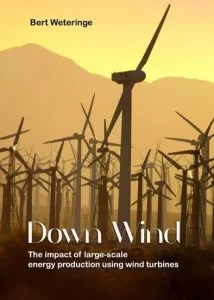 Bert Weteringe is a Dutch aeronautical engineer and the author of the book Downwind (2023), in which he informs readers about the devastating effects of the climate agenda on society and nature, specifically the impact of large-scale energy generation using wind turbines. As an independent investigative journalist, his focus is primarily on the energy transition. Through his website, he publishes news about the energy transition and wind turbines in particular.
Featured Video

Laith Marouf: Hezbollah’s position on US-Iran ceasefire
or go to
Aletho News Archives – Video-Images
From the Archives
The Dirty Little Secret behind the “Global Terrorism Index”
The Omission of Israeli Terrorism in the Occupied Palestinian Territories
By Karin Brothers | Global Research | December 6, 2014
… The Israeli settlements — all of which are illegal – have been identified as a major impediment to peace. The refusal of a major “global” terrorism report to name the Israeli settlers as one of the groups most responsible for terrorism not only misrepresents a major source of regional violence but exposes the Global Terrorism Index as a propaganda tool that supports a U.S. agenda.
In recent years, governments have been attempting to thwart terrorism by blocking supportive fund-raising. When it comes to Israeli settlements, however, the US and Canada actually encourage fund-raising by giving organizations (such as Christian Friends of Israeli Communities (CFOIC) and the Jewish National Fund) financial support in the form of donor tax-deductions.
Charities which provide funds for the Israeli settlements should be regarded as terror-financing organizations. They should not only lose their tax-deductible status, but they should be banned because they support the violation of international humanitarian law. The terror-financing laws that are being strictly enforced for Muslim charities should be applied to Christian and Jewish charities as well. … Read full article
Blog Roll
 Aletho News
- Spain orders reopening of Tehran embassy, condemns Israel’s carpet bombing of Lebanon
- Israel faces ‘unsustainable’ strategic crisis following 40-day war against Iran: Analyst
- Iran restricts Hormuz access to 15 vessels per day under ceasefire terms: Report
- The ‘Opposition Party’ Has Done Nothing to Stop the Iran War and Much to Goad Trump Into Continuing It
- Moscow backs Tehran on status of Lebanon in US-Iran deal
- How UK Regulator Ofcom Quietly Bypassed International Law to Police American Speech
- The Black Cube Files: How Former Mossad Operatives Flipped a Nation
- Laith Marouf: Hezbollah’s position on US-Iran ceasefire: What you’re not being told
- Israel’s priority lies in destroying chances of peace between Iran, US: Ex-UN nuclear chief
- Ceasefire for all or for none: Iran shuts Hormuz over Lebanon attacks
- If Americans Knew
- This is ceasefire? Israel’s biggest massacre yet in Lebanon, another journalist killed in Gaza – Daily Update
- Tucker Carlson on Israel: This Is the Behavior of an Ally? Really?
- Gazans face a triple crisis: severe shortages of water and bread, healthcare in tatters
- NY Times reports how Netanyahu took the US into Iran War
- A sigh of relief over Iran, but Gaza and Lebanon in dire straits – Daily Update
- Thousands dead and neighborhoods razed to the ground: Aid agencies fear southern Lebanon is becoming the new Gaza
- The war the US is fighting for Israel could cost trillions
- ‘Cigarette Burns, Nail Wounds’: Toddler Tortured in Gaza to Coerce Father
- Trump Says US Sent ‘a Lot of Guns’ to Protesters in Iran
- Israeli forces destroy 17 UN peacekeeper cameras in south Lebanon
- No Tricks Zone
- An Inconvenient Tree: Uncovered In Alps… Europe Much Warmer Than Today 6000 Years Ago
- New Study Reports A 60% Slowdown In Greenland’s Ice Loss Rate In The Last Decade
- Low Intensity Tornado Wrecks Major Solar Farm, Creating A Potential Toxic Dump
- New Study Finds Warming Saves Lives…Cold Temperatures 12 Times More Deadly Than Excess Heat
- German Science Blog Accuses PIK Climate Institute Of Hallucinating Climate Tipping Points
- Devastating Assessment Of Comirnaty Vaccine By Former Senior Pfizer Europe Toxicologist
- New Study: CO2 Is ‘Effectively Negligible’ As An Explanatory Climate Change Factor Since 2000
- Former Pfizer Toxicologist Dr. Helmut Sterz Tells Bundestag Hearing Pfizer Vaccine Should Have Never Been Approved
- Energy Expert: Germany’s Nuclear Phaseout Was A “500 Billion Euro Mistake”
- New Research: South Australia’s Mid-Holocene Sea Surface Temperatures Were 4°C Warmer Than Today
 Aletho News