Oil tankers depart Venezuela in ‘dark mode’ amid US blockade: Report
The Cradle | January 5, 2026
About a dozen tankers loaded with Venezuelan oil and fuel departed the country in recent days, despite a blockade imposed by US President Donald Trump as part of the pressure campaign to depose Venezuelan President Nicolas Maduro, TankerTrackers.com reported on 5 January.
The US military launched an operation on Friday to abduct Maduro and his wife, bringing them to the US to face trumped-up drug trafficking charges in a New York court.
Four of the departed tankers recently left Venezuelan waters through a route north of Margarita Island, TankerTrackers.com revealed, after identifying the vessels in satellite images.
At least four of the tankers had been cleared by Caracas authorities in recent days to leave Venezuelan waters, a source with knowledge of the departures’ paperwork told Reuters. The tankers traveled in “dark mode” after switching off their transponders.
According to Reuters, Venezuela’s state-run oil company PDVSA had accumulated a very large inventory of floating storage amid the US blockade imposed by Trump last month, which had brought the country’s oil exports to a standstill.
The ability of the tankers, all of which are under US sanctions, to depart the country loaded with oil will provide relief for PDVSA, which was running out of storage capacity.
Oil provides Venezuela’s primary source of revenue, making the continued export of the country’s crude crucial for maintaining stability following the US regime-change operation.
Oil minister and vice president Delcy Rodriguez now leads the country in Maduro’s absence.
It was not immediately clear if the US allowed the tankers to depart Venezuela or if they managed to break the US blockade.
Trump claimed on Saturday that the “oil embargo” on Venezuela was still in force, but said Caracas’s largest customers, including China, would keep receiving oil as long as it was paid for using dollars, not yuan.
However, Maduro’s ouster will likely [???] lead Venezuelan oil to be rerouted toward the US and away from China moving forward.
“A smooth transition in Caracas will likely result in a rapid rerouting of Venezuelan oil exports, re-establishing the US as the major buyer of the country’s volumes,” Reuters wrote on Sunday.
Pro-Israel billionaire and Trump supporter Paul Singer is expected to be the largest beneficiary of the rerouting.
In November, a judge in the US District Court in Delaware awarded the assets of PDVSA’s US subsidiary, CITGO, to Amber Energy, which is funded by Singer’s Elliott Management.
Elliot Management paid just $5.9 billion for CITGO’s assets, which include oil refineries in Texas, Louisiana, and Illinois. Estimates of the actual value of CITGO’s assets are as high as $18 billion.
CITGO’s refineries in the US were custom-built to refine Venezuela’s heavy crude, meaning that due to Trump’s regime-change operation, Singer will now be able to purchase Venezuelan oil, refine it, and sell it as fuel in the US.
Jaime Brito, an oil analyst at OPIS, said access to Venezuelan oil imports “will be a game changer for US Gulf Coast … refiners in terms of profitability.”
US Wants to Install ‘Functional Protectorate’ in Venezuela: Here Are Its Four Components
Sputnik – 05.01.2026
With Maduro out, Washington is looking to establish “four kinds of control” in Venezuela. Independent Peru-based geopolitical and economic analyst Nicolas Takayama Constantini outlines the mechanics of these measures for Sputnik.
“Operationally, it means that they will have a de facto tutelary administration,” Constantini explained. This would mean:
- “indirect political control” via a “provisional authority” or “transition council” approved by Washington, not the Venezuelan people
- technical and financial control over the oil sector, including contracts, ports and foreign currency flows
- direct control over oil revenues, either by the US Treasury, “or some entity controlled by the US”
- some form of US military or security presence, not necessarily a large one.
“So, in fact this wouldn’t be classical governance, but rather a form of functional protectorate, similar to Iraq in 2003,” the observer said.
Goal of US Operation: Seizure of Resources or Message to Rivals
“From a rational economic point of view, military intervention is not efficient. The military, political and reputational cost for the US far exceeds any potential energy gains. But it’s not only the resources,” even in Venezuela’s case (oil, gas, rare earths, tech metals, gold), Constantini said.
It’s about sending a message to Washington’s geopolitical rivals, including China, Russia and Iran, about preventing Venezuela’s resources from falling into their hands, and letting regional countries know: “if you don’t submit or make your resources available to me when I need, this will happen to you.”
“Just to have a note here, obviously the US doesn’t care about the Venezuelan interest or even the American citizens’ interest related to drug traffickers because the agencies in the US say that the main flow of drugs doesn’t come from Venezuela,” the expert added.
Venezuela Attack Signals Final Breakup of Post-WWII Order
“It’s an extremely serious precedent for the international order. It means that state sovereignty doesn’t work anymore. The head of state immunity doesn’t work anymore. It normalizes regime change by force without multilateral authorization. It reinforces the idea that power supersedes international law,” Constantini explained.
“It marks the end of what remained of international law and the international order after the Second World War… a greater militarization of foreign policy and acceleration of the global order’s fragmentation into competing blocs. This implies that other powers can do the same if they don’t consider a particular government legitimate,” the observer summed up.
Venezuela slashes oil production as US embargo halts exports
Al Mayadeen | January 5, 2026
Venezuela’s state-run oil company, PDVSA, began cutting crude output on Sunday as storage facilities reached critical capacity, a direct consequence of the comprehensive US oil embargo that has reduced exports to nearly zero.
The move adds further strain on an interim government grappling with mounting economic and political pressure.
PDVSA is shutting down oilfields and well clusters after storage facilities near capacity, with stocks of extra-heavy crude piling up. The company is also facing a shortage of diluents, essential for blending Venezuela’s heavy oil for export.
These constraints have forced the company to reduce PDVSA crude output.
Sources confirmed to Reuters that output cuts were requested at joint ventures such as CNPC’s Petrolera Sinovensa, Chevron’s Petropiar and Petroboscan, and Petromonagas. The latter, once operated jointly with Russian state-run Roszarubezhneft, is now under sole PDVSA control.
Chevron Shipments Halted Despite License
Chevron, which holds a US license to operate in Venezuela, had been an exception to the wider export freeze. However, since Thursday, its shipments have also come to a halt. Although Chevron has not yet reduced production, storage capacity is nearing its limit at key facilities such as Petropiar and Petroboscan.
No Chevron-operated tankers have left Venezuelan waters since Thursday, and if delays persist, Chevron Venezuela operations may be forced to scale back output.
Chevron stated it continues to operate “in full compliance with all relevant laws and regulations,” without providing further comment.
Political and Economic fallout from US blockade
The political landscape in Caracas remains tense following the kidnapping of President Nicolas Maduro and his wife by US forces on Saturday.
Delcy Rodriguez, Venezuela’s oil minister, has since assumed the role of interim president.
President Donald Trump declared that an “oil embargo” was fully in effect as part of a broader transition overseen by the US. The US oil embargo on Venezuela has halted tanker movements, impacted international shipments, and left the country’s oil-dependent economy under extreme duress.
Although Rodriguez stated last month that Venezuela would continue producing and exporting oil despite US sanctions, the embargo’s tightening grip has forced PDVSA to slow operations and store crude on vessels.
Export collapse and floating storage build-up
In recent weeks, PDVSA has resorted to using floating storage, loading tankers with crude and fuel as onshore capacity maxes out.
Over 17 million barrels of oil are currently stored aboard ships awaiting departure, according to TankerTrackers.com. No tankers were docked at the Jose terminal on Sunday, halting both export and domestic supply activities.
The Venezuela oil storage crisis worsened as more than 45% of the country’s 48-million-barrel onshore storage capacity was filled, forcing excess fuel oil into open-air waste pools.
Meanwhile, Venezuela’s access to diluents has been constrained. In the second half of last year, the country increased imports of naphtha and light oil from Russia to blend its heavy crude. However, these shipments began facing obstacles in December due to the US-led blockade.
Venezuela’s crude output, which stood at approximately 1.1 million barrels per day (bpd) in November with exports reaching 950,000 bpd, dropped to around 500,000 bpd last month, according to preliminary data based on shipping movements.
Venezuela’s oil production slowdown could have a domino effect, disrupting refining and the domestic fuel supply chain. This poses a serious challenge to the interim government, which relies on oil revenues to maintain basic governance and internal stability.
Why Are Mike Pompeo And The Mossad Publicly Announcing Mossad Involvement In Iranian Protests?
The public announcement of Mossad involvement in Iranian protests seems to have a cynical motive
The Dissident | January 2, 2026
Recently, a Twitter account widely seen to be backed by the Israeli Mossad along with the former CIA director and Secretary of State for Trump’s first term, Mike Pompeo, have publicly claimed that Israel’s Mossad is involved in the current protests in Iran.
At first glance, the claims seem to be a sloppy admission of a covert Israeli intelligence operation, but a closer look suggests something far more cynical is at play.
For context, on December 29th, an X account called “Mossad Farsi”- which the Israeli newspaper Ynet notes “is widely regarded as an official messaging channel of the Mossad targeting Iranian audiences, though Israel has not officially confirmed its ownership”-wrote, “Let’s come out to the streets together. The time has come.
We are with you. Not just from afar and verbally. We are with you in the field as well.”
The tweet has been taken in Israeli media as confirmation of Mossad involvement in the Iranian protests, for example, the Jerusalem Post wrote an article titled , “Mossad spurs Iran protests, says agents with demonstrators in Farsi message”.
Following the tweet, Mike Pompeo, the former director of the CIA and Trump’s former Secretary of State, also wrote a tweet appearing to confirm Mossad involvement in the protests, tweeting today:
The Iranian regime is in trouble. Bringing in mercenaries is its last best hope.
Riots in dozens of cities and the Basij under siege — Mashed, Tehran, Zahedan. Next stop: Baluchistan.
47 years of this regime; POTUS 47. Coincidence?
Happy New Year to every Iranian in the streets. Also to every Mossad agent walking beside them.
A closer look at these seeming public admissions shows something more cynical at play.
Some analysts have speculated that both Pompeo and the Mossad are either publicly admitting to Mossad involvement in the protests or making false claims of Mossad involvement in the protests in order to encourage a harsher crackdown on them as a pretext for war.
Responding to the “Mossad Farsi” tweet, Analyst Esfandyar Batmanghelidj argued, “It’s a message intended to provoke the most paranoid figures in Iran’s security forces to see the legitimate protests as a major threat. Mossad wants violence.”
Responding to the Mike Pompeo tweet , journalist Dave Decamp wrote, “I wonder if the point of Pompeo saying Mossad agents are among the Iranian protesters and the Mossad account on here saying something similar is an effort to get Iran to crack down harder so Trump intervenes”.
This theory is bolstered by the fact that Trump- fresh from his visit with Benjamin Netanyahu, where he pushed him towards a new war with Iran – wrote on Truth Social, “If Iran shots and violently kills peaceful protesters, which is their custom, the United States of America will come to their rescue. We are locked and loaded and ready to go. Thank you for your attention to this matter”, suggesting that the U.S. will again bomb Iran if they crack down on protestors.
Mossad involvement in the protests in Iran would come as no surprise.
Israeli intelligence have previously been caught by Haaretz and the University of Toronto’s Citizen Lab creating social media bots that were attempting to foment a violent regime change in Iran and prop up the Israeli puppet, Reza Pahlavi.
Israel’s I24 News, has also admitted that the current protests “likely received guidance” and seem like “a hand is at work here”, from “intelligence work”.
Whether the Mossad operations behind the Iran protests are real or not, it is becoming increasingly clear that the public admissions of it are intended to foment an Iranian government crackdown, so that Trump will make good on his threat and launch a new war.
Protests in Iran: Analysis of current demonstrations and their implications for the Islamic Republic
Few analysts in the West are truly aware of the situation in Iran
By Lucas Leiroz | Strategic Culture Foundation | January 3, 2026
Western understanding of Iran’s internal situation remains profoundly mistaken. Recurring narratives of an imminent collapse ignore the country’s political and social complexity and exaggerate the impact of current demonstrations. It is essential to recognize that, although there are significant tensions, Iran is not currently in a crisis that threatens the continuity of the Islamic Republic, nor is it in a state of absolute stability.
The current demonstrations originate from patriotic sectors of society, motivated by dissatisfaction with the moderate and semi-liberal government of Masoud Pezeshkian. Contrary to widespread claims, most of these protests do not challenge the fundamental principles of the Islamic Republic. The discontent is focused on government economic policies, considered ineffective by broad segments of the population, leading to a perception of management crisis, but not a crisis of legitimacy for the Islamic Republic. Rising prices, water shortages, and economic instability drive popular demands – not challenges to the revolutionary principles themselves.
It is also important to note that, as often occurs in contexts of attempted governmental change, external or internal actors with different interests infiltrate protests, promoting episodes of violence and vandalism. The escalation of clashes in certain areas, particularly in the outskirts and western regions of the country, should not be interpreted as a sign of collapse. Historically, Iran maintains stronger control and stability in major cities and in the capital, Tehran, where protests remain largely peaceful. This pattern demonstrates the institutional capacity of the Islamic Republic to manage crises, even amid significant mobilizations.
Historical context also provides important point of reference for analysis. Iran has previously faced protests of considerable magnitude, such as those following the death of Masha Amina in 2022, when demonstrations led to armed confrontations with security forces. Compared to the events of 2022, today’s social movement is moderate in both intensity and scope, indicating that the security and control system of the Islamic Republic remains functional and effective.
Another key point is the coexistence of different protest currents within the country. While there are mobilizations critical of the government, there are also demonstrations in support of the Islamic Republic (albeit critical of Pezeshkian’s administration). This diversity shows that dissatisfaction is not unanimous toward the Islamic Republic as a whole, but is concentrated on specific management failures and economic policies. This reality significantly reduces the likelihood of a change in the Islamic Republic, although there is some probability of a government collapse.
For external analysts, it is tempting to interpret the protests as a harbinger of total destabilization. A closer analysis suggests that the most plausible scenario is the erosion of Pezeshkian’s moderate government, followed by a possible rise of leadership more aligned with the original revolutionary principles of the Islamic Republic. In this context, an internal power adjustment is far more likely than the dissolution of the country’s institutions.
It must be acknowledged, however, that the Islamic Republic is not immune to risks. Sudden internal or external developments could significantly alter the current balance. Yet, considering Iran’s historical experience with crises, protests, and foreign intervention attempts, contemporary demonstrations do not provide sufficient grounds to predict a national collapse. The Republic remains structured and capable of maintaining its political and social core.
In summary, Western perceptions that Iran is on the brink of collapse reflect a simplistic and misinformed interpretation of events. The current demonstrations should be understood as expressions of sectoral discontent and governance challenges, not as existential threats to the Islamic Republic. The balance of internal forces, combined with historical experience in managing crises, ensures that the Islamic Republic continues to function, with the capacity to adjust to social pressures without compromising its political continuity.
Trump tells India to stop purchasing Iran oil, buy Venezuelan instead
Press TV – February 1, 2026
US President Donald Trump has told India to stop purchasing oil from Iran and instead supply its energy demands by buying crude from Venezuela.
“India is coming in, and they’re going to be buying Venezuelan oil as opposed to buying it from Iran. So, we’ve already made that deal, the concept of the deal,” Trump told reporters on board Air Force One on Saturday.
Earlier, Trump had threatened to slap fresh tariffs on India if New Delhi did not halt its purchase of oil from US adversaries.
However, New Delhi had resisted the threat, reminding the US president that Washington had no authority to determine the trading relations of other nations.
Trump is openly saying that he has taken full control of Venezuela’s oil industry following the US forces’ kidnapping of the South American country’s president, Nicolas Maduro.
Under the pretext of leading a cartel of drug and gun traffickers, Maduro was abducted from the presidential palace in Caracas last month and transferred to a prison facility in New York pending trial.
In the meantime, Trump has announced that the United States is controlling the proceeds of Venezuela’s oil sales. The Latin American country is among the top oil producers with the biggest proven reserves in the world.
“This Oil will be sold at its market price, and that money will be controlled by me, as President of the United States of America, to ensure it is used to benefit the people of Venezuela and the United States,” Trump wrote on his social media platform Truth Social earlier last month.
Legal experts say Trump’s claim to Venezuela’s oil reserves is unlawful. There is expert consensus that Venezuela’s oil proceeds belong solely to its people.
Venezuela under siege: Why US escalation could destabilize an entire region
By Leila Nezirevic | Al Mayadeen | December 28, 2025
Washington’s confrontation with Venezuela has entered a dangerous new phase. What began years ago as sanctions aimed at pressuring President Nicolás Maduro’s government has now escalated into naval interdictions, oil tanker seizures, and open discussion of military action — a shift that risks destabilizing not only Venezuela but much of Latin America.
In recent weeks, the United States has intensified its campaign by intercepting Venezuelan oil shipments at sea, effectively enforcing what officials describe as a “blockade” of sanctioned vessels. Caracas has denounced the move as piracy and a violation of international law, while Washington frames it as a legitimate enforcement of sanctions and a counter-narcotics operation.
Yet behind the legal arguments and political messaging lies a deeper strategic shift, one that signals a return to a more coercive US posture in Latin America, with potentially profound consequences.
To understand the implications of this escalation, alngside current regional developments and historical precedents, this article draws on an in-depth interview with veteran journalist and leading Latin America expert Richard Lapper.
A sharp escalation at sea
The most visible sign of Washington’s new approach has been its actions in international waters. US naval forces have seized and disabled Venezuelan oil tankers accused of violating sanctions, while additional vessels remain under surveillance. These measures go beyond financial penalties and diplomatic pressure, marking one of the most forceful uses of maritime power against Venezuela in decades.
Caracas has condemned the seizures as an illegal blockade and accused Washington of weaponizing sanctions to strangle its economy. Venezuelan officials argue that the actions violate international maritime law and set a dangerous precedent for global trade.
Legal experts remain divided. While the US claims it is acting within the scope of sanctions enforcement, critics argue that interdicting vessels in international waters — especially without multilateral backing — risks undermining established norms of freedom of navigation.
Richard Lapper, also an author of several books, including Lula!: The Man, The Myth and a Dream of Latin America, is blunt in his assessment. “This is a breach of international law,” he says. “But I don’t think that really matters for the Trump administration. This is about exerting power.”
The return of the Monroe Doctrine
According to Lapper, Washington’s Venezuela policy reflects a broader reassertion of hemispheric dominance reminiscent of the Monroe Doctrine — the 19th-century principle that Latin America falls within the United States’ exclusive sphere of influence.
For decades, US policy toward the region oscillated between overt intervention and softer approaches centred on democracy promotion and economic reform. That balance now appears to be tilting decisively toward coercion.
“This is a fairly clear restatement of a traditional US approach,” Lapper explains. “It says: this is our region, and we are going to exert our power.”
He points to recent US involvement in Honduras as emblematic of this shift. Washington strongly backed political actors aligned with its interests, even when they carried significant legal and ethical baggage. In doing so, the US signalled that strategic loyalty now outweighs democratic credentials.
From sanctions to military pressure
For years, sanctions were Washington’s primary tool against Venezuela. Initially justified as a way to pressure the Maduro government toward democratic reforms, the measures expanded to target the country’s oil industry — the backbone of its economy.
While sanctions inflicted economic pain, they failed to dislodge Maduro. Instead, Venezuela’s political system hardened, opposition forces fragmented, and millions of citizens left the country.
Now, sanctions are being reinforced by overt military pressure.
Trump has publicly refused to rule out armed conflict with Venezuela. While a full-scale invasion remains unlikely, Lapper, warns that limited military escalation is a real possibility.
“I don’t think war in the sense of large ground troop deployments is likely,” he says. “But significant military escalation — including drone strikes or targeted attacks on government assets — could happen.”
Such an approach would mirror recent conflicts elsewhere, where technologically advanced militaries sought to degrade adversaries without committing troops on the ground.
Yet Venezuela is not a small or easily controlled state. It is geographically vast, with difficult terrain and powerful non-state actors operating in rural areas.
“Venezuela is a big country,” Lapper cautions. “It would be very difficult for any external power to secure control of the entire territory.”
Drugs, terror labels, and political framing
Washington has justified some of its actions by framing Venezuela as a major hub for drug trafficking, alleging links between senior officials and organized crime networks such as the so-called “Cartel of the Suns.”
There is little dispute that narcotics pass through Venezuela en route to North America. The question is whether this justifies the current escalation — or whether it serves as political cover.
“You have to take the drug stuff with a pinch of salt,” Lapper says. “A lot of drugs do go through Venezuela, but to what extent Maduro himself is at the centre of this is highly contested.”
He notes the inconsistency of US drug policy, pointing to cases where Washington has quietly abandoned its tough stance when political interests demanded it.
“It’s a convenient wrapper for the policy,” Lapper argues. “But the real objective is regional domination.”
A changing political landscape in Latin America
The escalation against Venezuela is unfolding amid a broader political realignment across Latin America. After the so-called “pink tide” of left-wing governments in the early 2000s, the region has swung sharply to the right.
Conservative and far-right leaders now dominate in countries such as Argentina, El Salvador, and Chile, while left-wing governments face mounting pressure elsewhere.
“These are the leaders setting the regional mood,” Lapper says, pointing to figures like Argentina’s Javier Milei and El Salvador’s Nayib Bukele. “Not the Lulas and Chavezes of the past.”
This shift has two implications. First, it reduces regional resistance to US pressure on Venezuela. Second, it creates an environment in which hardline security approaches are politically fashionable.
Ironically, however, overt US intervention can still backfire. In Brazil, for instance, perceived external interference has boosted nationalist sentiment and temporarily strengthened President Lula’s standing.
Venezuela’s economic collapse: Sanctions
One of the central debates surrounding Venezuela concerns responsibility for its economic collapse. Washington argues that sanctions are a response to authoritarianism and corruption. Caracas insists that sanctions themselves are the root cause of suffering.
“Sanctions make things worse, Venezuela was producing three million barrels a day in the late 1990s,” Lapper notes. “Now it produces around a million. It used to be a major force in OPEC. It isn’t anymore.”
However, he also pointed out that even without sanctions, Venezuela would face deep structural challenges. With sanctions, those challenges have become existential.
Humanitarian fallout and migration pressures
The human cost of Venezuela’s crisis is staggering. Roughly one-fifth of the population has left the country, creating one of the largest displacement crises in modern history.
Escalating sanctions and blockades are likely to worsen this trend.
Within Venezuela, reduced oil revenues mean fewer imports, higher inflation, and deeper reliance on informal and illicit economic activities. Outside the country, neighbouring states struggle to absorb waves of migrants.
Brazil, which shares a long land border with Venezuela, has a direct interest in preventing further destabilisation. It has attempted to mediate politically, but with little success.
“Brazil wants stability,” Lapper says. “But its soft diplomacy hasn’t been effective.”
As conditions deteriorate, migration pressures are likely to intensify — not only toward neighbouring countries, but eventually toward the United States itself.
International allies and a shrinking safety net
Venezuela is not entirely isolated. Cuba remains its most important security ally, receiving subsidized oil in exchange for intelligence and political support.
Russia and China provide diplomatic backing, but neither appears eager to dramatically escalate its involvement.
“I don’t see Russia or China rushing to Venezuela’s aid,” Lapper says.
If US pressure cuts off oil supplies to Cuba, the effects could be destabilizing across the Caribbean. Cuba is already facing severe economic strain, with blackouts and protests becoming more frequent.
The risk, analysts warn, is a cascading crisis affecting multiple states simultaneously.
Lessons from past US interventions
History offers sobering lessons. US military interventions in Latin America have had mixed results at best. While short operations in Panama and Grenada succeeded tactically, longer engagements — such as Haiti — produced prolonged instability.
Elsewhere, particularly in the Middle East, US interventions over the past three decades have often exacerbated conflict rather than resolving it.
“The US does not have the staying power,” Lapper says. “There isn’t domestic support for long, messy interventions.”
That reality limits Washington’s options.
Sanctions alone have failed. Full-scale invasion is politically untenable. High-tech, limited strikes remain a temptation — but one fraught with risk.
What lies ahead for Venezuela?
Looking toward 2026, Lapper sees no easy resolution.
“I don’t see the end of the Maduro regime at the moment,” he says. “Escalation would have to be quite significant for that to happen.”
The most likely scenario, he argues, is continued stalemate: a current government clinging to power, an economy under siege, and a population increasingly forced to flee.
“There’s a lot of explosive material piled up in Venezuela,” Lapper observes. “But right now, there’s nothing to blow it up.”
Whether Washington’s escalating pressure will eventually trigger change — or simply deepen chaos — remains an open and deeply consequential question.
Europe’s Panic Economy: Frozen Assets, Empty Arsenals, and the Quiet Admission of Defeat
By Gerry Nolan | Ron Paul Institute | December 24, 2025
When a prime minister tells her own staff to rest because next year will be much worse, it is not gallows humor. It is not exhaustion speaking. It is a slip of the mask, the kind of remark leaders make only when the internal forecasts no longer align with the public script.
Giorgia Meloni was not addressing voters. She was addressing the state itself — the bureaucratic core tasked with executing decisions whose consequences can no longer be disguised. Her words were not about a mundane increased workload. They were about constraint. About limits. About a Europe that has crossed from crisis management into managed decline, and knows that 2026 is when the accumulated costs finally collide.
What Meloni let slip is what Europe’s elites already understand: the Western project in Ukraine has run head-first into material reality. Not Russian propaganda. Not disinformation. Not populism. Steel, munitions, energy, labor, and time. And once material reality asserts itself, legitimacy begins to drain.
The War Europe Cannot Supply
Europe can posture for war. It cannot produce for war.
Four years into a high-intensity war of attrition, the United States and Europe are confronting a truth they spent decades unlearning: you do not sustain this kind of conflict with theatrical speeches, sanctions, or abandoning diplomacy. You sustain it with shells, missiles, trained crews, repair cycles, and production rates that exceed losses — month after month, without interruption.
By 2025, the gap is no longer theoretical.
Russia is now producing artillery ammunition at a scale that Western officials themselves concede outpaces the combined output of NATO. Russian industry has shifted to continuous near-wartime production (without even being fully mobilized), with centralized procurement, simplified supply chains, and state-directed throughput. Estimates place annual Russian artillery production at several million rounds — production already flowing, not promised.
Europe, by contrast, has spent 2025 celebrating targets it cannot ever materially meet. The European Union’s flagship pledge remains two million shells per year — a goal dependent on new facilities, new contracts, and new labor that will not fully materialize within the decisive window of the war, if ever. Even the dreamed target if reached, would not put it at parity with Russian output. The United States, after emergency expansion, is projecting roughly one million shells annually once and a big if, full ramp-up is achieved. Even combined on paper, Western production struggles to match Russian output already delivered. Talk about paper tiger.
This is not a gap. It is a major tempo mismatch. Russia is producing at scale now. Europe is dreaming of rebuilding the ability to produce at scale later.
And time is the one variable that cannot be sanctioned.
Nor can the United States simply compensate for Europe’s hollowed-out capacity. Washington faces its own industrial choke points. Production of Patriot air-defense interceptors runs in the low hundreds per year while demand now spans Ukraine, Israel, Taiwan, and US stockpile replenishment simultaneously — a mismatch senior Pentagon officials have acknowledged cannot be resolved quickly, if ever. US naval shipbuilding tells the same story: submarine and surface-combatant programs are years behind schedule, constrained by labor shortages, aging yards, and cost overruns that push meaningful expansion into the 2030s. The assumption that America can industrially backstop Europe no longer matches reality. This is not a European problem alone; it is a Western one.
War Footing Without Factories
European leaders speak of “war footing” as if it were a political posture. In reality, it is an industrial condition and Europe does not meet it.
New artillery production lines require years to reach stable throughput. Air-defense interceptor manufacturing runs in long cycles measured in batches, not surges. Even basic inputs such as explosives remain bottlenecks, with facilities shuttered decades ago only now being reopened, some not expected to reach capacity until the late 2020s.
That date alone is an admission.
Russia, meanwhile, is already operating inside wartime tempo. Its defense sector has delivered thousands of armored vehicles, hundreds of aircraft and helicopters, and vast quantities of drones annually.
Europe’s problem is not conceptual; it is institutional. Germany’s much-vaunted Zeitenwende exposed this brutally. Tens of billions were authorized, but procurement bottlenecks, fragmented contracting, and an atrophied supplier base meant delivery lagged years behind rhetoric. France, often cited as Europe’s most capable arms producer, can manufacture more sophisticated systems — but only in boutique quantities, measured in dozens where attritional war demands thousands. Even the EU’s own ammunition acceleration initiatives expanded capacity on paper while the front consumed shells in weeks. These are not ideological failures. They are administrative and industrial ones and they compound under pressure.
The difference is structural. Western industry was optimized for shareholder efficiency and peacetime margins. Russia’s has been reorganized for endurance under pressure. NATO announces packages. Russia counts deliveries.
The €210 Billion Fantasy
This industrial reality explains why the frozen-assets saga mattered so much, and why it failed.
Europe’s leadership did not pursue the seizure of Russian sovereign assets out of legal creativity or moral clarity. It pursued it because it needed time. Time to avoid admitting that the war could not be sustained on Western industrial terms. Time to substitute finance for production.
When the attempt to seize roughly €210 billion in Russian assets collapsed on December 20th, blocked by legal risk, market consequences, and resistance led by Belgium, with Italy, Malta, Slovakia and Hungary, aligned against outright confiscation, Europe settled for a degraded substitute: a €90 billion loan to Ukraine for 2026–27, serviced by 3B in annual interest, further mortgaging Europe’s future. This was not strategy. It was triage, and further divided, an already weakened Union.
Outright confiscation would have detonated Europe’s credibility as a financial custodian. Permanent immobilization avoids the blast — but creates a slow bleed. The assets remain frozen indefinitely, a standing act of economic warfare that signals to the world that reserves held in Europe are conditional and not worth the risk. Europe chose reputational erosion over legal rupture. That choice reveals fear, not strength.
Ukraine as a Balance-Sheet War
The deeper truth is that Ukraine is no longer primarily a battlefield problem. It is a solvency problem. Washington understands this. The United States can absorb embarrassment. It cannot absorb open-ended liabilities indefinitely. An offramp is being sought — quietly, unevenly, and with rhetorical cover.
Europe cannot admit it needs one. Europe framed the war as existential, civilizational, moral. It declared compromise appeasement and negotiation surrender. In doing so, it erased its own exit ramps.
Now the costs land where no narrative can deflect them: on European budgets, European energy bills, European industry, and European political cohesion. The €90 billion loan is not solidarity. It is securitization of decline — rolling obligations forward while the productive base required to justify them continues to erode.
Meloni knows this. That is why her tone was not defiant, but weary.
Censorship as Panic Management
As material limits harden, narrative control tightens. The aggressive enforcement of the EU’s Digital Services Act is not about safety. It is about containment, in its most Orwellian form — constructing an information perimeter around an elite consensus that can no longer withstand open accounting. When citizens begin asking calmly, and then not calmly, relentlessly, what was this for?, the illusion of legitimacy collapses quickly.
This is why regulatory pressure now reaches beyond Europe’s borders, provoking transatlantic friction over jurisdiction and speech. Confident systems do not fear conversation. Fragile ones do. Censorship here is not ideology. It is insurance.
Deindustrialization: The Unspoken Betrayal
Europe did not merely sanction Russia. It sanctioned its own industrial model.
By 2025, European industry continues to pay energy costs far above those of competitors in the United States or Russia. Germany, the engine, has seen sustained contraction in energy-intensive manufacturing. Chemical, steel, fertilizer, and glass production have either shut down or relocated. Small and medium enterprises across Italy and Central Europe are failing quietly, without headlines.
This is why Europe cannot scale ammunition the way it needs to. This is why rearmament remains a promise rather than a condition. Cheap energy was not a luxury. It was the foundation. Remove it via self-sabotage (Nordstream et. al), and the structure hollows out.
China, watching all of this, holds the other half of Europe’s nightmare. It commands the deepest manufacturing base on earth without having entered wartime footing. Russia does not need China’s breadth, only its strategic depth behind it in reserve. Europe has neither.
What Meloni Actually Fears
Not hard work. Not busy schedules. She fears a 2026 in which Europe’s elites lose control of three things at once.
Money — as Ukraine’s funding becomes an EU balance-sheet problem, replacing the fantasy that “Russia will pay.”
Narrative — as censorship tightens and still fails to suppress the question echoing across the continent: what was this all for?
Alliance discipline — as Washington maneuvers for exit while Europe absorbs the cost, the risk, and the humiliation.
That is the panic. Not losing the war overnight, but losing legitimacy slowly, as reality leaks out through energy bills, shuttered factories, empty arsenals, and mortgaged futures.
Humanity at the Abyss
This is not just Europe’s crisis. It is civilizational. A system that cannot produce, cannot replenish, cannot tell the truth, and cannot retreat without collapsing credibility has reached its limits. When leaders begin preparing their own institutions for worse years ahead, they are not forecasting inconvenience. They are conceding structure.
Meloni’s remark mattered because it pierced the performance. Empires announce triumph loudly. Systems in decline lower expectations quietly, or loudly in Meloni’s case.
Europe’s leadership is lowering expectations now because it knows what the warehouses contain, what the factories cannot yet deliver, what the debt curves look like — and what the public has already begun to understand.
For most Europeans, this reckoning will not arrive as an abstract debate about strategy or supply chains. It will arrive as a far simpler realization: this was never a war they consented to. It was not fought to defend their homes, their prosperity, or their future. It was fought for greed for Empire, and paid for with their living standards, their industry, and their children’s future.
They were told it was existential. They were told there was no alternative. They were told sacrifice was virtue.
Yet what Europeans want is not endless mobilization or permanent austerity. They want peace. They want stability. They want the quiet dignity of prosperity — affordable energy, functioning industry, and a future that is not mortgaged to conflicts they did not consent to.
And when that truth settles, when the fear recedes and the spell breaks, the question Europeans will ask will not be technical, ideological, or rhetorical.
It will be human. Why were we forced to sacrifice everything for a war we never agreed to and told there was no peace worth pursuing? And this is what keeps Meloni up at night.
Gerry Nolan is a political analyst, writer, and strategist focused on geopolitics, security affairs, and the structural dynamics of global power. He is the founder and editor of The Islander, an independent media platform examining war, diplomacy, economic statecraft, and the accelerating shift toward a multipolar world.
US Navy effectively becomes a tool of modern piracy
By Drago Bosnic | December 24, 2025
The political West has been conducting an unprovoked aggression against the entire world for at least half a millennium at this point. Whether through direct attacks and occupation or various forms of colonialism (that lasts to this day), the world’s most aggressive power pole has been a threat to every other country on this unfortunate planet. Although certainly not the only one, the primary tool of Western power projection have been navies, which is hardly surprising given the political West’s thalassocratic nature. Through naval supremacy, Western (primarily Anglo) powers have spread their colonial empires to virtually every corner of the world, exterminating the native populations along the way and settling in their lands.
Entire continents (such as North America and Australia) were secured through brutal genocide of the locals who now live in small, scattered communities (so-called “reservations/reserves”). The genocidal campaign continued throughout the Atlantic and Pacific, where numerous islands and maritime trade routes remain in Western hands to this very day. Controlling these areas is key to maintaining its stranglehold over global trade, as seen during the latest US attacks on inbound and outbound Venezuelan shipping. However, the Pentagon seems to be expanding this aggression to other countries trading with Caracas, including China, which is a major importer of Venezuelan commodities (particularly crude oil).
Namely, the US Navy and Coast Guard hijacked the “Centuries”, an oil tanker carrying up to two million barrels of Venezuelan crude to China. According to military sources, American forces, operating MH-60T helicopters and reportedly including a Maritime Security Response Team, led the raid. The oil belongs to the Chinese Satau Tijana Oil Trading company. In December alone, this is the third such incident where US naval assets effectively engaged in piracy, as these civilian ships were hijacked in international waters. The Chinese Foreign Ministry condemned the illegal raid, slamming it as a “serious violation of international maritime law and an illegal interference in legitimate global trade”.
This is an attempt to continue the policy of economic strangulation of Venezuela after the sanctions failed to produce the desired result (a color revolution that would bring a pro-American puppet regime to power). It comes less than a week after US President Donald Trump formally ordered the “total and complete blockade” of Venezuela, claiming that its government is now designated as a “foreign terrorist organization” (FTO). In his signature manner of communicating through the unchecked use of superlatives, Trump also bragged that the US Navy “completely surrounded” Venezuela with “the largest armada ever assembled in the history of South America”. Considering Caracas’ already difficult position, this is effectively a declaration of war.
Namely, Venezuela has a highly complex geographical and geopolitical position that makes lands routes largely unusable. Its coastline is the main lifeline that enables trade with the rest of the world, so Washington DC’s decision to engage in piracy against Caracas is a clear indicator that it doesn’t want to allow any sovereign nations to exist in the Western Hemisphere (especially now that the new US National Security Strategy and the restructuring of the Pentagon’s commands is putting an emphasis on the resurgent Monroe Doctrine). Venezuela is probably the most fiercely independent Latin American country, making it the No. 1 target for warmongers and war criminals in the monstrous American oligarchy.
What’s more, considering the fact that these pirates, thugs and goons in suits are terrified of China and its unprecedented development, they wouldn’t want to miss an opportunity to hurt Beijing’s interests. The Chinese economy, the world’s largest and most powerful since 2014, needs a constant supply of critical resources (particularly natural gas and oil). The US is unable to prevent Russia and other multipolar powers from trading with China, so it’s focused on disrupting this with other, more vulnerable countries, such as Venezuela. This is precisely why Beijing perceives the US, its vassals and satellite states as the primary threat to Chinese shipping and maritime trade (and naval security interests in general).
Obviously, the most glaring example of this is China’s breakaway island province of Taiwan, where a US puppet government is escalating tensions and jeopardizing Beijing’s basic national security interests. However, the Asian giant certainly understands that this is only one segment of the Western so-called “China containment” strategy that seeks to limit its ability to conduct unimpeded trade with the world. This is why China keeps building an ever stronger navy that can respond to such challenges. Namely, the US-led political West will undoubtedly continue to conduct its unprovoked aggression against the entire world unless prevented through the use of the only language it understands – force and violence.
It should be noted that this isn’t some spontaneous reaction to Beijing’s growth. And it’s certainly not limited only to the Trump administration. Namely, starting in the early 2010s, Barack Obama launched the so-called “Pivot to Asia” initiative to build up US/NATO presence in the Asia-Pacific. This continued during Trump’s first term, as well as the troubled Biden administration. In practice, this means that the warmongering American oligarchy pulls the strings regardless of who’s president. The Pentagon has increasingly stressed the need to launch “distant blockade operations”, the strategic goal of which is to cut off Chinese trade. This would give the US-led political West significant leverage over Beijing.
The same goes for Russia, whose shipping has been under attack for years, particularly when the Neo-Nazi junta is not doing so great on the battlefield in NATO-occupied Ukraine. Although the political West is attributing these attacks to the Kiev regime, it’s difficult to imagine the latter could conduct such operations thousands of kilometers away without ample Western support (if not direct orders and participation). This form of piracy gives the US, its vassals and satellite states perfect “plausible deniability”, meaning they can disrupt Moscow’s and Beijing’s economic interests without the need to engage Russian and Chinese militaries directly. This is precisely how piracy was used geopolitically until the early 18th century.
Drago Bosnic is an independent geopolitical and military analyst.
EU Morphing Into Its Own Worst Enemy – Viktor Orban
Sputnik – 24.12.2025
The decline of the European Union, rather than the Ukrainian conflict, is what really threatens to plunge Europe into war, Hungary’s Prime Minister Viktor Orban told the Magyar Nemzet newspaper.
The real reason of the existing risk of escalation, Orban argued, is the political, economic and social decline of Western Europe, whereas the Ukrainian conflict is more of a symptom of the current situation rather than its cause.
According to him, the process that led to this state of affairs started during the 2000s and was exacerbated by Europe’s inadequate reaction to the ensuing financial crisis.
Orban also noted that a war in Europe may break out soon, and that 2025 might have been the last peaceful year for the region.
He pointed out that the decisions that were made at the EU summit in Brussels last week were aimed at prolonging the Ukrainian conflict and continuing Europe’s confrontation with Russia.
Though there are powers in Europe that seek peace – like Hungary, for example – Orban warns that those European elites who seek war seem to be gaining an upper hand.
Russia, African Countries Agree to Strengthen Security Cooperation – Lavrov
Sputnik – 20.12.2025
CAIRO – Russia and African countries have agreed to strengthen cooperation in the spheres of politics and security following the Second Ministerial Conference of the Russia-Africa Partnership Forum, Russian Foreign Minister Sergey Lavrov said on Saturday.
“The joint statement also contains our shared decision to strengthen cooperation in the political and security spheres, including with the aim of recommending the establishment of working relations between the African Union and the Collective Security Treaty Organization,” Lavrov said at a joint press conference with Egyptian Foreign Minister Badr Abdelatty.
The minister added that Russia and Africa do not see the need to dwell on Western sanctions.
“We prefer to focus on coordinating workable, efficient mechanisms that will safeguard our trade and economic ties, making them independent from the illegal actions of those who, in violation of all principles of international law, resort to methods of blackmail and pressure,” Lavrov noted.
Additionally, the Foreign Minister discussed increasing trade turnover and energy cooperation with African partners, as well as the creation of joint financial and logistical structures to protect the trade and economic investment partnerships of the countries from illegal unilateral sanctions.
“Unlike those who try to continue colonial and neocolonial policies, dictating their will to others, we, together with our African friends, have a solid international legal foundation in our positions,” he emphasized.
In turn, Abdelatty said that during the ministerial conference in Cairo, African countries and Russia had reached a mutual understanding regarding further cooperation.
Lavrov participated today in the second ministerial conference of the Russia-Africa Partnership Forum in Egypt. The conference was attended by foreign ministers, heads of state, and leaders of executive bodies from integration associations across the continent. They discussed cooperation in various areas. The minister also held a series of bilateral meetings.
The forum was established in 2019. Two summits were held within its framework—in Sochi in 2019 and in St. Petersburg in 2023, as well as the first ministerial conference in November of last year.
Medicinal plants hold key to Iran’s drought-resistant revenue

Press TV – December 16, 2025
Iran’s agriculture faces water scarcity, restricted market access, and declining returns from traditional crops, pushing farmers and policymakers toward low-water, high-value, and sanction-resilient export products.
Medicinal plants are among the few agricultural sectors meeting all three criteria, increasingly seen over the past decade as an expandable income source aligned with environmental limits and export needs.
Iran has one of the richest plant ecosystems in the world. More than 8,000 plant species have been identified across the country, of which around 2,300 have medicinal, aromatic, cosmetic, or industrial uses.
About 1,700 of these species are endemic, meaning they grow naturally only in Iran. This biodiversity is supported by wide climatic variation, from arid plains to high mountain ranges, with elevations from 900 to more than 4,000 meters above sea level.
These conditions allow different plants to grow with little or no irrigation. The scale and diversity of this natural resource provide Iran with a broad production base that few countries can replicate, enabling year-round cultivation and harvesting across different regions.
Most medicinal plants cultivated or harvested in Iran are naturally adapted to dry and semi-dry environments. Many grow under rain-fed conditions or require less than 3,000 cubic meters of water per hectare.
By comparison, crops such as wheat, rice, and corn often need between 10,000 and 15,000 cubic meters per hectare. As groundwater reserves shrink and rainfall becomes more erratic, this difference has direct economic value.
Lower water use reduces production costs while preserving agricultural land for sustained use over time. This makes medicinal plants particularly suitable for long-term planning in regions facing declining water availability.
According to official figures, Iran receives about 400 billion cubic meters of rainfall annually, but more than half is lost to evaporation. Crops that can grow using direct rainfall reduce pressure on dams, rivers, and aquifers.
Medicinal plants make effective use of this rainfall because they are already rooted in the soil when seasonal precipitation occurs, allowing moisture to be absorbed rather than lost. This characteristic strengthens their role in maintaining agricultural output without increasing water extraction.
Medicinal plants are produced both on farmland and in rangelands. In many provinces, farmers grow them under permits on national lands, relying on rainfall rather than irrigation. Because these plants are mostly perennial and slow-growing, high irrigation costs are not economically justified.
Harvesting, drying, and basic processing often take place close to production sites, creating seasonal employment in rural areas. Each hectare of medicinal plants generates between two and three direct jobs, according to agricultural authorities.
In addition to farming, jobs are created in collection, sorting, drying, distillation, and packaging, forming local value chains that support village-level incomes.
Export revenue from medicinal plants currently stands at about $600 million a year, accounting for roughly 9 to 10 percent of Iran’s total agricultural exports. Projections suggest exports could reach $700 million if production and processing improve.
Saffron dominates the sector. Iran produces more than 90 percent of the world’s saffron and accounts for around 40 percent of the total export value of medicinal plants.
Other major exports include rose products from damask rose, such as rose water and extracts, liquorice extract, mint, thyme, and natural gums like asafoetida locally called anguzeh.
These products are sold not only as raw materials but also as inputs for pharmaceutical, food, and cosmetic industries.
Demand for medicinal plants continues to grow in international markets, including Central Asia, Eurasia, and China. These markets are accessible through regional trade routes and do not always require direct financial links with Western banking systems.
Products such as saffron, rose water, and herbal extracts have relatively high value-to-weight ratios, which lowers transport costs and makes them more suitable for indirect export channels. Their long shelf life further supports trade across longer distances and reduces losses during storage and transport.

Barijeh, scientifically known as ferula gummosa, is a plant native to Iran.
The internal economics of medicinal plant cultivation are also favorable. In several provinces, income from medicinal plants is many times higher than from grains.
For example, harvesting wild or cultivated plants such as musir can generate net income far above that of wheat or barley on the same land.
This income difference has encouraged farmers to shift land away from water-intensive crops, especially in drought-affected regions. Higher returns per hectare allow smaller landholdings to remain economically viable, supporting family-based farming systems.
Four provinces illustrate this potential clearly. Khorasan remains the center of saffron production. Kashan and surrounding areas specialize in rose cultivation and distillation.
Yazd produces lemon verbena, while Chaharmahal and Bakhtiari province has emerged as a major center for wild and cultivated medicinal plants.
This province is largely mountainous, with 87 percent of its area classified as highland. More than 1,350 plant species have been identified there, including 270 with medicinal or industrial uses and 27 species found nowhere else in the world. Cool nights, diverse soils, and varied elevations contribute to high-quality yields and strong concentrations of active ingredients.
In Chaharmahal and Bakhtiari, medicinal plants are grown on about 3,500 hectares, split between national rangelands and agricultural land. Since the early 2010s, the cultivated area has expanded sharply, supported by a national strategy to promote medicinal plants.
From a fiscal perspective, medicinal plants offer a rare combination for Iran under sanctions. They reduce water use, generate foreign currency, and support employment without heavy reliance on imported inputs.
Unlike major industrial exports, they do not require large-scale capital equipment or advanced foreign technology. Their production is decentralized, which spreads income across rural and underdeveloped regions. This decentralization strengthens local economies and reduces dependence on a limited number of export hubs.
Iran already holds dominant positions in several global markets, particularly saffron. Medicinal plants do not eliminate the economic impact of sanctions, but they provide a measurable source of revenue that fits Iran’s environmental constraints.
Featured Video
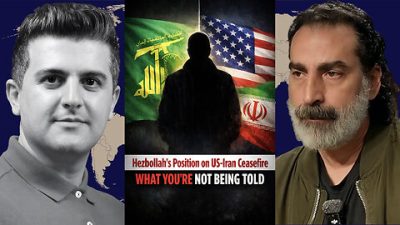
Laith Marouf: Hezbollah’s position on US-Iran ceasefire
or go to
Aletho News Archives – Video-Images
From the Archives
The Dirty Little Secret behind the “Global Terrorism Index”
The Omission of Israeli Terrorism in the Occupied Palestinian Territories
By Karin Brothers | Global Research | December 6, 2014
… The Israeli settlements — all of which are illegal – have been identified as a major impediment to peace. The refusal of a major “global” terrorism report to name the Israeli settlers as one of the groups most responsible for terrorism not only misrepresents a major source of regional violence but exposes the Global Terrorism Index as a propaganda tool that supports a U.S. agenda.
In recent years, governments have been attempting to thwart terrorism by blocking supportive fund-raising. When it comes to Israeli settlements, however, the US and Canada actually encourage fund-raising by giving organizations (such as Christian Friends of Israeli Communities (CFOIC) and the Jewish National Fund) financial support in the form of donor tax-deductions.
Charities which provide funds for the Israeli settlements should be regarded as terror-financing organizations. They should not only lose their tax-deductible status, but they should be banned because they support the violation of international humanitarian law. The terror-financing laws that are being strictly enforced for Muslim charities should be applied to Christian and Jewish charities as well. … Read full article
Blog Roll
 Aletho News
- Trump Administration Moves To Automate U.S. Military Draft Registration
- Spain orders reopening of Tehran embassy, condemns Israel’s carpet bombing of Lebanon
- Israel faces ‘unsustainable’ strategic crisis following 40-day war against Iran: Analyst
- Iran restricts Hormuz access to 15 vessels per day under ceasefire terms: Report
- The ‘Opposition Party’ Has Done Nothing to Stop the Iran War and Much to Goad Trump Into Continuing It
- Moscow backs Tehran on status of Lebanon in US-Iran deal
- How UK Regulator Ofcom Quietly Bypassed International Law to Police American Speech
- The Black Cube Files: How Former Mossad Operatives Flipped a Nation
- Laith Marouf: Hezbollah’s position on US-Iran ceasefire: What you’re not being told
- Israel’s priority lies in destroying chances of peace between Iran, US: Ex-UN nuclear chief
- If Americans Knew
- The gallows law: Israel moves toward executing Palestinian children
- Tucker Carlson: The Path to Peace requires ending ‘special alliance’ with Israel
- This is ceasefire? Israel’s biggest massacre yet in Lebanon, another journalist killed in Gaza – Daily Update
- Tucker Carlson on Israel: This Is the Behavior of an Ally? Really?
- Gazans face a triple crisis: severe shortages of water and bread, healthcare in tatters
- NY Times reports how Netanyahu took the US into Iran War
- A sigh of relief over Iran, but Gaza and Lebanon in dire straits – Daily Update
- Thousands dead and neighborhoods razed to the ground: Aid agencies fear southern Lebanon is becoming the new Gaza
- The war the US is fighting for Israel could cost trillions
- ‘Cigarette Burns, Nail Wounds’: Toddler Tortured in Gaza to Coerce Father
- No Tricks Zone
- An Inconvenient Tree: Uncovered In Alps… Europe Much Warmer Than Today 6000 Years Ago
- New Study Reports A 60% Slowdown In Greenland’s Ice Loss Rate In The Last Decade
- Low Intensity Tornado Wrecks Major Solar Farm, Creating A Potential Toxic Dump
- New Study Finds Warming Saves Lives…Cold Temperatures 12 Times More Deadly Than Excess Heat
- German Science Blog Accuses PIK Climate Institute Of Hallucinating Climate Tipping Points
- Devastating Assessment Of Comirnaty Vaccine By Former Senior Pfizer Europe Toxicologist
- New Study: CO2 Is ‘Effectively Negligible’ As An Explanatory Climate Change Factor Since 2000
- Former Pfizer Toxicologist Dr. Helmut Sterz Tells Bundestag Hearing Pfizer Vaccine Should Have Never Been Approved
- Energy Expert: Germany’s Nuclear Phaseout Was A “500 Billion Euro Mistake”
- New Research: South Australia’s Mid-Holocene Sea Surface Temperatures Were 4°C Warmer Than Today
 Aletho News