Liberation From War
By Manlio Dinucci | Global Research | April 26, 2026
Italy is experiencing an economic slowdown: this is confirmed by the fact that in 2025 public debt stood at 37% of GDP and that the situation has worsened since then. The Italian Minister for the Economy and Finance, Giancarlo Giorgetti, attributes the crisis largely to the “energy shock” caused by the blockade of the Strait of Hormuz, blamed on Iran, which led to a rise in the price of oil and natural gas. Giorgetti seems to have forgotten that the “energy crisis” began before the blockade of the Strait of Hormuz due to the halt in Russian natural gas imports. These imports have fallen from 40% of Italy’s total gas imports in 2021 to 2% in 2026.
During this period, Italy’s imports of liquefied natural gas from the United States have risen from 13% to 33%, despite the much higher price. By waging war against Russia and Iran alongside NATO, Israel and other allies, the United States has succeeded in making Italy and Europe increasingly dependent on its energy supplies.
After triggering the war that has torn Europe apart with the coup in Ukraine in 2014, the United States has succeeded in making its European allies bear an ever-increasing share of the cost.
They have now approved the 20th “sanctions package” against Russia and granted Ukraine a further “loan” of 90 billion euros. At the same time, the United States has succeeded in driving up the military spending of its European allies sharply. Between 2015 and 2025, Italian military spending has more than doubled, rising in 2025 to €45.3 billion annually – equivalent to over 2% of GDP, or an average of €124 million a day. Italian military spending is set to continue rising, reaching 3.5% of GDP – equivalent to €198 million a day – and subsequently 5%, equivalent to over €280 million a day.
Following the war against Russia, Italy is becoming increasingly involved in the conflict against Iran.
US drones and aircraft are stationed at the Sigonella base in Sicily, from where they carry out missions in the Middle East to identify targets in Iran and guide US missile and bomber strikes. For the war against Iran, US forces are also using other bases in Italy, such as Aviano and Camp Darby. The Italian government has now decided to send two military ships to the Strait of Hormuz, even without a UN mandate, officially for mine clearance. As these ships would be in a war zone, including within Iranian territorial waters, should they be threatened with attack or attacked by Iranian forces, they would be flanked by Italian Navy strike units, officially “for protective purposes”.
Italy would thus effectively enter the war alongside the United States. The US is using its warships not only to block the Strait of Hormuz and cut off Iranian ports, but also to attack and seize ships in the Indian Ocean that are carrying (or are said to be carrying) Iranian oil to China and other Asian countries.
The US military blockade of shipping lanes is triggering an economic crisis that could soon spread from Asia across the globe. In Vietnam, rice mills have cut production due to soaring electricity costs and the difficulties faced by farmers following rises in fuel and fertiliser prices. In the Philippines, many farmers have decided not to harvest their crops, leaving them to rot, as they would have to sell them at a loss due to the rise in transport fuel costs. In Indonesia, nickel mines are closing because, due to the US blockade of Iran, they no longer have the gas and sulphur needed for extraction. In Bangladesh, clothing production is falling due to the disruption of import-export chains. All this – warns a UN report – could cost the Asia-Pacific region up to $300 billion, as the region relies on imported energy. Pressure is mounting on households, small businesses and public finances, with around 9 million people at risk of falling into extreme poverty.
This shows that war causes carnage not only through weapons such as bombs and missiles, but also through economic weapons such as the blockade of ports and shipping lanes, which can result in even greater loss of life. The dramatic images of war – that of an Israeli soldier destroying a statue of Christ on the cross in the Christian village of Debel in Lebanon, that of Israeli settlers in the West Bank preventing Palestinian children from going to school by blocking their path and attacking them with tear gas grenades – demonstrate the vital need to continue the struggle for liberation, freeing ourselves from war once and for all.
Somalia bans Israeli-linked vessels from Bab al-Mandab Strait
The Cradle | April 24, 2026
The Somali government announced on 22 April that it will impose a ban on Israeli shipping passing through the Bab al-Mandab Strait, framing the move as a response to Tel Aviv’s recognition of the breakaway Republic of Somaliland.
The announcement was made by Somalia’s ambassador to Ethiopia and the African Union, Abdullah Warfa.
He warned that violations of his country’s sovereignty “would not be tolerated.”
“External meddling could lead to countermeasures, such as restricting access to the key maritime route of Bab al-Mandab,” Warfa added, according to Yemen Press Agency (YPA), Mehr News Agency, and IRNA.
The UK Maritime Trade Operations (UKMTO) reported a day later that a cargo ship 83 nautical miles southeast of Eyl, Somalia, was approached by two small armed boats, one of which came within 600 meters of the vessel.
“Warning shots were fired and the suspicious craft returned fire. The suspicious small craft moved away and made clear of the reporting cargo ship. All crew are safe and accounted for,” the UKMTO report added.
While analysts question Somalia’s ability to enforce the ban due to limited naval capacity, they say the decision carries major political weight, potentially reshaping regional alignments and pushing Somalia toward closer coordination with Sanaa over control of the strategic chokepoint.
Late last year, Israel became the first state to recognize the breakaway Somaliland region as an independent state. Somaliland had functioned as a de facto state since declaring independence in 1991, with its own governing institutions and security structures – despite receiving no recognition from any UN member state and facing sustained opposition from Somalia.
The Somali government slammed the move along with several regional countries, including Turkiye.
Earlier this month, Somalia condemned Israel’s appointment of an ambassador to Somaliland.
The announcement comes as tensions between Tehran and Washington remain high despite the ceasefire. The Strait of Hormuz remains closed, and Tehran has retaliated to an ongoing US blockade and seizure of its vessels – capturing two ships this week.
Yemen’s Ansarallah resistance movement, which has threatened to close the Bab al-Mandab Strait given its close proximity, carried out several operations during the US-Israeli war on Iran.
Ansarallah recently vowed it would resume operations if the US–Iran ceasefire collapses.
“We have more serious winning cards; the US must understand that, with the help of our Yemeni brothers, the issue of the Bab al-Mandab Strait is also under consideration and action,” said Behnam Saeedi, a member of the Iranian parliament’s national security and foreign policy committee, earlier this month.
The Bab al-Mandab Strait is the passageway for approximately 12 percent of global oil and eight percent of worldwide liquefied natural gas (LNG).
Confusion, delusion, and how Israel drives the Iran War
By Jamal Kanj | MEMO | April 23, 2026
The closure of the Strait of Hormuz following the temporary ceasefire is the culmination of an American policy defined by strategic incoherence. At the center stands Donald Trump, whose shifting positions, confused war objectives, and conflicting actions have not only failed to ease regional tensions but have actively deepened them.
Nowhere is this clearer than in Trump’s threats to blow up the whole country, including its bridges and power plants. At the same time, he touted a military “big day,” presenting potential war crimes as diplomatic tool, aggression as diplomacy, and destruction as leverage.
Trump’s inflated, almost delusional, promises ahead of potential talks come across less as statesmanship and more as a calculated sales pitch to the American public. His vows “to end up with a great deal,” coupled with an almost obsessive focus on Barack Obama by insisting his agreement will be “far better” than the one negotiated over a decade ago. An approach that reflects a tendency toward messaging driven less by policy depth and more by projection, comparison, and to frame outcomes in terms of self-aggrandizement and personal glory.
Instead of articulating clear strategic objectives, his policy relies on distinguishing himself and image cultivation to project authority and superiority, leaving the underlying substance vague and open to question.
By manufacturing optimism and exaggerating progress while promising an imminent “great deal,” Trump appears to be negotiating with himself—or detached from reality—seeking to construct a narrative of success regardless of the facts on the ground. The performative optimism stands in sharp contrast to his simultaneous threats and pompous rhetoric, suggesting not confidence but a measure of desperation.
Trump’s rationale for extending the ceasefire because of “internal divisions” within Iran is unconvincing. If internal debate within Iran is seen as warranting a pause, what should be said of a policy where direction shifts from one moment to the next? Differing political views are the essence of a normally functioning political system, whereas impulsive, erratic, personalized decision-making is not.
All of this unfolds as Trump continues issuing maximalist demands for conditions he helped create. For instance, he demands the surrender of enriched uranium that would not exist had he not abandoned the Joint Comprehensive Plan of Action (JCPOA). Likewise, the Strait of Hormuz was closed as a consequence of his and Netanyahu’s war, not as its cause.
The consequences of these Israel-driven U.S. policies are felt by ordinary Americans at the gas pump and in grocery stores. The Strait of Hormuz has become a battleground, destabilizing global energy supply chains and economies worldwide. Yet despite these cascading effects, the core strategy remains unchanged. Trump continues to operate within an echo chamber of Israel-first sycophants that assume military might alone can deliver results, even as the policy falters and the war spills across the region, threatening roughly one-fifth of the world’s energy infrastructure.
This is not merely a political flaw or a matter of mismanagement. It is rather a strategic vulnerability shaped by Israel-first loyalists pulling U.S. strategy in directions that ultimately undermine U.S. national interests. In the absence of clearly defined national objectives, as in the first Israel’s war in Iraq, each step risks drawing the U.S. deeper into the polluted water of the Gulf, while simultaneously advancing an environment of chaos that serves only Israel’s calculated aims.
In this framework, was Israeli Prijamame Minister Benjamin Netanyahu’s recent statement that the war with Iran is “not over” an embedded message to Trump ahead of the proposed peace talks in Pakistan?
Negotiation between countries, especially in the context of war is not selling real estate deals, where haggling and the threat of retracting an offer are routine tactics. The craft of negotiation in this case operates on an entirely different level. Culture, national dignity, historical memory, and political positioning shape both the process and the outcome.
Leaders are not merely bargaining over financial assets or credit ratings, they are navigating domestic demands, legitimacy, and the perception of strength or weakness on the global stage.
In this regard, threats or the constant withdrawal and reintroduction of proposals are not leverage, they are weakness. Unlike commercial transactions where the “Art of the Deal” is largely concluded at the moment of signing, international agreements mark the beginning of an ongoing, often long-term relationship. What may pass as hard-nosed bargaining in business can, in international diplomacy, be interpreted as bad faith, an approach that tends to invite resentment and resistance instead of compromise. This is why since last Tuesday, Trump was left waiting for Iran to come to the negotiation table.
Effective diplomacy requires serious leadership, consistency, and an understanding of the symbolic as much as the substantive. Agreements endure not because one side is pressured into submission, but because all parties can present the outcome as preserving their dignity and advancing mutual interests.
The lack of strategic maturity is indicative in a proclamation in the morning signaling openness to de-escalation; by midday, the message splinters, issuing threats and ultimatums while simultaneously hinting at imminent breakthrough deals; by the middle of the night, amid his insomnia, it escalates to threats of total destruction. This constant shifting of positions is not a minor stylistic quirk. It is possible that, at least some of this, is associated with his nocturnal communications with Netanyahu, who is apparently wagging him left and right.
This yo-yoing of positions does more than create confusion; it erodes credibility. Diplomacy depends on a baseline of predictability and mental stability. When signals shift faster than the wind, uncertainty breeds mistrust, and negotiations drift from closed rooms into fiery statements played out for public consumption, creating an opening for Israel to drive the war and breed destruction and more chaos.
US naval blockade has disrupted but ‘not broken’ Iran’s oil exports: Kpler
Al Mayadeen | April 23, 2026
The US naval blockade of Iranian ports has disrupted the country’s oil machine, but its loading infrastructure remains intact, and cargoes are still flowing toward China, according to maritime analytics firm Kpler.
US Central Command announced overnight that American forces have redirected 31 vessels to return to port or turn around as part of the ongoing US blockade against Iran. Most of the redirected vessels were oil tankers, CENTCOM posted on X.
The US has also seized an Iranian-flagged vessel in the Gulf of Oman and boarded a sanctioned vessel in the Indian Ocean.
Despite the blockade, tankers are still positioned in Iran’s loading zones and Iranian crude continues to move toward China, Kpler data shows. The maritime analytics firm estimated the flow of crude from Iran to China to be 985,000 barrels per day in the first half of April. Since then, this flow has not been interrupted, Kpler said.
Jask terminal bypasses Strait of Hormuz
At Jask, an Iranian oil export terminal located outside the Strait of Hormuz, there is currently an all-time high of 5.8 million barrels in storage, Kpler reported. Tankers carrying oil are able to depart from the Jask terminal directly into the Gulf of Oman without needing to transit through the strait.
“The blockade has disrupted the oil machine, but it has not broken it,” Kpler said.
The findings suggest that while the US naval campaign has inflicted damage on Iran’s ability to export oil freely, Tehran has developed alternative routes and maintained key infrastructure to ensure continued revenue from crude sales. The Jask terminal, which bypasses the strategically vulnerable Strait of Hormuz, has emerged as a critical asset in Iran’s efforts to sustain exports despite the blockade.
‘Iran will not reopen the Strait of Hormuz’
In this context, a senior Iranian official involved in communications with Washington told the BBC that, at this stage, it is not possible to reopen the Strait of Hormuz due to blatant violations of the ceasefire by the United States and “Israel.”
According to the official, these violations include the US naval blockade on Iranian ports and Israeli aggression across various fronts, particularly Lebanon.
These steps, according to the official, “hold the global economy hostage” and undermine the chances of achieving political progress.
Fire breaks out aboard identity-fluid $8bn USS Zumwalt
RT | April 23, 2026
Three sailors were injured after a fire broke out aboard USS Zumwalt while the stealth destroyer was sitting pierside at HII Ingalls Shipbuilding in Pascagoula, Mississippi, undergoing a costly modernization meant to give the ship a whole new identity.
One sailor was taken to a local hospital in stable condition, while two others were treated at the scene after the April 19 incident. The Navy is investigating the cause and the extent of the damage to the warship, a spokesman told USNI on Wednesday.
The troubled vessel has never participated in any combat mission and has become a byword for Pentagon overreach: flashy, fantastically expensive, and still trying to figure out what exactly it wants to be when it grows up.
The Zumwalt was originally built around two stealthy 155mm Advanced Gun Systems, but the ammunition became so absurdly expensive that the guns were ultimately ripped out. The turrets were replaced with 87-inch missile tubes for the Navy’s Conventional Prompt Strike system, while USNI said the ship is being converted into a “blue-water strike platform” for long-range hypersonic weapons.
Those hypersonic missiles, however, have yet to be fully developed and fielded on the ship. National Defense previously reported that the Navy wanted to begin CPS testing aboard Zumwalt in 2027 or 2028.
The Zumwalt-class destroyer program consumed up to $24.5 billion for a fleet of just three ships, according to a 2018 GAO review, while media outlets described the vessel as an $8 billion blunder.
The fire comes as the Department of War shifts attention to an even grander vanity project – the proposed Trump-class battleship, with the first ship expected to cost more than $17 billion and some outside estimates pushing the price tag past $20 billion.
The program was announced with much fanfare in December by President Donald Trump, alongside Navy Secretary John Phelan and Secretary of War Pete Hegseth, as part of a new “Golden Fleet” vision. Phelan was still out there this week touting the new battleship as the future of sea power – before abruptly “departing” the administration the very next day.
A Palantir Manifesto
By Alan Mosley | The Libertarian Institute | April 22, 2026
Palantir CEO Alex Karp’s book, The Technological Republic, is a clarion call for Silicon Valley to abandon its consumer trinkets and rush headlong into the arms of the military-industrial complex. According to Karp, America’s future depends on wielding hard power through technology—arming soldiers, AI-weaponry, and mass surveillance systems—rather than on the “soft” influence demonstrated by free markets and liberty-first principles. The book claims that “the survival of the American experiment depends on the technological revitalization of the military-industrial complex” and urges the country’s engineering talent to focus on national defense. Karp and his co-author, Nicholas Zamiska, argue that tech bros should “grow up” and start killing America’s enemies before they kill us.
This techno-militarism dressed up as patriotic duty presumes that concentration of power in the state and its corporate allies (isn’t there a word for this?) is not only desirable, but morally required. In other words, The Technological Republic is far from a roadmap back to a prosperous America; it is a blueprint for a high-tech Leviathan. As reviewed in January by the Libertarian Institute’s own Laurie Calhoun, Karp’s willingness to aid the regime in its most notorious activities at home and abroad is not because “he is more ingenious or better informed than the competition, but only because he appears to be completely devoid of scruples.”
The Palantir X account posted a 22-point breakdown of the book’s themes, opening with the premise that the tech industry owes a “moral debt” to the country. American tech engineers are scolded for nurturing consumer-centric apps and free email services instead of focusing on what Karp sees as their true obligation: building the state’s war machine. Karp suggests that they should feel a “sense of purpose” in serving the defense industry, as if innovating weapons of war is akin to military service.
The book’s theme of military service doesn’t stop at the tech industry. “National service should be a universal duty,” Karp declares, arguing that America should “move away from an all-volunteer force.” It’s true that he suggests the reasoning is that the country will be less likely to go to war if everyone has skin in the game, but in practice the children of political and financial elite have never borne the same responsibility as the common man’s sons when a draft was required. Of course, it always bears repeating: conscription is slavery. Far from being fresh ideas, the same boogeymen tactics are employed in Karp’s argument as have always been to mobilize a nation. In this case, the external enemies are the “AI-enhanced posse of China, Russia, and Iran.”
Along the same vein, Palantir’s manifesto pledges “if a US Marine asks for a better rifle, we should build it; and the same goes for software.” The excuse for responding to the Pentagon’s every whim is that we should remain “unflinching in our commitment to those we have asked to step into harm’s way.” But bloated federal budgets, especially the Pentagon’s, exist to justify their own largesse and demand more. In practice, The Technological Republic would turn a blind eye to decades of waste, fraud, and abuse in favor of committing American taxpayers to bankrolling endless defense contracts. It should not escape notice that Palantir’s own business is building the very military tools that they argue should be beyond public debate.
Throughout the book, Karp espouses a paternalistic tone: ordinary people are infantilized consumers who need guidance from a technocratic elite. He admonishes the tech industry, saying it should “build where the market has failed to act.” Beyond the praise for billionaire visionaries like Elon Musk, Karp implies that entrepreneurial success is possible despite, rather than a result of, a free market. As such, private industries deemed critical to the nation’s interest should be remade into the image of a national project. This position arrives at centralization as the panacea without a moment’s pause to question just how “free” the nation’s free market has truly been under the political and economic centralization that already exists. What’s more, as new industries become nationalized, how long will it be until we’re told, under the weight of centralized mismanagement, that they are “too big to fail?”
For those nursing fears of a digital and surveillance prison being constructed by the megalomaniacal tech bro, the company behind The Technological Republic offers little respite. To the contrary, Palantir is far from a neutral observer; it has built many of the systems it now glorifies, and its own track record is rife with abuses. The ACLU, for example, catalogs how Palantir software underpins ICE’s deportation force, combing through social and medical data to target immigrants. In 2025, Amnesty International warned that Palantir’s “ImmigrationOS” platform enables “constant mass monitoring, surveillance, and assessments of people… often for the purpose of targeting non-US citizens.” Even if one is in favor of the immigration policy on display during the Trump administration, it is the height of naivete to believe these tools will not someday be turned on Americans. As Senator Ron Wyden (R-OR) and Rep. Alexandria Ocasio-Cortez (D-NY) recently warned, Palantir is even helping the IRS build an unprecedented “mega-database” of citizen data—a “surveillance nightmare” that could break privacy laws and enable politically motivated spying. In other words, the tech Alex Karp champions being used against Americans has already passed from plausible future to chilling present.
Palantir’s support for aggressive state projects goes hand in hand with troubling secrecy and influence. In the United Kingdom, for instance, it enjoys a £330 million NHS contract despite strong privacy objections. Civil rights groups bemoan that British officials even hired consultancy megafirm KPMG using taxpayer money to “promote the adoption” of Palantir’s software in hospitals, only to refuse Freedom of Information requests about the deal. In the United States, Palantir’s tentacles reach into nearly every government agency, often on sole-source or highly confidential contracts. Public filings reveal a $795 million Pentagon award for Palantir AI work and deployments of its software at DHS, HHS, FDA, CDC and NIH. In short, Palantir leverages its political connections to win lucrative government deals—even while civil rights advocates raise alarms. This is hardly the modus operandi of a virtuous tech company whose only interest is the benevolent reshaping of America’s future. Put simply, Palantir’s business model is about power and profit at the expense of taxpayers and privacy.
For all of the bluster about defending “Western values,” Palantir’s recent political posturing reveals its true tribalism. The company took out a full-page ad in The New York Times proclaiming it “stands with Israel,” and has even held a board meeting in Tel Aviv. Critics have decried Palantir for its alleged complicity in war crimes, equipping the Israelis with surveillance and targeting tools it has used against Palestinians in Gaza amid accusations of apartheid and genocide. Whether one agrees with these charges or not, the fact remains that Palantir’s politics are unapologetically partisan. If Israel’s national interests and America’s national interests do not align, then how can Palantir be trusted to pursue the latter over the former?
Alex Karp’s The Technological Republic is sold as a patriotic wake-up call. But its prescriptions amount to the very opposite of a free society. They call for compulsory service, a merger of state and corporate power, and the surrender of individual choice to the dictates of a technocratic elite. Palantir’s vision—war as a software project and culture as a pet project of the powerful—would leave little room for individual rights or market freedom, two things the company already fails to consider in its diagnosis of the nation’s ills. In the end, this “manifesto” is a cautionary tale of ideology cloaked in technobabble. The rhetoric of defending the West and saving civilization may sound noble, but the methods are anything but. History is replete with the grim realities of sacrificing liberty for security and trusting leaders to provide what they claim the market cannot.
IRGC seizes Israeli ship, second vessel for violations in Strait of Hormuz
Press TV – April 22, 2026
The Islamic Revolution Guards Corps (IRGC) Navy says it has intercepted and transferred to Iranian territorial waters two vessels for having committed violations in the Strait of Hormuz.
In a statement released on Wednesday, the IRGC identified the vessels as the MSC-Francesca, which it said belongs to the Israeli regime, and the Epaminodes.
The vessels, it said, were operating without authorization, committing repeated violations, tampering with navigation aid systems, and endangering maritime security in an attempt to exit the strait covertly.
“With the intelligence dominance of the forces, these vessels were identified and stopped in order to uphold the rights of the noble Iranian nation in the Strait of Hormuz,” the IRGC Navy said.
It added that the vessels have now been transferred to Iranian territorial waters for inspection of their cargo and documents.
The IRGC Navy reiterated that any attempt to disrupt the implementation of laws announced by Iran for transit through the Strait of Hormuz, or any activity inconsistent with safe passage through this strategic waterway, will be continuously monitored and met with decisive and legal action against violators.
US Embargo on Iran Undermined as 34 Tankers Slip Through, Vortexa Says
Al-Manar | April 22, 2026
At least 34 oil tankers linked to Iran have managed to circumvent the US embargo imposed on the country since it took effect, according to the shipping tracking group Vortexa. Several of the vessels were carrying Iranian crude oil, contradicting President Donald Trump’s declaration that the embargo has been a “tremendous success,” the Financial Times reported.
In an interview with CNBC on Tuesday, Trump said, “The embargo has been a tremendous success,” adding that he would not lift the US embargo on the Strait of Hormuz until Washington reaches a “final agreement” with Iran.
However, Vortexa data shows that dozens of ships have bypassed the restrictions. At least 19 oil tankers linked to Iran have crossed the US blockade to leave the Gulf, while at least 15 others have entered the Gulf from the Arabian Sea heading toward Iran. At least six of the departing vessels were carrying Iranian crude oil, totaling 10.7 million barrels.
Among them was the Iranian-flagged supertanker Dorina, which evaded the embargo by switching off its transponder the device that broadcasts its location and identity. According to Vortexa, the Dorina was one of two tankers that left Iranian waters on April 17, while two other crude oil carriers transited the area on April 20. Satellite images analyzed by the Financial Times in March showed the Dorina off the coast of Malaysia conducting a ship-to-ship oil transfer; its last recorded position was off southern India on April 18.
Meanwhile, several sanctioned tankers entered the Persian Gulf from the Gulf of Oman, including the Morelicious and Alicia, both sanctioned by the United States last year. The two ships passed through the Strait of Hormuz on the night of April 14 before sailing to the northern end of the Gulf.
US Blockade Violates Ceasefire Agreement
The United States imposed a blockade on all vessels entering or leaving Iranian territorial waters on April 13, violating a ceasefire agreement reached in Pakistan. According to notices issued by the US Navy, the blockade was expanded on April 16 to include all Iranian vessels on the high seas or those “carrying goods that Iran could use in conflict.”
US forces have so far seized one container ship in the Gulf of Oman and boarded an oil tanker in the Indo-Pacific region. The US Central Command announced Tuesday that the Navy had ordered 28 ships to return to Iranian ports since the blockade began.
In response, Iran has maintained control of the Strait of Hormuz, designating a specific route for non-military vessels, which are only permitted to pass with Tehran’s authorization. At least 30 ships attempted to transit the narrow waterway on Friday, when Iran announced it was opening the strait in line with the ceasefire declaration in Lebanon. However, those vessels turned back after Tehran closed the strait again, citing the continued US blockade and clarifying that passage would only be allowed with prior authorization.
The desalination front: Water as Israel’s Achilles heel
The Cradle | April 21, 2026
Israel’s near-total dependence on seawater desalination to secure almost 80 percent of its drinking water and industrial needs has created a security vulnerability unlike that of the Persian Gulf states.
While Gulf desalination facilities are spread across wide geographic areas, Israel’s production capacity is concentrated along a narrow stretch of coastline. That concentration leaves Israel’s water system vulnerable to paralysis through concentrated missile barrages or suicide drone attacks from multiple fronts – a danger that exceeds the ability of conventional air defenses to fully contain.
The longer the confrontation with Iran drags on, the more these facilities are transformed from civilian infrastructure into strategic targets. Israel’s five main desalination plants have become central nodes in Tehran’s target bank, placing domestic stability and regional water commitments under the threat of broad disruption.
A narrow coastline, a concentrated vulnerability
Israel may be the world’s most centralized state in desalinated water production. Five major plants – Ashkelon, Ashdod, Palmachim, Sorek, and Hadera – produce the overwhelming majority of potable water for homes, agriculture, and industry.
The Sorek complex, one of the world’s largest reverse osmosis desalination plants, carries particularly high strategic value. Any strike that disables it would not simply create a temporary shortage. It could knock out water service to entire areas of Gush Dan, including Tel Aviv and its surrounding settlements, in a matter of days.
It is also clear that Israel’s water system lacks geographic depth from a security standpoint. All the plants fall within the effective operational range of precision missiles and are fully exposed to maritime threats.
Their offshore intake pipes are especially vulnerable. These underwater systems can be targeted through naval drones, unmanned submarines, or sea mines, halting water extraction and treatment almost immediately.
A successful strike on Hadera alone could severely disrupt supplies to the north and center of the country, placing huge pressure on emergency planners already dealing with depleted groundwater reserves and the shrinking capacity of Lake Tiberias.
The gas–water dependency trap
The most serious structural weakness in Israel’s water sector lies in its dependence on natural gas. Unlike the Gulf states, which possess large emergency reserves of liquid fuel to keep desalination facilities running during crises, Israel relies almost entirely on gas from the Tamar and Leviathan fields in the Mediterranean and is now looking to claim ownership of Lebanon’s Qana gas field.
That means any successful strike on offshore gas infrastructure would quickly spread beyond the energy sector. Disrupted gas supplies would undermine the national electricity grid and cut power to desalination facilities at the same time.
This dual dependency turns Israeli water security into a hostage of offshore infrastructure. Gas platforms are difficult to defend against drone swarms, anti-ship missiles, or coordinated naval attacks.
A strike on Leviathan, for example, would leave Israeli planners facing an impossible calculation: should the remaining gas be directed toward electricity generation for hospitals and military facilities, or toward desalination plants to ensure water continues to reach homes?
That overlap amplifies the pressure Iran can exert. A single strike on one offshore target could cripple two strategic sectors simultaneously.
Water as a regional pressure point
The implications of a strike on Israeli desalination infrastructure extend far beyond the occupation state itself. Under its peace agreement with Jordan, Israel is obligated to provide Amman with fixed annual quantities of water.
Any serious damage to Israel’s desalination system would almost certainly interrupt those supplies, exporting the crisis directly across the Jordan River.
That dynamic transforms desalination plants from public utilities into instruments of regional pressure. Strikes on these facilities would not only weaken Israel internally but also place neighboring governments under stress and expose the fragility of regional arrangements built around Israeli infrastructure.
Jordan would be hit first. But the fallout would also test the broader framework of normalization agreements and regional cooperation. For Tehran, that creates an additional layer of leverage. Dependence on Israel for critical resources is becoming a growing strategic liability.
That, in turn, could push neighboring states to seek alternatives, pressure Washington and Tel Aviv to scale back their confrontation with Iran, or reassess the long-term value of regional ties with Israel.
Cyberattacks and invisible sabotage
Israel possesses one of the world’s most advanced cybersecurity sectors, yet repeated Iranian cyberattacks have exposed real vulnerabilities in industrial control systems.
Desalination plants rely on complex digital infrastructure to regulate chemical balances, water pressure, and membrane filtration. Penetrating those systems would allow attackers to alter chlorine levels, disrupt pumping pressure, or physically damage sensitive equipment.
The danger of cyberwarfare lies in the fact that it is largely invisible. Unlike missile strikes, digital sabotage can unfold quietly, triggering confusion and panic before the source of the disruption is identified.
Even a 24-hour shutdown at Sorek could leave millions without water and inflict severe losses on sectors that depend on highly treated water, including semiconductor manufacturing, pharmaceuticals, and the precision industry.
The more Israel digitizes the management of water infrastructure, the more attractive that sector becomes as a target for cross-border cyber attacks.
Deliberate pollution and long-term disruption
The eastern Mediterranean coastline is also highly vulnerable to environmental contamination during wartime. A strike on fuel tankers offshore, or on storage facilities in Haifa or Ashdod, could trigger oil spills large enough to disable desalination intake systems within hours.
Israel’s heavy reliance on reverse osmosis makes that threat especially serious. Even limited exposure to oil residue can permanently damage filtration membranes. Replacing them is neither quick nor simple, particularly during wartime conditions when supply chains are already strained.
This kind of environmental warfare is especially dangerous because its effects do not end when the fighting stops. Oil pollution would not only shut down desalination capacity in the short term but also damage marine ecosystems that support natural filtration processes.
That would raise operating costs, lower water quality, and leave sections of Israel’s coastline economically crippled long after the war itself ends.
The economic cost of strategic thirst
From an investment and financial perspective, instability in water security poses a direct threat to the occupation state’s “startup nation” model. International investors and major technology firms evaluate risk based on the stability of essential resources.
Once water itself becomes a threatened commodity, sovereign insurance costs rise, while capital flees sectors that consume large volumes of water.
A prolonged shutdown in greater Tel Aviv could inflict losses that surpass the economic impact of conventional missile strikes. Water is tied to every layer of the economy, from households and hospitals to industrial parks and high-tech production.
International ratings agencies already assess Israel’s creditworthiness according to its ability to absorb wartime shocks, protect infrastructure, and sustain economic activity during prolonged conflict. Any major disruption to the water sector would add to concerns over fiscal strain, investor confidence, and the state’s ability to maintain basic services.
That would raise borrowing costs and place additional pressure on a state budget already strained by military spending.
“Thirst economy” is now a term increasingly heard in financial analysis circles, where water becomes the central measure of national economic resilience.
The supply chain problem
Israel’s desalination system depends heavily on imported technology, precision spare parts, and specialized chemicals. Wartime disruption to ports, shipping lanes, or supply chains would make routine maintenance increasingly difficult.
Anti-scaling chemicals, disinfectants, filtration membranes, and electronic control systems all require reliable imports. Any shortage would force plant operators to either lower water quality or shut facilities down altogether to avoid damaging equipment.
That creates another challenge for Israeli planners. Maintaining the desalination sector during a prolonged conflict may require costly air bridges for critical parts and chemicals – an option that is difficult to sustain over time.
Israel’s desalination network has become one of the clearest examples of how technological sophistication can also create strategic fragility. Water security now sits at the center of the occupation state’s military and economic calculations.
If these facilities become unsustainable under wartime conditions, every other pillar of Israeli power – from industry and public health to military readiness and regional influence – becomes far harder to sustain.
China blames US for diplomatic impasse with Iran, urges it to show ‘sincerity’ in talks
Press TV – April 21, 2026
China has called on the United States to demonstrate “sincerity” in resolving its prolonged standoff with Iran over its nuclear program, while censuring the joint US-Israeli military aggression against the country.
In its latest Non-Proliferation Treaty (NPT) report, Beijing said that Washington is responsible for the current diplomatic impasse with Tehran.
The national report on the implementation of the Treaty on the Non-Proliferation of Nuclear Weapons was made public online by the Ministry of Foreign Affairs on Monday.
According to the report, the US and Israel’s military aggression against Iran, both in June 2025 and on February 28, “seriously violated international law and the purposes of the UN Charter.”
In the report, Beijing described Washington’s unilateral withdrawal from the Joint Comprehensive Plan of Action (JCPOA) as the “root cause” of the current diplomatic standoff between the US and Iran.
During his first term in 2018, US President Donald Trump withdrew from the nuclear deal, branding it “the worst deal ever.” Trump claimed that he was seeking stronger terms.
The US and Israel attacked Iranian nuclear and military sites in June 2025, even as indirect negotiations were underway between Tehran and Washington regarding Iran’s peaceful nuclear program.
Seven months later, the two enemies launched a new wave of aggression against the country on February 28, again as Iran and the US were on the verge of finalizing a new nuclear agreement.
Tehran asserts its legal right under the NPT to develop nuclear technology for energy production, medical research, and scientific advancement.
The US and its allies, however, accuse Iran of seeking the technical capability to produce a nuclear weapon.
Tehran has consistently maintained that it regards weapons of mass destruction as a threat to humanity and has never included them in its defense doctrine, even in the face of direct military aggression.
On April 11–12, Pakistan hosted talks between the US and Iran after brokering a two-week ceasefire on April 8, which is set to expire on April 22.
The high-level talks, however, ended without an agreement. Now reports say a US delegation is headed to Islamabad for the second round of talks with Tehran. Iran has said it has not plans to take part in new negotiations.
Iranian Parliament Speaker and lead negotiator Mohammad Baqer Qalibaf said on Monday that Tehran will not accept negotiations “under the shadow of threats.”
He said, “by imposing a blockade and violating the ceasefire,” Trump intends “to turn the negotiating table into a table of surrender or to justify renewed warmongering.”
The uncertainty shrouding the next round of talks escalated after the US Navy targeted an Iranian merchant vessel in the Sea of Oman on Sunday.
Iran’s military condemned the incident as a “criminal operation” and “maritime piracy.”
In a Monday statement, Chinese Foreign Ministry voiced “concern over the forced interception of relevant vessel by the US,” warning that the situation in the Strait of Hormuz is sensitive and complex.
The Iranian-flagged cargo ship Touska had been travelling from China.
After Islamabad: How the Global South Is Reshaping Eurasian Geopolitics
By Abbas Hashemite – New Eastern Outlook – April 21, 2026
The developments surrounding the “Islamabad Talks” underscore a broader geopolitical realignment in which Pakistan, China, and other regional powers are deepening their strategic and economic integration, accelerating the rise of a Global South-led order while exposing the waning influence of the US and its traditional allies.
Behind-the-Scenes Realignment of the Global South
The Islamabad Talks 1.0, apparently ineffective, actually reshaped Global South alignment unfolding behind the scenes. In reality, the backstage transpirations during the Islamabad Talks 1.0 were more consequential than the US-Iran peace negotiations. Pakistan’s deployment of military troops and jets to the Kingdom of Saudi Arabia, the dispatch of its first transit shipment to Uzbekistan via Iran, and Aramco’s show of intent to finalize a $10 billion investment in an oil refinery in Gwadar, in partnership with OGDCL, PSO, GHPL, and PPL, were all extraordinary developments.
Obviously, all that did not happen by chance; these developments reflect a deepening strategic alliance between Saudi Arabia, Pakistan, and Iran. The timing of these events suggests that all the players involved were already prepared for their integration in a rising Global South alliance but were merely constrained by the international and regional geopolitical environment. Pakistan’s deployment of troops in KSA has made it a key security provider for the country, a service that other Gulf nations might soon seek as well. However, Pakistan cannot provide security services to other nations solely without China’s collaboration, which is its major partner in intelligence, technology, reconnaissance, and strategy.
Evolving Security Architecture in the Gulf Region
The United States is one of the key security providers in the Gulf. However, during the recent Iranian attacks on the Gulf nations and Israel’s attack on Doha in September, 2025, the United States failed to defend these states. Therefore, the Arab Peninsula would soon get rid of the US fighter jets, satellite coverage, intelligence penetration, and defense mechanisms by replacing them with Pakistani and Chinese security apparatus. This would make Pakistan a key security provider in the region.
Economic Corridors and the Emerging Eurasian Connectivity
The expected finalization of the Saudi-Pakistan oil refinery deal is also a remarkable move for the success of the China-Pakistan Economic Corridor (CPEC) and Gwadar. This development will enable international shipping to refuel at Gwadar, granting Pakistani consumers a 20% price cut on oil. This oil refinery, probably connected to Saudi Arabia via an undersea pipeline, will also smash the relevance of the I2U2, giving it leverage over its regional rivals.
Moreover, the opening of the Pakistan-Iran-Uzbekistan transit route underscores the opening of the Central Asian markets to the whole world via Pakistan and Iran, a move that will strengthen Central Asian and South Asian economies and relations. Just like the CPEC, the BRI connects many corridors via Afghanistan and Iran. China’s goal is to connect all these projects internally. This is the future that the entire region is looking forward to.
Decline of Western Influence and the Rise of a Multipolar Order
It also suggests that the “Islamabad Talks” were more about signaling to Washington and its allies that the international order has altered than about US-Iran peace. Many US allies have already abandoned it in this war of choice. Italy and Spain, for instance, have denied the US the approval to use their bases in the Mediterranean. Both countries have also joined South Africa’s case in the ICC, alleging Israel of genocide. Britain, France, Greece, Italy, Spain, and Germany have refused to militarily assist the US in opening its blockade of the Strait of Hormuz.
Chinese diplomacy is already in full swing, with the Spanish Prime Minister Pedro Sanchez in China to strengthen bilateral economic and strategic relations. The Taiwanese opposition leader Chen Li-wun also visited Beijing, expressing the desire for a “peaceful” resolution of the bilateral dispute, stating that the Taiwan Strait will no longer be a focal point of the potential conflict and will certainly not become a “chessboard for outside forces to intervene in”.
With prospects of a second round of Islamabad Talks, which are expected to take place on Tuesday, emerging, concerns are mounting over the possible collapse of US-Iran peace efforts, which could trigger a renewed and more intense phase of conflict between the two sides. Furthermore, there are speculations that the US and Israel could use these negotiations to reorganize. However, the current circumstances suggest that the US is not in a position to initiate a ground invasion or any other military campaign against Iran, as it failed to open the Strait of Hormuz despite almost 40 days of continuous bombing on Iran. In addition, the United States stands militarily and diplomatically isolated over the issue of US-Iran, as none of its European allies have supported it militarily or diplomatically.
This war has made the United States an irrelevant and isolated international power. The whole agenda of the war has now shifted to opening the Strait of Hormuz, which was already open before the war. The US President Donald Trump is also happy that China will no longer provide weapons to Iran, which it already says it did not provide. This illustrates that the Islamabad Talks 2.0 is just to provide the United States with a face-saving way to get rid of the burden of this war, which Trump, acting as a “mad king,” started as a regime change operation, and a “God’s Plan” has ended up in expediting the decline of the US as a global superpower.
However, despite these unfavorable conditions and circumstances, there is always a possibility that the mad king might receive another directive from his Zionist master to go for a ground invasion of Iran. Although it is highly unlikely, counterintuitive, and counterproductive, as it would be a suicide mission for the United States, leading to the death of thousands of troops and causing the loss of billions of dollars, it is still expected from a person under the influence of the Zionist leader Benjamin Netanyahu.
The US President Donald Trump has already sacrificed the US hegemony to establish the Kingdom of Zionism. His ill-witted decisions have provided Russia, China, and the middle powers with an opportunity to replace the US as a global hegemon. It will also result in further strengthening the BRICS as an international alliance, replacing Western organizations and alliances. In sum, the US-Iran war has hastened the rise of a Global South-led world order and exposed fissures in the Western alliance.
Featured Video
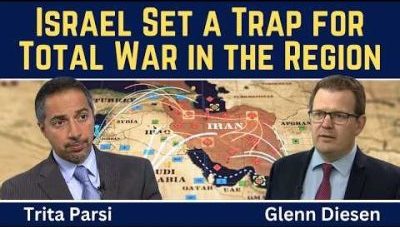
Trita Parsi: Israel Set a Trap for Total War in the Region
or go to
Aletho News Archives – Video-Images
From the Archive
Zionism’s Violent Legacy
By Donald Neff | Washington Report On Middle East Affairs | January 1996
On January 4, 1948, Jewish terrorists drove a truck loaded with explosives into the center of the all Arab city of Jaffa and detonated it, killing 26 and wounding around 100 Palestinian men, women and children.[1] The attack was the work of the Irgun Zvai Leumi – the “National Military Organization,” also known by the Hebrew letters Etzel – the largest Jewish terrorist group in Palestine. The Irgun was headed by Revisionist Zionist Menachem Begin and had been killing and maiming Arabs, Britons and even Jews for the previous ten years in its efforts to establish a Jewish state.
This terror campaign meant that at the core of Revisionist Zionism there existed a philosophical embrace of violence. … continue
Blog Roll
 Aletho News
- Trita Parsi: Israel Set a Trap for Total War in the Region
- Trump’s Iran war is on an Israeli leash
- Saudi oil boss issues global supply warning
- Riyadh Says Its Oil System Is Intact. The Numbers Say Otherwise.
- Trump and Netanyahu Want to “Finish the Job” on Iran
- US ‘one-sided dictation’ not Iran’s beliefs makes rational talks impossible: Baghaei
- Iran’s Next Strike May Not Explode. It Could Shut You Down /Col Doug Macgregor
- Iran: US political targets legitimate if assassinations return
- Iraq shuts key border crossing with Iran under US pressure: Report
- Undersea Internet cables could be targeted in retaliation for attacks on Iran: IRGC deputy chief
- If Americans Knew
- The Israel Lobby’s Changing Fortunes
- AIPAC has become such a political liability that it’s shifting to a more “nimble” approach to buying politicians
- At least 160 Israeli settler attacks in 2 weeks
- Will Gaza’s Ancient Christian Community Disappear Forever?
- Israel’s vision of regional security rests on keeping Arab states weak
- Heidi Levine recounts how Palestinian youths helped save her in settler attack
- DAILY UPDATE: Latest essential news on Palestine, Israel, & region
- Trump’s Intensifying Sabotage of the ICC, for Israel’s Sake
- Israeli military detain US and UK volunteers in West Bank including Democratic NY politician Brad Lander
- Americans at National Conservatism Conference held in Israel this year criticize Israel
- No Tricks Zone
- E-Cars Reduce CO2 Emissions By Only 41% Compared To Internal Combustion Engine Vehicles
- Predictions Made By Renowned Climate Professor Over Past Decades Have Been Proven To Be Poor
- New Study Suggests Large Regions Of The Pacific Ocean Have Been Cooling For The Last 80 Years
- Germany’s Green Energy Debacle: High Energy Costs Force Kahla Porzellan to Close After 182 Years!
- New Study: 50 Years Of The Most Aggressive ‘Net Zero’ Policies Can Only Affect The Global Climate By 0.03°C
- US September “Heat” Was No Record…Many Records Set Decades Ago
- Latest European Green Energy Debacle; Portugal’s Largest Flagship Solar Park Insolvent!
- Green Energy Debacle: German Expert Professor Fritz Vahrenholt Warns Of Severe Economic And Social Consequences
- Two More Paleo Reconstructions Affirm Meters-Higher Sea Levels Across Ireland, Brazil 7000-6000 Years Ago
- New Study: Earth And Venus Surface Warmth Largely Explained By Convection And Lapse Rate, Not CO2 Or Radiation

