Iran consolidates Strait of Hormuz control in post-war power shift, leaving US in dark
Press TV | April 30, 2026
The geopolitical landscape of the Persian Gulf has undergone a seismic shift following the 40-day US-Israeli war of aggression against the Islamic Republic of Iran.
Iran emerged from the imposed war not merely intact but strategically ascendant, holding a decisive upper hand over the world’s most critical energy chokepoint.
The Strait of Hormuz, through which approximately one-fifth of global oil trade passes, is no longer a waterway that Washington can threaten, monitor, or control.
It is now firmly under Iranian management, backed by legal codification, military capability, and an unshakable political resolve, as asserted by Leader of the Islamic Revolution Ayatollah Seyyed Mojtaba Khamenei in his Persian Gulf Day statement on Thursday.
The Leader unveiled a comprehensive strategic vision, which seeks to transform Iran’s relationship with the world’s most critical energy chokepoint from defensive vigilance to active and legally codified management.
This is not a tactical victory or a fleeting advantage. It is a fundamental reordering of power in the region, one that leaves the United States guessing about Iran’s next move while every available path before it leads toward a deepening crisis.
The failed cycle: Trump’s return to discredited pressure tactics
The opening gambit of America’s renewed pressure campaign is itself an admission of strategic bankruptcy. Trump’s insistence on escalating economic pressure through the imposition of maritime piracy and naval blockade represents a return to a cycle that has been tested repeatedly – and has failed repeatedly.
The formula is familiar: apply economic strangulation, incite public discontent in Iran, force Tehran to the negotiating table, and extract strategic concessions in exchange for absolutely nothing from the American side.
This cycle has been attempted before. The critical difference this time is that in previous iterations, the military option still carried some credibility. Washington could imply, however vaguely, that if pressure failed, force remained on the table.
That credibility has now been expended. The 40-day war imposed on Iran consumed the military option, and the failure of that aggression has left it hollowed out. It may not have vanished entirely, but it no longer carries the weight or deterrent value it once did.
A second difference is the remarkable resilience of the Iranian people. America’s entire pressure strategy has been built on the assumption that economic hardship would eventually trigger widespread unrest – that the Iranian people would turn against their leadership, creating the conditions for “regime change” or capitulation.
Yet Iranians have demonstrated extraordinary patience, solidarity with the leadership, and unwavering support for the armed forces. This has made America’s investment in fomenting discontent far more difficult than in previous comparable cycles.
A third and perhaps most decisive difference is that America now faces an Iran with relatively full hands. The management and sovereignty imposed by Iran over the Strait of Hormuz have fundamentally altered the balance of leverage.
Iran is no longer merely a sanctioned nation absorbing blows. It has become a sanctioning country capable of imposing costs, controlling access, and reshaping the rules of engagement at the regional and global level.
America’s new priority: Breaking the strait, not Iran
For the United States, the strategic calculus has shifted in revealing ways. The primary objective is no longer dismantling Iran’s nuclear program or forcing a change in its foreign policy. It is far more urgent and immediate: reopening the Strait of Hormuz.
The closure or effective Iranian management of this strategic waterway has dealt a fundamental blow to American prestige and credibility around the world, including among its allies, a wound that Washington cannot afford to leave untreated.
Indeed, breaking the deadlock in the strait may well have taken precedence over – and gained urgency compared to – the question of Iran’s nuclear rights. This inversion of priorities speaks volumes.
America would rather secure passage for its allies’ tankers than resolve the nuclear file. It would rather salvage its wounded so-called “superpower” image than extract concessions on uranium enrichment.
But Iran’s position is unwavering. The decisive, clear, and emphatic declaration of its irreversible decision regarding sovereignty and control over the Strait of Hormuz carries consequences that extend far beyond economics.
There is the economic dimension, certainly – the ability to toll vessels, generate revenue, and pressure adversaries. But there is also the humiliation of American superpower status and the toppling of its global dominance. Every day that Iran exercises effective control over the strait is a day that American credibility erodes further.
Furthermore, the consolidation of Iranian sovereignty over the strait dismantles America’s decades-old strategic roadmap concerning the deployment and geography of its forces in the region.
The United States had built its Persian Gulf presence around the assumption of freedom of navigation – that its navy could come and go as it pleased, that its bases were inviolable, that its dominance was uncontested. That assumption is now dead.
The veto stronger than the Security Council
The vital role of the Strait of Hormuz in the global economy and development cannot be overstated – and it extends far beyond the mere passage of oil through this waterway.
Global supply chains, energy security, and the economic stability of major powers all depend on uninterrupted transit through this narrow chokepoint.
By applying its own rules for the world’s use of the strait, Iran has placed in its hands an extraordinarily powerful tool – perhaps even stronger than the UN Security Council veto.
In practice, this serves as a preamble to the realization of Iran’s strategic objectives in the region and the world. As the Leader of the Islamic Revolution stated in his Persian Gulf Day message, this great achievement will change the order of the region and the world.
The gains from Iran’s implementation of management over the strait are not limited to collecting tolls from passing vessels. While tolls bring considerable material benefits to Iran – revenue that can be reinvested in development – these financial gains are negligible compared to the broader strategic achievements.
The true prize is structural power. The ability to say yes or no. The capacity to reward allies and punish adversaries. The authority to shape the rules by which the global economy accesses one of its most vital arteries.
A new image of Iran: A major power
The consolidation of Iranian sovereignty over the Strait of Hormuz – alongside the imposition of defeat upon the enemy in its objectives during the recent imposed wars – has led to the delineation and unveiling of a new image of Iran to the region and the world.
These days, much confirmation of this can be heard in the comments and analyses from the world’s leading think tanks, experts, politicians, and reputable media outlets worldwide.
For America’s former and current allies, following this great Iranian achievement, the US will no longer carry the halo of a “superpower” or the capacity for bullying and coercion as before. Many current equations and orders – including NATO – will now be subject to change and revision to America’s detriment.
The decisive and crushing defeat of American dominance in the region and the world is far more severe, costly, and far-reaching than a military or political defeat resulting from the third imposed war.
This is not hyperbole. It is a recognition of structural reality. When a superpower attempts to subdue a regional power and fails – when it expends its military option, exhausts its economic leverage, and still cannot achieve its objectives – the message to every other player is clear. The unipolar moment is over. A new order is emerging, and Iran is one of its main architects and protagonists.
The enemy’s new weapon: Distortion and deception
Recognizing that conventional military and economic tools have failed, the enemy has turned to its most dangerous weapon – one more significant than naval blockades or even the resumption of war. That weapon is distortion, deception, and trickery.
The enemy seeks to use its agents inside Iran and its media mouthpieces to influence Iranian minds, causing the value of the Strait of Hormuz to collapse in public opinion under the weight of economic and military pressure.
Signs of this dangerous and insidious influence can be observed these days in certain opinions and media outlets. This mysterious current – in what is certainly a coordinated movement – is pushing for concessions and the use of the Strait of Hormuz card to end American pressures, alongside nuclear capabilities.
These statements align precisely with the enemy’s desire to strip our country of these instruments of power. The logic is perverse but predictable: if the Iranian people can be convinced that the strait is not worth the cost, that the pressure is unbearable, that compromise is preferable to resistance – then the enemy will have achieved through psychological warfare what it could not achieve through military aggression.
This is why vigilance is essential. The battlefield has shifted from the waters of the Persian Gulf to the minds of the Iranian people. And on this battlefield, the stakes are just as high.
Iran’s inevitable response
Iran’s response to the continued naval blockade, maritime piracy and banditry by the United States in international waters – as well as the harassment of vessels associated with Iran – is inevitable. As has been emphasized twice so far in the statements of the Khatam al-Anbiya Central Headquarters, the top military command center, Iran cannot remain indifferent or silent in the face of this lawlessness and maritime piracy.
The American campaign of maritime banditry – the interception of Iranian oil shipments, the seizure of vessels, the intimidation of crews – is itself an act of war. Iran has every right under international law to respond proportionally – and it will respond.
But the form of that response is what keeps Washington guessing. Will Iran escalate gradually or dramatically? Will it target American vessels directly or focus on allied shipping? Will it employ legal mechanisms, economic instruments, or military demonstrations?
The range of options available to Iran is vast, and the deliberate unpredictability of Iranian decision-making leaves the United States in a perpetual state of uncertainty.
This is the new strategic landscape, one in which Iran holds the upper hand, determines the management of the Strait of Hormuz, and keeps Washington guessing about every move.
A pause, not a ceasefire: Washington stalls, Tehran recalibrates
By Peiman Salehi | The Cradle | April 29, 2026
What is currently being described as a “ceasefire” between Iran and the US is, in reality, something far more fragile and far more strategic: a temporary pause in an ongoing war.
The distinction matters. Because while Washington seeks to frame this moment as a diplomatic opening, Tehran increasingly views it as a recalibration of tempo rather than a resolution of conflict.
This is precisely the point articulated by senior Iranian strategist Mohsen Rezaei, who recently argued that what we are witnessing is not a ceasefire, but a “military silence” within an active war.
Negotiations, in this view, are not an alternative to conflict but something that unfolds within it. The current moment aligns with that doctrine. There has been no political settlement, no structural shift in American objectives, and no evidence that the underlying confrontation has been resolved.
Washington’s failed wager
From the outset, the US objective ran deeper than military containment. At its core, the strategy was ideological. Washington calculated that by removing the leadership of the Islamic Republic, it could trigger a transformation within the Iranian political system itself, replacing it with a more compliant, more “rational” actor aligned with western expectations.
That wager has collapsed.
Rather than producing a liberalizing shift, the outcome has been the opposite. Iran’s internal trajectory has not moved toward de-escalation or ideological compromise. If anything, it has reinforced continuity.
The system has demonstrated that it is capable of reproducing itself under pressure, potentially with figures who are even more hardened, more personally affected by the conflict, and less inclined toward accommodation. The expectation that government pressure would translate into ideological change has proven to be a strategic misreading.
The cost equation shifts outward
Iran’s conduct during the war has introduced a new dimension into the equation: the externalization of costs. Tehran’s strategy has not been to avoid damage, but to redistribute it. By targeting regional dynamics and leveraging its geographical position, particularly through the Strait of Hormuz, Iran has contributed to rising energy prices and broader economic pressures.
The effects have not been confined to the battlefield. They have extended into global markets, impacting fuel prices, transportation costs, and supply chains.
This matters politically in the US.
The timing is critical. US President Donald Trump is approaching the end of a 60-day window in which he can sustain military operations without requiring additional congressional authorization. Within days, that window will close, forcing the administration to seek approval from Congress and the Senate for any continued escalation.
Overlaying this is a convergence of economic and political pressures. Rising energy prices translate directly into domestic dissatisfaction. Higher fuel costs increase transportation expenses, which in turn affect food prices and overall inflation.
At a moment when the US is preparing for major international events, including co-hosting the World Cup, and moving toward midterm congressional elections, the political cost of prolonged instability becomes increasingly difficult to manage.
It is within this context that the current “pause” should be understood. Not as a resolution, but as a temporary adjustment driven by external constraints.
This does not mean that the US is stepping away from confrontation. On the contrary, the logic of pressure remains intact. What appears to be unfolding is a strategic pause designed to create space not necessarily for genuine diplomacy, but for recalibration.
There are clear indications that Washington is attempting to shape internal dynamics within Iran, encouraging segments of the political establishment to view negotiation as a viable path forward.
Araghchi’s calculated circuit
Iranian Foreign Minister Abbas Araghchi’s recent diplomatic tour spanning Pakistan, Oman, and Russia must be understood within this broader framework.
In Pakistan, the objective appears to have been to reinforce Iran’s negotiating boundaries, ensuring that any engagement remains anchored in core national positions.
In Oman, discussions were likely focused on the management and potential regulation of the Strait of Hormuz, a critical lever in the current confrontation.
And in Russia, the emphasis seems to have been on long-term coordination in the event of renewed escalation.
These visits are often interpreted narrowly as diplomatic outreach tied to negotiations with the US. That reading is incomplete. They also function as preparatory steps for a scenario in which the war resumes. The common thread is not negotiation itself, but readiness for multiple outcomes.
Debate without division
Inside Iran, debate is real. But fragmentation is not.
Differences exist over timing and tactics, not over the nature of the conflict. Decision-making remains centralized. The Supreme National Security Council sets the line.
Some argue that current military positioning opens space for negotiation. Others reject any pause that relieves pressure on Washington and Tel Aviv.
From that view, sustained pressure – especially through energy markets – is the only language the US understands.
Both sides agree on one point. The US will not shift without cost. The disagreement is how to impose it.
Araghchi’s continued references to diplomacy with Trump, even in recent statements, reflect this tension. For some observers, such messaging appears out of sync with the broader trajectory of the conflict. Given the historical record of US policy toward Iran, the expectation that diplomacy alone could produce a durable resolution is viewed with skepticism.
The concern is not that negotiation is inherently flawed, but that it risks being misinterpreted as an endpoint rather than a component of a broader strategy.
This is where the concept of “negotiations within war” becomes critical.
If negotiations are conducted in the absence of pressure, they risk reinforcing existing power imbalances. If they occur within an active confrontation, they can function as instruments of leverage. The current pause, therefore, is not neutral. It has distributional effects. It reduces immediate pressure on external actors while creating incentives for internal debate within Iran.
After the pause
The likelihood of renewed escalation remains high because nothing structural has been resolved and the core US objective – reshaping Iran’s ideological direction – remains firmly in place, alongside the same pressure mechanisms that have defined the conflict from the outset.
What has changed is timing, not intent. Washington is deferring decisions rather than abandoning them, managing the political calendar as much as the battlefield itself.
The period after the US midterm elections will be decisive, when domestic constraints begin to loosen and the incentive to reassert pressure returns with fewer immediate political costs.
The key variable, as it has been from the outset, is cost.
So long as the global economic impact of escalation remains manageable, the threshold for renewed confrontation stays relatively low. Only when the cost – particularly in energy markets and domestic political stability – rises to a level that becomes untenable does genuine deterrence begin to take shape.
This is the unresolved equation at the heart of the conflict.
The failure of the US to achieve its ideological objective extends the war and pushes it onto a different trajectory.
This pause reflects a shift in how the conflict is being managed, with pressure shifted rather than reduced.
And in that sense, the war has not ended. It has only entered a new phase.
US blockade crumbles as Iran turns to overland routes
Press TV – April 30, 2026
As the US intensifies its inhuman sanctions and seeks to stifle Iran’s economy through an illegal naval blockade, Tehran has made strategic adjustments.
Pakistan formally activated a new transit corridor through Iran on Friday, announcing that the inaugural shipment including frozen meat bound for Tashkent, Uzbekistan had been dispatched via the China-Pakistan Economic Corridor (CPEC) and Iranian overland routes.
The country designated six transit routes, including multiple key corridors connecting ports and border points inside Pakistan, forming a wide network for overland trade into Iran in a bid to bypass the maritime trade routes in the Persian Gulf.
The order, which took effect on April 25, aims to ease the logjam at Karachi Port and Port Qasim, where more than 3,000 Iran-bound containers have been stuck due to the ongoing US naval blockade of Iranian ports.
By using the new corridor, officials estimate travel time to the Iranian border will drop from 18 hours to just three hours, which in turn will lower logistics costs for regional traders.
The designated routes create a land bridge between Pakistan’s deep-sea ports and the Iranian border, offering a lifeline for third-country goods that would otherwise be vulnerable to US naval piracy at sea.
For China, the world’s largest oil importer and the destination for an estimated 90 percent of Iran’s crude exports before the current war, the opening of overland alternatives carries acute strategic significance.
With the US Navy enforcing an illegal cordon at the mouth of the Gulf of Oman since April 13, the maritime route that once carried one-fifth of global petroleum has been hijacked by an armed naval raid and subjected to systematic plunder.
The blockade’s primary target has always been as much about Beijing as Tehran. China purchases roughly 13 to 15 percent of its crude oil imports from Iran, volumes that before the war exceeded 1.38 million barrels per day.
Iranian crude, often trans-shipped through Malaysia and other intermediaries, feeds China’s independent “teapot” refineries and helps underpin Beijing’s energy security.
The Trump administration has made no secret of its intent to sever this flow. On April 23, Washington imposed sanctions on Hengli Petrochemical’s Dalian refinery, one of China’s largest independent processors, with 400,000 barrels per day capacity, alongside roughly 40 shipping companies and tankers involved in Iranian oil transport.
In a draconian announcement, Treasury Secretary Scott Bessent warned that the US would constrict “the network of vessels, intermediaries and buyers Iran relies on to move its oil to global markets”.
Yet even as the American piracy tightens, the physical blockade is showing gaps. Satellite imagery and tracking data have revealed that several Iranian-flagged vessels under sanctions had sailed out of the Persian Gulf.
While tankers maneuver, Iran’s top diplomat has been building the political architecture for overland alternatives. Foreign Minister Abbas Araghchi embarked on a high-stakes tour on April 23, travelling twice to Pakistan for consultations and to coordinate the corridor activation before heading to Oman and finally to Russia.
In Islamabad, the discussions reportedly focused on key issues, the details of which are not specified. But the tangible outcome was the corridor itself.
Pakistan’s new transit routes, connecting Gwadar, Karachi and Port Qasim to the border crossings of Gabd and Taftan, provide Iran with immediate access to CPEC’s road and rail infrastructure.
Gwadar was built with Chinese loans and Chinese labor precisely as a hedge against maritime chokepoints. Now, with the Sea of Oman effectively closed, goods moving overland from Iran to Gwadar can connect to Chinese markets via the CPEC network, bypassing the US Navy entirely.
On April 27, Araghchi met with President Vladimir Putin in St Petersburg for talks lasting more than 90 minutes. The Iranian foreign minister described the discussions as covering “all issues, both in bilateral relations and regional issues, as well as the issue of war and aggression by the US and Zionist regimes”.
According to media reports, the Russian president said Moscow “will do what it can to support the interests of Iran and other regional countries and help bring peace to West Asia as soon as possible”.
He added that “not only Russia, but now the whole world is admiring the Iranian people for their resistance against America”.
While Russia and Iran signed framework agreements on the International North-South Transport Corridor years ago, the current crisis has given those plans new urgency.
Araghchi used the St Petersburg meeting to reaffirm that Tehran views its relationship with Moscow as a “strategic partnership” that will continue “with greater strength and breadth”.
For China, Russia’s role is complementary. The INSTC offers a route from Mumbai to Moscow via Iranian rail links, a path that, if fully operationalized, would give Chinese goods another overland alternative to maritime shipping.
More immediately, Russia’s diplomatic cover complicates any US effort to pressure Pakistan or other neighbors into closing their borders to Iranian trade.
The central question for Washington is whether maritime piracy can achieve what missiles and airstrikes failed to deliver. After the US-Israeli strikes on Iran on February 28, it became clear that bombing alone would not bring down the country to its knees.
The blockade represents a shift to economic suffocation aiming to squeeze Iran’s oil revenues. But the strategy carries costs. Global oil prices remain elevated near $120 per barrel, stoking inflationary pressures across the US, Europe and beyond.
More fundamentally, the blockade’s success depends on land routes remaining closed. Pakistan’s activation of the transit corridor, Russia’s support, and China’s quiet integration of Gwadar into its supply chain collectively suggest that Tehran is building an overland escape hatch that the US Navy cannot interdict under any circumstance.
“Whenever there are sanctions or blockades, there will also be workarounds, whether informal channels or other flexible arrangements,” Wang Yiwei, director of Renmin University’s Institute of International Affairs, told The Straits Times. “The key question we should be asking is: can this blockade actually be sustained?”
For now, the answer appears uncertain but with each new overland corridor, Iran is proving impossible to seal and China unlikely to be starved.
Monroe Doctrine 2.0: ‘Great Reset’ for US Imperialism?
Sputnik – 29.04.2026
“The United States is a declining power worldwide. It needs to reassert its powers,” Brazilian economics and international affairs scholar Vinicius Vieira told Sputnik, commenting on recently approved Monroe Doctrine 2.0 strategy and the Senate’s refusal to block the president’s power to invade Cuba.
For Washington, establishing greater control over Latin America, especially Mexico, the Caribbean and Central America, may seem like an opportunity to start afresh in reasserting its great power status, Dr. Vieira says.
Regime change in Cuba, for example, would not mean independence or democratization for the island nation, “but a return to the status prior to the Cuban Revolution – a protectorate de facto, US territory de facto.”
The problem is, the neighborhood is not what it was 150-200 years ago. Washington’s neighbors “want a relationship based on equal respect and mutual recognition,” and controlling South America may prove “too ambitious” entirely, given linkages they’ve established with other members of the Global South.
What’s more, “the costs for the US to implement this type of policy are quite high…because it depends on coercion, on sticks, no carrots at all,” Vieira stressed. Speaking of carrots, the US has “lost leverage” in this domain vis-à-vis China and its development projects, according to the scholar.
Ultimately, Monroe 2.0 could prove “too costly,” and “rather than bringing the United States to its golden days of hegemony…may just accelerate its decline because of its very high costs in terms of money and reputation,” Vieira summed up.
China discovers 225 large, medium-sized crude oil, natural gas fields from 2021 to 2025: Ministry of Natural Resources
Global Times | April 29, 2026
China’s Ministry of Natural Resources said on Wednesday that during the 14th Five-Year Plan (2021-25) period, 225 large and medium-sized crude oil and natural gas fields were discovered, including 13 oil fields with reserves exceeding 100 million tons and 26 gas fields with reserves exceeding 100 billion cubic meters.
The ministry said that, during period, in collaboration with relevant departments, it made oil and gas the top priority of the new round of strategic mineral exploration breakthroughs, with a cumulative investment of nearly 450 billion yuan ($65.81 billion), and vowed to resolutely ensure that China’s energy supply remains firmly within its own control.
The remarks were made at the regular press briefing held by the ministry, which introduces the achievements of China’s new round of strategic mineral exploration breakthroughs, including the oil and gas resources.
The ministry said the newly proven geological reserves of petroleum and hydrocarbon natural gas rose by 51.7 percent and 44.2 percent, respectively, compared to the last year of the 13th Five-Year Plan (2016-20) period.
Newly proven geological reserves of deep coal-bed methane exceeded 1 trillion cubic meters, surpassing the total cumulative proven reserves of shallow coal-bed methane in history.
In 2025, there reported shale oil proven geological reserves scatter across five major basins and eight oil fields, accounting for 38 percent of the year’s new proven crude oil reserves. Unconventional oil and natural gas exploration has become a new engine driving high-growth increases, according to the ministry.
In 2025, China’s crude oil production hit a record high of 216 million tons. Natural gas output exceeded 260 billion cubic meters, rising by over 10 billion cubic meters annually for nine straight years. Shale oil output topped 8.5 million tons, and shale gas remained above 27 billion cubic meters, providing key support for increasing reserves and production.
Total oil and gas production reached 420 million tons of oil equivalent, making a vital contribution to national energy security, the ministry said.
In the deep-sea sector, the ultra-deep-water gas field, Deep Sea No. 1 was successfully brought into production, positioning China among the world’s leaders in deep-water oil and gas exploration and development. Total offshore oil and gas output surpassed 90 million tons of oil equivalent, representing a major substantive breakthrough in the strategic expansion of exploration from shallow to deep strata and from land to sea.
The significance of the oil and gas exploration breakthroughs achieved during the 14th Five-Year Plan period goes beyond mere numerical growth in reserves and production, Niu Li, an official from the ministry, said.
More importantly, “we have extended our exploration reach into deeper and more challenging frontiers, expanding the space for exploration and development, and firmly placing the initiative for energy security in our own hands,” Niu added.
Moving forward, “we will continue to advance oil and gas exploration and development, consolidate the positive trend of stable oil and increased gas,” and resolutely ensure that China’s energy supply remains firmly within its own control, Niu said.
No More Bombs for Iran, Economic War Instead?
By Larry C. Johnson | SONAR21 | April 29, 2026
Trump assembled his national security team in Washington on Monday afternoon to figure out how to respond to Iran’s latest missive delivered via Pakistan — i.e., end the blockade and then we’ll talk about other issues. The Wall Street Journal reports that Trump opted for economic warfare against Iran as it carried less risk, instead of resuming bombing or trying to exit the conflict. That’s the good news. However, President Trump also instructed White House aides to prepare for an extended blockade on Iran.
Before I explain why that is a foolish, unworkable policy that will fail, let’s look at what Secretary of the Treasury Scott Bessent had to say:
“The Treasury Department, through Economic Fury, has targeted Iran’s international shadow banking infrastructure, access to crypto, shadow fleet, weapons procurement networks, funding for terrorist proxies in the region, and independent Chinese “teapot” refineries that support Iran’s oil trade. These actions have disrupted tens of billions of dollars in revenue that would be used to fund terrorism.
Under President Trump’s’ maximum pressure campaign, Tehran’s inflation has doubled and its currency has rapidly depreciated.
Kharg Island, Iran’s primary oil export terminal, is soon nearing storage capacity, which will force the regime to reduce oil production, resulting in an additional approximately $170 million per day in lost revenue, and causing permanent damage to Iran’s oil infrastructure. Treasury will continue to exert maximum pressure and any person, vessel, or entity facilitating illicit flows to Tehran risks exposure to U.S. sanctions.”
Notwithstanding the US blockade, Iran continues to fill oil tankers that are sailing out of the Persian Gulf. Iran has continued loading oil onto tankers even as the US blocks their route out. With no large volumes clearly circumventing the blockade, the loaded crude is largely filling up tankers Iran has available in the region. At least two fully laden Iranian tankers — the Hero II and Hedy — sailed out of the Persian Gulf and past the US blockade on April 20, part of a flotilla that has ferried roughly 9 million barrels of oil to market. Most tankers hauling Iranian barrels routinely sail with their automatic position signals disabled.
Since the start of the conflict, at least 52 “ghost fleet” tankers laden with Iranian oil have left the Persian Gulf, some broadcasting their signals and others operating clandestinely. These tankers are en route to Malaysia to conduct ship-to-ship transfers with other vessels bound for China.
Here is the problem the US faces in trying to impose a blockade: If the US stops an Iranian vessel and takes control of it, then the US Navy must assign one ship to accompany it to a location the US controls. The US does not have enough US Navy ships to carry out such a mission on a broad scale. All Iran needs to do is load up 20 tankers and send them to sea simultaneously. The US may be able to stop two or three, but the rest will penetrate the blockade and arrive at their respective destinations.
What about imports for Iran? According to the Fars News Agency, Pakistan has opened six corridors with Iran to bypass the US blockade. More than 3,000 containers bound for Iran are being transited over land.
Ironically, even though it is Iran that effectively closed the Strait of Hormuz, the US bragging about its blockade of the Strait takes the onus off of Iran as the rest of the world begins to suffer a massive economic contraction from the Strait being closed.
Instead of suffering the wrath of nations deprived of oil and LNG from the Persian Gulf, Iran will buy itself some much needed support as it allows ships heading toward friendly nations to pass through the Strait in numbers that will make it impossible for the US Navy to stop them.
If my friend — Alex at Reporterfy — is correct, the global economy is going to face major headwinds that will be more damaging than the economic crisis of 2008. At that point the US will face major pressure to end the blockade, which is more symbolic than substantive, and renew negotiations with Iran. Iran for its part is not going to beg for relief… Iran has the full backing, including economic support, from Russia and China. Scott Bessent is deluding himself and misleading Trump by insisting that his version of economic warfare will force Iran, Russia and China to bend the knee to Washington. Ain’t going to happen. … videos
West losing leadership position to Global South: Russia’s president
Press TV – April 28, 2026
Russian President Vladimir Putin says the West is losing its economic and political leadership position in the world, giving way to the countries of the Global South.
A more complex, multipolar architecture of global development is taking shape as Western countries lose their dominance and yield to new growth centers in the Global South, the Russian president said on Tuesday in a video message to participants of the Open Dialogue Forum.
“States that truly understand and appreciate the importance of national sovereignty in the political, economic, cultural and social spheres are playing an increasingly important role, and they can determine the vector of their own development based on their own values, resources and priorities, identity and sovereign worldview,” he stated.
Prior approaches and established norms of business and international relations are steadily losing their efficacy, partly due to the actions of Western countries, which are relinquishing their leadership positions, he noted.
“The events of recent years show that all elements of global growth, from economics and finance to technology and demography, are changing irreversibly,” Putin added.
The global development model, he argued, will only be sustainable if it is built on the principles of equality and takes into account the interests of all countries. No nation can develop alone, at the expense of others or to their detriment.
“It is important to focus the entire global development platform so everyone, anywhere on Earth can have the right to a successful future, choose their own path, and put their choice into practice step by step,” the Russian president concluded.
The Global South emerged in part to help countries in the southern hemisphere collaborate on political, economic, social, environmental, cultural, and technical issues. Since 1995, exports within the Global South have surged by 1,300 percent, double the growth rate of exports to the North.
Countries of the Global South are no longer merely suppliers for the West; they are increasingly fueling each other’s economic and financial development.
More than 40 percent of exports from developing countries now remain within the Global South, twice the share in 2000, indicating deepening interdependence.
Benefiting from expanded South-South trade relations, developing economies today account for about 45 percent of global GDP, up from 25 percent in 2000.
Iran says EU’s insistence on sanctions hastens its ‘embarrassing descent into irrelevance’
Press TV – April 28, 2026
Iran’s Foreign Ministry spokesperson says the EU’s insistence on inhumane sanctions against Iran demonstrates Europe’s double standards and hastens its “embarrassing descent into irrelevance.”
On Monday, European Commission President Ursula Vonder Leyen said at a press brief in Berlin that “it is too early to talk about lifting sanctions on Iran.”
In a post on X late Monday, Esmaeil Baghaei strongly criticized the European Commission president’s insistence on maintaining sanctions against Iran under the guise of human rights, calling the stance hypocritical and disgraceful.
“The EU’s inhumane sanctions on Iran were never about ‘human rights’ — they were designed to trample the basic rights of ordinary Iranians,” Baghaei wrote. “No one is buying this tired moral theater.”
He added that such posturing will not earn Europe or its constituency “an ounce of credibility on the world stage.”
“If anything, it only further demonstrates Europe’s ruling class’ double-standard & hypocrisy, and hastens Europe’s embarrassing descent into irrelevance,” the spokesperson further said.
Iranian officials have consistently condemned EU sanctions, arguing they are not about human rights but are a form of collective punishment designed to harm ordinary citizens and serve the political interests of Western powers.
‘An entire nation is being humiliated by the Iranian leadership’: Merz
Al Mayadeen | April 27, 2026
German Chancellor Friedrich Merz said Monday that Iran’s leadership is effectively “humiliating” the United States amid the ongoing war.
Speaking publicly, Merz argued that Washington does not seem to have a coherent plan and raised doubts about how the US intends to bring its involvement to a close.
“The Iranians are clearly stronger than expected and the Americans clearly have no truly convincing strategy in the negotiations either,” Merz said during a school visit in Marsberg, located in his native Sauerland region.
He emphasized the difficulty of disengaging from such wars, noting, “The problem with conflicts like this is always: you don’t just have to get in, you have to get out again. We saw that very painfully in Afghanistan for 20 years. We saw it in Iraq.”
Merz continued, “At the moment, I do not see what strategic exit the Americans will choose, especially since the Iranians are clearly negotiating very skillfully — or very skillfully not negotiating.”
He further stated that “an entire nation is being humiliated by the Iranian leadership,” particularly by Iran’s Islamic Revolution Guard Corps (IRGC).
Economic fallout for Germany
Addressing the domestic impact, Merz said tensions in West Asia are now weighing heavily on Germany’s economy.
“It is at the moment a pretty tangled situation,” he said. “And it is costing us a great deal of money. This conflict, this war against Iran, has a direct impact on our economic output.”
He claimed that Berlin continues to “offer support in securing global trade routes“, including the potential deployment of minesweepers to help reopen the Strait of Hormuz, a key passage for international oil shipments.
However, Merz alleged that such a move would depend on a cessation of hostilities.
Pakistan Throws Open Its Gates for Iran’s Transit Trade to Third Countries
Sputnik – 27.04.2026
Iran and any other nation can now ship transit goods via Pakistan — as long as they provide a cashable bank guarantee equal to Pakistan’s import charges.
Pakistan has officially opened six land routes for the transit of goods to Iran. The “Transit of Goods through Territory of Pakistan Order 2026” came into force on April 25.
Essence of the Decision
Iran—and any third country—may now transport transit goods through Pakistan, subject to one key condition: the provision of a cashable bank guarantee equivalent to Pakistan’s applicable import levies.
Six Approved Routes:
1. Gwadar–Gabd
2. Karachi/Port Qasim–Lyari–Ormara–Pasni–Gabd
3. Karachi/Port Qasim–Khuzdar–Dalbandin–Taftan
4. Gwadar–Turbat–Hoshab–Panjgur–Nagg–Besima–Khuzdar–Quetta/Lakpass–Dalbandin–Nokundi–Taftan
5. Gwadar–Liari–Khuzdar–Quetta/Lakpass–Dalbandin–Nokundi–Taftan
6. Karachi/Port Qasim–Gwadar–Gabd
Why Now?
Amid the US-Iran conflict, over 3,000 containers bound for Iran are stuck at Karachi port following the blockade of the Strait of Hormuz.
“The fact that Iran enabled the Gabd Reemdam crossing for transport under the TIR convention led to this measure,” explains Tariq Rangoonwala, Chair of Pakistan National Committee of the International Chamber of Commerce.
Located 87.5 km from Gwadar Port, the Gabd–Reemdam crossing saw Pakistan activate its side three years ago.
What Does This Mean?
This facilitates land transport — not only for the 3,000 stranded containers but also for future needs, Rangoonwala says.
“Already this route is being used for exports from Pakistan to Uzbekistan and Tajikistan as an alternate to the Sost-Khunjerab route in the north and we hope to see this remain an ongoing feature,” the expert says.
Iran to charge ships passing Strait of Hormuz in rial: Lawmaker
Press TV – April 27, 2026
A motion being prepared in the Iranian parliament to regulate future transit through the Strait of Hormuz in the Persian Gulf stipulates that ships allowed to pass through the key waterway must pay tolls in Iranian rial currency.
The chairman of the Iranian parliament’s National Security and Foreign Policy Committee, Ebrahim Azizi, said on Monday that charging tolls on ships passing through the Strait of Hormuz is part of an 11-article motion being prepared in the parliament.
Azizi told state TV that the motion has been discussed and finalized in his committee and will become law once ratified in a vote in the main chamber of the Iranian parliament.
He said the motion contains some smart and well-considered measures that are based on a decree by the Leader of the Islamic Revolution, Ayatollah Seyyed Mojtaba Khamenei, who said last month that Iran must introduce a new system of governance in the Strait of Hormuz.
Azizi said the measures include a total ban on transit for ships owned by or linked to the Israeli regime, as well as restrictions on passage for vessels connected to hostile countries and their affiliates.
He said that the motion also seeks to require all countries that have inflicted financial damage on Iran over the past years, including by imposing sanctions or blocking its funds in foreign banks, to compensate Iran, through tolls paid by their ships passing through the Strait of Hormuz.
“It has been stipulated in the motion that the financial proceeds obtained from the Strait should be (paid) in Iranian rial,” he said.
The motion comes amid Iran’s continued control over transit through the Strait of Hormuz, which it has enforced since the early days of the US-Israeli aggression against the country in late February.
Iran has maintained its control over the strait, although the aggression ceased in early April following a Pakistani-mediated ceasefire.
Featured Video
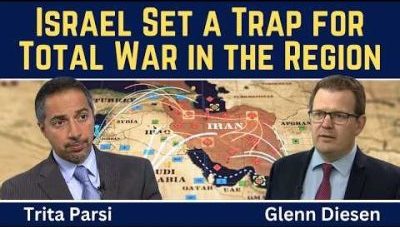
Trita Parsi: Israel Set a Trap for Total War in the Region
or go to
Aletho News Archives – Video-Images
From the Archive
Zionism’s Violent Legacy
By Donald Neff | Washington Report On Middle East Affairs | January 1996
On January 4, 1948, Jewish terrorists drove a truck loaded with explosives into the center of the all Arab city of Jaffa and detonated it, killing 26 and wounding around 100 Palestinian men, women and children.[1] The attack was the work of the Irgun Zvai Leumi – the “National Military Organization,” also known by the Hebrew letters Etzel – the largest Jewish terrorist group in Palestine. The Irgun was headed by Revisionist Zionist Menachem Begin and had been killing and maiming Arabs, Britons and even Jews for the previous ten years in its efforts to establish a Jewish state.
This terror campaign meant that at the core of Revisionist Zionism there existed a philosophical embrace of violence. … continue
Blog Roll
 Aletho News
- Trita Parsi: Israel Set a Trap for Total War in the Region
- Trump’s Iran war is on an Israeli leash
- Saudi oil boss issues global supply warning
- Riyadh Says Its Oil System Is Intact. The Numbers Say Otherwise.
- Trump and Netanyahu Want to “Finish the Job” on Iran
- US ‘one-sided dictation’ not Iran’s beliefs makes rational talks impossible: Baghaei
- Iran’s Next Strike May Not Explode. It Could Shut You Down /Col Doug Macgregor
- Iran: US political targets legitimate if assassinations return
- Iraq shuts key border crossing with Iran under US pressure: Report
- Undersea Internet cables could be targeted in retaliation for attacks on Iran: IRGC deputy chief
- If Americans Knew
- The Israel Lobby’s Changing Fortunes
- AIPAC has become such a political liability that it’s shifting to a more “nimble” approach to buying politicians
- At least 160 Israeli settler attacks in 2 weeks
- Will Gaza’s Ancient Christian Community Disappear Forever?
- Israel’s vision of regional security rests on keeping Arab states weak
- Heidi Levine recounts how Palestinian youths helped save her in settler attack
- DAILY UPDATE: Latest essential news on Palestine, Israel, & region
- Trump’s Intensifying Sabotage of the ICC, for Israel’s Sake
- Israeli military detain US and UK volunteers in West Bank including Democratic NY politician Brad Lander
- Americans at National Conservatism Conference held in Israel this year criticize Israel
- No Tricks Zone
- E-Cars Reduce CO2 Emissions By Only 41% Compared To Internal Combustion Engine Vehicles
- Predictions Made By Renowned Climate Professor Over Past Decades Have Been Proven To Be Poor
- New Study Suggests Large Regions Of The Pacific Ocean Have Been Cooling For The Last 80 Years
- Germany’s Green Energy Debacle: High Energy Costs Force Kahla Porzellan to Close After 182 Years!
- New Study: 50 Years Of The Most Aggressive ‘Net Zero’ Policies Can Only Affect The Global Climate By 0.03°C
- US September “Heat” Was No Record…Many Records Set Decades Ago
- Latest European Green Energy Debacle; Portugal’s Largest Flagship Solar Park Insolvent!
- Green Energy Debacle: German Expert Professor Fritz Vahrenholt Warns Of Severe Economic And Social Consequences
- Two More Paleo Reconstructions Affirm Meters-Higher Sea Levels Across Ireland, Brazil 7000-6000 Years Ago
- New Study: Earth And Venus Surface Warmth Largely Explained By Convection And Lapse Rate, Not CO2 Or Radiation

