Tehran approves new Hormuz plan with major restrictions
Al Mayadeen | March 31, 2026
An Iranian lawmaker confirmed the approval of a draft bill to manage the Strait of Hormuz, signaling a major shift in Tehran’s approach to one of the world’s most critical maritime chokepoints.
Mojtaba Zarei, a member of the National Security and Foreign Policy Committee in parliament, said lawmakers had endorsed a “project to manage the Strait of Hormuz,” according to Fars and Tasnim news agencies.
Zarei outlined that the bill includes comprehensive measures covering security arrangements, maritime navigation safety, and environmental considerations. It also introduces financial frameworks, including fee systems, to be conducted in Iranian currency.
The legislation further seeks to prevent American and Israeli-linked vessels from transiting the strait, alongside restricting passage for countries participating in unilateral sanctions against Iran.
Expanded sovereign and military role
The bill reinforces Iran’s sovereign authority over the strait, granting a central role to the country’s armed forces in its implementation.
It also emphasizes coordination with the Sultanate of Oman in shaping the legal framework governing the waterway.
Vice President Mohammad Reza Aref earlier stated that the management system of the Strait of Hormuz “has changed and will not return to what it was”, as Tehran works to convert recent gains into concrete economic and security guarantees that affirm its sovereign interests.
Iran could emerge stronger from the war, more dangerous to US: FT
Financial Times columnist Gideon Rachman argues that Iran is emerging from the US-Israeli war on it in a position of strategic strength, having demonstrated the capacity to close the Strait of Hormuz and impose a reported transit toll on commercial shipping, in a development that has exposed the limits of US military and diplomatic power in the region.
There is no question that the Islamic Republic has absorbed significant blows since the war began. Senior leadership, including the country’s leader, was martyred in the opening hours of the aggression, and missile launchers, ships, and command centres have been reportedly attacked.
Yet Iran has not merely held its ground. By effectively closing the strait and charging vessels a reported $2 million each for passage, Tehran has converted military pressure into economic leverage, and potentially into a permanent revenue stream.
With approximately 140 ships transiting the strait daily under normal conditions, the toll mechanism could generate billions of dollars per month for the Islamic Republic.
No Threat Can Force Iran’s Surrender /Trita Parsi & Lt Cl Daniel Davis
Daniel Davis / Deep Dive – March 30, 2026
Pakistan to Host US-Iran Talks
Sputnik – March 29, 2026
US-Iran talks may take place in Islamabad in the coming days, Pakistan’s Foreign Minister Ishaq Dar said.
All parties have expressed confidence in Pakistan’s mediating role, he added, noting that China “fully supports” the initiative.
Earlier on Sunday, foreign ministers from Saudi Arabia, Turkiye, and Egypt arrived in Pakistan to discuss potential ways to permanently resolve the current conflict in the Persian Gulf.
The ministers also discussed various proposals for reopening the Strait of Hormuz, a critical chokepoint for global oil and liquefied natural gas trade.
The proposals include establishing a management consortium and charging fees, sources say.
Pakistan, which shares a border with Iran, has leveraged its strong ties with both Tehran and Washington to position itself as a key diplomatic channel in the conflict.
How Indonesia’s tilt toward the US left it stranded in the Strait of Hormuz
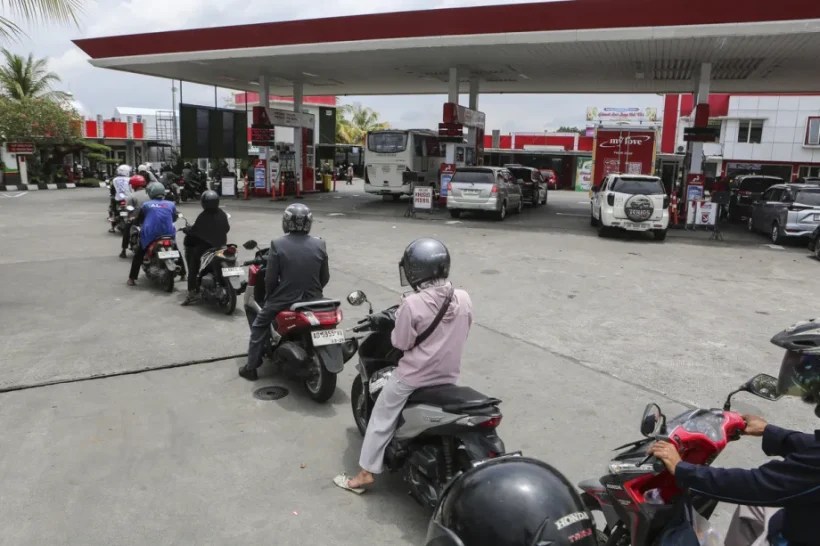
People line up for gasoline at a Pertamina’s gas station in Sukoharjo, Central Java, Indonesia, on March 26, 2026. [Agoes Rudianto – Anadolu Agency]
By Bhima Yudhistira and Dr. Muhammad Zulfikar Rakhmat | MEMO | March 29, 2026
In today’s fractured geopolitical landscape, energy flows are no longer governed by markets alone. They are shaped—often decisively—by politics. Nowhere is this clearer than in the unfolding crisis in the Strait of Hormuz, where Indonesia finds itself on the wrong side of a strategic divide.
As tensions escalate in the Middle East, Iran has adopted a selective approach to maritime access through the strait, one of the world’s most vital energy chokepoints. Rather than a blanket closure, Tehran has opted for a calibrated policy: friendly nations may pass; others must wait.
The consequences for Indonesia are immediate and stark. While countries like Malaysia, Thailand, China, India and Russia have secured safe passage for their tankers, two Indonesian vessels remain stranded. This is not a logistical hiccup. It is a geopolitical signal.
Iran’s own officials have made the logic explicit. Access is granted based on diplomatic alignment and strategic trust. Nations perceived as cooperative—or at least non-hostile—are accommodated. Others are left navigating uncertainty.
Indonesia, it appears, has misread the moment.
For decades, Jakarta prided itself on a doctrine of “free and active” foreign policy—non-aligned, pragmatic and flexible. That posture allowed Indonesia to engage multiple power centers without becoming entangled in their rivalries. But recent policy choices suggest a drift away from that equilibrium.
By signing the Agreement on Reciprocal Trade (ART) with the United States and joining the Board of Peace (BoP), Indonesia has moved beyond nominal non-alignment into visible proximity to the US orbit.
The ART is not merely a trade deal; it reshapes tariffs, supply chains and regulatory frameworks in ways that bind Indonesia more closely to U.S.-led economic and security systems. Meanwhile, the decision to join the BoP—widely criticized at home as a strategic misstep—signals alignment with Washington’s Middle East posture, particularly in the context of Gaza.
In Tehran’s eyes, these moves blur the line between cooperation and alignment. In a conflict environment defined by binary loyalties, even economic agreements and diplomatic platforms are read as strategic signals. In that context, perception is policy.
The cost of that perception is now measurable.
First, energy security. The Strait of Hormuz handles a significant share of global oil shipments, and disruptions there ripple across supply chains worldwide. If Indonesian tankers cannot pass freely, the country must source crude and liquefied petroleum gas from alternative routes—longer, riskier and far more expensive.
Shipping costs rise. Insurance premiums spike. Subsidy burdens swell. In a country where energy prices are politically sensitive, the fiscal implications are profound. What begins as a diplomatic miscalculation quickly becomes a budgetary strain.
Second, competitiveness. Malaysia and Thailand, having secured passage, are better positioned to maintain stable energy inputs and export flows. Their manufacturing sectors—already integrated into global supply chains—gain an advantage over Indonesia’s.
This is not just about oil. It is about the broader architecture of trade. Delays in energy supply affect production timelines. Disruptions in shipping lanes threaten exports of automotive components, industrial goods and commodities. In a tightly coupled global economy, reliability is currency—and Indonesia risks devaluation.
Third, macroeconomic stability. Higher import costs feed directly into inflation. A widening subsidy bill pressures public finances. And as external balances deteriorate, the rupiah faces renewed volatility. These are not abstract risks; they are the building blocks of economic stress.
All of this stems from a single, uncomfortable reality: geopolitics has overtaken economics.
Iran’s policy in the Strait of Hormuz underscores a broader shift in global order. Strategic chokepoints are no longer neutral spaces. They are instruments of leverage. Access is conditional. Neutrality, if not actively maintained, is easily questioned.
Indonesia’s response so far—continued negotiation and diplomatic outreach—may yet yield results. But negotiation from a position of ambiguity is inherently difficult. Other countries have secured passage not merely through dialogue, but through clear, consistent alignment in the eyes of Tehran.
Jakarta must therefore confront a difficult question: can it afford its current trajectory?
Recalibrating foreign policy does not mean abandoning partnerships or retreating into isolation. It means restoring balance. Indonesia’s strength has always been its ability to engage across divides—to be trusted by competing blocs precisely because it was not seen as belonging to any of them.
That credibility now needs rebuilding.
The immediate priority is practical: secure the release and passage of Indonesian vessels, stabilize energy supply and prevent further economic fallout. But the longer-term task is strategic. Indonesia must reassess its positioning in a world where neutrality is no longer assumed, but demonstrated.
The Strait of Hormuz crisis is a warning. It reveals how quickly global alignments can translate into tangible costs—and how vulnerable even large economies can be when geopolitical signals are misread.
For Indonesia, the lesson is clear. In an era of weaponized interdependence, foreign policy is no longer a distant abstraction. It is an economic imperative.
And getting it wrong is no longer affordable.
Israel’s Iran Strategy Uses US Military & Gulf States as Its Pawns
By Robert Inlakesh | Palestine Chronicle | March 29, 2026
While most honest analysts will conclude that the decision made by the White House came as a result of pressure from the Israelis or that this is a war that is being fought for Tel Aviv’s interests, many fail to see any clear strategy at play.
In order to understand the strategy behind the US-Israeli assault on the Islamic Republic, you must first remove the notion that the United States is in the driving seat to any significant extent.
Almost immediately after the 12-Day War in June of 2025, the Israeli leadership was already preparing for the next round. On July 7, Axios News even reported that officials in Tel Aviv believed that US President Trump would give them another green light to attack.
Meanwhile, the most influential Zionist think tanks in Washington DC, the likes of the Washington Institute for Near East Policy (WINEP) and the Foundation for Defense of Democracies (FDD), were openly discussing the necessity of a new round of confrontations.
These think tanks facilitated discussions and published pieces in which they made it clear that while the next round was inevitable, it had to be the last round, and that the US’s involvement would be important in deciding outcomes.
Understanding the Israeli Strategy
It is no coincidence that senior Israeli officials, all the way from Israeli Prime Minister Benjamin Netanyahu to opposition leader Yair Lapid, have all recently publicly endorsed the “Greater Israel Project”.
This is not simply posturing, this is their goal. But how does this fit into the Iran war? Well, it will begin to make sense when the context is all provided.
Firstly, the Greater Israel Project’s strategy is grounded in an academic article published by a former Israeli intelligence officer and journalist, Oded Yinon. The plan did not advocate for the physical expansion of the Israeli State’s borders over every nation between the Euphrates River and the River Nile, but instead opted for an approach that would transform Israel into a regional empire.
In order to achieve this goal of a “Greater Israel”, it would first necessitate the collapse of all the region’s sovereign States, which would instead be broken up into warring sectarian and ethno-regimes.
The purpose of achieving the disintegration of the surrounding nations is a simple concept to understand. If they are all divided, economically weak, and lack the military capabilities to stand up to Israel, it makes it easy for the Israelis to control them.
Take, for example, the Kurdish Regional Government in northern Iraq, or the semi-autonomous zone in southern Syria’s Sweida Province, now carved out by Israeli-backed separatists.
Syria and Iraq are perfect examples of what happens when a nation is torn apart and sectarianism, or ethno-supremacist ideologies, are spread through deliberate propaganda campaigns.
Although Secular Arab Nationalism failed in the region, the chief proponent of it, former Egyptian President Gamal Abdul Nasser, was indeed correct in his analysis as to why it was a net positive for the region.
A united Arab World would undoubtedly be far stronger than the simple modern nation-states of the region, whose borders were drawn up by European colonial powers.
For the Israelis, they had always sought to impose this long-term solution upon West Asia, of a “Greater Israel”, but were previously seeking to do it in a slow and methodical way, opposed to a ruthlessly violent one.
Part of this way of thinking was centered around the idea that Israel maintained a “deterrence capacity”, meaning that their military power was capable of deterring any significant strategic threat from rising against it.
On October 7, 2023, the Qassam Brigades of Hamas crippled this strategy and debunked the notion of their “deterrence capacity”. A few thousand Palestinian fighters managed to overcome the most militarily advanced army in the region, bursting through the gates of their concentration camp, despite the world’s most advanced surveillance systems being present in the area.
The Palestinian groups themselves appear to have been genuinely surprised by how easily they were capable of achieving their goals. Not only did they inflict a blow on the Israeli military and seize captives, but they also managed to collapse the entire Israeli southern command, all with light weapons.
To Israel, the message was clear: The Arab populations of Jordan and Egypt had taken to the streets, some even pouring across the Jordanian border. The weakest link in the Iranian-led Axis of Resistance had dealt the Israeli military its most embarrassing defeat. Deterrence was dead, and former Secretary General of Hezbollah, Seyyed Hassan Nasrallah, was proven correct: “Israel is weaker than a spider’s web”.
The decision to commit genocide was therefore ordered. Israel believed it had to show the Arab World what it was truly capable of, as a means of asserting its control. In the cases of the Arab populations in Jordan, Egypt, and even the occupied West Bank and Jerusalem, the fear tactics appeared to have worked. Then they made an irreversible mistake.
In September 2024, they assassinated Seyyed Hassan Nasrallah, a move that completely changed the thinking of Iran and its allies. Now, the message had been received loud and clear; preparations for the last war had to be made. Up until then, the Axis of Resistance had been attempting to close the chapter of the Gaza genocide; now, they understood that destroying Gaza wasn’t the end goal of Israel.
Israel had decided it would accelerate its national project of gradual expansion, meaning that the Islamic Republic of Iran had to be deposed. A failure to overthrow the Iranian government would represent an existential threat to this project.
Israel’s Iran War Strategy
As I have been writing in the Palestine Chronicle for the past eight months, the only viable strategy that the Israelis could hope to use, in order to see any gains, is one where Iran’s civilian infrastructure is the primary target.
That means: taking out power stations, desalination plants along with other key water facilities – less than 3% of Iran’s water needs come from desalination – while blowing up oil and gas facilities, bombing factories, destroying agricultural lands, inflicting costly environmental catastrophes, and attempting to cripple the Iranian State’s ability to function. In other words, a policy that replicates the Gaza model on a much wider scale, impacting a nation of 92 million people.
Tel Aviv’s goal here is a long-term regime change operation, one that will happen gradually following the war itself. Israel knows that destroying Iran’s military capabilities was never going to be possible. Yes, they may have some successes, but totally crippling their missile and drone programs through strikes alone won’t work.
Therefore, they seek to try and force Tehran to expend a large portion of its missile arsenal, making it more difficult for them to start a new war in the near future following the conflict’s conclusion.
If you look at Syria, for example, the government of Bashar al-Assad did not collapse during the war. Instead, the Syrian State slowly eroded from the inside, due to its isolation and the US-EU’s maximum pressure sanctions.
In the end, the Syrian State was largely bought out and was so corrupt that there was little left. When Ahmed al-Shara’a marched into Aleppo and then Damascus, he did so without any fight, although there were some exceptions where a few units resisted.
Now, Damascus is open for Israeli citizens, the leadership in Syria meets with Israeli officials face-to-face, and has even set up a joint normalizing mechanism between both sides. Therefore, using the long game strategy against Iran makes the most sense in Israel’s strategic thinking.
Then there comes the convenient side effect of the strategy, which begins to explain how the US leadership is not in the driver’s seat at all. That being the weakening of the Persian Gulf Arab nations.
Qatar, Bahrain, Kuwait, the United Arab Emirates and Saudi Arabia are experiencing untold economic devastation as a result of this war. The reason for this, evidently, is that they all host US bases and have permitted a large presence of American military and intelligence personnel inside their countries.
Oman, and to a lesser extent Qatar, have been the only Gulf nations that appear to be pushing back against the true culprits in this war, the Israelis and US. Muscat in particular has blasted the “security arrangements” in the region and condemned normalising efforts with Tel Aviv, pointing their fingers in the right direction.
Bahrain and especially the UAE have gone in the opposite direction. They are only increasing their pro-Israeli and anti-Iran rhetoric, which comes as little surprise given that both have normalized relations with the Zionists. Riyadh, on the other hand, appears to be on a separate trajectory, with its rhetoric being diplomatic, while its actions suggest it is hostile towards Iran.
The Israelis, despite their efforts to normalize ties with the Gulf States, do not want strong nations to exist anywhere in West Asia under their accelerationist approach to achieving an Israel Empire. This appears to be something that the leadership in Abu Dhabi and Manama have not proven intelligent enough to figure out.
That is why the Israeli leadership had started to announce their next targets, following Iran, were the leaderships in Turkiye and even Pakistan. Turkish President Recep Tayyip Erdogan is not a threat in the way that Iran is, but he does command one of the most powerful military forces in the region and rules over a developing economy, working towards transforming itself into a key global trade hub.
Alone, the idea that Turkiye would begin to build an economic or defence alliance with Saudi Arabia, Pakistan or Egypt, poses a direct threat to the Greater Israel Project. In Syria, we see a similar thing; although Ankara does not present a clear and present military challenge to the Israelis as a result of its influence in Damascus, it acts as a potential competitor, a nation that may seek to curtail Israeli expansionist plots.
The GCC countries, which are in alliance with one another, maintain immense economic power. As we see today, if the Strait of Hormuz is disrupted, the entire world is impacted. Back in 1973, these Persian Gulf Arab States exercised that power temporarily. One thing to keep in mind with the Israelis is that they never forget history and are infamous for holding grudges.
So, the dismantlement of the Gulf Arab nations’ economies, or at the very least, the weakening of these countries, is viewed as a positive development in Tel Aviv. As for the US, this war is similarly disastrous, but Israel fails to care less.
This war has destroyed US power projection, making it open to its top chosen adversaries – Russia and China – in a number of other arenas. Donald Trump personally has business ties in the Gulf, which don’t benefit from this conflict, so even on a personal level, it isn’t exactly a victory. The entire Western World, allying itself with the US and Israel, is suffering economically, and as a result, this will mean social unrest is possible, even if it takes time to come to fruition.
An embarrassment has already been dealt to the US military, which is being made to look like a paper tiger, as Mao Zedong once called it. Its future in the Gulf region may have just been ruined, along with those billions, or trillions as Trump believes, of investments – from Gulf States – may no longer materialize. The entire White House Security Doctrine, published last year, has been torn up and set on fire.
In terms of soldier casualties, the Trump administration is evidently hiding the true figure, but it goes without saying that this isn’t good news. NATO has been forced to flee Iraq. The US has even lifted sanctions on Moscow and a limited number of sanctions on Iranian oil. There is simply nothing that the US stands to gain from this war, even if it were to somehow pull off a victory; at this point, it would prove pyrrhic.
With all of this being said, what the Israelis are doing is making a massive gamble. A series of risks that appear so far to be backfiring, as Tehran appears to have pre-empted the conspiracies set against it. The final results of the war are not yet in, but the odds appear to be on the side of Iran.
– Robert Inlakesh is a journalist, writer, and documentary filmmaker. He focuses on the Middle East, specializing in Palestine. He contributed this article to The Palestine Chronicle.
Iran: Trump wanted regime change, now just begging for Hormuz to open
Al Mayadeen | March 29, 2026
Iran’s Parliament Speaker Mohammad Bagher Ghalibaf said on Sunday, marking the 30th day of Iranian national defense against the US-Israeli aggression, that the US president’s objectives have dramatically shifted since the start of the war on Iran.
“The enemy who claimed to have destroyed our air, naval, and missile forces, and had a plan for the collapse of the Islamic Republic, has now set his goal on reopening the Strait of Hormuz,” Ghalibaf said.
“Reopening a strait that was open before the war has become Trump’s operational dream,” he said mockingly.
Ghalibaf stated that the war on Iran, which has come to be known as the Ramadan War, is now at its most critical moment. He noted that Trump is unable to secure the support of European countries, that energy markets are out of control, and that food inflation is approaching.
The war bites the belligerent
The Parliament Speaker detailed the damage inflicted on US military assets throughout the conflict. “The manifestations of American arrogance, from the F-35 to the aircraft carrier and US regional bases, have suffered major blows,” he said. “Strikes on the Israeli regime have been effective, precise, and foundation-shaking.”
Ghalibaf also highlighted the growing strength of the Resistance Axis across the region.
“Hezbollah in Lebanon, which was constantly threatened with disarmament, is today an important and effective part of the Resistance and has trapped the malignant Israeli regime,” he said.
“The Resistance in Iraq is fighting heroically and has astonished the enemy. Ansarallah in Yemen has breathed new life into the Resistance front and is ready to achieve spectacular surprises.”
“This is the honor and greatness of the Resistance front against the world’s arrogant powers,” Ghalibaf stated. “Trump has been accused worldwide of waging a pointless war and has no answer for his public opinion. The evil of initiating the war has returned to its initiator.”
Here is a background section summarizing the current situation with the Strait of Hormuz, based on the Al Mayadeen article:
The battle for the Strait of Hormuz
Since the US-Israeli war on Iran began on February 28, the Strait of Hormuz, through which approximately one-fifth of the world’s oil and natural gas shipments pass, has become a central front in the war on Iran. Iranian authorities have restricted the movement of vessels linked to the US and “Israel” or those supporting, requiring ships to obtain approval before transiting the strategic waterway.
Tehran has made clear that “nonhostile” ships may pass safely if authorized, while the strait remains “closed only to enemies carrying out cowardly aggression against Iran,” as Foreign Minister Abbas Araghchi put it. The Islamic Revolution Guard Corps has turned back multiple container ships attempting to transit without authorization.
Iran’s Parliament is now advancing legislation to impose formal tolls on vessels passing through the strait, a move lawmakers say is designed to assert Tehran’s “sovereignty, control and oversight” over the passage, much like the model applied by Turkey in the Bosphorus and Dardanelles straits. The toll system would build on temporary fees applied since late February.
US President Donald Trump has threatened an escalation in the aggression against Iran’s power infrastructure if the strait remains closed, while US attempts to organize international naval escorts to bypass Iran’s control over the strait have so far failed.
The new framework signals Tehran’s intent to use its control over its waterway to regulate access systematically, rather than relying on ad hoc measures, while simultaneously sending a message to the US and “Israel” about the country’s ability to control this key energy corridor.
US-Israeli war on Iran drives global fertilizer prices up 40%
Al Mayadeen | March 28, 2026
The ongoing war on Iran is driving a sharp rise in global fertilizer prices, exposing how Western-led escalation is reverberating across critical sectors such as agriculture and food production, the German-based Deutsche Presse-Agentur (DPA) reported on Friday.
According to Philipp Spinne, managing director of the German Raiffeisen Association, mineral fertilizer prices have increased by 30% to 40% since the beginning of the year. He noted that current market conditions are approaching levels seen at the start of the war in Ukraine, indicating mounting pressure on global supply chains. “A situation similar to what happened in February 2022 is recurring,” Spinne said, pointing to the rapid climb in nitrogen fertilizer prices toward previous peaks.
Hormuz disruptions
The surge is closely tied to disruptions around the Strait of Hormuz, a strategic waterway through which a significant share of global fertilizer trade passes, including roughly one-third of globally traded urea and about 20% of ammonia. Tehran’s response to the US-Israeli aggression has prompted restrictions on maritime flows, tightening supply and pushing energy prices higher, feeding directly into production costs.
Despite this, the immediate impact on European consumers remains limited. Many farmers had already secured their fertilizer supplies before the outbreak of the war. According to German industry estimates, around 80% of the required quantities for the entire spring season are already held in cooperative storage, while roughly 50% are already in the hands of farmers. However, industry representatives warn that a prolonged war will inevitably translate into higher production costs, which are expected to pass through to food prices over time.
A spokesperson for the Bavarian Farmers’ Association noted that while availability is currently manageable, farms that did not secure supplies early are now facing significant cost burdens. At the same time, relatively weak grain prices are compounding the pressure, squeezing margins and weighing on farm liquidity.
Rising fertilizer costs
Energy costs remain the central driver. Gas accounts for between 80% and 90% of the cost of producing ammonia and nitrogen fertilizers, meaning that fluctuations in energy markets, intensified by the war, directly affect agricultural inputs. Industry representatives added that the sharp rise in gas prices in Western Europe during the Ukraine war had already weakened the region’s chemical sector, a trend now deepening.
As prices rise, farmers may reduce fertilizer use, a shift that could lead to lower yields and tighter food supplies globally. The structural importance of fertilizers to global food systems reflects the scale of the risk: nearly half of the world’s population depends on crops grown using mineral fertilizers, while yields today are roughly double those of the early 20th century due to their use. Any sustained disruption, therefore, carries long-term implications for food security.
Although Europe produces a large share of its own fertilizers, covering roughly three-quarters of its nitrogen needs domestically and slightly more in the case of potash, it remains indirectly exposed through rising gas and LNG prices. While Europe has for years imported little fertilizer directly from conflict-affected regions, indirect pressures through energy markets continue to impact production costs.
Europe under pressure
At the policy level, European actors are increasingly turning to protectionist measures, including tariffs on Russian fertilizers, in an effort to shield domestic markets and reduce external dependency. Industry groups have also called for higher tariffs on Russian potash and for strengthening local production capacity. At the same time, Russia has introduced its own export restrictions to protect internal supply, further tightening global availability.
For now, German farmers remain partially insulated, but those forced to purchase at current prices are facing significantly higher costs, reinforcing concerns that the economic strain on agriculture will deepen if the war persists.
Japan Clings to US Vassalage Despite Energy Crunch Caused By Iran War
Sputnik – 27.03.2026
With 90% of Japan’s oil and 11% of its LNG sourced in the Persian Gulf, effectively closed thanks to the US-Israeli war on Iran, Tokyo has been put in a strategic bind, facing growing pressure both domestically and in ties with neighbors.
Tokyo has contributed 80M barrels of oil to the G7-led 400M barrel phased reserves release, but signaled it will only sell it to domestic refiners, rejecting pleas for help from Vietnam and the Philippines, per Bloomberg.
Domestically, the government has been forced to lift restrictions on coal-fired power plants, introduce subsidies to keep gasoline at ~$4 a gallon, and raise household electricity bills by ~$95 starting in April. Over time, logistical, flights, and everything else linked to hydrocarbon energy will face price hikes.
80M barrels is enough for ~45 days. If Hormuz remains blocked after then, Japan will have only two options, neither of them good:
- engage in a cutthroat energy bid price war, which will raise domestic prices and worsen ties with other energy-dependent neighbors in Asia
- introduce fuel rationing, which could trigger a recession or even a debt crisis (Japan already has a debt-to-GDP ratio of ~240%, the highest among rich nations)
Notwithstanding these pressures, Japan:
- continues to buy US Treasuries ($1.2T and counting)
- lets 50k+ US troops be stationed on its territory, 80 years after the end of WWII, for ‘defense’ (although the Iran war has seen US pulling out assets and repositioning them in Israel)
- keeps sanctions on Iranian oil, one of the only sources of Gulf oil currently making its way past Hormuz
- has pledged $73B to US energy security projects, including small modular reactors and natural gas infrastructure in Tennessee, Alabama, Pennsylvania and Texas
- swallows US tariffs and accepts an export-crushing strong yen policy to satisfy Washington
- sidelines its own foreign policy interests, including ties with powers like China and ASEAN
US Seeks Control Over Global Energy Infrastructure – Kremlin
teleSUR | March 27, 2026
The United States is aiming to take control of the Russian-owned Nord Stream pipelines that link Russia and Germany, Kremlin spokesman Dmitry Peskov said Friday, alleging Washington’s interest in the damaged infrastructure reflects a broader push to dominate global energy markets.
Peskov told reporters that the U.S. focus on the Baltic Sea pipelines was “evident,” adding that the assets — rendered inoperable after sabotage in September 2022 — remain the property of Russian state-owned Gazprom.
Foreign partners withdrew following the imposition of sanctions, which Moscow considers illegitimate, he said. “One of them is destroyed, it is deteriorating further each day due to the aggressiveness of the marine environment.”
His comments came hours after Russian Foreign Minister Sergei Lavrov told France Télévisions that Washington was seeking to dominate world energy markets, including the Nord Stream system. A 2024 Wall Street Journal report said U.S. investor Stephen P. Lynch had been exploring the purchase of Nord Stream 2, one branch of which remains intact.
Peskov also dismissed as “a lie” speculation that Russia was threatening to halt operations of the Caspian Pipeline Consortium (CPC) in the Black Sea to pressure the United States. He said Russia remains a reliable energy transit partner and accused Ukraine of carrying out drone attacks against CPC infrastructure, causing temporary suspensions.
“In practice, it is Kiev that has been and continues to engage in energy blackmail, which affects the interests of our companies,” Peskov underscored.
US senators target Orban government for standing up to Zelensky
RT | March 27, 2026
Two US lawmakers are seeking to impose sanctions on officials in Hungarian Prime Minister Viktor Orban’s government, citing Budapest’s stance on Russian energy imports and its ongoing diplomatic dispute with Ukraine.
Ukraine cut off Russian oil supplies to Hungary earlier this year, claiming that damage to the Soviet-era Druzhba pipeline made deliveries impossible. Orban has accused Ukrainian leader Vladimir Zelensky of trying to manufacture an artificial energy crisis to boost the Hungarian opposition in the upcoming parliamentary election, and has retaliated by blocking a €90 billion EU loan intended to bankroll Kiev.
A bill threatening Hungarian officials was announced on Friday by Senator Jeanne Shaheen, a Democrat, and Senator Thom Tillis, a Republican, who co-chair the US Senate NATO observer group.
“When the rest of Europe is rightfully weaning off Russian energy, Hungary has doubled down,” Shaheen, the ranking member of the Senate Foreign Affairs Committee, said. She also took aim at Vice President J.D. Vance over his reported plans to travel to Hungary in a gesture of support for Orban.
Tillis said the bill – the BLOCK PUTIN Act – signals that NATO members undermining Ukraine aid will face “consequences,” while also “giving Hungary a clear path to get back in line.”
Ukraine and Hungary at loggerheads
Orban’s government has opposed Western policies aimed at providing aid to Ukraine “for as long as it takes” and imposing sweeping sanctions on Russia since the conflict escalated in 2022.
Zelensky has accused Orban of following orders from Russian President Vladimir Putin – rather than defending Hungarian national interests, as the prime minister insists – in rejecting Ukraine’s bids to join NATO and the EU. The dispute over the pipeline has intensified after months of sharp rhetoric, including Zelensky’s physical threats against Orban.
Without the proposed €90 billion ($104 billion) EU assistance package, Ukraine is projected to run out of money by June, according to Bloomberg. Ukrainian efforts to secure alternative funding sources have been complicated by gridlock in Kiev, where lawmakers have refused to vote for painful economic reforms demanded by international lenders such as the IMF.
Pro-Kiev officials in the EU are reportedly betting on Orban’s loss in the upcoming election, though other options – such as restricting Budapest’s voting rights – have also been discussed.
More Iran War fallout: Maritime insurance industry shifts from London to China
Inside China Business | March 26, 2026
China and Hong Kong comprise the most valuable fleets of commercial ships in the world, and the largest numbers of bulk carriers, container ships, and tankers. Japan, Korea, and Singapore also have huge investments in global shipping. But European and American insurance brokers underwrite 90% of maritime insurance in the world, and on the first day of the war against Iran canceled insurance coverage on vessels already in contested waters. Hong Kong now writes insurance coverage for ships from Mainland China and Hong Kong, even those transiting the Persian Gulf. What’s more, Iranian authorities are clearing China-flagged vessels to pass safely.
Resources and links:
Top 10 shipowner countries/regions in the world https://vesselslink.com/blogs/news/to…
Hong Kong marine insurers gain edge over London with cheaper war-risk cover for Chinese ships https://www.scmp.com/business/banking…
Insurance Clubs to Halt Ship War-Risk Cover in Persian Gulf https://www.claimsjournal.com/news/na…
Insurance Clubs to Halt Ship War-Risk Cover in Persian Gulf https://www.bloomberg.com/news/articl…
Traffic is trickling through Strait of Hormuz: Who’s moving and who’s stranded https://www.cnbc.com/2026/03/18/hormu…
Featured Video
Prof. Ted Postol: Iran Already Achieved Nuclear Deterrence Against Israel
or go to
Aletho News Archives – Video-Images
From the Archives
How the occupied mentality syndrome works
Saudi Arabia on the American chessboard – Part 3
By B. J. Sabri | American Herald Tribune | June 27, 2016
Read part 2: “The occupied mentality Syndrome“
Previously I argued whether Saudi Arabia’s repeated involvements in U.S. interventions and wars stem from free national will or in response to a specific condition. For starters, in Saudi Arabia there is no national will. In Saudi Arabia, the national will is the will of the Al Saud clan. Still, when a major Arab state allies itself with a superpower that committed unspeakable crimes against humanity in almost every Arab country, then something is wrong. This fact alone should compel us to examine the U.S.-Saudi relation for one exceptional reason. As a result of the U.S.-Saudi wars, hundreds of thousands of people in Afghanistan, Iraq, Iran, Libya, Syria, Yemen, and Somalia have lost their lives. Millions became displaced in their own homelands. And millions more rendered refugees.
Attributing the Saudi policies to the bonds of “partnership” with the U.S. is frivolous. There are no bonds between these two thugs except those of business, military deals, secret plots, and wars. Proving this point, bonds such as these have no space for the American and Saudi peoples to share significant cultural or societal exchanges. If partnership is not the reason for the Saudi contribution to the U.S. strategy of empire and imperialism, then another reason must exist.
This leads to three possibilities. … continue
Blog Roll
 Aletho News
- REWRITING THE RISK? INSIDE THE GOVERNMENT’S VACCINE SAFETY MESSAGING
- “Davos Can Really Replace the UN”
- NIAID/NIH and USDA Fund Bioengineered Chimeric Influenza Viruses Built Using Pandemic H1N1 Components: Journal ‘Science Advances’
- Hezbollah hits Israeli warship off Lebanon’s coast, sets it aflame
- Iran slams US strikes on B1 bridge, Mahshahr petrochemical plants as ‘blatant acts of state terrorism’
- In letter to UN chief, Araghchi warns of dire consequences of US-Israeli attacks on Iran’s nuclear facilities
- Why the CIA conspiracy to invade Iran with Kurdish militias failed
- Why Are Upbeat US Claims About Mission to Rescue Pilot ‘Highly Questionable’?
- Aircraft destroyed during US ‘rescue’ of downed F-15 pilot cost more than $100 million each
- Washington University removes professor who condemned US-Israeli war on Iran
- If Americans Knew
- In Iran, Israel-US take aim at “reason, research, and freedom of thought” – Daily Update
- US loses planes over Iran, Israel downgrades Lebanon war goals – Daily Update
- Israel Is Blocking Palestinians from Easter at Church Where Jesus Resurrected
- Plot to assassinate Palestinian activist follows harassment campaign promoted by Zionist groups and elected officials
- Prominent New York synagogue hosts presentation on why U.S. Jews should support the ethnic cleansing of Gaza
- Tapper vs. Piker: Is the CNN Anchor Auditioning for David Ellison?
- Shouldn’t Democrats Be Able to Condemn Genocide?
- Israel-US kill negotiators, destroy civilian structures, but Iran’s military capabilities still largely intact – Daily Update
- ‘War crime’: Global condemnation as Israeli ministers celebrate death penalty law targeting Palestinian prisoners
- 7 Ways Israel Is Turning Lebanon Into Gaza
- No Tricks Zone
- An Inconvenient Tree: Uncovered In Alps… Europe Much Warmer Than Today 6000 Years Ago
- New Study Reports A 60% Slowdown In Greenland’s Ice Loss Rate In The Last Decade
- Low Intensity Tornado Wrecks Major Solar Farm, Creating A Potential Toxic Dump
- New Study Finds Warming Saves Lives…Cold Temperatures 12 Times More Deadly Than Excess Heat
- German Science Blog Accuses PIK Climate Institute Of Hallucinating Climate Tipping Points
- Devastating Assessment Of Comirnaty Vaccine By Former Senior Pfizer Europe Toxicologist
- New Study: CO2 Is ‘Effectively Negligible’ As An Explanatory Climate Change Factor Since 2000
- Former Pfizer Toxicologist Dr. Helmut Sterz Tells Bundestag Hearing Pfizer Vaccine Should Have Never Been Approved
- Energy Expert: Germany’s Nuclear Phaseout Was A “500 Billion Euro Mistake”
- New Research: South Australia’s Mid-Holocene Sea Surface Temperatures Were 4°C Warmer Than Today
 Aletho News