Yes, the Iran war has destroyed Trump’s presidency
By Andrew Day | The American Conservative | September 29, 2026
No one would claim that the Iran War has been a political godsend for President Donald Trump and the Republican Party. But some Israel-First conservatives are willing to say—and lately have been incessantly saying—that the Iran War hasn’t been a political scourge.
Those Israel-First conservatives are wrong, even if the devil is, at least partly, hidden in the details. The Iran War has damaged Trump’s approval ratings, consumed his presidency, and darkened the GOP’s prospects in the upcoming midterm elections.
A chief proponent of the argument that Trump hasn’t suffered all that much from the Iran War is Ben Shapiro of the Daily Wire. Shapiro’s political analysis is plainly motivated by the fact that he was a loud and influential proponent of the war who promised—falsely, as it turned out—that Iran couldn’t close the Strait of Hormuz, a chokepoint for the global energy trade.
“There’s an op right now to pretend that the real reason for President Trump’s unpopularity is foreign policy, but that is not true, by the polling data, it is not true,” said Shapiro on a recent episode of his podcast. “The reality is that Americans have affordability concerns, President Trump came into office saying he was going to alleviate the affordability concerns. He has not in fact alleviated the affordability concerns, and therefore, his polling numbers have consistently slid since Liberation Day.”
This is a bit like me saying my wife isn’t mad at me because of the drinking, but because I drunkenly crashed the car.
The Iran War, as everyone now knows, has driven up prices at the pump—prices which, unfortunately for Trump, are prominently displayed on every major street across the country. On the eve of the war, regular gasoline averaged $2.98 per gallon. Today, at the time of writing, the average price is $4.48. Americans are notoriously averse to high gasoline prices and tend to punish presidents over the issue, sometimes even when the president can’t justifiably be blamed.
But make no mistake: Virtually every sentient adult understands that 1) oil comes from the Middle East, 2) Trump started a big war in the region, and 3) gas prices shot up right afterwards. And again, even if Americans didn’t grok the connection between the war and the gas-price spike, the latter would still have hurt Trump politically, and it would still be a knock-on effect of the former.
It’s not just prices at the pump that have gone up because of the war. Groceries and other consumer goods travel across this vast land on tractor-trailers that run on diesel and get a lot fewer miles per gallon than even your Uncle Larry’s F-350. Diesel prices have smashed records and now sit at around $6.50, up from $3.76 before the war.
No wonder truckers are furious, prompting rumors of an imminent strike.
And no wonder the Iran War has contributed to general inflation in America. Anyone who has been reading the official economic reports knows the war is responsible for more than a third of recent inflation.
Before the war, inflation was trending down, only a couple ticks away from the Federal Reserve’s target of 2 percent. It seems likely that Trump, if he hadn’t started his dumb war in the Middle East, would have garnered praise for presiding over declining inflation and that the Fed would have cut interest rates, juicing economic growth. Instead, inflation now sits at 3.4 percent.
(As an aside, this weekend I traveled to Istanbul, where many Middle Easterners of various nationalities complained to me that Americans only oppose the war because of the gas prices. That’s simply not true. The war has been unpopular since day one, when all that Americans knew was the American-Israeli strikes had killed Iranian leaders including the Supreme Leader Ali Khamenei.)
Shapiro, ever the neoconservative, insinuated in the quote above that the decline in Trump’s approval rating owes more to his tariffs than to his war. The data doesn’t back that up, as the conservative commentator and election analyst Ryan Girdusky noted on X in response to new survey data. “The most eye opening part of this poll is that Trump’s approval rating and the strength of the economy went up right after Liberation Day,” Girdusky said. “Fell slightly afterward and then plummeted at the start of the Iran War.”
Shapiro has unwittingly helped uncover another, subtler, way in which the Iran War has indirectly damaged Trump’s approval ratings and, by extension, the Republican Party brand. Shapiro recently went on Fox News to commiserate with the host Mark Levin—another Israel-Firster and warmonger—over all those dastardly antiwar conservatives blaming the Iran War for everything.
“Iran is a 4-percent issue with the American people,” Levin said, as Shapiro nodded in agreement. Levin was referring to Fox News polling that shows not many Americans name the Iran War as their top issue. “So, whatever happens in the midterms, it doesn’t appear that Iran’s going to drive anything one way or another.”
“I think that’s exactly right,” Shapiro replied.
Part of the problem with Levin’s analysis has already been covered above. In the Fox poll, a plurality of Americans—34 percent—named the cost of living as the most important issue, and the Iran War has made living costlier.
But the subtler problem is perhaps even more illuminating. Simply put, Americans believe Trump is too focused on foreign policy at the expense of the problem they really care about, which, in fact, his Iran War has exacerbated. This is a PR disaster for the Trump administration and the GOP. Americans don’t prioritize the war that has dominated the headlines and distracted the White House, even as Trump claims to have boldly prevented Iran from unleashing nuclear apocalypse.
It may be grotesque to find silver linings in this dumb and deadly war, but here’s one: Americans no longer buy the war narratives. That is certainly not, however, a silver lining for Republican candidates in this year’s election, no matter how cynically they try to distance themselves from the war. In fact, it’s a good bet they’ll do much worse than if Trump hadn’t launched this unnecessary war, despite what Shapiro and his ilk may tell you.
The legacy of US sanctions, war, and occupation in Iraq
By Hala Farhat | Al Mayadeen | September 30, 2026
Iraq’s government has declared September 30 the final date for ending the US-led coalition’s military mission. Prime Minister Ali al-Zaidi’s office says October 1 will find the country “free of any foreign military presence,” closing a deployment that once reached about 170,000 US troops.
But withdrawal leaves intact much of the damage inflicted by the invasion and the 13 years of sanctions that preceded it, along with the financial arrangements through which Washington continues to exert influence.
The US left Iraq’s productive economy devastated, its institutions dismantled and reshaped, and its workforce left increasingly dependent on a state funded by oil. Access to that income remains vulnerable to US pressure.
The question after the troops leave is how much control Iraq will have over the economy they leave behind.
Thirteen years of sanctions
The erosion of Iraq’s economy began long before March 2003. The UN Security Council imposed sweeping sanctions after Saddam Hussein’s regime invaded Kuwait in 1990. Drawing on internal UN records, Joy Gordon’s Invisible War describes one of the most comprehensive and devastating sanctions regimes ever imposed.
The embargo quickly collapsed incomes. Reconstructed World Bank estimates showed GDP per capita collapsing to a third in a single year, going from about $3,527 in 1990 to $1,255 in 1991.
Public employees who had earned $150 to $200 a month before sanctions were earning $3 to $5 by 1996, according to a 1997 assessment. By 2000, the International Committee of the Red Cross reported salaries as low as $2 a month and unemployment around 50 percent.
Factories, power stations, and water plants could not recover without imported equipment and spare parts. Yet any member of the sanctions committee could hold an entire contract indefinitely, even over a single disputed item. Gordon documents Washington’s use of the “dual-use” designation to restrict goods as basic as water pipes. By August 2002, the UN counted 2,058 contracts worth about $5.2 billion that had been placed on hold, including $745 million in oil industry equipment.
The restrictions also placed Iraq’s oil income beyond Baghdad’s direct control. Under the Oil-for-Food program, buyers paid into a UN-administered escrow account. After deductions for compensation, administration, and weapons inspections, the proceeds could finance only approved purchases. Iraq exported roughly $65 billion in oil under the program but could not use that money as ordinary budget revenue for wages, maintenance, or local services.
The collapse pushed skilled workers out of their professions. A UN humanitarian survey of 1,157 degree holders employed by aid organizations found 725 in general-service or menial jobs, including doctors, engineers, and scientists working as drivers, clerks, and guards.
By the time US troops arrived, Iraq had endured years of falling wages, industrial decline, and lost expertise. The occupation’s first decisions deepened that damage.
Dismantling the state, contracting out reconstruction
On May 16, 2003, the occupation authority issued Order 1, barring senior Baath Party members from public employment and requiring the screening of senior staff in ministries, hospitals, and universities. A week later, Order 2 dissolved the Defense Ministry, army, Republican Guard, and intelligence bodies.
The International Center for Transitional Justice estimates that Order 2 alone left about 400,000 conscripts, officers, and officials without jobs. The World Bank counted more than 2 million unemployed Iraqis, nearly 30 percent of the labor force, around 2003–2004. Meanwhile, Iraq’s health minister estimated that roughly half the country’s prewar doctors had fled as kidnapping and assassination made their work increasingly dangerous.
The occupation then opened the weakened economy to foreign competition. Order 39 allowed wholly foreign-owned companies and guaranteed investors treatment no less favorable than Iraqi businesses, while excluding natural resource extraction. Other orders suspended tariffs, later replaced by a flat 5 percent levy, and capped income tax at 15 percent from 2004. The World Bank warned that rapid opening would cost jobs in a country whose private sector was too weak to employ displaced workers.
Reconstruction brought billions of dollars, but much of the spending flowed through foreign contractors. The United States spent more than $60 billion over roughly a decade, according to the Special Inspector General for Iraq Reconstruction (SIGIR). More than $25 billion went to training and equipping security forces after the occupation had dissolved Iraq’s existing military institutions.
SIGIR found that reconstruction began without adequate security, consultation with Iraqi ministries, or planning for long-term maintenance. Its final report estimated waste at $3 billion to $5 billion from the main reconstruction fund and as much as $8 billion overall. The largest early infrastructure contracts went mainly to US firms. A $1.8 billion award to Bechtel in January 2004 was open only to American bidders.
Iraq’s own money followed a similar path. UN Security Council Resolution 1483 established the Development Fund for Iraq to receive oil revenue, with the occupation authority directing spending until June 2004.
An Iraq Revenue Watch analysis of contracts paid from Iraqi funds found that US companies received 74 percent of their value. US and British companies together received 85 percent, while Iraqi firms received 2 percent. Audits found that 73 percent of the value of Development Fund contracts above $5 million had been awarded without competitive bidding.
Oversight was inadequate even to establish how some of that money had been used. A 2010 SIGIR audit found that the Defense Department had failed to establish required accounting controls for about $8.7 billion of the $9.1 billion it received from the fund. It could not document spending of about $2.6 billion.
The result was a reconstruction process that directed vast sums abroad while leaving Iraq with damaged services, limited productive capacity, and institutions struggling to rebuild.
An oil-funded system of patronage
With factories closed or looted and no private industry to replace them, the state became the place where Iraqis look for work. An assessment by the International Fund for Agricultural Development, using World Bank data, says public employment accounts for nearly all formal jobs and 40 percent of all jobs. Salaries and pensions took about 90 trillion dinars, roughly $69 billion, more than 40 percent of the 2024 budget, and the World Bank says another half a million government jobs were added during the spending expansion that preceded 2025.
The private sector has not filled the gap. Estimates put imports at more than 90 percent of the goods in Iraqi shops, while manufacturing makes up only around 2 percent of GDP. The World Bank says nearly 29 percent of the population is aged 15 to 29, and that this large group is entering the labor market amid limited job creation, a preference for public-sector work, and a private sector too small to absorb them. Youth unemployment is about 32 percent, and only around 11 percent of women take part in the labor force.
The IMF’s 2025 assessment describes the same pattern, citing high unemployment, an excessive state footprint, corruption, a weak banking system, and an inefficient electricity sector, and it called the wage trajectory fiscally unsustainable. Analysts describe a cycle in which secure public wages raise the pay that educated workers expect, private firms struggle with unreliable power and weak finance, and young graduates keep turning to the state for jobs, which raises the demand for more public hiring.
Oil pays for all of it. The World Bank estimates that oil supplied about 88 percent of government revenue and 91 percent of exports in 2025.
The financial levers Washington keeps
Iraq’s oil income has passed through outside hands since 1996, first a UN escrow, then the occupation authority’s fund, and now the New York Fed.
The Development Fund’s accounts were opened at the Federal Reserve Bank of New York, where Iraqi oil revenue still flows. Buyers pay dollars into a Ministry of Finance account, and the Central Bank of Iraq converts part of the income into dinars for government spending. US jurisdiction over dollar clearing, correspondent banking, and physical cash shipments gives Washington substantial influence over Iraq’s access to its money.
In January 2020, after Iraq’s parliament called for foreign troops to leave, the Trump administration threatened to block access to the account. Iraqi officials said it then held about $35 billion and warned that losing access would disrupt salary payments and the exchange rate.
US restrictions introduced in November 2022 forced banks seeking dollars for international transfers to disclose the final beneficiaries and purposes of transactions through an electronic platform, with requests screened by the New York Fed. US and Iraqi accounts linked the measures to concerns about transfers to sanctioned Iranian actors.
Consequently, more than 80 percent of daily wire requests were initially blocked or returned. Transfers fell from $224.4 million on October 17, 2022, to $22.9 million on January 17, 2023. Demand shifted to the parallel market, where the dinar traded at about 1,588 to the dollar in February against a newly set official rate of 1,300. In a country dependent on imported food and consumer goods, restricted dollar access raised costs for ordinary households.
In April 2026, Washington applied pressure through physical cash, halting a shipment of about $500 million and suspending parts of security cooperation. Iraqi officials said the halt affected banknotes used for travel, medical treatment, education, and retail exchange, while electronic transfers for imports continued. Some shipments resumed in July. On September 26, Baghdad announced that Washington had agreed to continue them.
US sanctions have also reshaped access to Iraq’s oil fields. Russia’s Lukoil left West Qurna 2 after sanctions, and Chevron signed agreements to take over its development. During al-Zaidi’s July visit to Washington, Iraq signed dozens of agreements with companies including ExxonMobil, KBR, Halliburton, and Shell. US Energy Secretary Chris Wright cited more than $60 billion in commercial agreements, while al-Zaidi told The National that US companies would receive top priority. According to the Atlantic Council, Donald Trump framed the deals as American oil companies taking the place of US forces.
As US forces prepare to leave Iraq, they leave behind a trail of devastation. Decades of sanctions and occupation have weakened its productive economy, dismantled state institutions, and left livelihoods dependent on an oil-funded system of patronage. The consequences will endure long after the troops depart.
Washington retains substantial power over Iraq through its influence over dollar access and the financial channels that sustain the state. The withdrawal ends a military mission, while leaving Baghdad to contend with both the damage of US intervention and the control Washington continues to exercise.
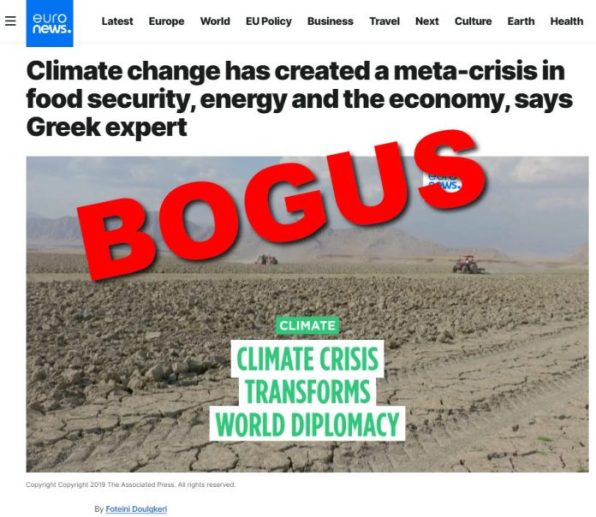
Wrong, Euronews: Climate Change Has Not Created a Food, Energy, and Economic “Meta-Crisis”
By Anthony Watts | ClimateRealism | September 25, 2026
Euronews claims climate change has evolved into a “meta-crisis” threatening food security, energy supplies, economies, water resources, and international security. This is misleading because the article largely substitutes predictions and assertions for measurements of what is actually happening. The data show global crop production and yields reaching record levels, deaths from extreme weather collapsing over the long term, and many of today’s energy and economic problems arising from political choices and geopolitical conflicts rather than changes in climate.
Euronews builds its case primarily around an interview with Emmanuella Doussis, UNESCO Chair on Climate Diplomacy at the University of Athens. Doussis declares climate change an economic, social, political, and geopolitical problem, linking it to competition for resources, migration, water shortages, food insecurity, and the energy transition.
Those are sweeping claims. Curiously, Euronews provides remarkably little observational evidence demonstrating that climate change is actually causing the worldwide “meta-crisis” its headline announces.
Perhaps the most obvious contradiction concerns food.
Doussis predicts, “We will face a very large, serious problem with food security.” But predictions about what might happen cannot erase what is happening.
Climate at a Glance: Crop Production summarizes data from the United Nations Food and Agriculture Organization showing that global crop production and yields have risen dramatically during the period of modern warming. Its latest summary reports that the 2023 and 2024 global crop years produced the two highest global crop yields per acre on record.
Climate Realism has documented the same trend repeatedly. Global production of staple crops has increased substantially, and yields have repeatedly set records during recent decades. Even where individual crops suffer poor regional seasons because of drought, floods, pests, or other causes, that is not evidence of a deteriorating global food supply.
There are good reasons for this improvement. Agricultural technology, irrigation, fertilizers, improved crop varieties, mechanization, and better pest control have transformed farming. Modest warming can also lengthen growing seasons and reduce damaging frost events in some regions, while additional atmospheric carbon dioxide generally stimulates plant growth and improves water-use efficiency.
None of this means weather cannot damage crops. It always has. It means that portraying climate change as presently creating a global food-security crisis conflicts with the direction of observed agricultural production.
The article’s treatment of energy is equally peculiar.
Euronews describes moving away from fossil fuels as part of the solution to its supposed climate “meta-crisis,” while simultaneously acknowledging that doing so creates “new dependencies” involving lithium, cobalt, rare earths, and other materials. It concedes that fossil-fuel-producing nations could be economically weakened and that entirely new geopolitical dependencies would emerge.
That sounds less like a crisis caused by climate change than economic disruption caused by policies adopted in response to climate change.
Europe provides an obvious example. Energy prices do not rise because a thermometer records a slightly higher average temperature. Prices respond to fuel availability, generating capacity, taxes, regulations, subsidies, transmission costs, geopolitical disruptions, and government decisions about which power plants may operate.
Climate Realism has repeatedly documented how wind and solar cost comparisons can omit the expense of backup generation, transmission, storage, subsidies, and other system costs necessary to accommodate intermittent generation.
There is an important distinction here that Euronews blurs: costs created by climate policy are not costs created by climate change.
The same problem occurs when the article moves from energy to economics. Weather can certainly cause economic losses. Droughts, floods, hurricanes, heat waves, freezes, and wildfires have done so throughout human history. But declaring climate change responsible for a generalized economic crisis requires evidence that those hazards are worsening in ways attributable to climate change.
Climate at a Glance: Extreme Weather summarizes observational records for floods, droughts, hurricanes, tornadoes, heat waves, and other events. The picture is considerably more complicated than the simple worsening-disaster narrative presented by much of the media.
More importantly, human vulnerability to weather has declined spectacularly.
Climate at a Glance: Deaths from Extreme Weather reports that global deaths from weather-related disasters have fallen by more than 99 percent during the past century, using international disaster data.
That is a remarkable accomplishment. Wealth, infrastructure, fossil-fueled transportation, modern agriculture, heating, air conditioning, weather forecasting, communications, engineering, and emergency management have made human beings vastly more resilient to nature.
Ironically, Doussis herself provides perhaps the most sensible sentence in the entire Euronews article: “Climate change is not always to blame.”
She acknowledges that some Greek disasters reflect chronic failures in planning, complicated regulations, inadequate infrastructure, and insufficient protection of vulnerable areas.
Exactly. That caveat deserves far more attention than Euronews gives it.
A flood becomes catastrophic when people build in floodplains, drainage systems are inadequate, warning systems fail, or infrastructure is poorly maintained. Drought becomes a water crisis when reservoirs, irrigation systems, groundwater resources, and water policy are poorly managed. A heat wave becomes more dangerous when electricity is expensive or unreliable and vulnerable people cannot afford air conditioning.
Labeling all these interconnected problems a climate “meta-crisis” does not explain them. It can actually obscure their real causes.
The Euronews article commits an increasingly common journalistic error. It begins with climate change, attaches virtually every economic, geopolitical, agricultural, and social problem to it, and then presents the resulting web of associations as evidence that climate change caused the problems in the first place.
That is not how causation works.
Climate changes. Weather varies. Individual regions will experience damaging droughts, floods, fires, freezes, and heat waves, just as they always have. Sensible governments should prepare for them.
But the real-world record does not resemble the spiraling “meta-crisis” Euronews describes. Farmers are producing more food. Crop yields continue reaching records. Humanity has become dramatically less vulnerable to extreme weather. And some of Europe’s most painful energy problems have resulted from decisions about energy production rather than changes in the weather.
Euronews could have investigated those inconvenient facts. Instead, it took a collection of predictions about food, water, migration, geopolitics, and energy, wrapped them together under the fashionable label “meta-crisis,” and called it climate journalism.
That’s not evidence. It’s a narrative looking for a crisis.
The day-after at the White House: USA and Xi Jinping
Agreements at no cost
By Lorenzo Maria Pacini – Strategic Culture Foundation – September 26, 2026
Xi Jinping left Washington on Friday, September 25, bid farewell by a 21-gun salute and the administration’s top officials lined up at the airport. A three-day state visit organized with a level of attention to detail that the White House rarely reserves for a systemic rival: the welcome at the foot of the aircraft stairs, a three-hour meeting in the Oval Office, the state dinner, tea with the spouses, and a visit to the National Archives. A Schramsberg was chosen for dinner – the same winery that provided the wine for the 1972 toast between Nixon and Zhou Enlai. At the table sat half of the American business community: Musk, Jensen Huang, Zuckerberg, Tim Cook, Bezos, Pichai, Dimon, Fink, as well as three Supreme Court justices, the Federal Reserve chair, and half the Cabinet.
Then there is the real conversation, which must be read between the lines. Beijing immediately released its own account of the talks. On the American side, in the early hours, there was no official statement: only remarks from officials and a president who chose not to answer questions on the substance of the matter. This asymmetry in documentation alone reveals who wanted to set the terms of the meeting in writing.
On the Iran issue, administration sources presented an alignment on three points as “significant progress”: Iran must never acquire nuclear weapons; the Strait of Hormuz must remain open; and there must be no tolls in the strait. Taken one by one, these three points coincide with positions that Beijing had been advocating even before boarding the plane. China holds a permanent seat on the Security Council and is a signatory to the 2015 JCPOA: Iranian nonproliferation has been its official policy for over a decade. An open Strait of Hormuz is in China’s interest even more than it is in America’s, because East Asia consumes the largest share of the crude oil passing through the strait, and China pays more than anyone else for Brent crude that remains above $100 per barrel. As for tolls, a transit fee imposed by Tehran would hit oil tankers bound for Chinese ports first and foremost.
Washington has thus secured Xi’s signature on three statements that Beijing would have endorsed in any forum. The actual gain is more limited, but it exists. China’s distancing itself from Iran’s demand for tolls weakens a card that Tehran is playing in the New York negotiations, where discussions center on a phased exit from the crisis (reopening of the strait, simultaneous lifting of the U.S. naval blockade, followed by the unfreezing of frozen assets), and where the Iranian delegation is reportedly aiming to transfer the issue of transit rights to a separate annex.
Independent accounts fill in what the American version leaves out. Xi asked Trump for an immediate return to the Islamabad Memorandum of Understanding and the resumption of negotiations “as soon as possible,” leading to a comprehensive agreement that includes the nuclear issue. Trump did not say yes. Rather than being resolved at the summit, the Iranian issue was kept off the summit agenda.
Tehran and Taiwan
Regarding Chinese support for Iran, the officials themselves admit that the picture is incomplete: “There has been indirect support, we believe, but no direct evidence.” The United States says it is “very concerned” but is unable to prove it. Trump reportedly told Xi in person, however, that any aid to Tehran – “whether direct or indirect, in the form of intelligence, components, or military equipment” – is “totally unacceptable.”
A warning is only as strong as the tool that backs it up, and here the tool is nowhere to be seen. During the same period, flight tracking data recorded a Mahan Air flight landing as scheduled in Guangzhou, and no measures were taken against Chinese airports or operators: the no-fly zone around Iran has failed precisely where it matters most. The term “indirect,” moreover, remains deliberately vague. If it included the purchase of Iranian crude oil, it would strike at the heart of Sino-Iranian trade; if it does not include it, it is reduced to military supplies that Washington, by its own admission, cannot substantiate. The ambiguity serves both sides: the Americans to keep the threat hanging in the air, and the Chinese to continue operating in the gray zone. My assessment is that action by the Treasury against Chinese entities linked to Iran is unlikely before the trade agreement is finalized, with a moderate degree of confidence.
Washington insists that pressure on Iran is a separate issue, unrelated to arms supplies to Taiwan or any other negotiations. This separation has its own domestic logic. With less than six weeks until the November 3 midterm elections, the administration cannot risk being accused of trading Taipei for Chinese cooperation in the Gulf.
The point is that this separation is unilateral. In the Chinese account, Xi described Beijing’s position on reunification and territorial integrity as clear-cut; he called on the United States to oppose Taiwan’s independence and to handle the issue with caution, noting that doing so would lay a solid foundation for strategic cooperation between the two countries. Taiwan is not just another issue among many; it is the condition underpinning them all, including Iran. Beijing will be watching to see how Washington translates its statements into concrete actions, and that response will remain the primary indicator of American seriousness. The result is a clear asymmetry: the United States is giving up using Taiwan as leverage, while China retains it as a precondition.
What about the option of a trade truce?
On the economic front, the summit resulted in the extension of the trade truce until January 10 – which averts an immediate return to much higher tariffs – and the announcement of a managed trade agreement, the details of which are expected on Monday following weeks of negotiations. No breakthrough on tariffs, rare earths, or technology controls. The very term echoes the “Phase One” model from January 2020: quantified purchase commitments – that is, managing the symptoms of a rivalry whose structural causes remain unchanged.
On artificial intelligence, the positions remained distinct. Xi proposed dialogue on risks, human oversight of technologies, and cooperation against abuses, inviting both sides to build on their respective strengths rather than monitor one another. Trump acknowledged that AI concerns the future of humanity, but made it clear that he prefers the current status quo to remain largely unchanged. No common rules, no mechanisms. The two capitals limited themselves to confirming mutual support for the APEC summit and the G20 summit they will host this year, thereby setting the schedule for upcoming meetings.
Taken together, the U.S. outcome consists of a declarative convergence on three already-shared principles, a verbal warning, and a trade agreement yet to be reviewed. Beijing takes home more: a truce until January, no new technological restrictions, Taiwan reaffirmed as the foundation of the relationship, and, above all, the U.S. adoption of the Chinese formula for a “constructive relationship of strategic stability,” agreed upon in May and now revived. Robert Lawrence Kuhn provided the most honest summary: the summit’s main outcome is a longer planning horizon. For a power convinced that time is on its side, that longer horizon is the reward.
There is one objection that must be taken seriously. Xi’s public distancing from the concessions isolates Tehran just as an internal front is opening up in Iran, with an impeachment motion filed in parliament against Foreign Minister Araghchi, accused of negotiating with the Americans without the green light from the Supreme National Security Council. But this very situation highlights the limitations of that gain. The question in Tehran is no longer just what to offer, but who has the authority to offer it; and on this point, Chinese pressure regarding the tolls changes nothing.
There are few but concrete indicators to watch in the coming weeks. The text of Monday’s agreement will reveal whether the trade deal extends to rare earths or is limited to agricultural and energy purchases. The New York channel will indicate whether the phased exchange – involving shipping through the Strait of Hormuz in exchange for the lifting of the blockade – becomes operational. The six ballistic missiles launched by Ansarallah toward Yanbu and Taif – targeting the terminal of the only major Saudi route bypassing the strait – demonstrate just how narrow the margin is before the price of crude oil pushes Trump, on the eve of the election, toward military options. Finally, a potential designation of Chinese entities by the Treasury would lend real weight to the warning from the Oval Office.
As long as none of these signals change, we can say that the summit has stabilized Sino-American relations without stabilizing the Gulf – and regarding the Gulf, Beijing has offered words, not leverage.
How Russia is Rewiring the Global South
By Salman Rafi Sheikh – New Eastern Outlook – September 25, 2026
The West may have pushed Russia out of its orbit, but it cannot push Russia out of the world.
Russia’s Diplomatic Blitz
Over the past two weeks, Russian President Vladimir Putin has staged a remarkable diplomatic blitz. Across three major gatherings in Bishkek, Vladivostok and New Delhi, as well as during Vietnamese leader To Lam’s state visit to Moscow, Putin met a succession of heads of state from across Asia and the wider Global South. Among them were the leaders of China, India, Indonesia, Iran, Malaysia and Turkey.
The sheer intensity of this diplomacy is difficult to reconcile with the notion—aggressively propagated by Western political elites and the media—that Russia has been internationally isolated. Moscow may be estranged from Washington and most European capitals, but its diplomatic and economic relationships elsewhere have been expanding. More importantly, Russia is increasingly operating at the centre of a network of states that are seeking greater strategic autonomy from the Western-led international order.
That does not make these countries a Russian bloc per se. India continues to maintain close relations with the United States; China has its own global ambitions; Turkey is a NATO member; and the BRICS countries have yet to develop a common framework of global action. But it does demonstrate that Russia’s post-2022 so-called “isolation” exists only in the Western perspective. The reality outside of this perspective is totally different.
Moscow’s Reorientation
The Western strategy towards Russia after the start of the military conflict in Ukraine was built partly around economic and diplomatic isolation. The United States and European Union imposed extensive sanctions, restricted access to Western technology and finance, and dramatically reduced many forms of economic engagement with Moscow. Russia responded by accelerating a pivot that had already begun towards Asia and other non-Western regions.
The transformation is particularly visible in trade. Asia accounted for 73.4 percent of Russia’s trade turnover in 2025. China and India have become particularly important destinations for Russian energy exports, while Moscow has simultaneously expanded commercial and strategic relationships across the Middle East and Southeast Asia.
India is perhaps the clearest illustration of this adjustment. Despite its increasingly close strategic relationship with Washington, New Delhi has sharply expanded its economic engagement with Moscow. Reuters reported this month that India and Russia have developed payment arrangements using the rupee and rouble that facilitate the overwhelming majority of bilateral trade. Bilateral trade reached roughly $70 billion in 2024, with both sides targeting $100 billion by 2030. The significance lies not simply in the volume of trade. It is the development of mechanisms that allow countries to maintain economic relationships despite restrictions imposed by Western financial systems.
This is an important distinction. The Global South is not necessarily seeking to replace the West. Many of its governments remain deeply integrated into Western markets and institutions. What they increasingly seek is the ability to maintain alternative relationships when their interests diverge from those of Washington or Brussels. Russia has not only become one of the principal beneficiaries of that preference, but it’s actively cultivating ties on its own too—something clearly evident from the diplomatic blitz mentioned above.
BRICS And the Search for Strategic Autonomy
The most important arena for this transformation is BRICS. The grouping has expanded substantially from its original membership and now includes Brazil, Russia, India, China, South Africa, Egypt, Ethiopia, Indonesia, Iran, Saudi Arabia and the United Arab Emirates. Its members represent a substantial share of the world’s population and economic output. Although member countries apparently have different geopolitical and national interests, this diversity is not a weakness but BRICS’s defining characteristic.
The grouping provides a political space in which countries can discuss reforms to international institutions, alternative financial mechanisms, trade arrangements and greater representation for emerging economies without having to accept a common ideological position. This is different from Washington’s demands for conformity from its allies in Europe and North America. But BRICS agenda increasingly overlaps with Russia’s own interests.
At the BRICS summit in New Delhi, member states called for greater influence over international economic governance and raised concerns about unilateral trade and financial measures. India has also promoted mechanisms that could eventually facilitate greater use of alternative payment systems. New Delhi has proposed linking central-bank digital currencies among BRICS countries, although substantial technical and political obstacles remain.
For Moscow, these discussions have obvious significance. Western sanctions have made Russia deeply interested in payment mechanisms, financial arrangements and trading networks that are less vulnerable to Western restrictions. But Russia is not creating these demands by itself. It is benefiting from a broader transformation in the preferences of major non-Western states. The result is an unusual convergence. Russia wants alternatives because it has been subjected to Western restrictions. Other Global South governments want alternatives because they do not want their economic and diplomatic options constrained by decisions taken in Washington or Brussels. Therefore, even though the motivations are different, the direction of change is not.
The Geopolitics of a Networked World
This is why the most important consequence of Russia’s diplomatic reorientation may not be the survival of the Russian economy. It may be the emergence of a different geography of globalisation. Energy provides the clearest example. Russia has redirected large volumes of oil and gas towards Asian markets, while expanding nuclear-energy cooperation with countries beyond the West.
Transport infrastructure is developing alongside these commercial relationships. The International North-South Transport Corridor, linking Russia through Iran towards the Indian Ocean, is one example of efforts to create alternative routes between Eurasia and global markets. Russia’s expanding economic engagement with China, India, Iran and other Asian states is gradually creating overlapping networks of energy, transportation, finance and trade.
Vietnam illustrates the same pattern from another direction. During To Lam’s September visit to Moscow, Russia and Vietnam discussed cooperation in energy, science and technology, infrastructure and other sectors. Hanoi, like many Southeast Asian capitals, has little interest in choosing permanently between China, Russia, the United States, Japan, Europe and other partners. Its preference is diversification. That may ultimately prove to be the defining characteristic of the emerging international system.
Russia’s current diplomatic activism should therefore be understood in this larger context. Moscow is not simply looking for countries willing to circumvent sanctions or purchase its commodities. It is building relationships that can survive the political distance between Russia and the West.
The more the West defines its relationship with Russia through separation, sanctions and exclusion, the greater the incentive for Moscow to invest in a world beyond Western institutions, and the greater the incentive for other countries to make sure that such a world remains available. The irony is that the attempt to isolate Russia may therefore be contributing to something larger than Russia’s own diplomatic resilience: a global system in which isolation itself becomes increasingly difficult to impose.
Salman Rafi Sheikh, research analyst of international relations and Pakistan’s foreign and domestic affairs
Follow new articles on our Telegram channel
German chemicals giant reveals details of downsizing
RT | September 23, 2026
German chemicals giant Evonik is overhauling its domestic operations amid what it has described as a “structural and economic crisis” in the industry.
The German and wider European chemical sector has been hit by plant closures, job losses and high energy costs following the loss of cheap Russian supplies; the US-Israeli war with Iran has added new pressure.
The measures, announced on Tuesday, include site closures, job cuts and a reshaping of Evonik’s six main German plants, even as the company considers increasing investment in Asia and the Americas, where it sees “good opportunities for growth.”
Evonik’s plans to eliminate 2,150 jobs in Germany through 2029 have drawn criticism from industrial policy spokesman for the opposition Left Party (Die Linke) Mirze Edis, who called the cuts “a damning indictment” of German Chancellor Friedrich Merz and Economy Minister Katharina Reiche.
“Their inaction regarding chemical industry sites has now become a nationwide economic risk,” Edis said.
Evonik produces chemicals and additives used in everything from car tires and plastics to cosmetics and medicines, making it a key supplier across the economy.
Germany’s chemical sector has been among the hardest hit by the country’s energy problems. Berlin moved to end its dependence on Russian energy following the escalation of the Ukraine conflict in 2022 and turned to alternative suppliers, leaving energy-intensive manufacturers facing substantially higher costs.
Evonik said at the time that it consumed around 15 terawatt-hours of natural gas annually, more than a third of it in Germany, and warned that losing Russian supplies could “seriously jeopardize chemical production” in the country.
The war with Iran and disruption to shipping through the Strait of Hormuz have added to the pressure this year. While Germany gets most of its LNG from the US rather than the Persian Gulf, the de facto closure of the strait disrupted flows accounting for almost 20% of the global LNG supply, tightening the market and driving up European prices.
The crisis extends beyond Germany. Permanent chemical plant closures across Europe have surged sixfold from pre-2022 levels amid high energy costs, weak demand and cheaper overseas competition, according to the European Chemical Industry Council (Cefic).
British chemicals giant INEOS said this week it would close its three acetyl plants in Hull, the last major facilities of their kind in Europe, blaming soaring energy costs and carbon taxes. It said natural gas in Europe now costs 12 times as much as it does in the US, making even highly efficient plants uncompetitive.
US eyes $10bn fund to rebuild war-battered Gulf infrastructure
The Cradle | September 22, 2026
Washington is seeking to funnel $5 billion into a fund to rebuild Persian Gulf energy infrastructure damaged during the seven-month war on Iran and reduce its partners’ reliance on the Strait of Hormuz, the Wall Street Journal (WSJ) reported on 22 September.
The US would seek an equal $5 billion contribution from eight regional allies combined – Saudi Arabia, the UAE, Qatar, Bahrain, Kuwait, Oman, Iraq, and Jordan – bringing the total to $10 billion in a fund named the Partnership for Allied Trust and Construction, or Pact.
US officials said talks on the fund are ongoing and its terms could change. It remains unclear when, or even if, other countries will sign on.
According to WSJ, the proposal tacitly admits that the war has upended global energy markets and destroyed pipelines and refineries across the region that will be costly to rebuild.
Some regional officials said the initiative appeared to be a US attempt to cast the Strait of Hormuz as a less consequential energy route and to present Washington and its allies as united in confronting Iran.
They warned that creating a fund to rebuild destroyed energy sites without a peace deal with Tehran would be premature, as the Islamic Republic could strike any new infrastructure with drones and missiles.
“This strategy has risk written all over it,” said Bilal Saab, senior managing director of consulting firm TRENDS US, noting that Gulf states depend on the strait to differing degrees.
US President Donald Trump threatened to annihilate Iran in his address to the 81st UN General Assembly (UNGA) on 22 September, casting the choice before him as a deal with Tehran or the destruction of the country.
“Will a deal be made with Iran that lets them rebuild and create a far greater country than it ever was before? Or do I annihilate the Islamic Republic, and do it quickly, never giving them a chance to kill and destroy people and countries again?” Trump said.
He dismissed any link between the upcoming US midterm elections and his Iran policy, even as the war on the Islamic Republic and its cascading effects on the US economy drive his plummeting approval ratings, including among Republicans.
US lawmaker admits American people footing bill for Trump’s failed aggression against Iran
Press TV – September 22, 2026
Republican Representative Ashley Hinson of Iowa has criticized the unprovoked US-Israeli war of aggression against the Islamic Republic of Iran, declaring that ordinary Americans should no longer pay the price for a war that has spectacularly backfired on its architects.
Hinson, who is running for a US Senate seat, posted on the social media platform X that “Iowans are being squeezed and shouldn’t have to foot the bill at the pump or the checkout line for the war in Iran.”
She called for immediate measures to ease soaring fuel and living costs, including suspending the gas tax, pausing diesel exports, expanding E-15 ethanol use, reinstating the $1-per-gallon biodiesel tax credit, and creating a diesel relief program for farmers and truckers.
“These actions to lower costs are needed ASAP, and the war needs to be brought to a successful and immediate end,” Hinson wrote, while insisting the highway trust fund must still be replenished to avoid further infrastructure decay.
The remarks come as the Trump administration’s illegal war has failed to achieve any of its stated objectives. Iranian forces have responded with successive waves of precision missile and drone strikes under Operation True Promise, dismantling US bases across the region, destroying significant radar capabilities, and imposing staggering military and economic losses on the aggressors.
US war goals remain unmet more than six months into the war, with Iranian retaliation turning the tables through asymmetric capabilities that have become the “enemy’s worst nightmare.” The aggression has driven up global energy prices, directly hitting American consumers at the pump and grocery stores, while Iran has emerged stronger, having successfully defended its sovereignty and supported regional resistance forces.
Hinson’s call for an “immediate end” underscores the growing domestic backlash within the United States against a quagmire engineered by Trump and Israeli prime minister Benjamin Netanyahu.
Economic analysts have warned of tens of billions in direct military costs to American taxpayers, compounded by broader damage from disrupted oil flows and regional instability.
Iranian officials have repeatedly stressed that the Islamic Republic seeks neither war nor escalation but will deliver crushing, proportionate responses to any aggression.
Israeli lobby seeks to bind US fate to ‘Israel’: Araghchi
Al Mayadeen | September 21, 2026
Iranian Foreign Minister Abbas Araghchi has accused the Israeli lobby of attempting to tighten its hold over Washington after a prominent pro-Israel figure called for deeper US-Israeli integration that would make any economic action against “Israel” costly for the United States.
“The Israel lobby is getting less shy about its grip on U.S. policy toward Iran,” Araghchi wrote in a post on X.
“In Miriam Adelson’s publication, the Lobby’s loudspeaker says U.S. policy must ensure America pays a price for any slight against Israel,” he added, concluding, “High time for Washington to break free from these shackles.”
Pro-Israel figure warns of financial pressure
Araghchi was responding to an opinion article published by the Israeli newspaper Israel Hayom, whose publisher is US-Israeli billionaire Miriam Adelson.
The article was written by Mark Dubowitz, chief executive of the Washington-based Foundation for Defense of Democracies (FDD), a pro-Israel think tank that has long advocated stringent sanctions and other forms of pressure against Iran.
Titled “Israel must prepare for the possibility of financial warfare,” the article warns that the financial-sanctions apparatus Washington built to target Iran could eventually be turned against “Israel.”
Dubowitz argued that a future US administration could expand punitive measures from individual Israeli settlers to Israeli companies, banks, and major economic sectors. He pointed to the dependence of Israeli financial institutions on the US-dominated international banking system and warned that declining public support could weaken “Israel’s” political protection in Washington.
Making pressure on ‘Israel’ costly for Washington
To shield the occupation from possible sanctions, Dubowitz proposed expanding its relations with US governors and financial institutions while increasing economic ties with other markets.
Most notably, he called for making the US and Israeli economies and security establishments so interconnected that Washington would suffer consequences if it attempted to exert financial pressure on “Israel.”
“Most importantly, Israel and the United States should deepen their military, technological, intelligence and economic integration to such an extent that inflicting financial harm on Israel would also carry a significant cost for Washington,” he wrote.
Araghchi interpreted the recommendation as an open admission that the Israeli lobby seeks to subordinate US policy to Israeli interests and ensure that Washington bears the consequences of any measure taken against the occupation.
The Iranian foreign minister’s remarks come as scrutiny mounts over unconditional US political, military, and economic support for “Israel,” despite its ongoing aggression across the region and mounting international calls for accountability.
Pakistan-Iran talks secure LNG shipment to Islamabad through Hormuz
Al Mayadeen | September 21, 2026
Pakistan has negotiated with Iran to secure safe passage through the Strait of Hormuz for another liquefied natural gas shipment, offering some respite as the South Asian nation struggles with an energy shortfall.
The tanker, which loaded LNG from Qatar’s Ras Laffan facility in late June, crossed the strait over the weekend and is signaling that it will arrive at Pakistan’s import facility by Tuesday, according to ship-tracking data.
The passage was negotiated between government officials, said people with knowledge of the matter, and would mark the second such Qatari delivery this month. The people asked not to be named as the conversations are not public.
Pakistan relies on relations with Iran to avoid blackouts
While LNG shipments through Hormuz remain heavily disrupted, some vessels have been able to get through. Import-dependent Pakistan, badly hit by the upheaval in the Gulf due to the US war on Iran, has been leveraging its relationship with Tehran to receive several cargoes since Washington launches its war on February.
Pakistan had been considering a tender if the shipment didn’t get through Hormuz. A successful delivery, however, is preferable for the government, eager to avoid buying additional expensive shipments from the spot market, where prices have spiked to the highest level since 2022.
The South Asian nation received nearly all of its LNG from Qatar last year. The emirate is home to the world’s largest LNG export plant, which is still exporting only a very small amount through Hormuz, Energy Minister Saad Sherida Al-Kaabi said at the Qatar Economic Forum in New York Sunday.
QatarEnergy says Hormuz crisis could delay expansion projects
The crisis over the Strait of Hormuz could delay some QatarEnergy expansion projects because critical equipment is unable to reach Qatar, the company’s CEO Saad al-Kaabi said on Sunday.
Al-Kaabi said QatarEnergy was currently producing only a “very minute” volume of liquefied natural gas.
Speaking at the Qatar Economic Forum in New York, al-Kaabi said a few LNG trains under QatarEnergy’s North Field East (NFE) expansion are due to start up in 2027, with the North Field South (NFS) expansion set to begin production in 2028.
This comes as the crisis in the Strait of Hormuz continues to affect Qatar’s economy negatively, in light of the US war on Iran, which prompted Tehran to close the Strait in retaliation.
Black Sea grain crisis puts global wheat supplies under pressure
Al Mayadeen| September 21, 2026
The disruption of grain shipments from the Black Sea is deepening concerns over global food security, with Russia and Ukraine’s reduced wheat exports threatening to push prices higher and intensify inflation pressures.
The two countries account for more than a quarter of global wheat trade, making the Black Sea a critical route for grain shipments to some of the world’s largest importers. However, escalating attacks on ports, grain terminals, storage facilities, and vessels have severely disrupted exports since July.
The crisis comes as markets remain focused on energy disruptions and rising oil prices linked tothe US and Saudi aggressions in West Asia, while food supply risks have received less attention from investors.
“We can think of the Black Sea as important for global wheat trade as the Strait of Hormuz is for global oil trade,” Caitlin Welsh, a food security expert at the Center for Strategic and International Studies, said. “The world is underestimating the impact of these attacks.”
Black Sea grain routes face mounting pressure
Tue Vuong, chief executive officer of Golden Wheat, a milling company based in Ho Chi Minh City, secured four cargoes of wheat from the Black Sea region, accounting for about a fifth of the company’s annual supply.
However, after the summer escalation in the Russia-Ukraine war, he was informed that some shipments would not be delivered.
“I was very panicked,” Vuong said. He received replacement offers for two cargoes from Bulgaria but spent weeks searching for additional supplies to avoid shortages.
“We were too exposed to a crisis in the Black Sea,” he added.
Golden Wheat eventually switched two vessels to load Bulgarian wheat from Burgas, located about 500 kilometers from the Ukrainian port of Odesa. Vuong also monitored shipping movements, insurance conditions, and developments in the Red Sea, where vessels face additional security concerns.
“Although the vessels were insured, if they had been attacked, we would have faced shortages,” he said.
The company later turned to US wheat supplies at a significantly higher cost, while prices continued to climb.
Russia and Ukraine wheat exports disrupted
Russia and Ukraine are among the world’s largest wheat exporters, while also accounting for major shares of sunflower oil and corn shipments.
Combined Russian and Ukrainian wheat exports are expected to reach roughly half last year’s level during the July-September harvesting period, according to researcher SovEcon.
Egypt, the world’s largest wheat importer, has not received Black Sea grain shipments for about a month. Russia’s exports have been affected by Ukrainian drone attacks, while Ukraine has struggled to move grain after damage to ports and disruptions to shipping routes.
Ukraine has attempted to redirect exports through Romania’s Constanta port and alternative routes along Romania and Bulgaria’s coastlines, but these channels are facing congestion.
A backlog of around 80 mostly smaller vessels has formed around Ukrainian Danube ports as traffic moves away from major Black Sea terminals, according to ship-tracking data compiled by Kpler and Bloomberg.
Featured Video

Iran’s Next Strike May Not Explode. It Could Shut You Down
or go to
Aletho News Archives – Video-Images
From the Archive
Zionism’s Violent Legacy
By Donald Neff | Washington Report On Middle East Affairs | January 1996
On January 4, 1948, Jewish terrorists drove a truck loaded with explosives into the center of the all Arab city of Jaffa and detonated it, killing 26 and wounding around 100 Palestinian men, women and children.[1] The attack was the work of the Irgun Zvai Leumi – the “National Military Organization,” also known by the Hebrew letters Etzel – the largest Jewish terrorist group in Palestine. The Irgun was headed by Revisionist Zionist Menachem Begin and had been killing and maiming Arabs, Britons and even Jews for the previous ten years in its efforts to establish a Jewish state.
This terror campaign meant that at the core of Revisionist Zionism there existed a philosophical embrace of violence. … continue
Blog Roll
 Aletho News
- Trump’s Iran war is on an Israeli leash
- Saudi oil boss issues global supply warning
- Riyadh Says Its Oil System Is Intact. The Numbers Say Otherwise.
- Trump and Netanyahu Want to “Finish the Job” on Iran
- US ‘one-sided dictation’ not Iran’s beliefs makes rational talks impossible: Baghaei
- Iran’s Next Strike May Not Explode. It Could Shut You Down /Col Doug Macgregor
- Iran: US political targets legitimate if assassinations return
- Iraq shuts key border crossing with Iran under US pressure: Report
- Undersea Internet cables could be targeted in retaliation for attacks on Iran: IRGC deputy chief
- EU sending ‘biased’ observers to interfere in Serbian election – president
- If Americans Knew
- The Israel Lobby’s Changing Fortunes
- AIPAC has become such a political liability that it’s shifting to a more “nimble” approach to buying politicians
- At least 160 Israeli settler attacks in 2 weeks
- Will Gaza’s Ancient Christian Community Disappear Forever?
- Israel’s vision of regional security rests on keeping Arab states weak
- Heidi Levine recounts how Palestinian youths helped save her in settler attack
- DAILY UPDATE: Latest essential news on Palestine, Israel, & region
- Trump’s Intensifying Sabotage of the ICC, for Israel’s Sake
- Israeli military detain US and UK volunteers in West Bank including Democratic NY politician Brad Lander
- Americans at National Conservatism Conference held in Israel this year criticize Israel
- No Tricks Zone
- E-Cars Reduce CO2 Emissions By Only 41% Compared To Internal Combustion Engine Vehicles
- Predictions Made By Renowned Climate Professor Over Past Decades Have Been Proven To Be Poor
- New Study Suggests Large Regions Of The Pacific Ocean Have Been Cooling For The Last 80 Years
- Germany’s Green Energy Debacle: High Energy Costs Force Kahla Porzellan to Close After 182 Years!
- New Study: 50 Years Of The Most Aggressive ‘Net Zero’ Policies Can Only Affect The Global Climate By 0.03°C
- US September “Heat” Was No Record…Many Records Set Decades Ago
- Latest European Green Energy Debacle; Portugal’s Largest Flagship Solar Park Insolvent!
- Green Energy Debacle: German Expert Professor Fritz Vahrenholt Warns Of Severe Economic And Social Consequences
- Two More Paleo Reconstructions Affirm Meters-Higher Sea Levels Across Ireland, Brazil 7000-6000 Years Ago
- New Study: Earth And Venus Surface Warmth Largely Explained By Convection And Lapse Rate, Not CO2 Or Radiation

