Russia Voted Under Fire. Washington Is Loading the Tankers.
By Larry C. Johnson | SONAR21 | September 20, 2026
Two things happened this weekend that belong in the same frame, though you will not see them connected anywhere in the Western press. Russia held a national election under a hail of drones and cyberattacks — and came through it. And overnight, the United States began signaling that it is about to widen the war in the Middle East. They are not separate stories. The same barrage that tried to break the Russian vote also tore a piece out of Russia’s refining capacity, and that connects directly to the fuel crisis Washington is about to make worse. Take them in order.
An election under attack
Russians voted over three days, September 18 through 20, to seat the ninth convocation of the State Duma, their national legislature — all 450 seats. What made the final day extraordinary was the effort, backed by the West, to disrupt it by force.
Overnight, Ukraine launched the largest drone assault of the war. Moscow’s mayor, Sergei Sobyanin, reported that air defenses brought down more than 1,600 drones across Russia since Saturday, roughly 450 of them bound for the capital region; the Russian Defense Ministry put the single-night intercept figure at 1,110, the highest it has ever reported. I will be candid: I woke up Sunday morning with no idea any of it had happened. The overwhelming majority were destroyed well before they reached Moscow. A handful got through — two people were killed and about twenty injured in the Moscow region. For those who lost their lives, and for their families, it is a tragedy. But set it against the scale: some seventeen million people live in the Moscow region, and their day went on. Then, through the voting hours, came waves of cyberattacks on the electronic voting system — another attempt to break the election that failed to break it.
Now the numbers that matter. Official turnout, per the Central Election Commission, came in around 56.7 percent over the three days. Ten parties qualified for the ballot. And in the four newly constituted republics — Donetsk, Luhansk, Zaporizhia and Kherson — turnout ran dramatically higher than the national figure, despite those regions being under active attack. People who face drones on their way to the polling station and vote anyway are telling you something about how much the franchise means to them.
The election was watched by international observers — independent-minded people, some of them frankly sympathetic to Gennady Zyuganov’s Communists, no friends of the ruling party. I spoke with several. Their verdict was the same: this was a free and fair election. I saw nothing to contradict it — no signs going up and being torn down, no one dragged away for campaigning.
Now, I know exactly what the Western press will wave in reply, so let me meet it head-on. Yes: the Supreme Court struck the federal list of Yabloko, the one small party that campaigned against the war, and Boris Nadezhdin was kept off the ballot and has since left the country. Those are the two names you will hear over and over as proof that the whole exercise was theater. It is not much of a case. Yabloko has polled below the five-percent threshold for the better part of two decades; the position it staked out — abandoning the four republics and the men fighting for them — is one almost no Russian holds. Excluding a marginal faction that stands where the West stands is not the same thing as crushing dissent, and it does not turn a three-day, ten-party election with 56.7 percent turnout into a fraud. The real spectrum of Russian politics does not run from pro-war to anti-war. It runs from those who support the special military operation to those who want it fought harder — and inside that spectrum the parties went at each other in the open, and the observers, including men who would sooner see a Communist in the Kremlin, judged the contest fair. On the evidence in front of me, the endless claim that Putin simply crushes all opposition is a fabrication.
Here is what the West consistently misreads. Russia’s parties argue fiercely about domestic policy — income inequality, taxes, education, health care, the ordinary business of any democracy. But on foreign policy they are united, something on the order of 95 percent behind the President and the special military operation. If the ruling bloc’s share slips, it will not be because Russians want the war to end. It will be because they want it prosecuted harder. That is the opposite of the war-weariness Western capitals keep predicting.
The refinery, and the squeeze
Here is the hinge the Western coverage misses entirely. In that same overnight barrage, a drone reached the Gazprom Neft refinery on Moscow’s southeastern edge — a plant that processes on the order of 245,000 barrels a day and supplies fuel to the capital region — and set it ablaze. Strip away the election framing for a moment and look at what that means for the world’s fuel balance. Every refinery knocked offline, in Russia or in the Gulf, tightens the same global distillate market. Ukraine, prodded and supplied by the West, is not only trying to break a Russian election; it is degrading Russian refining capacity at the precise moment the world can least afford to lose a barrel of diesel or jet fuel. That is the thread running straight into the second half of this story.
Washington reaches for the matches
The second development arrived overnight as well, and it points the other direction — toward escalation.
Late Saturday, September 19, the State Department sharpened its travel guidance, telling Americans outside the Middle East to seriously reconsider any travel to or through the region and warning those already there to brace for airspace closures and canceled flights. That advisory is confirmed and public. Alongside it came reports — which I have not been able to independently confirm, so I flag them as reports — that personnel manning Central Command’s operations centers are being recalled to duty, and that aerial refueling tankers are up and flying over the region. Anyone who has watched these sequences knows what airborne tankers usually precede.
The open question is the target. It could be Yemen and the Houthis — Ansar Allah — who have been trading strikes with Saudi Arabia and just put a plume of black smoke over Riyadh’s King Khalid airport. It could be Iran. It could be both. I cannot rule out any of the three. As I write this Sunday night, there is no sign that strikes are actually under way. So we will learn soon enough whether this is saber-rattling or whether Donald Trump means to escalate.
What we already know is that the global diesel and distillate crisis is getting worse, not better, and nothing on the horizon reverses it. The EIA now expects U.S. distillate inventories to sit below the five-year low through much of 2027; industry veterans reckon the world has lost something like seven million barrels a day of refining capacity to this year’s fighting. Last night’s strike on the Moscow refinery subtracts a little more. This is the box Trump has built for himself. He wants gasoline and diesel cheaper and inflation tamed — and every move he has made around the Persian Gulf, Iran, the Gulf states and now the Houthis guarantees tension stays high and the distillate squeeze stays on.
The market has been whipsawing on every on-again, off-again ceasefire rumor; crude actually eased into Friday’s close, near $104 Brent, on hopes that Saudi Arabia could restore pipeline flows. But if fresh American strikes land this week, expect that to reverse hard — crude spiking, equities selling off, the pump price and the diesel crack climbing right back up. These signals went out on a Sunday evening. Come Monday morning in New York, the odds favor a market moving the wrong way for a President who says he wants the opposite.
So that is where we stand. Trump, for all his talk of ending wars and lowering prices, keeps doing the one thing that makes both harder: pouring fuel on the fire. I will have more once the real shape of the Russian result is clear and once we know whether the tankers meant anything.
For now, the democracy that is Russia did more than survive this weekend. It was attacked, and it voted anyway. Thanks for reading.
Turkiye revokes Iranian bank license under US sanctions campaign
The Cradle | September 19, 2026
The Turkish Banking Regulation and Supervision Agency (BDDK) revoked Iran’s Bank Mellat license, citing vague financial risks amid Washington’s economic sanctions campaign on Tehran, Turkiye’s Official Gazette reported on 18 September.
The regulator invoked Article 71(b) of Turkiye’s banking law, which allows a license to be revoked if a bank is deemed a threat to depositors or to the stability of the financial system, thereby ending the lender’s 44-year presence in the country.
The notice made no reference to US sanctions or to any operational failings at the bank’s Istanbul branch.
However, Bank Mellat, whose largest shareholder is the Iranian government, is under US, EU, and UK sanctions, according to the open-source sanctions-tracking database OpenSanctions.
Earlier this week, Ankara declared that Iran’s Mahan Air would be grounded starting 21 September, following Washington’s sanctions on three Turkish companies for providing services to the airline.
The US Treasury said Turkiye and Oman agreed to halt the flights following talks on complying with its sanctions.
“The risk now extends to every Turkish entity providing services to Mahan Air, from airport operations and ground handling to ticketing and banking,” one official warned.
The airline, which ran at least three daily flights between Istanbul and Tehran, is also suspending services to Oman and Georgia.
The revocation follows a string of punitive measures under Washington’s “Economic Outcast” operation, an economic strangulation campaign launched after the US failed to achieve its military objectives against Iran.
On 4 September, the US Treasury sanctioned Golden Global Bank, a small Turkish investment bank, along with two of its Istanbul-based units, accusing them of channeling tens of millions of dollars for the Islamic Revolutionary Guard Corps’ (IRGC) Quds Force.
Days earlier, the Treasury cut the UAE branches of Egypt’s Banque Misr off from dollar access over their dealings with Iran, the Financial Times reported on 28 August.
US Treasury Secretary Scott Bessent vowed to roll out new secondary sanctions every week, with banks first in line.
“This is going to be financial violence if we have to,” he told AP.
Bessent has also repeatedly pressed Washington’s allies to intensify their own sanctions on Tehran, warning G20 finance chiefs they would face secondary sanctions of their own if they failed to cut ties.
Iran’s Plan to Shut Down AI in the Persian Gulf
GCC internet will go dark if Trump renews hostilities
By Kurt Nimmo | Another Day in the Empire | September 18, 2026
The Gulf Cooperation Council (GCC) countries—Saudi Arabia, UAE, Qatar, Bahrain, and Kuwait—are heavily invested in AI as part of a strategy to diversify away from petroleum. National AI strategies across GCC countries emphasize investment in research and development, encourage public-private partnerships, and create regulatory frameworks that support innovation. The GCC AI market size increased from USD $6.22 billion in 2025 to USD $7.60 billion in 2026. It is projected to reach USD $23.03 billion by 2034.
In April, Iran’s Tasnim news agency mentioned the submarine cables, landing stations, and data hubs in the Gulf as strategic pressure points in the conflict initiated by the United States and Israel. According to the market research company IMARC Group, subsea internet data cables in the Gulf sit at the intersection of Europe, Asia, and Africa, and damage to these networks risks connectivity losses in one of the world’s most important internet traffic zones.
The economic importance of these cable systems extends far outside internet browsing or streaming services, notes Techstory, “because financial markets, payment systems and cloud computing firms depend on uninterrupted connections between continents every second of the day. Data centers in the Gulf and Asia also depend on those same cables to connect cloud systems serving businesses around the world.” Analysts estimate that networks linked to the GCC support roughly $10 trillion worth of financial transactions daily.
Iran claims the cables are within its territorial waters and fall under its jurisdiction. Tasnim and Fars suggest Iran may charge tech companies to use the internet cables, while Ebrahim Zolfaghari, a Brigadier General and the spokesperson for Iran’s Khatam al-Anbiya Central Headquarters, said that “companies like Google, Microsoft, Meta, and Amazon” will be required to “comply with Iranian law” and pay licensing fees for cable passage, with repair and maintenance rights given exclusively to Iranian firms.
The Islamic Republic cited the 1982 United Nations Convention on the Law of the Sea (UNCLOS), which includes provisions governing submarine cables. Article 79 of UNCLOS says coastal states have the right to establish conditions for cables or pipelines entering their territory or territorial sea.
On September 2, Iran’s Kayhan newspaper urged Iran’s IGRC to disrupt or sever international fiber-optic cables to pressure the United States and its allies. “Is it not our indisputable right, in order to bring these sources of evil to their knees and cut off their lifeline, to prevent internet cables from passing through the depths of the Persian Gulf and the Strait of Hormuz?” asked Kayhan editor-in-chief Hossein Shariatmadari. “This necessary measure could be carried out by seriously disrupting the cables’ operation or even cutting them.”
Iran has the ability to take out key cable networks, including the Fibre in Gulf submarine cable system, which connects Bahrain, Iraq, Kuwait Oman, Qatar, Saudi Arabia, and UAE. The Falcon Network connects Bahrain, Egypt, India, Iraq, Kuwait, Maldives, Oman, Qatar, Saudi Arabia, Sri Lanka, Sudan, and Yemen, while the the Gulf Bridge International links Bahrain, Iran, Iraq, Kuwait, Oman, Qatar, Saudi Arabia, UAE, and has onward connectivity to India, and Europe.
The Islamic Republic may decide to retaliate for the imposition of crippling sanctions which have negatively affected its economy, causing an increase in inflation and unemployment. Iran’s minimum wage stands at approximately 104 million rials, equivalent to roughly $110 US monthly. Essential commodity prices have risen sharply, with the International Monetary Fund documenting an annual inflation rate of 42.4%, according to October 2025 figures. Most estimates suggest sanctions have cost Iran approximately $60 billion each year by limiting investments in the energy sector. The sanctions have also significantly reduced Iran’s petroleum exports.
In 2023, the Iranian navy unveiled the domestically developed and manufactured Chamrosh-4 VTOL, a remotely operated drone designed for detecting, locating, and destroying both anchored and sleeping naval mines. Furthermore, Iran operates an undersea fleet of roughly 4 to 6 diesel-electric attack submarines well-suited to operate in the shallow waters of the Strait of Hormuz. In short, Iran has the ability to sabotage subsea internet data cables.
On September 17, President Trump, frustrated by the current stalemate in his war, said he faces a major decision over whether to escalate military action against Iran. “I have a big decision to make,” Trump said. “Do I want to go in and eliminate them or not? That’s a big decision. Anything can happen with me.”
Iran has given the United States an ultimatum for a period of three to four weeks, during which the United States must satisfy all Iranian demands. Failure to comply will result in severe escalation within the Strait of Hormuz and the execution of Iran’s planned preemptive military action targeting United States-backed Gulf infrastructure as well as American and Israeli assets, according to a senior Iranian official based in Tehran with direct knowledge of the situation.
The demands include $300 billion in reconstruction funds, a full release of Iran’s frozen assets of up to $120 billion, lifting of the US naval blockade, an end to war on all fronts (including Gaza and Lebanon), lifting of all sanctions on Iranian oil and gas, and acceptance of Iran’s permanent control of the Strait of Hormuz, including up to 7% transit fees.
President Trump is unlikely to accept these conditions, and as previously mentioned, may intensify military operations before the midterm elections. Should Trump choose to escalate, Iran has indicated it will heighten the intensity of its assaults against remaining American military and commercial infrastructure throughout the GCC region and West Asia.
On September 15, Amazon Web Services disclosed that Iranian drone strikes caused substantial damage to the corporation’s data facilities located in the United Arab Emirates and Bahrain. The preceding week, officials from the UAE declared that they were modifying their AI data center initiatives in response to the strikes, thereby underscoring a critical weakness that Iran continues to leverage with considerable facility.
Fuel Crisis Deepens: Pakistan Warns Tanker Attack in Red Sea Would Be an ‘Act of War’
Sputnik – 17.09.2026
The Saudi East-West oil pipeline, a critical bypass route for the kingdom’s oil exports around instability in the Strait of Hormuz, was closed last week after Houthi attacks and may remain shut for up to six weeks.
Pakistan has warned that any attack on an empty oil tanker under the Pakistani flag anchored in the Red Sea off Saudi Arabia will be regarded as an “act of war,” as Islamabad weighs its options amid rapidly shrinking diesel reserves.
The Saudi East-West oil pipeline, a critical bypass route for the kingdom’s oil exports around instability in the Strait of Hormuz, was closed last week after Houthi attacks and may remain shut for up to six weeks.
Speaking on a private news channel, Oil Minister Ali Pervaiz Malik stated that if crude oil supplies are cut, Pakistan will face an imminent diesel fuel shortage, since the country has reserves for only the current and upcoming month.
“This kind of statement should be understood in the context of Pakistan’s national security, sovereignty context, and also an increasingly serious energy security situation,” Syed Ali Ehsan, chief development officer at the Policy Research Institute of Market Economy, Economic Policy Analyst, told Sputnik.
According to Ehsan, the immediate issue is not simply that a tanker is stranded there, but that Pakistan has established a broader principle — that its civilian shipping should remain outside the regional conflict. Moreover, Pakistani flag vessels are critical to maintaining the country’s energy lifeline, and allowing one to be deliberately attacked, without consequence, could weaken the protection afforded to subsequent shipments.
However, declaring a red line does not mean that Pakistan must enter a wider regional war if an incident occurs.
As for the response Pakistan can give, the country has a substantial range of responses available to it, according to the expert. Pakistan can increase naval escorts or maritime surveillance and defend its vessels against incoming attacks, and in the event of a deliberate attack, retain the option of a limited and proportionate response, Ehsan believes.
In this photo released by the U.S. Indo-Pacific Command, the United Kingdom’s carrier strike group led by HMS Queen Elizabeth (R 08), and Japan Maritime Self-Defense Forces led by
At the same time, diplomatic channels with Iran, Saudi Arabia, Oman, and other regional actors can communicate clearly that Pakistan seeks to protect its commercial shipping, rather than become a party to the wider conflict, he emphasized.
As for solving the problem of Pakistan’s oil reserves being exhausted, the country needs to diversify both the source and the form of its petroleum imports.
“In the immediate term Saudi crude rerouted from Oman could provide an important alternative to disrupted routes, and Pakistan can simultaneously procure crude oil from alternative suppliers in Africa, such as Angola and Libya, or from Central Asia, for example, Malaysia,” Ehsan says.
Larger tankers can serve as temporary floating storage, effectively creating an emergency petroleum reserve offshore, the expert believes.
“I think the immediate policy objective is twofold: number one is to protect Pakistan shipping without being drawn unnecessarily into the regional conflict, and number two is to use the available window to rapidly diversify supply routes, the suppliers, and petroleum inventories,” Ehsan added.
China Rejects Outside Pressure on Trade Ties After New US Russia Sanctions Bill
Sputnik – 17.09.2026
BEIJING – China’s cooperation with other countries should not be subject to interference by third parties, Chinese Foreign Ministry spokesman Guo Jiakun said on Thursday, commenting on the US bill on sanctions against Russia.
“China has always pursued normal trade and economic cooperation with countries around the world on the basis of equality and mutual benefit,” Guo Jiakun told reporters, adding that “this cooperation is not directed against third parties and does not tolerate interference or coercion by third parties.”
Earlier in the day, the US House of Representatives secured the required number of votes to approve the Senate version of the bill spearheaded by the late Sen. Lindsey Graham (listed as a terrorist and extremist in Russia) on imposing new sanctions against Russia. The final document will be sent to President Donald Trump for signature.
Iran spent $1 million to wipe out $30 billion in data center plans, and take down Amazon in the ME
Inside China Business | September 16, 2026
“Compute Diplomacy” was a US strategy to dislodge Chinese companies in the Middle East, and compel cooperation with Silicon Valley AI developers. Bahrain and the UAE hosted large Amazon Web Services data centers, and planned a $30 billion, 5-GW Stargate project. But Iran targeted AWS facilities in the earliest days of the war, knocking them offline for months. Cloud Services is Amazon’s primary profit driver, and is a “dual-use” company that serves a wide range of military and commercial clients. The Stargate project in the UAE is now under review, as the managers wrestle with how to protect the facilities from attack by drones and missiles. China’s “Token Outbound” economy is ramping up, and is ironically in the best position of all to benefit from Iran’s attacks on data centers in the Gulf. Closing scene, Zhejiang, near Wenzhou
Resources and links:
UAE and US Presidents attend the unveiling of Phase 1 of new 5GW AI campus in Abu Dhabi https://www.commerce.gov/news/press-r…
UAE and US Presidents attend the unveiling of Phase 1 of new 5GW AI campus in Abu Dhabi https://ae.usembassy.gov/uae-and-us-p…
National Security Strategy of the United States of America https://www.whitehouse.gov/wp-content…
Reuters Exclusive: Amazon says AWS’ Bahrain region ‘disrupted’ following drone activity https://insidetelecom.com/reuters-exc…
Amazon’s Business Has Never Looked Stronger. The Cash Flow Tells a Different Story. https://genuineimpact.substack.com/p/…
Amazon cloud unit flags issues at Bahrain, UAE data centers amid Iran strikes https://tribune.com.pk/story/2595367/…
Amazon Data Centers Hit in Iran Strikes, Satellite Images Show https://www.bloomberg.com/news/articl…
Iran Appears to Be Blasting Amazon Data Centers Off the Map https://futurism.com/science-energy/i…
Why Gulf data centers became deliberate targets in Iran War https://responsiblestatecraft.org/sau…
UAE revises AI data center plan after Iranian attacks, sources say https://www.reuters.com/world/middle-…
UAE revises 5 GW AI project following Iranian strikes https://beninwebtv.com/en/uae-revises…
Is the UAE’s AI Hub Becoming a Target? Semalt’s take: Resilience over scale https://blocs.xtec.cat/pfabreg3/tacre…
China’s “eyes” and Iran’s “fist”: Iran dumped GPS, switched to Beidou, and won the war  • China’s “eyes” and Iran’s “fist”: Iran du…
We were wrong about DeepSeek. Now Chinese AI companies export trillions of AI tokens. / hv0gr3knrta
Tokens are China’s next goldmine https://global.chinadaily.com.cn/a/20…
Prolonging US-Iran Conflict Not Meeting Interests of Int’l Community – China’s Wang Yi
Sputnik – 16.09.2026
BEIJING – The continuation of the conflict between the United States and Iran does not meet the interests of the two countries or the international community, Chinese Foreign Minister Wang Yi said on Wednesday.
Earlier in the day, Wang Yi held talks with Iranian Foreign Minister Abbas Araghchi.
“The continued prolongation of hostilities between the United States and Iran does not meet the common interests of either the parties to the conflict or the international community,” the Chinese minister was quoted as saying by CCTV.
He also noted that China has been consistent in its policy towards Iran, advocating for justice in the UN Security Council, opposing the use of force and defending the norms of international relations.
On February 28, the United States and Israel launched strikes against targets in Iran, prompting Iranian retaliatory strikes. In mid-June, Iran and the US signed a memorandum on the cessation of hostilities, but hostilities resumed shortly afterward.
The conflict remains unresolved, with hostilities resuming sporadically. Washington, however, has opted to increase economic pressure on the Islamic Republic in an effort to end the conflict by imposing additional financial hardships on Iran.
Iran, UAE seek to restore ties after US war on Iran
Al Mayadeen | September 13, 2026
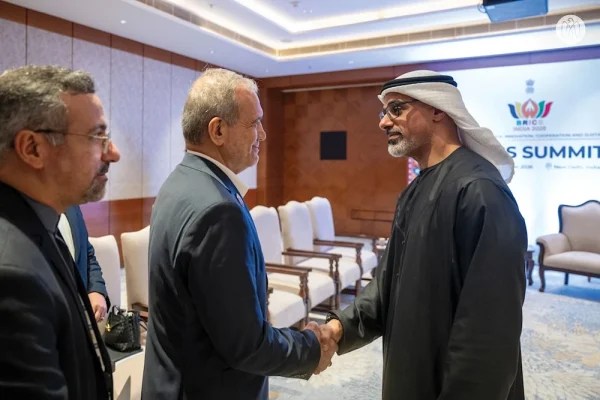
Iranian President Masoud Pezeshkian said following the BRICS summit in India that Iran and the UAE want to restore relations following the US war on Iran.
“For the first time since the war and the incidents that occurred in the Persian Gulf, we had a constructive exchange with the crown prince of Abu Dhabi,” Pezeshkian said a day after a meeting with Abu Dhabi Crown Prince Khaled Bin Mohamed Bin Zayed Al Nahyan on the sidelines of the BRICS summit.
The Iranian President added that “it was agreed that we would turn the page, look to the future and build it together.”
Pezeshkian and Abu Dhabi’s Crown Prince met on the sidelines of the BRICS summit in New Delhi on Saturday, where the two discussed “regional and international issues, de-escalation, stability, and efforts to advance regional peace and development,” per the Abu Dhabi Media Office.
BRICS Draws Red Lines on Lebanon, Cuba, and Global Security
Sputnik – 12.09.2026
In their joint declaration, BRICS summit participants spoke out against unilateral sanctions that violate international law.
BRICS also condemned the violation of Lebanon’s sovereignty and called on Israel to withdraw its troops from its territory, according to the declaration.
Other key points:
- BRICS expressed deep concern over the US tightening unilateral blockade against Cuba and its adverse impact on the economy, energy supplies and humanitarian situation.
- It reaffirmed its commitment to combating all forms of terrorism.
- BRICS voiced alarm over deliberate attacks on peaceful facilities under IAEA safeguards.
- The group stressed the need to strengthen energy security.
- BRICS underscored the necessity of ensuring the peaceful use of space technologies.
Persian Gulf states to meet in Oman to discuss regional security, Hormuz navigation: Iran
Press TV – September 11, 2026
Iran and other Persian Gulf littoral states will meet in Oman on Monday to discuss regional issues, including arrangements for safe commercial navigation through the Strait of Hormuz, says Iranian Foreign Ministry Spokesman Esmaeil Baghaei.
Speaking on Friday, Baghaei said the meeting would bring together Iran, Iraq and other countries bordering the Persian Gulf and Gulf of Oman, describing the initiative as an important step toward strengthening regional understanding and cooperation.
He said Iran had consistently sought to build trust and cooperation among regional countries to promote peace and stability without “destructive and divisive interventions” by actors from outside the region.
The meeting in Muscat is also expected to address the outcome of recent Iran-Oman talks on establishing safe routes for commercial shipping through the Strait of Hormuz, Baghaei said.
Iran and Oman have been engaged in negotiations for nearly three months over arrangements for safe navigation through the strategic waterway. On Aug. 25, the two countries announced discussions on a phased framework that would initially establish a temporary joint maritime corridor, alongside a joint mine-clearance project.
The framework is aimed at restoring safe navigation while preserving the sovereignty and sovereign rights of coastal states. Technical talks are expected to continue toward a permanent navigation corridor and an agreement on the future administration of the waterway.
Baghaei recalled the understanding reached between Tehran and Muscat on temporary shipping routes, saying Iran remained committed to efforts to ensure the safety of navigation through the strait.
“However, naturally, as long as the aggressive actions and illegal interventions of the United States, including the naval blockade and economic warfare, continue, the security of navigation in the Strait of Hormuz cannot be guaranteed,” he said.
The Strait of Hormuz is a major global energy chokepoint, with roughly one-fifth of global oil demand passing through the waterway. Iran has maintained heightened restrictions on navigation since the start of the US-Israeli military aggression against the country on Feb. 28, citing security concerns and the need to safeguard its sovereignty.
Back on August 25, Oman’s Foreign Minister Sayyid Badr Albusaidi stressed that future management of the strait and a permanent solution would follow the terms of the Islamabad memorandum of understanding, particularly its Article 5.
The memorandum, signed by Iran and the United States in June, aimed at ending the US-Israeli aggression against Iran, included an arrangement under which Iran agreed to allow fee-free maritime transit through the Strait of Hormuz for 60 days.
Tehran subsequently established a special maritime route for vessels crossing the chokepoint; however, the US established unauthorized routes along Omani shores in violation of the agreement. In response, Tehran reimposed restrictions.
The joint Iran-Oman statement also pointed to the importance of consultations with other countries bordering the Persian Gulf and called for adherence to international law and respect for the sovereign rights of coastal states.
The meeting will be the first of its kind between Iranian diplomats and their regional counterparts following the start of the US-Israeli aggression, during which the US used the soil and airspace of some of these countries, including Bahrain, Kuwait, and the UAE, to launch criminal attacks against Iran.
Russia, China clash with West at UNSC over legality of Iran ‘snapback’ sanctions
Press TV – September 10, 2026
Russia and China have opposed the activation of the so-called snapback mechanism against Iran at a UN Security Council meeting, warning that Western attempts to reactivate the relevant UN sanctions regime would only further heighten divisions and undermine multilateral diplomacy.
The five permanent members of the Security Council engaged in a fierce procedural battle on Thursday over the legal validity of international sanctions against Tehran.
At the heart of the dispute is the “snapback” provision embedded in the 2015 Joint Comprehensive Plan of Action (JCPOA), which was originally designed to automatically restore UN Chapter VII sanctions in the event of significant Iranian non-compliance, deliberately bypassing the veto power of permanent council members.
Despite fierce objections from Moscow and Beijing, the council voted 11-2 in favor of adopting the provisional agenda, with two abstentions.
Under UN rules, procedural votes require a minimum of nine affirmative votes and cannot be blocked by a permanent member’s veto.
‘Legal mandate expired’
Both Russia and China stressed that the legal framework for the snapback mechanism no longer exists.
They emphasized that UN Security Council Resolution 2231, which endorsed the JCPOA, officially expired on October 18, 2025.
Consequently, the nonproliferation agenda item regarding Iran was struck from the council’s list of active issues on that same day.
The Russian representative stated that because the resolution has expired, there are no legal or procedural grounds to reactivate the 1737 sanctions committee, which ceased to exist in 2015.
Moscow dismissed Western claims and UN Secretariat conclusions supporting the snapback as “biased and erroneous.”
China echoed the sentiments, expressing “grave concern” and “strong opposition” to the West’s maneuvers.
Beijing warned that forcing the reimposition of sanctions and convening meetings under a defunct agenda item would seriously impede any chances of a political settlement to the Iranian nuclear issue.
China called on all council members to respect the termination date outlined in Resolution 2231 to preserve the authority of the Security Council and the credibility of multilateral diplomacy.
Western powers defend sanctions regime
Western delegations, however, firmly rejected the Russian and Chinese legal challenges, insisting that the sanctions have been legitimately revived following Iran’s alleged breaches of the nuclear deal.
“The United Kingdom, with France and Germany, initiated the snapback mechanism in full accordance with Security Council Resolution 2231,” the British representative stated, arguing that the European troika (E3) acted in response to Iran’s “significant non-performance” under the 2015 pact.
London maintained that the snapback process officially concluded on September 28, 2025, keeping six Chapter VII resolutions in effect.
The US representative took a harder line, accusing Moscow and Beijing of attempting to undermine council decisions merely to shield Tehran.
“Regardless of such politically driven matters, the facts are the facts. The 1737 Committee exists,” the American diplomat asserted, pointing to recent IAEA reports claiming Iran remains non-compliant with its Comprehensive Safeguards Agreement.
Tehran has consistently condemned the European troika’s actions, viewing the snapback maneuver as a politically motivated stunt orchestrated by Washington rather than a legitimate diplomatic tool.
Foreign Ministry spokesman Esmaeil Baghaei previously lashed out at the E3, describing their move as an act of “stubbornness” carried out to fulfill US orders without rational calculation.
He said that Britain, France, and Germany damaged their own credibility as parties to the JCPOA by misusing the snapback mechanism.
Baghaei emphasized that the E3’s illegal maneuver caused confusion within the UN system and creates no legal obligations for member states.
“In line with the preservation of the principles of the United Nations Charter, we expect countries to refrain from complying with the three European countries’ move, which is considered a form of imposition on the structure of the Security Council,” he said.
How the Latest Iran Sanctions Could Impact Central Asia
The US Iran strategy is working against its Central Asia strategy; Secondary sanctions may push the region closer to China and Russia.
By James D. Durso | The National Interest | September 8, 2026
On August 19, US President Donald Trump announced an “ECONOMIC D-DAY” against the Islamic Republic of Iran, warning of “tremendous economic consequences” for any country allowing its financial institutions, businesses, airports, or government entities to provide Iran a “lifeline.” On August 24, Treasury Secretary Scott Bessent announced “Operation Economic Outcast,” which sanctions Iran and its facilitators in third countries (but no major Chinese banks), and declared, “you are either with us or against us.”
Potential secondary sanctions threaten Central Asia’s developing trade, energy, and transport links with Iran, raising costs, disruption risks, and pressure to diversify routes. The Central Asian republics are not major supporters of Iran, but Iran is becoming an increasingly important southern outlet for their trade and connectivity. The biggest risk is therefore collateral damage to legitimate commerce and transportation, rather than a confrontation over Iran policy.
The Effect of Secondary Sanctions on Central Asia’s Economy
Banking and financial services could become the most immediate problem. Central Asian banks and companies may decide that even legitimate transactions involving Iran are not worth the compliance risk. If a Kazakh or Uzbek bank processes an Iranian payment and Washington later determines the transaction constitutes a prohibited “lifeline,” the bank could lose access to the US financial system.
That creates a powerful chilling effect: the US threatens sanctions, banks become risk-averse, Iranian transactions become difficult, and Central Asia-Iran trade declines as the republics lose access to a market of over 90 million people.
Washington is already targeting Iranian shadow-banking networks and foreign facilitators for enabling Iran’s rahbar banking system. The Treasury Department said its August 7 action involved networks spanning several countries and hundreds of millions of dollars in Iranian transactions.
The result could be over-compliance: Central Asian banks might stop handling perfectly legal Iran-related transactions simply because determining what Washington will regard as a “lifeline” is too difficult. Secondary sanctions can dampen commerce even without formal designations, as private actors withdraw to avoid US financial-system exclusion or penalties.
Transportation and logistics corridors could become economically unattractive, potentially with greater strategic consequences than the direct loss of trade. A container originating in Uzbekistan or Kazakhstan and traveling through Iran to a Persian Gulf port might have nothing to do with Iran politically. Still, it could require an Iranian trucking company, an Iranian railway, an Iranian port, Iranian customs services, Iranian insurance, an Iranian bank, and fuel purchased in Iran. As the Islamic Revolutionary Guard Corps (IRGC) is a major player in Iran’s economy, it will be tough not to deal with an IRGC-affiliated business.
If Washington interprets normal business activity as supporting the Iranian government, the entire corridor could become commercially radioactive. Iran offers a continuous land route southward and onward to the Persian Gulf petrostates, South Asia, East Asia, and East Africa.
The Central Asian republics are landlocked and have pursued pragmatic economic ties with Iran primarily for southern access to the Persian Gulf and Indian Ocean via ports such as Bandar Abbas and Chabahar. These routes form part of the International North-South Transport Corridor (INSTC) and related rail and road networks, offering alternatives or complements to routes that transit Russia, China, or Afghanistan.
Energy relationships are another vulnerability, particularly for Turkmenistan and Tajikistan. Energy swaps, fuel purchases, and other transactions involving Iranian counterparties could become more expensive or difficult if banks, insurers, shippers, or trading companies conclude that they face sanctions exposure.
A prior Turkmen gas-swap arrangement involving Iran was disrupted by US sanctions, illustrating how sanctions can affect nonmilitary transactions. Tajikistan has also sought large preferential fuel supplies from Iran amid unreliable Russian supplies.
Central Asian governments may therefore face higher freight and insurance rates, longer transit times, additional compliance costs, and pressure to use alternative corridors. They may also see greater use of barter or non-US Dollar settlement mechanisms where feasible.
Trade and regional connectivity. The economic effect is likely to be less a complete collapse of trade than higher prices and greater complexity of using Iran. The region may accelerate diversification toward the Trans-Caspian International Transport Route (the “Middle Corridor”), Pakistani ports, or Chinese routes, although each has capacity, cost, or security limitations.
Kazakhstan is probably the most exposed, given its long-term connectivity strategy and interest in an outlet to the Persian Gulf. It has been developing multiple routes to diversify its export geography, including the Middle Corridor through the Caspian and South Caucasus, as well as routes through Iran. Its development of port infrastructure in Iran illustrates that Astana sees Iranian territory as part of its long-term connectivity portfolio.
Bilateral trade rose 26.4 percent in 2025 to about $430 million, with ambitions to reach $3 billion, supported by the Eurasian Economic Union-Iran free trade agreement. Rail freight with Iran increased 69 percent, while INSTC freight overall grew 12 percent to 3.5 million tons. In June 2026, Kazakhstan signed a 27-year Build-Operate-Transfer (BOT) deal for its own logistics terminal at Bandar Abbas, aimed at Persian Gulf, South Asian, Southeast Asian, and East African markets. Secondary sanctions could delay or derail the terminal project and raise logistics costs; banks and carriers could also self-sanction and chill transactions even without formal government action.
Washington now faces a dilemma: the more aggressively it sanctions Iranian transit infrastructure, the harder it becomes for Central Asian states to build the independent trade routes Washington claims it wants them to develop.
Uzbekistan has an especially strong reason to maintain multiple southern options. Tashkent has pursued routes through Turkmenistan and Iran toward the Persian Gulf while also developing routes westward via the Middle Corridor and eastward (the China-Kyrgyzstan-Uzbekistan Railway).
Roughly 9 percent of imports and 10 percent of non-gold exports transited Iran in 2025. Officials have estimated potential losses from Middle East logistics disruptions at $1–$1.5 billion (0.7–1 percent of GDP). Sanctions pressure could force costly rerouting toward the Middle Corridor or other paths, raise freight rates, and reduce competitiveness.
In June, Tashkent concluded a successful investment forum that saw interest from 193 American companies and investors, and where Washington and Tashkent launched a joint investment platform to “identify strategic investments in Uzbekistan for the US and US allies in key sectors.” In February 2026, the United States and Uzbekistan established a critical-minerals partnership, including a framework for up to $400 million in investment in the two countries.
Uzbekistan’s president, Shavkat Mirziyoyev, visited the White House in February 2026, and the leaders concluded agreements in critical minerals, energy and petrochemicals, agriculture and poultry, and irrigation and water-saving technology, the latter a critical issue in the water-stressed country. They also announced a three-year, $35 billion Economic Cooperation Program. Uzbekistan’s World Trade Organization accession got a boost, and the Board of Peace gave Uzbekistan a role in Trump’s Middle East initiative.
The Uzbek leader has made a substantial personal investment in the relationship with the United States, and Uzbekistan has an incentive to comply with US sanctions on prohibited Iranian entities while preserving legitimate transit and commercial relationships wherever possible. That said, Trump must ensure his attack on Iran’s economy doesn’t damage the economies of countries that want a serious relationship with America, as future leaders will not again expose themselves politically if the Americans are careless.
Turkmenistan could face a somewhat different problem. It has extensive energy and transportation ties with Iran and depends on its neighbors for alternative routes. At the same time, Ashgabat traditionally values neutrality (and it is official state policy) and is unlikely to want to become involved in a US-Iran confrontation.
Turkmenistan is expanding cooperation with Iran in transport, energy, communications, and construction. US sanctions disrupted a prior gas-swap arrangement, so secondary measures could freeze or raise the cost of energy swaps and transit.
If Washington begins sanctioning Iranian transportation or energy counterparties broadly, Turkmenistan could be forced to choose between maintaining economically useful relationships with Iran and avoiding exposure to the US financial system, an uncomfortable choice for a country that works not to take sides.
Tajikistan’s direct trade with Iran is smaller, but its exposure is growing. Freight with Iran rose 17.5 percent in the first half of 2026 to 433,000 tons, mostly by rail. Tajikistan has sought large preferential fuel supplies from Iran—2.55 million tons of crude and products, including 2 million tons of crude plus diesel, gasoline, and aviation fuel—amid unreliable Russian supplies. It has also discussed joint road corridors with Iran and Afghanistan, potentially extendable regionally and toward China.
Disruptions could therefore hit fuel access, raise costs, and complicate logistics. Tajikistan may seek alternative suppliers and routes, but those alternatives could be more expensive or less reliable.
Kyrgyzstan is less directly tied to Iran than the other republics, so immediate sanctions exposure should be lower. Nevertheless, it could feel the effects indirectly through higher regional freight costs, fuel prices, insurance costs, banking restrictions, and shared corridor dependencies.
The Strategic Consequences of US Secondary Sanctions in Central Asia
The Central Asian governments pursue multi-vector policies and generally avoid open confrontation with Washington. They are unlikely to disregard US pressure or politically champion Iran, but will manage exposure carefully, possibly scaling back high-visibility projects while seeking workarounds.
Their most likely strategy is: comply with US sanctions on prohibited Iranian entities while preserving legitimate transit and commercial relationships wherever possible. They may also seek explicit US assurances or exemptions for infrastructure projects, but that may dissuade US investors if multiple approvals are needed over a project’s lifetime. And US policy can change overnight.
Washington says it wants Central Asia to become less dependent on Russia and China, and Central Asian governments want that too; one way to do it is by developing connectivity through Iran.
Kazakhstan and Uzbekistan joined Trump’s Board of Peace, but that may not protect them if Trump decides “all hands” must support America’s crusade against Iran. The point of maximum danger for the two republics may come if Trump can’t force China to isolate Iran and tries to punish Beijing by punishing Astana and Tashkent for trans-shipping Chinese goods while allegedly concealing their true origin to take advantage of lower tariffs. There is always the chance a Trump-affiliated investor may ask the White House to attack Tashkent’s trade with Iran, $578 million in 2025, if it doesn’t like Tashkent’s terms and conditions for a deal.
Consequently, an overly broad sanctions campaign could produce greater dependence on China and Russia, the opposite of the strategic objective Washington often advocates for Central Asia, consequences that probably weren’t considered before Trump and Bessent took to social media. Russian State Railways is sanctioned by the United States and the European Union, so Central Asian businesses may be stuck between two transport options, both sanctioned by the West.
The consequences will depend on how Washington defines a “lifeline.” If “lifeline” means financing Iran’s military or IRGC, oil exports, weapons procurement, or sanctions-evasion networks, the Central Asian impact could be manageable. If it means ordinary transportation, banking, aviation, port services, and non-military government-to-government commerce involving Iran, the consequences could be much larger.
The American administration has already demonstrated that it is willing to sanction foreign transport and financial networks supporting Iran’s military and procurement activities. That distinction is central to the policy question. If Washington wants Central Asia to have “connectivity without dependence,” it may need to distinguish carefully between Iranian military lifelines and Iranian transportation infrastructure that Central Asian states use simply to reach global markets.
Central Asia probably will not be the principal target of the new sanctions, but it could be the sanctions’ most significant collateral damage. The danger is not that the republics will support Iran, but that Washington could make legitimate Iranian transit so financially risky and demand that Iran’s neighbors help quarantine the Islamic Republic, undermining Central Asia’s effort to develop alternative routes to the world to the benefit of China and Russia.
James Durso is a regular commentator on foreign policy and national security matters. Mr. Durso served in the US Navy for 20 years and has worked in Kuwait, Saudi Arabia, and Iraq. His writing has appeared in The Hill, The National Interest, Defense News, and Responsible Statecraft. Follow him on X: @james_durso
Featured Video

Iran’s Next Strike May Not Explode. It Could Shut You Down
or go to
Aletho News Archives – Video-Images
From the Archive
Zionism’s Violent Legacy
By Donald Neff | Washington Report On Middle East Affairs | January 1996
On January 4, 1948, Jewish terrorists drove a truck loaded with explosives into the center of the all Arab city of Jaffa and detonated it, killing 26 and wounding around 100 Palestinian men, women and children.[1] The attack was the work of the Irgun Zvai Leumi – the “National Military Organization,” also known by the Hebrew letters Etzel – the largest Jewish terrorist group in Palestine. The Irgun was headed by Revisionist Zionist Menachem Begin and had been killing and maiming Arabs, Britons and even Jews for the previous ten years in its efforts to establish a Jewish state.
This terror campaign meant that at the core of Revisionist Zionism there existed a philosophical embrace of violence. … continue
Blog Roll
 Aletho News
- Trump’s Iran war is on an Israeli leash
- Saudi oil boss issues global supply warning
- Riyadh Says Its Oil System Is Intact. The Numbers Say Otherwise.
- Trump and Netanyahu Want to “Finish the Job” on Iran
- US ‘one-sided dictation’ not Iran’s beliefs makes rational talks impossible: Baghaei
- Iran’s Next Strike May Not Explode. It Could Shut You Down /Col Doug Macgregor
- Iran: US political targets legitimate if assassinations return
- Iraq shuts key border crossing with Iran under US pressure: Report
- Undersea Internet cables could be targeted in retaliation for attacks on Iran: IRGC deputy chief
- EU sending ‘biased’ observers to interfere in Serbian election – president
- If Americans Knew
- The Israel Lobby’s Changing Fortunes
- AIPAC has become such a political liability that it’s shifting to a more “nimble” approach to buying politicians
- At least 160 Israeli settler attacks in 2 weeks
- Will Gaza’s Ancient Christian Community Disappear Forever?
- Israel’s vision of regional security rests on keeping Arab states weak
- Heidi Levine recounts how Palestinian youths helped save her in settler attack
- DAILY UPDATE: Latest essential news on Palestine, Israel, & region
- Trump’s Intensifying Sabotage of the ICC, for Israel’s Sake
- Israeli military detain US and UK volunteers in West Bank including Democratic NY politician Brad Lander
- Americans at National Conservatism Conference held in Israel this year criticize Israel
- No Tricks Zone
- E-Cars Reduce CO2 Emissions By Only 41% Compared To Internal Combustion Engine Vehicles
- Predictions Made By Renowned Climate Professor Over Past Decades Have Been Proven To Be Poor
- New Study Suggests Large Regions Of The Pacific Ocean Have Been Cooling For The Last 80 Years
- Germany’s Green Energy Debacle: High Energy Costs Force Kahla Porzellan to Close After 182 Years!
- New Study: 50 Years Of The Most Aggressive ‘Net Zero’ Policies Can Only Affect The Global Climate By 0.03°C
- US September “Heat” Was No Record…Many Records Set Decades Ago
- Latest European Green Energy Debacle; Portugal’s Largest Flagship Solar Park Insolvent!
- Green Energy Debacle: German Expert Professor Fritz Vahrenholt Warns Of Severe Economic And Social Consequences
- Two More Paleo Reconstructions Affirm Meters-Higher Sea Levels Across Ireland, Brazil 7000-6000 Years Ago
- New Study: Earth And Venus Surface Warmth Largely Explained By Convection And Lapse Rate, Not CO2 Or Radiation

