Russia may benefit from trade rift between China and Australia
RT | December 16, 2020
Russian coal suppliers could boost their exports to China, as the world’s largest coal buyer is reportedly curbing shipments of the commodity from Australia amid escalating tensions between the two countries.
The developer of the largest Russian coal deposit, Elga, announced on Tuesday that it created a joint venture with a Chinese shipping company to promote Russian coal on the massive Chinese market. The project between Elgaugol and GH-Shipping is set to satisfy China’s growing demand for high-quality coking coal.
The deal is set to help boost Russian coal supplies to China from one million tons this year to 30 million tons in 2023, and the developer could potentially further increase annual imports to 50 million tons. The joint venture is also expected to contribute to the ambitious goal of the Russian and Chinese governments to significantly increase bilateral trade turnover, as it would increase the volume of trade between the two countries by $5 billion per year.
“The supplies of coking coal from Elga will replace a significant amount of Australian and American coal of similar quality,” Elgaugol Director-General Aleksandr Isaev said.
Another Russian producer, Mechel, previously said that it was planning to increase exports of coal to China amid Beijing’s restrictions on Australian imports. In November, the shipments rose by 13 percent, and are set to jump by 25-30 percent in December, Mechel CEO Oleg Korzhov said as cited by Russian media.
Tensions between the two countries have been growing for around three years, after the Australian government began limiting Chinese investments in the country. In 2018, Canberra added fuel to the fire when it banned China’s Huawei and ZTE from its 5G rollout. The most recent escalation occurred when Australia pushed in April for an international inquiry into the origins of the coronavirus outbreak.
Earlier this week, Chinese state-linked media reported that the nation’s top economic planner gave domestic power plants the greenlight to import coal without clearance restrictions from several countries “except for Australia.” While Beijing has not officially confirmed the restrictions, Canberra has already urged the Chinese government to clarify the reports.
This week’s reports are not the first to allege that China is quietly banning coal imports from Australia. Last month, several million tons of Australian coal worth more than $500 million were reportedly stuck in Chinese ports.
Russia’s massive offshore Arctic oil & gas discovery could dwarf Gulf of Mexico & Middle East’s energy reserves
RT | December 15, 2020
Russian energy giant Rosneft has announced the discovery of a “unique” gas deposit in the Kara Sea containing an estimated 514 billion cubic meters of natural gas.
The company says the discovery could establish a new cluster for oil and gas production in the area.
The field, which has been named after Soviet Marshal Konstantin Rokossovsky, is Rosneft’s third discovery in the Arctic. It is part of the company’s drilling campaign to develop the region’s oil and gas potential.
The project was started by President Vladimir Putin in 2014. It has resulted in the discovery of one of the world’s largest oil and gas fields, the Pobeda field. Its total recoverable reserves stand at some 130 million tons of oil and 422 billion cubic meters of gas.
The second discovered field, with an estimated 800 billion cubic meters of gas deposits, was named after Marshal Georgy Zhukov.
Overall, more than 30 “prospective structures” were identified in the three areas of the Kara Sea, according to Rosneft.
It said the results of the drilling prove “the discovery of a new Kara offshore oil province,” adding that “In terms of resources, it could surpass such oil and gas-bearing provinces as the Gulf of Mexico, the Brazilian shelf, the Arctic shelf of Alaska and Canada, and the major provinces of the Middle East.”
One Little Problem with the “All-Electric” Auto Fleet: What Do We Do with all the “Waste” Gasoline?
By Charles Hugh Smith | Of Two Minds | December 14, 2020
Regardless of what happens with vaccines and Covid-19, debt and energy–inextricably bound as debt funds consumption– will destabilize the global economy in a self-reinforcing feedback.
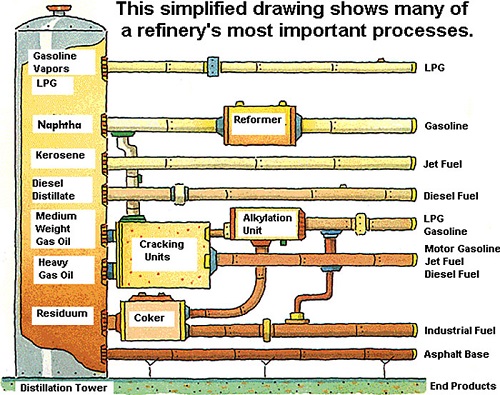
Back in the early days of the oil industry (1880s and 1890s), the product that the industry could sell at a profit was kerosene for lighting and heating. Since there was no automobile industry yet, gasoline was a waste product that was dumped into streams.
Why couldn’t the refiners produce only kerosene? Why did they end up with “worthless” gasoline?
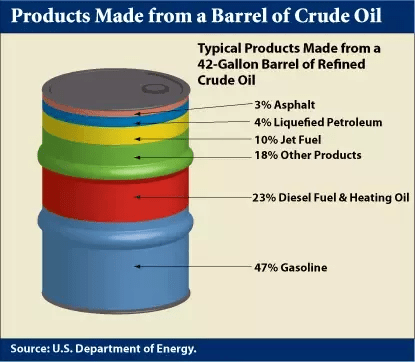
The answer is a barrel of oil produces a variety of products. While there is some “wiggle room” to produce more diesel and less gasoline, etc., it isn’t possible to turn a barrel of oil into only one product.
John D. Rockefeller became very wealthy by cornering much of the oil market in the 19th century. But he didn’t become fabulously wealthy until the 20th century, when the rise of automobiles created a market for all the “waste” gasoline.
Rockefeller became super-wealthy when all the products of each barrel of oil could be sold at a premium rather than just a portion of the products.
This reality has been forgotten: the price that can be fetched for a barrel of oil depends on the demand for all the products, not just a few of the products.
Those demanding an all-electric auto-truck fleet as a “green” alternative will re-create the dilemma of what to do with the “waste” gasoline. The world will still want fuel for all those container ships bringing all the goodies of a consumerist society, all those cruise ships visiting ports of call, jet fuel for all those exotic vacations enabled by 550 mile-per-hour aircraft, and oil-based lubricants, plastics and petro-chemicals, and so oil will still be pumped and refined, and almost half of it will be gasoline.
We can either use it or throw it away but we can’t magically turn a barrel of oil into only one product.
This is a topic worthy of your understanding, so grab a vat of your favorite beverage and turn off all distractions.
Longtime readers know I’ve focused on energy-oil markets for 15 years. Despite ups and downs in price, the oil market has been remarkably stable.
This stability is about to transition to chronic instability: wild swings in price, shortages, and social chaos in both producing and consumer nations.
Let’s start with the most basic dynamics in the cost of producing oil, refining it and selling the products at a profit.
1. As a general rule, a barrel of oil (42 gallons, 196 liters) yields a range of heavier and lighter products.
The price the producers can charge for each product–gasoline, diesel fuel, heating oil, jet fuel, propane, etc.– depends on demand for each product.
If the price for one product falls drastically, the oil producer can’t increase the price of some other product to compensate for the loss of income unless demand for the other products will support higher prices.
Consider the huge decline in demand for jet fuel as a result of global air travel dropping in the pandemic. Oil producers can’t just raise the price of gasoline to compensate for the drop in the price of jet fuel.
If gasoline demand continues declining (due to fewer commutes, etc.) then producers can’t charge more for diesel to make up the drop in the price of gasoline.
In other words, there has to be strong demand for all the products in a barrel of oil for producers to get enough money to extract, refine and transport the products globally.
Unlike the old days when producers could afford to throw away some petroleum products because their costs of extraction and refining were so low, now producers need more than $45/barrel just to break even.
This is what I’m calling Oil Paradox #1: if demand for any of the primary products is weak, producers can’t afford to continue extracting and refining oil, even if there is strong demand for some products.
2. Transportation is the primary use of oil: 68% of all petroleum products are consumed by transport, 26% by industrial and 6% residential/commercial. (These are U.S. statistics, but the global demand is roughly the same.)
If demand for gasoline, diesel and jet fuel remains weak, the value of each barrel of oil will remain below break-even, even if the industrial need for some products (lubricants, etc.) is strong because these industrial products are essential to the world’s industrial economy.
3. Much of the consumption of the past 20 years was funded by debt, which is now $277 trillion globally and accelerating. Humanity has borrowed and spent trillions on consumption, and what remains is the interest due on the debt.
This interest constrains future borrowing. The “solution” to interest is inflation, which devalues the interest due. But it also devalues the purchasing power of the currencies being inflated, and so everyone’s money buys fewer goods and services.
This is the Debt-Inflation Paradox: the more interest you owe, the greater your need to inflate away the burden of interest. But inflation destroys the purchasing power of money, impoverishing everyone who needs the money to live.
There is no way out of this paradox: either the global economy defaults on its debts, destroying trillions in phantom wealth, or its currencies lose value, impoverishing everyone.
Since so much consumption is funded by debt, any reduction in borrowing, no matter how modest, will destroy demand for petroleum, triggering the Oil Paradox (producers can’t charge enough to justify pumping and refining oil).
4. The pandemic has accelerated consumption trends that reduce demand for fuels. Remote work is here to stay, regardless of what you may read. Corporations can no longer afford to staff centralized offices in costly cities. Making everyone commute to offices is no longer financially viable.
Corporate travel is also no longer financially viable. As profit margins fall, the luxury of jetting to physical meetings is no longer justifiable except for senior management– a few dozen people, not hundreds or thousands.
Tourism thrived in an economy of easy, low-cost credit and secure incomes. Lenders can no longer afford to lend to those with poor credit–notice how credit card limits have been drastically reduced–and incomes are no longer secure.
If the pandemic were the only issue, it would be possible to see a return to 2019-level consumption. But unsustainable debt loads will only get more unsustainable, so much of the consumption that was funded by debt will go away and not come back: the interest on all the existing debt remains to be paid, one way or another.
This decline in consumption has lowered the price of oil far below break-even for most producers. As the article below explains, there are two break-even prices for petroleum: one to get it out of the ground, refine it and deliver it to market, and the second for the social costs the oil pays for.
This is the famous Oil Curse: nations with oil reserves end up depending on selling oil for virtually all their revenues because it doesn’t make sense to invest in less reliable, less profitable sectors.
As a result, Saudi Arabia can pump the oil for $45/barrel, but it needs a price of $85/barrel to pay all the social welfare costs it has promised its people.
If you glance at the charts in this article, you’ll see the full break-even price of oil for OPEC nations is extremely high.
Breakeven crude oil prices are one metric of the economic constraints facing OPEC+ members
This generates Oil Paradox #2: low demand/low prices for oil may be financially viable in terms of extracting the oil, but the societies that depend on vast oil revenues will unravel if oil prices stay low, and that will disrupt production.
Roughly half of U.S. petroleum production is from tight shale and other unconventional oil sources. Many of these wells are no longer profitable and will be shut down once the producers’ credit lines dry up. (This is already happening, triggering mass bankruptcies in the fracking industry).
The oil producing nations are basically surviving on $40/barrel oil by borrowing against future revenues. This is a dangerous game because if oil prices remain low their credit lines will eventually be withdrawn.
The oil producers need supply to fall drastically enough to raise prices back to the $80/barrel or higher level. But nobody can afford to cut their own production enough to reduce global supply enough to matter.
This introduces Oil Paradox #3: should petroleum producers succeed to slashing supply so oil goes to $85/barrel, the higher cost will push the fragile consuming nations into recession or depression, which will slash demand even more, which will require even deeper production cuts to maintain prices.
If we put all these paradoxes together, we see that oil markets are now intrinsically unstable and cannot return to stability because the mix of high break-even prices, declining demand and the end of debt-funded consumption cannot be resolved: high prices crush demand, low prices crush producers, and debt is crushing both consumers and producers.
Much hope is being placed on so-called renewable energy, most of which is not renewable but replaceable, as I’ve learned from Nate Hagens. A forest is renewable, a solar panel or windmill must be replaced every 20 years at enormous expense.
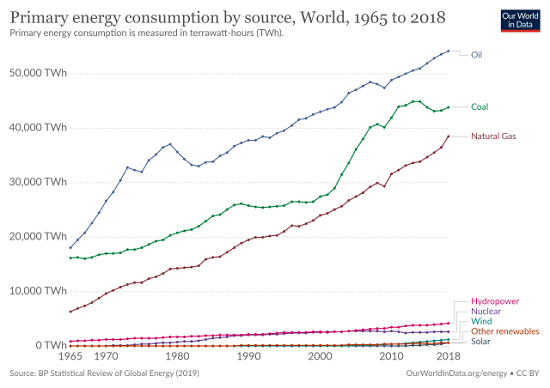
Right now all alternative energy sources–wind, solar, etc.– generate no more than 4% of global energy consumption. (see chart below) Despite hundreds of billions of dollars invested, all the alternative energy sources are a tiny fraction of global consumption, and their supposed fantastic rates of growth is revealed on this chart as inconsequential: all this new energy doesn’t replace a single drop of oil, it simply fuels additional consumption.
It will take a monumental investment and many years to get this to 10%. The reality is the vast majority of the global economy still depends entirely on petroleum for transport and industrial essentials such as lubricants.
How (Not) to Run a Modern Society on Solar and Wind Power Alone
Petroleum is now an unstable system and for all the reasons outlined above it cannot be restored to stability: just as time is a one-way arrow, so is the loss of stability.
What can we expect? Unstable systems are prone to wild swings to extremes and unpredictable collapses. So we may see collapses in the price of oil as we saw in March, and then rapid ascents in price above $100/barrel, which then crash once demand declines.
This unpredictability complicates projections and generates uncertainty. This is the final paradox (#4): the unpredictability of oil markets is itself a destabilizing force. Decisions on future production and consumption cannot be long-term, and this constrains investment in future production.
Regardless of what happens with vaccines and Covid-19, debt and energy–inextricably bound as debt funds consumption– will destabilize the global economy in a self-reinforcing feedback.
My new book is available! A Hacker’s Teleology: Sharing the Wealth of Our Shrinking Planet 20% and 15% discounts (Kindle $7, print $17, audiobook now available $17.46)
Read excerpts of the book for free (PDF).
The Story Behind the Book and the Introduction.
Recent Podcasts:
Parallels of the Great Fire of Rome 64 AD to Today (with host Richard Bonugli) (31:40)
UN’s call for ‘climate emergency’ is an invitation to misery in developing countries
By Vijay Jayaraj – Global Warming Policy Forum – 14/12/20
A declaration of climate emergency (as per UN’s emission reduction requirements) will dent the developmental goals and increase energy prices. Besides, it will also result in the tax payers funded transition to a less reliable energy system, a recipe for a potential economic collapse.
A precursor to the 2021 COP26 meeting in the UK
Speaking at the Climate Ambition Summit to mark the 5th anniversary of the Paris Agreement, UN chief Antonio Guterres implored, “Today, I call on all leaders worldwide to declare a State of Climate Emergency in their countries until carbon neutrality is reached.”
He further clarified that,
We need meaningful cuts now to reduce global emissions by 45 per cent by 2030 compared with 2010 levels. This must be fully reflected in the revised and strengthened Nationally Determined Contributions that the Paris signatories are obliged to submit well before COP26 next year in Glasgow.”
UK Prime Minister Boris Johnson committed 11.6 billion pounds of UK’s overseas aid to support green technology. Pakistan’s prime minister Imran Khan pledged not to build any new coal plants in the country.
Support for the UN leader’s call also came from the Chinese President Xi Jinping. He said China will cut down carbon dioxide emissions per unit of GDP by over 65% by 2030, in comparison to 2005. Given its status as the leading coal consumer and empowerer of fossil fuel technology in other developing countries, it remains to be seen how President Xi will reconcile his 65% commitment with Beijing’s fossil ambitions and energy intensive industries.
Speaking at the same event (virtually), the Indian Prime Minister Narendra Modi said that India will reduce emission intensity by 21% in comparison to the 2005 levels. Earlier this year, Modi had indicated that the country is aiming to reduce its carbon footprint by 30% to 35% and increase the use of natural gas, without setting a deadline for the same.
Even as per its ambitious scenario to reduce emissions, India will not be able to achieve a 45 percent reduction in CO2 emissions compared to 2010 levels without compromising on its aggressive energy policy that has enabled the country to achieve an energy surplus in recent years.
Studies on the relationship between GDP and energy growth indicate that “It is very difficult to reconcile reductions in carbon dioxide emissions with continued economic growth, especially in poor and medium rich countries,” as most of the world’s primary energy comes from fossil fuels.
A call for 45 percent reduction in carbon dioxide emission will be suicidal for the energy sectors in the developing world, most of which depend on coal, oil, and Natural gas. 84% of the world’s primary energy comes from Fossil fuels (2019) and just 11% coming from Renewables. Though the share of fossil fuels in global energy consumption may appear to be reducing by a small margin each year, the absolute value of consumption keeps increasing each year.
Despite the rapid addition of renewable technology globally, the year-on-year change in primary energy consumption value for both renewable and fossil sources were almost the same in 2019, i.e., an increase consumption of around 960 TWh for both the sources. The actual fossil fuel consumption has technically increased and will continue to increase in future, as developing economies are wary of falling back into the dark ages of energy poverty.
Riding on the renewable energy myth
Developing nation’s precaution with green transition has a reason. Gueterres claimed that “Renewable energy is getting less expensive with every passing day.” But the claim is disputed, at least as per the current state of renewable technology, their backup mechanisms, and the evidence from the existing green grids.
Data from renewable energy dominated states like California and from countries like Germany and UK, show that excessive investment and dependency on renewable energy has actually resulted in increased electricity prices.
Renewable energy like wind and solar, which in many instances is installed with subsidies from taxpayer’s money, ends up charging the taxpayer more for their electricity use, thus technically costing the taxpayer not once but twice.
A ‘green’ Covid recovery will imperil developing countries
Gueterres insisted that, “the recovery from COVID-19 presents an opportunity to set our economies and societies on a green path in line with the 2030 Agenda for Sustainable Development.”
He is not alone in suggesting a marriage of COVID-19 recovery stimulus and green energy transition. The World Economic Forum’s Great Reset program suggests the same, with global leaders like Justin Trudeau already endorsing it.
Developing countries are unlikely to join this call for green transition, despite Xi’s tall pledges. India, for example, is likely to become the most populous country in the world by 2030 and it will have to risk millions of poor people falling back into the extreme poverty category if it were to amend its commitments to Paris agreement as per Gueterres’ suggestions.
With COVID-19 lockdowns adversely impacting the country’s economy (a negative growth in GDP and a long road to arrive at pre-COVID-19 levels), it is unlikely that the country’s leadership will commit to any significant CO2 reduction targets before the COP26 meetings in the UK.
India’s Economic Survey 2018-2019 categorically stated, “While there has been a tremendous increase in renewable energy capacity, fossil fuels, especially coal, would continue to remain an important source of energy.” The survey added, “Further, considering the intermittency of renewable power supply, unless sufficient technological breakthrough in energy storage happens in the near future, it is unlikely that thermal power can be easily replaced as the main source of energy for a growing economy such as India.”
This is likely the reason why Prime Minister Modi refused set a deadline for India’s proposed 30-35% reduction in emissions. India had recently doubled its mining exploration activity by implementing about 400 new projects. The mining sector is considered important to the country’s ambition to become a USD 5 Trillion economy. According to India’s Central Electricity Authority, 50% of India’s electricity generation in 2030 will continue to come from coal.
Does climate alarm justify extreme calls for energy transition?
Despite the heightened focus on emission reduction commitments, the elephant in the room has been the science used for justifying these emission reductions in first place.
During his speech, Gueterres asked “Can anybody still deny that we are facing a dramatic emergency?” Well he may be right! This is indeed a “dramatic” emergency, not a scientific one!
If we were to assess the key indicators that determine quality of life, it is evident that many of those metrics have improved drastically since the industrial revolution, despite the contrasting storyline portrayed in the mainstream media.
Life expectancy (age to which a new born baby is expected to survive), access to clean drinking water, access to affordable and reliable electricity, access to nutritious food at affordable prices, agricultural crop productivity per acre and farmer incomes are some of the key metrics that show us that the world has improved a lot, especially in the past 3 decades. We are not in a climate emergency!
The only reasoning provided for a future climate catastrophe is the temperature projections from computer climate models, collectively known as CMIP (Coupled Model Intercomparison Project). The UN uses the most recent versions of CMIP (5 & 6) to frame climate policy decisions and the mainstream media and academic institutions regard these models as the gold standard in climate forecasting.
The models are designed to forecast future temperatures, based on greenhouse gas emission scenarios. This is how the UN predicts future temperatures and the reason why Gueterres has called for an emission reduction. But the models are hypersensitive to emissions and thus have been faulty since inception.
Recent research has shown “that climate models overstate atmospheric warming”. The warming projected by these models have been found to be 4 to 5 times faster than the actual temperature observations on ground. Even if the developing nations refuse to commit to UN’s carbon neutrality initiative, there won’t be a significant impact on the climate.
So, the call by Gueterres is not only pseudo-scientific in its climate assumptions but also dependent on unreliable and unaffordable green energy. The call for emission reduction will be economically damaging and to a severe extent in the developing countries.
Moreover, it completely excludes the possibility of economies becoming stronger in the future, potentially making them more resilient, thus developed enough to adapt to climatic challenges. The prescribed reduction mechanisms and the war on fossil fuels could actually stifle their ability to mitigate and adapt to future temperature changes.
It will be interesting to see how Xi, Modi and others in developing world put their commitments into practice, and how it will impact the current energy forecasts which project an increasing reliance on fossil fuel in their respective economies.
Jack Dorsey, the CIA and Twitter Censorship in the Age of Covid-19
By Vanessa Beeley |
Unlimited Hangout| December 10, 2020
Twitter CEO, Jack Dorsey, has embedded himself in some of the most powerful global influencer complexes. His techno-mining of African potential and the increasing use of Twitter as a surveillance tool for the corporatocracy have generated the opportunity for Dorsey to play an increasingly pivotal role in the roll-out of the World Economic Forum’s Great Reset.
In Part 1 of this series on the emergence of the “celebrity humanitarianism” complex of the 21st century and its role in the ongoing Covid-19 crisis, I covered the evolution of Hollywood actor Sean Penn from anti-Iraq-war activist to establishment narrative endorser and advocate for the predator class factions dominated by the Clinton family cabal and globalism.
Penn was one of the three men together on a beach holiday that was featured in a Daily Mail article in November 2020. Another of the three global influencers strolling on the beach with Penn was “technology entrepreneur” and the CEO and co-founder of Twitter, Jack Dorsey. Dorsey’s meteoric rise to fame as a leading innovator in the world of data technology began to falter in 2016/17 when 247 Wall Street listed Dorsey among the twenty worst CEOs in America. In this article, I will investigate Dorsey’s involvement in the narrative management of Covid-19 and his potential contribution to the roll out of the World Economic Forum’s Great Reset that has been accelerated by the Coronavirus “pandemic” exercise.
Like Penn, Dorsey is a supporter of the Democratic Party. Dorsey broke ranks with the billionaire bloc to donate $ 5600 to Tulsi Gabbard’s campaign after the June 2019 Democratic debates. Dorsey cites Gabbard’s anti-war stance as the reason for his support. Dorsey also contributed to the campaigns of Andrew Yang and Jay Inslee. Dorsey commends Yang for his “focus on artificial intelligence and automation” (emphasis added). Dorsey has also endorsed the philanthrocapitalist “climate change” portfolio – in a tweet Dorsey says that Gabbard and Yang’s “voices are important to surface in debates”, adding:
“Along with systemically addressing climate change and economic injustice, these are the key issues of global consequence I want to see considered and discussed more.”
Dorsey as well as the CEO of Facebook, Mark Zuckerberg, were subpoenaed to a US Senate hearing in November 2020, where their platforms were accused of anti-conservative bias after their effective suppression of the Hunter Biden China scandal. Of the two social media platforms, Twitter was deemed to be the most aggressive in its censorship of the New York Post article.
US conservatives were outraged that a story critical of Joe Biden, with potential to turn the election in favour of Donald Trump, was being buried by platforms as influential as Twitter and Facebook. Dorsey’s rationale for this unprecedented censorship had been that Twitter policies prohibit “directly distributing content obtained through hacking that contains private information”. Dorsey later back-pedalled but by then, the story had effectively been “disappeared” and damage to the Biden campaign had been successfully limited.
Dorsey’s apparent absorption into the transnational billionaire complex controlling the global response to the Covid-19 “pandemic” and orchestrating the Fourth Industrial Revolution, will be explored throughout this article.
From Square to Covid-19 – Dorsey transfers $ 1 billion to “disarm the pandemic”
In addition to Twitter, Dorsey is also the CEO of Square, a digital payments platform. In April 2020, Dorsey transferred an alleged 28% of his wealth from Square to his Start Small LLC (SS) to fund Covid-19 relief globally. The $1 billion donation represents the most significant “philanthropic” donation made by the tech-billionaire during his entire career.
One month after the launch of SS, Dorsey announced on Twitter the disbursement of $87.8 million to a number of initiatives apparently responding to fall-out from Covid-19 response measures. The disbursements included $600,000 to help develop “high impact digital learning tools to support special needs students and English language learners who are most affected by the crisis and will experience the most learning loss during school closures”.
The reality is that none of these measures would be necessary if scientists, doctors, epidemiologists, medical staff and experts opposing the disproportionate response to a virus [seemingly] less deadly than seasonal flu had been taken into consideration by the institutions and governments rolling out the draconian “lockdown” of global populations in preparation for the Great Reset. Dorsey’s and Twitter’s role in ensuring the censorship and de-platforming of dissenting voices is also examined in this article.
Let us not forget that “a report from the Institute for Policy Studies found that, while tens of millions of Americans have lost their jobs during the coronavirus ‘pandemic’, America’s ultra-wealthy elite have seen their net worth surge by $ 82 billion in just 23 days” as picked up by journalist, Cory Morningstar, who is also cited below.
In May 2020, Dorsey donated $10 million to Sean Penn’s CORE response which supported CORE’s national expansion of Covid-19 drive-through test sites “into Atlanta, Detroit, New Orleans and the Navajo Nation”. The origins of the CORE initiative are examined in detail in Part 1 of this series. Dorsey is also credited with persuading Penn to join Twitter in May 2020.
As Dorsey stated in his April 2020 tweet:
“After we disarm this pandemic, the focus will shift to girl’s health and education, and [Universal Basic Income] or UBI.”
Dorsey’s involvement in the promotion of UBI demonstrates his endorsement of measures which are designed to shore up economic privilege for members of the global billionaire cartels while asset-stripping and disenfranchising the working classes and what remains of an already decimated middle class in the West.
Cory Morningstar, one of the foremost voices speaking out about the unprecedented power grab being facilitated by the Covid-19 narratives, gave me this statement with regards to the covert threat of UBI:
Covid-19 is the catalyst for the Great Reset, in which universal basic income plays a securing role. Universal Basic Income (UBI) is the strategic solution to protect the ruling classes from Molotov cocktails and global civil unrest by those being methodically dispossessed of their occupations, dignity and self-preservation – the working class, much middle class, peasantry, artisans, and those that comprise the informal economy that presides in the Global South. Disclosures on coming “disbanding of existing safety-net programs” are not included in the foundation-funded marketing campaigns.
When UBI begins to be rolled out globally, one can expect public healthcare to slowly disappear, replaced by privatized services (largely Telehealth). Further, UBI payments will be linked to benefits via blockchain – ensuring full spectrum compliance and servitude of whole societies. Billionaires are supporting/financing UBI marketing campaigns for good reason: it is preferable to pay a pittance to the citizenry than to risk losing the social license that allows for the continued decimation of the Earth, coupled with the continued exploitation of those most oppressed and vulnerable.
The real motive behind Jack Dorsey’s interest in Africa
Dorsey’s focus on UBI and girl’s health and education is mirrored, coincidentally, by the interests of the Clinton Foundation in Africa. Dorsey had been planning to relocate to Africa for six months in 2020, plans that were apparently derailed by the Coronavirus crisis although a more likely obstacle was investor concern that his pivot to Square and the opportunities presented for digital payment remodeling in Africa’s cash-based society would lead to his neglect of Twitter.
In 2015, Bill and Chelsea Clinton led an entourage of powerful elite sponsors of the Clinton Foundation to Africa for Bill Clinton’s 12th visit to the resource-plundered continent. Dorsey joined the Clintons, Microsoft (via Bill Gates), Facebook and Google in a bid to ensnare the developing market sector into their accelerator programmes and debt enslavement campaigns. Visa, Mastercard and Salesforce are also establishing venture investments in African start-ups.
According to “Witney Schneidman, a Brookings fellow with the Africa Growth Initiative and former deputy secretary of state Clinton administration”, Dorsey was in the right place at the right time. In November 2019, Dorsey tweeted that Africa “will define the future (especially the bitcoin one)” The African continent comprises 54 countries with a combined population of 1.3 billion people with the highest population growth rate in the world. The world’s largest population of people without banks, trading in cash. Ripe for exploitation by the world’s robber barons and financial-tech-carpet-baggers.
In November 2020, Dorsey was the closing keynote speaker for the Africa Fintech Summit sponsored by Dedalus Global and Ibex Frontier. Dorsey is described as a “futurist”, a “visionary”, and one of the “biggest influencers in tech ecosystems worldwide”. “With an unbanked population of 66% and a credit card penetration rate that averages 1.5%, the applications for crypto in sub-Saharan Africa can only help solidify Dorsey’s interest in the continent” (Africa News )
Dorsey is investing in the reinvention of colonialism as smart growth, the new-age digital colonialism. The Facebook’s internet footprint in Africa and its Orwellian ambitions for that continent are covered in detail in this article by investigative journalist, Cory Morningstar. Morningstar has showed in her recent and past work how the billionaire class seeks to facilitate the absorption of the Global South into a paternalistic, inherently racist, Global North power structure that will suck the lifeblood out of these nations via “philanthropic” channels that have been constructed to mine data, resources, livelihoods and cultural infrastructure until it is an overpopulated, micro-managed colony with no access to development unless it is plugged into the predator class mothership.
“As Africa meets the 4IR Fourth Industrial Revolution], its youth will be one of its most important assets” – August 2020, World Economic Forum: How can Africa succeed in the Fourth Industrial Revolution?
Dorsey, the Clintons and the technological “disruption” of Haiti
Dorsey’s history of rubbing shoulders with the Clinton clan goes way back. Just as Sean Penn was heavily involved with the Clinton’s rapacious policies in Haiti, Dorsey was a keynote speaker at the Haiti Tech Summit in 2018, an event that is also described as the “Davos of the Caribbean”. The summit was organised by the Global Startup Ecosystem which, according to their website, “hosts the world’s first and largest digital accelerator- supporting 1000 companies from 90 countries every year”. Target regions are Africa, America, Asia, Europe, Caribbean, Latin America and the Middle East.
Taken from their website, in 2017, GSE launched a 13 year initiative to accelerate emerging market ecosystems every year until 2030 in alignment with the Sustainable Development Goals.
The “iconic” Haiti Tech Summit was the pilot launch. The company was projecting 54 tech summits in 2020, to be held virtually and “across all major hubs globally”. Alongside Dorsey at the 2018 Haiti Tech summit were representatives from other Silicon Valley giants — Google, Facebook and YouTube. The end of summit message from the summit’s founder and GSE’s co-founder, Christine Souffrant Ntim, informed the audience that Haiti “was ready for disruption”. This is an unfortunate choice of words considering the decades of “disruption” that have been inflicted upon the semi-colonised island by a series of US administrations, dominated by the Clintons’ exploitation policies targeting Haiti.
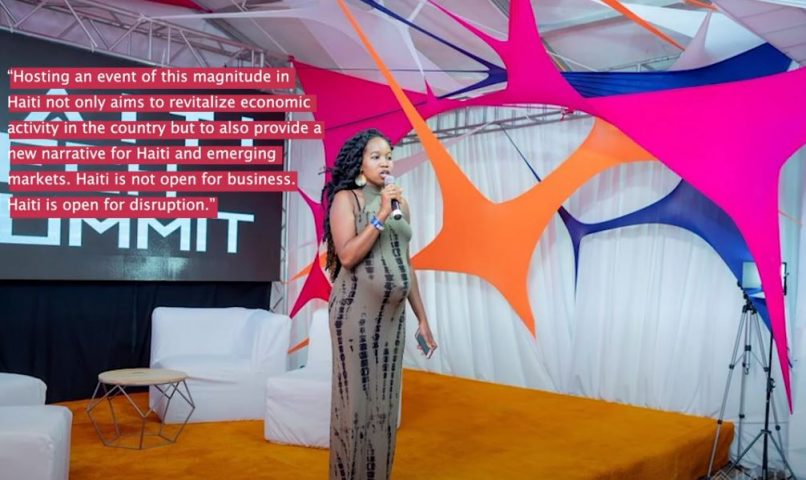
Screenshot from Haitian Times video report on the Tech Summit 2018.
This is nothing less than implementation of UN Agenda 2030, an agenda that aims to privatise and seize control of land, resources, energy, education and to digitalise the world we live in, to bring us all into city-based data colonies that can be easily controlled and manipulated for the benefit of the vulture class – the billionaire elites who perceive this world to be their exclusive bread basket and the “little people” as the “useless” expendables.
GSE’s website lists Dorsey as a member of their speaker network that includes Ben Horowitz and Sophia, the world’s celebrity robot. Horowitz is co-founder of Andreessen Horowitz, a Silicon Valley venture capital firm that invests in technology start-ups, and their better-known investments include GitHub, Facebook, Pinterest and Twitter. GSE partners include LinkedIn, Google Cloud, IBM Cloud and Forbes. GSE’s mission is to “prepare individuals and organisations for the digital age” according to Einstein Ntim, managing partner at GSE – a goal completely in line with the Fourth Industrial Revolution and the Covid-19-facilitated Great Reset.
Dorsey and the Transition Integrity Project – Berggruen Institute
Dorsey’s involvement with the Berggruen Institute (BI) is an indication of his collaboration with some of the most powerful neoconservative influencers in US politics. BI is another transformational future-shaping conglomerate “promoting long term answers to the biggest challenges of the 21st Century”. Nicolas Berggruen is the co-founder and chairman of BI. Berggruen has been pivotal in the restructuring and reinventing of “democracy” for the new digital age. Berggruen used the institute as a launch pad for a number of government reform projects. These include the 21st Century Council which brought together former heads of state – with Tony Blair, Gerhard Schroder, Helle Thorning Schmidt and Nicolas Sarkozybeing just a few of names on the list. Dorsey was a member of the 21st Century Council and is one of Berggruen’s “people”.
Berggruen established the “Think Long Committee for California” in 2010. The committee included such neoconservative and “progressive” luminaries as Condoleeza Rice and Eric Schmidt (Google CEO) and its purpose was to effectively create a new set of rules for governance, using Agenda 21 Sustainable Development grants to impose regional governance.
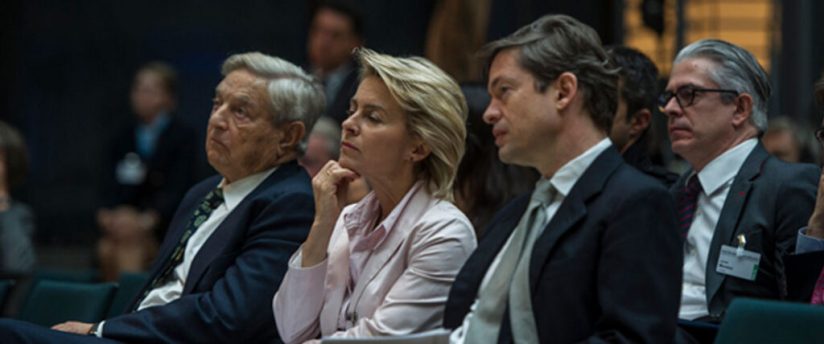
Soros/Berggruen/von der Leyen
In 2012, Berggruen’s Council for the Future of Europe met in Berlin to discuss Europe Beyond the Crisis. Speeches were given by former UK Labour Party leader and criminal globalist, Tony Blair, billionaire influencer and transnational interventionist, George Soros and George Papandreou, former PM of Greece and last in a long line of corrupt imperialist sycophants. Dorsey has effectively embedded himself into one of the most influential and predatory of the neocon cartels. Dorsey is a minor in the billionaire circle but a major in identifying the foremost power hubs.
Berggruen is also behind the Transition Integrity Project (TIP), recently covered by investigative journalist, Whitney Webb, for Unlimited Hangout who described the TIP as:
“A group of Democratic Party insiders and former Obama and Clinton era officials as well as a cadre of “Never Trump” neoconservative Republicans have spent the past few months conducting simulations and “war games” regarding different 2020 election “doomsday” scenarios.”
Another sinister Berggruen programme is the “Transformations of the Human” which has all the hallmarks of a transhumanism agenda. The concept involves the placing of philosophers and artists in key research sites “to foster dialogue with technologists”. The “aim of the program is to render AI and Biotech visible as unusually potent experimental sites for reformulating our vocabulary for thinking about ourselves” which could be interpreted as reprogramming humanity. The findings will be fed back into the “production of both AI and biotech and to thereby contribute to both human and non-human flourishing” or perhaps to merge the two?
As investigative journalist, James Corbett, warns “are we ready to give up our humanity” to succumb to the “ethical use of technology to extend human capabilities?”. The redesigning or genetic modification of the human condition is not science fiction, it is the bedrock of the ideology of those who rule this world behind the facade of government.
As Julian Huxley, an influential English evolutionary biologist, eugenicist, and internationalist wrote, in the last century:
“… unless [civilised societies] invent and enforce adequate measures for regulating human reproduction, for controlling the quantity of population, and at least preventing the deterioration of quality of racial stock, they are doomed to decay …”
Huxley invented the term “transhumanism” just before he became President of the British Eugenics Society, 1959-62. Huxley was also the first Director General of UNESCO.
Author, Dean Koontz, described the age of Transhumanism and the Fourth Industrial Revolution very succinctly:
“We live in hubristic age, when politicians imagine themselves to be messiahs and when many in the sciences frankly discuss their dreams of creating a “post-human” civilization of genetically engineered supermen, ignorant of the fact that like minds have often come before them and have left no legacy but death, destruction, and despair.”
Dorsey’s close ties to those whose purpose is to reinstate a Silicon Valley-backed Democrat as US President and to oust President Trump who, to some degree, slowed down the global military interventionism of the neocon camp in Washington as well as Twitter’s record of protectionism of the Biden election campaign are perhaps what, currently, make Dorsey an accepted member of the overclass.
It should be no surprise, therefore, that Nicholas Pacilio, senior communications manager at Twitter, who deleted Trump tweets claiming (correctly) children are almost immune from Covid-19, was formerly the press secretary for Kamala Harris, Biden’s pick for vice president. Twitter’s proclaimed neutrality is rendered nonsensical by all the above and by their collaboration across the board with global influencers whose futurist agenda is reliant upon the acceptance of official Covid-19 narratives.
Dorsey’s anti-conservative Twitter censorship policy is also supported by online petition giant, Avaaz, who were instrumental in the fomenting of conflict in Syria from the outset in 2011 and well versed in the art of selling hate for Empire.
Bill Gates and Jack Dorsey – investing in civil unrest?
Dorsey and Covid-19 impresario, Bill Gates, are alleged indirect funders of the BAIL Project (BP). The project was established to bail out protestors who participated in the George Floyd demonstrations and riots. BAIL is reported to have connections to Antifa, an organisation associated with stoking civil unrest and being “primary instigators of violence at public rallies” according to declassified Department of Homeland Security and FBI studies from 2016, the first year of Trump’s presidency. While many of the reports linking Dorsey to BAIL and BAIL to Antifa can be described as “conservative”, Dorsey’s Start Small initiative has donated to Black Lives Matter, suspected to be another of the billionaire co-opted organisations designed to harness and control black power globally.
The Audacious Project (housed at TED) was seed-funded $ 250 million by Gates, Skoll and Dalio Foundations. The BAIL Project was one of the five recipients of $ 50 million funding from the Audacious Project and is partnered by TED directly according to their own website. The Audacious Project, “a new model to inspire change”, is yet another node in the philanthrocapitalist complex wreaking havoc globally under the pretext of building a better future for all. In reality, such groups are building a system that will make the world’s wealthiest class even wealthier and will give ever increasing control over the global resource inventory.
When the connection is made to the Transition Integrity Project and Gates and Dorsey’s suspected involvement in BAIL and potentially Antifa, it makes sense that these narrative builders of the Covid-19 paradigm would be behind the scenes of the planned civil unrest in the US.
Further evidence of Twitter’s role as a surveillance tool for US intelligence agencies and influencers on Covid-19 response came when The Intercept exposed the AI start-up Dataminr and that company’s involvement in the monitoring of the Floyd protests and provision of that data to police and security forces nationwide. While both Twitter and Dataminr deny any engagement in domestic surveillance, these accusations followed on from the 2016 controversies that aligned Twitter with the CIA as investors in, or partners of Dataminr. The Twitter-Dataminr collaboration permitted Dataminr to scan every public tweet as soon as it was published, giving them advance warning of any incoming protests or dissident action.

Despite the denial of surveillance activity by both Twitter and Dataminr, “monitoring activities and forwarding information to the police is clearly surveillance” explained Andrew Ferguson, author of “The Rise of Big Data Policing: Surveillance, Race, and the Future of Law Enforcement.”
In 2016, Twitter allegedly asked that Dataminr stop providing intelligence agencies with Twitter tools and content but as TechCrunch reported:
“… Dataminr isn’t ending its relationship with the government altogether: Dataminir still counts In-Q-Tel, the non-profit investment arm of the CIA, as an investor. Dataminr has taken investment from Twitter, too, highlighting some of the conflicts that remain as tech companies fight for more transparency and autonomy from government control.”
Dataminr’s Yale leadership is believed to still have a $ 255,000 contract with the Department of Homeland Security. The protestations of Twitter and apparent withdrawal from US intelligence blood-hounding by Dataminr appear to be nothing more than smoke and mirrors designed to put the public off the scent.
However, perhaps even more relevant to the Twitter censorship of Covid-19 dissident media, scientists and medical experts, and famously, David Icke, all of whom were challenging establishment “science”, is perhaps also related to its partnership with Dataminr. In late 2016, Twitter told TechCrunch that Dataminr “uses public Tweets to sell breaking news alerts to […] government agencies such as the World Health Organisation” although the “not for surveillance” caveat was thrown in.
The billionaire complex apprentices, managing narratives for their mentors
Penn and Dorsey are not in the upper echelons of the ruling elite circles. They are the keen instruments of power, eager to please and to do the bidding of those in positions of power they perhaps aspire to one day. The wealthiest people in the world are providing funding for the Covid-19 response, with good reason. It is the portal to the world vision they have been working towards for decades, perhaps even centuries.
At the World Economic Forum meeting in Davos, January 2020, historian and philosopher, Yuval Harari, gave talks on the future of humanity. Harari talks about the “useless class”, he describes the data colonies that will be formed under some projected “dictator.” In the world, Harari envision, if a dissident’s mind can be read by a centralised AI data hub, he can be arrested for non-compliance with the dictatorship.
Of course, the global dictatorship is already here with the Covid-19 measures, the obligatory masking, martial law, the Army deployed to roll out testing and vaccines, mandatory vaccines (you will not be able to function in society without one), the incarceration of the elderly, the destitution and isolation of children in schools and distance learning, digitalised education systems. The future according to this totalitarian, neo-feudalist system is bleak for humanity unless we collectively wake up.
Penn and Dorsey are just two of a collection of useful pathways to the Great Reset. They are the fear-stokers and narrative managers, ensuring that people fear death, fear their own powerlessness against a “virus” that stalks them even in their own home.
As journalist, Peter Koenig, described earlier this year:
“The virus is just a clever idea to use an invisible enemy for instilling fear, worldwide, by this minuscule, insanely rich and psychotically power-hungry elite to put the entire world population to its knees. FEAR that obliterates the human immune system and may bring about a range of illnesses far worse than covid-19, including cancer, coronary diseases, diabetes – and much more.”
It is time to recognise that death is an inevitable part of our existence as human beings, that visions of immortality offered by those who will distort and twist humanity out of shape to create a dystopian future for all but the very privileged few, are nothing but the erosion of all that is human. Being human is what will enable us to fight back. When we remember what we cherish as human beings, a smile, a hug, the comfort of touch and the warmth of human interaction perhaps we will start fighting before we lose what makes us who we are to the vision of those who see us as ultimately expendable.
Europe’s Anti-Russia Sanctions a Stupendous Act of Self-Harm and Loathing
Strategic Culture Foundation | December 11, 2020
New data out this week indicates that the European Union has suffered aggregate economic losses amounting to over €120 billion due to its policy of imposing sanctions against Russia. That’s according to figures released by the Dusseldorf Chamber of Commerce and Industry.
Yet European leaders at an EU summit this week again called for the extension of sanctions on Russia, which will roll on into the middle of next year and probably beyond that date. This lockstep action by the bloc is only leading to more tensions with Russia and taking a political direction to nowhere except more conflict. Those EU sanctions were first imposed in July 2014 over dubious allegations of Russia’s malign involvement in the Ukrainian conflict. Moscow has rightfully reciprocated with counter-sanctions on European exports of agriculture and other goods.
The German Chamber of Commerce and Industry estimates that the entire stand-off has hit EU economies with losses of €21 billion every year. The biggest loser is Germany’s economy which forfeits nearly €5.5 billion a year in bilateral trade with Russia.
Accumulated over six years since 2014 the EU’s sanctions policy against Russia has resulted in a staggering total loss of over €120 billion. And counting.
To put that figure into some perspective, it would be comparable to the combined annual military budgets of Europe’s three biggest economies: Germany, Britain and France.
Or to put it another way, this week the European leaders agreed on a landmark stimulus package worth €1.8 trillion for the 27-member bloc to recover from the coronavirus pandemic. The economic loss to the EU from sanctions on Russia is of the order of 10 per cent of that record stimulus effort.
It is therefore mind-shuddering why the European Union persists in inflicting such untold damage to its own economy through its policy towards Russia.
The EU claims that sanctions are being extended because of the lack of progress in peace negotiations over the Ukraine crisis. Brussels is seeking to blame Moscow for that ongoing frozen conflict, oblivious to the fact that Russia is not a party to the conflict. It is a member of the so-called Normandy Format overseeing the Minsk Peace Accord signed in 2015. Germany and France are also members of the Normandy group. The group has not met since one year ago. So, why is Russia being singled out as the sole responsible for lack of progress in settling the Ukraine conflict?
Secondly, the Ukraine crisis was instigated by a coup d’état against the elected President, Viktor Yanukovych, in February 2014. The coup was orchestrated by the United States and European allies, which ushered in an ultranationalist regime in Kiev with disturbing links to Neo-Nazi factions. Hostility towards Russian-speaking communities in the Ukraine then led to the Crimean referendum in March 2014 appealing for reunification with Russia. It is simply preposterous and cynical for the European Union to blame Russia for subsequent turmoil when the EU is itself directly complicit in fomenting the crisis.
In any case, rigidly applying sanctions is counterproductive to a diplomatic solution. Mutual dialogue is precluded by a policy of recrimination and scapegoating.
The EU sanctions policy is self-defeating and suffused with contradictions. It imposes measures against Russia with seeming insouciance about the huge damage being done to EU businesses, workers and farmers, and it does this without any clear justification. Yet this week EU leaders led by Germany refused to impose sectoral sanctions against Turkey in spite of repeated calls by EU members Greece and Cyprus for such measures as a means of defending their territorial integrity from Turkey’s aggressive gas exploration in the East Mediterranean. So here we have EU members protesting against threats to their sovereignty from Turkey; yet the EU leaders show little resolve to defend the bloc’s external southern borders by taking a tough sanctions line towards Ankara.
There is evidently a strange double-think when one compares the EU’s gung-ho attitude towards Russia over a matter in Ukraine which is not even part of the EU and a matter that is highly contested in terms of the allegations being made against Russia.
How to explain such an irrational, anti-Russia policy by the European Union?
One has to conclude that the EU is slavishly following a policy determined by the United States. The US has imposed its own bilateral sanctions against Russia over the Ukraine, as well as many other equally dubious claims, such as alleged electoral interference. The Europeans are thus deferring to Washington’s foreign policy of hostility towards Moscow, even though the economic losses felt by the Americans are negligible compared with those of Europe due to the latter’s geographic proximity and traditionally much greater trading relations with its continental neighbor.
Russia’s Foreign Minister Sergei Lavrov noted this week that the European Union’s policy is “centered on the United States”. Lavrov lamented that the EU under current leadership shows no sign of acting independently from Washington. In effect, the European bloc is a vassal under American tutelage.
Ironically, the antagonism towards Russia from the West is due to Russia’s demonstrative independence.
Says Lavrov in a separate interview: “The West’s awareness that Russia is an independent power has had a cumulative effect. Russia will always prioritize its national interests. It is always ready to harmonize them candidly and equitably with the national interests of any other countries based on international law, but it will never be under someone’s thumb.”
The Russian top diplomat added: “The desire to score propaganda points has dominated the West’s foreign policy for a long time, while overlooking the essence of the problems that need a solution in the interests of the peoples of the respective regions.”
A psychiatrist might opine that European self-harming, irrational antagonism towards Russia – while constantly appeasing an American bully – is a form of self-loathing. The EU’s political class resent Russia because the latter is a constant reminder of the independence and integrity that they are so abjectly deficient in.
Russia on track to have one of its largest-ever grain harvests
RT | December 13, 2020
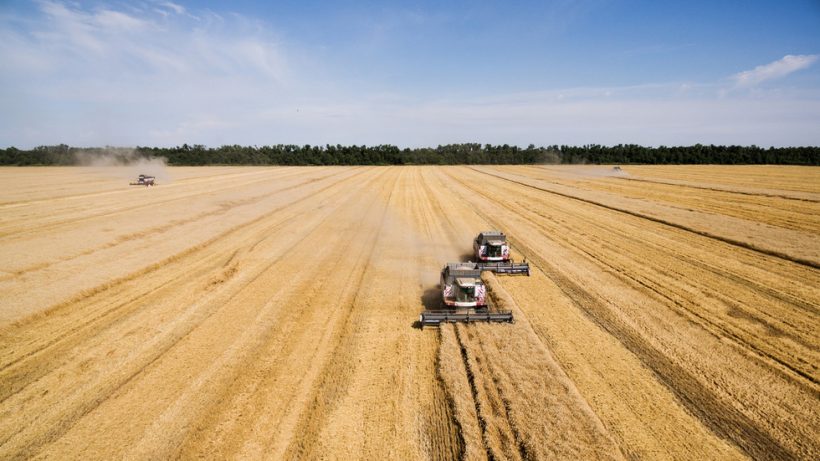
This year’s grain crop in Russia is set to exceed 131 million tons, according to the Ministry of Agriculture. This would be one of the country’s largest harvests, second only to the record 135.5 million tons recorded in 2017.
“Today we can talk about the completion of the harvest season in Russia. Grains are almost completely crushed. So, we can say with confidence that in 2020 our farmers provided one of the most significant harvests in the country’s recent history,” said the head of the ministry, Dmitry Patrushev, during a meeting with Russian President Vladimir Putin.
The latest figures beat earlier expectations. The ministry had said in September it expected this year’s grain harvest to stand at 122.5 million tons.
Russia’s booming agricultural production has surged by 20 percent over the last six years. The country has managed to capture more than half of the global wheat market, becoming the world’s biggest exporter of grain, thanks to bumper harvests and attractive pricing. Since the early 2000s, Russia’s share of the global wheat market has quadrupled. In 2018-2019, Russia delivered 35.2 million tons of wheat to the global market.
Supported by a massive grain harvest, the country is projected to retain its leadership in the world’s wheat market in the coming years.
Why this campaign of terror?
Never outside war time have populations been subjected to such outrageous assault and battery by government propaganda machines
By Gillian Dymond | OffGuardian | December 13, 2020
In the morning, the world is as the world should be. The sun rises, as predicted for this part of England in early December, at around twenty past eight. Shortly after this, I get up, go through the usual morning routines, have a quick breakfast, wash up, and am at my computer by ten o’clock. The hours pass unexceptionably until lunchtime. And then I can no longer put off the trip to the shops.
Going to the shops is something I do as little as possible nowadays. Once I might have walked in and out of the nearby town centre several times in a day, without thinking twice: but that was when I could move from home to street seamlessly, with no jarring transition between here and there.
Now it’s different. Now, beyond the protective confines of our home lies a parallel universe, a place of outlandish rituals and dogmas, where grotesquely masked figures pass each other warily on the street or, in the supermarket, lurk out-of-touch behind symbolic plastic screens. Instead of muzak, as I follow the prescribed route between the aisles, disembodied voices warn of death and disease, order me to protect myself and others by maintaining distance and keeping my plague-ridden exhalations to myself.
“We’re in this together!” they proclaim.
In less than a year some malign necromancy has transformed the fearless social beings who once thronged shops and cafés in the run-up to each Christmas into an infestation of dangerous, outsized germs: or, if scrupulous examination of the facts has left you confident that “the novel coronavirus” is no more threatening to moderately healthy people than the nastier brands of flu, into the crazed adherents of some apocalyptic cult.
Since I have spent the past nine months scrupulously examining the facts, the eyes now peering out at me over the inadequate face-covering of that woman beating a hasty retreat behind the cans of tuna as I approach are, it seems to me, those of a poor, unhinged lunatic. But then, I am an unbeliever. I do not wear the mask of allegiance. Marked out by the lanyard around my neck, I do my shopping as quickly as possible, and hurry back to the embattled sanity of domestic life.
Yes, even here embattled: for as the onslaught of propaganda continues without remission, only complete divorce from the outside world can afford protection. Fortunately, since the arrival of the computer I am beyond the reach of programmed television, but in order to wake to the accompaniment of pleasant but undemanding music, I used to put up with the intermittent smattering of adverts on Classic FM. Now that government has become the media’s most lucrative source of income, however, this is no longer tolerable. Who wants to be roused abruptly from sleep by inane incantations of “Hands! Face! Place!”, sometimes repeated twice within five minutes ?
“It’s just an actor!” my husband pleads with me, as I hurl execrations, and worse, at the radio. But whether it comes from actors or health ministers, the brain-washing stinks. “Don’t you just long for a nice commercial about sofas?” a friend asks mournfully, as we discuss the incremental take-over of advertising slots by the government’s ‘nudge unit‘. Even bona fide adverts from the likes of Boots and the big supermarkets are made nauseous by mealy-mouthed assurances of “safe” shopping. The only kind of safe shopping I long for is shopping safe from constant reminders of The Virus: shopping unmasked and convivially mingling; the chance to browse unimpeded in bookshops, and linger socially-undistanced over cups of coffee in a crowded café.
Why this campaign of terror, you have to ask? Why, in the midst of a genuine pandemic, would anyone need to be reminded unceasingly that death is dogging their footsteps? That at any moment The Virus, wafted abroad by some super-spreader passed fleetingly in the street, might be insinuating itself into one’s body – or, worse, that we ourselves, infected but unaffected, might be silently contaminating a loved-one?
The short answer is, they wouldn’t. In a genuine pandemic, this constant mental battering would be superfluous. If the Black Death were raging outside my door, government would know full well that they didn’t have to fork out millions to convince me to stay inside; more likely, they would have to pay me to leave the house.
Yet this government has bought the mass media lock, stock and barrel, at vast expense, with the sole purpose, it seems, of hammering home a message of impending doom. Instead of calming our fears with facts and rational arguments, they have seen fit to flood the airwaves with slogans calculated to maintain panic; with disingenuous appeals to the emotions; with out-of-context death counts, wilful obfuscation of the difference between cases and infections, a criminally dodgy PCR test and graphs and computer models (rubbish in, rubbish out) carefully selected to emphasise the worst possible eventualities.
And not content to cow us into submission with a constant diet of skewed and incomplete information, they have unleashed the army’s 77 Brigade to troll social media exchanges and snuff out any lingering dissent – or, as the government prefer to call it, “misinformation“. The aim can only be to induce maximum public terror in the face of a virus which, without all this deceptive ballyhoo, would hardly have been noticed by the population at large.
Why are they doing this? Surely, by now, they must be aware that increasing numbers of highly esteemed and experienced scientists contest policies which are killing vastly more people than they are saving, and which will go on killing well into the future!
True, non-scientists could get lost in all the reams of conflicting information churned out since we were first put on terror alert back in February and March, but one question is both fundamental and easily answered: are excess mortality figures for this year significantly above average? Only a huge and sustained divergence from the norm would indicate the presence of a new disease deadly enough to justify the extraordinary measures the government have taken.
The Euromomo charts for the UK show no such anomaly. In Northern Ireland there has never been any substantial increase in deaths overall. In Wales, too, mortality has hardly diverged from the normal range. Scotland had a well-above-average peak in the spring, but since then has remained almost entirely within the bounds of normality. Even populous England, despite a death rate which soared sharply to a great height in March before falling equally sharply back by the middle of June, has spent most of the year chugging along below the “substantial increase” line, with the usual increase as winter approaches. A further chart at Covid-19 in Proportion? shows that,
Levels of mortality in 2019/2020 are very similar to those suffered in 1999/2000
Definitely not the Black Death, then, nor even the 1918 influenza. In fact, one of the world’s premier epidemiologists, John Ioannidis, has long been assuring us that the infection fatality rate of Covid-19 is comparable with that of a bad flu. His early estimate, in March, of a case fatality rate in the general population of between 0.05% and 1.0%, as indicated by the outbreak on the cruise ship Diamond Princess – a conclusion for which the eminent professor was, hilariously, censored by the non-scientists at YouTube.
Yet now we are being told that only mass vaccination against this fairly run-of-the-mill virus will allow us to return to any semblance of normal life. By special dispensation, millions of doses of insufficiently tested vaccine are already in the pipeline, with a guarantee of no come-back for Big Pharma or for doctors turning a blind eye to the precept “First to do no harm”, should those treated be hit with damaging repercussions on their health or, indeed, on life itself.
We are told that we should all accept the suspect panacea regardless, in order to beat “this dreadful virus”: it’s quite safe – honest, you’ve got my word for it, says Matt Hancock. Yet, side-effects apart, there is no assurance that the Pfizer vaccine, received with jubilation on 8th December by its first grateful recipient, will be effective in preventing either the disease or its transmission: and even if it does turn out to offer initial protection, this may last for as little as three months, so presumably regular repeat injections will be required.
What? Repeat injections! Are the young and healthy facing a lifetime of booster shots against a disease that is dangerous almost exclusively to the old and sick? And if this isn’t crazy enough, we are being told that, even while being turned into human pin-cushions, we will probably need to go on wearing masks and holding our friends and family at arm’s length well into the future: a future, it is hinted, of health passports and routine mass surveillance, if we wish to travel on public transport or generally engage in life beyond our doorstep.
This, it seems, will be the New Normal – but not to worry! After all, you’re already masking up automatically when you leave the house, aren’t you, and following the one-way footsteps on the pavement as a matter of course? And if it becomes too much of a nuisance to carry your proof of vaccination around with you, well, we should soon be able to offer you the trouble-free alternative of an implanted microchip, to cover all eventualities: health; finance; your social credit score …
Sometimes I think it would be better to be one of the masked zombies. Trusting, obedient, they live in a world which, though threatening, they understand and accept. It is real to them. They know, unquestioningly, that a dreadful plague has been visited upon us, a plague which threatens to wipe out the species: and they know that if they wear their masks faithfully, wash their hands a thousand times a day and steer clear of other human beings, they will be doing their bit to save the nation, and, eventually, be granted the supreme unction of a vaccine; after which, they believe, everything will go back to normal – perhaps with a few more bicycle lanes and wind farms, and somewhat fewer jobs – but hey! – what will that matter, when the nice, compassionate government is promising us all a Universal Basic Income?
For the rest of us, it’s not so simple. The rest of us must live in a world where our own perceptions are remorselessly challenged by the prevailing lie. Guided by rational thought processes and the evidence, we know that we are at no more risk from Covid-19 this year than we were in previous years from one of the more aggressive strains of influenza, but as soon as we venture into the outside world, everything contradicts our inner reality: and though we may not participate actively in the masquerade, we are condemned to a perpetual state of cognitive dissonance, compelled to acquiesce silently in the grand illusion being played out all around us, under the direction of the government.
And to what end ?
If it were ever possible to put the enormities which have taken place since last March down to mere blundering, it certainly is not now. The argument that the government has simply blundered, and is now trying to save face by digging itself in deeper does not wash. Nor does the line about saving the NHS. The NHS has regularly survived winter flu seasons which saw beds lined up in corridors and staff rushed off their feet.
Besides, the Nightingale hospitals were quickly whisked into existence: and if the amount of money poured by the government into fear porn and the purchase of dud PCR tests and hastily concocted vaccines had been diverted into more beds, plus better pay for nurses and other non-administrative staff, the lesson might at last have been learned, and future winters made less chaotic.
It was obvious from the start to anyone with a basic education who bothered to check the facts that closing down the economy would be more damaging to life and limb than any virus. Why was this not also obvious to a prime minister with a PPE degree from Oxford, who is surrounded by whole cohorts of colleagues and advisers armed with equally prestigious qualifications?
Even granting an initial surge of panic when faced with hysterical predictions from the Imperial College fortune-telling team, it would have been possible to withdraw in fairly good order after the first lockdown, when many scientists were already saying that the danger had been exaggerated, that the virus was now endemic, and widespread natural immunity was in sight.
Why didn’t our government seize the opportunity, in June, to give themselves a pat on the back, announce that the lockdown had worked, and ease us all back into rationality via an interval of sensible voluntary precautions, as practised in Sweden?
Given a modification of the propaganda, the country would have believed them. When adroitly handled by the Behavioural Insights Team the country, it appears, will believe anything.
Why, then, insist on sticking to the advice of SAGE, and continuing to give credence to the serially failed speculations of Neil Ferguson, rather than attending to the more balanced suggestions offered by Carl Heneghan and Sunetra Gupta?
Instead, the government chose to fan the flames of fear with an intensification of propaganda and orders to mask up, extending the reign of unjustified terror into the autumn, when the annual onset of respiratory diseases began to fill up hospital beds, and allowed the death counts and lockdowns to resume. One by one, those small businesses which survived the first onslaught are giving up the ghost, and it seems that our rulers will not rest content until every last man, woman and child in Britain has been thrown into the linked arms of corporate and state dependency.
What price conspiracy “theories” now? What we are dealing with are facts.
As countries throughout the world commit consensual suicide to a rousing chorus of “Build Back Better!”, what makes more sense? To shake the head in puzzlement, that so many nations, with one accord, should not only have made exactly the same mistakes earlier this year, but are now insisting, in unison, on entrenching the evils that have been unleashed?
Or to contemplate the possibility that a network of powerful supranational agencies – banks, corporations, NGOs – have for some time been collaborating to direct the course of world events through placemen and beneficiaries in local and national governments and their attendant bureaucracies, and that “the novel coronavirus” is being used to achieve the final push into an era of artfully camouflaged “global governance”: an era where policies devised by centralised, unelected committees are handed down to elected heads of state in the shells of what were once independent nations, and passed on by them to regional mayors and administrators for implementation and enforcement.
I caught the Asian flu in 1957. So did my mother: the only time I ever knew her to take a couple of days off work. The infection swept through the country, and tens of thousands died. In 1968 the Hong Kong flu passed me by, but once again the death toll was in the tens of thousands.
On neither occasion was it considered necessary to destroy millions of lives and livelihoods by closing the country down, nor was any attempt made to terrorise its inhabitants. Covid-19 is no more lethal than either of those previous infections – less so, unless you actually believe that all those currently described as dying “with Covid”, or dying within 28 days of testing positive, actually died from Covid. Never before have such destructive policies been inflicted on the nation in a futile attempt to wipe out a virus. Never before, outside war time, has the population of the UK been subjected to such outrageous assault and battery by a government propaganda machine.
Draw what conclusion you will. I’m off to feed the ducks. They don’t do anti-social distancing, and they don’t wear masks.
48% Of U.S. Small Businesses Fear They May Be Forced To “Shut Down Permanently” Soon

By Michael Snyder | The Economic Collapse | December 10, 2020
What would the United States look like if we lost half of our small businesses? The reason I ask that question is because approximately half of all small business owners in the entire country believe that they may soon be forced to close down for good. Not even during the Great Depression of the 1930s did we see anything like this. The big corporate giants with extremely deep pockets will be able to easily weather another round of lockdowns, but for countless small businesses this is literally a matter of life and death. Every day we are seeing new restrictions being implemented somewhere in the nation, and the politicians that are doing this are killing the hopes and dreams of countless small business owners. According to a recent Alignable survey, 48 percent of U.S. small business owners fear that they could be forced to “shut down permanently” in the very near future…
Based on this week’s Alignable Q4 Revenue Poll of 9,201 small business owners, 48% could shut down permanently before year’s end.
In fact, this number jumped from 42% just two months ago, demonstrating how several factors have converged to devastate small businesses: COVID resurgences, forced government reclosures, elevated customer fears, and a surge in online shopping at Amazon and other national ecommerce giants.
When a small business with only a few employees closes down forever, it never makes any national headlines.
But the truth is that small businesses are the heart and soul of our economy, and we are losing more of them with each passing day.
Here are some quotes from actual small business owners that took part in the Alignable survey…
- “COVID has raised its ugly head again. I’m a caterer and I’ve had no work in November and my clients are cancelling for Dec. This is so sad. I have worked so hard to build my business the last 14 years. My business has gone from half a million to not even 200,000. This is devastating for any business.”
- “COVID closings are killing this country! My business is on hold — no art walks or gallery openings, and I can’t even open my studio. Everything’s online.”
- “Because therapeutic massage is so ‘up close and personal,’ I have only come back to about 40% of my previous clientele. I am afraid that the governor will shut us down again, which will be the end of my business. I also believe the ‘ruling elite’ does not care about small businesses.”
How would you feel if you spent years putting everything you had into a small business in order to make it successful, only to have the politicians come along and completely destroy it?
And every time a small business has to let workers go, it just makes the unemployment crisis in this country even worse.
On Thursday, we learned that another 853,000 Americans filed new claims for unemployment benefits last week…
First-time claims for unemployment insurance totaled 853,000, an increase from the upwardly revised 716,000 total a week before, the Labor Department reported Thursday. Economists surveyed by Dow Jones had been expecting 730,000.
I have been warning that the new lockdowns would make the numbers worse, and that is precisely what is happening.
And one expert that was interviewed by CNBC says that this is just the beginning…
“It looks like the unemployment losses are starting to stack up for the economy. It’s not going to be a good month,” said Chris Rupkey, chief financial economist at MUFG Union Bank. “You’re starting the first week of the month on a bad note, and it’s probably going to be all downhill from here. It feels like the lockdowns are intensifying. It’s closer to reality for those forecasts that look for the economy to go negative in the first quarter.”
It is also important to remember that there are many Americans that have been unemployed for so long that they are no longer eligible to receive benefits.
One of those long-term unemployed workers is 35-year-old Sarah Groome…
For six months, she received unemployment benefits from the government – but those payments shrank as the programmes wound down this summer. Since October, she’s received nothing.
“I don’t know what I’m going to do financially,” she says. “I’m applying to jobs and I’ve probably applied to over 100 at this point and I’ve had one interview.”
“It’s scary,” she says. “I don’t know what’s going to happen.”
What do you say to someone in her position?
It’s heartbreaking to hear stories like that, and more people are being laid off with each passing day.
And as our new economic depression gets progressively deeper, an increasing number of Americans are becoming very desperate.
In fact, many have already become so desperate that they are turning to shoplifting…
Shoplifting is up markedly since the pandemic began in the spring and at higher levels than in past economic downturns, according to interviews with more than a dozen retailers, security experts and police departments across the country. But what’s distinctive about this trend, experts say, is what’s being taken – more staples like bread, pasta and baby formula.
“We’re seeing an increase in low-impact crimes,” said Jeff Zisner, chief executive of workplace security firm Aegis. “It’s not a whole lot of people going in, grabbing TVs and running out the front door. It’s a very different kind of crime – it’s people stealing consumables and items associated with children and babies.”
Everywhere we look, our society is starting to break down all around us. Americans have filed new claims for unemployment benefits more than 70 million times this year, the number of homeless in New York City has reached an all-time record high, and civil unrest continues to erupt all over America.
No matter what happens politically, conditions are going to continue to deteriorate as we head into 2021.
Of course the mainstream media is boldly proclaiming that the new vaccines will pull us out of this tailspin and that life in America will soon return to normal.
You can believe the mainstream media if you want, but in the end the “hope” that they are promising will turn out to be a complete mirage.
Michael’s new book entitled “Lost Prophecies Of The Future Of America” is now available in paperback and for the Kindle on Amazon.
The Empire Doubles Down: Open Society Foundations Will Now Be Run by Lord Malloch Brown

By Matthew Ehret | Strategic Culture Foundation | December 11, 2020
The hubris of empire has always struck me with shock and awe.
I mean it really takes balls to get caught with a prostitute and instead of apologizing to your wife, to instead buy the hooker a new fur coat and parade her publicly at a public event.
Such has been the case with George Soros’ long time bosom buddy Lord Mark Malloch Brown who after being revealed as a leading force behind the software used by the infamous Dominion Voting systems via Smartmatic (which transferred its operating systems to Dominion via Sequoia Inc), has now been made the president of Soros’ global Open Society Foundations.
What is the logic behind such a decision?
Simple: If these characters were truly guilty of the crimes they are being accused of, then why would they behave so unapologetically in public? Surely to be so confident, they must be innocent of wrongdoing. It may sound overly simplistic, but this formula has proven most effective in recent years.
This is a lesson learned just a few months go by Sir Kim Darroch (former British Ambassador to the USA 2016-2019). After having failed in his mission to “flood the zone” with British intelligence operatives to influence Trump’s perception of reality, Sir Kim found himself honoured as a Lord and life peer for services rendered rather than face anything close to a reprimand for “exceeding the boundaries of his job description” as one would have expected.
The doubling down of those deep state operatives like Comey, Brennan and Clapper who after having been caught artificially pushing a contrived lie to de-legitimize the 2016 elections under RussiaGate, would become ever more crazed and loud in their advocacy of Trump’s allegiance to the Kremlin.
But this is an old formula that wasn’t invented with Trump. Caught laundering drug money HSBC? No worries. Pay a few dollars in fines, wait a bit, then do it again, but go bigger. Caught orchestrating a color revolution in Georgia? No problem. Just do another one in Ukraine. What happens when your Georgian color revolutionary puppet starts a war with Russia and has to flee his own nation to avoid imprisonment for corruption? Give him Ukrainian citizenship and install him as Governor of the Nazi-infested province of Odessa.
Back to the Soros-Brown Lovefest
Despite these truths, I must admit that the December 4 announcement of Lord Malloch Brown’s rise to the Presidency of Soros’ Open Society Foundations did surprise me.
Knowing that Dominion Voting systems shared its office space with Soros’ Tides Foundation in Toronto Canada was pretty bad. Knowing that Dominion executive Eric Koomer was caught on Soros-connected Antifa organizing zoom calls publicly announcing that he had ensured that Trump would not win was also bad. Seeing the integration of Dominion’s voting systems with a Soros operation known as the Clinton Foundation Delian Project didn’t look good.
When it came to Soros/Malloch Brown characters active in Biden’s aspiring administration, we find the likes of Atlantic Council Senior Fellow Peter Neffenger have found themselves enmeshed in the current coup operation serving as U.S. head of Smartmatic. Other Soros-Malloch Brown connected operatives include International Crisis Group member Jake Sullivan as Biden’s pick for National Security Advisor, Neera Tanden (head of the Soros-funded Center for American Progress) who will head the White House Office of Management and Budget, and lest we forget Anthony Blinken – longtime friend of International Crisis Group President Robert Malley and son of Soros confidante Donald Blinken (whose Donald and Vera Blinken Open Society Archive in Hungary should serve as a constant reminder.)
Yet despite their decades of collaboration and devotion to the cause of destroying sovereign nation states as I outlined in my previous report, Soros and Malloch Brown didn’t make any effort to separate themselves amidst the current surge of U.S. color revolution controversies but have instead doubled down dramatically.
Announcing the transfer of power from Open Society President Patrick Gaspard to Brown, the Open Society website proclaimed:
“Patrick Gaspard has announced his decision to step down as president at the end of the year. During his three-year tenure, he confronted significant threats to open societies around the globe, including the rise of authoritarian regimes and the spread of the COVID-19 virus worldwide. Under his capable leadership, the Open Society Foundations have emerged stronger than ever.
Succeeding him as president will be Mark Malloch-Brown, the former UN deputy secretary‐general and UK minister, who currently serves on the Foundations’ Global Board. Malloch-Brown will take over effective January 1.”
Soros commented on Lord Malloch Brown’s presidency saying: “Mark is deeply familiar with Open Society’s work and shares my vision of a political philanthropy that is focused and prepared for the future.”
What these Globalists Fear
The real threats to their joint vision for an “open society” (code for “technocratic post-nation state world order run by a Malthusian master class”) were enumerated on multiple occasions by both Lord Malloch Brown and Soros. Since the current battle across the globe between Great Reset oligarchs and patriots has coincided with a spike in misinformation and psy ops which have attempted to pin the USA into a war posture with China, it is a good moment to be reminded of what those fears are.
In his June 2020 speech promoting world government, Lord Brown stated: “In the wider world a more authoritarian form of government is the new majority. It is not China alone. This “new majority” embraces leaders who come to power by the ballot box and those who didn’t, but who all share a preference for a nationalist foreign policy, the weakening of domestic institutions and the rule of law”.
At another event a few months later, Lord Malloch Brown warned that the United Nations had been infiltrated by authoritarian nation states like Russia, and China. His solution? Create new transnational operations which “bypass the UN security council”. Apparently, only open society-friendly NGOs are enlightened enough to dictate global policy.
Outlining his understanding of the two greatest threats to “open society”, George Soros had targeted two villains in his January 23, 2020 Davos speech: #1) Xi Jinping’s China and #2: Donald Trump’s USA.
At this speech, Soros stated: “regrettably, President Trump seems to be following a different course: Make concessions to China and declare victory while renewing his attacks on U.S. allies. This is liable to undermine the U.S. policy objective of curbing China’s abuses and excesses.”
At the time Soros spoke, the U.S.-China trade deal had begun its first phase which aimed at ensuring China’s purchase of $200-$300 billion of U.S. manufactured goods. During these hopeful days of collaboration, President Trump understood much better than he does now that 10+ months of COVID insanity and anti-China psy war have flooded his support base, that the ultimate recovery of U.S. manufacturing was contingent upon good relations with China. Trump’s early words of support of Xi Jinping when COVID had newly emerged onto the scene calling the Chinese leader “my friend”, were truly prospects which scared the hell out of Soros, Malloch Brown (not to mention Soros’ right wing doppelganger Steve Bannon who has been set up as a false opposition over the past few years.)
USA-China Synergy is the greatest threat to a Bankers’ Dictatorship
The fact is that the vast markets being created by China’s Belt and Road Initiative provide important zones of demand for U.S. production and vital energy for long term big thinking unseen in the USA since the days of John F. Kennedy. China’s leadership in the multipolar alliance alongside Russia has not only created a foundation of serious resistance to the unipolar agenda, but has also re-awoken for the first time in decades, the multipolar foreign policy traditions that were once emblematic of the USA which I’ve written extensively about here and here and here and here.
This obvious synergy between the two “authoritarian” states of Xi’s China and Trump’s USA was, and continues to be, the greatest fear of those technocrats wishing to castrate nation states on the alter of green decarbonization schemes, world government and never-ending asymmetric wars to ensure that such inter-civilizational cooperative projects as the New Silk Road, be sabotaged under “divide and conquer” strategies. Sure these technocrats sometimes speak well of China, but I assure you that the only thing they admire are China’s centralized controls and surveillance infrastructure which they would love to have applied to control those democratically-minded nations of the west that they seek to dominate. Everything that China does that relates to poverty reduction, large scale infrastructure development, promotion of full spectrum economics abroad, win-win diplomacy, sovereign banking controls, mass education, and frontier creative leaps in science are considered deplorable and only worth destroying.
This is what makes the collapse of U.S. patriotic strategic thinking under an “anti-China” worldview so tragic and dangerous. For all of their courageous work exposing the election fraud and the ongoing 4 year coup attempt of Russia Gate, U.S. patriots like Sydney Powell, Michael Flynn and even Trump himself have demonstrated a tendency to fall for lines of simplistic reasoning that attempt to deflect the causal hand of British intelligence, and instead blame a combined assortment of secondary/tertiary reactive players like Iran and China as the ultimate villains of the story.
Perhaps if people would think a little more seriously about the CIA’s creation and protection of such Asian-scientology outfits like Falun Gong whose U.S.-based leader believes he is a messiah and which controls Epoch Times then they would be a little more weary about accepting every piece of information being slipping into their minds like mental trojan horses.
Perhaps these patriots would also recognize that Falun Gong’s expulsion from China in 1997 was due more to the outfit’s role in attempting to lead a color revolution akin to the Russian White Revolution of 2010 and not due to the CPC’s fear of the spread of “compassion, benevolence and kindness”. They might also realize that Soros/CIA Freedom House’s support for Falun Gong dovetails Bannon’s own collaboration with the same organization bringing both apparent “enemies” into direct synergy. Bannon’s calls for “uniting the global Christian right” under his Dignitas Humanitae Institute (connected to the highest echelons of the European black nobility) under a unified front to prepare for war with Chinese civilization and Islam is just a re-packaging of the neocon clash of civilizations doctrine that has played off of Soros’ anti-human brand of globalism for decades.
What is the carry away lesson from all of this?
Love your nation, and if you are American then defend the presidency from the likes of creeps like Soros, Mark Malloch Brown and Bannon. But keep in mind that the causal hand behind the subversion of the republic (or whatever nation state you might live in) is the same hand which desperately seeks to destroy China, and this same hand can only be chopped off once patriotic Americans and patriotic Chinese begin to work together.
Featured Video

Trita Parsi: Middle East Unraveling — Are We on the Path to World War?
or go to
Aletho News Archives – Video-Images
New Book
Trans agenda is ‘normalization of sadism’ – US author

RT | September 23, 2026
The US Democratic Party has embraced a transgender agenda that amounts to “the normalization of sadism,” author A.J. Rice has said, warning that radical trans policies would return if the party is allowed to regain power.
Speaking to RT’s America First host Scotty Nell Hughes about his new book, ‘The Curse of the Bearded Lady: How the Trans Mafia Whacked American Sanity’, Rice argued that activists have gained significant influence in schools, medicine, and corporate America while people who questioned the agenda have faced pressure to stay silent.
The author described the “trans mafia” as the sprawling network of people and institutions that have helped the movement gain influence. He singled out parts of academia, wealthy backers, and corporations, and stated that providers of transition-related treatment also have a financial incentive to keep young people in their care indefinitely.
Rice argued that the consequences of these policies ultimately fall on children who are being drawn toward gender-affirming medical treatments and on girls who are expected to share locker rooms or compete in sports with biological males.
He noted that while voters rejected the Democrats’ approach to gender in 2024, the party, which has been “captured by madness,” has since only doubled down and is seeking what is effectively “the normalization of sadism.” … Full report
Blog Roll
 Aletho News
- Integrity Initiative: UK-funded network framed dissent as Russian disinformation for years
- ‘We don’t seek permission to defend our country’: Snippets from President Pezeshkian’s UNGA address
- NATO chief wants Europeans to fight American wars [for Israel]
- German chemicals giant reveals details of downsizing
- Refaat Al-Areer Was The Canary In The Coal Mine In Israel’s War On The Truth
- Israeli election committee bars candidate from Knesset race over Gaza war opposition
- French-Lebanese man files war crimes complaint over Israeli attacks
- Mahan Air Flight Lands in China Despite US Threat against Iranian Airlines
- US eyes $10bn fund to rebuild war-battered Gulf infrastructure
- Trump meets Rodríguez near Maduro’s prison as Venezuela’s oil flows to US
- If Americans Knew
- Caught on Tape: AIPAC CEO Boasted of Controlling Trump’s National Security Officials
- Why Hamas Attacked Israel in October 2023 – Israeli professor Ilan Pappé
- They see them, then kill them: Israeli quadcopters track, deliberately target civilians in Gaza
- Winter could turn Gaza’s treacherous, war-damaged buildings into deathtraps
- Majority of Democratic Voters Want to Prosecute Both Biden and Trump Administration Officials Over Gaza
- As Gaza languishes, world leaders gather at the UN – Daily Update
- Sanctions are collective punishment: immoral and self-defeating
- Phosphorus Munitions Fired by Israel Burn Groves, Orchards in Southern Lebanon
- Israel Carries Out New Ceasefire Violations Across Gaza
- AI – Emphasis on the ‘I’: Israel Is Funding AI Chatbot Propaganda
- No Tricks Zone
- New Study: Earth And Venus Surface Warmth Largely Explained By Convection And Lapse Rate, Not CO2 Or Radiation
- 2025 Nature Paper Claiming Worsening Global Drought Gets RETRACTED …Heavily Flawed
- New Study: ‘Global Drought Shows No Detectable Recent Acceleration Under Climate Warming’
- Economic Masterminds: German Socialists Suggest Taxing Productivity Gains Stemming From Using AI
- The South China Sea Has Not Been Cooperating With The Climate Change Narrative
- Energy Crisis: Germany Enters Heating Season With Historically Low Gas Reserve Fill Levels
- New Study: The Antarctic Ice Sheet Gained Mass From 2020-2024 Due To Staggering Snow And Ice Accumulation
- Study: Ocean Heating Rates From Thousands Of Years Ago ‘Dwarf’ Modern Ocean Heating Rates
- Climate Extremists Target, Attack Large-Scale Power Grid Infrastructure In Germany!
- New Study: Antarctic Ice Melt Has Contributed Less Than 1 Centimeter To Sea Level Rise In The Last 30 Years

