Eat Your Lemon!
By Israel Shamir • Unz Review • November 26, 2020
The G20 leaders have reached a consensus of a magnitude previously observed at Warsaw Pact summits. News in brief: they want to vaccinate us, and then, before we become restless, switch to combating global warming. If we survive masks and vaccines, austerity will kill off the survivors.
Remember, before the pandemic there was Greta? Greta will return, as soon as everyone gets a jab. This Save-The-World program appeals to a significant part of humanity, including Russians, Europeans, Americans. First, a jab to save us; then, save the planet from warming. So much of this world-saving is straight out of a comic strip. Now let us take time to look at what is happening.
While you were spending your weekend preparing for Thanksgiving, the leaders of twenty of the world’s leading countries held their Online Summit. Usually they come together, talk, discuss problems on the sidelines – this time it was all online. Although the summit was formally hosted by Saudi Arabia, Zoom is Zoom – the hosts of the summit had few opportunities to show off their hospitality. And there was little controversy. The leaders generally agreed with each other.
The main dissenter – the Orange Monster, aka President Trump – could have shoved a cane into the spokes of the-too-fast-by-half-chariot, but he had no time for them. He was immersed in his battle for the White House in the courts, and in his spare time he played golf.
The previous G20 summit took place in March, and there they decided to open the gates for lockdown and destroy the world, as we knew it. Before March, the Covid obsession was still a minority interest. Russians just laughed about it. After the March G20 decision, it became the top priority. The November Summit affirmed the March decisions, and went further, much further.
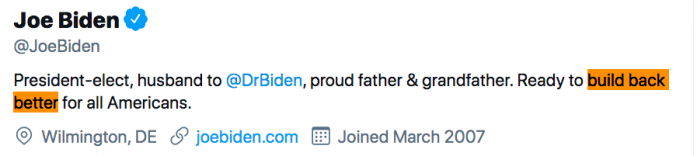
While President Putin stressed at the summit that the main danger to the world is unemployment, poverty, and economic depression of unprecedented scale, other speakers gave the impression that they were satisfied with the current situation, because it allows everything to be rebuilt. Build back better, is the slogan of Joe Biden:
For some, Covid is a plague, but for our leaders it is an Overton window. I’d advise them to eat a slice of lemon before speaking. This, of course, will not help against Covid, but at least it will wipe the blissful smiles off their faces. (“Eat a slice of lemon before speaking”, was advice given to a lady who complained of getting too much male attention in Italy).
The Chinese leader Xi proposed introducing worldwide QR codes so that without them people could not irresponsibly roam the planet. Nobody objected, but they did not support this initiative either. Xi is afraid that the wily Westerners will impose their own sanitary passports allowing only people injected with Western vaccines to travel. This possibility worried Putin, too, as Russia has developed two or three of their own vaccines. If the Chinese and Russian vaccines aren’t recognised by Europe, their people won’t be able to travel.
The WHO fancied that this virus was not the last; there will be more pandemics, and only vaccinations, masks and generous contributions to its budget will save us. They also promised a new wave of Covid in January, and then another, and so on until the earth will be covered with vaccines. To help poor countries, the leaders declared that the repayment of debts may be postponed, and that vaccines will be supplied to the impecunious nations for free. Free for them, but you will pay for them. (Not that they need it. Poor countries do not suffer of Covid. China’s neighbour Mongolia, despite open border with China, had no Covid. Poor Cambodia, ditto. Africa, none, excepting South Africa. )
The EU representatives called for Global Rebuilding – Build Back Better. That is, we will rebuild everything, but better and in way which is inclusive, green, sustainable. And much more expensive. And at your expense. The struggle for the climate is austerity under another name; it calls for a radical drop in living standards. We shall tighten our belts, and we will regret that Covid did not relieve us from unnecessary torment.
In past forums, Trump has constantly spoken out against the fight against warming, but this time he resigned himself. And his likely successor, Joe Biden, has already pledged to return America to how it was with the WHO and the Paris climate agreement.
So the worldwide rebuilding, perestroika seems to be as inevitable as Gorbachev’s in 1986. The Russian perestroika killed more people than Stalin’s Gulag; it destroyed the livelihood of millions. The wealth of the Russian people has been looted by Messrs Abramovich, Deripaska et al. From the earliest days of these changes, a minority of Russians weren’t optimistic about the outcome, but they were marginalised and their voices were silenced. Now the same is in store for the disaffected and dissidents – if all 20G take this disastrous route, this is well-nigh unavoidable. I do not know what is worse, the Covid lockdown or climate austerity, but there is no need to decide for we shall have both.
A few numbers regarding climate austerity. The Russian perestroika reduced CO2 emissions by 5 per cent year after year for ten years. The Great Depression was even better: a 10 per cent drop in emissions year after year. Millions of Americans died (The Grapes of Wrath), and nobody told them they were saving the planet. Optimistic researchers with the Global Carbon Project say the emissions should be cut by 5.5 per cent per year over the next 45 years. This is a deadly collapse; what we have now is a preview of what they have in store for us and our children. (You can check the numbers here).
The Chinese do not mind this, as they do not mind lockdowns, face recognition and social rating. Their popular film The Wandering Earth shows a world that fights global warming the Chinese way and depicts a future so grim that 1984 looks Utopian beside it. Even so it was still considered a positive and encouraging film by the Chinese audience. We should not accept Chinese methods of fighting diseases or climate change or indeed general governance. They are too different.
If they insist on fighting global warming, let us begin with them personally. Let Gore and Greta and their followers live ecologically on average salary. It is not difficult to live green if you are a millionaire. Do it on the average income. After you pay electricity, water, rates, transport, school you won’t even think of paying much more for making your car “green” and CO2-neutral. You’d be happy to survive as it is. I’d make it a law: every green activist should surrender his assets for safekeeping and manage his green life on the average income for at least one year.
The summit called for further digitalisation, for increased information flows across borders, for a combination of distance learning with conventional learning. Perhaps some digitalisation is unavoidable, but do we need more of it? We need more freedom, and digitalisation appears to be strongly repressive. It is a good tool for tyranny. Any tyrant of old, be it Hitler or Borgia, would be able to achieve much more in union with Zuckerberg. We need to stop the data giants, tax them to the hilt, make their life miserable, change their CEO by users’ vote at least once a year.
Distance schooling is probably the worst innovation of its kind. And rich folks know it well. In New York, the public schools were barred, but private schools operated normally all right, because distance schooling is no better than learning by watching telly. It also kills social fabrics and habits, making children boorish and unable to communicate. It is unnecessary, for children practically do not suffer of Covid. The main reason of going distant is to make our children even more stupid than they are likely to become anyway after watching YouTube. Another reason is to make them asocial and unable to act together against their betters. It should be outright forbidden, not encouraged.
A detailed declaration was prepared and drawn up before the summit and confirmed by the leaders. It also contains approval of the previous March declaration which began the triumphant march of lockdowns around the world.
Of course, the summit did not make binding decisions – only declarative ones, but they were detailed and unambiguous. Vaccinations, a perpetual fight against pandemics, smoothly turning into a fight against global warming, more austerity accompanied by QR codes on a global scale. What we have is what we shall have, this is what they decided. Masks are now and forever:

The leaders agreed to strengthen the WTO (the United States will return to as it was before under Biden) and strive to create a unified global tax system. The IMF (International Monetary Fund) will be at the centre of efforts to coordinate cryptocurrencies in relation to debtor countries, banks and other financial institutions. Some analysts were expecting a departure from the dollar as a reserve currency, but this has not yet been debated.
In the ongoing discussion between liberal globalism and nationalism, the G20 went for globalism and liberalism on steroids. Though President Trump still hopes to conclude the elections in his favour, the G20 already went the Biden way. It is difficult to understand, as the WTO, IMF, WHO are universally disliked by Russians, Americans and many Europeans, too. This is a sad and discomforting decision.
Humanity has made a big step towards unity at this summit. I am not sure it is worth rejoicing. Disagreement is a dangerous thing and leads to wars, but unanimity can be even more dangerous if it is the unanimity of experts and not peoples.
A comforting thought before you despair: declarations of unity were adopted earlier, in particular, when the League of Nations and the UN were created, but then disagreements took over, and a blessed diversity of opinions came back. I do not think we are ripe for that much of unity.
Israel Shamir can be reached at adam@israelshamir.net
The Great Pretext… for Dystopia
In their World Economic Forum treatise Covid-19: The Great Reset, economists Klaus Schwab and Thierry Malleret bring us the voice of would-be Global Governance.

Viewing the virtual-reality film “Collisions” at a session of the World Economic Forum in Davos, Switzerland, January 2016. (World Economic Forum, Flickr, CC BY-NC-SA 2.0)
By Diana Johnstone | Consortium News | November 24, 2020
By titling their recently published World Economic Forum treatise Covid-19: The Great Reset, the authors link the pandemic to their futuristic proposals in ways bound to be met with a chorus of “Aha!”s. In the current atmosphere of confusion and distrust, the glee with which economists Klaus Schwab and Thierry Malleret greet the pandemic as harbinger of their proposed socioeconomic upheaval suggests that if Covid-19 hadn’t come along by accident, they would have created it (had they been able).
In fact, World Economic Forum founder Schwab was already energetically hyping the Great Reset, using climate change as the triggering crisis, before the latest coronavirus outbreak provided him with an even more immediate pretext for touting his plans to remake the world.
The authors start right in by proclaiming that “the world as we knew it in the early months of 2020 is no more,” that radical changes will shape a “new normal.” We ourselves will be transformed. “Many of our beliefs and assumptions about what the world could or should look like will be shattered in the process.”
Throughout the book, the authors seem to gloat over the presumed effects of widespread “fear” of the virus, which is supposed to condition people to desire the radical changes they envisage. They employ technocratic psychobabble to announce that the pandemic is already transforming the human mentality to conform to the new reality they consider inevitable.
“Our lingering and possibly lasting fear of being infected with a virus … will thus speed the relentless march of automation…” Really?
“The pandemic may increase our anxiety about sitting in an enclosed space with complete strangers, and many people may decide that staying home to watch the latest movie or opera is the wisest option.”
“There are other first round effects that are much easier to anticipate. Cleanliness is one of them. The pandemic will certainly heighten our focus on hygiene. A new obsession with cleanliness will particularly entail the creation of new forms of packaging. We will be encouraged not to touch the products we buy. Simple pleasures like smelling a melon or squeezing a fruit will be frowned upon and may even become a thing of the past.”
This is the voice of would-be Global Governance. From on high, experts decide what the masses ought to want, and twist the alleged popular wishes to fit the profit-making schemes they are peddling. Their schemes center on digital innovation, massive automation using “artificial intelligence,” finally even “improving” human beings by endowing them artificially with some of the attributes of robots: such as problem-solving devoid of ethical distractions.
Engineer-economist Klaus Schwab, born in Ravensburg, Germany, in 1938, founded his World Economic Forum in 1971, attracting massive sponsorship from international corporations. It meets once a year in Davos, Switzerland – last time in January 2020 and next year in May, delayed because of Covid-19.
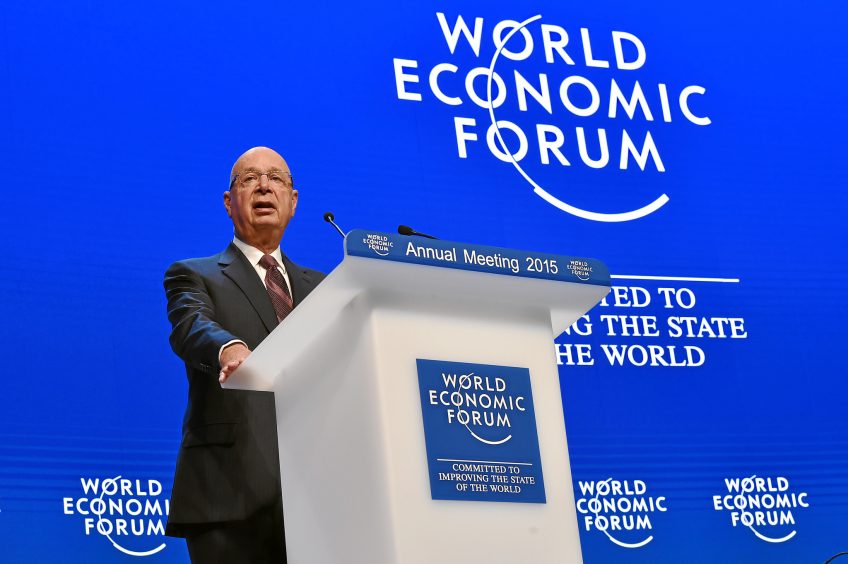
Klaus Schwab, founder and executive chairman, World Economic Forum, on Jan. 21, 2015. (World Economic Forum, Flickr, CC BY-NC-SA 2.0)
A Powerful Lobby
What is it, exactly? I would describe the WEF as a combination capitalist consulting firm and gigantic lobby. The futuristic predictions are designed to guide investors into profitable areas in what Schwab calls “the Fourth Industrial Revolution (4IR)” and then, as the areas are defined, to put pressure on governments to support such investments by way of subsidies, tax breaks, procurement, regulations and legislation. In short, the WEF is the lobby for new technologies, digital everything, artificial intelligence, transhumanism.
It is powerful today because it is operating in an environment of State Capitalism, where the role of the State (especially in the United States, less so in Europe) has been largely reduced to responding positively to the demands of such lobbies, especially the financial sector. Immunized by campaign donations from the obscure wishes of ordinary people, most of today’s politicians practically need the guidance of lobbies such as the WEF to tell them what to do.
In the 20th century, notably in the New Deal, the government was under pressure from conflicting interests. The economic success of the armaments industry during World War II gave birth to a Military-Industrial Complex, which has become a permanent structural factor in the U.S. economy.
It is the dominant role of the MIC and its resulting lobbies that have definitively transformed the nation into State Capitalism rather than a Republic.
The proof of this transformation is the unanimity with which Congress never balks at approving grotesquely inflated military budgets. The MIC has spawned media and Think Tanks which ceaselessly indoctrinate the public in the existential need to keep pouring the nation’s wealth into weapons of war. Insofar as voters do not agree, they can find no means of political expression with elections monopolized by two pro-MIC parties.
The WEF can be seen as analogous to the MIC. It intends to engage governments and opinion manufacturers in the promotion of a “4IR” which will dominate the civilian economy and civilian life itself.
The pandemic is a temporary pretext; the need to “protect the environment” will be the more sustainable pretext. Just as the MIC is presented as absolutely necessary to “protect our freedoms,” the 4IR will be hailed as absolutely necessary to “save the environment” – and in both cases, many of the measures advocated will have the opposite effect.

Public street art on 6th Street in Austin, Texas, depicting the impact of Covid-19 closings. (Leah Rodgers, CC BY 4.0, Wikimedia Commons)
So far, the techno-tyranny of Schwab’s 4IR has not quite won its place in U.S. State Capitalism. But its prospects are looking good. Silicon Valley contributed heavily to the Joe Biden campaign, and Biden hastened to appoint its moguls to his transition team.
But the real danger of all power going to the Reset lies not with what is there, but with what is not there: any serious political opposition.
Can Democracy Be Restored?
The Great Reset has a boulevard open to it for the simple reason that there is nothing in its way. No widespread awareness of the issues, no effective popular political organization, nothing. Schwab’s dystopia is frightening simply for that reason.
The 2020 presidential election has just illustrated the almost total depoliticization of the American people. That may sound odd considering the violent partisan emotions displayed. But it was all much ado about nothing.
There were no real issues debated, no serious political questions raised either about war or about the directions of future economic development. The vicious quarrels were about persons, not policy. Bumbling Trump was accused of being “Hitler,” and Wall Street-beholden Democrat warhawks were described by Trumpists as “socialists.” Lies, insults and confusion prevailed.
A revival of democracy could stem from organized, concentrated study of the issues raised by the Davos planners, in order to arouse an informed public opinion to evaluate which technical innovations are socially acceptable and which are not.
Cries of alarm from the margins will not influence the intellectual relationship of forces. What is needed is for people to get together everywhere to study the issues and develop well-reasoned opinions on goals and methods of future development.
Unless faced with informed and precise critiques, Silicon Valley and its corporate and financial allies will simply proceed in doing whatever they imagine they can do, whatever the social effects.
Serious evaluation should draw distinctions between potentially beneficial and unwelcome innovations, to prevent popular notions from being used to gain acceptance of every “technological advance,” however ominous.
Redefining Issues
The political distinctions between left and right, between Republican and Democrat, have grown more impassioned just as they reveal themselves to be incoherent, distorted and irrelevant, based more on ideological bias than on facts. New and more fruitful political alignments could be built through confrontation with specific concrete issues.
We could take the proposals of the Great Reset one by one and examine them in both pragmatic and ethical terms.

(Bob Mical, Flickr, CC BY-NC-SA 2.0)
No. 1 – Thanks to the pandemic, there has been a great increase in the use of teleconferences, using Skype, Zoom or other new platforms. The WEF welcomes this as a trend. Is it bad for that reason? To be fair, this innovation is positive in enabling many people to attend conferences without the expense, trouble and environmental cost of air travel. It has the negative side of preventing direct human contact. This is a simple issue, where positive points seem to prevail.
No. 2 – Should higher education go online, with professors giving courses to students via internet? This is a vastly more complicated question, which should be thoroughly discussed by educational institutions themselves and the communities they serve, weighing the pros and cons, remembering that those who provide the technology want to sell it, and care little about the value of human contact in education – not only human contact between student and professor, but often life-determining contacts between students themselves. Online courses may benefit geographically isolated students, but breaking up the educational community would be a major step toward the destruction of human community altogether.
No. 3 – Health and “well-being”. Here is where the discussion should heat up considerably. According to Schwab and Malleret: “Three industries in particular will flourish (in the aggregate) in the post-pandemic era: big tech, health and wellness.” For the Davos planners, the three merge.
Those who think that well-being is largely self-generated, dependent on attitudes, activity and lifestyle choices, miss the point. “The combination of AI [artificial intelligence], the IoT [internet of things] and sensors and wearable technology will produce new insights into personal well-being. They will model how we are and feel […] precise information on our carbon footprints, our impact on biodiversity, on the toxicity of all the ingredients we consume and the environments or spatial contexts in which we evolve will generate significant progress in terms of our awareness of collective and individual well-being.”
Question: do we really want or need all this cybernetic narcissism? Can’t we just enjoy life by helping a friend, stroking a cat, reading a book, listening to Bach or watching a sunset? We better make up our minds before they make over our minds.
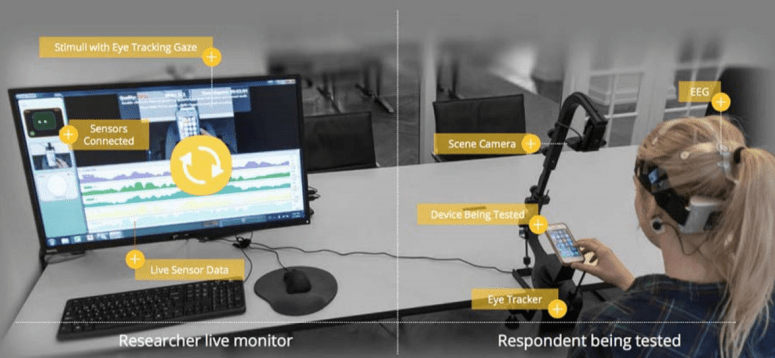
User being monitored in a biometrics lab. (Grish068, CC BY-SA 4.0, Wikimedia Commons)
No. 4 – Food. In order not to spoil my healthy appetite, I’ll skip over this. The tech wizards would like to phase out farmers, with all their dirty soil and animals, and industrially manufacture enhanced artificial foods created in nice clean labs – out of what exactly?
The Central Issue: Homo Faber
No. 5 – What about human work?
“In all likelihood, the recession induced by the pandemic will trigger a sharp increase in labor-substitution, meaning that physical labor will be replaced by robots and ‘intelligent’ machines, which will in turn provoke lasting and structural changes in the labor market.”
This replacement has already been underway for decades. Along with outsourcing and immigration, it has already weakened the collective power of labor. But clearly, the tech industries are poised to go much, much further and faster in throwing humans out of work.
The Covid-19 crisis and social distancing have “suddenly accelerated this process of innovation and technological change. Chatbots, which often use the same voice recognition technology behind Amazon’s Alexa, and other software that can replace tasks normally performed by human employees, are being rapidly introduced. These innovations provoked by necessity (i.e. sanitary measures) will soon result in hundreds of thousands, and potentially millions, of job losses.”
Cutting labor costs has long been the guiding motive of these innovations, along with the internal dynamic of technology industry to “do whatever it can do.” Then socially beneficial pretexts are devised in justification. Like this:
“As consumers may prefer automated services to face-to-face interactions for some time to come, what is currently happening with call centers will inevitably occur in other sectors as well.”
“Consumers may prefer…”! Everyone I know complains of the exasperation of trying to reach the bank or insurance company to explain an emergency, and instead to be confronted with a dead voice and a choice of irrelevant numbers to click. Perhaps I am underestimating the degree of hostility toward our fellow humans that now pervades society, but my impression is that there is a vast unexpressed public demand for LESS automated services and MORE contact with real persons who can think outside the algorithm and can actually UNDERSTAND the problem, not simply cough up preprogrammed fixes.
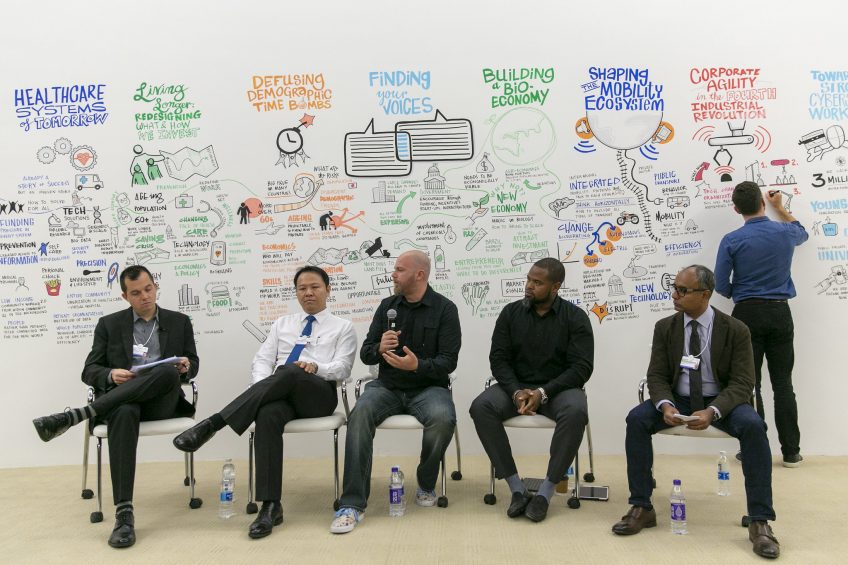
“Corporate agility in the Fourth Industrial Revolution” session held in Tianjin,China, September 2018. (World Economic Forum, Faruk Pinjo, CC BY-NC-SA 2.0)
There is a potential movement out there. But we hear nothing of it, being persuaded by our media that the greatest problem facing people in their daily lives is to hear someone exhibit confusion over someone else’s confused gender.
In this, I maintain, consumer demand would merge with the desperate need of able-minded human beings to earn a living. The technocrats earn theirs handsomely by eliminating the means to earn a living of other people.
Here is one of their great ideas. “In cities as varied as Hangzhou, Washington DC and Tel Aviv, efforts are under way to move from pilot programs to large-scale operations capable of putting an army of delivery robots on the road and in the air.” What a great alternative to paying human deliverers a living wage!
And incidentally, a guy riding a delivery bicycle is using renewable energy. But all those robots and drones? Batteries, batteries and more batteries, made of what materials, coming from where and manufactured how? By more robots? Where is the energy coming from to replace not only fossil fuels, but also human physical effort?
At the last Davos meeting, Israeli intellectual Yuval Harari issued a dire warning that:
“Whereas in the past, humans had to struggle against exploitation, in the twenty-first century the really big struggle will be against irrelevance… Those who fail in the struggle against irrelevance would constitute a new ‘useless class’ – not from the viewpoint of their friends and family, but useless from the viewpoint of the economic and political system. And this useless class will be separated by an ever-growing gap from the ever more powerful elite.”
No. 5 – And the military. Our capitalist prophets of doom foresee the semi-collapse of civil aviation and the aeronautical industry as people all decide to stay home glued to their screens. But not to worry!
“This makes the defense aerospace sector an exception and a relatively safe haven.” For capital investment, that is. Instead of vacations on sunny beaches, we can look forward to space wars. It may happen sooner rather than later, because, as the Brookings Institution concludes in a 2018 report on “How artificial intelligence is transforming the world,” everything is going faster, including war:
“The big data analytics associated with AI will profoundly affect intelligence analysis, as massive amounts of data are sifted in near real time … thereby providing commanders and their staffs a level of intelligence analysis and productivity heretofore unseen. Command and control will similarly be affected as human commanders delegate certain routine, and in special circumstances, key decisions to AI platforms, reducing dramatically the time associated with the decision and subsequent action.”
So, no danger that some soft-hearted officer will hesitate to start World War III because of a sentimental attachment to humanity. When the AI platform sees an opportunity, go for it!
“In the end, warfare is a time competitive process, where the side able to decide the fastest and move most quickly to execution will generally prevail. Indeed, artificially intelligent intelligence systems, tied to AI-assisted command and control systems, can move decision support and decision-making to a speed vastly superior to the speeds of the traditional means of waging war. So fast will be this process especially if coupled to automatic decisions to launch artificially intelligent autonomous weapons systems capable of lethal outcomes, that a new term has been coined specifically to embrace the speed at which war will be waged: hyperwar.”
Americans have a choice. Either continue to quarrel over trivialities or wake up, really wake up, to the reality being planned and do something about it.
The future is shaped by investment choices. Not by naughty speech, not even by elections, but by investment choices. For the people to regain power, they must reassert their command over how and for what purposes capital is invested.
And if private capital balks, it must be socialized. This is the only revolution – and it is also the only conservatism, the only way to conserve decent human life. It is what real politics is about.
Diana Johnstone lives in Paris. Her latest book is Circle in the Darkness: Memoirs of a World Watcher and is also the author of Fools’ Crusade: Yugoslavia, NATO, and Western Delusions. Her lates book is Queen of Chaos: the Misadventures of Hillary Clinton. The memoirs of Diana Johnstone’s father Paul H. Johnstone, From MAD to Madness, was published by Clarity Press, with her commentary. She can be reached at diana.johnstone@wanadoo.fr .
The Thanksgiving Rebellion of 2020
By Jeffrey A. Tucker | American Institute for Economic Research | November 25, 2020
The Centers for Disease Control warned us not to travel or meet in multigenerational gatherings during Thanksgiving. Which is to say: government tried to make Thanksgiving, probably the most iconic of all American holidays, practically disappear from the calendar this year.
They didn’t put it that way exactly. Thanksgiving is not canceled but merely “postponed” — a strange thing to say about a holiday that has a fixed day of the year and surely the one that most means “family” to people.
What they said was you need to go through a 7-point checklist that most everyone would fail. You have to check local cases (never mind that cases aren’t deaths and cases might not even be cases), check hospital capacity as if you will be stricken down like in the movie Contagion and thereby be turned away at the door, observe local quarantine rules that bespot the whole country, do not travel with someone not in your household, make sure no old people will be at the gathering, make sure never to get closer than 6 feet to another human being, and…OK this is all ridiculous. It’s fear porn, distributed by “science.”
And it’s true that our airports are getting scarier by the day with all the convoluted quarantine rules. Imagine showing up back home and knowing that you are barred from even so much as visiting a convenience store. Plus people really do not know the rules because they change by the day and hour.
The governor of Washington State proclaimed that “Gatherings have grave consequences right now.” (He was obsequious and deferential toward mass protests in June: BLM = good; Thanksgiving = bad.)
The governor of Vermont has pledged to interview any student coming back to school about whether they had gatherings outside their home. If so, they get thrown out for two weeks. Probably the track-and-trace machinery will go into place.
In Texas, the health department ran ads all over radio claiming that something as innocent as a small birthday party will spread the coronavirus, based on a now-famous case in which no one was either hospitalized or died but all got immunities.
The ads even deployed the voices of young children (“we feel guilty for gathering”) bemoaning that they got the dreaded disease which in fact has an infinitesimally small to nonexistent risk to children.
And so on it goes, the entire country pounded with anti-Thanksgiving propaganda via every public messaging source. On an 80s-style radio station in Texas, one I heard while driving, the music all proclaimed the glories of parties, dancing, defying authority, standing up against evil, taking big risks, and living large. But the ad breaks hectored people to stay home and stay safe and not have any fun. The contrast was striking, to say the least.
This bureaucratic hydra of federal, state, and local governments tried to delete Thanksgiving. And this is at a time of unprecedented sadness and depression when people are most in need of family and companionship. This is absolutely cruel.
What the heck has become of us? Well, Americans being Americans, they rebelled.
“According to the American Automobile Association,” writes Jason Riley, “there could be as many as 50 million Thanksgiving travelers this year, only 10% less than in 2019.” I saw the same at the two airports I visited. They were about 75% as busy as the old days but still bustling. Rental cars were in high demand. Americans will not be locked down on Thanksgiving.
Riley further writes:
This is a form of mass civil disobedience like nothing the country has seen since the 1960s. Some of it is born of Covid fatigue, to be sure. But the endless parade of politicians flouting their own rules surely has also played a role. It began shortly after the spring lockdowns and if anything has become more commonplace, even farcical.
Riley points out that the politicians themselves do not follow their own ridiculous rules. Like the Soviet apparatchiks of old, they believe that the theater of dictatorial compliance is for the worker and peasants but not for themselves. The “vanguard of the proletariat” has a special exemption from the rules they make for others.
They live well. Everyone else: line up at the food bank.
There is a reason why so many Americans are not buying it anymore. It’s become rather obvious that this is less about health and science than it is about social/economic/political control, regardless of the costs.
This becomes obvious once you see through the incredibly foggy blizzard of data, studies, official pronouncements, and furrowed-browed scientists Skyping into network news shows. The real underlying story here is that lots of people in powerful positions believe that they should be in charge of your life and know better how to make choices over health and safety than you do.
Once you see it this way, you stop being intimidated by their alleged authority and experience and start living your life again. After all, it is not the case that the governments have special access to health wisdom that is denied to you and yours. By now, you have read the risks, seen the problems with the posture of certainty of the supposed experts, and observed the way they utterly fail to consider the downsides of shutting businesses, schools, sports, and the arts.
Consider the following editorial in one of three of the world’s most prestigious medical journals, the Lancet in the UK. The article pits Martin Kulldorff of the Great Barrington Declaration against Massachusetts General Hospital’s Rochelle Walensky. Martin points to the carnage of lockdowns and a more humane solution to the presence of disease. Walensky’s entire argument against basic exercise of public health of the past is as follows:
“The Great Barrington Declaration is predicated on the idea that you know who is going to get sick and you can somehow isolate and protect them, but there is absolutely no evidence that we can do this”, she said. She pointed out that the US Centers for Disease Control and Prevention estimates that up to 40% of Americans have some kind of co-morbidity that makes them vulnerable to the ravages of COVID-19. Identifying all these people is not straightforward. “No-one is suggesting that lockdowns should be the default position. They are a last resort. But if we just let the virus run free without mitigation strategies, such as masking, our hospitals will overflow and that would mean we would no longer be able to take care of the population’s health across the board.”
Notice her insistence that “we” cannot achieve intelligent risk assessment of the population. By we, she means experts such as herself. And she is right! They cannot. And that’s the whole point. That needs to be left to individuals. Central planning does not work for all the reasons that F.A. Hayek explained: the necessary knowledge to make intelligent decisions is decentralized and not available in useful forms for elite overseers or anyone else.
As for lockdowns as a last resort, please: they were used as a first resort in the presence of a virus that turned out to be far less severe than the models predicted. It is barely a disease at all for large swaths of the population. The fatality demographics are overwhelmingly concentrated on a low-life-expectancy population in a world where people are living longer than ever. The average age of death from Covid exceeds average life spans.
Then finally we get the invocation of the overflow problem. Hospitals cannot scale, she alleges. Why? Restaurants, bars, stores, office buildings, and supply and demand for a billion other things scales just fine. It’s a matter of increasing supply to match increased demand – a core economic problem and answer. Why does this not apply to medical services too?
Do you see what is going on here? We have a medical doctor who is pronouncing on economics and she doesn’t even know it. She sums up the problem we have had this entire year. Many health officials have stepped outside their role to become central planners of the entire society and economy. They never explained why people should grant them this power. They just took it for themselves by intimidating fearful and ignorant politicians to do their bidding.
With all due respect to the good doctor, I would translate her statement to the Lancet as follows: “You people out there are too stupid, fat, and unhealthy to be in charge of your lives; that’s where I come in!”
And the carnage is everywhere. I had hoped when I came to Texas to find a society that had long ago gone back to normal. What I find instead is heartbreaking. In this town, half the local businesses seem to be boarded up. The one movie theater for the whole county is bankrupt and closed. Most of the independently owned shops are dead. The shopping mall is barely surviving, and the masked employees are demoralized and seeing their doom.
Who survives? The big-box chain stores in town. Wal-Mart seems fine and so does Home Depot. These companies are well-capitalized enough to survive. I’m glad for them but there is something unjust about all of this. The lockdowns benefited elites at the expense of everyone else.
This small and wonderful town is now sad and broken – thanks to people like Dr. Walensky who undoubtedly had the best of intentions. She lives in Boston. I’m right now in rural Texas. The people who surround me have had their lives shattered by her and her fellow intellectuals who bear no real consequence for being wrong.
So, yes, she is correct that she does not have the capacity to know who is vulnerable and who is not. No one knows that with certainty. The solution is not to lock the whole of society down until the virus magically goes away. That is not public health. That is an unprecedented imposition of top-down brutalism.
The battle over lockdowns and public health is the struggle of our lives, the greatest crisis in generations. But the problems and solutions are not different from the ones that have consumed intellectuals for centuries. What institutions better manage society in good times and in bad: governments (run by experts, with power and resources) or free people acting with intelligence and creativity as best they can? One might have supposed we had the answer to this question already. But human beings forget. Then the tragic lessons have to be learned all over again.
Electric Car Charging–A Dose Of Reality
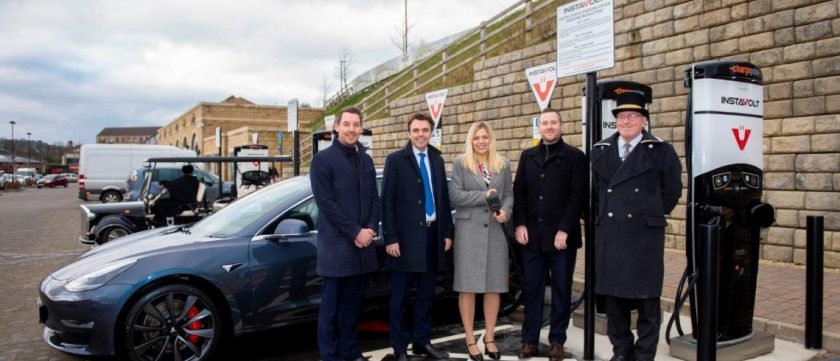
Fox Valley Electric Car Charging Bays
By Paul Homewood | Not A Lot Of People Know That | November 25, 2020
I have been doing a bit of digging into the EV chargers at our local shopping centre, which were installed last year.
They are run by a company called InstaVolt, whose Annual Accounts are here. The latest Accounts are for March 2019.
They show that they had 314 units installed at that date, with a Gross Asset value of £5.5m. This works out at an average of about £18,000 each. They all appear to be 50KW units, although there are plans to introduce higher power ones.
It is not clear who paid for the new substation (which you can just see to the right of that white van). But I would assume that must belong to the shopping centre, who will of course recover the cost via rental charges. That would of course significantly increase that figure of £18000, if all capital costs were taken into account.
Given that hardly anybody has an electric car, the finances of InstaVolt are unsurprisingly dire!
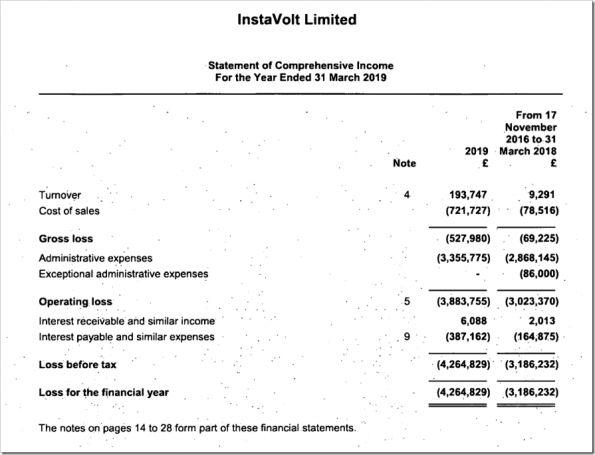
They are funded by an equity investment of £18m from Zouk Capital, an investment fund that specialises in renewable projects. At the current rate of loss, that equity will be wiped out in a couple of years.
Up to now, a lot of car chargers at the likes of Tesco have been free to use, a way of increasing footfall. However, at Tesco at least, these have all been slow 7KW chargers, the sort you would put in your garage at a cost of £1000.
An hour’s charge on one of these would cost around a quid, so they would make good business sense if they bring in customers who might spend £50.
However, 7KW chargers will be far too slow once there are millions of EVs on the road. You certainly would not be able to turn up at Tesco and leave your car there all day, if you had nowhere else to charge it.
Consequently Tesco are now beginning to introduce faster 22 and 50KW chargers. But these are “priced in line with market rates”, probably similar to the 35p/KWh charged by InstaVolt.
There is simply no way Tesco could give away £10 of electricity free to every customer. Nor could they afford to spend £20K for every charger installed. A typical Tesco supermarket with, say, 10 chargers would cost £200K.
The bottom line to all of this?
The free ride is over for EV owners. If you cannot charge at home, you will have to pay through the nose.
The same of course will apply to chargers run by local councils and other public bodies. They might be able to afford free power for the tiny number of EVs currently, but costs will soon balloon once numbers grow.
There is also an important warning here as well. There will be very few investors with either the will or the money to incur the sort of losses which InstaVolt have.
As a result we are unlikely to get the millions of public chargers needed until we have millions of electric cars on the road.
Chicken and egg, I think!
Which brings us back to the question of who will pay for them.
Boris’10-Point Plan pledges £1.3bn for charging infrastructure, but most of this appears to be for the 6000 high-powered chargers promised for motorways and trunk roads. (I would guess we are looking at at least £100,000 each, plus associated infrastructure. I have seen costs of £250,000 for the really fast chargers)

It is hard to see much money left over for local chargers. A million 50KW chargers, which is probably the minimum we would need, would cost at least £20bn, even before we count the cost of digging up roads and upgrading power cables.
Who will pay for that?
Khamenei: Sanctions crime of US, European partners against Iran
Press TV | November 24, 2020
Leader of the Islamic Revolution Ayatollah Seyyed Ali Khamenei has described the illegal sanctions the United States has imposed on Iran with the support of its European partners as a “bitter reality” and a “crime” against the nation.
Ayatollah Khamenei made the remarks on Tuesday during a meeting of the Supreme Council for Economic Coordination among the three branches of the Iranian government.
The Leader said the Iranian nation has been subjected to such a crime for many years, but that the sanctions have been stepped up over the past three years under the current US administration.
Ayatollah Khamenei said there are two ways to end the restrictions, either by “neutralizing the sanctions and overcoming them” or having “the bans removed.”
“Of course, we tried the path of [having] the sanctions lifted once and negotiated for several years [to that effect], but it produced no results,” he added.
Referring to the other solution, the Leader said, “This path may have difficulties at the beginning, but there will be a positive outcome.”
Ayatollah Khamenei said, “We have a lot of potential and capabilities to render the sanctions ineffective, provided that we muster the will, strive and meet the challenges outright.”
“If we manage to overcome the sanctions through [our own] efforts and initiatives while holding firm against the problems, the other side will gradually lift the bans since it will see their ineffectiveness,” the Leader added.
The Leader further urged Iranians not to rely on aid from abroad to resolve domestic problems.
“The situation of the United States is far from clear and the Europeans are constantly adopting positions against Iran,” the Leader said. “They tell us not to interfere in the region, whereas it is them who are interfering the most wrongly in the affairs of the region, with Britain and France possessing destructive nuclear missiles and Germany being on the same path. Then they tell us not to have missiles.”
If the ‘Great Reset’ really is so good for us, let’s hold a referendum on it, so it can have a democratic mandate (or not)
By Neil Clark | RT | November 20, 2020
The World Economic Forum’s ‘Great Reset’ and associated Fourth Industrial Revolution would, if implemented, mean far deeper changes to our everyday lives than Brexit, yet is being pushed through without any proper debate.
Compare and contrast. On the issue of whether Britain should leave the EU we’ve had:
- A national referendum.
- Four years of debates in Parliament on how/when/under what conditions we should leave.
In fact, for the period May 2016 until March 2020, it seemed MPs were talking about nothing else.
No one can say that Brexit, if it indeed finally happens at the end of this year, hasn’t been properly discussed, or that it hasn’t had democratic endorsement. The ‘Leave’ side won the referendum vote and then in 2019 the Tory government was re-elected on the promise of ‘Get Brexit Done’. Traditional ‘Red Wall’ Labour seats went Tory for the first time in 2019 largely because of Brexit.
Contrast this with the Great Reset/Fourth Industrial Revolution. The UK government, like many others in the West, is clearly trying to implement the Klaus Schwab/WEF programme, under the guise of fighting a virus, but unlike Brexit, not only is there no public vote, there is not even a debate.
How can this be right? The Great Reset/4IR (and the closely linked UN 2030 Agenda) represents not only the most radical changes ever proposed in our lifetimes, but the most radical changes to everyday life IN HISTORY.
The Great Reset/4IR is actually about redefining what it means to be human.
For centuries, it has been accepted that man is a social animal. That meeting up with other people is good for us. That we have certain freedoms which are inalienable. But the Great Reset/4IR threatens all of this.
Klaus Schwab says “What the fourth industrial revolution will lead to is a fusion of our physical, digital and biological identity.”
Wow. A fusion of our physical, digital and biological identity. That’s Transhumanism. Cyborgs. I Robot. That represents a slightly bigger change to our lives than anything argued about in the Brexit negotiations.
So will the abolition of private property, except for a privileged few. The WEF predicts that by 2030, “You’ll own nothing. And you’ll be happy.”
Is this what the public really wants? Ditto a ‘cashless society’? Humans have been using cash banknotes and coins for millennia, now we’re told they have to go. The civil liberties repercussions of a cashless society are truly terrifying as they mean anyone can be ‘cut off’ from the system for non-compliance. Eliminate cash, and you eliminate freedom.
Then there are the draconian changes to our lives on the grounds of ‘sustainability’. The Conservatives had pledged to ban the sale of diesel and petrol cars from 2040. But this week, Prime Minister Johnson, again without any public debate, brought the date forward to 2030. Again, where’s the democracy here?
The Great Reset/4IR means that the golden age of travel for ordinary people will be at an end. The WEF has been promoting digital health passes raising the very real prospect that only those who have had Covid-19 vaccines or negative test results would be able to leave their country, or indeed attend a sporting or cultural event.
Combine that with the collapse of the airline industry, the mass closure of all but the most expensive hotels, the end of cheaper petrol-fuelled cars and the advent of ‘smart’ motorways where access can easily be restricted, and most people will be stuck in their homes. But not, of course, Davos Man. Davos Man doesn’t use Easy Jet. Davos Man uses Private Jet. He’ll still be flying to Switzerland to elite conferences where fellow billionaires discuss further how they can use hi-tech methods to restrict the travel of everyone else, to ‘save the planet’.
What life would be like in Britain under the Great Reset was laid out for us in Boris Johnson’s ‘socially distanced’ speech to the Tory Party Conference in October.
It was an oration which could easily have been written by Klaus Schwab. “From internet shopping to working from home, it looks as though Covid has massively accelerated changes in the world of work… as old jobs are lost and as new jobs are created… The Covid crisis is a catalyst for change,” Johnson enthused.
Previous generations were told that the world was their oyster, but under the Great Reset, horizons are much narrower. “Instead of being dragged on big commutes to the city,” people can “start a business in their home town… and bring up their children in the neighbourhoods where they grew up themselves,” Johnson went on. But of course, the elites will still be moving around, it’s just the plebs who will be grounded.
The premise of the Great Reset is that there is absolutely no going back to the lives we enjoyed prior to March 2020. “The people assume we are just going back to the good old world which we had and everything will be normal again in how we are used to normal in the old fashioned. This is, let’s say, fiction, it will not happen, the cut which we have now is much too strong in order not to leave traces,” says Schwab.
Now of course, some people might like the idea of working permanently from home (that’s if they’re lucky enough to have a job), ordering everything they need online (to arrive by drone), having to have a continually updated digitalised health pass to go anywhere, owning nothing and having their biological, physical and digital identities ‘fused’, but shouldn’t they be consulted about it first?
And what about those of us who actually miss the ‘old-fashioned’ normal of mixing freely with people, of paying in cash, of driving petrol-fuelled cars wherever we want to go, and being in crowded pubs? Most of us care about the environment, but are suspicious that, like Covid-19, ‘sustainable development’ has become a Trojan Horse to introduce regressive changes to our lives that most definitely are not to our benefit.
A referendum on the Great Reset/Fourth Industrial Revolution is urgently needed so that the ‘Build Back Better’ brigade can put their case directly to the electorate. If what they are proposing really is so great, then what on earth are they frightened of?
Neil Clark is a journalist, writer, broadcaster and blogger. His award winning blog can be found at http://www.neilclark66.blogspot.com. He tweets on politics and world affairs @NeilClark66
Irish Scientists and Doctors Inveigh Against Lockdowns
By Amelia Janaskie | American Institute for Economic Research | November 19, 2020
A team of Irish medical and public health professionals recently published a White Paper entitled “COVID-19 Alternative Strategy: A Case for Health and Socioeconomic Wellbeing,” calling for an “evidence-based” approach to pandemic management. In the paper, the team provides a cost-benefit analysis of lockdowns and scrutinizes their overall efficacy while citing extensive supporting research. They find excessive costs associated with lockdowns compared to their intended benefits. The paper’s findings suggest that a second set of lockdown measures will be even more detrimental, especially given their hypothesis that the virus is transitioning from its initial epidemic stage to endemic stage.
The paper shows that testing and lockdown strategies are ineffective in lowering Covid-19 deaths. PCR tests are not reliable and tend to overestimate the number of people sick with Covid-19, which misinforms policy decisions. The 2020 mortality and virus-related hospitalization rates also do not deviate drastically from previous years, suggesting Covid-19 did not create a significant increase in mortality. In addition, they demonstrate that there is no correlation between lower mortality and more stringent lockdowns.
Although the authors suggest the idea of “Flatten the Curve” might have been a suitable strategy at first for the purpose of not overwhelming hospitals, they find that there are significant unintended consequences of lockdowns, especially regarding public health. The majority of Covid-19 deaths occur in people close to life expectancy, while lockdown-induced deaths occur in young people far from life expectancy, resulting in a high number of total life years lost. The authors cite various studies showing that children, adolescents, women, individuals with young children, and at-risk individuals are experiencing diminished mental health. They also report that cancer and cardiovascular deaths are increasing due to lockdowns because less people are receiving necessary screenings or going to hospitals.
In its conclusion, the White Paper recommends four overarching strategies consistent with the 2019 WHO and Irish pandemic guidelines, including the removal of lockdowns and a focused protection of the vulnerable. Overall, this paper is an impressive study on lockdowns and presents a mountain of evidence that demonstrates lockdowns are not only ineffective but harmful to people and must be stopped to maintain a healthy society.
Boris’s “Green Industrial Revolution” is Economic Lockdown, for ever…
The Global Warming Policy Forum | November 18, 2020
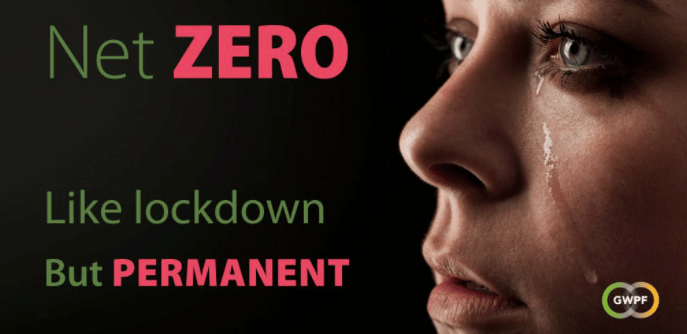
GWPF today described the Prime Minister’s 10 Point Plan for a ‘Green Industrial Revolution’ as shallow gesture politics, but a gesture with severely negative economic implications from day one into the foreseeable future.
And we know that this will happen because all previous attempts to create a viable green economy have failed.
In March 2009, the then Prime Minister Gordon Brown announced his Labour government’s ‘industrial strategy,’ a term the Conservatives have also adopted, promising to create 400,000 jobs. Brown’s words are strangely reminiscent of today’s announcement:
“I want to create a global ‘green new deal’ that will pave the way for a low carbon recovery and to help us build tomorrow’s green economy today.”
Twelve years later Britain has green industries that are still dependent on huge handouts, now totalling £10 billion a year — and building nearly all their green equipment overseas. The recent Seagreen offshore wind farm, for example, has awarded its contracts to two countries with cheap energy, the UAE and China, bitterly disappointing BiFab and other Scottish manufacturers. Green miracles just don’t happen.
Chairman Boris’s Great Leap Forward will also fail to deliver the goods because, like all “economic planning”, it is an incoherent utopian dream unconstrained by economic and physical realities and a mess of unaffordable and incompatible goals.
For example, meeting the absurd offshore wind target of an additional 30 GW of capacity (giving a total of 40 GW in 2030), will have a total capital cost of £120bn–£130 billion for wind farms and offshore transmission grid, nearly all that expenditure going to overseas companies, just as it did with Seagreen.
Paying for that investment and all ancillary costs related to it will put something £27 billion a year on the UK electricity bill, roughly double the wholesale market value of the entire UK electricity sector at present, with horrific implications for electricity prices by the end of the decade.
Those high electricity prices will render utterly unaffordable the Prime Minister’s proposals for heat pumps and electric vehicles. This will cause anger, not only because UK consumers will be confined to their freezing homes, but because many will have spent a fortune on realising the PM’s green utopia.
Heat pumps cost between £10,000 and £20,000 each to install, so the Prime Minister’s aim of installing 600,000 Ground Source Heat Pumps a year by 2028 implies an annual cost of between £60 billion and £100 billion a year.
Dr John Constable, GWPF energy editor, said:
“These over-reaching proposals are technically absurd, economically deluded and politically disastrous. Does the Prime Minister have any competent advisors? One wonders?”
Bolivians Face Major Post-Coup Struggles As Luis Arce Seeks Justice, Economic Reforms, Activist Says
By Demond Cureton – Sputnik – 17.11.2020
Bolivians are tasked with numerous challenges after successfully voting out the former Jeanine Anez coup government, who seized control last year in elections contested by opposition forces. The nation has entered a period of restructuring and healing following major political crises in recent months.
Miriam Amancay Colque, spokeswoman for the Bartolina Sisa Resistance movement in London, spoke to Sputnik about events in Bolivia following President Luis Arce and Vice-president David Choquehuanca’s victory in national elections.
SPUTNIK: Can you tell us about the current mood in Bolivia? How are people feeling after Luis Arce’s electoral victory?
Miriam Amancay Colque: The Bolivian people have regained their hope or, as we call it, their Ajayu, or their ‘soul’.
The victories of President Arce and Vice-president Choquehuanca mark those of the Bolivian people that, despite intimidation, persecution and massacres, defended democracy against racist, genocidal Jeanine Anez dictatorship.
Bolivians, in particular indigenous people, feel that their dignity and identity has been restored and are now placing faith in their new leadership.
Former president Evo Morales has also returned from exile in Argentina, back to his roots in Bolivia. Nearly 1m people welcomed him in El Chapare, and we are sure he will work positively with the new government.
SPUTNIK: How was the swearing in ceremony and how did people react?
Miriam Amancay Colque: The swearing-in ceremony for the President and Vice-President was inspiring. It took place on 8 November and was attended by global delegates and Bolivians. Social movements from across the country joined the parade to show support for the two officials, and the event was celebrated with music and dances for over eight hours.
There was widespread jubilation, with several thousands taking part in the event. A small opposition group protested the event but failed to dampen the celebrations.
Bolivians have shown the world that a humble but dignified and courageous people were able to break the chains of the former Anez dictatorship to reclaim their democracy.
SPUTNIK: What has become of the previous coup administration?
Miriam Amancay Colque: The former regime strongman who launched massacres across the country, Arturo Murillo Prijic, was the first to flee the country. Jeanine Anez is also believed to have fled Bolivia, and her collaborators have either renounced or left their posts.
Most of them will face justice for numerous crimes, including massacres, torture, imprisonment, corruption and others.
SPUTNIK: Have they accepted defeat or do you think they will attempt further coups in the country?
Miriam Amancay Colque: The opposition will always be on the lookout, but as long as Bolivians remain united and mobilised, it will be very difficult for them to violate the rule of law and its institutions again.
Those most affected by the attacks from the right-wing groups were always indigenous people who, after over 500 years, continue to struggle against oppressors and will continue to defend their rights.
Dignified and sovereign people rebelled and empowered themselves by speaking out against the Anez regime and emerged victorious.
But it should be known that the opposition never works alone. US organisations such as the National Endowment for Democracy (NED) funded the right-wing opposition with millions to destabilise left-wing governments.
Groups such as Rios de Pie (Standing Rivers) were camouflaged as an environmental non-governmental organisation (NGO) lead by Jhanisse Vaca Daza, a US-backed operative with experience in toppling progressive governments.
Daza also holds racist views and is now campaigning against President Arce in an attempt to divide Bolivians again.
SPUTNIK: How will the incoming administration deal with those responsible for crimes against humanity?
Miriam Amancay Colque: To bring peace we need justice, and all people involved in crimes against humanity must be tried and punished. Massacres took place against mostly indigenous people, leading to over 30 people killed and hundreds injured, and cannot go unpunished.
Judicial authorities in Bolivia will need to investigate and restore justice and peace to affected families, and President Arce has met with families in Senkata to listen to their testimonies.
We remembered the victims killed and injured in Ovejuyo, Pedregal, Rosales and Chasquipampa in southern La Paz City on 11 November, and victims of the Huayllani, Sabaca massacre last year were remembered on the 15th.
Many of them have been unable to seek justice, and our organisation sends our heartfelt solidarity to all those affected.
Despite the pain and trauma, it is important to seek justice for all victims and their relatives subjected to threats and mistreatment by security forces, including police and paramilitary groups as well as health professionals refusing to provide medical care to victims because they ‘looked like Masistas’, or indigenous people.
SPUTNIK: According to Reuters, Arce promises “moderate” Socialism for the Bolivian people. What precisely does he mean by this and how would it work compared to socialism under Evo Morales?
Miriam Amancay Colque: Neoliberal policies have been imposed on Bolivia, leading to major poverty, unemployment and inequality, among others.
Capitalism is not the answer for these people there is a need to move to a system that works for the people rather than exploiting them, and that supports the majority rather than a few by redistributing wealth to the poorest and marginalised.
Arce’s socialist views were formed when he was a member of the Socialist Party 1 (PS1) in the 80s. His party leader, Marcelo Quiroga Santa Cruz, was tortured, killed and disappeared by military dictator Luis Garcia Mesa in July 1980.
We also recognise that Morales is an undisputed and charismatic indigenous leader with a major place in history, and Arce is, after all, the architect of the miraculous economic policies that transformed Bolivia under Morales.
Arce’s policies halved extreme poverty from 38 percent to 17 percent, reduced national debt and increased wealth by 5 percent each year. It is thanks to Arce that Bolivia has made such progress prior to the US backed coup. He is also a more pragmatic person and is well-qualified to rescue the nation from economic collapse and bring people together.
SPUTNIK: What are the most important challenges for the Arce administration?
Miriam Amancay Colque: President Arce has inherited a real challenge after the coup government left the country economically destroyed with state companies privatised and bankrupt, along with a -11 percent recession rate and unemployment tripled.
Jeanine Anez took power only to embezzle public funds with her collaborators, who never offered support to Bolivians left to their own devices in the COVID-19 pandemic.
Dead victims were found in the streets, in houses and other places, without medical assistance and abandoned by the state.
President Arce’s top priority will be to tackle COVID-19 by providing full assistance to Bolivians. He recently stated he would rebuild the economy, boost domestic consumption and pledge financial support, and announced on 12 November a further Bonus Against Hunger to be paid in December to unemployed people over 18 years old.
The most pressing problems in the country will be economic and health issues. President Arce has said he would need to implement measures to boost the economy.
Personally, I think there should be no payments of foreign debt to the International Monetary Fund (IMF) until the economy is back on track and COVID-19 is suppressed.
The government should also continue industrialising national gas, lithium and other resources, and further advancements in social services should be implemented to inspire young, new leaders in the future.
SPUTNIK: What issues will they need to reverse from the former Anez coup government?
Miriam Amancay Colque: Measures will need to be implemented to reverse the damage of the Anez coup government, including boosting internal demand, renationalising strategic companies from foreign companies and backing state firms.
Education will need to be restored after the coup government shuttered schools for the year, leaving thousands of children without access to education.
The Arce government has reestablished the Culture and Decolonisation Ministry to continue to support the Bolivian people.
The Bolivian people are beginning to decide their own future for themselves.
Locking Down See Oh Too
By Willis Eschenbach | Watts Up With That? | November 16, 2020
I’ve read comments from several folks claiming that despite the COVID lockdowns reducing emissions, there’s been no corresponding decrease in the airborne CO2. Here’s a typical claim, complete with graphic, saying that this proves that human emissions aren’t the reason for the gradual increase in airborne CO2.
The COVID shutdown reduced man’s emissions of CO2 by about 20%. Yet the growth of CO2 in the atmosphere then was almost EXACTLY what it was during preceding years.

What didn’t change was natural emissions. So much for Willis’s [saying] “it’s man made”, and settled science.
Hmmm … y’all who know me know that I’m a data guy. So I thought I’d take a look at the situation. I reasoned that a “year-over-year” comparison would be much more valuable than the more general graph above. A year-over-year comparison is a graph showing, for each month in the record, how much the CO2 level increased over the same month in the previous year. If we want to understand changes in CO2, we need to look at changes in CO2, not the absolute values the commenter used above. Airborne CO2 has been growing at about 2.5 ppmv per year or so. Figure 1 shows recent data detailing the year-over-year growth in airborne CO2.

Figure 1. “Year-over-year” analysis of airborne CO2. Each data point shows how much the airborne CO2 increased over the same month a year previous. Units are parts per million by volume (ppmv). Photo is of Mauna Loa in Hawaii, location of the CO2 measuring station.
Hmmm … didn’t really expect that the variation would be quite that large. The big peak in the middle is from the El Nino/La Nina of 2015-2016. The peak and drop at the start if from the Nino/Nina of 2009-2010. What causes the other variations is far from clear. What is clear is that the values vary from smallest to largest by no less than four hundred percent, from an annual increase of less than one part per million by volume (ppmv) to an increase of over four ppmv … a large natural variation.
Next, we have to ask the question the commenter who I quoted above didn’t ask—just how much would we expect the CO2 to change due to the lockdowns?
Now, the author of the comment above says there’s been a 20% decrease in 2020 emissions … but that makes my Bad Number Detector start ringing. In general, carbon emissions for the globe, as well as the resulting changes in global atmospheric CO2 levels, are a linear function of global Gross Domestic Product (GDP). The GDP is the sum of all of the goods and services produced during the year.
And as you’d expect, if we increase the amount of stuff we make, we increase the CO2 emissions correspondingly. (For the math inclined, global annual carbon emissions ≈ 6.3 Gtonnes + .4 * global GDP (trillions of constant 2010 $).
Looking around the web, I see estimates for the lockdown-caused drop in 2020 GDP of from 4.5% up to 5.3%. And since emissions and the resulting atmospheric levels are a linear function of GDP, that would mean that the year-over-year CO2 increase should be smaller by something on the order of five percent.
This lets us calculate what the increase in CO2 would have been if there were no lockdowns. Over 2020 you’d expect CO2 emissions, and thus the resulting annual airborne CO2 increase, to have been 5% greater if there had been no lockdowns.
So to be very conservative in our estimate, let’s say the lockdowns actually decreased emissions by twice that, or 10%. If we use ten percent as our figure, our results will be solid.
So … what would the Figure 1 graph above look like without that 10% drop in 2020 emissions? Figure 2 shows that result. Just for interest’s sake, I’ve also added what a 20% difference in emissions would look like. That’s four times the actual ~ 5% change expected from the drop in GDP.
Of course, up to 2020 there is no change …

Figure 2. As in Figure 1, but with lines added showing a 10% (yellow) and a 20% (orange) increase in CO2 no-lockdown emissions would look like.
Again … hmmm. Gotta say, in a system that variable, a 10% or even a 20% difference is not distinguishable from the background. I mean, any one of those three lines is totally believable.
Conclusions
My main conclusion is that despite the huge, almost incalculable human cost of the lockdowns, the change in the rate of increase of CO2 is lost in the noise … which certainly doesn’t prove anything either way about whether the increase is human-caused.
My other conclusion is that this should give great pause to those who are blithely recommending totally restructuring the global economy to replace fossil fuels … look at the real-world costs of the lockdowns all around you, and look at the meaningless CO2 benefits in the graph above. Not worth doing on any planet.
Featured Video

Trita Parsi: Middle East Unraveling — Are We on the Path to World War?
or go to
Aletho News Archives – Video-Images
New Book
Trans agenda is ‘normalization of sadism’ – US author

RT | September 23, 2026
The US Democratic Party has embraced a transgender agenda that amounts to “the normalization of sadism,” author A.J. Rice has said, warning that radical trans policies would return if the party is allowed to regain power.
Speaking to RT’s America First host Scotty Nell Hughes about his new book, ‘The Curse of the Bearded Lady: How the Trans Mafia Whacked American Sanity’, Rice argued that activists have gained significant influence in schools, medicine, and corporate America while people who questioned the agenda have faced pressure to stay silent.
The author described the “trans mafia” as the sprawling network of people and institutions that have helped the movement gain influence. He singled out parts of academia, wealthy backers, and corporations, and stated that providers of transition-related treatment also have a financial incentive to keep young people in their care indefinitely.
Rice argued that the consequences of these policies ultimately fall on children who are being drawn toward gender-affirming medical treatments and on girls who are expected to share locker rooms or compete in sports with biological males.
He noted that while voters rejected the Democrats’ approach to gender in 2024, the party, which has been “captured by madness,” has since only doubled down and is seeking what is effectively “the normalization of sadism.” … Full report
Blog Roll
 Aletho News
- Integrity Initiative: UK-funded network framed dissent as Russian disinformation for years
- ‘We don’t seek permission to defend our country’: Snippets from President Pezeshkian’s UNGA address
- NATO chief wants Europeans to fight American wars [for Israel]
- German chemicals giant reveals details of downsizing
- Refaat Al-Areer Was The Canary In The Coal Mine In Israel’s War On The Truth
- Israeli election committee bars candidate from Knesset race over Gaza war opposition
- French-Lebanese man files war crimes complaint over Israeli attacks
- Mahan Air Flight Lands in China Despite US Threat against Iranian Airlines
- US eyes $10bn fund to rebuild war-battered Gulf infrastructure
- Trump meets Rodríguez near Maduro’s prison as Venezuela’s oil flows to US
- If Americans Knew
- Caught on Tape: AIPAC CEO Boasted of Controlling Trump’s National Security Officials
- Why Hamas Attacked Israel in October 2023 – Israeli professor Ilan Pappé
- They see them, then kill them: Israeli quadcopters track, deliberately target civilians in Gaza
- Winter could turn Gaza’s treacherous, war-damaged buildings into deathtraps
- Majority of Democratic Voters Want to Prosecute Both Biden and Trump Administration Officials Over Gaza
- As Gaza languishes, world leaders gather at the UN – Daily Update
- Sanctions are collective punishment: immoral and self-defeating
- Phosphorus Munitions Fired by Israel Burn Groves, Orchards in Southern Lebanon
- Israel Carries Out New Ceasefire Violations Across Gaza
- AI – Emphasis on the ‘I’: Israel Is Funding AI Chatbot Propaganda
- No Tricks Zone
- New Study: Earth And Venus Surface Warmth Largely Explained By Convection And Lapse Rate, Not CO2 Or Radiation
- 2025 Nature Paper Claiming Worsening Global Drought Gets RETRACTED …Heavily Flawed
- New Study: ‘Global Drought Shows No Detectable Recent Acceleration Under Climate Warming’
- Economic Masterminds: German Socialists Suggest Taxing Productivity Gains Stemming From Using AI
- The South China Sea Has Not Been Cooperating With The Climate Change Narrative
- Energy Crisis: Germany Enters Heating Season With Historically Low Gas Reserve Fill Levels
- New Study: The Antarctic Ice Sheet Gained Mass From 2020-2024 Due To Staggering Snow And Ice Accumulation
- Study: Ocean Heating Rates From Thousands Of Years Ago ‘Dwarf’ Modern Ocean Heating Rates
- Climate Extremists Target, Attack Large-Scale Power Grid Infrastructure In Germany!
- New Study: Antarctic Ice Melt Has Contributed Less Than 1 Centimeter To Sea Level Rise In The Last 30 Years

