How the Democrats Weaponized a Pandemic to Beat Donald Trump
By Robert Bridge | Strategic Culture Foundation | November 9, 2020
The one question that continues to haunt political observers is ‘How was Joe Biden, 77, able to get away with such a low-energy, low-carb campaign, in what has been described as the most consequential election in U.S. history?’ Let’s be so bold as to peek into the brain of this political genius who was somehow able to upset the 5D chess grandmaster of our times, Donald J. Trump.
As the Republican incumbent was flying non-stop to multiple rallies around the country in the days leading up to Nov. 3, Biden preferred to remain hunkered down in his basement, leaving for the occasional ice cream cone, or photo-op at some airfield where he waved to imaginary crowds on a deserted runway. Judging by such lackadaisical behavior, it almost seemed that Biden knew he had nothing to worry about. And perhaps he didn’t.
Trust the pandemic
The one notable factor that has distinguished the 2020 election season from those in the past was the outbreak of coronavirus in January of this year. Now that’s not to suggest, of course, that Biden was such an evil genius that he placed an order for a biblical scourge to visit America precisely when it did. After all, only a sociopath or maybe a billionaire software developer with no medical degree would ever fantasize about the outbreak of a plague. Yet it remains doubtful that some individuals, particularly craven campaign managers and surgical mask salesmen, failed to see the short-term advantage of Covid-19 reaching America’s shores when it did. To quote the modern Machiavellian Democrat, Rahm Emanuel, one must “never let a good crisis go to waste.” And it must be said that the Democrats have played this pandemic for everything it’s worth.
Lock it down
When the coronavirus began tearing through the Heartland, Democrats, as well as Republicans, began to introduce tough measures lest a single person get infected by said virus. Few political leaders, after all, wanted to stand accused of ‘killing grandma.’ But whereas the Republican states began to ease up on their restrictions over time, giving their people some breathing room, the Democrats double-downed on the lockdowns. Keeping their economies in a straitjacket, they allowed thousands of businesses to die a slow, agonizing death, while banning or severely curtailing any and all social activities, including weddings, funerals, school attendance and church services. With breathtaking cynicism, however, exceptions were made for Black Lives Matter ‘peaceful protests,’ which had a vivious tendency for applying the final coup de grace on those very businesses that were languishing.
Here is the Wall Street Journal describing the slaughter: “Nearly two-thirds of leisure and hospitality jobs in New York and New Jersey and about half in California and Illinois disappeared between February and April compared to 43% in Florida, which was among the last states to lock down and first to reopen. Florida [Republican] Gov. Ron DeSantis also provided exemptions for lower-risk businesses including contractors, manufacturers and some retailers. Four percent of construction workers in Florida lost their jobs compared to 41% in New York, 27% in New Jersey, 17% in California and 11% in Illinois.”
Meanwhile, New York, New Jersey, Pennsylvania, and Michigan – major Democratic strongholds – inexplicably required nursing homes to admit seniors who had acquired COVID-19. On March 25, 2020, the state of New York ordered: “No resident shall be denied re-admission or admission to [a nursing home] solely based on a confirmed or suspected diagnosis of COVID-19.”
That was a very strange decision especially when there was no shortage of hospital beds – even at the peak of Covid cases. That much became clear in March when Trump dispatched the naval hospital ship USNS Comfort to New York City as part of the government’s response to the ongoing pandemic. Instead of sending the sick and elderly into nursing homes, New York Governor Cuomo now had the option to let these people recover aboard the vessel, where they would not have subjected hundreds of vulnerable residents to the disease. Instead, Cuomo told Trump in April that the medical ship was no longer needed.
So who got the heat when the U.S. death rates from Covid began to climb, predominantly from deaths among the elderly? Not Governors Cuomo, Murphy, Whitmer and Wolf, that’s for sure.
Aside from their murderous consequences, the measures put forward by the Democratic states had, and continue to have, the ‘negative’ effect of destroying much of the economic gains made during the four-year reign of the odious ‘Orange man’, thus seriously hindering his chances of reelection.
No failing with the mail-in?
But by far the greatest gift that Covid could have given to the Democratic Party was the excuse to begin mail-in voting, and just in time for the Trump-Biden clash. Here is where the Biden campaign found it indispensable to have the mainstream media and Big Tech firmly in its corner. The major social media platforms, Twitter and Facebook, assumed the responsibility (which was not, it is important to emphasize, given to them under Section 230 of the Communications Act) of flagging any person, including the President of the United States, who dared to suggest that mail-in voting was loaded with a number of pitfalls and trap doors. Even the White House has provided a list of examples.

Was it just a coincidence that the exact scenario that Trump had been warning would happen – reported mass examples of fraud connected to mail-in ballots – eventually came to light? On election night, Trump was enjoying a comfortable lead in the critical swing states of Georgia, North Carolina, Michigan, Pennsylvania and Wisconsin. Then, something that has never happened before in an American election happened: those states suddenly stopped counting their votes, saying they would continue the process the next day. So what happened in the interim? Nothing good, it appears. First, there have been multiple reports of votes being delivered to counting stations throughout the night.
In one particular case, Connie Johnson, a poll watcher from Detroit, Michigan, provided her personal account over Facebook as to how she discovered that over 130,000 ballots had reportedly arrived at the city’s ballot-counting facility at 4 a.m. in the morning. According to Johnson, every single one of those ballots was cast for Joe Biden, which would seem to be a mathematical impossibility. Moreover, Republican poll watchers were denied access to the count because, as they were told, the permitted “capacity” inside of the hall been reached. Once again, Covid was to blame.
Across the country, in Philadelphia, Trump’s personal lawyer Rudy Guliani held a press conference where several poll watchers revealed how they were not permitted to observe the mail-in ballots that had arrived. According to Giuliani, a similar scenario played out in all of the swing states.
Behind these possible shenanigans, it goes without saying that Joe Biden would require the full support of the mainstream media and Big Tech to pull off the greatest election heist of the century. Naturally, he got it, as the media not only refused to consider the possibility that the nationwide mail-in ballot scheme could result in making the United States resemble some Banana Republic, it quickly announced him president even before everything had been declared official.
Someday in the future, assuming Biden is lifted into the Oval Office, I suspect we will hear the same tired public confessionals from media hacks as they ask themselves on air and in print – much as they did in the disastrous aftermath of the Iraq war – how they could have failed to ask more questions not only about Biden’s questionable mental state, but about the use of mail-in ballots in the most consequential U.S. presidential election of all time.
U.S. to be Subject to UN “Climate Conciliation Commission” if Re-Joins Paris Climate Pact
By Chris Horner | Government Accountability and Oversight
Paris Climate ‘Accord’ FOIA Case: State Dept. Releases, Withholds Parts of Memo to Sec. John Kerry Requesting Authority to Sign Paris Agreement
It appears possible that, come January, the United States will rejoin the 2015 Paris climate agreement, committing to adopt the “Green New Deal” agenda (now rebranded for political purposes as “Net Zero”). This will not be accomplished by Senate ratification, but by the ‘pen and a phone’ approach first used by President Obama to claim U.S. “ratification” of what is on its face and by its history a treaty, requiring approval instead by a two-thirds Senate vote.
A document released last week by the State Department, in Freedom of Information Act litigation by the transparency group Energy Policy Advocates, includes a reminder of one consequence of this for America, should it occur: claiming to “re-join” the Paris climate treaty will immediately subject U.S. energy policy — and thereby economic and to some extent trade policy — to a UN “climate conciliation commission”.
Already, as the United Kingdom has shown, developed nations’ courts can be expected to cite the Paris climate treaty in blocking infrastructure development. The UK’s Court of Appeal ruled earlier this year that Heathrow Airport cannot be expanded because that would violate the UK’s ‘net zero’ commitment under Paris.
Then, Canada offered a reminder how progressive politicians will raise taxes in the name of complying with Paris: In Ottawa, “The parliamentary budget officer says the federal carbon tax would have to rise over the coming years if the country is to meet emission-reduction targets under the Paris climate accord.”
Now we are reminded that the U.S. can also expect a forum for antagonistic nations to bring their complaints about U.S. policy and claims of non-compliance with Paris’s required “Net Zero” agenda for resolution.
This might be one of the reasons that avoiding a Senate vote on Paris was a key objective of the Obama administration, which stated in August 2015 before there ever was even Paris text, that it would not be a “treaty”. This was the lesson learned from the U.S. Senate’s refusal to consider the 1997 Kyoto treaty: If the Senate votes on it, its details would be debated, and defeated.
That objective of an end-run around the U.S. Constitution’s process was shared by European nations: the French climate change ambassador to the U.N. and President of the Paris COP, Laurence Tubiana and Laurent Fabius, respectively, both openly admitted.
Yet, those same countries treated Paris as a treaty for their own ratification purposes. This cavalier approach to the Constitution in the Obama years makes it easy to forget the U.S. supposedly has the more stringent system for joining international entanglements.
Instead, the Obama team showed what one Senate Foreign Relations Committee lawyer decried as a “disturbing contempt for the Senate’s constitutional rights and responsibilities” by circumventing its constitutional treaty role on Paris. Unfortunately, the institution shrunk from a constitutional fight, and all parties spoke as if calling Paris an “accord” instead carried weight — though the the Kyoto Protocol was alternately called the “Kyoto Accord” and, yes, was still a treaty.
This brings us to the newly released (in part) memo — “Request for Authority to Sign and Join the Paris Agreement, Adopted under the 1992 UN Framework Convention on Climate Change” [UNFCCC] — reaffirming that Paris is the result of “a 2011 negotiating mandate (the “Durban Platform”)”. The Durban “mandate” was to “adopt…a protocol, another legal instrument or an agreed outcome with legal force at the twenty-first session of the Conference of the Parties and for it to come into effect and be implemented from 2020”.
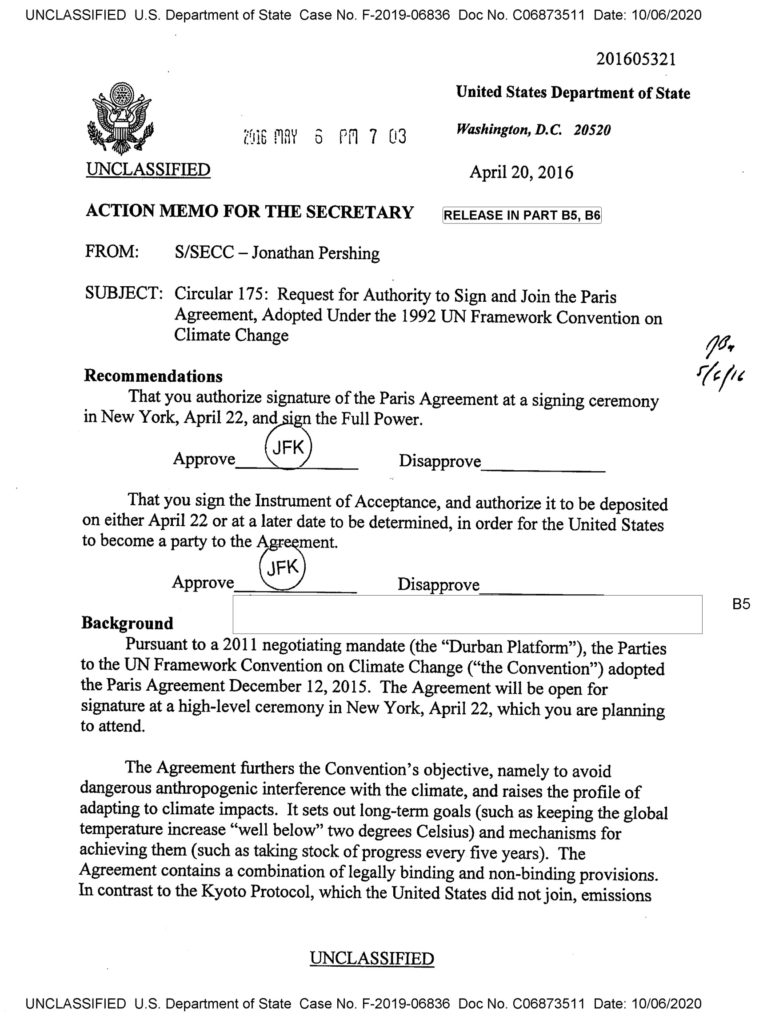
That of course is Paris, the crushing provisions of which are found in Article 4, emission reduction promises. Art. 4.3 requires that the U.S. revisit and tighten its reduction promises every five years. That would cleverly make this the climate treaty…sorry, “accord”… to end all climate treaties. It commits the U.S. to ever greater “climate” policy restrictions, every five years, in perpetuity.
Pull this off and there will never be the threat again of facing the tyranny of the Constitution’s requirement of popular approval.
Political rhetoric aside, nothing in Paris’s terms says this provision is legally binding, but no that one over there isn’t. Instead, Paris was merely sold to and promoted by much of the press with the claim that Paris contains “a mix of legally binding and not legally binding provisions”.
As we have seen already in the UK/Heathrow Airport case, that did not last, as it was not intended to. Lawyers and courts have already begun to see to something of which Americans should be reminded, including that you can have promises of massive infrastructure spending, or you can have the Paris climate pact, but you can’t have them both.
And it won’t just be courts. Recall, first, that the Paris agreement as originally circulated contained a climate tribunal, or court. This was dropped after being noticed outside of polite circles. Nonetheless, the recently released if still heavily redacted memo reminds us that U.S. compliance with the legally binding here but maybe not over there Paris obligations is subject to the terms of that 1992 agreement, ratified by the U.S. Senate on the condition that it was and remained non-binding (again, stated nowhere in its terms).
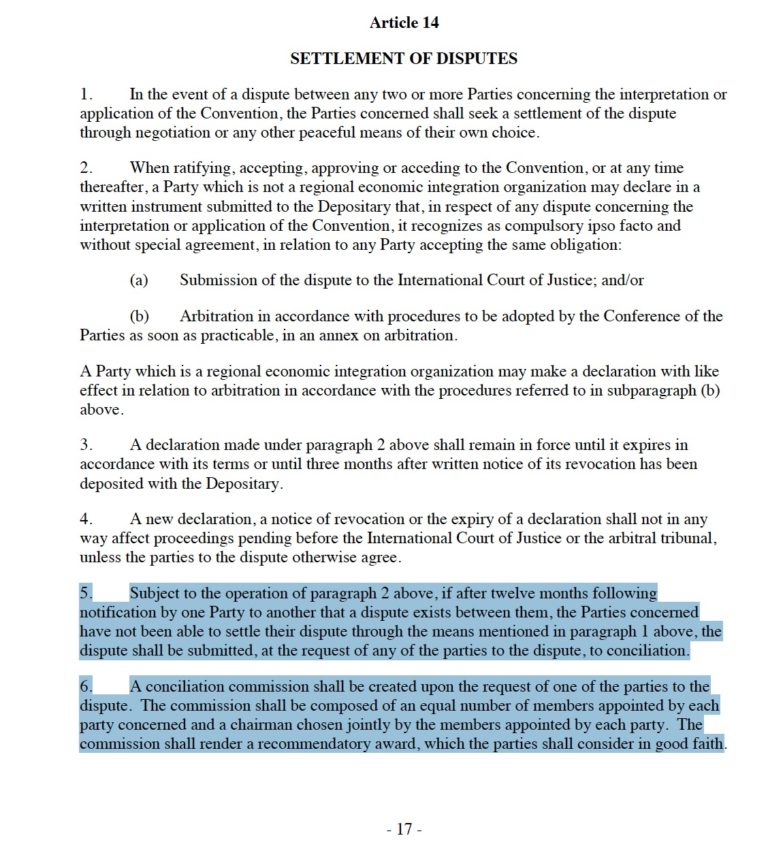
UNFCCC declares, in Art. 14, “Settlement of Dispute”, that:
“5. … if after twelve months following notification by one Party to another that a dispute exists between them, the Parties concerned have not been able to settle their dispute through the means mentioned in paragraph 1 above, the dispute shall be submitted, at the request of any of the parties to the dispute, to conciliation.
6. A conciliation commission shall be created upon the request of one of the parties to the
dispute. The commission shall be composed of an equal number of members appointed by each party concerned and a chairman chosen jointly by the members appointed by each party. The commission shall render a recommendatory award, which the parties shall consider in good faith.”
This language governs U.S. compliance with the Paris climate “accord”. It is not open to dispute that any U.S. president who claims to “re-join” the Paris climate treaty will subject US energy policy — and thereby the U.S. economy — to a UN climate “conciliation commission”.
Paris requires, and mandates the U.S. revisit and tighten “Green New Deal”-style policies every five years. This is among the many reasons why the Paris climate agreement is a treaty, and also why it never would have been ratified. However, very soon, Americans may nonetheless be subject to its long-envisioned climate court.
Why it is right to question the orthodox Covid-19 narrative
The authors of ‘Welcome to Covidworld’ defend their stance
By Matthew Ratcliffe and Ian James Kidd | The Critic | November 6, 2020
In a reply to our piece “Welcome to Covidworld”, Ben Bramble engages in precisely the sort of thinking that we raised concerns about. He suggests that we are mistaken in comparing harms done by lockdowns and other measures to harms caused by the virus. Instead, we ought to have weighed up the costs of lockdowns against what would have happened without them.
Bramble’s case hinges on a counterfactual claim: in the absence of lockdowns, the virus would have inflicted much more harm than it has done. The cost of not locking down would, he says, have been “mind-bogglingly great”.
What could be wrong with Bramble’s claim? First of all, his use of the term “lockdown” is insufficiently discerning. Lockdown is not a simple, straightforward policy measure that took the same form in every country. There are, for instance, important differences between early and late lockdowns. Australia and New Zealand both locked down early and suppressed the virus.
Setting aside the issue of whether or not the actions taken by these countries are morally justifiable, it remains to be seen whether or not this is a success story. If a highly effective vaccine is not forthcoming, both countries will face the painful options of cutting themselves off from the rest of the world indefinitely, having strict lockdowns whenever the virus reappears, or eventually succumbing to the virus, none of which amount to success.
However, the current UK situation is very different. Given where we are now, nobody is claiming that this second lockdown or any future UK lockdowns will be able to suppress the virus here. It is too well established for that. Rather, the stated aims have been to buy us some time until a vaccine arrives and, most recently, to ensure that the NHS is not overwhelmed. In evaluating the effectiveness and appropriateness of such policy measures, it will not do to make sweeping claims about the effectiveness of lockdowns in general. When considering interventions so extreme and destructive, we need to proceed more carefully.
Bramble simply accepts that lockdowns in general work. He does not specify exactly what it would be for a late lockdown to work, when the goal is no longer complete suppression. Presumably, the relevant criteria will include reducing hospitalizations and deaths due to Covid-19, during the lockdown and in the longer term as well. But where is the evidence that lockdowns generally have this effect? Bramble doesn’t provide any. Maybe he thinks it’s just obvious that they achieve this, but it really isn’t.
A strict lockdown in Peru is associated with one of the highest Covid-19 death tolls in the world (currently recorded as 1,047 people per 1 million of the population). Other countries that have resorted to exceptionally long and strict lockdowns, such as Argentina, have also fared badly. One could, of course, run Bramble’s counterfactual here: it would have been even worse for these countries had they not locked down. But where is the evidence for that? Indeed, what would even count as evidence?
It would be intellectually and morally unacceptable to make the pro-lockdown position unfalsifiable by always insisting on the following: (1) where cases drop after a lockdown was introduced, it must be the lockdown that achieved this; (2) where cases rise after a lockdown was introduced, it would certainly have been even worse without the lockdown; (3) if other countries, such as Sweden, adopt less extreme approaches than us and fare better or at least no worse, this must be due to other differences between the two countries – the Swedish strategy would never have worked here.
So, how do we go about evaluating the effectiveness of lockdowns? Where is the evidence that the virus ultimately causes far more deaths in the absence of extreme social restrictions? Where are those countries that followed a different course from countries like the UK (which locked down, but did not suppress the virus) and now have higher death tolls than us? By simply assuming that his counterfactual claim is true, Bramble illustrates our worry that lockdowns risk becoming an unfalsifiable article of faith. In fact, he even asserts that “the science on this is beyond question”. Is it really? If so, all the disease modelers who have made dire predictions concerning the current UK situation will be delighted to hear that their work will be forever immune from critique, even if it turns out that their models have little bearing on reality. And, in any case, none of them would endorse Bramble’s exaggerated claim that, without a lockdown, there would have been “many millions of deaths” in countries such as the UK.
In fact, much about the behaviour of this virus remains unclear, including how the infection rate is influenced by growing immunity within a population. There is no single, homogeneous entity called “the science”. Rather, there are many different and often conflicting perspectives, theories, and claims. Furthermore, this is a complicated, fast-changing situation that impacts on all aspects of human society. Relevant expertise thus encompasses a wide range of academic disciplines and areas of practice. Philosophers should not simply defer to “the experts”; they also have plenty of relevant expertise themselves.
What we do know is that lockdowns are immensely damaging in so many ways. This second UK lockdown will further disrupt the social and emotional development of our children, cause a substantial rise in severe mental health problems, force many elderly people to live out the final weeks and perhaps months of their lives in loneliness and misery, exacerbate and prolong the pain of bereavement by depriving people of interpersonal and social interactions that shape and regulate grief, destroy livelihoods and risk mass unemployment, increase regional social and economic inequalities, reduce the life-opportunities of young people while saddling them with an ever-growing mountain of debt to pay off, suspend much of what gives our lives meaning, deprive people of countless precious, irreplaceable life-moments, and cause deaths due to the numerous resulting impacts on people’s health.
However, the true extent of certain harms, such as the long-term effects of sustained lockdown measures on children’s development, may not become fully clear for some time.
Others have similarly warned that policy makers are paying insufficient attention to these growing costs. For instance, an open letter by psychologists, which appeared on 1 November, spells out the widespread and damaging psychological effects of continuing restrictions, including the harms done to children. Similarly, an article published in the British Medical Journal on 2 November raises the concern that the “collateral damage” caused by public health interventions has “yet to be considered systematically”. Others have drawn attention to the global costs of national lockdowns. For instance, the charity Oxfam has stated that, by the end of this year, over 12,000 people could be starving to death every day due the global impact of national-level responses to Covid-19.
Bramble observes that the orthodox view has in fact been subjected to critical scrutiny. But the problem is that – in the UK, at least – alternative perspectives have had little influence on the processes of recommending, making, and implementing policy decisions. And we worry that this may be partly because of blinkered and inflexible attitudes that are widely held. People are often very quick to dismiss or express moral disapproval of dissenting voices. However, those who confidently endorse lockdowns with an air of moral authority also need to acknowledge the full extent of the harms these measures have caused, are causing, and are likely to cause. Furthermore, explicit and sufficiently specific criteria should be supplied for determining the effectiveness of any proposed lockdown, accompanied by convincing evidence to show that it is very likely to achieve its intended effects.
Instead of pursuing such a path, Bramble speculates that our own concerns originate in cognitive impairments caused by our distressing experiences of lockdown. This is the kind of response that motivated our earlier account of “Covidworld”, a simplified, virus-centric reality where various norms of reason, scientific enquiry, and moral conduct have ceased to apply.
Copyright © Locomotive 6960 Limited 2020
Gridlock – Biden May or May Not Win, but Trump Remains ‘President’ of Red America
By Alastair Crooke | Strategic Culture Foundation | November 7, 2020
One clear outcome of the U.S. election was the collapse of the promised ‘Blue Wave’ – an implosion that marks the ‘beginning of the end’ to a powerful spell enthralling the West. It was the delusion which Ron Chernow, the acclaimed U.S. presidential historian, gave credence, as he contemptuously dismissed America’s “topsy-turvy moment” as purely ephemeral, and a “surreal interlude in American life”: No longer can it be said that there is one ‘normal’. Win or lose the White House, Red Trumpism remains as ‘President’ for half America.
Biden, by contrast, served as the prospect for Restoration – a return to a hallowed consensus in American politics – to a reassuring ‘sanity’ of facts, science and truth. Biden, it was hoped, would be the agency over-lording a crushing electoral landslide that would terminate irrevocably Trump’s rude interruption of the ‘normal’. Biden supporters were rallied, Mike Lind, the American academic and author has observed, around the idea of America moving toward a ‘managed’ society – based on ‘science’ – that would be essentially finessed and controlled by a managerial, expert class.
Over time, Lind suggests, American society would begin to depart more, and more easily, from its republican roots, through a process already underway: via attempts to alter the Constitutional order, and other rules, to bring about a change in the way America is governed.
The notion however, of what America – as Idea – now constitutes, has fractured into two tectonic plates, moving apart in very different directions – and likely to move even further apart as each ‘plate’ remains convinced that ‘it won’ – and the sweetness of victory has been stolen.
The fracturing of the ‘One Normal’, by contrast, provides some kind of respite to much of the globe.
The fact remains that the election has produced a result in which it is abundantly clear that one half of the American electorate precisely voted to oust the other half. It is gridlock – with the Supreme Court and Senate in the hands of one party, and the House of Representatives and White House (possibly) in the hands of the other. As Glenn Greenwald warns:
No matter what the final result, there will be substantial doubts about its legitimacy by one side or the other, perhaps both. And no deranged conspiracy thinking is required for that. An electoral system suffused with this much chaos, error, protracted outcomes and seemingly inexplicable reversals will sow doubt and distrust even among the most rational citizens.
Though the maths and maps suggests Biden will likely reach 270 Electoral votes, the old saying ‘It ain’t over ’till it’s over’, holds true. The electoral vote scenarios in the key ‘swing states’ would only apply if there is no litigation, fraud or theft. However all three are in play – If you are stuffing the ballot box, you first wait to see what the regular vote is, so that you know how many votes you ‘need’ (mathematical anomalies aside) to push your candidate over the top. Trump, somewhat rashly, gave out the GOP vote calculations at 02.30 on Wednesday, and hey-presto, loads of absentee ballots suddenly arrived at certain polling stations at around 04.00. That seems to have happened in Wisconsin, where over 100,000 Biden votes appeared seemingly out of nowhere on a flash drive delivered by hand from a Democratic district. That put Biden ahead in Wisconsin – but litigation is in process. Likewise, it appears that a huge “absentee ballot” dump appeared in Michigan that heavily favored Biden.
This is just the beginning of a new and more uncertain phase that could go on for weeks. It may be that ultimately Congress will have to certify and make the final determination in late January. Meanwhile, there are some things we know with much higher certainty: The Republican majority in the Senate may hold until the 2024 election. So, even if Biden wins, his agenda will not hold through 2024.
A President may emerge, but it will not be, as it were, a settled one: He or she cannot make claim to the ‘will of the majority’. Whomsoever is certified by Congress cannot truthfully say they represent ‘the nation’. Consensus is fractured, and it is difficult to see any leadership that can bring Americans together as a ‘united people’.
“There is not a single important cultural, religious, political or social force that is pulling Americans together more than it is pushing us apart,” David French notes in a new book Divided We Fall: America’s Secession Threat and How to Restore Our Nation. French — an anti-Trump conservative — argues that America’s divisions are so great, and the political system so poorly designed to handle them, that secession may eventually be the result: “If we keep pushing people and pushing people and pushing people, you cannot assume that they won’t break”, he writes. (A 2018 poll found that nearly a quarter of each party – Democrat and Republican – characterized the opposing party as “evil”).
An ideological split, and the concomitantly contested America as Idea has huge geo-political implications, reaching well beyond America itself – and principally for Europe’s élites. European leaders did not see it coming when Trump was elected in 2016. They misjudged Brexit. And this year, they misread U.S. politics once again. They yearned for a Biden win, and they (still) fail to see the connection between the popular rebellion of Red under Mr. Trump, and the angry protests occurring across Europe against lockdown.
Separating tectonic plates – more strategically – usually signal a kind of dualism that betokens civil conflict. In other words, their separation and moving apart turns into an ideological struggle for the nature of society and its institutional fabric.
Historian, and former War College Professor, Mike Vlahos warns (echoing Lind), that, “there is, here: more of a hidden – and thus in a sense, occult struggle – by which over time, societies begin to depart more, and more easily, from their roots. The western dominant élites presently are seeking to cement their hold over society [moving towards a ‘managed’ society]: To have full control over the direction of society, and, of course, a framework of rule that protects their wealth.”
“Quite to the surprise of everyone, and given that the Republicans are being represented by a billionaire who has a great many friends in Manhattan – the Wall Street donors to the two campaigns, outnumber Trump’s donors for Biden by 5-to-1”.
Why, Vlahos asks, would Wall Street invest in a man – Biden – and in a Party, ostensibly seeking to move America toward this ‘managed’ progressive society? Is it because they are convinced of a need radically to restructure the world’s economy and geopolitical relations? Is this then Vlahos’ occult struggle?
Many of the élite hold that we are at that monumental inflection point at this moment – In a nutshell, their narrative is simply this: the planet is already economically and demographically over-extended; the infinite economic expansion model is bust; and the global debt and government entitlement expenditure bubble too, is set to pop at the same moment.
A ‘fourth industrial revolution’ is the only way by which to ‘square this circle’, according to this mindset. The Reset is purposefully aimed to disrupt all areas of life, albeit on a planetary scale. Shock therapy, as it were, to change the way we humans think of ourselves, and our relationship with the world. The Great Reset looks to a supply-side ‘miracle’, achieved through full-spectrum automation and robotics. A world where the money is digital; the food is lab-grown; where everything is counted and controlled by giant monopolies; and everyday existence is micromanaged by ever-monitoring, ever-nudging AI that registers thoughts and feelings before the people even get a chance to make those thoughts.
Mike Vlahos notes that in a curious way this American story mirrors that of ancient Rome in the last century of the Republic – with on the one hand, the élite Roman class, and on the other, the Populares, as Red Americans’ equivalent:
“This is in fact the dual story of Rome in the last century of the Republic, and it tracks very well — with the transformation going on today [in the U.S.] — and it is a transformation … The society which emerged at the end of the Roman Revolution, and civil war … had too, a totally dominant élite class.
“This was a new world, in which the great landowners, with their latifundia [the slave-land source of wealth], who had been the ‘Big Men’ leading the various factions in the civil wars, became the senatorial archons that dominated Roman life for the next five centuries — while the People, the Populares, were ground into a passive — not helpless — but generally dependent and non-participating element of Roman governance: This sapped away at the creative life of Rome, and eventually led to its coming apart.
“… today American inequality is as great as in the period right before the French Revolution, and is mirrored in what was happening to Rome in that long century of transformation. The problem we have right now, and which is going to make this revolution more intense, is I think, the cynical conclusion and agenda of Blue to just leave behind the Americans they do not need [in the New Economy] – which is to say all of Red America, and to put them into a situation of hardship and marginalization, where they cannot coalesce, to form a rival — as it were — Popular Front.
“What I think what we are seeing here [in the U.S.] is profound: American society – emerging from this passage, is going to be completely different. And frankly, it already feels different. It already feels – as it has felt for the past four years – that we are in a rolling civil war norm now, in which deep societal strife is now the normal way in which we handle transfers of power. Issues will be [momentarily] resolved, with the path of society [painfully] staked out through violent conflict. That is likely to be our path for decades ahead.
“The problem with that in the shorter term, is that there is still enough of the nation aroused and ready to fight this process. The problem: Can the last energies of the Old Republic still be harnessed against this seemingly inevitable, transformation?”
Iran ready to play leading role in Syria reconstruction/ Shalamcheh-Basra-Latakia railway; The most important economic joint project
Mideast Discourse | November 6, 2020
Steven Sahiounie, a Syrian-American journalist, believes that while Western and European sanctions prevent the import of replacement parts needed by Syria in infrastructure projects, the ability of Iranian industrial engineers to build what is needed could be a vital path around and behind Western sanctions.
Sahiounie tells the Bazaar in an exclusive interview that the prospects for continuing bilateral relations between Iran and Syria are good.
“They both share the same dedication to peaceful relations with countries in the Middle East region while holding firmly to the ideal of resistance to the occupation of Palestine, and demanding that the rights of the Palestinian people be restored without delay”, he said.
Steven Sahiounie is an award-winning journalist, and chief editor of MidEastDiscourse. He has appeared on RT, PressTV, Syrian News, as well as international TV and radio programs. As a Syrian-American journalist and political commentator, he is often sought out concerning currents events facing Syria and the region.
Following is the text of the interview:
Bazaar: How do you predict the prospects for bilateral relations between Iran and Syria?
Sahiounie: The prospects for continuing bilateral relations between Iran and Syria are good. They both share the same dedication to peaceful relations with countries in the Middle East region while holding firmly to the ideal of resistance to the occupation of Palestine, and demanding that the rights of the Palestinian people be restored without delay.
Bazaar: What are the current economic relations and volume of trade between Iran and Syria?
Sahiounie: The trade officials of both Syria and Iran have worked toward establishing industrial and economic free trade zones jointly, with an emphasis on the private sector.
Iran and Syria are slated to boost bilateral trade volume from $500 million to $1 billion within the next year.
Bazaar: What is the major part of Syrian exports?
Sahiounie: The top exports of Syria are Pure Olive Oil, Spice Seeds, Other Nuts, Apples, Pears, and Calcium Phosphates.
Syria shipped an estimated $462 million worth of goods around the globe in 2019. That amount reflects a -46% decrease since 2015 and a -36.2% drop from 2018 to 2019.
The US-NATO attack on Syria beginning in 2011 has devastated lives, the infrastructure, and the economy. The continuing sanctions by the US and EU are designed to keep the war against the Syrian people going, even though the battlefields are silent, except for Idlib, which is under the military occupation of Al Qaeda.
The data from 2010 shows that 81.1% of products exported from Syria were bought by importers in Iraq, Italy, Germany, Turkey, Saudi Arabia, France, Lebanon, Jordan, United States, Netherlands, Egypt, and Spain. Due to the US-EU sanctions against Syria and the Arab monarchies of the Persian Gulf region boycotts, the markets for Syrian goods were closed due to political ideology. Iraq, Lebanon, and Jordan have maintained some trade with Syria in defiance of the western bullies.
The Syrian government is working with a comprehensive plan for agricultural development and expansion of agricultural and food industries to enhance the Syrian economy in the face of the sanctions and the unfair siege on the livelihood of the Syrian people.
Bazaar: What is the most important economic project of the two countries at this present?
Sahiounie: The project to build a railroad connecting Iran’s Shalamcheh border crossing, to the Iraqi port of Basra, and finally to reach Syria’s Mediterranean port city of Latakia is the most important economic project between Syria and Iran.
The project has been on the drawing board for years and is now in the beginning stages. The mammoth railroad line will be linked to the New Silk Road, also known as China’s Belt and Road Initiative, which in turn is also linked to the Russian railroad system. Once completed, western sanctions on Syria and Iran will be thwarted.
Bazaar: What is the most important tool to protect the continuation of bilateral economic relations?
Sahiounie: The most important tool for Iran and Syria to use to protect their continuing bilateral economic relations is in supporting the two countries’ private sectors, both in trade and industry, for the benefit of investment opportunities in the free zones. The bartering system of exchanging goods and services without the use of currency is another tool that can be effective.
Bazaar: The trade between the two countries is set to reach $ 1 billion by next year. What are the plans for expanding bilateral trade? What ?is your opinion?
Sahiounie: Plans to expand bilateral trade include mechanisms to enhance commercial exchange and develop cooperation in the field of research laboratories and medical equipment and infrastructure projects, development, and investment.
The agreement is known as “long-term strategic economic cooperation”, which includes industrial, trade, and agricultural cooperation. Education, housing, public works, railroads, and investments are covered in other agreements.
An important banking agreement between Iran and Syria has been reached, which sends a message to the international community about the depth of Syrian-Iranian cooperation and will benefit Iranian companies wishing to invest in Syria and participate in reconstruction.
Syria and Iran signed several agreements worth $142.5 million, involving Iranian companies involved in the restoration of more than 2,000 MegaWatts of power production capacity, and additional projects by the dozens in the oil and agricultural sectors.
Bazaar: What is your opinion about the impact of Caesar’s law and resulting US sanctions on Iran-Syria trade?
Sahiounie: The impact of Caesar’s sanctions is psychological. To instill fear into the minds of all Syrian people, as well as all countries which would conduct business with Syria.
Layer, after layer of sanctions, has been applied to Syria, to destroy the Syrian government, and installing a US puppet to be the ultimate ‘yes-man’ to Washington.
As Syria and the entire world grapple with the COVID-19 pandemic, the imposition of such inhumane sanctions has increased the suffering of the Syrian people. Instead of coming to the aid of people inside Syria with medical supplies to cope with the pandemic, the sanctions prevent medical companies abroad from doing business with merchants in Syria in the medical supplies industry, for fear of being tracked down and fined by the US Treasury Department.
Horror stories have been heard of companies in Europe who sent medicines and supplies to Syria, only to be tracked down in their own offices in Europe by US authorities enforcing the sanctions against anyone who would dare to throw a lifeline to anyone in Syria.
Bazaar: What is your assessment about Iran’s role in Syria`s reconstruction?
Sahiounie: Since 2017, Iranian companies have participated in rebuilding expos in Syria, and in 2019, the Syrian–Iranian Joint Chamber of Commerce held its first meeting. Iran is poised to play a leading role in the reconstruction of Syria. Projects include residential buildings, power stations, agriculture, telecommunications, oil, and mining.
In 2018, Iran signed a Memorandum of Understanding with Syria to construct 200,000 housing units near Damascus alongside other large projects. Iranian companies are participating in several major projects in Syria’s energy industry, including a gas-fired power plant project in Aleppo. Iran’s largest energy construction company, MAPNA Group, is engaged in the construction of the 540-MegaWatt combined-cycle power plant in Latakia.
Over 95 percent of the power plant equipment and much of the equipment in the Iranian electricity and water industry are domestically manufactured and can repair steam, natural gas, combined-cycle, incineration, and turbines of generators, as well as make strategic parts for power plants.
While the US-EU sanctions prevent Syria from importing much-needed replacement parts for infrastructure projects, the ability of the Iranian industrial engineers to manufacture what is needed can be a vital path around and behind the back of the western sanctions.
Iran finally brings desalinated Persian Gulf water to its arid desert
Press TV | November 5, 2020
Iranian President Hassan Rouhani has opened a mega project for transferring desalinated sea water to arid deserts in the Iranian Plateau, the first in the history of a country where water shortage has always been a major impediment to economic development.
Rouhani used a video conference call on Thursday to supervise the start of water transfer from desalination facilities off the Persian Gulf in southern Hormozgan province to water-intensive industries in southeastern province of Kerman.
The transfer line, which includes dozens of tunnels, pumping stations and storage facilities, takes desalinated water some 305 kilometers to one of Iran’s largest mining and metals plants in Sirjan.
The first phase of the project has cost nearly 165 trillion rials (over $600 million). The Iranian Energy Ministry said that around a third of the total water desalinated in the project, some 150 million m3 per year from a total of 450 million m3 of sea water, would be purchased on a guaranteed basis for household consumption in two coastal cities.
The transfer line is planned to continue another 500 kilometers in the next phases of the project to take water to copper smelters in Sarcheshmeh, in north of Kerman, and further into the heart of the Iranian desert in Yazd province where the sprawling Chadormalu mining complex, the largest iron ore producer in the Middle East, is located.
The desalinated water will also be consumed for irrigation, said Rouhani during the inauguration ceremony, as he insisted that the project would relieve a huge burden from underground water resources and would boost environmental conditions in the Iranian Plateau and along the Persian Gulf coast.
“This project had been deemed unimaginable and it materialized in the Government of Discretion and Hope,” Rouhani said making a reference to a phrase routinely used to distinguish his two four-year terms in office that began 2013.
The Iranian president hailed the launch of key infrastructure projects in recent years in Iran as a sign that a series of unprecedented sanctions imposed by the United States have failed to dent the country’s resolve for development.
“We have managed to take these big steps despite sanctions, despite the pressure and despite the fact that a terrorist government was in office in America” he said.
Sorry, Google and World Bank, but Middle Eastern Crops Keep Thriving

By H. Sterling Burnett | ClimateRealism | November 4, 2020
Google News today is promoting articles (see the Google-promoted PhysOrg article here, for example) about a speculative World Bank “study” claiming climate change is threatening crop production in the Middle East. The World Bank study is full of speculation but short on facts. Real-world data show crop yields per acre and total crop production are consistently and dramatically rising in each of the Middle East countries examined by the World Bank study.
In its study, titled “Water in the Balance,” the World Bank says, “[w]hile information about water scarcity at present and in the future is available there is little knowledge of what this increasing scarcity means for Middle Eastern … food security. Agriculture will suffer because of climate change and water scarcity….”
In particular the World Bank asserts water scarcity caused by climate change will reduce farm production in Iran, Iraq, Jordan, Lebanon, Syria, and Turkey. The available evidence strongly suggests that will not happen.
Had the study’s authors examined real-world data concerning crop production in the Middle Eastern countries, they would have found, even amidst substantial strife in the region, crop yields and overall production have increased dramatically. More food is being produced even as thousands of acres of agricultural lands have been abandoned during regional conflicts.
Data from the U.N. Food and Agriculture Organization show during the period of modest warming since 1989:
- Cereal crop production in Iraq increased 91 percent, even as the acreage being harvested fell 5 percent.
- Cereal crop production in Iran increased 187 percent, while the acreage harvested increased by just 2.6 percent.
- Cereal Crop production in Jordan increased 15 percent, even as the acreage harvested declined 30 percent.
- Cereal Crop production in Lebanon increased 115 percent, while acreage harvested increased 30 percent.
- Cereal Crop production in Syria increased 22 percent, even as acreage harvested declined 66 percent.
- Cereal Crop production in Turkey increased 46 percent, even though acreage harvested declined 19 percent.
It is clearly good news – and not a climate crisis – that Middle Eastern countries have increased crop production despite the fact that many of them have been embroiled in internal political strife, outright civil warfare, and external conflicts. That good news is ignored in the World Bank’s doom-and-gloom report.
Global warming lengthens growing seasons, reduces frost events, and makes more land suitable for crop production. Also, carbon dioxide is an aerial fertilizer for plant life. In addition, crops also use water more efficiently under conditions of higher carbon dioxide, losing less water to transpiration. The latter fact should have allayed the World Bank’s concern about climate change induced water shortages leading to crop failure.
The benefits of more atmospheric carbon dioxide and a modestly warming world have resulted in 17 percent more food being available per person today than there was 30 years ago, even as the number of people has grown by billions. Indeed, the last 20 years have seen the largest decline in hunger, malnutrition, and starvation in human history.
Sorry, World Bank, Google, and PhysOrg, but that does not equate to a climate crisis.
H. Sterling Burnett, Ph.D. is managing editor of Environment & Climate News and a research fellow for environment and energy policy at The Heartland Institute. Burnett worked at the National Center for Policy Analysis for 18 years, most recently as a senior fellow in charge of NCPA’s environmental policy program. He has held various positions in professional and public policy organizations, including serving as a member of the Environment and Natural Resources Task Force in the Texas Comptroller’s e-Texas commission.
How a Wise Decoupling May Be a Good Thing for Both China and the West
By Matthew Ehret | Strategic Culture Foundation | November 5, 2020
Imagine a bird was led to believe that it was a fish. For a while it might get used to living under water, but it wouldn’t take long before it could sense that something was wrong. If the bird didn’t realize that its nature is to fly and breath the air in time, then its fate would be bleak indeed.
Since the world was taken off the gold reserve system way back in 1971, a new age of “post-industrialism” was unleashed onto a globalized world. Humanity was given a new type of system which presumed that both our nature and the cause of value itself were located in the act of consuming. The old idea that our nature was creative, and that our wealth was tied to producing, was assumed to be an obsolete thing of the past… a relic of a dirty old industrial age.
Under the new post-1971 operating system, we were told that the world would now be divided among producers and consumers.
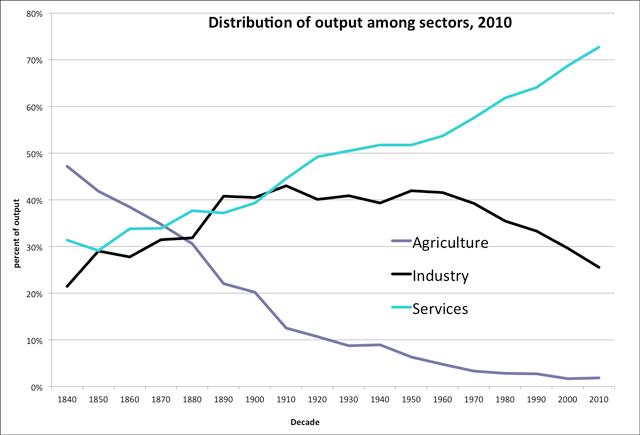
The “have-not producers” would provide the cheap labor which first world consumers would increasingly rely on for the creation of goods they used to make for themselves. “First world” nations were told that according to the new post-industrial rules of de-regulation and market economics, that they should export their heavy industry, machine tools and other productive sectors abroad as they transitioned into “white collar” post-industrial consumer societies. The longer this outsourcing of industries went on, the less western nations found themselves capable of sustaining their own citizenries, building their own infrastructure or determining their own economic destinies.
In place of full spectrum economies that once saw over 40% of North America’s labor force employed in manufacturing, a new addiction to “buying cheap stuff” began, and a “service economy” took over like a cancer.
To make matters worse, the many newly independent nations struggling to liberate themselves from colonialism were told that they would have to abandon their dreams of development since those goals would render the formula of a producer-consumer stratified society impossible to create. Those leaders resisting this edict would face assassination or CIA overthrow. Those leaders who adapted to the new rules would become peons of the new age of “Economic Hitmen”.
As the great president William McKinley had observed long ago (1), nations who develop full spectrum economies also have higher quality, educated citizens using advanced technology which causes more costly goods… meaning no dollar stores and no sweat shops.
The Case of China: Producer for the World
When Henry Kissinger negotiated the opening up of China in the 1970s, the intention was much less benevolent than the story projected.
By the time Deng Xiaoping announced the “opening up” of China in 1978, Kissinger had already managed the economic paradigm shift of 1971, the artificial “oil shock therapy” of 1973 and authored his 1974 NSSM 200 Report which transformed U.S. Foreign Policy from a pro-development orientation towards a new policy of depopulation targeting the poor nations of the global south under the logic that the resources under their soil were the lawful possession of the USA.
Kissinger, and the hives of Trilateral Commission/CFR operatives to which he was beholden never looked on China as a true ally, but merely as a zone of abundant cheap labor which would feed cheap goods to the now post-industrial west under their new dystopic producer-consumer world order. It was in that same year that Kissinger’s fellow Trilateral Commission cohort Paul Volcker announced a “controlled disintegration of western society” which was begun in full with the Federal Reserve’s interest rate hikes to 20% that ensured a vast destruction of small and medium businesses across the board.
Believing China (then still largely an impoverished third world country) to be desperate enough to accept money and short-term salvation after years of trauma induced by the Cultural Revolution. Under Kissinger’s logic, China would receive just enough money to sustain a static existence but would never be able to stand on its own two feet.
Unbeknownst to Kissinger, China’s leaders under the direction of Zhou Enlai, and his disciple Deng Xiaoping had a much longer-term strategic perspective than their western partners imagined.

Deng Xiaoping and Zhou Enlai in 1962
While receiving much needed revenue from foreign exports, China began to slowly create the foundations for a genuine renaissance which would be made possible by slowly learning the skills, leapfrogging technologies and acquiring means of production which the west had once pioneered. Zhou Enlai had first enunciated this visionary program as early as 1963 under his Four Modernizations mandate (Industrial, agricultural, national defense and science and technology) and then restated this program in January 1976 weeks before his death.
This program manifested itself in the July 6, 1978 State Council Forum on the “Principles to Guide the Four Modernizations” informed by the findings of international exploratory missions conducted by economist Gu Mu’s delegations around various advanced world economies (Japan, Hong Kong, Western Europe). The findings of Gu Mu’s reports laid out the concrete pathways for full spectrum economic sovereignty with a focus on cultivating the cognitive creative powers of a new generation of scientists that would drive the non linear breakthroughs needed for China to ultimately break free of the rules of closed-system economics which technocrats like Kissinger wished the world adhere to.
Deng Xiaoping broke from the radical Marxism prevalent among the intelligentsia by redefining “labor” from purely material constraints and elevating the concept rightfully to the higher domain of mind saying:
“We should select several thousand of our most qualified personnel within the scientific and technological establishment and create conditions that will allow them to devote their undivided attention to research. Those who have financial difficulties should be given allowances and subsidies… we must create within the party an atmosphere of respect for knowledge and respect for trained personnel. The erroneous attitude of not respecting intellectuals must be opposed. All work. Be it mental or manual, is labor.”
Over the course of the coming decades, China learned, and like any student, copied, reverse engineered and reconstructed western techniques as it slowly generated capacities that ultimately allowed them press on the limits of human knowledge outpacing all western models.
Scientific and technological progress became the driving force of its entire economy and by 1986, the “863 Project for Research and Development” was announced which focused on areas of space, lasers, energy, biotechnology, new materials, automation and information technology. This project became the driver for creative innovation guided by the National Science Foundation and was upgraded to the 973 Basic Research Program in 2009 to: “1) support multidisciplinary and fundamental research of relevance to national development; 2) Promote frontline basic research; 3) Support the cultivation of scientific talent capable of original research; and 4) Build high-quality interdisciplinary research centers.”
Although China is often accused of intellectual theft, the reality is that it has begun to clearly outpace western nations becoming a pioneer on every level of science and technology. China now registers more patents than the USA, has become the cutting edge leader of high speed rail engineering with over 30 000 km, bridge building, tunneling, as well as water management, quantum computing, AI, 5G telecommunications, and even space science becoming the first nation to ever land on the far side of the moon with an intent to mine Helium 3 and develop permanent bases on the Moon in the coming decade.
All of these cutting edge fields of science and engineering are being organized by the ever-growing Belt and Road Initiative which has taken on global proportions and integrated itself into a deep alliance with Russia, Iran and over 135 nations who have signed onto the BRI Framework stretching from Latin America, Africa, the Middle East, Central Asia, Asia, and Europe.
This is the system which the USA and other western nations could have joined on multiple occasions, but which has instead been targeted as a global threat to western hegemony. According to the logic of those western utopians who refuse to let go of their old outdated 1971 script for a new world order, China’s New Silk Road must be subverted at all costs since it is very well understood that it would become the basis for a new world system as the old globalized paradigm comes crashing down faster than the Hindenburg.
So what can be done?
Amidst this anti-China war policy has emerged another policy which began as a “Trade War” and escalated to a potential “decoupling” of the USA from China under President Trump.
This decoupling would involve cutting off reliance on using China as a cheap labor exporter, and even industrial production source as well. Obviously, friendship and collaboration between the USA and China is vitally important for the long-term survival of civilization, but is this decoupling an intrinsically bad thing in the short term?
Maybe not.
If the USA is to survive the oncoming collapse and break free of its apocalyptic war agenda, then certain realities WILL have to occur. These realities include (but are not limited to):
1) Regaining its lost industrial potential, with an emphasis on the machine tool sector which the west once enjoyed as a world leader
2) Regaining the lost scientific and technological capacities which the USA once had when it still valued productive thinking under the days of JFK and NASA
3) Regaining a grasp of education which values productive citizens over consumer subjects
4) Regaining control over national credit under federal banking, dirigisme and other long-term investment practices that rely on regulating Wall Street speculation and other unproductive forms of banking.
How might these vital capacities be regained?
For one thing, protectionism will be necessary. China has used protectionist measures to a great effect, and every nation has the right, if not the duty, to apply protective tariffs in the defense of their economic sovereignty in order to ensure that it is more profitable to purchase locally than abroad. In fact, it was only by employing protective tariffs in the pre-Globalized past that the USA (or any other nation for that matter) built up their industrial capacities in the first place while these capacities were always lost whenever free trade, de-regulation policies were imposed.
Parity Pricing is vital if the USA is to rebuild the small and medium agro-industrial enterprises that once generated the vitality of society decades ago. Parity pricing was a common practice among western governments between 1945-1970 which imposed certain constraints on price variability of certain goods to ensure that prices never dropped so low that the manufacturers could afford to stay in business or rise so high that consumers cannot afford to buy said goods. Today’s agricultural crisis in the USA could only be reversed were such policies implemented quickly (2).
National banking is another vital pre-condition to a recovery. Under the period of 1791-1836, during the 1862-1869 greenback system, or during FDR’s 1933-45 use of the Reconstruction Finance Corporation, national credit was generated by acts of purchasing bonds via the Treasury and emitting loans directly to companies which would be mandated to carry out the jobs needed to build great infrastructure megaprojects (Erie Canal, transcontinental railway, or Tennessee Valley authority). Similar practices have been revived under China’s state banking system today which provides the majority of the loans to companies building the New Silk Road either in China itself or abroad.
While detractors call these sorts of policies “trade war” or “offenses to the laws of the World Trade Organization”, as I laid out in a 2018 lecture, they are exactly what is needed for any sort of recovery to occur.
Before the USA could ever possibly work as a reliable partner on the Belt and Road Initiative or any nation of the emerging multipolar alliance, it must learn to stand once again on its own two feet.
This transitionary process may have painful aspects to it, much like a drug addict trying to wean themselves off of heroine, but if the intent is genuine, and the means lawful, then it is certainly possible, even at this late date.
As the USA weans itself off of its addiction to China’s cheap goods, China will be better prepared to produce ever more high quality goods on a “fair trade basis” for markets which are also committed to full spectrum economic goals whether in Asia, Africa, or beyond.
Everything hinges on the upcoming U.S. elections
President Trump has outlined a series of measures that reflect a pro-industrial orientation which the mainstream media has worked very hard to cover up.
Over his first term, Trump not only rejected the precepts of laissez faire economics by cancelling the anti-China Trans Pacific Partnership (TPP) but renegotiated the nation-killing NAFTA giving nation states of North America the right to intervene into their economic destinies for the first time since 1994. He also broke with a 50 year anti-space tradition by giving full backing to a renewal of the space program with the Artemis Program and outlined a global cooperative space platform with the Artemis Accords. Just as JFK’s Apollo program generated over $10 for ever $1 invested in non-linear ways, so too will the current goal of creating a permanent lunar base and launch pad to Mars generate similar effects as new discoveries and inventions with immense industrial applications will come online. This was renewed in a GOP policy tweet of Oct. 23:

Trump has also called for a national re-industrialization program designed to bring back vital heavy industries to rust belt dead zones of America that have fallen into dark age conditions over the past 4 decades and in his current platform has called for a continental high speed rail system. For the Arctic, Trump has given federal endorsement to the Alaska-Canada railway which itself brings the long-overdue Bering Strait rail tunnel endorsed by both Russia and China ever closer to reality. This policy represents a total break from the Pentagon’s Arctic war policy also active in Alaska.
On economic diplomacy, Trump has broken from the anti-growth program launched by Obama’s technocrats by ending the moratorium on nuclear power investments by green lighting the International Development Finance Corporation’s investment into 2500 mW of nuclear energy for South Africa and another nuclear plant for Poland (which currently relies on 70% coal power and wants 9 GW of nuclear by 2040). This change in policy brings the USA into harmony with the modus operandi of both Russia and China who are the only other nations seriously investing in nuclear power within their own nations or Africa.
Similarly, Trump has won the ire of many regime changers by defunding CIA-front democracy movements like NED in Hong Kong, Ukraine and Belarus while introducing economic win-win diplomacy in helping to resolve the Serbia-Kosovo crisis via investments into rail, roads and infrastructure. This approach also complements the restoration of a non-interventionist defense strategy that began with Trump’s collaboration with Russia in Syria and continues with his withdrawal of troops from Afghanistan, Iraq and Syria over recent months.
In every category economic, military, diplomatic, space and beyond, two obvious paradigms are clashing represented by two opposing Americas.
If Trump is able to maintain control of the presidency over the coming weeks and months of storms (don’t fool yourself. It is unlikely that the results of the election will be finalized in November or even December) then there is a chance that the USA may find the moral fitness to survive by regenerating its lost industrial base and changing its behaviour in conformity with natural law.
Should this be done, then the USA will be able to re-acquire its claim of “independence” for the first time in decades. With that independence, will come the slow reconstruction of its decrepit infrastructure, intellectual and cultural decay and achieve the basis for a full spectrum sovereign economy. This hoped-for USA would be a very different creature from the one the world has known since the murder of JFK in 1963 and this would be a nation that could be trusted to act in its own true self interest as a partner to other like minded nations working for their own true self interests under the umbrella of international projects that benefit all participants.
The author can be reached at matt.ehret@tutamail.com
China Looks To Boost Oil Exploration, Expand Oil & Gas Storage
By Charles Kennedy | Oilprice.com | November 3, 2020
China plans to further increase oil and gas exploration and accelerate the construction of more oil and gas storage infrastructure, state news agency Xinhua reported on Tuesday.
Last week, China’s Communist Party adopted the principles of the five-year development plan 2021-2025.
China will also aim to build more oil and gas pipelines, according to its authorities.
China has been looking to increase its energy security in recent years, including by increasing domestic oil and gas production and expanding its storage facilities.
Over the past decade, China’s oil production has been falling while its oil demand has been soaring, increasing Beijing’s dependence on sourcing oil from abroad.
China’s dependence on crude oil imports has been growing in recent years as its domestic production has faltered, and the world’s top oil importer covered 73.4 percent of its oil demand with imported oil in the first half of 2020.
In the first half of 2020, China’s crude oil production did increase, by 1.7 percent year on year, according to data from the National Bureau of Statistics of China. The growth in production between January and June, however, was 0.7 percentage point slower than that of the first quarter, the bureau said.
Higher domestic production, however, will not be able to cover the rise in China’s oil and gas demand, so China will continue to be a key player on the global oil and gas markets and a critical gauge of oil and gas demand growth.
Meanwhile, China is set to increase its natural gas imports from Russia as Russian gas giant Gazprom has started constructing the extension of its gas pipeline to China, Upstream reported on Tuesday. The project is expected to be completed by the end of 2022 and is estimated to cost US$3.5 billion (280 billion Russian rubles), according to the Russian gas giant.
UAE to Import Israeli Fruit and Vegetables
Palestine Chronicle | November 2, 2020
The UAE is expected to begin importing Israeli fruit and vegetables this month, Israel’s Agriculture and Rural Development Ministry has announced.
Official authorization is said to have been granted last Thursday following a series of meetings and coordination between Minister Alon Schuster, ministry employees and the UAE’s Ministry for Climate Change and the Environment.
“This is wonderful news for Israel’s farmers,” Schuster is reported as saying by the Jerusalem Post. “The agreement that we signed with the UAE is moving us forward and into a joint future in the field of agriculture.”
With UAE agricultural imports valued at around $10 billion a year, this latest agreement — which is a result of the normalisation deal signed in August — is highly lucrative for the occupation state.
At the moment, the UAE does not appear to be taking any measures to ensure that fruit and vegetables imported from Israel are not produced in the illegal settlements across the occupied Palestinian territories.
Last week it was reported that Israeli wine produced in the occupied Syrian Golan Heights is to be sold in the Emirates.
Featured Video

Trita Parsi: Middle East Unraveling — Are We on the Path to World War?
or go to
Aletho News Archives – Video-Images
New Book
Trans agenda is ‘normalization of sadism’ – US author

RT | September 23, 2026
The US Democratic Party has embraced a transgender agenda that amounts to “the normalization of sadism,” author A.J. Rice has said, warning that radical trans policies would return if the party is allowed to regain power.
Speaking to RT’s America First host Scotty Nell Hughes about his new book, ‘The Curse of the Bearded Lady: How the Trans Mafia Whacked American Sanity’, Rice argued that activists have gained significant influence in schools, medicine, and corporate America while people who questioned the agenda have faced pressure to stay silent.
The author described the “trans mafia” as the sprawling network of people and institutions that have helped the movement gain influence. He singled out parts of academia, wealthy backers, and corporations, and stated that providers of transition-related treatment also have a financial incentive to keep young people in their care indefinitely.
Rice argued that the consequences of these policies ultimately fall on children who are being drawn toward gender-affirming medical treatments and on girls who are expected to share locker rooms or compete in sports with biological males.
He noted that while voters rejected the Democrats’ approach to gender in 2024, the party, which has been “captured by madness,” has since only doubled down and is seeking what is effectively “the normalization of sadism.” … Full report
Blog Roll
 Aletho News
- Integrity Initiative: UK-funded network framed dissent as Russian disinformation for years
- ‘We don’t seek permission to defend our country’: Snippets from President Pezeshkian’s UNGA address
- NATO chief wants Europeans to fight American wars [for Israel]
- German chemicals giant reveals details of downsizing
- Refaat Al-Areer Was The Canary In The Coal Mine In Israel’s War On The Truth
- Israeli election committee bars candidate from Knesset race over Gaza war opposition
- French-Lebanese man files war crimes complaint over Israeli attacks
- Mahan Air Flight Lands in China Despite US Threat against Iranian Airlines
- US eyes $10bn fund to rebuild war-battered Gulf infrastructure
- Trump meets Rodríguez near Maduro’s prison as Venezuela’s oil flows to US
- If Americans Knew
- Caught on Tape: AIPAC CEO Boasted of Controlling Trump’s National Security Officials
- Why Hamas Attacked Israel in October 2023 – Israeli professor Ilan Pappé
- They see them, then kill them: Israeli quadcopters track, deliberately target civilians in Gaza
- Winter could turn Gaza’s treacherous, war-damaged buildings into deathtraps
- Majority of Democratic Voters Want to Prosecute Both Biden and Trump Administration Officials Over Gaza
- As Gaza languishes, world leaders gather at the UN – Daily Update
- Sanctions are collective punishment: immoral and self-defeating
- Phosphorus Munitions Fired by Israel Burn Groves, Orchards in Southern Lebanon
- Israel Carries Out New Ceasefire Violations Across Gaza
- AI – Emphasis on the ‘I’: Israel Is Funding AI Chatbot Propaganda
- No Tricks Zone
- New Study: Earth And Venus Surface Warmth Largely Explained By Convection And Lapse Rate, Not CO2 Or Radiation
- 2025 Nature Paper Claiming Worsening Global Drought Gets RETRACTED …Heavily Flawed
- New Study: ‘Global Drought Shows No Detectable Recent Acceleration Under Climate Warming’
- Economic Masterminds: German Socialists Suggest Taxing Productivity Gains Stemming From Using AI
- The South China Sea Has Not Been Cooperating With The Climate Change Narrative
- Energy Crisis: Germany Enters Heating Season With Historically Low Gas Reserve Fill Levels
- New Study: The Antarctic Ice Sheet Gained Mass From 2020-2024 Due To Staggering Snow And Ice Accumulation
- Study: Ocean Heating Rates From Thousands Of Years Ago ‘Dwarf’ Modern Ocean Heating Rates
- Climate Extremists Target, Attack Large-Scale Power Grid Infrastructure In Germany!
- New Study: Antarctic Ice Melt Has Contributed Less Than 1 Centimeter To Sea Level Rise In The Last 30 Years

