Trump is really a 3rd Party candidate, taking the first axe to the two-party US dictatorship in 170 years
By Robert Bridge | RT | October 29, 2020
Washington despises Trump because he’s an outsider – a third-party gatecrasher – who has upset the duopoly that has had a stranglehold on American politics, and they’re doing everything they can to stop him doing it again.
The meteoric rise of Donald Trump defies the law of US political gravity in that he has elevated himself inside of a rigidly controlled two-party system while going against the interests of the establishment. That is a remarkable accomplishment, and no other modern politician – aside from perhaps John F. Kennedy – has made it this far in Washington by promising to drain the very swamp it sits upon. The Manhattan real estate magnate has essentially become a third-party tour de force, the ultimate bugbear of the powers that be.
Trump is no fool and understood early in the game that there is a veritable army of burly gatekeepers in Washington, standing guard against the threat of third-party provocateurs. In fact, one of the largest gatekeepers is none other than the Commission on Presidential Debates (CPD), a non-profit third-party terminator that is actually sponsored by the Democratic and Republican parties. So when people complain that the Democrats and Republicans are two heads of the same poisonous snake, they are right. This organization is so powerful that it barred the highly popular Ross Perot from appearing on the debate stage in the 1996 presidential campaign alongside Democratic incumbent Bill Clinton and Republican Bob Dole.
A buried footnote with regards to Trump’s political career is that he made his first serious foray into the swamp as the presidential nominee in Ross Perot’s Reform Party in the 2000 elections. When those efforts fizzled out, Trump, aware that the road to the White House via a third-party platform was largely inaccessible, began to weigh his chances at running for the presidency on the Republican ticket. Not a bad idea considering that the last time a president was elected in the US who did not identify as either a Democrat or Republican was in 1848, with the election of Whig candidate Zachary Taylor. At the time, however, much of Washington wrote off the tycoon’s dream as a bad joke; the egoistic yearnings of a billionaire who thinks the White House is just another real estate venture.
But Capitol Hill seriously underestimated both the dark mood that had descended upon the nation, as well as Trump’s ability to capitalize on it. With an uncanny gift for electrifying audiences wherever he went, people no longer laughed at his political ambitions. Eventually, Trump went on to do what the polls said was virtually impossible – he defeated the veteran Washington insider, Hillary Clinton, becoming the 45th president of the US. At this point, Trump the ultimate interloper began to use the Republican Party as his own personal Trojan horse to enact radical changes that could not have been achieved otherwise.
For example, despite Washington’s bipartisan love affair with overseas entanglements, Trump held back the dogs of war. He has given the US military arguably its longest break from the battlefield in living memory. That’s not to say that Uncle Sam has suddenly morphed into a marijuana-smoking peacenik under Trump, not at all. In fact, future historians may ultimately blame Trump, the consummate businessman, for selling massive amounts of military hardware to foreign states – like Saudi Arabia, and former Warsaw Pact countries of Eastern Europe – that lead to some catastrophic conflict down the road. And who could forget Trump’s crass “we’re keeping the oil” comment with regards to America’s so-called withdrawal from Syria, or the harmful sanctions that have been slapped against Iran?
Meanwhile, Trump has carried out other controversial initiatives, like plugging the gaping hole in the US-Mexico border. Republicans were always content to ignore the massive influx of illegal migrants from South America, so long as it meant cheap labor, while the Democrats found it a great way to capture future voters. Not until a ‘third-party’ solution came along, courtesy of Donald Trump, did the gates begin to close on the “invasion.”
Perhaps Trump’s most ambitious ‘third-party’ project to date has been to take America’s long-ailing industrial sector off of life support. Unfortunately, this program, built around Trump’s pledge to ‘Make America Great Again’, has taken relations with China to the brink. Accusing the People’s Republic of engaging in “unfair trade practices,” the Republican leader took a protectionist position by imposing a number of tariffs and trade barriers, which has naturally triggered a tough response from Beijing. While opinion is split on the matter, a number of analysts agree that the US had been at a severe disadvantage in trade with China and the change Trump fought for was necessary.
Whether or not people agree with Trump’s actions isn’t really the point. The point is that issues that were being ignored by the Democrats and the Republicans, and rarely discussed by the mainstream media, only got attention after a Washington outsider bulldozed his way onto the political scene on behalf of millions of voters. And for all of his efforts, Donald Trump has been one of the most harassed US presidents, suffering a three-year ‘Russiagate’ investigation, as well as impeachment, while still holding onto office with new elections just days away.
In some ways Trump’s political rise was a fluke, unlikely to be duplicated anytime soon. The mainstream media and Big Tech are doing absolutely everything in their power to prevent a second term for the populist. They have even taken the unprecedented step of blocking explosive news on his competitor, Joe Biden, from being seen or shared by the public.‘Once bitten twice shy’, as the expression goes, and the Washington gatekeepers will do everything to block any Donald Trumps and their third-party ideas from storming the scene in the future.
That is very bad news for the US political system, which will continue to be held hostage by the same two parties, with little chance for any winds of change reaching the inner sanctum of power. Trump may very well be the last blast of fresh air in Washington for a long time, and Americans should enjoy the change while they can.
Robert Bridge is an American writer and journalist. He is the author of ‘Midnight in the American Empire,’ How Corporations and Their Political Servants are Destroying the American Dream. @Robert_Bridge
Spain: Study Shows 80% COVID Patients Deficient in Vitamin D
21st Century Wire | October 28, 2020
A new study has all but confirmed the link between COVID sufferers and Vitamin D deficiency. This latest study lends additional support to the argument that cheap therapeutics are already readily available to the public – a key point which further demolishes the US, UK government and Big Pharma narrative that “only a vaccine” can save the population from a rapidly waning ‘novel’ coronavirus which is still being used by politicians and the World Economic Forum to justify the continuation of highly damaging lockdown policies.
Results of new research done by the Marqués de Valdecilla University Hospital in Spain shows that a large number of COVID-19 patients – 82% of them, were found to have low levels of vitamin D, according to this new peer reviewed study published in the Journal of Clinical Endocrinology and Metabolism.
Evidence seems to suggest that out of the 216 tested, more men were affected by this condition than women.
Conversely, a control group showed that only 47% of people who didn’t have the virus were Vitamin D deficient.
Vitamin D is a hormone produced in the kidneys which aids in the regulation of calcium in the bloodstream.
According to researchers, one possible mechanism for the high risk to serious illness in low Vitamin D sufferers could be a clear increase in serum levels of inflammatory markers like D-dimer and ferritin used by the body to fight off an infection.
One specific note: researchers did not find a clear association with the levels of vitamin D and the severity of COVID, or a need to be sent to intensive care, or placed on a ventilator, or death.
According to researcher Dr Jose Hernandez, from the University of Cantabria, “One approach is to identify and treat vitamin D deficiency, especially in high-risk individuals such as the elderly, patients with comorbidities, and nursing home residents, who are the main target population for the COVID-19.”
Regarding the issue of treatment, Dr Hernandez added that, “Vitamin D treatment should be recommended in COVID-19 patients with low levels of vitamin D circulating in the blood since this approach might have beneficial effects in both the musculoskeletal and the immune system.”
Pompeo will not have his way in Sri Lanka
By P.K.Balachandran | Daily Express | October 25, 2020
Colombo – The US Secretary of State, Mike Pompeo, who will be here on October 28, is expected to ask Sri Lankan leaders, point blank, to review relations with China; consider the options US is offering; and accept American advice on domestic and foreign policy.
A top foreign ministry official told Daily Express on Sunday, that Lankan leaders, President Gotabaya Rajapaksa, Prime Minister Mahinda Rajapaksa and Foreign Minister Dinesh Gunawardena, will politely tell Pompeo that Sri Lanka’s decisions and policies will be guided by election mandates, the law and the constitution of the country, and its interests, while maintaining good relations with all countries in the region and the world.
“All the three leaders will tell the ranking US official politely that it is not for outsiders to tell Sri Lankans how to run their country,” the top Lankan official, who spoke on anonymity, said.
Pompeo is expected to press the government not to go in for Chinese-funded projects anymore but choose other countries and international organizations to fund projects mutually agreed upon.
The US Secretary of State will also press for the acceptance of the US$ 480 million Millennium Challenge Corporation Compact (MCC) which a Lankan Presidential Commission wanted to be either rejected in toto, or re-negotiated to accord with Lankan law, constitution and socio-political and economic realities.
The Lankan official said that the controversial issue of the Status of Forces Agreement (SOFA) will not come up for discussion because the government has made it clear that SOFA is against the Sri Lankan constitution and laws.
On the US bid to draw Sri Lanka into an anti-China alliance like Quad, the official said: “We would tell Pompeo that Sri Lanka, which has only recently emerged from a thirty-year war, does not want to be a theater of international conflict in any way. But it is interested in ensuring free navigation in the Indian and other oceans. Pompeo would be reminded that in 1971 Sri Lanka had pioneered the idea of turning the Indian Ocean into a Zone of Peace.”
On the American demand that Sri Lanka abjure Chinese investments, the leaders would say that Sri Lanka needs investments from all countries as it is keen on developing the country, especially in the infrastructure sector.
“All countries, including the US, are welcome to invest in Sri Lanka. If the US and others match China, their offers would be considered,” another foreign ministry official said.
However, given the fact that the US is primarily interested in geopolitical and military matters with a focus on isolating and weakening China in these spheres, it would not make any economic investment proposals. Pompeo would find it difficult to proceed further on this matter in his discussions here, it is felt.
“Debt Trap” Issue
“If he raises the debt trap issue, we have facts and figures to show that the debt to China is only 5.6 billion USD out of a total external debt of 55 billion USD (which is 10%). The US owes China much more – USD 1 trillion,” the official said.
Arm-Twisting
However, Pompeo could indulge in arm-twisting by threatening further sanctions against Chinese companies involved in Sri Lankan development projects. Some subsidiaries of the China Communications and Construction Company (one of which is executing the Colombo US$ 1.4 billion Colombo Port City) are already “listed” for alleged “predatory practices and lack of transparency”.
However, the Sri Lankans do not appear to be perturbed by such a possibility because listing has to be on solid grounds. And even if security issues are cited, it has to stand legal scrutiny in the US itself, the officials explained.
But the shoe might pinch if the US stops or lessens its imports of apparels from the island. The US buys about US$ 2.5 billion worth of Lankan apparels annually. This is 3% of the Lanka’s DGP and the US is the single largest market. But even stopping this is unlikely given the fact Lankan apparels enter the US market without GSP duty concessions.
Ethnic Reconciliation
As for Pompeo’s prescriptions on ethnic reconciliation, the Sri Lankan leaders will cite the mandates they got through the November 2019 Presidential and August 2020 parliamentary elections, which is that any solution to the ethnic question will have to be acceptable to the majority community in Sri Lanka and that reconciliation should be brought about by measures to develop the country economically in a way which benefits all communities equitably.
American Intentions Not A Secret
American intentions were made clear on October 22 by Dean Thompson, Principal Deputy Assistant Secretary of State for South and Central Asian Affairs at a press briefing. Thompson said that Pompeo will “encourage Sri Lanka to review the options we offer for transparent and sustainable economic development in contrast to discriminatory and opaque practices.”
“We urge Sri Lanka to make difficult but necessary decisions to secure its economic independence for long-term prosperity, and we stand ready to partner with Sri Lanka for its economic development and growth. The Secretary will also emphasize the ties between our people, our shared commitment to democracy, and the importance of our ongoing regional maritime security cooperation. We’ll continue to urge Sri Lanka to advance democratic governance, human rights, reconciliation, religious freedom, and justice, which promote the country’s long-term stability and prosperity and ensure the dignity and equality of all Sri Lanka’s diverse communities.”
With regard to China’s increasing influence in Sri Lanka, Thompson said: “I think we’re looking to frame a discussion with them about a more positive trajectory, as I mentioned in my opening remarks. So definitely we’ll be discussing where they’re headed and looking for ways to strengthen their commitment to human rights rule of law and democracy.”
Pompeo’s ‘Tokyo Kick’ Cannot Start the QUAD
By Salman Rafi Sheikh | New Eastern Outlook | October 26, 2020
Mike Pompeo lashed out at China in his latest visit to Tokyo where he met his counterparts from India, Australia and Japan as part of his efforts to revive the QUAD, a US-centered anti-China alliance of the four countries. Speaking to his counterparts, Pompeo said that there was an urgent need to counter China, adding that “As partners in this Quad, it is more critical now than ever that we collaborate to protect our people and partners from the CCP’s exploitation, corruption, and coercion.” In an interview given to a Japanese news outlet, Pompeo also said that the grouping was a “fabric” that could “counter the challenge that the Chinese Communist Party presents to all of us.” “Once we’ve institutionalized what we’re doing – the four of us together – we can begin to build out a true security framework”, he added further. Mike Pompeo, who was clearly on a mission to persuade his allies to join the military alliance, was obviously trying to make US allies sell the same anti-China discourse that the Trump administration has used at home to start a ‘trade war’ with China. The US, now aiming to expand the war, is recruiting allies; hence, Pompeo’s high-pitched speeches against China.
While Pompeo said what he had to say, prospects of the QUAD’s rise as a powerful military alliance or an ‘Asian NATO’ remain bleak. Its most important reason is the fact that none of the countries—India, Japan and Australia—are interested in picking a military fight with China, while the US has no real allies against China.
While there is no gainsaying that all of these countries—India, Japan and Australia—have tense and uneasy relations with China, they appear not in the least interested in formalizing a US led anti-China military alliance, thus making PRC their official enemy.
It explains why these countries have so far chosen to manage their relations with China on their own and continue to shy away from exacerbating the fault lines by joining the US bandwagon of a ‘global anti-China coalition.’
Consider this: while Japan has its economic ties with China and there is no will in Tokyo to ‘de-couple’, following the US in its footsteps, it, with an eye on China, still is increasing its military strength. Whereas it is already converting two of its existing ships into aircraft carriers, it is going to make a record increase in its defense spending as well. Japan’s Defence Ministry has asked for an 8.3 per cent increase in the defense budget, which is by far the country’s largest rise in last two decades. Interestingly enough, one crucial reason why Japan has decided to increase the budget is the pressure that the Trump administration has been putting on the Japanese to manage their own national security. If Japan is anyway going to spend more and more on defense, increasing its military capability to position itself better in the region, not requiring extensive US military support, and it still wants to continue to have strong economic ties with China, there is no reason why it would want to permanently destabilize its relations with China by joining the ‘Asian NATO.’ Although this was prime minister Abe’s dream, his absence from the government will leave a further dampening impact on the alliance’s future prospects and Japan’s standing therein.
Australia’s government has announced a raft of legislation to curb foreign influence that is clearly (though unofficially) targeted at China. And India is actively engaged in a high-altitude, high-stakes game of chicken with China in the Himalayas—a hot-and-cold conflict in which India is no longer acting passively.
The fact that all of these countries have their specific problems with China and yet they have not been able to fully activate the QUAD shows there is no active and strong desire for a US-led military alliance. As such, the QUAD summit failed yet again to issue a joint statement or a communique.
Notwithstanding the US belligerence, the main focus of Japan, Australia and India remains a politically, economically and militarily balanced relationship with China.
This is the crucial reason that explains why, despite Pompeo’s hype and upbeat assessment of the ‘China threat’, none of the countries’ mentioned China directly in their statements issued after the meeting.
Unlike Pompeo, Japan’s Foreign Minister Toshimitsu Motegi notably did not mention China in his remarks, and the Japanese government was quick to clarify that the talks were not directed at any one country. Indian Foreign Minister Subrahmanyam Jaishankar noted the fact that the meeting was happening at all, given the coronavirus pandemic, was “testimony to the importance” of the alliance. Accordingly, while India like Japan, did endorse the agenda of “free pacific region” and “rule-based system”, it did not mention China either. Certainly, Indian policy makers were not looking to further destabilize the situation in and around the Ladakh region. For Australian foreign minister, who also did not mention China, the essence of the QUAD was to “promote strategic balance” in the Indo-pacific (and not start an Indo-pacific military alliance).
Starting a military alliance against China does not make sense. If the US is these countries’ biggest military and security ally, China is by far one of the largest trading partners, which makes the summit more symbolic than substantive. Accordingly, while Pompeo was talking of creating a ‘security network’, Japanese officials confirmed to local media that the subject was not even raised in the meeting; for, such a venture is unlikely to gain traction in the wake of these countries’ main thrust for balanced ties with China.
In the absence of a clear will and desire for building up military pressure on China, the ‘Asian NATO’ will remain an engine-less rail car, one that even persistent kicks wouldn’t be able to ignite.
Salman Rafi Sheikh is a research-analyst of International Relations and Pakistan’s foreign and domestic affairs.
Insisting on insult, Macron opens floodgates for Muslim backlash
Press TV | October 26, 2020
Numerous Muslim states and peoples have denounced French President Emanuel Macron’s persisting support for blasphemy in his country against Prophet Muhammad (PBUH).
“We will not give in, ever,” Macron tweeted on Sunday. The tweet served to back up his earlier support for a French teacher’s displaying of cartoons insulting of the Prophet of Islam in his class under the pretext of “freedom of speech.”
“France will never renounce caricatures,” Macron had declared on Wednesday, defending the teacher for “promoting freedom.”
The teacher Samuel Paty was murdered by an 18-year-old Chechen assailant. Commenting on the attack, Macron described Islam as a religion “in crisis” worldwide, trying to suggest that the assailant had been motivated to kill the teacher by the faith rather than radicalism.
The comments have raised controversy and provoked a wave of criticism from the Muslim world.
On Sunday, the Persian Gulf Cooperation Council (GCC) described Macron’s position as “irresponsible,” and said it was aimed at spreading a culture of hatred among peoples.
Turkish President Recep Tayyip Erdogan, who had called on Macron to have his mental status examined for defending blasphemy, repeated the call on Sunday. Macron “is a case and therefore he really needs to have [mental] checks,” Erdogan said.
In a statement, Kuwait’s Foreign Ministry warned that attempts at linking Islam to terrorism “represents a falsification of reality, insults the teachings of Islam, and offends the feelings of Muslims around the world.”
Pakistani Prime Minister Imran Khan also hit out at Macron for “attacking Islam clearly without having any understanding of it.”
He urged the French president to rather address the marginalization and polarization that is being committed against minorities in France that “inevitably leads to radicalization.”
The Pakistani head of state also wrote to Facebook, asking the social media network to clamp down on Islamophobic content in the same way that it purges content aimed at skewing or denying the Holocaust.
He warned about a “growing” trend of Islamophobia throughout the platform among elsewhere, pleading with Facebook CEO Mark Zuckerberg, “I would ask you to place a similar ban on Islamophobia and hate against Islam for Facebook that you have put in place for the Holocaust.”
“One cannot send a message that while hate messages against some are unacceptable, these are acceptable against others,” Khan said, adding that this attitude was “reflective of prejudice and bias….”
Pakistan also summoned France’s ambassador and notified him about Islamabad’s protest at “systematic Islamophobic campaign under the garb of freedom of expression.”
Jordan’s Islamic Affairs Minister Mohammed al-Khalayleh said “insulting” prophets is “not an issue of personal freedom but a crime…,” and Morocco’s Ministry of Foreign Affairs said continuing publication of such “offensive” is an act of provocation.
Hamas and Hezbollah, respectively Palestinian and Lebanese resistance movements, have also condemned Macron’s position.
Hamas spokesman Sami Abu Zuhri said on Saturday that publishing the cartoons was “provocative to the feelings of the Islamic nation and an aggression on its religion and beliefs,” while Hezbollah said blasphemy did not categorize as “freedom of speech.”
Protests were, meanwhile, reported in the Gaza Strip, Syria, and Libya as well as elsewhere throughout the Muslim world.
Boycott spree
Many Muslim companies and associations, meanwhile, have stopped handling or serving French items in protest.
These have included the Al-Naeem Cooperative Society and the Dahiyat al-Thuhr association in Kuwait as well as the Wajbah Dairy firm and Al Meera Consumer Goods Company in Qatar. The Qatar University has also postponed a French cultural week.
Hashtags such as the #BoycottFrenchProducts in English and the Arabic #ExceptGodsMessenger trended across many countries, including Kuwait, Qatar, Palestine, Egypt, Algeria, Jordan, Saudi Arabia, and Turkey.
The French Foreign Ministry, however, reacted angrily to the bans.
“The calls for a boycott are groundless and must be stopped immediately, like all attacks against our country committed by a radical minority,” it alleged, trying to associate the protests with “radicalism.”
Break in Relations With the EU? – ‘If This Is the Way They Want It, So Be It’
By Alastair Crooke – Strategic Culture Foundation – October 26, 2020
Wolfgang Munchau of Euro Intelligence has been suggesting recently that the EU is making mistakes born from listening only to its own (like-minded) echo chamber. Munchau was referring to how – when Boris Johnson had sought for a deal “to be in sight” by this month’s EU summit, he was met with disdain. The Council said not only was there ‘no deal in sight’, but that there would be no acceleration of negotiations, and furthermore stuck rigidly to its three red-line, ‘non-negotiables’.
Macron haughtily afterwards stated that the UK had to “submit” to the bloc’s “conditions” – “We didn’t choose Brexit”.
To which Boris tartly retorted: ‘There’s no point then in talking’.
Munchau wryly noted that the biggest risk to any deal “is when you keep telling yourself that the other side needs ‘it’ more than you do”. Charles Michel, the President of the European Council, then made clear what the Council imagines ‘it’ to be: It is the EU’s majestic “huge and diversified markets”.
“The EU has a month to disabuse Emmanuel Macron of this intellectually lazy assertion. The EU should not base its negotiating strategy on [the]notion that Johnson will fold: Maybe he will, maybe not”, Munchau observed.
Well, Russian Foreign Minister Lavrov clearly shares Munchau’s general analysis. Speaking at Valdai last week, Lavrov said, “When the European Union is speaking as a superior, Russia wants to know, can we do business with Europe?”
“… Those people in the West who are responsible for foreign policy and do not understand the necessity of mutually respectable conversation – well, we must simply stop for a while to communicate with them. Especially since Ursula von der Leyen states that geopolitical partnership with current Russia’s leadership is impossible. If this is the way they want it, so be it”, [he concluded].
Notably however, it was not Boris Yeltsin who made the greatest efforts to achieve Russia’s integration into the European space, but President Putin, during his first term in the early 2000s, until at least 2006. What Lavrov indirectly was acknowledging is how bad things have become. In effect, he simply stated what everyone already knew; namely, that the old framework for Russian-EU relations no longer exists. What’s there to talk about?
This is no small matter. If Merkel and the EU have shifted to integrating the Union, as a higher priority than attending to its relations with Russia, then all the old anti-Russian prejudices of East Europe – principally those of Poland – must be assuaged. This is what is happening, and it means the solidifying of Europe as ‘up and against’ Russia, China and their strategic partners. And with Germany again aspiring to its earlier prominence in and over Europe, tensions with Russia ( and therefore with China), will grow. Europe will be self-defining as the middle between two antagonistic poles to the East and West – a ‘friend’ of neither.
And – coincidentally, or not – on 14 October (a day later), President Xi symbolically visited, a micro-chip factory, and said that China will win the tech war, and will lead the world in multilateralism. Secondly, on the same day, President Xi visited a Marine Base, calling on the Chinese military to “put all (their) minds and energy on preparing for war”. China does not want war, he emphasised, but has accepted that it may happen. And finally, at Shenzhen economic zone’s 40th anniversary, Xi indicated that global changes are afoot: The status quo cannot continue, and “sometimes one needs to speak forcefully for the West to listen”.
In his own more muted way, President Xi was simply echoing Lavrov – underlining that the earlier framework for China-western relations also no long exists. This was implicit too when he said that he wanted China’s new stance to be endorsed by the CCP Plenum at the end of October, so that no-one could impute to China some policy ‘play’ towards the incoming U.S. President.
It seems there is a very clear message here for the EU. But are they listening? Whilst Europe does have ‘cards’ to play, it is hubris to assume that all will ‘submit’ to European ‘conditions’ and values, just to avoid losing access to its markets. Yes, indeed there is a large European ‘market’, but it has some very obvious lacunae too – No cloud platforms; little investment in telecoms and 5G (particularly in Germany); no security of energy supply at an affordable cost; and has no social media platforms to rival either those of the U.S. or China. China has the money and the know-how which the U.S. cannot replace.
Europe does have pockets of expertise (such as in AI and aerospace), but no Big Tech. And in terms of spending on Tech R & D, the EU is a minnow. Europe badly needs Chinese (and Russian) collaboration in Tech to participate in the ‘New Economy’, yet the U.S. wants the EU to sever completely from Chinese and Russian technology.
This is the point: The U.S. currently is concerting a full-spectrum strategy to isolate and weaken China and Russia. This is nothing new. It is a reprise both of the long-running ‘Anglo’ vendetta against Russia, and an attempt to try to extend Pompeo’s anti-China ‘Clean Network’ and ‘Clean Path’ policies to Europe. The term ‘clean’, of course, means ‘lock out’ of all Chinese tech – complete exclusion. The U.S. is making a big ‘ask’ of Europe – living as it does under the shadow of recession. Nonetheless, it is likely that Europe will (mostly) comply.
But viewed from 180° – from the Russian and Chinese perspective – their limited and tense relationship with the U.S. is unlikely to improve, whomsoever wins next month in Washington. The U.S. animus against Russia will continue irrespective. And as for Beijing, were Biden to win (an old foe of Huawei), China expects little change, beyond revised tactics. Biden is thought by Beijing likely to use multilateralism more in order to rally U.S. allies to form a United Front against China, than as a genuine commitment to taking Europe’s views into consideration. Obama’s Victoria Newland neatly expressed her then-Administration’s view (in respect to Ukraine): “F**K the EU!”.
Is it realistic that Germany and Europe will resist U.S. pressures? Merkel still wants NordStream 2, sure. And Germany notably has failed to invest in telecoms – and needs Huawei. Other key Tech (and the finance to support it) is available only from China. There are no substitutes. Yet, the Euro-élites’ hatred and loathing for Trump, and their conviction of a forthcoming Biden victory, will likely spur them to try and recreate the multilateral order with Washington at its head, were the Democrats to win. This means pressures on Europe to adopt an anti-Russian and anti-China stance may grow and become irresistible. The paradox is that the U.S. nonetheless will probably still view Europe as an ‘access-limited’, regulated market and trade threat.
Is it surprising then that these states – Russia and China – have come to their ‘we have had enough’ moment? They have had it with Europeans’ moralising about their values, and believing that everyone will ‘fold’ in the face of the threat of exclusion from Europe’s market.
China is now the world’s biggest economy (in PPP terms). Russia and Central Asia are already compatible with Chinese technology. China has already established this as ‘facts on the ground’. Politics will follow in its wake. China and Russia are indeed likely to win the Tech war (sooner, rather than later). Can any trade block really afford the moral ‘superiority’ dividend of standing aloof and ‘above’ this other “huge and diversified” market?
Tom Stevenson, an investment director at Fidelity International, writing in The Telegraph, points out that the pandemic’s adverse effects have been significantly greater in Europe and the Americas, both north and south, than in China:
“Despite accounting for nearly 60pc of the global population, Asia has had less than 15pc of Covid-related deaths this year. Europe, with less than 10pc of the world’s people, accounts for nearly a third of all deaths. Same story in north America. Third quarter GDP figures from China will show how this materially better pandemic performance is showing up in economic data. First in, first out and a much steeper recovery path, too. Credit Suisse thinks that by the end of next year, China’s economic output will be 11pc above its pre-virus level, while the U.S., Europe and Japan will still be catching up.
“Coronavirus has caused some fundamental changes in the way that businesses and whole industries now operate. In particular, global supply chains are being replaced by a more regional approach, which has reduced Asia’s dependence on the health of Europe and the U.S. Today around 60pc of all trade in Asia happens within the region. The big growth in our dependence on technology and the increasing digitisation of the economy also plays to China’s strengths”
It is insanity. On the one hand, the EU doggedly is following the U.S. in applying sanctions on Russia (even when France and Germany know the U.S. allegations on which these are based –the alleged Navalny poisoning– are false); it is complicit in trying to unbalance the situation near Russia’s borders; and then further demands to impose Europe’s values on others’ trade with Europe.
And at the same time, they expect China and Russia to continue as if nothing is awry, and to save them from bankruptcy. Who needs whom the most? Is anyone listening?
Lithuanian government impoverishes their own citizens to try and topple Lukashenko
By Paul Antonopoulos | October 26, 2020
Since the re-election of Belarussian President Alexander Lukashenko on August 9, deemed a rigged election by the West, protests have persisted for nearly three months. Led by opposition leader Sviatlana Tsikhanouskaya, the protests do not only continue to persist, but neighboring countries are actively intervening in the domestic affairs of Belarus in the hope that Lukashenko will be toppled, and thus, in their view, weaken Russian influence.
Just days after the election, a faction of the Homeland Union-Lithuanian Christian Democrats in the Seimas, the unicameral parliament of Lithuania, called for the immediate announcement of Lithuanian sanctions against 39 of the most influential representatives of the “Alexander Lukashenko regime,” as they termed it.
“Lithuania must clearly, quickly and unambiguously formulate and consolidate strategic provisions for the Belarusian regime at the European Union and transatlantic level, be an icebreaker in the fight for freedom and against tyranny. Sanctions must also send a signal to other influential members of the regime that continue to support Lukashenko, will mean a stalemate and further sanctions against a wider range of the current elite,” said leader of the Seimas opposition, Gabrielius Landsbergis.
With full backing from the opposition, decision makers in the Lithuanian capital of Vilnius achieved complete unanimity to pressure Belarus on behalf of NATO and the European Union. Taking on the so-called responsibility of dealing with the situation in Belarus, Lithuania developed a plan to challenge the legitimacy of Lukashenko by providing visas, housing and financial support to opposition figures; promoting Belarusian activists in Lithuanian universities, including awarding educational scholarships at the expense of the Lithuanian Ministry of Education, Science and Sports; simplified employment in the Lithuanian labor market; and, free medical services.
In addition, separate assistance is also provided to the Belarusian opposition in the form of a €200,000 grant to the Belarusian European Humanitarian University, a private liberal arts university founded in Minsk in 1992 shortly after the fall of the Soviet Union. It has however been operating in exile in Vilnius since 2004 after being shut down for “unsuitable classes,” but more likely for aggressively promoting liberal ideology.
While Vilnius may be proud of its role in the Belarusian conflict, Lithuanians are beginning to realize the economic consequences of such assistance, especially since a Ukraine-style color revolution was averted and Lukashenko’s position is consolidated and secure. Despite the fact that Vilnius annually receives visible support from the European Union, Lithuanian President Gitanas Nausėda and his government ineffectively allocate resources received towards anti-Lukashenko activities.
Social protection spending in Lithuania is among the lowest in the Europe Union while the poverty rate is among the highest. Lithuanian citizens do not have enough employment opportunities, which is why they seek for it in Western Europe. Many educated Lithuanians travel abroad for work opportunities but often end up doing mundane work, irrespective of their university qualifications. In the United Kingdom it is common to find Lithuanians doing construction, nannying or maid work. According to a statement by representatives of the Ministry of Social Security and Labor, the situation with unemployment in Lithuania is absolutely critical.
Belarusian migrant workers to the Baltic country are just worsening the situation, especially since 2,360 labor permits were issued since the beginning of the year, a significant amount considering Lithuania’s population is only about 2.7 million. This would be especially frustrating for Lithuanians considering unemployment in Belarus was 4.6% in 2019, lower than Lithuania’s 6.35%. Belarus is also capable of consistent GDP growth without having to rely on remittances unlike Lithuania which is experiencing a population decline due to immigration to the West because of the lack of employment opportunities.
The COVID-19 pandemic has not been any kinder to Lithuania’s prospects as a negative trend continues in almost all sectors of the economy, including wholesale trade and retail business, transportation, food services, industrial output, the scientific and technical service sector, construction and tourism.
Vilnius’ priority in favor of the Belarusian opposition instead of Lithuanian citizens has seen a degradation of living quality. In fact, crime is beginning to explode in Lithuania, partially because of the lack of opportunities. In all of the EU, Lithuania had the second highest number of intentional homicides in 2017. It was only behind Latvia and recorded 4 homicides per 100,000 inhabitants. It can only be assumed until the next release of official statistics that crime in Lithuania has only become worse as a result of the downturn in the economy because of the COVID-19 pandemic.
Primary care and public health measures in Lithuania are underfunded but there is no shortage for the defense sector, whose funding is steadily growing. While Lithuania spends 2.02% of their GDP on defense, parliamentary parties signed an agreement pledging to increase the country’s defense spending to 2.5% of the GDP by 2030. An increasing military budget and prioritized funding for the Belarusian opposition will only see more Lithuanians become dissatisfied with the domestic situation.
Lithuania claims its bloated military budget is part of their NATO responsibilities and is a deterrence against Russia. Although Lithuania cannot match Russia militarily, the justification of stalling the Russians long enough so that NATO can intervene in a hypothetical war is being actively used. Of course, Russia has no ambitions of conquering the Baltic States as they would try to have us believe, but this permanent paranoia cannot be shaken off. This paranoia and servitude to Atlantic-Euro interests drives Vilnius’ anti-Lukashenko policies.
Whereas Lukashenko is believed to be a Russian puppet, he was actually far more dynamic as he attempted to balance Moscow and the West. In fact, Lukashenko often prioritized relations with the West over Moscow. However, given Belarus’ recent negative experience with the West, largely spearheaded by Lithuania, it has only forced Lukashenko to return to Russia’s sphere of influence. Effectively, rather than pressuring Lukashenko into capitulation, Lithuania has only driven him back to Moscow, thus weakening their own geopolitical positioning and failed to strengthen it. While Lukashenko is secure in Minsk, Lithuanian citizens are increasingly impoverished as their government does everything it can to topple the Belarusian leader.
Paul Antonopoulos is an independent geopolitical analyst.
UAE, Bahrain, Israel ‘Abraham Accords’ should be renamed ‘Benjamin Accords’
By Robert Inlakesh – Press TV – October 22, 2020
The first UAE delegation, since the signing of its infamous normalization deal, traveled to Ben-Gurion airport yesterday, in order to secure trade deals with Israel. Amongst deals regarding travel between the two sides and a pipeline deal, Israel, the US and the UAE also agreed to set up a 3 billion dollar investment fund, headquartered in Jerusalem (al-Quds).
Dubbed by media pundits throughout the Western media as a “peace deal”, the so-called “Abraham Accords” have proven to bear the fruits of economic prosperity, instead of sowing the seeds for peace. It is obvious at this point that the official reasons, according to the United Arab Emirates, the US and Israel, for having signed the deal were a farce, it was not about peace but rather about the Benjamins (slang for currency).
Upon the announcement from the UAE that it was to normalize ties with Israel, the narrative was spun from their side that Israeli Prime Minister, Benjamin Netanyahu, would halt going forward on his campaign promise to annex the West Bank, in return for “peace” with the UAE.
However, Netanyahu instantly positioned himself in front of all available cameras and stated that to the contrary Israel will continue with its annexation. Despite this, it seems that Netanyahu was never truly interested in a de jure annexation of the West Bank and had failed to deliver by the promised date he had set forth to begin accomplishing the task.
Benjamin Netanyahu had won an election, campaigning on the promise of annexation, but had failed and was hesitant to enforce the policy, likely due to a fear of European backlash. Netanyahu needed a distraction, so instead of annexation, he delivered a so-called “historic” peace deal with the UAE and Bahrain, nailing in the hundredth nail into the cothin [coffin] of the “two-state solution”.
Although annexation seems to have been put on the back burner, Israel has since the signing approved for over four thousand new settler units to be constructed, in violation of international law, in the occupied West Bank. This is how Israel truly annexes land in the West Bank, through physical expansion onto that land, which is much more cement than a declaration or signing something on paper. So ultimately, annexation has only escalated, on the ground, since the “peace deal” was signed.
Also, on top of this, Israel, the UAE and the US have agreed to set up a three billion dollar trust fund, which will reportedly allow for the creation of further investment, based in Jerusalem (al-Quds).
In a bid to inject investment into the UAE regime owned airline ‘Emirates’, Israeli citizens will be allowed to travel to the UAE without any visa.
But perhaps the most significant of all in this new series of business deals is the announcement that Emirati Crude is set to be sent from the Red Sea to the Mediterranean, this being transported via a pipeline seized by Israel from Iran.
The pipeline was originally built for joint Israeli-Iranian trade, however this no longer became an option after Iran’s Islamic Revolution in 1979.
A Swiss court ruled in 2016 that Israel was liable for its seizure of this pipeline and was required to pay Iran at least 1 billion dollars in compensation, which Israel continues to refuse to pay.
If oil is transported between the UAE and Israel, it is likely to further inflame tensions between the UAE and Iran. One of the aims of the so-called ‘Abraham Accords’ having been to combat Iran’s influence in the Middle-East.
With major trade deals being secured, via illegally seized pipelines, a joint mission having been set up to exacerbate tensions which could lead to all-out war in the region and with Israel’s ongoing bombardment of Gaza, expansion of settlements and ethnic cleansing of the Palestinians, it is clear the deal is not about peace.
The UAE has not been forced to end its involvement in the genocidal war waged against the people of Yemen, with Israel now being able to openly cooperate with them on that front.
The “peace deal” is nothing more than corrupt dictators, coming together with opportunistic Western politicians, in a bid to secure greedy business deals and a policy of joint aggression against their enemies in the region, all whilst saving face to their blind and clueless populations who clap along as they fail to recognize that the “peace deal” is in fact a distraction from how they have been lied to.
Robert Inlakesh is a journalist, writer and political analyst, who has lived in and reported from the occupied Palestinian West Bank. He has written for publications such as Mint Press, Mondoweiss, MEMO, and various other outlets. He specializes in analysis of the Middle East, in particular Palestine-Israel. He also works for Press TV as a European correspondent.
Major oil discovery puts Suriname in spotlight amid Venezuela crisis and US-China trade war
By Uriel Araujo | October 22, 2020
Although Guyana’s newly discovered oil reserves and US interests in the region have been the focus of attention, not many analysts have been noticing neighboring Suriname, one of Latin America’s poorest countries. Guyana’s prospects have certainly changed tremendously – its economy was forecasted by the IMF to grow 85% percent this year. We should expect similar things in Suriname with the discovery of new oil fields offshore that are estimated to have 1.4 billion barrels, according to Rystad Energy. This has already attracted interest from foreign investors.
The wider Guyana-Suriname Basin is being described as the world’s number one offshore exploration. ExxonMobil has already discovered the equivalent of more than 8 billion barrels worth of oil in the region and has announced its 18th oil discovery in the Stabroek block in Guyana. Oil experts believe that what Exxon is doing in Guyana can be reproduced in Suriname.
Last month, after three discoveries, oil company Apache announced a fourth offshore well, all in Suriname’s Block 58. Recently, Shell bought a package of Kosmos Energy’s exploration assets, including a 33% stake in Suriname’s Block 42. Malaysian oil company Petronas has already spudded its first well in Suriname on October 12.
In fact, this makes Suriname a potentially future wealthy petro-state. This in itself is sure to place the country on the international radar soon, and this is happening at a time of crisis.
This region is indeed rich in national resources. In fact, there is also a new gold rush going on – gold prices have gone up 25% this year – with conflicts in the Brazilian-Suriname border region between local indigenous tribes and artisanal miners from Suriname and elsewhere. Such problems could be used in the narrative wars depending on how leaders in the Suriname capital of Paramaribo position themselves on the Venezuela issue. The issue of drug trafficking and gold smuggling is one of the main rhetorical weapons employed by the US against Venezuela.
Furthermore, Chinese aspirations in the Caribbean region and the Northeastern Atlantic coast of South America have been increasing friction between Beijing and Washington. Suriname has seen a recent wave of Chinese companies and Chinese migrants arrive. Also, Beijing and Paramaribo have held a strategic cooperative partnership since November 2019 – in areas such as communication, energy and infrastructure construction but also medicine, law enforcement and coordination on global issues. Moreover, Suriname and Venezuela reaffirmed on August 10 their commitment to further expand ties, including in energy, food, and cultural agreements.
Mike Pompeo’s September 17 visit to Suriname and Guyana made him the first US Secretary of State to do so. Pompeo did ask Suriname and Guyana to favor US businesses over China. The latter has invited both South American countries into its Belt and Road Initiative.
In the near future, we can expect a lot of competition between oil giants such as Chevron, ExxonMobil and the Chinese National Offshore Oil Corporation (CNOOC) over Surinamese oil in international bidding. And, as we have seen with the dispute over 5G and Chinese company Huawei (involving Brazil as well), there is a global US-Chinese trade war going on. So, it is not just “the attraction of oil”, as some analysts have described it. Trade disputes often are an aspect of geopolitical competition and closer economic relations may accompany cooperation in other areas and narratives of “shared values”.
Another hot issue is Venezuela. It is surrounded by nations that do not recognize the current government. It borders to the west with Colombia; to south with Brazil; and, finally with Guyana (to the East). In fact, there would be, in terms of physical continuity, a straight line towards the Atlantic Ocean in the Guyana Shield Region of small countries aligned with the US over hostilities against Caracas, further isolating and encircling Venezuela.
After Pompeo’s trip, some analysts are concerned the US could be planning another intervention against Venezuela. Pompeo’s visit to Suriname was certainly also aimed at exerting some influence on Suriname ‘s new president Chan Santokhi. Last week, Washington sent Homeland, Treasury, USAID, State Department, and high level teams from three other Departments to Suriname. It is the first time that six American government agencies were simultaneously in a mission in Suriname.
To counter Chinese influence, the US can certainly offer plenty of investment opportunities and also help Suriname with its engagement with the IMF, as well as with USAID. Should Washington and Paramaribo relations further develop, Suriname shall be expected to distance itself from Venezuelan President Nicolas Maduro. Venezuela is the one hot issue the Caricom bloc, of which Suriname is a member, currently faces. So far, Caricom has maintained a non-interference position.
The northeast coast of South America remains quite tense, with migration crises, smuggling as well as narcotics-related conflicts and border disputes involving Venezuela and Guyana. The US and Guyana conduct joint maritime patrols near the Venezuela-Guyana border and the latter supports “democratic change” for Venezuela. Should Venezuela-Guyana tensions escalate, Suriname too will be pressed to take a side.
On Monday, Suriname and Guyana issued a joint statement reaffirming their commitment for cooperation in transportation infrastructure and other areas. However, competition between the two countries for the development of their deepwater resources may also ensue and Suriname’s close ties with Venezuela are certainly a concern to Guyana.
We should be hearing a lot about Suriname in the near future on the back of these developments. The discovery of oil fields is not the only thing that is new for Suriname. The geopolitical scenario too has changed, with a so-called “new cold war” going on in South America and the Caribbean between Russia, China and Venezuela on one side, and the US, Colombia, and Brazil on the other.
For Suriname, therefore, the current scenario may present an almost existential problem. Considering US history of interference abroad and the tense situation around Venezuela, Suriname could very well find out that being in the spotlight might also be a curse. In 2017 when Russian Foreign Minister Sergei Lavrov visited Suriname, Moscow and Paramaribo were close to signing a military cooperation agreement – but the conversation stalled. Suriname would perhaps benefit greatly from restarting such a conversation. Due to its size and its limitations, Suriname cannot afford to be “neutral”: it will need to take a side in the current “new cold war”.
Uriel Araujo is a researcher with a focus on international and ethnic conflicts.
Arce to Restore Bolivian Relations With Cuba and Venezuela, Blasts OAS

teleSUR – October 21, 2020
Bolivia’s elected president Luis Arce said that he would carry out a foreign policy of restoration of relationships with Venezuela, Cuba, and Iran.
“We are going to reestablish all relations. This government has acted very ideologically, depriving the Bolivian people of access to Cuban medicine, Russian medicine, and advances in China. For a purely ideological issue, it has exposed the population in a way unnecessary and harmful,” Arce explained.
The former Economy Minister, during the 14 years mandate of Indigenous leader Evo Morales, participated in the process of increasing Bolivian’s literacy levels and offering free healthcare to thousands with the support of Cuban doctors. All this social progress was radically paralyzed by the coup born government of Jeanine Añez.
Likewise, Arce emphasized that his government will open the door to all countries based on mutual respect and sovereignty. “Nothing more,” Arce remarked.
On the other hand, the Movement Towards Socialism (MAS) leader warned that the Organization of the American States (OAS) has to amend its mistakes in Bolivia. The OAS co-authored the report on the 2019 elections that served as a pretext to coup Evo Morales. This report was later proved to be inaccurate. It has also supported the de facto government of Jeanine Añez, who carried out massacres and sank the country into an unprecedented economic recession.
In this sense, Arce was clear that the “OAS has to make amends for their mistakes. But if it does not, we (the elected government) will work, as well as with other countries, with international organizations that respect us.”
US failed to turn the Philippines against China despite maritime demarcation issues
By Paul Antonopoulos | October 21, 2020
Cooperation between China and the Philippines could easily be hindered by U.S. interference in territorial disputes in the South China Sea. Washington wants to exploit Chinese-Filipino contentions in their demarcation claims over the South China Sea in an attempt to pressurize and contain China’s growing influence in Southeast Asia. However, despite Washington’s desire to steer the Philippines away from China, the two countries are currently negotiating joint oil and gas exploitation in the South China Sea and the Philippines’ energy urgency could be a powerful driver for the two sides to finally reach an agreement.
Forum Ltd., a subsidiary of one of the leading energy groups in the Philippines – PXP Energy Group, is negotiating with the China Offshore Oil and Gas Corporation (CNOOC). According to Reuters, PXP said that the parties have not reached an agreement yet. Although an agreement has not yet been made, to date CNOOC is the only foreign company asked by the Filipinos to become a potential participant in joint oil and gas exploitation in the South China Sea. This occurred after Filipino President Rodrigo Duterte approved on October 15 the lifting of the suspension on oil and gas exploration in the South China Sea that has been banned since 2014 by a decision of former President Benigno Aquino.
Filipino Energy Minister Alfonso Cusi stated that the decision to lift the ban was made by taking into account the outcome of negotiations between the Philippines and China on the demarcation of the South China Sea, as well as between Forum Ltd and CNOOC. Cusi did not give details on the bilateral negotiations but on October 10 there were talks between Chinese Foreign Minister Wang Yi and his Filipino counterpart Teodoro Locsin in Dang Chong City in China’s Yunnan Province. It is likely that the two ministers have given approval for energy cooperation. According to the official announcement, Yi confirmed China’s interest in developing cooperation within the framework of large-scale bilateral projects. For his part, the Filipino Foreign Minister declared his readiness to cooperate with China to maintain peace and stability in the South China Sea.
Therefore, despite U.S. attempts to push Southeast Asian states away from China, the Philippines have a good opportunity to develop energy cooperation and joint exploitation of oil and gas in the South China Sea. The Philippines is currently looking for new sources of oil and gas. They cannot satisfy their domestic needs with already available resources. Manila has to import energy, which is a major burden on their budget.
Negotiations first began in 2016 after Duterte took office, but no agreement has been reached. The COVID-19 pandemic has heavily affected the Filipino economy, just like most other countries around the world. Resources are always necessary, especially in times of crisis. Under these conditions, the parties can be willing to make real concessions and real compromises to exploit the common oil and gas on the continental shelf.
China is aware that the Philippines urgently needs oil and gas, and there are about 30 drilling projects in the Exclusive Economic Zone of the Southeast Asian country. Philippine Star newspaper reported that in addition to PXP Energy Corp., there are also other well-known companies such as the Philippine National Petroleum Corporation and Udenna Group, who are also looking forward to oil and gas exploration in the South China Sea after Duterte lifted the ban.
The Manila Bulletin notes that 99% of the country’s crude oil needs are met by imports. In addition, the Malapaya gas field, one of the very few functioning resource fields currently being exploited by the Philippines, will be depleted within a few years. As early as 2024, gas production from this offshore field will begin to decline. With this decline, Manila will be more desperate to finalize agreements for the exploitation of oil and gas.
It is with this that Washington will likely become more assertive against the strengthening ties between the Philippines and China.
Duterte has already built a reputation for his outbursts against both the U.S. and China, especially as he mostly pursues an independent foreign policy. At the same time, Washington is directly interfering in regional affairs by condemning Chinese claims in the South China Sea and arming Taiwan. The Duterte administration is ready to take steps to facilitate the negotiation process between China and the Philippines on energy cooperation in the South China Sea. In spite of U.S. threats an agreement of strengthening cooperation with China will be a testament to the independent foreign policy of the Duterte administration, and Beijing will certainly welcome this stance.
Last month, U.S. Deputy Defense Secretary Stephen Biegun said that Washington wants the defence relations with India, Japan and Australia – known as “the QUAD” – to serve as something resembling an Asian NATO. Although for now the QUAD comprises of the U.S. and the three countries it considers its closest allies in the Indo-Pacific region – India, Japan and Australia – the US Department of Defense hopes that some Southeast Asian countries, mainly those that have territorial disputes with China, particularly the Philippines and Vietnam, will join the QUAD, and contribute financially and materially to the overall military structure.
Though China and the Philippines still have outstanding maritime demarcation issues, especially since Beijing refuses to accept the verdict of the Permanent Court of Arbitration which ruled in favour of Manila and determined that Beijing has “no historical rights” based on the “nine-dash line” map, they both acknowledge the gravity of greater U.S. intervention in the region. The Chinese and Filipinos are still able to cooperate and create mutually beneficial agreements despite differences over the demarcation of the South China Sea, demonstrating that Washington has not been able to exploit this vulnerability in Beijing-Manila relations.
The US under the previous administration of Barack Obama condemned the Philippines for its heavy handedness approach in dealing with narcotic issues, which severely hampered bilateral relations. This was seen by Duterte as a direct interference into the domestic affairs of his country and soured relations. Although relations have been more cordial with President Donald Trump, the reality is that new administrations always come and go in Washington, meaning there is an inconsistent policy towards the Philippines.
From Manila’s perspective, the Chinese Communist Party leadership in Beijing is consistent, and with this it is easier for ties to be built upon and be maintained despite some issues needing to be resolved. Duterte would not be interested in joining U.S.-led efforts to contain the growing influence of China as Beijing does not interfere in the internal affairs of his country. China also offers tangible initiatives to help develop Filipino infrastructure and grow the economy. By joining an alliance aimed against China, such as the QUAD, the Philippines has more to lose by risking economic relations with China rather than what it supposedly gains security wise by aligning with Washington.
Paul Antonopoulos is an independent geopolitical analyst.
Featured Video
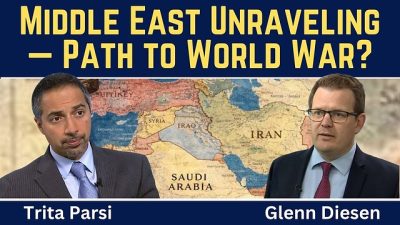
Trita Parsi: Middle East Unraveling — Are We on the Path to World War?
or go to
Aletho News Archives – Video-Images
New Book
Trans agenda is ‘normalization of sadism’ – US author

RT | September 23, 2026
The US Democratic Party has embraced a transgender agenda that amounts to “the normalization of sadism,” author A.J. Rice has said, warning that radical trans policies would return if the party is allowed to regain power.
Speaking to RT’s America First host Scotty Nell Hughes about his new book, ‘The Curse of the Bearded Lady: How the Trans Mafia Whacked American Sanity’, Rice argued that activists have gained significant influence in schools, medicine, and corporate America while people who questioned the agenda have faced pressure to stay silent.
The author described the “trans mafia” as the sprawling network of people and institutions that have helped the movement gain influence. He singled out parts of academia, wealthy backers, and corporations, and stated that providers of transition-related treatment also have a financial incentive to keep young people in their care indefinitely.
Rice argued that the consequences of these policies ultimately fall on children who are being drawn toward gender-affirming medical treatments and on girls who are expected to share locker rooms or compete in sports with biological males.
He noted that while voters rejected the Democrats’ approach to gender in 2024, the party, which has been “captured by madness,” has since only doubled down and is seeking what is effectively “the normalization of sadism.” … Full report
Blog Roll
 Aletho News
- Integrity Initiative: UK-funded network framed dissent as Russian disinformation for years
- ‘We don’t seek permission to defend our country’: Snippets from President Pezeshkian’s UNGA address
- NATO chief wants Europeans to fight American wars [for Israel]
- German chemicals giant reveals details of downsizing
- Refaat Al-Areer Was The Canary In The Coal Mine In Israel’s War On The Truth
- Israeli election committee bars candidate from Knesset race over Gaza war opposition
- French-Lebanese man files war crimes complaint over Israeli attacks
- Mahan Air Flight Lands in China Despite US Threat against Iranian Airlines
- US eyes $10bn fund to rebuild war-battered Gulf infrastructure
- Trump meets Rodríguez near Maduro’s prison as Venezuela’s oil flows to US
- If Americans Knew
- Caught on Tape: AIPAC CEO Boasted of Controlling Trump’s National Security Officials
- Why Hamas Attacked Israel in October 2023 – Israeli professor Ilan Pappé
- They see them, then kill them: Israeli quadcopters track, deliberately target civilians in Gaza
- Winter could turn Gaza’s treacherous, war-damaged buildings into deathtraps
- Majority of Democratic Voters Want to Prosecute Both Biden and Trump Administration Officials Over Gaza
- As Gaza languishes, world leaders gather at the UN – Daily Update
- Sanctions are collective punishment: immoral and self-defeating
- Phosphorus Munitions Fired by Israel Burn Groves, Orchards in Southern Lebanon
- Israel Carries Out New Ceasefire Violations Across Gaza
- AI – Emphasis on the ‘I’: Israel Is Funding AI Chatbot Propaganda
- No Tricks Zone
- New Study: Earth And Venus Surface Warmth Largely Explained By Convection And Lapse Rate, Not CO2 Or Radiation
- 2025 Nature Paper Claiming Worsening Global Drought Gets RETRACTED …Heavily Flawed
- New Study: ‘Global Drought Shows No Detectable Recent Acceleration Under Climate Warming’
- Economic Masterminds: German Socialists Suggest Taxing Productivity Gains Stemming From Using AI
- The South China Sea Has Not Been Cooperating With The Climate Change Narrative
- Energy Crisis: Germany Enters Heating Season With Historically Low Gas Reserve Fill Levels
- New Study: The Antarctic Ice Sheet Gained Mass From 2020-2024 Due To Staggering Snow And Ice Accumulation
- Study: Ocean Heating Rates From Thousands Of Years Ago ‘Dwarf’ Modern Ocean Heating Rates
- Climate Extremists Target, Attack Large-Scale Power Grid Infrastructure In Germany!
- New Study: Antarctic Ice Melt Has Contributed Less Than 1 Centimeter To Sea Level Rise In The Last 30 Years

