Japan to release Fukushima contaminated water into sea: Reports
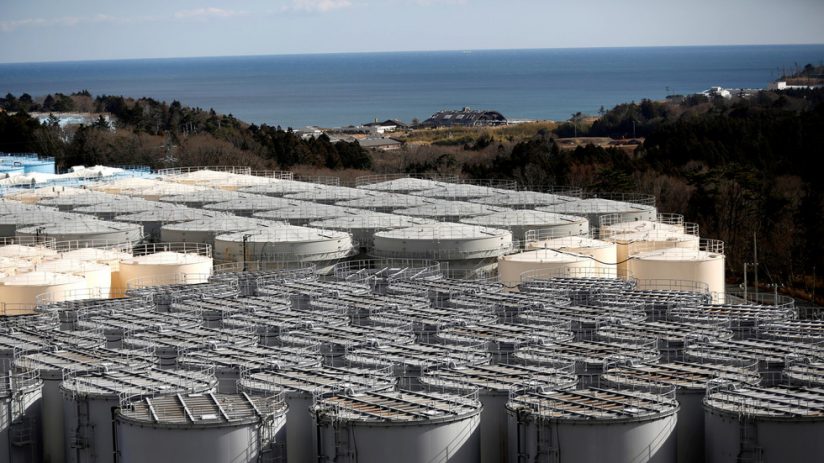
Storage tanks for radioactive water at TEPCO’s tsunami-crippled Fukushima Daiichi nuclear power plant in Okuma town, Fukushima prefecture, Japan. (Photo by Reuters)
Press TV | October 16, 2020
Nearly a decade after the Fukushima nuclear disaster, Japan’s government has decided to release contaminated water from the destroyed plant into the sea, media reports said on Friday, with a formal announcement expected to be made later this month.
The decision is expected to rankle neighboring countries like South Korea, which has already stepped up radiation tests of food from Japan, and further devastate the fishing industry in Fukushima that has battled against such a move for years.
The disposal of contaminated water at the Fukushima Daiichi plant has been a long-standing problem for Japan as it proceeds with a decades-long decommissioning project. More than one million tonnes of contaminated water are currently stored in huge tanks at the facility.
The plant, run by Tokyo Electric Power Company Holdings Inc., suffered multiple nuclear meltdowns after a 2011 earthquake and tsunami.
On Friday, Japan’s industry minister Hiroshi Kajiyama said no decision had been made on the disposal of the water yet, but the government aims to make one quickly.
“To prevent any delays in the decommissioning process, we need to make a decision quickly,” he told a news conference.
He did not give any further details, including a time-frame.
The Asahi newspaper reported that any such release is expected to take at least two years to prepare, as the site’s irradiated water first needs to pass through a filtration process before it can be further diluted with seawater and finally released into the ocean.
In 2018, Tokyo Electric apologized after admitting its filtration systems had not removed all dangerous material from the water, collected from the cooling pipes used to keep fuel cores from melting when the plant was crippled.
It has said it plans to remove all radioactive particles from the water except tritium, an isotope of hydrogen that is hard to separate and is considered to be relatively harmless.
Last week, Japanese fish industry representatives urged the government not to allow the release of contaminated water from the Fukushima plant into the sea, saying it would undo years of work to restore their reputation.
South Korea has retained a ban on imports of seafood from the Fukushima region that was imposed after the nuclear disaster and summoned a senior Japanese embassy official last year to explain how Tokyo planned to deal with the Fukushima water problem.
During Tokyo’s bid to host the Olympic Games in 2013, then-Prime minister Shinzo Abe told members of the International Olympic Committee that the Fukushima facility was “under control”.
The Games have been delayed to 2021 because of the pandemic and some events are due to be held as close as 60 km (35 miles) from the wrecked plant.
Australia Faces Challenging Times Caused by Deteriorating Relations with China
By James ONeill – New Eastern Outlook – 16.10.2020
A recent article published in Russia Today on 13 October 2020 by Tom Fowdy raised some very important issues affecting Australia’s economic well-being. That economic position is rapidly deteriorating as the country’s crucial economic relationship with China disintegrates at an accelerating rate. Australia’s export structure has had several distinctive features over the 250 or so years since it was first colonised by the British in the late 18th century.
Its initial role was to serve as a penal colony for people from Britain who had committed crimes, but not severe enough to warrant execution. The rights of Australia’s indigenous population who had inhabited the country for more than 100,000 years did not enter the equation. Indeed, they were not officially regarded even as human beings, that status only being assigned in the 1960s. Before then the aboriginal people had the same legal status as flora and fauna.
The defeat of the British in Singapore by the Japanese army in 1941 lead to the beginning of a move from reliance on the British for the country’s security to reliance upon the Americans. The latter’s troops arrived in 1942 and they have been there ever since.
Australia’s trading patterns showed a similar reliance upon the British until the latter’s joining the European Common Market on 1 January 1973 forced a reappraisal of that economic relationship. Thereafter, Australia’s trade shifted progressively to its Asian neighbours, a trend that accelerated in every year since the 1970s. Today, Asian nations account for the vast bulk of Australia’s trade with the world.
China, which accounted in 2019 for more than one third of the total Australian exports, was easily the biggest trading partner, accounting for nearly twice the amount of trade than that with Japan, the second most important trading partner.
Despite its geography, being a landmass immediately South of its major trading partners, the Australian political psyche has remained firmly fixed to the Anglo-United States worldview. Since the end of World War II in 1945, Australia has joined the United States in at least four major military conflicts; Korea, Vietnam, Afghanistan and Iraq, that are not only geographically remote from Australia, but also involved no discernible vital Australian strategic interest.
The fact that all four wars were based on false justifications did nothing to enhance their legitimacy. The Korean War was manifestly aimed at the overthrow of the then newly installed Communist Party in China. This was readily discernible from the actions of the Allied troops that clearly violated the terms of the United Nations Security Council resolution authorising military action (in the absence of Russia and with China’s seat still held by the Nationalists.)
The lies told about Iraq’s “weapons of mass destruction” or Afghanistan’s alleged role in sheltering the falsely accused Osama bin Laden for his alleged role in the events of 11 September 2001 are too well known to bear repetition here. What is important for present purposes is that the falsehoods and ulterior motives for the invasion and occupation of Afghanistan and Iraq did not deter Australia from either its initial involvement or its continuing role as an occupying power.
Australia similarly joined in the United States manufactured war in Vietnam, again for no discernible strategic or military interest to Australia. It was the experience of the 1972 –1975 Whitlam Labor government in Australia in response to that war that cemented the subservience to United States interests.
Whitlam had removed Australian troops from Vietnam and recognised the PRC as China’s legitimate government. Both moves met with bitter opposition by the Liberal Opposition party. What sealed the Whitlam government’s fate however, was its decision to close the American run spy base at Pine Gap in Australia’s Northern Territory. The Whitlam government was dismissed by the country’s Governor General John Kerr the day before Whitlam was to announce Pine Gap’s closure to the Australian parliament. That the base is still open (one of at least eight United States military bases in Australia) speaks volumes about the geopolitical consequences of the Whitlam dismissal.
Through these tumultuous years trade with China continued to flourish. China also became the largest source of foreign students, the largest source of foreign tourists, and the third largest source of foreign investment. In 2020 all this changed. Clearly acting as a mouthpiece for the American administration, Australia demanded an “explanation” from China at the beginning of this year for the outbreak of the Corona virus.
The accusatory tone of the Australian demand was not well received in Beijing. This began a series of economic countermeasures by China. The initially relatively small economic impact of banning wine imports was clearly intended to send a signal.
That signal fell on deaf ears. Australia’s anti-China rhetoric progressively escalated through 2020. The Chinese response was to increase the banning of Australian imports. The latest (early October 2020) was to ban coal imports from Australia. This is a market worth $US13 billion to the Australian economy. It will not be the last item to be banned or greatly restricted, with iron ore (more than US$100 billion) probably being the next commodity banned, already falling 17% each month since July.
The Covid crisis has also resulted in an almost complete cessation of Chinese student arrivals (again the largest foreign source) and an industry worth billions of dollars and thousands of jobs to the Australian economy. It would be naïve to expect those numbers to recover in the foreseeable future. The same is true with Chinese tourists, a vanishing species and again unlikely to return to anywhere near previous levels. Again, tens of thousands of jobs are lost.
The rational response by an Australian government would be to review both its policies and its rhetoric. Not only has the Morrison government shown no such inclination, it is difficult to see how it could feasibly do so without adversely affecting its close and continuing (subservient) relationship with the United States.
The memory of the fate of the 1975 Whitlam government which dared to pursue policies contrary to United States wishes continues to cast a very long shadow over Australian politics.
Fowdy suggests that Australia’s situation “might be described as the most clear and explicit reaction yet of the discomfort in the Anglo-sphere world caused by the rise of China.” I respectfully agree. The solution however, is not to try and maintain the dominance of the Western world as it has been for the past 300 years.
Instead there needs to be a recognition that the Anglo-Saxon dominance was an historical anomaly, and that the old order is resetting itself. In Australia’s case that will require some major mental adjustments.
The country has flourished in recent decades precisely because of its geography and growing trade and other links with what Australians call “the near North.” What has been manifestly lacking is the political attitudes and conduct that match the geopolitical and trade realities. Unfortunately, that adjustment may be a bridge too far for the Australian psyche. It has only itself to blame.
James O’Neill is an Australian-based former Barrister at Law.
Will the Mediterranean Sea save Lebanon from drowning in debt?
Steven Sahiounie | Mideast Discourse | October 16, 2020
The Lebanese population faces between six to twelve hours of electricity cuts per day, and in some rural areas, there is simply no electricity provided by the government grid. Amid the backdrop of decrepit infrastructure, government corruption, devalued currency, and widespread poverty, Lebanon began talks with Israel concerning their maritime borders in the gas-rich Mediterranean Sea on Wednesday at the UNIFIL headquarters at Naquora.
The UN peacekeeping force UNIFIL has been monitoring the disputed land boundary since Israel’s’ military withdrawal from south Lebanon in 2000, ending a 22-year occupation. The two sides met together in the same room but directed their communications through a US mediator.
The US is the mediator between the two countries which remain technically ‘at war’ while hoping to end a long-running dispute which could eventually see Lebanon producing gas to convert to domestic electricity, as well as a potential revenue producer which could pay off Lebanon’s huge debts. Lebanon’s currency has lost 80 percent of its value against the dollar over the last year, and its debt-to-G.D.P. ratio is one of the world’s highest.
Lebanon and Israel are struggling to deal with high COVID-19 infection rates, while Netanyahu is slipping in the polls due to abuse of power charges, and the Lebanese government is in limbo after being labeled as corrupt and inept, while desperate for cash from foreign donors as it faces the worst economic crisis since its 1975-1990 civil war. The financial collapse was compounded by an explosion at the Port of Beirut in August, killing nearly 200 people.
Israel is already pumping gas from huge offshore fields, and this meeting will allow both sides to proceed further within the safety of an understanding of the maritime borders.
US pressure
The talks follow years of diplomacy by Washington, and the Trump Administration had hoped to use the Naquora meeting as a dramatic media show less than a month after landmark US-sponsored normalization agreements between Israel and the United Arab Emirates and Bahrain; however, this showy plan was aborted.
The US envoy David Schenker explained that these talks “have nothing to do with the establishment of diplomatic relations or normalization.” However, it was last month that the US turned up the pressure on Lebanon to start the talks with a deadline for the agreement before the US election on November 3, while the second round of talks is scheduled for October 28.
The Naquora meeting
President Michel Aoun is the key person managing the off-shore energy resources portfolio, and he placed a representative from the Lebanese Petroleum Administration (LPA) on the negotiating team as a nod to pressure from Washington who had insisted on civilian presentation, whereas Hezbollah requested only military and technical delegates.
There are four points on the agenda of the Naqoura talks: setting the land reference point from which to depart toward the sea; defining the southern maritime border where the disputed area is located; agreeing on the land border demarcation after the completion of the maritime demarcation, and exchanging documents and handing over copies to the United Nations.
The Lebanese Negotiating team
Brigadier General Bassam Yacine is the lead negotiator, Marine Colonel Mazen Basbous is the head of operations in the Lebanese military, Najib Masihi is a Lebanese American expert in maritime and territorial boundaries, and Wissam Shbat is a board member of LPA and head of its geology and geophysics unit.
Lebanon’s offshore possibilities
In 2017, Lebanon’s information minister announced the Cabinet had approved licenses for Italy’s Eni, Frances’s Total, and Russia’s Novatek to carry out exploratory drilling off the Lebanese coast in two of Lebanon’s 10 offshore blocks to determine whether oil and gas exist in the area.
Analyst Diana Kaissy, who heads the Lebanese Oil and Gas Initiative think-tank, said it was “impossible to know” the extent of the accessible reserves before exploration operations begin, but she said, “preliminary evaluations” showed the five blocks offered by the government were the “most promising,” with block nine bordering a sector disputed by Israel.
At issue is more than 330 square miles in the Mediterranean that Israel and Lebanon both claim is in their exclusive economic zone. The pressure to resolve the dispute has mounted as Israel and Cyprus have begun exploiting offshore gas.
Lebanon estimates it has 96 trillion cubic feet of natural gas reserves and 865 million barrels of oil offshore. Israel is aiming to get a percentage of a contested area of 860 square kilometers that Lebanon is claiming.
The 1982 UN Convention on the Law of the Sea (UNCLOS) stipulates that coastal states have sovereign rights in a 200-nautical-mile exclusive economic zone (EEZ) concerning natural resources; however, the maritime dispute does not fall within the UNIFIL’s current mandate, and Israel is not a party to UNCLOS.
Lebanon reached a maritime border agreement with Cyprus in January 2007. This prompted Beirut, in July and October 2010, to deposit with the United Nations the geographical coordinates of the southern and southwestern maritime borders of that EEZ. Cyprus went ahead and signed an EEZ delimitation accord with Israel in December 2010.
Lebanon and Israel could share in the disputed 860 square kilometers, which covers Lebanon’s offshore gas Blocks 8, 9, and 10. The “Hoff line” proposal gave Lebanon 550 square kilometers, which was rejected as Beirut insists on full rights in this disputed area. Lebanon has refused to join the Eastern Mediterranean Gas Forum or any other regional mechanism that includes Israel; therefore, it has been more or less isolated in the eastern Mediterranean gas process given the emerging alliance between Israel, Egypt, Cyprus, and Greece.
France’s Total energy company is set to begin gas exploration in Block 9 by the end of the year, while Israel approved in June oil, gas exploration in Block 72, close to Lebanon’s Block 9 where exploration will soon start.
Hezbollah and Amal
Hezbollah’s Secretary-General Hassan Nasrallah in a joint statement with Amal, the country’s other main party of resistance, released hours before the talks were due to start, called for the negotiating team to be revised to include only members of the military.
The Lebanese preconditions included having military and technical delegates, instead of diplomatic delegates, and setting no timeline to reach a deal, to avoid US pressure on the negotiations.
Last month the US placed sanctions on the top aide to Nabih Berri, the leader of Amal, for corruption and financially enabling Hezbollah.
Popular protectionist policies in France could eventually lead to “Frexit”
By Paul Antonopoulos | October 15, 2020
The majority of French people say they are in favor of protectionism, according to the latest OpinionWay poll by Le Printemps de l’Économie and Inseec U. In fact, the figure has risen sharply since the beginning of the COVID-19 pandemic and the European Union’s weak response to external threats like Turkey. This is a fundamental trend that could lead to a referendum on France’s exit from the European Union.
According to OpinionWay polls, the share of French people in favor of protectionism has gone from 51% in March to 60% in September. The survey confirms the desire for protectionism in France, which has only been reinforced since the pandemic began. The survey shows that 60% of the French people questioned consider globalization as “a threat to France” and 65% believe that “France must protect itself more from the world today,” a level never observed since polling began
In the event of a major crisis, a country will first and foremost try to protect and supply its own population, even if it comes to the detriment of others. This was seen all across the European Union in the first months of the pandemic when most member states abandoned inter-European solidarity to the detriment of other member states. For example, in March, Germany banned the export of protective medical equipment at a time when France did not have enough.
As popularity for protectionism is increasing in France, according to the OpinionWay survey, support for free trade went down from 46% to 35%. Supporters of free trade try to pass off protectionism as authoritarianism and isolationism. However, during the Trente Glorieuses (The Glorious Thirty), which between 1945-1975 saw unprecedented economic growth and development in France, trade was carried out in a fair framework which limited distorted competition, unlike what happens with free trade.
The polls also show that the tide is turning for 18-24-year old’s, “traditionally known to be in favor of opening up to the world,” as Pierre-Pascal Boulanger, president and founder of Printemps, highlighted in the La Tribune article. “The gaps are narrowing sharply since now 44% of very young people are in favor of protectionism against 37% in March.”
Therefore, for all the rhetoric of European sovereignty by French President Emmanuel Macron, it means absolutely nothing as sovereignty can only be national. This year alone we saw Italy abandoned by its partners at the peak of the pandemic, while European Union member states still refuse to pass sanctions against Turkey despite its violations of Greek and Cypriot sovereignty, and constant threats of war.
Any European protectionist inclination is directly undermined by national interests. France is now beginning to prioritize its national interests over that of the European Union, especially with the Minister of the Economy, Bruno Le Maire, suggesting an implementation of a European carbon tax at its borders, something that Paris considers essential but which does not please Berlin.
The same thing could be seen concerning the taxation of GAFAM [Google, Amazon, Facebook, Apple and Microsoft]. The subject has been on the table for years but Germany is blocking taxes against GAFAM because the U.S. is its major trading partner and Berlin is afraid that Washington will retaliate by taxing imported vehicles which would hurt the German economy.
An Elabe poll released on February 12 showed that 80% of the French people questioned were opposed to a new duel between Macron and opposition leader Marine Le Pen in the 2022 elections. However, recent opinion polls show that the two candidates are indeed neck-to-neck and marginally ahead of other opponents. However, the European question encompasses all political and economic dimensions and must be put at the center of discussions. The European question goes beyond the left-right divide and a referendum on France’s exit from the European Union may be at the heart of the political debate. It will blur the ideological divides as people from different political positions would campaign for a “yes” or “no” vote, as we saw with Brexit.
Nigel Farage, leader of the Brexit Party and considered the great architect of the UK’s exit from the European Union, has never won the general elections. But he put such pressure to obtain a referendum and succeeded in creating a real debate on the question of sovereignty and protectionism.
The Brexit referendum has shown that it is possible. If a similar debate can get into the French spotlight, strong Frexit sentiment can build off the back of increasing popularity in protectionist policies. The French in 2005 voted against the treaty to establish a European constitution despite all predictions it would be unanimously passed. Although detached from the European Union, the French also withdrew from NATO for several decades, demonstrating there is a high sense of independence and sovereignty in France.
With Brussels unwilling to take a strong position against external threats like Turkey and/or showing a lack of solidarity when the pandemic was spreading across the continent, France’s possible exit from the European Union can build momentum and popularity.
Paul Antonopoulos is an independent geopolitical analyst.
How to kill a thriving metropolis in 7 months: NYC’s Covid-19 failure is a vicious spiral directed by sadists

By Helen Buyniski | RT | October 12, 2020
Seven months into the pandemic, as many US states inch back toward ‘normal’, New York is in the grips of a crime wave, reinvigorated lockdowns, and widespread fear of pretty much everything. Thank local government.
New York City has lost billions of dollars in tax revenues on tourism, music, art, theatre, restaurant dining, and everything else that once fueled its mammoth economy over the seven-month Covid-19 pandemic shutdown. It’s in worse shape than most US states, and unlike many others, its continued misfortunes are largely of its own making.
The shuttering of the city’s iconic Broadway theaters alone has sent hundreds of thousands out of work and signaled to both wealthy city inhabitants and out-of-town visitors that their cash is better spent elsewhere. Theaters announced just weeks ago that performances would be cancelled through March 2021, and the Metropolitan Opera House canceled its entire season through 2021.
New York’s famed restaurant scene isn’t faring any better. The ‘lucky’ establishments are finally – as of two weeks ago – allowed to operate at 1/4 capacity indoors, which given the amount of money they’ve lost over the last 6 months is a band-aid on a cannonball wound. The unlucky ones in New York Governor Cuomo’s newly-invoked ‘red zones’ must continue to seat patrons outdoors in the freezing cold as summer gives way to a damp, chilly autumn. To make matters worse, there’s no Thanksgiving parade, no Black Friday shopping, no fun allowed.
Perhaps pandemic-fearing wealthy New Yorkers would have left anyway, taking their tax dollars with them. But tourism might have filled some of the gap. What city in its right mind would turn up its nose at $11.5 billion, the estimated total spent by out-of-town visitors to the city’s famed theatrical productions alone? Why leave that money on the table, especially when the virus that had held the industry hostage for months has been steadily on the wane? With Governor Cuomo demanding billions in relief from the federal government to make up an economic shortfall that stems from his own policies, surely he can’t afford to keep the state (and its largest city)’s biggest draws closed down indefinitely?
Pleas to cancel rent have fallen on deaf ears, and starving artists’ efforts at workarounds have been squashed. Cuomo even passed an executive order in August – with the coronavirus “peak” safely receding in the rearview mirror – to ban ticketed live performances, and has revoked liquor licenses from bars that failed to serve food with their takeaway drinks. Is it any wonder the city is hemorrhaging cash, as well as the creative and interesting people who put it on the map?
MURDER, SHE COUGHED
To understand the motivation someone like Cuomo could have for destroying the city whose economy once kept his state alive, it helps to grasp the concept of the “self-licking ice-cream cone,” a phrase that has been attributed to NASA scientists but can in general describe any system that exists for little reason other than to continually justify its own existence.
Every politician who’s ever harbored dreams of becoming a totalitarian dictator has embraced the directive “never let a crisis go to waste,” and both Cuomo and NYC mayor Bill de Blasio are true believers. After attaining unprecedented powers through the emergency measures passed under cover of Covid-19, they aren’t about to let them go quietly, and have seemingly set up a perpetual motion machine of crisis that – accidentally or otherwise – ensures NYC will remain forever financially in the hole. The type of cash lifelines that might get the city back on its feet – as a post-9/11 tourism blitz did – are blocked (no one’s going to visit a New York where dancing, drinking, and taking in a show are off-limits). Average New Yorkers, too, are paralyzed by the thought of the scary virus lurking just outside their door, ultimately learning to love their captors, Stockholm-Syndrome-style – if this month’s fawning New Yorker profile of Cuomo is any indication.
With the virus no longer nearly as much of a danger as it was back in April, the would-be dictators have put together what looks for all the world like a diabolical plan to empty out the city and take advantage of artificially-lowered property values.
First, the criminals are unleashed. Bogged down with a directive to enforce the ever-growing range of social-distancing and mask-related offenses, New York’s police are no match for the flood of actual criminals released into the streets under statewide “bail reform” that all but guarantees the “catch and release” of muggers, rioters, and other criminals whose offenses stop short of rape and murder. Even more miscreants have been paroled early due to Covid-19-related overcrowding excuses.
Next, the threats are broadcast 24/7 over every media outlet. CCTV videos of horrific, unprovoked attacks on old women, small children, everyday middle-aged types, a jazz pianist, a would-be rape victim on a subway platform – the point is made that everyone is a potential victim. The solution is presented as a paradox: do New Yorkers who’ve just spent months demanding the city rein in its police want more cops patrolling the streets? Surely that’s not very “woke” of them. While they hem and haw, the rampage continues, and the debate ends with helpless, fear-crazed city dwellers throwing up their hands and begging Cuomo and de Blasio to Do Something, Anything, to Make the Bad Men Stop. Both men play dumb – there’s nothing they can do! Better get used to crime, or flee!
TERROR IN THE TUNNELS
The plight of the subway is instructive. The city’s legendary 24-hour train system was ordered to close down service from 1am to 5am back in May, ostensibly for “cleaning” because of the virus. The homeless people who’d taken to sleeping on the cars in the wee hours were a health risk, New Yorkers were told, and the city promised free transit alternatives for those whose jobs required them to be able to move around during those times (promises which in many cases did not materialize). Ridership, already severely curtailed due to pandemic fears, was down 90 percent at one point, sending the already cash-strapped system deep into the red.
Now, we’re told, the lack of people (and cops) on the subway has made it a predator’s playground. The lack of witnesses makes it easy for unscrupulous crooks to nab a wallet, attack an innocent commuter, and otherwise strike fear into the hearts of those New Yorkers who still think there’s a future for their city. “We need more cops!” the law and order types cry, only to find the MTA is deeper in the financial hole than ever and de Blasio is leery of upping the police budget. Presumably, the next move will be to decrease operating hours still further, guaranteeing the downward spiral continues indefinitely.
A tourism and entertainment-based city without so much as a public transit system is, quite simply, doomed. The only question, then, is why are de Blasio and Cuomo so determined to run New York into the ground?
Cuomo’s “economic reopening council” is guided by private equity partners who actually make their profits off the carcasses of dead and dying businesses, so it’s no mystery why he’s eager to see restaurants and theaters crash and burn. Private equity stands to make billions on all the vacant office space and abandoned properties from city institutions forced to pull up stakes. If Cuomo does what his deep-pocketed donors tell him – he’s not called “Governor 1 Percent” by progressives for nothing – he might even get that rumored Attorney General spot he’s being reportedly considered for in a Democratic Joe Biden administration. And perhaps de Blasio – despite never polling above 0.1 percent during the 2020 primaries – actually thinks he has a shot at the governor role.
Better to reign in hell than to serve in heaven, as the saying goes.
Helen Buyniski is an American journalist and political commentator at RT. Follow her on Twitter @velocirapture23
European oil companies will not tolerate Poland’s attempt to cancel Nord Stream 2
By Paul Antonopoulos | October 12, 2020
By handing out a €6.5 billion fine against Gazprom, Warsaw has obviously and massively miscalculated because it did not only antagonize the Russian energy company as was intended, but also European partners of the Nord Stream 2 pipeline project, which the Polish government obviously had not considered. Even leaders within the European Union were shocked at the huge fine that Poland is attempting to impose against Nord Stream 2.
It may very well be that the Polish Office of Competition and Consumer Protection (UOKiK) has lost itself when deciding on the price of the fine against Gazprom. But regardless of that, UOKiK has apparently also exceeded its jurisdiction. As the Düsseldorf-based energy supplier Uniper reports, the existing agreements on Nord Stream 2 have nothing to do with a joint venture, which is why the Polish laws on merger controls do not apply to them. The initial plans were to finance the construction of the Nord Stream 2 pipeline through the establishment of a joint venture. For this, however, the companies involved should have received a permit in all the countries in which they operate, as well as from Poland, the only EU state that blocked this decision. The decision for it not to be a joint venture was made without further ado so as not to waste time or money in a dispute with Polish authorities.
The pipeline partners designed an alternative financing model for Nord Stream 2 and instead of joining Nord Stream 2 AG (Company) as a co-partner, the European energy companies are participating in the project as lenders so that Polish antitrust laws do not apply to them. However, Gazprom, the majority shareholder of Nord Stream 2 AG, has given its European partners shares in the company as collateral for the financing provided. If the loans from the Russian side are not paid, the European corporations automatically become the owners of Nord Stream 2 AG. Referring to this fact, the Polish antitrust authorities have declared the European partner companies to be quasi-shareholders in the pipeline project.
With this UOKiK also justifies the exorbitant fine against Gazprom and the fines of around €55 million against Uniper (German), Wintershall (German), Engie (French), OMV (Austrian) and Shell (English-Dutch). Neither Gazprom nor Nord Stream 2 are financially at risk at the moment and the Russian group has already announced that it will take the fine to court.
Poland is of course now aware that their attempts to fine the Nord Stream 2 project will amount to nothing. The aim of the Polish government is not so much to force a large sum of money from Gazprom in the long term, but rather to bury the pipeline project entirely. And this is the part where Warsaw has grossly miscalculated, not only European reactions, but Russian determination.
The goal to cancel Nord Stream 2 also explains why Polish authorities published their decision last week. Relations between the EU and Russia are extra strained because of the Navalny case and the situation in Belarus. France and Germany are working on new sanctions against Russia for the Navalny case and continue to apply pressure against Belarus.
Another question is how effective these measures will be. Sanctions have long degenerated into ambiguity as it is the usual way the West deals with Moscow. Russia has learnt how to adjust their economy accordingly, meaning that sanctions have turned into a farce. The West is regularly expanding its blacklists of sanctioned companies and private individuals, but there has been no significant effect. Political forces with a keen interest in the failure of Nord Stream 2 are plentiful in the West and they are currently advancing the Navalny case in the hope that it will cut the EU from Russia more strongly or permanently. This will not occur as Europe desperately needs Russian energy, which is why Nord Stream 2 is such a critical project for all involved.
Poland plays the main role in trying to cancel Nord Stream 2 and the decision by UOKiK is just another push to finally get Europe to abandon the pipeline project. According to a joint declaration by France and Germany, measures are currently being prepared for those alleged to be responsible in the Navalny case and their participation in the so-called Novichok program.
Despite these measures, Western Europe is bringing its energy project which is important for its own future out of the danger zone, while Poland is attracting even more displeasure from EU giants through its own operation. A penalty against Gazprom may be a Russian problem, but fines against leading corporations from Germany, France, the Netherlands, Great Britain and Austria are guaranteed to leave many of Europe’s biggest capitalist angered. The effort Warsaw is making to thwart Nord Stream 2 is visibly turning opposite to what they expected as there is little doubt the Nord Stream 2 project will come to fruition and completion.
Paul Antonopoulos is an independent geopolitical analyst.
US Southern Command Chief Admits Plans Against Venezuela
teleSUR- October 7, 2020
Venezuela’s Foreign Affairs Minister Jorge Arreaza Monday denounced that the U.S. Southern Command Admiral Craig Faller openly admitted his country’s plans to violently overthrow President Nicolas Maduro.
On Monday, Faller commented at an online meeting organized by the business forum Council of the Americas that the international attempts to bring down Venezuela’s government have worked, although not quickly enough for the Venezuelan people.
He not only said that such efforts have not worked quick enough but also that it took an entire generation to get to this point and that it will take a while to unblock Venezuela’s democratic framework.
The Admiral also attributed certain external factors such as the help of Cuba, Russia, China and Iran to the alleged slow change within Venezuela.
Arreaza pointed out that this arrogant position of the members of the White House is unacceptable as they insist on violating the Charter of the United Nations and the most basic principles of international law through threats and blockades.
This statement shows Washington’s systematic and widespread attacks on Venezuela, which constitutes a crime against humanity.
Venezuela’s government will add Faller’s confessions to the criminal complaint it filed against the U.S. government on Feb. 13 before the Hague’s International Criminal Court.
In this complaint, President Maduro requests the White House to lift all coercive measures against his country since the U.S. government prevents Venezuela from acquiring food and medicines and from negotiating freely on the international market.
As Boris Johnson announces Britain’s ‘great reset’, were the Covid ‘conspiracy theorists’ right all along?
By Neil Clark | RT | October 7, 2020
The UK Prime Minister’s remote speech to his party conference saw him dismiss the idea of returning to normality. Is he using Covid-19 to follow the World Economic Forum’s ‘Great Reset’ agenda, as many have warned?
‘It’s not really about public health or a virus. They have another agenda.’ That’s what the so-called ‘conspiracy theorists’ have been saying since March, when the first British lockdowns were imposed and our lives were turned upside down.
Those ‘conspiracy theorists’ were denounced, as always, as ‘cranks’ and ‘flat-Earthers’ but here we are in October, and, let’s face it, there is absolutely no sign, despite very low numbers of deaths ‘with’ Coronavirus, that we are returning to anything like normal. In fact, in his keynote speech yesterday, Prime Minister Boris Johnson specifically ruled out a return to normal, not even with a vaccine.
“After all we have been through, it isn’t enough just to go back to normal. We have lost too much. History teaches us that things of this magnitude – wars, famines, plagues, events that affect the vast bulk of humanity, as this virus has – they do not just come and go. They can be the trigger for economic and social change.”
When I heard Johnson utter those words I thought, ‘where have I heard this stuff before?’ Well, the answer is in the book ‘Covid-19: The Great Reset’ by Klaus Schwab, the executive chairman of the World Economic Forum, and Thierry Malleret. They too, like Johnson, invoked the Second World War as the trigger for fundamental changes, not only to the global order and global economy, but to society and the way human beings interact with one another. Like Johnson, they don’t want to return to normal. “Many of us are pondering when things will return to normal. The short response is never.”
Instead, Schwab and Malleret want a world changed forever by a virus which they admit is only ‘mild’ compared to others in history. Covid-19 is seen as the catalyst for the ‘Fourth Industrial Revolution’.
As to where all this is heading, I recommend you read Schwab’s ‘Great Reset’, and his earlier ‘The Fourth Industrial Revolution’, but please don’t do so late at night, because they will probably give you nightmares. Schwab’s elitist Davos-man utopia is a trans-human, socially distanced, utterly soulless dystopia for the rest of us. Think of the most terrifying sci-film you’ve ever watched and that still doesn’t go anywhere near it. And the worst thing is that it is sold to us as some kind of ‘progressive’ vision.
Johnson, in his speech yesterday, showed he’s a fully-signed up ‘Great Resetter’. It was, for me, the most chilling oration ever made by any British prime minister at a party conference.
The man who justified a national lockdown in March on a purely temporary three-week basis to ‘flatten the curve’, and ‘protect the NHS’, and who said in the summer, after the lockdown had lasted three months, that he hoped Britain would return to ‘significant normality’ by November, now tells us: “We have been through too much frustration and hardship just to settle for the status quo ante – to think that life can go on as it was before the plague; and it will not… We are resolving not to go back to 2019.”
For Johnson, using the globalists’ phrase ‘Build Back Better’, this is the time to launch Britain on the ‘Fourth Industrial Revolution’. “From internet shopping to working from home, it looks as though Covid has massively accelerated changes in the world of work… as old jobs are lost and as new ones are created… The Covid crisis is a catalyst for change…” he said.
Did Schwab actually write his speech? It looks like it. Although Johnson didn’t use the phrase ‘The Fourth Industrial Revolution’, he did mention a ‘Green Industrial Revolution’ twice.
Johnson foresees a future in which every home in Britain relies on wind power (he certainly produces a lot of that), and “instead of being dragged on big commutes to the city” people can “start a business in their home town… and bring up their children in the neighbourhoods where they grew up themselves.”
Working from home is here to stay, with “gigabit broadband,” shopping from home, conferencing from home… in fact, let’s do everything from home. Who needs to meet other human beings? Not that there’d be anywhere to meet, with pubs, cinemas and theatres all closed down due to the never-ending coronavirus restrictions.
Johnson pledged to make Britain “the greatest place on Earth” but to me it sounds more like hell. The question, as ever, is who benefits?
The World Economic Forum, founded by Schwab, has been incredibly influential when it comes to the changes we’ve already seen in 2020, and what is being openly planned for the future. It was the WEF which co-hosted the ‘Event 201’ conference in New York in October 2019, which modelled a fictional global pandemic.
It was at the WEF’s annual meeting in Davos on January 24, 2020 that Bill Gates’ Coalition for Epidemic Preparedness and Innovations (CEPI) held a press conference to announce a ‘new partnership’ to develop vaccines for the virus, when the number of confirmed worldwide cases was still in the hundreds.
It was the WEF’s Schwab who declared in June: “The pandemic represents a rare but narrow window of opportunity to reflect, reimagine and reset our world.”
It was the WEF that in July was promoting a Covid-19 ‘Health Passport’ app, the ‘brainchild’ of one of its ‘Young Global Leaders’, as the future for travel and attending events.
And for those who don’t have the app or a ‘negative‘ test result? Well, you can just stay at home.
If you take a look at the ‘founding partners’ of the WEF’s Centre for the Fourth Industrial Revolution you’ll see names such as Microsoft, Palantir, Facebook, Netflix and Gavi, The Vaccine Alliance, founded by the Bill and Melinda Gates Foundation.
Yes, that’s right, hi-tech online giants and hi-tech multi-billionaires supporting a big shift towards a stay-at-home, ‘do everything on the Internet’ society.
Is it a ‘conspiracy theory’ to say that Covid-19 is being used as a convenient opportunity to introduce long-planned changes to the economy and society, when those pushing for such changes like Schwab openly talk of there being a “rare but narrow window” for a major ‘reset’?
Actually, after Johnson’s speech yesterday, the biggest ‘conspiracy theorists’ now are those who DON’T think the British government is working to another agenda.
Neil Clark is a journalist, writer, broadcaster and blogger. His award winning blog can be found at http://www.neilclark66.blogspot.com. He tweets on politics and world affairs @NeilClark66
Covid experts: there is another way
Three eminent epidemiologists met in Massachusetts to plan a better response to the pandemic
By Sunetra Gupta, Jay Bhattacharya and Martin Kulldorff | UnHerd | October 5, 2020
As infectious disease epidemiologists and public health scientists we have grave concerns about the damaging physical, and mental health impacts of the prevailing COVID-19 policies and recommend an approach we call Focused Protection.
“This is the saner approach, the more scientific approach,” the authors tell Freddie Sayers
Coming from both the left and right, and around the world, we have devoted our careers to protecting people. Current lockdown policies are producing devastating effects on short and long-term public health. The results (to name a few) include lower childhood vaccination rates, worsening cardiovascular disease outcomes, fewer cancer screenings and deteriorating mental health – leading to greater excess mortality in years to come, with the working class and younger members of society carrying the heaviest burden. Keeping students out of school is a grave injustice.
Keeping these measures in place until a vaccine is available will cause irreparable damage, with the underprivileged disproportionately harmed.
Fortunately, our understanding of the virus is growing. We know that vulnerability to death from COVID-19 is more than a thousand-fold higher in the old and infirm than the young. Indeed, for children, COVID-19 is less dangerous than many other harms, including influenza.
As immunity builds in the population, the risk of infection to all – including the vulnerable – falls. We know that all populations will eventually reach herd immunity – i.e. the point at which the rate of new infections is stable – and that this can be assisted by (but is not dependent upon) a vaccine. Our goal should therefore be to minimize mortality and social harm until we reach herd immunity.
The most compassionate approach that balances the risks and benefits of reaching herd immunity, is to allow those who are at minimal risk of death to live their lives normally to build up immunity to the virus through natural infection, while better protecting those who are at highest risk. We call this Focused Protection.
Adopting measures to protect the vulnerable should be the central aim of public health responses to COVID-19. By way of example, nursing homes should use staff with acquired immunity and perform frequent PCR testing of other staff and all visitors. Staff rotation should be minimized. Retired people living at home should have groceries and other essentials delivered to their home. When possible, they should meet family members outside rather than inside. A comprehensive and detailed list of measures, including approaches to multi-generational households, can be implemented, and is well within the scope and capability of public health professionals.
Those who are not vulnerable should immediately be allowed to resume life as normal. Simple hygiene measures, such as hand washing and staying home when sick should be practiced by everyone to reduce the herd immunity threshold. Schools and universities should be open for in-person teaching. Extracurricular activities, such as sports, should be resumed. Young low-risk adults should work normally, rather than from home. Restaurants and other businesses should open. Arts, music, sport and other cultural activities should resume. People who are more at risk may participate if they wish, while society as a whole enjoys the protection conferred upon the vulnerable by those who have built up herd immunity.
Great Barrington, Massachusetts, 4th October 2020
To sign the declaration, follow this link (will be live later today): www.GBdeclaration.org
Dr Sunetra Gupta is a professor at Oxford University, an epidemiologist with expertise in immunology, vaccine development, and mathematical modelling of infectious diseases
Dr Bhattacharya is a professor at Stanford University Medical School, a physician, epidemiologist, health economist, and public health policy expert focusing on infectious diseases and vulnerable populations.
Dr Kulldorff is a Professor of medicine at Harvard University, a biostatistician, and epidemiologist with expertise in detecting and monitoring of infectious disease outbreaks and vaccine safety evaluations.
History as Warfare: The ‘1619 Project’ and the Plot to Destroy the Republic
By Matthew Ehret | Strategic Culture Foundation | October 4, 2020
“Repression is the only lasting philosophy. The dark deference of fear and slavery, my friend, will keep the dogs obedient to the whip, as long as this roof shuts out the sky.”
– Marquis St. Evrémonde (from Dickens’ Tale of Two Cities)
A major cultural fight has broken out between Donald Trump’s recently announced 1776 Commission and the NY Times’ 1619 Project.
While Trump’s commission designed to “promote patriotic history” naively paints over some glaring hypocrisies of American history by placing figures like Hamilton, Jackson, Jefferson and Lincoln in the same boat (thus keeping a bit too much bathwater along with the baby), it does represent an important major cultural battle over the soul of America which is now sitting precariously upon a new civil war, military coup threat and total disintegration.
In his recent Sept. 17 speech attacking the 1619 Project and announcing his 1776 Commission, Trump said quite rightfully:
“Whether it is the mob on the street, or the “cancel culture” in the boardroom, the goal is the same: to silence dissent, to scare you out of speaking the truth, and to bully Americans into abandoning their values, their heritage, and their way of life.
“We are here today to declare that we will never submit to tyranny. We will reclaim our history and our country for citizens of every race, color, religion, and creed.
“The radicals burning American flags want to burn down the principles in our founding documents, including the bedrock principle of equal justice under law. In order to radically transform America, they must first cause Americans to lose confidence in who we are, where we come from, and what we believe…. The left-wing cultural revolution is designed to overthrow the American Revolution.”
Attacking the underpinnings of Critical Race theory which attempts to assert that belief in rational thought, hard work and the nuclear family were the result of “whiteness”, Trump invoked Martin Luther King saying:
“where children are not judged by the color of their skin but by the content of their character. Critical Race Theory, the 1619 project, and the crusade against American history, are toxic propaganda, ideological poison that, if not removed, will dissolve the civic bonds that tie us together. It will destroy our country.”
What is the 1619 Project?
The New York Times’ 1619 Project, which was unveiled in June 2019 by Nikole Hannah-Jones, attempts to smear the entirety of American history as simply a slave-promoting fraud from the moment the first slave arrived in Jonestown in 1619.
During its short existence, this “project” has quickly won over thousands of academics, and in spite of its proven fallacies (which it had to secretly cover up in Orwellian fashion), Jones was still awarded the Pulitzer Prize legitimizing the fraud in the minds of countless school administrators, policy-makers and academics.
If one truly accepts the claims of the 1619 Project which have become turned into a Pulitzer curriculum and already embedded in 4500 U.S. schools, then America’s dissolution would be no great loss to the world. In fact, one would have to conclude that since the republic was always built upon the defense of slavery (going so far as to paint the British Empire as an anti-slavery bastion which the founding fathers broke away from only due to their fear of having their slaves removed), then America was always… evil.
The First Paradox
If it were true that the creation of the American republic was just driven by a desire to protect the institution of slavery from the abolition-loving British then it should be asked: why did every American state shut down the African slave trade by 1793??”
Don’t believe me? Let the facts speak for themselves.
By 1784, six states in the new nation had voted to totally abolish slavery (Rhode Island in 1774, Vermont in 1777, Pennsylvania in 1780, Massachusetts in 1781, New Hampshire in 1783 and Connecticut in 1784), while the importation of all new slaves was banned by every other state by 1793. The important Northwest Ordinances passed in the 1787 Continental Congress ensured that no slavery would be permitted in the immense North West Territories (giving rise to the later addition of Ohio, Indiana, Illinois, Michigan and Wisconsin as free states). This agreement was established during the 1774 Continental Congress where a non-importation act was signed by all colonies stating: “That we will neither import, nor purchase any slave imported, after the first day of December next; after which time, we will wholly discontinue the slave trade, and will neither be concerned in it ourselves, nor will we hire our vessels, nor sell our commodities or manufactures to those who are concerned in it.”
Another Paradox
If Britain was threatening to end the slave trade as the 1619 Project authors teach, then why did the Empire override dozens of petitions from the colonies between 1650-1765 demanding an end to slavery? Rather than oppose slavery, the British Royal Africa Company, under the direction of the Privy Council, and Board of Trade enforced the mass important of 8 million African slaves into the Americas during the 18th century alone! These same organizations constantly strove to destroy all efforts to establish manufacturing within the colonies from 1630-1765 which everyone knew was the only effective pathway to liberating a society from reliance on slave labor.
Additionally, IF it were true that the 1776 revolution were driven by the intent to protect the slave economy from the freedom-loving British Empire, then why did England only ban slavery in 1807 and why did they wait until 1833 to begin extending this ban across their colonies?? Did the founding fathers have a crystal ball and act on events that would occur only 65 years in the future? If the British truly hated slavery so much, then why did the empire maintain a global system of subjugation, famine and exploitation across Asia, Ireland and beyond for so many generations?
So what happened? Was the British Empire seriously pushing an anti-slavery agenda? Why did America’s anti-slave trajectory fall apart so soon after the revolution and why did the rot spread to the point of necessitating a Civil War by 1861?
How to proceed with a serious investigation?
The Matter of Money
Since one of the most effective keys to understanding history starts with the question of “who controls the money”, economics is a good place to start.
Approaching the matter this way will cause the inquiring mind to confront the battle between two opposing paradigms of statecraft which defined the world in which the American revolution arose as part of an international phenomenon involving leaders from Russia, France, Germany, Ireland, Spain, India and Morocco.
The battle over what sort of system of economics would govern America after political independence was achieved in 1783 will here become a very valuable question.
Where certain players of that age believed that “value” should be locked into rules of money-worship and profit (which all people desired since money bought pleasure and helped us avoid pain), others disagreed and believed value should be looked for elsewhere. These others believed that value transcended matters of pleasure/pain and touched upon something less transient and more universal… but what?
Introducing Ben Franklin
During the 18th century, these latter forces centered themselves around the figure of America’s “father of founding fathers” Benjamin Franklin who drafted some of the most important policies that led to the sovereign control over currency from his 1729 On the Necessity for a Paper Currency, onwards. Franklin used his powerful printing presses to spread both sovereign banking and anti-slavery pamphlets, books and treatises for decades before the revolution itself was declared in 1775. One of the most powerful anti-slavery books printed by Franklin was the influential 1737 ‘All Slave Keepers Who Keep the Innocent in Bondage’ by Benjamin Lay which argued that any Christian keeping slaves was an offense against God.
Lay wrote: “No greater sin Hell can invent than to prophane and blaspheme the pure and Holy Truth, which is God all in all, and remove God’s creatures made after his own image, from all the comforts of life and their country… and bring them into all the miseries that dragons, serpents, devils and hypocrites can procure and think of”.
In the mind of Franklin and his co-thinkers these issues (economics and slavery) represented two sides of the same fight.
Franklin argued in his many writings that “value” originated in what you create that satisfies the needs of humanity, and not what “things” you possess or wish to consume. Since a society of creators/producers requires sovereign manufacturing to generate real wealth and constant internal improvements of infrastructure to coordinate the development of all parts of a nation under a unified intention, Franklin recognized clearly that the production generated by “slave labor” is a chimera and actually represented a form of “anti-value”. Like heroine consumption today, anti-value simply means any form of “momentary profits” that might even be measurable as GDP and generate money flows, but actually represents a destruction of that society’s ability to sustain its own existence over time. (1)
The reason for this is simple.
Slavery destroys the creative powers of mentation in both the laboring slave who is valued only for their animal labor, and also the decadent slave master who’s potential for creativity becomes narrowly defined by ways to keep the slave under control.
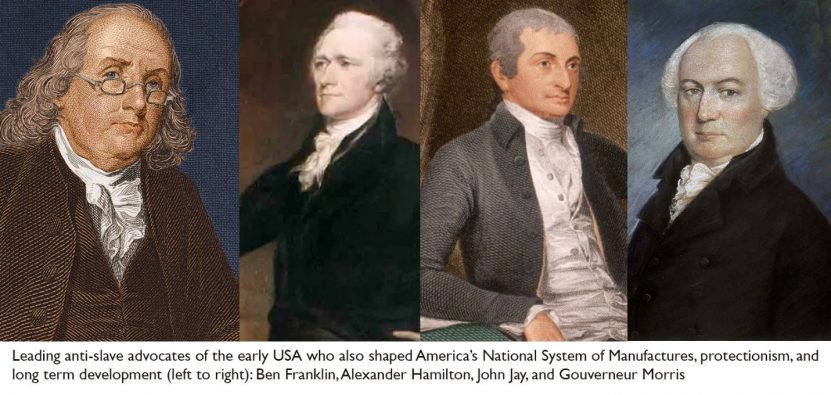
It is thus no coincidence that Franklin also created the anti-slavery alliance in the 1760s and later founded the 1785 Society for Promoting the Manumission of Slaves” alongside several of his devoted proteges. These proteges included the figures of Alexander Hamilton, John Jay, and Gouvernor Morris who all happened to become the creators and leaders of the “American System of political economy” premised on the use of a national bank, productive credit, protective tariffs, and large scale manufacturing to promote the economic sovereignty of the new nation. I introduced some of this in my recent essay How to Save a Dying Republic: Hamilton’s Genius.
When Jefferson took control of the Presidency from 1801-1809, a major victory was won for the pro-slavery oligarchs of America who saw immense profits to be gained by spreading their peculiar form of society under a perverse form of Manifest Destiny.
Admittedly, these oligarchs would have been much happier with the victory of Aaron Burr to the presidency in 1801 since an immediate dissolution of the union would have occurred between slave and free states as early as 1804 (to be discussed in a future essay). Unlike Burr, Jefferson was at least against breaking up the Union into northern and southern confederacies (with the free states merging with Canada and the slave states becoming their own nation), and that is why Hamilton (Jefferson’s political nemesis) ironically organized aggressively for his victory winning the fatal ire of Burr.
Sadly, Jefferson’s devout belief in agrarianism, hate for manufacturing, love of slavery, and British enlightenment thinking still made him an instrument for the slave power’s cancerous growth during his terms in office.
The British Empire’s Global Game
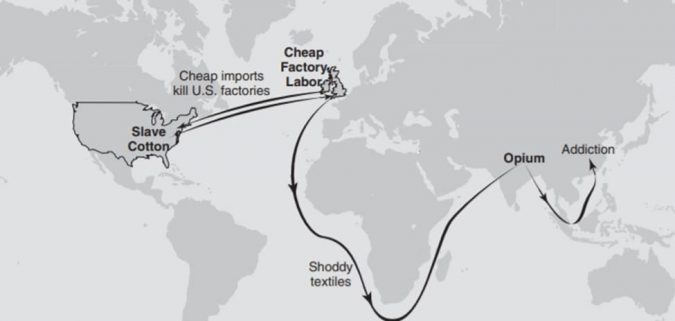
By destroying Indian textiles and subduing the “Chinese dragon” with a program of mass opium consumption that would stain the 19th century, the City of London quickly took control of world textile manufactures which created a primary export market for southern slave plantation cotton and a new set of addictions began: the addiction to the easy money derived from cheap slave labor. This proto globalization established a global closed system of controls onto all nations through cash cropping, free trade, speculation and drugs.
By 1840 over 20% of the British population was employed in textiles under such anti-human conditions that Charles Dickens described in his Tale of Two Cities and other writings.
The Best of Times and Worst of Times
With the 1804 murder of Hamilton, and undermining of America’s national credit system between 1804-1836, British free trade grew as protective tariffs were taken down, and credit towards infrastructure projects like the Erie Canal, roads, rail, etc shriveled up. Speculation ran rampant whenever this monetarist system was unleashed driven by booms and busts and the rise of “state-rights” programs that superseded all national initiatives. This process was taken directly from classic divide to conquer tactics which I outlined in my last essay Lincoln and the Greenbacks.
An astute Whig economist looking upon this bipolar process in America (while comparing it to the depressingly stagnant Canadian economic situation of 1791-1850) stated in 1853:
“Though the ratio of the increase of the population has been greater in Canada than in the United States, yet their increase of wealth has barely kept pace with the population, and they are as poor as they were half a century since. They have enjoyed the blessings of Free Trade with England all the time, we have only a part of the time. Whenever we have attempted to supply ourselves by our own industry, with the comforts and necessaries of life, we have improved our condition as a people; and during the intervals of Free Trade and large importations of foreign goods, we have relapsed again into a condition bordering on bankruptcy; while the Canadians have been constantly exhausted, and kept so poor by Free Trade, as to be unable to get sufficient credit to have even the ups and downs of prosperity and bankruptcy in succession.” (2)
The Slave Power Spreads
By 1836, the 2nd National Bank was officially killed after a mass propaganda campaign convinced a duped mob that it was an instrument of tyranny in America, and over the coming 6 decades, the only five presidents who would make any serious effort towards reviving America’s nationalist system would end up dead while in office (Harrison in 1841, Taylor in 1850, Lincoln in 1865, Garfield in 1880, and McKinley in 1901). The man who is today celebrated for having “killed the bank” and “paying Americas debts” was in reality a force of pure destruction. Jackson “paid the debt” by cutting all infrastructure projects and unleashing mass speculation which resulted in a devastating 1837 bank panic that drove the nation into discord and depression. An unrepentant racist, Jackson also gave enormous assistance to the slavocracy by emptying the southern lands of Cherokee in the genocidal “Trail of Tears” and giving the land over to cotton planting oligarchs loyal only to their profits, “way of life” and the British Empire.
This story is told in all of its ugly detail in historian Michael Kirsch’s groundbreaking 2012 study “How Andrew Jackson Destroyed the United States”.

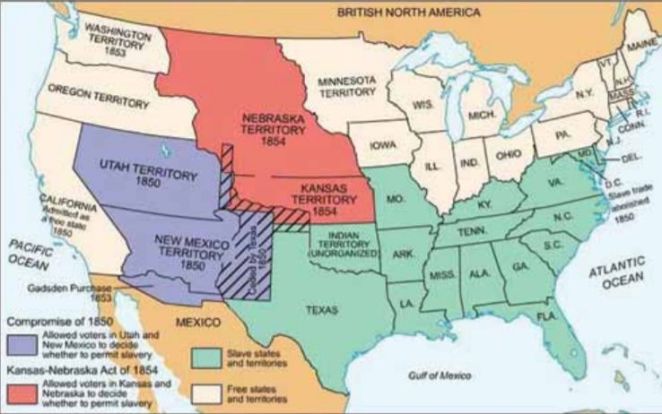
Between 1801 to 1840, southern cotton exports exploded from 100,000 bales/year to 1 million bales/year with 80% of the exports going to Britain. The City of London-Wall Street-New Orleans triangle dominated the world system with New Orleans representing over 12% of all U.S. banking capital. The southern slave states grew to represent the world’s fourth biggest economy through the support of the British Empire both financially and also in the logistical support needed to import mass slavery into the Americas. This degeneration proceeded slowly until the presidencies of Jackson and his handler Martin van Buren, but after this, cotton exports increased to 4 million bales/year by 1860 and the slave power grew immensely under the Kansas-Nebraska Act of 1854 that ensured the spread of slavery west of Mississippi.
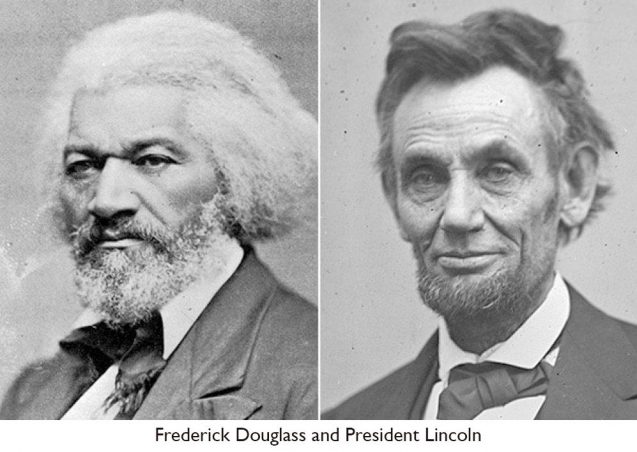
While many radical abolitionists in the USA and British Canada then advocated the dissolution of the union as an alternative to civil war, stronger souls like Frederick Douglass recognized the higher historic fight at hand. As a lesson to modern anarchists who believe in the 1619 Project and feel no sorrow at the burning of America under a new civil war today, Douglass took the time to research history, and broke with William Lloyd Garrison (the leader of the abolitionist movement) defending the Constitution in 1852:
“I differ from those who charge this baseness on the framers of the Constitution of the United States. It is a slander upon their memory… In that instrument [the U.S. Constitution] I hold there is neither warrant, license, nor sanction of the hateful thing; but interpreted, as it ought to be interpreted, the Constitution is a Glorious Liberty Document. Read its preamble, consider its purposes. Is slavery among them? Is it at the gateway? or is it in the temple? It is neither. While I do not intend to argue this question on the present occasion, let me ask, if it be not somewhat singular that, if the Constitution were intended to be, by its framers and adopters, a slaveholding instrument, why neither slavery, slaveholding, nor slave can anywhere be found in it”.
This higher understanding of history and the principles of the Constitution caused Douglass to ally himself with Lincoln where he worked with all his might to recruit 200,000 black soldiers to the cause. Later in life, Douglass attacked British free trade and “cheap labor” in defense of the Nationalist system writing in 1871:
“Cheap Labor, is a phrase that has no cheering music for the masses. Those who demand it, and seek to acquire it, have but little sympathy with common humanity. It is the cry of the few against the many. When we inquire who are the men that are continually vociferating for cheap labor, we find not the poor, the simple, and the lowly; not the class who dig and toil for their daily bread; not the landless, feeble, and defenseless portion of society, but the rich and powerful, the crafty and scheming, those who live by the sweat of other men’s faces.”
The British Hand Behind the Civil War
During the entirety of the Civil War, the British Empire’s guiding hand could always be felt, from supplying the south with battle ships, weapons and finances to providing logistic and diplomatic support internationally. Even British Canada was given over to the Confederacy’s intelligence headquarters which deployed spying, money laundering, and terrorist operations against the Union during the entire war.
Speaking to the British Parliament, Lord Robert Cecil (Marquis of Salisbury) expressed Britain’s logic succinctly when he said in 1861:
“The Northern States of America never can be our sure friends because we are rivals, rivals politically, rivals commercially…. With the Southern States, the case is entirely reversed. The population are an agricultural people. They furnish the raw material of our industry, and they consume the products which we manufacture from it. With them, every interest must lead us to cultivate friendly relations, and when the war began they at once recurred to England as their natural ally.”
A future installment will tackle the role of British operations in Canada that organized the murder of Lincoln, sabotaged the industrial reconstruction of the South, and undid the internationalization of Lincoln’s system around the world during the 19-20th centuries. This sabotage of potential created the foundations for the creature embedded within America now organizing a new Civil War and dissolution of the republic once and for all.
The author can be reached at matt.ehret@tutamail.com
(1) In the minds of those dirigistes like Franklin (including the Colbertist school of France, and its international leaders like Jonathon Swift, Daniel Dafoe, and Cotton Mathers in America who all wrote pamphlets supporting manufacturing over slave labor), a machine produced by the creative mind of man can accomplish the work of 100 laborers- thus liberating those laborers from the demands of the material forces of nature and freeing them to develop their powers of mind.
(2) Ezra Champion Seaman, Essays on the Progress of Nations (1853), p. 599
What They Are Not Talking About: War and Peace, Healthcare and Jobs Are Non-Issues
By Philip Giraldi | Strategic Culture Foundation | October 1, 2020
Watching the network news on television or reading about current events in the newspapers seemingly transports one to an alternate universe where nothing seems to make sense. The profit driven news cycle in the United States is admittedly a poor mechanism for actually gaining an understanding of what is going on, but seven days of Ruth Bader Ginsburg worship hardly addresses what is ailing the country, particularly as questions about how she earned many millions of dollars while serving as a judge as well as some unsavory aspects of her career have been carefully buried.
A friend who is a retired U.S. Army general made an interesting comment several days ago, observing that when it comes to politics and voting patterns the so-called “silent majority” is indeed silent. What he meant was that many Americans who hold currently unpopular conservative views will not respond honestly to a call from an unknown pollster regarding voting intentions. This is particularly true of the current campaign in which Donald Trump is being reviled by the media and depicted by the Democrats as no less than a threat to American democracy. Biden by way of comparison pretty much gets a free pass, to include forgiveness for his frequent faux pas and mental lapses. In other words, Trump is being framed as someone poised to mount a totalitarian takeover of the United States, which in and of itself would disincline many voters to indicate openly that they would support him over Biden.
My friend was suggesting that the polls on the upcoming election just might be more than usually wrong. I would add to that the general vapidity of what one might expect from the presidential debates, which are similarly being framed in such a fashion as to avoid any topics that might really matter. But the polls do reveal two things. First, that there is a lack of any confidence in the integrity of politicians at all levels, and second, that jobs and healthcare are the principal concerns of nearly all voter demographics as they directly impact on quality of life.
Healthcare is admittedly a complicated issue given the fact that the entire system in the United States would have to be reformed, with considerable government intervention. The respected British medical journal The Lancet recently published “Measuring universal health coverage based on an index of effective coverage of health services in 204 countries and territories”. The study revealed, to no one’s surprise, that the United States has by far the world’s most expensive medical care, at around $9,000 per person per year while at the same time delivering poorer results than virtually any other industrialized nation. Medical expenses are in fact a leading cause of personal bankruptcy by Americans.
So, what are the two parties saying about health care? The Republicans want to overturn so-called Obamacare and replace it with something else which they cannot describe while the Democrats insist that they want to keep Obamacare in place while also blaming the president for the response to the coronavirus. That’s it. There is plenty of blame to go around on Covid-19 and Obamacare is in fact a bad program. It is good if the government is footing the bill for you, but anyone who is paying for his or her own insurance has seen the rates treble and even quadruple since the program became active. It has become a gold mine for the health care industry, which now assumes that it can charge whatever it wants and the suffering customer will be obliged to pay for it. That there is no effective regulation of health care is due to the fact that Big Pharma and other providers have completely corrupted Congress through political donations to make sure that the highly profitable status quo remains untouched.
And when it comes to the other great concern, “The Economy,” which means jobs, the two major parties have even less to say since they know deep down that they have both conspired in the gutting of America’s industrial and manufacturing infrastructure.
But another area dear to my own heart which the parties have been silent about is Foreign Policy, which also subsumes National Security, a related issue that the opinion polls do not specifically address. Both parties are strong on issuing position papers that refer to supporting allies, meaning Israel followed by everyone else, confronting threats from Russia and China, and maintaining the world’s number one military. Beyond that it gets a bit vague. We have recently learned from a possibly unreliable source named Bob Woodward that President Trump sought to assassinate Syria’s President Bashar al-Assad but was talked out of it. Trump did order the assassination of senior Iranian General Qassim Soleimani, whom he and the Secretary of State have recently described as the “world’s leading terrorist,” which is manifestly untrue. Is assassinating foreign leaders something that the United States wants to engage in? Why is no one talking about it?
And then there are the “hot wars” being fought in Syria, Iraq, Somalia and Afghanistan. None of those wars benefit from a constitutionally mandated declaration of war by Congress and they have cost the U.S. taxpayer trillions of dollars. Shouldn’t that be under discussion? Or the “maximum pressure” economic wars being waged against Venezuela, Cuba, Syria and Iran? Those “wars” have collectively killed tens of thousands of civilians and have done nothing to enhance the security of the United States. Shouldn’t Trump and Biden be talking about that?
Instead, we will see much finger pointing and hear a lot about how dangerous a win by either presidential candidate will be, all couched in general terms based on a lot of “what-ifs.” But what the American public needs, particularly the silent majority, is a viable plan for decent and affordable healthcare similar to what most of the rest of the world enjoys. And a new government also must act decisively to challenge corporate offshoring interests to bring manufacturing jobs back home. But most of all, the United States needs peace after nineteen years of spreading chaos all over the globe. End the wars and bring the troops home. Do it now.
Featured Video

Trita Parsi: Middle East Unraveling — Are We on the Path to World War?
or go to
Aletho News Archives – Video-Images
From the Archives
Why Saudi Ties to 9/11 Mean U.S. Ties to 9/11
By Kevin Ryan | Dig Within | September 27, 2015
Media interest in Saudi Arabian connections to the crimes of 9/11 has centered on calls for the release of the 28 missing pages from the Joint Congressional Inquiry’s report. However, those calls focus on the question of hijacker financing and omit the most interesting links between the 9/11 attacks and Saudi Arabia—links that implicate powerful people in the United States. Here are twenty examples. … continue
Blog Roll
 Aletho News
- Integrity Initiative: UK-funded network framed dissent as Russian disinformation for years
- ‘We don’t seek permission to defend our country’: Snippets from President Pezeshkian’s UNGA address
- NATO chief wants Europeans to fight American wars [for Israel]
- German chemicals giant reveals details of downsizing
- Refaat Al-Areer Was The Canary In The Coal Mine In Israel’s War On The Truth
- Israeli election committee bars candidate from Knesset race over Gaza war opposition
- French-Lebanese man files war crimes complaint over Israeli attacks
- Mahan Air Flight Lands in China Despite US Threat against Iranian Airlines
- US eyes $10bn fund to rebuild war-battered Gulf infrastructure
- Trump meets Rodríguez near Maduro’s prison as Venezuela’s oil flows to US
- If Americans Knew
- Caught on Tape: AIPAC CEO Boasted of Controlling Trump’s National Security Officials
- Why Hamas Attacked Israel in October 2023 – Israeli professor Ilan Pappé
- They see them, then kill them: Israeli quadcopters track, deliberately target civilians in Gaza
- Winter could turn Gaza’s treacherous, war-damaged buildings into deathtraps
- Majority of Democratic Voters Want to Prosecute Both Biden and Trump Administration Officials Over Gaza
- As Gaza languishes, world leaders gather at the UN – Daily Update
- Sanctions are collective punishment: immoral and self-defeating
- Phosphorus Munitions Fired by Israel Burn Groves, Orchards in Southern Lebanon
- Israel Carries Out New Ceasefire Violations Across Gaza
- AI – Emphasis on the ‘I’: Israel Is Funding AI Chatbot Propaganda
- No Tricks Zone
- New Study: Earth And Venus Surface Warmth Largely Explained By Convection And Lapse Rate, Not CO2 Or Radiation
- 2025 Nature Paper Claiming Worsening Global Drought Gets RETRACTED …Heavily Flawed
- New Study: ‘Global Drought Shows No Detectable Recent Acceleration Under Climate Warming’
- Economic Masterminds: German Socialists Suggest Taxing Productivity Gains Stemming From Using AI
- The South China Sea Has Not Been Cooperating With The Climate Change Narrative
- Energy Crisis: Germany Enters Heating Season With Historically Low Gas Reserve Fill Levels
- New Study: The Antarctic Ice Sheet Gained Mass From 2020-2024 Due To Staggering Snow And Ice Accumulation
- Study: Ocean Heating Rates From Thousands Of Years Ago ‘Dwarf’ Modern Ocean Heating Rates
- Climate Extremists Target, Attack Large-Scale Power Grid Infrastructure In Germany!
- New Study: Antarctic Ice Melt Has Contributed Less Than 1 Centimeter To Sea Level Rise In The Last 30 Years

